

Hostname: page-component-6766d58669-tq7bh Total loading time: 0 Render date: 2026-05-19T00:18:56.375Z Has data issue: false hasContentIssue false

The anatomical mammary gland position influences the weight gain and morphometry of piglets at weaning

Published online by Cambridge University Press:  13 November 2024

Pedro Henrique da Silva Fidelis
Affiliation:
Department of Animal Science, Universidade Federal Rural do Semi-Árido, Mossoró, RN, Brazil
Thatila Ellinna Batista de Lima
Affiliation:
Department of Animal Science, Universidade Federal do Ceará, Fortaleza, CE, Brazil
Lígia Vanessa Leandro Gomes
Affiliation:
Department of Animal Science, Universidade Federal Rural do Semi-Árido, Mossoró, RN, Brazil
João Paulo Bezerra Saraiva
Affiliation:
Department of Animal Science, Universidade Federal Rural do Semi-Árido, Mossoró, RN, Brazil
Tiago Silva Andrade
Affiliation:
Department of Animal Science, Universidade Federal do Ceará, Fortaleza, CE, Brazil
Cibele dos Santos Borges
Affiliation:
Department of Bioscience, Universidade Federal Rural do Semi-Árido, Mossoró, RN, Brazil
Adriano Henrique do Nascimento Rangel
Affiliation:
Academic Unit Specialized in Agricultural Sciences, Universidade Federal do Rio Grande do Norte, Macaíba, RN, Brazil
Michelly Fernandes de Macedo
Affiliation:
Department of Animal Science, Universidade Federal Rural do Semi-Árido, Mossoró, RN, Brazil
Pedro Henrique Watanabe
Affiliation:
Department of Animal Science, Universidade Federal do Ceará, Fortaleza, CE, Brazil
Rennan Herculano Rufino Moreira*
Affiliation:
Department of Animal Science, Universidade Federal Rural do Semi-Árido, Mossoró, RN, Brazil
*
Corresponding author: Rennan Herculano Rufino Moreira; Email: rennanherculano@hotmail.com

Abstract

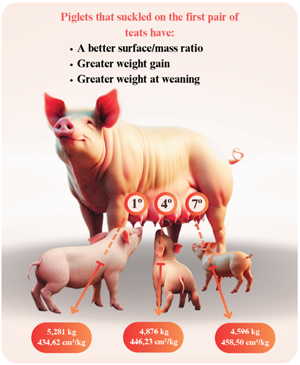
The objective was to evaluate the performance of suckling piglets based on their choice of mammary gland. A completely randomized design was used, considering the position of the mammary glands pair and their respective piglets as experimental unit. The mammary gland position was considered for the treatments, being 1st, 4th and 7th pair. The ration and leftovers were weighed daily to obtain daily feed intake of the sow. On post-natal day (PND) 3 and 21, 80 ml of milk was collected to analyse crude protein, fat, lactose, non-fatty solids, mineral matter and total solids. On PND 3 and 21, the piglets were weighed to determine weight gain and estimate milk consumption. The piglets' longitudinal length and head circumference were measured in the same period and estimated body surface area/mass ratio. Blood samples from the sows and piglets were collected on PND 3 and 21 to analyse total cholesterol, triglycerides, total protein, fractions and glucose. There was an effect of mammary gland position on piglets at PND 21 suckling on the 7th pair, which had a 23.88 cm2/kg greater body surface/mass ratio compared to those who suckled in the 1st pair. In turn, at PND 21, the piglets that suckled in the 1st pair presented higher weight, weight gain and milk consumption (0.685, 0.033 and 0.127 kg, respectively) than those that suckled in the 7th pair. Anterior mammary glands result in better productive performance and better chances of maintaining piglet homeostasis at PND 21.

Information

Type
Animal Research Paper
Copyright
Copyright © The Author(s), 2024. Published by Cambridge University Press

Access options

Get access to the full version of this content by using one of the access options below. (Log in options will check for institutional or personal access. Content may require purchase if you do not have access.)

Article purchase

Temporarily unavailable