

Nature vs. Culture
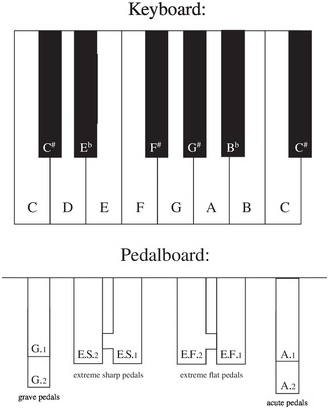
Opinion was sharply divided about Reverend Henry Liston’s euharmonic organ (Figure 9.1), the first musical organ capable of “perfect intonation” or “natural tuning,” following its 1817 debut at the London firm of Flight & Robson. But as a critic writing under the pen name “Philo-Musicus” pointed out, there was one argument on which its fans and detractors agreed: that it was “contrary to all which might have been anticipated” that its first (and only) purchasers should be the Presbyterian congregation of St. Andrew’s in Calcutta.1 “Are there no Music-schools, or places for study among us,” wrote the distinguished geologist, mathematician, and amateur music theorist John Farey Senior, “where the practicing of correct singing, and the study of harmony in all its curious combinations, by Composers for perfect Instruments, might be aided and safely guided by these improved instruments?”2 Another critic, noting that the Church of Scotland had prohibited the use of organs in its churches since 1574, wondered why a passion for “harmonic improvement” would have seized a Presbyterian congregation in a “distant colony” before any Anglican church in Britain, where the organ was considered “almost as a necessary appendage to every polite Church or Chapel?”3 A third reviewer wondered why no English scientists were moved by the prospect of an instrument whose principles “have been drawn (as all the soundest principles of every science have been,) from actual experiment.”4 British sensibilities “must surely be greatly vitiated,” if no one in London cared for an instrument that could finally eradicate the “rattling and truly disgusting effects of beats” found in artificial temperaments, and restore the diatonic scale in all its natural glory.5
The keyboard and pedalboard for Liston’s ‘euharmonic organ’. Each of the keys is in natural tuning (or in technical terms, five-limit just intonation).
What was the euharmonic organ, and how did it mark an improvement over what came before? The answer lies in how it resolved one of the central predicaments of keyboard tuning. By the end of the eighteenth century, the standard keyboard had for practical reasons been fixed at twelve keys per octave, each corresponding to a different tone of the chromatic scale.6 It was, however, impossible to tune these twelve keys so that every potential consonance – every species of fifth, fourth, third, and sixth – would be perfectly in tune. Tuners were thus forced to develop musical temperaments that could distribute the dissonance inherent in the twelve-note gamut in small enough increments across the entire system that it would be less perceptible overall. There was disagreement on the best way of doing this, but the consensus was that tuners should optimize the consonances of the simplest intervallic ratios between their two component tones: the octaves (2:1), fifths (next, at 3:2) and their complementary fourths (4:3), and major thirds (5:4). Some borrowed slivers from the fifths to keep the thirds natural; others borrowed from the thirds in order to preserve the fifths.7 Nevertheless, as the theorist John Holden noted in his 1770 treatise An Essay towards a Rational System of Music, every temperament was an artificial solution, and therefore flawed. It was impossible to banish entirely the dissonant wolves that emerged from imperfectly tuned fifths so long as the gamut remained fixed at twelve divisions of the octave. To be sure, “we ought to make all our fifths and fundamental great thirds good, if it could be done” – but as practical concerns prevented increasing the gamut to more than twelve keys, “this is abundantly proved to be impossible.”8
Liston, a Presbyterian minister by day and amateur music theorist by night, disagreed. Why not increase the gamut if a keyboard layout that was practical enough could be devised? His answer was a euharmonic organ that offered not just one, but three or more intonations for each pitch level. It provided a lower E to accord with the C as a perfectly tuned third, as well as a higher E to accord with the A in a perfectly tuned fifth, and so on, adding up to thirty-nine divisions of the octave. To avoid disorganizing the keyboard with extra keys, Liston added a rank of eight pedals that would automatically toggle the output of selected keys to the higher or lower intonations.9 The result, he claimed, was an intuitive layout for all kinds of music: “admirers of elegant simplicity, who prefer the more sober and chastened compositions of the older school … cannot but be delighted with having the diatonic scale in its truth and purity, freed from the jarring beats inseparable from every tempered system,” while “lovers of the chromatic and enharmonic … will find such sources of variety, and so wide a field laid open to them, as, I presume to say, the musical world have not at present any conception of.”10
Few took Liston’s proposal seriously. The critic A. F. C. Kollmann found the euharmonic instrument fussy to tune, overpriced, and impractical, as “young ladies who are not yet tall and strong enough to reach those pedals … are as good as being prohibited performing on that kind of instrument.”11 Anyway, he wrote, equal temperament was the more modern temperament: it was efficient and multivalent, as every tone could serve “in an almost infinite number of different capacities.”12 Thus, one E should be enough to serve as the perfectly tuned third of C and the upper fifth of A, and the upper second of D, and so forth. More “simple and complete,” equal temperament opened up harmonic and melodic liberties that nature had foreclosed, and suited the “great desideratum of modern music, a standard scale” to which every instrument from around the world might one day tune.13 Its fifths and thirds might not be perfectly consonant, but “like all other things in the world which are considered as perfect, it may be called virtually perfect, though not strictly so.”14 Natural tuning would reduce “the science of music to that state of infancy, where every note is considered only in one individual capacity, and not as a member of that grand compound, on which all the simplicity of a perfect doctrine of harmony and modulation depends.”15 For this reason, he concluded, natural tuning was actually an artificial system, as it was out of step with the “nature and purpose of our modern scale.”16
Kollmann’s arguments found more support, causing Liston to miss out on a coveted appointment to the Royal Philharmonic Society. As the musicologist Ellen Lockhart has argued, one of the reasons why Liston’s arguments failed to stick in metropolitan London was that the vituperative arguments about natural and modern temperaments were connected to a broader shift in how the relationship between nature and culture was construed in turn-of-the-century Britain.17 Liston’s advocates championed the mutual imbrication of nature and music, in which musical culture would draw directly on the natural principles of consonance and resonance in devising tuning and temperament systems. Those on Kollman’s side championed the separation of nature from culture, favoring the latter on the grounds of rationalization, systematization, and progressivism. Drawing on Bruno Latour, Lockhart maintains that arguments like Kollmann’s were successful because European modernity was itself predicated on a similar separation of nature from culture.18 Accordingly, Liston’s natural tuning seemed outdated on arrival – a shibboleth, discordant with the modern times.19
But if London critics considered the euharmonic organ passé, why would the members of St. Andrew’s in Calcutta have deemed it au courant? Were the colonial congregants simply behind the times when it came to tracking the developments of metropolitan London? This would be the wrong conclusion to draw. Historical records also show that many members of St. Andrew’s were connected to the Scottish Enlightenment, and musical tastes in Calcutta were as modern as those in London; colonists could purchase British prints of the latest works of Corelli and Haydn months after their entry onto the market, and copies of Holden’s Essay were printed in Calcutta.20 Postcolonial scholars have also cautioned against provincializing the events of colonial cities by confining them to the waiting room of history.21 If we instead begin with the presumption that the members of St. Andrew’s were as up to date on what constituted the modern as their London counterparts, an alternative proposition emerges. Perhaps the euharmonic organ seized the attention of St. Andrew’s because when viewed from the perspective of the missionary or the colonial agent, it seemed an effective instrument of modernity, rather than an instrument antithetical to the modern.
The following sections examine this proposition. First, I investigate how the organ was applied toward the modernization of the Presbyterian liturgy and why that was construed as an essential step in establishing the Anglo-Indian Presbytery on an equal footing with the Anglican Church of India. I draw on the writings of James Bryce, the Presbyterian chaplain of Bengal who preached at St. Andrew’s, as well as literature about the debate over the use of organs in the Presbyterian Church, to demonstrate how the purchase of the euharmonic organ was intended to recast the church as a progressive and modern institution. I show how the use of the euharmonic organ entailed significant changes in the ways the Presbyterian Church construed the relationship between sensation and reason, while also subsuming a Scottish religious and ethnic identity into that of the British. Next, I show how the instrument was intended to modernize the colonial Indian landscape immediately surrounding the church. I examine Bryce’s theories of religious education and contemporary theories of tonal space and meter, and connect them to the arguments of the political historian Timothy Mitchell that colonial modernity is staged through acts of representation that project new configurations of time and space into existence.22 The euharmonic organ, I suggest, was designed to represent musical space and time as organized in accordance with the topological and chronological propositions of colonial modernity. This capability of the euharmonic organ to create distinctively modern apprehensions of space and time – the insights of Latour and Lockhart notwithstanding – is what allowed Liston’s supporters to defend its utility as an instrument of modernity. Finally, in the “Afterword” I reflect on how the fragility of this project was revealed a century later, when Indian theorists shifted the terms of what natural tuning represented and suggested that musical modernity had originated from Hindustani culture – not from European culture, or from a universal nature.
Succumbing to Sirens
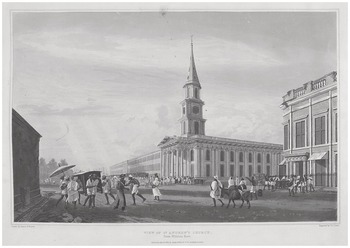
The inaugural service of St. Andrew’s on March 12, 1818, marked a triumph for the Presbyterian community of Calcutta after years of struggle with the East India Company. Standing in the pulpit was James Bryce, who had been appointed the first Presbyterian chaplain of Bengal by an agreement between the Company and the General Assembly of the Church of Scotland. Bryce had arrived in Calcutta five years earlier believing he had a writ from the Company to build a Scottish kirk, and had organized ambitious plans for the luxurious edifice shown in Figure 9.2 at the center of Tank Square – the heart of the European district known as “White Town,” adjacent to the Company’s headquarters in the Writers’ Building – outfitted with marble columns and flooring, a grand steeple, and an organ.23 During its construction, he met obstacles at every turn. First the Company withheld support for two years; then Lord Middleton, the Anglican bishop of St. John’s of Calcutta, disputed the right of St. Andrew’s to build a steeple, as that privilege had never before been granted in an English diocese.24 The congregants of St. Andrew’s were eventually able to convince the Company to approve the steeple on the ground that its absence would constitute “a mark of inferiority hitherto unknown” on the Presbyterian Church of India.25 Nevertheless, they were quickly disabused of the idea that the Company might therefore consider them equals, as all of their requests to public officials for assistance with the relief from the 33,000 rupees of debt they had accrued in constructing the church were rejected. Upon its opening, Bryce was even more determined to prove that the Presbyterian Church should be recognized as the “Sister Establishment of the Church of England” in India, and that St. Andrew’s was a national rather than Scottish regional institution, meaning it therefore deserved Company support for its efforts to “preserve the British character, amidst the temptations, with which public life in India is surrounded.”26
St. Andrew’s Church in Tank Square, Calcutta, c. 1826. From James Baillie Fraser, Views of Calcutta and Its Environs, plate 13.
Bryce did not voice these arguments in his inaugural sermon, which was dedicated to the role of preaching and “native education.”27 But appearing behind him as he preached was the euharmonic organ, the mere presence of which communicated that St. Andrew’s aimed to be taken just as seriously as St. John’s down the road. Commissioned by the members of the church for a hefty fee of £4,000 – roughly the same amount as the kirk’s debt – the euharmonic organ was the first musical instrument ever sanctioned by the Presbytery of Scotland, breaking with three hundred years of prohibitions on the use of instrumental accompaniments.28 Back in Scotland, in fact, tempers were still running high from a recent dispute between the Presbytery and the congregants of St. Andrew’s in Glasgow, who had petitioned to install an organ in their church, arguing that the centuries-long ban had quite literally “untuned the feelings of our country” and cemented for the Presbyterian faith a lamentable musical reputation.29 Practice with an organ, the Glaswegian congregants urged, was essential to “advance the knowledge and the practice of psalmody” and “rescue our national character from the reproach of having almost entirely neglected the cultivation of sacred music.”30 The anti-organists of the Presbytery of Glasgow denied their request on the ground that it would convert the church into a “concert-room.”31 They insisted that the purpose of the liturgy was to lift the congregation “above the airy grandeur of sense” and into a realm of “purified reason and religion”; to comply “with the advocates of musical harmony of sound” would promote “discord in the church of Christ,” because it would substitute “for the discountenanced simplicity of that service, whose melodies can flow only from the heart, a vain and pompous combination of sounds.”32 For anti-organists, the “day hath indeed dawned on a sensual and benighted world” when Presbyterians succumbed “to the syren sounds of sensual delusion,” and they deplored “the wafting of our holiest aspirations to heaven, through the medium of other sounds than those that can issue from the heart.”33
Bryce, however, managed to convince the Presbytery to make an exception, by appealing to both the exceptional situation of his parish and the properties of the euharmonic organ. Because the inventor of the instrument was himself a Presbyterian minister, it would represent Presbyterian leadership in two of the most important domains for the colonial enterprise – technology and the musical arts – and thus strengthen Bryce’s efforts to earn from the Company greater respect and support. (It must also have helped that Liston opted for the same descriptors the anti-organists had used to describe what psalmody should sound like – “pure,” “simple,” “sweet,” “unornamented,” “solemn” – in characterizing the natural tuning of his instrument.34) Sure enough, the strategy paid off, as the possession of the instrument seemed to elevate the status of St. Andrew’s. The Asiatic Mirror of Calcutta reported its “sweetness of tone” as “unrivalled,” and its ability to sustain “perfect harmony” ensured that all other choirs in India “would lose much by the comparison”; indeed, it continued, the whole “world is indebted to the Revd. Henry Kiston [sic]” for this “truly important and scientific improvement of that noble instrument,” which adds so much “to the solemnity of the Service.”35 London critics celebrated “universal satisfaction” with the organ, and saluted the “liberal views and intentions of the Elders and Congregants” of St. Andrew’s that had placed it among the “friends of harmonic improvements.”36 This positive praise soon led the kirk to commission Liston for a second instrument, a chamber organ (debt be damned!) with four additional tones and an extra foot pedal that would bring the gamut up to forty-three divisions of the octave. The Presbyterian Church no longer seemed musically regressive, and was now situated at the forefront of musical advancement, aligned with the Company’s ambitions to transmit liberal values and cultural “improvements” to subaltern populations.
As the anti-organists might have feared, the presence of an organ at St. Andrew’s did signal a change in the ways the physical senses were configured within the Presbyterian Church. Bryce was therefore also eager to suggest that its presence was not in contradiction with Presbyterian values, arguing that it would help the church accomplish its missionary goals. At the rhetorical highpoint of his sermon, after calling upon his congregants not to “relax in our exertions to instruct them [i.e., ‘our Asiatic brethren’] in a religion capable of doing so much for the happiness of the human race,” Bryce declaimed:
It is not in human nature to yield belief to the truths of revelation and not be affected by their sublimity, and melted into gratitude by their benevolence. As well may the healthy eye be acted on by the rays of light, or the ear by the vibration of sound, and yet no sensation be experienced by the percipient being to whom these organs belong.37
It could not have been lost on the congregation that Bryce had appealed (albeit metaphorically) to aural sensation, not reason, in outlining the goals of missionary work. The recital on the euharmonic organ moments later would have underscored the point. Indeed, in his later writings, Bryce would outline the objectives of missionary education in terms that indicated how the aural sensations provoked by the euharmonic organ would contribute to their mission – and in doing so, he would provide a rationale for understanding the organ as an instrument for modernizing the subaltern.
Organizing India
Within a decade of his arrival in India, Bryce established himself as an authority on missionary education. Colonial perspectives on Indian education were roughly divided into two camps: the Orientalists on the one hand, who championed education in Indian subjects and languages, and, on the other, the group that would eventually follow Thomas Babington Macaulay, who aimed at fostering “a class of persons Indian in blood and colour, but English in tastes, in opinions, in morals and in intellect.”38 Bryce aligned himself with the latter in founding the Scottish Church College, the first pedagogical institution in India to teach exclusively in English. Its success was secured with the assistance of Ram Mohan Roy, an occasional presence in the congregation of St. Andrew’s and a leading figure of the Bengali Renaissance who championed English education as a vehicle for Indian modernization.39 With Roy’s support Bryce was able to find numerous pupils on whom to practice his pedagogical theories, which he would eventually outline in series of tracts published in both India and England.40
Within these texts, Bryce synthesizes the objectives of the Church of Scotland and the East India Company: missionary education and modernization. He proposes that the two are alike in requiring “astonishing command … over time and space.”41 Securing command over time in missionary education entails the overlay of a “Mosaic account of creation” onto the “Chronology of the Hindu schools.”42 This was contrary to the arguments of some Orientalist scholars – “infidel philosophers,” he called them – who had come to argue that Vedic history was distinct from Biblical history, more ancient, and therefore more authoritative.43 Bryce was adamant that once mythology, allegory, and superstition were subtracted from Vedic accounts, its temporality could be made commensurate with Christian eschatology – and thus, “so far from proving a weapon in the hands of the adversary, to shake belief in Christianity, [Vedic temporality] may be employed with the manifest good effect by the Gospel missionary, to establish the truth of the Religion which he seeks to make known to the Hindus.”44
Securing command over space involved measures to ensure that the message of modernity would have universal reach. It required cultivating both the arts and sciences, which facilitate “intercourse between the remotest countries of the world” and “increase the command of man over the elements of nature.”45 Advances in communications and technological development could help missionaries diffuse “the blessings, which might otherwise stagnate” across the entire Indian subcontinent.46 The commands of time and of space were also mutually constitutive: controlling space involved disseminating the rubrics of unilinear developmentalism, while controlling time involved enfolding as much of India as possible into the domain of the Presbyterian Church. For Bryce, time and space were imbricated domains, with the control of both essential for the authority of church and Company.
In this sense Bryce’s arguments seem to affirm the assertion of the political theorist Timothy Mitchell that colonial modernity is constituted as a “particular relationship between space and time.”47 Drawing first on Walter Benjamin, Mitchell contends that modern time is apprehended by “uniform, unfilled” time slots, such as those of the standard calendar, work timetable, and clock.48 Appealing next to Benedict Anderson, Mitchell observes that these time slots are configured and expressed in spatial terms, as a successive sequence of empty moments laid onto an even unilinear trajectory. He then points out the consequence of this particular temporal–spatial relationship: the construction of contemporaneity and co-presence. The universal dissemination of modern time-keeping mechanisms through daily mass media and telegraphic communications ensures that people who once lived unconnected lives – because they operated from incommensurate maps and systems for keeping time – are made to feel as if they live within the same space (the universe) at the same moment (now). Another mechanism he identifies further reinforces this sensibility: representation. Representation refers for Mitchell not only to the making of images or meanings, but to “forms of social practice” – in many ways analogous to what media theorists call cultural techniques – “that set up in the social architecture and lived experience of the world … a distinctive imagination of the real.”49 The map, for instance, represents the space of the nation as a “real and knowable totality.” The newspaper represents an ephemeral moment in a form that conjures simultaneity and is also archivable, so that any moment can later be made “available through a form of replay.” The theater, novel, and museum all represent “stage objects and characters to create simulations of a real world.” Representation is thus for Mitchell the “novel method of creating colonial modernity’s distinctive apprehensions of space and time,” creating “an effect we recognize as reality, by organizing the world endlessly to represent it.”50
What might we gain by analyzing the euharmonic organ alongside the map and newspaper as an instrument for representing colonial modernity? The musicologist James Q. Davies has previously argued that keyboards adapted for natural tuning played a role in constituting colonial space by operating as a class of communication technology capable of “annihilating distances” between musical cultures separated by different tuning systems.51 A natural tuning system, supposedly based on universal principles and therefore common to all, promised to facilitate forms of collaboration that were previously impossible. But in reality, he argues, instruments for natural tuning only entrenched the forces of colonialism, as the terms of the universal tonal space they afforded were inevitably dictated by Europe – rendering them what Davies calls “instruments of empire.”
But if modernity consists of the representation of a particular relationship to space and time, this explanation covers only half the story. A survey of writings by Liston and members of his circle helps fill in the remainder. In an entry on “Music” for the Edinburgh Encyclopaedia, Liston claimed that the first organs had been used as a unison accompaniment for the liturgy.52 Soon, musicians discovered harmony within its affordances, for “the facility which it furnishes of sounding several notes at once would soon lead to the observation of the agreeable effect” of octaves and fifths.53 Choirs began to use harmonies as an accompaniment to the cantus firmus; this practice, in “a clear proof of [its] true origin,” was called organizare (sic), and the end result was called organum.54 Organum then evolved independently of the organ into discant, once singers discovered that they could incorporate thirds into the pantheon of consonances; discant engendered psalmody, and thus (he claimed) harmonic practice was born. The standard organ thus exerted a “material influence on the progress of that art toward perfection” by engendering consonance, even if it could not keep up with later harmonic developments, as its restricted gamut of tones prevented use of both natural fifths and thirds.55 The invention of the euharmonic organ would finally resolve that problem by affording both perfectly tuned consonances at once.56
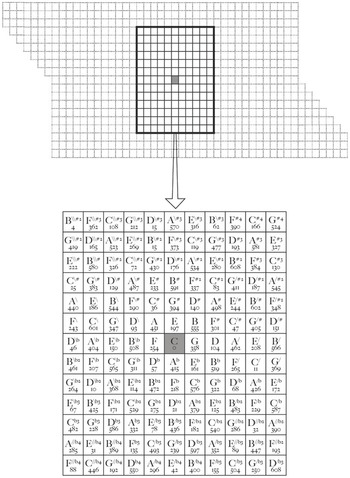
In a series of articles for the Philosophical Magazine, John Farey picked up where Liston left off by demonstrating how the euharmonic organ represented the tonal network of consonant thirds and fifths for the listener as a type of space. This was not an entirely new observation; spatial metaphors and diagrammatic practices date back to ancient Greece, if not earlier. But the idea of representing tonal space emerged as a theoretical trope in full force during the eighteenth century, following the influence of Leonhard Euler and Johann Philipp Kirnberger.57 Shortly before Farey, Charles Stanhope, 3rd Earl Stanhope, had presented his “Table of Successive Major Thirds,” which represented the twelve keys of the standard organ as chains of thirds locked in separate columns, on account of the dissonant “wolves” that emerged between their elements.58 But as Farey noted, the “happy discovery” of Liston’s tuning system was that once the number of keys was increased, one could extend Stanhope’s columns further, and alight upon new consonances between their elements that afforded the removal of barriers between them.59 Farey was thus led “to the arrangement, of [Liston’s] extended scale … in a Table, composed of numerous small squares” – so numerous, at 612 and counting, that Farey did not try to represent it on the paper his article was printed on, but instead provided instructions to his readers on how to reproduce it.60 On this diagram, represented in Figure 9.3, one would discover that the euharmonic organ represented a tonal space that was uniform, homogeneous, networked, and barrier-free – in conformity with the topography of modernity.
Farey’s table of Liston’s tuning system, from two perspectives, as described in Farey, ‘On Mr. Liston’s, or the Euharmonic Scale of Musical Intervals,’ 443. The upper half of the image represents the entire table zoomed out; the lower half represents a closer look at a segment of the table that is eleven columns by thirteen rows large. Perfectly tuned fifths run from left to right, major thirds run from bottom to top. The numbers in the boxes on the lower half of the table indicate to which division of the octave into 612 parts they correspond.
Meanwhile Liston continued tracing how the organ played an instrumental role in creating modern musical time. Citing Burney, he explained that music before the invention of counterpoint consisted of melodies whose durations were held in “shackles” by the laws of prosody.61 Franco of Cologne, he continued, had broken music free with the concept of musica mensurata, or “measured music,” in which individual rhythms were governed by a set of proportional rules that operated independently of the text to ensure proper counterpoint. And since counterpoint had been engendered by the organ, he argued, “clearly it is to the organ and organizing that measured music owes its origin.” The basic proportions of musica mensurata were moreover the same as those of organum and discant: 2:1 gave both the octave and the relationship between the imperfect long and the breve, 3:2 gave both the fifth and the relationship between prolatio maior and prolatio minor, etc. – revealing that the configurations of “organized” space and time were fundamentally isomorphic.62 Measured music, he suggested, further engendered the concept of musical meter, conceived as an abstract grid of equidistant impulses that articulated an even and unidirectionally flowing time, and dictated the rate at which the proportional relations of musica mensurata unfold.63 It was in representing metrical music that the organ bracketed off uniform and unfilled time slots, construing a temporality in conformity with modern time. Thus, according to Liston’s perspective, with each harmonized and metricized setting of one of the psalms, the euharmonic organ at St. Andrew’s would have created musical representations of modern space and time that were homogeneous, universal, uniform, networked, and unencumbered.
In this sense, the euharmonic organ contributed to Bryce’s main goal of missionary education – the seizure of command over space and time – and operated as an instrument of modernity no less than Kollmann’s equal-tempered organ or Mitchell’s map and census. What, however, sets it apart from Mitchell’s or Kollmann’s instruments is its direct appeal to the aural sense. For Mitchell, representation is mostly configured as a visual and cognitive phenomenon; Farey’s tonal space and Liston’s organized time, however, appeal to both the visual and auditory faculties. For Kollmann, the equal-tempered organ required listeners to de-sensitize themselves to a certain degree of dissonance so that they could reap the benefits of a more “complete” musical system. The euharmonic organ was, however, built to re-sensitize “vitiated” ears, guiding the listener toward the apperception of a more “perfect” harmony attuned to the configurations of modern space and time. This would seem to confirm Walter Mignolo’s contention that seizing control over sensory perception and the cultural valuation of sensory impressions – what he calls aesthesis – was just as important to colonialism as the seizure of control over the economy, politics, and epistemology.64 Making subaltern subjects hear and valorize acoustical representations of modernity, in other words, was a musical prelude to the modernization of the colonies.
Afterword: Shift and Displacement
The euharmonic organ was short-lived. Fewer than three years after the debut of the instrument, a report appeared in Philosophical Magazine:
The friends of harmonic improvements will regret to learn, that the liberal views and intentions of the Elders and Congregation of the Scotch Church at Calcutta, which induced them to purchase one of Mr. Liston’s improved Organs, and to take out Mr. John Alsager as their Organist, are likely to be frustrated by the sudden death of that gentleman, from a stroke of apoplexy, which occasioned him to fall lifeless from his seat, while performing before the congregation!65
Bryce was in London on furlough when the incident occurred, meaning that St. Andrew’s was suddenly left without its minister, organist, and organ, for no one else had learned how to play the instrument. Elders of the congregation, “despairing of the opportunity of quickly supplying Mr. Alsager’s place,” decided to “employ some organ-builder who is resident there, to cut down this fine and unique instrument into a common organ, having only 12 sounds in its several octaves.”66 Plans for a second chamber organ were shelved.
The abbreviated life of the euharmonic organ was largely due to the fact that it was a difficult instrument to learn and maintain. Yet there were likely other contributing factors, including that once natural tuning started to enter Anglo-Indian music-theoretical discourse, the terms of what it represented quickly drifted in directions that would have made its retention at St. Andrew’s untenable. The reason for this has to do with the nature of representation itself. As Mitchell explains, representation necessarily relies on processes of “shift, displacement, or contamination”: “an image or simulation functions by its subtle difference from what it claims to simulate or portray, even if the difference is no more than the time lag between representations,” or the time lag between the real of the present day and the future it intends to organize.67 Such processes are moreover particularly vulnerable to acts of misrepresentation or misreading that stem from simple misunderstanding, intentional subterfuge, and just about anything in between.68 A survey of Anglo-Indian music-theoretical discourse on natural tuning from the years after the installation of the euharmonic organ reveals how the dynamics of misrepresentation ultimately created substantial support for a new set of arguments that destabilized missionary and colonial projects for the instrument, by suggesting the true origins of organized musical space and time were not English and Christian, but Indian and Hindu.
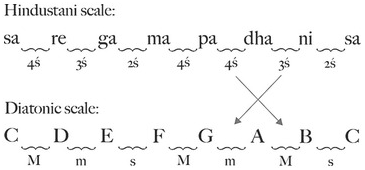
The seeds for this argument were planted at the end of the nineteenth century, when Orientalist scholars including William Jones, Captain Augustus Willard, and J. D. Paterson began to suggest that the principles of natural tuning were latent in ancient Sanskrit theoretical texts that dated from long before Mughal and English colonization. What precipitated this argument was the discovery that these early sources seemed to propose a division of the octave into twenty-two microtonal units called śrutis. According to these authors, “Indian scales” of seven notes, not unlike the Western diatonic scale, were derived by grouping the śrutis into clusters of two, three, or four in the manner shown in Figure 9.4.69 The three intervals comprised by these śruti clusters also seemed to them to correspond nearly exactly to the naturally tuned semitone, minor tone, and major tone, or the three smallest intervals between the individual steps of the Western diatonic and chromatic scale.70 None went so as far as to try to prove that their ratios were equivalent – Paterson noted that the metaphysical slant of Sanskrit theory rendered “mathematical calculation out of the question” – but they left indications that natural tuning was a latent principle behind the structures of ancient Eastern theory.71 The fact that Indian theorists had come closer to the principles of natural tuning than Greek theorists suggested to Jones that Indian music theory might actually be ahead of Western music on the unilinear developmental timeline, and could therefore serve as a resource for “improvements in our [i.e., European] musical system.”72 He would ultimately argue (at least rhetorically) that the chauvinism of figures like Bryce was misplaced: “we are like the savages, who thought that the sun rose and set for them alone, and could not imagine the waves, which surrounded their island, left coral and pearls upon any other shore.”73
The connection between the European diatonic scale and the ‘Indian scale’ composed of twenty-two śrutis, per Captain N. Augustus Willard, William Jones, and J. D. Paterson.
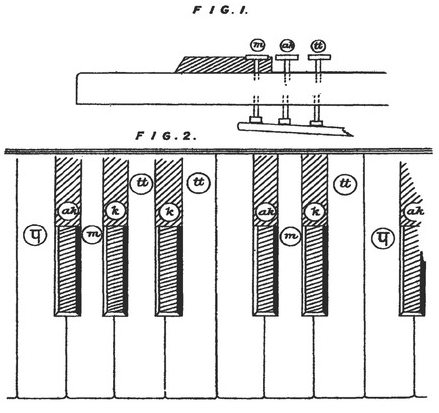
These arguments were soon taken up by Indian theorists such as Sourindro Mohun Tagore, who recognized within them the potential to reformulate the power dynamics of musical discourse. Tagore proposed that structural similarities between the Western diatonic scale and Indian “scales” could be traced back to shared origins in a system he called the “primitive Sanskrit Sharja-gráma.”74 On the basis of this lineage, he suggested that Hindustani musicians held a privileged position as modern-day carriers of the ancient musical “learning and fame” that originated with “the early pioneers of civilization in the land of the rising sun.”75 Thus he believed that the origins of the modern European understanding of natural tuning therefore extended back to ancient Indian learning. Several decades later, the Pune-based theorist Krishnaji Ballal Deval echoed these claims in proposing that India deserved the “palm of priority” for discovering natural tuning first, but went further in his claims that Hindustani musicians should protect themselves from the “mischief,” “evil,” and “disease” European instruments had wrought by importing equal temperaments.76 To accomplish this task, he invented the “Indian Harmonium” shown in Figure 9.5 with a full range of twenty-two keys in natural tuning per octave, designed to “arouse an interest in Hindu music amongst the civilized and rich nations of the West, so that they will have the benefit of having Aryan quarter or one-third tones (the want of which is so keenly felt in Europe).”77 One of Deval’s colleagues, Ganesh Sakharam Khare, adopted diagrammatic techniques similar to Farey’s in order to represent the tonal space of the “Indian Harmonium” as shown in Figure 9.6, further reinforcing the notion that the principles of modern organized tonal space were latent in ancient Indian texts.78
Krishnaji Ballal Deval’s ‘Indian Harmonium’, from Henry Keatley Moore, ‘Indian Harmonium’, patent application GB 15548, filed July 4, 1911, issued December 12, 1911.
A diplomatic transcription of G. S. Khare’s diagram of the twenty-two śrutis.

Thus, roughly ninety years after Liston’s euharmonic organ had met its demise, the idea that an organ in natural tuning could serve as an effective instrument of modernity was revived – albeit with India displacing Europe as the prime agent of musical organization. The ethnomusicologist Nazir Ali Jairazbhoy has memorably labeled this branch of Indian music theory “Indo-Occidentalist,” and has taken figures such as Tagore and Deval to task for having “toadied” to colonists by facilitating the transfer of their organizational tools into Hindustani musical discourse.79 Had he lived to see it, Bryce, who deplored the “infidel philosophy” of the Orientalist scholarship Tagore and Deval drew upon, would hardly have been much happier than Jairazbhoy to see such a shift in the development of music theory, given what it would have meant for the euharmonic organ in which his church had invested so much. Perhaps he should have considered more fully the implications of the insight from “Philo-Musicus” that the history of natural tuning develops in ways “contrary to all which might have been anticipated.”


 Open access