The first German missionaries arrived in Namibia in the 1820s. German rule over Namibia officially began under Otto von Bismarck in 1884. Following a January 1904 uprising led by Herero chief Samuel Maharero against colonial rule, German officials ordered the extirpation of the Herero and Nama peoples. On 4 October 1904, German military commander General Lothar von Trotha issued a chilling extermination order (Vernichtungsbefehl) to his troops: ‘Every Herero, with or without a gun, with or without cattle, will be shot. I will no longer accept women and children, I will drive them back to their people or I will let them be shot at’.Footnote
1
Germans murdered 10,000 Nama (half the population) and 65,000 Herero (nearly 80 percent of the population), as well as thousands of other indigenous peoples.
The 1904 Herero uprising was crushed. The town of Okahandja, the site of uprising, is today a scene of memory. We visited on a sunny Saturday morning in October 2025. Okahandja is about an hour’s drive north of Windhoek, Namibia’s capital, along a major and modern highway flanked by wildlife – including antelopes, ostriches, and monkeys.
The name Okahandja means the place where two rivers flow into each other. Namibia, however, is a vastly arid space. These rivers run dry for most of the year. Okahandja is a small town, home to an old train station with a faded and failing verandah, a brick microwave telecommunications tower, two woodcarver markets, and several foodserver restaurants. Okahandja is the administrative center for the Herero people, and Herero Day is celebrated here annually.
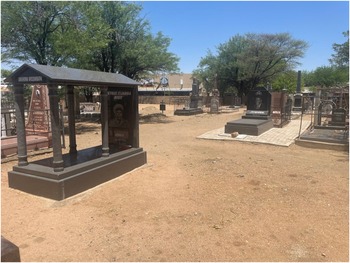
German vestiges persist, including in many street names in Okahandja, and even more so in Windhoek. The Okahandja soil, moreover, uniquely cradles the bodies of German soldiers who fought against the Nama and the Herero between 1904 and 1908. The genocide was ugly, and the Germans were coldly and cruelly ruthless. But the bodies of their fallen remain, in graves still tended to and accessible to the public. These bodies, resting in the German Military Cemetery since 1904, lie next to the remains of Okahandjans of far more recent times, including some contemporary Herero tribal leaders. Two German graves remain unnamed, while the others have simple, monochrome headstones with bare biographical details noted in German (Figure 1). The side of the cemetery hosting Okahandjans has larger and more ornate markers, many inscribed with Bible verses written in the Otjiherero language (Figure 2). The Rheinische Missionskirche anchors the unified site, while an old German fort sits around the corner.
Figure 1:
German Soldier Graves, German Military Cemetery, Okahandja, October 2025
Figure 1: Long description
The image shows a military cemetery in Okahandja, Namibia, featuring numerous graves of German soldiers. Each grave is marked with a headstone that bears the name and dates of the soldier. The headstones are arranged in neat rows, and the ground around them is covered with small gravel. The cemetery is surrounded by trees and other gravestones, indicating it is part of a larger burial ground. The headstones are made of stone and have inscriptions in German, reflecting the historical presence of German soldiers in the region.
Figure 2:
Okahandjan Graves, German Military Cemetery, Okahandja, October 2025
Figure 2: Long description
The image shows a German military cemetery in Okahandja, featuring graves of German soldiers who fought against the Nama and Herero between 1904 and 1908. The cemetery includes both named and unnamed graves, with simple, monochrome headstones for the German soldiers and larger, more ornate markers for local residents, many inscribed with Bible verses in the Otjiherero language. The graves are arranged in rows, with some areas more densely populated with markers than others. The cemetery is surrounded by a fence and trees, providing a serene and respectful environment.
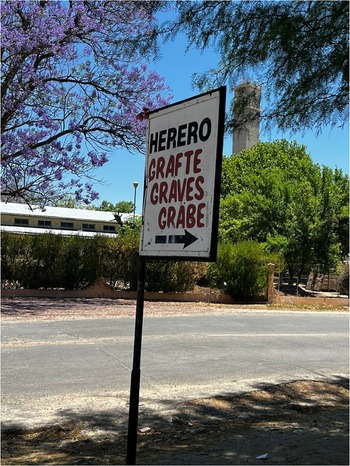
A wholly separate cemetery for Herero chiefs is a few blocks down the same street. A sign beckons visitors (Figure 3). This cemetery contains the graves of Samuel Maherero and other leaders, including Hosea Kutako, eponym of Windhoek’s international airport. Yet the chiefs’ graves are locked up and sequestered, not visitable, off in a distant fenced field. A small child wanted to take us to see them, behind the fences and locks, but we declined. It didn’t feel right.
Figure 3:
Sign for Herero Chiefs’ Graves, Okahandja, October 2025
Kintsugi is a Japanese artistic tradition of repairing broken pottery and porcelain by mending the areas of breakage with lacquer while leaving them visible. Kintsugi incorporates rupture into the form. The object is not discarded, nor a new one created to replace. Rupture becomes wrinkle and unity. As an approach to life, kintsugi approaches past breakage as part of the present – not to be hidden or disguised. For us, that morning, the German Military Cemetery in Okahandja formed a kintsugi of sorts: divided as it is with German graves on the left and Herero graves on the right, yet mended together, as one, the left side in the past and the right side in the present and future, with an unmarked yet discernible seam in between. Within this pleated plot, the past subsumes into the present; while scarred, kintsugi aims to grow a more just future. We felt a tenderness of sorts in the German Military Cemetery’s kintsugi: tenderness among the dead nestled together in the earth, side-by-side as neighbours of sorts, the oppressed volitionally placing themselves next to their oppressors through time and thereby joining across generations. We can imagine other onlookers feeling resentment, or different emotions, at the fact the cemetery retains its old name despite its new occupants.
The shared soil in the German Military Cemetery contrasts brutally with land ownership patterns in Namibia generally. German Namibians, who now comprise a mere two per cent of Namibia’s population, own about 70 per cent of the country’s land (largely used for agriculture).Footnote
2
Non-resident Germans also own extensive tracts. Questions of land ownership and justice in Namibia remain raw and unresolved despite the years that have passed since the genocide.
Equitable return of this land would be a new kintsugi of sorts, a rupture with the past that lacquers onto a more just present. We urge its centrality in Germany’s reparations for the genocide it perpetrated.





 This is an Open Access article, distributed under the terms of the Creative Commons Attribution licence (https://creativecommons.org/licenses/by/4.0/), which permits unrestricted re-use, distribution and reproduction, provided the original article is properly cited.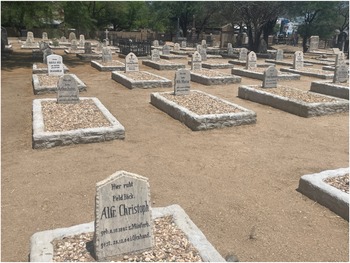
 You have
Access
You have
Access
 Open access
The first German missionaries arrived in Namibia in the 1820s. German rule over Namibia officially began under Otto von Bismarck in 1884. Following a January 1904 uprising led by Herero chief Samuel Maharero against colonial rule, German officials ordered the extirpation of the Herero and Nama peoples. On 4 October 1904, German military commander General Lothar von Trotha issued a chilling extermination order (Vernichtungsbefehl) to his troops: ‘Every Herero, with or without a gun, with or without cattle, will be shot. I will no longer accept women and children, I will drive them back to their people or I will let them be shot at’.Footnote 1 Germans murdered 10,000 Nama (half the population) and 65,000 Herero (nearly 80 percent of the population), as well as thousands of other indigenous peoples.
The 1904 Herero uprising was crushed. The town of Okahandja, the site of uprising, is today a scene of memory. We visited on a sunny Saturday morning in October 2025. Okahandja is about an hour’s drive north of Windhoek, Namibia’s capital, along a major and modern highway flanked by wildlife – including antelopes, ostriches, and monkeys.
The name Okahandja means the place where two rivers flow into each other. Namibia, however, is a vastly arid space. These rivers run dry for most of the year. Okahandja is a small town, home to an old train station with a faded and failing verandah, a brick microwave telecommunications tower, two woodcarver markets, and several foodserver restaurants. Okahandja is the administrative center for the Herero people, and Herero Day is celebrated here annually.
German vestiges persist, including in many street names in Okahandja, and even more so in Windhoek. The Okahandja soil, moreover, uniquely cradles the bodies of German soldiers who fought against the Nama and the Herero between 1904 and 1908. The genocide was ugly, and the Germans were coldly and cruelly ruthless. But the bodies of their fallen remain, in graves still tended to and accessible to the public. These bodies, resting in the German Military Cemetery since 1904, lie next to the remains of Okahandjans of far more recent times, including some contemporary Herero tribal leaders. Two German graves remain unnamed, while the others have simple, monochrome headstones with bare biographical details noted in German (Figure 1). The side of the cemetery hosting Okahandjans has larger and more ornate markers, many inscribed with Bible verses written in the Otjiherero language (Figure 2). The Rheinische Missionskirche anchors the unified site, while an old German fort sits around the corner.
German Soldier Graves, German Military Cemetery, Okahandja, October 2025
Figure 1: Long description
The image shows a military cemetery in Okahandja, Namibia, featuring numerous graves of German soldiers. Each grave is marked with a headstone that bears the name and dates of the soldier. The headstones are arranged in neat rows, and the ground around them is covered with small gravel. The cemetery is surrounded by trees and other gravestones, indicating it is part of a larger burial ground. The headstones are made of stone and have inscriptions in German, reflecting the historical presence of German soldiers in the region.
Okahandjan Graves, German Military Cemetery, Okahandja, October 2025
Figure 2: Long description
The image shows a German military cemetery in Okahandja, featuring graves of German soldiers who fought against the Nama and Herero between 1904 and 1908. The cemetery includes both named and unnamed graves, with simple, monochrome headstones for the German soldiers and larger, more ornate markers for local residents, many inscribed with Bible verses in the Otjiherero language. The graves are arranged in rows, with some areas more densely populated with markers than others. The cemetery is surrounded by a fence and trees, providing a serene and respectful environment.
A wholly separate cemetery for Herero chiefs is a few blocks down the same street. A sign beckons visitors (Figure 3). This cemetery contains the graves of Samuel Maherero and other leaders, including Hosea Kutako, eponym of Windhoek’s international airport. Yet the chiefs’ graves are locked up and sequestered, not visitable, off in a distant fenced field. A small child wanted to take us to see them, behind the fences and locks, but we declined. It didn’t feel right.
Sign for Herero Chiefs’ Graves, Okahandja, October 2025
Kintsugi is a Japanese artistic tradition of repairing broken pottery and porcelain by mending the areas of breakage with lacquer while leaving them visible. Kintsugi incorporates rupture into the form. The object is not discarded, nor a new one created to replace. Rupture becomes wrinkle and unity. As an approach to life, kintsugi approaches past breakage as part of the present – not to be hidden or disguised. For us, that morning, the German Military Cemetery in Okahandja formed a kintsugi of sorts: divided as it is with German graves on the left and Herero graves on the right, yet mended together, as one, the left side in the past and the right side in the present and future, with an unmarked yet discernible seam in between. Within this pleated plot, the past subsumes into the present; while scarred, kintsugi aims to grow a more just future. We felt a tenderness of sorts in the German Military Cemetery’s kintsugi: tenderness among the dead nestled together in the earth, side-by-side as neighbours of sorts, the oppressed volitionally placing themselves next to their oppressors through time and thereby joining across generations. We can imagine other onlookers feeling resentment, or different emotions, at the fact the cemetery retains its old name despite its new occupants.
The shared soil in the German Military Cemetery contrasts brutally with land ownership patterns in Namibia generally. German Namibians, who now comprise a mere two per cent of Namibia’s population, own about 70 per cent of the country’s land (largely used for agriculture).Footnote 2 Non-resident Germans also own extensive tracts. Questions of land ownership and justice in Namibia remain raw and unresolved despite the years that have passed since the genocide.
Equitable return of this land would be a new kintsugi of sorts, a rupture with the past that lacquers onto a more just present. We urge its centrality in Germany’s reparations for the genocide it perpetrated.