




Human activity is reshaping Earth’s biodiversity, including through extinction (Cowie et al. Reference Cowie, Bouchet and Fontaine2022), invasions (Isitt et al. Reference Isitt, Liebhold, Turner, Battisti, Bertelsmeier and Blake2024), and range shifts in response to climate change (Rubenstein et al. Reference Rubenstein, Weiskopf, Bertrand, Carter, Comte and Eaton2023). Documenting this reshaping is a major challenge, in part because there are a multitude of species to be monitored and because many taxonomic groups are chronically understudied (Cowie et al. Reference Cowie, Bouchet and Fontaine2022). Within Insecta, the most diverse clade of animals, much biodiversity remains undiscovered or poorly documented. However, some taxa have received more careful attention because of their importance to human health or to economic activity, and these provide opportunities to detect biodiversity changes. In such groups, extinctions, local extirpations, invasions, or range expansions are more likely to be detected, and the resulting data provide a window on processes presumably affecting Earth’s biota more widely. One such well-studied insect group is the family Culicidae, the mosquitoes.
The family Culicidae (Diptera) includes over 3500 species worldwide, 80 of which occur in Canada (Wood et al. Reference Wood, Dang and Ellis1979; Thielman and Hunter Reference Thielman and Hunter2007). In New Brunswick, Canada, a mosquito survey performed in 2002–2003 (Webster et al. Reference Webster, Giguere, Maltais, Roy, Gallie and Edsall2004) reported 38 species of mosquitoes belonging to seven genera: Aedes Meigen (including Ochlerotatus Lynch Arribalzaga), Anopheles Meigen, Coquillettidia Dyar, Culex Linnaeus, Culiseta Felt, Psorophora Robineau-Desvoidy, and Wyeomyia Theobald (Webster et al. Reference Webster, Giguere, Maltais, Roy, Gallie and Edsall2004). To date, no published records document mosquitoes from the genus Uranotaenia Osten Sacken (Diptera: Culicidae) for New Brunswick. North America is home to three species of Uranotaenia: Ur. anhydor Dyar, Ur. lowii Theobald, and Ur. sapphirina (Osten Sacken); however, only Ur. sapphirina has been identified in Canada. Considered rare, it has been reported in Canada only in Manitoba, Ontario, and Quebec (Twinn Reference Twinn1949; Judd Reference Judd1950; Wood et al. Reference Wood, Dang and Ellis1979; Stuart Reference Stuart2007). The North American distribution of Ur. sapphirina includes much of the eastern and midwestern United States of America, extending west to North Dakota and south into Mexico (Darsie and Ward Reference Darsie and Ward2005; Canto-Mis et al. Reference Canto-Mis, Chan-Chable, Gómez-Rivera, López-Sosa, González-Acosta, Correa-Morrales and Ávila2021; Ortega-Morales et al. Reference Ortega-Morales, Rodríguez-Martínez, Méndez-Alvarado, Garza-Hernández, López-Hernández and Medrano-Santillana2022; Fig. 1). Here, we report the first known observation of Ur. sapphirina in New Brunswick, Canada.
Range map for Uranotaenia sapphirina. Shaded range is approximate and is drawn from the literature: Mexico, after Ortega-Morales et al. (Reference Ortega-Morales, Rodríguez-Martínez, Méndez-Alvarado, Garza-Hernández, López-Hernández and Medrano-Santillana2022); United States of America and Canada, after Darsie and Ward (Reference Darsie and Ward2005). The dot is 2022 New Maryland, New Brunswick collection; the Xes are our 2023–2024 collections near Woodstock, Fredericton, St. Martin’s, and Sussex, New Brunswick. The square is Stuart’s (Reference Stuart2007) record from Winnipeg, Manitoba; stars are selected research-grade observations from iNaturalist. The province of New Brunswick is enlarged, showing collection localities.

Three separate field surveys for adult mosquitoes were performed. Study one took place from 21 July 2022 to 9 September 2022 at 12 trapping locations across southern New Brunswick (Table 1). Study two took place from 29 May 2023 to 24 October 2023, and study three took place from 15 May 2024 to 19 September 2024, both latter using the same 31 trapping locations across New Brunswick each time (Table 1). For each site, a single Centers for Disease Control and Prevention miniature CO2-baited light trap (John W. Hock Company, Gainesville, Florida, United States of America) was deployed for approximately 24 hours. Study one deployed traps at each site weekly, whereas studies two and three deployed traps weekly but rotated through locations such that each location was sampled on a triweekly basis. These traps use a combination of CO2 (from dry ice) and light to attract the mosquitoes to the trap.
Location, GPS coordinates, and total number of Uranotaenia sapphirina captured in New Brunswick, Canada. Traps 1–12 are from the 2022 survey and traps 13–32 are from the 2023 and 2024 surveys.

Trap catches were kept frozen on dry ice until reaching the laboratory at either the University of New Brunswick (Fredericton, New Brunswick) or Acadia (Wolfville, Nova Scotia, Canada). At the lab, insects collected were transferred to Petri dishes and stored at –20 °C for study one and at –80 °C for studies two and three until they could be processed for identification. We identified insects using a stereomicroscope (Leica M60; Leica Microsystems, Wetzlar, Germany) and standard keys (Carpenter and LaCasse Reference Carpenter and LaCasse1955; Wood et al. Reference Wood, Dang and Ellis1979; Thielman and Hunter Reference Thielman and Hunter2007). Study one identification was performed at the genus level, except that we identified mosquitoes to species in the genera Culex (to assay West Nile virus prevalence in the potential vectors Culex pipiens/restuans; MacDonald and Heard Reference MacDonald and Heard2023) and Uranotaenia (to confirm the identity of Ur. sapphirina for the present paper). Studies two and three were performed at the species level.
For study one, five female individuals of Ur. sapphirina were identified over the course of our collections. Two were identified from the 19 August 2022 New Maryland catch, and three were identified from the 9 September 2022 New Maryland catch. For study two, three individuals of Ur. Sapphirina from three separate locations were identified. The first individual (female) was collected on 20 September 2023 from one of the Fredericton sites, the second individual (male) was collected on 21 September 2023 from the Saint Martin’s Parish site, and the last individual (female) was collected on 7 October 2023 from the Plumweseep site. In 2024, a total of 10 individuals of Ur. sapphirina were identified from two separate locations. On 12 September, two individuals (males) were collected from one of the Fredericton sites (the same site where it was collected in 2023). The second collection was a total of eight individuals (seven males, one female) from one of the sites in Woodstock. No Ur. sapphirina mosquitoes were identified at the remaining collection sites at any of the collection times.
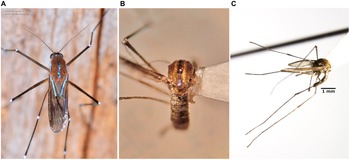
Uranotaenia mosquitoes in North America are very distinctive, with short palps, a proboscis swollen at the tip, a short r2 wing cell, and – most obviously – iridescent bright-blue scales in patches on the head and thorax (Fig. 2). Uranotaenia sapphirina is easily distinguished from other North American Uranotaenia by the presence of a stripe of blue scales down the centre of the scutum and the lack of pale scales on the hind tarsi. Three specimens from study one have been deposited in the insect collection of the New Brunswick Museum, Saint John, New Brunswick, Canada. Voucher specimens from studies two and three will be deposited at the Canadian National Collection of Insects, Arachnids, and Nematodes in Ottawa, Ontario, Canada.
Uranotaenia sapphirina: A, live specimen, observed by Alain Hogue at Châteuaguay, Quebec, Canada (alainhogue 2021; photograph used with permission); B, dried specimen from 2023 New Brunswick collections, dorsal view showing blue scales; and C, dried specimen from 2023 New Brunswick collections, lateral view. Images B and C have been cropped and focus-stacked, and brightness and contrast have been adjusted. Visibility of blue scales depends strongly on angle and intensity of incident light.

The Canadian distribution of Ur. sapphirina was previously recorded only as including southern Ontario, the southwestern part of Quebec, and more recently southern Manitoba (Twinn Reference Twinn1949; Judd Reference Judd1950; Stuart Reference Stuart2007). The closest reported occurrences of Ur. sapphirina to our New Brunswick sites appear to be research-grade observations on iNaturalist from Berthierville in southwestern Quebec (500 km to the west; apdp 2024) and near Waterville in south–central Maine (250 km to the southwest; myawiles 2019). The Maine observation is itself 200 km from the next most northerly iNaturalist observation in central New Hampshire (Fig. 1).
Uranotaenia sapphirina is not known to bite humans or other vertebrates and is therefore not a public health concern for vector-borne illnesses. Instead, these mosquitoes are specialist feeders on annelids (Reeves et al. Reference Reeves, Holderman, Blosser, Gillett-Kaufman, Kawahara, Kaufman and Burkett-Cadena2018). The small number of individuals caught in our survey and their absence from Webster et al.’s (Reference Webster, Giguere, Maltais, Roy, Gallie and Edsall2004) survey of an overlapping set of sites using the same trapping methods suggest that these mosquitoes are a recent arrival to New Brunswick. Although we do not have direct evidence for the cause of this range expansion, it could be related to changing climate, which involves warming in most regions, including Atlantic Canada. Indeed, other mosquito species, including medically relevant ones, are undergoing similar range shifts (Ludwig et al. Reference Ludwig, Zheng, Vrbova, Drebot, Iranpour and Lindsay2019). Continued monitoring of mosquitoes using the kind of standardised survey techniques we deployed in the present study is likely to document further changes in local faunas. Only with repeated monitoring of well-documented insect groups can we hope to understand the rate and drivers of future biodiversity change.
Acknowledgements
A.M.M. and S.B.H. thank Jackie Badcock for suggesting the survey work. Siobhan Desjardins, Lucy Dunphy, Vika Khomenok, Sarah Makepeace, and Bronwyn Terry helped to choose field sites, make collections, sort catches, and mount specimens. The authors are grateful to Reggie Webster for advice and to Don McAlpine and the New Brunswick Museum for lending equipment. L.F., G.R., and N.B. thank Emily Bacon, Maddy MacNeil, Lili Ricker, and Alina Rutherford for assistance in the field. The authors also thank Alain Hogue for permission to use his photograph in Figure 2A, and Nhu Trieu and Steven Cogswell from the University of New Brunswick Microscopy and Microanalysis Facility for assistance with the photographs in Figure 2B and 2C.
Funding statement
A.M.M. and S.B.H.’s research was funded by the New Brunswick Department of Public Health and by the Natural Sciences and Engineering Research Council (Canada; Discovery Grant RGPIN-2015-04418 to SBH). L.F., S.H., G.R., and N.B.’s research was funded by the Public Health Agency of Canada.
Competing interests
The authors declare that they have no competing interests.



 Open access

