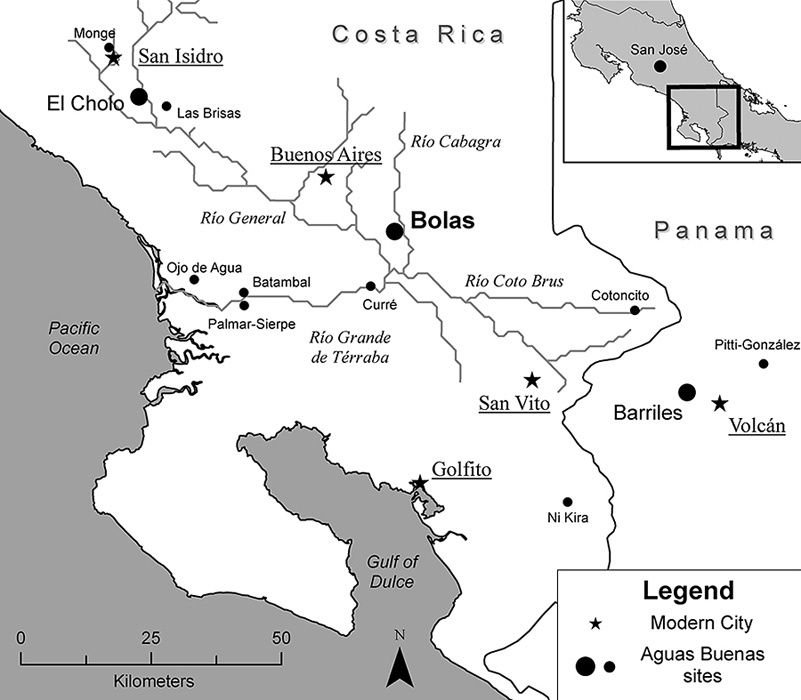


Location of Bolas and other Aguas Buenas period sites in southern Costa Rica and western Panama.

The Aguas Buenas period (300 BC–AD 900) was a time of profound social change in southern Costa Rica and western Panama. The period is associated with the formation of nucleated villages, social differentiation, monumentality (Frost & Quilter 2012) and, in certain areas, the emergence of regional political organisation (Drolet 1992; Hoopes 1996; Corrales Ulloa 2000; Palumbo 2013). While the Aguas Buenas is defined as a common ceramic complex shared over a wide area, comparisons between various sequences suggest that the activities associated with these social changes were variable. For example, the florescence of village life in western Panama involved a strong emphasis on funerary ritual (Palumbo 2009), while that in areas of southern Costa Rica emphasised the specialised production of stone axes and ornaments (Drolet 1992). Despite the clear ceramic similarities, emerging research suggests that Aguas Buenas societies were quite diverse—a point first explored in detail by Hoopes (1996).
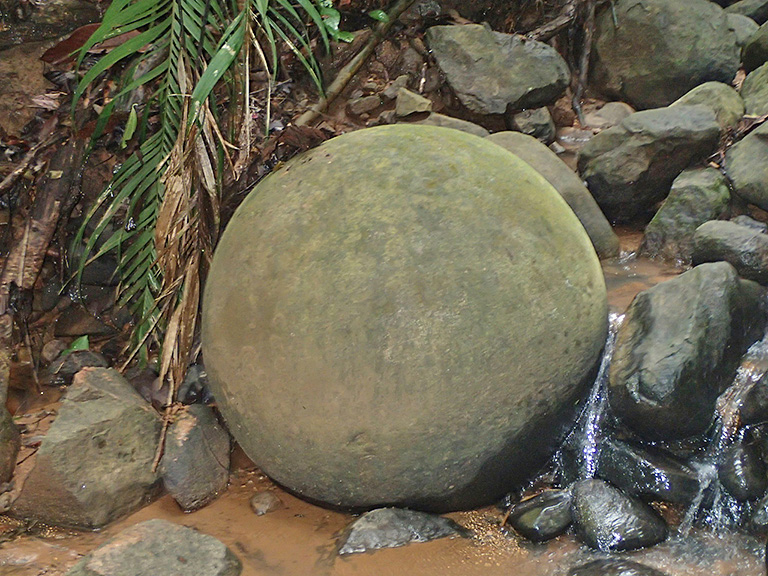
The Bolas site (P-90 Bl-1) is located in the foothills of the Talamanca Mountains of southern Costa Rica (Figure 1). The site lies in tropical rainforest, on top of a small mountain ridge. Bolas is one of the earliest and largest concentrations of stone sphere monuments in the country (see Figure 2 for an example), originally containing at least 22 (Quintanilla Jimenez 2007). The site also contains stone sculpture fragments, cobblestone structure foundations and a number of artificial earthen mounds. Such conspicuous remains led earlier researchers to conclude that Bolas was a socioceremonial centre (Drolet 1992: 222). While we do not yet understand the conditions associated with the growth of the site, its location on a narrow ridge with little flat, arable land nearby suggests to us that access to prime agricultural land was not a determining factor. The monumentality of Bolas is reminiscent of the later sites of the Chiriquí period (AD 900–1530) located to the south (Lothrop 1963). Many of these sites, particularly those with in situ stone spheres, are currently under nomination as UNESCO World Heritage sites.
Stone sphere in a streambed at Bolas.

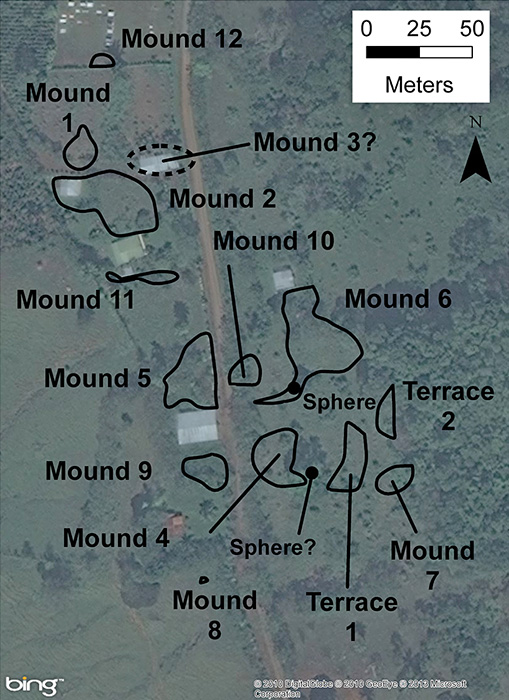
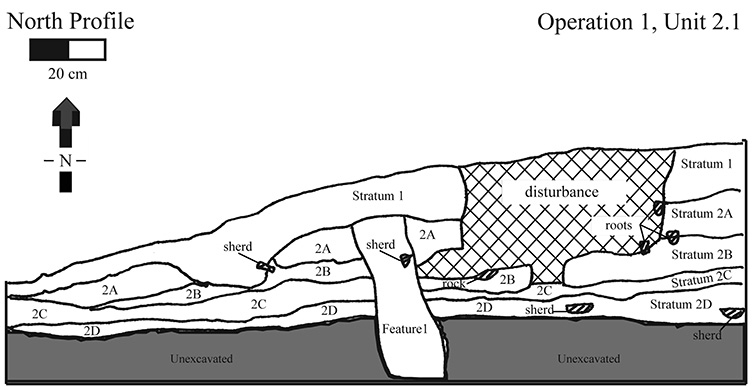
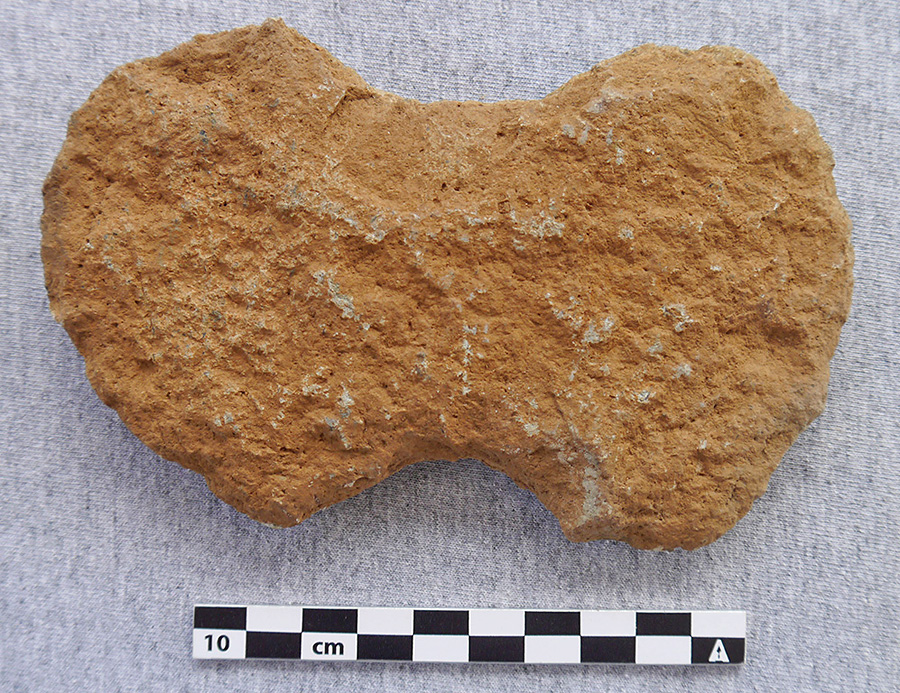
The Southern Costa Rica Archaeological Project (SCRAP) was one of the first to solicit and receive indigenous permission to conduct research in Costa Rica and organised research as part of an archaeological field school. Our topographic mapping of Sector 1 identified 12 surviving mounds (Figure 3). Excavations in Mound 1 uncovered cobblestone retaining walls, packed earthen floors (Figure 4), posthole features and domestic artefacts (e.g. chipped stone, burnt sherds, etc.), suggesting this mound had a residential function. This sector of the site also included numerous stone axes scattered along the adjacent hillside, many fragmented, and we suspect these were related to forest clearance and tree cultivation activities (Figure 5). Cursory pedestrian survey of the ridge revealed at least two additional sectors to the north with abundant remains of habitation and mounds. Further survey is required between these sectors to determine if they belong to the same, or separate, sites.
The mound and terrace features of sector 1 at Bolas.

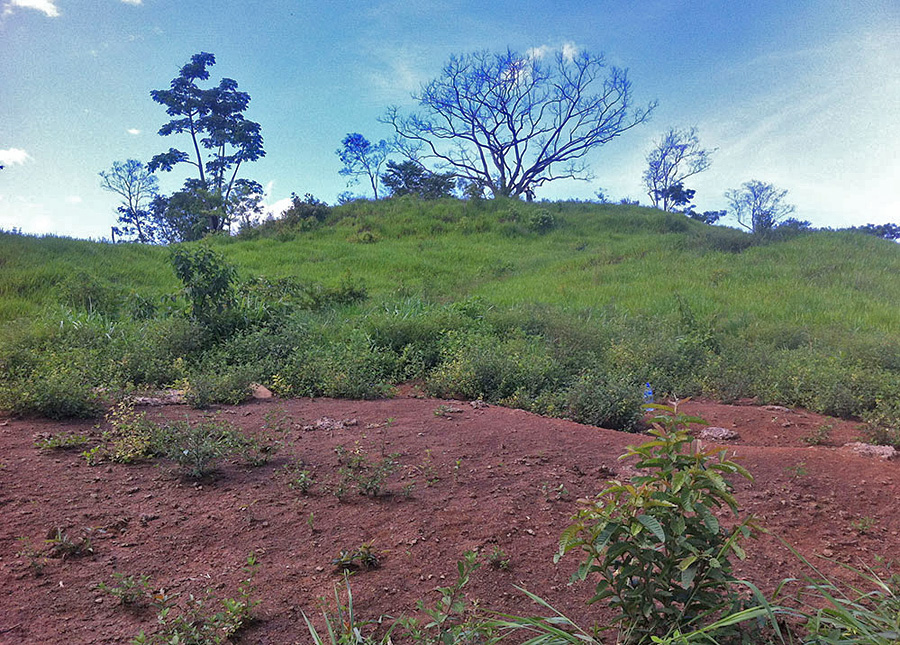
Exploratory survey of the surrounding region revealed small Aguas Buenas ceramic scatters that we interpret as farmsteads or hamlets. One newly documented site on a neighbouring hilltop, Mosca (P-1315 Ms), contained a cluster of nearly 2ha of large mounds and artificial terraces and was found in association with Aguas Buenas ceramics. The largest mound at this site measures several metres in height and is nearly 30m in summit diameter (Figure 6). It is much larger than any single mound at Bolas and may represent one of the largest pre-Columbian monuments in Costa Rica. Our preliminary survey has therefore identified a variety of Aguas Buenas settlement types in the surrounding region, ranging from the small and ephemeral to the large and monumental, and we suspect that these constitute parts of a regional settlement hierarchy.
The general picture that has emerged from our 2013 research is that the Bolas site is considerably larger and more internally complex than previously suggested. Our previous understandings of Aguas Buenas polities were those which included centres with modest public architecture surrounded by constellations of villages and farming hamlets. Bolas dwarfs these examples and likely represents one of the earliest and most conspicuous examples of complex social organisation on the southern Central American isthmus.
Mound 1 excavation profile showing superimposed earthen floors (strata 2B and 2D). Profile by M. Murphy and A. Shiver.

Stone axe from Bolas.

Looking uphill towards the principal mound (centre) and terrace features of the Mosca site (P-1315 Ms).

The prospect of more intensive research in the area is important for two reasons. The first is that the proposed construction of a hydroelectric dam will drown those sites below 300m asl, likely including a significant portion of the Bolas settlement system and a variety of other important sites. This makes researching the upper Terrába region particularly time-sensitive.
Second, much of the research on early complex societies around the world has concentrated on areas where these were brief precursors to larger states and empires. Such examples represent a small and biased data set on which to base the comparative examination of the factors that patterned social change more broadly (Drennan et al. 1991). Because these sequences document societies quickly on their way to becoming organised into larger states and empires, the principles upon which these social changes were based may have been qualitatively different from those which patterned smaller hierarchical societies elsewhere in the world. This is a topic that only archaeology is well positioned to address. Southern Costa Rica is free of the complications of prehistoric state influence, exhibits social variability prehistorically and, during the Aguas Buenas period, presents a rare opportunity to examine the full development, persistence and waning of regional political organisation. Although the area is traditionally understudied, it is an ideal location to investigate political cycling and comparative archaeology in greater detail.
Acknowledgements
We warmly thank Ifigienia Quintanilla, Rafael Delgado and Hugo Lázaro for arranging meetings with Cabagra representatives, and the inhabitants of Bolas and Cabagra for their support and friendship during our initial season. Claudia Vidal and Juan Jiménez graciously gave us permission to work on their property. We thank Sarah Taylor for directing our lab work and the Comisión Arqueológica Nacional for permitting our project. We are grateful to the College of Lake County and Flagler College for providing financial support to the archaeological field school and, finally, to the effort and dedication of our students (in alphabetical order): Jared Bingham, Gina Buckley Yost, Sarah Christensen, Jack Fitzgibbon, Tara Fraser, Patrick Johnson, Eddie Lawton, Alysia Leon, Meghan Murphy, Natalia Orozco, Catarino Rodriguez, Holden Sheftel, Anthony D. Shiver, Elizabeth Valnoha and Cetan Zephier.