




Introduction
The research aims to analyze the origins and processes of self-identification and hetero-identification of the communities in Dobruja, assessed from the outside perspective (the majority population and other ethnic groups in Dobruja, but also from the perspective of the academic literature published so far, with names such as: Muslim Roma, Turkish Roma, or Xoraxane . Self-image and the image of Others are processes that we will analyze from the perspective of Richard Jenkins’ theory, distinguishing between social categorization as an external defining process (by different actors who enjoy sufficient authority to impose classifications) and group identification, as an internal process, generated from inside the group (Jenkins Reference Jenkins2008, 23). According to Jenkins, ethnic identification (or any kind of identification) is never an isolated or a unilateral process, but it emerges at the intersection of these two processes (internal and external definitions) (Jenkins Reference Jenkins2008, 76). These two dimensions are not mutually exclusive, but rather interdependent and continuously negotiated within social interaction (Jenkins Reference Jenkins2008, 55). Central to Jenkins’ argument is the idea that power and authority are completely basic to how categorization works (Jenkins Reference Jenkins2008, 74–76). The act of defining and labelling groups is embedded in asymmetrical relationships that confer legitimacy upon certain representations while marginalizing and making others invisible. Institutions such as the political and state authorities, the media, and academia, as well as dominant social groups, have the power to impose classifications that organize the social world. These categorizations, sometimes in absolute terms, have significant consequences: they influence access to resources, inform policies, and structure social hierarchies by determining which identities are recognized as legitimate, stigmatized, or rendered invisible. The effective categorization of a group of people by a more powerful Other is not, therefore, “just” a matter of classification, but it is necessarily an intervention in that group’s world that will, to an extent and in ways that are a function of the specifics of the situation, alter that world and the experience of living in it (Jenkins Reference Jenkins2008, 74). Therefore, ethnic identity (or any other kind of identity) cannot be understood outside the historical and political contexts where it is formed and contested. The interplay between categorization and power results in the construction of symbolic boundaries, the lines that demarcate who belongs to a group and who does not. These boundaries are neither static nor consensual, but are permeable and variable (Jenkins Reference Jenkins2008, 54), subjected to constant negotiation, resistance, and reinterpretation. Groups and individuals may internalize totally or partially, or they may challenge or reject externally imposed classifications (Jenkins Reference Jenkins2008, 74–75).
Thus, grounded conceptually, we explored two main directions. First, which groups were placed in a position of external authority, and the instruments/practices used by them to impose on some groups an identity and a social label disconnected from the self-identification discourse of these groups? Second, we listened to the voices of these invisible and unheard groups, examining the self-identification processes of those identified as Muslim Roma from the outside, including their motivations for their choice of one ethnic or ethno-religious identity or another (Turkish, Millet, Davulcu, etc.).
In terms of methodology, the research is based on discourse analysis, applied to a wide range of sources, mainly archive documents, press and academic literature, the interpretation of information obtained via qualitative methods, semi-structured and life history interviews, conducted with the Romanian majority group and other local significant ethnic groups (Turks, Tatars, Roma), with members of the communities identified from outside as Muslim Roma and self-identified as Millet, Turkish Tinsmiths and Davulcu. The research is based on participative observation and informal talks with community members from seven urban localities in which we conducted our fieldwork: Constanța, Medgidia, Mangalia, Hârșova (Constanța County), Tulcea, and Babadag (Tulcea County). The conversations took place individually or in groups of up to ten people.
The respondents who participated in the study were selected by using the snowball technique, on the recommendation of other interlocutors, based on the criterion of their belonging to one of the three groups self-identified as Millet, Turkish Tinsmiths, and Davulcu, and on their willingness to share knowledge and life stories. Our empirical study included over 70 individual interviews, women and men equally, from all generations, aged between 18 and 74, inhabitants of the above-mentioned localities. Some interviews (10 percent), taken in Constanța, Medgidia, and Mangalia, were also conducted with the informal leaders of these communities.
The respondents from the Romanian majority group were representatives of the local authorities in the mentioned localities, and in the case of those from different ethnic groups (local Turks, Tatars), they were regular members of these communities or members of the local branches of the ethnic organizations of these minorities: the Turkish Democratic Union of Romania ( Uniunea Democrată Turcă din România — UDTR) and the Democratic Union of Turkish-Muslim Tatars in Romania ( Uniunea Democrată a Tătarilor Turco-Musulmani din România , UDTTMR).
During the archival research, we consulted the funds at the branches of the National Archives in the counties of Călărași, Constanța, Tulcea, but also at the main headquarters in Bucharest. The archival research was not as useful for identifying information about the communities studied as for a better understanding of why they are “invisible minorities.” We managed to identify very few documents where they are explicitly mentioned. Moreover, terms such as “Millet” or “Davulcu” are non-existent in archival documents. The situation is similar in the press, even in the contemporary one.
Who are those called from outside the Muslim Roma? An outline of the Balkan region
In the Balkans, especially in Greece, North Macedonia, Bulgaria, and Romania, some communities are identified by the populations they encounter as “ țigani turci ” in Romanian, “ turski tsigani ” in Bulgarian, “ turkogifti ” in Greek (Marushiakova and Popov Reference Marushiakova, Popov, Kamusella, Nomachi and Gibson2016, 28), in the official literature — Muslim Roma. In some cases, they also use this term for self-designation, but there are also large sections of these groups that are Turkish-speaking and who declare themselves Turks. Research in different Balkan states shows that there are also groups that still speak the Romani language or have spoken it in the recent past, while in other cases, it has been preserved only among the older generations, and in others, a mixture of Turkish and Romani is used. These linguistic and identity variations show that they are not a unified or homogeneous group and are divided by the borders of the Balkan states (Marushiakova and Popov Reference Marushiakova, Popov, Kamusella, Nomachi and Gibson2016, 28) created after the collapse of the Ottoman Empire, where they were included in a separate administrative organization, called liva-i “ çingane ” or “ çingane ” sancağı (“Gypsy”Footnote 1 sub province or sancak), revealing their classification on ethnic grounds, in a category parallel to the system of Millets — non-territorial confessional communities - that functioned in the Ottoman Empire (Çelik Reference Çelik2013, 365–366; Altınöz Reference Altınöz2013, 115–116).
Their presence is mostly linked to the advance of the Ottoman Empire in the Balkans, in the 14th and 15th centuries, as auxiliaries or craftsmen of the army. Others settled in the region before the Ottoman period, in the 9th to 11th centuries, adopting Islam after their integration into the Muslim society of the Ottoman Turks (Oprișan and Grigore Reference Oprișan and Grigore1999, 32; Cupcea Reference Cupcea2020, 4). They learned the dominant language, Turkish, assuming in parallel a Turkish identity, sometimes to the detriment of their own. Marushiakova and Popov mention that these processes à la longue durée , present since the Ottoman period and extended after the creation of the Balkan nation-states, highlight the correlation and gradual overlap between Islamic religion and Turkish identity, the term Turk implying that they are Muslims and vice versa (Marushiakova and Popov Reference Marushiakova, Popov, Kamusella, Nomachi and Gibson2016, 28).
During the 20th century, they started to develop separate identities, supported by their own version of history (sometimes at the level of folklore and quasi-science). They usually declare themselves Turks, their mother tongue is Turkish, and some of them prefer to call themselves simply Millet (Marushiakova, Heuss, Boev, Jan Rychlik, Ragaru, Zemon, Popov, Friedman 2001, 15; Zenkines, Reference Zenkines1994, 27–33). Marushiakova and Popov define this process as the development of a preferred ethnic identity, considering it particularly characteristic “of Muslim Roma who declare themselves as ethnic Turks” with roots in the times of the Ottoman Empire. The phenomenon remains at the level of potential future, as in the case of the communities in Bulgaria, “who define themselves with the ethnically neutral designation Millet ” (Maruhiakova and Popov Reference Marushiakova and Popov2018, 29).
An example from the Balkan region is that of the groups of Egyptians and Ashkali, of Islamic religion, in Kosovo, who are perceived as Muslim Roma, but refuse to declare themselves as such, and who may have originally been Roma, but who, over time, have preferred to develop alternative identity discourses, precisely to distance themselves from the rest (Marushiakova, Heuss, Boev, Jan Rychlik, Ragaru, Zemon, Popov, and Friedman Reference Marushiakova, Heuss, Boev, Rychlik, Ragaru, Zemon, Popov and Friedman2001, 11–14). Other communities are living in the Balkans, besides the Egyptians and Ashkali, whose members are called by the surrounding population and in the official literature — Muslim Roma and who have recently begun to develop separate identities, supported by their own “history,” albeit at the level of folklore and quasi-science. Such Turkish-speaking communities live in the eastern and northeastern parts of Bulgaria, in Greece (in the region of Western Thrace), in North Macedonia, and in Serbia. They usually declare themselves Turks. However, the local population (including the Turks) does not accept them as such and calls them Turkish Roma. Their mother tongue is Turkish, and some of them prefer to call themselves simply Millet (meaning nation, people, or Muslims), which is an ethnically neutral category. An example is the Usta Millet (Usta meaning “craftsman” in Turkish) from northeastern Bulgaria, who have developed a discourse about their own history, according to which they are descendants of an unknown tribe of blacksmiths from Afghanistan, who were the most famous weapon makers in the Ottoman Empire (Marushiakova et al. Reference Marushiakova, Heuss, Boev, Rychlik, Ragaru, Zemon, Popov and Friedman2001, 15).
A similar situation is that of the community in the Western Thrace region of Greece, identified externally as Roma, who are Turkish speakers; some of them define themselves as Muslims, without referring to an explicit ethnic category, while others state that they are Turks (Zenkines Reference Zenkines1994, 27–33).
Also, in the western part of the Republic of North Macedonia (as well as in Skopje), there is a population that the Roma call yalâm agalar (half-gentlemen or false gentlemen in Turkish) and who are mostly Turkish-speaking and self-declare Turks (Zenkines Reference Zenkines1994, 27–33).
Another variation of this type of identity claim is mentioned in a group from the Ludogorie region of Bulgaria. They claim to be of Arab origin, descendants of the Quraysh clan (the clan of the Prophet Muhammad), who lived in Bulgaria in the years 1200–1300 AD. According to them, evidence for their existence is the Muslim tombstones throughout the region, dating from the reign of King Kaloyan around 1205 AD. The myth of Arab origins is based on the false reading (deliberate or not) of the years on Muslim tombstones, which, while dated according to the Islamic calendar (A.H., the year of the Hegira, 622 AD), are interpreted according to the Christian calendar. However, the difference between the two calendar systems is almost six hundred years (Marushiakova and Popov Reference Marushiakova and Popov.2000, 86; Reference Marushiakova, Popov, Kamusella, Nomachi and Gibson2016, 28).
A less well-known and studied example is that of the community in the Northern DobrujaFootnote 2 region of Romania, called by the majority population and other ethnic minorities with whom they come into contact (Turks and Tatars), Muslim Roma, a term used alternatively with Xoraxane. Due to border changes (1878, 1913, 1940), this community became distinct from the one in the Southern Dobruja region of Bulgaria (Marushiakova and Popov Reference Marushiakova, Popov, Kamusella, Nomachi and Gibson2016, 33).
Choice of Millet for self-designation in the Balkans
Millet is a Turkish term that means “people” or “nation,” and it is widely used by academic scholars to refer to the administrative system for non-Muslims in the Ottoman Empire (especially Christians and Jews) applied after the mid-18th Century (Katsikas Reference Katsikas2009, 180; Evstatiev Reference Evstatiev2019, 90) and developed in more specific terms during the 19th century. They were organized in self-governing religious communities, each constituted in a Millet that included all the members of the same religion in the empire, regardless of their ethnic origin (Katsikas Reference Katsikas2009, 178). The Turkish word Millet , deriving from Arabic milla (a religiously defined community or nation), entails various connotations (Evstatiev Reference Evstatiev2019, 90). First, Millet denotes a community, a group of individuals deriving their identity from a shared religious affiliation. In this sense, Millet is synonymous with the Islamic umma ( millet-i islamiye ). Second, Millet was sometimes used as an adjective designating the doctrine, practice, and law shared by one of these religious communities. Third, millet referred to a formal organization of the religious community with its ecclesiastical hierarchy, clerical and judicial organs (Evstatiev Reference Evstatiev2019, 90).
While some scholars regarded the Ottoman Millet system as the most developed model of non-liberal religious tolerance, leaving little or no freedom within each religious community, others have seen it as a good model for the respect and protection of minority rights (Katsikas Reference Katsikas2009, 187).
Mary Neuburger (Reference Neuburger2004) states that it was a pattern for accommodating diversity, also called milletism, and having a twofold potential: as a social integrative force and as a venue for community extrication and emancipation. She underlines that although the Millet system ensured the loyalty of the non-Muslim elites to the Ottoman state, at the same time it established the basis for rights based on language and religion (Neuburger Reference Neuburger2004, 33; Evstatiev Reference Evstatiev2019, 90). Stefanos Katsikas, analyzing the case of the Greek and Bulgarian Muslims (2009), goes further and demonstrates that after the dismantling of the Ottoman Empire, the Millet-type of relations became entangled with the modern European concept of nation-building in the Balkans. He states that after the creation of the nation-states in the former Ottoman Balkans, Muslims became religious minorities, Muslim Millets within two nation-states. In this context, the international treaties signed following the two Balkan Wars and the First World War (in 1912 and 1923) sought to secure a smooth transition from the Ottoman Empire to a nation-state, providing autonomy in terms of religion, education, and culture for the Muslim populations, exactly the way the cultural autonomy of non-Muslims was protected through the Ottoman Millet system. In reality, Greek and Bulgarian Muslims (similar to other Muslim minorities in the Balkans) were regarded and treated as homogeneous religious groups without any internal ethnic or religious differentiation, just as non-Muslims were under the Millet system. In other words, the multicultural and multi-ethnic character of the Muslim minorities in both countries was neither recognized nor protected from assimilationist policies within the minority (Katsikas Reference Katsikas2009, 182, 183)
Katsikas’s main idea is that in the new nation-states created at the end of the 19th century, the administrative system of post-Ottoman Muslims followed the Millet system model, designed for the non-Muslims in the Ottoman Empire. It was a highly centralized system of administration which, on the one hand, facilitated the exercise by state authorities of effective control over the minority affairs and the application of any state minority agenda, while, on the other hand, providing the legal and political means of promoting cultural assimilation from within the minority itself. Any ethnic or social group that could control the minority’s political organs and representative institutions would be able to impose its policies, norms, and values on the whole community.
Simeon Evstatiev (Reference Evstatiev2019) elucidates further the continuation of the Millet-type of belonging in the nation-states in the Balkans, touching upon the subtle situation of a Roma group against the backdrop of a specific (post-) Ottoman continuity (Evstatiev Reference Evstatiev, Evstatiev and Eickelman2022) and who self-identifies as Millet. The same group mentioned by Evstatiev (Reference Evstatiev, Evstatiev and Eickelman2022) is explored by Yelis Erolova (Reference Erolova2021), who explains that in this case, Millet designates a form of Turkish ethnicity, the same or different from that of the local Turks. Erolova stresses that the ethnonym “Roma” reflects not the self-identification of most of the Millet community, but its external identification (Erolova Reference Erolova2021, 215). She deepens the current meaning assigned to this term stating that depending on the ethnic-social context, and based on various criteria (ethnicity, language, religion, and traditional occupation), the representatives of the Millet define themselves variously as “Turks,” “Turkish Muslims,” “Turkish-speaking,” “Millet,” “ Usta Millet ,” “ Mehter Millet ,” and, more recently, as “Ottoman Turks,” “Muslims,” or “a minority.” The process of Turkification, typical for most of them, is sustained not only by the association (widely popular in Bulgaria and the Balkans) between Turkish ethnicity and the Islamic religion but also by the community/group understanding that one raises one’s social status by distancing oneself from other Roma groups and joining the Turkish community, closer in terms of language, religion, and culture (Erolova Reference Erolova2021, 215). According to Marushiakova and Popov, the process of the formation of a preferred Turkish self-consciousness among these groups began centuries ago in the Ottoman Empire, probably because of the Ottoman socio-economic policies (Marushiakova and Popov Reference Marushiakova and Popov.2000, 25–61; Erolova Reference Erolova2021, 215).
Terminological variations used from outside: Xoraxane and Muslim Roma. Focus on the Romanian Case
According to the latest census, from 2021, the Muslim community in Romania consists of 76 215 individuals, most living in the south-eastern region of Romania, known as Northern Dobruja, in the counties of Constanța and Tulcea. From an ethnic point of view, most school textbooks, dictionaries, and encyclopedias, but also most of the published scientific works present the ethnic composition of the Muslim community in Dobruja as consisting mainly of Turks, Tatars, and some also mention “small groups of ‘Muslim Turkish Roma’.”Footnote 3 The term is also used in the Balkan region, including Dobruja, in the variant of Muslim Roma, Turkish Roma (Marushiakova and Popov Reference Marushiakova and Popov2012, 3), or Xoraxane in the Romani language (also spelled Khorakhane , Horakhanè , Horahane , Kharokane , Xoraxai ).
Xoraxane is both a religious and historical term, which, according to definitions, designates “Muslim Roma, living in the states of the Balkan region” (Hübschmannova 2003, 9) and derives from the name of the medieval Turkic Karakhanid dynasty of Central Asia that ruled in Central Asia in the 10th to 12th centuries (Matras Reference Matras2015, 285; Matras Reference Matras2010, 39).
In Turkey and Greece, Muslim Roma are divided under the umbrella of xoraxane into: kalayji (tinsmiths), ayjides (bear trainers), bohchegyz (door-to-door textile merchants), etc. Thus, the religionym Xoraxane functions in certain localities as hypernym. (Hübschmannová Reference Hübschmannová2003, 9) In the southern Balkans, Muslim Roma living among Turks and other Muslim minorities often refer to themselves using the term Koraxane (pronounced Koh-ra-ha-neh) or Xoraxane (Hoh-ra-ha- neh), which means “Turk.” Yaron Matras says that this term, Xoraxane , is one of the early loanwords in the Romani language, being used for “Turks” and in some varieties of the Romani language, generally for “foreigner,” mainly suggesting a worldview that was informed and inspired by the proximity and contact of the Roma with the Turkish armies. (Matras Reference Matras2015, 285; Matras Reference Matras2010, 39).
Between the two meanings, Muslim and Turkish, as in the entire Balkan region, there is a correlation and a mutual exchange (Marushiakova and Popov Reference Marushiakova and Popov2012, 143). This has its roots in the Ottoman period, when the ethnonym Turk was commonly used to designate all Muslims in the region, regardless of their ethno-religious origin, because the adoption of the Islamic religion during the Ottoman period automatically meant a process of Turkification, by accepting a Turkish-Ottoman lifestyle (Zemon Reference Zemon, Biagini and Motta2014, 143) and implicitly assuming a Turkish identity. After the creation of the national states in the Balkans, this overlap was facilitated, as Peter Mentzel succinctly points out, by the fact that Christian populations in the region perceived Balkan Muslim populations as an undifferentiated mass, often referring to them as “Turks,” regardless of their ethnicity or nuanced, multi-layered self-perceptions (Mentzel Reference Mentzel2000, 199). Thus, currently the term Turk means Muslim and vice versa (Marushiakova and Popov Reference Marushiakova, Popov, Kamusella, Nomachi and Gibson2016, 27–33).
Based on our field research conducted in 2023–2024 in urban communities in Dobruja identified from the outside as “Turkish Roma,” the term Xoraxane is not part of the local common vocabulary, being used only in the academic environment, by the Roma communities and by the majority population, especially in journalistic language to designate Roma of the Islamic religion. Exploring the meanings of this term revealed, within the communities identified from the outside as Muslim Roma, both Millet and Turkish Tinsmiths, that, even if, in general, the term is recognized by the older generations, there are cases where the younger generations do not know its meaning. For example, in Medgidia, members of the Millet say that they do not know or use this term. For example, C.S., a leader of Millet from Medgidia, when asked to explain the term Xoraxane , told us, “I haven’t heard of Xoraxane. I don’t know what it means,” and even confused the term with a Tatar dish made from dough: “I’ve heard of kalakay.” (C.S., member of the Millet community, interview with the authors, Medgidia, Constanța County, May 25, 2023).
In localities such as Hârșova, Babadag, Tulcea, and in the Turkish Tinsmiths communities, the term Xoraxai / Xoraxane is perceived, as in other areas of the Balkan region, as a term from the vocabulary of the Romani language, having the meaning of Turk or Muslim. In these latter cases, all elderly individuals self-identified with this term, mentioning that it is a name assigned to them by the Roma community. Xoraxane is not, however, a term used voluntarily in Dobruja today by these communities to self-identify and self-represent.
In the language of the majority population, but also of other ethnic groups in the Northern Dobruja region, Tatars, including Turks, the term “Turkish Gypsies” is used. This term has existed since the Ottoman Empire, “ Çingene ,” when it was used in the sense of “Muslim Gypsies” and reflected the mixture and interchangeability between religion and ethnicity mentioned above (Slavkova Reference Slavkova and Todorović2004, 41). It also had, in the past, the purpose of reflecting ethnic origin and religion, being at the same time an ethnonym and a religionym (or ethno-religionym).
In Dobruja, the term “ Çingene ” was used in the Ottoman census of 1830. According to this census, in the Silistra sanjak, 975 “Gypsies” (“ Çingene ”) were registered, distributed in the following kazas: Isaccea (39), Mangalia (37), Balcik (125), Măcin (25), Constanța (41), Harșova (21), Tulcea (19), and Babadag (488). They were listed separately even if they were Muslim, and the census included only the religious categories (Muslims, Christians, and Jews) (Karpat Reference Karpat2010, 224).
The Romanian version, “ țigani turci ” (“Turkish Gypsies”), appears to have been used since the first years after the region’s administration was taken over by Romania (1877–1878), in the documents of local administrations in Dobruja, in the press, and the diaries of foreign travellers in the region. It should be noted, however, that the term “Turkish Gypsies” first appeared in the Romanian administrative language at the beginning of the 19th Century (in the form of “Turkic Gypsies,” in Romanian: “ țigani turciți ”).Footnote 4 Julieta Rotaru explains this term in the sense of being connected to the Turkish community, through customs and religion, referring to the correlation between religion and ethnicity (Rotaru Reference Rotaru, Kyuchukov, Zahova, Duminică and Series2021, 79). Although the date of their arrival in the Principality of Wallachia is uncertain, Achim states that most of those who joined the group of state slaves from Wallachia during this period were the so-called “Turkic Gypsies” (“ țigani turciți ”) — that is, Muslim Roma from the Ottoman Empire who crossed the Danube in several waves after 1800 (Achim Reference Achim, Pargas and Schiel2023, 539).
The term occurs especially in the press of the first decades of the 20th Century, when they were perceived as a social problem, in the guise of criminals — thieves, rapists, troublemakers,Footnote 5 or as a population with an archaic way of life, in an exclusively orientalist approach that insists on cultural representations of violent, primitive, lazy, superstitious people.Footnote 6
The term also begins to spring in photographic art at the beginning of the 20th Century. For example, we can see it in the descriptions of some photographs and postcards from Dobruja, such as “Turkish Gypsies” in Balchik from 1928 (“ Țigani turci la Balcic ,” See Figure 1), respectively, a portrait titled Types of Dobruja. “Turkish Gypsy” ( Tipuri din Dobruja. “țigan turc.” See Figure 2).Footnote 7
Photo entitled “Turkish Gypsies” in Balchik (currently in Bulgaria), Realitatea Ilustrată Newspaper, 8 October, 1928.

Postcard entitled, Types of Dobruja. “Turkish Gypsies”
Source: Personal collection.

Figure 2. Long description
A group of approximately twelve people, including men, women, and children, are posed in a line.
* On the far left, a man in a patterned jacket and baggy trousers stands near a woman carrying two buckets on a shoulder yoke.
* In the center, two women stand prominently, wearing patterned skirts and headscarves.
* To their right, several men wear turbans and striped or dark vests over loose clothing.
* A small child in a light-colored tunic stands among the adults on the right side.
* The background features a dense line of trees and a calm river or lake to the left.
* At the bottom center, red text reads Tipuri din Dobrogea, followed by Tigani Turci.
* In the bottom left corner, smaller red text reads Photo par H. Wichmann, Galatz.
Also, at the end of the 19th and at the beginning of the 20th Century, the term “Turkish Gypsy” appears in travel diaries and works of geographical and historical exploration of Dobruja, alternatively under the forms “Mohammedan Gypsy” (“ țigan mahomedan ”), “Muslim Gypsy” (“ țigan musulman ”) or “Turkish Gypsy” (“ țigan turc ”)
In 1901, the Swiss anthropologist Eugène Pittard mentioned in his travel notes the French form of the term “ tzigans turcs ” (Pittard Reference Pittard1902a, 60) or “ tzigans turcomans ” (Pittard Reference Pittard1902b, 457–458). He recommended at that time the distinction resulting from affiliation to different religions, between “ les tzigans roumains ,” followers of the Christian-Orthodox religion, and “les tzigans,” followers of the Islamic religion, attached to the mosques of their community (Pittard Reference Pittard1902a, 60–61).
The categories proposed by Pittard are also mentioned in 1944 by sociologist Ion Chelcea, who uses the term “Turkish Gypsies” and “Mohammedan Gypsies” alternatively, noting that they are called by the Turks in Turkey, fıranlar , in the sense of pharaohs (Chelcea Reference Chelcea1944, 27, 28), a term that refers to the theory of attributing Egyptian origins to the Roma, still popular at that time (Ulusoy Reference Ulusoy2013, 17–18). This differentiation of “Gypsies” according to religious affiliation was imposed quite early. In an article published in 1928, a representative of the Ministry of Religions and Arts in Romania presents statistics from 1906, showing that in Dobruja there were 1 759 “Christian Gypsies” and 358 “Turkish Gypsies,” all registered only in Tulcea County (Ilioniu Reference Ilioniu1928, 624–625).
All these sources show us that the term was used in the first decades of the 20th Century in everyday, journalistic, and scientific language, borrowed even by those who came from outside and encountered the local culture, to designate an ethnic and religious category.
At the same time, documents produced by local administrations in Dobruja at the beginning of the 20th Century and demographic sources/census of the period use the term “Muslim Gypsy,” “Mohammedan Gypsy” or “Turkish Gypsy” to designate this ethnic and religious category. Usually, when referring to this population, local administration documents point to the health and public order problems they cause.
For example, in an address of February 18, 1888, sent to the Ministry of the Interior, the mayor of Constanța, Mihail Coiciu, shows that “several legions of Turkish Gypsy families” have settled on the outskirts of the city, that some had already settled there in the Ottoman period, and others after the province became a part of the Romanian borders. Coiciu mentions that these families have settled “without any authorization” and that they live in “shacks so miserable that they do not seem to be human dwellings.” After claiming that these families are “a hotbed of various diseases,” the mayor of Constanța proposed moving them to villages “where there is a lack of hands for cultivating the land.”Footnote 8
Regarding the communist period, because the authorities did not record information related to ethnicity, archival sources very rarely contain information in this regard. From the research conducted at the local, central, and CNSAS archives, we identified a document that calls the inhabitants of Piața Chiliei and Tăbăcăriei neighborhoods in Constanța, “Turkish Gypsies” or “Gypsies of Muslim origin.” This is an informative note from 1956 of a meeting between the Mufti of the Muslim Community in Romania and several Turkish teachers and imams, where the informative source “Stambul” mentions that the “Gypsies of Muslim origin” from the two neighborhoods of Constanța “have become a compact mass of people who pose a social danger to the population of the city of Constanța and even to the entire region, due to begging and violence,” proposing the solution “that the police take measures to isolate them from the city of Constanta and force them to work and teach their children to read.”Footnote 9
The main question is how all these sources help us reconstruct the way the term “Turkish Gypsy” entered public discourse and everyday language after 1878, how the semantic field of this term evolved, but especially to what extent this term reflects the own narrative of this ethno-religious group. The challenge comes from the fact that the documents of local administrations, press, and scientific articles produced immediately after 1878 and those drawn up during the interwar and communist periods were drafted by those outside the group and reflect the perspective and position of the majority elites, of the state authorities, journalists, and the academic environment. Also, the accounts of foreign travelers maintain the same perspective, because during their visits, they first encountered the local Dobruja elites, so their accounts reflect the perceptions and even the terminology used by the majority elites to designate this group.
One thing we must establish is that accessing the voices of the members of this group, in those periods, is an incomplete and even impossible process. Even records of personal requests by the members of this group to the authorities in different socio-economic contexts (for example, requests for settlement in different localities) are drafted by state officials and signed by the fingerprint of the applicant. The major problem, however, is the fact that both the archival documents produced by the local administrations in Dobruja, as well as the local or central press texts, mention them only when they are considered a social problem or perceived as an inconvenience or a threat to the majority group.
Even when topics from their daily lives are discussed in the press, their voice is indirect and passed through the filter of a journalistic discourse influenced by the ideological patterns of eugenics and orientalism from the early 20th Century:
The inhabitants … often of rare beauty, are nothing but “Turkish Gypsies,” “ cenghene ,” as they call themselves.
Being “Gypsies,” they behave like “Gypsies”: they smoke a pipe at the mouth of their hut…. They beg, they tell fortunes in their palms, and they have fleas. As Turks, they respect the letter of the Qur’an with reverence, they do not drink, they do not steal, they are jealous, they belly dance and sit in Turkish style.Footnote 10
From this journalistic report, prepared in 1932 in Mangalia and published in the newspaper Ilustrațiunea română , we learn that they called themselves “cenghene.” Most likely, the text refers to the Romanianized form of the Turkish term “ Çingene ,” used by the Ottoman Turks (along with kıbti )Footnote 11 to designate the Roma in the Ottoman Empire.Footnote 12
It is possible that the ethnonym “cenghene”/“ Çingene ” in this context, recorded at the beginning of the 20th Century in a community in Mangalia, was preserved from the Ottoman period of the region. Its use in Dobruja during the Ottoman period can be established, either based on travel diaries in the region in the 16th and 17th centuries, but also by analogy with its use in legal and administrative documents ( mühimme registers, ahkam , tahrir ) and in Ottoman identity documents ( tezkire ) (Çelik Reference Çelik2013; Altınöz Reference Altınöz2013). These cases are reported by researchers such as Altınöz, Ginio, and Çelik in the province of Rumelia, Istanbul (formerly Constantinople), and Edirne, when the Roma were identified by the Ottoman administration as: “ Çingene ,” “ Çingane ,” “ Çingene ,” “ Çingeniya ,” but also Kıbti , Kıbtiyan , or Kıbti Müslim (Çelik Reference Çelik2013, 282, 400, 401).Footnote 13 Faika Çelik, however, raises an important question: to what extent do Ottoman documents present an ethnicity or a socio-economic category when referring to “ Çingene ”? (Çelik Reference Çelik2018, 250) The question remains open and can also be applied to the Romanian (Ottoman) and post-Ottoman Dobruja cases.
Marushiakova and Popov argue that ethnonyms are not something static and frozen over centuries. Rather, they argue that these ethnonyms reflect fluid and mutable processes of segmentation of different communities or consolidation of their place in society. In the context of such processes, there is no impenetrable wall between exonyms and endonyms; on the contrary, these processes take place in both directions; exonyms can become endonyms and vice versa (Marushiakova and Popov 2014, 63). Therefore, the presence of the term “cenghene”/“ Çingene ” in Dobruja in 1932 can be interpreted as the result of such a process, where the exonym “ Çingene ” used by the Ottoman Turks became, over time, an endonym, found in these communities in post-1878 Dobruja.
The article, although it must be mentioned because it is the only source during the 20th Century that offers us a form of access to how the members of this group self-identified, is an insufficient source for the reconstruction of the self-narrative of this group, saying more, as we stated above, about the position of those from outside the community.
Considering the types of sources we have at our disposal and their limited number, we can only state that ethnonyms like “ Çingene ” (or kıbti ) (see Çelik Reference Çelik2013; Ginio Reference Ginio2004) were in Ottoman documents, names given from outside, by the Ottoman administrative elites. The same can be said about “Turkish Gypsy,” in all its forms, “Gypsy of the Mohammedan religion,” and “Muslim Gypsy.” Based on the sources available for the 20th Century (pre-war, inter-war, communism): administrative documents, scientific articles, and press, “Turkish Gypsy” is an exonym, applied from outside to an ethno-religious group, by Romanian administrative elites, journalists, and researchers. It is a term that has already been used in the Principality of Wallachia since the beginning of the 19th Century (see Achim Reference Achim, Pargas and Schiel2023; Rotaru Reference Rotaru, Kyuchukov, Zahova, Duminică and Series2021), therefore it was already circulating among the members of the Romanian macro-society, at the time when Dobruja came under Romanian administration in 1878.
If, after 1878 and during the communist period, the terms “Turkish Gypsy,” “Mohammedan Gypsy,” “Gypsy of Mohammedan religion” predominated, as we have seen, after the fall of communism and the extension of the European Union towards Eastern Europe, the replacement of the term “Gypsy” with that of “Roma” at the level of public discourse and the attention that began to be paid to diversity and inclusion policies (Marushiakova and Popov Reference Marushiakova and Popov2013, 62–63) would lead to an intermediate period in the mid-1990s, when the exonym “Gypsy” coexisted with the endonym of Roma, so that towards the end of the 1990s the ethnonym Roma imposed itself (Matei Reference Matei, Horváth and Nastasă2012, 22–23). Historian Petre Matei says that this post-1990 discourse is based on essentialization, on the representation of them as forming a unit. It starts from the premise that it can be objectively decided who belongs to this category, forming the tendency to define Roma as all those who are seen from the outside as “Gypsies” (Matei Reference Matei, Horváth and Nastasă2012, 22–23).
This statement can also be extrapolated to the level of public discourse regarding communities identified from the outside as “Turkish Gypsies.” If in the mid-1990s, the term “Turkish Gypsy” appeared in the local and central press, after 2000, attempts could be observed to introduce politically correct alternative variants to the level of public discourse. In the long term, this meant the circulation in the public space of terms and categories that are likely to be artificial, such as Turkish RomaFootnote 14 and Muslim Roma.Footnote 15
Petre Matei, speaking about the discourse promoting the ethnonym Roma, says that the term ends up being artificial since it is used to designate all Roma, regardless of their options, which are generally overlooked. A simplification occurs, the real differences “from within” being ignored and delegitimized (Matei Reference Matei, Horváth and Nastasă2012, 25), in a process where all those who are identified as “Gypsies” from the outside become Roma. The same process took place in the case of those identified from the outside as “Turkish Gypsies,” who are called Muslim Roma, regardless of the differences that exist between the groups this term is used to designate. This observation also emerges from the description that Marushiakova and Popov make of the meta-group, the Muslim Roma from the Balkan region:
For centuries, numerous Roma communities have lived in the Balkans. Their members are referred to as “Turkish Gypsies” (“ турски цигани ”, “ τουρκο-γύφτοι ”, “ ţigani turci ” and other similar names) by the surrounding population. In many cases, they themselves use the same appellation. These Roma are Muslims and, in most cases, entirely, or at least partially, Turkish speaking. Many of them also speak Romani or have spoken it in the past. In some cases, the latter is preserved only by the older generations; in other cases, a mixture of Turkish and Romani is still in use. They are neither a unified nor a homogeneous community. The existing country borders divide the Muslim Roma communities. Additionally, they are further differentiated into more or less detached communities according to various parameters (including endogamy) (Marushiakova and Popov Reference Marushiakova and Popov2012, 1).
Thus, the disregard of differences between groups (Matei Reference Matei, Horváth and Nastasă2012, 25) by members of the macro-society and other ethnic groups, the tendency of essentialization on the part of international or national institutions (Matei Reference Matei, Horváth and Nastasă2012, 25), is also reinforced by the use in the academic environment of this umbrella term, Roma Muslims, sometimes referring to groups who simply do not currently recognize an affiliation with the Roma identity. This leads not only to the ignoring of the self-identification discourse of these communities (see Matei Reference Matei, Horváth and Nastasă2012) but also to the ignorance towards the particularities and the identity of these groups.
The main argument for the artificial nature of these terms is that they are not recognized by members of the communities assigned to them, through political discourse, public opinion, members of macro-society, other ethnic groups, and researchers, and do not have coverage in their self-identification discourse, as we will show in the following sections of the study.
Millet, Turkish Tinsmiths and Davulcu Millet
In Dobruja, the group of those identified from the outside as Muslim Roma is made up of three subgroups: Millet, spoitori turci /Turkish Tinsmiths, and Davulcu (see Figure 3).
Demographical distribution of Millet, Turkish Tinsmiths, and Davulcu in Romania, based on information gathered during field research within the project: “Invisible Minorities. Millet, Turkish Tinsmiths and Davulcu in Dobruja (Romania),” supported by Gerda Henkel Foundation.

Figure 3. Long description
A map of Southeast Romania displays the distribution of three ethnic groups using proportional pie charts.
Geographical Distribution:
* In the North, Tulcea and Babadag show large purple circles representing Turkish Tinsmiths.
* In the West, Hârșova features a purple circle for Turkish Tinsmiths, while Călărași shows a green circle for Millet.
* In the Southeast, Medgidia, Constanța, and Mangalia feature large green circles for Millet, with small slivers of purple and blue representing Turkish Tinsmiths and Davulcu.
Legend Details:
* Community size is indicated by circle diameter, ranging from 1000 to 5000.
* Community type colors: Green for Millet, Purple for Turkish Tinsmiths, and Blue for Davulcu.
* Map lines: Thick black for State border, thin black for County limits, and light grey for Administrative-territorial units.
* A scale bar indicates 0 to 50 kilometers.
Data Table (Locality, County, Millet, Turkish Tinsmiths, Davulcu, Total):
* Constanța, Constanța: 5050, 70, 20, 5140.
* Medgidia, Constanța: 5400, 300, 300, 6000.
* Mangalia, Constanța: 900, 100, 0, 1000.
* Hârșova, Constanța: 0, 2000, 0, 2000.
* Tulcea, Tulcea: 0, 1000, 0, 1000.
* Babadag, Tulcea: 0, 3500, 0, 3500.
* Călărași, Călărași: 2000, 0, 0, 2000.
* TOTAL: 13500, 6970, 320, 20640.
In Dobruja, the most numerous Millet communities are concentrated in Constanța (See Figure 4), Medgidia and Mangalia. Outside this region, a substantial Millet community lives in one of the neighborhoods on the outskirts of the city of Călărași (see Figure 3).
Piața Chiliei (Millet neighbourhood), Constanța, Constanța County, Romania, July 2023.
Source: Fieldwork photo.

From the perspective of self-identification, the Millet declares themselves Turks in everyday relations and censuses and do not recognize an affiliation with the Roma identity, in spite of the majority insisting on it. The majority population and other ethnic groups in Dobruja (Tatars, local Turks), as well as the local administrations, call them Muslim Roma and other alternative forms (for example, Turkish Roma). They are also called and refer to themselves by the term Millet . The acceptance of this term by community members is also the reason why it was chosen throughout this study. Therefore, in Dobruja, the term is both an endonym, because it is used from the perspective of self-identification, and an exonym, but exclusively within the Muslim community, not being a general exonym (outside the Muslim community), but an intra-community one. Currently, it has a double meaning. In addition to the meaning of confessional community (see Evstatiev Reference Evstatiev2019, 90), Millet also has an ethno-religious content, being used in the sense of Turk/Muslim (see Marushiakova and Popov Reference Marushiakova, Popov, Kamusella, Nomachi and Gibson2016, 28). At the same time, the term translates as nation/people in modern Turkish (Field observations June–September 2023; Field observations July 2024).
The exonym “Turkish Gypsy” is more of a social label attributed to this group by the majority, thus marking a social, not ethnic category. The differences between local Turkish ethnics and the Millet are a matter of economic status, education, and the practice/respect of Islam. Having decent living standards, that is, a job in the local community or resources from working abroad, an equally decent education level, meaning at most high-school graduation (a university degree being rare), along with practicing Islam, become the factors of acceptance within the Turkish ethnic group. Illiteracy and poverty are two conditions attributed by the majority population to the label of “Turkish Gypsy,” and overcoming these practically ensures social mobility for the members of the Millet. Within this process, an important element is the respect/practice of Islam, as it becomes an indicator of Turkish identity.
Closed, conservative, and almost exclusively endogamous, these communities are islands of preservation of the Turkish language in Dobruja, given that the rest of the Turkish community replaced their native language with Romanian in everyday communication contexts (Cupcea Reference Cupcea and Horváth2022, 179). Although concrete data on the linguistic skills of the Millet communities in Dobruja is missing, considering the field observations (2023–2024) and the particular linguistic ecology of the region, it can be said that diglossia is a characteristic of this population. In this way, a certain language among those known is used exclusively in certain communication contexts. Thus, in the private sphere (family, religious or secular community events), only Turkish is used, while in the public sphere (shopping, managing administrative affairs, workplace), Romanian is spoken. Although they are bilingual, speaking Turkish and Romanian, and endogamous, vulnerable communities face a lack of income and a high degree of illiteracy; the situations of public linguistic use they are exposed to are limited. Thus, knowledge of the Romanian language is often deficient in these communities, Turkish, as the first acquired language, becoming dominant (Field observations June–September 2023; Field Observations July 2024).
The Turkish language, considered their mother tongue, taught and spoken in family and community, is one of the strongest indicators of their Turkishness. In opposition to the phenomenon taking place in the Turkish community, that is, the acquisition of Turkish as a second language, occasionally used, the Millet communities remain the keepers of Turkish as the first language of communication, its members declaring that this is their mother tongue, specific to the community:
He speaks Turkish like the people in Turkey. We had guests from Turkey, friends, who said he speaks Turkish very well. I was in Turkey and the people there didn’t notice any difference. Maybe he’s a little bit sloppier with grammar (R. member of the Millet community, and C., his Romanian wife, interview with the authors, Mangalia, Constanța County, July 1, 2024).
The attachment to Turkish culture is reflected also by frequent trips to Turkey for commercial or tourist purposes, the preference for Turkish television channels bearing a significant role in the improvement of Turkish language in the last 20 years, but also through the inventory of the houses revealing their Turkish-Islamic identity: the nazar boncuğu (evil eye bead) is a common amulet in the homes of the Millet, as are the Islamic calligraphies, hung on the walls, with invocations in Arabic: (for example, Bismillah ir-Rahman ir-Rahim — in the name of Allah, the most merciful and compassionate).Footnote 16 (Field observations June-September 2023; Field observations July 2024)
In parallel with their Turkishness, in the Dobruja Millet, the members retain certain social norms, values, and behaviors specific to Roma culture, such as early arranged marriages or marriages by elopement or a combination of the two; the presence of a single leader whose authority is accepted in the community and who is entrusted with solving intra-community disputes. Not least, the concept of honor and the importance of the extended family and mutual support between its members, or belonging to a wider kinship group, are elements that regulate the community life of the Dobruja Millet (see Matras Reference Matras2015, 39–83).
In the matter of the Romani language, informal discussions with members of the community reveal that the third past generation (that is, individuals born in the 40s, 50s, 60s) had some knowledge of it, in parallel with Turkish. Currently, these generations say that they don’t know or speak Romani, or understand it very shallowly, the majority considering this a consequence of their contact with the Christian Roma. It is possible that these generations were the first to manifest a non-Roma identity, in a process of ethnic mimicry of the Turkish community, by displaying Roma identity only in their own community environment. Thus, “ethnicity, rather than being fixed or unchanging, is, depending on situation and context, to some extent variable and manipulable” (Jenkins Reference Jenkins2008, 42). Here is what a 38-year-old man, a member of the Millet, says:
My father knows a little Roma language, but very little. Maybe there are other old people who know a little bit, but don’t speak it anymore. I say this is because the Roma were close to us, and then, in order to be able to talk to each other, our people learned from them. But we, these young people, don’t know (I.K., member of the Millet community, interview with the authors, Medgidia, Constanța County, July 20, 2023).
Currently, the younger generations, that is, individuals born in the 80s, 90s, and 2000s, speak Turkish, declare themselves Turks, and affiliate with the Turkish community. The community, as a whole, displays a strong attachment both to the Turkish language, preserved, without exception, in the family, used in daily communication and all community gatherings (weddings, funerals, sünnets , iftars ; even in cases where permanent or temporary emigration of families abroad takes place), but also to Turkish culture and identity in general:
We are Turks, and I’ll tell you something that shows this: the Turkish language. We speak it better than everyone else. Have you heard them (local Turks) or the Tatars speak Turkish? They don’t speak it like us, the Tatars, for example, have that accent of theirs and some have to think when they speak Turkish. But we speak it very well, we speak it at home, among ourselves, because we weren’t assimilated. We have closed ourselves off, we have isolated ourselves, and this is one of the reasons we have problems with the education [system], the Millet didn’t send their children to school precisely because of this, because they [] are afraid of assimilation, of getting lost. … (I.K., member of the Millet community, interview with the authors, Constanța, Constanța County, September 5, 2023).
From the perspective of the majority population and other ethnic groups, including local Turks, those who fail to overcome the two aforementioned conditions, illiteracy and poverty, are stigmatized, being denied full inclusion in “two of the major categories of identity formation — religion (Islam) and ethnicity (Turkish), and, thus, the identity they desire to choose. In communities such as Constanța and Medgidia, in cases where they manage to overcome poverty and illiteracy and are accepted in the Turkish ethnic group, everyday situations indicate duplicitous behaviors, reinforced by the observance of the Roma culture elements, as emerges from the testimony of a member of the Turkish community in Constanța:
They say they are Turks, but we who know and we see what they are. You can see in the weddings they make. Since we are neighbours, I can’t go out and insult them, asking them why you declared yourself as Turks, you must respect them as individuals. They are indeed Roma, but they are respectful, and we respect each other
(S.I., member of the Turkish community, interview with the authors, Constanța locality, Constanța County, May 15, 2023).Millet and the reasons for a preferred Turkish identity
As Marushiakova and Popov mention for the Bulgarian Millet (Maruhiakova and Popov Reference Marushiakova and Popov2018, 29) there is a possibility that in the case of the Romanian Millet, the process of transforming/changing the identity from Roma to Turkish, accompanied by the transition to speaking Turkish, was a process that began as early as the Ottoman Empire, with the attempts of the “ Çingene ” (or Kıbti ) communities to be accepted within the Muslim Millet (Altınöz Reference Altınöz2013, 27). After the nation-states took shape, their attachment did not switch towards Bulgarians or Romanians but remained with the Muslim community — Millet, preserving this as their own community name. If in the Ottoman Empire, ethnicity didn’t matter, the most important distinction being the religious one (that is, Muslims and non-Muslims), after the formation of the nation-states, ethnicity/nationality would become the reference category. In the new state contexts, where these communities became ethnic and religious minorities, the content of the term transformed, becoming ethno-religious, through the association between the Islamic religion and Turkish ethnicity — an ethnonym that went through these identity processes.
Their preference for Turkish identity manifested in different historical contexts that marked the evolution of the Muslim community in Romania. First, it is about emigration to the Ottoman Empire/Republic of Turkey. Immediately after (Northern) Dobruja became part of the Romanian state as a result of the Russo-Ottoman War of 1877–1878, numerous Muslims from this territory chose to emigrate to remain within the borders of the Empire to which they belonged. In fact, some of the people interviewed during the field research acknowledged either that they have relatives who emigrated to Turkey during the interwar period, or that their parents or grandparents tried, but failed for unknown reasons, to emigrate. Republican Turkey, in a process of identity construction, accepted the emigration of Muslim Turkish populations from the Balkans, but tried to stop those who were perceived as Roma, even if they were Muslim and Turkish speakers (Omer Reference Omer2020, 314–316). Thus, assuming Turkish identity became necessary for anyone who wanted to reach the Republic of Turkey, perceived as the “space of identity” (Omer Reference Omer2020, 277). At the same time, the ownership of Turkish identity was a method of demarcation from the Christian majority. This perception, also encountered at the official level, was translated, for example, into the introduction of the study of Turkish at the Muslim Seminary, a school designed to train imams and Turkish language teachers for the community, operating until 1967 (Cupcea, Marin, and Omer Reference Cupcea, Marin and Omer2016). After communism, the main factors determining the consolidation and intensification of the process of manifestation of the preferred Turkish identity can be listed as follows: trips for economic and tourist purposes, the resumption in certain cases of family ties with those who emigrated to Turkey between the two world wars; the formation of a representative organization of the Turkish minority (Romanian Democratic Turkish Union); the presence of Turkish religious actors in Dobrogea, such as Diyanet — through Turkish imams sent with five-year mandates; the resumption of the study of the Turkish language in some localities, and last but not least the access to Turkish TV channels.
Kalaycılar / Spoitori turci /Turkish Tinsmiths
The second subgroup from the mass identified from the outside as Muslim Roma is the Kalaygi — kalaycılar in Turkish — translated as tinsmiths; or in their own definition and presentation — spoitori turci /Turkish Tinsmiths, in the sense of tinsmiths of the Islamic religion. Most of them are concentrated in the municipalities of Tulcea, Babadag, and Hârșova, where they represent the majority of the Muslim population (Figure 5). They also live in smaller numbers in Medgidia, Constanța, or Mangalia, alongside the Millets and Tatars.
Houses inhabited by Turkish Tinsmiths, Babadag, Tulcea County, Romania, July 2023.
Source: Fieldwork photo.

One of the few written pieces of evidence of their presence in Dobruja can be found in the archive of the Tulcea County Prefecture, in a registry from 1939, regarding the issue of authorizations for the establishment or movement of nomadic Roma, where they are called “Turkish Tinsmiths.”Footnote 17
The combined term, Turkish Tinsmiths,Footnote 18 found in their current discourse and in the administrative language of the 1930s, is both a professionym and a religionym. “Tinsmiths” is an indicator of the profession they practiced, and “Turkish” is an indicator of their Islamic religion, showing their connection to the Turkish community through religion and customs. This is again one of the cases already demonstrated in other parts of the Balkans, that is, the correlation of religion with ethnicity (Rotaru Reference Rotaru, Kyuchukov, Zahova, Duminică and Series2021, 85; Marushiakova and Popov Reference Marushiakova, Popov, Kamusella, Nomachi and Gibson2016, 28).
They were probably part of a larger “Tinsmiths” group (Achim Reference Achim, Pargas and Schiel2023, 539) moving from Ottoman Rumelia (today’s Bulgaria, cf. Bataillard Reference Bataillard1875, 582) into Wallachia and settled in several municipalities north of the Danube (Rotaru Reference Rotaru, Kyuchukov, Zahova, Duminică and Series2021, 75).
We know of this group, mentioned sporadically in the official censuses of the 19th Century because of their nomadic lifestyle (Rotaru Reference Rotaru, Kyuchukov, Zahova, Duminică and Series2021, 85), from research conducted at that time, revealing that it counted approximately 5 000 people (Rotaru Reference Rotaru, Kyuchukov, Zahova, Duminică and Series2021, 85; Obédenare 1875, 600–04). From the same sources, we learn that the Romanians called them tinsmiths (Bataillard Reference Bataillard1875, 582) or “ tsigani turciţi ” (Turkified “Gypsies”)Footnote 19 (Rotaru Reference Rotaru, Kyuchukov, Zahova, Duminică and Series2021, 85; Bataillard Reference Bataillard1875, 582). At the same time, the term they used for self-designation was that of Calamji (Rotaru Reference Rotaru, Kyuchukov, Zahova, Duminică and Series2021, 85; Obédenare 1875, 600), more precisely kalaycı in Turkish, referring to the profession they practiced, that of tinsmith (Ro: spoitor ). Perceived in all sources of the period, scientific or travel diaries, as Muslim in name only or pseudo-Muslim because of the process of losing Muslim customs, it is only from an oral history account, collected from the tinsmiths in the city of Giurgiu, that we learn they believed “in the God of the Turks, in Allah.” The same account discloses that they were converted to Christianity in 1935, when: “the mayor of the city gathered everyone … took them to the water bank (the Danube) and baptised them” (Copoiu Reference Copoiu1996, 8). The episode of the conversion in Giurgiu was practically part of a larger phenomenon of conversion of Muslim Roma in Southern Romania, part of the Orthodox Church’s missionary work at the time, and of the collaboration in this regard with the Association of the General Union of Roma in Romania ( Asociația Uniunea Generală a Romilor din România — AUGRR). Petre Matei mentions, based on press sources, several such ceremonies in municipalities in the south of the country, where collective baptisms of groups of Roma of the Islamic religion took place, especially Tinsmiths (Matei Reference Matei2023, 22).
With a nomadic way of life, characterized by temporary residence in villages during the winter, travelling in buffalo-drawn carts during the warm season, practising pot and cauldron making” (Rotaru Reference Rotaru, Kyuchukov, Zahova, Duminică and Series2021, 85; Obédénare Reference Obédénare1875, 600–04; Russel 1913), a part of the Kalaygi group from Rumelia reached the Dobruja region. Some of them, the oldest, still retain the memory of their origins in Bulgaria. We cannot establish with certainty when their first nomadic wanderings in Northern Dobruja took place. Just as the Millet, they mention the arrival of their ancestors in Northern Dobruja in a semi-mythical time “of wars, when the borders were closed,” impossible to establish chronologically. Most likely, “this time” of emigrations to Northern Dobruja refers to the context of the cession of the Southern Dobruja to Bulgaria, through the Treaty of Craiova of 1940, during World War II, and to the population exchange provided for in this treaty, between Romanian citizens of Bulgarian ethnic origin from Tulcea and Constanța counties and Bulgarian citizens of Romanian origin from Durostor and Caliacra. According to their life stories, the ancestors (grandparents and great-grandparents) of those who are currently the third generation of this subgroup were already in Dobruja in the 1920s–1930s.
Their presence in this region was most likely the determining factor in the preservation of the Islamic religion in the context of the conversions organized by the Romanian Orthodox Church (BOR) in collaboration with the Association of the General Union of Roma in Romania (AUGRR) (Matei Reference Matei2023, 21–22). Due to settlement in Dobruja, where the Muslim population was dominant in numerous municipalities from both Tulcea and Constanța Counties, they preserved the habitus of the Muslim way of life, with all that it encompassed (Islamic customs and traditions, Muslim mosques — places of worship and religious clergy — imams). The permanent contact with these communities, facilitated by the profession they exercised and by settling during the winter on the outskirts of settlements with a significant Muslim population, most likely represented one of the factors that contributed greatly to the preservation of the Islamic religion. Finally, Dobruja, an Ottoman territory until 1878, with a demographic and religious structure reflecting into the Turkish-Islamic sphere, was not included in the efforts of the BOR and AUGRR, supported by the authorities, for the collective conversion of the Tinsmiths from the north of the Danube localities (Matei Reference Matei2023, 21).
Currently, they are Muslim, speakers of the Xoraxane dialect of the Romani language, but also of Turkish in the localities where they come into contact with the Turkish-speaking Millet communities, such as Medgidia or Constanța. In some cases, learning Turkish is a recent phenomenon, begun post-1990 in the context of trade in goods imported from Turkey and access to Turkish television channels. Muslim Tinsmiths have an intersectional identity that includes two categories, ethnicity and religion. In many cases, they declare themselves Turks, a term indicating their primary religious identity. Turks must also be understood in this context in the sense of Muslim, as it bears, for them, religious content, referring to their affiliation with the Islamic religion. As an expression of their Islamic identity but also as a form of social emancipation, one can observe a tendency to declare themselves as Millet in the sense of members of the Muslim confessional community. From the point of view of the Turks, the Tatars and the Millet group, this affiliation is questionable, on the one hand because of the Turkish Tinsmiths’ Roma identity component, which is expressed primarily in language, and on the other because they see the Turkish Tinsmiths as living outside the local set of Islamic values (the attendance at the mosque for the Friday prayer, fasting during the Ramadan, fulfilling the Hajj, the Zakat, not eating pork or not drinking alcohol (see Cupcea Reference Adriana2023, 213).
At the same time, in some cases, Turkish Tinsmiths declare themselves “Turkish Gypsies,” a term they use themselves, thus recognizing their affiliation with the Roma identity, preferring the term “Gypsy” for designation, in a general rejection of the “Roma” category, associated with the Christian Roma (“Romanized Roma” in their language), to whom they choose to dissociate. Based on their affiliation with the Islamic religion, they reject the label of “Roma,” applied by the majority population. From the perspective of their representation, the term “Roma” cannot be associated with that of Muslim, the content that they give to the term “Roma” being that of Christian/“Romanized.” The alternative name both Turkish Tinsmiths and Millet use for Roma is that of Laho, derived from Vlach and indicating someone belonging to the Christian-Orthodox culture. The Turkish Tinsmiths support their separate identity, based primarily on their Islamic religion:
I am a “Turkish Gypsy.” That’s how I like to introduce myself because somehow, I grew up with Turkish traditions. I went to the mosque, I learned Turkish, prayers, the Quran, [and] several rules from the Turkish community. That’s what I like to say; I don’t like to say I’m a “gypsy.” … We are all Roma, because that’s how the Romanians in Romania present us. Because the Romanians hear me speaking “Gypsy.” … The Ursari Roma have a much different language than ours. Our language it’s a kind of “Gypsy” mixed with Turkish and Romanian […]. There are several Roma communities in Romania. The “Turkish Gypsy” community is separated from the rest. … (H.I., member of the Turkish Tinsmiths community, interview with the authors, Hârșova municipality, Constanța County, July 14, 2024).
Informal discussions with locals indicate that the reference to Roma identity in the case of Turkish Tinsmiths, but also in some Millet cases, may be contextual, linked to certain pragmatic situations, most often with the admission of children in high school or university on special places assigned to Roma students. As our research shows, Roma school mediators play an essential role in such cases. They provide advice and bureaucratic assistance, representing the legitimate authority (see Jenkins Reference Jenkins2008, 74) that can guide people through the bureaucratic maze and help them access programs and services that meet their economic, social, and health needs. The cases are still far too few to determine whether young people entering the high-school or university system in Roma places evolve towards a Roma identity or retain their group identity.
If in the case of the Millet, overcoming the two conditions, poverty and illiteracy, practically grants the members acceptance into the Turkish ethnic group, in the case of the Turkish Tinsmiths, the situation will be different, the symbolic borders that exist between the local Turks and the Turkish Tinsmiths not being as permeable as in the case of the Millet. These borders are maintained by certain elements belonging to Roma culture, such as: their mother tongue — the Xoraxane dialect, components of the women’s attire like the colorful skirts or certain rituals and practices associated with the Roma culture, especially those related to wedding: marriages arranged by parents, bride’s purchase by the groom’s family, the tradition of confirming the bride’s virginity, marriage at very young ages, all preventing members from attending school and thus leading to a high level of illiteracy. Finally, it is about their way of living, characterized after 1990 by the “palace architecture” defining their residences, which became central, prestigious artefacts (see Graf Reference Graf2008, 15). Their construction questions the spatial segregation that was practiced during the communist period, in some municipalities like Babadag or Medgidia, but at the same time contributes to the perpetuation of symbolic borders between them and other groups: Millet, local Turks — the majority of the population. Thus, even though they accumulate resources, either from agriculture, animal husbandry, real estate business, or from working abroad, reaching a decent economic status, sometimes above average, this does not ensure their acceptance within the Turkish ethnic group.
As an expression of the osmotic symbolic boundaries that exist between the subgroup of Millet and that of the Turkish Tinsmiths, the two use different terms for mutual designation, which are actually pejorative exonyms. If the Millet uses the term Hıdıri to identify the Turkish Tinsmiths, the latter will use the term Ciaralo / Ciarale to identify the Millet. The origin and meaning of these terms have been lost, but the only certainty is the pejorative, derogatory meaning of both Hıdıri and Ciaralo . Ciaralo or Külcü (in the Turkish version) are derived from the words ciar and kül , which mean “ashes” in both languages (Romani and Turkish). ashes. They are most likely referring to the past occupation of this group (Marushiakova and Popov Reference Marushiakova, Popov, Kamusella, Nomachi and Gibson2016, 30), that of lime producers in the rural areas of Constanța County, around settlements like Dobromir or Lespezi, where they had access to calcareous rocks — the raw material from which lime was obtained (M.Ș., member of the Millet community, interview with the authors, Medgidia, August 30, 2023, Medgidia; K.I., member of the Millet community, interview with the authors, July 18, 2023, Medgidia).
In the case of the term Hıdır , the situation is more complicated, because apart from the current derogatory meaning, none of our interlocutors were able to establish its origins. Most likely, Hıdır comes from Hıdırllez, the festival related to the arrival of spring, celebrated throughout the Turkic world and in the Balkans, every year on May 6. Hıdrellez combines several Islamic and Christian elements and is celebrated as the day on which Al Khidr (a prophet endowed with knowledge by Allah, see Sura Al Kahf 65) and the prophet Ilyas (Elias/Elijah) from the Old Testament (Hasluck Reference Hasluck1929, 320–322) met on Earth. The name of the holiday comes from the fusion of the two characters’ names. The connection with the group of tinsmiths/Hıdırs comes on the one hand from Al Khidr, which derives from Arabic and means “green,” hence its association with spring, and a series of virtues attributed to him, including that of being the patron saint of travelers and the protector of those in need (Gourlay Reference Gourlay2023). Although he is known to be specific to Sunni Islam, Hasluck (Reference Hasluck1929) noted that Al Khidr was also venerated by the Alawites and the Kızılbaș (Alevi) tribes of Anatolia, as well as by the Yezidis. In the folklore of the Caucasus, he takes the form of a venerable wanderer who guides lost travellers. All these elements connect with the nomadic lifestyle of the Muslim Tinsmiths/Hıdırs, considering that, according to the old Anatolian calendars, the period between May and November is summer (Couroucli Reference Couroucli and Bowman2012, 49), so precisely the period of nomadic wanderings is the period known as the days of Hızır . Finally, Hasluck’s observations regarding his veneration among some Sufi orders are linked to their presence during the Ottoman period on the territory of Bulgaria, from where this group migrated to Northern Dobruja.
It is entirely possible that Ciaralo expresses the reminiscences of past divisions between the two subgroups, based primarily on distinct occupations. These types of distinctions/demarcations are extremely blurred, on the one hand because the traditional occupations of both subgroups have been lost, and on the other because the Millet group has been engaged in a process of social mobility and emancipation, of assuming Turkish identity and of acceptance within the Turkish ethnic group, based on socio-economic and religious considerations, from which the Turkish Tinsmiths have been and are excluded since they retain elements of Roma culture and identity (Field observations, June-August 2023; July 2024). For example, one of the oldest members of the Muslim Tinsmiths/ Hıdırs community in Tulcea explained the terms as follows:
Hıdır also means “Gypsy,” in Turkish. Others from Constanța, the Romanized Turks, call us Hıdır …. These Turks from Constanța, the Tatars, call us Hıdır . It’s a Turkish word, but I don’t know what it means. My father used to tell me that they call us Hıdır , which means “Gypsy”. We call those in Constanța [who] are our own people, Ciaralo. But they speak like that, an older language. At Piața Chiliei, they only speak Turkish; they don’t know “Gypsy”
(C. member of the Turkish Tinsmiths community, interview with the authors, Tulcea, Tulcea County, August 24, 2023).According to Marushiakova and Popov, exonyms and endonyms, just as the symbolic boundaries between groups (Jenkins Reference Jenkins2008: 54, 74–75), are the reflection of fluid and mutable processes of segmentation and consolidation of the place of communities in society, processes that go in both directions, exonyms become endonyms and vice versa (Marushiakova and Popov Reference Marushiakova and Popov2013, 64). Thus, Hıdır currently has a derogatory meaning and is used throughout Dobruja, both by the Muslim community (Millet, Turks, Tatars) and by the majority population, to identify the group of Muslim Roma. The term is not always part of their self-identification discourse; there are cases in which they distance themselves from this term, due to its derogatory content. In some cases, they assume it, but as part of their heteroimage, of how other members of the Muslim community perceive them, as an exonym given by them to designate their identity.
Davulci /Drumers
The third subgroup, that of the Davulci , is encountered as part of the Millet (in the sense of religious community), in close relationship with the Tatar communities. In fact, their strongest indicator is their knowledge of the Tatar language. In our field research, we met the Davulci, especially in Medgidia, Constanța, and Mangalia, that is, in the communities where the Millet is also found (See Figure 6).
Davulcu performing at a kureș (Tatar wrestling) competition, Mangalia, Constanța County, Romania, 2024.
Source: Democratic Union of Turkish-Muslim Tatars in Romania.

The Tatar language they speak is identical to that spoken by the Tatar community in Dobruja:
F.M.: Davulcuman men Davulcu.
A: Neșin Davulcu? Ne demek Davulcu?
F.M.: Bız Tatarmız. Davulcuca konışamız. Tatarca konışamız. Nenem bo yerde otıra. O da Tatar.
F.M.: I am Davulcu, Davulcu. A: Why Davulcu? What does it mean, Davulcu? F.M.: We are Tatars. We speak the Davulcu language. We speak Tatar. (F.M., member of the Davulcu community, interview with the authors, Constanța, Constanța County, June 11, 2024)
There is even an affinity towards them among the Tatar community, its members perceiving them as superior to the Millet and the Tinsmiths: “They are calmer, more hardworking, more educated.” (O.M., member of the Tatar community, interview with the authors, Medgidia, Constanța County, February 14, 2024). In some cases, they are even seen as part of the community, but marginally, considered among the Tatars “those who didn’t like the work.” (M.N., member of the Tatar community, interview with the authors, Constanța, June 11, 2023)
The name Davul cu also indicates the relationship with the Tatar community. Davul cu in Tatar and Turkish means drummer. The community received its name from the main profession they practiced, that of fiddlers, the main musical instruments used in Tatar musical folklore being the davul and the zurna . Almost all the Davul cus that we met told us that their parents or grandparents played at Tatar weddings. The relationship of interdependence due to the profession, between the two communities, can also be seen in their preferred living areas. For example, one of the Davul cus that we spoke to, who practiced the profession of fiddler for several generations, mentioned that he was born in the village of Vânători (Așçılar), but later chose to move to Mangalia (I. member of the Davul cu community, interview with the authors, Mangalia, Constanța County, July 1, 2024). Vânători was a village inhabited by Tatars, in an area with several Tatar villages, but, during the communist period, because of migration from village to city, the vast majority of community members chose to settle in the urban area.
This close connection between the Davulcu and the Tatars suggests three possibilities regarding their origin. First, it could be the Kıbti /“Çingene” community of the Crimean Khanate. It is known that most of the Tatar community in Romania was formed after the annexation of the Crimean Khanate by the Russian Empire in 1783, as a result of the waves of emigration to the Ottoman Empire (Omer Reference Omer2020, 48–55). It is very likely that the Kıbti / “Çingene” communities also emigrated with the Tatars. The latter are attested both in the testimonies of foreign travellers who passed through the Crimean Khanate, such as Evliya Celebi, and in the Ottoman documents. Ottoman registers even mention urban centers such as Kezlev or Karasubazar that had separate neighborhoods for “Çingene” or Kıpti (Bilici 2014, 12–13; Kavak Reference Kavak2014, 28).
In addition, in Crimea, four main categories of “ Çingene ” are mentioned depending on the profession they practiced, including Davulcu , presented as musicians. The other three groups were: Altincilar or Kuyumcular — goldsmiths and silversmiths, Kurbets — horse traders, Elekci and Septeciler — basket weavers, Ayuvcular — bear trainers, and nomads (Abdulaeva Reference Abdulaeva2019).
The Crimean origin of the Davulcu is also proposed by Marushiakova and Popov. They show that the Crimeans present themselves as Taifa/Daifa (clan or family in Crimean Tatar). In the past, they spoke a Romani dialect and were also known as Urumčel/Urmačel , but are currently accepted by the Crimean Tatars as part of their nation. Those from Romania and Bulgaria settled in Dobruja during the Ottoman period (Marushiakova and Popov Reference Marushiakova, Popov, Kamusella, Nomachi and Gibson2016, 34). Regarding their origin, according to Marushiakova and Popov, their folkloric memory reports that their ancestors emigrated in the 17th and 18th centuries from the Mersin area, Anatolia (Marushiakova and Popov Reference Marushiakova, Popov, Kamusella, Nomachi and Gibson2016, 34).
Even though the version of their arrival in Crimea from the Ottoman Empire is difficult to verify, it is useful for formulating the second hypothesis regarding the origins of the Davulcu from Dobruja. Thus, it is possible that their ancestors also came from the Ottoman Empire and learned the Tatar language because of their contacts with the Tatar communities in the region. Moreover, in several sources from the beginning and middle of the 20th Century, the hypothesis appears that the Roma in Crimea are Turkmen in origin, some from Central Asia, others from the Ottoman territories, the difference from the rest of the population not being one of ethnicity, but of lifestyle (Kizilov Reference Kizilov2021, 40–41). Since the Turkish community in Dobruja was formed as a result of the settlement policies of the Ottoman state, especially with Turkmen populations, it is possible that the Davulcu arrived then and learned the Tatar language later. Finally, the third option is the one in which the origins are a combination of the first two, namely the Crimean and the Ottoman.
The noticeable trend nowadays is that the Davulcu are no longer specialized only in music, but they practice various professions. At the same time, there is a strong tendency among them to assume the identity of Millet , implicitly of Turkish identity, in a process of social mobility and emancipation, showing how the salience of identity within primary socialization is likely to be a product of local contingencies of place and time. (Jenkins Reference Jenkins2008, 49). However, they consider both the Turkish and Tatar languages as mother tongues.
Conclusion
The decision to approach this research was nurtured by a field observation. At the local community level in Dobruja, and even at the level of public opinion in Romania, the existence of a large population of the Islamic religion, speaking Turkish, is known, but it is dissociated from the Turkish community. This population is called by the Romanian majority “Turkish Roma,” without anyone being able to place their presence historically in the region or outside the region, considering their opinions about who they are and where they come from. The analysis of archival documents, the press, and other secondary sources is not edifying, because these are only available when the communities represent a problem (health, hygiene, residential, social security) for the surrounding populations. Their absence from history until now is because their oral traditions are scarce and do not produce written evidence, their existence being recorded through documents created by others, who were in a position of power (mainly central and local authorities, journalists). Their identity as Millet, Turkish Tinsmiths, or Davulcu cannot be identified in documents or in the press at any time. This identity is visible only in interactions and in direct discussions with members of these communities. Our research provided exactly this double perspective, from inside and out, and revealed that in Romania, there is a similar situation to that in other Balkan countries. Starting from an analysis of unpublished documentary material, but also of other written sources such as travel diaries and the press, combined with field research in the form of semi-structured interviews with community members and participatory observations, we concluded that in the Romanian case, the use of the formulas “Turkish Gypsy” by the surrounding populations or “Muslim Roma,” “Turkish Roma,” in the official administrative language, are imposed from outside the group.
If, during the communist period, the references at the level of official discourse almost disappeared, after 1989, there would be an increased interest in these communities. This time, however, amid attempts to respect the rules of inclusive language, both at the official level and in some academic circles, an attempt was made to impose the terms Turco-Roma, Turkish Roma, Muslim Roma, Mohammedan Roma, or Xoraxane. Although community members in Dobruja are aware that their self-perception cannot change the social realities in which they live, they reject these external definitions (Jenkins Reference Jenkins2008, 75). As previously shown in our analysis, they assume the Roma identity declaratively in pragmatic situations, identifying themselves based on one main internalized component: Islam. Thus, according to our research, the community identified as Turkish/Muslim Roma is made up of three main groups: Millet, Turkish Tinsmiths, and Davulcu /Drumers. The development of these groups followed the Balkan, post-Ottoman pattern of the preferred Turkish/Muslim identity.
The process was a response to the formation of national identities and the negative image associated with the term “Turkish Gypsy.” For the studied communities, the terms Turk and Millet have an ethno-religious content, referring primarily to Islamic religious affiliation. What is particular about the Romanian case is the lack of attachment immediately after 1878 to the values of the Romanian majority and the maintenance of attachment to the Muslim community. This phenomenon manifested in the social isolation of these communities. Their neighborhoods were, and still are, in many cases, closed micro-societies, endogamous, ritualized communities, governed by their own values and customs, where education was not valued, as it was considered an expression of an external value system, equivalent to the loss of one’s own identity and assimilation into the Romanian majority.
In the Romanian case, the assumption of Turkish identity was favored by the prestige of being heir to the Ottoman Empire. This ensured the Turkish community a superior historical and cultural status within the Romanian state. Historical processes such as the emigration of Turks from Romania to Turkey at the beginning of the 20th century also played a role. In addition, Turkish was the language of the local Muslim elites and the prestigious language of the new Republic of Turkey.
The Millet is the most advanced group in this process of identity transformation. In their case, it is not only a question of identity transformation, but also of transgression towards a Turkish identity — a process assumed by the community’s leaders. Today, in the case of Millet communities, language is the main indicator of their Turkish identity, along with the Islamic religion.
In the case of the Turkish Tinsmiths, the process of identity transformation towards a Turkish one is smoother. Islam is also the main component of their identity, declaring themselves either Turks in the sense of Muslim or “Turkish Gypsies,” recognizing their affiliation with the Roma identity, but preferring the term “Gypsy” and rejecting the Roma category, associated with the Christian Roma (Laho). It is very possible that, if the younger generations are oriented towards education, they will adopt the Roma identity because of the pejorative nature of the term they currently use to identify themselves, which they cannot use in the public sphere. In the long run, the practical necessities related to access to education, health services, and social services, as well as the existing strategies and networks for the inclusion of Roma people, are likely to influence their decision to adopt a Roma identity.
In the case of the Davulcu, there is a tendency to assume the Millet identity, but at the same time, in the areas of contact with the Tatar community, the Davulcu identity remains the main one. This situation can be observed especially in the case of the activities organized by the Democratic Union of Turkish-Muslim Tatars in Romania, the representative organization of the Tatar community in Romania, where the Davulcu are invited to perform their typical profession/skill, that of drummers (Davulcu).
Finally, in a broad sense, this research demonstrates that there is a Balkan patternFootnote 20 of nation-building, identity development, relationship between religion and secularism, different from Western Europe. The identity formation in the case of the three groups analyzed here must be seen in this Balkan context, determined by the Balkan heritage and the process of post-Ottoman nation-building.
Acknowledgments
We are grateful for the generous bibliographical suggestions to László Fosztó and to Székely István Gergő, who designed the map: Demographical distribution of Millet, Turkish Tinsmiths and Davulcu in Romania (Figure 3 in the text). Both are researchers at the Romanian Institute for Research on National Minorities.
Financial support
This research was completed with the generous support of the Gerda Henkel Foundation, within the project: “Invisible Minorities. Millet, Turkish Tinsmiths and Davulcu in Dobruja (Romania).”
Disclosure
None.
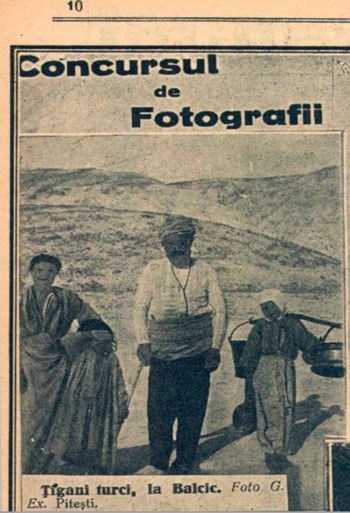
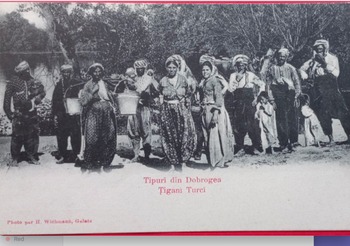
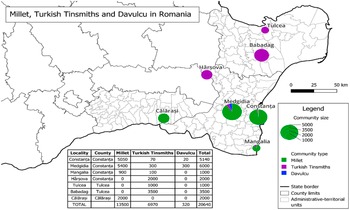
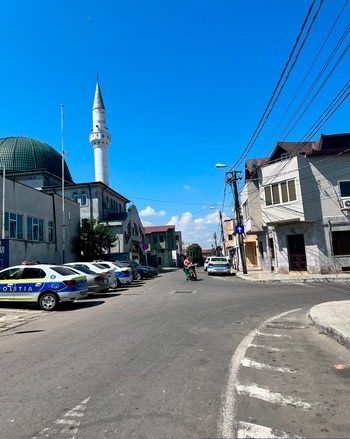
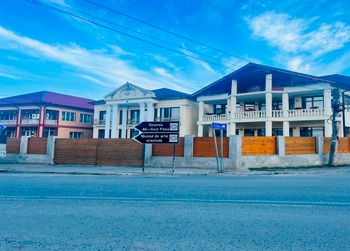
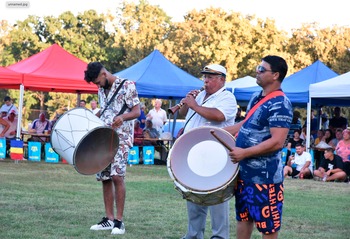

 Open access

