


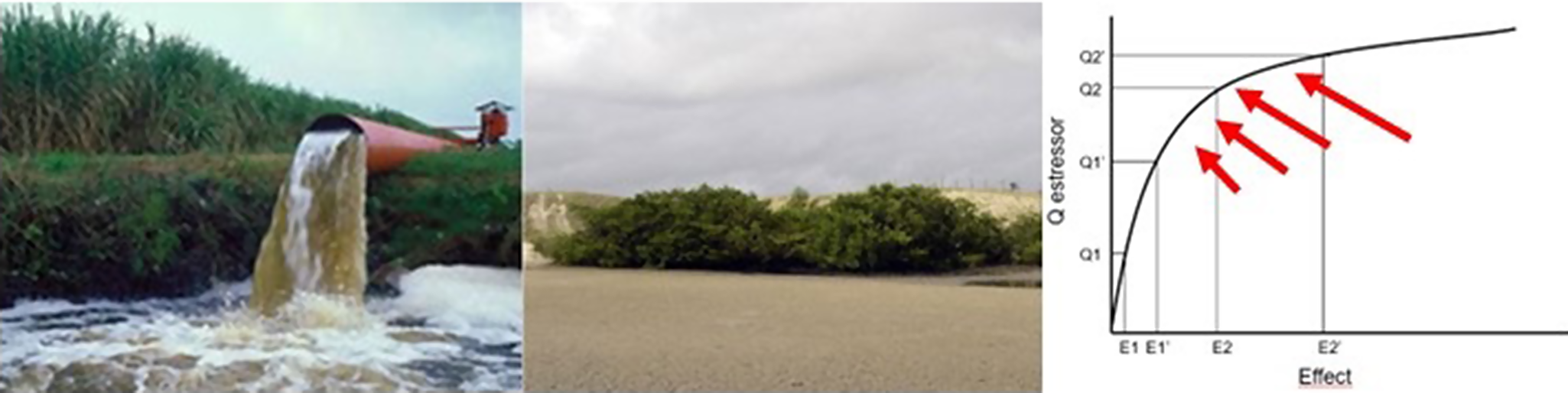



Impact statement
Semiarid mangroves in Brazil cover a small extent compared to humid areas, but with high ecological and economic importance that sustain traditional fisheries and high biodiversity, including many threatened species. Although with lower aboveground biomass, they show similar below ground biomass and soil carbon stocks compared to humid mangroves. Their structure and functioning results from interactions among functional groups of organisms, that strongly influences key ecological processes, but are presently affected by anthropic and climatic factors. Soil biogeochemical mediator microbiota, burrowers/bioturbators and herbivores/detritivores, are the main affected groups, leading to functional degradation and eventual dieback. Notwithstanding legal protection in Brazil, semiarid mangroves witness progressive degradation due to regional drivers, mostly aquaculture and river damming, a worldwide scenario in semiarid coasts. Semiarid mangroves are particularly sensitive to drivers associated with global climate change that are worsened by the natural biologically stressful conditions. Landward migration as a response to climate change is constrained by dunes encroachment and urban expansion. The main strategy to conserve ecosystem services from semiarid mangroves is to preserve the forests. Assisted recovery of degraded sites was successful in most cases and bring back rapidly the crucial ecosystem functions, mostly when used native species with higher recovery capacity after impacts from natural or human-originated events. In Brazil, whilst most of these mangroves are protected, the levels of protection can, in practice, be quite weak, and management should be conducted in partnership with local communities, who rely heavily on mangroves goods and services, as well as spiritual and cultural history, often unaccounted for in policy and management.
Mangroves of the Brazilian Equatorial Margin: extent and forest structure
Brazil has the largest mangrove forest extent in the Americas and second largest worldwide. The most recent mangrove survey in Brazil suggests a total varying from 1,107,200 ha (Bunting et al. Reference Bunting, Rosenqvist, Lucas, Rebelo, Hilarides, Thomas, Hardy, Itoh, Shimada and Finlayson2018) to 1,398,900 ha (ICMBio 2018), depending on the resolution of their mapping. Mangroves occur unevenly distributed along almost the entire Brazilian coast (Figure 1) and present distinct biological and ecological characteristics, depending on climate, fluvial contribution and the geomorphology of the littoral (Lacerda et al. Reference Lacerda, Ferreira, Borges, Ward, Das, Ashton and Thammineni2022a). The Brazilian Equatorial Quaternary Margin borders two large marine ecosystems: the Semiarid Equatorial Coast (SAEC) to the east and the Amazon Macrotidal Mangrove Coast (AMMC) to the west. The two sectors have witnessed increasing environmental pressure from local anthropogenic and global climate change. Mangroves from the two sectors also share some characteristics as a narrow latitudinal distribution (<10°), mean annual temperature and the dominant tree species. However, they differ significantly in rainfall quantities and seasonal distribution, hydric stress and terrigenous supply of sediments. These differences are major controlling parameters of mangrove response to climate change and suggest SAEC mangroves as more vulnerable to environmental pressures. This work reviews the major mangrove processes affected by climate change and how they specifically affect SAEC mangroves and their ecosystems’ response. Eventually, due to the mentioned similarities, comparisons with the AMMC are used to better dimension the impacts on SAEC mangroves.
Location of mangrove forests along the humid and semiarid sectors of the Equatorial Brazilian Coast and their approximate forest area and the relative contribution (%) to the total mangrove area in Brazil. AMMC = Amazon Macrotidal Mangrove Coast; SAEC = Semiarid Equatorial Coast.

The SAEC extends by 1,038 km from the Mangues Secos Point in Maranhão State (2°S, 43°W) to Cape Calcanhar in Rio Grande do Norte State (5°S, 35°W), under tropical semiarid climate with mean annual temperature of ~26oC, annual rainfall varying from 400 to 900 mm and limited continental runoff (~590 m3 s−1) originated from highly seasonal and non-perennial rivers (Soares et al. Reference Soares, Campos, Carneiro, Barroso, Marins, Teixeira, Menezes, Pinheiro, Viana, Feitosa, Sánchez-Botero, Bezerra, Rocha-Barreira, Matthews-Cascon, Matos, Gorayeb, Cavalcante, Moro, Rossi, Belmonte, Melo, Rosado, Ramiresi, Tavares and Garcia2021). Mangroves in the SAEC cover 44,300 ha, about 4% only of mangrove cover in Brazil, mostly as scattered forests or dwarf and scrubby stands (Diniz et al. Reference Diniz, Nerino, Rodrigues, Sadeck, Adami and Souza-Filho2019). The water source is sea water, variably diluted by rainwater and small rivers, presenting high seasonality and site-specificity and strongly dependent on human water use upstream of the hydrographic basins (Marins et al. Reference Marins, Freire, Maia, Lacerda, Lacerda, Kremer, Kjerfve, Salomons, Marshall-Crossland and Crossland2002). Between 1980 and 2000, an increase in SAEC mangrove area of about 20% has been reported (Maia et al. Reference Maia, Lacerda, Monteiro and Souza2006).
The AMMC extends from Cape Orange at 4oN 51oW to Mangues Secos Point in Maranhão State (2°S, 43°W). It comprises broad, lowland coastal plains and has a large fluvial contribution of about 135,000 m3 s−1 and inputting over 109 tons year−1 of sediments. It has a tropical humid climate, high and constant annual average temperature (~27oC) and rainfall (~2,000 mm), a macrotidal regime (>7 m) and is bordered by a broad continental shelf extending 90–250 km. The enormous amount of sediment transported by Amazon basin rivers forms mud flats 20–30 km in width (Proisy et al. Reference Proisy, Gratiot, Anthony, Gardel, Fromard and Heuret2009), serving as sites for mangrove colonisation (Proisy et al. Reference Proisy, Gratiot, Anthony, Gardel, Fromard and Heuret2009). The AMMC harbours 78% of Brazil’s mangroves (~860,000 ha), including the largest (about 700,000 ha) continuous high-density mangrove forest in the world with little change in extent (<2%; 20,000 ha), over the past three decades (Kjerfve and Lacerda Reference Kjerfve and Lacerda1993; Diniz et al. Reference Diniz, Nerino, Rodrigues, Sadeck, Adami and Souza-Filho2019).
Salinity and freshwater supply differ by two to three orders of magnitude between the AMMC and SAEC subregions of the Equatorial Margin of Brazil and are crucial factors regulating mangrove growth, since temperature and solar radiation intensity are relatively similar. The strong seasonality of the SAEC induces high variations in soil and porewater salinity, which may reach values well above the local seawater salinity during the dry season (Marins et al. Reference Marins, Lacerda, Abreu and Dias2003). The infiltration of flood water from the rivers during the wet season keeps soil and porewater salinity lower than seawater. Trees and consequently forest structure reflect this stressor (Komiyama et al. Reference Komiyama, Poungparn, Umnouysin, Rodtassana, Pravinvongvuthi, Noda and Kato2019). At the AMMC, even low seasonal flow is sufficient to keep salinity lower than seawater. As a result, growth of mangrove trees is restricted during the dry season in SAEC, while no constraint to growth occurs in the humid subregion. Along the AMMC the large semidiurnal tidal amplitude, which may exceed 8 m in some places, allows the development of broad mangrove fringes of up to 40 km wide, and the large annual rainfall of more than 2,000 mm and abundant nutrient and freshwater enhances mangrove growth. Avicennia trees are particularly well-developed and can reach 40–45 m in height and up to 1.0 m in trunk diameter. SAEC, although with significant tidal amplitude (up to 4 m), lacks permanent freshwater and nutrient supply from the continent, restricting mangroves to a narrow strip along estuaries, migrating upstream along rivers depending on the extension of the saline intrusion. Rhizophora mangle is the most conspicuous species with heights that seldom exceed 10 m (Kjerfve and Lacerda Reference Kjerfve and Lacerda1993). Salt flats are a common feature in the SAEC mangroves due to strong evapotranspiration, and groundwater salinity can reach three times that of normal seawater, strongly affecting tree growth and producing stunted forests, mainly of Avicennia spp.
In the AMMC, freshwater macrophytes and flooded forest trees and palms invade the transition zone in the upper estuary, whereas in the SAEC, the presence of sand spits and relic dunes at the landward border of mangroves results in invasion by dry coastal ecosystem plants, mostly grasses, but also some associates, such as shrubs like Conocarpus erectus (buttonwood mangrove) and Hibiscus spp., that can only tolerate a small degree of flooding, but can occupy these seldom waterlogged high elevation areas. The landward edge of SAEC mangroves presents high diversity of herbs, sedges and grasses, mostly from the Poacea, Aizoaceae and Amaranthacea families (Silva et al. Reference Silva, Rabelo and Cestaro2020).
Table 1, adapted from Lacerda et al. (Reference Lacerda, Ferreira, Borges, Ward, Das, Ashton and Thammineni2022a), summarises the major physical and structural characteristics of mangrove forests in the SAEC of Brazil, while Figure 2 shows examples of typical forest formations. In summary, four types of forests can be identified along the SAEC: Riverine; Basin; Fringe and Overwash. This division is mainly based on their specific location, but eventually results in different functional and structural attributes.
A simplified characterization of mangrove forest types in the Semiarid Equatorial Coast (SAEC) of Brazil, modified from Lacerda et al. (Reference Lacerda, Ferreira, Borges, Ward, Das, Ashton and Thammineni2022a)

Examples of major mangrove forest types from the Semiarid Equatorial Coast (SAEC) of Brazil. a.1. Riverine forest bordering the Cocó River with the Metropolitan area of Fortaleza city; a.2. Narrow riverine forest limited by the Barreiras Formation in the Jaguaribe river estuary; b.1. Basin forest with high density of pneumatophores from Avicennia sp.; b.2. Basin forest with abundant Rhizophora mangle at the edge of a tidal creek and Avicennia sp. in the back; c.1.Partially eroded fringe forest at the Jaguaribe River mouth; c.2. aerial roots of R. mangle fringing the coast at the Jaguaribe river mouth; d.1. Overwash forest in an estuarine island at the Mundaú river; d.2. Overwash forest growing in newly formed sand banks at the Jaguaribe estuary.

Riverine mangrove along the SAEC occurs along estuaries and are absent from open coasts, in contrast to the extensive and broad stretches of mangroves along the AMMC where they attain complex forest structure and high biomass. Along the SAEC, riverine stands occur in narrow fringes (Figure 2a.1, a.2) along rivers and estuaries margins, typically presenting lower canopy density and overall biomass that are frequently eroded, and trees are blown down by the wind. Well-developed fringe forests occur along the broad mud flat expanse of the Amazon coast, which provides protection from high-energy marine influences. In the SAEC, strong ocean forcing, waves and currents, as well as year-round stronger winds, readily remove any pioneer fringe forests along the open coast (Figure 2c.1), restricting them to the relatively protected waters of estuarine mouths (Figure 2c.2) and within the littoral fringes of coastal lagoons.
Basin forests (Figure 2b.1, b.2) typically occupy the landward portion of mangroves, where flooding occurs mostly during spring tides leading to high soil salinity due to strong evaporation. These extreme conditions result in high organic matter accumulation in soils, but from a poorly structured stunted vegetation, frequently dominated by the salt excreting Avicennia spp.
Overwash forests occur in recently formed fluvial and estuarine islands (Figure 2d.1, d.2) that generally present medium to coarse sands (Lacerda et al. Reference Lacerda, Menezes and Molisani2007; Godoy and Lacerda Reference Godoy and Lacerda2014). There, they are flooded daily by tides with slow accumulation of organic matter in soils, most of the litterfall being exported to adjacent waters. This forest type sometimes also appears colonising beach rock outcrops at the intertidal level.
Biology and ecology of functional groups (FGs)
Mangrove ecosystem properties, such as diversity, structural complexity, productivity and biomass, are influenced by local abiotic factors, for example, coastal geomorphology, rainfall, tidal amplitude, temperature, salinity and soil characteristics (nutrients and oxygen content, grain size, humidity) (Krauss et al. Reference Krauss, Lovelock, McKee, López-Hofman, Ewe and Sousa2008), as well as biotic factors, like soil micro and macro-organism communities’ composition, bioturbation, propagules fixation ability, pollination and herbivory (Cannicci et al. Reference Cannicci, Lee, Bravo, Cantera-Kintz, Dahdouh-Guebas, Fratini, Fusi, Jimenez, Nordhaus, Porri and Diele2021; Kristensen Reference Kristensen2008; Ferreira et al. Reference Ferreira, Ganade and Attayde2015). On the other hand, several attributes of mangrove community structure and function evolved from interactions among organisms, that is, among their niches.
Organisms of different species can perform similar ecological functions or ecosystem processes (independently of their taxonomic position) through ‘functional groups’ (FGs) (Blondel Reference Blondel2003). Thus, key FGs strongly influence mangrove structure and function, which can influence responses to anthropogenic drivers and environmental changes, but reciprocally, these changes can affect FGs ecological roles (Ferreira et al. Reference Ferreira, Ashton, Ward, Hendy and Lacerda2024). Considering the structural resistance and resilience of the forests as crucial features to face climate change and human degradation drivers in semiarid mangroves, the most significant FGs are the biogeochemistry mediators (which include decomposers), bioturbators/burrowers, herbivores and wood borers (Ferreira et al. Reference Ferreira, Ashton, Ward, Hendy and Lacerda2024).
Biogeochemistry mediators
Microorganisms are an extremely important group of organisms in mangrove ecology and functionality (Holguín et al. Reference Holguín, Vazquez and Bashan2001; El-Tarabily et al. Reference El-Tarabily, Sham, Elbadawi, Hassan, Alhosani, El-Esawi, AlKhajeh and AbuQamar2021; Lacerda et al. Reference Lacerda, Ferreira, Borges, Ward, Das, Ashton and Thammineni2022a; Farrer et al. Reference Farrer, Van Bael, Clay and Smith2022). A wide range of bacterial groups are involved in cycling of carbon (C), nutrients and several metals in mangrove soils, with some groups involved in more than one cycle, for example, the nitrogen (ammonification, nitrification, denitrification), sulphur (sulphate reduction), iron (Fe) and phosphorus (P) cycles (Bashan and Holguín Reference Bashan and Holguín2002; Alongi Reference Alongi2021; Ferreira et al., Reference Ferreira, Freire, Rodrigues and Bezerra2022a). Bacteria and fungi can reach around 90% of the total microbial biomass, which also includes algae and protozoa and microphytobenthos, such as Diatomacea and Cyanobacteria, that contribute to significant amounts of buried carbon and trace elements in mangrove soils and in hypersaline tidal flats (Brown et al., Reference Brown, Marotta, Peixoto, Enrich-Prast, Barroso, Soares, Machado, Pérez, Smoak, Sanders, Conrad, Sippo, Santos, Maher and Sanders2021a; Lacerda et al. Reference Lacerda, Ward, Borges and Ferreira2022b).
Mangroves are highly dependent on the efficiency of specific microbial communities both in soil and waters. The microbiome of SAEC mangroves is highly diverse and displays a higher level of complexity than those in the AMMC (see e.g. Andreote et al. Reference Andreote, Jiménez, Chaves, Dias, Luvizotto, Dini-Andreote, Fasanella, Lopez, Baena, Taketani and de Melo2012; Tavares et al. Reference Tavares, Bezerra, Normando, Rosado and Melo2021). SAEC datasets extracted from Rhizophora roots environment were dominated by Proteobacteria (reducing nitrate and sulphur compounds), mainly by Deltaproteobacteria and Gammaproteobacteria, which are part of the core microbiome of mangroves worldwide. Desulfobacterales (anaerobics involved in S and C cycling, and methane and nitrogen transformation) was the most abundant order, and Euryarcheota (Archaea) (active carbon transformation through methanogenesis) is the second most abundant group. Other ubiquitous phyla comprise Planctomycetes, Acidobacteria, Bacteroidetes and Chloroflexi. This microbiome diversity (Shannon Index) shows a significantly positive correlation with salinity, organic C, potential evapotranspiration, minimum temperatures year-round and a significantly negative correlation with annual precipitation. These responses to environmental parameters suggest adaptation to the typical stressful conditions of the SAEC and favour adaptions to a changing environment, of increasing salinity intrusion and decreasing annual rainfall, such as landward migration and increasing nutrient cycling efficiency (Tavares et al. Reference Tavares, Bezerra, Normando, Rosado and Melo2021).
Bioturbators/burrowers
Several functional roles are performed by semiterrestrial Decapods (Crustacea: Decapoda), which are one of the most ecologically significant macrobenthic organisms. This group is dominated mostly by several Brachyuran crabs, such as grapsoids, ocypodoids and xanthoids. Bioturbation by burrowing is mostly driven by several Sesarmids (Grapsoidea), fiddler crabs and Ucides cordatus (Ocypodoidea), and Panopeus sp. and Eurytium limosum (Xanthoidea) (Ferreira and Sankarankutty Reference Ferreira and Sankarankutty2002; Ferreira et al. Reference Ferreira, Alencar and Bezerra2019b). Ocypodid crabs tend to be richer in species in intermediate latitudes (Teles et al. Reference Teles, Peres, Jimenez, Mantelatto and Quimbayo2024), but SAEC mangroves have relatively rich Brachyuran communities, mainly of Grapsids.
Mostly are fossorial species that can be found associated in communal anastomosed long-lasting tunnels (except individual-burrower fiddler crabs) between the roots of R. mangle (Ferreira et al. Reference Ferreira, Alencar and Bezerra2019b), contributing to oxygenating underground tree roots and adjacent soil, and also used by several juvenile and adult fishes, including cyprinodonts, gobiids, fundulids, rivulins, poeciliids and eleotrids for protection (Barletta et al. Reference Barletta, Saint-Paul, Barletta-Bergan, Ekau and Schories2000; Lewis and Gilmore Reference Lewis and Gilmore2007; Lira et al. Reference Lira, Berbel-Filho, Espírito-Santo, Tatarenkov, Avise, Leaniz, Consuegra and Lima2021). In general, the root system of Lumnitzera racemosa and Avicennia spp. seems to impair the construction of these multibranched systems, thus decreasing crab diversity (Ferreira et al. Reference Ferreira, Alencar and Bezerra2019b).
Through burrowing and consequent soil bioturbation these ecosystem engineers can also influence the microbiota and infaunal diversity, and through changes in sediment and porewater physical chemistry, they can influence nutrient availability and therefore tree species growth and productivity (Warren and Underwood Reference Warren and Underwood1986; Kristensen Reference Kristensen2008; Ferreira et al. Reference Ferreira, Bezerra and Mathews-Cascon2019a; Barbanera et al. Reference Barbanera, Markesteijn, Kairo, Juma, Karythis and Skov2022). In SAEC, burrowing by some fiddler crabs (Ocypodoidea) can bury small mangrove propagules, like those of L. racemosa, promoting the dominance of large R. mangle propagules, a tree species with higher biomass and C stock (Ferreira et al. Reference Ferreira, Bezerra and Mathews-Cascon2019a).
Herbivores
Herbivory in mangroves is predominantly performed by crustaceans, insects and also gastropods and depends on the chemical characteristics of leaves of tree species. In general, mangrove leaves present chemicals to support resilience to strong ultraviolet radiation and high soil salinity, which also work as deterrents to herbivores. For example, R. mangle and L. racemosa showed significantly lower area eaten and number of leaves attacked than Avicennia schaueriana, which was attributed to leaf chemical composition of this salt-excreting species, with higher content of sodium, crude fibre, ash content and lower content of total phenols and soluble carbohydrates (Lacerda et al. Reference Lacerda, Rezende, José, Francisco, Wasserman and Martins1986).
Leaf eating crabs are important for energy and carbon flow and provide a food source for predators (Ashton et al. Reference Ashton, Macintosh and Hogarth2003). Crab faeces are rich in nitrogen (Lee Reference Lee2008) and combined with sloppy feeding (Camilleri Reference Camilleri1989) produce smaller fragments available for deposit feeders. One of the most important herbivores at soil level is the big crab Ucides cordatus. By removing the leaf litter and storing below-ground in their burrows, carbon is retained within the mangrove system. Conversely, Aratus pisonii feed on mangrove leaves in the canopy. This crab shows a preference for the leaves of the red mangrove R. mangle over L. racemosa and Avicennia germinans.
While herbivory has not been reported to affect canopy characteristics in mangroves in the SAEC, it can, through differential propagule consumption and herbivory depending on tree species, determine the tree type that establish/remain in a site, and thus the structural/architectural features and biomass of the forest, which can indirectly influence infaunal diversity and nutrient cycling (Smith et al. Reference Smith, Chan, McIvor and Robblee1989; Alongi and Christoffersen Reference Alongi and Christoffersen1992; Ferreira et al. Reference Ferreira, Bezerra and Mathews-Cascon2019a; Barbanera et al. Reference Barbanera, Markesteijn, Kairo, Juma, Karythis and Skov2022). The neotropical crab Goniopsis cruentata has a significant structural role in the forest through the higher consumption of propagules of L. racemosa and Avicennia sp., thus promoting the predominance of R. mangle, which is architecturally more complex and consequently richer in crab species among and over roots’ habitats. Abiotic (tides, rain, temperature, soil) and biotic (FG composition) differences between humid and semiarid mangroves are potentially able to determine differences in tree species composition (Ferreira et al. Reference Ferreira, Bezerra and Mathews-Cascon2019a).
Studies on functional roles of insects in mangroves of the Brazilian Equatorial Margin are very scarce, limiting our knowledge on their full ecological functions in the community. The extent of herbivory depends on diverse factors affecting the palatability and nutritional value of leaves that vary with age, season and between species. Insect herbivory removes less than 5% of leaf biomass, thus with small impact on C and nutrient cycling. However, some insects can cause heavy defoliation events, despite being limited by tannin content (Lacerda et al. Reference Lacerda, Rezende, José, Francisco, Wasserman and Martins1986; Hogarth Reference Hogarth1999; Cannicci et al. Reference Cannicci, Burrows, Fratini, Smith, Ofenberg and Dahdouh-Guebas2008).
Defoliation by insect and consumption of apical buds, despite, in general, not deadly to the trees, can potentially reduce reproductive and vegetative growth, reducing reproductive output and hence influencing tree species recruitment, frequently associated with anthropogenic activities impacting on mangroves (Krauss et al. Reference Krauss, Lovelock, McKee, López-Hofman, Ewe and Sousa2008; Lu et al. Reference Lu, Xiao, Cui, Xu, Lin and Lin2019; Maldonado-López et al. Reference Maldonado-López, Vaca-Sánchez, Canché-Delgado, García-Jaín, González-Rodríguez, Cornelissen and Cuevas-Reyes2019). In the SAEC, insect herbivory was strongly associated with abiotic and biotic factors. Higher intensity of leaf consumption by insects occurred in the dry season, when monthly rainfall varied from 2 to 4 mm and water salinity was >54‰. In the rainy season (70–290 mm; 34–35‰) the degree of total foliar herbivory increased, mostly in L. racemosa and R. mangle (Silva and Maia Reference Silva and Maia2022)
Wood borers
Several marine isopods (Crustacea), Teredinidae mollusks (shipworms) (e.g. Teredo spp.) and wood-boring coleopterans (e.g. cosmopolitan Coccotrypes rhizophorae) are wood borers in mangroves. They can affect the development and even survival of mangrove trees, hence affecting tree diversity and forest architecture (Perry and Brusca Reference Perry and Brusca1989; Svavarsson et al. Reference Svavarsson, Melckzedeck and Osore2002), leading to changes in live and dead biomass and thus aboveground carbon stock. Unfortunately, no study on the effects of marine isopods is known for the SAEC. Teredinids, on the other hand, burrow into mangrove wood and are important in breaking down dead wood, having a significant role in biodegradation, and when abundant can affect the amount of carbon stored in, and released by, the forest. Yet, vacant teredinid tunnels can be exploited by many macro-benthic taxa (e.g. fishes, octopus, polychaetes), enhancing trophic and functional resilience (Hendy et al. Reference Hendy, Michie and Taylor2014, Reference Hendy, Shipway, Tupper, Etxabe, Ward and Cragg2022). The impacts of this FG, however, have hardly been studied along the Brazilian Equatorial Margin, the few reports come from the AMMC, where teredinid molluscs are a significant component of local peoples’ traditional diet, and show they display seasonality with higher activity during the wet season (Filho et al. Reference Filho, Tagliaro and Beasley2008).
Biogeochemistry
Biomass, productivity and carbon stocks
Mangroves from the Equatorial Margin of Brazil are comparatively less known in terms of biomass and carbon (C) stocks than their counterparts on the southern coasts. Table 2 summarises the few most complete studies with comparable methodologies that allows an evaluation of differences between biomasses and C stocks of mangroves from the two subregions of the Equatorial coast (AMMC and SAEC). The small number of studies impedes a generalisation of the findings. However, some results are outstanding. SAEC mangroves present lower aerial biomass and aerial C stock by a factor of 2–5 relative to mangroves in the AMMC. This results from poor structural complexity due to a deficiency of freshwater supply, higher salinity and low inputs of continental-derived nutrients. However, they show similar belowground biomass and soil C stock (Table 2). Exceptionally high aboveground biomass (AGB) values and C contents are found in the Parnaíba River Delta, a 3,700 km2 mangrove forest at the border between the semiarid northeast and the humid Amazon regions. The uniqueness of this area has been highlighted in previous oceanographic studies (Carvalho et al. Reference Carvalho, Marins, Dias, Rezende, Lefèvre, Cavalcante and Eschrique2017; Chielle et al. Reference Chielle, Marins, Dias, Borges and Rezende2023a, Reference Chielle, Marins, Cavalcante and Cotovicz2023b), but the logistic and methodological challenges have hampered more detailed studies in the region and proper estimates of BGB and soil C stock are not yet available.
Comparisons of carbon and aboveground (AGB) and belowground biomass (BGB) in t ha−1 between humid and semiarid mangroves in the equatorial coast of Brazil

Notes: Only forests dominated by Rhizophora were used. *Soil carbon transformed from the original unit to tC ha−1.**Transformed from biomass to Carbon values using a 0.47 conversion Factor, following Portela et al. (Reference Portela, Espinola, Vallares, Amorin and Frota2020) and Schumacher (Reference Schumacher2002). 1. Santos et al. (Reference Santos, Beltrão and Trindade2019); 2. Kauffman et al. (Reference Kauffman, Bernardino, Ferreira, Giovannoni, Gomes, Romero, Jimenez and Ruiz2018a); 3. Rovai et al. (Reference Rovai, Twilley, Worthington and Riul2022); 4. Portela et al. (Reference Portela, Espinola, Vallares, Amorin and Frota2020); 5. Kauffman et al. (Reference Kauffman, Bernardino, Ferreira, Bolton, Gomes and Nobrega2018b).
Meng et al. (Reference Meng, Xia, Li and Meng2017) reported a positive relationship between C stocks in AGB and in BGB of mangroves in China and suggested this relationship could be applicable worldwide and thus used to obtain more accurate estimates of mangrove blue C stocks at regional or global scales. Their review, however, failed to include data from the Equatorial Western Atlantic, and the preliminary results available suggest this relationship does not hold for SAEC mangroves. Therefore, predictions of decline of C stock in AGB and BGB (C in roots and soil) under any future climate change scenario may result differently depending on the forest type and location (Singh et al. Reference Singh, Schwendenmann, Wang, Adame and Mandlate2022).
Season is an important variable regulating forest productivity in the SAEC, being higher in the rainy season, much like any other mangroves worldwide (Portela et al. Reference Portela, Espinola, Vallares, Amorin and Frota2020; Gomes et al. Reference Gomes, Vescovi and Bernadino2021). Highest productivity occurs under low soil and porewater salinity and with adequate supply of nutrients and freshwater restricted to the short wet season. In pristine mangroves in the SAEC, increased fluvial discharge strongly influences nutrient concentrations and therefore availability to mangroves. Higher dissolved N and soluble reactive P concentrations occurs in the rainy season (Barroso et al. Reference Barroso, Becke and Melo2016; Silva et al. Reference Silva, Silva-Cunha, Passavante, Grego and Muniz2009; Nóbrega et al. Reference Nóbrega, Ferreira, Romero, Marques and Otero2013), a pattern also observed after storms events in other semiarid coasts of the world and attributed to increased leaching and transport of materials from river upper basins and fluvial waterways (Eyre and Ferguson Reference Eyre and Ferguson2005). This nutrient pulse during the short rainy season may be responsible for up to 85% of the total nutrients exported to the lower estuary. Unfortunately, to our knowledge, there is no estimate of mangrove litterfall rates in SAEC. However, mangrove forests under similar climatic and geological conditions shows litterfall rates in the same range of values observed in semiarid littorals; 82 gC m−2 year−1 in the Gulf of California, Mexico (Arreola-Lizarraga et al. Reference Arreola-Lizarraga, Flores-Verdugo and Ortega-Rubio2004); 212 gC m−2 year−1 in Karachi, Pakistan (Farooqui et al. Reference Farooqui, Shafique, Khan, Ali, Iqbal, Pirzada and Siddiqui2012) and from 57 to 238 gC m−2 year−1 in semiarid Caribbean mangroves (Lacerda Reference Lacerda2002). Based on the C content of typical thyolitic gleysols, mangrove soils (Suárez-Abelenda et al. Reference Suárez-Abelenda, Ferreira, Camps-Arbestain, Rivera-Monroy, Macías, Nóbrega and Otero2014; Nóbrega et al. Reference Nóbrega, Ferreira, Siqueira Neto, Mendonça, Romero and Otero2019) estimated extremely high soil C stock of 8,200 ± 900 gC m−2. Unfortunately, this extremely high estimate cannot be confirmed by field data. Year-round larger fluxes in the AMMC result in highest litterfall that vary from 51 to 203 gC m−2 year−1 (Gonçalves et al. Reference Gonçalves, Fernandes and Carvalho2006; Nascimento et al. Reference Nascimento, Mehlig and Menezes2006; Fernandes et al. Reference Fernandes, Nascimento and Carvalho2007; Mehlig Reference Mehlig2001).
Average whole ecosystem carbon stocks per unit of area in AMMC mangroves (361–746 t C ha−1; at 0°40′S and annual rainfall of 2,300 mm) (Kauffman et al. Reference Kauffman, Bernardino, Ferreira, Bolton, Gomes and Nobrega2018b); and those from the humid eastern coast, the Jaguaripe estuary in Bahia State (at 13°11′S, 1 and annual rainfall of 350 mm) are similar (250–633 Mg C ha−1) (Hatje et al. Reference Hatje, Masqué, Patire, Dórea and Barros2021). This clearly confirms higher carbon stocks are more clearly associated with humid climate, rather than latitude. An exception is the urban-influenced mangroves in the SAEC, where soil carbon sequestration rates, due to high allochthonous aeolian and urban inputs of organic material rather than autochthonous production, are up to 14 times higher than the global average (Ward et al. Reference Ward, Lacerda, Cerqueira, Hugo and Hernandez2023). A detailed characterisation of the mangrove soils organic matter in urban-impacted and rural areas mangroves found a significant contribution of anthropogenic sources in the total carbon accumulated in sediments, and a clear increase in importance of anthropogenic carbon in the more urbanised sites (Mounier et al. Reference Mounier, Lacerda, Marins and Makowski2018). Passos et al. (Reference Passos, Penny, Sanders, França, Oliveira, Santos and Barcellos2021) reported increasing accumulation rates of total organic carbon and total nitrogen in the Suape estuary, in NE Brazil following the port-industrial facilities development starting in the 1980’s, reflecting urbanisation and industrial growth. The anthropogenic contribution was clearly shown by the observed heavier δ15N values in the sediment column. This scenario, however, seems not exclusive of SAEC mangroves, since in humid coastlines, mangroves adjacent to or within metropolitan regions show increased sediment accretion rate (SAR) and carbon sequestration and contents in sediments (Sanders et al. Reference Sanders, Eyre, Santos, Machado, Luiz-Silva, Smoak, Breithaupt, Ketterer, Sanders, Marotta and Silva-Filho2014). Robust sampling undertaken along estuarine gradients strongly suggests that soil Corg stocks are considerably less variable along the sea–land estuarine gradient than across the intertidal gradient from the water edge to the border with terrestrial vegetation. Although AGB is much more variable along the longitudinal estuarine gradient, the highest AGB is observed in the lower estuary and lowest ABG in the upper estuary (Hatje et al. Reference Hatje, Masqué, Patire, Dórea and Barros2021).
Sulphur and iron soil chemistry
The AMMC is dominated by soils with significant amounts of Fe and Al, classified as Ferri-humuluvic Spodosols and Hydromorphic Arenics, a few meters in thickness, with horizons containing significant proportions of organic matter and Fe. Mangrove soils, mostly halomorphic and hydromorphic Gleisols in the AMMC, receive a large amount of Fe from upland soils. Clay and silt fractions predominate with moderate to high amounts of organic matter and soluble salts. They are weakly consolidated, greyish to black in colour, with the overwhelming presence of H2S (Schaefer et al. Reference Schaefer, Lima, Teixeira, Vale, Souza, Corrêa, Mendonça, Amaral, Campos, Ruivo, Curi, Ker, Novais, Vidal-Torrado and Schaefer2017). Iron content is unaffected by seasonality due to a surplus of water even in the dry season. These circumstances promote nearly permanent anoxic conditions and allow the precipitation of pyrites and the accumulation of chalcophile elements, including toxic heavy metals of environmental significance, such as Cd, Pb, Hg, Zn and Cu.
SAEC mangroves soils are characterised by tertiary and quaternary deposits forming coastal plains constituted of sandy soils closer to the coast and yellow-red latosols (mostly oxisols) inland (Lacerda et al. Reference Lacerda, Molisani, Sena and Maia2008). They are relatively poorer in iron content resulting from the relatively smaller Fe input from upstream basins (Ferreira et al. Reference Ferreira, Otero, Vidal-Torrado and Macías2007, Reference Ferreira, Nóbrega, Queiroz, Souza Júnior, Barcellos and Ferreira2021). During the wet season, suboxic to anoxic conditions may develop as in the AMMC. A strong water deficit in the dry season and increased flooding by oxic seawater solubilise deposited sulphides and releases Fe and heavy metals to porewaters, which are converted to Fe oxyhydroxides at the rhizosphere level.
The production of sulphides derives from the anaerobic decomposition of organic matter. Sulphides accumulate in the sediment porewater and may exceed the tolerance threshold of mangroves. In the AMMC, Fe(III) (hydr)oxides efficiently mitigate sulphide toxicity to mangroves by partially avoiding rapid sulphide accumulation by sequestering it in the sediment in the form of pyrite or jarosite (Cobacho et al. Reference Cobacho, Janssen, Brekelmans, van de Leemput, Holmgren and Christianen2024). This adaptation may be impaired during the long dry season in the SAEC resulting in higher toxicity to mangrove plants. Framboidal pyrite crystals about 40 μm abound in the sediments of SAEC mangrove soils, an example is shown in a scanning electron microscopy photograph in Figure 3. The X-rays analysis of this framboid reveals the dominant presence of S (Figure 3a) and Fe (Figure 3b), elements forming the most common type of pyrites. Through the same technique, it is possible to reveal the presence of chalcophile toxic heavy metals in the framboid, such as copper (Cu). These metals can be remobilised to porewaters during the longer dry season.
Framboidal pyrite forming in mangrove sediments from the SAEC of Brazil, mostly formed by sulphur (a) and iron (b), but with considerable contents of other elements, including toxic heavy metals.

The strong seasonal shifts of fluvial flux variability in the SAEC strongly affects biogeochemical processes at the soil–air interface, including evapotranspiration that significantly affect redox-sensitive biogeochemical processes, including root radial oxygen loss, iron plaque formation through iron and sulphate reduction and pyrite oxidation. These will impact on productivity, biomass growth and root exudate release, potentially affecting fauna activity, and in the case of FG (Araújo Júnior JM et al. Reference Araújo Júnior JM, Ferreira, Suarez-Abelenda, Nóbrega, Albuquerque, Bezerra and Otero2016), key biogeochemical processes and ecosystem functioning and services. Precipitation of carbonates may occur, as soil contents can vary from 4 to 11%, contributing to SARs (Albuquerque et al. Reference Albuquerque, Ferreira, Nóbrega, Romero, Souza Júnior, Meireles and Otero2014). Redox-sensitive micronutrients, such as Fe and Mn, are particularly affected by shifts in fluvial fluxes (Lacerda et al. Reference Lacerda, Ward, Borges and Ferreira2022b; Aragon and Miguens Reference Aragon and Miguens2001) and can eventually impact on nutrient balance and availability of plant uptake as well as export to adjacent coastal areas, in particular phosphorus (Silva et al. Reference Silva, Lacerda, Ovalle and Rezende1998; Marins et al. Reference Marins, Lacerda, Araújo, Fonseca and Silva2020).
Response to anthropogenic stressors
Contamination and pollution
Sulphate reduction by-products pose threats to mangroves that adapt via a range of anatomical and physiological mechanisms dependent on species, which eventually control pollutant transfer. Distribution of iron in the rhizosphere of the dominant neotropical mangrove species shows the formation of iron-plaques that are the most effective barriers to trace metal uptake and translocation by mangrove plants (Machado et al. Reference Machado, Gueiros, Lisboa Filho and Lacerda2005; Cheng et al. Reference Cheng, Liu, Tam, Wang, Li and Chen2010). Relatively less reducing environmental conditions in mangrove sediments of the SAEC, as discussed in the previous section on Fe geochemistry, may reduce the formation and significance of iron plaques in fixating toxic metals in the rhizosphere. In the semiarid Jaguaribe River Estuary, iron plaques contribute to an average fraction of the total Cu content in roots varying from 25.8 to 42.7%. Minimum contribution, meaning more Cu being uptake by roots, occurred in less reducing Eh, whereas maximum contribution occurred in the more reducing conditions (Lacerda et al. Reference Lacerda, Cavalcante, Soares and Marins2024). In these mangroves, Cu concentrations are 10 times higher than those reported for these species in mangroves from humid mangroves in SE Brazil, where soil redox potential is extremely negative (−316 to −327) (Madi et al. Reference Madi, Boeger and Reissmann2015), corroborating that the less reducing conditions of the semiarid mangroves result in higher metal availability for plant uptake. In these humid areas, metal retention in iron plaques is much higher, varying from 62% in Avicennia schaueriana to 87% in R. mangle (Machado et al. Reference Machado, Gueiros, Lisboa Filho and Lacerda2005). In addition, Fe accumulation in the salt excretion glands of A. germinans from the SAEC suggests that salt excretion can help decrease internal plant concentrations of some toxic metals.
The capacity of mangroves to immobilise toxic metals can be used for pollution mitigation measurements and rehabilitation of mangrove as filters to protect adjacent coastal areas from metals leaching from ground water, avoiding contamination of adjacent coastal waters. Figure 4 compares the vertical distribution of selected heavy metals in mangroves from afforested and bare degraded areas sediments surrounding a landfill in a humid region. The strong capacity of mangrove rhizosphere to immobilise metals is clearly shown by the sharp increase in total metal contents at the sediment layers showing highest root biomass in the afforested site, whereas in bare, degraded mangrove sediments metal profiles show a steadily increase in concentrations towards the surface suggest transfer to pore and surface waters. This entire mechanism can be disrupted by the impact on the plant metabolism due to hyper salinity, resulting from reduced rainfall and increased saline intrusion, and smaller porewater contents of dissolved iron due to higher Eh. These are typical conditions found in SAEC mangroves (Lacerda et al. Reference Lacerda, Ward, Borges and Ferreira2022b). This discussion, however, may be very preliminary, due to the scarcity of data on iron plaque formation and metal immobilisation in both the SAEC and AMMC mangroves.
Iron plaque surrounding the external cortex of R. mangle roots and root biomass distribution and the distribution of Zn and Hg concentrations in sediment cores from afforested and bare degrade mangroves. Adapted from Lacerda et al. (Reference Lacerda, Cavalcante, Soares and Marins2024) and Machado et al. (Reference Machado, Moscatelli, Rezende and Lacerda2002), respectively.

Excess nutrients from anthropogenic sources trigger eutrophication in many mangrove-dominated estuaries along the SAEC, mostly due to poor sanitation, sewage treatment and inadequate waste disposal. This problem may affect the AMMC but considering the extension of their estuaries and coastal mangroves and low density of human population, no studies have quantified the eutrophic state of the region’s mangroves, except for specific locations. In addition, rapidly expanding intensive shrimp farming has greatly increased the eutrophication pressure on mangrove ecosystems in the SEAC due to excess nutrients (Lacerda et al. Reference Lacerda, Borges and Ferreira2019), and today it is by far the most significant source of nutrients to SAEC mangroves, with the exception of the urban mangroves surrounding the metropolitan areas of northeastern Brazil capital cities. As a comparison, the AMMC has less than 3% of the total operating shrimp farms in the SAEC (Lacerda et al. Reference Lacerda, Marins and Dias2020). Mangroves have been suggested to act as filters to human-derived nutrients, based on actual measurement of a net import of nutrients by mangroves, observations have shown that only a fraction of the nutrient input entering the forest is exported back to adjacent coastal areas (Sanchez-Carrillo et al. Reference Sanchez-Carrillo, Sanchez-Andre, Alatorre, Angeler, Lvarez-Cobelas and Arreola-Lizarraga2009; Silva et al. Reference Silva, Lacerda, Ovalle and Rezende1998), while others reached the same conclusion by modelling nutrient concentrations in waters as a function of dilution (Bin and Dushof Reference Bin and Dushof2004). Therefore, mangroves seem to actively immobilise this element either accumulating them in mangrove biomass and/or sediments. At the SAEC, although nutrient inputs may be limiting, mangroves may attain high productivity, through an efficient recycling of limiting nutrients (Holguín et al. Reference Holguín, Vazquez and Bashan2001). Sediment fauna also influences this process but seems very site-specific (Ferrante and Fearnside Reference Ferrante and Fearnside2019). Marins et al. (Reference Marins, Lacerda, Araújo, Fonseca and Silva2020) and Sanders et al. (Reference Sanders, Eyre, Santos, Machado, Luiz-Silva, Smoak, Breithaupt, Ketterer, Sanders, Marotta and Silva-Filho2014) reported a continuous increasing threat in total nitrogen and phosphorus, respectively, in mangrove sediments following the increasing intensity of anthropogenic drivers, similar to observations by Queiroz et al. (Reference Queiroz, Ferreira, Taniguchi, Barcellos, Nascimento, Nóbrega, Otero and Artur2020) and extended to a verified increase in GHG emissions (Queiroz et al. Reference Queiroz, Artur, Taniguchi, Silveira, Nascimento, Nóbrega, Otero and Ferreira2019; Cotovicz et al. Reference Cotovicz, Ribeiro, Régis, Bernardes, Sobrinho, Vidal, Tremmel, Knoppers and Abril2021).
Damming
River damming and waterways diversion causes extensive changes in hydrodynamics and sedimentation in semiarid estuaries, particularly, siltation of estuaries and erosion of the coastline due to reducing sediment supply to the coast (Ward et al. Reference Ward, Lacerda, Cerqueira, Hugo and Hernandez2023). Most rivers along the SAEC are small and intermittent and show a well-defined hydroperiod (Maltchik and Medeiros Reference Maltchik and Medeiros2006). During the dry season, sediments accumulate in the river channels and the freshwater flow is almost non-existent. The highest fluxes in the wet season are capable of transporting large amounts of sediments to the continental shelf. Changes in the drainage of the river basins by flow diversion and the construction of multiple dams in the past three decades (Molisani et al. Reference Molisani, Cruz and Maia2006) simultaneous to the climate change-driven reduction in annual rainfall (Cunha et al. Reference Cunha, Zeri, Deusdará Leal, Costa, Cuartas, Marengo, Tomasella, Vieira, Barbosa, Cunningham, Cal Garcia, Broedel, Alvalá and Ribeiro-Neto2019) have reduced freshwater inputs during the rainy season, thereby affecting the fundamental transfer fluxes of water and materials between the continent and the ocean.
The main effects of river damming and diversion are that the reduced and frequently regulated fluxes to estuaries are unable to wash out sediments and those accumulate along fluvial beaches, settle and create new, or enlarge existing islands and bars, creating new space for mangrove colonisation (Godoy et al. Reference Godoy, Meireles and Lacerda2018). In the Pacoti river estuary, another estuary in the semiarid coast, mangrove expansion occurred over abandoned salt pans and on recently enlarged estuarine beaches and islands, also resulting from decreased and regulated fluvial flow by a sequence of dams built less than 100 km from the mouth of the river, to supply water to the metropolitan region of the Ceará (CE) State capital, Fortaleza. Natural fluxes varying from 1.0 to 19 m3 s−1 were regulated to 1.7 m3 s−1 year-round. These new areas were quickly occupied and fixed by mangroves, expanding the forest cover from about 71 ha in 1958 to 142 ha in 1999, following dam construction and further expanding to 144 ha in 2004, probably responding to increased ocean forcing (Lacerda et al. Reference Lacerda, Menezes and Molisani2007). In addition to controls on river flows, the reduced transport capacity of rivers increased sediment retention in estuaries, which has been aggravated by a simultaneous decrease in rainfall over the SAEC of 4.8–5.6 mm year−1 in the last 30 years (Moncunill Reference Moncunill2006; Alvalá et al. Reference Alvalá, Cunha, Brito, Seluchi, Marengo and Moraes2019; Marengo et al. Reference Marengo, Alves, Alvalá, Cunha, Brito and Moraes2018).
Aquaculture
One of the most significant drivers of environmental impacts on the SAEC mangroves is intensive shrimp farming, mostly after recent changes to the Brazilian Forest Code, that have weakened protection for mangroves and associated salt flats (Ferreira and Lacerda Reference Ferreira and Lacerda2016a, Reference Ferreira and Lacerda2016b). Although the SAEC has only 4% of the total Brazilian mangrove area (ICMBio 2018), it produces over 96% of cultivated shrimp in the country. While only a small area of Northeast mangroves has been directly converted to aquaculture ponds (ICMBio 2018), this direct and indirect forest loss, reported less than 8% of the total mangrove area of the SAEC (Maia et al. Reference Maia, Lacerda, Monteiro and Souza2006), may be proportionally more significant than in mangroves of the humid sector of the Equatorial coast. The reason for this being that SAEC coastal waters are highly oligotrophic and, therefore, primary productivity and fisheries are largely dependent on nutrient fluxes from mangrove-dominated estuaries.
Regional intensive shrimp aquaculture in the SAEC, although a relatively recent phenomena, has grown over 2,000% since 1997 (Figure 5), although it has stabilised to an annual production of about 70,000 tons and covering a total pond area of 30,000 ha over the past decade (Valenti et al. Reference Valenti, Barros, Moraes-Valenti, Bueno and Cavalli2021). Typically, shrimp ponds are built in mangrove-adjacent salt flats rather than the mangroves themselves, but they maintain periodic hydrological connectivity through dammed channels, allowing the flushing of effluents to local mangrove tidal creeks. The main impacts on mangroves are, therefore, mostly indirect, due to the release of nutrient-rich, oxygen demanding effluents and changes in hydrology, which strongly affect ecosystem functioning, decrease of ecosystem service provision, reduction in nutrients, primary productivity and carbon storage capacity, and the mangrove’s efficiency as an estuarine filter (Lacerda et al. Reference Lacerda, Ward, Ferreira, Borges, Godoy and Meireles2021).
Shrimp aquaculture production and pond area from 1997 to 2021 in the SAEC (adapted and based on figures from Valenti et al. Reference Valenti, Barros, Moraes-Valenti, Bueno and Cavalli2021).

Shrimp pond effluents are enriched not only in nutrients but also in trace elements, such as Cu and mercury (Hg) present in aquafeed and chemicals used in the production process. Emission factors of N, P, Cu and Hg are higher than all other anthropogenic sources and concentrations in excess of natural levels and ubiquitous in adjacent tidal creek waters. Mangroves within the Jaguaribe river estuary, a significant production area in the SAEC, with over 3,600 ha of shrimp ponds, have increased annual P emissions by 30% to 43.9 tons, following shrimp pond area increase between 2001 and 2006 (Marins et al. Reference Marins, Paula Filho, Eschrique and Lacerda2011). This was followed by an additional increase to 69 tons in 2013 resulting from another increase in shrimp pond area (Marins et al. Reference Marins, Lacerda, Araújo, Fonseca and Silva2020), effluents from the local shrimp aquaculture represent over 60% of the total phosphorus load from natural and anthropogenic sources to the lower Jaguaribe Basin (Lacerda et al. Reference Lacerda, Ward, Ferreira, Borges, Godoy and Meireles2021). Local mangroves receiving these effluents had their efficiency to accumulate P reduced by over 50%, relative to mangroves in estuaries not affected by shrimp farm effluents, triggering algal blooms and eutrophication in the adjacent estuarine waters (Marins et al. Reference Marins, Lacerda, Araújo, Fonseca and Silva2020).
Changes in tidal creek hydrology also exert a significant impact on mangroves. Reduction in mangrove canopy health adjacent to shrimp farms has been reported and in certain areas has led to the complete degradation and loss of mangrove forests. Normalized Difference Vegetation Index (NDVI) comparing the photosynthetic activity related to canopy structure showed a spatial relationship between mangroves loss and increasing shrimp farm area (Alatorre et al. Reference Alatorre, Sanchez-Carrillo, Miramontes-Beltr, Medina, Torres-Olave and Bravo2016). At the Jaguaribe estuary, nearly 30% of the total mangrove forest exhibited canopy degradation evidenced by a decreasing NDVI following shrimp farm expansion from 2003 to 2017 (Figure 6). There was a 15% reduction in NDVI between 2003 (0.78) and 2008 (0.65), following shrimp pond area increase from 340 to 1,600 ha; in 2017, there was a further decrease to 0.2, when shrimp farms area increased 10-fold to about 3,400 ha, notwithstanding no direct conversion of mangroves to shrimp ponds. This reduction in the health of mangrove forests is not added to the direct area loss (8%), when computing total area loss of mangrove forest due to shrimp aquaculture. As in the Jaguaribe estuary, this additional canopy loss of integrity would increase the actual mangrove loss up to 15% (Lacerda et al. Reference Lacerda, Ward, Ferreira, Borges, Godoy and Meireles2021).
Normalized Difference Vegetation Index (NDVI) of mangrove forests in a Jaguaribe estuary tidal creek receiving shrimp pond effluents in the SAEC.

Decommissioning of shrimp farms is not included in Brazilian environmental legislation; soil damage and remaining infrastructure may impair or complicate mangrove restoration and their long-term existence may trigger the occupation of abandoned farms by other activities, resulting in permanent exclusion of mangroves from these areas (Ferreira and Lacerda Reference Ferreira and Lacerda2016a).
Global climate change
Climate change represents an increasing direct threat to semiarid mangroves (Alongi Reference Alongi, Thammineni and Ashton2022), whereas indirectly it can reinforce impacts from local anthropogenic activities (Gilman et al. Reference Gilman, Ellison, Duke and Field2008; Moomaw et al. Reference Moomaw, Chmura, Davies, Finlayson, Middleton, Natali, Perry, Roulet and Sutton-Grier2018; Ashton Reference Ashton, Thammineni and Ashton2022). Contrary to mangroves in humid regions, SAEC mangroves are already under stress from natural drivers, and as in other extreme environments, the impacts from climate change are a reality and have already altered mangrove forest’s structure, extent, distribution and functioning along this coast. Impacts of climate change are triggered, mostly from rising temperatures, sea level rise (SLR), coastal acidification, changes in precipitation patterns, increased storms and extreme weather events and rising atmospheric CO2, among others (Ward et al. Reference Ward, Friess, Day and Mackenzie2016).
While occurring and predicted, effects of climate change over mangrove forests have been extensively addressed (e.g. Ward et al. Reference Ward, Friess, Day and Mackenzie2016; Ward and Lacerda Reference Ward, Lacerda, Sidik and Friess2021; Alongi Reference Alongi, Thammineni and Ashton2022), empirical evidence is still scarce and their indirect effects through impacts on the associated biota are not yet well understood. There are concerns that climate change stressors combined with other anthropogenic stressors impact key biotic FGs resulting in functional degradation potentially eroding resilience and leading to stand dieback (Ferreira et al. Reference Ferreira, Lacerda, Rodrigues and Bezerra2023) and under certain circumstances, even complete loss of mangroves from certain regions of the SAEC. In addition, the increasing water demand by a growing population along the SAEC requires more damming of rivers and reservoir construction, which will further decrease water and sediment load from the continent to the sea, exacerbating the impacts of climate change.
In summary, mangrove responses to climate change are different, or at least not the same intensity when comparing in semiarid (SAEC) with humid (AMMC) mangroves. For most drivers, impacts are stronger on SAEC mangroves than at the AMMC, mostly due to the already stressful conditions of the SAEC compared to the relatively optimal environmental conditions verified in the AMMC. Table 3 summarises the main climate change impacts on the function of SAEC mangroves from drivers associated with climate change and makes a comparison with humid regions mangroves. Further, each major driver is discussed individually.
A summary of reported drivers of impacts on mangrove ecosystem functioning associated with global climate change in humid and semiarid coasts of the Equatorial Margin of Brazil

Notes: 1. Alongi (Reference Alongi2015); 2. Ward and Lacerda (Reference Ward, Lacerda, Sidik and Friess2021); 3. Jennerjahn et al. (Reference Jennerjahn, Gilman, Krauss, Lacerda, Nordhaus, Wolanski, Rivera-Monroy, Lee, Kristensen and Twilley2017); 4. Makowski and Finkl (Reference Makowski and Finkl2018); 5. Soares et al. (Reference Soares, Campos, Carneiro, Barroso, Marins, Teixeira, Menezes, Pinheiro, Viana, Feitosa, Sánchez-Botero, Bezerra, Rocha-Barreira, Matthews-Cascon, Matos, Gorayeb, Cavalcante, Moro, Rossi, Belmonte, Melo, Rosado, Ramiresi, Tavares and Garcia2021); 6. Azevedo et al. (Reference Azevedo, Pestana, Rocha, Meneguelli-Souza, Lima, Almeida and Souza2018); 7. Lacerda and Miguens (Reference Lacerda and Miguens2011)); 8. Nguyen et al. (Reference Nguyen, Nghia, Nguyen, Le, Tran, Duong, Bohm and Furniss2020); 9. Lacerda et al. (Reference Lacerda, Marins and Dias2020); 10. Lei et al. (Reference Lei, Zhong, Duan and Pan2019); 11. Bergamaschi et al. (Reference Bergamaschi, Krabbenhoft, Aiken, Patino, Rumbold and Orem2012); 12. Morgado et al. (Reference Morgado, Santos, Sampaio, LACERDA, Soares, Vieira and Abreu2021); 13. Cai et al. (Reference Cai, Ng, Geng, Jia, Wu, Wang, Liu, Gan B Yang, Santoso, Lin, Li, Liu, Yang, Ji, Collins and McPhaden2023); 14. Tavares et al. (Reference Tavares, Bezerra, Normando, Rosado and Melo2021); 15. Sippo et al. (Reference Sippo, Maher, Tait, Holloway and Santos2016); 16. Borges et al. (Reference Borges, Djenidi, Lacroix, Théate, Delille and Frankignoulle2003).
Global and regional increases in air and soil temperature
In the recent extreme drought in the Amazon region, temperatures approached the survival threshold of a range of species of fishes, crabs, trees and microorganisms of the Amazon forest (Pörtner et al. Reference Pörtner, Scholes, Arneth, Barnes, Burrows, Diamond, Duarte, Kiessling, Leadley, Managi, McElwee, Midgley, Ngo, Obura, Pascual, Sankaran, Shin and Val2023). Temperatures at the SAEC under natural semiarid conditions added to global warming may have already been very close to the survival threshold of mangrove fauna and flora. Rising temperatures can affect mangrove sediment microorganism communities that mediate OM composition and nutrient/pollutant availability, and eventually biogeochemical processes (Kristensen Reference Kristensen2008; Booth et al. Reference Booth, Fusi, Marasco, Mbobo and Daffonchio2019; Fusi et al. Reference Fusi, Booth, Marasco, Merlino, Garcias-Bonet, Barozzi, Garuglieri, Mbobo, Diele, Duarte and Daffonchio2022). Tavares et al. (Reference Tavares, Bezerra, Normando, Rosado and Melo2021), demonstrated that humid and semiarid mangroves react differently to increasing temperature. The large buffering capacity of humid mangroves, due to greater freshwater flux and larger and more structured forests, will reduce abrupt changes in temperature. Under semiarid conditions, adaptation to these swift changes in temperature of the already stressed mangroves close to the limits of their autecological tolerances will probably decrease microbiome biodiversity and interrelationships.
Increases in temperature and ocean heat waves in the SAEC impact already stressed invertebrate fauna, crabs in particular, and can increase thermohaline stress over gills, prompting burrowing for protection in some species, potentially altering propagule consumption and recruitment patterns (Ferreira et al. Reference Ferreira, Ganade and Attayde2015). Temperature increases and greater intensity and duration of heatwaves reduce larval survival recruitment of the fiddler crab Leptuca thayeri (Marochi et al. Reference Marochi, Grande, Pardo, Montenegro and Costa2022). Effects of increased temperatures can also affect burrowing crabs indirectly through disease outbreaks, algal blooms, eutrophication or hypoxia in mangroves of the SAEC (Orélis-Ribeiro et al. Reference Orélis-Ribeiro, Boeger, Vicente, Chammas and Ostrensky2011). On the other hand, the dominant anemophily of mangrove tree species and their less specialised association with few unspecialised pollinator insects (Nadia and Machado Reference Nadia and Machado2014; Diniz et al. Reference Diniz, Nadia, Mello and Machado2022), probably dampens the risk of disruption of pollination function by increasing temperature.
SLR
Among many impacts from global climate changes affecting the semiarid mangroves of Brazil, SLR, caused ultimately by ocean warming, results in increasing frequency and intensity of the impacts of marine hydrological events, such as waves and tidal forcing. But even earlier than these catastrophic events, SLR strongly alters hydrology, surface and groundwater salinity and soil stability, challenging mangroves with new environmental situations and competitive requirements (Jennerjahn et al. Reference Jennerjahn, Gilman, Krauss, Lacerda, Nordhaus, Wolanski, Rivera-Monroy, Lee, Kristensen and Twilley2017). In Brazil, mangroves advancing over higher coastal plain vegetation have been recorded, since the last decade of the 19th century probably due to the increase in SLR since the end of the Little Ice Age, with a significant intensification from the mid-20th century onwards (Bozi et al. Reference Bozi, Figueiredo, Rodrigues, Cohen, Pessenda, Alves, de Souza, Bendassolli, Macario, Azevedo and Culligan2021).
SLR is threatening mangrove ecosystems throughout the semiarid region and is further exacerbated by decreasing annual rainfall and damming of rivers. Along the northern extreme of the AMMC, a study of 38 years of spatial monitoring using Landsat images showed a consistent landward migration of mangroves along the shoreline and at the upper region of estuaries, totalling nearly 160 km2 in net area increase (Visschers et al. Reference Visschers, Santos and Franco2022). At the SAEC, historical series of remote sensing maps showed a consistent mangrove expansion associated with increased sedimentation (Ward et al. Reference Ward, Lacerda, Cerqueira, Hugo and Hernandez2023) and recolonisation of abandoned salt production ponds and decommissioned shrimp aquaculture farms (Lacerda et al. Reference Lacerda, Menezes and Molisani2007).
The erosion of fringe forests, the major impact of SLR, is triggered when SLR is greater than the SAR (see example in Figure 2c.1). SAR includes sediment build-up by trapping continental runoff and marine suspended particles and carbonate precipitation. In the SEAC mangroves, SAR is quite variable and range from 1.5 to 2.2 mm year−1 in mangroves in rural estuaries to relatively high SAR (3.1–7.6 mm year−1) in mangroves thriving along urbanised estuaries (Table 4) (Passos et al. Reference Passos, Penny, Sanders, França, Oliveira, Santos and Barcellos2021; Ward et al. Reference Ward, Lacerda, Cerqueira, Hugo and Hernandez2023). Along drier coastlines, such as along the Persian Gulf, the gap between SLR and SAR can be even larger since average SAR in the local mangroves vary little and reaches only 0.21 ± 0.09 mm year−1 (Saderne et al. Reference Saderne, Cusack, Almahasheer, Serrano, Masqué, Arias-Ortiz, Krishnakumar and Rabaoui2018). Along the AMMC, SARs vary greatly between 0.7 and 7.1 mm year−1, excluding SEAC urban mangroves, the average AMMC SAR are slightly higher (Table 4).
Sediment accretion rates derived from 210Pb dating (mm year−1) and sea level rise data derived from Ward et al. (Reference Ward, Lacerda, Cerqueira, Hugo and Hernandez2023) for the SAEC and from PBMC (2017) for the AMMC

Notes: LM denotes cores taken from lower elevation mangroves and UM from higher elevation (less frequently inundated mangroves).
Reported SAR values suggests that mangroves, free of other constraints, will eventually adapt to SLR by migrating inland, as observed in different arid and semiarid coastlines, with SLR higher or similar to SAR. Dated sediment cores ranging in extension from decades to millennia provide insightful templates of mangrove response to this pressure along the semiarid coast.
One of the most outstanding mangrove expansions landward of about 400% was estimated at the Aracatimirim River Estuary, also in CE state in the semiarid northeastern Brazil, from the late 1990’s to 2018 (Figure 7). Mangroves occupied sediments in recently formed intertidal islands and enlarged fluvial beaches that were formed following increased choking of tidal estuarine waters by stronger ocean forcing linked to climate change-related heat accumulation in the South Atlantic (Lacerda et al. Reference Lacerda, Marins and Dias2020). Declining terrestrial vegetation by tree mortality as a response to increasing groundwater salinity in low elevation areas and partial replacement by A. germinans was reported in Sugarloaf Key, Florida, USA (Ross et al. Reference Ross, O’Brien, Ford, Zhang and Morkill2009). Along the equatorial margin of northern Brazil, the location of the most extensive continuous stretch of mangroves in the world (Kjerfve and Lacerda Reference Kjerfve and Lacerda1993); vast pasture lands on low lying islands and river margins have been replaced by mangroves (Souza Filho and Paradella Reference Souza Filho and Paradella2003). This landward migration is the most well documented response of mangroves to sea-level rise (see Godoy and Lacerda Reference Godoy and Lacerda2015, for a review). Although observed worldwide, it is consistently more intense along semiarid coasts, associated with lower annual rainfall and fluvial fluxes, for example, NE Brazil (Godoy et al. Reference Godoy, Meireles and Lacerda2018).
Landward migration of mangroves along the Aracatimirim river estuary, Ceará state in the semiarid northeastern Brazil.

Annual reduction in rainfall, increased duration and frequency of extended droughts and the effects of floods potentialise the impact of SLR on mangroves, although droughts and floods have an episodic nature, their frequency and intensity have increased due to climate change. The SAEC experienced the worst drought ever recorded in Brazilian history between 2011 and 2017 with a 60% deficit in the average accumulated precipitation relative to historical means (Marengo et al. Reference Marengo, Cunha, Nobre, Ribeiro Neto, Magalhaes, Torres, Sampaio, Alexandre, Alves, Cuartas, Deusdará and Álvala2020) that resulted in long-term hypersalinity, strongly affecting mangrove productivity. In semiarid estuaries organisms cope differently with hypersalinity, whereas phytoplankton are relatively well-adapted (Barroso et al. Reference Barroso, Tavares, Soares, Garcia, Rozendo, Vieira, Viana, Pontes, Ferreira, Pereira Filho, Schettini and Santaella2018), other taxa respond with changes in composition, diversity and biomass, including mangroves during these extended dry periods (Maia et al. Reference Maia, Rosa Filho, de Almeida Rocha-Barreira, Matthews-Cascon, dos Santos, David, Matos, Lana and Bernardino2018; Garcia et al. Reference Garcia, Matthews-Cascon, Schettini, Matsumura-Tundisi and Neumann-Leitão2020). Despite being halophytes, mangrove trees are sensitive to abrupt changes in salinity and prolonged periods of abnormally high salinity. In addition, extended droughts can increase the effects of thermal stress in soil organisms, including crabs, which can decrease litter transformation in detritus. While mangrove swamp crabs are expected to be good osmoregulatory organisms (Burggren and McMahon Reference Burggren and McMahon1988), sudden or permanent changes in porewater salinity can cause mass mortality by osmotic accommodation failure, particularly if synergistically occurring with high temperatures (Nurdiani and Zeng Reference Nurdiani and Zeng2007).
Whereas extended droughts directly impact mangrove physiology, extended flooding events, which also tend to increase in frequency following a decreasing number of rainy days and consequently compressing rainfall to shorter periods, can increase anoxia in pore waters affecting iron plaque formation and the nutrient absorption capacity of roots (Kumar and Ramanathan Reference Kumar and Ramanathan2015). Prolonged flooding shifts the sediment and porewater conditions in SAEC mangroves and diminishes plant protection from toxic substances, such as sulphides and trace metals.
Extreme weather events such as those that occur during El Niño events, which are predicted to increase in strength (Cai et al. Reference Cai, Ng, Geng, Jia, Wu, Wang, Liu, Gan B Yang, Santoso, Lin, Li, Liu, Yang, Ji, Collins and McPhaden2023) can lead to mangrove mortality, mainly by the disruption of soil features from abrupt sea level changes and thermohaline stress (Lovelock et al. Reference Lovelock, Krauss, Osland, Reef, Ball, Goldstein and Santiago2016; Servino et al. Reference Servino, Gomes and Bernardino2018; Ferreira et al. Reference Ferreira, Lacerda, Rodrigues and Bezerra2023). Soil disruption following these swift changes can also kill micro-and macro-biota that influence biogeochemical cycles, leading to mangrove dieback and release of CO2 and nitrous oxide to the atmosphere. Damage by extreme storms and tidal bores is more significant on fringe forests but can be mitigated by trees with large stems and roots or similar aboveground heterogeneous complexity such as pneumatophores, decreasing the force of winds and water currents (Dahdouh-Guebas et al. Reference Dahdouh-Guebas, Jayatissa, Di Nitto, Bosire, Seen and Koedam2005; Kathiresan and Rajendran Reference Kathiresan and Rajendran2005). Unfortunately, the natural stressful oceanographic conditions of the continental seaward margin of the SAEC impede the development of robust fringe forests and thus are more sensitive than fringe forests in the AMMC. In addition, mature Rhizophora spp., the dominant species in fringe forests in the SAEC lack resprouting meristems, adding additional difficulty to after-event regeneration (Baldwin et al. Reference Baldwin, Egnotovich, Ford and Platt2001; Villamayor et al. Reference Villamayor, Rollon, Samson, Albano and Primavera2016).
Erosion of fringe forests (Figure 8) increases suspended solid concentrations in adjacent waters and can locally increase SAR to the level of occluding lenticels diminishing the respiration capacity of mangrove trees and their ability to cope with high salinity. Erosion also accelerates the oxidation of reduced minerals (sulphides) mobilising deposited metals and intensifying the oxidation of sedimentary organic matter, with a resultant increase in CO2 emissions.
Erosion of large fringing forests dure to extreme flooding and dredging of the estuarine channel in São Luís Bay, at the AMMC.

Sand dune encroachment
Mobile dunes are a typical landform of semiarid coasts, and their displacement varies in extent depending on the duration and intensity of the dry season, which in the SEAC depends on the southward migration of the Intertropical Convergence Zone (ICTZ) and the intensity of El Niño Southern Oscillation (ENSO). Since Sea Surface Temperature changes drive the latitudinal position of the ITCZ, there is an intimate relationship between ENSO and the position of the ICTZ. During the dry season, from August to December, when the ICTZ moves northwards, virtually no rain falls (<130 mm) and wind velocity is at its lowest (5.5 m s−1). In contrast, precipitation may reach about 1,400 mm and wind velocities can be at their highest average (7.8 m s−1). Maia et al. (Reference Maia, Freire and Lacerda2005) recorded annual dune displacement in the western coast of the SAEC and observed a relationship with ENSO intensity and duration, with annual average displacement of 17.5 m (14.6–21.0 m) depending on the duration and intensity of the dry season, which is related to ICTZ-ENSO interactions. The estimated associated aeolian transport resulting from these displacement rates averages 102 m3 m−1 year−1 (74–125 m3 m−1 year−1). This seasonal dynamic of mobile dunes is similar worldwide (Abbasi et al. Reference Abbasi, Opp, Groll, Rohipour and Gohardoust2019).
Mobile dune displacement is accelerating, encroaching adjacent mangroves in the SAEC (Figure 9). Lacerda (Reference Lacerda2018) argued that this phenomenon is most threatening to mangroves at the interface between the semi-arid and the Amazonian climate, such as the Parnaíba River Delta, that harbours 30,000 ha of mangroves, the largest in NE coast of Brazil. There, larger fluvial fluxes allow glycophytic wetland species, such as Montrichardia sp., a typical Amazon basin species, to invade the upper estuary, outcompeting mangroves and impeding their landward migration, exposing them to dune encroachment. In drier conditions, dune displacement over mangroves in the SAEC also favour the invasion of typical dry coastal ecosystems plants species, mostly from the Fabaceae (Dalbergia ecastaphyllum L., Crotalaria retusa (Forssk.) ‘Schrank’, Desmodium triflorum (L.) DC.), Convolvulaceae (Ipomoea spp.) and Acanthaceae (Ruellia paniculata L.) families, which can compete for nutrients with mangrove species (Lacerda et al. Reference Lacerda, Ferreira, Borges, Ward, Das, Ashton and Thammineni2022a).
Mobile sand dunes encroaching mangroves in the west cost of Ceará estate in northeastern Brazil.

Global changes are causing stronger ENSO associated with a decrease in annual rainfall and increasing frequency and duration of extended droughts over the semiarid region (Marengo et al. Reference Marengo, Alves, Alvalá, Cunha, Brito and Moraes2018; Alvalá et al. Reference Alvalá, Cunha, Brito, Seluchi, Marengo and Moraes2019), and this has been evidenced by Maia et al. (Reference Maia, Freire and Lacerda2005) in dune fields in NE Brazil. Therefore, dune displacement, although of small significance to humid regions mangroves, is becoming a real and present threat to mangrove ecosystems in the SAEC due to climate change.
Ocean acidification
A global effect of atmospheric CO2 increase is its absorption by the ocean, leading to acidification. Mangrove ecosystems are important carbon sinks but may also act as sources of CO2 to the atmosphere. CO2 balance and fluxes from mangrove tidal creeks derive from the contribution of mangrove porewater enriched in pCO2, dissolved inorganic carbon (DIC) and total alkalinity (TA) and the sediment’s microbial metabolism which produce TA and DIC different anaerobic processes (Chielle et al. Reference Chielle, Marins, Dias, Borges and Rezende2023a; Sippo et al. Reference Sippo, Maher, Tait, Holloway and Santos2016). Positive correlations between carbonate system parameters with salinity are significantly higher in the dry season; therefore, in the SAEC, the strong deviation of pCO2, TA, and DIC from the conservative mixing curve suggests a significant contribution from organic matter degradation in mangrove-dominated waters. The observed ratio of DIC and TA inputs from SAEC mangroves to coastal waters (Chielle et al. Reference Chielle, Marins, Cavalcante and Cotovicz2023b) results in an overall increase in pH, and thus increasing the buffer capacity of estuarine waters to acidity, an important ecosystem services in a period of global change. The magnitude and extent of this buffering effect is dependent on water residence times and on other sources and sinks of DIC and TA, thus being site specific. The effect of the large TA export from SAEC mangroves and thus their buffering effect on adjacent waters is sensitive to changes in pH and thus could be strongly reduced in a scenario of ocean acidification.
Erosion and tree mortality increase strong oxygenation of sediments, while saline intrusion of ground water brings oxygenated seawater, these processes may induce pyrite oxidation further decreasing pH and increasing acidification. Marins et al. (Reference Marins, Lacerda, Goncalves and Paiva1997) showed increasing Eh and decreasing pH in sediment porewaters, while Lacerda et al. (Reference Lacerda, Cavalcante, Soares and Marins2024) showed high heavy metal mobilisation from sediments following seawater intrusion. This mobilisation processes will be enhanced as acidification increases.
Resilience, recovery and rehabilitation
Mangroves are recognised as resilient shoreline ecosystems over long timescales, including the Holocene fluctuations in sea-level (Alongi Reference Alongi2015), but with different tolerance depending on species (McLeod and Salm Reference McLeod and Salm2006). Several natural and anthropogenic degradation drivers, mainly if acting in synergy, can degrade them physically and/or functionally, particularly under the already stressful conditions posed by the semiarid climate. The relatively small area covered by SAEC mangroves relative to the AMMC and other humid areas in the Brazilian coast makes their conservation, and when possible, their rehabilitation/restoration (R/R), extremely important. Protection of existing mangrove stands is mandatory as a first measure to preserve their connectivity and metapopulational structure. As shown in previous sections, SAEC mangroves can colonise ‘apicuns’ (salt flats) or new sedimentary areas created by river damming and/or SLR (Godoy and Lacerda Reference Godoy and Lacerda2015; Ferreira et al. Reference Ferreira, Freire, Rodrigues and Bezerra2022a). They are also able to recover degraded areas if abiotic (mainly soil features and tidal extension) and biotic (interaction with FGs of organisms) conditions are maintained or recovered, assisted or naturally (Ferreira et al. Reference Ferreira, Ganade and Attayde2015).
Motivated by the decrease in mangrove forest stands at SAEC, many R/R attempts have been made, most of them at low scale, without post-R/R monitoring of recovery attributes and evolution, and occasionally only reported in grey literature. Hence, the area of restored/rehabilitated mangroves at SAEC is unknown. Moreover, the same is valid for mangroves of the AMMC region. SAEC mangrove tree diversity rarely consists of more than three neotropical species in the same stand, so individual species occupy a wider individual niche dimension of the same shoreline functional space respect to more diverse mangroves, such as those in the Indo-West Pacific, facilitating the early succession of a range of native species in R/R projects. In the AMMC region, natural macroscale processes of accretion–erosion of sediment minimise the temporal and spatial magnitude of localised restoration projects, despite the fact that they are valid for specific aims such as stopping localised erosion, recovering fisheries or promoting conservation awareness (Ferreira et al. Reference Ferreira, Lacerda, Rodrigues and Bezerra2023). There is no published data on medium to large-scale rehabilitation/restoration projects/attempts (RRPA) either in SAEC or AMMC mangroves.
Some small scale or experimental RRPA in the SAEC and AMMC have been published, rendering insights for application in larger areas or to show that mangrove restoration is possible if in the right environmental and social context (Ferreira et al. Reference Ferreira, Ganade and Attayde2015; Ferreira et al. Reference Ferreira, Lacerda, Rodrigues and Bezerra2023; Gardunho et al. Reference Gardunho, Virgulino Júnior, Fernandes and Fernandes2023). In general, assisted mangrove restoration (planting) is only needed if conditions are not able to self-recover, or if a hydrological restoration fails to promote propagule establishment (Lewis Reference Lewis2005, Reference Lewis, Perillo, Wolanski, Cahoon and Brinson2009). In the Potengi River estuary, in easternmost SAEC, for example, two cleared adjacent mangrove areas, one (0.67 ha) planted with the original species (R. mangle) and the other (2.3 ha) left to self-recover, recovered in few years. The increase in tree biomass was faster in the planted area, but remained monospecific, and seemed reinforced by heavy consumption of Avicennia sp. and L. racemosa but not R. mangle propagules by Grapsoid crabs, while the self-recovered area took more time to reforest and to reach the high biomass of the former but recovered with the three most common tree species in the estuary: R. mangle, A. germinans and L. racemosa. Studies showed that some significant faunal FGs, like burrower/bioturbator and herbivore/omnivores (mostly consisting in Brachyuran crabs), soon recolonised the areas, first in the planted site, and were thus associated with the dominance of higher-biomass R. mangle and consequent higher carbon stock of the forest (Ferreira et al. Reference Ferreira, Ganade and Attayde2015).
To the west of that site, in the CE State, with a slightly lower average annual rainfall, a 3-ha area of abandoned saltwork was rapidly recovered through hydrological restoration, and the most resistant species to hypersaline soils A. germinans and L. racemosa (in lower density) were the main colonisers (Ferreira et al., Reference Ferreira, Freire, Rodrigues and Bezerra2022a). In spite of the slow return of FGs (e.g. biogeochemical mediators), ecological interactions like facilitation, herbivory and bioturbation are increasingly shaping the establishing forest. This showed that estuarine salt flats are areas prone to be colonised by mangroves when ongoing SLR push mangroves landward in the SAEC. A nearby 1.75-ha area in the Cocó River mouth was restored by planting R. mangle, with planted fragments of 3 and 7 years. Recent studies compared these planted fragments with natural and degraded surrounding areas and found a trend in higher fine sediment and carbon accumulation with mangrove age, with the highest values found in the mature mangrove patch due to higher soil C inputs from root growth and exudates, increased microbial biomass and plant litter (Jimenez et al. Reference Jimenez, Queiroz, Otero, Nóbrega and Ferreira2021), which are typical of Rhizophora forests (Ferreira et al. Reference Ferreira, Bezerra and Mathews-Cascon2019a; Ferreira et al. Reference Ferreira, Alencar and Bezerra2019b). These findings confirm the effectiveness of RRPA to restore soil properties, as well as the high efficiency of R. mangle as a key species for neotropical and SAEC mangrove rehabilitation but always allowing the promotion of further establishment of other mangrove species like the recovery capacity over semiarid grounds by A. germinans. In addition, while management issues for restoration/rehabilitation of larger mangrove areas in the SAEC await to be tested, a patched restoration applying different techniques appropriated to the state of the targeted fragment or an expected climate effect should be aimed. This may include from passive recovery to a gradient of assisted R/R, a kind of an ‘in-mosaic or patchwork restoration’, that seems to function well for SAEC estuarine mangroves recovery.
In the AMMC, in the State of Pará, several sites covering a total of 14 ha were restored (replanted after clearing by wood extraction) with R. mangle and are now dominated by L. racemosa and R. mangle. The most significant bioturbator/herbivore leaf consumer crab Ucides cordatus (an important item in the food and income of the native populations) increased their populations in the recovered areas (which was one of the aims of the RRPA), as well as other ecosystem goods and services that the native inhabitants of the areas helped to restore (de Aviz et al. Reference de Aviz, de Brito Simith and Fernandes2020; Gardunho et al. Reference Gardunho, Virgulino Júnior, Fernandes and Fernandes2023).
Beyond the direct effects of climate change on the diversity and structure of forests, their indirect effects through organisms (and FGs) directly associated with mangrove functioning can alter the ecological processes of the forest, impairing recovery or leading to further mangrove degradation and decrease of functionality and resilience, and/or mangrove dieback. Forest fragmentation is one of the main drivers of forest degradation, since it decreases ecosystem service provision by mangroves, limits their capacity to resist climate change drivers, allows more human invasions and decreases the continuity of organisms’ populations and their genetic flux (Bryan-Brown et al. Reference Bryan-Brown, Connolly, Richards, Adame, Friess and Brown2020). In spite of the size and extent of humid Amazonian mangroves, damage can also be significant, as seen by the ongoing falling of huge trees, in mangrove stand at the margins of Baia de São Marcos, in front of the capital of Maranhão State, São Luiz, driven by channel dredging and SLR.
Through restoration and recovery programs important lessons are to understand the dynamics of targeted areas and the local autecological preferences of the tree species allowing the selection of appropriate R/R strategies (e.g. passive or different degrees of active recovery) (Ferreira et al. Reference Ferreira, Ganade and Attayde2015, Reference Ferreira, Freire, Rodrigues and Bezerra2022a). Some key faunal (soil microbiota, Brachyuran crabs) and vegetal (red mangrove R. mangle, herbaceous halophytes) components are important in functional mangrove community recovery and as indicators of R/R success (Ferreira et al. Reference Ferreira, Ganade and Attayde2015; Ferreira et al. Reference Ferreira, Alencar and Bezerra2019b; Jimenez et al. Reference Jimenez, Queiroz, Otero, Nóbrega and Ferreira2021). Climate change impacts are posing a challenge to rehabilitate mangroves in the SAEC, especially in areas exacerbated by other hum impacts (Lacerda et al. Reference Lacerda, Ward, Borges and Ferreira2022b; Ferreira et al. Reference Ferreira, Lacerda, Rodrigues and Bezerra2023).
In addition, R/R programs that have been initiated in areas converted to salt works or shrimp farms are likely suffer from delayed recovery due to soil degradation and impairment of hydrology. Political lobbies are connected to these enterprises, so legal frameworks are constantly backtracked (Ferreira and Lacerda Reference Ferreira and Lacerda2016a; Ferreira and Lacerda Reference Ferreira and Lacerda2016b; Lacerda et al. Reference Lacerda, Borges and Ferreira2019, Reference Lacerda, Ward, Ferreira, Borges, Godoy and Meireles2021). Extreme levels of OM, Hg and Al in soils with deposition of shrimp ponds effluents have been observed, potentially causing indirect mangrove degradation (Costa et al. Reference Costa, Soares, Torres and Lacerda2013; Lacerda et al. Reference Lacerda, Ward, Ferreira, Borges, Godoy and Meireles2021).
Ecosystems services and management
Ecosystem services provided by mangroves
Notwithstanding the relatively small area of mangroves on the SAEC, they provide critical ecosystem services that underpin environmental health and human well-being. These services include not only coastal protection (Zamboni et al. Reference Zamboni, Prudêncio, Amaro, Matos, Verutes and Carvalho2022) and carbon sequestration (Souza et al. Reference Souza, Souza, Saldanha and Costa2023) but also cultural services (Queiroz et al. Reference Queiroz, Rossi, Calvet-Mir, Ruiz-Mallén, García-Betorz, Salvà-Prat and Meireles2017).
The importance of mangroves as natural barriers against storm surges and coastal erosion along the SAEC has been shown to reduce shoreline exposure to coastal hazards and, therefore, helps safeguard population settlements along a mangrove area in Rio Grande do Norte state, at the easternmost sector of the SEAC (Zamboni et al. Reference Zamboni, Prudêncio, Amaro, Matos, Verutes and Carvalho2022).
Carbon sequestration is another crucial service provided by these mangroves. Mangroves on the SAEC contribute to carbon storage and sequestration in below- and above-ground biomass (Souza et al. Reference Souza, Souza, Saldanha and Costa2023). The possibilities with Blue Carbon in the SEAC have been celebrated under the assumption that promoting blue carbon can be considered an environmentally responsible strategy and a key measure to ensure a sustainable and prosperous future for the region. However, the same study warns that successful implementation requires the collaboration of various stakeholders, including governments, local communities and non-governmental organisations (Tavares et al. Reference Tavares, Gil and Fontenele2023).
One ecosystem service that is frequently overlooked is the cultural aspect. Local communities in the northeast region of Brazil have identified four additional cultural services associated with the preservation of traditional ecological knowledge. These include fostering and maintaining social relationships, personal satisfaction and mental and physical relaxation (Queiroz et al. Reference Queiroz, Rossi, Calvet-Mir, Ruiz-Mallén, García-Betorz, Salvà-Prat and Meireles2017). Local communities have a symbolic relationship with mangrove forests that extends beyond the typical material perspective used to value ecosystem services. This implies that policymakers should consider the socio-cultural dimension of mangrove services a crucial criterion when addressing the major challenges in coastal ecosystem conservation. However, cultural services provided by northeastern mangroves in Brazil are frequently overlooked in policy-making processes. This oversight is likely indicative of a broader global trend where mangrove ecosystems’ cultural and spiritual values are similarly undervalued.
Conservation status of Brazil’s semiarid mangroves
Despite the vast provision of ecosystem services, mangroves on Brazil’s semi-arid coast are under significant threat, from the deforestation for agriculture and urban development and the pollution from industrial activities to the expansion of shrimp farming (Ferreira and Lacerda Reference Ferreira and Lacerda2016a). The detrimental impacts of shrimp farming are particularly concerning, including habitat degradation and water quality deterioration resulting from effluent discharge in northeast Brazil (Lacerda et al. Reference Lacerda, Ward, Ferreira, Borges, Godoy and Meireles2021).
In response to these threats, the National Action Plan for the Conservation of Mangroves outlines strategies to protect and restore mangrove areas through legal protections, restoration projects and sustainable management practices (MMA 2015; ICMBio 2019). Another legal instrument protecting mangroves in Brazil is the 2012 Forest Code, which classifies mangroves as permanent protection areas. However, literature on the subject indicates that the 2012 revision of Brazil’s Forest Code has introduced changes that have weakened the protection of mangrove ecosystems (Borges et al. Reference Borges, Ferreira and Lacerda2017). In present year, a special law (Decree. Nr 12.045/2024) launched in Brazil the ‘National Program of Conservation and Sustainable Use of Mangroves – ‘ProManguezal’) to promote the conservation, recovering and sustainable use of Brazilian mangroves.
Against the backdrop of environmental legislation that has been weakened by Congress and governments in Brazil (Soares-Filho et al. Reference Soares-Filho, Rajão, Macedo, Carneiro, Costa, Coe, Rodrigues and Alencar2014; Ferrante and Fearnside Reference Ferrante and Fearnside2019; Losekann and Paiva Reference Losekann and Paiva2024), the National System of Conservation Units (SNUC) – which establishes protected areas and promotes sustainable natural resource use (Brasil 2000; MMA 2015) – is one of the most robust pieces of legislation to protect ecosystems in Brazil.
In Brazil, 87% of the entire mangrove environment is located within protected areas (ICMBio 2018). However, assessing the effectiveness of mangrove conservation within protected areas in the SAEC presents mixed outcomes. Despite the presence of a dedicated manager and considerable community support in a mangrove protected area in CE state, significant improvements are necessary across all management dimensions. None of the dimensions assessed achieved a ‘satisfactory’ or ‘very satisfactory’ rating (Araruna and Soares Reference Araruna and Soares2017). The study identified several areas for improvement, including the need to increase human and financial resources, update and refine management plans and expand environmental education initiatives within the communities.
Further research within the mangroves of marine protected areas in CE state indicated that local stakeholders support the protected areas and desire greater engagement from management institutions (Araruna and Soares Reference Araruna and Soares2017; Maia et al. Reference Maia, Sousa, Benevides, Amorim and Sousa2019), with a need for a more inclusive approach that addresses local needs (Ternes et al. Reference Ternes, Freret-Meurer, Nascimento, Vidal and Giarrizzo2023).
Some of these protected areas rely heavily on co-management strategies or some other degree of involvement of local communities in mangrove conservation. In a review of community-based mangrove management worldwide, Datta et al. (Reference Datta, Chattopadhyay and Guha2012) emphasise the effectiveness of involving local communities in conservation efforts, which has improved ecosystem health and resilience. However, the equitable distribution of accrued benefits and services among community members is also a significant concern in these initiatives. Community-led governance, which involves considering local knowledge in selecting rehabilitation and management strategies, encourages genuine participation through mutual assistance and enables independent collective decision-making. For example, the creation of the ‘Sustainable Use Reserve’ (RDS) Ponta do Tubarão in RN State was a demand of the native communities, aiming to break the expansion of aquaculture and real estate speculation (Mattos et al. Reference Mattos, Nobre and Aloufa2011). However, the success of coastal protection is also influenced by geomorphological traits, indicating the need for an integrated strategy that combines physical and social aspects when shaping community participation (Damastuti et al. Reference Damastuti, van Wesenbeeck, Leemans, de Groot and Silvius2023).
These concerns extend to management instruments on Brazil’s semiarid coast, where conservation-related subsidies have and will continue to impact the living conditions of local populations positively. However, the impacts on ecosystem health are perceived as a potential concern that has not yet been realised (MDSCF 2016). Irrespective of the legal instrument in place, enforcement remains largely inadequate (Ferreira and Lacerda Reference Ferreira and Lacerda2016a). Consequently, the continued occurrence of illegal activities threatens mangrove health. Therefore, it is imperative to reinforce implementation and monitoring efforts to ensure the long-term conservation of these ecosystems, particularly along the semiarid coast, where the natural extreme climate conditions, worsened by global warming, highlight their importance to local traditional populations.
Conservation challenges on the semiarid coast
The specific characteristics of these mangroves have a direct impact on the conservation and management efforts that are undertaken. These characteristics relate to the geomorphological traits of the location of these mangrove areas, the tidal regimes and the nearby environment, which may or may not be adequate for a possible landward expansion of mangroves in a sea-level rise scenario. These traits directly impact the ecological and biological features of these mangroves. A second set of characteristics has to do with the history of the colonisation of the Brazilian northeast coast, which explains the current urbanisation and other land use change patterns that directly affect northeastern mangroves.
Regarding geomorphological and geographical aspects, the available area for mangrove migration is restricted on several sites on the semiarid coast due to urban development expanding at the edge of estuaries (Ward et al. Reference Ward, Lacerda, Cerqueira, Hugo and Hernandez2023). Additionally, large dune systems along the coastline are natural barriers to mangrove expansion (Lacerda Reference Lacerda2018). This may result in mangroves, like other coastal elements, becoming encroached by mobile dunes under the current climate emergency (Maia et al. Reference Maia, Freire and Lacerda2005).
Vis-à-vis historical degradation patterns and poverty on the semi-arid coast, the Brazilian northeast is one of the poorest regions in the country. Therefore, the significance of mangrove ecosystem services is intensified by the pervasive socioeconomic distress experienced by a considerable proportion of the population, including poverty and hunger (Ottonelli and Mariano Reference Ottonelli and Mariano2014; Caldas and Sampaio Reference Caldas and Sampaio2015) and insecure employment (Silva Filho and Queiroz Reference Silva Filho and Queiroz2011). Consequently, the challenges associated with mangrove conservation include the consideration of the impact on local populations, who often depend on these ecosystems for their livelihoods.
Conclusions
Mangroves within the SAEC region of northeastern Brazil are able to develop and be resilient in a semiarid coastal environment, but mostly human direct and indirect (i.e. climate change) impacts threaten them. These mangroves are of ecological and economic importance and their support to large traditional fisheries and high biodiversity, including some threatened species. They present lower aboveground biomass compared to humid mangroves of the AMMC but show similar belowground biomass and soil carbon stocks. Iron geochemistry is a primary driver of soil characteristics in SAEC mangrove, suggesting different responses to climate change drivers compared to AMMC region mangroves. Notwithstanding legal protection, SAEC mangroves are witnessing progressive degradation due to regional drivers, which differs from those in the AMMC region, mostly aquaculture and river damming, potentialised by global climate change. These conditions occur at a global scale; however, the impacts in the SAEC are worsened by the natural conditions of semiarid coastlines, which already provide biologically stressful conditions for mangroves. The main strategy to conserve ecosystem services from SAEC mangroves is to preserve and expand the remaining forests. However, where assisted recovery, rehabilitation/restoration projects are required, appropriate consideration should be taken concerning species selection in light of local conditions, including anthropogenic pressures and climate change impacts. SAEC mangrove tree diversity rarely comprises more than three species in the same stand, each species occupying a wider ecological niche at the shoreline respect to more diverse mangroves, facilitating rapid development through the selection of native species with a high recovery capacity, for example, R. mangle and A. germinans. As noted here, while many of SAEC mangroves are protected, the levels of protection can, in practice, be quite weak, and management should be conducted in partnership with local communities, many of whom rely heavily on mangroves for traditional fishing practices, as well as their importance from a spiritual and cultural perspective, which is often unaccounted in policy and management.
Open peer review
To view the open peer review materials for this article, please visit http://doi.org/10.1017/cft.2024.16.
Data availability statement
All data are available by contacting the corresponding author.
Author contribution
Conceptualisation and methodology, all authors; formal analysis, A.C.F., L.D.L. and R.W.; investigation, all authors; writing original draft, all authors; writing-review and editing, all authors; supervision, L.D.L.; funding acquisition, L.D.L and A.C.F. All authors have read and agreed to the published version of the manuscript.
Financial support
This work was supported by the INCT-TMCOcean – Conselho Nacional de Desenvolvimento Científico e Tecnológico – CNPq, grant number 405.765/2022-3 and Fundação Cearense de Apoio ao Desenvolvimento Científico e Tecnológico – FUNCAP, grant number 00159-001-0009/2019 and INCT-28054-93148.65.44/77.
Competing interest
The authors declare no conflict of interests.


 Open access


Comments
Dear Editor,
We present here a synthesis on major drivers, pressures and environmental impact on mangroves of the semiarid coast of Brazil. We assess the evolution of major anthropogenic drivers of environmental impacts based on a comparison with regional available assessments and original research done by our group. We also critically compare our findings with the environmental conditions verified in humid regions mangroves from the Equatorial Coast of Brazil. Our results show that drivers of environmental impacts from regional and global drivers upon semiarid mangroves produce different responses when compared to humid mangroves and that this scenario has decreased the positive impact of mangrove’s ecosystem services and on the wellbeing of tradition populations. These, to us, seem adequate to seek publication in Cambridge Prism Coastal Future.
Yours,
Luiz Drude de Lacerda
Fortaleza, June 10th, 2024