



Introduction
Chronic obstructive pulmonary disease (COPD) is a growing public health problem; it is reported as the leading cause of morbidity and mortality worldwide (Sánchez-Nieto et al., Reference Raghavan, Lam, Webb, Guenette, Amornputtisathaporn, Raghavan, Tan, Bourbeau and O’Donnell2016). It is a progressive and debilitating disease and has an important impact on patients’ functional performance and quality of life especially in late stages (Ferrer et al., 1997). The disease is characterized by acute exacerbations that cause its control difficult because of negative effects on quality of life (Seemungal et al., Reference Sánchez-Nieto, Andújar-Espinosa, Bernabeu-Mora, Hu, Gálvez-Martínez, Carrillo-Alcaraz, Álvarez-Miranda, Meca-Birlanga and Abad-Corpa1998; Domingo-Salvany et al., Reference Domingo-Salvany, Lamarca, Ferrer, Khalaf, Marrades, Monsó, Serra-Batlles and Antó2002). However, there are usually no complaints during silent periods of the illness. Although screening for COPD is not recommended, attempts to diagnose COPD at an earlier symptom-free stage are continuing [Global Initiative for Chronic Obstructive Lung Disease (GOLD), Reference Ferrer, Alonso, Morera, Marrades, Khalaf, Aguar, Plaza, Prieto and Anto2016].
Spirometry is known to be a gold standard for the diagnosis of COPD (Van Schayck et al., Reference Silva Júnior, Conde, de Sousa Corrêa, da Silva, da Silva Prestes and Rabahi2002; Dales et al., Reference Dales, Vandemheen, Clinch and Aaron2005; Enright, Reference Enright2006). In the absence of spirometric measurements, the diagnosis of COPD is usually postponed. Patients with COPD admit to a physician in late stages of the disease generally when the symptoms are apparent. Failure of early diagnosis leads to lack of the treatment, and hence the disease progresses in that time. COPD screening is not yet recommended in asymptomatic cases (Lin et al., Reference Joo, Sharp, Au, Lee and Fitzgibbon2008; Centers for Disease Control and Prevention, 2012; Ford et al., Reference Gunen, Hacievliyagil, Yetkin, Gulbas, Mutlu and Pehlivan2013). The cost of spirometry and need for an educated staff limits its usage. COPD screening with spirometry is not cost-effective and the rate of false positive results limits the test to be used as a screening tool. However, determination of risk groups and screening of COPD in those people by spirometry may be reasonable.
The COPD Assessment Test (CAT) is a short, easy and understandable test to measure quality of life in COPD patients (Dinc et al., Reference Dinc, Maden and Uzun2014). It is an eight-item questionnaire currently in use to evaluate response to treatment in patients with COPD. It is recommended to monitor the adequacy of the treatment of patients with high CAT test results and, if necessary, to change the treatment applied to the individual according to the treatment protocol.
Screening of patients under risk of COPD by CAT was evaluated in previous studies (Raghavan et al., Reference Omachi, Katz, Yelin, Gregorich, Iribarren, Blanc and Eisner2012; Yoshimoto et al., Reference Yorgancıoğlu, Polatlı, Aydemir, Yılmaz, Kırkıl, Naycı, Köktürk, Uysal, Akdemir, Ozgur and Günakan2014). In the present study, we aimed to evaluate if CAT is an adequate tool for screening COPD in general population.
Methods
The study was designed as a multi-centered cross-sectional study. Sampling was made from persons registered to three family physicians located in three different regions in Bursa city. In total, 600 persons, aging 40–65 years old, were randomly selected from patients list of these family practitioners. These persons were invited to the study by phone contact.
Persons who agreed to participate were weighed with light clothes, and their heights’ were measured while they were not wearing shoes. A nurse was trained to use spirometer from each family practice office. Forced expiratory volume in first second (FEV1), forced vital capacity (FVC) and peak expiratory flow were measured by a calibrated manual spirometer. The diagnosis of COPD was based on spirometry using GOLD criteria (5). Pulmonary obstruction was defined as FEV1/FVC<70% and patients with pulmonary obstruction were tested for reversibility 20 min after inhalation of two puff salbutamol.
Chronic diseases, medications and smoking habits were asked to the patients. Components of CAT test are a cough, phlegm, chest tightness on chest, breathlessness, activity limitation, leaving home despite lung condition, soundly sleeping and having energy. Each items are scored (0–5) as six-point ordinal questionnaire of severity for each item for a possible total score 0–40 and patients with CAT scores >10 revealed test positivity. CAT questionnaire is validated to Turkish by Yorgancıoğlu et al. (Reference Van Schayck, Loozen, Wagena, Akkermans and Wesseling2011) in 2012.
Exclusion criteria were contraindications to spirometry (active infection, dissecting/unstable aortic aneurysm, current pneumothorax, recent surgery including ophthalmic, thoracic abdominal or neurosurgery), inability to use the spirometry, pregnancy, high fever (>37°C), lung cancer, previous history of obstructive lung disease and refusal to give informed consent. Patients using corticosteroids, bronchodilators, theophyllines or other medications that may interfere with pulmonary functions were also excluded.
A written informed consent was obtained from the persons who accepted to participate in the study. Ethical approval was approved by the local ethical committee of the hospital and the study was undertaken in accordance with the Declaration of Helsinki.
Statistical analysis
Variables were reported as mean±standard deviation or median (minimum:maximum) values. Normality of distribution of the data was analyzed using Shapiro–Wilk test. According to normality test Mann–Whitney U test was used for between group comparisons. Categorical variables were compared by χ 2 test or Fisher’s exact test. Relationships between FEV1, FVC and FEV1/FVC measurements, and total CAT scores were analyzed by correlation analysis, Spearman’s correlation coefficient was calculated. SPSS (IBM Corporation, Reference Yoshimoto, Nakano, Onishi, Hagan and Jones2012) software was used for performing statistical analysis and P<0.05 was set at statistical significance.
For the purpose of computing the sensitivity, specificity, positive likelihood ratio, negative likelihood ratio, positive predictive value and negative predictive value, the spirometry was designated the gold standard. This gold standard results were compared with the presence or absence of CAT positivity (CAT scores >10).
Results
In total, 357 persons out of 600 participated in the study. Three persons failed to exhale to spirometry properly and nine patients who knew that they had COPD and one person with a diagnosis of lung cancer were excluded from the study. There were 15 cases of COPD (4.2%) out of 357 participants. The mean age of the female participants (n=200) was 55.71±8.46 years, and the mean age of male participants (n=157) was 55.26±9.05 years.
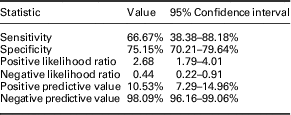
For the internal consistency of the CAT questionnaire Cronbach’s α reliability coefficient was 0.84. There were 95 participants who have total CAT scores >10 and there were 10 patients with COPD in this group. Sensitivity, specificity, likelihood ratios and predictive values are shown in Table 1. The positive likelihood ratio was 2.68 while the negative predictive value of the CAT was 98% to diagnose COPD in the study group.
Statistics for CAT to estimate COPD diagnosed with spirometry
CAT=Chronic Obstructive Pulmonary Disease (COPD) Assessment Test.
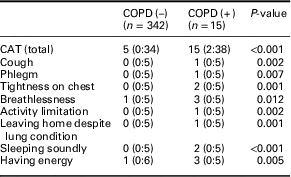
Total CAT scores and scores of all the questions were significantly higher in patients with COPD (Table 2). Soundly sleeping was the most significant item associated with the CAT. There were 85 current smokers (23.8%) and CAT scores were not correlated with smoking status. Only the scores to the phlegm were significantly higher among current smokers (Table 3).
Relationship between the CAT results and COPD diagnosed with spirometry
CAT=Chronic Obstructive Pulmonary Disease (COPD) Assessment Test.
The relationship between CAT scores and smoking habits

CAT=Chronic Obstructive Pulmonary Disease Assessment Test.
Patients with co-morbid diseases (n=248) had CAT scores [6 (0:38)] higher than CAT scores [3 (0:25)] of patients with no co-morbid diseases (n=109) (P<0.001). Patients who were using medication for any specific illness (n=236) had CAT scores [7 (0:38)] higher than CAT scores [3 (0:31)] of patients who used no medication (n=121) (P<0.001). Patients with a history of depression who were using antidepressant drugs had higher scores of having energy (P=0.014) (Table 4). Antidepressant usage frequency among patients without COPD (n=351) was 12% (n=42) while its frequency was 33.3% (n=5) among patients with COPD (n=15) but there was no statistically significant difference between these two groups (P=0.161).
The relationship between CAT scores and antidepressant usage

CAT=Chronic Obstructive Pulmonary Disease Assessment Test.
When the relationships between FEV1, FVC and FEV1/FVC ratio and total CAT score were examined, it was seen that there was a significant negative correlation between CAT score and related measures (r=−0.31, P<0.001; r=−0.26, P<0.001; r=0.18, P=0.001). The change in total CAT scores is affected inversely from the change in FeV1, FVC and FeV1/FVC ratios.
Discussion
As a result of our study, in this sampling COPD frequency was 4.2%. Total CAT scores were higher in patients with COPD and the item ‘soundly sleeping’was the most significant variable. Sensitivity and specificity of CAT to diagnose COPD were 66.67 and 75.15%, respectively.
In the present study, the COPD prevalence was lower than the results of previous studies (Gunen et al., Reference Ford, Croft, Mannino, Wheaton, Zhang and Giles2008; Deveci et al., Reference Deveci, Deveci, Turkoglu, Turgut, Kirkil, Rahman, Açik and Muz2011; Arslan et al., Reference Arslan, Ilgazlı, Etiler and Hamzaoğlu2013; Dikis et al., Reference Dikis, Dulger, Karadag and Demirci2015). There might be some reasons to explain the low frequency of COPD in the present study. Fight against smoking in Turkey with the campaign named as 100% smokeless air may be the first reason. Recently, wide spreading of heating with natural gas instead of coal may be the other. Car exhaust examinations have been carried more seriously than before in the last decade in Turkey, and it might have affected the dust in the air.
In a previous study composed of smokers, it was shown that CAT results were most associated with phlegm and breathlessness (Raghavan et al., Reference Omachi, Katz, Yelin, Gregorich, Iribarren, Blanc and Eisner2012). In the present study, phlegm was significantly associated with smoking habits. We also found that CAT scores were higher in patients with COPD and the item of ‘soundly sleeping’ was the most significantly associated item. CAT positive cases had a higher probability of having COPD and the sensitivity, specificity and predictive values we recorded were similar to the results in the literature.
COPD is usually the disease of elderly and so some co-morbid diseases like diabetes mellitus, depression and hypertension may accompany COPD. These co-morbid diseases are shown to interfere with spirometric results (Omachi et al., Reference Lin, Watkins, Johnson, Rodriguez and Barton2009; Joo et al., 2013; Battaglia et al., Reference Battaglia, Basile, Scichilone and Bellia2015). In the present study, co-morbidities were detected as a confounding factor for CAT evaluation. The higher the number of co-morbidities the higher was the total CAT score. Moreover, it has been shown that CAT scores elevated with the presence of depression (Silva Júnior et al., Reference Seemungal, Donaldson, Paul, Bestall, Jeffries and Wedzicha2014). We also noticed that patients with depression who currently using antidepressant, had higher scores with the item ‘having energy.’ Further research is needed to evaluate these relationships in depth.
One of the limitations of the study was the manual spirometry used to detect pulmonary functions. But, manual spirometry is the instrument that is currently available at primary care centers. The other limitation was the small number of participants involved in the study which prevented us to make generalizations with the results we obtained.
In conclusion, CAT is a reliable questionnaire and there is an apparent relationship between its scores and pulmonary function test results. However, CAT’s ability to screen COPD is limited since it misses symptom-free cases at the early stages of the disease.
Acknowledgments
The authors thank to Nazli Demirci (Philologist) for her contribution to the study.
Financial Support
None.
Conflicts of Interest
None.



