

Legacy archaeological documents and data have tremendous value if they are compiled in accessible digital archives and are reused. In the United State alone, the annual expenditures relating to cultural heritage total more than $1.4B (Altschul and Klein Reference Altschul and Klein2022), with most of those costs associated with compliance with cultural heritage laws. Archaeologists survey large tracts of land and excavate sites for management and mitigation of future land-disturbing activities and to gain a better understanding of the human experience across space and time. At the end of these projects, there is the expectation that reports will be written and data will be generated, whether it is a report documenting the National Register of Historic Places eligibility of an archaeological site, a technical site or project report fulfilling client or grant agency requirements, or an analytical study for peer review. There is also an expectation, both in law and in professional ethics, that the data deriving from these projects be preserved for future use. Indeed, the legal premise behind archaeological mitigation is that we incur the expense of the archaeological investigations so that we can retain the information the mitigated resources embodied despite their physical destruction.
Although archaeological gray literature is not intended to be highly circulated, evidence suggests that only a small fraction of these documents or data are easily findable or accessible, never mind interoperable or reusable (i.e., in accordance with the FAIR principles for data management and stewardship; Nicholson et al. Reference Nicholson, Kansa, Gupta and Fernandez2023; Wilkinson et al. Reference Wilkinson, Dumontier, Jan Aalbersberg, Appleton, Axton, Baak and Blomberg2016). These materials are widely dispersed and often only available in government libraries and archives, at State Historic Preservation Offices, or at the permitting agencies / land manager offices. The dispersed nature and lack of sufficient metadata or description of these materials lead to a lower degree of accessibility, even though there are legal mandates for such preservation and there have long been practical and inexpensive solutions to ensure that the products created from these scientific and humanistic endeavors are preserved and made reusable.
This narrative highlights a four-year (2017–2021) digital archival project funded by the National Endowment for the Humanities (NEH) designed to enhance information and data reuse. We describe the process of building a regional digital archive of archaeological documents and data dedicated to the Huhugam culture in Arizona, the Digital Archive of Huhugam Archaeology (Kintigh and Nicholson Reference Kintigh and Nicholson2021). More generally, we explore the question of why data reuse is important, especially in archaeological research, and conclude with a discussion of how this archive has been used to date.
Our goals of featuring this digital archive are to (1) promote the reuse of archaeological data in accordance with the FAIR and CARE data principles, (2) demonstrate the utility and value in creating region-specific archives that advance not only scholarship but also aid cultural resource management workflows, and (3) consider how digital archives can work toward providing better information access solutions for archaeologists and tribal communities.
Background
The term “Huhugam” refers to the ancestors of the O’odham people living today in central Arizona. The Huhugam people are seen archaeologically as the Hohokam archaeological culture, a term that is limited to a specific time period and refers to the particular ancient group’s material culture, such as distinct pottery manufacturing techniques, architectural traditions, and other customs (Hill Reference Hill2018). The Hohokam “culture” is seen over 80,000 km2 of central and southern Arizona, including the present-day greater Phoenix and Tucson metropolitan areas from about AD 500 to the Spanish invasion (Figure 1; Abbott et al. Reference Abbott, Craig, Zanotto, Judd and Kober2019). Huhugam culture in central and southern Arizona and northern Mexico encompasses a set of geographically separate but interacting communities spread across a large territory and integrated with one another through the exchange of goods and services (Abbott Reference Abbott2006, Reference Abbott2009; Abbott et al. Reference Abbott, Smith and Gallaga2007; Wilcox and Sternberg Reference Wilcox and Sternberg1983). These Sonoran Desert inhabitants had sophisticated irrigation systems, extensive networks of ceremonial ball courts, specialized craft production, extensive regional trade, and large, long-lived towns. Over the past 100-plus years, much of the remnants of the Huhugam culture have been removed or enveloped by the construction of modern cities, their adjacent municipalities, and supporting industries.
Huhugam geographic extent (from Abbott et al. Reference Abbott, Craig, Zanotto, Judd and Kober2019).

To mitigate the impact of this modern built environment atop Huhugam material cultural heritage, archaeologists have undertaken thousands of investigations, mostly resulting from compliance work required by state and federal legislation, including Section 106 of the National Historic Preservation Act and the Arizona Antiquities Act. Unfortunately, the largely technical reports from long-completed projects (i.e., gray literature), whether paper or digital, can be difficult to discover or access by both archaeologists and the local Indigenous community because of the dispersed manner in which documents and data are collected and stored when projects are completed. Typically, once a project is completed, one or more of the several entities involved—the contractor, the State Historic Preservation Office, or the federal agency—houses the resulting project report within its own internal archive, either on a physical shelf, as digital media on in-house computer storage, or on rapidly obsolete technology such as CD-ROMs. Each entity maintains this report using its idiosyncratic standards of quality assurance, data management, and longevity.
For archaeologists not directly involved in a project, the first hurdle to surmount in accessing such documents is knowing they exist and where they are stored. Even if a citation can be found, it is often unclear where it can be accessed, a necessity if one is to have the ability to request and retrieve the report. In many cases, one must pay for access. Because problems with accessing data of this nature are incredibly common across the United States, we created the DAHA project to make data from these undertakings easily findable, accessible, and reusable through use of the digital repository, tDAR (the Digital Archaeological Record).
Digital Archives and Reuse
Compiling dispersed hard-copy legacy documents for hundreds, if not thousands, of archaeological projects in a digital archive that facilitates the reuse of information is slowly becoming more common and has real potential value (Kansa Reference Kansa2012; Kansa and Kansa Reference Kansa and Whitcher Kansa2021, Reference Kansa and Whitcher Kansa2022; Kintigh and Altschul Reference Kintigh and Altschul2010; Kintigh et al. Reference Kintigh, Spielmann, Adam Brin, Clark and Peeples2018; McManamon and Kintigh Reference McManamon and Kintigh2016; McManamon et al. Reference McManamon, Kintigh, Anne Ellison and Brin2017; Nicholson et al. Reference Nicholson, Fernandez and Irwin2021, Reference Nicholson, Kansa, Gupta and Fernandez2023; Ortman and Altschul Reference Ortman and Altschul2023; Richards Reference Richards2015, Reference Richards2017; Richards et al. Reference Richards, Jakobsson, Novák, Štular and Wright2021, Reference Richards, Ellen Wright, Geser and Massara2022; Watrall et al. Reference Watrall, Gold and Klein2016). In the field of archaeology, tangible benefits for making data reusable include, first, streamlining the early planning stages of the Section 106 and other legal compliance processes by facilitating gray literature research, and second, enhancing scholarly research opportunities related to synthesis and graduate projects. A third goal is to provide tangible “collective benefit” (Carroll et al. Reference Carroll, Garba, Figueroa-Rodríguez, Holbrook, Lovett, Materechera and Parsons2020) to Native communities related to accessing and reusing these materials while following the CARE principles of “Responsibility” and “Ethics.”
Data reuse holds the potential to enhance efficiencies and streamline legal compliance efforts (Beagrie et al. Reference Beagrie, Beagrie and Houghton2013). A fundamental part of archaeological research, embraced by both scholars and cultural resource managers, involves delving into and synthesizing information from gray literature reports produced by predecessors. Although providing a state-by-state breakdown of gray literature reports archived by State Historic Preservation Offices (SHPOs) is beyond the scope of this work, it is worth noting that the Arizona State Museum, which manages documents for the Arizona SHPO in compliance with Section 106 of the National Historic Preservation Act and the Arizona State Historic Preservation Act, houses 11,658 digital reports (1970–2020; Gabe McGowan, personal communication 2024) and approximately 980 linear feet of hard-copy reports (1974–2023; Kimberly Henkel, personal communication 2024) to explore. It is reasonable to estimate that millions of gray literature reports are available nationwide for review, and this number is always increasing.
Although most SHPOs and their partner institutions have developed systems for digital storage of these reports (Nicholson et al. Reference Nicholson, Fernandez and Irwin2021), the accessibility of this information is not uniform. SHPOs exhibit significant variation in their requirements for digital document and data archiving, including geospatial files, within their formal submission processes. Those SHPOs lacking curation responsibilities or facilities may depend on federal or other state agencies to fulfill their requirements for curating digital data and artifacts (Neller et al. Reference Neller, Heckman, Bollwerk, Noack Myers and Wells2024; Rivers Cofield et al. Reference Rivers Cofield, Childs and Majewski2024). In many cases, project reports and other digital data follow physical collections to museums or agency repositories. However, like SHPOs, few of these museums or physical artifact repositories are funded, staffed, or trained to responsibly curate digital data (Bollwerk et al. Reference Bollwerk, Gupta and Smith2024; Domeischel and Childs Reference Domeischel and Childs2024; Rivers Cofield et al. Reference Rivers Cofield, Childs and Majewski2024; Warner and Rivers Cofield Reference Warner and Rivers Cofield2024).
The ready availability of gray literature can greatly facilitate the early stages of archaeological compliance work. Limited access to existing archaeological reports and data during the initial planning phases of development projects can complicate the permitting and related compliance process (McKnight Reference McKnight2018). If project proponents or their consultants can identify or even model areas where cultural resources have been documented or are likely to be found (Halford and Ables Reference Halford and Dayna2023; Heilen Reference Heilen2020) during the early stages of project planning and can understand the extent of those resources, they are better able to offer solutions that avoid or minimize the needed mitigation of significant resources, such as those eligible for the National Register of Historic Places. Thus, easy access to documentation on past projects allows resource managers to consider preservation alternatives early in the permitting process, leading both to cost savings and reducing the impact on archaeological resources. However, the value of data reuse extends beyond these “industry” benefits.
Digital archive solutions also enhance our ability to do scholarly research by streamlining access to the data that need to be compiled and interoperated, facilitating our ability to address “Grand Challenge”-type questions (Altschul et al. Reference Altschul, Kintigh, Klein, Doelle, Hays-Gilpin, Herr and Kohler2018; Kintigh et al. Reference Kintigh, Altschul, Beaudry, Drennan, Kinzig, Kohler and Fredrick Limp2014a, Reference Kintigh, Altschul, Beaudry, Drennan, Kinzig, Kohler and Fredrick Limp2014b). Initiatives such as the Coalition for Archaeological Synthesis (Altschul et al. Reference Altschul, Kintigh, Klein, Doelle, Hays-Gilpin, Herr and Kohler2018), People 3000—PalEOclimate and the PeopLing of the Earth (Bird et al. Reference Bird, Miranda, Vander Linden, Erick Robinson, Nicholson and Capriles2022), and the Digital Index of North American Archaeology (DINAA; Kansa et al. Reference Kansa, Kansa, Wells, Yerka, Myers, DeMuth, Bissett and Anderson2018) use disparate information and data reported in gray literature reports to answer broader questions related to human demography, responses to climate change, technological shifts, and migration. However, a researcher’s ability to investigate “grand challenge” or “big data” questions hinges on their ability to find and access data collected from individual projects and then interoperate them into larger datasets that allow for testing hypotheses.
Finally, the information housed in FAIR- and CARE-aligned open-access digital archives offers potential to benefit tribal communities. In alignment with the CARE principle of “Collective Benefit,” Indigenous communities seeking to forge connections and deepen their understanding of ancestral heritage can use archives to empower Tribes to make their own interpretations of an archaeological analysis from which they have been largely excluded (Atalay Reference Atalay, Habu, Fawcett and Matsunaga2008, Reference Atalay2012; Gonzalez and Edwards Reference Gonzalez and Edwards2020; Marek-Martinez Reference Marek-Martinez, Panich and Gonzalez2021; Nicholas Reference Nicholas2014; Strawhacker Reference Strawhacker2017; Watkins Reference Watkins2000, Reference Watkins2011). Even though most archaeology in the United States is conducted by non-Indigenous archaeologists (Society for American Archaeology 2020), digital archives can and should provide a platform for Tribes to access information on ancestral lifeways gathered during archaeological compliance-related or investigator-instigated research work aligning with the CARE principles of “Responsibility” and “Ethics.”
In the current landscape of document and data control, Section 106 and other compliance reports are often stored by federal or state agencies on servers accessible only to their employees, making them inaccessible to Tribes or other members of the public. If these reports were stored in an “open-access” repository with appropriate confidentiality settings (e.g., “open when possible, closed when necessary” [Landi et al. Reference Landi, Thompson, Giannuzzi, Bonifazi, Labastida, da Silva Santos and Roos2020]), Federal Resource Advisors working as part of a fire incident command alongside Tribal Historic Preservation Offices (THPOs) could use available documents with maps (or GIS data) to act quickly when archaeological sites are threatened by wildfire (Long et al. Reference Long, Tecle and Burnette2003); having an open-access repository would also increase those advisors’ capacity to document, track, and identify cultural property crimes (CPC; Welch et al. Reference Welch, Altaha, Cantley, Doelle, Herr, Kersel, MacDonald, McManamon, Mills and Nials2019). Furthermore, the information could become considerably more accessible to tribal communities. Many of these reports contain valuable documentation of ancestral cultural practices and materials, data that should be made available in innovative ways for future generations.
These examples underscore the diverse approaches that various archaeological communities can adopt when considering how to use digital archives to enhance information reuse. The DAHA project clearly demonstrates how one archive can benefit multiple communities. The advantages of archaeological information reuse span a spectrum, and discerning distinctions in the quality and quantity of data reuse can significantly improve the functionality of these systems.
Digital Archive of Huhugam Archaeology
In collaboration with the Amerind Museum, Arizona State University’s Center for Digital Antiquity (CDA), which operates tDAR, received a three-year grant from NEH in 2017 to create a comprehensive digital library of archaeological investigations of the ancient Huhugam. The Digital Archive of Huhugam Archaeology (DAHA) was conceptualized and designed to house major archaeological reports, images, and datasets in tDAR, an online repository that preserves and provides access to archaeological data (Figure 2; McManamon et al. Reference McManamon, Kintigh, Anne Ellison and Brin2017). The goal of the project was to create a comprehensive corpus of research materials of archaeological reports relating to the Huhugam “culture” that would be online, discoverable, and freely accessible to all.
Digital Archive of Huhugam (DAHA) web page on tDAR.

tDAR (2024), operated and maintained by CDA, is a CoreTrustSeal-certified repository designed to preserve digital records generated by archaeological investigations. To date, tDAR has systematically archived 425,900 resources, including more than 23,900 documents, 33,100 images, and 2,100 datasets from an international suite of contributors. Each resource upload to tDAR is assigned rich, descriptive metadata (McManamon et al. Reference McManamon, Kintigh, Anne Ellison and Brin2017), and this information is encoded on individual resource webpages to aid in the findability of a resource. Users can used advanced searches to limit queries based on a single term or multiple keywords and phrases in the title, description, full text, person, institution, calendar dates, radiocarbon dates, year, or geographic region.
The first NEH-funded phase of DAHA focused on documents, although a small number of images were also uploaded. The DAHA collection (https://core.tdar.org/collection/30428/digital-archive-of-huhugam-archaeology-daha), as it stands today with more than 2,000 digital resources—documents, data, images, and geospatial files—provides scholars with crucial long-term data for comparative studies and Indigenous communities with access to a wealth of research on ancestral populations. It also offers the general public access to reliable, vetted, and redacted documents focused on Huhugam culture resources without publicly disclosing privileged locational and human burial information.
Development of the DAHA collection was guided by input from a variety of collaborator groups, including descendant community members (the Cultural Resources Working Group of Four Southern Tribes of Arizona) and regional archaeologists affiliated with the Arizona Archaeology Council. Although the COVID-19 quarantine requirements disrupted consultations, before 2020, project staff held in-person meetings with as many contributors and collaborators as possible. DAHA project staff met three times with representatives of the Four Southern Tribes Cultural Resources Working Group (facilitated by David Martinez), during their regularly scheduled meetings, to discuss project goals and key issues as they arose. This descendant community feedback was incorporated into processing workflows throughout the project.
The discussions with the Four Southern Tribes Cultural Resources Working Group were also essential both in establishing relationships and in informing tDAR’s broader policy regarding culturally sensitive information. One specific outcome from the meetings was the development of a detailed policy outlining definitions of and procedures for the treatment of documents and images that contain sensitive, confidential information, or both (tDAR 2021a). Confidential information is information about the location or nature of any archaeological resource or historic property. Disclosure of detailed spatial information could violate local, state, and federal laws and create a risk of harm to the resource, such as looting or vandalism. All confidential information has been redacted from publicly available documents, and spatial locations are obfuscated on DAHA website maps. In DAHA files, sensitive information—for example, drawings or images of human burials—was also redacted out of respect for descendant community ideals (tDAR 2021a). However, the original, unredacted versions are maintained with a confidential status, and access may be granted by the contributor of the document and the Four Southern Tribes Cultural Resources Working Group. Both confidential and culturally sensitive items were redacted manually by project staff following a multistep review process to ensure that this information would not be made public (tDAR 2021b).
The DAHA project met its primary goal of identifying significant scholarship, creating digital copies, assembling files in an easy-to-access online collection, and adding metadata that make the collection easily discoverable and widely available at no cost to the user. One of our partners, the Amerind Museum, had actively engaged in archaeological excavations at important Huhugam sites during much of the twentieth century. More than 75 lengthy reports of these investigations were published, but all are now out of print; several date to the early 1930s (https://core.tdar.org/search/results?query=1930&collectionId=30428&_tdar.searchType=simple, accessed February 3, 2026). As part of this project, curators at CDA were able to digitize and process copies of these important Huhugam volumes, including scans of oversized maps and imagery, so that they are now available with full-text indexing and completely searchable content.
The DAHA team also received reports and other manuscripts from partners and contributors, including the City of Phoenix S’edav Va’aki Museum (formerly the Pueblo Grande Museum); Desert Archaeology Inc.; Bureau of Reclamation, Phoenix Office; SWCA Environmental Consultants; and Arizona State Parks. Existing resources in tDAR were also added to DAHA from the Salt River Project, Statistical Research Inc., and the ASU Center for Archaeology & Society collections. Each of these organizations generously made available reports, images, and datasets that were not otherwise accessible outside their offices. At the end of this project, 2,196 digital resources were available in DAHA (Table 1). And, of course, the database can be easily expanded.
Number, Type, and Accessibility of Files in the Digital Archive of Huhugam Archaeology.

Table 1 Long description
The table counts active files in a digital archaeology archive by resource type and access level: publicly accessible, partly restricted, or fully restricted. Overall there are 2,196 active files, with 1,057 publicly accessible, 930 partly restricted, and 206 restricted. Documents are the largest category at 1,572 files and have the most access limits, with 513 public, 909 partly restricted, and 148 restricted. Datasets are the next largest at 339 files, mostly public at 309, with 30 restricted and none partly restricted. Images total 269, with 223 public, 21 partly restricted, and 24 restricted. Coding sheets and ontologies are fully public, while all geospatial files are restricted. Totals may not align perfectly across categories if any files have mixed access rules within a type, as reflected by the separate “some files restricted” column.
In tDAR, resource ownership is assigned to the contributor who provided the document, image, or dataset, not necessarily the entity that commissioned or authored the report. Resource owners are given the option to make materials publicly available, confidential (or restricted), or embargoed (e.g., restrict access for a set period of time). Because not all archaeological information can or should be open access, tDAR allows contributors to directly manage these different permission levels. If a contributor decides the digital resources contain sensitive information (geographic or cultural), it can be marked in the metadata as “confidential.” With this designation, only individuals who are granted access by the resource owner may download it; however, anyone can create a tDAR account and request access from the owner. As part of the DAHA project, CDA requested that contributors themselves provide access to confidential files to the Tribal Historic Preservation Officers of the Four Southern Tribes.
To properly process the large number of files from partner organizations, CDA staff developed a comprehensive and systematic digital curation workflow designed to process DAHA documents in a consistent, timely, and cost‐effective manner (Figure 3). This workflow ensures quality control and helps maximize the research value of DAHA. As a digital repository, tDAR adds value to all collections because robust descriptive metadata link disparate files, resulting in more accurate search results. Optical character recognition (OCR) and full-text indexing on all text files ensure that even uncommon keywords are located during user searches.
File processing workflow developed at the Center for Digital Antiquity to properly archive legacy documents.

Figure 3 Long description
The flowchart outlines a file processing workflow divided into five stages. The Planning stage includes identifying key documents, creating a metadata style guide and creating ontologies. The Acquisition stage involves obtaining files from partners and creating a file tracking system. The Processing stage consists of digitizing paper documents, file processing with PDF/A and OCR and setting redaction and confidentiality settings. The Review stage is conducted by a senior curator and partner or contributor, followed by corrections and final review. The Publication stage includes making files active, tracking usage and research results, conducting conference and workshop presentations and producing publications.
We were able to identify and enhance features in tDAR that support most of the key research needs of archaeologists. The DAHA team distributed a survey to 205 people, with 49 responses, to assess the relevant information-related needs of one of DAHA’s main user communities: survey participants included members of the Arizona Archaeology Council and 28 other archaeologists working in cultural heritage management who are concerned with Huhugam archaeology (Kintigh Reference Kintigh2018; Kintigh and Nicholson Reference Kintigh and Nicholson2021). The survey accomplished several objectives, including opening a dialogue with archaeologists about significant research questions and potential uses for DAHA, publicizing and increasing awareness of DAHA, and prioritizing the digital analysis needs of this community of users. The survey responses allowed us to focus on developing features that facilitate efficient discovery of the documents (full-text search, enhanced metadata), and that enable users to retrieve data using a map search tool. Most of the requested features have been incorporated into tDAR.
As a result of this user community feedback, the collection search tool was enhanced by adding Huhugam geographic subareas to generate additional keywords; for example, subarea names include Lower Gila, Lower Verde, Northern Periphery, Tonto Basin, Phoenix Basin, Santa Cruz River, Tucson Basin, San Pedro Valley, Safford Basin, and Papaguería. Huhugam sites are found throughout the desert landscape of central and southern Arizona, with most located in the river valleys that supported irrigated fields.
Archaeologists working in the Huhugam region often refer to smaller subareas named for their associated location (e.g., Phoenix Basin, Tucson Basin) or watershed, such as Lower Verde River or Santa Cruz River (Abbott et al. Reference Abbott, Smith and Gallaga2007; Wilcox and Sternberg Reference Wilcox and Sternberg1983). For the DAHA project, we delineated these subareas and created a map that supports advanced search in tDAR. The Huhugam regional system also includes large tracts of land that are not in a major river basin and are not part of a named subarea but are nevertheless important and were traversed and used in a variety of ways. We have designated these as Interstitial Areas, and together with the geographic subareas, they provide a searchable geographic framework for the DAHA project (Figure 4).
Map of geographic subarea regions and interstitial areas used to provide a searchable geographic framework for the archive.

Figure 4 Long description
The map of Arizona displays DAHA geographic regions and interstitial zones. Geographic regions are outlined in green and include Northern Periphery, Tonto Basin, Phoenix Basin, Lower Verde, Lower Gila, Santa Cruz River, Tucson Basin, San Pedro Valley and Safford Basin. Interstitial zones are shaded and labeled as A, B, C, D, E and F. Major rivers are marked in blue and ball courts are indicated by red dots. The map includes a scale bar showing distances up to 100 kilometers. The layout provides a framework for archaeological research in the Huhugam region, highlighting areas of interest and their spatial relationships.
Assessing Archive Use
Understanding archaeological data reuse in DAHA begins by looking at quantifiable variables. The tDAR platform has administrative software tools that allow us to assess which resources are being viewed and downloaded; that is, their quantity. The usage index we employ here is based on tDAR server logs that indicate the level of interest in and reuse of resources through page views (minus bot traffic) and downloads (Faniel et al. Reference Faniel, Kriesberg and Yakel2016; Perrin et al. Reference Perrin, Yang, Barba and Winkler2017). We acknowledge, however, that this does not capture fully the spectrum of reuse in the academy, industry, and among Indigenous communities; that is, data quality.
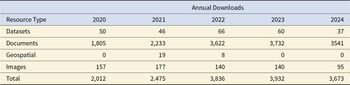
Document resources in the DAHA collection are the most numerous, most viewed and most downloaded type of resource, with images being the second most downloaded resource type (Table 2). The archive is experiencing steady usage since 2020, with more than 3,600 downloads in 2024 (Table 3). As more individuals working and doing related research in the region learn of the archive, downloads for all resources should increase.
Resources in the Digital Archive of Huhugam Archaeology, Metadata Page Views (minus bots), and Number of Downloads from 2020 to 2024.

Table 2 Long description
The table reports counts of archived resources and their user activity, listing total items, metadata page views with bots removed, and downloads for each resource type from 2020 through 2024. Documents are the largest category with 1,562 resources and also lead engagement with 794,612 metadata views and 14,933 downloads. Images are a distant second with 269 resources, 178,649 views, and 709 downloads. Datasets include 133 resources and received 94,721 views but only 259 downloads, suggesting many users view dataset records without downloading. Geospatial resources are rare at 4 items and have the lowest activity at 5,080 views and 27 downloads. Overall totals are 1,968 resources, about 1.07 million metadata views, and 15,928 downloads, with documents accounting for most of the views and downloads. Interpret totals cautiously because views exclude bots and the total views figure appears formatted inconsistently, which may affect exact reading.
Type of Resources in the DAHA Archive with Total Number of Annual Downloads, 2020–2024.

Table 3 Long description
Annual download counts are listed by resource type for each year from 2020 through 2024. Documents account for the vast majority every year, rising from 1,805 in 2020 to 2,233 in 2021 and 3,622 in 2022, peaking at 3,732 in 2023, then dipping slightly to 3,541 in 2024. Total downloads increase from 2,012 in 2020 to 2,475 in 2021 and 3,836 in 2022, reach 3,932 in 2023, and ease to 3,673 in 2024. Datasets remain modest, moving from 50 in 2020 to 46 in 2021, up to 66 in 2022, 60 in 2023, and down to 37 in 2024. Images are consistently lower than documents, at 157 in 2020 and 177 in 2021, then 140 in both 2022 and 2023, and 95 in 2024. Geospatial downloads are minimal, with 0 in 2020, 19 in 2021, 8 in 2022, and 0 in both 2023 and 2024. Overall, the growth in total downloads through 2023 is driven primarily by increased document downloads, with a small pullback in 2024.
In terms of user patterns, we found that the number of metadata page views (e.g., the number of times someone viewed a page), at the resources level, is not significantly correlated to the number of times a resource is downloaded, after extreme outliers are removed (Table 4). The highest correlation between page views and downloads occurs with images; the more someone viewed the metadata page that housed a thumbnail image, the more likely they were to download the resource. This finding has implications for understanding how archive users evaluate which resources to download and how we can support discovery and reuse in the future.
Pearson’s Correlation Coefficient (R2) between Number of Metadata Page Views and Number of Times the Resource Was Downloaded for Each Resource Type.

Table 4 Long description
The table reports R squared values describing how strongly metadata page views relate to download counts for different resource types. Images show the highest association, with an R squared of 0.270. Documents are next at 0.197. The combined total across all resources is lower at 0.098. Datasets have the weakest association at 0.053. Overall, the relationships are weak to modest, suggesting page views explain only a limited share of variation in downloads. These values indicate association only and do not establish that page views cause downloads.
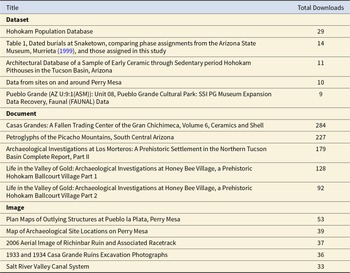
We also think it is informative to share the most “popular” or downloaded digital resources to date. Table 5 lists the five most downloaded resources by resource type in the DAHA archive from 2020 to 2024. The document “Casas Grandes: A Fallen Trading Center of the Gran Chichimeca, Volume 6, Ceramics and Shell” (Di Peso et al. Reference Peso, Charles, John and Gloria1974) is one chapter in a book detailing the excavation and research done by the Amerind Foundation. This book is well regarded and has been cited 503 times (Google Scholar 2/2/2023), although it is not possible to see how many times the materials were downloaded through tDAR. For data, the Hohokam Population Database (Peeples Reference Peeples2006) contains population estimates for all major sites within the Hohokam region from about AD 700 to 1400. Finally, the most downloaded images are from the “Plan Maps of Outlying Structures at Pueblo la Plata, Perry Mesa” (Russell Reference Russell2007). In 2005, students working on the Legacies on the Landscape project located and recorded outlying structures in the vicinity of Pueblo la Plata, on Perry Mesa, which were the basis for maps drawn by Will Russell (Figure 5).
Example from “Plan Maps of Outlying Structures at Pueblo la Plata, Perry Mesa” (https://core.tdar.org/image/406879/plan-maps-of-outlying-structures-at-pueblo-la-plata-perry-mesa, accessed June 16, 2025).

Figure 5 Long description
The map of La Plata Mesa - Small Site 23, mapped on 10 March 2007, illustrates archaeological features. It includes symbols for wall rubble and artifact scatter, as indicated in the legend. A compass rose is present for orientation, marked with ′MN′. The map features a datum point, represented by a triangle. A scale bar at the bottom shows measurements of 1 meter and 5 meters for reference. The layout depicts various clusters and formations, likely representing structural remains and artifact distributions.
Five Most Downloaded Resources in DAHA by Resource Type.

Table 5 Long description
The table lists the five most downloaded items in DAHA for each resource type and their total download counts. Document downloads are highest overall, led by “Casas Grandes: A Fallen Trading Center of the Gran Chichimeca, Volume 6, Ceramics and Shell” with 284, followed by “Petroglyphs of the Picacho Mountains, South Central Arizona” with 227 and “Archaeological Investigations at Los Morteros... Part II” with 179. Dataset downloads are much lower, ranging from 9 to 29, with “Hohokam Population Database” highest at 29 and “Pueblo Grande... Faunal Data” lowest at 9. Image downloads fall between datasets and documents, ranging from 33 to 53, led by “Plan Maps of Outlying Structures at Pueblo la Plata, Perry Mesa” with 53. Across all listed items, the most downloaded document exceeds the most downloaded image and dataset by a wide margin. Counts reflect downloads only and do not indicate quality, impact, or unique users.
Discussion
tDAR’s mission is to ensure the long-term preservation and ethical reuse of data. Making digital resources highly reusable has numerous benefits (Custers and Uršič Reference Custers and Uršič2016; Faniel et al. Reference Faniel, Kansa, Kansa, Barrera-Gomez and Yakel2013, Reference Faniel, Kriesberg and Yakel2016; Federer Reference Federer2020; Garstki Reference Garstki2022; E. Kansa and S. Kansa Reference Kansa and Whitcher Kansa2022; Kansa et al. Reference Kansa, Atici, Kansa and Meadow2019; S. Kansa and E. Kansa Reference Kansa and Whitcher Kansa2022; Kintigh and Nelson Reference Kintigh and Nelson2019; McManamon and Kintigh Reference McManamon and Kintigh2016) and is of interest to many sectors (e.g., state and federal agencies, scientific organizations, college and university faculty and students, funding bodies, Tribes, and peer-reviewed journals). Data reuse results in tangible improvements in overall research efficiency (Beagrie et al. Reference Beagrie, Beagrie and Houghton2013), streamlines student research, enables new academic research (Mons Reference Mons2020), and improves public trust in science (Faniel et al. Reference Faniel, Kriesberg and Yakel2016; Resnik Reference Resnik2011). But reporting and assessing meaningful metrics remains challenging. Although reporting numbers of downloads and views for resources is straightforward, understanding how the information is used—that is, its quality—may be difficult.
Given that DAHA has only been public since 2020, information regarding the quality of reuse remains difficult to assess. The literature on assessing digital collections reuse typically focuses on how much the collection is used and the nature of the use and measures circulation, collection size, and patron visits (Perrin et al. Reference Perrin, Yang, Barba and Winkler2017). Although tDAR collects patron information when a user registers for an account, it does not track who is downloading which items. Furthermore, it is difficult to distinguish between “accidental use” (or download) and “actual use,” when material is used directly for research or as a citation within peer-reviewed, scholarly works (Perrin et al. Reference Perrin, Yang, Barba and Winkler2017).
Alternative Metrics
Archivists responsible for both physical and digital resources assert that reuse creates efficiencies, yet demonstrating these efficiencies proves challenging. This challenge is compounded by the difficulty of sustaining digital archives: funding agencies often prioritize supporting new projects over maintaining existing ones. Maintaining digital archives incurs costs, such as the salaries of digital curators, programmers, and support personnel, which may not receive enthusiastic support from academics and funding agencies, despite their benefiting from the archives (Nicholson et al. Reference Nicholson, Fernandez and Irwin2021; Richards et al. Reference Richards, Austin and Hardman2010). Consequently, digital archives need to justify their existence and scholarly impact by measuring scholarly reuse of their materials (Federer Reference Federer2020). As indicated earlier, however, tracking and quantifying meaningful data usage statistics pose challenges.
One other potential avenue for addressing the reuse of a digital archival collection, at least for tDAR, is to develop audience-specific metrics that focus on the needs of a particular group. Although academics might be satisfied by knowing the number of downloads per resource in their collection, federal agencies, which may have other reporting requirements, might be interested in assessing the reduction in operational and personnel cost (Beagrie et al. Reference Beagrie, Beagrie and Houghton2013) associated with efficiently finding documents related to new development projects. For example, cultural resource managers working on military installations spend considerable time looking for documents from earlier projects to locate information to determine National Register eligibility for National Historic Preservation Act Section 106 compliance. By reducing the time needed to locate documents by making it easier to find and access documents—compared to standard operating procedures that often require looking through hard-copy documents—it is possible to deploy development projects more quickly and at a lower cost.
To aid in finding documents from previous projects, often contractors are hired to do background gray literature research at museums, SHPOs, and tribal and agency libraries to see if previous projects have been done in the area. Unfortunately, many of these documents may only be hard copies; finding them may be very time consuming and may not be conducive to adequately locating all relevant documentation. Some agencies are at the forefront of making digital resources findable and accessible, having invested considerable money in data management systems, GIS, and other tools that connect projects, site reports, and resource locations so that they can evaluate new projects quickly and efficiently; however, many have not. Many agencies still rely on perusing hard-copy paper records that must be searched each time a new project is proposed. Thus, it is possible to calculate cost-savings metrics for enhanced findability and accessibility of documents. A potential analysis could quantify how using digital archives can save an agency (1) time (as measured by the elapsed time from request for project documentation to delivery), (2) effort (in person-hours to fulfill background request), and (3) money (hours × rate) for doing both background searches and consultant costs related to resurveying areas.
When documenting the reuse of existing information and data from past investigations, land management agencies (tribal, federal, or state) may find it useful to evaluate and describe qualitatively how and why digital resources were used, rather than solely quantifying their frequency or volume. One qualitative reuse example would involve compiling narratives that chronicle the operational use of existing digital resources used to mitigate the impacts of natural disasters, such as wildfires, flooding, and tropical storms, on cultural resources. Whether the information is used in field operations, administration, or planning, a qualitative report could present what information was used to assess (1) the areas previously surveyed, (2) the affected area, and (3) imperiled resources. The assessment could specify the datasets or documents used to analyze and evaluate impacts. Subsequently, these narratives could be used to illustrate, to funding bodies how the judicious reuse of digital information, even if not voluminous, contributes to cost savings by reducing staff time or project costs, as well as the stewardship and safeguarding of culturally significant resourcse imperiled by natural calamities.
Reflecting on CARE
In evaluating archival practices and data reuse in archaeology, it is important to consider the application of the CARE Principles for Indigenous Data Sovereignty. It is also important to note that the DAHA project and archive, as originally conceived, predates the publication of the CARE Principles (Carroll et al. Reference Carroll, Garba, Figueroa-Rodríguez, Holbrook, Lovett, Materechera and Parsons2020). Therefore, our work with Arizona’s Four Southern Tribes does not directly address these principles. Instead, its focus is on policies related to the treatment of documents that are sensitive, confidential, or both.
At tDAR, we define confidential information as any data concerning the location or nature of archaeological resources or historic properties, the disclosure of which could create a risk of harm to those resources. Federal officials responsible for archaeological resources or historic properties covered by the Archaeological Resources Protection Act (16 U.S.C. 470aa-mm) and the National Historic Preservation Act (54 USC 300101 et seq.) are required to restrict access to information about these resources, unless the release would further the purposes of the statutes and not cause harm to the resources. This is akin to “authority to control” and falls under the jurisdiction of the federal or state entity where the investigation took place. In practice, the information most commonly considered to be confidential is specific location data of archaeological resources.
In consultation with the Four Southern Tribes, we agreed that all confidential information in documents would be redacted, and spatial locations would be obfuscated on website maps. A full, unredacted version of these documents is held in the archive but is marked as confidential. Access to this version is strictly controlled and requires permission from the contributor. The redacted versions are publicly available for viewing and download on tDAR.
Sensitive information, in contrast, refers to data that may be culturally offensive to some individuals or groups. This concept is aligned with respecting Indigenous worldviews. In working with the Four Southern Tribes Cultural Resources working group, we developed a definition of sensitive information that includes any images, drawings, photographs, or other representations of burials (tDAR 2021a). All sensitive information in DAHA documents has been redacted. As with confidential information, an unredacted version of the documents has been archived but remains confidential and requires contributor permission to access. The redacted versions are publicly available for viewing and download.
The CARE Principles emphasize the importance of non-Indigenous researchers respecting Indigenous information control and advocating for decolonizing practices that uphold Indigenous sovereignty and cultural rights. In archaeology, there have been significant efforts to integrate the CARE and FAIR principles to address tribal concerns about data security and access (Atalay Reference Atalay, Habu, Fawcett and Matsunaga2008, Reference Atalay2012; Gupta et al. Reference Gupta, Martindale, Supernant and Elvidge2023; Nicholson et al. Reference Nicholson, Kansa, Gupta and Fernandez2023; Stats 2020). It is critical for those managing digital archives and repositories to recognize that many Indigenous communities prefer to limit the sharing and reuse of their archaeological data to their own communities (Carroll et al. Reference Carroll, Garba, Figueroa-Rodríguez, Holbrook, Lovett, Materechera and Parsons2020, Reference Carroll, Herczog, Hudson, Russell and Stall2021; Gupta et al. Reference Gupta, Martindale, Supernant and Elvidge2023; Laluk et al. Reference Laluk, Montgomery, Tsosie, McCleave, Miron, Russo Carroll and Aguilar2022; Strawhacker Reference Strawhacker2017; Tsosie Reference Tsosie2019).
Although we aspire to align with the “Collective Benefit” principle—where Indigenous communities can use DAHA to connect with and interpret their ancestral heritage—we understand that it is our role to create tools that empower access to this information, not to pressure Tribes into using them. We believe that the work done on DAHA sets the stage for tDAR to do a better job of embedding CARE practices in future workflows and incorporating new metadata categories that reflect traditional knowledge (Farnel Reference Farnel2018; Liggins et al. Reference Liggins, Hudson and Anderson2021; Montenegro Reference Montenegro2019).
Conclusions
The last 50 years have witnessed an explosion in the number and size of archaeological investigations, resulting in hundreds of thousands, if not millions, of gray literature reports that provide the only source of consistently produced documentation of these projects. Our success in using these reports to address archaeology’s important questions, however, hinges on our capacity for data management, sharing, and synthesis (Altschul et al. Reference Altschul, Kintigh, Klein, Doelle, Hays-Gilpin, Herr and Kohler2018; Heilen Reference Heilen2020; Kansa and Kansa Reference Kansa and Kansa2018; Kintigh et al. Reference Kintigh, Spielmann, Adam Brin, Clark and Peeples2018; McManamon and Kintigh Reference McManamon and Kintigh2016; Ortman and Altschul Reference Ortman and Altschul2023). Current attempts at synthesis are frustrated by an inability to discover or access relevant documents, by the lack of a “preservation pathway” for vast amounts of gray literature in danger of being lost, and by the utter inadequacy of our methods for synthesizing texts. Thanks to this NEH grant, the CDA team has been able to start tackling these problems using the DAHA archive and literature of one of the most intensively investigated areas in the world.
The focus of the NEH grant was assembling a large corpus of Huhugam documents. By doing so, the project intended both to create a resource that would enhance Huhugam scholarship and to see how the availability of a large digital corpus dedicated to a single prehistoric culture would affect that scholarship. tDAR will continue to add documents to the archive as they become available and will encourage our partners to actively contribute; we will continue to solicit submissions to the archive. We plan to expand the availability of related datasets and other materials identified by archaeologists and tribal partners.
Additionally, CDA staff plan to do the following:
• On an annual basis, review the access and download statistics for DAHA resources and compare these metrics with other collections to track usage of the archive
• Provide preservation space and staff time to process additional file uploads from Tribal partners and project contributors
• Advertise the availability of DAHA through blog posts, social media, and conferences
• Continue to build collaborative relationships with representatives of Huhugam descendant communities (the Four Southern Tribes Cultural Working Group) and incorporate their knowledge and preferences as the collection grows
With access to previously inaccessible information, educational resources can be developed more easily and can serve as invaluable tools for educating both Indigenous community members and the broader public about the Indigenous community’s profound regional history. Digital archives thus emerge as a conduit for preserving Indigenous community ancestral history, facilitating the ethical sharing of information with non-Indigenous communities often unaware of an Indigenous community’s continuous presence in a given area. This approach fosters a more comprehensive and inclusive understanding of the shared history and cultural heritage that strengthens connections within and extends beyond Indigenous communities, contributing to a more interconnected and informed society. If the archaeological community is to fully embrace data archiving and reuse, domain-specific entities such as tDAR, Open Context, and the Digital Archaeological Archive of Comparative Slavery, among others, must establish meaningful methods and metrics for evaluating reuse and its effects beyond mere download or view counts.
Acknowledgments
We thank the National Endowment for the Humanities (PW-253799-17) for funding this work and Frank McManamon and Mary Whelan for their work in developing and implementing the archive. We also thank Dan Garcia for his comments that led to the improvement of the article, Margaret Hangan for discussions related to data reuse with the US Forest Service, and Gabe McGowan and Kimberly Henkel at the Arizona State Museum. We appreciate the help of our numerous partners and contributors on the project: our grant partners: David Abbott, Adam Brin, Leigh Anne Ellison, David Martinez, Eric Kaldahl, Michael Simeone, Christine Szuter, and Richard Toon; contributors: Amerind Foundation, Archaeology Southwest, Arizona Museum of Natural History, ASU Center for Archaeology & Society, ASU Libraries, Arizona State Parks, Desert Archaeology Inc., City of Phoenix, S’edav Va’aki Museum, SWCA Environmental Consultants, Salt River Project, Statistical Research Inc., and the USDI Bureau of Reclamation, Phoenix Area Office; and our tribal partners: Barnaby Lewis, Arthur Wilson, Bianka Mata, Carmen Narcia, David Tenario, Elaine F. Peters, Angela Garcia-Lewis, Jefford Francisco, Larry Benallie Jr., Martha Martinez, Peter Steere, Raquel Romero, Samuel Fayuant, Sandra Ortega, Shane Anton, Vernon Smith, and Eric Klucas. No permits were required for this research.
Funding Statement
This work was supported by the National Endowment for the Humanities under Grant PW-253799-17.
Data Availability Statement
tDAR administrative usage data on the Digital Archive of Huhugam Archaeology collection are available at https://www.doi.org/10.48512/XCV8501093.
Competing Interests
The authors report none.





 Open access

