

Conditional cash transfers (CCTs) have become a prominent form of social policy in Latin America. As these programs have grown in size and spread across the region, scholars have paid considerable attention to the political consequences of these benefits, mostly their effects on electoral behavior. This article contributes to this line of research by analyzing the effects of CCT programs from a different angle, exploring how race shapes recipients’ electoral responses to these benefits. Latin America is home to the most unequal distribution of income in the world, with ethnic and racial hierarchies mapping cleanly onto class structures. As a result of the means-tested nature of CCT programs, ethnoracial minority groups often make up large shares of recipients in the region. Yet little is known about what role, if any, race or ethnicity plays in how social benefits shape electoral participation and support for incumbent parties at the polls.
This article explores this question by considering the consequences of race for understanding the electoral effects of Brazil’s Bolsa Família program. It shows that while the program has inconsistently proven to shape political behavior in Brazil, the focus on race sheds light on the mechanisms through which CCTs translate into incumbent support. Drawing on findings in the literature on political behavior in Latin America, the article shows how race shapes individuals’ baseline propensities for electoral participation and vote choice, and how these differences limit the potential for CCTs to mobilize recipients to the polls and to persuade voters to support the incumbent. Among Afro-Brazilians, who are more likely to abstain and to support the leftist PT when they vote, benefits mobilize recipients to the polls but have no effect on vote choice. Among white Brazilians, who are more likely to vote and support a candidate in opposition to the PT, benefits have little mobilizing effect, but persuade recipients to support the PT.
These findings contribute to research on social welfare provision and comparative political behavior in Latin America. A large literature in the study of U.S. politics has documented the myriad ways that race and ethnicity shape political behavior and participation. These same questions, however, have not been explored to the same extent in the Latin American context. With this in mind, this analysis focuses on Brazil, a highly unequal country in which half the population is Afro-descendant.
While scholars long ago uncovered the salience of race for explaining socioeconomic outcomes, scholarship on the political relevance of race has been less conclusive. In addition to deepening our understanding of CCTs, this article aims to show that in the absence of a politicized racial cleavage, race can still play a role in shaping political behavior and outcomes, even among the targeted poor. Uncovering the racialized effects of CCTs in Brazil thus contributes to our understanding of political behavior in Latin America and raises questions for future research on the consequences of race for understanding social policy more broadly in the region.
Before proceeding, it is helpful to specify what I mean by “race” and to delimit the scope of this study. When I use the term race, I am referring to individuals’ self-classification into categories based largely on skin color. This article does not discuss the rich literature on race and color in Brazil, which has documented the fluidity and complexity of these identities (see Guimarães Reference Guimarães1999; Telles Reference Telles2004). It conforms to common practice in quantitative studies of race in Brazil and analyzes self-identified preto (black) and pardo (mixed-race) Brazilians together, referring to them as Afro-Brazilians. Footnote 1 In quantitative analyses, scholars are forced to make choices about how to code race and classify survey respondents. I opt for “Afro-Brazilian” not because I believe this is a self-evident category, but because the boundary between pretos and pardos has been shown to be more porous than between brancos and pardos (Silva Reference Silva1994; Wood Reference Wood1991), and because this makes theoretical and statistical sense in this analysis. To be clear, this is not a study of racial identity or identification, per se; it is a study of how “race” influences political behavior and its consequences for understanding the effects of social welfare policies. As such, I treat individuals’ racial identifications as given.
This article proceeds to review literatures on cash transfer programs in Latin America and the social salience of race in Brazil. It then derives hypotheses on the racialized effects of CCTs from the comparative political behavior literature, followed by the empirical analysis and a final discussion.
Cash Transfers and the Salience of Race in Brazil
CCT programs vary across countries, but are known for two key features. First, benefits are means-tested and nondiscretionary. Income-based poverty lines are specified ex ante, and families qualify for and receive benefits if they meet these requirements. Footnote 2 Second, these programs are conditional. Future transfers depend on families’ compliance with social investments in childhood education, health, and nutrition, which are intended to disrupt the intergenerational transmission of poverty. Families falling below the poverty line become ineligible for benefits only if they fail to comply with these requirements. CCT programs are widely seen as effective in reducing poverty and improving social outcomes; programs in Mexico and Brazil receive particular attention (Fiszbein et al. Reference Fiszbein, Schady and Ferreira2009; Lindert et al. Reference Lindert, Linder, Hobbs and De la Brière2007).
Brazil’s CCT program began in the 1990s at the state level. It was scaled up to the national level by President Fernando Henrique Cardoso of the Brazilian Social Democratic Party (PSDB) in 2001 and expanded under Workers’ Party (PT) president Luiz Inácio Lula da Silva after 2003. Footnote 3 The program distributed benefits to roughly 6.5 million families in 2004 and more than 14 million families in 2014, nearly 30 percent of the total population (Dados; Weisbrot et al. Reference Weisbrot, Johnston and Lefebvre2014). That such a large percentage of the population qualifies for these benefits demonstrates the extent of poverty in Brazil, but also raises the program’s profile as an electoral resource.
While evidence does not show that CCT programs alter election outcomes writ large in favor of incumbents (Corrêa Reference Corrêa2015; Corrêa and Cheibub Reference Corrêa and Cheibub2016), single-country and cross-sectional studies have all provided evidence that CCTs boost individual-level electoral support for the incumbent. Previous studies focus on two mechanisms to explain pro-incumbent effects: mobilization, in which CCTs boost turnout to the polls; and persuasion, in which recipients change their votes from the opposition to the incumbent (De La O Reference De La O2013; Layton and Smith Reference Layton2015; Manacorda et al. Reference Manacorda, Miguel and Vigorito2011; Zucco Reference Zucco2013).
One of the first studies to call attention to the electoral consequences of CCTs in Brazil was Hunter and Power’s 2007 analysis of Lula’s re-election in 2006. Amid a widespread corruption scandal implicating him and his political party, Lula handily won re-election for a second presidential term. To explain this, Hunter and Power point to regional swings in Lula’s electoral base, which they attribute to the expansion of Bolsa Família into the country’s less-developed regions. Whereas in 2002 Lula drew support from educated, largely white, middle-class voters in Brazil’s wealthy South and Southeast regions, in 2006 he drew support from the majority Afro-Brazilian, poor, and less-developed North and Northeast, where Bolsa Família spending was greatest.
Hunter and Power’s argument is bolstered by Zucco’s 2013 analysis of individual-level behavior in Brazil, which finds that CCT recipients indeed reward incumbent parties at the polls. While the relationship between government transfers and votes has raised concerns over vote buying (De La O Reference De La O2015), research on Brazil’s CCT program has shown it to be free of political manipulation (Fiszbein et al. Reference Fiszbein, Schady and Ferreira2009; Lindert et al. Reference Lindert, Linder, Hobbs and De la Brière2007), and there is even evidence that the program has played a role in eroding clientelistic linkages that predominate outside of urban centers (Sugiyama and Hunter Reference Sugiyama and Hunter2013).
Yet despite considerable scholarly attention paid to the electoral effects of CCT programs, most studies focus on whether recipients as a whole are more likely to turn out and reward the incumbent at the polls. Few studies seek to understand how or if other dimensions of poverty shape recipients’ electoral responses to these benefits (Bohn Reference Bohn2013). Footnote 4 While Brazil’s highly targeted CCT program directs benefits to the poorest sectors of Brazilian society on the basis of income, what is also unavoidable in contexts of inequality is the indirect targeting of social groups disproportionately represented among the poor. In Brazil, one cannot discuss issues of poverty and inequality without considering race. Brazil has long been regarded as one of the most unequal countries in the world’s most unequal region, but the racial stratification that is layered on socioeconomic inequalities has not yet received much attention in studies of the political consequences of social welfare policies in Latin America.
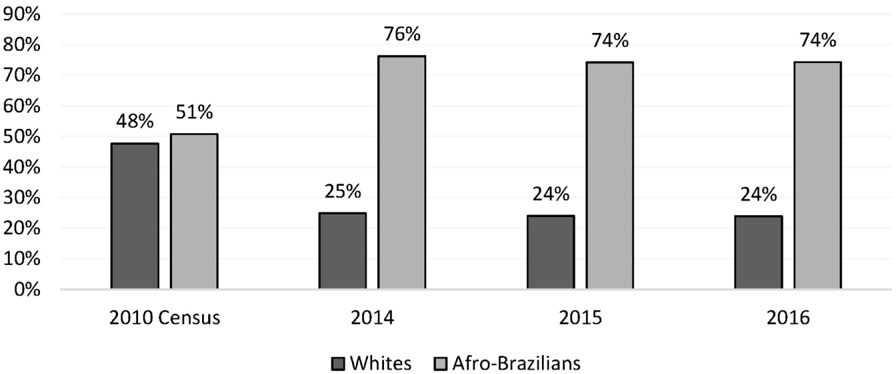
Self-identified whites and Afro-Brazilians constitute the overwhelming majority of Brazil’s population. According to the 2010 census, white Brazilians accounted for 48 percent and Afro-Brazilians 51 percent of the population, making the two groups roughly equal in size. Without a strong correlation between race and income, one would expect relatively equal representation of whites and Afro-Brazilians among recipients of means-tested benefits. A long line of social science research, however, has shown sizable and persistent racial gaps across socioeconomic outcomes. Footnote 5 A recent report by the Institute of Applied Economic Analysis (IPEA) in Brazil shows that the racial gap in average per capita household income in Brazil began to decline in the mid-2000s, but by 2015 Afro-Brazilians earned, on average, only 55 percent of what white Brazilians earned (see IPEA 2016, table 10.3). Some scholars may dismiss racial inequalities as artifacts of the historical legacies of slavery or Afro-descendants’ heavily populating Brazil’s less-developed North and Northeast regions. Footnote 6 But systematic research on racial inequality is clear: relative to their white counterparts, even within regions and class strata, Afro-Brazilians are paid less for equal work, less educated, and die at greater rates (Telles Reference Telles2004).
Given the strong correlation between race and income and the means testing of the CCT program, it is not puzzling why or how the program indirectly targets Afro-Brazilians. Consistent data on CCT recipients’ racial identifications are not readily available from the national program, but data for the program’s recent years demonstrate this indirect targeting. Figure 1 shows the racial composition of CCT recipients compared to the total population in the 2010 census. Again, the trend is clear: wide disparities in income lead Afro-Brazilians to become roughly three-quarters of recipients despite constituting roughly half the total population. Of course, it remains unclear if this disproportionate representation itself matters for understanding the effects of CCTs on electoral behavior. But considering that race is a salient dimension of poverty in Brazil and, consequently, the CCT program, the question of how or if race significantly shapes the political behavior of recipients merits consideration.
Racial Composition of CCT Recipients, 2014–2016

Electoral Behavior in Brazil: Does Race Matter?
To be sure, the idea that race ought to shape electoral behavior in Brazil is not a foregone conclusion. The notion that race is politically irrelevant in Brazil extends beyond the electoral sphere and as far back as the middle of the twentieth century. Gilberto Freyre’s canonical Casa-grande e senzala (1933), translated to English as The Masters and the Slaves, is widely credited with laying the foundation of Brazil’s national identity as a “racial democracy”—a postracial society born from the miscegenation of Portuguese colonizers, enslaved Africans, and indigenous people. Social scientists long ago labeled racial democracy a myth, yet it continued to cast a long shadow in Brazilian society, serving as official state policy during Brazil’s twentieth-century dictatorships (Loveman Reference Loveman2014; Nobles Reference Nobles2000), and sustaining scholarly arguments about the absence of institutionalized racial oppression (Marx Reference Marx1998) and race-based political mobilization from below (Hanchard Reference Hanchard1994).
Even without focusing on Brazilian national identity, scholars have noted that race has not played a major role in shaping electoral politics on a macro scale. Scholarship on the Brazilian electoral system finds few social correlates for partisanship (Samuels Reference Samuels2006) or electoral behavior more broadly, let alone race (Mainwaring Reference Mainwaring1998). But this is not entirely surprising, given Brazil’s highly fragmented multiparty system (Mainwaring Reference Mainwaring1997) and tradition of clientelistic politics (Hagopian Reference Hagopian1996), which provide few incentives for parties to develop programmatic linkages with voters or electoral bases rooted in sociological cleavages. Given these features, it is not obvious that social cleavages or identities ought to find unambiguous expression in the electoral arena.
However, as Mitchell (Reference Mitchell1977) noted decades ago, accepting the political irrelevance of race in Brazil as a foregone conclusion has prevented scholars from asking how or in what ways race may shape political outcomes. Moreover, many studies that rely on the idea of racial democracy were conducted in an era of Brazilian racial politics largely shaped by it. Footnote 7 The Brazilian state today, by contrast, explicitly recognizes and aims to address racial discrimination and inequality, a posture markedly distinct from the past (Htun Reference Htun2004; Paschel Reference Paschel2016). In this new era, the merits of race-targeted policies are now part of national political debate, race is increasingly central to activism (Caldwell Reference Caldwell2007; Perry Reference Perry2013; Smith Reference Smith2016), and recent survey evidence shows that Brazilians consider race a key determinant of a person’s life chances (Silva and Paixão Reference Silva and Paixão2014). Studies have also shown that race is an important component of campaign strategy, even if it is not articulated explicitly (Mitchell Reference Mitchell2009; Oliveira Reference Oliveira2007).
While the literature on race in Brazil is too vast to review in its entirety, suffice it to say that the political relevance of race in Brazil remains an active research agenda. But how does race affect the electoral consequences of CCTs? And why might the effects of these benefits vary across racial groups among the targeted poor? The argument advanced here is a relatively simple one. Drawing on research on comparative political behavior in Latin America, I argue that by shaping individuals’ baseline propensities toward electoral participation and candidate support before receiving benefits, race imposes different limits on the potential for CCTs to shape electoral behavior. In other words, CCTs can mobilize to the polls only those who might opt to abstain, and can persuade in favor of the incumbent only those who otherwise are inclined to support a rival candidate. The extent to which race shapes participation and vote choice prior to the receipt of CCTs may then determine whether benefits operate via mobilizing or persuasive mechanisms for individuals of different racial categories.
Although earlier research has found little evidence that race shapes partisanship or the party system, recent research provides ample evidence that race shapes electoral participation in Latin America. In a cross-sectional analysis, Carlin and Love (Reference Carlin and Love2015) find that demographic characteristics—such as race or ethnicity, age, and gender—add the most explanatory power to models of electoral participation and that these factors cannot be reduced merely to differences in resources or socioeconomic status. Footnote 8 While several demographic variables are shown to shape behavior, I expect race to matter in particular because Afro-Brazilians suffer disproportionately from socioeconomic inequalities (Hasenbalg Reference Hasenbalg1979; Telles Reference Telles2004), racism, and discrimination, all of which are likely to have an outsized effect on their self-esteem (Hordge-Freeman Reference Hordge-Freeman2015). Layton and Smith (Reference Layton and Smith2017), for example, provide compelling systematic evidence showing that skin color is one of the strongest correlates of perceived discrimination in Brazil. According to these authors, this holds even for discrimination reportedly due to class and gender, suggesting that Afro-Brazilians suffer more from all kinds of discrimination in Brazil.
In any case, the finding that race has an effect on political participation independent of resources or status differs from major findings in the U.S. politics literature. In their influential studies explaining intergroup differences in civic participation, for example, Brady et al. (Reference Brady, Verba and Schlozman1995) and Verba et al. (Reference Verba, Schlozman, Brady and Nie1993) find that apparent differences across racial groups are due to intergroup differences in civic skills, socioeconomic status, and resources. Once controlling for these factors, there are no significant differences across ethnic and racial groups in civic participation. Footnote 9 In an analysis of political participation in Brazil, however, Bueno and Fialho (Reference Bueno and Fialho2009) find that while resources do explain a significant portion of participation, race moderates the effect of resources on individuals’ participation. In other words, given the same resources, Afro-Brazilians participate less than their white counterparts.
To be clear, I have no fixed opinion on the precise mechanism that links race to behavior, though this certainly deserves greater scholarly attention in the Brazilian context. Whether it derives from the moderating effect of race on resources, diminished self-esteem or political efficacy resulting from discrimination, or some other factor, I simply build on Carlin and Love’s finding that demographics influence behavior by shaping baseline propensities toward participation before the receipt of CCT benefits.
Of course, the application of these findings to electoral behavior in Brazil must also take into account the presence of compulsory voting. According to Fornos et al. (Reference Fornos, Power and Garand2004), compulsory voting laws are one of the primary determinants of electoral turnout in Latin America. While it makes sense that compulsory voting would increase aggregate turnout, the relevance of these authors’ finding is limited here because their cross-sectional analysis relies on aggregate vote shares. This tells us little about participation at the individual level and in a given institutional context. This limitation becomes even more acute when we consider that individuals have the option to avoid fines by turning out and spoiling their ballots. In fact, Power and Garand (Reference Power and Garand2007) find that compulsory voting increases the share of spoiled ballots in addition to turnout in Latin America. In order for CCTs to benefit incumbent parties via the mobilization mechanism, recipients must not only turn out at the polls on election day, but they must also cast a valid vote.
While compulsory voting might reduce the effects of other factors in explaining turnout (Carlin and Love Reference Carlin and Love2015; Layton and Smith Reference Layton2015), the question remains as to who is most likely to cast a valid vote at the polls and how race shapes individuals’ decisions to do so. If it is true that baseline propensities limit the effects of CCTs on participation and that Afro-Brazilians are less likely than white Brazilians to participate in elections, then CCTs will be more likely to mobilize Afro-Brazilians, rather than white Brazilians, to the polls (hypothesis 1).
While evidence is mixed as to whether Brazilians prefer candidates of their same race or color, or race-specific policies (Aguilar et al. Reference Aguilar, Cunow, Desposato and Barone2015; Bueno and Dunning Reference Bueno and Dunning2017; Janusz Reference Janusz2017; Kay et al. Reference Kay, Mitchell-Walthour and White2015; Mitchell Reference Mitchell2010), a number of studies suggest that Afro-Brazilians exhibit candidate preferences that are less influenced by other factors, such as class or education. Berquó and Alencastro (Reference Berquó and de Alencastro1992), for example, find evidence that a racial voting bloc emerged in São Paulo with the lifting of literacy requirements. Castro (Reference Castro1993) similarly finds, in a study conducted in five major cities across Brazil, that not only are Afro-Brazilian voters less likely to cast valid votes, but that when they do, they are more likely to support leftist candidates. The finding that Afro-Brazilian voters lean toward leftist candidates is also supported by Soares and Silva (Reference Soares and do Valle Silva1987), who find that race was a significant explanatory factor in Leonel Brizola’s election as governor of Rio de Janeiro. Furthermore, Souza (Reference Souza1971) also analyzes Afro-Brazilian political behavior and finds that race strongly shaped voters’ preferences for the Brazilian Labor Party (PTB). Whereas the PTB derived support only from working-class and poor whites, a majority of Afro-Brazilians supported the PTB at all levels of class and status.
Previous scholarship on Afro-Brazilians’ candidate preferences highlights two important but underdiscussed points. First, scholarship does point to distinctive leftist preferences among Afro-Brazilian voters. And second, this leftist tendency potentially carries important implications for the electoral effects of CCTs, given that the incumbent party in all presidential elections since the major expansion of Bolsa Família in 2003 has been the leftist PT. Considering now the proposition that baseline propensities to support certain candidates will limit the potential persuasive effects of CCTs, and that Afro-Brazilians demonstrate a predisposition toward leftist candidates, CCTs ought to have their greatest persuasive effects on white voters, who are less disposed to support leftist candidates (hypothesis 2).
In sum, despite conventional wisdom that race is not a salient determinant of political behavior in Brazil, there is ample evidence to suggest that race is a significant factor in shaping individuals’ baseline propensities to participate in elections and to choose whom to support at the polls before receiving CCT benefits. I argue that these baseline propensities shape the electoral effects of CCTs by limiting the opportunities for these benefits to mobilize recipients to cast valid votes, and that they persuade them to support the incumbent PT, rather than a rival candidate. If these expectations are correct, then CCTs ought to have a mobilizing effect on Afro-Brazilians (who are less likely to participate in elections) and a persuasive effect on white Brazilians (who are more likely to support candidates in opposition to the PT).
Analysis
This study tests these hypotheses using matching-weighted logistic regression of AmericasBarometer survey data, made available by the Latin American Public Opinion Project (LAPOP). The periodic LAPOP surveys are nationally representative; those used for this study were conducted in Brazil biennially from 2006 to 2014, though due to issues of question compatibility, this analysis includes only surveys from 2008 to 2014. Many surveys conducted in Brazil do not include racial identification questions; LAPOP surveys include both racial identification and CCT status and are, to the best of my knowledge, the most suitable for testing these hypotheses. While survey data that predate the scaling-up of the CCT program in 2004 would be ideal, no available surveys over this period include the key independent variables required for this analysis.
LAPOP surveys allow for temporal generalizability, though they present other challenges because they are not always conducted in election years, and they overestimate support for the incumbent PT. As a robustness check, the analysis presented here was replicated using the Brazilian Electoral Study conducted by the survey firm IBOPE (Brazilian Institute of Public Opinion and Statistics) in 2014 (IBOPE/CESOP 2014). The IBOPE survey also is nationally representative, and was conducted in the two weeks following the second round of the 2014 election. It is the only other survey to include both racial ID and CCT status.
Table 1 compares estimates of electoral behavior from the LAPOP and IBOPE surveys with official election results provided by the Tribunal Superior Eleitoral (TSE) for elections held between 2006 and 2014. Aggregate estimates of each survey show that there are tradeoffs to relying on each one to study real-world electoral behavior: LAPOP surveys appear to capture abstention rates more accurately, but the IBOPE survey better captures vote choice. It is not possible, of course, to know if these differences represent inaccuracies or if they are a product of sampling, but the relevant question is whether findings presented in this analysis depend on the source of the data analyzed. The replication analysis with the IBOPE data is intended to test for this possibility.
Comparisons of Election Outcomes with Survey Estimates (percent)

Notes: Abstention rates are computed as the sum of abstainers, blank, and spoiled ballots as a proportion of the voting-eligible population. Incumbent and opposition vote shares reflect the percentages of valid votes won. In first-round elections, all non-PT votes are considered opposition, consistent with the LAPOP survey response. LAPOP and IBOPE figures are computed from full samples, not matching-weighted samples.
Source: Tribunal Superior Eleitoral; LAPOP; IBOPE.
Empirical Strategy
The targeted nature of the CCT program and the correlation between race and class raise questions about the validity of comparisons made with full samples from each survey. The endogeneity of race and class means that simple regression might rely too heavily on comparisons of poor Afro-Brazilian beneficiaries with better-off white nonbeneficiaries to estimate the effects of CCTs on electoral behavior. To mitigate this inferential challenge, I employ Iacus et al.’s (Reference Iacus, King and Porro2011a, Reference Iacus, King and Porrob) coarsened exact matching (CEM) weighting scheme to “prune” from the sample those observations without valid matches in either treatment or control groups. The result is a sample of CCT recipients and nonrecipients that are alike on all other covariates. The full sample of pooled surveys contained 4,702 observations, of which 53 percent were pruned, resulting in a sample of 2,202 observations. Tables 9 and 10 in the appendix display the results of the matching algorithm, showing good covariate balance across treatment groups.
One consequence of sample pruning is that the estimated parameters become local sample average treatment effects for the treated (local SATT), defined as the treatment effect averaged over only the subset of treated units for which good matches exist among available controls (Iacus et al. Reference Iacus, King and Porro2011a, 5). While pruning the sample in this way increases confidence in the internal validity of the estimates, it also decreases the external validity of the analysis by lessening how nationally representative the sample is. This, however, is not of primary concern, since CCT recipients themselves are not nationally representative. Instead, pruning and weighting the sample allows for the computation of unbiased estimates by reducing dependence on the identifying assumptions of the statistical model (Ho et al. Reference Ho, Imai, King and Stuart2007).
Dependent Variables
LAPOP surveys ask respondents to recall their electoral behavior in previous elections, but responses in these surveys have been shown to be unreliable and inaccurate (Zucco and Power Reference Zucco2013). Instead, this analysis relies on a question asking how respondents would vote in a hypothetical election held the week following the survey. Respondents are given the options to a) stay home, b) cast a blank ballot or spoil their vote, c) vote for the opposition, or d) vote for the incumbent.
To capture the mobilizing and persuasive effects of CCTs, responses to this question are coded in two ways. First, electoral participation is measured as a binary variable, coded 1 for casting a valid vote (c or d) and 0 for staying home or spoiling one’s ballot (a or b). Participation is coded in this way to accurately capture the mobilizing effect of CCTs: as discussed above, for the incumbent party to benefit electorally, recipients must turn out to the polls and cast valid votes. Second, vote choice is also coded as a binary variable, coded 1 for incumbent support (d) and 0 for opposition support (c). This coding restricts the sample to those who cast valid votes, isolating the potential for CCTs to operate through the persuasive mechanism. Table 2 shows tabulations from the pruned sample. Approximately 27 percent of respondents reported that they would abstain from the hypothetical election, 16 percent reported opposition support, and 56 percent reported incumbent support. Across racial and CCT groups, there are some apparent differences. Afro-Brazilians appear more likely to support the incumbent, as do CCT beneficiaries, though only CCTs, and not race, appear to increase the likelihood of electoral participation.
Pruned Sample Electoral Participation and Vote Choice

Independent Variables
Respondents’ race and CCT recipient status are the two main independent variables of interest in this analysis. Race is captured through self-declaration using the five major census categories: white, brown (mixed-race), black, Asian, and indigenous. Because there are too few observations in the sample, Asian and indigenous respondents are excluded from the analysis. Footnote 10 Race is operationalized as a binary variable, coded 0 for white respondents and 1 for Afro-Brazilian respondents, which collapses black and brown categories together. While some may criticize this coding for inaccurately reflecting Brazilian racial subjectivity (Bourdieu and Wacquant Reference Bourdieu and Wacquant1999), a dichotomous variable is used for two reasons. First, because the theoretical expectations here are that race differentiates white from nonwhite beneficiaries, not mixed-race from black beneficiaries. Footnote 11 And second, because the subsample of self-identified blacks is too small to efficiently compute estimates. Combining preto and pardo respondents increases statistical efficiency.
CCT status is captured with a binary variable, coded 0 for nonrecipients and 1 for recipients. Table 3 shows the cross-tabulation of racial groups and CCT status in the pruned sample. Whereas in the full sample Afro-Brazilians receive benefits at nearly twice the rate of whites, in the pruned sample these two groups receive benefits at similar rates, with whites receiving them at a slightly higher rate.
Pruned Sample CCT Recipient Status by Race

Other covariates in this analysis include measures of household wealth, education, age, gender, and party identification, as well as region and survey-year fixed effects. LAPOP surveys include a categorical measure of household income, but due to the response scheme employed, a very large proportion of respondents fall into the highest income category, making the notoriously unreliable measure of income even more so in these surveys. Following Córdova (Reference Córdova2009), this analysis instead uses a measure of household wealth, constructed using principal factor analysis of household goods: televisions, freezers, land lines, cellphones, cars, motorcycles, washing machines, microwaves, potable water, bathrooms, and computers. Respondents are then sorted into quintiles, a more reliable and less noisy measure of respondents’ household wealth.
Education is measured continuously as the number of years of school attended. Age is measured continuously and is included in all models along with a square term. Gender is measured as a binary variable, coded 1 for females and 0 for males. Party identification is coded 0 for nonpartisans, 1 for the PT, 2 for the PSDB, 3 for the PMDB, and 4 for other parties. One consequence of the matching design is that PSDB partisans are discarded from the analysis. Dummy variables are included to control for region (North, Northeast, Center-West, South, and Southeast) and survey-year fixed effects. Table 4 shows summary statistics for each independent variable in the pruned sample. Details on variable coarsening in the matching algorithm are included in the appendix.
Summary Statistics of Independent Variables

Models and Estimation
Electoral participation and vote choice are estimated with logistic regression. All models are weighted per the CEM algorithm. Observations without valid matches are given a weight of 0 and thus discarded from the analysis. For both dependent variables, four models are estimated: (1) a base model regressing only CCT status and race on the dependent variables; (2) the base model plus controls for wealth, education, age, age Footnote 2 , sex, and party ID; (3) the base model with controls and region and survey-year fixed effects; and (4) the full model plus an interaction term between CCT status and race. Full estimation results are presented only from the LAPOP data. The main findings from the IBOPE replication are discussed here, but full IBOPE estimation results are presented only in the online replication and supplementary materials for this article. All predicted probabilities and marginal effects are computed from the full, interactive model and are computed as “average partial effects”: rather than compute these estimates at mean values of independent variables, they are computed at the observed values of the independent variables of each observation and averaged across the sample (Hanmer and Kalkan Reference Hanmer and Kalkan2013).
Electoral Participation
Table 5 displays estimates from four models of electoral participation. Model 1 estimates that CCTs have a positive and statistically significant effect on casting a valid vote. Being Afro-Brazilian, by contrast, is estimated to have a negative effect on participation, though this effect is marginally significant at p < .1. In models 2 and 3, the effects of CCTs and race on participation are robust to the inclusion of controls and fixed effects. Education, age, female sex, and PT partisanship are all positively and statistically significantly correlated with participation. Unexpectedly, household wealth is negatively correlated with participation.
Models of Electoral Participation

* p<.1
** p<.05
*** p<.01.
Coefficients are in log-odds units. Standard errors in parentheses. Race is coded 1 for Afro-Brazilians. Party ID estimates are relative to the baseline category of nonpartisans.
With the addition of controls and fixed effects, the magnitude of the estimated effect of CCTs decreases considerably relative to model 1, by roughly 20 percent in model 2 and 40 percent in model 3. In model 3 the effect also becomes marginally significant. By contrast, the magnitude of the estimated effect of race grows considerably with the inclusion of controls and fixed effects. Relative to model 1, the effect of race grows by 33 percent in model 2 and 100 percent in model 3. The effect of race also reaches higher levels of significance in models 2 and 3.
The interaction term of model 4 is not significant, but, as Brambor et al. (Reference Brambor, Clark and Golder2006) note, the appropriate metric by which to interpret conditional effects of interactive models is predicted probabilities. Table 6 presents predicted probabilities computed from model 4 by race and CCT status. On average, being Afro-Brazilian is estimated to decrease the probability of participation by 7 percent (p < .01). Model 4 estimates similar effects among both CCT recipients and nonrecipients of 6 and 8 percent, respectively. This supports the expectation that race shapes individuals’ propensities to participate in elections, with Afro-Brazilians less likely to do so than whites.
Predicted Probabilities of Electoral Participation by CCT Status and Race

* p<.1
** p<.05
*** p<.01.
Standard errors in parentheses.
On average, the estimated marginal effect of CCTs on participation is 4 percent (p < .1), increasing the probability from roughly 72 to 76 percent. Table 6 shows, however, that this average effect is largely driven by Afro-Brazilians in the sample. Among Afro-Brazilians, CCTs are estimated to increase participation by 4 percent (p < .1), from 71 to 75 percent. Among whites, however, the estimated marginal effect is statistically insignificant at 2 percent, increasing the probability of participation from 78 to 80 percent. It is important to note, however, that the difference in the marginal effect of CCTs across racial groups is not statistically significant. Nevertheless, these results provide support for the expectation of hypothesis 1, that CCTs have a mobilizing effect among Afro-Brazilians, whose baseline propensities to participate in elections are lower than those of white Brazilians.
Comparison with official election returns suggest that LAPOP data better reflect rates of abstention than IBOPE data, but replicating this analysis with IBOPE data can nonetheless lend further support to this finding. Predicted probabilities were computed from a matching-weighted interactive model analogous to model 4. The analysis of electoral participation in the 2014 election’s first round estimates that CCTs increase the probability of participation among Afro-Brazilians by 4 percent (p < .05), and estimates no effect (0 percent) among white recipients. By contrast, analysis of second-round participation suggests that CCTs have no significant effect on participation: 0 percent among Afro-Brazilians and −2 percent among white Brazilians, with neither effect statistically significant. While it is not entirely surprising that first-round participation is more susceptible to CCT effects than second-round participation, when the election outcome is at stake, it is important to keep in mind that IBOPE data appear to overestimate electoral participation. Nevertheless, analysis from the 2014 election’s first round corroborates the LAPOP finding and suggests that it is not an artifact of this particular survey.
Vote Choice
Table 7 presents estimates from models of vote choice among those individuals who have chosen to cast a valid vote. Model 1 estimates that CCTs and race both have positive and significant effects on a person’s support for the incumbent PT. These effects are robust to the inclusion of controls and fixed effects in models 2 and 3. Wealth, education, and partisanship with nonmajor parties are negatively and significantly correlated with incumbent support, while PT partisanship is positively correlated. The magnitude of the effect of race in models 1 to 3 does not change greatly with the inclusion of controls, though the effect does fall to marginal significance in model 3. The magnitude of the effect of CCTs decreases with controls relative to model 1, by roughly 20 percent in model 2 and 25 percent in model 3. The effect remains nonetheless significant at p < .05.
Models of Electoral Support for Incumbent PT

* p<.1
** p<.05
*** p<.01.
Coefficients are in log-odds units. Standard errors in parentheses. Race is coded 1 for Afro-Brazilians. Party ID estimates are relative to the baseline category of nonpartisans.
Table 8 displays predicted probabilities and marginal effects by race and CCT status, computed from model 4. On average, being Afro-Brazilian is estimated to increase support for the incumbent PT by 4 percent (p < .1). The marginal effect of race holds only among nonrecipients, however. The estimated effect of being Afro-Brazilian is 6 percent and statistically significant among nonrecipients, but is 1 percent and insignificant among recipients. This supports the expectation that Afro-Brazilians are more likely to support the incumbent PT than whites before receiving CCTs.
Predicted Probabilities of PT Support by CCT Status and Race

* p<.1
** p<.05
*** p<.01.
Standard errors in parentheses.
On average, CCTs are estimated to increase PT support by 5 percent (p < .05). This estimated average effect is driven by white recipients, however. Among white recipients, CCTs are estimated to significantly increase PT support by 9 percent; among Afro-Brazilians, CCTs are estimated to increase PT support by only 3 percent, though this effect is not significant. Again, the difference in marginal effects across racial groups is not significant, but subgroup comparisons highlight how estimated average effects are driven by one racial subgroup. This finding provides support for the expectation of hypothesis 2, that CCTs are most likely to have a persuasive effect on white recipients, whose baseline propensities are to support a party in opposition to the incumbent PT.
Results from the replication from the IBOPE data, which more closely reflect real election results, support these findings. The marginal effect of CCTs on first-round vote choice from the analogous model 4 is estimated at 11 percent among white Brazilians (p < .05) and at 2 percent and insignificant among Afro-Brazilians. The difference in first-round marginal effects across racial groups is marginally significant at p < .1. The second-round marginal effect of CCTs on vote choice is estimated at 15 percent among white Brazilians (p < .01) and 4 percent and insignificant among Afro-Brazilians. The difference in second-round marginal effects across racial groups is significant at p < .05. Results from the IBOPE analysis thus corroborate the finding that CCTs have a persuasive effect among white recipients but not among Afro-Brazilian recipients.
Conclusions
This article has considered the consequences of race for understanding the effects of CCTs on electoral behavior in Brazil. It has shown how race shapes individuals’ baseline propensities for electoral participation and vote choice, which in turn shape the mechanisms through which CCTs boost support for the incumbent PT. The analysis provides evidence that CCTs mobilize Afro-Brazilians to cast valid votes but have no effect on Afro-Brazilian voters’ support for candidates; by contrast, the evidence suggests that CCTs do not mobilize whites, but they do persuade white voters to support the PT. Considering that Afro-Brazilians make up three-quarters of recipients, this would mean that CCTs more often operate through a mobilizing mechanism, despite the presence of compulsory voting laws in Brazil.
Two important caveats are in order. The first is that these findings apply to behavior after the 2006 election. That is to say that these findings should not be interpreted as evidence against Hunter and Power’s 2007 finding that the PT received considerable electoral support from the Northeast in 2006. Nevertheless, this analysis has provided a more complete understanding of how CCTs interact with individuals’ racialized electoral behavior to boost electoral support for the incumbent PT at the polls.
The second caveat stems from challenges to studying these questions empirically, due to the scarcity of available data. This analysis has, to the best of my knowledge, made use of the highest-quality and most reliable data sufficient for testing these hypotheses, but it has also relied on observational data from a large, omnibus survey. Future research may seek to confirm these findings using original data or design-based approaches to test these propositions further.
The findings of this analysis have nevertheless uncovered one expression of racial difference in Brazil’s electoral arena. Despite official rhetoric that has promoted racial unity and conventional wisdom that few social correlates are found in Brazil’s electoral system, this analysis has shown that race is a significant determinant of electoral behavior and that racialized differences carry consequences for understanding the political effects of ostensibly nonracial policy. Even if race does not appear to be a relevant factor, racialized priors may channel effects in ways that shape mechanisms or outcomes. One potential avenue for future research would be to consider the precise mechanisms through which race operates to shape behavior. This analysis remains agnostic in this regard, but scholars might aim to understand this relationship better, particularly whether it is driven by resources or status, self-esteem or political efficacy, or some other factor that can account for the situations and behaviors for which race is a relevant determinant in Brazil.
Athough these findings may be readily applicable to electoral behavior, they are certainly not limited to it. In fact, that racialized effects could be uncovered in an electoral arena so unconducive to the expression of social identities ought to raise questions as to what consequences race carries for understanding the various political effects of social policy in Brazil and more broadly in Latin America. As interest in the study of social welfare continues to move beyond the electoral arena (e.g., Hunter and Sugiyama Reference Hunter and Sugiyama2014; Layton Reference Layton2015), scholars might consider the direct or indirect roles that race plays in political processes. While it may not always be a relevant factor, race may operate in ways that are not obvious at first glance. There is therefore much to be gained by considering more carefully the ethnoracial dimension to socioeconomic and political inequality in Latin America.
Appendix
Joint Frequency Distribution of Observations with Matches Across Treatment Groups

Univariate Imbalance (ℒ 1) of Treatment Groups After Preprocessing
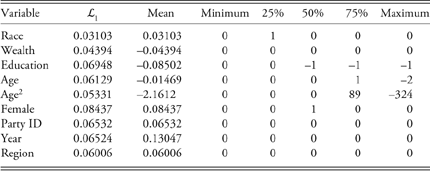
Independent Variable Coarsening
The CEM algorithm improves balance across treatment and control groups by sorting observations into strata of treated and untreated observations that are “exact matches” on all other covariates. Strata without treated and control observations are assigned a weight of 0 and discarded. The CEM algorithm thus relies on specified cut points in the values of each independent variable to sort observations into bins, within which observations can be considered qualitatively alike. In the LAPOP analysis, observations were sorted into bins using the following cut points:
-
Race was coarsened as white (0) and Afro-Brazilian (1).
-
Wealth was coarsened into quintiles.
-
Education was coarsened to correspond to levels of education in Brazil, 4 years for the first half of primary, 8 years for the second half, 11 years for high school, and 15 years for university and above.
-
Age was coarsened using the software’s default binning algorithm, Sturge’s rule.
-
Female was coarsened into male (0) and female (1).
-
Party ID was coarsened into nonpartisans (0), PT (1), PSDB (2), PMDB (3), and other partisans (4).
-
Year was coarsened for each survey year, 2008 to 2014.
-
Region was coarsened for each major geographic region, North (1), Northeast (2), Center-West (3), Southeast (4), and South (5).
Replication Data
For replication data, see the author’s file on the Harvard Dataverse website: https://dataverse.harvard.edu/dataverse/laps