

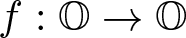



1. Introduction
We are concerned with ‘slice regular’ functions on the algebra of octonions. (See [Reference Conway and Smith14, Reference Dray and Manogue16] for general information on octonions.)
The notion of slice regular functions on octonions is a generalization of the corresponding notion for quaternions.
There is a long history of studying quaternions going back to Hamilton which has many applications, e.g., in geometry and physics.
In view of the theorem of Kervaire and Milnor, which states that  ${\mathbb R}$, ${\mathbb C}$, the quaternion algebra ${\mathbb H}$ and the algebra ${\mathbb O}$ of octonions are the only finite-dimensional real division algebras, the algebra of octonions ${\mathbb O}$ may be regarded as the ‘small brother’ ‘small’ in the sense that it has weaker properties. In particular ${\mathbb O}$ is an algebra which is only alternative and not associative. Of course $\dim({\mathbb O}) \gt \dim({\mathbb H})$. of the quaternionic algebra ${\mathbb H}$, raising the question up to which degree results on quaternions remain true in the octonion setup.
This article addresses this issue with regard to ‘slice regular functions’.
For the algebra  ${\mathbb H}$ of quaternion numbers, the theory of slice regular functions was introduced by G. Gentili and D. Struppa in two seminal papers in 2006 [Reference Gentili and Struppa19] and in [Reference Gentili and Struppa20]. They used the fact that $\forall I \in \mathbb{S}_{\mathbb{H}} = \{J \in \mathbb{H} \,\, | \,\, J^2=-1 \}$ the real subalgebra $\mathbb{C}_{I}$ generated by 1 and $I$ is isomorphic to $\mathbb{C}$ and they decomposed the algebra $\mathbb{H}$ into a ‘book-structure’ via these complex ‘slices’:
 \begin{equation*}
\mathbb{H} =\cup_{I \in \mathbb{S}_{\mathbb{H}} } \mathbb{C}_I
\end{equation*}
\begin{equation*}
\mathbb{H} =\cup_{I \in \mathbb{S}_{\mathbb{H}} } \mathbb{C}_I
\end{equation*} On an open set 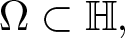 $\Omega \subset \mathbb{H},$ they defined a differentiable function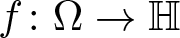 $f \colon \Omega \to \mathbb{H}$ to be (Cullen or) slice regular if, for each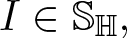 $I \in \mathbb{S}_{\mathbb H},$ the restriction of $f$ to $\Omega_I= \Omega \cap \mathbb{C}_I$ is a holomorphic function from $\Omega_I$ to $\mathbb{H},$ both endowed with the complex structure defined by left multiplication by $I.$ This definition contains all convergent power series of the form:
 \begin{equation*}
\sum_{n \in \mathbb{N}_0} w^n a_n
\end{equation*}
\begin{equation*}
\sum_{n \in \mathbb{N}_0} w^n a_n
\end{equation*}with  $\{a_n \}_{n \in \mathbb{N}_0} \subset \mathbb{H}.$
On the algebra  $\mathbb{O}$ of octonion numbers, the same approach may be used, and an analogous book-structure with complex slices holds true, as well as the power series expansion in zero with octonionic variable and coefficients, for slice regular functions over $\mathbb{O}$.
There is another, different, but equivalent approach to slice regular functions introduced by R. Ghiloni and A. Perotti in 2011, [Reference Ghiloni and Perotti21]. For an alternative  $*-$algebra $A$ over $\mathbb{R}$ they use ‘stem functions’ with values in the complexified algebra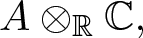 $A \otimes_{\mathbb{R}} \mathbb{C},$ denoted by $A_{\mathbb{C}}$.
The algebra of octonions  ${\mathbb O}$ is an alternative $*$-algebra, so this theory applies to the octonions. In this article we mostly use this approach.
Let us denote the elements of  ${{\mathbb O}_{\mathbb C}}$ as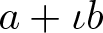 $a+\iota b$ where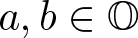 $a, b \in {\mathbb O}$ and $\iota$ is to be considered as the imaginary unit of $\mathbb{C}$ distinguished by the $i$ that appears in the usual basis for ${\mathbb O}$.
For any slice regular function 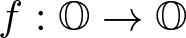 $f:{\mathbb O}\to {\mathbb O}$, and for any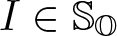 $I \in {\mathbb S}_{\mathbb O}$, (with ${\mathbb S}_{\mathbb O}=\{x\in {\mathbb O}:x^ 2=-1\}$) the restriction $f \colon \mathbb{C}_I \to {\mathbb O}$ can be lifted through the map $\phi_I \colon {\mathbb O}_{\mathbb{C}} \to {\mathbb O}$, $\phi_I (a+\iota b) := a+I b$ to a map ${\mathbb C}\cong{\mathbb C}_I\to{{\mathbb O}_{\mathbb C}}$ and it turns out that the lift does not depend on $I.$ In other words, there exists a holomorphic function $F \colon \mathbb{C} \to {{\mathbb O}_{\mathbb C}}$ which makes the following diagram commutative for all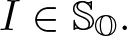 $I \in {\mathbb S}_{{\mathbb O}}.$

Conversely if a function 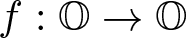 $f:{\mathbb O}\to{\mathbb O}$ admits such a lift, it is slice regular.
The class of ‘slice regular functions’ includes polynomials of the form  $P(w)=\sum_{k=0}^d w^k c_k$ (with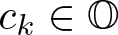 $c_k\in{\mathbb O}$) and similar power series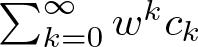 $\sum_{k=0}^\infty w^kc_k$ (if convergent). In particular, using power series development, classical functions like $\exp$, $\sin$, $\cos$, $\cosh$ extend to slice regular functions on ${\mathbb O}$.
This notion of ‘slice regularity’ easily generalizes to the case where we consider functions which are defined not globally, but only on a suitable open subset (‘axially symmetric domain’).
For instance, the power series 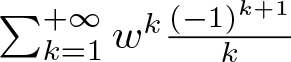 $\sum_{k=1}^{+\infty} w^k\frac{(-1)^{k+1}}{k}$ of the logarithmic function $w\mapsto \log(1+w)$ may be used to define a slice regular function on the unit ball in the algebra of octonions.
After the first definitions were given, the theory of slice regular functions knew a big development: see, among the others, the following references [Reference Altavilla and Bisi1, Reference Angella and Bisi2, Reference Bisi and Cordella4–Reference Bisi and Winkelmann11, Reference Gentili, Stoppato and Struppa18, Reference Ghiloni, Perotti and Stoppato22].
The ‘essential’ properties of a number or a function should not be changed by symmetries.
As a  $*$-algebra, the algebra of octonions ${\mathbb O}$ admits an antiinvolution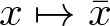 $x\mapsto \bar x$ which commutes with all automorphisms. As a consequence,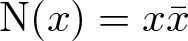 $\operatorname{{N}}(x)=x\bar x$ and $\operatorname{{Tr}}(x)=x+\bar x$ are invariant under automorphisms. In fact, we have the equivalence (for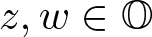 $z,w\in{\mathbb O}$):
 \begin{equation*}
\operatorname{{N}}(z)=\operatorname{{N}}(w)\ \text{and}\ \operatorname{{Tr}}(z)=\operatorname{{Tr}}(w)
\iff \exists \,\,\, \phi\in {\mathrm{Aut}}({\mathbb O}):\phi(z)=w
\end{equation*}
\begin{equation*}
\operatorname{{N}}(z)=\operatorname{{N}}(w)\ \text{and}\ \operatorname{{Tr}}(z)=\operatorname{{Tr}}(w)
\iff \exists \,\,\, \phi\in {\mathrm{Aut}}({\mathbb O}):\phi(z)=w
\end{equation*}where  $\phi$ is an automorphism of ${\mathbb O}$ as an ${\mathbb R}$-algebra. (See [Reference Dentoni and Sce15], $L_4$, p.260.)
This raises the question whether a similar correspondence holds not only for the elements in the algebra, but also for slice-regular functions of this algebra.
As it turns out, essentially this is true, but only via the associated stem functions and up to a condition on the multiplicity with which values in the centre of  ${{\mathbb O}_{\mathbb C}}$ are assumed (see §14.2). To state the latter condition, in §14.2 we use the notion of a ‘central divisor’ $\mathop{cdiv}$ which we introduced in [Reference Bisi and Winkelmann12]. We also assume that $f,h$ are not slice preserving, i.e., the image of their stem functions is not contained in the centre of ${{\mathbb O}_{\mathbb C}}$. Using this, we prove (Theorem 2.1) that, given two slice regular functions $f$ and $h$ with stem function $F$ and $H$, they have the same invariants (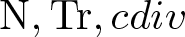 $\operatorname{{N}},\operatorname{{Tr}},\mathop{cdiv}$) if and only if there is a holomorphic map $\phi$ with values in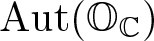 ${\mathrm{Aut}}({{\mathbb O}_{\mathbb C}})$ such that
 \begin{equation*}
\forall z: F(z)=\phi(z)\left(H(z)\right)
\end{equation*}
\begin{equation*}
\forall z: F(z)=\phi(z)\left(H(z)\right)
\end{equation*} The complete statement is in § 2, in § 3 we discuss notions like  $\operatorname{{N}}$, $\operatorname{{Tr}}$ and do some preparations, in § 4 we lay out the strategy of the proof of the main theorem. The remainder of the paper consists of the actual proofs.
Remark. Here, we discuss octonionic slice regular functions. In an earlier paper ([Reference Bisi and Winkelmann12]) we obtained similar results for the algebra of slice regular functions with values in the algebra of quaternions  $ \mathbb{H}$ or the Clifford algebra $ \mathbb{R}_3 =\mathbb{H} \oplus \mathbb{H}$.
We would like to emphasize that, while the results are similar, for the proofs we need quite different methods in the two cases (octonions versus quaternions (and  ${\mathbb R}_3$)).
2. Main theorem
Our Main Theorem is the following:
Theorem 2.1. Let  ${\mathbb O}$ be the algebra of octonions, ${{\mathbb O}_{\mathbb C}}={\mathbb O}{\otimes}_{\mathbb R}{\mathbb C}$ its complexification and $G_{{\mathbb C}}=Aut({{\mathbb O}_{\mathbb C}})$ the group of ${\mathbb C}$-algebra automorphisms of ${{\mathbb O}_{\mathbb C}}$. Let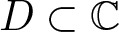 $D\subset{\mathbb C}$ be a symmetric domain and let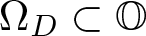 $\Omega_D\subset {\mathbb O}$ denote the corresponding axially symmetric domain (as defined in Definition 3.4).
Let  $f,h:\Omega_D\to {\mathbb O}$ be slice regular functions and let $F,H:D\to{{\mathbb O}_{\mathbb C}}$ denote the corresponding stem functions.
a) Assume that neither $f$ nor
$h$ is slice preserving.
$f$ nor
$h$ is slice preserving.Then the following are equivalent:
(i)
$f$ and
$h$ have the same invariants
$\mathop{cdiv}$,
$\operatorname{{Tr}}$,
$\operatorname{{N}}$.(ii)
$F$ and
$H$ have the same invariants
$\mathop{cdiv}$,
$\operatorname{{Tr}}$,
$\operatorname{{N}}$.(iii)
$\mathop{cdiv}(F)=\mathop{cdiv}(H)$ and for every
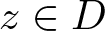
$z\in D$ there exists an element
$\alpha\in Aut({{\mathbb O}_{\mathbb C}})=G_{{\mathbb C}}$ such that
$F(z)=\alpha(H(z))$.(iv) There is a holomorphic map
$\phi:D\to G_{{\mathbb C}}$ such that
$F(z)=\phi(z)\left(H(z)\right)\ \forall z\in D$.
b) Assume that
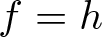
$f$ is slice-preserving. Then the following are equivalent:(i)
$f=h$.(ii)
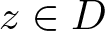
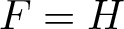
$F=H$.(iii) For every
$z\in D$ there exists an element
$\alpha\in Aut({{\mathbb O}_{\mathbb C}})=G_{{\mathbb C}}$ such that
$F(z)=\alpha(H(z))$.(iv) There is a holomorphic map
$\phi:D\to G_{{\mathbb C}}$ such that
$F(z)=\phi(z)\left(H(z)\right)\ \forall z\in D$.












Remark. The notion of a ‘central divisor’ is defined only if the function is not slice preserving. This is similar to the classical situation in complex analysis where the divisor of a holomorphic function is defined only if it is not constantly zero.
The following example illustrates the need for a special treatment of slice-preserving functions. Namely, we show that if one of the functions is slice preserving and the other one not, then they may share the same invariants  $\operatorname{{N}}$, $\operatorname{{Tr}}$ without being related by a map to the automorphism group.
Example 2.2. Let 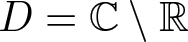 $D={\mathbb C}\setminus{\mathbb R}$. Let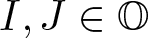 $I,J\in{\mathbb O}$ with $I^2=-1=J^2$ and $IJ=-JI$. Define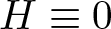 $H\equiv 0$ and $F:D\to{{\mathbb O}_{\mathbb C}}$ as
 \begin{equation*}
F(z)=\begin{cases}
I{\otimes} z +J{\otimes}\iota z & \text{if}\ \mathop{\Im m}(z) \gt 0\\
I{\otimes} z -J{\otimes}\iota z & \text{if}\ \mathop{\Im m}(z) \lt 0\\
\end{cases}
\end{equation*}
\begin{equation*}
F(z)=\begin{cases}
I{\otimes} z +J{\otimes}\iota z & \text{if}\ \mathop{\Im m}(z) \gt 0\\
I{\otimes} z -J{\otimes}\iota z & \text{if}\ \mathop{\Im m}(z) \lt 0\\
\end{cases}
\end{equation*} Then  $F$ is a stem function with $\operatorname{{N}}(F)=0=\operatorname{{Tr}}(F)$, but evidently there is no holomorphic map $\phi:D\to{\mathrm{Aut}}({{\mathbb O}_{\mathbb C}})$ with
 \begin{equation*}
F(z)=\phi(z)\left(H(z)\right)=\phi(z)\left( 0 \right)
\ \forall z\in D,
\end{equation*}
\begin{equation*}
F(z)=\phi(z)\left(H(z)\right)=\phi(z)\left( 0 \right)
\ \forall z\in D,
\end{equation*}since every automorphism of the algebra  ${{\mathbb O}_{\mathbb C}}$ fixes the zero element $0$.
$0$.
The main theorem (Theorem 2.1) is proved in §15. Details concerning conjugation, trace, and norm are discussed in §3. For the definition of the ‘central divisor’  $\mathop{cdiv}$, see § 14.2.
3. Preparations
Here, we collect basic facts and notions needed for our main result. First, we discuss conjugation, norm, and trace, then types of domains, then slice regular functions and stem functions, followed by investigating conjugation, norm and trace for function algebras.
We will formulate these preparations for arbitrary alternative algebras even if we will apply them only to the case of octonions.
3.1. Conjugation, norm, and trace
Let  $A$ be an alternative ${\mathbb R}$-algebra with $1$ and let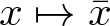 $x\mapsto \bar x$ be an antiinvolution, i.e., an ${\mathbb R}$-linear map such that $\overline{xy}=(\bar y)\cdot(\bar x)$ and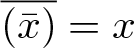 $\overline{(\bar x)}=x$ for all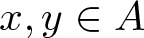 $x,y\in A$. (An ${\mathbb R}$-algebra with an antiinvolution is often called $*$-algebra.)
Definition 3.1. Given an  ${\mathbb R}$-algebra $A$ with antiinvolution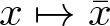 $x\mapsto\bar x$, we define:
 \begin{align*}
\text{Trace: } & \operatorname{{Tr}}(x)=x+\bar x\\
\text{Norm: } & \operatorname{{N}}(x)=x\bar x\\
\end{align*}
\begin{align*}
\text{Trace: } & \operatorname{{Tr}}(x)=x+\bar x\\
\text{Norm: } & \operatorname{{N}}(x)=x\bar x\\
\end{align*}Consider
 \begin{equation*}
C=\{x\in A: x= \bar x\}.
\end{equation*}
\begin{equation*}
C=\{x\in A: x= \bar x\}.
\end{equation*} We assume that  $C$ is central and associates with all other elements, i.e.,
 \begin{equation*}
\forall c\in C, x,y\in A: cx=xc\text{and} \ c(xy)=(cx)y
\end{equation*}
\begin{equation*}
\forall c\in C, x,y\in A: cx=xc\text{and} \ c(xy)=(cx)y
\end{equation*} It is easy to verify that  $C$ is a subalgebra (under these assumptions, i.e., if $C$ is assumed to be central).
Lemma 3.2. Under the above assumptions, the following properties hold:
(i)
$\forall x\in {\mathbb R}:x=\bar x$.(ii)
$\forall x\in A: \operatorname{{N}}(x),\operatorname{{Tr}}(x)\in C=\{y\in A: y=\bar y\}$(iii)
$\forall x\in A: x\bar x=\bar x x$(iv)
$\forall x\in A: \operatorname{{N}}(x)=\operatorname{{N}}(\bar x)$.(v)
$\forall x,y\in A: \operatorname{{N}}(xy)=\operatorname{{N}}(x)\operatorname{{N}}(y)$.





Proof. See [Reference Bisi and Winkelmann12], Lemma 2.2.
Other notions.
If  $\operatorname{{Tr}}(x)\in{\mathbb R}\ \forall x\in A$, then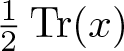 $\frac12\operatorname{{Tr}}(x)$ is often called real part of $x$, sometimes denoted as $x_0$. $N(x)$ is also called the symmetrization of $x$ and denoted as $x^s$.
3.2. (Axially) symmetric domains
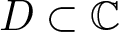
Lemma 3.3. Let  $\Omega$ be an open subset of the algebra ${\mathbb O}$ of octonions. Let ${\mathbb S}_{{\mathbb O}}=\{q\in{\mathbb O}:q^2=-1\}$.
Then the following are equivalent:
(i) There exists an open subset
$D\subset {\mathbb C}$ such that
\begin{equation*}
\forall x,y\in{\mathbb R}:\forall J\in{\mathbb S}_{{\mathbb O}}:\
x+yi\in D\quad \iff\quad x+yJ\in\Omega
\end{equation*}(ii)
\begin{equation*}
\forall J,K\in{\mathbb S}_{{\mathbb O}}:\forall x,y\in{\mathbb R}:
x+yJ\in\Omega\ \iff\ x+yK\in\Omega
\end{equation*}(iii) There is a subset
$M\subset{\mathbb R}\times{\mathbb R}^+_0$ such that
\begin{equation*}
\Omega=\{q\in{\mathbb O}:(\operatorname{{Tr}}(q),\operatorname{{N}}(q))\in M\}
\end{equation*}(iv)
$\Omega$ is invariant under the action of
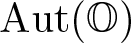
${\mathrm{Aut}}({\mathbb O})$.(v)
$\Omega$ is invariant under the action of
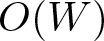
$O(W)$, the group of orthogonal transformations of
$W=\{q\in{\mathbb O}:\operatorname{{Tr}}(q)=0\}$ acting naturally on
$W$ and acting trivially on
${\mathbb R}$.


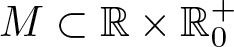






Proof.  $(i)\iff(ii)$ is obvious. $(ii)\iff(iii)$: Let $q=x+yJ\in{\mathbb O}$ with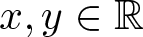 $x,y\in{\mathbb R}$,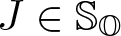 $J\in{\mathbb S}_{{\mathbb O}}$. Then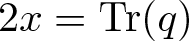 $2x=\operatorname{{Tr}}(q)$ and $x^2+y^2=\operatorname{{N}}(q)$. Hence, for any given $(t,n)\in{\mathbb R}\times{\mathbb R}^+_0$ we have
 \begin{align*}
&\{q=x+yJ\in{\mathbb O}: \operatorname{{N}}(q)=n, \operatorname{{Tr}}(q)=t\}\\
=&\left\{\frac t2+yJ: J\in{\mathbb S}_{{\mathbb O}},
t\in{\mathbb R}, y\in{\mathbb R}^+_0,
y^2=n-t^2/4\right\}.\\
\end{align*}
\begin{align*}
&\{q=x+yJ\in{\mathbb O}: \operatorname{{N}}(q)=n, \operatorname{{Tr}}(q)=t\}\\
=&\left\{\frac t2+yJ: J\in{\mathbb S}_{{\mathbb O}},
t\in{\mathbb R}, y\in{\mathbb R}^+_0,
y^2=n-t^2/4\right\}.\\
\end{align*} This yields  $(ii)\iff(iii)$. $(iii)\iff(iv)$: See Corollary 9.5. $(iv)\iff(v)$: Follows from Corollary 9.5 in combination with Proposition 9.1.
(i) A domain
$D$ in
${\mathbb C}$ is called symmetric if
\begin{equation*}
z\in D\iff \bar z\in D.
\end{equation*}(ii) A domain
$\Omega$ in
${\mathbb O}$ is called axially symmetric if it satisfies one (hence all) of the properties of Lemma 3.3.


In the situation of Lemma 3.3  $(i)$ we write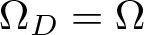 $\Omega_D=\Omega$, since $D$ and $\Omega$ are in one-to-one-correspondence.
3.3. Slice and stem functions
Definition 3.5. Let  $D$ be a symmetric domain in ${\mathbb C}$ and let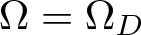 $\Omega=\Omega_D$ be the associated axially symmetric domain, i.e.,
 \begin{equation*}
\Omega=\Omega_D=\{x+yJ:x,y\in{\mathbb R},J\in{\mathbb S}_{{\mathbb O}}, x+yi\in D\}
\end{equation*}
\begin{equation*}
\Omega=\Omega_D=\{x+yJ:x,y\in{\mathbb R},J\in{\mathbb S}_{{\mathbb O}}, x+yi\in D\}
\end{equation*}(i) A function
$F:D\to{{\mathbb O}_{\mathbb C}}$ is a ‘stem function’ if
where we conjugate the complex part of the tensor product
\begin{equation*}
\forall z\in D:\ \overline{F(\bar z)}=F(z)
\end{equation*}
${{\mathbb O}_{\mathbb C}}={\mathbb O}{\otimes}_{\mathbb R}{\mathbb C}$.(ii) A function
$f:\Omega_D\to{\mathbb O}$ is a slice function, if there exists a stem function
$F=F_1+\iota F_2$ (
$F_i:D\to{\mathbb O}$) such that
\begin{equation*}
\forall x+yi\in D,J\in{\mathbb S}_{{\mathbb O}}:
f(x+yJ)=F_1(x+yi)+J F_2(x+yi)
\end{equation*}(iii) A function
$f:\Omega_D\to{\mathbb O}$ is a slice regular function, if there exists such a corresponding stem function
$F$ which is holomorphic.









3.3.1.
$*$-product

The space of slice regular functions on an axially symmetric domain in  ${\mathbb O}$ forms an alternative ${\mathbb R}$-algebra with the $*$-product as multiplication.
This  $*$-product may be defined by the correspondence with stem functions:
Given slice regular functions  $f,g$ with stem functions $F$ resp. $G$, their ‘star product’ is defined as the slice regular function whose stem function is $F\cdot G$ (with $(F\cdot G)(z)=F(z)G(z)$).
If slice regular functions  $f,g$ are described by convergent power series
 \begin{equation*}
f(q)=\sum_{k=0}^{+\infty} q^ka_k,\quad
g(q)=\sum_{k=0}^{+\infty} q^kb_k
\end{equation*}
\begin{equation*}
f(q)=\sum_{k=0}^{+\infty} q^ka_k,\quad
g(q)=\sum_{k=0}^{+\infty} q^kb_k
\end{equation*}then
 \begin{equation*}
(f*g)=\sum_{k=0}^{+\infty} q^kc_k,\quad
c_k=\sum_{j=0}^ka_jb_{k-j}\quad
\text{(Cauchy product)}
\end{equation*}
\begin{equation*}
(f*g)=\sum_{k=0}^{+\infty} q^kc_k,\quad
c_k=\sum_{j=0}^ka_jb_{k-j}\quad
\text{(Cauchy product)}
\end{equation*} Warning: In general  $(f*g)(q)\ne f(q)g(q)$.
3.4. Conjugation, norm, and trace: function algebras
Given the notion of conjugation on an algebra, we want to define conjugation also on associated function algebras. This is often intricate, since conjugation must be defined such that the conjugate of a function is still a member of the function algebra at hand.
For a stem function  $F$ we define $(F^c)(z)=\left(F(z)\right)^c$, i.e., we apply (octonion) conjugation pointwise. Thus, we obtain a conjugation on the algebra of stem functions defined on a symmetric domain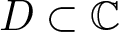 $D\subset {\mathbb C}$.
For a slice regular function  $f$, we may define its conjugate $f^c$ using the correspondence between slice functions and stem functions, i.e., given a slice regular function $f:\Omega_D\to{\mathbb O}$ with stem function $F:D\to{{\mathbb O}_{\mathbb C}}$ we define its conjugate $f^c$ as the slice regular function which has $F^c$ as stem function.
Warning. Given a slice regular function  $f:q\mapsto f(q)$ in general neither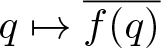 $q\mapsto\overline{f(q)}$ nor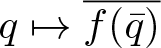 $q\mapsto \overline{f(\bar q)}$ is regular.
In general we have 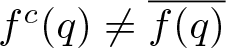 $f^c(q)\ne\overline{f(q)}$.
From these definitions we easily deduce
(i) The map
$f\mapsto f^c$ is an antiinvolution on the
${\mathbb R}$-algebra of slice regular functions on
$\Omega_D$ for every axially symmetric domain
$\Omega_D$.(ii) If
$F=F_1+\iota F_2$ is the stem function for a slice regular function
$f$, then
\begin{align*}
f(x+Iy)&=F_1(x+iy)+IF_2(x+iy)\\
f^c(x+Iy)&=F_1^c(x+iy)+IF_2^c(x+iy)
\end{align*}
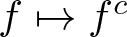





Once conjugation 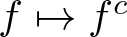 $f\mapsto f^c$ is defined, we define norm and trace in the usual way (as in Definition 3.1).
For a stem function  $F$ we obtain:
 \begin{equation*}
\operatorname{{N}}(F)(z)=(FF^c)(z)=(F(z))(F^c(z))=(F(z))(F(z))^c=\operatorname{{N}}(F(z))
\end{equation*}
\begin{equation*}
\operatorname{{N}}(F)(z)=(FF^c)(z)=(F(z))(F^c(z))=(F(z))(F(z))^c=\operatorname{{N}}(F(z))
\end{equation*}and
 \begin{equation*}
(\operatorname{{Tr}} F)(z)=(F+F^c)(z)=F(z)+(F(z))^c=\operatorname{{Tr}} (F(z))
\end{equation*}
\begin{equation*}
(\operatorname{{Tr}} F)(z)=(F+F^c)(z)=F(z)+(F(z))^c=\operatorname{{Tr}} (F(z))
\end{equation*}3.5. Power series
Let  $\Omega=B_r=\{q\in{\mathbb O}:||q|| \lt r\}$ with $0 \lt r\le +\infty$. Then every slice regular function $f$ on $\Omega$ is given by a power series $f(q)=\sum_{k=0}^{+\infty} q^ka_k$ (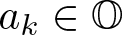 $a_k\in{\mathbb O}$) which converges on all of $\Omega$.
In this case we have:
 \begin{equation*}
f^c(q)=\sum_{k=0}^{+\infty} q^k\bar a_k,\quad\quad
(\operatorname{{Tr}} f)(q)=\sum_{k=0}^{+\infty} q^k\left(\operatorname{{Tr}} a_k\right)
\end{equation*}
\begin{equation*}
f^c(q)=\sum_{k=0}^{+\infty} q^k\bar a_k,\quad\quad
(\operatorname{{Tr}} f)(q)=\sum_{k=0}^{+\infty} q^k\left(\operatorname{{Tr}} a_k\right)
\end{equation*}3.6. Conjugation, norm, and trace: summary
Immediate from the construction, we obtain:
Proposition 3.7. Let  $f$ be a slice function and $F$ its associated stem function.
Then  $\operatorname{{N}}(F)$,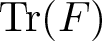 $\operatorname{{Tr}}(F)$ and $F^ c$ are the stem functions associated to $\operatorname{{N}}(f)$, $\operatorname{{Tr}}(f)$ resp. $f^c$.
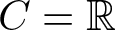
We will apply the notions of conjugation, norm, and trace not only to  ${\mathbb O}$, but to all of the following ${\mathbb R}$-algebras:
(i) The algebra
${\mathbb O}$ of octonions with the usual multiplication and conjugation with
$C={\mathbb R}$.(ii) The complexified octonions
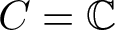
${{\mathbb O}_{\mathbb C}}$ with
$C={\mathbb C}$ embedded into
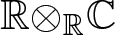
${{\mathbb O}_{\mathbb C}}={\mathbb O}{\otimes}_{{\mathbb R}}{\mathbb C}$ as
${\mathbb R}{\otimes}_{{\mathbb R}}{\mathbb C}$. Conjugation on
${\mathbb O}$ is a
${\mathbb R}$-linear self-map of
${\mathbb O}$ which naturally induces a
${\mathbb C}$-linear self-map on the tensor product
${{\mathbb O}_{\mathbb C}}={\mathbb O}{\otimes}_{\mathbb R}{\mathbb C}$. We take this octonionic conjugation as the antiinvolution. This octonionic conjugation is not to be confused with the complex conjugation of the complex vector space
${{\mathbb O}_{\mathbb C}}={\mathbb O}{\otimes}_{\mathbb R}{\mathbb C}$.(iii) The algebra of slice regular functions on an axially symmetric domain
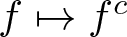
$\Omega_D$ with the star product as multiplication and
$f \mapsto f^ c$ (see discussion in §3.4) as involution and the subalgebra of slice-preserving functions (see §3.7) as
$C$.(iv) The algebra of ‘stem functions’
$F:D\to{{\mathbb O}_{\mathbb C}}$ on a symmetric domain
$D$ with pointwise multiplication as product and pointwise octonionic conjugation as conjugation. Here,
$C$ denotes the subalgebra of those functions whose values are contained in the centre of
${{\mathbb O}_{\mathbb C}}$.












3.7. Slice-preserving functions
There is a special class of slice (regular) functions which is called ‘slice preserving’.
Proposition 3.8. Let 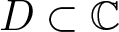 $D\subset {\mathbb C}$ be a symmetric domain with associated axially symmetric domain $\Omega_D$.
Let  $f:\Omega_D\to {\mathbb O}$ be a slice regular function with stem function $F:D\to{{\mathbb O}_{\mathbb C}}$.
Then the following are equivalent:
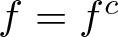
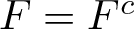
(i)
$f=f^c$,(ii)
$F=F^c$,(iii)
$F(D)\subset {\mathbb R}{\otimes}_{\mathbb R}{\mathbb C}\subset {\mathbb O}{\otimes}_{\mathbb R}{\mathbb C}={{\mathbb O}_{\mathbb C}}$.(iv)
$f(D\cap {\mathbb C}_I)\subset{\mathbb C}_I$ for all
$I\in{\mathbb S}_{{\mathbb O}}=\{q\in {\mathbb O}:q^2=-1\}$ (with
${\mathbb C}_I={\mathbb R}+I{\mathbb R}$).




Definition 3.9. If one (hence all) of these properties are fulfilled,  $f$ is called ‘slice preserving’.
Proof. These equivalences are well known.  $(iv)\iff(iii)$ follows from representation formula. $(i)\iff(ii)\iff(iii)$ by construction of $(\ )^c$.
A slice regular function  $f$ which is given by a convergent power series $f(q)=\sum_{k=0}^{+\infty}q^ka_k$ is slice preserving if and only if all the coefficients $a_k$ are real numbers.
3.8. Compatibility
Recall that conjugation for slice regular functions is not just pointwise conjugation of the function values.
Therefore, in general
 \begin{equation*}
(\operatorname{{Tr}} f)(q)\ne \operatorname{{Tr}}(f(q)), (\operatorname{{N}} f)(q)\ne \operatorname{{N}}(f(q)).
\end{equation*}
\begin{equation*}
(\operatorname{{Tr}} f)(q)\ne \operatorname{{Tr}}(f(q)), (\operatorname{{N}} f)(q)\ne \operatorname{{N}}(f(q)).
\end{equation*} Let  $B$ be a ${\mathbb R}$-subalgebra of an ${\mathbb R}$ algebra $A$. Let $A$ be equipped with an antiinvolution which stabilizes $B$.
$B$.
Then for 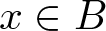 $x\in B$ the notions $\operatorname{{Tr}}(x)$ and $\operatorname{{N}}(x)$ are the same regardless whether we regard $x$ as an element of $B$ or as an element of $A$.
$A$.
As a consequence
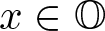
• For
$x\in{\mathbb O}$ the notions
$\operatorname{{N}}(x)$,
$\operatorname{{Tr}}(x)$ agree independent of whether we consider
$x$ in
${\mathbb O}$ or in
${{\mathbb O}_{\mathbb C}}$.• For an element
$x\in{\mathbb O}$ the notions
$\operatorname{{N}}(x)$,
$\operatorname{{Tr}}(x)$ agree whether we regard
$x$ in
${\mathbb O}$ or as a constant slice regular function with value
$x$.




3.9. Decomposing
${\mathbb O}$

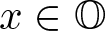
Frequently, we will use the vector space decomposition  ${\mathbb O}=C\oplus W$ where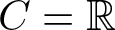 $C={\mathbb R}$ is the centre of ${\mathbb O}$ (and also $C=\{x\in{\mathbb O}:x=\bar x\}$), and $W$ denotes the imaginary subspace, i.e.,
 \begin{equation*}
W=\ker\operatorname{{Tr}}=\{x\in{\mathbb O}:x=-\bar x\}
\end{equation*}
\begin{equation*}
W=\ker\operatorname{{Tr}}=\{x\in{\mathbb O}:x=-\bar x\}
\end{equation*} This decomposition  ${\mathbb O}=C\oplus W$ is a vector space decomposition (in fact the eigenspace decomposition for the conjugation map), but not an algebra decomposition.
It induces a similar decomposition  ${{\mathbb O}_{\mathbb C}}=C_{{\mathbb C}}\oplus W_{{\mathbb C}}$ of the complexification.
4. Strategy
Here, we want to present a rough ‘road map’ for the proof of our main theorem (Theorem 2.1).
As always in this paper,  ${\mathbb O}$ denotes the algebra of octonions.
Let  $\Omega_D$ be an axially symmetric domain in ${\mathbb O}$ associated to a symmetric domain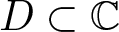 $D\subset{\mathbb C}$ (as in §3.2).
The most difficult part of our main theorem (Theorem 2.1) is the implication  $(iii)\implies(iv)$. In order to prove this we have to show the following statement for certain namely, ‘Stem functions’ as discussed in the preceding section holomorphic maps $F,H:D\to{{\mathbb O}_{\mathbb C}}$
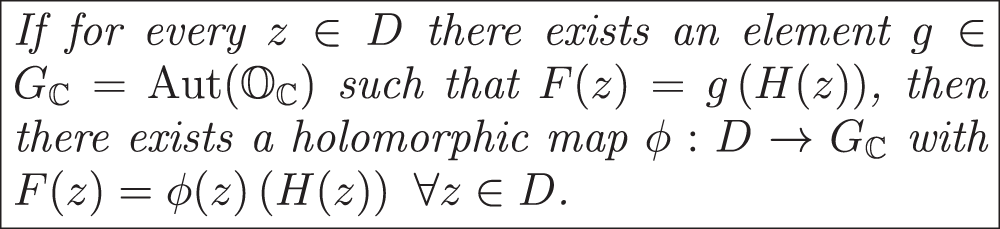
This amounts to finding a section for a certain projection map, namely  $\pi:V\to D$ with
 \begin{equation*}
V=\{(z,g)\in D\times G_{{\mathbb C}}: F(z)=g\left(H(z)\right) \}
\end{equation*}
\begin{equation*}
V=\{(z,g)\in D\times G_{{\mathbb C}}: F(z)=g\left(H(z)\right) \}
\end{equation*}and 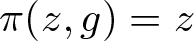 $\pi(z,g)=z$.
It is easy to reduce to the case where  $\operatorname{{Tr}}(F)=\operatorname{{Tr}}(H)=0$ (Lemma 13.1).
We discuss the locus where the imaginary parts of  $F$ and $H$ assume zero as value. For this purpose, we need the notion of a ‘central divisor’ (§ 14.2). Using this notion we arrive at the case where the imaginary parts of $F$ and $H$ have no zeroes. Then all the fibres of $\pi:V\to D$ have the same dimension.
Based on the construction of  $V$ and an analysis of the automorphism group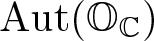 ${\mathrm{Aut}}({{\mathbb O}_{\mathbb C}})$ of the algebra of complexified octonions ${{\mathbb O}_{\mathbb C}}$, we deduce that there is a discrete subset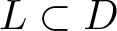 $L\subset D$ such that $\pi$ restricts to a holomorphically locally trivial fibre bundle over $D_0=D\setminus L$ (Proposition 12.1).
For a point  $p$ in the discrete set $L$ the map $\pi$ is not a locally trivial bundle on any neighbourhood of $p$ in $D$; in fact here the $\pi$-fibre is not isomorphic to the generic $\pi$-fibre.
We continue as follows: First we construct a topological section over  $D_0$ (Proposition 6.1), then we show that we can extend this section to a section defined on all of $D$ by suitable modifications near the special fibres (Proposition 6.3). Here, it is important that the generic fibres are simply-connected, and that by a result in an earlier paper (see Proposition 5.1) we know that $\pi$ admits everywhere local sections (even holomorphic ones).
Once we have obtained a continuous section for  $\pi:V\to D$, we may deduce the existence of a holomorphic section $\sigma:D\to V$ using Oka theory (Proposition 7.6). For this purpose, we verify that $\pi:V\to D$ is an elliptic map in the sense of Oka theory.
We would like to emphasize that for the case 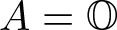 $A={\mathbb O}$ we need new methods and technologies which differ from those we used in [Reference Bisi and Winkelmann12] for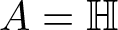 $A={\mathbb H}$. In particular, for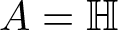 $A={\mathbb H}$ the fibres of the above-mentioned map $\pi:V\to {\mathbb C}$ are one-dimensional, and in [Reference Bisi and Winkelmann12] we used special properties only true in low dimensions. Here, for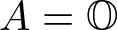 $A={\mathbb O}$ we need more general theory, in particular Oka theory.
On the other hand, the arguments we used for the octonion case need that the generic fibres of the above-mentioned map  $\pi$ are simply-connected, while in the quaternionic case they are isomorphic to ${\mathbb C}^*$. Thus, the proof for the quaternionic case is not a corollary to our result for the octonion case.
5. Local equivalence
Proposition 5.1. Let  $G$ be a connected complex Lie group acting holomorphically on a complex manifold $X$ such that all the orbits have the same dimension $d$.
$d$.
Let
 \begin{equation*}
F,H:\Delta=\{z\in{\mathbb C}:|z| \lt 1\}
\to X
\end{equation*}
\begin{equation*}
F,H:\Delta=\{z\in{\mathbb C}:|z| \lt 1\}
\to X
\end{equation*}be holomorphic maps such that for every 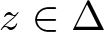 $z\in\Delta$ there exists an element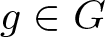 $g\in G$ (depending on $z$, not necessarily unique) with $F(z)=g\cdot H(z)$.
Then there exists  $0 \lt r \lt 1$ and a holomorphic map
 \begin{equation*}
\phi:
\Delta_r=\{z:|z| \lt r\}\to G
\end{equation*}
\begin{equation*}
\phi:
\Delta_r=\{z:|z| \lt r\}\to G
\end{equation*}such that
 \begin{equation*}
F(z)=\phi(z)\left( H(z)\right)\ \forall z\in\Delta_r.
\end{equation*}
\begin{equation*}
F(z)=\phi(z)\left( H(z)\right)\ \forall z\in\Delta_r.
\end{equation*}Proof. See [Reference Bisi and Winkelmann12], Proposition 9.4.
6. Topological preparations
6.1. Existence of sections
Proposition 6.1. Let  $\pi:E\to B$ be a locally trivial topological fibre bundle and assume that the fibre $F$ is pathwise connected and that $B$ is homotopic to a (real) one-dimensional $CW$ complex.
Then there exists a continuous section  $\sigma:B\to E$.
Proof. First we claim: There is no loss in generality in assuming that  $B$ is itself a one-dimensional $CW$-complex (instead of merely being homotopic to one.)
Indeed, let  $W$ be a real one-dimensional $CW$-complex homotopic to $B$. This means that there are continuous maps $f:W\to B$ and $g:B\to W$ such that $g\circ f$ and $f\circ g$ are homotopic to $id_W$ resp. $id_B$. Assume that the pullback bundle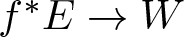 $f^*E\to W$ has a section. This yields an induced section in $g^*(f^*E))\to B$ ([Reference Steenrod30], Lemma 2.11). But the bundle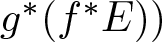 $g^*(f^*E))$ is isomorphic as a bundle to $E$, because $g\circ f\sim id_B$ ([Reference Steenrod30], Theorem 11.5.)
Thus, from now one we may and do assume that  $B$ itself is a real one-dimensional $CW$-complex.
We remove points  $p_i$ ( $i\in I$) in the one-dimensional cells of $B$ such that the complement $M=B\setminus\{p_i:i\in I\}$ has only contractible connected components. For this, we have to remove points in one-dimensional cells which are part of closed loops. Evidently this may be done by removing at most one point in each one-dimensional cell. For this reason the (possibly countably infinite) family of points $(p_i)_i$ forms a discrete subset of $B$.
$B$.

The restriction of the bundle to  $M$ is trivial, because $M$ is contractible. Hence, there is a section $s_0:M\to E$. Each of the chosen points $p_i$ admits an open neighbourhood $U_i$ with an homeomorphism $\phi_i:U_i\,\simeq\,]-\!1,+1[$ with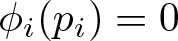 $\phi_i(p_i)=0$. Fix $q_i^-=\phi_i^{-1}(-0.5)$ and $q_i^+=\phi_i^{-1}(0.5)$.
The bundle admits a trivialization on  $U_i$ (because $U_i$ is contractible). Hence
  $\exists\alpha_i:\pi^{-1}(U_i)
\stackrel{\sim}{\longrightarrow} U_i\times F$. Now we choose a path
$\exists\alpha_i:\pi^{-1}(U_i)
\stackrel{\sim}{\longrightarrow} U_i\times F$. Now we choose a path
 \begin{equation*}
\gamma_i:[-0.5,+0.5]\to F
\end{equation*}
\begin{equation*}
\gamma_i:[-0.5,+0.5]\to F
\end{equation*}with  $ \alpha_i(s_0(q_i^-))=(q_i^-,\gamma_i(-0.5))$ and $ \alpha_i(s_0(q_i^+))=(q_i^+,\gamma_i(0.5))$.
We obtain a section on  $U_i$ as
 \begin{equation*}
\sigma:x\mapsto
\begin{cases} s_0(x) & \text{if $x\not\in\phi_i^{-1}([-0.5,0.5])$}\\
\alpha_i^{-1}(x,\gamma_i(t)) & \text{
if $\phi_i(x)=t$ with $t\in[-0.5,0.5]$}\\
\end{cases}
\end{equation*}
\begin{equation*}
\sigma:x\mapsto
\begin{cases} s_0(x) & \text{if $x\not\in\phi_i^{-1}([-0.5,0.5])$}\\
\alpha_i^{-1}(x,\gamma_i(t)) & \text{
if $\phi_i(x)=t$ with $t\in[-0.5,0.5]$}\\
\end{cases}
\end{equation*} By performing this procedure around each  $p_i$ and keeping $s_0$ outside the union of all $U_i$ we obtain a global section $\sigma:B\to E$.
6.2. Homotopy equivalence of sections
Proposition 6.2. Let  $\pi:E\to B$ be a locally trivial topological fibre bundle with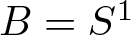 $B=S^1$ where the fibre $F$ is connected and simply-connected.
Then any two continuous sections are homotopic to each other.
Proof. Let  $\sigma_0,\sigma_1:B\to E $ be two continuous sections.
Recall that 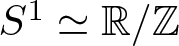 $S^1\simeq{\mathbb R}/{\mathbb Z}$. In particular, $S^1$ may be obtained from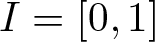 $I=[0,1]$ by identifying $0$ with $1$. Let $\rho:I\to \left(I/\!\sim\right) \simeq S^1=B$ be the corresponding quotient map.
Let
 \begin{equation*}
\rho^*E=\tilde E\stackrel{\tilde\pi}\longrightarrow I
\end{equation*}
\begin{equation*}
\rho^*E=\tilde E\stackrel{\tilde\pi}\longrightarrow I
\end{equation*}be the pull-back of the bundle  $\pi:E\to B$ under the map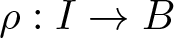 $\rho:I\to B$.
Since  $I$ is contractible, this pull-back bundle may be trivialized as described in the commutative diagram below

Here,  $\tilde\rho:\rho^*E=\tilde E\to E$ and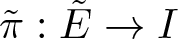 $\tilde \pi:\tilde E\to I$ are the natural maps which make the diagram commute, and $\psi$ denotes the second component of the trivializing map $\phi:\tilde E\to I\times F$.
Since  $B$ is obtained from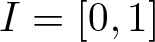 $I=[0,1]$ by identifying $0$ with $1$, we may obtain $E$ from $\tilde E\simeq I\times F$ by identifying $(0,p)$ with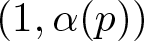 $(1,\alpha(p))$ for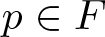 $p\in F$ where $\alpha$ denotes an homeomorphism of $F$. Then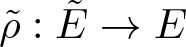 $\tilde\rho:\tilde E\to E$ is the natural quotient map.
Let 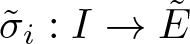 $\tilde \sigma_i:I\to\tilde E$ denote the pull-backs of the sections $\sigma_i$. Note that
  $\psi\left(\tilde\sigma_i(1)\right)=
\alpha\left(\psi\left( \tilde\sigma_i(0)\right) \right)$ for
$\psi\left(\tilde\sigma_i(1)\right)=
\alpha\left(\psi\left( \tilde\sigma_i(0)\right) \right)$ for 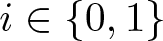 $i\in\{0,1\}$.
Because  $F$ is pathwise connected, there is a continuous map $\gamma:[0,1]\to F$ with
 \begin{align*}
&\gamma(0) = \psi(\tilde\sigma_0(0)) \\
\text{and }\quad&\gamma(1) = \psi(\tilde\sigma_1(0)). \\
\end{align*}
\begin{align*}
&\gamma(0) = \psi(\tilde\sigma_0(0)) \\
\text{and }\quad&\gamma(1) = \psi(\tilde\sigma_1(0)). \\
\end{align*} Let  $Q=[0,1]\times[0,1]$.
We define a map  $K:\partial Q\to F$ as indicated in the diagram below.

Precisely, we define (for all 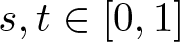 $s,t\in[0,1]$):
 \begin{align*}
K(0,t)&=\psi(\tilde\sigma_0(t)),\\
K(1,t)&=\psi(\tilde\sigma_1(t)),\\
K(s,0)&=\gamma(s)\\
K(s,1)&=\alpha\left(\gamma(s)\right)\\
\end{align*}
\begin{align*}
K(0,t)&=\psi(\tilde\sigma_0(t)),\\
K(1,t)&=\psi(\tilde\sigma_1(t)),\\
K(s,0)&=\gamma(s)\\
K(s,1)&=\alpha\left(\gamma(s)\right)\\
\end{align*} It is easily checked that  $K:\partial Q\to F$ is well-defined and continuous.
Since  $F$ is simply-connected, we may extend $K$ to a continuous map $H_0:Q\to F$.
Then there is a homotopy  $H:[0,1]\times B\to E$ from $\sigma_0$ to $\sigma_1$ via
 \begin{equation*}
H(s,\rho(t))=\tilde\rho\left( \phi^{-1} \left( t, H_0(s,t)
\right)\right)
\end{equation*}
\begin{equation*}
H(s,\rho(t))=\tilde\rho\left( \phi^{-1} \left( t, H_0(s,t)
\right)\right)
\end{equation*} First, let us check that  $H$ is well-defined. Since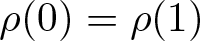 $\rho(0)=\rho(1)$, we need
 \begin{equation*}
\forall s\in[0,1]:
\tilde\rho( \phi^{-1} ( 0, \underbrace{H_0(s,0)}_{=\gamma(s)}
))
=
\tilde\rho( \phi^{-1} ( 1, \underbrace{H_0(s,1)}_{=\alpha(\gamma(s))}
))
\end{equation*}
\begin{equation*}
\forall s\in[0,1]:
\tilde\rho( \phi^{-1} ( 0, \underbrace{H_0(s,0)}_{=\gamma(s)}
))
=
\tilde\rho( \phi^{-1} ( 1, \underbrace{H_0(s,1)}_{=\alpha(\gamma(s))}
))
\end{equation*}which is true because the definition of  $\tilde\rho$ and $\alpha$ implies
 \begin{equation*}
\tilde\rho \left( \phi^{-1} (0,x)\right)
=
\tilde\rho \left( \phi^{-1} (1,\alpha(x))\right)\quad\forall x\in[0,1]
\end{equation*}
\begin{equation*}
\tilde\rho \left( \phi^{-1} (0,x)\right)
=
\tilde\rho \left( \phi^{-1} (1,\alpha(x))\right)\quad\forall x\in[0,1]
\end{equation*} Second, we verify that  $H$ is indeed a homotopy from $\sigma_0$ to $\sigma_1$:
 \begin{equation*}
H(0,\rho(t))=\tilde\rho\left( \phi^{-1} \right. ( t,
\underbrace{H_0(0,t)}_{=K(0,t)}
) \left. \hbox to 0pt{\phantom{$\phi^{-1}$}}\right)
=\tilde\rho(
\underbrace{\phi^{-1} \left( t,\psi(\tilde\sigma_0(t))
\right)}_{=\tilde\sigma_0(t)}
)=\sigma_0(t)
\end{equation*}
\begin{equation*}
H(0,\rho(t))=\tilde\rho\left( \phi^{-1} \right. ( t,
\underbrace{H_0(0,t)}_{=K(0,t)}
) \left. \hbox to 0pt{\phantom{$\phi^{-1}$}}\right)
=\tilde\rho(
\underbrace{\phi^{-1} \left( t,\psi(\tilde\sigma_0(t))
\right)}_{=\tilde\sigma_0(t)}
)=\sigma_0(t)
\end{equation*}and
 \begin{equation*}
H(1,\rho(t))=\tilde\rho\left( \phi^{-1}\right. ( t,
\underbrace{H_0(1,t)}_{=K(1,t)}
) \left. \hbox to 0pt{\phantom{$\phi^{-1}$}}\right)
=\tilde\rho(
\underbrace{\phi^{-1} \left( t,\psi(\tilde\sigma_1(t))
\right)}_{=\tilde\sigma_1(t)}
)=\sigma_1(t).
\end{equation*}
\begin{equation*}
H(1,\rho(t))=\tilde\rho\left( \phi^{-1}\right. ( t,
\underbrace{H_0(1,t)}_{=K(1,t)}
) \left. \hbox to 0pt{\phantom{$\phi^{-1}$}}\right)
=\tilde\rho(
\underbrace{\phi^{-1} \left( t,\psi(\tilde\sigma_1(t))
\right)}_{=\tilde\sigma_1(t)}
)=\sigma_1(t).
\end{equation*}6.3. Existence of global sections
In Proposition 6.1, we proved the existence of global continuous sections for certain locally trivial fibre bundles. For our purposes everywhere locally trivial bundles are a too restricted class of surjections, we need the existence of global continuous sections under weaker conditions. Hence, we deduce the proposition below.
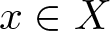
Proposition 6.3. Let  $E$ connected real manifold, $X$ non-compact Riemann surface,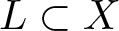 $L\subset X$ a discrete subset and $\pi:E\to X$ be a surjective $C^1$-map such that
(i) There are local continuous sections everywhere, i.e., for every
$x\in X$ there is an open neighbourhood
$U$ and a continuous map
$\sigma:U\to E$ with
$\pi\circ\sigma=id_U$.(ii) The restriction of
$\pi$ to
$X_0=X\setminus L$ is a locally trivial fibre bundle with a connected and simply-connected fibre
$F$.






Then there exists a global continuous section  $\sigma:X\to E$.
Proof.  $F$ is a connected manifold and therefore pathwise connected. $X$ is a non-compact Riemann surface and therefore homotopic to a one-dimensional $CW$-complex (see, e.g., [Reference Hamm24]). Hence, Proposition 6.1 implies the existence of a continuous section $\sigma_0$ on $X_0=X\setminus L$.
For every 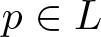 $p\in L$, we choose an open neighbourhood $U_p$ of $p$ in $X$ such that
(1) all the
$U_p$ are disjoint.(2) There is a biholomorphic map
$\zeta_p:U_p\to\Delta_3=\{z\in{\mathbb C}:|z| \lt 3\}$ with
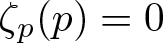
$\zeta_p(p)=0$.(3) There is a continuous section
$s_p$ of
$\pi$ on
$U_p$, i.e., a continuous map
$s_p:U_p\to E$ with
$\pi\circ s_p=id_{U_p}$.






We fix 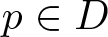 $p\in D$, such a map $\zeta_p$ and such a section $s_p$.
By assumption  $(ii)$, $\pi:E\to X$ restricts to a locally trivial bundle
 \begin{equation*}
E\supset\pi^ {-1}\left(U_p\setminus\{p\}\right)
\stackrel{\pi}\longrightarrow U_p\setminus p.
\end{equation*}
\begin{equation*}
E\supset\pi^ {-1}\left(U_p\setminus\{p\}\right)
\stackrel{\pi}\longrightarrow U_p\setminus p.
\end{equation*} Now for 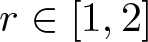 $r\in[1,2]$ we have maps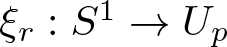 $\xi_r:S^1\to U_p$ defined as
 \begin{equation*}
\xi_r(x)=\zeta_p^ {-1}(rx)\quad (x\in S^ 1=\{z\in{\mathbb C}:|z|=1\}).
\end{equation*}
\begin{equation*}
\xi_r(x)=\zeta_p^ {-1}(rx)\quad (x\in S^ 1=\{z\in{\mathbb C}:|z|=1\}).
\end{equation*} Since  $\xi_r$ (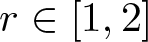 $r\in[1,2]$) are all homotopic, the pull-back bundles $\xi_r^ *E$ are isomorphic. Fixing such an isomorphism, we may regard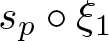 $s_p\circ\xi_1$ and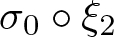 $\sigma_0\circ\xi_2$ as sections in the same fixed $F$-fibre bundle over $S^ 1$. Due to Proposition 6.2 it follows that there is a homotopy between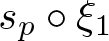 $s_p\circ\xi_1$ and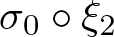 $\sigma_0\circ\xi_2$.
Using the aforementioned isomorphism this homotopy yields a continuous map  $H:[1,2]\times S^ 1\to E$ such that
•
$\zeta_p(\pi \left(H(r,t)\right))=rt$.•
$H(1,t)=s_p\left( \zeta_p^{-1}(t)\right)$.•
$H(2,t)=\sigma_0\left( \zeta_p^{-1}(2t)\right)$.



Now we may define  $\sigma$ on $U_p$ as
 \begin{equation*}
\sigma(x)=\begin{cases}
s_p(x) & \text{if $|\zeta_p(x)|\le 1$}\\
H(r,t) & \text{if $r=|\zeta_p(x)|\in[1,2]$ with
$\zeta_p(x)=rt$, $t\in S^1$}\\
\sigma_0(x) & \text{if $|\zeta_p(x)|\ge 2$}\\
\end{cases}
\end{equation*}
\begin{equation*}
\sigma(x)=\begin{cases}
s_p(x) & \text{if $|\zeta_p(x)|\le 1$}\\
H(r,t) & \text{if $r=|\zeta_p(x)|\in[1,2]$ with
$\zeta_p(x)=rt$, $t\in S^1$}\\
\sigma_0(x) & \text{if $|\zeta_p(x)|\ge 2$}\\
\end{cases}
\end{equation*} Since we may do this at every point 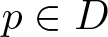 $p\in D$ independently, we obtain a globally defined continuous section.
7. Oka theory
In complex analytic geometry, there is the notion of an Oka manifold. If a complex manifold  $X$ is a Oka manifold, then for every Stein manifold $Z$ and every continuous map $f_0:Z\to X$ there exists a holomorphic map $f:Z\to X$ which is homotopic to $f_0$.
See [Reference Forstnerič17] for more information about Oka manifolds.
7.1. Elliptic maps
In Oka theory, there is the notion of ‘elliptic’ maps ([Reference Forstnerič17], Definition 6.1.2) which we will use.
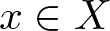
Definition 7.1. Let  $f:X\to Y$ be a holomorphic map between complex manifolds.
Remark. The definition as stated above (Definition 7.1) is more restrictive than the original one in [Reference Forstnerič17], Definition 6.1.2. We do not need the most general form.
The map  $f$ is called ‘elliptic’ if there exists a ‘(dominating fibre) spray’, i.e., if there exists
a holomorphic vector bundle  $\pi:E\to X$ and a holomorphic map $s:E\to X$ satisfying the following properties:
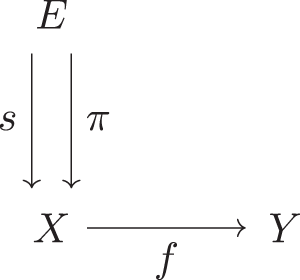
• For every
$x\in X$ let
$0_x$ denote the point in the zero-section of the vector bundle
$E$ which is above
$x$. Then
$s(0_x)=x\ \forall x\in X$.•
$\forall p\in Y:\ s(E_p)\subset X_p$ for
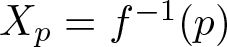
$X_p=f^ {-1}(p)$ and
$E_p=(f\circ\pi)^ {-1}(p)=\pi^ {-1}(X_p)$. In other words:
$f\circ s=f\circ\pi$.• For every
$x\in X$,
$V_x=\{v\in T_xX:(Df)_x(v)=0\}=T_x\left(X_{f(x)}\right)$,
$W_x=\{w\in T_{0_x}E: (D\pi)_{0_x}(w)=0\}=T_{0_x}\left(\pi^ {-1}(x)\right)$ the linear map
$(Ds)_{0_x}:W_x\to V_x$ is surjective.
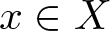









Remark. If  $f$ is constant, the last condition is equivalent to $s$ being submersive at every point of the zero-section.
Example 7.2. Let  $f:X\to Y$ be an unramified covering. Then $f$ is an elliptic map (using as $E$ the trivial bundle with fibre $\{0\}$).
For us, the important fact on elliptic maps is the following:
Theorem 7.3. Let  $f:X\to Y$ be an elliptic holomorphic map. Assume that $Y$ is a Stein manifold.
Then every continuous section  $\sigma$ (i.e., every continuous map $\sigma:Y\to X$ with $f\circ\sigma=id_Y$) is homotopic to a holomorphic section.
Proof. See [Reference Forstnerič17], Theorem 6.2.2.
Example 7.4. Let  $G$ be a complex Lie group, $p:P\to B$ a $G$ principal bundle. Then the projection map $p:P\to B$ is an elliptic map:
We set  $f=p$,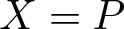 $X=P$,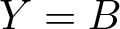 $Y=B$, $E=P\times \mathop{Lie}(G)$ (where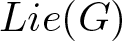 $\mathop{Lie} (G)$ denotes the Lie algebra of $G$);
$G$);  $\pi$ denotes the projection from $E$ to the first factor. In this way $E$ is a trivial vector bundle with fibre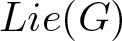 $\mathop{Lie}(G)$ over $B$. Let $\mu:P\times G\to P$ be the principal right action of the principal bundle $p:P\to B$. Then we may choose $s$ as
 \begin{equation*}
s:P\times\mathop{Lie}(G)\ni (x,v)\mapsto \mu(x,\exp(v))
\end{equation*}
\begin{equation*}
s:P\times\mathop{Lie}(G)\ni (x,v)\mapsto \mu(x,\exp(v))
\end{equation*}In this way, the above Theorem 7.3 generalizes the classical Grauert Oka theorem ([Reference Grauert23]).
Proposition 7.5. Let  $G$ be a complex Lie group acting transitively on a connected complex manifold $F$.
$F$.
Let  $\pi:H\to B$ be a holomorphic locally trivial fibre bundle with fibre $F$ and structure group $G$.
$G$.
Then  $\pi$ is an elliptic map.
Proof. Let 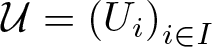 ${\mathcal U}=\left(U_i\right)_ {i\in I}$ be a trivializing open cover on $B$. We may identify $H$ with the quotient of
 \begin{equation*}
\{(x,i,p):i\in I, x\in U_i,p\in F\}
\end{equation*}
\begin{equation*}
\{(x,i,p):i\in I, x\in U_i,p\in F\}
\end{equation*}with respect to the equivalence relation
 \begin{equation*}
(x,j,p)\sim (x,i,\phi_{ij}(x)(p))
\end{equation*}
\begin{equation*}
(x,j,p)\sim (x,i,\phi_{ij}(x)(p))
\end{equation*}for some ‘transition functions’  $\phi_{ij}:U_i\cap U_j\to G$.
Then we consider the quotient  $E$ of
 \begin{equation*}
\{(x,i,p,v):i\in I, x\in U_i, p\in F, v\in\mathop{Lie}(G)\}
\end{equation*}
\begin{equation*}
\{(x,i,p,v):i\in I, x\in U_i, p\in F, v\in\mathop{Lie}(G)\}
\end{equation*}with respect to
 \begin{equation*}
\left((x,i,p,v)\sim (x,i,\phi_{ij}(x)(p),Ad\left(\phi_{ij}(x)\right)(v)\right)
\end{equation*}
\begin{equation*}
\left((x,i,p,v)\sim (x,i,\phi_{ij}(x)(p),Ad\left(\phi_{ij}(x)\right)(v)\right)
\end{equation*} Since the adjoint action of  $G$ on its Lie algebra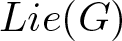 $\mathop{Lie}(G)$ is linear, the natural projection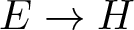 $E\to H$ is a vector bundle.
Finally, we define a spray  $s:E\to H$ by a representative:
 \begin{equation*}
s:[(x,i,p,v)]\mapsto [(x,i,\exp(v)(p))]
\end{equation*}
\begin{equation*}
s:[(x,i,p,v)]\mapsto [(x,i,\exp(v)(p))]
\end{equation*}where 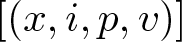 $[(x,i,p,v)]$ resp. $[(x,i,\exp(v)(p))]$ denotes the point in $E$ resp. $H$ represented by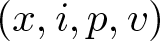 $(x,i,p,v)$ resp. $(x,i,\exp(v)(p))$.
It is easily verified that this is well-defined and indeed a dominating spray.
Proposition 7.6. Let  $G_{{\mathbb C}}$ be a complex Lie group acting holomorphically on a complex manifold $X$. Assume that all isotropy groups have the same dimension $k$. Let $Z$ be a Stein complex manifold. Let $C,F:Z\to X$ be holomorphic maps and let
 \begin{equation}
V=\{(g,t)\in G_{{\mathbb C}}\times Z: g \left( C(t)\right)=F(t)\}
\end{equation}
\begin{equation}
V=\{(g,t)\in G_{{\mathbb C}}\times Z: g \left( C(t)\right)=F(t)\}
\end{equation} Let  $\pi:V\to Z$ be the natural projection map: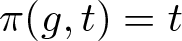 $\pi(g,t)=t$. Then $\pi$ admits a holomorphic section $\sigma:Z\to V$ if and only if it admits a continuous section.

Proof. First we observe that  $\pi\circ\sigma=id_Z$ implies the surjectivity of $\pi$. Thus, the statement is trivially true if $\pi$ is not surjective: Without surjectivity of $\pi$ neither continuous nor holomorphic sections may exist.
From now on we assume that  $\pi:V\to Z$ is surjective. Then there exist local holomorphic sections due to Proposition 5.1. Let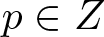 $p\in Z$ and let $\sigma:W\to V$ be a local section in an open neighbourhood $W$ of $p$ in $Z$. Then $\pi\circ\sigma=id_W$, implying $D(\pi\circ\sigma)_p=id$. It follows that $D\pi$ is surjective, i.e., $\pi$ is submersive.
Let  $\Gamma=Gm_k(\mathop{Lie} G_{{\mathbb C}})$ be the Grassmann manifold parametrizing $k$ dimensional vector subspaces of the Lie algebra of $G_{{\mathbb C}}$.
Recall that all the isotropy groups have the same dimension  $k$. Thus, we have a map $\zeta$ from $Z$ to $\Gamma$ mapping a point $t\in Z$ to the point in the Grassmann manifold corresponding to the Lie algebra of the isotropy group at $F(t)$.
We recall the notion of the ‘tautological vector bundle’ 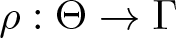 $\rho:\Theta\to\Gamma$ which is defined as
 \begin{equation*}
\Theta=\{([U],u)\in \Gamma\times \mathop{Lie} G_{{\mathbb C}}: u\in U\},
\quad \rho([U],u)=[U]
\end{equation*}
\begin{equation*}
\Theta=\{([U],u)\in \Gamma\times \mathop{Lie} G_{{\mathbb C}}: u\in U\},
\quad \rho([U],u)=[U]
\end{equation*} Let  $E=(\zeta\circ\pi)^*\Theta$ be the pull-back as a vector bundle, i.e.,
 \begin{align*}
E&=\{(\vartheta,v)\in\Theta\times V:
\rho(\vartheta)=\zeta(\pi(v))\}\\
&
\simeq
\left\{([U],u;v)\in\Gamma\times\mathop{Lie}G_{{\mathbb C}}\times V
:\ u\in[U]=\zeta(\pi(v)) \right\}\\
&
=
\left\{([U],u;v)\in\Gamma\times\mathop{Lie}G_{{\mathbb C}}\times V
:\ u\in[U],\ U=\mathop{Lie} \left(G_{{\mathbb C}}\right)_{F(\pi(v))}
\right\}
\end{align*}
\begin{align*}
E&=\{(\vartheta,v)\in\Theta\times V:
\rho(\vartheta)=\zeta(\pi(v))\}\\
&
\simeq
\left\{([U],u;v)\in\Gamma\times\mathop{Lie}G_{{\mathbb C}}\times V
:\ u\in[U]=\zeta(\pi(v)) \right\}\\
&
=
\left\{([U],u;v)\in\Gamma\times\mathop{Lie}G_{{\mathbb C}}\times V
:\ u\in[U],\ U=\mathop{Lie} \left(G_{{\mathbb C}}\right)_{F(\pi(v))}
\right\}
\end{align*} The condition  $U=\mathop{Lie} \left(G_{{\mathbb C}}\right)_{F(\pi(v))}$ implies that $[U]$ is determined by $v$. Hence
 \begin{equation*}
E\simeq \left\{(u;v)\in\mathop{Lie}G_{{\mathbb C}}\times V
:\ u\in\mathop{Lie} \left(G_{{\mathbb C}}\right)_{F(\pi(v))}
\right\}
\end{equation*}
\begin{equation*}
E\simeq \left\{(u;v)\in\mathop{Lie}G_{{\mathbb C}}\times V
:\ u\in\mathop{Lie} \left(G_{{\mathbb C}}\right)_{F(\pi(v))}
\right\}
\end{equation*} We recall the definition of  $V$ as a subset of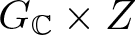 $G_{{\mathbb C}}\times Z$ as in (7.1) and observe that
 \begin{align*}
&u\in\mathop{Lie} \left(G_{{\mathbb C}}\right)_{F(\pi(v))}\\
\iff &\exp(ru) \in \left(G_{{\mathbb C}}\right)_{F(\pi(v))}\ \forall r\in{\mathbb C}\\
\iff & \exp(ru)(F(\pi(v)))=F(\pi(v))\ \forall r \in{\mathbb C}\\
\end{align*}
\begin{align*}
&u\in\mathop{Lie} \left(G_{{\mathbb C}}\right)_{F(\pi(v))}\\
\iff &\exp(ru) \in \left(G_{{\mathbb C}}\right)_{F(\pi(v))}\ \forall r\in{\mathbb C}\\
\iff & \exp(ru)(F(\pi(v)))=F(\pi(v))\ \forall r \in{\mathbb C}\\
\end{align*}Therefore:
 \begin{equation}
\begin{aligned}
E\simeq \{ (u,g,t)\in \left(\mathop{Lie}G_{{\mathbb C}}\right)\times G_{{\mathbb C}}\times Z
: (g,t)\in V ,\\
\exp(ru)(F(t))=F(t)\ \forall
r\in{\mathbb C} \}.
\end{aligned}
\end{equation}
\begin{equation}
\begin{aligned}
E\simeq \{ (u,g,t)\in \left(\mathop{Lie}G_{{\mathbb C}}\right)\times G_{{\mathbb C}}\times Z
: (g,t)\in V ,\\
\exp(ru)(F(t))=F(t)\ \forall
r\in{\mathbb C} \}.
\end{aligned}
\end{equation} Let  $\tau:E\to V$ be the natural projection onto $V$. Now $E\to V$ is a vector bundle such that the fibre over a point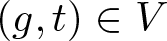 $(g,t)\in V$ is naturally isomorphic to the Lie algebra of the isotropy group for the $G_{{\mathbb C}}$-action on $X$ at $F(t)$, i.e.,

We define a spray  $s$ as follows:
 \begin{equation*}
E\ni(u,g,t)\stackrel{s}{\mapsto} \left( \exp(u)\cdot g, t\right)\in V
\end{equation*}
\begin{equation*}
E\ni(u,g,t)\stackrel{s}{\mapsto} \left( \exp(u)\cdot g, t\right)\in V
\end{equation*} Let us verify that  $s$ is in fact a dominating fibre spray:
• By definition of
$E$ we have
$(u,g,t)\in E \implies u\in\mathop{Lie}G_{{\mathbb C}}\implies \exp(u)\in G_{{\mathbb C}}$ and
$\exp(ru)(F(t))=F(t)\ \forall r\in{\mathbb C}$. By definition of
$V$ in (7.1) for
$(g,t)\in V$ we obtain
\begin{equation*}
g(C(t))=F(t)
\end{equation*}With
$\exp(ru)\left(F(t)\right)=F(t)\ \forall r$ this implies
which (specializing to the case
\begin{equation*}
F(t)=\exp(ru)\left(F(t)\right)=\exp(ru)\left(g(C(t))\right)
=\left(\exp(ru)\cdot g\right)\left(C(t)\right)
\end{equation*}
$r=1$) implies
\begin{equation*}
(\exp(u)\cdot g,t)\in V.
\end{equation*}Thus,
$s$ defined as above is indeed a map from
$E$ to
$V$.• For
$u=0$ we have
$\exp(0)=e_{G_{{\mathbb C}}}$ and therefore
$\exp(0)\cdot g=g$.Thus
\begin{equation*}
s(0,g,t)=\left((\exp(0))\cdot g,t\right)=(g,t)
\end{equation*}•
\begin{equation*}
\pi(s(u,g,t))=\pi(\exp(u)\cdot g, t)=t=\pi(g,t)
=\pi\left(\tau(u,g,t)\right)
\end{equation*}Therefore,
$\pi\circ s=\pi\circ\tau$.• Fix
$(g,t)\in V$. We consider the space of ‘vertical vector fields’
\begin{equation*}
W=\left\{w\in T_{(0,g,t)}E : (D\tau)(w)=0\right\}.
\end{equation*}We have to show that
$Ds$ maps
$W$ surjectively onto
\begin{equation*}
W'=\left\{w\in T_{(g,t)}V: (D\pi)(w)=0\right\}
\end{equation*}Let
$H=(G_{{\mathbb C}})_{F(t)}$. The exponential map from the Lie algebra
$\mathop{Lie} H$ to the Lie group
$H$ is a diffeomorphism near
$0\in\mathop{Lie} H$.Furthermore, standard Lie group theory tells us that for every action of a Lie group
$H$ on a manifold the fundamental
$H$-vector fields span the tangent space of each
$H$-orbit everywhere.Observe that the fibre
admits a natural transitive action of
\begin{equation*}
V_t=\pi^{-1}(t)=\{(g,t):g\in G_{{\mathbb C}}: g \left( C(t)\right)=F(t)\}
\end{equation*}
$H=(G_{{\mathbb C}})_{F(t)}$ given by
\begin{equation*}
H\ni h:(g,t)\mapsto (hg,t)
\end{equation*}The
$H$-fundamental vector fields for this action span the tangent space of
$V_t$ everywhere. Since
$s(u,g,t)=\left(\exp(u)\cdot g,t\right)$, it follows that
$Ds$ maps
$W$ surjectively onto
$T_{(g,t)}V_t=W^{\prime}$.




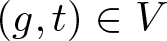









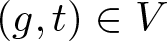



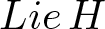











Thus,  $\pi:V\to Z$ is elliptic in the sense of [Reference Forstnerič17], Definition 6.1.2.
Now [Reference Forstnerič17], Theorem 6.2.2 implies that there is a weak homotopy equivalence between the space of continuous sections and the space of holomorphic sections. This implies the assertion.
8. Existence of holomorphic sections
Proposition 8.1. Let  $X$ be a non-compact Riemann surface. Let $S$ be a (not necessarily connected) complex Lie group and let $F$ be a connected complex manifold on which $S$ acts transitively and let $\pi:E\to X$ be a locally trivial holomorphic fibre bundle with fibre $F$ and structure group $S$.
$S$.
Then  $\pi$ admits a global holomorphic section.
Proof. First we recall that a non-compact Riemann surface is homotopic to a real one dimensional  $CW$-complex ([Reference Hamm24]). Thus, the existence of a continuous section follows from Proposition 6.1.
Due to Proposition 7.5  $\pi:E\to X$ is an elliptic map. Furthermore, $X$ is Stein, because it is a non-compact Riemann surface. Hence, Theorem 7.3 implies the existence of a global holomorphic section.
9. Automorphisms of octonions
9.1. Automorphisms of
${\mathbb O}$

Proposition 9.1. Every ring automorphism of  ${\mathbb O}$ is ${\mathbb R}$-linear, continuous, commutes with conjugation and preserves the scalar product given as
 \begin{equation*}
\left \lt q,r\right \gt =\mathop{\Re e}\left(q\bar r\right)
\end{equation*}
\begin{equation*}
\left \lt q,r\right \gt =\mathop{\Re e}\left(q\bar r\right)
\end{equation*}Proof. See [Reference Baez3][Reference Springer and Veldkamp29].
However, unlike in the case of the quaternionic algebra  ${\mathbb H}$, not every orientation preserving orthogonal linear map fixing ${\mathbb R}$ is an ${\mathbb R}$-algebra automorphism of ${\mathbb O}$ (see Example 9.6 below).
In the next subsection, we present a precise description of the automorphism group of  ${\mathbb O}$, using the theory of ‘basic triples’.
9.2. Basic triples
Definition 9.2. A ‘basic triple’ is an ordered triple of elements  $e_1,e_2,e_3\in{\mathbb O}$ such that
(i)
$||e_k||=1\ \forall k$.(ii) every
$e_k$ is purely imaginary.(iii)
$e_1$ and
$e_2$ are orthogonal.(iv)
$e_3$ is orthogonal to
$e_1$,
$e_2$ and
$e_1e_2$.



Theorem 9.3. The automorphism group of  ${\mathbb O}$ acts simply transitively i.e., for every $x,y$ there is a unique element $g$ mapping $x$ to $y$. on the set of basic triples.
Proof. See [Reference Baez3][Reference Springer and Veldkamp29].
Corollary 9.4. Let 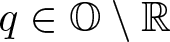 $q\in {\mathbb O}\setminus{\mathbb R}$. Then the isotropy group
 \begin{equation*}
I=\{\phi\in{\mathrm{Aut}}({\mathbb O}):\phi(q)=q\}
\end{equation*}
\begin{equation*}
I=\{\phi\in{\mathrm{Aut}}({\mathbb O}):\phi(q)=q\}
\end{equation*}is isomorphic to 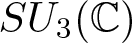 $SU_3({\mathbb C})$.
Proof. Let  $e_1$ be a purely imaginary element of ${\mathbb O}$ with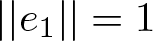 $||e_1||=1$ such that $q=r+te_1$ for some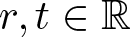 $r,t\in{\mathbb R}$, $t\ne 0$.
Then the isotropy at  $q$ equals the isotropy at $e_1$. We choose $e_2,e_3$ such that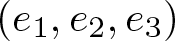 $(e_1,e_2,e_3)$ is a basic triple.
Given  $e_1$, we have to choose $e_2$ in a $5$-dimensional sphere and then $e_3$ in a three-dimensional sphere. Since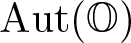 ${\mathrm{Aut}}({\mathbb O})$ acts simply transitively on the set of basic triples, $I$ can be identified with the set of basic triples with fixed $e_1$. It follows that $\dim_{\mathbb R}(I)=8$.
Note that  $e_1\cdot e_1=-1$. Because ${\mathbb O}$ is an alternative algebra, this implies
 \begin{equation*}
e_1\cdot(e_1\cdot x)=(e_1\cdot e_1)\cdot x=-x\ \forall x\in {\mathbb O}.
\end{equation*}
\begin{equation*}
e_1\cdot(e_1\cdot x)=(e_1\cdot e_1)\cdot x=-x\ \forall x\in {\mathbb O}.
\end{equation*} Let  $P$ denote the orthogonal complement of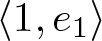 $\left \lt 1,e_1\right \gt $ in ${\mathbb O}$. Then $J:x\mapsto e_1\cdot x$ defines a complex structure on $P$. Note that every $\phi\in I$ acts trivially on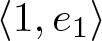 $\left \lt 1,e_1\right \gt $ and therefore stabilizes $P$.
$P$.
Observe that
 \begin{equation*}
\phi(e_1\cdot x)=\phi(e_1)\cdot\phi(x)=e_1\cdot\phi(x)
\ \forall x\in P,\phi\in I
\end{equation*}
\begin{equation*}
\phi(e_1\cdot x)=\phi(e_1)\cdot\phi(x)=e_1\cdot\phi(x)
\ \forall x\in P,\phi\in I
\end{equation*}i.e.,  $\phi$ commutes with left multiplication by $e_1$. This means that $\phi$ is a unitary transformation with respect to the complex structure on $P$ defined by $J:x\mapsto e_1\cdot x$.
Furthermore, we note that 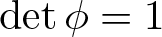 $\det\phi=1$, because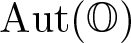 ${\mathrm{Aut}}({\mathbb O})$ is simple (Theorem 9.7). Since $\phi$ acts trivially on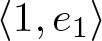 $\left \lt 1,e_1\right \gt $, it follows that $\det(\phi|_P)=1$.
Therefore
 \begin{equation*}
I\subset SU(P)\simeq SU_3({\mathbb C}).
\end{equation*}
\begin{equation*}
I\subset SU(P)\simeq SU_3({\mathbb C}).
\end{equation*} For dimension reasons (both  $I$ and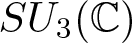 $SU_3({\mathbb C})$ are real $8$-dimensional) we have equality.
Corollary 9.5. Let 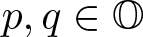 $p,q\in {\mathbb O}$.
Then the following is equivalent;
•
$N(p)=N(q)$ and
$Tr(p)=Tr(q)$.• There is an
${\mathbb R}$-algebra automorphism
$\phi$ of
${\mathbb O}$ such that
$\phi(p)=q$.




Remark: A similar statement is to be found in [Reference Dentoni and Sce15],  $L_4$, p.260. For the convenience of the reader we nevertheless provide a proof.
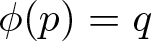
Proof. For every 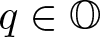 $q\in {\mathbb O}$ let $q_0$ denote the real part and let $q_v$ denote the imaginary (sometimes called: vectorial) part, i.e., $q=q_0+q_v$ with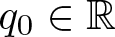 $q_0\in{\mathbb R}$ and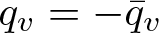 $q_v=-\bar q_v$. Then $Tr(q)=2q_0$ and $N(q)=||q||^2=||q_0||^2+||q_v||^2$.
This implies: If  $Tr(p)=Tr(q)$ and $N(p)=N(q)$, then $p_0=q_0$ and $||p_v||=||q_v||$.
If  $||p_v||=||q_v||=0$, then $p=p_0=q_0=q$ and we may take the identity map as $\phi$. Thus, we may assume that $||p_v||=||q_v|| \gt 0$.
Define
 \begin{equation*}
\tilde p_v=\frac{p_v}{||p_v||},\ \ \tilde q_v=\frac{q_v}{||q_v||}
\end{equation*}
\begin{equation*}
\tilde p_v=\frac{p_v}{||p_v||},\ \ \tilde q_v=\frac{q_v}{||q_v||}
\end{equation*} We may complete  $\{\tilde p_v\}$ resp. $\{\tilde q_v\}$ to a basic triple of ${\mathbb O}$. Now Theorem 9.3 implies that there exists an automorphism $\phi$ of ${\mathbb O}$ with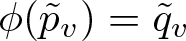 $\phi(\tilde p_v)=\tilde q_v$. Since $\phi$ is linear, and $||p_v||=||q_v||$, it follows that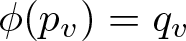 $\phi(p_v)=q_v$. Because $\phi$, like every algebra automorphism of ${\mathbb O}$, acts trivially on the centre ${\mathbb R}$, we may conclude that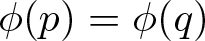 $\phi(p)=\phi(q)$.
For the converse, let 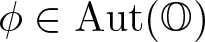 $\phi\in{\mathrm{Aut}}({\mathbb O})$. Then $\phi$ acts linearly on $W$ and trivially on the centre ${\mathbb R}$. As a consequence, $\phi$ commutes with conjugation. Due to the definition of $N$ and $Tr$ this implies that $Tr(\phi(x))=Tr(x)$ and $N(\phi(x))=N(x)$ for all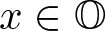 $x\in {\mathbb O}$.
Example 9.6. Let 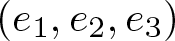 $(e_1,e_2,e_3)$ be a basic triple for ${\mathbb O}$, and let $P$ be the orthogonal complement of $\left \lt 1,e_1,e_2,e_3\right \gt $ in ${\mathbb O}$. Since $\dim_{{\mathbb R}}(P)=4$ and therefore $SO(P)\ne\{Id\}$, there is a non-trivial orientation preservation orthogonal transformation $\phi_0$ on $P$. It extends to a bilinear self-map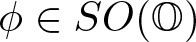 $\phi\in SO({\mathbb O})$ with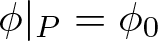 $\phi|_{P}=\phi_0$,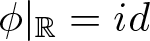 $\phi|_{{\mathbb R}}=id$ and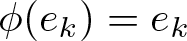 $\phi(e_k)=e_k$ (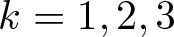 $k=1,2,3$). By Theorem 9.3, an ${\mathbb R}$-algebra automorphism of ${\mathbb O}$ preserving $e_1$, $e_2$ and $e_3$ must be the identity map. Thus, $\phi$ is an orientation preserving orthogonal transformation on ${\mathbb O}$ which is not an $ {\mathbb R}$-algebra automorphism.
Theorem 9.7. The automorphism group of the  ${\mathbb R}$-algebra ${\mathbb O}$ is a simply-connected compact simple real Lie group of type $G_2$.
Proof. See [Reference Baez3].
Theorem 9.8. The automorphism group of the  ${\mathbb C}$-algebra ${{\mathbb O}_{\mathbb C}}$ is a connected complex simple Lie group of type $G_2$.
Proof. See [Reference Springer and Veldkamp29], Theorem 2.3.5.
Corollary 9.9. Let  $G$ be the automorphism group of the real algebra ${\mathbb O}$ and let $G_{{\mathbb C}}$ be the automorphism group of the ${\mathbb C}$-algebra ${{\mathbb O}_{\mathbb C}}$ and consider the induced action of $G$ on ${{\mathbb O}_{\mathbb C}}$.
Then  $G_{{\mathbb C}}$ is the smallest complex Lie subgroup of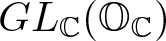 $GL_{\mathbb C}({{\mathbb O}_{\mathbb C}})$ containing $G$.
$G$.
Proof. Let  $H$ be the smallest complex Lie subgroup containing $G$. Since $G_{{\mathbb C}}$ is a complex Lie group,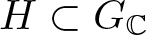 $H\subset G_{{\mathbb C}}$. On the other hand, $G$ is totally real and $\dim_{\mathbb R}(G)=14=\mathop{dim}_{{\mathbb C}}(G_{{\mathbb C}})$. Hence, $\dim_{\mathbb C}(H)=14=\dim_{\mathbb C}(G_{{\mathbb C}})$. In combination with the connectedness of $G_{{\mathbb C}}$ and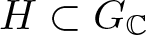 $H\subset G_{{\mathbb C}}$ this implies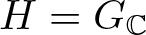 $H=G_{{\mathbb C}}$, i.e., $G_{{\mathbb C}}$ is the smallest complex Lie subgroup of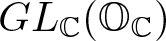 $GL_{\mathbb C}({{\mathbb O}_{\mathbb C}})$ containing $G$.
$G$.
10. Orbits in the complexified algebra
The proposition below is principally applied to the situation, where 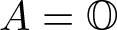 $A={\mathbb O}$ and $A={\mathbb R}\oplus W$ as vector space, $W$ being the subspace of totally imaginary elements.
In [Reference Bisi and Winkelmann12] (Proposition 12.1) we deduced the following proposition:
Proposition 10.1. Let 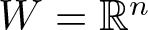 $W={\mathbb R}^n$, and let $G$ be a connected real Lie group acting by orthogonal linear transformations on $W$ such that the unit sphere $S=\{v\in{\mathbb R}^n:||v||=1\}$ is a $G$-orbit.
Let  $W_{{\mathbb C}}=W{\otimes}_{\mathbb R}{\mathbb C}$. Let $B$ denote the ${\mathbb C}$-bilinear form on $W_{{\mathbb C}}$ extending the standard Euclidean scalar product on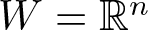 $W={\mathbb R}^n$.
Let  $G_{{\mathbb C}}$ be the smallest complex Lie subgroup of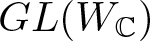 $GL(W_{{\mathbb C}})$ containing $G$. Then the $G_{{\mathbb C}}$-orbits in $W_{{\mathbb C}}$ are the following:
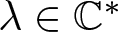
•
$H_\lambda=\{v\in W_{{\mathbb C}}:B(v,v)=\lambda\}$ for
$\lambda\in{\mathbb C}^*$.•
$H_0=\{v\in W_{{\mathbb C}}:B(v,v)=0\}\setminus\{0\}$.•
$\{0\}$.



We also need some corollaries of this proposition, likewise proved in [Reference Bisi and Winkelmann12].
Corollary 10.2. (=Corollary 12.2 of [Reference Bisi and Winkelmann12])
Let  $A$ be a finite-dimensional ${\mathbb R}$-algebra with ${\mathbb R}$ as centre. Let $A={\mathbb R}\oplus W$ as vector space and let $G$ be a real Lie group acting trivially on ${\mathbb R}$ and by orthogonal linear transformations on $W$. Assume that $G$ acts transitively on the unit sphere of $W$.
$W$.
Let  $G_{{\mathbb C}}$ be the smallest complex Lie subgroup of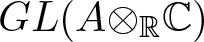 $GL(A{\otimes}_{\mathbb R}{\mathbb C})$ containing $G$.
$G$.
Then all the  $G_{{\mathbb C}}$-orbits in $\left(W{\otimes}_{\mathbb R}{\mathbb C}\right)\setminus\{0\}$ are complex hypersurfaces. In particular, they all have the same dimension.
Corollary 10.3. (=Corollary 12.3 of [Reference Bisi and Winkelmann12])
Under the assumptions of Corollary 10.2 for every point  $p\in\left(W{\otimes}_{\mathbb R}{\mathbb C}\right)\setminus\{0\}$ the isotropy group $I$ of the $G_{{\mathbb C}}$-action at $p$ satisfies
 \begin{equation*}
\dim_{\mathbb C} I+\dim_{\mathbb R} W-1=\dim_{\mathbb C}(G_{{\mathbb C}}).
\end{equation*}
\begin{equation*}
\dim_{\mathbb C} I+\dim_{\mathbb R} W-1=\dim_{\mathbb C}(G_{{\mathbb C}}).
\end{equation*}Corollary 10.4. (=Corollary 12.4 of [Reference Bisi and Winkelmann12])
Under the same assumptions, there is a Zariski open subset
 \begin{equation*}
U\subset A{\otimes}_{\mathbb R}{\mathbb C}\stackrel{\zeta}
\sim{\mathbb C}\oplus \left(W{\otimes}_{\mathbb R}{\mathbb C}\right)
\end{equation*}
\begin{equation*}
U\subset A{\otimes}_{\mathbb R}{\mathbb C}\stackrel{\zeta}
\sim{\mathbb C}\oplus \left(W{\otimes}_{\mathbb R}{\mathbb C}\right)
\end{equation*}defined as  $U=\{q:\zeta(q)=(x,v), B(v,v)\ne 0\}$ such that all the isotropy groups of $G_{{\mathbb C}}$ at points in $U$ are conjugate.
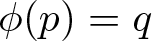
Corollary 10.5. Let  $p,q\in{{\mathbb O}_{\mathbb C}}\setminus{\mathbb C}$. Then the following properties are equivalent:
(i)
$\operatorname{{Tr}}(p)=\operatorname{{Tr}}(q)$ and
$\operatorname{{N}}(p)=\operatorname{{N}}(q)$.(ii) There is an automorphism
$\phi\in {\mathrm{Aut}}({{\mathbb O}_{\mathbb C}})$ such that
$\phi(p)=q$.



Here, we need a proof, since in [Reference Bisi and Winkelmann12] we covered only the quaternionic case.
Proof. By construction, we have  $\operatorname{{N}}(x)=x(\bar x)=B(x,x)$ for all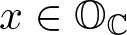 $x\in{{\mathbb O}_{\mathbb C}}$ and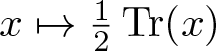 $x\mapsto \frac 12\operatorname{{Tr}}(x)$ equals the projection of $x$ to ${\mathbb C}$ with respect to the d irect sum decomposition ${{\mathbb O}_{\mathbb C}}={\mathbb C}\oplus W_{{\mathbb C}}$.
Let  $p=p^{\prime}+p^{\prime\prime}$,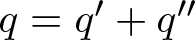 $q=q^{\prime}+q^{\prime\prime}$ with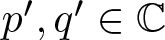 $p^{\prime},q^{\prime}\in{\mathbb C}$, $p^{\prime\prime},q^{\prime\prime}\in W_{{\mathbb C}}$. Since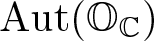 ${\mathrm{Aut}}({{\mathbb O}_{\mathbb C}})$ acts trivially on ${\mathbb C}$ and by linear, $B$-preserving transformations on $W_{{\mathbb C}}$, $(ii)$ implies that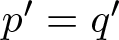 $p^{\prime}=q^{\prime}$ and $B(p^{\prime\prime},p^{\prime\prime})=B(q^{\prime\prime},q^{\prime\prime})$ which in turn implies $\operatorname{{Tr}}(p)=\operatorname{{Tr}}(q)$, $\operatorname{{N}}(p)=\operatorname{{N}}(q)$.
Conversely,
 \begin{equation*}
( \operatorname{{Tr}}(p)=\operatorname{{Tr}}(q)) \land ( \operatorname{{N}}(p)=\operatorname{{N}}(q)))
\implies
( p^{\prime}=q^{\prime}) \land\left( B(p^{\prime\prime},p^{\prime\prime})=B(q^{\prime\prime},q^{\prime\prime})\right)
\end{equation*}
\begin{equation*}
( \operatorname{{Tr}}(p)=\operatorname{{Tr}}(q)) \land ( \operatorname{{N}}(p)=\operatorname{{N}}(q)))
\implies
( p^{\prime}=q^{\prime}) \land\left( B(p^{\prime\prime},p^{\prime\prime})=B(q^{\prime\prime},q^{\prime\prime})\right)
\end{equation*}and the latter condition implies  $\exists\phi\in {\mathrm{Aut}}({{\mathbb O}_{\mathbb C}}):\phi(p)=q$ due to Propo-sition 10.1.
11. Automorphisms of
${\mathbb O}{\otimes}_{\mathbb R}{\mathbb C}$: isotropy groups
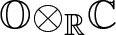
As a  ${\mathbb R}$-vector space, ${\mathbb O}$ admits a direct sum decomposition ${\mathbb O}=C\oplus V$, where $C$ is the (real one-dimensional centre), and $V=\{q\in{\mathbb O}: Tr(q)=0\}$. The Euclidean scalar product on $V$ resp. ${\mathbb O}$ extends to a complex bilinear form on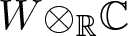 ${W{\otimes}_{\mathbb R}{\mathbb C}}$ resp.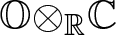 ${\mathbb O}{\otimes}_{\mathbb R}{\mathbb C}$ which we denote by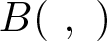 $B(\ ,\ )$.
In the sequel, let  $G$ denote the automorphism group of the ${\mathbb R}$-algebra ${\mathbb O}$ of octonions and let $G_{{\mathbb C}}$ denote the automorphism group of the ${\mathbb C}$-algebra ${{\mathbb O}_{\mathbb C}}$.
Proposition 11.1. For every  $x\in {W{\otimes}_{\mathbb R}{\mathbb C}}$ with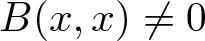 $B(x,x)\ne 0$ the isotropy group $I$ of $G_{{\mathbb C}}$ at $x$ is isomorphic to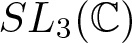 $SL_3({\mathbb C})$.
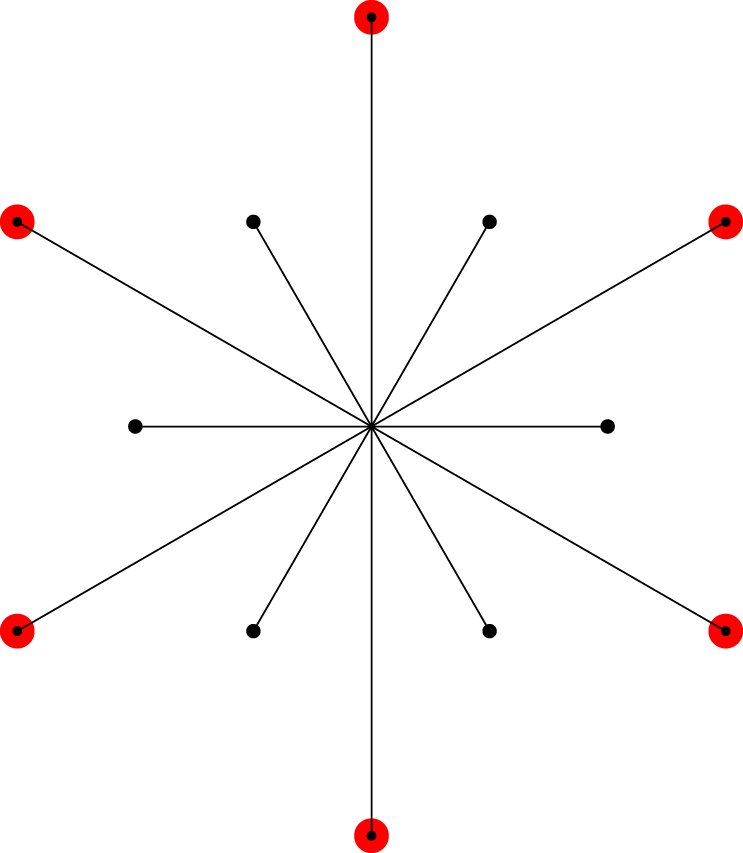
Root system of  $G_2$. Red: Subsystem of type $A_2$ ( $SL_3$).
Proof. Let 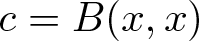 $c=B(x,x)$. Choose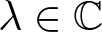 $\lambda\in{\mathbb C}$ and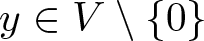 $y\in V\setminus\{0\}$ such that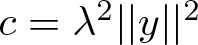 $c=\lambda^2||y||^2$. Let $\lambda=\alpha+i\beta$,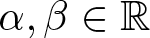 $\alpha,\beta\in {\mathbb R}$. Define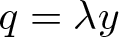 $q=\lambda y$. Then $B(q,q)=B(x,x)$. Therefore $x$ and $q$ lie in the same $G_{{\mathbb C}}$-orbit and consequently the isotropy groups at $q$ and $x$ are conjugate.
We consider the isotropy group of the  $G$-action at $q$. Since $q=\alpha y+ i\beta y$, the real part $\alpha y$ and the imaginary part $\beta y$ of $q$ are ${\mathbb R}$-linearly dependent elements of ${\mathbb O}$. It follows that the isotropy of $G$ at $q$ agrees with the isotropy of $G$ at $y$.
$y$.
The isotropy of  $G$ at $y$ is isomorphic to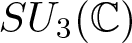 $SU_3({\mathbb C})$ (Corollary 9.4). The isotropy $I$ of $G_{{\mathbb C}}$ at $y$ is a complex Lie subgroup of $G_{{\mathbb C}}$ containing the isotropy of $G$ at $q$.
$q$.
The  $G_{{\mathbb C}}$-orbit through $q$ is a smooth affine quadric and therefore simply-connected. The fibration $G_{{\mathbb C}}\to G_{{\mathbb C}}/I$ induces the long exact homotopy sequence
 \begin{equation*}
\ldots\to\underbrace{\pi_1(G_{{\mathbb C}}/I)}_{=1}\to
\pi_0(I)\to \underbrace{\pi_0(G_{{\mathbb C}})}_{=1}\to\ldots
\end{equation*}
\begin{equation*}
\ldots\to\underbrace{\pi_1(G_{{\mathbb C}}/I)}_{=1}\to
\pi_0(I)\to \underbrace{\pi_0(G_{{\mathbb C}})}_{=1}\to\ldots
\end{equation*}which yields that  $I$ is connected.
We have  $\mathop{dim}_{{\mathbb C}}(I)=8$, because the $G_{{\mathbb C}}$-orbit is $6$-dimensional and $\mathop{dim}_{{\mathbb C}}(G_{{\mathbb C}})=14$.
Thus,  $\mathop{dim}_{{\mathbb C}}(I)=\mathop{dim}_{{\mathbb R}}(G\cap I)$ and $G\cap I$ is a ‘real form’ of $I$. Since $G\cap I\simeq SU_3({\mathbb C})$ which is compact, $G\cap I$ is actually a maximal compact subgroup of $I$. Every connected Lie group is homotopic to its maximal compact subgroup. Since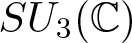 $SU_3({\mathbb C})$ is simply-connected, it follows that $I$ is simply-connected. Hence, $I$ is a simply-connected complex Lie group with a real form isomorphic to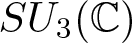 $SU_3({\mathbb C})$. This implies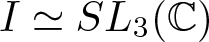 $I\simeq SL_3({\mathbb C})$.
Remark. The figure shows in terms of the root system how 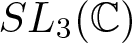 $SL_3({\mathbb C})$ occurs as a subgroup of the simple complex Lie group of type $G_2$. For general information on semisimple Lie groups and root systems see, e.g., [Reference Knapp26] or [Reference Humphreys25]
Corollary 11.2. Let  $U$ denote the Zariski open subset of ${\mathbb O}{\otimes}_{\mathbb R}{\mathbb C}={\mathbb C}\oplus W_{\mathbb C}$ defined as
 \begin{equation*}
U=\{(t,q)\in{\mathbb C}\oplus W_{\mathbb C}: B(q,q)\ne 0\}.
\end{equation*}
\begin{equation*}
U=\{(t,q)\in{\mathbb C}\oplus W_{\mathbb C}: B(q,q)\ne 0\}.
\end{equation*} For every 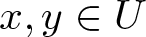 $x,y\in U$ the isotropy groups of $G_{{\mathbb C}}$ at $x$ and $y$ are conjugate and isomorphic to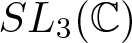 $SL_3({\mathbb C})$.
Proof. Follows from the above Proposition 11.1 in combination with Coro-llary 10.4.
Proposition 11.3. For every  $q\in \left({W{\otimes}_{\mathbb R}{\mathbb C}}\right)\setminus\{0\}$ with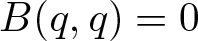 $B(q,q)= 0$ the isotropy group $I$ of $G_{{\mathbb C}}$ at $q$ is a semidirect product $I=S \lt imes U$ where $S\simeq SL_2({\mathbb C})$ and $U$ is a $5$-dimensional unipotent normal subgroup of $I$.
$I$.
Proof. Let  $q=x + iy\in({W{\otimes}_{\mathbb R}{\mathbb C}})\setminus\{0\}$ with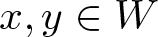 $x,y\in W$ and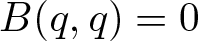 $B(q,q)=0$. Then
 \begin{align*}
&0=B(q,q)=B(x+iy,x+iy)= B(x,x)-B(y,y)+2iB(x,y)\\
\implies\
&B(x,x)=B(y,y),\quad B(x,y)=0.\\
\end{align*}
\begin{align*}
&0=B(q,q)=B(x+iy,x+iy)= B(x,x)-B(y,y)+2iB(x,y)\\
\implies\
&B(x,x)=B(y,y),\quad B(x,y)=0.\\
\end{align*} Since  $B$ is the standard scalar product on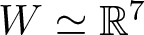 $W\simeq{\mathbb R}^7$, $x$ and $y$ are orthogonal in $W$ (because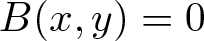 $B(x,y)=0$) and of the same length $r \gt 0$ (because $B(x,x)=B(y,y)$).
Define 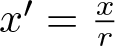 $x'=\frac xr$,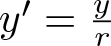 $y'=\frac yr$. Now $x'$ and $y'$ are orthonormal. The set of all $z$ for which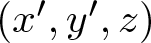 $(x',y',z)$ is a basic triple (as defined in Definition 9.2) is the set of all elements $z$ of length $1$ in the orthogonal complement of $P=\left \lt x',y',x' \cdot y'\right \gt $. Since the automorphisms group of ${\mathbb O}$ acts simply transitively on the set of basic triples, it follows that there is a $1\!:\!1$-correspondence between the unit sphere in $P^ \perp$ and the set of all automorphisms which preserve both $x'$ and $y'$. Now a linear endomorphism preserves $x'$ iff it preserves $x$ and similarly for $y$ and $y'$. Hence, the set of automorphisms preserving both $x'$ and $y'$ is simply the isotropy group of $G$ at $q=x+iy$.
It follows that the isotropy group of  $G$ at $q$ is isomorphic to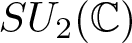 $SU_2({\mathbb C})$ (which is the only real Lie group homoeomorphic to the $3$-sphere).
We recall that  $G$ is a maximal compact subgroup of $G_{{\mathbb C}}$. Let $I$ denote the isotropy group of $G_{{\mathbb C}}$ at $q$ and let $K$ be a maximal compact subgroup of $I$. Now $K$ is a compact subgroup of $G_{{\mathbb C}}$ and therefore conjugate to a subgroup of any maximal compact subgroup of $G_{{\mathbb C}}$ ([Reference Borel13], VII, Theorem 1.2(i)) Thus
 \begin{equation*}
\exists g\in G_{{\mathbb C}}: gKg^{-1}\subset G.
\end{equation*}
\begin{equation*}
\exists g\in G_{{\mathbb C}}: gKg^{-1}\subset G.
\end{equation*}Observe that
 \begin{equation*}
gKg^{-1}\subset gIg^{-1}=\{h\in G_{{\mathbb C}}:h(g(q))=g(q)\}.
\end{equation*}
\begin{equation*}
gKg^{-1}\subset gIg^{-1}=\{h\in G_{{\mathbb C}}:h(g(q))=g(q)\}.
\end{equation*}Now
 \begin{equation*}
\{z\in{W{\otimes}_{\mathbb R}{\mathbb C}}:B(z,z)=0,\ z\ne 0 \}
\end{equation*}
\begin{equation*}
\{z\in{W{\otimes}_{\mathbb R}{\mathbb C}}:B(z,z)=0,\ z\ne 0 \}
\end{equation*}is one  $G_{{\mathbb C}}$-orbit. Hence, the above considerations (showing that the $G$-isotropy at $q$ is isomorphic to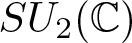 $SU_2({\mathbb C})$) apply likewise to $g(q)$. Thus
 \begin{equation*}
gKg^{-1}\subset gIg^{-1}\cap G\simeq SU_2({\mathbb C})
\end{equation*}
\begin{equation*}
gKg^{-1}\subset gIg^{-1}\cap G\simeq SU_2({\mathbb C})
\end{equation*}which in turn implies
 \begin{equation*}
K \, \subset\, I\cap g^{-1}Gg\, \simeq\, SU_2({\mathbb C}).
\end{equation*}
\begin{equation*}
K \, \subset\, I\cap g^{-1}Gg\, \simeq\, SU_2({\mathbb C}).
\end{equation*} Recall that  $K$ is maximal compact in $I$ and that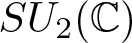 $SU_2({\mathbb C})$ is compact. Hence
 \begin{equation*}
K = I\cap g^{-1}Gg \,\simeq\, SU_2({\mathbb C}).
\end{equation*}
\begin{equation*}
K = I\cap g^{-1}Gg \,\simeq\, SU_2({\mathbb C}).
\end{equation*} By standard Lie theory we have a Levi decomposition  $I=S \lt imes U$ where $U$ is unipotent and $S$ is reductive. ([Reference Mostow27], see also [Reference Onishchik and Vinberg28], Chapter 6.) Let $K$ be a maximal compact subgroup of $S$. From $K\simeq SU_2({\mathbb C})$ it follows that $S\simeq SL_2({\mathbb C})$.
12. On the structure group of a certain bundle
We need a criterion that certain holomorphic maps are locally trivial fibre bundles with a Lie group as structure group.
Proposition 12.1. Let  $G$ be a complex Lie group acting holomorphically on a complex manifold $X$. Assume that all isotropy groups are connected and conjugate to a Lie subgroup $I$ of $G$. Let $D$ be a complex manifold. Let $H,F:D\to X$ be holomorphic maps and let
 \begin{equation*}
V=\{(g,z)\in G\times D: g\cdot H(z)=F(z)\}
\end{equation*}
\begin{equation*}
V=\{(g,z)\in G\times D: g\cdot H(z)=F(z)\}
\end{equation*} Let  $\pi:V\to D$ be the natural projection map: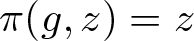 $\pi(g,z)=z$. Assume that $\pi$ is surjective.
Then  $\pi$ is a holomorphically locally trivial fibre bundle with structure group
 \begin{equation*}
(N_G(I)/Z_G(I)) \lt imes I
\end{equation*}
\begin{equation*}
(N_G(I)/Z_G(I)) \lt imes I
\end{equation*}and fibre  $I$. Here, we use the notations
 \begin{align*}
N_G(I) &= \{g\in G: \forall h\in I:
ghg^{-1}\in I\}\quad & \text{(Normalizer)}\\
Z_G(I) &= \{g\in G: \forall h\in I: ghg^{-1}=h \}
\quad & \text{(Centralizer)}\\
\end{align*}
\begin{align*}
N_G(I) &= \{g\in G: \forall h\in I:
ghg^{-1}\in I\}\quad & \text{(Normalizer)}\\
Z_G(I) &= \{g\in G: \forall h\in I: ghg^{-1}=h \}
\quad & \text{(Centralizer)}\\
\end{align*}Proof. Let 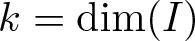 $k=\dim(I)$. Let $M$ be the Grassmannian manifold parametrizing $k$-dimensional vector subspaces of the Lie algebra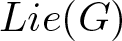 $Lie(G)$. The adjoint action of $G$ on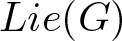 $\mathop{Lie}(G)$ naturally induces a $G$-action on $M$. Recall that by assumption all the isotropy groups
 \begin{equation*}
I_z=\{g\in G: g(z)=z\}\quad (z\in X)
\end{equation*}
\begin{equation*}
I_z=\{g\in G: g(z)=z\}\quad (z\in X)
\end{equation*}are conjugate. Hence, there is one  $G$-orbit $Y$ in $M$ which for every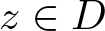 $z\in D$ contains the point of $M$ corresponding to the Lie algebra $W_z$ of the isotropy group at $H(z)$. We apply Proposition 5.1 to $G$ acting on $Y$ and deduce that locally (near $p\in U\subset D$) on $D$ there are maps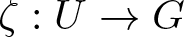 $\zeta:U\to G$ such that
 \begin{equation*}
Ad(\zeta(z))\left( W_p \right) = W_z.
\end{equation*}
\begin{equation*}
Ad(\zeta(z))\left( W_p \right) = W_z.
\end{equation*}Since the isotropy groups
 \begin{equation*}
I_z=\{g: g H(z)=H(z)\}\simeq I
\end{equation*}
\begin{equation*}
I_z=\{g: g H(z)=H(z)\}\simeq I
\end{equation*}are connected, we deduce
 \begin{equation*}
\zeta(z)I_p\zeta(z)^{-1}=I_z.
\end{equation*}
\begin{equation*}
\zeta(z)I_p\zeta(z)^{-1}=I_z.
\end{equation*} Let  $\psi:U\to G$ be a holomorphic map such that $\sigma:z\mapsto (\psi(z),z)$ is a local section $\sigma:U\to\pi^{-1}(U)$.
We define a local trivialization
 \begin{equation*}
\begin{matrix}
I_p\times U & \simeq & \pi^{-1}(U) & \subset & V \\
\downarrow && \downarrow && \downarrow \\
U & = & U & \subset & D \\
\end{matrix}
\end{equation*}
\begin{equation*}
\begin{matrix}
I_p\times U & \simeq & \pi^{-1}(U) & \subset & V \\
\downarrow && \downarrow && \downarrow \\
U & = & U & \subset & D \\
\end{matrix}
\end{equation*}via
 \begin{equation*}
\pi^{-1}(U)\ni (g,z)\stackrel{\Phi}\longrightarrow
\left( \left( \zeta(z)\right)^{-1}\left(\psi(z)\right)^{-1}g\zeta(z)
; z \right) \in I_p\times U
\end{equation*}
\begin{equation*}
\pi^{-1}(U)\ni (g,z)\stackrel{\Phi}\longrightarrow
\left( \left( \zeta(z)\right)^{-1}\left(\psi(z)\right)^{-1}g\zeta(z)
; z \right) \in I_p\times U
\end{equation*} Let us check that  $\Phi(g,z)\in I_p\times U$ for $(g,z)\in\pi^{-1}(U)$. First we observe that $(\psi(z),z),(g,z)\in V$ implies
 \begin{equation*}
\psi(z)\cdot H(z)=F(z)= g\cdot H(z)
\end{equation*}
\begin{equation*}
\psi(z)\cdot H(z)=F(z)= g\cdot H(z)
\end{equation*}which in turn implies
 \begin{equation*}
\left(\psi(z)\right)^{-1}\cdot g\cdot H(z)=H(z)\iff
\left(\psi(z)\right)^{-1}\cdot g\in I_z= \zeta(z)I_p\zeta(z)^{-1}
\end{equation*}
\begin{equation*}
\left(\psi(z)\right)^{-1}\cdot g\cdot H(z)=H(z)\iff
\left(\psi(z)\right)^{-1}\cdot g\in I_z= \zeta(z)I_p\zeta(z)^{-1}
\end{equation*}Hence
 \begin{equation*}
\left( \zeta(z)\right)^{-1}\left(\psi(z)\right)^{-1}g\zeta(z)\in I_p
\end{equation*}
\begin{equation*}
\left( \zeta(z)\right)^{-1}\left(\psi(z)\right)^{-1}g\zeta(z)\in I_p
\end{equation*} Thus,  $\pi$ is holomorphically locally trivial.
13. Reduction to the case
$\operatorname{{Tr}}=0$
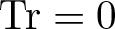
Lemma 13.1. Let  $ {{\mathbb O}_{\mathbb C}}$ be the complexified algebra of octonions. Let $G_{{\mathbb C}}={\mathrm{Aut}}({{\mathbb O}_{\mathbb C}})$.
Let  $D$ be a domain in ${\mathbb C}$. Let $F,H:D\to {{\mathbb O}_{\mathbb C}}$ be holomorphic maps. Assume that $\operatorname{{N}}(F)=\operatorname{{N}}(H)$ and $\operatorname{{Tr}}(F)=\operatorname{{Tr}}(H)$ (with $\operatorname{{Tr}}(F)=F+F^ c$ and $\operatorname{{N}}(F)=FF^ c$).
Define  $\hat F=\frac 12(F-F^c)$ and $\hat H=\frac 12(H-H^c)$.
Then:
(i)
$\operatorname{{Tr}}(\hat F)=0=\operatorname{{Tr}}(\hat H)$.(ii)
$\operatorname{{N}}(\hat F)=\operatorname{{N}}(\hat H)$.(iii) There exists a holomorphic map
$\phi:D\to G_{{\mathbb C}}$ with
$F(z)=\phi(z)\cdot(H(z))$ if and only there exists a holomorphic map
$\phi:D\to G_{{\mathbb C}}$ with
$\hat F(z)=\phi(z)\cdot(\hat H(z))$.

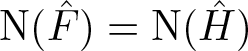




Proof. See [Reference Bisi and Winkelmann12], Lemma 14.1.
14. Vanishing orders
Here, we introduce the notion of ‘central divisors’. As a preparation for this, we first discuss divisors for vector valued function.
14.1. General maps
Normally, divisors are defined for holomorphic functions with values in  ${\mathbb C}$. Here, we extend this notion to holomorphic maps from Riemann surfaces to higher-dimensional complex vector spaces.
Definition 14.1. Let  $F:X\to V={\mathbb C}^n$ be a holomorphic map from a Riemann surface $X$ to a complex vector space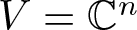 $V={\mathbb C}^n$. Assume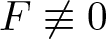 $F\not\equiv 0$.
The divisor of  $F$ is the divisor corresponding to the pullback of the ideal sheaf of the origin, i.e., for $F=(F_1,\ldots,F_n)$, $F_i:X\to{\mathbb C}$ we have $div(F)=\sum_{p\in X} m_p\{p\}$ where $m_p$ denotes the minimum of the multiplicities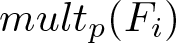 $mult_p(F_i)$.
Proposition 14.2. Let  $X$ be a non-compact Riemann surface, $V$ a complex vector space and $F,H:X\to V$ holomorphic maps which are not identically zero. Assume that $F,H$ have the same zero divisor.
Then there exists a holomorphic function  $\lambda:X\to{\mathbb C}$ and holomorphic maps $\tilde F, \tilde H: X\to V\setminus\{0\}$ such that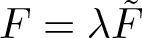 $F=\lambda\tilde F$,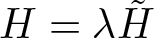 $H=\lambda\tilde H$.
Proof. Recall that on a non-compact Riemann surface every divisor is a principal divisor, i.e., the divisor of a holomorphic function.
We choose a holomorphic function  $\lambda$ on $X$ with
 \begin{equation*}
div(\lambda)=div(H)=div(F)
\end{equation*}
\begin{equation*}
div(\lambda)=div(H)=div(F)
\end{equation*}and define 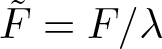 $\tilde F=F/\lambda$,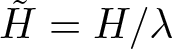 $\tilde H=H/\lambda$.
Lemma 14.3. Let  $X$ be a Riemann surface, $V$ a vector space and $F:X\to V$, $\phi:X\to GL(V)$ be holomorphic maps,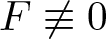 $F\not\equiv 0$.
Define  $H(z)=\phi(z)\left(F(z)\right)$.
Then  $F$ and $H$ have the same divisor.
Proof. Let  $div(F)=\sum_p m_p\{p\}$. Then for every $p\in X$ and $i\in\{1,\ldots,n\}$ the germ of $F_i$ at $p$ is a divisible by $z_p^{m_p}$ where $z_p$ is a local coordinate with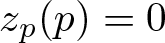 $z_p(p)=0$. Since $\phi(p)$ is linear, the components $H_i$ likewise have germs at $p$ which are divisible by $z_p^{m_p}$. Hence, $div(H)\ge div(F)$.
The same arguments show that also  $div(F)\ge div(H)$, since
 \begin{equation*}
F(z)=\tilde\phi(z)\left(H(z)\right)
\end{equation*}
\begin{equation*}
F(z)=\tilde\phi(z)\left(H(z)\right)
\end{equation*}for
 \begin{equation*}
\tilde\phi(z)=\left(\phi(z)\right)^{-1}.
\end{equation*}
\begin{equation*}
\tilde\phi(z)=\left(\phi(z)\right)^{-1}.
\end{equation*} Thus,  $div(F)=div(H)$.
14.2. Central divisors
In [Reference Bisi and Winkelmann10], Definition 3.1, we introduced the notion of a slice divisor. Here, we will need a different notion of divisors.
Namely, we need a notion of divisor which measures where a given stem function assumes a value in the centre  $C_{\mathbb C}$ of ${{\mathbb O}_{\mathbb C}}$. This we call ‘central divisor’.
Definition 14.4. Let  ${{\mathbb O}_{\mathbb C}}={\mathbb O}{\otimes}_R{\mathbb C}$ be the complexification of the octonions with centre ${C_{{\mathbb C}}}={\mathbb R}{\otimes}_R{\mathbb C}\simeq{\mathbb C}$.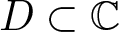 $D\subset{\mathbb C}$ a domain, $F:D\to{{\mathbb O}_{\mathbb C}}$ a holomorphic map. Assume $F(D)\not\subset {C_{{\mathbb C}}}$.
The central divisor 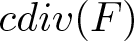 $\mathop{cdiv}(F)$ is defined as the divisor (in the sense of Definition 14.1) of the map from $D$ to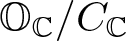 ${{\mathbb O}_{\mathbb C}}/{C_{{\mathbb C}}}$.
Let  $W$ denote the space of imaginary octonions, i.e.,
 \begin{equation*}
W=\{q\in{\mathbb O}: \operatorname{{Tr}}(q)=0\}
\end{equation*}
\begin{equation*}
W=\{q\in{\mathbb O}: \operatorname{{Tr}}(q)=0\}
\end{equation*} Then  ${{\mathbb O}_{\mathbb C}}={C_{{\mathbb C}}}\oplus\left({W{\otimes}_{\mathbb R}{\mathbb C}}\right)$ and we can decompose $F:D \to{{\mathbb O}_{\mathbb C}}$ as
 \begin{equation}
F=(F^{\prime},F^{\prime\prime}):D\to {C_{{\mathbb C}}}\times({W{\otimes}_{\mathbb R}{\mathbb C}})
\end{equation}
\begin{equation}
F=(F^{\prime},F^{\prime\prime}):D\to {C_{{\mathbb C}}}\times({W{\otimes}_{\mathbb R}{\mathbb C}})
\end{equation}and the central divisor 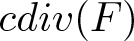 $\mathop{cdiv}(F)$ equals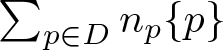 $\sum_{p\in D} n_p\{p\}$ where $n_p$ denotes the vanishing order of $F^{\prime\prime}$ at $p$.
$p$.
Example 14.5. Consider
 \begin{equation*}
F(z)=1{\otimes} z + i{\otimes} z^2(z-1) + j{\otimes} z^3(z-1)^2.
\end{equation*}
\begin{equation*}
F(z)=1{\otimes} z + i{\otimes} z^2(z-1) + j{\otimes} z^3(z-1)^2.
\end{equation*}Then
 \begin{equation*}
\mathop{cdiv}(F)=
2\cdot\{0\}+1\cdot \{1\}.
\end{equation*}
\begin{equation*}
\mathop{cdiv}(F)=
2\cdot\{0\}+1\cdot \{1\}.
\end{equation*}Caveat: These central divisors do not satisfy the usual functoriality:
Example 14.6. Let
 \begin{equation*}
F(z)=1+i{\otimes} z,\quad H(z)=1+j{\otimes} (1+z)
\end{equation*}
\begin{equation*}
F(z)=1+i{\otimes} z,\quad H(z)=1+j{\otimes} (1+z)
\end{equation*} Then  $\mathop{cdiv}(F)=1\cdot\{0\}$ and $\mathop{cdiv}(H)=1\cdot\{-1\}$, but
 \begin{equation*}
\mathop{cdiv}(FH)=\mathop{cdiv}(1+i{\otimes} z+j{\otimes} (z+1)+k{\otimes}(z^2+z)
\end{equation*}
\begin{equation*}
\mathop{cdiv}(FH)=\mathop{cdiv}(1+i{\otimes} z+j{\otimes} (z+1)+k{\otimes}(z^2+z)
\end{equation*}is empty. Thus
 \begin{equation*}
\mathop{cdiv}(FH)\ne\mathop{cdiv}(F)+\mathop{cdiv}(H).
\end{equation*}
\begin{equation*}
\mathop{cdiv}(FH)\ne\mathop{cdiv}(F)+\mathop{cdiv}(H).
\end{equation*} (This is an example for  ${\mathbb H}$, first presented in [Reference Bisi and Winkelmann12]. But of course, ${\mathbb H}$ is a subalgebra of ${\mathbb O}$, so it is an example for the octonions as well.)
14.3. Central divisor for slice functions
Let  $f$ be a not slice-preserving slice regular function with associated stem function $F$. Then we may simply define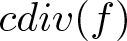 $\mathop{cdiv}(f)$ as
 \begin{equation*}
\mathop{cdiv}(f)\stackrel{def}{=}\mathop{cdiv}(F)
\end{equation*}
\begin{equation*}
\mathop{cdiv}(f)\stackrel{def}{=}\mathop{cdiv}(F)
\end{equation*} Note that for a slice regular function  $f$ on an axially symmetric domain $\Omega_D$ its central divisor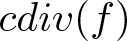 $\mathop{cdiv}(f)$ is a divisor on $D$ (and not on $\Omega_D$).
15. Proof of the main theorem
We are now in a position to prove our main theorem 2.1.
First, we consider slice-preserving functions (Lemma 15.1).
Second, we deal with the case where the image of  $F$ is contained in the null cone of the bilinear form $B$ (Proposition 15.2).
Third, we prove Proposition 15.3 which embodies the most difficult part of Theorem 2.1.
Finally, we complete the proof of Theorem 2.1.
Lemma 15.1. Let  ${\mathbb O}$ be the algebra of octonions, ${{\mathbb O}_{\mathbb C}}={\mathbb O}{\otimes}_{\mathbb R}{\mathbb C}$, $G_{{\mathbb C}}=Aut({{\mathbb O}_{\mathbb C}})$. Let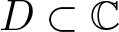 $D\subset{\mathbb C}$ be a symmetric domain and let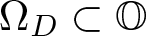 $\Omega_D\subset {\mathbb O}$ denote the corresponding axially symmetric domain.
Let  $f,h:\Omega_D\to {\mathbb O}$ be slice regular functions and let $F,H:D\to{{\mathbb O}_{\mathbb C}}$ denote the corresponding stem functions.
Assume that  $f$ is slice-preserving. Then the following are equivalent:
(i)
$f=h$.(ii)
$F=H$.(iii) For every
$z\in D$ there exists an element
$\alpha\in Aut({{\mathbb O}_{\mathbb C}})=G_{{\mathbb C}}$ such that
$F(z)=\alpha(H(z))$.(iv) There is a holomorphic map
$\phi:D\to G_{{\mathbb C}}$ such that
$F(z)=\phi(z)\left(H(z)\right)\ \forall z\in D$.
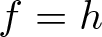
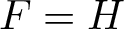
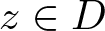




Proof.  $(i)\iff(ii)\implies(iv)\implies(iii)$ is obvious. $f$ being slice preserving is equivalent to
 \begin{equation*}
\forall z\in D: F(z)\in C_{\mathbb C}=\{q\in{{\mathbb O}_{\mathbb C}}:q=\bar q\}\simeq{\mathbb C}
\end{equation*}
\begin{equation*}
\forall z\in D: F(z)\in C_{\mathbb C}=\{q\in{{\mathbb O}_{\mathbb C}}:q=\bar q\}\simeq{\mathbb C}
\end{equation*} (see Proposition 3.8). Now we obtain  $(iii)\implies(ii)$, because the automorphism group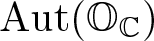 ${\mathrm{Aut}}({{\mathbb O}_{\mathbb C}})$ acts trivially on $C_{\mathbb C}$.
Proposition 15.2. Let  ${\mathbb O}$ be the algebra of octonions and ${\mathbb O}_{\mathbb C}={\mathbb O}{\otimes}_{\mathbb R}{\mathbb C}$.
Let 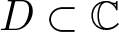 $D\subset{\mathbb C}$ be a symmetric domain.
Let  $F,H:D\to {\mathbb O}_{\mathbb C}\setminus\{0\}$ be holomorphic maps.
Assume that  $\operatorname{{Tr}}(F)=\operatorname{{Tr}}(H)=0$, $\operatorname{{N}}(F)=\operatorname{{N}}(H)$ and that
 \begin{equation*}
F(D)\subset\{v\in W_{\mathbb C}: B(v,v)=0\}.
\end{equation*}
\begin{equation*}
F(D)\subset\{v\in W_{\mathbb C}: B(v,v)=0\}.
\end{equation*} Then there exists a holomorphic map  $\phi:D\to G_{{\mathbb C}}$ such that
 \begin{equation*}
\phi(z)\left(F(z)\right)=H(z)\ \forall z\in D.
\end{equation*}
\begin{equation*}
\phi(z)\left(F(z)\right)=H(z)\ \forall z\in D.
\end{equation*}Proof. Due to our assumption  $F(D)\subset\{v\in W_{\mathbb C}: B(v,v)=0\}$ we know that $F(D)\subset W_{\mathbb C}$ and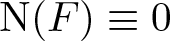 $\operatorname{{N}}(F)\equiv 0$. Thus, $\operatorname{{N}}(H)=\operatorname{{N}}(F)\equiv 0$ which (in combination with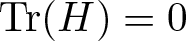 $\operatorname{{Tr}}(H)=0$) implies
 \begin{equation*}
H(D)\subset\{v\in W_{\mathbb C}: B(v,v)=0\}.
\end{equation*}
\begin{equation*}
H(D)\subset\{v\in W_{\mathbb C}: B(v,v)=0\}.
\end{equation*} Recall that  $H_0=\{v\in W_{{\mathbb C}}:B(v,v)=0\}\setminus\{0\}$ is one orbit of $G_{{\mathbb C}}={\mathrm{Aut}}({{\mathbb O}_{\mathbb C}})$ (Proposition 10.1). Hence, $H_0\simeq G_{{\mathbb C}}/I$ for some complex Lie subgroup $I$. Thus, we may regard $F,H$ as holomorphic maps from $D$ to the quotient manifold $G_{{\mathbb C}}/I$. Due to Proposition 11.3 we know that $I$ is connected. Now $G_{{\mathbb C}}\to G_{{\mathbb C}}/I$ is a $I$-principal bundle by standard Lie theory. If we pull-back this $I$-principal bundle via $F$ or $H$, we obtain an $I$-principal bundle over $D$ which admits a holomorphic section due to Proposition 8.1. These sections induce liftings of the maps $F,H:D\to G_{{\mathbb C}}/I$ to maps $\tilde F,\tilde H:D\to G_{{\mathbb C}}$.

Now we may define the desired map  $\phi$ using the group structure of $G_{{\mathbb C}}$
 \begin{equation*}
\phi(z)=\tilde H(z)\cdot\left(\tilde F(z)\right)^{-1}.
\end{equation*}
\begin{equation*}
\phi(z)=\tilde H(z)\cdot\left(\tilde F(z)\right)^{-1}.
\end{equation*}Then
 \begin{equation*}
\phi(z) \cdot\tilde F(z)=\tilde H(z)\quad\implies\quad
\phi(z) \left(F(z)\right)=H(z).
\end{equation*}
\begin{equation*}
\phi(z) \cdot\tilde F(z)=\tilde H(z)\quad\implies\quad
\phi(z) \left(F(z)\right)=H(z).
\end{equation*}Proposition 15.3. Let  ${\mathbb O}$ be the algebra of octonions and ${\mathbb O}_{\mathbb C}={\mathbb O}{\otimes}_{\mathbb R}{\mathbb C}$.
Let 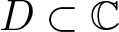 $D\subset{\mathbb C}$ be a symmetric domain.
Let  $F,H:D\to {\mathbb O}_{\mathbb C}\setminus\{0\}$ be holomorphic maps such that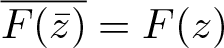 $\overline{F(\bar z)}=F(z)$,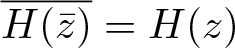 $\overline{H(\bar z)}=H(z)$,
Assume that  $\operatorname{{Tr}}(F)=\operatorname{{Tr}}(H)=0$, $\operatorname{{N}}(F)=\operatorname{{N}}(H)$ and that
 \begin{equation*}
F(D)\not\subset \{q\in{{\mathbb O}_{\mathbb C}}:B(q,q)=0\}.
\end{equation*}
\begin{equation*}
F(D)\not\subset \{q\in{{\mathbb O}_{\mathbb C}}:B(q,q)=0\}.
\end{equation*} Then there exists a holomorphic map  $\phi:D\to G_{{\mathbb C}}$ such that
 \begin{equation*}
\phi(z)\left(F(z)\right)=H(z)\ \forall z\in D.
\end{equation*}
\begin{equation*}
\phi(z)\left(F(z)\right)=H(z)\ \forall z\in D.
\end{equation*}Proof. Throughout the proof, we will use the fact that  $D$ is a non-compact Riemann surface.
Note that we assume  $\operatorname{{Tr}}(F)=\operatorname{{Tr}}(H)=0$. It follows that the images $F(D),H(D)$ are contained in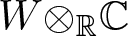 ${W{\otimes}_{\mathbb R}{\mathbb C}}$.
Thus, we may regard  $F$ and $H$ as holomorphic maps from $D$ to $\left({W{\otimes}_{\mathbb R}{\mathbb C}}\right)\setminus\{0\}$.
From our assumption on  $F$ and $H$ we deduce that for every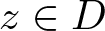 $z\in D$ there is an element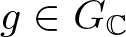 $g\in G_{\mathbb C}$ with $H(z)=gF(z)$ (Corollary 10.5).
The case where both  $F$ and $H$ are constant is trivial. Hence, we may assume that at least one of the two maps is not constant. Without loss of generality, we assume $F$ to be non-constant.
We define a complex space  $V$ and a projection map $\pi:V\to D$:
 \begin{align*}
&V=\{(\alpha,z)\in G_{{\mathbb C}}\times D : F(z)= \alpha H(z)\}\\
&\pi:(\alpha,z)\mapsto z.\\
\end{align*}
\begin{align*}
&V=\{(\alpha,z)\in G_{{\mathbb C}}\times D : F(z)= \alpha H(z)\}\\
&\pi:(\alpha,z)\mapsto z.\\
\end{align*} The isotropy groups for the  $G_{{\mathbb C}}$-action on ${W{\otimes}_{\mathbb R}{\mathbb C}}\setminus\{0\}$ have all the same dimension (namely $8$) due to Corollary 10.3.
Therefore, we may apply Proposition 5.1. It follows that for every 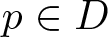 $p\in D$ there is an open neighbourhood $M$ of $p$ in $D$ and a holomorphic map $\psi:M\to G_{{\mathbb C}}$ with
 \begin{equation*}
F(z)=\psi(z)H(z)\ \,\, \forall z\in M.
\end{equation*}
\begin{equation*}
F(z)=\psi(z)H(z)\ \,\, \forall z\in M.
\end{equation*} In other words: There are everywhere local holomorphic sections for  $\pi:V\to D$.
Define
 \begin{equation}
L=\{z\in D:B(F(z),F(z))=0\},\ U=D\setminus L
\end{equation}
\begin{equation}
L=\{z\in D:B(F(z),F(z))=0\},\ U=D\setminus L
\end{equation}Recall that
 \begin{equation*}
F(D)\not\subset\{v: B(v,v)=0\}.
\end{equation*}
\begin{equation*}
F(D)\not\subset\{v: B(v,v)=0\}.
\end{equation*} Thus,  $U$ as defined in (15.1) above is an open dense subset of $D$.
$D$.
We recall that for 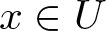 $x\in U$ the isotropy group at $x$ is isomorphic to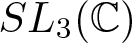 $SL_3({\mathbb C})$ (Proposition 11.1) and therefore in particular simply-connected. In the case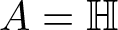 $A={\mathbb H}$ this group is isomorphic to ${\mathbb C}^*$ and thus not simply-connected. One reason, why we need different proofs in the two different cases.
Recall
 \begin{equation*}
V=\{(\alpha,z)\in G_{{\mathbb C}}\times D : F(z)= \alpha H(z)\}
\end{equation*}
\begin{equation*}
V=\{(\alpha,z)\in G_{{\mathbb C}}\times D : F(z)= \alpha H(z)\}
\end{equation*} Let  $\pi:V\to D$ denote the natural projection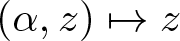 $(\alpha,z)\mapsto z$. For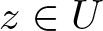 $z\in U$ we have $\pi^ {-1}(z)\simeq SL_3({\mathbb C})$. Fix a point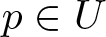 $p\in U$ and let
 \begin{equation*}
I=\{\alpha\in G_{{\mathbb C}}:\alpha\cdot F(p)=F(p) \}.
\end{equation*}
\begin{equation*}
I=\{\alpha\in G_{{\mathbb C}}:\alpha\cdot F(p)=F(p) \}.
\end{equation*} From Proposition 12.1, we deduce that 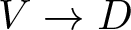 $V\to D$ restricts to a holomorphically locally trivial fibre bundle on $U$ with fibre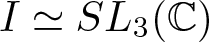 $I\simeq SL_3({\mathbb C})$ and a structure group which is isomorphic to
 \begin{equation*}
\left( N_{G_{\mathbb C}}(I)/Z_{G_{\mathbb C}}(I) \right) \lt imes I
\end{equation*}
\begin{equation*}
\left( N_{G_{\mathbb C}}(I)/Z_{G_{\mathbb C}}(I) \right) \lt imes I
\end{equation*} Thus,  $\pi:V\to D$ restricts to a locally trivial fibre bundle over $U$ whose structure group is a (not necessarily connected) complex Lie group.
In view of the fact that 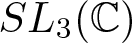 $SL_3({\mathbb C})$ is simply-connected, we infer from Proposition 6.3 that $\pi:V\to D$ admits a global continuous section.
Finally, we obtain a global holomorphic section (equivalently: a holomorphic map  $\phi$ with the desired properties) by Proposition 7.6.
Proposition 15.4. Let  ${\mathbb O}$ be the algebra of octonions and ${\mathbb O}_{\mathbb C}={\mathbb O}{\otimes}_{\mathbb R}{\mathbb C}$.
Let 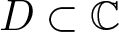 $D\subset{\mathbb C}$ be a symmetric domain.
Let  $F,H:D\to {\mathbb O}_{\mathbb C}\setminus\{0\}$ be holomorphic maps.
Assume that  $\operatorname{{Tr}}(F)=\operatorname{{Tr}}(H)=0$ and $\operatorname{{N}}(F)=\operatorname{{N}}(H)$.
Then there exists a holomorphic map  $\phi:D\to G_{{\mathbb C}}$ such that
 \begin{equation*}
\phi(z)\left(F(z)\right)=H(z)\ \forall z\in D.
\end{equation*}
\begin{equation*}
\phi(z)\left(F(z)\right)=H(z)\ \forall z\in D.
\end{equation*}Proof. Follows from Proposition 15.2 and Proposition 15.3.
Proof of the Theorem 2.1
The assertions of part  $b)$ have been proved in Lemma 15.1.
Thus, we may assume without loss of generality that neither  $f$ nor $h$ is slice preserving.
We proceed as follows:
 $(ii)\implies(iv)$:
By assumption, we have  $\operatorname{{Tr}}(F)=\operatorname{{Tr}}(H)$. Define
 \begin{equation*}
\hat F=\frac 12\left(F-F^ c\right),\quad
\hat H=\frac 12\left(H-H^ c\right)
\end{equation*}
\begin{equation*}
\hat F=\frac 12\left(F-F^ c\right),\quad
\hat H=\frac 12\left(H-H^ c\right)
\end{equation*} Evidently  $\operatorname{{Tr}}(\hat H)=\operatorname{{Tr}}(\hat F)=0$. Moreover, $\operatorname{{N}}(F)=\operatorname{{N}}(H)$ in combination with Lemma 13.1 implies that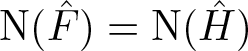 $\operatorname{{N}}(\hat F)=\operatorname{{N}}(\hat H)$.
With respect to the decomposition  ${\mathbb O}_{\mathbb C}={\mathbb C}\oplus\left({W{\otimes}_{\mathbb R}{\mathbb C}}\right)$ the map $\hat F$ resp. $\hat H$ is just the second component of $F$ resp. $H$. Recall that we discuss the case where neither $f$ nor $h$ is slice preserving. Hence, neither $\hat F$ nor $\hat H$ are vanishing identically.
By the definition of the central divisor (introduced in §14.2) we may conclude that  $\mathop{cdiv}(F)=\mathop{cdiv}(\hat F)$ and $\mathop{cdiv}(H)=\mathop{cdiv}(\hat H)$.
Since  $\mathop{cdiv}(F)=\mathop{cdiv}(H)$, it follows that there are holomorphic maps $\tilde F,\tilde H:D\to{{\mathbb O}_{\mathbb C}}\setminus\{0\}$ and $h:D\to{\mathbb C}$ such that
 \begin{equation*}
\hat F=h\tilde F, \quad\hat H=h\tilde H
\end{equation*}
\begin{equation*}
\hat F=h\tilde F, \quad\hat H=h\tilde H
\end{equation*} (Proposition 14.2, here multiplication by  $h(z)$ means multiplying elements of ${{\mathbb O}_{\mathbb C}}$ via ${\mathbb C}\simeq{1}{\otimes}{\mathbb C}\subset{\mathbb O}{\otimes}_{\mathbb R}{\mathbb C}$.)
Observe that
 \begin{align*}
&0=\operatorname{{Tr}}(\hat F)=hTr(\tilde F),\ \operatorname{{N}}(\hat F)=h^ 2N(\tilde F)\\
&0=\operatorname{{Tr}}(\hat H)=hTr(\tilde H),\ \operatorname{{N}}(\hat H)=h^ 2N(\tilde H)\\
\end{align*}
\begin{align*}
&0=\operatorname{{Tr}}(\hat F)=hTr(\tilde F),\ \operatorname{{N}}(\hat F)=h^ 2N(\tilde F)\\
&0=\operatorname{{Tr}}(\hat H)=hTr(\tilde H),\ \operatorname{{N}}(\hat H)=h^ 2N(\tilde H)\\
\end{align*} Hence,  $\operatorname{{Tr}}(\tilde F)=0=\operatorname{{Tr}}(\tilde H)$ and $\operatorname{{N}}(\tilde F)=\operatorname{{N}}(\tilde H)$ and Proposition 15.4 implies that there is a holomorphic map $\phi:D\to G_{{\mathbb C}}$ such that
 \begin{equation*}
\phi(z)\left(\tilde F(z)\right)=\tilde H(z)\ \forall z\in D.
\end{equation*}
\begin{equation*}
\phi(z)\left(\tilde F(z)\right)=\tilde H(z)\ \forall z\in D.
\end{equation*}which in turn implies
 \begin{equation*}
\phi(z)\left(\hat F(z)\right)=\hat H(z)\ \forall z\in D,
\end{equation*}
\begin{equation*}
\phi(z)\left(\hat F(z)\right)=\hat H(z)\ \forall z\in D,
\end{equation*}because  $G_{{\mathbb C}}$ acts linearly,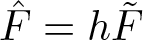 $\hat F=h\tilde F$ and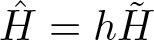 $\hat H=h\tilde H$. Finally
 \begin{equation*}
\phi(z)\left(F(z)\right)=H(z)\ \forall z\in D
\end{equation*}
\begin{equation*}
\phi(z)\left(F(z)\right)=H(z)\ \forall z\in D
\end{equation*}follows via Lemma 13.1. $(iv)\implies(iii)$: The implication $(iv)\implies \mathop{cdiv}(F)=\mathop{cdiv}(H)$ is due to Lemma 14.3, the other assertion is obvious.
For  $(iii)\iff(ii)$ see Corollary 10.5.
For  $(i)\iff(ii)$, see Proposition 3.7 and Section 14.3.
Acknowledgements
The authors were partially supported by GNSAGA of INdAM. The author C. Bisi was also partially supported by PRIN Varietá reali e complesse: geometria, topologia e analisi armonica.


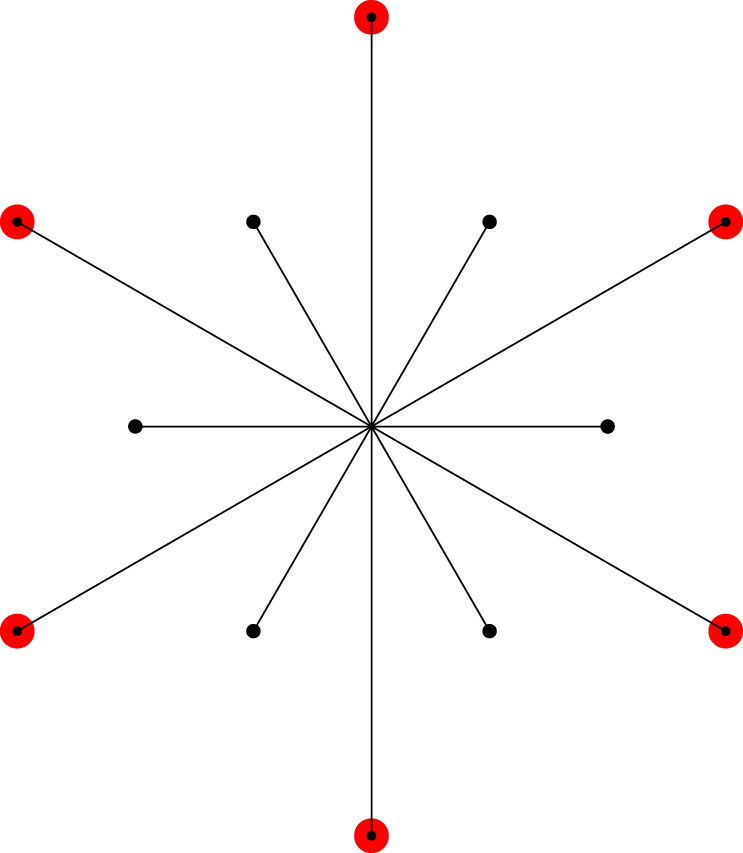


 Open access

