





1. Introduction
Organic matter in natural environmental matrices such as soils and sediments are inherently complex, being comprised of thousands of chemical constituents. Determining the composition, source, and dynamics of these complex mixtures presents a formidable challenge, yet it is crucial for understanding how organic carbon (OC) is cycled over a range of spatial and temporal scales. By providing key constraints on carbon origin and turnover time, radiocarbon (14C) measurements have been extensively employed as both a tracer and a chronometer. These techniques, developed since the late 1940s (Arnold and Libby Reference Arnold and Libby1949; Godwin Reference Godwin1962), have proven to be essential tools over subsequent decades (Wang et al. Reference Wang, Amundson and Trumbore1996; Hajdas Reference Hajdas2008). However, commonly used “bulk” analyses yield only an average 14C content of all OC constituents contained within a given sample (Trumbore Reference Trumbore2009; Keaveney et al. Reference Keaveney, Reimer and Foy2015; Bao et al. Reference Bao, McNichol, Hemingway, Lardie Gaylord and Eglinton2019), despite the fact that different constituents may be described by diverse ages ranging from (post-)modern (e.g., recently fixed biomass) to radiocarbon-dead (e.g., fossil OC of geological origin, so-called “petrogenic” OC; Bordovskiy Reference Bordovskiy1965a; Bordovskiy Reference Bordovskiy1965b; Barnes and Barnes Reference Barnes, Barnes and Lerman1978). It is therefore desirable to separate and isotopically characterize different OC components and determine 14C signatures of specific constituents.
Several approaches have been developed to achieve this goal, including both physical (e.g., density separation; Balesdent et al. Reference Balesdent, Wagner and Mariotti1988; Catroux and Schnitzer Reference Catroux and Schnitzer1987; Elliott and Cambardella Reference Elliott and Cambardella1991) and chemical methods (e.g., isolation and analysis of specific compounds; Catroux and Schnitzer Reference Catroux and Schnitzer1987; Eglinton et al. Reference Eglinton, Aluwihare, Bauer, Druffel and McNichol1996; Rethemeyer et al. Reference Rethemeyer, Kramer, Gleixner, Wiesenberg, Schwark, Andersen, Nadeau and Grootes2004). Complementing these techniques, OC can be separated and analyzed for 14C content according to its thermal lability. This simple yet effective approach—variably termed ramped pyrolysis/oxidation (RPO), Ramped PyrOx, or ramped oxidation (RO) in the literature, the latter of which we adopt here—has gained extensive use in the geosciences over the past decade (Rosenheim and Galy Reference Rosenheim and Galy2012; Rosenheim et al. Reference Rosenheim, Day, Domack, Schrum, Benthien and Hayes2008). Here, we adopt the term “ramped oxidation” to highlight the fact that our objective is not to induce combustion (i.e., generating heat and/or light) but to systematically degrade the organic matter into CO2 using an oxidizing agent in the ramping furnace.
Applications are wide-ranging and include studies aimed at understanding soil carbon turnover dynamics (Grant et al. Reference Grant, Galy, Haghipour, Eglinton and Derry2022; Stoner et al. Reference Stoner, Schrumpf, Hoyt, Sierra, Doetterl, Galy and Trumbore2023); organo-mineral interactions in fluvial, lacustrine, and marine sediments (Cui et al. Reference Cui, Mucci, Bianchi, He, Vaughn, Williams, Wang, Smeaton, Koziorowska-Makuch and Faust2022; Hemingway et al. Reference Hemingway, Rothman, Grant, Rosengard, Eglinton, Derry and Galy2019); petrogenic OC transport and oxidation (Hemingway et al. Reference Hemingway, Hilton, Hovius, Eglinton, Haghipour, Wacker, Chen and Galy2018; Li et al. Reference Li, Fischer, Lamb, West, Zhang, Galy, Wang, Li, Qiu and Li2021); dissolved OC dynamics (White et al. Reference White, Nguyen, Koester, Lardie Gaylord, Beman, Smith, McNichol and Beaupré2023); sediment provenance (Bao et al. Reference Bao, Strasser, McNichol, Haghipour, McIntyre, Wefer and Eglinton2018; Orsi et al. Reference Orsi, Coolen, Wuchter, He, More, Irigoien, Chust, Johnson, Hemingway and Lee2017); and sediment chronology and age-model constraints (Rosenheim et al. Reference Rosenheim, Day, Domack, Schrum, Benthien and Hayes2008; Subt et al. Reference Subt, Fangman, Wellner and Rosenheim2016). Overall, RO has emerged as a powerful tool to study 14C characteristics of OC in complex natural samples.
Briefly, RO involves serial OC combustion while increasing temperature to ∼900°C at a constant ramp rate (e.g., 5°C⋅min–1); this method separates OC as a function of thermal stability (Rosenheim et al. Reference Rosenheim, Day, Domack, Schrum, Benthien and Hayes2008; Sokolov et al. Reference Sokolov, Dmitrevskaya, Pautova, Lebedeva, Chernikov and Semenov2021). The concentration of evolved CO2 is monitored continuously as a function of temperature to yield a so-called “thermogram” and aliquots are subsequently collected according to user-prescribed temperature intervals or “thermal fractions” (e.g., ambient 320°C; 320–375°C, etc.) using cryogenic agents (e.g., liquid nitrogen), after which they are subsequently purified, graphitized, and analyzed for 14C content by accelerator mass spectrometry (AMS; Rosenheim et al. Reference Rosenheim, Day, Domack, Schrum, Benthien and Hayes2008). By determining a 14C content for each thermal fraction, RO provides insights into the 14C characteristics of different constituents that shed light on OC sources, turnover times etc.
RO exhibits three key benefits over other radiocarbon methods: First, it requires minimal sample processing (Rosenheim et al. Reference Rosenheim, Day, Domack, Schrum, Benthien and Hayes2008). Second, it can be used in conjunction with other techniques such as gas chromatography (when samples are heated in the absence of O2) to further chemically characterize released compounds (Ginnane et al. Reference Ginnane, Turnbull, Naeher, Rosenheim, Venturelli, Phillips, Reeve, Parry-Thompson, Zondervan and Levy2024; Picó and Barceló Reference Picó and Barceló2020; Sobeih et al. Reference Sobeih, Baron and Gonzalez-Rodriguez2008). Finally, CO2 thermograms can be used to derive activation energies for thermal decomposition of different OC constituents and estimate carbon bond-strength distributions (Hemingway et al. Reference Hemingway, Rothman, Rosengard and Galy2017b). That is, since all OC is converted to CO2, thermograms qualitatively separate different components based on thermal stability. In this way, RO provides valuable information that bridges bulk and molecular level 14C analyses.
Despite these benefits, to date very few RO-14C setups have been implemented and existing RO methods adopt an “offline” approach whereby serial oxidation products are manually trapped and purified before being transferred to an AMS as either CO2 or graphite for 14C analysis (Keaveney et al. Reference Keaveney, Gerard, Barrett, Kerry, Paula and Reimer2021; Rosenheim et al. Reference Rosenheim, Day, Domack, Schrum, Benthien and Hayes2008). To enhance the precision, efficiency, and throughput of this method, here we describe an instrumental system that directly couples RO to AMS, which we term online ramped oxidation (ORO). Compared to traditional cryogenic trapping and offline measurement methods, the ORO system offers the significant advantage of an online sample analysis. Like other methods, it allows for the selection of fractions based on real-time thermogram progression, but it requires only a minimal amount of sample material, as typically needed for gas measurements. Another advantage is its compact design, which requires little space and facilitates straightforward operation.
In the following sections, we first explain the ORO instrumental design and configuration. We then describe results from a series of blank and reproducibility standard tests to place our ORO results within the context of other RO instruments developed to date.
2. Methods
2.1. Instrumental configuration
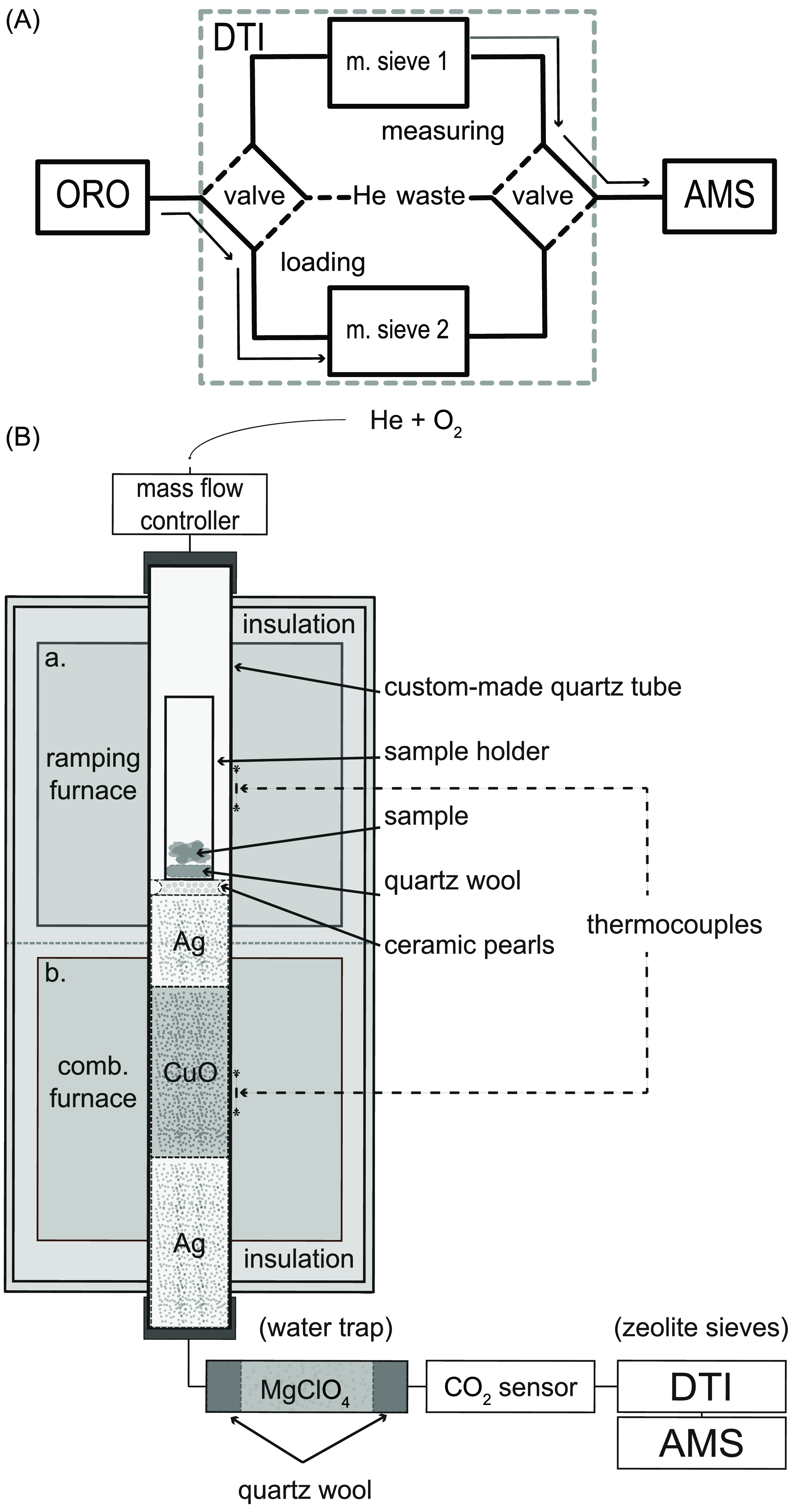
Our instrumental configuration consists of two modules (see Figure 1A for a schematic overview): (i) an online ramped oxidation (ORO) system, which serves as the sample combustion and CO2 concentration monitoring unit; and (ii) a double trap interface (DTI) developed by De Maria et al. (Reference De Maria, Fahrni, Lozac’h, Marvalin, Walles, Camenisch, Wacker and Synal2021), where CO2 is collected using parallel molecular sieve (zeolite) traps. This setup is then directly coupled to a MIni CArbon DAting System (MICADAS) AMS or Low Energy AMS (LEA) equipped with CO2-accepting ion sources (Synal et al. Reference Synal, Stocker and Suter2007; Synal and Wacker Reference Synal and Wacker2010). Each module is described in more detail below:
(A) Schematic of the ORO-DTI-AMS setup. The ORO combustion unit continuously generates CO2, which is trapped by zeolite sieves in the DTI unit via toggling between traps. One zeolite sieve injects the previously collected CO2 fraction while the second zeolite sieve simultaneously collects the ongoing CO2 fraction. (B) Detailed schematic of the table-top ORO system (not to scale; dimensions: 10 × 30 × 40 cm), showing: (a.) ramping furnace, where sample is loaded and undergoes heating; (b.) combustion furnace containing Ag and CuO catalysts that effectively remove S and N compounds during the combustion process; (c.) MgClO4 water trap positioned before the CO2 sensor to prevent potential damage; and (d.) CO2 sensor NDIR; smartGas flowEvo. The bottom reactor insert is an open cylinder (out diameter 1.2 cm, in diameter 1.0 cm, wall thickness 0.1 cm) connected to a Swagelok glass tube capillary fitting (5/8 inch).
2.1.1. Online ramped oxidation (ORO)
The ORO module includes two sequential ceramic fiber furnaces (Watlow Inc.; Figure 1B). The first furnace (Figure 1B-a.), where the sample is inserted, is connected through a Ø 1 cm, ∼20 cm long quartz tube to the second furnace holding catalysts. Two thermocouples are positioned perpendicularly to the tube in the middle of each furnace and are fixed with bolts to the aluminum case of the ORO unit. The furnaces are heated with a spiral wire (48 W). The tube with the catalysts can be removed from the top, and the height can be adjusted. We generally aim to position the catalyst tube so that the sample holder tube aligns with the spiral wires of the ramping furnace. The sample is loaded in a precombusted, Ø 0.7 cm, ∼5 cm long quartz tube partially filled from below with quartz wool. The first furnace is programmed to heat with a constant temperature ramp, and evolved products are continuously carried downstream by a combustion gas containing a mixture of O2 (18 mol%) and He (82 mol%) industrially produced on request by PanGas AG, with 6.0 gas purity (relative error 0.5%), ISO 17025 certification, and Swiss Calibration Service (SCS) 0023. The flow rate is kept constant at ∼90 mL⋅min–1 using a mass-flow controller (Axetris MFC-2022). After exiting the first furnace, evolved products are carried into the second furnace (Figure 1B-b.), which is constantly held at 900°C and contains copper oxide (CuO) and silver (Ag) wool catalysts to ensure complete combustion to CO2 and to remove unwanted nitrogen- and sulphur-containing compounds, while the excess O2 is fed directly into the AMS source. After exiting the second furnace, generated CO2 passes through a magnesium perchlorate (MgClO4) water trap and is quantified at a frequency of 1 Hz using a non-dispersive infrared sensor (NDIR; smartGas flowEvo; precalibrated with N2). ORO and DTI processes are controlled via a LabVIEWTM interface, whereas acquisition of CO2 concentration data is managed by smartGas Data Logger software.
2.1.2. Dual trap interface (DTI) and AMS coupling
The DTI module is a variant of a gas interface system (GIS) coupled to AMS (Ruff et al. Reference Ruff, Szidat, Gäggeler, Suter, Synal and Wacker2010; Wacker et al. Reference Wacker, Fahrni, Hajdas, Molnar, Synal, Szidat and Zhang2013; De Maria et al. Reference De Maria, Fahrni, Lozac’h, Marvalin, Walles, Camenisch, Wacker and Synal2021). The interface features two traps filled with molecular sieve 5Å zeolite (∼100 mg each; 60–80 mesh size), which alternately collect the CO2 released by combustion and regulate its injection into the AMS ion source. Molecular sieves are connected to both the ORO and the AMS using a two-way, 10-port Valco valve. During the trapping phase, CO2 from a given thermal fraction is collected on the “loading” molecular sieve kept at ∼10°C, a process regulated by a thermal sensor and controlled via a LabVIEWTM interface. During the release and measurement phase, the molecular sieve is heated from ∼10°C to 400°C in ∼3 min. A pressure transducer (Keller AG, Winterthur, Switzerland) monitors the pressure of CO2 entering the AMS and is located between the traps and the source capillary. A He inlet and a waste (vacuum) outlet are also placed before the trap and between the molecular sieve and the source capillary, respectively.
Helium is used both as carrier gas to transport CO2 through the system and for a molecular-sieve and feeding-capillary cleaning routine. The DTI is manually operated to switch between molecular sieves. During the release and measurement phase, short He injections are used to regulate CO2 mass flow into the ion source, allowing for stable measurement conditions for analyses up to 10 min. After measuring, the sieve is cleaned by injecting He at 400°C and using a vacuum pump to remove residual material. This cleaning routine is integrated within the trap cooling sequence, during which He is introduced into the molecular sieves until they reach a temperature of ∼90°C. The primary cooling is accomplished by turbo-blasting compressed air around the tubing that contains the molecular sieves. This cooling process typically lasts ∼3 min, and removed material is diverted to waste. If inactive for an extended period, the zeolite sieves can be heated and cleaned as needed. Further DTI construction and technical details are reported in De Maria et al. (Reference De Maria, Fahrni, Lozac’h, Marvalin, Walles, Camenisch, Wacker and Synal2021).
2.2. Experimental procedure
Prior to analysis, soil and sediment samples are fumigated in the presence of concentrated acid (HCl 37%) to remove carbonates and subsequently neutralized with NaOH base (both steps at 65ºC for 72 hr in a vacuum desiccator). As standard procedure, samples are then homogenized with a mortar and pestle and weighed into precombusted (∼600°C, > 2 hr) quartz glass tubes along with CuO and Ag catalysts. Periodically the cleaning procedure is done at above 600°C.
Once loaded and sealed, the entire system is flushed with O2:He gas mixture at a preselected flow rate (usually ∼90 mL⋅min–1) for ∼5 min at room temperature to eliminate potential contamination resulting from infiltration of atmospheric CO2. The first furnace gradually heats from ambient temperature to 900°C at a defined temperature ramp rate (e.g., 4∼6°C⋅min–1), while the second furnace is held at ∼900°C. The temperature ramp can be fine-tuned based on the analysis of the initial CO2 fractions stemming from thermal decomposition of the organic matter. Evolved CO2 moves from the ORO unit into the DTI molecular sieve and is collected for 15–20 min, corresponding to an 80–100°C thermal window (assuming 5°C⋅min–1 ramp rate). Once the first molecular sieve is loaded and switched to the release and measurement phase by toggling the DTI, the second molecular sieve begins collecting evolved CO2 arriving from the furnace. This process is continuous and does not interrupt the flow of the CO2. The CO2 gas is then dissociated, ionized, and measured for 14C concentrations in the AMS after reaching a stable ion current, thus ensuring a consistent signal over time. This process did not involve cryo-trapping or graphitization. Our aim was to generate beam currents between 5 and 7 μA for at least 12.5 min per thermal fraction. We generally dissected samples into 9 thermal fractions over approximately 3.5 hr, considering the furnace ramping rate and with the carbon content of the sample material as constraint. The total measurement process duration is typically ∼10 min for each thermal fraction. Resulting 14C activity is reported in units of F14C (Reimer et al. Reference Reimer, Brown and Reimer2004), which is normalized to 95% of the activity of the international oxalic acid (OXA) standard and corrected for fractionation using measured 13C/12C ratios (Stuiver and Polach Reference Stuiver and Polach1977).
2.3. Quantifying carbon content and bulk 14C content from thermal fractions
2.3.1. Carbon content and weighted-average 14C content quantification
When using the resulting thermogram for quantification, a conversion factor is required to determine the carbon mass released during combustion; this is obtained from a calibration curve created using compounds with known carbon content. For this purpose, known masses of acetanilide (ACE, Merck KgaA; 71% C content) and phthalic anhydride (PHA, Sigma-Aldrich; 60% C content) were oxidized at several flow rates. Conversion factors can then be calculated using the relationship
 $$M = sA,$$
where M (mg) is the mass of carbon loaded, s (mg⋅ppm–1⋅s–1) is a flow-rate-specific conversion factor, and A (ppm⋅s) is the area of the thermogram. A_is determined as the cumulative sum
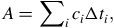 $$A = \mathop \sum \nolimits_i {c_{i}}{\Delta t_i},$$
where ci (ppm) is the CO2 concentration measured each time step i with spacing Δti (s). We empirically determined s by linearly fitting calibration curves for ACE and PHA materials; we then apply Eq. (1) to estimate total and thermal-fraction-specific carbon mass released when analyzing unknown samples.
Furthermore, the ORO-DTI-AMS system only measures F14C for CO2 released within each thermal fraction. Thus, to compare with bulk 14C measurements of the same sample, we calculate the mass-weighted average F14C value as
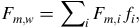 $${F_{m,w}} = \mathop \sum \nolimits_i {F_{m,i}}\;{f_i},$$
where Fm,i is the measured F14C value for thermal fraction i,
 $${f_i} = {{{{M_i}}}\over{{\mathop \sum \nolimits_i {M_i}}}},$$
is the fraction of total carbon mass contained in thermal fraction i, and Mi is the mass of carbon in thermal fraction i. Utilizing the fact that mass and area scale linearly (Eq. 1), Eq. (4) can be rewritten as
 $${f_i} = {{{{A_i}}}\over{{\mathop \sum \nolimits_i {A_i}}}},$$
where Ai is the thermogram area of thermal fraction i. The Fm,w values are then be compared to the bulk F14C measurements, which were measured separately.
2.3.2. Carbon content and weighted-average 14C concentration error
To assess the accuracy and precision of our calculated weighted-average carbon masses and 14C contents, we considered multiple sources of error. First, we calculate uncertainty in the measured thermogram area as
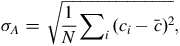 $${\sigma _A} = \sqrt {{{1}\over{N}}\mathop \sum \nolimits_i {{({c_i} - \bar c)}^2}}, $$
where N is the total number of points in a user-defined moving average and $\bar c$
is the moving-average ppm CO2 value. Throughout this study, we used N = 100, as the number of measured points for the CO2 moving average. While the temperature ramp is filtered to show incremental changes using a Savitzky-Golay filter, the smoothed CO2 data is then superimposed on the temperature ramp and the raw CO2 ppm data. The uncertainty in CO2 measurements is up to 5 ppm, as specified by the manufacturer of the CO2 sensor, while the variation in temperature can be up to 5°C. The loss in area from the raw to the smoothed CO2 data is approximately 2%. Next, we calculate uncertainty in the calibration-curve conversion factor using results from all ACE and PHA analyses as
$\bar c$
is the moving-average ppm CO2 value. Throughout this study, we used N = 100, as the number of measured points for the CO2 moving average. While the temperature ramp is filtered to show incremental changes using a Savitzky-Golay filter, the smoothed CO2 data is then superimposed on the temperature ramp and the raw CO2 ppm data. The uncertainty in CO2 measurements is up to 5 ppm, as specified by the manufacturer of the CO2 sensor, while the variation in temperature can be up to 5°C. The loss in area from the raw to the smoothed CO2 data is approximately 2%. Next, we calculate uncertainty in the calibration-curve conversion factor using results from all ACE and PHA analyses as
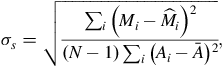 $${\sigma _s} = \sqrt {{{\mathop \sum \nolimits_i {{\left( {{M_i} - \widehat {{M_i}}} \right)}^2}}}\over{{\left( {N - 1} \right)\mathop \sum \nolimits_i {{\left( {{A_i} - \bar A} \right)}^2}}}}, $$
where ${M_i}$
and
${M_i}$
and ${A_i}$
are the loaded mass and calculated area of ACE or PHA analysis
${A_i}$
are the loaded mass and calculated area of ACE or PHA analysis $i$
,
$i$
, $\widehat {{M_i}}$
is the predicted mass of ACE or PHA analysis
$\widehat {{M_i}}$
is the predicted mass of ACE or PHA analysis $i$
,
$i$
, $\bar A$
is the mean area of all analyses, and
$\bar A$
is the mean area of all analyses, and $N$
is the number of analyses included in the regression. Whereas
$N$
is the number of analyses included in the regression. Whereas ${\sigma _A}$
is determined for each (unknown) sample,
${\sigma _A}$
is determined for each (unknown) sample, ${\sigma _s}$
is determined using only standards with known carbon contents and loaded masses. Combining Eqs. (6) and (7), we calculate the propagated error of total loaded carbon mass for any sample as
${\sigma _s}$
is determined using only standards with known carbon contents and loaded masses. Combining Eqs. (6) and (7), we calculate the propagated error of total loaded carbon mass for any sample as
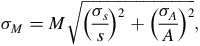 $${\sigma _M} = M\sqrt {{{\left( {{{{\sigma _s}}}\over{s}} \right)}^2} + {{\left( {{{\sigma_A}}\over{A}} \right)}^2}}, $$
assuming s and A are uncorrelated. To estimate error in mass-weighted average F14C values, we first calculate uncertainty in the fraction of total mass within each thermal fraction as
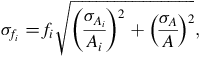 $${\sigma _{{f_i}}} = {f_i}\sqrt {{{\left( {{{{\sigma _{{A_i}}}}}\over{{{A_i}}}} \right)}^2} + {{\left( {{{{\sigma _A}}}\over{A}} \right)}^2}}, $$
where Ai
is the thermogram area of thermal fraction $i$
,
$i$
, $A$
is the total thermogram area, and we assume
$A$
is the total thermogram area, and we assume ${A_i}$
and
${A_i}$
and $A$
are uncorrelated. Finally, combining Eq. (9) with measured analytical F14C uncertainty for each thermal window
$A$
are uncorrelated. Finally, combining Eq. (9) with measured analytical F14C uncertainty for each thermal window $i$
(
$i$
( ${\sigma _{{F_{m,i}}}}$
), we calculate the mass-weighted average F14C propagated error as
${\sigma _{{F_{m,i}}}}$
), we calculate the mass-weighted average F14C propagated error as
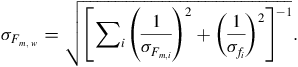 $${\sigma _{{F_{m,\;w}}}} = \sqrt {{{\left[ {\mathop \sum \nolimits_i {{\left( {{1}\over{{{\sigma _{{F_{m,i}}}}}}} \right)}^2} + {{\left( {{1}\over{{{\sigma _{{f_i}}}}}} \right)}^2}} \right]}^{ - 1}}}. $$
While informative, this propagated error does not explicitly account for low-frequency noise reduction measures on the temperature control (Supplementary Material Figure S2–S3C). Such low-frequency noise is an additional potential error source that may affect the thermogram and overall mass calculation. Thus, while we use error predicted by Eq. (10) throughout this study, future work is required to further refine propagated analytical uncertainty.
3. Results and Discussion
3.1. Carbon content quantification
ACE and PHA standard materials were oxidized at several masses ranging from ∼0.1 to 0.8 mg (Supplementary Material Figure S1); each material is described by a distinct CO2 peak at ∼150°C and return to baseline at ∼300°C, indicating complete combustion independent of loaded mass. Using these thermograms, we estimate a conversion factor of $s\; = \;$
(5.387 ± 0.136)
$s\; = \;$
(5.387 ± 0.136) $ \cdot $
10−7 mg
$ \cdot $
10−7 mg $\cdot$
ppm−1
$\cdot$
ppm−1 $\cdot$
s−1 for ACE and
$\cdot$
s−1 for ACE and $s=$
(5.024 ± 0.114)
$s=$
(5.024 ± 0.114) $ \cdot $
10−7 mg
$ \cdot $
10−7 mg $\cdot$
ppm−1
$\cdot$
ppm−1 $\cdot$
s−1 for PHA (flow rate = 90 mL
$\cdot$
s−1 for PHA (flow rate = 90 mL $\cdot$
min–1). For the subsequent measurements of natural samples we used the ACE value, because uncertainties for this compound were smaller. These values are similar but not statistically identical (p > 0.05), suggesting that the conversion factor is partly sample-dependent. The fast generation of CO2 of larger samples may increase the gas flow in the CO2 sensor, thus, lowering the integrated CO2 signal. Due to the faster oxidation rate of PHA (resulting in a sharper peak), it might have a more pronounced impact on the flow rate compared to ACE. As a result, the integrated signal in the sensor is slightly smaller for PHA, as its fast combustion increases the flow rate in the detector. Utilizing smaller, homogeneous grain sizes (<0.05 mm) resulted in thermograms with less noise compared to materials with a flaky texture. To assess the impact of the flow rate on s, we analyzed similar masses of ACE at 15, 45, 90, and 150 mL⋅min–1 (0.542 mg, 0.537 mg, 0.544 mg, and 0.544 mg, respectively). For a given sample mass, we observe higher peak height at higher flow rates, as expected given the higher amount of O2 at disposal (Supplementary Material Figure S1). This result implies that sensor calibration should be performed at the intended flow rate for sample measurement. For this proof-of-concept setup, we aimed for a calibration curve with minimal uncertainties. However, PHA’s flaky texture (i.e., to PHA’s hygroscopic nature and potential for polymerization) resulted in noisy thermograms, increasing the uncertainties on our carbon content conversion factor. In contrast, the thermograms for ACE were more consistent. Therefore, we decided to use only ACE for this proof-of-concept setup.
$\cdot$
min–1). For the subsequent measurements of natural samples we used the ACE value, because uncertainties for this compound were smaller. These values are similar but not statistically identical (p > 0.05), suggesting that the conversion factor is partly sample-dependent. The fast generation of CO2 of larger samples may increase the gas flow in the CO2 sensor, thus, lowering the integrated CO2 signal. Due to the faster oxidation rate of PHA (resulting in a sharper peak), it might have a more pronounced impact on the flow rate compared to ACE. As a result, the integrated signal in the sensor is slightly smaller for PHA, as its fast combustion increases the flow rate in the detector. Utilizing smaller, homogeneous grain sizes (<0.05 mm) resulted in thermograms with less noise compared to materials with a flaky texture. To assess the impact of the flow rate on s, we analyzed similar masses of ACE at 15, 45, 90, and 150 mL⋅min–1 (0.542 mg, 0.537 mg, 0.544 mg, and 0.544 mg, respectively). For a given sample mass, we observe higher peak height at higher flow rates, as expected given the higher amount of O2 at disposal (Supplementary Material Figure S1). This result implies that sensor calibration should be performed at the intended flow rate for sample measurement. For this proof-of-concept setup, we aimed for a calibration curve with minimal uncertainties. However, PHA’s flaky texture (i.e., to PHA’s hygroscopic nature and potential for polymerization) resulted in noisy thermograms, increasing the uncertainties on our carbon content conversion factor. In contrast, the thermograms for ACE were more consistent. Therefore, we decided to use only ACE for this proof-of-concept setup.
Another option considered is the utilization of ancient wood; however, this combustion temperature does not align with our parameters. We will combust small sample masses to generate 80 μg of carbon as CO2 content and compare them for contamination. This approach could yield more precise values and reduce the error, a strategy also adopted by Hemingway et al. (Reference Hemingway, Galy, Gagnon, Grant, Rosengard, Soulet, Zigah and McNichol2017a).
3.2. Quality assessment of measurement precision and contamination risks
We conducted several tests to assess measurement accuracy, reproducibility, and the potential for contamination or sample carry-over during combustion in our instrumental setup. Our evaluation comprises three distinct phases: First, we assessed combustion within the ORO system and CO2 transfer to the DTI. Second, we quantified measurement reproducibility using natural reference materials. Third, we explored instrumental limitations by comparing results with other established methods. We describe results from each phase below.
3.2.1. Combustion efficiency and molecular sieve performance
In this phase, we aimed to discern the effects of directly injected gases from a standard bottle into the DTI (similar to the Gas Interface System), as well as gas from oxidized material from the ORO handled by DTI molecular sieves and thus test the loading mechanism. This approach was intended to offer insights into the background of the setup and verify the proper connection of all components.
To do so, we analyzed two different CO2 gases: one “modern” reference gas (oxidized OXA2, 5.3% CO2 in He, National Institute of Standards & Technology SRM-4990C; F14C = 1.3407 ± 0.0066) and one “ancient” blank gas (5% CO2 in He, Messer AG; F14C∼0.0). Both gases were directly injected into the molecular sieves, and 14C activity was measured and compared to the reported values. This process was repeated twice, since it was observed that the initial analysis of each gas measurement was influenced by the presence of carry-over contamination with CO2 from the previous runs. To minimize the memory effect and avoid carryover, we regulated regulated (3 short injections 50 ms at ∼400°C) the flushing time with He in the molecular sieve at high temperature. Additionally, we applied intermittent injections of He before the high-temperature flushing. The intermittent pressure generated by these injections mobilizes any residual CO2 before flushing. To validate the methodology, we carried out separate tests using OXA2 and blank gas as benchmarks, which showed essentially no remaining CO2 in the molecular sieves. Upon subsequent analysis, F14C values from directly injected gases agreed within error with anticipated values (oxidized OXA2, 5.3% CO2 in He, National Institute of Standards & Technology SRM-4990C; average F14C = 1.3434 ± 0.0128 and 5% CO2 in He, Messer AG; average F14C = 0.0079 ± 0.0008).
To evaluate ORO combustion, catalyst efficiency, and absorption ability of the molecular sieves, we utilized modern (OXA2, 20% carbon content; F14C = 1.3407 ± 0.0066) and ancient (PHA, Sigma-Aldrich, 60% carbon content, PN-320064; F14C∼0.0) solid reference materials. These reference materials (∼0.5 mg for OXA2 and 0.4 mg for PHA) were subjected to ORO analysis, and the evolved CO2 was alternately trapped using both collecting molecular sieves. During the combustion process, we anticipated a CO2 peak within the temperature range of 150 to 180°C. To ensure complete combustion of any potential residues, we continued the analysis up to ∼270°C, where the NDIR sensor did not detect any CO2. For initial PHA tests, we utilized a thermal fraction of ∼50 to 180°C. However, this temperature range is not representative of natural sample combustion (which is typically starts at ∼150°C), and initial results in this temperature range deviated from the expected carbon-dead F14C. Thus, for subsequent PHA tests as well as OXA2 tests, we selected a thermal fraction starting from 100°C.
The initial PHA tests, conducted using a temperature range of 50 to 180°C, revealed modern contamination that we attribute mainly (but not only) to residual atmospheric CO2 from the loading phase being released at temperatures below 100°C (average F14C = 0.0388 ± 0.0019). However, subsequent PHA tests using a temperature range of 100 to 180°C yielded carbon-dead F14C results within uncertainty (F14C = 0.0109 ± 0.0010). F14C values measured for OXA2 were similarly consistent with the reference value within uncertainty (an average F14C = 1.3397 ± 0.0136) indicating negligible contamination. Moreover, these tests demonstrated that initial contamination resulting from sample loading was effectively eliminated by selecting a thermal fraction starting from 100°C. This was also validated upon reviewing results from modern (OXA2) and ancient (Blank CO2 in He 5%) gases on both collection sieves and from additional measurements on well-characterized natural samples (black shale and Swiss soil; see Sec. 3.2.2., below).
Nevertheless, PHA and OXA2 tests revealed limitations in characterizing an instrumental blank. These compounds demonstrated contamination, particularly affecting carbon-dead material, but due to their earlier combustion (at lower temperatures) compared to actual samples with complex natural matrices such as soils or sediments, we could not utilize them to precisely quantify and validate a blank for thermal fractions at higher temperatures as expected for natural samples. The development of a more comprehensive correction routine would involve a blank assessment using both 14C-dead pure standards and natural samples that combust over an extended temperature range (e.g., ∼150 to 700°C). To find an optimal material for this purpose, we are currently seeking a substance that can combust within the temperature range of approximately 150 to 350°C. This range is particularly crucial, as it is where most labile compounds from sediment and soil combust (black shale and Swiss soil; see Sec. 3.2.2., below). Unfortunately, the availability of natural reference material that are carbon dead (i.e., shale) within this temperature range is limited, emphasizing the necessity for a carefully selected reference material. One approach for future blank assessments could involve three replicate tests, combusting a mixture of PHA and 14C-dead material (with a known—or various—ratios).
3.2.2. Thermogram and 14C-content reproducibility of natural reference samples
In the second phase, we assessed combustion of two in-house natural reference materials. Specifically, these materials comprise (i) a black shale, representing ancient (nearly 14C-free) material (1.8% OC; F14C = 0.0156 ± 0.0003), and (ii) a Swiss standard soil, representing modern biospheric material (up to 2.4 % OC; F14C = 1.0642 ± 0.0045).
For the black shale, we expected thermally recalcitrant organic material i.e. a thermogram displaying peak CO2 at relatively high temperatures (c.f., ≥ 500°C; Hemingway et al. Reference Hemingway, Hilton, Hovius, Eglinton, Haghipour, Wacker, Chen and Galy2018; Li et al. Reference Li, Fischer, Lamb, West, Zhang, Galy, Wang, Li, Qiu and Li2021). To test this, we removed carbonate via fumigation and ground ∼50 mg of this material to a grain size of <0.05 mm and subjected it to ORO-DTI-AMS. We have observed a uniform CO2 peak between 381 and 780°C, with corresponding output levels ranging from approximately 0 to around 900 ppm. The carbon content within each of the eight fraction ranges from ∼2.2 ± 0.1 to 511.8 ± 13.0 μg (Figure 2 and Table S1).
Black shale thermogram showing F14C and CO2 concentration against temperature. Colors display carbon mass released at different temperature intervals. Both F14C and carbon mass are shown with respective uncertainties. Given the geologic age of this shale, it is expected to be radiocarbon free (“14C-dead”); here, we measured ${F_{m,w}}$
= 0.0272 ± 0.0196.
${F_{m,w}}$
= 0.0272 ± 0.0196.

The lowest three as well as the highest thermal fractions (i.e., 171–215°C, 215–300°C, 300–381°C, and 780–900°C) show unexpectedly high F14C values (0.5181 ± 0.0170, 0.5696 ± 0.0112, 0.3268 ± 0.0054, and 0.1901 ± 0.0068), likely due to atmospheric contamination and beam currents below 5 μA, which resulted in larger uncertainties and suggested insufficient initial material. Additionally, the cleaning routine did not perform as expected and has since been adjusted (as described above). In contrast, intermediate thermal fractions (i.e., 471–551°C, 551–620°C, and 620–780°C) with the much higher C masses (i.e., 511.8 ± 13.0, 377.9 ± 9.6 and 100.3 ± 2.5 μg) showed expected F14C values (nearly 14C-free: 0.0091 ± 0.0009, 0.0149 ± 0.0013, and 0.0165 ± 0.0010, respectively). We calculated a mass-weighted average F14C value ( ${F_{m,w}}$
) of 0.0272 ± 0.0196 (Eq. 3). This is offset by 0.0116 ± 0.0196 from the reported bulk F14C. Given these are statistically identical (two-tailed t test, p < 0.05), we conclude that the C mass from high-F14C fractions is relatively small (up to 28.0 ± 0.7 μg) and does not significantly impact the overall weighted-average F14C value, consistent with expectations.
${F_{m,w}}$
) of 0.0272 ± 0.0196 (Eq. 3). This is offset by 0.0116 ± 0.0196 from the reported bulk F14C. Given these are statistically identical (two-tailed t test, p < 0.05), we conclude that the C mass from high-F14C fractions is relatively small (up to 28.0 ± 0.7 μg) and does not significantly impact the overall weighted-average F14C value, consistent with expectations.
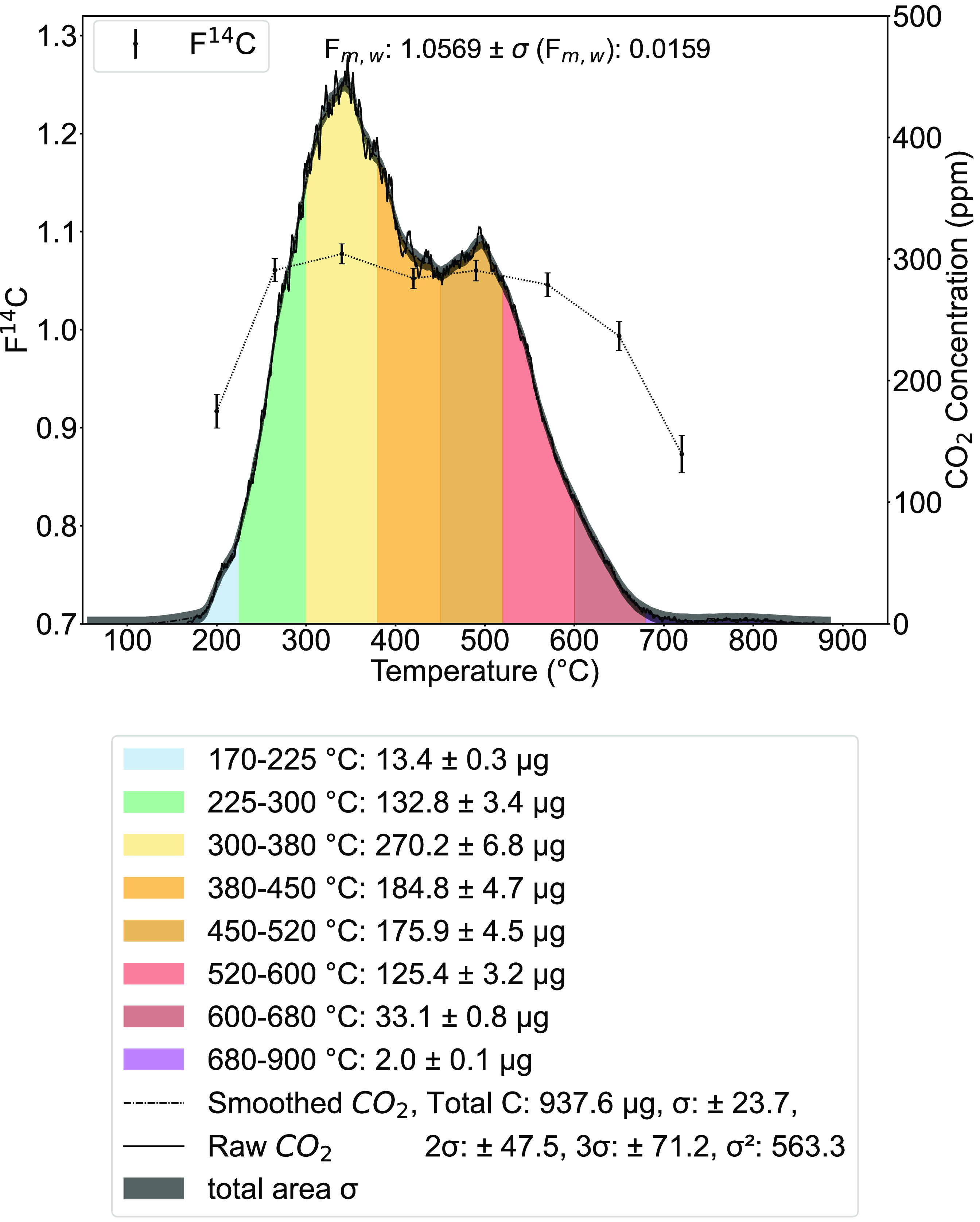
For the Swiss Standard Soil, we expected thermally labile organic material, thus a thermogram displaying peak CO2 at relatively low temperatures (c.f., ≤ 350°C; Grant et al. Reference Grant, Galy, Chadwick and Derry2019; Hemingway et al. Reference Hemingway, Hilton, Hovius, Eglinton, Haghipour, Wacker, Chen and Galy2018, Reference Hemingway, Rothman, Grant, Rosengard, Eglinton, Derry and Galy2019). Similarly to the previous test, we decarbonized and ground ∼43 mg of Swiss Standard Soil to a grain size of <0.05 mm and subjected it to ORO-DTI-AMS. Results are largely consistent with expectations, albeit with nuanced behavior. Specifically, we observe peak CO2 between 280 and 370°C, with a secondary peak between 480 and 520°C (Figure 3 and Table S1), suggesting some contribution of more thermally recalcitrant material or charring effects, as suggested by Williams et al. (Reference Williams, Rosenheim, McNichol and Masiello2014). the likelihood of charring effect is decrease by the fact that OC is oxidized rather than pyrolyzed in this set up. Furthermore, F14C values showed a decreasing trend with increasing temperature, with the exception of the first thermal fraction (0.9168 ± 0.0172; Figure 3). This deviation from predicted F14C values is thus apparent only in thermal fractions with low carbon content (i.e., < 65 μg C). Furthermore, for this fraction, the beam currents were below 5 μA and the beam time was under 10 min. Additionally, contamination might have occurred due to the AMS capillary not being thoroughly cleaned after the previous run with carbon-dead material. Nevertheless, the calculated ${F_{m,w}}$
(=1.0569 ± 0.0159; Eq. 3) is with in margin of error to the expected bulk F14C value for this sample (two-tailed t test, p < 0.05). In summary, the discrepancy from the anticipated F14C values is predominantly noticeable in the initial low temperature thermal fractions of both Black Shale and Swiss Standard Soils, specifically those with a low carbon content (i.e., < 65 μg C).
${F_{m,w}}$
(=1.0569 ± 0.0159; Eq. 3) is with in margin of error to the expected bulk F14C value for this sample (two-tailed t test, p < 0.05). In summary, the discrepancy from the anticipated F14C values is predominantly noticeable in the initial low temperature thermal fractions of both Black Shale and Swiss Standard Soils, specifically those with a low carbon content (i.e., < 65 μg C).
Swiss Standard soil thermogram showing F14C and CO2 concentration against temperature. Colors display carbon mass released at different temperature intervals. Both F14C and carbon mass are shown with their respective uncertainties. The measured ${F_{m,w}}$
value of 1.0569±0.0159 is in good agreement with an expected modern bulk F14C value.
${F_{m,w}}$
value of 1.0569±0.0159 is in good agreement with an expected modern bulk F14C value.
Based on our preliminary assessment, an internal blank is conservatively described by an F14C value ranging from 0.5696 ± 0.0112 to 0.8730 ± 0.0190. These values represent the highest observed for any thermal fraction in our 14C-free black shale and the lowest observed for any thermal fraction in our modern Swiss Standard Soil, respectively. The blank must fall within this range because it needs to adjust both the blank and the modern standard to these intermediate F14C levels. We chose to determine the blank masses for each thermal fraction solely from the black shale. This choice was grounded in the assumption that the “true” F14C of this sample should remain constant and equal to zero over temperature. In contrast, the Swiss standard soil may exhibit more F14C variability over temperature given that it represents a complex mixture of compounds of varying ages. We thus calculated thermal fraction-specific blank masses from measured black shale results as a simple two-end member mixing with sample F14C = 0 and blank F14C = 0.6–0.9 (Supplementary Material Table S2). Calculated blank mass is smallest at low- and high-temperature extremes (i.e., 1.3–2.0 μg and 0.3–0.5 μg for the lowest and highest thermal fractions with low carbon content (below 65 and down to 2 μg of C content) and increases to 10.5–16.1 μg for the 300 to 381°C thermal fraction (Supplementary Material Table S2). This trend implies that blank contamination is largely the result of compounds combusting in the mid temperature range. After conducting a blank test where we didn’t combust anything, there was no evident output, giving no additional information about the source of the contamination in the mid-temperature combustion.
Nevertheless, despite smaller absolute blank mass, extreme low- and high-temperature fractions are most susceptible to blank contamination given the similarly small mass of sample that combusts over these temperature windows.
In general, F14C uncertainties on thermal fractions with small carbon masses could be reduced with a more stable AMS ion current, i.e., by timing DTI toggling to yield relatively constant carbon masses in each thermal fraction, rather than at predetermined temperatures as is current practice. Additionally, initial thermal fractions (i.e. at low temperature) appear to be impacted by carry-over processes, as indicated by F14C deviations from expected values (i.e., higher and lower than expected for black shale and Swiss standard soil, respectively).
In contrast, final thermal fractions appear to deviate from expectations when insufficient carbon (from 2 to 65 μg of C content per fraction) is collected to generate high enough currents for a duration of 10 min. Further testing with both natural reference samples will be necessary to validate these findings. Both issues—i.e., modern contamination and F14C uncertainties on thermal fractions with small carbon masses—appear more accentuated in the black shale reference sample, a material of geological age (i.e., that should contain no measurable 14C), compared to contemporary samples. To enhance the reliability of 14C determination, we need to minimize the modern contamination and the cross contamination (i.e., memory effect) between samples. This can be achieved by optimizing the DTI timing (i.e., flushing routine) and achieve consistent carbon masses in each fraction thereby avoid possible memory effect (i.e., < 1%).
3.2.3. Intercomparisons of natural samples
Finally, we compared our results to those from another well-characterized RO instrument using a Nantucket mud patch sediment (1.2∼1.4% OC; F14C = 0.8324 ± 0.0020, acid fumigated; Bao et al. Reference Bao, McNichol, Hemingway, Lardie Gaylord and Eglinton2019) that is frequently analyzed at the National Ocean Sciences Accelerator Mass Spectrometry facility (NOSAMS; Woods Hole, USA; Bao et al. Reference Bao, McNichol, Hemingway, Lardie Gaylord and Eglinton2019; Hanke et al. Reference Hanke, Gagnon, Reddy, Lardie Gaylord, Cruz, Galy, Hansman and Kurz2023). We analyzed this sample both with and without acid fumigation (Supplementary Material Figures S2–S7) to also assess the impact of carbonate removal on ORO results.
Using a sample mass of 42 to 45 mg both with and without acid treatment, we observed a prominent peak at ∼300°C, consistent with previous studies. Furthermore, for the fumigated aliquot, less than 1% of total carbon mass oxidized between 600 and 900°C. In contrast, between 5 to 10% of total carbon mass oxidized within this temperature range for the untreated sample. We thus assume that the removal of carbonates, which decompose at ∼600°C, during the acid treatment resulted in a less pronounced “tail” at these elevated temperatures, consistent with our expectations and previous findings (Bao et al. Reference Bao, McNichol, Hemingway, Lardie Gaylord and Eglinton2019). Additionally, when subjecting an acid-treated Nantucket mud patch sample to combustion in our setup, we calculate an average OC content of 1.3% (Eq. 1), in agreement with the existing literature.
However, thermograms of fumigated aliquots of this sample reported in the literature also display a pronounced shoulder at ∼500°C (Bao et al. Reference Bao, McNichol, Hemingway, Lardie Gaylord and Eglinton2019; Hanke et al. Reference Hanke, Gagnon, Reddy, Lardie Gaylord, Cruz, Galy, Hansman and Kurz2023), which we initially did not observe as pronounced here. To explore the potential causes of this discrepancy, we performed three additional tests by varying: (i) heat gradient, (ii) O2 flow rate, and (iii) sample mass. These tests were respectively chosen to independently assess the impact of potential “cold spots” within the sample, oxidant availability, and thermal inertia.
First, we enhanced heat-gradient homogeneity by introducing a cut-to-size molybdenum foil (∼45 mm length, ∼25 mm width and 0.1 mm thickness) into the ramping furnace (Figure 1B-a).
This metal was chosen for its physical properties, specifically its high melting point (> 2 623°C) and good thermal conductivity (139 W⋅m−1⋅K−1, NIST). Unlike alternative materials that may excel in either high thermal conductivity (e.g., Silver) or high melting point (e.g. iron, cupper oxides), this metal offers a well-balanced combination of both attributes. Resulting thermograms for non-fumigated sample material did not show any qualitative difference with and without molybdenum foil, although the foil addition appeared to dampen thermogram noise (Supplementary Material Figure S3A). The molybdenum foil acts as a seal when wrapped around the quartz tube, which helps to reduce internal thermal fluctuations and to homogenize the heat distribution at elevated temperature. We conducted measurements at both the top and bottom of the ramping furnace (i.e., the one holding the sample) confirming even heat distribution throughout. Resulting F14C measurements for fumigated samples both with and without molybdenum foil were statistically identical (two tailed t-test, p > 0.05).
Second, we adjusted the O2 flow rate to align with that utilized in the operation of the NOSAMS RO instrument; specifically, that instrument uses an O2 concentration of approximately 8% at a total flow rate of 35 mL min–1 (Bao et al. Reference Bao, McNichol, Hemingway, Lardie Gaylord and Eglinton2019; Hanke et al. Reference Hanke, Gagnon, Reddy, Lardie Gaylord, Cruz, Galy, Hansman and Kurz2023). To mimic the NOSAMS conditions, we adjusted our gas mixture flow rate to achieve 2.8 mL min–1 (i.e., ∼15 mL min–1 total flow of ∼18% O2 in He; equivalent to ∼35 mL min–1 of 8% O2 in He used at NOSAMS). As for the molybdenum foil test, resulting thermograms (here using untreated samples, Figure S3) are statistically identical for both O2 flow rates tested here. This result implies that O2 availability is not a limiting factor for the sample’s combustion, and the setup generates consistent thermograms, even with variations in flow using our gas mixture. F14C values were not measured in this test because only untreated samples (i.e. containing some 14C-free carbonates) were used.
Finally, we adjusted sample mass to 22.8 mg (i.e., ∼50% of initial analysis; fumigated). Unlike for previous tests, this condition yielded a pronounced second CO2 peak at ∼500°C as reported for the NOSAMS RO instrument (Supplementary Material Figure S7; Bao et al. Reference Bao, McNichol, Hemingway, Lardie Gaylord and Eglinton2019; Hanke et al. Reference Hanke, Gagnon, Reddy, Lardie Gaylord, Cruz, Galy, Hansman and Kurz2023). This result suggests that similar to the RO of NOSAMS, our setup can generate a thermogram with a peak at ∼300°C and a second prominent shoulder at ∼500°C, by adjusting sample mass. The measured F14C values (from the sample mass 22.8 mg) are consistent within the margin of error to our previous measurements. Furthermore, the sample size and the respective thermal fraction aliquot for F14C generated a comparable mass-weighted average F14C to the previous measurements.
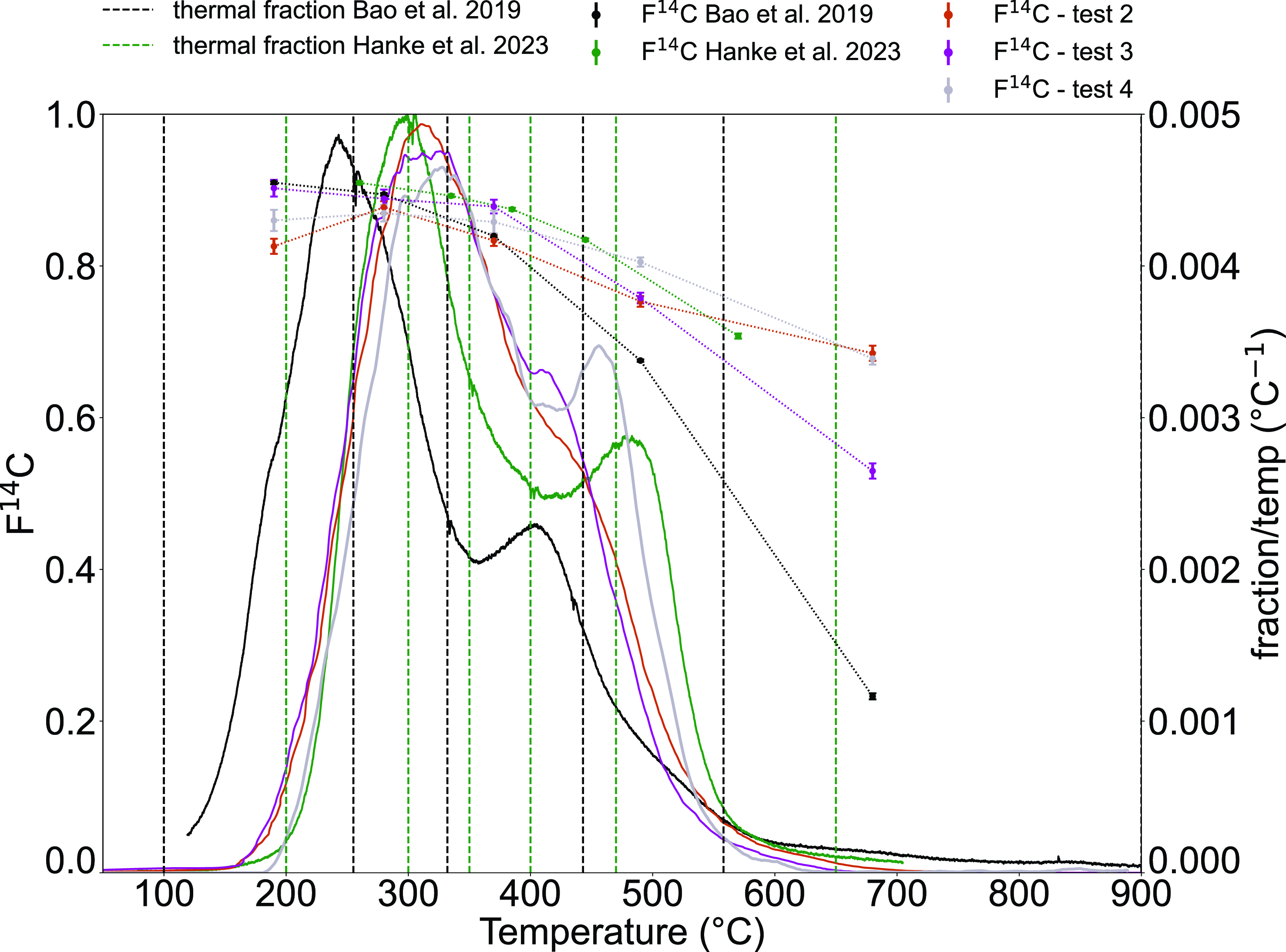
For all tests and both pretreatment scenarios (i.e., with or without fumigation), we observe a consistent decrease in F14C with increasing temperature (Figure 4 and Table S1). In the first thermal window, F14C value for all tests (n = 3) averaged 0.8628 ± 0.0113; this decreased to 0.6099 ± 0.0093 in the last thermal window. For two out of the three sample runs, the initial thermal windows displayed a F14C range of 0.8259 ± 0.0100 to 0.8600 ± 0.0140. In contrast, the second thermal window showed a F14C range from 0.8773 ± 0.0080 to 0.8696 ± 0.0110. Despite internal variations, the ${F_{m,w}}$
values between different tests were statistically identical (two tailed t-test, p>0.05), ranging from 0.8306 ± 0.0194 to 0.8620 ± 0.0195. This demonstrates that our instrument yields robust F14C values and indicates its potential for successful application in future experiments. As reported in Sec. 3.2.2 we noticed a discrepancy from the anticipated F14C values, where the first thermal windows had a lower F14C compared to the second thermal windows. As expected, F14C values are more susceptible to contamination of the setup when there is a low carbon content in the initial thermal windows.
${F_{m,w}}$
values between different tests were statistically identical (two tailed t-test, p>0.05), ranging from 0.8306 ± 0.0194 to 0.8620 ± 0.0195. This demonstrates that our instrument yields robust F14C values and indicates its potential for successful application in future experiments. As reported in Sec. 3.2.2 we noticed a discrepancy from the anticipated F14C values, where the first thermal windows had a lower F14C compared to the second thermal windows. As expected, F14C values are more susceptible to contamination of the setup when there is a low carbon content in the initial thermal windows.
Comparison of acidified Nantucket mud patch sediment combusted F14C in ORO-DTI-AMS set up with those in the study of Bao et al. (Reference Bao, McNichol, Hemingway, Lardie Gaylord and Eglinton2019) and Hanke et al. (Reference Hanke, Gagnon, Reddy, Lardie Gaylord, Cruz, Galy, Hansman and Kurz2023). Four runs of treated Nantucket mud patch were combusted and three of them were measured (NNS—test 2 orange, 3 violet, 4 gray). The vertical black dotted line are the thermal windows used in Bao et al. (Reference Bao, McNichol, Hemingway, Lardie Gaylord and Eglinton2019) and our runs. In green are marked the thermal windows Hanke et al. (Reference Hanke, Gagnon, Reddy, Lardie Gaylord, Cruz, Galy, Hansman and Kurz2023). There is an overall trend of F14C decreasing over temperature. While our set up shows consistency with the results of Hanke et al. (Reference Hanke, Gagnon, Reddy, Lardie Gaylord, Cruz, Galy, Hansman and Kurz2023), the thermogram from Bao et al. (Reference Bao, McNichol, Hemingway, Lardie Gaylord and Eglinton2019) appears to be a stronger spreading in the higher thermal windows.
4. Conclusion
We describe a new ORO-DTI-AMS instrument for online serial thermal oxidation and radiocarbon analysis of complex natural matrices. Our instrumental setup presents distinct advantages over previous designs, particularly by enabling real-time 14C analysis and eliminating the need for offline processing of the evolved CO2. This enables comprehensive sample analysis, encompassing up to 9 discrete thermal fractions and 14C measurements, all within an approximate timeframe of 3.5 hr, without the need for cryo-trapping or graphitization procedures.
We validated our setup with several tests, including (i) direct CO2 injections of modern/ 14C-dead gas to assess blank contributions, (ii) analysis of two in-house standards to assess reproducibility, and (iii) analysis of one reference sediment sample for intercomparison of accuracy and precision between different instruments. Test results demonstrate that the use of zeolite sieves for CO2 collection and release exhibits no significant impact on 14C values. Furthermore, in-house standard measurements display a high degree of internal reproducibility regardless of thermal gradient or oxidant availability. However, thermogram profiles appear sensitive to loaded sample mass—particularly when resolving high-temperature (i.e., ≥ 500°C) peaks—indicating the importance of thermal inertia in our instrument, which we aim to improve with replicate samples. Nevertheless, our preliminary instrumental setup presents a novel and flexible approach to investigate radiocarbon characteristics of thermal fractions in natural samples.
Supplementary material
To view supplementary material for this article, please visit https://doi.org/10.1017/RDC.2025.6
Acknowledgments
We would like to express our sincere gratitude to the following individuals and institutions for their invaluable contributions to this project: Arno Synal and Valier Galy for initiating discussions about the method, Phillipe Vogel from D-PHYS for his instrumental work in designing the ORO system, and Phillip Gautschi, also from D-PHYS, for providing the zeolite sieves. We acknowledge funding by the Swiss National Science Foundation (SNF) (grant number 200021-204093 to L.B.). We also wish to acknowledge the facilities at ETH for providing the necessary resources and infrastructure to carry out this research. Finally, we express our gratitude to NOSAMS facility, with special thanks to Mary Lardie Gaylord, for providing reference samples and sharing data. Additionally, we extend our sincere appreciation to Prof. Dr. Rui Bao (Ocean University of China) for sharing valuable unpublished data. We thank the associate editor, Pieter Grootes, and two anonymous reviewers for their comments that greatly improved this manuscript.
Author contributions
The project was conceived by Lisa Bröder, Jordon D. Hemingway, Lukas Wacker, Timothy I. Eglinton, and Negar Haghipour. Marco A. Bolandini, Daniele De Maria, and Lukas Wacker developed instrumental the setup. Marco A. Bolandini conducted the measurements under the guidance of Daniele De Maria and Negar Haghipour. Both Marco A. Bolandini and Negar Haghipour performed the sample preparation. The results were interpreted by Marco A. Bolandini, Negar Haghipour, Jordon D. Hemingway, Daniele De Maria, and Lukas Wacker. Marco A. Bolandini took the lead in writing the manuscript, with all authors providing critical feedback to the research, analysis, and manuscript.


 Open access

