


The Cyprus Issue in Its Historical Perspective: Setting the Scene for Understanding Sociogenetic Processes
Cyprus history is often depicted as a long succession of different rulers: Assyrian, Persian, Alexander the Great, Ptolemy of Egypt, Roman, Byzantines, Arabs, Crusaders, Lusignans, Venetians. In 1571, Cyprus became part of the Ottoman Empire until it changed hands when administration was ceded to the British in 1878. After the First World War the British officially annexed Cyprus to the British Empire. According to the Official Census of Population of 1946 during the British colonial period, Greek Cypriots (henceforth GCs) comprised 80% of the population and Turkish Cypriots (henceforth TCs) 18%. An interesting observation about censuses is the changing identification of the two communities of Cyprus. In the 1931 census the term Christian and Moslem was used to describe the communities; in 1946 it was turned to Greek Orthodox and Moslem (Turkish); and after the independence of 1960 it was just Greeks and Turks, pointing to the changing and socially constructed nature of national identification. The TCs were living in minority numbers in the towns, in 105 purely Turkish Cypriot villages and in many mixed villages peacefully together with GCs for hundreds of years until the ethno-nationalist projects of the 19th and 20th centuries of Greece and then Turkey were imported to Cyprus and caused the first intercommunal frictions, initially during the Ottoman period and more recently – and more pertinent to our discussion – in 1957 and 1958. This was during the 1955–1959 anti-colonial struggle of GCs organised by EOKAFootnote 1 for liberation from the British and union with Greece, and the corresponding nationalist struggle of the leadership of TCs organised by TMTFootnote 2 for ‘taksim’, or the partition of Cyprus into two parts, one Greek and one Turkish (Attalides, Reference Attalides1979).
In 1960, the Republic of Cyprus was established as an independent bicommunal partnership state under a consociational constitution (a form of democratic power sharing between the two communities). Such a constitution was then seen by both communities as a temporary solution and the first step towards ‘enosis’ (union with Greece) for GCs and ‘taksim’ (partition of the island) for TCs. The GCs’ sentiment was that the constitutional community rights accorded to the Turkish community, that was seen as a minority, were unfair and that they should only be guaranteed minority rights in the Republic of Cyprus; the Turkish Cypriots claimed that these were the just rights of a co-founding community. Soon, particular provisions relating to taxes and the autonomy of municipalities brought frictions between the two communities and a gridlock in the normal functioning of the state (Markides, Reference Markides1977). In December 1963, intercommunal conflict erupted after the President of the Republic of Cyprus, Archbishop Makarios, proposed constitutional amendments to improve the functionality of the Cypriot state, that were perceived by the TC leadership as a move that removed almost all their rightful claims as co-founders of the Republic, and that was aiming at downgrading their community to the status of a minority. The armed conflicts that ensued led to the withdrawal of TC ministers from the Cabinet.
The fighting between extremists from both sides lasted throughout 1963 and 1964. TCs began retreating from isolated rural areas and villages into enclaves. After 1967, intercommunal strife ceased and Makarios started to turn away from union with Greece towards a more independent policy resisting the dictates of the Greek military junta that came to power in 1967 in Athens.
In 1974, a coup was staged by the Greek junta with the help of a local ultra-nationalist group called EOKA B, which continued its struggle for union of Cyprus with Greece against President Makarios. This was followed by a Turkish military offensive that was allegedly conducted to restore the constitutional order but actually resulted in ethnic cleansing of the northern part of Cyprus to materialise taksim (partition). As a result, 160,000 GCs living in northern Cyprus – now occupied by the Turkish military forces – were forced to flee south, and 45,000 TCs moved north to settle on land constituting 37% of island’s total area, thus drastically changing the mixed demographic landscape that existed in 1960 (see Figure 4.1).
Demographic composition of Cyprus in 1960.
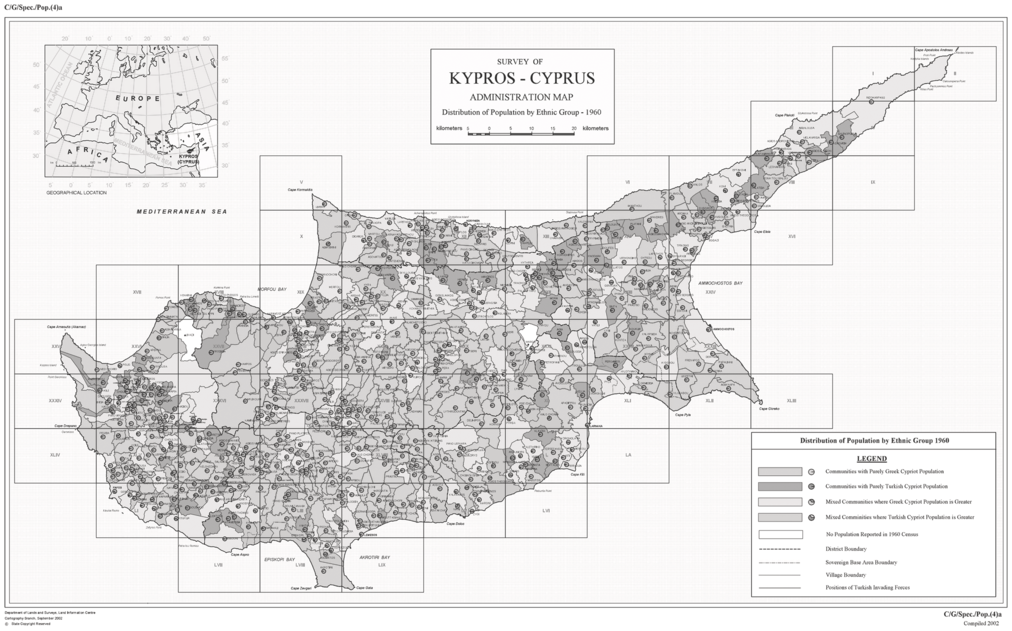
Figure 4.1 Long description
The administrative map of Cyprus from 1960 depicts the ethnic distribution of populations across the island, with different community types. The legend specifies various community classifications, purely Greek Cypriot, purely Turkish Cypriot, mixed communities where Greek Cypriots are the majority, mixed communities where Turkish Cypriots are the majority, and areas with no population recorded in the 1960 census.
The intercommunal conflict of 1963–1964 and the war of 1974 impacted the lives of many people in Cyprus in both direct and indirect ways, as shown in Table 4.1. The data come from a large-scale bicommunal representative survey conducted in 2007 (Psaltis, Reference Psaltis, Marková and Gillespie2012), but of course it is expected that with passing time the percentage of people with direct experience of the conflict will become progressively smaller.
The two communities became geographically completely segregated in 1974. In 1983, the TC leadership established a breakaway state in the northern part of Cyprus internationally recognised only by Turkey. UN resolutions condemned the establishment as an illegal act, and the European Court of Human Rights in 1998 has described the self-styled ‘Turkish Republic of Northern Cyprus’ as ‘a subordinate local administration of Turkey operating in Cyprus’.
The status quo on the island today is that of division, with UN forces patrolling the buffer zone between the two communities. On 23 April 2003, the TC leader announced that he would unilaterally partially lift the travel restrictions that had been enforced since the Turkish intervention/invasion of 1974,Footnote 3 and which had prevented GCs from crossing into the northern part of Cyprus and TCs from crossing into the south. From 2003 to 2020 more checkpoints have been opened, totalling nine by 2024.
In April 2004, one year after the first opening of checkpoints, GCs rejected a UN-sponsored plan (Annan Plan) to reunite Cyprus under a Bizonal Bicommunal Federation (BBF) by 76% whilst Turkish Cypriots accepted it with 65%. Later that year Cyprus as a whole joined the EU, but the acquis communautaire was suspended in the north pending a solution of the Cyprus problem. After the failed UN effort in 2004, negotiations stalled for a few years, and with the election of new leadership in the GC community in 2008 (leftist Demetris Christofias), full-fledged negotiations restarted. After some progress was made, they stalled again in 2010 with the election of a nationalist leader Derviş Eroğlu in the TC community (see Figure 4.2 for a timeline of negotiations). In 2013, the presidential elections in the GC community brought to power Nicos Anastasiades who, as the leader of a right-wing party (DISY), took the risk back in 2003 to support a Yes vote on the Annan Plan under a generally negative climate for solution in the GC community engineered by the late Tassos Papadopoulos. However, little progress was achieved until 2015 when the TCs returned to the negotiating table as their leader a pro-reconciliation veteran politician Mustafa Akinci, which gave a new impetus to the negotiations, with significant progress made in the 2015–2017 period to reach a comprehensive settlement on the basis of a BBF. The two teams of negotiators led by Anastasiades and Akinci discussed the issues of (1) governance and power sharing, (2) property, (3) territory, (4) economic affairs, (5) European Union affairs and (6) security and guarantees.
A timeline of negotiations on the Cyprus problem.
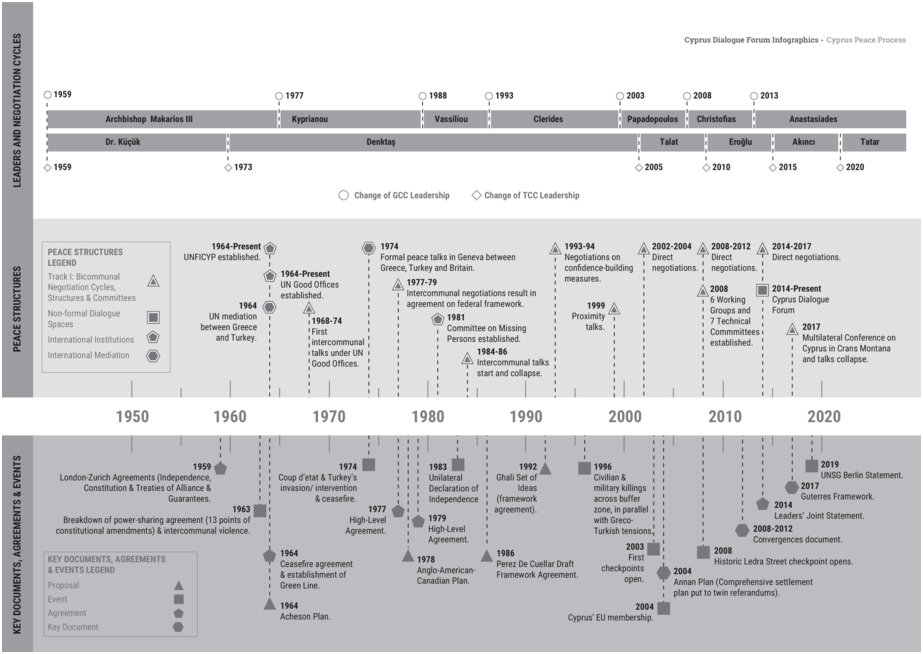
Figure 4.2 Long description
The infographic is divided into three main sections. The section titled Leaders and Negotiation Cycles lists leaders from both the Greek Cypriot and Turkish Cypriot communities, with transitions in leadership and negotiation periods. The section titled Peace Structures provides a legend describing various mediation efforts, bicommunal negotiations, and the involvement of international peace institutions such as the United Nations Peacekeeping Force in Cyprus (U N F I C Y P) and the United Nations Good Offices. The section titled Key Documents, Agreements and Events categorises and chronologically places significant proposals, agreements, and diplomatic events, including the London-Zurich Agreements of 1959, the High-Level Agreement of 1977, the Annan Plan of 2004, and the Guterres Framework of 2017.
In 2017, UN Secretary-General António Guterres brought all interested parties and Guarantor countries (Turkey, Greece and the United Kingdom) into a summit at Crans Montana, Switzerland. There he proposed the so-called Guterres package as a give-and-take peace plan that would essentially give political equality to TCs, end Turkish military occupation and replace the security provisions of the three Guarantor powers with an implementation agreement.
In June 2017, the effort came to its climax in a summit of the two communities, Greece, Turkey and the UK as the guarantor powers, and an EU representative taking part in the negotiations to ensure that any solution would be in line with the European aqui. The Conference on Cyprus in Crans Montana was widely seen as the closest the parties involved in the Cyprus issue had ever come to reaching a settlement. After a week of intensive negotiations, however, in the early morning of 7 July, Secretary-General Guterres announced to reporters that, despite considerable efforts, the Conference was closing without an agreement. Soon after that Guterres called on all parties to take time off to reflect and asked the leaders of the two communities to jointly agree on terms of reference for negotiations to resume.
The period of no negotiations continues until today, however; in the meantime, a negative development emerged which is the claim by Turkey and the new TC leadership of Ersin Tatar, elected in 2020, that they have changed policy and now support the right for TCs to a ‘sovereign equality’, which for GCs is tantamount to claiming a two-state solution instead of a BBF and is considered a non-starter for negotiations.
A detailed chronology of change of leadership in the two communities and milestones in the negotiations can be seen in Figure 4.2, as produced by the Cyprus Dialogue Forum.Footnote 4
The Ontogenesis of Social Representations of the Cyprus Issue as Significant Structures
Given the multifaced nature of the Cyprus problem, representations of the Cyprus issue relate to all dimensions of the problem, such as property, territory, power sharing, representations of the other community of Cyprus and involved countries, representations of the past and so forth. However, if one wants to understand the core of the representation in each community, then the best way to approach this is to study the educational processes in the two communities that produce new political subjectivities in relation to the problem.
In Cyprus, where two communities with distinct linguistic and religious backgrounds are geographically divided across ethnic lines for almost half a century, different social representations have evolved in each community, especially regarding the Cyprus problem and its history. Such narratives are politically manipulated by various political elites and centrally controlled by the administrations for the corresponding ‘national collective struggles’ in each community. The systematic use of rituals, national symbols (see Psaltis, Beydola, Filippou & Vrachimis, Reference Psaltis, Beydola, Filippou, Vrachimis, Dezalia and Moeshcberger2014), memorials, commemorations, national struggle museums (Makriyianni, Reference Makriyianni2006) and politically driven manipulation of the media (Avraamidou & Psaltis, Reference Avraamidou and Psaltis2019) and the educational system all contributed to the creation of different social representations of the past. The teaching of history in public schools reflected a specific official master narrative in both communities (Makriyianni, Reference Makriyianni2006; Makriyianni, Psaltis & Latif, Reference Makriyianni, Psaltis, Latif, Erdmann and Hasberg2011; Papadakis, Reference Papadakis2008; Psaltis, 2012a) that largely contributes, as we will show below, to prejudice and distrust towards members of the other community when uncritically internalised by the individual.
According to Papadakis (Reference Papadakis2008), the central nationalistic historical narrative in the GC textbooks is one that begins with the arrival of the Greeks (14th century BC) in Cyprus that leads to its Hellenization, where the moral centre are the Greeks (of Cyprus) and the major enemy are the Turks. The plot concerns a struggle for survival by Cypriot Hellenism against foreign conquerors and the tragic end is the ‘barbaric Turkish invasion’ and occupation of 37% of Cyprus.
The corresponding TC narrative is one that begins with the arrival of the Turks in Cyprus (in 1571 AD), the moral self are the Turks (of Cyprus) and the major enemy are the Rums (GCs).Footnote 5 The plot concerns a struggle for survival by the Turks of Cyprus against GC domination. The war of 1974 marks a happy ending with the ‘happy peace operation’ by Turkey in Cyprus which saved TCs from a pending union of Cyprus with Greece following the Greek military coup.
Such official narratives clearly promote a particular form of collective remembering of victimisation by others (Psaltis, Reference Psaltis2016). Adherence to the official narratives is not only predictive of threats (of both a realistic and symbolic form and of group esteem threat), but through these threats prejudice is increased and further distrust is created between the two communities in Cyprus. This is eventually reflected in reduced wish to co-exist with the other community in the future (Psaltis et al. Reference Psaltis, Franc, Smeekes, Ioannou, Žeželj, Psaltis, Carretero and Čehajić-Clancy2017). The ontogenesis of the social representation of the Cyprus issue for GCs is mostly a process of internalising a feeling of one-sided victimisation which is formed quite early on. This can be mostly attributed to the educational policy of ‘I do not forget and I struggle’ (Den xechno kai agonizomai). This finding is of crucial political importance, since it reveals that the educational system in the GC community despite its proclaimed aim of reunification of Cyprus was producing dynamics that undermine the spirit of reconciliation and reunification.
This policy in the case of the GCs emerged a few years after the mass displacements of 1974. It did not happen immediately after, since in the first months after the Turkish invasion internally displaced persons believed that they would soon return to their properties with a swift solution of the problem. However, after a few years they realized that this might take much longer. There was also a public discussion about the need for a long-term struggle (makrochronios) and the attempt to cultivate a sense of unity and patience to achieve the goal of everybody returning to their properties.
A primary objective of the GC educational system since 1974 has been to educate the new generation of GCs about the part of the island that is occupied by Turkey (Christou, Reference Christou2006) and instil the desire for a reunification of the island. A major challenge for the GC educational system since 1974 has been to impart the values of ‘humanism, justice, freedom and democracy’ while remaining faithful to the ‘preservation of our national and cultural identity’ (Christou, Reference Christou2006). The aims can be clearly seen in a policy brief sent to the educators by the Ministry of Education in 1994 that stated as the aims of ‘I know, I do not forget and I struggle’ the following:
1. To help students learn about the occupied places, to keep the memory of the occupied places alive and to cultivate the hope and will to struggle for the return;
2. To help students know and understand human rights as they have been recognised by international organisations and to work towards their implementation in Cyprus; and
3. To help students appreciate and respect all the elements (tradition, customs, manners, merits) that promoted the ethnic and physical survival of GCs and to participate in the struggle against the dangers faced by their country.
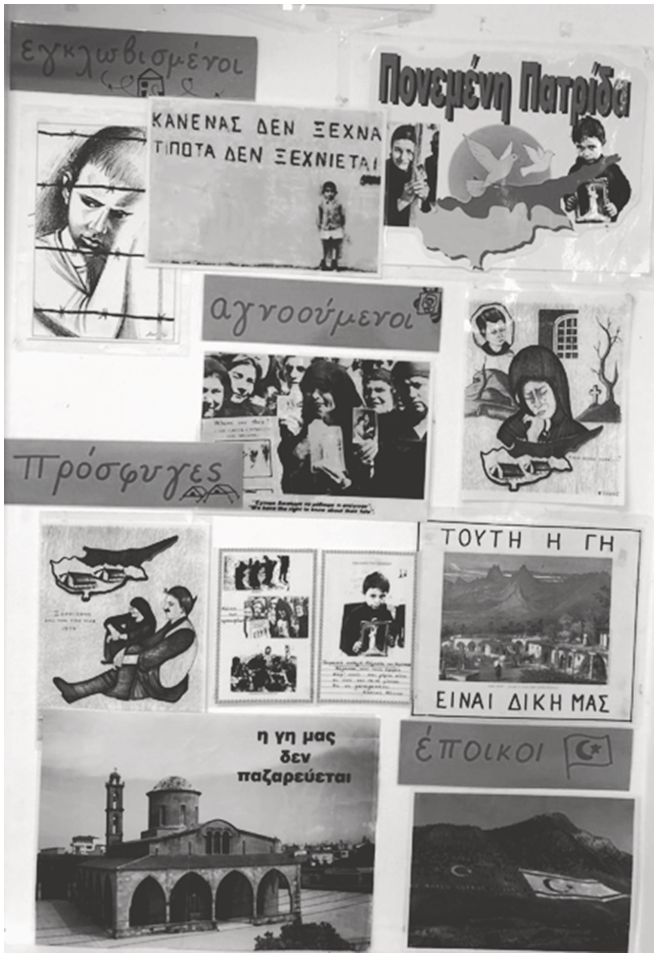
Figure 4.3 shows a billboard at an elementary school exhibiting the artefacts relating to Den Xechno (‘Do not forget’).
Artefacts relating to Den Xechno on a billboard at an elementary school (retrieved from https://episkopiprimaryschool-denksexno.blogspot.com/p/blog-page_20.html).
This policy has been criticised by academics in Cyprus, who see a number of problems in its rationale. According to Christou (Reference Christou2006), soon after 1974, the Ministry of Education, with curricular changes, directed teachers to incorporate in their courses references to the events of 1974, the plight of GC refugees and the importance of remembering the part of Cyprus that was occupied by Turkey. This is how Christou (Reference Christou2006) described the activities around the policy:
At the elementary school level, three books aid teachers in creating lesson plans on these themes and integrating them in courses such as Greek language, history, geography, music, and the visual arts. The books are filled with pictures, personal stories and poems about life in the occupied part of the island before 1974 and the refugees’ experience of displacement. Though less regularly, such references continue up to the level of the gymnasium and the lyceum. In general, however, everyday life in Greek Cypriot schools is infused with commemorations of 1974, and all school celebrations (at the primary and secondary levels) include direct references to the Cyprus Problem.
Whilst this bombardment of students with a one-sided victimisation narrative and ‘overdetermination of meaning’ is present from the genetic social psychology point of view, it should not be assumed that all children will passively internalise this master narrative in the same way. Still, as we show below, the template of victimisation that is formed in the elementary school years is present in almost all children, and variations of internalisation are premised on the same template (Wertsch, Reference Wertsch2008, Reference Wertsch2021) and potent enough to undermine any positive developments in the progression of historical thinking.
One early research by Chara Makriyianni (Reference Makriyianni2006) shed light on this question when GC elementary school students aged 9–10 were asked to write a short ‘history’ of their homeland in 2002–2003. To put their narratives into a time perspective one has to be reminded that this point in time is already almost 30 years after the events of 1974; the parents of these children were probably in their early 40s or younger, so about one-third of these parents would have been personally displaced (first-generation internally displaced persons) at the age of 10 (see Makriyianni, Reference Makriyianni2006, p. 240 for more details). One child wrote the following:
My homeland is Cyprus. Cyprus is 8000 years old. Its capital is Nicosia. The mother homeland is Greece and we are Greek-Cypriots. In 1974 there was an invasion by the Turks and we were conquered. Some people are now refugees and they long for their villages.
A shorter narrative written by a boy with no reference to Greece read like this:
My homeland is Cyprus. Various people came and conquered us. The last enemies were the Turks. They made war against us and took half of Cyprus.
If we compare the two narratives, we can see one of the main internal ideological tensions in the GC community relating to identity politics. It is the tension between a hellenocentric and cypriocentric position (Mavratsas, Reference Mavratsas1999). The first sees Cyprus as part of Greece whilst the second suggests a more localised sense of moral centre and national identity. However, both at their core share an asymmetrical structure of small and helpless Cyprus as the unprovoked victim of a mighty and expansionist Turkey.Footnote 6
Below are some more excerpts given by Makriyianni (Reference Makriyianni2006) in her PhD thesis exploring the representations of 9–10-year-old GC students born in the 1991–1992 cohort, with data collected in 2002. These accounts are very telling for how this birth cohort constructed meaning of the Cyprus issue at a time when developmentally they start having the capacity for a more expansive horizon that could include out-groups into a more universalising morality.
The representations of the history of Cyprus extracted from these short histories reflect both messages from Den Xehno policy and indirect personal experience of internal displacement objectified in short narratives that make use of narration as traditional or exemplary types in Rusen’s terms that serve memory functions of a projected future of a ‘free Cyprus’ but devoid of any mention of TCs and their presence in Cyprus:
My homeland is Cyprus. In Cyprus the war between England and Cyprus took place, the Turkish invasion and now we are enslaved by the Turks. Many soldiers were killed; there were orphans, missing people, refugees, and enslaved people. I love my country very much. (Boy from urban school, Date: 10/11/2002)
My homeland is Cyprus. I was born and have lived here for nine years. Cyprus has made loads of wars. Even today is enslaved. Turks do not allow us to go to the other half. My country is a small island. I love her a lot and I do not want to live in any other country. (Girl from urban school, no. 146, Date: 10/11/2003).
My homeland was enslaved by the Turks because Turks came and took away from us our prettiest cities, we made a lot of war and thus we were enslaved. The war, when the Turks came, it was horrific because they took our mother from her house and forced her to leave Morfou with only the clothes she wore. (Girl from urban school, no. 512, Date: 8/3/2004)
My homeland is Skylloura, I think it’s there. It is wonderful, especially in the old times before Turks destroy it in 1974. Skylloura is one of the best villages of Cyprus. (Boy from urban school, no. 132, Date: 10/11/2002)
My homeland is Cyprus and many years ago the Turks came and made war on us. In the end they won and now they have seized almost half of Cyprus. We fought with all our efforts for our country. We were very brave and courageous. I was very sad when they took Cyprus. I used to remember some of the soldiers of Cyprus but now I have forgotten about them.
Around the same period (before the opening of the checkpoints in 2003) a study by Christou (Reference Christou2006) asked 15–18-year-old high school GC students to discuss what they make out of the Den Xechno slogan. Christou (Reference Christou2006) also notes how ideology can operate under a ‘hidden curriculum’, with the tacit ways in which knowledge and behaviour are constructed, outside the usual course materials and formally scheduled lessons. Christou rightly identifies a major weakness of the way the Den Xechno policy operates: ‘The re-united and independent Cyprus is the professed goal, but, as I am arguing here, this goal, for the new generation, represents an official though largely empty imagination. Young Greek Cypriots reiterate “our desire to go back to our homes,” but this is where their imagining of the future stops: the vision of re-united communities, which is crucial for a peaceful solution, does not exist’ (p. 299). She concludes, ‘The political subjectivity of the new generation of Greek Cypriots is constituted through a historical definition of struggle that oscillates between armed resistance and the silent persistence of memory.’
To sum up, the core of the significant structure of social representations is formed quite early in childhood. This can be described as an asymmetrical triadic configuration of loss of control and one-sided victimisation as shown in Figure 4.4. The shorter the distance in the other–object relationship, the stronger is control of the object by other. Such a configuration of loss of control of property depicted in Figure 4.4 in the case of the Cyprus issue is naturally – and expectedly – resisted by GCs, causing anger and resentment for the Turkish army, Turkey and the Turks.
A triadic configuration of loss of control.
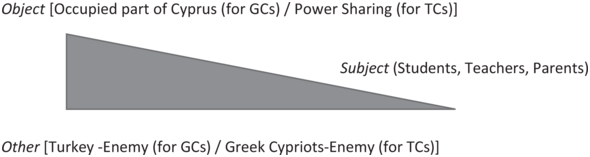
Figure 4.4 Long description
The diagram is structured into three categories. Object, Other, and Subject. It features a triangle pointing to the right, dividing these perspectives. The Object category highlights differing viewpoints: Greek Cypriots perceive the occupied part of Cyprus as their concern, while Turkish Cypriots focus on power-sharing. The Other category depicts perceptions of opposition, with Greek Cypriots viewing Turkey as an enemy and Turkish Cypriots seeing Greek Cypriots as an enemy. The Subject category includes groups involved in shaping opinions and understanding of the situation, specifically Students, Teachers, Parents.
What is most striking in the significant structure in the case of Greek Cypriots is the absence of TCs from the picture. To some extent this is due to the double minority syndrome nature of the Cyprus problem (Michael, Reference Michael2007). TCs feel like a minority in the face of the substantial GC majority on the island; GCs feel like a threatened minority in the face of mainland Turkey 40 miles from the shores of northern Cyprus.
However, the empty imagination of GCs is very problematic, as it has no place for TCs who are not actors in the history of Cyprus. The objective possibility, in Goldmann’s terms (see Chapter 1) of this representation, is exhausted into the quest for freedom for Cyprus to be achieved not by a compromise solution that will include the re-establishment of power sharing with TCs, as envisioned by the UN-supported plan since 1977 in the form of a BBF, but rather with the withdrawal of Turkish troops and the end of occupation of Cyprus. If anything becomes clear about TCs by the end of their school trajectory in public school around 17 years of age (unless they challenge this narrative) is that TCs were given too many privileges in the 1960 constitution that were unfair to the majority (GCs) and that the TCs rebelled against the legal state in 1963–1964. It thus suggests that a majoritarian unitary state that offers TCs minority rights would be all TCs could ask for. As we show in the following sections, even after a history education reform that took place in 2010 and a new curriculum written in 2016, and despite some important changes in the methodology of history teaching, the one-sided victimisation narrative remained intact with important consequences for the progression of historical thinking and orientation towards the other community.
The orientation towards otherness (the tip of the iceberg taking the form of prejudice) formed by this Den Xehno policy is clearly seen in the work of Makriyianni (Reference Makriyianni2006), where the same representative sample of the 9–10-year-old students in 2002 who offered their short historical narratives of Cyprus were also asked to state their feelings towards both TCs and Turks. The results regarding feelings towards TCs were as follows: 5% stated that they like TCs a lot, 21% stated that they like TCs, most (40%) stated they neither liked nor disliked TCs, 21% stated that they do not like TCs and 12% that they do not like them at all. So, on the whole, the dominant feeling was neutral to negative, which can be explained mostly through the absence of knowledge about TCs as a community, their history in Cyprus since 1571 as well as their rightful claims to power sharing in Cyprus as the co-founding community of the 1960 constitution.
When it came to the attitude towards the Turks, the dominant feeling was significantly different: more negative to very negative, with the majority of students (54%) stating that they do not like the Turks at all and 25% stating that they do not like them. Only 16% reported neutral feelings and 5% said that they like the Turks. Only 1% said that they liked Turks a lot, which is only expected given that Turkey and the Turks occupy the position of the enemy and the Turkish state that of a barbaric occupier in the hegemonic narrative.
In the case of TCs, the asymmetrical configuration of control would concern the loss of political equality and power sharing in 1963 accompanied by a threat of marginalisation as the weaker community by GCs who would be the main enemy ‘other’. These are the reasons much research undertaken just after the opening of the checkpoints and before contact started showing its positive effects that TCs showed higher levels of threats, prejudice and distrust towards the GCs compared to the levels of threats, prejudice and distrust experienced by GCs towards TCs (Psaltis, Reference Psaltis, Marková and Gillespie2012) (see Appendix A and Table B.1 in Appendix B for the methodology of data collection of all studies on which the data are based of trend figures in Appendices A and B).
Opening of Crossing Checkpoints in 2003: A Historical Turning Point?Footnote 7
This earlier brief historical framing of the Cyprus issue makes clear that the opening of crossing checkpoints on 23 April 2003 was a unique situation of rupture (Zittoun et al., Reference Zittoun, Duveen, Gillespie, Ivinson and Psaltis2003) of the taken-for-granted no-contact status quo that continued for 30 years since 1974.Footnote 8 Any meaningful analysis of contact in Cyprus needs to keep this historical fact in perspective. People had to face the very tangible dilemma: to cross or not to cross (see Demetriou, Reference Demetriou2007). They had to master the unfamiliar situation of deciding whether or not they would be visiting their houses, now occupied by other people or troops, or places of highly symbolic value and nostalgia that they had left under life-threatening conditions. Crossing the checkpoints and coming into contact with people now occupying a home one left 30 years ago can be an emotionally tormenting but also ideologically laden and filled with tensions that create questions of the capacity of intergroup contact to lead to the reduction of prejudice, the promotion of trust and the reconstruction of the representations of the Cyprus problem and its hegemonic narrative under these unique conditions.
In the context of Cyprus, a meta-regression of a large number of studies (Psaltis & Ioannou, in preparation) undertaken in both communities of Cyprus since 2006 revealed that quantity of contact between GCs and TCs relates to reduced levels of prejudice in both communities. In fact, the mean effect size identified in both communities (r = –0.37 for GCs and r = –0.32 for TCs) is substantially higher than the mean effect size of r = –0.22 reported by Pettigrew and Tropp (Reference Pettigrew and Tropp2006) in their meta-analysis.
In the same year (2003), there was a change in leadership with the election of Tasos Papadopoulos in the GC community with the support of leftist party and pro-reconciliation AKEL in 2003. One year later Cyprus also joined the EU. Both of these developments as well as the opening of the checkpoints led to a reconsideration of the educational policy of ‘I do not forget and I struggle’ and signalled the beginning of an effort for a general educational reform that seemed, at that time, promising in revising the ethnocentric master narrative.
In a November 2003 circular issued by the Ministry of Education and Culture we find elements of attempting rapprochement with the TC community and mention of a need for a solution to the Cyprus issue that would secure GC needs:
[S]o that all the inhabitants of our homeland live peacefully and brotherly in a new European Cyprus, under conditions of security, peace, freedom, prosperity, and justice.
[A] solution that will secure the end of occupation, the withdrawal of occupying troops and settlers, the refugees’ return to their homes, the disclosure of the missing people’s fate, and the re-unification of our island.
With the rejection of the UN plan by the GC leadership of Papadopoulos in 2004, history education reform was put on hold until 2008. This was due to a resurgence of nationalist feelings and pressures from the church not to revise history textbooks, as it was seen by them as an effort to ‘dehellenise’ GCs (Makriyianni, Psaltis & Latif, Reference Makriyianni, Psaltis, Latif, Erdmann and Hasberg2011). However, when the leader of leftist party AKEL Dimitris Christofias was himself elected president of the Republic of Cyprus in 2008 (see Figure 4.1), the educational reform effort obtained a new impetus. In the TC community the election of a left-wing government in 2004 made some radical changes in the history teaching in terms of syllabus and methodology by promoting both multi-perspectivity and a more Cypriot-centric orientation in new history textbooks that replaced the previous nationalistic separatist teaching with clear messages of co-operation between the two communities (Papadakis, Reference Papadakis2008; Makriyianni et al., Reference Makriyianni, Psaltis, Latif, Erdmann and Hasberg2011; Perikleous et al., Reference Perikleous, Onurkan-Samani and Onurkan-Aliusta2021).
A New Policy by the Ministry in 2008 and Resistance to Change: New Co-operative Structures in Place
The newly elected GC leader Demetris Christofias and a leftist and pro-reconciliation ideological partner Mehmet Ali Talat met soon after the February election in March 2008 and agreed to start fully fledged negotiations. They established six working groups and seven technical committees that would work towards facilitating co-operation between the two communities in various spheres of the everyday life (health, crime, environment, cultural heritage, opening of more checkpoints, etc). They also decided to reopen Ledra Street in divided capital Nicosia as a confidence-building measure. Between May and July 2008, the leaders reaffirmed their commitment to the negotiation framework of a Bizonal Bicommunal Federation with political equality. They agreed that this partnership would have a federal government with a single international ‘personality’, as well as a TC constituent state and a GC constituent state of equal status. They agreed in principle on single sovereignty and citizenship. Finally, they agreed that the solution reached would be put to separate simultaneous referenda. The provision of referenda is crucial for the importance of the present book as one that explores the views of possible voters. This is the reason that all research reported in this book (with the exception of school samples) is representative of the two communities sampling people aged 18+ with voting rights. These are the people that will define the future of Cyprus in case of a new referendum in relative autonomy from their political elites.
In August 2008, before the commencement of the school year, the GC Minister of Education, Dr Andreas Demetriou, an academic and a developmental psychologist who had worked for years on developing a neo-Piagetian theory of intelligence, sent the aims of the 2008–2009 school year to all teachers. The first aim referred to the ‘cultivation of a culture of peaceful co-existence, mutual respect and co-operation between Greek and Turkish Cypriots’. This was the first time in the history of Cyprus that such an aim was set by the Ministry of Education, and it was promoted whilst the Den Xechno policy was still in place. This was bound to lead to tensions given that many teachers saw the two aims as incompatible whilst others attempted to redefine the meaning of the ‘I do not forget’ policy in a way that the two could become compatible (Charalambous, Charalambous & Zembylas, Reference Charalambous, Charalambous and Zembylas2014) with the spirit of reconciliation. Chistodoulou (Reference Christodoulou2018) offers empirical findings about the sources of resistance to efforts for history education reform in the GC community through an analysis of interviews, policy documents, newspapers, speeches and circulars revealing a pronounced link between education and security. She identified discourses of resistance that present changes to history textbooks as a betrayal and threat to the nationalist struggle, a process that, she argues, constitutes the securitisation of history textbooks. Such resistances can be further understood by an analysis of the positions in the representational field of the Cyprus problem in Cyprus, as they form significant representational structures that, as documented below, can be largely mapped on the three significant structures described in Chapter 2, Table 2.1 of social relations of constraint (submission or domination) and co-operation.
Identity Positions in the Representational Field of the Cyprus Issue
Reactions to Demetriou’s proposals ranged from enthusiastic support to vehement rejection (see Makriyianni, Psaltis & Latif, Reference Makriyianni, Psaltis, Latif, Erdmann and Hasberg2011). As in the case of the reception of psychoanalysis in France at the end of the 1950s, one could similarly understand the reception of this new policy depending on the ideological positions within the GC community. These reactions can be rendered intelligible by identifying the various significant structures or transindividual subjects in the representational field of the Cyprus issue. In an earlier research project in 2006–2007 we explored intergroup dynamics in Cyprus and representations of the past. There we had the chance to explore the representations of the Cyprus issue in adults 18 years old and over, in relation to the role of intergroup contact between GCs and TCs and several variables that tap the quality of intercommunal relations in Cyprus. This was a large-scale questionnaire survey with a representative sample from both communities (N = 800 GCs and N = 853 TCs) and was made possible by the partial lifting of travel restrictions across the UN buffer zone after 23 April 2003. The questionnaire in particular explored the amount and quality of contact between members of the two communities, national identification, trust, forgiveness, threats (realistic, symbolic, distinctiveness threat), intergroup anxiety, perspective taking, intergroup salience and attitudes towards the other community (see Psaltis, Reference Psaltis, Marková and Gillespie2012 for details).
Attitude towards ‘motherlands’ (Turkey and Greece) and wish for the use of their symbols (flag, national anthem) by the corresponding community was labelled as Helleno/Turco centrism. On the contrary, Cypriocentrism (Mavratsas, Reference Mavratsas1999) was operationalised as the wish for use of Cypriot national symbols and civic identity and feelings of detachment from motherlands. Furthermore, there were questions that explored the representations of the history of the Cyprus problem and in particular the interpretation of the events of intercommunal strife in 1963–1967, the nature of the Cyprus problem and its causes and views concerning organisations like the GC EOKA and the TC TMT that fought for enosis (union with Greece) and taksim (partition), respectively. Finally, the questionnaire included questions that tried to tap the level of acceptance of a variety of possible solutions to the Cyprus issue (Bizonal Bicommunal Federation, Unitary state, Keeping the Status Quo, Two-states solution).
An analysis of this set of data from a social representations perspective (see Psaltis, 2012a) made clear that different representations of the Cyprus issue have indeed evolved between the two communities as they have been geographically divided across ethnic lines for almost half a century. Importantly, however, this research identified three different identity positions within each community: the pro-reconciliation/co-operative, the communitarian and the ethno-nationalist position. From the results, it appeared that in both communities, people in the pro-reconciliation clusters are people who show a very positive orientation towards members of the other community on a series of variables (trust, contact, forgiveness) and who also score lower on perceived threats and intergroup anxiety as proposed in the third row of our model in Table 2.1.
In fact, the Pro-reconciliation clusters in the two communities are almost identical in the profile of their views expressing peace activists, bicommunal non-governmental organisations (NGOs) who have the support of intergovernmental organisations such as the CoE, UN and the EU who advance a social representations project (see Bauer & Gaskell, Reference Bauer and Gaskell1999) of joint collective action for the solution of the problem. In Lucien Goldmann’s terminology, the objective possibility of this significant structure was that of the vision of a reunited Cyprus. These individuals covered the political spectrum from pro-reconciliation left to cosmopolitan right and NGOs doing bicommunal work, although the majority came from leftist parties. The stronger Cypriocentric views of this position suggested that the aim was to form a superordinate political community of Cypriots that includes both GCs and TCs, a solidarity formed on either a basis of cultural similarity between the two communities or a civic form of constitutional patriotism.
The communitarian position in each community was described by more adherence to the ethno-national symbols (flag, national anthem of ‘motherlands’) and was related to high levels of perceived realistic and distinctiveness threats as well as lower levels of trust and contact with the other community. In the two communities these positions share structural similarities, as they represent a form of banal nationalism (Billig, Reference Billig1995), where the ethical horizon of the concern of participants is constrained by the limits of their own community fed by the mundane reality of everyday living in two geographically separated communities for decades. Politically this position is related to parties of the patriotic left or the so-called centre traditionally hard-line and maximalist on the Cyprus that often express a wish for a federation with the ‘right content’ (not accepting political equality, or demanding both the withdrawal of Turkish troops and settlers or immigrants who came to the north of Cyprus after 1974) and sometimes veer towards an antifederalist stance altogether using the majoritarian discourse of ‘one man, one vote’ (Loizides, Reference Loizides2016, Reference Loizides2020).
Lastly, the ethno-nationalist position was expressed in the two communities with ideas of Greek and Turkish ethno-nationalism forming a mirror image of each other where the ethical horizon is a larger ethnic community that includes the mainland nationals but excludes the other community in Cyprus, as suggested by the low levels of intercommunal contact, trust and forgiveness and high levels of prejudice and threats. Politically this position is related to the conservative right-wing DISY and extreme right-wing parties (Allileggyi, ELAM).
To return to the reactions to the new policy of 2008, these came from the communal and the ethnonationalist stance at the grassroots level. At the institutional level it came from EOKA fighter organisations and the church who again saw an effort by the leftist government to ‘dehellenise’ the island. Reactions also came from officials in the ministry itself who were close to the church and the so-called maximalist centre parties against the policy of the minister, since they saw an opportunity to attract votes from the right of the political spectrum, given that in the first two years of the policy the right-wing party of Anastasiades (who supported a Yes vote during the 2004 referendum) did not resist the policies. However, after a few years, DISY started resisting the efforts for a compromise solution, and by 2010, when the TCs elected a new nationalist leader, DISY had already withdrew their support of the pro-reconciliation policies of the ruling party (both for the solution of the problem and the educational policies). Their resistance began when they realised that they started losing votes to the so-called centre maximalist parties and the newly established far-right ELAM that was the sister party of the neo-Nazi Golden Dawn in Greece. By 2010, AKEL was left on its own politically to materialise any positive changes in the educational system and then succumbed to resistance without actually achieving any substantial change in the revision of the history curriculum and textbooks or in their pro-intergroup contact policies. The fact that the newly elected TC leader Derviş Eroğlu changed the pro-reconciliation history textbooks and brought back the nationalist narrative did not help either (Perikleous, Samani & Aliusta, Reference Perikleous, Onurkan-Samani and Onurkan-Aliusta2021). The only positive residue of this process was a new history curriculum in 2010 which emphasised a disciplinary understanding (the way knowledge is constructed in the discipline of history), the writing of a new history textbook for third graders in the elementary school along these lines and some production of teaching proposals and history teaching seminars. However, the ethnocentric narrative and selection of context in the curriculum stayed the same.
In fact, as it can be seen in Appendix A, 2010 was the year that most GCs showed negative feelings towards TCs. In the summer of 2011, a large amount of ammunition and military explosives self-detonated at the Mari Naval Base, killing 13 people. This development brought the Demetris Christofias government into a very difficult position and isolated AKEL more, which eventually retreated from any controversial reform efforts. Before the end of the summer, there was a reshuffle in government, and Andreas Demetriou was replaced by Giorgos Demosthenous who did not make any effort for change in history teaching. In 2013, there were presidential elections. Demetris Christofias lost power and Nicos Anastasiades from right-wing DISY was elected as the new president of Cyprus with the support of DIKO. The new minister of education came from DIKO and actively obstructed the efforts for any reform on history education, annulling secondments of educators in the ministry who were seen as a threat to the official master narrative.
Sociogenetic Change: Transformation and Continuity of Significant Structures from 2013 to 2023
On 11 February 2014, the leaders of the two communities, Nicos Anastasiades and Derviş Eroğlu, issued a joint statement expressing their willingness for fully fledged negotiations aimed at reaching a comprehensive settlement of the Cyprus problem. This led to the resignation of DIKO from the government in the south of the divide. In 2015, there were elections in the TC community that brought to power Mustafa Akinci, the pro-reconciliation veteran politician who gave a new impetus to the negotiations to resolve the Cyprus problem, with significant progress made in the 2015–2017 period. This election could have potentially resulted in significant revision of the official master narrative in the field of history teaching as well; however, the lack of support from the GC leadership of Nicos Anastasiades on this particular issue on initial proposals by Akinci and concentration on track-one negotiations by both leaders until the Crans Montana failure in July 2017 meant that history education reform was not prioritised in the end. This potential for significant change came by the establishment of the Bicommunal Technical Committee of Education by the leaders of the two communities with administrative support from the Good Offices team of the UNSG special adviser on Cyprus Espen Barth Eide, who since 22 August 2014 was appointed in this position by former UN Secretary-General Ban Ki-moon.
The Bicommunal Technical Committee on Education
On 15 November 2015, 32 years had passed since Rauf Denktaş, the TC nationalist leader, unilaterally declared the independence of a state in northern Cyprus, unrecognised internationally (TRNC). The anniversary fell on a Sunday, prompting schools in the southern part of Cyprus to permit students to hold protests the next day, 16 November. Despite ongoing peace talks improving bicommunal relations, some students affiliated with the far-right ELAM party (aligned with Greece’s Golden Dawn) attacked cars with TC registration plates in central Nicosia. These incidents seemed coordinated and occurred on three different occasions.
The leaders of the two communities and the education minister in the south, Dr Costas Kadis, student unions and various political parties (excluding ELAM) condemned these actions and expressed solidarity with the victims. TC leader Mustafa Akinci called for the arrest of those responsible. By 18 November, four students from a Nicosia lyceum were detained.
Subsequent public discourse in newspapers and on social media highlighted the need for educational systems to foster reconciliation, not division. This incident catalysed a political momentum for establishing a new Bicommunal Technical Committee on issues of education. The ensuing week saw intense communication, including phone calls and emails by academics and activists, advocating for a bicommunal educational committee.
Key figures in this lobbying effort included TC Technical Committees coordinator and ex–vice president of the Association for Historical Dialogue and Research, Dr. Meltem Onurkan Samani, and people close to the bicommunal NGO, Association for Historical Dialogue and Research. They, along with associates of Andreas Pirishis, GC coordinator of the Technical Committees, pushed for this initiative.
Dr Samani was tasked by the two leaders to write a proposal outlining the committee’s purpose. Given our previous co-operation with Dr Samani in the context of the intercommunal NGO Association for Historical Dialogue and research, she trusted me to write a first draft of the mandate for the committee. After feedback and revisions from Dr Samani, the final decision on the text was made during a leaders’ meeting a week after the incidents, their sixth meeting in November 2015. Following this meeting, a UN representative by the end of November announced the formation of the Bicommunal Technical Committee on Education. The mandate announced was the following:
1. Review existing research and good practices in education in Cyprus and abroad and undertake new relevant research on how education can contribute to conflict transformation, peace, reconciliation and the countering of prejudice, discrimination, racism, xenophobia and extremism.
2. Work on devising a mutually acceptable mechanism for the implementation of confidence-building measures in schools of the two educational systems and promote contact and co-operation between students and educators from the two communities.
3. Recommend best policy options and course of action that will allow coordination of the two educational systems, thus contributing to a viable, sustainable and functional bicommunal, bizonal federation.
An interesting aside to the origins of the committee and its early-day workings is that a number of current and former members of the bicommunal Association for Historical Dialogue and Research (AHDR) who were appointed to this committee proposed an early study of the curriculum (including history) in the two communities supported by a number of academics in the committee and Professor Andreas Demetriou who was also appointed in the committee. Unfortunately, in the early days of the committee there was resistance from the official GC side to proceed in this direction. A few months later it looked like both official sides decided to not touch sensitive issues such as history in the context of the work of this committee, and the curriculum study component has never materialised.
Nevertheless, the Bicommunal Committee achieved several commendable successes such as establishing a mechanism, which involved co-operation with the education ministries on both sides, to address without any prejudice to the issue of official recognition of the one side by the other. It made possible the launching of the bicommunal peace education project IMAGINE praised by the UN Secretary-General in his reports on the UN operations in Cyprus.Footnote 9
The IMAGINE programme was implemented by the Association for Historical Dialogue and Research at the ‘Home for Co-operation’ under the auspices and scientific guidance of the Bicommunal Technical Committee on Education. The programme was implemented between 2017 and 2022. The activities of the IMAGINE programme were successfully implemented with the participation of approximately 6,000 pupils and 800 teachers from all communities in Cyprus. During the programme, pupils engaged in pedagogical activities in which GC pupils came into contact with TC pupils of the same age, accompanied by their teachers. Activities were held in the UN-controlled area of Ledra Palace during school time. The programme’s pillars included an anti-racist workshop in schools and contact preparation (before the meeting with pupils from the two communities). IMAGINE trainers would visit classrooms and engage children in experiential activities discussing issues of stereotyping, discrimination and racism as components of a culture of violence and preparing the conditions for a bicommunal meeting at the Home for Cooperation. Then the pupils would participate in bicommunal activities that took place in three languages (Greek, Turkish, English), with the option of repetition.
The committee also produced a report (Final Report of the Technical Committee for Education: An Evaluation of the Current State of Affairs in Education, Challenges, Good Practices and Suggestions, October 2017) of the state of affairs in education (on racism, xenophobia, history teaching, intergroup contact between the two communities in and out of schools, anti-racist education and intercultural education). The report also put forward suggestions about the production of educational material, establishment of contact schemes and a coordinating body for educational standards of the two educational systems. The second part of the report also provided a summary of recorded good practices in the two educational systems, and the third part outlined good practices and policies in the international arena that can be applicable for Cyprus.
However, these proposals were not taken up by the two leaderships when these lines were written in early 2024, despite calls by the UNSG to do so. The Committee is yet to make further progress on the issue of history textbooks also, and no substantial suggestion or delivery from the Committee on history education has yet taken place. Some have argued that the absence of history education work is due to ‘concerns about possible reactions caused by changes that could be considered as threatening to the official narratives’ (Perikleous et al., Reference Perikleous, Onurkan-Samani and Onurkan-Aliusta2021, 133). This is therefore another example of how the dominance of the two conflicting ethnocentric narratives does not allow changes in the teaching of history. After the 2020 election of TC leader Ersin Tatar and his consequential policy shift away from the pursuit of BBF, the Bicommunal Technical Committee’s work is almost frozen and the IMAGINE project was unilaterally stopped by the TC leadership in late March 2022. It is worth noting that a few days before this unilateral freezing of the programme, several ultra-nationalist newspapers in Turkey published front-page articles against the IMAGINE project, depicting it as a GC propaganda mechanism to promote BBF in Cyprus.
It should be recognised, nevertheless, that some minor changes in the methodology of history teaching seem to have taken place in the TC community more recently. In 2013, the TC educational system, under the aegis of the TC educational authorities and funded by the Turkish embassy, initiated the Basic Education Curriculum Development Project (TEPGEP) (Perikleous et al., Reference Perikleous, Onurkan-Samani and Onurkan-Aliusta2021). This project was managed by a TC university and marked the first development of a basic education curriculum for Cyprus history within the TC educational framework. The curriculum, titled ‘Cypriot and Turkish Cypriot History Curriculum’ for lower secondary education, was designed to be student centred, drawing on ‘Progressivism and Reconstructionism’ as its guiding educational philosophies, with the goal of enhancing historical thinking. A team comprising Turkish and TC academic historians and history teachers authored three colourfully illustrated school textbooks, but the island’s periods of intercommunal conflict are depicted from the TC viewpoint still.
As Perikelous et al. (Reference Perikleous, Onurkan-Samani and Onurkan-Aliusta2021) state, despite the curriculum’s stated objective of fostering historical thinking, the textbooks primarily deliver factual knowledge and offer limited scope for students to engage in constructing their own understanding or developing critical, historical and reflective thinking skills.
History teachers in Cyprus and beyond are thus correct in noting that what history education is able to deliver ‘may be limited by more culturally powerful representations of a past variously preserved in folk traditions and memorials, perpetuated by the heritage lobby, or invented by the media and entertainment industries’ (Perikleous & Shemilt, Reference Perikleous and Shemilt2011, pp. 12–13). And the argument is correct in more than one way: not only because representations of the Cyprus issue and its history raise resistance in efforts to reform the curriculum as we have seen before, but also in how history teaching is done in the classroom. In a PhD project completed recently by Georgiou (Reference Geogriou2020) at the Institute of Education at University College London under the supervision of Professor Arthur Chapman, it was clear that 17–18-year-old GC students assimilated conflicting historical accounts into the official and practical past they know, since the educational system is such that it does not encourage the distinction between collective memory and history. Georgiou notes that ‘the past is mythologised, fetishized and eternalised, and consequently reproduced as history through curricula, textbooks and the hidden curriculum’. In her work she shows, for example (with data collected in the years 2014–2015), how the interpretation of two conflicting accounts (a key historical thinking skill) about the events of 1974 in Cyprus is assimilated into the official master narrative and textbook narratives students have already internalised in the earlier years of their school career.
Positions in the Representational Field in 2017
Given all these ups and downs in political developments after 2013, the positive climate of 2015–2017 but also the failure of Crans Montana in July 2017, the blame game that followed and the parallel positive but slow movement in the educational systems, one might wonder if the positions in the representational field discussed earlier changed in any way the three positions presented earlier in this chapter (ethnonationalist, communitarian and pro-reconciliation/co-operative) in the representational field of the Cyprus issue in the GC community. To explore this topic, in 2017 we collected data a few months after the Crans Montana failure and proceeded with a similar mapping of the positions in the representational field to the one that was conducted 10 years earlier in 2007. The corresponding two-step cluster analysis in the GC community was interesting because – compared to the similar analysis of 2007 (Psaltis, Reference Psaltis, Marková and Gillespie2012) – a new position was detected that was absent a decade earlier.
The new position was a partitionist position, surprising for GCs given that this was historically equivalent to the Turkish and TC nationalists claim to taksim. But given the apparent increasing acceptance of the idea of partition by some right-wing circles around the GC leader or at least scepticism towards BBF at that time,Footnote 10 this fact might have freed some people from the guilt of expressing an anti-normative view. One might wonder why, if this position was present since 2007 (see Figure A.5 of Appendix A), it was not revealed in the 2007 cluster analysis. This is probably due to the fact that the communitarian position in 2007 already included the seeds of an emerging alienation from TCs in the younger generation, but the correlations between the variables that we identified in Table 2.1 were not articulated clearly enough to form a distinct position in cluster analysis. But most importantly, self-enhancing values related to the golden passport bonanza were not widespread either.
Thus, it is possible that back in 2007 some younger members of the communitarian position without emotional bonds to the north, when asked whether they would accept a two-state solution, answered in the affirmative – without, however, formulating a structured set of beliefs, values and attitudes that would support this position. However, 10 years later, delegitimisation of the previous leftist government and the following financial benefits from development of the real estate sector by a right-wing government flooded by millions from the golden passport scheme (mostly in Limassol and Paphos districts), a more machiavellian and cold-minded neo-liberal stance was already crystalising, freed from the master narrative but motivated by self-enhancing values of power, stimulation and hedonism as described in the second row of Table 2.1 and captured by an expression allegedly used by Anastasiades during this period when he was asked about the solution of the Cyprus issue: ‘I Lemesos peta tziai eseis milate mou gia to kypriako’ (‘Limassol is flying, and you are talking to me about the Cyprus issue’). The fact that a publication by Gregoris Ioannou (Reference Ioannou2020) suggested that many of the GC elites and laypeople normalised partition in their consciousness in this period made the importance of exploring the existence and ‘epidemiology’ of this view in public opinion more urgent.
The four positions that emerged in 2017 were:
1. Pro-reconciliation/Pro-BBF – federalist mentality
2. Neutral towards TCs – favouring a unitary state / BBF as a solution of necessity / against partition
3. Ambivalent/Polarised attitude towards TCs – partitionist
4. Xenophobic/Hellenocentric – anti-federation
It must be stated from the outset that all four groups in their majority agree that the Cyprus problem should be solved through compromise and reject the idea of armed struggle. There is a very small percentage of extremists who do not reject armed confrontation; these constitute the hard core of the xenophobic/Hellenocentric/anti-federal bloc, most of whom bear a grudge about the military defeat in 1974. Moreover, it should be noted that 58% of the entire sample would accept BBF either as a satisfactory solution or as a solution of necessity, while about 70% clearly reject a two-state solution.
Analysis of the first position (18.8%), those clearly in favour of the UN-supported BBF and reconciliation and involved in bicommunal work and NGOs working for reconciliation, reveals the following characteristics: very positive attitude towards the other community, high level of trust, quality contact with the TC community, and low levels of perceived realistic and/or symbolic threats. Identity issues are distinguished by a more Cypriot-centric approach, and this position sees federation and the single state as satisfactory solutions and rejects both the two-state solution and the status quo. The majority believe that the church should not interfere in educational matters. The majority are educated, male and believe firmly in the need for reconciliation and forgiveness. Compared to the other three groups, this group has the least anxiety about the functionality of a future BBF state, Turkey’s intervention in a federal Cyprus and Turkish settlers acquiring citizenship in the new state. Together with the second group, they express the lowest levels of fear that GCs are not ready to co-exist with TCs. On the contrary, they have the highest degree of hope that, in the event of a solution, relations with Turkey will be normalised and economic development and free movement will take place throughout Cyprus. In terms of historical consciousness, one could find both the critical and the genetic types in this position, the hallmark being the future-oriented imaginary of a united Cyprus that overcomes division through co-operation between the two communities.
The second group (Neutral towards TCs), which is also the most numerous (43.1%), maintains a neutral attitude towards TCs and has neutral levels of qualitative contact and trust towards TCs but has a particularly negative attitude towards Turkey and Turkish settlers. Although they express high levels of perception of realistic and symbolic threats, and view the single state as an ideal solution to the Cyprus problem, they are ready to accept federation as a compromise and explicitly reject the two-state solution (90% of the group). About one-third of this group accept the status quo, but the rest reject it. Considering the hopes and fears relating to a possible solution on the basis of BBF, this group profile is very similar to that of the rapprochement group but reveals significantly higher fears for the functionality of the state, Turkey’s possible intervention in the future federation and a significantly lower degree of hope that, in the event of a solution, relations with Turkey will be normalised and economic growth will take place. Another subdivision within this group is those who support federation either as a satisfactory solution or as a solution of necessity (about 63%). This group is estimated to be between 18% and 23% of the general electorate, and they also seem to be influenced by the prevailing climate (optimism or pessimism) in Cyprus at any given time, thus being more susceptible to changing in-group norms compared to the first group. In terms of historical consciousness, it has not completely made a break with the traumatic past, as there is still the fear of Turkish ‘expansionist’ plans, since the reading of history is mostly exemplary. They see Turkey as always being a lurking threat, despite their more neutral disposition towards TCs and their wish for reunification of Cyprus. For them, ideally, TCs would one day demand the end of occupation of Cyprus together with GCs. This would be the condition of full acceptance of TCs as partners in overthrowing Turkish occupation. At the same time, those who see BBF as a painful compromise and not a satisfactory solution find it difficult to accept political equality with the smaller community and share power.
The third group (Mixed attitude to TCs) (18.6%) is comprised by an increased number of youth, and their profile reflects the decades-long geographical separation of the two communities. Thus, this position is expressed by primarily younger, more educated, female and those with few emotional ties to the occupied part of Cyprus. In one sense they have become emancipated from the Den Xechno policy of ‘all refugees should return to their homes’ but not from the idea of ‘expansionist Turkey’. Thus, in the absence of contacts with TCs and increased symbolic threats, stereotypes for the present state of the north of Cyprus and political apathy, they fail to see the usefulness of reunification, which could be a risk to some educated young professionals who are competing for jobs in a shrinking job market.
Although this group has, on average, neutral feelings towards the TCs, and their support comes from the big two parties (AKEL and DISY, who lost hope on the return of refugees or a solution), there is also a minor part (coming from the extreme right-wing party ELAM) with extreme negative emotions towards TCs. The group shows significant distrust and expresses feelings of symbolic threat as they feel different to the TCs; they prefer the two-state solution or maintenance of the status quo to federation or the unitary state. However, about 50% said they could accept the BBF mainly if it were necessary (one may assume if it took the form of a decentralized or ‘loose’ federation as proposed by some centre-right politicians and later in 2019–2021 by GC leader Nicos Anastasiades).
It is important to note the age of this group and consider how the educational curriculum may have contributed to their positions. A series of surveys in the GC community have shown a positive correlation between age and the quality of bicommunal relations / readiness to live together with TCs. Specifically, the older the participant, the higher the wish for a solution – and vice versa (Psaltis et al., Reference Psaltis, Halperin, Loizides, Stefanovic, Leshem and Cakal2021). This relationship is largely due to the youth never having lived with the other community, and therefore not knowing TCs (unless they have established contacts or friensdships after the opening of the checkpoints). Indeed, in another research with inhabitants of formerly mixed villages we found that those who had contacts before 1974 or came from villages with higher intergroup contact and less conflict were, in 2010, less likely to show prejudice and distrust towards members of the other community (Kende et al., Reference Kende, Psaltis, Reiter, Fousiani, Cakal and Green2022).
Although there is a sense of Cypriotness in the historical narrative of this partitionist position which indicates some distance from the Hellenocentric orientation of the narrative, it does not go beyond the official narrative of ‘Turkey has always wanted to conquer the whole of Cyprus’ and shows great ignorance of the mistakes or atrocities committed by the GC community against the TC community. Those who do recognise these atrocities might approach them with a cynical attitude of ‘things like that unfortunately happen in wars, the Turkish army did the same’, making perspective-taking a part of a Machiavellian sociocentric approach. Through these moral disengagement strategies (Psaltis et al., Reference Psaltis, Franc, Smeekes, Ioannou, Žeželj, Psaltis, Carretero and Čehajić-Clancy2017) the sense of victimisation remains unchanged, due in large part to the educational stance of ‘I Know, I Do not Forget, I Claim’ that is taught from primary school onwards. Cyprus history is taught in a way that encourages perceptions of realistic and symbolic threats, bias and lack of trust (Makryianni & Psaltis, Reference Makriyianni and Psaltis2007; Psaltis et al., Reference Psaltis, Franc, Smeekes, Ioannou, Žeželj, Psaltis, Carretero and Čehajić-Clancy2017). Regarding the hopes and fears in relation to a scenario of a solution on the basis of BBF, this group expresses considerably more concern about the functionality of the state, the intervention of Turkey in the future federation and/or problems with Turkish settlers who will acquire citizenship in the new state. They also present, together with the fourth group, the least hope that, in the event of a solution, relations with Turkey will be normalised and economic development and free movement will take place throughout Cyprus. It is worth noting that this group has the greatest fear of living together, declaring that ‘we are unprepared as a society’, ‘we did not grow up to live peacefully together’ and ‘nationalists will mess things up’.
The emergence of this position should be read as age related and partly a longer-term cohort effect and not a recent period effect. It expresses the view of some people from the post-1974 generation that were raised in a partitioned geographical space who have normalised in their mind the partition of the island, mostly due to significant gaps in the cultivation of relationships with the TC community in their educational system for years (with the exception of the recent post-2003 opening of the checkpoints and the IMAGINE years).
The fourth and final group (Xenophobic/Hellenocentric) (19.5%) believes in the continuation of traditional Greek nationalism in Cyprus, characterised particularly by anti-Turkish and negative feelings towards the TCs (whom they often equate with Turks); shows the greatest mistrust, very high perceptions of symbolic and realistic threat arising from difference, and feelings of superiority arising from a generalized ethnocentric, Helleno-centric and xenophobic ethos (also against immigrants). This group is strongly opposed to federation as a solution to the Cyprus problem and sees the ideal solution to the Cyprus problem as the unitary state or ‘liberation’, while a small extreme right-wing nationalist fraction still seeks union with Greece (enosis). However, almost half of this group sees the maintenance of the status quo or even the two-state solution as the second-best solution to avoid federation (about 40% of this group). It should be noted that despite the general anti-federal feelings in this group, one-third reported they could accept the federation as a solution of necessity.
Most in this group are middle-aged, and therefore, apart from their traditional Hellenocentric roots, they are also influencing many in the younger generation through extreme nationalist groups and various ‘right-wing’ football clubs. This group also identifies as the most religious and the most frequent churchgoers, so they may also be influenced by church preachings. Regarding the possible solution of the Cyprus problem on the basis of BBF, this group does not differ significantly from the previous partitionist group, since it is also characterised by a high degree of fear that there will be problems with the Turkish settlers who will acquire citizenship in the new state. They also have a lower degree of hope that, in the event of a solution, relations with Turkey will be normalised and economic development and free movement will take place throughout Cyprus. Moreover, this group believes most strongly in the lack of functionality of the federal state, due to possible interventions by Turkey.
The Role of Ontogenetic and Sociogenetic Changes in Values in the Greek Cypriot Community
Expanded analysis of sociogenetic changes of values in Cyprus further supports the claim that the detection of the fourth partitionist position in the 2017 data could be attributed to age and partly cohort-generational change of values given their crucial role as the organising principles of representations. In Appendix C an analysis of the Round 9 ESS data (collected in 2018) on Shwartz 10 values from the GC community can be found, along with their relationship with various sociodemographic characteristics. The relationships are what one would expect from findings in other parts of the world (Shwartz, Reference Schwartz2021). The social vs personal higher-order focus has a clear relationship with age. The younger the people, the more they prioritise personal (Achievement [AC], Power [PO], Hedonism [HE], Stimulation [ST], Self-Direction [SD]) over social (Universalism [UN], Benevolence [BE], Security [SE], Tradition [TR], Conformity [CO]) values.
Modelling of Age–Period–Cohort effects in our lab using ESS Round 9 data for Cyprus (Nicolaou, in preparation) reveals that for some of the values the relationship of values with age can be attributed more clearly to an age effect. Cohort effects, however, are also present (more on this distinction in the next chapter), having to do with increasing individualism over decades in Cyprus with the exception of cohorts born after 1995, for which a reversal of the trend is noted. In particular, after 1995, a unique pattern related to Cyprus is observed where social values start gaining importance. There is, of course, variation in social values, and not all could be seen as conducive to co-operative relations. Self-transcendence values (BE and UN), for example, are related to more benevolence to in-groupers and out-groupers. The increase in these values that we find in those born after 1995 and in the period of the last decade could be related to generations who in their school and formative years experienced Cyprus as an EU member state. However, in the same cohorts and period there is an increase in the importance of tradition and security values, which could be related to a more threatening Turkey after the Crans Montana failure and the financial crisis of 2012. Self-enhancement values in the same cohorts and period follow the opposite trend of losing importance. Given these general trends in the recent period, the partitionist position identified in the cluster analysis of 2017 should be read as either (a) expressing a minority of people around the golden passport bonanza and not the wider public or (b) a time-lagged expression of increased individualism that mostly affected younger cohorts but not the too young ones born after 1995, following a U-shaped curvilinear relationship with age. This hypothesis will be further explored later in this chapter and the next one.
We also see in Appendix C that the health status of the individual significantly relates to almost all values, with poorer health relating to more social values. This is clearly related to a life stage change of values as an age effect. There is also a similar pattern in relation to gender where females seem to be more oriented towards social values (e.g. Security and Benevolence) compared to men. Women also score significantly lower than men on Self-Determination, Stimulation and Hedonism. These three values probably relate to the influence of religion on women, since there are significantly more religious women than men in the GC community. There is also a clear pattern of findings relating to education of the participant as well as maternal and paternal educational levels, with higher education leading to higher personal focus values at the expense of social focus values, especially conservation values. The pattern of correlations for income is also similar to the education findings, suggesting that higher socio-economic status plays the predicted role of promoting individualist values as in Inglehard and Welzel (Reference Inglehart and Welzel2010) as well as in the work of Henrich (Reference Henrich2020).
Interestingly, political orientation on the left–right spectrum is largely unrelated to values, with the only exception being the value of Benevolence with the left being higher in benevolence compared to the right. On the contrary, religiosity is clearly related to specific social values, with conservation values being higher in more religious people. Interestingly, Universalism is unrelated to religiosity in the GC community, which is different from findings in other European countries. Xenophobic attitudes relate to higher conservation values and lower self-transcendence values. Intergroup contact with TCs relates to higher Openness to Change values and lower self-enhancement and conservation values, which supports our proposal for the relationship between the co-operative significant structure and self-transcendence values in Table 2.1 of Chapter 2.
The findings presented in Appendix C also shed light on the role of communication technologies. The more participants watch, read or listen to news related to politics, the higher they score on social values (especially conservation values). This is probably reflecting youth alienation from politics in Cyprus. On the contrary, the more hours spent on the internet, the more they prioritise personal (especially stimulation and hedonism) over social values. This is an important finding, as it suggests high internet use is related to more individualist values. The findings are suggestive of a negative impact of excessive social media use to the extent that it constricts the ethical horizon of the youth into self-enhancement rather than self-transcendent values, unless of course they use social media to interact with the other community. Indeed, we found evidence that people of Cyprus who have Facebook friends from the other community had lower prejudice levels (Zezelj et al., Reference Zezelj, Ioannou, Franc, Psaltis and Martinovic2017).
In some of our work in progress (Psaltis & Georgiou, in preparation) we found evidence of linkages between values and various social psychological variables relating to intercommunal relations in Cyprus. Specifically, we run hierarchical regression models to predict prejudice levels towards TCs, trust and stance on various forms of solution (BBF, Two States, Unitary state, Continuation of Status Quo) from various demographic variables and all 10 values of Appendix C. It was revealed that age, paternal and maternal educational level, position on the ideological spectrum, contact, rejection of immigrants and health status predicted prejudice levels. Interestingly, the direction of maternal and paternal educational levels was in opposite directions when predicting prejudice and trust, with those having more educated mothers showing more prejudice and less trust towards TCs compared to those with less educated mothers. On the contrary, those with more educated fathers showed less prejudice and more trust compared to those with less educated fathers.
Universalist values predicted less prejudice over and above the demographic variables. The findings for predicting trust were similar, with the only exception that two values predicted prejudice. One was again universalism in the expected direction and the other was security. The higher the score for security values, the higher were the distrust levels. Similarly, higher universalism increased support for BBF and lowered support for Two States and continuation of the Status Quo.
The age-related effects, however, are not clear-cut, as we show below and in the next chapter. Sometimes they are non-linear, taking a U shape, with very young people and older people who lived in a united Cyprus before 1974 being more similar to each other on some measures than compared to people aged between 35 and 55, at least in the GC community. So, the legitimacy of the idea of partition seems to be restricted in the minds of a minority of some younger or middle-aged GCs and political elites who became complacent with the spoils of power irrespective of age. Sometime this position is expressed with the words ‘a wall in the middle and that’s it’ (toicho mes tis mesi tziai kanei), but the present findings clearly show that we cannot talk about normalisation of partition (cf. Ioannou, Reference Ioannou2020) in the GC community as a whole, since this view represents only about 20% of the population and seems to be contained in a young professional’s middle-aged group who are probably already in well-paid jobs, largely unpolitical, narcissistic and individualist usually in the right wing of the ideological spectrum. This position in the representational field is closer to what we described in Chapter 2, Table 2.1 as a significant structure of Machiavellian domination.
Youth and the Cyprus Issue in 2020
The consequences of the empty imagination of GC youth that we identified in 9–10-year-old GC students studied in 2002 by Makriyianni (Reference Makriyianni2006) (the 1991–1992 cohort) can be captured 17 years later when this cohort is about 26–27 years old in a research just published that compared the views of 18–35-year-olds with the views of 36–54-year-olds and those aged 55+ on the Cyprus issue in 2020 (Psaltis et al., Reference Psaltis, Halperin, Loizides, Stefanovic, Leshem and Cakal2021), as well as another research by Dizdaroglu (Reference Dizdaroglu2020) who explored the views of the younger generation of the two communities about the Cyprus issue.
This recent research has pointed to certain generational differences about representations of the Cyprus problem, the feeling of hope and wish for solution, political culture and intergroup relations in research participants of the age group 18–35 in both communities (Dizdaroglou, Reference Dizdaroglu2020; Psaltis et al. Reference Psaltis, Halperin, Loizides, Stefanovic, Leshem and Cakal2021). In both communities there is an increased sense of alienation and low participation in politics and election processes in this age group, which seems to be related to a feeling of distrust for political parties, the government and even the parliament. This seems to be because the youth feel non-recognised as active citizens by the parties but also, as we know from the findings of the European Social Survey (ESSR9) data collected in 2018–2019, the GC youth in their vast majority do not feel confident in contributing to politics. In the GC community this has to do with the low levels of agency that institutional structures in Cyprus support (educational system, the church and some traditional family values that keep the youth at the parental house sometimes until they get married).
On bicommunal relations, there is more recognition by TC youth than GC youth of the importance of the opening of checkpoints and more frequent crossing to the south (about 50% of TCs cross regularly) for shopping or excursions. GC youth cross much less often and are not so keen on the opening of more checkpoints. This is probably because they are trapped into the discourse of some GC ‘centre’ political parties (EDEK, DIKO) but maximalist on the Cyprus issue who claim that ‘crossings normalise partition’ or ‘offer moral recognition and financial support to the non-recognised state in the north’, whereas the reality of social psychological findings is that the opposite of this discourse is true. On a more optimistic note, half of the youth in both communities state as a reason for not visiting the other side that ‘it just didn’t happen’, thus not evoking hatred or ideological resistance to the idea of having intergroup contact (Dizdaroglu, Reference Dizdaroglu2020). Similarly, the majority (around 60–70% in both communities) approve of socialisation of members of the two communities under various conditions, even when some of them assume member of other communities being in positions or roles of higher status (e.g. boss at work) (Dizdaroglu, Reference Dizdaroglu2020). This shows that GC youth would support contact and relationships between the two communities but not crossings of GCs to the other side, which they see as having negative consequences for the collective struggle of not allowing the recognition of the illegal state in the north of Cyprus. At the same time, the lack of a federalist mentality in the youth is also present, as there is a low acceptance of the idea of a president of the country from the other community (Dizdaroglu, Reference Dizdaroglu2020), which can be explained by the content transmitted through the educational system as discussed earlier. This is probably related to educational content of the last years of the lyceum, since in the research of Kyriakides (Reference Kyriakides2020), as students moved from the gymnasium to the lyceum, the percentage of those who disagreed with the idea that GCs and TCs can govern Cyprus together increased.
In Psaltis et al. (Reference Psaltis, Halperin, Loizides, Stefanovic, Leshem and Cakal2021) we found that the GC youth (aged 18–35) compared to older people are less likely to wish for peace, less likely to expect that peace will be achieved and less likely to support peace-promoting steps. Importantly, however, this is not because they are more prejudiced or distrustful than older people. In fact, they score significantly lower on the ethos of conflict scale compared to the older age groups (Psaltis et al., Reference Psaltis, Halperin, Loizides, Stefanovic, Leshem and Cakal2021). So, their weakened willingness to take positive steps should be interpreted more as the result of alienation and apathy than fanaticism. This is supported by another finding that they are less likely, compared to older people, to attend events where the Cyprus issue is discussed. The youth are also more uncompromising compared to older people, although the majority is still in favour of the idea that the solution to the Cyprus issue should satisfy the needs of both communities (around 70% compared to around 85% in older people).
There is also less enthusiasm in the youth about taking steps to promote BBF compared to older people. The less appetite for BBF is seen in another question where they are asked if they wish for a mutually agreed-upon solution on the basis of BBF. On this question 47.8% expressed no wish and 52.2% expressed a wish for a solution on the basis of BBF. In older age groups the wish to solve the issue by going the BBF route was much higher at close to 70%.
Overview of the Impact of Political Developments on Public Opinion and Students Views in the Period 2003–2023
In the GC community there were a few periods since 2003 when most of the people expressed negative feelings towards TCs (2005–2010) and other times when they were positive (2015–2017) (see Appendix A), particularly when the leaders of the two communities exhibited willingness to negotiate in good faith to resolve the Cyprus problem, made public appearances together and publicly showed trust in each other (Karayianni & Psaltis, Reference Karayianni and Psaltis2023). It is hard to believe that such a big portion of the population shifted their views in such a short period of time due to a deep ideological conversion. A more likely candidate is to attribute the change to a change in norms that mostly reduced people’s readiness to express prejudiced views during this period. Long-term positive changes are, however, still noticeable (Yucel & Psaltis, Reference Yucel and Psaltis2020a, Reference Yucel and Psaltis2020b) and mostly have to do with continuing contact and an increasing number of people from both communities that established intergroup friendships – a condition that, according to Pettigrew, satisfies the optimal conditions of intergroup contact. For example, by 2020, about 50% of TCs and 30% of GCs stated that they had at least one friend from the other community.
An additional factor contributing to this significant improvement, given that it was also accompanied by improvement of attitudes of students towards other out-groups (e.g. immigrants) compared to older research, could be related to the impact of EU and CoE policies after Cyprus joining the EU in 2004. Indeed, since 2008, the Ministry of Education, Sport and Youth (MOESY) in Cyprus has been actively promoting peace education more generally, anti-racist education and human rights education. These initiatives, even if they did not often directly relate to the Cyprus problem, included revising curricula and textbooks, altering education policies and participating in European programmes focused on human rights and peace education. For example, the MOESY has integrated human rights, anti-racist and intercultural education into the health education curriculum since 2011. This curriculum, applicable at all educational levels, includes success indicators addressing issues like bullying, violence, social identity, respect for diversity and peaceful co-existence. Teacher manuals, such as ‘Discovering the Elephant’ and Compasito (Council of Europe), support the implementation of these themes. The ministry in the south also gave a lot of attention to teacher training through policies at the Cyprus Pedagogical Institute (CPI) that provided training for teachers to work effectively in multicultural environments. In 2022, various in-service seminars were offered, covering topics like anti-racist policy, managing bullying and school violence, and empowering teachers in these areas. An anti-racist policy was also implemented since 2014–2015 that conceptualises racism broadly (sexism, homophobia, ethnic-related prejudice) and includes steps for schools to handle racist incidents. Additionally, an upgraded educational policy focused on the smooth integration of pupils with migrant backgrounds, emphasising intercultural approaches and teaching Greek as a second language. Finally, the MOESY and CPI have been involved in European projects like the ‘EU/CoE Pilot Projects Scheme on Human Rights and Democracy in Action’. These projects provided resources and training for teachers to address controversial issues holistically. The CPI also participated in implementing the Council of Europe’s Descriptors of Competences for Democratic Culture (CDC), adapting these to the Cypriot context. The ministry in the south of the divide also collaborated with other organizations on human rights education related to antisemitism and refugees. For example, ΜΟΕSY organised educational visits in collaboration with the Vad Yashem International School of Holocaust Studies for teachers and students once a year and a special conference for teachers on the pedagogical practices of the Holocaust, and a specialised educator gives in-service seminars on the subject for students and teachers. Finally, since 2017, the CPI, in collaboration with the UNHCR Cyprus Office, has organised three teacher-training conferences on issues of racism, nationalism, migration and asylum in education.
The broader picture in both communities is one of a positive shift in the period 2007–2017 in both prejudice reduction, trust building (Yucel & Psaltis, Reference Yucel and Psaltis2020a) and the acceptance of BBF as a compromise solution (see Appendices A and B). One cannot stress enough the positive effects of intergroup contact after the opening of the checkpoints that could be seen as a mechanism reversing the negative impact of alienation of the two communities through passing time.
In the recent years there are also a number of findings from TC students and youth and their attitudes towards GCs from the work of Shenel Husnu and her collaborators. Despite the fact that for TC children the GCs fit the picture of the enemy image (Mertan & Husnu, Reference Mertan and Husnu2014), they still found that imagined contact (Husnu & Crisp, Reference Husnu and Crisp2010) with university students and indirect contact interventions through storytelling at the elementary school can decrease prejudice levels towards GCs (Husnu et al., Reference Husnu, Mertan and Cicek2018). They also found that contact and positive in-group norms about contact can predict forgiveness in youth (Stathi et al., Reference Stathi, Husnu and Pendleton2017).
The working of various bicommunal technical committees and the positive climate between the two leaders in the period 2015–2017 also played a positive role in the formation of positive in-group norms. The positive climate was also transferred in education of the GC community as revealed by the study of Kyriakides who collected data in 2017 from public schools for ages 7 to 17. In his findings 44% of GC students expressed positive feelings towards TCs, 33% were neutral and 23% showed negative feelings towards TCs. Regarding feelings towards Turks, there was also an impressive improvement compared to the findings reported in 2003 by Makriyianni (Reference Makriyianni2006): 32% expressed positive feelings, 28% showed neutral feelings and 40% showed negative feelings. This was probably also due to changing in-group norms by a positive policy introduced in 2015 and 2016 in the GC community that connected peace education in relation to the TC community with general anti-racist educational policies announced by a circular to educators at the beginning of the school year as one of the general goals. An anti-racist policy could more easily facilitate a universalising expansion of the ethical horizon of students as described in Chapter 1, Figure 1.2.
In the same work (Kyriakides & Psaltis, Reference Kyriakides and Psaltis2023) exploring the views of GC students between 7 and 17 years old we also explored the role of Piagetian relations of constraint and co-operation with significant others (peers, family and teachers). We found low correlations between prejudice and social relations of constraint and co-operation in the interpersonal sphere in middle childhood but not adolescence, and additionally the increasing influence of both positive and negative norms in the expression of prejudice in early and late adolescence. The other interesting finding from this research is the emergence of resistance in early adolescence against positive norms, which is moderated by the strength of subgroup identification (proud of being GC). Early adolescents who have very high level of identification with the GC identity are not influenced by positive in-group norms by significant others, suggesting friendships with TCs, but they are influenced by negative norms. In contrast, in middle childhood, when interpersonal relations of constraint and co-operation play a stronger role in predicting prejudice, subgroup identification moderates the link in the opposite direction by enhancing the role of positive in-group norms in predicting prejudice reduction. As predicted by Piaget and Weil (Reference Piaget and Weil1951) and proposed in Chapter 1, Figure 1.2, older children start relating to ideals and political views or even world views that free themselves from the here and now. In the case of GCs, due to the Hellenocentric orientation of the education system, they create elective affinities, imaginary fraternal links with Greeks and Greece, or see Cyprus as part of wider Hellenism. Unfortunately, the historical ideological baggage of this ‘imagined community’ (Anderson, Reference Anderson1991) is often linked with ultra-nationalist views of the ‘Cyprus is Greek’ kind, which manifests as resistance in accepting normative suggestions to be friendly towards TCs in the context of relationships with the other community of Cyprus, and their strength of identification as simply Cypriot diminishes through their time in the public school system (see Table 4.2 based on Kyriakides, Reference Kyriakides2020). It is important to note that this is not criticism of positive feelings towards any out-group members. It is only when love for Greece translates to exclusive territorial claims of collective psychological ownership (Storz et al., Reference Storz, Martinović, Verkuyten, Žeželj, Psaltis and Roccas2020), as we discovered in recent research, that repercussions towards reconciliation in Cyprus take their toll.
| 7–8 years old | 10–11 years old | 13–14 years old | 16–17 years old | |
|---|---|---|---|---|
| Cypriot | 57% | 55.9% | 55.6% | 40.2% |
| Cypriot Greek | 9.3% | 11% | 8.5% | 8.5% |
| Greek Cypriot | 16.3% | 21.3% | 29.5% | 36.8% |
| Greek of Cyprus | 12.8% | 1.6% | 1.3% | 4.3% |
| Greek | 4.7% | 10.2% | 5.1% | 10.3% |
Ontogenetic Considerations
From an ontogenetic point of view, it could be hypothesised that as children develop from childhood to adolescence, relations at the interpersonal level of social constraint will diminish and relations of co-operation will increase as their agency develops. However, the actual content of the representations they are surrounded by will be mediated by in-group norms. In this transition the role of intergroup contact will be crucial, as it can define the limits of their ethical horizon beyond any cognitive developmental effect of widening of perspectives. The role of semiotic means the content of various symbolic resources (history textbooks, films, etc.) and school rituals in the orientation of the widening ethical horizon seems crucial. The mastery of part–whole relationships and multiple classification is in fact a prerequisite of an understanding of these more complex part–whole relationships. Dual identities also become more comprehensible. For example, in the research by Makriyianni, 9–10-year-olds had difficulty understanding what a Greek Cypriot and a Turkish Cypriot is. Most often, definitions were ‘people born in Cyprus but who came from Greece’ or speak Greek for GCs and ‘people who live in Cyprus but came from Turkey or speak Turkish’ for TCs. GC children have a difficulty understanding when exactly TCs came to Cyprus. Some mistake TCs with Turkish people from mainland Turkey that came to Cyprus after 1974, called settlers by the RoC, which is expected given that they are never taught anything about the history of the TC community except some cursory mentions of the ‘rebellion’ of TCs in 1963–1964 who did not accept the ‘just’ claims of President Makarios to change the constitution that was not functioning and gave TCs ‘over-privileges’. This kind of content is usually taught in late adolescence (lyceum) just before male students get prepared to enlist for military service.
From Marios Kyriakides’s PhD thesis we have some important empirical evidence about the importance of the transition period of 10–11 years old. This is the same age that Piaget identified as the transition to formal operational thinking. On the one hand, progressively fewer children around this age act trapped within the immediate situation and adults’ directions. Similarly, increasingly more children doubt and challenge authority while strengthening relations of co-operation. This suggests that influence from parents and teachers becomes less pronounced but influence from peers becomes more important. Also, individual intergroup experiences are expected to become a more significant source of information compared to earlier years. Indeed, this was verified by Kyriakides (Reference Kyriakides2020) who found that the effects of contact in the period of 10–14 years of age were more pronounced compared to younger children and older adolescents. In a longitudinal study by Hjerm, Eger and Danell (Reference Hjerm, Eger and Danell2018) of 13- and 16-year-olds that were followed for five consecutive years in Sweden showed that the mean level of prejudice in peer groups in both ages predicts their later individual prejudice levels. Additionally, popular students at the centre of social networks were found to be less influenced by the group having lower prejudice levels. Similar effects for parental attitudes were found. Interestingly, political discussions (irrespective of their content) were also found to have a prejudice reduction effect. This suggests that beyond the importance of the content there is also an important role played by the type of social interaction enacted if it takes the form of skills in democratic processes of open dialogue, which in the terms of genetic social psychology is the significant structure of co-operation.
This again would be predicted by Piaget in his idea of social relations of co-operation (open dialogue where all views can be expressed and new knowledge can be synthesised). The role of the formation of historical consciousness, as discussed earlier, is also crucial, and in contexts of protracted conflict, the misuse of history by politicians and the state is a well-known phenomenon that goes hand in hand with the political socialisation in the educational system (Psaltis, Carretero & Cehajic-Clancy, Reference Psaltis, Carretero and Čehajić-Clancy2017).
The role of constraints to developing agency by infrastructures of a traditional historical culture even in a period of positive bicommunal developments became clear in the work of Eleni Kotzamani (Reference Kotziamani2020), who studied the representations of childhood and children’s rights in Cyprus. Through qualitative analysis she found that in the circulars of the Christian Orthodox Church sent to schools by the Archbishop, minimal agency was extended to students through a patronising attitude that allowed children to take initiatives only to the extent that they satisfied the aims of the church to cultivate religious subjects or become willing participants in the collective struggle for the liberation of Cyprus from Turkish occupation. And although most 16-year-old students would resist any effort by the family, church or state to impose on them organised nationalist or religious rituals, there was about 20% of the sample that had internalised a position of social conformity and who had no problem whatsoever with the curtailment of their rights as long as the national cause or religion was served. This position of submission in our proposal (see Chapter 2, Table 2.1) was related in a sample of both 16-year-old students and their educators with a conservative view of childhood relating to diminished agency, higher religiosity, realistic and symbolic threats as well as patriotism and nationalism.
Developments after 2017
This shift towards conflict transformation became more difficult after November 2016 with a break in trust between the two leaders, when the GC leader Anastasiades showed cold feet to proceed to a solution on a few occasions. Around the same period the Greek Minister of Foreign Affairs Nikos Kotzias promoted publicly and through leaks in the GC press that Greece would not agree to any solution that would not annul the securities by Turkey, Greece and the UK and entail the withdrawal of all Turkish troops from Cyprus (see Avraamidou & Psaltis, Reference Avraamidou and Psaltis2019). This was accompanied by a provocative move by the extreme right-wing party ELAM when it requested in February 2017 in parliament that schools commemorate the plebiscite of 1950 for Union of Cyprus with Greece (a request which was not resisted by right-wing ruling party DISY). This created mistrust between the leaders of the two communities. The negotiations nevertheless proceeded with an international summit in June 2017 at Crans Montana in Switzerland to reach a package agreement. The negotiations collapsed in July 2017 amidst both sides accusing one another of not making the necessary final steps to lock a mutually agreed-upon solution. The 2018–2020 period was quite stagnant in terms of bicommunal negotiations, although very active, and filled with tensions, at the regional level. Foremost, Turkey carried out exploration and drilling for natural gas in parts of the Mediterranean that the Republic of Cyprus had delimited, in agreement with other countries, as their own Exclusive Economic Zone (EEZ). Turkey also undertook explorations in contested parts of the Mediterranean where Greece was laying claims, which led the two countries to the brink of a military confrontation in August 2020. At the same time, Turkey, in collaboration with nationalist TC party leaders, threatened to open Varosha under TC administration – a direct violation of the UN Security Council resolutions that demanded the return of Varosha to their rightful GC owners under UN administration. That threat was partly carried out in the days just prior to the elections for a new TC leadership, when Tayip Erdogan with Ersin Tatar, who eventually won the 2020 elections for the TC leadership with Turkey’s heavy backing, announced the opening of a stretch of beach in Varosha for visits without a change in its administration status, going against UN Security Council resolutions.
Research undertaken in 2019 and 2020 showed that the positive sentiments of GCs towards TCs and a BBF solution registered in 2015 and 2016 showed a lot of resilience, as the aforementioned negative developments after 2017 were not reflected as a turn against the wish for a solution and did not lead to worsening of the views towards TCs. This is probably because these events have made it clear to GCs how dangerous for their communal interests is the continuation of the status quo. Confirming this is the fact that from 2019 to 2020 there was a significant increase in the percentage of those who reject the status quo, from 50.8% to 79.4% (see Appendix A). At the same time, the option of a two-state solution also became less acceptable, with the rejection of it growing from 72.4% in 2019 to 80% in 2020, thus shrinking the appeal of the newly identified significant structure of partitionists.
These latest developments would suggest that the bridging social capital built with TCs in the period 2003–2017 formed a certain resilience in GC attitudes towards the other community. Given that these post-2017 provocations are mostly seen as emanating from Turkey and not TCs, one would not expect a deterioration of relations with the other community.
On the other hand, the relationship with Turkey in the minds of GCs is different. Tensions with Turkey about the EEZ are expected to be read by most GCs as fitting into the representation of an expansionist Turkey. At the same time, worsening relations with an emerging regional power like Turkey would probably lead some GCs into a more pragmatic attitude. The real options for them are not a choice between their ideal solution of a unitary state and the compromise solution of a BBF, but the choice between a compromise BBF and a costly permanent partition with no United Nations Peacekeeping Force in Cyprus patrolling the buffer zone, constant tensions with Turkey over gas exploitation and a complete demographic change in the north. At least some people faced with a dilemma of this nature would choose the compromise solution in order to avoid the costs of permanent partition. In the years after Crans Montana, for example, there was a steady increase in those who could either tolerate the BBF as a solution of necessity or accept it as a satisfactory solution (58.1% in 2018, 65% in 2019, 76% in 2020 and 80.5% in 2023). This finding makes the case that support for BBF is regulated by regional developments beyond the quality of intercommunal relations in Cyprus.
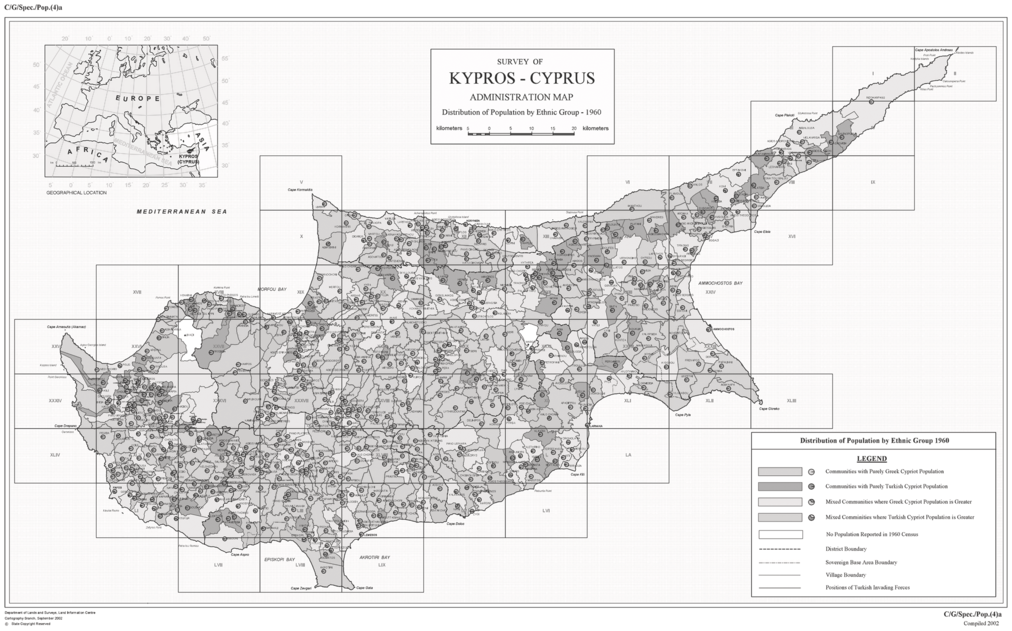
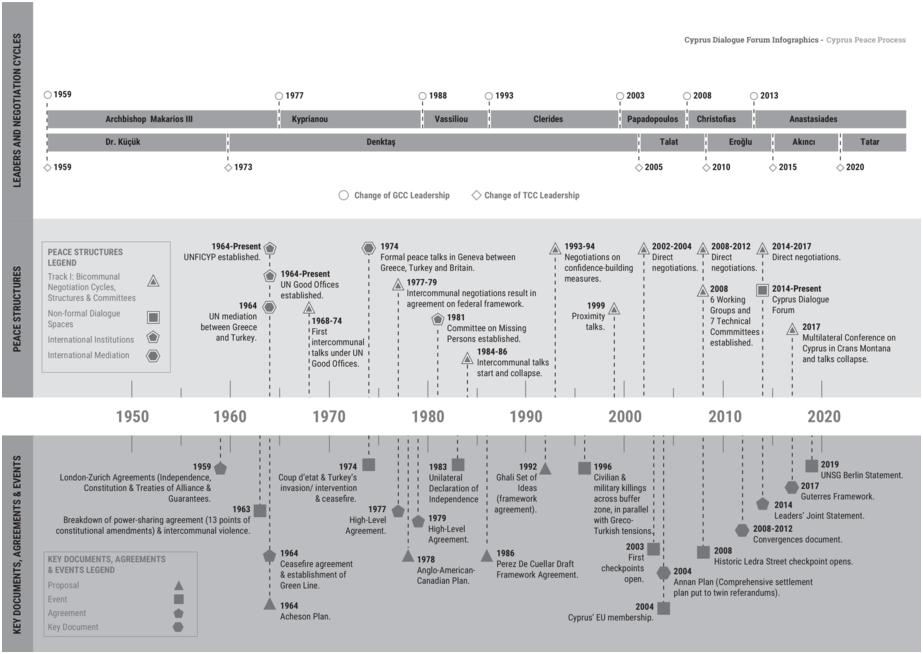
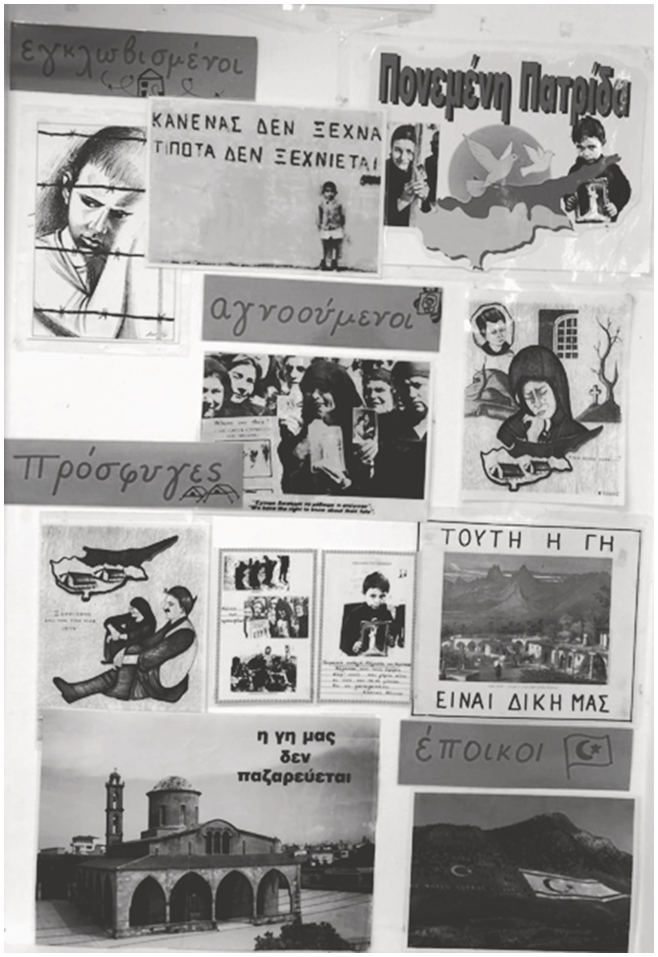
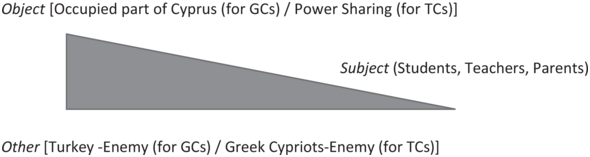

 Open access