

In the last volume of his Civilization and Capitalism, Fernand Braudel described the world between the fifteenth and the eighteenth centuries as a set of city-centered “world economies,” no one of them global in scope. Every world economy, he argued, obeyed certain rules: boundaries changed only slowly; a dominant capitalist city (whose location and influence might vary over time) always lay at the center; the peripheries of each world economy were organized as a hierarchy of zones.Footnote 1 After tracing the evolution of the European world economy, he devoted a long chapter to the rest of the world. The Americas and sub-Saharan Africa were treated as appendages of the European system. Russia, the Turkish empire, and the Far East were however discussed as each constituting a world economy in their own right. Indeed, Braudel described the Far East world economy as the “greatest of all.”Footnote 2
Given the evidence available to him, Braudel could not have realized that the city at the core of the Chinese world economy throughout this period was Suzhou, not Beijing.Footnote 3 Center of the last internal resistance to the emerging Ming empire, from the mid-fourteenth century Suzhou was saddled with much more onerous land taxes and labor services than the rest of the empire. Trade and crafts were however relatively lightly taxed, the area enjoyed ecological advantages as a center of both cotton and silk production, water-borne communication networks were unusually efficient, and social barriers to new men and new money unusually weak. Once the capital was moved from Nanjing to Beijing, separating the political from the demographic, economic, and cultural center of the empire for the first time in Chinese history,Footnote 4 Suzhou emerged as the center of the latter.
China's medieval economic revolution is well known but, in Song times, it remained a regional phenomenon. Its persistence and its spread to other parts of China in the late imperial era were contingent on its reconstitution after the fall of the Mongols. Given the burdens and opportunities it faced in the early Ming, Suzhou was compelled to specialize in its areas of comparative advantage were it to survive, much less thrive. This led to more efficient allocation of resources, higher living standards, and increased buffers against insecurity. It is worth stressing that such a process of Smithian growth not only required commoditization at the center; it also demanded it in the ever-expanding—and more tightly integrated—peripheries.Footnote 5 This was the genesis of the late-imperial, Suzhou-centered developmental cycle of the Lower Yangzi macro-region.Footnote 6 Recent scholarshipFootnote 7 has argued that one result was that standards of living in mid-Qing Jiangnan were comparable to those in the most developed corners of the pre-industrial world well into the eighteenth century.
Members of the so-called California School have stressed that China should be compared with Europe and the Lower Yangzi with England (and adjacent, high-income portions of the continent like HollandFootnote 8 ) rather than comparing China with England.Footnote 9 While the lack of overseas colonies deprived the Yangzi delta of the ghost acres that proved critical to the emergence of an industrial order on the other side of the world,Footnote 10 the Suzhou-centered system was chronically dependent on regular imports of food, fuel, and fiber from other parts of the empire.Footnote 11 Thus, by the end of the Ming, Suzhou depended on rice from Sichuan not merely to pay its taxes but to feed its population. Trees were felled in the interior, then shipped to Suzhou to build both buildings and boats. Local supplies of raw cotton were supplemented with imports from the North China plain—imports which were spun into thread, woven into cloth, dyed and calendered, then re-exported to other parts of the empire. By the early Qing, the area relied on imports of beancake from Manchuria to maintain the fertility of its fields. Economically, Ming-Qing China was an enormous “T” with Suzhou the point where the (separate) northern and southern ocean routes, the major north/south inland artery (the Grand Canal), and the empire's east/west corridor (the Yangzi River) intersected. It was the place “where the goods of all the provinces converged.”Footnote 12 The tastes of its elites defined excellence throughout the empire, and beyond.Footnote 13
China's internal market dwarfed that of all its neighbors combined—even Angus Maddison, who rejected arguments for essential equivalence between the most developed parts of Europe and Asia into the eighteenth century as Sinophilic illusion, showed that China was incomparably the world's largest single economy well into the nineteenth century.Footnote 14 The Chinese world economy was however by no means confined within the borders of the Middle Kingdom.Footnote 15 The recently rediscovered early seventeenth-century Selden Map depicts its external connections. Directions are given to and from the Fujian coast—starting point of the then recently legalized (1567) trade network which linked the rest of East and Southeast Asia with the Middle Kingdom.Footnote 16 From their first appearance in Asian waters, Europeans participated in that system but, down to the early nineteenth century, the bulk of the Nanhai 南海 trade remained an intra-Asian affair overwhelmingly in Chinese hands.Footnote 17
Although it had emerged as a major center of cotton production and could claim both artistic (Dong Qichang 董其昌, 1555–1636) and scholarly (Xu Guangqi 徐光啓, 1562–1633) eminence, late Ming Shanghai's position within this order was a relatively modest one. Once the restrictions on coastal trade imposed during the Ming-Qing transition were relaxed (1684), its importance as a port grew. Yet, until the beginning of the nineteenth century, it was primarily an outlet for trade between the Yangzi delta and points south—the far more lucrative northern route was centered at Liu Family Harbor 劉家港.Footnote 18 The decision to station the Circuit Intendant overseeing the River and Sea Customs Station at Shanghai in1730 was an effort to curb rampant criminality, not recognition of Shanghai's established economic importance.Footnote 19 Cotton appears to have been far more vulnerable to officially promoted attempts to encourage (for both moral and economic reasons) import-substitution in other parts of China than the silk industry central to Suzhou.Footnote 20 One standard gauge of cultural importance is an area's ability to get its sons through the imperial examinations. Redrawing of boundaries between districts makes direct comparison between Ming and Qing Shanghai difficult. We do know that Songjiang prefecture (of which Shanghai was a part) had produced 466 jinshi in Ming; in Qing, only 229.Footnote 21
Despite this, at some point between the seventeenth century and the twenty-first, the center of China's richest and most developed region shifted fifty miles east. Given the size of China, this might seem a relatively minor adjustment. Yet cities the size of High Qing Suzhou and Republican-era Shanghai exist only as the apex of a hierarchy of central places. At a minimum, the shift from one to the other would represent a fundamental reconfiguration of that hierarchy. This was not however just the transfer of a regional core from one city to another. The shift from Suzhou to Shanghai was the moment a China-centered “East Asian world economy” was displaced by the Shanghai-mediated integration of China into a global system not of China's making. The moment marked nothing less than the end of the Middle Kingdom. It was the true beginning of the painful process through which China began in earnest to re-invent itself so that it might survive and thrive in a western-dominated system of industrializing nation-states.
When and how did that shift take place?
We used to think that we knew: at the latest, the new order was firmly in place in the wake of the Second Opium War and the suppression of the Taiping Rebellion. The Tongzhi Restoration (1862–74) might have been a “last stand of Chinese conservatism”—but key architects of that movement were at work “self-strengthening” the empire to deal with the realities of a radically decentered China.
Indeed, recent work (in both Chinese and English) has suggested that the transition was well underway prior to the Opium War.Footnote 22 The silting up of Liu Family Harbor between 1790 and 1810 had led, for the first time, to the joining of the (more lucrative) northern coastal trade route with the southern—its preserve up to that point—at Shanghai. Problems with the Grand Canal had reduced the importance of that waterway, a phenomenon reflected in the experiment in sea transport of tribute grain (again through Shanghai) to Beijing. The volume of trade flowing through Shanghai's wharves in the 1830s—prior to its “opening” as a treaty port—was impressive: H.H. Lindsay's (1802–81) observations in July 1832 suggest that 400 junks, averaging between 100 and 400 tons, entered the port each week, “a volume of shipping equal to or greater than London's.”Footnote 23
EARLY NINETEENTH-CENTURY SUZHOU
Even so, Shanghai's trade was still a mere fraction of the volume registered at the inland customs station of Hushu 滸墅, the market-town just north of Suzhou on the Grand Canal.
This had long been the most important such station in the empire. In 1753—at the height of mid-Qing prosperity—it took in 495,226 taels in a single year.Footnote 24 Yet, from the beginning of the nineteenth century, it had failed to meet its quota year after year. In 1824, the emperor lowered the amount expected to 250,000 taels, cutting it a further 20,000 taels seven years later.Footnote 25 Even this figure could not be met, prompting Governor Lin Zexu 林則徐 (1785–1850) to investigate personally in 1835. He concluded that part of the problem was that boats which had once used the Grand Canal were now paying at Shanghai (whose collections exceeded its 49,699 tael quota by almost 25,000 taels). Moreover, some shipping paid at the lower Shanghai rate at Suzhou's north and northeast gates, a concession Beijing had authorized during the Grand Canal crisis of 1826 and never rescinded. While some traders were electing to use circuitous routes to avoid tax stations, and others were under-reporting, a spot check revealed that the manifests of 60 to 70 percent of the boats passing through Hushu were accurate in every detail.Footnote 26 While there probably had been a falling off from its mid-eighteenth-century peak, the combined effects of diversion and evasion are too massive to argue for substantial decline—and even at its reduced level, collections at Hushu were still running at three times the rate of Shanghai. (The amounts collected actually rose in the 1840s, continuing to dwarf the amount collected at Shanghai.Footnote 27 )
Much of Shanghai's trade originated in or was bound for Suzhou. Further, the substantial trade between Suzhou and points south and west like Hangzhou and Huzhou 胡州 would not have passed through Hushu or Shanghai. It is thus hard to avoid the conclusion that Suzhou's trade volume in the 1830s was four to five times that of Shanghai (hence London).
Such great commercial activity implies a substantial urban component. The three districts that made up Suzhou city and its immediate hinterland—Wu 吳, Changzhou 長洲 and Yuanhe 元和—had a combined population of 2,974,943 in 1820. Given registered arable land in Changzhou and Yuanhe of 1,351,600 mu (an average of 1.56 mu per capita), the conventional allotment of 10 mu per five-person household would leave almost 190,000 without access to land. The situation was even more dramatic in Wu: with only 710,300 mu, its agricultural sector could absorb only 355,150 of its 1,734,000 people. The prefectural city, the populous suburbs which had developed outside at least four of the city's six gates, and the area's twenty zhen 鎮 and seven shi 巿—large and small market towns—thus had to account for almost two-thirds of the population.Footnote 28
Shanghai district had a total population of 529,000 circa 1840; an estimated 120,000 resided in the city proper and its suburbs on the eve of its opening, with another 50,000 or so residing in the county's eighteen market towns.Footnote 29 By the standards of most of the pre-industrial world, this was a highly urbanized area; compared to Suzhou, it was still a largely rural backwater.
Recent estimates of the per capita income in the metropolitan districts of Songjiang 松江 (the prefecture to which Shanghai was subordinate) in the 1820s provide a conservative basis for translating population data into an estimate of the size of local economies. At 24 taels/1,000 1990 dollars per capita, this implies a GDP of 71,400,000 taels/2,975,000,000 1990 dollars per year for Suzhou. Shanghai by contrast would have a GDP of 12,696,000 taels (or 529,000,000 1990 dollars).Footnote 30 Given recent work on the relative health of silk versus cotton in the early nineteenth century,Footnote 31 this estimate may well understate the situation in Suzhou. There is much less reason to make the same argument for Shanghai.
Other indices suggest that Suzhou continued to prosper. Table 1 summarizes the success of its metropolitan districts in terms of examination degrees obtained. While success rates for the Daoguang era (1821–50) were lower than they had been under Jiaqing (1796–1820), they remained among the highest in the empire—after all, if success were evenly distributed, given 1,500 districts and an average of 300 passes, one should have expected one jinshi graduate every five exams (or 0.2 per exam per district). The numbers of graduates at lower levels were equally impressive.
Examination success (average number of graduates per examination).
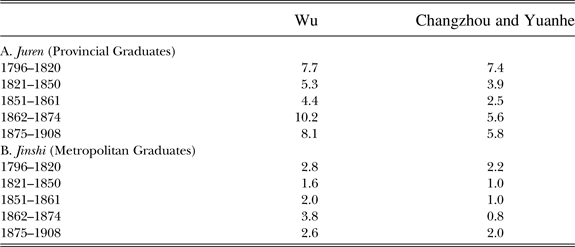
Source: Wu xian zhi (1933 ed.), juan 13: 13a–22a; juan 14; and juan 15: 1a–23a. Changzhou and Yuanhe were a single district (Changzhou) until 1723; hence their totals are combined here.
Moreover, businessmen were continuing to invest—at far higher rates—in Suzhou rather than Shanghai. Mindful of Byrna Goodman's argumentFootnote 32 that sojourners identified with the cities in which they had resided for decades only after they developed a national consciousness, it seems difficult to see this as irrational commitment to Suzhou in face of deteriorating conditions. Records make clear that construction of a sojourner lodge or trade association headquarters was a substantial investment: as John Henry Gray (1828–90) notes, “the guild-halls are amongst the most beautiful of Chinese buildings.”Footnote 33 They were often “more luxurious than… official buildings.”Footnote 34 Although he visited Suzhou only in the wake of its Taiping destruction, Gray remarked that Suzhou was “famous among other things for its magnificent guild-halls…. To judge from the gateways which still remained, the buildings must have been handsome.”
The area did face a spate of natural disasters in the Daoguang era; our recent experience (from Hurricane Katrina to the Tohoku tsunami) reminds us that the issue is less a society's immunity from such events than its ability to cope with them. Even on this score, early nineteenth-century Suzhou looks quite impressive. Widespread flooding in the Yangzi delta triggered tax deferrals in 1831. When he assumed the governor's office the following spring, Lin Zexu insisted that the area begin to whittle away at its massive arrears, even though the harvest had reportedly been a mere 60 percent of normal. The following year however even Lin felt obliged to risk imperial wrath (and a demotion) by pleading for tax reductions in his turn. The harvest was poor not only in the delta itself but in the areas from which it drew the grain which enabled its dense population to subsist. (In return, in normal times, those areas provided markets for Suzhou's handicrafts.) Some idea of the scale of the 1833–34 disaster is afforded by the private sums Lin raised to provide relief in Suzhou city itself, an amount sufficient to feed 200,000 people for six months. Assertions that as result of Lin's efforts no one starved to death are clearly hyperbolic. Yet it does seem that Lin took vigorous steps both to manage the immediate crisis and to deal with long-term problems. From early 1834, Lin substituted work-relief for soup-kitchens. This insured that efforts to feed the hungry would help remedy long-standing neglect of the area's rivers and canals. The regular dredging of these channels was critical for trade as well as agriculture.Footnote 35 When Lin's successor as governor, Yuqian 裕謙 (1793–1841), issued a broadside criticizing the mores of his subjects on the eve of the Opium War, he felt it necessary to lecture them on their extravagance, not to bemoan their penury.Footnote 36
While, in the wake of the Treaty of Nanjing, Suzhou remained off-limits for foreigners, its fame prompted several westerners to find ways of observing it for themselves. Robert Fortune (1812–80) was among them. Whenever one placed an order for “any thing superb… it must be sent for from Suzhou…. It is the Chinaman's earthly paradise, and it would be hard indeed to convince him that it had its equal in any town on earth.”Footnote 37 Disguised as a native, Fortune bribed boatmen to take him inland. He described the countryside between Shanghai and Suzhou as “one vast rice-field” and the city itself as “the seat of luxury and wealth [with] none of those signs of dilapidation and decay which one sees in such towns as [the newly-opened treaty port of Ningbo]…. [The] whole place has a cheerful and flourishing aspect, which one does not often see in the other towns of China, if we except Canton and Shanghai…. The walls and ramparts are high, and in excellent repair…. That part of the city near the east gate, by which I entered, is anything but splendid; the streets are narrow and dirty, and the population seems of the lowest order, but towards the west the buildings and streets are much finer, the shops are large, and every thing denotes this to be the rich and aristocratic part of town.”Footnote 38 Noting that the city gates were well guarded, the streets and lanes equipped with gates to enforce a nightly curfew, and the whole “in excellent order,” Fortune pronounced Suzhou “the great emporium of the central provinces of China…. Shanghai, from its favourable position as regards Suzhou, will doubtless become one day a place of vast importance, in a commercial point of view, both as regards Europe and America.”Footnote 39
The handful of westerners in China—perhaps 500 out of a population of 380 million—were deeply disappointed by the initial results of access to the five coastal cities opened to them by the first round of treaties. Although half China's trade with the west had shifted from Guangzhou to Shanghai, the total volume of that trade barely changed. They dreamt of exchanging such disappointing outposts as Ningbo and Fuzhou for the far more promising Suzhou.Footnote 40 As late as 1863, foreign merchants were unsuccessfully projecting that China's first railway link Shanghai to Suzhou.Footnote 41
THE TAIPING CRISIS
Much had however changed by the 1860s—so much that we have long believed that by that time it was Shanghai, not Suzhou, which was central. Steam had supplanted the clipper ships of the 1840s and 1850s, the opening of the Suez Canal cut the distance between Europe and Asia drastically, and China's exports doubled between 1850 and 1870.Footnote 42 By 1871 direct telegraph communication linked London and Shanghai. (Telegraph links were only established between Shanghai and Suzhou in 1881.Footnote 43 ) Above all, there was war.
Although Suzhou was not the front line, from 1853 military activity—the Taiping at Nanjing periodically extending their control to the Grand Canal ports of Zhenjiang 鎮江 and Yangzhou, the Nian Rebellion on the North China Plain, the Small Swords at Shanghai, a Second Opium War—disrupted critical elements of the system on which Suzhou depended. Expedients were devised: Jiangnan exported raw silk in response to the epidemic which devastated European and Middle Eastern silkworms from 1854. Its ability to do so resulted from the disruption of established patterns of production and trade at just that time, making raw silk available in exceptional quantity.Footnote 44 As those who had silver hoarded it, the Suzhou system—substituting opium for silver as a medium of exchange—preserved liquidity.Footnote 45
G. William Skinner provided us with a model of how the basic units of the late imperial order managed to survive such circumstances, shutting themselves off from the outside in times of crisis, then opening up once order was restored. In such a system, Kishimoto Mio has recently argued, the various nodes of the market economy resemble “numerous shallow ponds connected to one another by channels. Because of their shallowness, the ponds were vulnerable to changes in external economic conditions. For example, too little inflow or too much outflow of money or commodities could easily flood or dry up these ponds and paralyze local economies.”Footnote 46 While China's Suzhou-centered world economy had made considerable strides toward creating an “organically integrated… single economy,”Footnote 47 under the stress of rebellion within/invasion from without, the urban order that centuries of Smithian growth had created showed clear signs of unravelling. While this no doubt reduced the living standards of all involved, it threatened the very existence of an area with almost two million more mouths than the available land could support. There was moreover no reason to believe that, once the crisis had passed, resources and commodities would continue to flow through the same channels they had before rather than following new ones.
When, in spring of 1860, the Taiping movement was suddenly reinvigorated, Suzhou's situation lurched from crisis to catastrophe. The imperial forces adopted a scorched earth policy, setting fire to the area between Tiger Hill and the city wall. In three days, the flames consumed what heretofore had been bustling markets outside the Chang 閶 and Xu 胥 Gates, destroying (virtually) everything for a distance of 10 li.Footnote 48 The city's defenders opened the gates to rebel forces rather than mount a resistance. In wake of a decade's worth of lurid tales of Taiping atrocities, many of those who could not escape chose death rather than submission. Missionaries hastening to make contact with the “Christian” rebels a month after the city's fall found as they drew near that “for hundreds of yards” the channel was blocked by “bodies of the dead—cold, nameless, and uncountable—that jammed the canal like so many logs.”Footnote 49 Although strongmen in pockets of the countryside managed by timely defection from one side to the other to maintain considerable autonomy throughout,Footnote 50 the city and its suburbs were fully under the control of Loyal King Li Xiucheng 李秀成 (d. 1864, age 40) and his forces. Welsh Congregationalist Griffith John (1831–1912) reported that “the iconoclastic tendencies of the Taipings are still in full vigor. Nowhere, apparently, do they leave idols untouched…. It is common to see the nose, chin, and hands cut off. The floors of these buildings are bestrewn with relics of helpless gods…. Some are cast into the canals, and are found floating down the stream mingled with the debris of rifled houses and the remains of the dead.”Footnote 51 This was not merely an assault on Buddhist monasteries and Daoist temples. Cult centers were critical nodes organizing imperial society—from official ceremonies to Confucius and the City God through festivals honoring the presiding deity of each cluster of hamlets and the sacrifices to patron spirits of sojourner lodges and trade associations. Although targeted, Taiping zeal insured that the destruction they wrought was both disruptive and widespread.
The fortunate fled—it is in these years that up to 500,000 refugees crowded into the International Settlement and the French Concession at Shanghai. This triggered Shanghai's first real estate boom and led to the creation of that Sino-western hybrid, the lilong 里弄/shikumen 石庫門 rowhouse. Scholarship has tended to stress the importance of this in exposing a wide swath of the Jiangnan elite to western goods and foreign practices.Footnote 52 There are however ample reasons to be skeptical of how important this was: at least two of the trade association headquarters built in Suzhou in the Jiaqing reign (1796–1820) were built by merchants dealing in foreign goods,Footnote 53 and in 1843—the year Shanghai opened as a treaty port—the governor of Jiangsu noted that “the big Jiangsu trading junks (shachuan) regularly took colored cotton cloth (huabu) to Shandong and Guandong (i.e., Manchuria) markets, to exchange for soy beans. Foreign cloth (‘calico,’ ‘shirtings,’ ‘piece goods’), woolens, and camlets had all entered this trade via the emporium of Suzhou, west of Shanghai.”Footnote 54 Though growing—from 569 in 1860 to 2,297 in 1865—the number of westerners in the International Settlement remained tiny. (That in the French Concession was even smaller.) Most groups moreover kept to themselves.Footnote 55 Once peace was restored, most returned to their home towns: the “Chinese population in the British settlement fell from over 500,000 to just 77,000 in less than a year and to just 51,421 by 1870.”Footnote 56
Had a decade of war and three and a half years of occupation not dealt the Suzhou-centered world economy severe enough blows, the Qing reconquest should have delivered the coup de grace. Although a peaceful surrender of the city had been arranged, Li Hongzhang 李鴻章 (1823–1901) insisted on wreaking vengeance on the rebels, and on all who were seen as collaborators.Footnote 57 Some thirty thousand of the Taiping defenders made a final stand at the city's Double Pagoda; it is said that their blood soaked the monastery's soil to a depth of three inches.Footnote 58 Looting and pillage followed: a scholar who visited the city immediately after the restoration of Qing control noted “that of the buildings once located outside the six gates of the walled city not even a single shard of tile remained, and that the entire west side of the walled city had been obliterated while about half of the [much less prosperous] east side was in ruins…. All of the city's administrative offices were reduced to rubble.”Footnote 59 The “Chinaman's earthly paradise”Footnote 60 was reduced to charnel-houses amid the ruins.
A POST-TAIPING REVIVAL
Had Shanghai clearly emerged as central by 1864, one would expect Suzhou to have been left a pile of debris. Much of the empire had been destroyed in a generation of civil conflict. The Qing state's priority was the rebuilding of Nanjing; it received the limited funds and attention available for restoration. Suzhou's fate would primarily be left to the locals.Footnote 61
The number of these was much reduced. Although they cannot be taken at face value, figures for the males registered in 1875 versus those for 1820 are highly suggestive. The districts north and east of the prefectural city (including the eastern part of the city itself) had actually grown—from 285,140 to 289,702 in the case of Changzhou and from 218,837 to 314,125 in the case of Yuanhe. Including the figures for Taihu ting 太湖廳, Wu had however plummeted from 1,283,041 to 184,712.Footnote 62 Although the figures are labelled as representing those “actually resident” (shizai 實在), a decline that drastic may overstate the case, reflecting the level of disruption as much as the loss of life. A map of the area within the city walls dated to 1876–81, however, shows twenty-six mounds of ruble, each seven to ten meters high.Footnote 63 These do not appear on pre-Taiping maps.
A map dated 1896–1906 shows only ten of these mounds within the city. Their disappearance was in part due to the efforts of local officials, men who used local funds to finance the rebuilding of the government offices. Virtually all of these had been damaged, most destroyed, in the early 1860s. Given the heavy imprint of the Qing bureaucracy—Suzhou was seat of the Jiangsu provincial governor, the provincial treasurer, the provincial judge, the Suzhou Grain Circuit Intendant, a prefect, and three district magistratesFootnote 64 —this required a substantial investment. How substantial can be gleaned by considering the 1872 rebuilding of the Silk Weaving Bureau: reconstruction of that 400-plus bay complex cost more than 42,000 strings of cash.Footnote 65
The state was however neither willing nor able to shoulder the greater part of the task of reconstruction. It is only because those who presumably knew conditions best, and who had the most to lose by not exploiting them to the full, proved willing to invest their own funds that there is today anything much to see at Suzhou. While individually not as great as those made by officialdom, collectively (see Table 2) these investments were considerable: as early as the third month of 1865, Jiangsu lumber merchants spent a total of 547 dollars to rebuild their trade association. (This was possible only because one of the fifty-one contributors gave 250 dollars; fifteen gave a mere 2 dollars each). A decade later, the silk thread, Song brocade, and satin account shops spent more than 3,800 taels to rebuild their Yunjin 雲錦 Trade Association. The process could take years: in 1870, paper makers spent 348 ounces of silver to acquire property; seven years and an additional 1,000+ dollars later, their Liang Yi 兩宜 Trade Association was completed.
Sojourner lodges (huiguan 會館) and trade associations (gongsuo 公所).
A rebuilding is arbitrarily counted as equal to half a foundation.
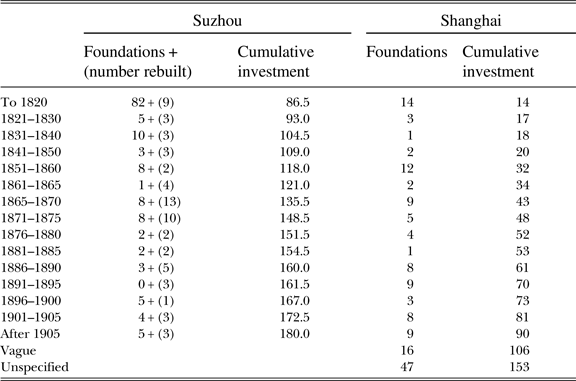
Sources: Fan Jinmin, Ming Qing Jiangnan shangye de fazhan, 287–301; Wang Weiping, Ming Qing shiqi Jiangnan chengshi shi yanjiu, 190–92, 210–21. Note that the distinction Johnson tried to make between Trade Associations and Sojourner Lodges has been rejected by most other scholars, who have noted that the terms are often used interchangeably in the sources. See Zhang Zhongmin, “The Civil Role of Sojourner and Trade Associations in Shanghai during the Qing Period,” in Dragons, Tigers, and Dogs: Qing Crisis Management and the Boundaries of State Power in Late Imperial China, edited by Robert J. Antony and Kate Leonard (Ithaca: Cornell, 2002), 108–11.
Surviving inscriptions make clear that the decision to make these investments was carefully considered. The relatively humble Zhenan 浙南 Trade Association (dealers in coarse Zhejiang paper and indocalamus leaves) noted that their headquarters had been burnt down in 1860, leaving only the land and a foundation. During the Taiping occupation, “merchant goods were very few and accumulated wealth was not great.” Hence, they initially rented room in an inn as a temporary expedient. By the late 1860s however, trade had begun to revive, prompting them to rebuild despite continuing difficulties. Beginning in the first month of winter of 1868, they put the neglected site in order, chose an auspicious day and began work. It took five years and 990 dollars to complete the walled compound with its storied building in front and central hall to the rear, each consisting of three bays and two wings. Windows, railings, ornamental brick and lacquer demanded another 640+ dollars. Even so, they had had to cut corners, settling for a rear ramp to the canal rather than the wharf they had previously used to load and unload commercial vessels. They could only hope that, at some future point, they would be able to raise the funds needed to finish the job.Footnote 66
Willingness to rebuild or create sojourner lodges and trade associations made sense only if one believed in the city's continued importance and future prospects. The same applies to the willingness of locals to reinvest in the area. Many of Suzhou's most prominent families fled to the relative safety of Shanghai during the Taiping crisis. They seem to have been fully aware of new opportunities Shanghai offered; many clearly attempted to seize them. From the mid-nineteenth century, individuals opened branches of Suzhou shops—silk textile firms, drugstores, stationers, money shops, carpentry shops, shops selling gold implements, cosmetics, and pastries—in the treaty port; served as compradors of foreign firms; invested in foreign firms and in Shanghai real estate; and placed their money in foreign banks.Footnote 67 In his roster of Shanghai's sojourner lodges and native place associations, Fan Jinmin lists five which were clearly built by Suzhou groups.
These were welcome additional sources of profit but, given ongoing investments at Suzhou, they were supplements to a still-vigorous Suzhou-centered system, not evidence of its hollowing out. Down to the last decade of the nineteenth century, the rise of Shanghai seemed destined simply to enhance the prosperity of Suzhou.
The most obvious example of the continuing willingness of wealthy and cultured locals to invest in Suzhou is provided by their record in creating lineage charitable estates. The minimum endowment for such an institution was generally regarded as 1,000 mu. It also implied the creation (in Suzhou, almost always in an urban area) of a building which served as office, granary, and ritual center. Such an undertaking usually required decades of effort by lineage activists, effort often spanning generations.Footnote 68 Table 4 shows that twenty-seven are known to have been established at Suzhou from the time of Fan Zhongyan 范仲淹 (989–1052) to 1861; we know of thirty-one established between 1862 and 1912. The eleven academies devoted to classical learning in early nineteenth-century Suzhou had all been destroyed by the Taiping; there were thirty-two in 1900.Footnote 69 Virtually all the privately-endowed charitable institutions listed in the gazetteer note that they were burnt to the ground in 1860; almost all of them were restored in the post-1864 era.
Suzhou sojourner lodges (HG) and trade associations (GS) at Shanghai.

Source: Fan Jinmin, Ming Qing Jiangnan shangye de fazhan, 295–301.
Lineage charitable estates.
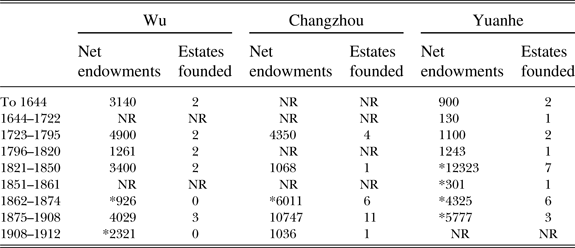
Source: Wu xian zhi (1933 ed.), 31: 11a–26a.
Net endowments to charitable estates are given in mu.
NR = Nothing recorded for this period in Wu xian zhi.
* = Includes increases in endowments of existing estates.
AN OUTSIDE OBSERVER: HAMPDEN COIT DU BOSE (1845–1910)
Much to the dismay of foreign missionaries (who were allowed to reside in parts of China not yet open to other foreigners by the Treaty of Tianjin), their efforts were also, in part, responsible for a revival of popular religion. In Suzhou, as in much of late Qing China, it seems that “local elites, as a result of their role in the reconstruction process, gained a stronger hand over clerics and local congregations in controlling temples and religious institutions.”Footnote 70 In the wake of the Taiping crisis, the state recognized many of the local gods it had previously spurned, and Buddhism underwent a revival. Western missionaries were dismayed to find idols once again regularly paraded through the streets, the cycle of popular festivals observed, and Suzhou and its surroundings “witch-ridden.”Footnote 71
It was not that Suzhou's residents were completely unexposed to Western influences. Some things entering China through the treaty ports found ready acceptance among Chinese consumers. This was particularly true of opium, of foreign cigarettes, of matches, of the best grades of British cotton cloth. And, although it was not a treaty port, Suzhou was opened to missionary influence in wake of the Second Opium War. Both Catholics and (American) Protestants were quick to take up residence. A sympathetic observer noted the less than cordial reception accorded them:
The one vice for which we think the Suzhou wits are in marked degree distinguished… is the ease with which they curse. Perhaps in the use of profane language they would, among all tribes and nationalities, be assigned the highest position. The most filthy, obscene, blasphemous language proceeds from their lips. They curse on the streets, in the teashops, and in their homes. Men curse and women curse, and the first words that infant lips pronounce are profane. Alas! For the last forty years, foreigners have come in for their due share. In other places ‘foreign devil’ is the style of address; here they have seven appellations which they have hurled at us seven times, as often with seven times the vehemence. Happily since the opening of the port [in 1895] this has improved. In other respects their conduct toward Europeans has been in the main blameless. No placards against them have ever been posted on the walls.Footnote 72
This, if anything, understates the degree of indifference laced with hostility with which these interlopers were received. PRC historians record a popular anti-Catholic movement as early as 1867.Footnote 73 Protestants were no more welcome. Shortly after his arrival in 1872, Southern Presbyterian missionary Hampden Coit du Bose and his wife had to face down locals convinced that the “foreign devils” were attempting to gouge out the eyes of a tearful babe in arms. In the next few years, the family twice had to flee the town for a few days to avoid rioters. In 1876, the mob was convinced that the missionaries were cutting off men's queues, thus gaining control of the individual's spirit to animate “mysterious paper dolls. These could float out on the midnight air, alight on a man's chest, grow very heavy and crush the sleeping man's lungs.”Footnote 74
A Suzhou resident until his death in 1910, du Bose remained a dedicated missionary. He emphasized that the missionary must “mingle with the people, become friendly with them and know them intimately,” supplementing hours of formal study of the language with immersion in the street. “We must, like them, be intimately acquainted with the three hundred and sixty trades, and especially the price of commodities. When we are speaking, the markets, fruit stands and vegetable stalls must be on the tongue's end for the sake of illustration. A man must know how to build a house, row a boat, plant rice, irrigate the fields, rear the silk worm, weave silk and quarry stone! We are, in our linguistic attainments, to be scholars, merchants, cobblers, cooks, coolies and washermen. We must know what the people know and prepare our sermons in the language of their daily life…. A lady to reach the women must converse fluently on all the details of home life and women's employments and avocations.”Footnote 75 Long residence, fluency in the language, and eagerness to immerse himself in the details of everyday life thus make du Bose a valuable participant observer of late Qing Suzhou.
He was less powerful as a conduit of secular western learning. While he was willing to employ interest in western science and technology, medicine, and education to expand his audience, he insisted that these remain subordinate to preaching the gospel: “We cannot expect a religious crop from scientific planting…. We rejoice in the introduction of the railways, telegraphs, steamships, scientific apparatus, and all of which a European civilization boasts… [but] should the people accept civilization and reject Christianity, it may be said ‘If the light that is in thee be darkness, how great is that darkness!’”Footnote 76 Given Suzhou scholars’ interest in mathematics and the Suzhou area's prominence as a center of traditional medicine, this may well have been a tactical mistake.Footnote 77 But du Bose demanded rigorous observance of the new faith: his daughter records that he expelled one convert for failing to keep the Sabbath—in a society in which the seven day week was unknown—and another for yielding to his family's pleas that Buddhist clergy be called in when his son died.Footnote 78 As result, he made few converts: the Statistics of the Central China Mission record that, as of August 31, 1894, 4 ordained missionaries and their wives ministered to a grand total of 48 communicants, 80 Sunday school pupils, and 143 students.Footnote 79
THE PERSISTENCE OF THE ESTABLISHED ORDER
Trade and Manufacturing
Suzhou's post-Taiping revival necessarily implied the survival of the urban system at whose apex it had so long stood. One factor facilitating this was an increasingly positive balance of trade with the outside world. Although we say much about the outflow of silver in the early nineteenth century (and the havoc it presumably wrought with prices and tax burdens), we are only now coming to emphasize the reversal of that flow from the 1850s to 1931. This was in part the result of the opening of new silver mines in distant parts of the world, in part the result of decisions almost everywhere else in the late nineteenth and early twentieth centuries to demonetize silver.Footnote 80 It effectively provided China with the same moderately inflationary environment which underlay prior periods of “efflorescence” in the late imperial era.
The number of outsiders in China remained very limited—indeed, between 1865 and the early 1880s, the number of westerners at Shanghai actually fell.Footnote 81 Especially prior to 1895, their connections with China were mediated by Chinese (who, they often complained, jealously maintained their particularistic networks and kept all the profits for themselves). Modern means of transportation operated only between treaty ports, and non-missionaries were still barred from the interior. Under these circumstances, the treaty port economy's stimulus flowed through existing channels linking Shanghai—and other treaty ports—to the rest of the empire, serving to enhance rather than to subvert those interests in the short to medium run.Footnote 82
Indeed, the timing of China's opening served to invigorate the established late imperial order. The epidemic which devastated European and Middle Eastern silkworms from 1854 on provided an opening for Chinese raw silk. Although the more standardized Japanese product, better suited to the needs of the American industry, eventually overtook China in the world market, it did not do so until 1909.Footnote 83 China's trade from the 1860s to the end of the Qing was as a result roughly in balance, with remittances from those sojourning abroad apparently covering whatever gap tea, raw silk, and import substitution for opium did not.Footnote 84 Combined with continued strong demand for Suzhou's woven goods in the East Asian world economy, these conditions fueled revival of the city's key textile industry.
In response to the expanded demand for raw silk, mulberry trees were planted and silkworms raised north and west of the city for the first time.Footnote 85 Silk weaving—which had been disrupted by the Taiping crisis—made a spectacular recovery: in 1878 there were said to be only 1,816 looms in operation, producing 65,326 bolts of cloth. By 1880, this rose to 6,000+ looms, peaking in 1900 when more than 11,000 looms employed a hundred thousand workers and generated annual sales of 6,000,000 yuan (Mexican silver dollars). Prior to 1860, only a tenth of that production was organized by merchant account houses (zhangfang 帳房); in the late nineteenth century, a greatly expanded number of such firms controlled some ninety per cent of Suzhou's exports.Footnote 86 At that point, there was said to have been at least a hundred firms with more than 100,000 yuan in capital, five hundred with more than 10,000, plus six hundred smaller firms with 2,000–3,000 yuan each.Footnote 87 Although primarily oriented to the domestic market, Suzhou silk cloth was exported in these decades to Russia, Korea, Burma, and India.
The cotton industry tells a different tale, one much less relevant in Suzhou's case. Imported English cloth captured the urban, up-scale market in the mid-nineteenth century while first American, then Japanese cottons competed with Jiangnan cloth for the North China market. It was Northern Chinese consumers who had preferred calendered cloth because it was “tighter and smoother so that sand and dust slid off the surface.”Footnote 88 The calendering shops—an important industry in high Qing Suzhou, but one which employed non-locals--accordingly went out of business. Yet, although one reads that “at present in the treaty ports and in the market towns and villages of the interior, 20–30 per cent wear native cloth while 80–90 per cent wear imported cloth,”Footnote 89 the former did not disappear. Cotton was grown on land ill suited to other uses in Jiangnan and, if raw cotton were available, households would continue to spin it: the labor to do so—that of the very young and the very old members of the household—was essentially a free good. By using imported yarn for the warp and handspun for the weft, handloom weavers could produce a cloth both warmer and more durable than foreign (or machine-made) cloth. Accordingly, while cloth imports plateaued, yarn imports—first from South Asia, later from Japanese and (increasingly after 1895) Chinese mills—led to an expansion in weaving. Since weaving was far the most lucrative phase of the process, the end result was to continue to provide tens of thousands of households with a welcome by-employment. Only where more profitable alternatives (knitting, lace-making, embroidery) were available for the same labor pool did weaving decline.Footnote 90 Both the domestic and the export market for Suzhou embroideries (a sector using local labor) expanded, the number of firms rising from 65 in 1884 to 150 at the end of the Qing.
For the most part, tastes—of the elite and of their less affluent compatriots—remained quite traditional, as the 1896–97 Blackburn Commission report emphasized.Footnote 91 Hence, insofar as Suzhou's crafts catered to the demands of the well-to-do (and those who, throughout the region and the empire, sought to emulate them), they faced little immediate competition from novelties landed at Shanghai. Accordingly, a long list of trades (metalwork, giltwork, jade carving, leatherwork, bamboo, costumes for the Chinese theater, etc.) were essentially unaffected. Others—such as makers of clay sculptures—actually were able to expand their market.Footnote 92 As the building and rebuilding of trade associations and sojourner lodges suggests, the construction trades were kept busy: if one looks closely, one discovers that almost everything now designated a historic site in Suzhou was rebuilt in the very late Qing.
Comparison of rice price data from Suzhou with that from Shanghai between 1864 and 1910 suggests that, down to the end of the Qing, the grain market also remained centered on Suzhou, not Shanghai.Footnote 93 Li Bozhong has shown that, textiles aside, the most important industries in Jiangnan between 1550 and 1850 were those devoted to food processing.Footnote 94 In the absence of change in the transportation network, it must have remained true that the husking of rice, the milling of wheat, and extraction of vegetable oils were carried out as close as possible to the retail market. Other tasks—the brewing of alcohol, the processing of tea—were tied to the places which produced their raw materials. Although the post-Taiping decline in the area's population would have reduced local demand, on a per capita basis there is thus every reason to believe that prior levels of production were maintained.Footnote 95
Consumption
Suzhou was however not only a center of trade and handicraft production; it was also a major center of conspicuous consumption. The exceptionally large concentration of officials, and their staffs, played a role. Probably more important was the presence of a substantial number of those who had passed the exams but were awaiting appointment. These men (who, because of the imperial tradition of appointing only those from outside a province to local office, were far from home) congregated in Suzhou for years at a time hoping not to be forgotten when a vacancy occurred. In late nineteenth-century Suzhou, there were 2,500 (or 2,800) “official residences” housing such men. One of the most profitable investments made by traditional banks was providing the advances that enabled them to live in the manner of an official while they waited for a post.Footnote 96
In much of China, local elites are thought to have preferred country estates to urban compounds. In Suzhou, however, landlords had long since moved into the city or to one of the prefecture's more picturesque market towns. In the post-Taiping era, they relied on rent bursaries backed by official power to collect their rents even as they, if not their tenants, benefited from reductions in the area's notoriously heavy land tax quotas.Footnote 97 The second most successful prefecture in terms of examination graduates in Qing,Footnote 98 Suzhou had an unusually large number of retired officials in residence. It continued (even exceeded) its early nineteenth-century levels of success in the post-Taiping era (see Table 1). And it benefited from post-Taiping expansion of quotas for the lower degree: between 1811 and 1850, enrollment in the three district schools at Suzhou fluctuated between 374 and 470; in the decades 1861–90, this rose to 683–764.Footnote 99
The presence of so many members of the elite supported a sizable service sector—which, given the need to have many tasks now mechanized performed by human beings, was much larger than it would be today. Each expectant official was said to have employed a staff of ten to thirty;Footnote 100 there is every reason to believe that every household who could retained one or two servants. Several regional schools of opera as well as practitioners of Suzhou-dialect storytelling (pingtan 評彈) built their own trade association headquarters; some restaurants and confectioners have lasted into the present. And Suzhou was a center of traditional finance: in addition to pawnshops, Suzhou was center for both the Shanxi system of interregional remittance banks (piaohao 票號) and for native banks (qianzhuang 錢莊). The latter are said to have had some 10,000,000 ounces of silver on deposit circa 1900; approximately 60 percent of the 12,000,000 ounces in loans on their books supported productive investment (or conspicuous consumption) in Suzhou.Footnote 101 Add to this the largest complement of merchant communities in the empireFootnote 102 and one begins to understand why down to the end of the dynasty Suzhou was regarded as awash in idle capital and a renowned source of ready cashFootnote 103 as well as why officials continued to denounce the extravagance of the locals.Footnote 104 Although a long-resident outside observer emphasized that “tens of thousands live on the merest pittance, and some know not the pleasure of a hearty meal,” he estimated that over half the city's population was made up of a “large middle class of teachers and of well-to-do shopmen and mechanics.”Footnote 105
NINETEENTH-CENTURY SHANGHAI: THE TREATY PORT AS INCUBATOR
While Shanghai was the dominant treaty port (accounting for 70+ percent of China's foreign trade in the 1870s, almost half in 1931),Footnote 106 to 1900 or so it remained a much smaller place than Suzhou. It was moreover a relatively isolated one, situated on the periphery of Jiangnan and tied to its potential hinterland only by traditional modes of transport: down to the late 1890s, Suzhou remained a three-day, two-night boat journey from Shanghai.Footnote 107 Neither notably successful in terms of examination successFootnote 108 nor noted as a traditional center of culture and learning,Footnote 109 Qing Shanghai was not home to an especially affluent or numerous local elite. Nor was it a particularly significant node in the bureaucratic structure: it was merely one of 1,500 county seats. (It was the base of the Circuit Intendant for River and Sea Customs in the Su-Song-Tai Circuit as well as of a sub-prefect in charge of coastal defense.Footnote 110 ) Combined, these factors imply that Shanghai proper was not a particularly important center of consumption. Nor, in the pre-1895 era, did it emerge as a major center of production.Footnote 111
It was the scene of much of Hao Yen-p'ing's “commercial revolution in nineteenth-century China”—yet a close reading of that work will suggest why, in the short to medium term, that revolution proved abortive. Hao notes that, from the 1870s, trade was less profitable than it had been—and there had been complaints that it was not all that profitable before;Footnote 112 that “risky” commodities included opium, tea, cotton, and silk; and that while fortunes were made they were just as regularly lost by both western firms and by compradors. While Hao laments the bureaucratization of the China Merchants Steam Navigation Company as well as the failure of proposed telegraph and cotton mill companies, his description of the 1883 crisis makes clear that those failures reflected the weaknesses of both western firms in China and their Chinese agents/collaborators. His roster of crisis years—1837, 1857, 1866–67, 1871, 1873, 1878, 1879, 1883, 1890–91 and 1910—suggests why an investor might view the late nineteenth-century treaty port economy less as a sure-fire investment than as a form of gambling with particularly poor odds of success.Footnote 113
None of this is meant to suggest that, in the long term, what was happening in Shanghai between 1843 and 1895 was insignificant—merely that its short-term impact was far more limited than we have been apt to think. As rice shoots are started in a nursery-bed, then transplanted, so western influences were confined to the relatively restricted area of the treaty ports, acclimating themselves to local conditions before being introduced into the broader field of China.
In many ways, Shanghai was a remarkable place: to a surprising degree, the latest innovations and urban amenities were adopted there before second-tier cities in Europe or North America could boast of them. Thus, it had gas lighting and a drainage system by 1862, the telegraph in 1866 (albeit only for local use—international connections were only established in 1871),Footnote 114 daily newspapers in Chinese from 1872, rickshaws in 1873, electricity in 1882 (and electric street lights a decade later), running water in 1883, tram lines and the first automobiles in 1902.
The broad streets and western colonial architecture of the International Settlement and the French Concession contrasted sharply with the winding lanes of the walled Chinese city and its suburbs to their south. From the 1850s forward, the hybrid lilong/shikumen emerged as a Sino-western instrument for real estate speculation. Shanghai's status as the leading treaty port meant that certain aspects of the west were promptly introduced—a port for foreign ships was established north of the old harbor for Chinese boats, leading not only to the prompt introduction of state-of-the-art western ships (which rapidly came to dominate shipping between treaty ports within China, even when those ships were in Chinese hands, as well as trans-oceanic lanes) but also to the opening of shipyards by Boyd and Farnham.Footnote 115 Thus, both the area's carpenters and its ship-builders had to quickly master the skills required by a novel architecture and a new naval technology.
New forms of financial and business organization were introduced. Although western banks long shied away from lending to Chinese firms directly, many made chop loans to native banks as a way of earning extra interest. While this allowed the western institutions to diffuse risk and draw on local knowledge of the market to maximize returns, it also allowed native banks to increase liquidity and reduce their risks. Little surprise then that the “first Chinese modern-style bank,” the Imperial Bank of China, was established at Shanghai in 1897.Footnote 116 From the opening of the port, compradors played a crucial role mediating between foreign firms and the Chinese economy—positioning them to benefit from innovations associated with the interlopers. When the British considered extending limited liability to Chinese investors in joint-stock companies registered in the International Settlement (1881), Chinese investors proved eager to avail themselves of the new opportunities.Footnote 117
While the numbers of missionaries remained limited, and the numbers of converts small, the turn from evangelizing to education (reaffirmed as policy by the Protestant missions in China in 1877) broadened their impact beyond the relative few ready to embrace Christianity. Schools, and ultimately universities (St. John's as early as 1879), were established. Both the Chinese language press (Shenbao 申報 from 1872, the Dianshizhai 點石齋 Pictorial from 1884) and a vigorous publishing industry (especially the Commercial Press, which opened its doors in 1897) helped introduce a world beyond the borders of the Middle Kingdom. It did so only slowly however: circulation figures for Shenbao suggest a peak of 18,000 copies in late Qing.Footnote 118 Even though each copy was read by several people, its audience was at best a small sliver of educated Chinese. Work on the Shanghai printing industry emphasizes that, down to the shift from lithography to new-style publishing in the 1897–1905 period, most of what sold were reprints of dictionaries, classic texts, and examination aids while even “in 1894, in terms of both investment value and the number of workers employed, Western-style printing and publishing of all kinds were only a minor contributor to Shanghai's economic activity.”Footnote 119 Those involved in the printing business in Suzhou successfully re-established the Chongde 崇德 Trade Association (destroyed by the Taiping) in 1874. Efforts to establish a branch at Shanghai only succeeded in 1905–6, twenty-one years after such an organization was first proposed.Footnote 120
The Jiangnan Arsenal became an important, if specialized, site where a “circle of officials, intellectuals, and translators deliberately conceived of gezhi 格致 [“investigation of things”] as a category encompassing both Chinese and western, both literary and hands-on science and technology.”Footnote 121 It is nonetheless worth noting that, while science was regarded as part of a good education, down to the end of the nineteenth century western science was presented to Chinese readers in terms (gezhi, gewu 格物) redolent of the Great Learning, one of the canonical Four Books.Footnote 122 The scholars who were engaged in such cross-cultural exchange were generally regarded as mavericks, misfits and second-raters, too fond of the bottle, the brothel, and the opium pipe to ascend the ladder of success in imperial China.Footnote 123 Moreover, the same officials who supported the Jiangnan Arsenal and its translation activities established centers of Song Confucianism: “From the time Shanghai had begun being active as a commercial port its atmosphere had changed too rapidly. In order to stem the tide before it became disastrous, [the Circuit Intendant] founded the [Longmen 龍門] academy.”Footnote 124
Much of this had limited immediate impact—as Bergère emphasizes, most Chinese in late Qing Shanghai avoided contact with sojourners from other parts of China, to say nothing of westerners.Footnote 125 While the number of schools and the volume of publication increased, Shanghai continued to lag in Chinese eyes as a center of learning and culture: as late as 1947, Shanghai was dismissed as a “financial sea but an intellectual desert.”Footnote 126 Certainly until China's defeat by Meiji Japan in 1895—and for most until the venerable examination system was scrapped a decade later—western learning, however presented, was at most a supplement to China's own classical civilization. Shanghai's theaters provided a refuge for stage traditions which developed out of the Taiping movement—a development possible precisely because of the city's continuing liminal position. That the works of fiction and non-fiction depicting late nineteenth century Shanghai (notably Han Bangqing's 韓邦慶 [1856–94] Sing-Song Girls of Shanghai and its emulators) focus so largely on the demi-monde of courtesans and their clients can itself be seen as evidence that Shanghai was regarded more as red-light district than as a real city. Indeed, one of the earliest city novels set in Shanghai was originally published as a Yangzhou novel; the publisher simply up-dated it by changing the local references.Footnote 127 Important as it was, even in its heyday, Qing Yangzhou had never threatened Suzhou's primacy.
Many of those who came to Shanghai in the mid-nineteenth century described it as Penglai 蓬萊, a barely real place boasting the widest streets, the tallest buildings and the brightest lights. It was also said to have the most beautiful courtesans, something long considered a marker of China's more important urban centers. (Westerners will think first of the role they play in Marco Polo's description of thirteenth-century Hangzhou as a paradise on earth. Nineteenth-century Chinese would have been familiar with Random Notes on [the Pleasure Quarters] by the Wooden Bridge and Peach Blossom Fan—on late Ming Nanjing—and Record of Painted Boats in Yangzhou.) There was a long literary tradition linking courtesans and aspiring literati as a way of flattering both: like the sites of upper level imperial examinations, late nineteenth-century Shanghai was a liminal space where the two groups were thrown together. First in biji 筆記, in bamboo twig ballads and in guidebooks, then in the entertainment press and installment fiction, the courtesan played a leading role in Chinese depictions of late Qing Shanghai. But were these writings either numerous enough or widely enough circulated to form a “mediasphere”Footnote 128 —an image of Shanghai which shaped the experience of both locals and outsiders of the place—prior to the first years of the twentieth century?
Scholarly studies of these materials suggest that they tell us as much about the writers and their attitudes toward the city of Shanghai as they do about the demi-monde: Catherine Yeh suggests that while “works of the 1870s and 1880s generally present Shanghai as the wonderland of wealth and comfort with the courtesan as the crowning glory,” the writings of authors like Zou Tao 鄒弢 (1850–1931) were permeated by ambivalence. His depiction of Shanghai courtesans was part of his self-image as a “‘scholar who cannot realize his career ambitions’ [by passing the exams and becoming a scholar-official]…. It seems no other place and career attracted him as much as this city [Shanghai] and his life there—and that he loathed himself for it.”Footnote 129 Similarly Wue's recent discussion of the portraits late nineteenth-century Shanghai artists made for themselves and their peers culminates in her discussion of the depiction of “[artists as] Beggars, Vendors, and Butchers.”Footnote 130
Both written and visual images of Shanghai were disseminated by the rapidly expanding publishing industry and by the rise of Chinese-language papers. These were in the final analysis business enterprises; they could and would thrive only insofar as they found acceptance in the market—a market which extended far beyond the boundaries of Shanghai. Pointing both to its continued use of “conservative literary forms” and to its appeals to the authoritative “words of the sages,” Mittler's study of the Shenbao demonstrates strong continuities with established discourse.Footnote 131 The fine arts were not obviously more innovative: bird and flower fan painting by late nineteenth century Shanghai artists does seem more dynamic than that produced a generation or two before.Footnote 132 It is however hard to read this as a radical challenge to established canons of taste. Participation by Shanghai artists in the campaign to raise money for relief of the great North China famine of 1877–78 were clearly a bid for respectability (as well as a mechanism for enhancing individual reputations). This would seem to enlist Shanghai painters as part of the emergent post-opening/post-rebellion public sphere described by Rankin and Rowe—but only if one ignores Han Seungyun's evidence that such activism was well underway in early nineteenth-century Suzhou.Footnote 133 Indeed, Suzhou artists and Suzhou's Taohaowu 桃花 塢 Trade Association initiated artist participation in the fund-raising campaign.Footnote 134 Lithography was a new technology—but the role of the Taohuawu is a reminder that woodcuts, which had been in widespread use for centuries, remained important.Footnote 135
Both the relative conservatism of these decades and the positive image of Shanghai appear to break down in the 1890s: it is then that “depravity” installment fiction begins to appear. These novels rapidly shift from ambivalence to depiction of the perils (social, physical, and moral) which await innocents from the hinterland in a ruthlessly materialistic and culturally unmoored metropole. Catherine Yeh suggests that in part this was reaction to the rise of factory production, the growth of organized crime, and the appearance of the New Culture movement with its critical stance toward all remnants of the “feudal” past. No less important, in her view, was the changing self-image of the Shanghai writer from frustrated man of letters to reformist critical intellectual.Footnote 136
Chinese attitudes toward Shanghai may well have been more conflicted in the twentieth century than they were in the late nineteenth. Yet—first with Japan's defeat of the Qing in 1895, then with the elimination of the exam system in 1905—the alternative (which, in important senses, Suzhou embodied) was no longer seen to be equal to the challenges China faced. It was in this context that the heretofore frustrated and underappreciated “pedlars of words” who had found gainful employment in treaty-port Shanghai laid claim to standing as vanguard of an iconoclastic modernizing intelligentsia. And it is in this context that they found an audience willing to entertain (if not always to embrace) such claims for the first time.
The earliest known use of the term “Shanghairen” 上海人 or “person/people of Shanghai,” circa 1912, reflects this ambivalent attitude toward the treaty port and its residents: “The [Chinese] newspapers’ Shanghairen… prescribed a moral, refined, clean, seasoned, and rational resident of Shanghai, but they described the vicious, vulgar, dirty, inexperienced, and irrational newcomer to Shanghai. On the pages of Shanghai newspapers, the Shanghairen lives a beautiful dream and an ugly reality at the same time…. One is never sure whether those who bragged about living in Shanghai were celebrating the enlightening adventure of life there or congratulating themselves on surviving the city's tormenting challenges.”Footnote 137
FROM SUZHOU TO SHANGHAI
The long delayed impact of these changes on the rest of China became evident only after 1895. The Treaty of Shimonoseki not only opened Suzhou as a treaty port; it also enabled foreigners to establish factories in China, expanded the reach of modern transport (heretofore confined to communication between treaty ports) into the interior, and touched off a scramble for concessions (leading, among other things, to the expansion of foreign controlled areas around Shanghai). It is at this point that the long-distance transportation and communications networks centered on Shanghai transformed the Yangzi delta into Shanghai's hinterland. The post-1895 advent of regularly scheduled steamboat service cut the distance between Shanghai and Suzhou from three days and two nights to twelve hours; completion of the railway in 1906 reduced it to just over two.Footnote 138 The consequences for Suzhou were by no means entirely negative—some firms, seeking lower costs, and benefiting both from the reduction in the friction of distance and the lessened opportunities for corruption, relocated to Suzhou, driving up real estate prices at Suzhou while reducing them in Shanghai. By 1909, a trading company had been set up, dedicated to exporting Suzhou's local manufactures to Southeast Asian markets. It also opened up the possibility of developing Suzhou as a tourist destination: as Clunas has pointed out, the city's gardens were not especially famous until they became easily accessible by rail.Footnote 139
The Boxer Uprising disrupted many of Suzhou's most important internal markets and imposed another round of heavy indemnities on the empire, thus undercutting internal demand. The number of looms in operation fell from 15,000 in 1899 to 7,500 in 1901. Only a dozen or so large merchant account houses weathered the storm. The rest became middling firms, the middling small, and the small retailers. By the end of 1901, thousands of weavers had been put out of work, reduced to pawning their possessions and relying on government soup kitchens. While, after 1902, there was a gradual recovery, it was never complete: the powers moved from buying Suzhou's woven fabrics to competing for the area's raw silk, protecting their domestic markets (Japan, 1900; Russia, 1908) from Chinese imports, and dumping their own manufactures (exempt from the internal transit tax) on the Chinese market.Footnote 140 The railroad brought foreign goods to Suzhou in unprecedented volume, leading to complaints that local products were “unsaleable.” Traditional banks, unable either to compete in the new context or to profit from it, faced collapse. Suzhou's silk industry, having stabilized at some 7,000 looms in operation between 1901 and 1911, fell to 4,000 looms in 1912 while local efforts to create modern industries—a tinned food company apart—floundered.Footnote 141 And the new transport network made it possible, as never before, simply to bypass Suzhou entirely: a whole series of new links reorganized the regional economy, this time around Shanghai. By 1911, Shanghai for the first time approached, if it did not already surpass, Suzhou in population. In the coming decades it would continue to expand as Suzhou shrank.
To such purely economic travails one must add the 1905 decision to eliminate the time-hallowed examination system, followed less than a decade later by the overthrow of the imperial system. The former devalued Suzhou's cultural capital; the latter deprived it of its administrative centrality. Not only was it unceremoniously demoted to the level of a single county seat but, in sweeping away the long-established law of avoidance, the new republic sent the well-financed colony of expectant office-seekers (and their retinues), so long a dependable source of conspicuous consumption, packing. The railroad facilitated the circulation of news and other cultural influences between Suzhou and Shanghai as never beforeFootnote 142 —but now influence flowed from Shanghai to Suzhou, not the reverse. Even so, study of the Shanghai publishing industry stresses the demand for new school textbooks, not that for contemporary fiction.Footnote 143
In sum, it was the Sino-Japanese War of 1894–95, not the Opium Wars or the Taiping crisis of the mid-nineteenth century, which decisively restructured China's world economy in ways which integrated it into the global economic order. The development of Shanghai between 1843 and 1895—in modern transport, communication, and finance as well as as a center of cross-cultural mediationFootnote 144 —was necessary but, in and of itself, not sufficient to shift from the world of the Selden map to that of an Atlantic-centered Mercator projection. On the other hand, absent those structures, the new dispensation would not have had anything like the effect it had, as quickly as it had, after 1895. Only when that new order could be directly tied to its hinterland would or could it have a transformative impact.
Stepping back and considering these developments suggests three further conclusions. First, we should date the end of the late imperial era to the 1890s, not a half century before. Second, given developments at that time, the post-Taiping generation's belief that incremental change would be equal to the challenges China faced was less implausible than it now seems. Japan, ruled by military men and with a population concentrated on the periphery of islands (hence within the range of ships’ guns), adopted far more sweeping changes in large part because they faced far more dire existential challenges, not necessarily because they were inherently better able to divine the course of future events. Finally, if the crisis—for almost all of China—occasioned by its incorporation into a very different global order (indeed, into an order whose terms, for the first time in its long history, it could not largely define) came much later than we have generally appreciated, this implies that the severity of that crisis was more acutely felt, that it was more quickly addressed, and that far more of the past is likely as result to be incorporated in the present than would otherwise be the case.



