


Impact statement
Declaration of 2026 as the International Year of Rangelands and Pastoralists by the United Nations General Assembly provides an opportune occasion to promote a global designation for the nonforested, nonagricultural land category. We respectfully urge multilateral organizations and partner nations to adopt “grassy biomes” as a formal designation for this heterogeneous land category. The defining feature of this designation is a consistent cover of annual or perennial grasses throughout much of the year, including coexistence of other plant growth forms e.g., forbs, shrubs, succulents and scattered trees. The grassy biome designation would provide a more ecologically accurate distinction from forests than the one which is currently utilized. This would establish the foundation for development and implementation of a grassy biome resource assessment comparable to that of forest resource assessments that have been conducted by FAO for the past 70 years. Collectively, these resource assessments would provide valuable inventory data for approximately 75% of the Earth’s land surface and effectively support the aspirations and futures of its many peoples. Continued prioritization of forest assessments over those of the grassy biome can no longer be justified given the pressing challenges confronting Earth stewardship.
Introduction
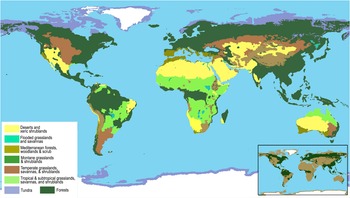
Earth’s land cover broadly consists of forests, agricultural land, urban settlements and a large, heterogeneous category that includes deserts, grasslands, savannas, shrublands and tundra. This land category represents approximately 50% of the Earth’s land surface, which is 1.5 and 2.8 times greater than that of forests and agricultural land, respectively (Reid et al., Reference Reid, Galvin, Kruska, Galvin, Reid, Behnke and Hobbs2008; UNCCD, 2024). Various terms are used to describe these lands, including drylands, grasslands, grassy biomes, open ecosystems, grazing lands and rangelands. These are overlapping but nonidentical terms and each has multiple definitions that vary by author and application, specifically with reference to land use and land type. For example, a recent report by the UN Convention to Combat Desertification (UNCCD) used three terms – drylands, grasslands and rangelands – to describe this heterogeneous land category, with rangelands defined as a land use, rather than a land cover type (UNCCD, 2024). Moreover, these lands occur on all continents except Antarctica, spanning numerous cultures and languages which further contributes to this varied nomenclature (Figure 1).
Map illustrating spatial coverage of the proposed grassy biome category, including its representative biomes, in comparison to forests. Inset illustrates the aggregate coverage of the proposed grassy biome category (beige) relative to that of the forest land category (green) (modified from Olson et al., Reference Olson, Dinerstein, Wikramanayake, Burgess, Powell, Underwood, D’amico, Itoua, Strand, Morrison, Loucks, Allnutt, Ricketts, Kura, Lamoreux, Wettengel, Hedao and Kassem2001).

The absence of a single, globally recognized designation for these lands creates a major obstacle to their recognition, perceived value and stewardship (Johnsen et al., Reference Johnsen, Niamir-Fuller, Bensada and W-B2019; Parr et al., Reference Parr, te Beest and Stevens2024). For example, numerous multilateral organizations specifically attend to forests and agricultural land, and the Food and Agriculture Organization (FAO) has conducted regular global forest resource assessments for 70 years (Garzuglia, Reference Garzuglia2018). In contrast, comparable assessments have not been conducted for the heterogenous land category, and a substantial fraction is routinely misclassified as forest or degraded forest (Scogings, Reference Scogings2023; Parr et al., Reference Parr, te Beest and Stevens2024). In addition, this land category is not explicitly referenced in the U.N. Sustainable Development Goals, whereas two targets specifically invoke forests in Goal 15 – Life on Land. The limited recognition and value assigned to these lands have been described as a “case of benign neglect” in a U.N. report (Johnsen et al., Reference Johnsen, Niamir-Fuller, Bensada and W-B2019). Insufficient emphasis on these lands by multilateral organizations and member states obscures the value of 50% of the Earth’s land area to society and Earth stewardship (Stafford-Smith and Metternicht, Reference Stafford-Smith and Metternicht2021; Zhang et al., Reference Zhang, Tariq, Hughes, Hong, Wei, Sun, Sardans, Penuelas, Perry, Qiao, Kurban, Jia, Raimondo, Pan, Yang, Zhang, Li, Ahmed, Beierkuhnlein, Lazkov, Toderich, Karryeva, Dehkonov, Hisoriev, Dimeyeva, Milko, Soule, Suska-Malawska, Saparmuradov, Bekzod, Allin, Dieye, Cissse, Whibesilassie and Ma2023).
Declaration of 2026 as the International Year of Rangelands and Pastoralists by the United Nations General Assembly provides an opportune occasion to promote a global designation for this land category (IYRP, 2022). Adoption of a common designation by multilateral organizations and member states would promote recognition and stewardship at a level comparable to that of forests. Such a designation is not intended to replace the established names of ecological biomes – large geographical regions characterized by a distinct climate and biota that possess similar adaptations to that environment e.g., desert, grassland or forest – or regional nomenclature for specific vegetation types within this land category.
Potential land category designations
The heterogeneous land category, excluding agricultural lands and human settlements, represents the conceptual reciprocal of forests. Forests comprise diverse tree growth forms, including evergreen and deciduous species of varying stature, density and proportion, but they share a common appearance because the tree growth form remains dominant. In contrast, the heterogeneous land category is comprised of multiple plant growth forms, including grasses, forbs, shrubs, succulents and trees, in various combinations and proportions, but are not forests. The heterogeneous composition of vegetation in this land category has eluded a collective designation, so that specific vegetation types – grasslands, savannas, shrublands, deserts and tundra – are individually referenced.
We have chosen to use land cover, rather than land use, to assess land category designations because it implicitly acknowledges the diverse ecosystem services supplied and is most easily evaluated by multiple assessment procedures. However, functional plant traits are referenced to identify critical distinctions between land cover categories when information is available.
The definitions and relative advantages and disadvantages of dryland, grassland, grassy biome, open ecosystem and rangeland as appropriate designations for this land category are presented in Table 1. Grassland is the only designation that represents an ecological biome. Each of the designations has numerous and varied definitions so those that identify the most common descriptors and are referenced most frequently have been selected. Although some commonality exists among the five broad designations associated with this land category, they do not express synonymous meanings, and they all possess various advantages and disadvantages. Drylands, grasslands and rangelands received careful consideration given their extensive prior usage and recognition, but they were all determined to have major limitations as an effective designation.
Definitions and advantages and disadvantages of five broad designations considered for the heterogeneous land category

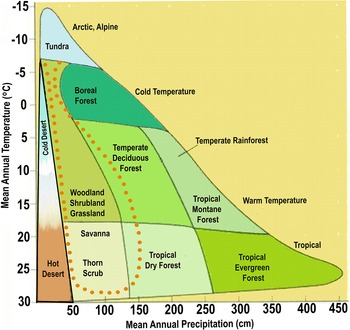
Drylands are exclusively based on climatic criteria – an aridity index (annual precipitation/evapotranspiration) less than 0.65 – without specific reference to land cover. This designation is ecologically appropriate insofar as the representative biomes occur in drier climates than do forests, but the wettest portions of grassland, savanna and shrubland biomes exceed this aridity index with a mean annual precipitation of 1,000 mm (Whittaker, Reference Whittaker1975) (Figure 2). Moreover, drylands represent the domain of the UNCCD, which includes arable lands.
Correlation between biomes and mean annual temperature and precipitation across the globe. Area within the dotted lines represents a zone of biome uncertainty in which natural disturbance regimes may prevent the climatic potential from being realized (modified from Whittaker, Reference Whittaker1975).

Grasslands are widely envisioned as expansive treeless plains, which are most prominent in Asia, North America and South America. However, globally, grasses often coexist with shrubs, trees and succulent plants in various combinations and proportions. These heterogeneous vegetation types – shrub-steppe, shrublands and savannas – are not effectively represented by the grassland designation and grasslands are frequently misinterpreted as degraded forests, rather than having evolved with unique climates and natural disturbance regimes (Bond et al., Reference Bond, Woodward and Midgley2005; Davis, Reference Davis2016).
The term rangelands has been extensively used in Western range science for over a century, primarily in Australia, South Africa and the U.S., but global usage has been limited. Two notable exceptions are the use of rangelands by the International Year of Rangelands and Pastoralists (IYRP, 2022), which adopted terminology developed by the International Rangeland Congress (IRC, 1978). Adoption of the term rangelands was strongly influenced by members of the U.S. rangeland community, which convened the inaugural rangeland congress in Denver, Colorado in 1978.
Broad international usage of rangelands has been limited by several major challenges. First, it has a negative connotation relative to forests, which dates to the mid-19th century when western European scholarship erroneously interpreted rangelands as degraded forests (Davis, Reference Davis2016; Kumar et al., Reference Kumar, Pfeiffer, Gaillard, Langan, Martens and Scheiter2020). In this context, rangeland is a social classification that emphasizes marginal land, rather than an ecological classification based on land cover (Sayre, Reference Sayre2017). Second, rangeland is often understood as a land use, emphasizing forage and livestock production, rather than a land cover type (UNCCD, 2024). Range livestock production is vital to pastoral livelihoods, but rangelands also hold great value to Earth stewardship for climate regulation, biodiversity conservation and numerous cultural values (Briske and Coppock, Reference Briske and Coppock2023; Zhang et al., Reference Zhang, Tariq, Hughes, Hong, Wei, Sun, Sardans, Penuelas, Perry, Qiao, Kurban, Jia, Raimondo, Pan, Yang, Zhang, Li, Ahmed, Beierkuhnlein, Lazkov, Toderich, Karryeva, Dehkonov, Hisoriev, Dimeyeva, Milko, Soule, Suska-Malawska, Saparmuradov, Bekzod, Allin, Dieye, Cissse, Whibesilassie and Ma2023). Third, the rangelands designation carries colonial implications derived from its European origins and imposition on indigenous lands (Davis, Reference Davis2016). Finally, a comparable term for rangelands does not exist in most languages, so translation presents a major challenge.
Open ecosystems were also considered inappropriate because they were introduced to identify a specific portion of this land category – grasslands and savannas that occur in climates warm and wet enough to support closed forests but are not forests or anthropogenically degraded forests (Bond, Reference Bond2019). In these cases, the natural disturbance regimes of fire and grazing prevent the climatic potential from being expressed as forest (Figure 2). The term “open” may further marginalize this land category by suggesting that it has minimal value and that it is well suited for alternative land uses, e.g., afforestation, agriculture and renewable energy (Briske and Coppock, Reference Briske and Coppock2023). Open ecosystems have several alternative meanings in ecology and information networking.
A multi-term designation was also considered – grassland–rangeland–savanna – but its value for further promoting global recognition of this land category is questionable. The composite term “grasslands and rangelands” has several supporting arguments: (a) “grasslands” is familiar/recognizable across places and languages, and many people value them; (b) and “rangelands” encompass the various land cover types that aren’t grasslands; (c) the two together allow for the presence or the absence of livestock grazing; (d) they both have recognized bodies of scholarship (grassland ecology, rangeland ecology). However, the existing ambiguity and inconsistency of each term are potentially compounded by their combined use (Table 1).
Selected land category designation
Grassy biome was selected as the most appropriate designation for this land cover category. It is characterized by a grass cover that varies from open grasslands to savannas with up to 60% tree cover that is maintained by natural disturbance regimes of grazing, drought and fire (Bond et al., Reference Bond, Woodward and Midgley2005; Parr et al., Reference Parr, Lehmann, Bond, Hoffmann and Andersen2014). Original usage of the term was similar to that of open ecosystems in that it was intended to establish tropical grasslands and savannas as being distinct from forests (Bond, Reference Bond2019) (Figure 2). However, recent usage of grassy biome indicates that it is more comprehensive than those of the topical systems originally identified.
We recommend that grassy biome be used to broaden the scope of the grassland biome, both tropical and temperate, by recognizing that grasses frequently coexist with other plant growth forms e.g., forbs, shrubs, succulents and scattered trees. The defining feature of this designation is a consistent cover of annual or perennial grasses throughout much of the year. In this context, grassy biomes also include tundra because grasses and grass-like sedges are an important land cover. The functional plant traits supporting high tolerance to drought, grazing and fire and low tolerance to prolonged shade make deserts, grasslands, savannas and shrublands more similar to each other than to forests (Bond et al., Reference Bond, Woodward and Midgley2005; Parr et al., Reference Parr, Lehmann, Bond, Hoffmann and Andersen2014).
The evolutionary history of the grassy biome has been well established in the palaeoecological record (Jacobs et al., Reference Jacobs, Kingston and Jacobs1999). They initially became widespread in the early to mid-Tertiary Period 30–60 MYA. Savannas and grasslands further expanded in the late Miocene Epoch 15 MYA as forests began to open in response to a drier and more seasonal climate. Herbivores coevolved with expanding grass-dominated biomes by adapting functional traits that facilitated grazing rather than browsing strategies.
A proposed definition for the grassy biome designation follows along with the current FAO definition for forests.
Grassy biome – Land spanning more than 0.5 ha with a minimum of 10% cover of annual or perennial grass for at least 2 months of the year (Lund, Reference Lund2007) and a canopy cover of trees greater than 5 m that does not exceed 45%. This land category includes grasslands, savannas, shrublands, deserts and tundra while cultivated, irrigated and agroforestry lands are excluded.
Forest – Land spanning more than 0.5 ha with trees higher than 5 m and canopy cover more than 10%, or trees able to reach these thresholds in situ. It includes young natural stands and forest nurseries but not forests on agricultural or urban lands (FAO, 2020).
We acknowledge that entirely unique designations may exist for this heterogeneous land category. A novel term that emerged from our deliberations was “terravista”. It is derived from the Latin word’s terra (“land”) and vista (“view”). “Terravista” expresses a feature common to all the biomes in this land category: namely, open visibility over long distances for a human on the ground. This effectively captures the reciprocal relation of “terravista” to forests because even though savannas have trees, the sparse densities permit ready visibility. While this may suggest a purely structural definition, we intend “terravista” to encompass the functional attributes associated with the grassy biome.
Forest–grassy biome demarcation
The recommended grassy biome category exhibits vast overlap with forest land based on FAO’s criterion of tree canopy cover >10% (Garzuglia, Reference Garzuglia2018; Scogings, Reference Scogings2023). This criterion was originally derived from the UNESCO report “International Classification and Mapping of Vegetation” (UNESCO, 1973), which defined “closed” forest as having interlocking canopies and “woodlands” as having a canopy cover >40%. The 1980 FAO forest resources assessment also referenced “open” and “closed” forests as having canopy covers of 10–40% and >40%, respectively (Garzuglia, Reference Garzuglia2018). However, the 2000 forest resources assessment eliminated the open and closed forest classifications and applied the minimum 10% canopy cover criterion to all forests. Modification of this important criterion appears to have been arbitrarily made without clear ecological or socioeconomic justification and it has received substantial criticism (Veldman et al., Reference Veldman, Overbeck, Negreiros, Mahy, Le Stradic, Fernandes, Durigan, Buisson, Putz and Bond2015; Scogings, Reference Scogings2023).
This canopy cover criterion greatly infringes on savannas, which occupy 20–25% of global land area (Scogings, Reference Scogings2023). Savannas are characterized by a continuous cover of C4 grasses that are interspersed with trees of varying density and canopy cover. Savannas typically occur in tropical and subtropical regions characterized by mean annual temperature >10 °C and mean annual precipitation of 200–2700 mm, which is distributed in distinct wet-dry seasons (Stevens et al., Reference Stevens, Bond, Feurdean and Lehmann2022). However, most savannas occur in a narrower range of mean annual precipitation of 400–1600 mm (Scogings, Reference Scogings2023). Savannas are of ancient origin and are maintained by interactions among climate, fire and grazing (Bond et al., Reference Bond, Woodward and Midgley2005). These disturbances enable grassy biomes to extend into climatic zones capable of supporting forests and long-term variation among these variables is known to have modified grassy biome–forest boundaries (Whittaker, Reference Whittaker1975; Staver et al., Reference Staver, Archibald and Levin2011) (Figure 2). However, this does not imply that forests can occupy major portions of these grassy biomes when these disturbances are lessened.
The distinction between savannas and forests is dependent upon the functional plant traits that determine shade and fire tolerance, in addition to structural criteria (Ratnam et al., Reference Ratnam, Bond, Fensham, Hoffmann, Archibald, Lehmann, Anderson, Higgins and Sankaran2011). The amount of canopy shade at which sun-tolerant savanna tree seedlings are replaced by shade-tolerant forest trees is considered a “deep shade” threshold (Charles-Dominique et al., Reference Charles-Dominique, Midgley, Tomlinson and Bond2018; Pilon et al., Reference Pilon, Durigan, Rickenback, Pennington, Dexter, Hoffmann, Abreu and Lehmann2021). This threshold occurs at a leaf area ratio (LAR, leaf area/ground area) of 1.0–1.5, which coincides with a tree canopy cover of approximately 40–45% (Martens et al., Reference Martens, Breshears and Meyer2000; Duursma and Mäkelä, Reference Duursma and Mäkelä2007). A second critical threshold, the “fire suppression” threshold, occurs when grass cover and production are insufficient to support frequent ground fires that are necessary to minimize tree establishment and maintain grass dominance (Ratnam et al., Reference Ratnam, Bond, Fensham, Hoffmann, Archibald, Lehmann, Anderson, Higgins and Sankaran2011). This threshold occurs at a LAR of 1.0 and C4 grasses that are characteristic of tropical savannas are greatly suppressed at a LAR > 1.5 (Charles-Dominique et al., Reference Charles-Dominique, Midgley, Tomlinson and Bond2018; Pilon et al., Reference Pilon, Durigan, Rickenback, Pennington, Dexter, Hoffmann, Abreu and Lehmann2021). These critical thresholds occur at a minimal tree canopy cover of approximately 40–45% which directly challenges the validity of the 10% canopy cover criterion used by FAO to define forests.
The adverse consequences of the 10% tree canopy cover criterion are highlighted in the FAO report entitled the “first global assessment of trees and forests in drylands”, which provides a forest-centric representation of drylands (FAO, 2019). The assessment indicates that 18% of drylands are forested, with 50 and 66% having a canopy cover >70% and 40%, respectively. However, savannas, which were not acknowledged in the assessment, likely comprise much of these dryland forests (Scogings, Reference Scogings2023). The assessment further indicated that woodlands, including shrublands, comprise 10% of drylands and that “other lands”, including barren lands and grasslands represent 28% and 25%, respectively (FAO, 2019). In contrast, the “thematic report on rangelands and pastoralists” conducted by the UNCCD describes rangelands as being comprised of deserts (35%), tropical grasslands and savannas (26%) temperate grasslands and savannas (13%) and three other minor vegetation types, in addition to tundra (15%) (UNCCD, 2024). The recommended grassy biome designation is intended to minimize these inconsistencies among multilateral organizations by collectively representing all major vegetation types with a grass cover (Figure 2).
We acknowledge that the grassy biome designation possesses limitations and ecological exceptions, but it is intended to serve as a critical administrative instrument more than an ecological concept. Consider that “forest” serves as an effective land cover designation even though forests differ greatly in structure, function, management and value. Therefore, we suggest that the grassy biome designation be interpreted in a similar manner to preclude ecological limitations and exceptions from obscuring the critical need for greater recognition and assessment of this land category.
Recommendations
We respectfully urge multilateral organizations, specifically FAO and UNCCD, to adopt the following two recommendations in support of IYRP 2022. First, adopt “grassy biomes” as a formal and universal designation for heterogeneous lands not included in forests, agricultural land and urban settlements to ensure that they receive comparable recognition and value to that of forests. Second, revise the 10% tree cover criterion for the definition of forests to a minimal value of 45% so that global savannas and shrublands are appropriately assigned to the grassy biome category. Establishment of an appropriate tree cover criterion will require careful evaluation of ecological, socioeconomic and land classification considerations.
Adoption of these recommendations would establish the foundation for the development and implementation of a grassy biome resource assessment that would be comparable to that of forest assessments, which have been conducted for the past 70 years. These combined assessments would encompass 75% of the Earth’s land surface and provide valuable inventory data in support of Earth stewardship. For example, a more comprehensive and quantitative inventory of grassy biomes would directly support the recent initiative launched by UNCCD to address the complex challenges confronting conservation, management and restoration of this land category and better support the aspirations and futures of its many peoples (Herrera Calvo and Alexander, Reference Herrera Calvo and Alexander2024). Continued prioritization of forest assessments over those of grassy biomes can no longer be justified given the pressing challenges confronting Earth stewardship and human well-being (FAO, 2019; Lewin et al., Reference Lewin, Murali, Rachmilevitch and Roll2024).
Open peer review
For open peer review materials, please visit https://doi.org/10.1017/dry.2025.2
Acknowledgements
The constructive comments of two peer reviewers are greatly acknowledged.
Author contribution
Conceptualization and writing of initial draft: D.D.B.; Graphics selection and modification: L.H.; Review, editing and development of alternative designation: N.F.S.; Development of savanna-forest boundary content: P.F.S.; Support of designation assessment and final editing: M. S-S and T.U.
Financial support
No financial resources supported this work.
Competing interest
The authors have no competing interests to declare.


 Open access


Comments
No accompanying comment.