

Therefore, the relationship between the informal economy and the state is, by definition, one of inevitable conflict (emphasis in the original). The whole point of the state is to assert the monopoly of its authority within a territory, but the whole point of informal entrepreneurs is to avoid or to subvert that authority. As we will see, this theoretically conflictive relationship devolves, in practice, into various forms of accommodation
(Centeno and Portes Reference Centeno, Portes, Fernández-Kelly and Shefner2006, 30)Introduction
In Latin America, informal activities represent a significant portion of the economy, occupying half of the workforce. Long understood as a by-product of market economies, traditional explanations have focused on their relationship with the formal sector, the structural causes of capitalist accumulation, or the excessive regulations that lead entrepreneurs to voluntarily exit the formal economy to avoid the costs of registration (Dell’Anno Reference Dell’Anno2021). Weak welfare systems also push citizens out of formal activities as they see informality as a way of escaping inadequate public goods and social protection mechanisms (Berens Reference Berens2020). More recent approaches have turned attention to the political and institutional conditions (Holland and Hummel Reference Holland and Hummel2022). Labor informality is not only the result of poor economic conditions, inadequate regulatory frameworks, or weak states unable to provide workers with sufficient employment options, but it also depends on states’ capacity and willingness to enforce their own laws.
Enforcement involves all sorts of controls carried out by regulatory agencies and all their possible follow-up measures (sanctions, prosecution, etc.). Recent scholarship suggests that governments alike modulate law compliance for electoral gain (Brollo et al. Reference Brollo, Kaufmann and La Ferrara2019; Feierherd Reference Feierherd2022; Holland Reference Holland2015). Rather than a technical issue, enforcement is a political process in which incumbents make choices about when and where to apply the rules (Short Reference Short2021). Sometimes these choices are motivated by institutional constraints. In settings with limited state capacity, political actors can achieve substantive social outcomes by modifying compliance levels rather than changing the rules (Brinks et al. Reference Brinks, Levitsky, Victoria Murillo, Brinks, Levitsky and Murillo2020). In other cases, the rationale is purely electoral. Politicians have well-founded reasons to tolerate informality when those marginalized from the formal labor market, or those who benefit from this informal work, make up a significant part of the electorate. However, incumbents also have motives to be tough on informality when it is part and parcel of their constituents’ demands: if their electorate faces unfair competition from those who evade the rules, the enforcement of labor regulations allows politicians to signal their commitment against informality.
This article addresses the electoral grounds behind the selective control of labor informality in Chile. On a theoretical level, we draw on Alisha Holland’s (Reference Holland2016) notion of forbearance, or the intentional and revocable nonenforcement of law, but rather than focusing on the reasons for leniency, we explore the motives of those governing to enforce the law more or less zealously at certain times and places in order to gain electoral advantage. Building on the literature on distributive politics, we argue that, in contexts of weak institutions and scarce resources, incumbents will apply enforcement selectively, targeting inspections to the areas and at the moments that will provide them with the highest electoral returns.
To operationalize our argument, the empirical analysis takes panel data on labor inspections, electoral outcomes, and socioeconomic conditions for the 345 Chilean municipalities over the period 2005–19. We consider the number of inspections per municipality as indicative of enforcement, and we inspect two drivers widely studied in the scholarship on distributive politics: partisan competition and the timing of elections. The identification strategy relies on two-way fixed effects (FE), and is robust to an event-study approach to test the causal incidence of elections over enforcement. The estimations indicate that right-wing governments modulate the timing and the spatial targeting of inspections, but contrary to previous literature, we find no statistically significant sign of forbearance by left-wing governments. In particular, our results show a selective enforcement by conservative governments, increasing the number of inspections in a significant way in the most competitive districts, and accelerating the pace of control as presidential polls approach.
This piece of work contributes to the literature on the electoral determinants of informal work in three major ways. To the authors’ knowledge, this is the first article addressing the electoral motives of the right for being selective in the control of labor informality. Previous analyses have focused on the left in order to provide detail on how progressive ruling parties forbear in the application of law as an electoral strategy to court the informal voter. As such, our work advances in understanding the reasons for conservative incumbents to apply the law selectively, and tests these arguments empirically. The other contributions are related to the allocation strategy. Our estimates show that the central government concentrates inspection resources on the constituencies where it obtained a smaller margin of victory, and that it follows the timing of the presidential elections. By contrast, the results of the municipal polls do not correlate with enforcement. The combination of these two insights reveals two features of the allocation strategy: first, the central government pursues its own electoral interests in a top-down strategy, and not those of its local strongholds; second, the right targets inspections at the most competitive districts. We interpret the latter as a nod to the part of its electorate that faces competition from rule-avoiders, hoping to be rewarded for its performance against informality.
The remainder of the article proceeds as follows. In the next two sections, we present the theoretical arguments concerning the political motivations for selective enforcement by incumbents on the left and right, followed by the research hypothesis. We then move into explaining the institutional framework. Afterwards, the data and the methodology are described. Next, we display the baseline results followed by the robustness exercises. The article concludes with a reflection on the results and the policy implications.
Labor Informality and the Politics of Selective Enforcement
Informal work is constrained by existing regulatory environments and their control through inspections, fines, and other penalties for businesses that violate laws. By increasing the costs of non-compliance, enforcing existing norms can encourage businesses to comply with labor laws. Traditionally, non-compliance has been associated with institutional weakness, corruption, or state capture by interest groups, particularly in countries of the Global South (Amengual and Dargent Reference Amengual, Dargent, Daniel, Levitsky and Murillo2020). However, the enforcement of informality is a political process subject to different influences and constraints. Governments of all kinds not only have different positions on the control of informality, but also have different attitudes in order to appeal to their constituencies. In settings where informal workers constitute a significant proportion of the labor force and the electorate, rulers may have different motivations for being more or less tolerant of violations of the law. Below, we explore the electoral incentives behind the selective enforcement of rules.
As a starting point, it is worth conceptualizing forbearance, since it can be useful as a concept that both mirrors and illustrates that of selective enforcement. Defined as the intentional and revocable government leniency toward violations of the law (Holland Reference Holland2016, 233), forbearance refers to a situation in which institutions, at a certain time and with regard to certain groups, refrain from applying regulations. This form of leniency does not stem from lack of institutional capacity, but from a deliberate decision not to enforce. It therefore entails discretion, a political choice. In this regards, forbearance can be used to gain electoral advantage because it can be targeted to particular constituents (e.g., informal workers) in exchange for support. Three characteristics make forbearance an attractive tool for mobilizing votes (Holland Reference Holland2016): (1) it can be revoked, that is, politicians can extend and retract it at will; (2) it can be adjusted informally, in other words, it is a hidden practice that allows potential vetoes from other social actors to be overcome; (3) and it is targeted to those willing to violate the law.
Taking these insights to selective enforcement, we can think of this as a selective application of existing rules to certain groups at certain times with the intention of obtaining some kind of electoral return. It therefore implies different degrees of compliance between forbearance and full enforcement. Like the former, it can be adjusted informally to match the expectations of the incumbent, and it can be revoked, or rather, it can be applied with different levels of zeal. However, forbearance plays more explicitly with the notion of revocability (Dewey et al. Reference Dewey, Woll and Ronconi2021, 11): a conscious decision has been made to be more tolerant. By contrast, selective enforcement emphasizes the idea that institutions in charge of controlling informality can modulate their actions, targeting efforts and resources to specific areas or groups and at specific times.
Several studies have operationalized forbearance empirically. For instance, Brollo et al. (Reference Brollo, Kaufmann and La Ferrara2019) evince that politicians aligned with the ruling party seeking re-election are more lenient on the violation of the requirements for the Bolsa Familia conditional cash transfer program. Also in Brazil, Feierherd (Reference Feierherd2022) shows that leftist PT mayors slow the pace of inspections as a way of courting informal workers. Non-compliance includes different types of goods and rationales. López-Cariboni (Reference López-Cariboni2019) studies electricity services to show how incumbents tolerate irregular access during economic downturns as a form of social policy. The latter signals forbearance as a redistribution mechanism: when social policies are insufficient or fail to reach those outside the formal sector, it can be tailored to provide access to income or public goods to the less well-off (Holland Reference Holland2015). In other cases, tolerance is not intended to attract votes, but to solve collective action problems, particularly in states with weak institutional capacity. If enforcement is costly, governments may take an active role in tolerating informality and encourage potential violators to organize and, once organized, interact with them over regulations (Hummel Reference Hummel2017).
The Electoral Dilemmas of the Left and the Right
An important issue is whether incumbents on the left and right have different incentives to be more or less lenient on informal work. Left-wing governments face a puzzling situation. On the one hand, they are intended to protect and expand the labor rights of the formal working class that forms part of their core constituency. This would entail a special zeal in labor inspections to bring companies that do not comply with regulations on informality to light. Ultimately, regulations are meant to protect workers’ rights. Indeed, in Latin America’s highly fragmented societies, leftist parties have often prioritized expanding the relatively privileged formal workers’ conditions over socially excluded sectors (Fairfield and Garay Reference Fairfield and Garay2017). However, cracking down on small and non-competitive companies can have unintended consequences on the employment situation of informal workers. Feierherd (Reference Feierherd2022) argues that the left resolves this coalitional dilemma by forbearing: by cutting down the number of inspections where it governs, it is able to meet the demands of its working-class constituency without hurting the interests of its informal electorate.
Analyses on forbearance have focused on the incentives of left-leaning incumbents (e.g., Brollo et al. Reference Brollo, Kaufmann and La Ferrara2019; Feierherd Reference Feierherd2022; López-Cariboni Reference López-Cariboni2019). In fact, there is no work that we are aware of addressing the electoral motives of the right. Nevertheless, there are sound reasons to expect right-wing incumbents to implement selective enforcement, although it is not clear, a priori, how they will do so. First, let us consider the electoral behavior of informal workers. A meta-analysis for Latin America found that informal workers are less likely to vote than formal ones, and that informal workers are more likely to vote for the left, although both effects are small (Baker and Dorr Reference Baker and Dorr2022).
Even more important is the fact that the right, like the left, faces an electoral conundrum since their upper-income and formal business constituencies have varying interests depending on their ties with informal work. We can illustrate the point from Chen’s (2012) landmark article on the theories of the informal economy. Part of the business sector benefits from informal work by lowering costs and making production more flexible. These constituents would oppose state intervention, insofar as informal labor subsidizes the competitiveness of their enterprises (Castells and Portes Reference Castells, Portes, Castells, Benton and Baltimore1989). However, another portion of the business community is harmed by the unfair competition of enterprises that avoid regulations and hire unprotected workers. The latter would advocate law enforcement to bring these practices into the formal regulatory environment (Chen 2012).
We expect the right to solve this puzzle through a selective application of regulations. In some cases, this will lead to greater tolerance of informality. For instance, in settings where the prevalence of informality is high, where productive specialization relies on informal work, where there is a weak institutional framework and lack of inspection resources or where there is a tolerant social attitude towards informality, the rational choice is to be permissive in order not to change the status quo. However, in contexts where informal work is not so widespread, where an important part of the business community faces competition from those who evade the rules and where the upper- and upper-middle classes demand a tough hand against informality, right-wing parties have every reason to be strict in order to woo their electorate. In essence, right-wing governments will make de facto decisions to ignore violations of the law under certain circumstances and accelerate the pace of inspections in others, but the concrete form of this selective application of the regulations will depend on the particular socioeconomic and institutional conditions. As Amengual and Dargent (Reference Amengual, Dargent, Daniel, Levitsky and Murillo2020, 165) summarize, selective enforcement is a modal form of nonenforcement in Latin America; there are many points of institutional breakdown where there are simply no strong political or societal interests pushing the state to take action and allocate limited resources that could be spent elsewhere. The question is, then, where, when, and why to be more or less selective in controlling informality in order to maximize the electoral returns.
The literature on distributive politics can shed light on this matter (Golden and Min Reference Golden and Min2013). To begin with the where, theoretical arguments and empirical evidence suggest that electoral competition affects resource allocation. Theoretically, electoral competition models show that, if parties are equal in their abilities to allocate redistributive benefits, they will target those groups that are most willing to switch their votes (Dixit and Londregan Reference Dixit and Londregan1996). Empirically, several analyses have documented how incumbents redistribute resources to the most competitive districts as an electoral strategy (Brollo and Nannicini Reference Brollo and Nannicini2012; Veiga and Veiga Reference Veiga and José Veiga2013; Gainza and Livert Reference Gainza and Livert2021). Translated to informality enforcement, this would imply that, in contexts of weak institutions, right-wing incumbents would modulate the scarce inspection resources in the most competitive settings as a lever to attract votes.
Regarding the when, scholarship on political budget cycles has shown that policy implementation tends to oscillate following the electoral calendar (De Haan and Klomp Reference De Haan and Klomp2013). The underlying assumption is that voters are backward looking and shortsighted (Alesina Reference Alesina1989), hence, they evaluate politicians’ performance on the basis of their most recent actions. Ample evidence suggests that elected officials target constituencies with a wide array of instruments as elections approach, from public spending (Livert and Gainza Reference Livert and Gainza2018), to transfers (Corvalán et al. Reference Corvalán, Cox and Osorio2018; Gainza and Livert Reference Gainza and Livert2021), to taxes (Prichard Reference Prichard2018). Concomitantly, varying the pace of inspections in the run-up to elections can help conservative politicians in their quest for re-election, but whether they will ultimately be more or less permissive as the clash comes closer will depend on the preferences of their electorate in different contexts.
Hypotheses
Our theoretical arguments have outlined the trade-off faced by both the left and the right in the control of informal labor. While the literature suggests that the left resolves this dilemma by forbearing, we have argued that the actual performance of the right will depend on the prevalence of informality, the institutional conditions, and the attitudes of its electorate towards those who evade regulations (the why question raised above). Before going into detail on the institutional setting, let us illustrate this point with reference to Chile in a way that also serves to give more context to our case study.
Chile is one of the Latin American and Caribbean countries with the lowest levels of informal employment, second only to Uruguay. The informal employment rate currently stands at 27%, and over the last two decades, it has decreased from 39.5% in 1998 to 28% in 2018 (Instituto Nacional de Estadística [INE] 2024). Informal employment includes self-employment and informal employment within firms, usually micro-enterprises and small firms. Self-employed workers have the highest rates of informality (66% on average), followed by domestic workers (52%), and private sector workers (16%) (INE 2024). Labor informality is a phenomenon predominantly localized in small enterprises. The informal employment rate in firms with less than 5 workers is 64% and in firms with 5–10 workers it is 23%; in contrast, in firms with 50–199 workers and 200 or more workers, the rate is 6% and 7% respectively (Ministerio de Hacienda 2022). By sector, commerce accounts for the largest number of informally employed persons by far (525,000), followed by construction (293,000) and manufacturing (226,000). This snapshot indicates that the structural component of informality is lower and the links between the informal and the formal sector seem to be weaker than in other Latin American countries, where the competitiveness of formal enterprises relies to a larger extent on informal employment. Consequently, we do not expect formal business constituents to demand a tolerant attitude towards informal work from politicians. On the contrary, it seems reasonable to expect a demand for greater control by those facing competition from informal labor recruiters, especially formal micro-entrepreneurs.
On the other hand, in Chile, complaints of unfair competition by traders and small businesses are recurrent. As recently noted, commerce is by far the sector with the largest number of informal workers and this sector has been vigilant against informal work. In 2016, the National Chamber of Commerce, Services and Tourism launched the Illicit Trade Observatory to generate relevant information and influence public policy (https://www.cnc.cl/ocis/). Likewise, small entrepreneurs have been active against informal work: in 2024, the Confederation of Production and Commerce (CPC), the Association of Pension Fund Administrators (AAFP), and the Association of Entrepreneurs of Chile (ASECH) created the Labor Formality Roundtable to propose 15 measures to tackle labor informality (CPC, AAFP, and ASECH 2024). Following on from the argument made above, this leads us to hypothesize that it is in the interest of the right to show a strong hand in order to woo that part of the electorate threatened by the unfair competition of informal work.
Alongside the profile of informal work and the disposition of small formal entrepreneurs, the right’s positioning on informal work also reinforces the idea of selective enforcement. Chilean society is strongly divided along class lines, and the right has taken a hard line against informality as part of its argument, something that is supported by a range of documentary evidence: in the two campaigns that brought him to the presidency, the conservative Piñera advocated improving labor inspection institutions (Piñera Reference Piñera2009, Reference Piñera2017) and, once in office, implemented several initiatives to enforce compliance with labor laws (e.g., Instituto de Seguridad Laboral 2011) and to crack down on illegal retail (e.g., La Tercera 2022).
Based on the theoretical arguments and the particular conditions of Chile, we raise the following research hypotheses:
-
H1: Electoral competition drives a selective application of labor informality enforcement.
-
H2: The enforcement of labor informality fluctuates throughout the electoral cycle, with the pace of inspections varying as presidential and municipal elections approach.
-
H3: There are systematic differences in the enforcement of labor informality between the right and the left. The left is more permissive to gain the support of informal constituents, whereas the right is stricter to court an electorate that demands a tough hand on informality.
Institutional Setting
Chile is a good case selection for four fundamental reasons. First, unlike other Latin American countries, electoral competition involves two stable contenders with marked programmatic differences. This competition has resulted in contested elections, both presidential and local, and in the alternation of power. Second, at the sub-national level informality rates show greater variability than in other Latin American countries, which is crucial for the estimation strategy. Third, labor inspections are distributed heterogeneously throughout the country and their governance involves different institutional levels: decisions on where to proceed rest on the Labor Directorate, an institution operating under the Ministry of Labor and Social Security, and local authorities, which are responsible for executing enforcement within their jurisdiction. Finally, there is some room for discretion in the control of informal work. According to the institutional reports of the Labor Directorate, while some labor inspections are complaint-driven, regional and local authorities arrange a significant proportion of the labor inspections. The proportion varied in different periods across the various municipalities in the country, reflecting not only the multilevel nature of the inspection process, but the margin for being selective in informality enforcement. In what follows, we develop these claims.
The Chilean Party System
From the return of democracy to the social unrest of 2019/2020, Chile has been characterized as having one of the most institutionalized party systems in Latin America (Valenzuela, Somma, and Scully Reference Valenzuela, Somma, Scully and Mainwaring2018). Even if there are several political parties, electoral competition has revolved around two coalitions structured along left/right axes. The center-left Concertación was created to unite the opposition to the dictatorship and comprised several parties (the Christian Democrats (PDC), the Democrats (PPD), the Social Democrats (PRSD) and the Socialist Party (PS)), whereas the right-wing Alianza consisted of conservative UDI, RN, and a number of minority parties that supported the military regime. Until the 2022 elections, which brought a third contender into government, these two coalitions alternated in power. Concertación ruled until 2010, when it was defeated by the Alianza for the first time. The left regained power in 2014 through a renewed coalition called Nueva Mayoría (New Majority), and in 2018, the right returned to government with the new coalition Chile Vamos.
Several reasons explain the stability of the party system and electoral competition during our sample period. First, a binomial electoral system was designed under Pinochet’s military dictatorship that persisted until the 2018 reform. The binomial electoral formula created districts that elected only two representatives and assigned both seats to the winning list only if they obtained twice the amount of votes than the runner-up. This formula, designed to over-represent right-wing parties and give stability to the electoral system, also meant reducing the number of contenders to two, as different parties joined in coalition. Second, the vote remained relatively stable in relation to ideological and programmatic coordinates (Valenzuela et al. Reference Valenzuela, Somma, Scully and Mainwaring2018). The two coalitions had a strong identification, with the right aligned to conservative values and the upper classes, and the center-left ranging from various left-wing parties to the Christian Democrats. The two contenders also differed in their programmatic proposals, and compared to other Latin American countries, the vote rested, to a higher degree, on these policy alternatives rather than on clientelistic incentives (Kitschelt et al. Reference Kitschelt, Hawkins, Rosas, Zechmeister, Kitschelt, Hawkins, Rosas and Zechmeister2010). Finally, coalitions remained stable over time without party shifts across blocs, a recurrent phenomenon in the region. Over time, however, this relatively stable scenario was to be eroded as the party system became increasingly elite-driven and socially uprooted (Bargsted and Maldonado Reference Bargsted and Maldonado2018), until the social unrest in 2019/2020 and the alternation of the two coalitions in government in 2022.
At the local level, the two-player scenario splits as several parties that amalgamate for presidential elections present their own choices. Moreover, municipal politics has its own specificities, such as the presence of independents, the creation of regional party organizations, the lack of coordination within national party structures, and the exaggerated territorial predominance of strong parties or mayors (Suárez-Cao and Muñoz Reference Suárez-Cao and Muñoz2017, 6). As a result, competition is stiffer and the highest vote share in municipal ballots does not usually exceed 20%. Nevertheless, we can sort municipalities into right or left depending on local parties’ support for one or the other block in presidential disputes.
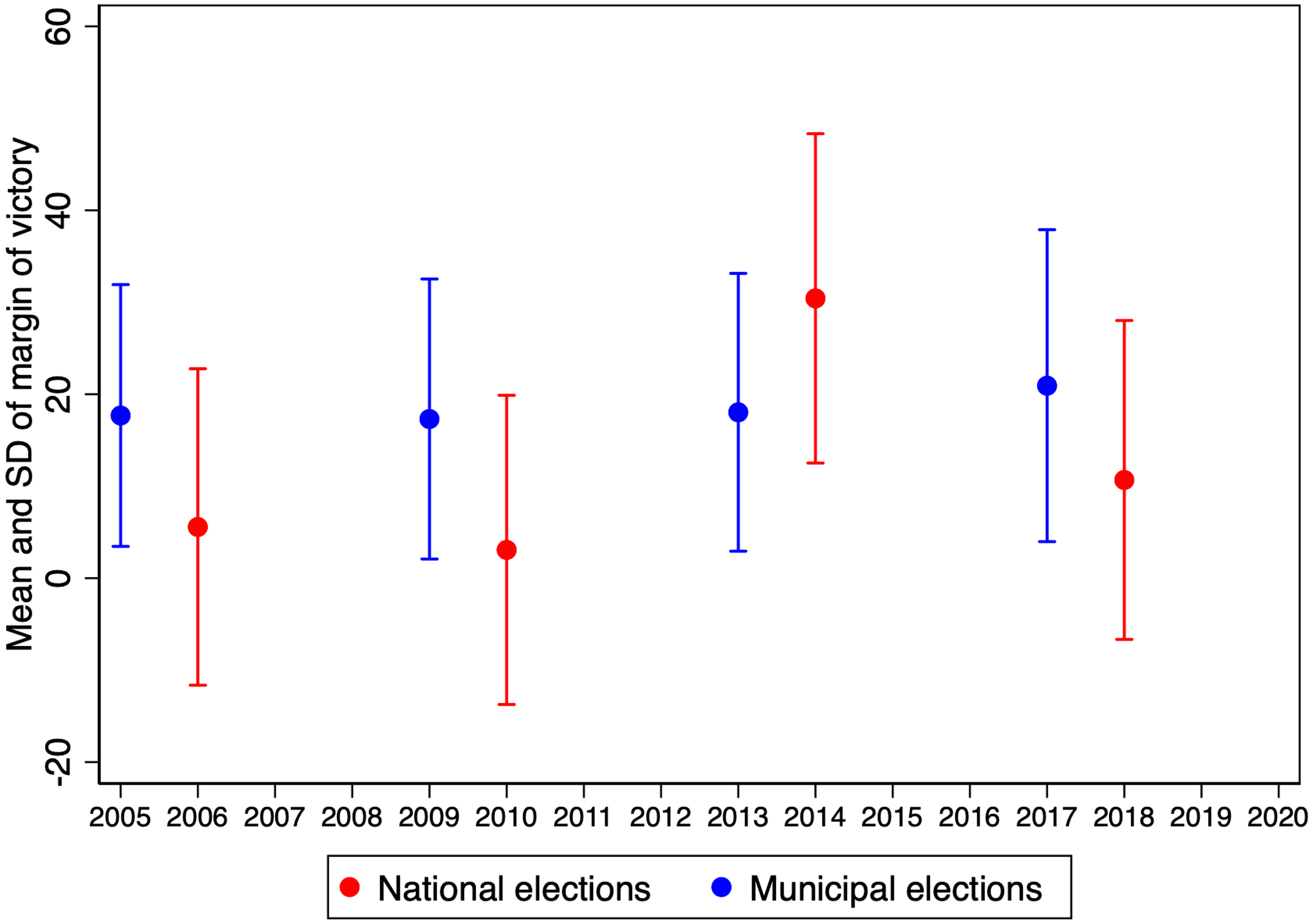
Figure 1 shows the evolution of the margin of victory in presidential and municipal elections during our sample period, which are two of the variables we examine (see below for further detail). Local competition has remained more stable, with an average difference between the first and the second slightly below 20%. Presidential elections show greater variability. The 2005 clash, when the center-left won, and the 2009 dispute, when the right took over the government for the first time, were very close. Michelle Bachelet’s return in 2013 marked a comfortable victory for the center-left, while the right regained the presidency more narrowly in 2017.
The Margin of Victory between the First and the Runner-up in Presidential and Municipal Elections.
Source: The authors.
The Enforcement of Labor Informality in Chile
The responsibility for enforcement lies with the Labor Directorate (DT), an organization created in 1907 that operates on a decentralized basis under the authority of the Ministry of Labor and Social Security. As such, its management and orientation changes with the shifts in the national government. This institution is responsible for overseeing and supervising compliance with labor legislation in the country. The DT’s main function is to protect workers’ labor rights and to ensure compliance with labor regulations by companies. To this end, it has a network of inspectors and lawyers specializing in labor issues who undertake inspections in companies.
The DT is organized countrywide through regional labor directorates, which are located in each of the 16 regions of the country. In addition, there are 47 provincial labor inspectorates and 82 municipal labor inspectorates in the country. Each year, a national inspection target is established. However, the regional and local authorities plan and decide where to carry out inspections, some as a result of complaints and others planned by labor inspectorates. According to the DT’s annual reports, less than half stem from workers’ or citizens’ complaints, while the rest are discretionally planned by local and regional authorities.
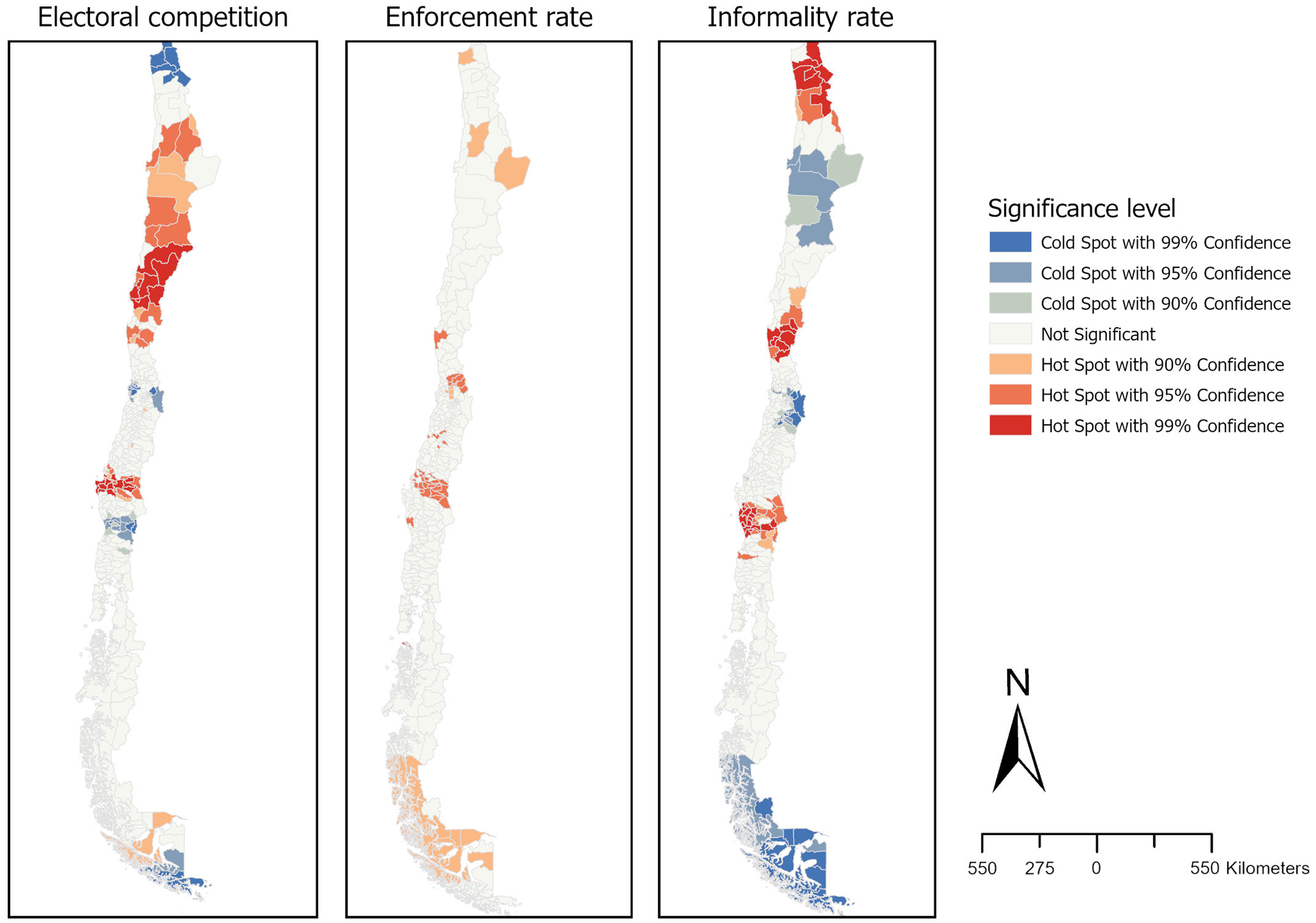
To show the spatial distribution of electoral competition, enforcement, and informality Figure 2 depicts from left to right the average difference in the margin of victory in presidential elections between the first and the runner-up as a measure for electoral competition; the number of inspections per 1,000 firms by municipality to capture the enforcement rate; and the informality rate. We take the informality rate from Livert et al. (Reference Livert, Miranda and Espejo2022), which is an estimation of the probability of informality at the local level based on several indicators; data are for the year 2017, as there is no time series. We performed a cluster analysis for each of the variables in order to identify areas where there are high and low prevalence rates at 90%, 95%, and 99% confidence levels. As the map shows, the most competitive municipalities are in the center-north and center; the enforcement rate is higher in the center, some municipalities of the North and in the South, whereas informality is higher in the North, Center-North, and the center.
Electoral Competition, Enforcement Rate, and Informality Rate by Municipality.
Source: The authors.
Additionally, the data in Appendix 1 displays the enforcement rate during presidential election years under left- and right-wing administrations. The variable captures the average rate of the two periods in which each of the administrations governed (2006–10 and 2014–19 the left, 2010–14 and 2019–23 the right), and PE stands for the presidential election year. This allows us to have a first glimpse of labor inspection efforts by progressive and conservative governments throughout the electoral cycle, which is one of the focuses of our statistical exercise. As the graph highlights, there appear to be systematic differences between left- and right-wing governments since, although both show signs of the electoral cycle, the inspection rate is significantly higher during conservative administrations.
The resources allocated also varied across governments. According to the information provided by the Chilean Ministry of Labor in its Comprehensive Management Balance Sheet (Balance de gestión integral) for the period 2005–20, in the two legislatures governed by the right, the budget and the staff allocated to labor inspection increased by 11% and 3%, respectively (https://www.dt.gob.cl/portal/1626/w3-propertyvalue-22973.html).
Data and Methodology
In order to test the above-stated hypotheses, the methodological strategy considers panel data for the 345 Chilean municipalities over the period 2005−19. The analysis takes information on labor inspections from the Ministry of Labor and Social Security, local and presidential elections, socioeconomic variables, municipal efficiency indicators, and geographical data. We take the enforcement rate, measuring the number of planned labor inspections per 1,000 companies in the municipality as the dependent variable. This variable comprises inspections carried out to ensure compliance with labor regulations, in other words, those aimed at detecting unprotected labor, illegal overtime, inadequate working conditions, and so on. We are therefore not measuring the control of the informal sector, which refers to production in unregistered enterprises, but the control of informal employment, that is, employment outside labor protection regulations (Chen 2012).
 $$Enforcement\;rat{e_{it}} = {{Labor\;inspection{s_{it}}\over{firm{s_{it}}}}\;x\;1000}$$
Independent variables are related to local and national election results. We include the following electoral variables: the vote margin in municipal and presidential elections to measure electoral competition, computed as the percentage difference between the votes obtained by the winner and the runner-up in the previous clash; municipal election year, presidential election year and the subsequent year (the variable year_2) to account for the electoral cycle; and coalition, capturing whether the government was left- or right-wing. The results of local and presidential polls are exogenous to enforcement decisions since polling dates are fixed and decided regardless of the wishes of local and national authorities. Municipal and presidential elections are held on the last Sunday of October once every four years, but there is a one-year gap between local and presidential ballots. The sample includes three local (2008, 2012, 2016) and four presidential (2005, 2009, 2013 and 2017) ballots, a period during which both the left and the right have ruled for two terms each. Aside from independent variables, we introduce a set of controls to account for local geographic, socioeconomic, employment, and municipal efficiency characteristics (see Appendix 2 for definitions and descriptive statistics of the variables).
Four econometric models were designed. Models 1 and 2 are related to the first hypothesis and aim to test whether competition in municipal and presidential ballots drives enforcement. As suggested, we expected audits to vary in the most competitive constituencies if governments use labor inspections as an electoral lever to attract votes.
 $$Enforcement\;rat{e_{it}} = \alpha \; + \beta 1\;Margin\;of\;victory\;{\left( {municipal} \right)_{it}} + \gamma {{\boldsymbol Z}_{it}} + {\sigma _i}\; + {\tau _t} + {u_{it\;}}$$
 $$Enforcement\;rat{e_{it}} = \alpha \; + \beta 1\;Margin\;of\;victory\;{\left( {presidential} \right)_{it}} + \gamma {{\boldsymbol Z}_{it}} + {\sigma _i}\; + {\tau _t} + {u_{it}}$$
The second hypothesis stated that the enforcement rate fluctuates along with the electoral cycle. Model 3 includes dummies for municipal election year, presidential election year, and the subsequent year (year_ 2 ) to account for the variation in labor inspections during municipal and presidential ballots. We also added the interaction between the victory margin and polling years to test whether electoral competition conditioned enforcement decisions as elections approached (Model 4).
 $$\eqalign{ & Enforcement\;rat{e_{it}} = \alpha \; + \beta 1Margin\;of\;victory\;{\left( {presidential} \right)_{it}} + \;\beta 2\;Municipal\;Election\;yea{r_t} \cr & \quad \quad \quad \quad \quad \quad \quad \quad \quad \quad + \;\beta 3\;Presidential\;Election\;yea{r_{}} + \;\beta 4\;year\_{2_t} + \gamma {{\bf{Z}}_{it}} + {\sigma _i}\; + {\tau _t} + {u_{it}}\cr} $$
 $$\eqalign{ & Enforcement\;rat{e_{it}} = \alpha \; + \beta 1\;Margin\;of\;victory\;{\left( {presidential} \right)_{it}} \cr & \quad \quad \quad \quad \quad \quad \quad \quad \quad \quad + \beta 2(Margin\;of\;victory\;{\left( {presidential} \right)_{it}}\;x\;\;Municipal\;Election\;yea{r_t}) \cr & \quad \quad \quad \quad \quad \quad \quad \quad \quad \quad + \beta 3(Margin\;of\;victory\;{\left( {presidential} \right)_{it}}\;x\;Presidential\;Election\;yea{r_t}) \cr & \quad \quad \quad \quad \quad \quad \quad \quad \quad \quad + \beta 4(Margin\;of\;victory\;{\left( {presidential} \right)_{it}}\;x\;\;year\_{2_t}) + \gamma {{\bf{Z}}_{it}} + {\sigma _i}\; + {\tau _t} + {u_{it}} \cr} $$
The models adopted a fixed-effects (FE) heteroscedasticity and autocorrelation robust estimation with municipal and time effects. The municipal fixed effects control for place-specific factors that are fixed over time, whereas the year fixed effects control for factors that vary over time but are common across all municipalities. Robust standard errors were estimated clustering them at the municipality level to control for serial and spatial correlation. In every specification, ${{\boldsymbol Z}_{it}}$
is a vector containing geographic, socioeconomic, employment, and municipal efficiency control variables,
${{\boldsymbol Z}_{it}}$
is a vector containing geographic, socioeconomic, employment, and municipal efficiency control variables, ${\sigma _i}$
and
${\sigma _i}$
and ${\tau _t}$
that account for municipal and time effects respectively, and
${\tau _t}$
that account for municipal and time effects respectively, and ${u_{it}}$
is the error term.
${u_{it}}$
is the error term.
We ran the regressions for right and left separately to check if there are systematic differences between them. The third hypothesis posits that rightist administrations would be tougher on inspections as a way of wooing their electorate. Consequently, we expected electoral competition and ballot years to be particularly significant during right-wing governments.
Results
Baseline Estimates
Table 1 presents the estimations for the effect of electoral competition on enforcement. When considering the whole period (columns 1–2), competition does not seem to affect the rate of inspections, as the margin of victory in neither municipal nor presidential elections is statistically significant. If we differentiate by government type, under left-wing administrations, we do not observe any meaningful effect (columns 3–4), but for the right, the margin of victory in presidential elections is statistically significant at 1% (column 6). The negative coefficient suggests that inspection accelerates the more competitive the district is, namely where the right achieved a tighter result in the previous polls; specifically, a percentage point decrease in the difference between first and second place in presidential clashes increases the enforcement rate, on average, by 0.33. Conversely, the municipal election performance is not accounted for (column 5). This outcome suggests that the central government, and not the local government, is the one that takes the credit for them. To assess the sensitivity of our first set of results, Appendix 3 displays the margin of victory estimates for right-wing governments with and without each of the controls. In all models, the coefficients for the margin of victory remain statistically significant, while the only control that is significant is the municipal own revenue per capita.
FE Estimations for Electoral Competition and Enforcement
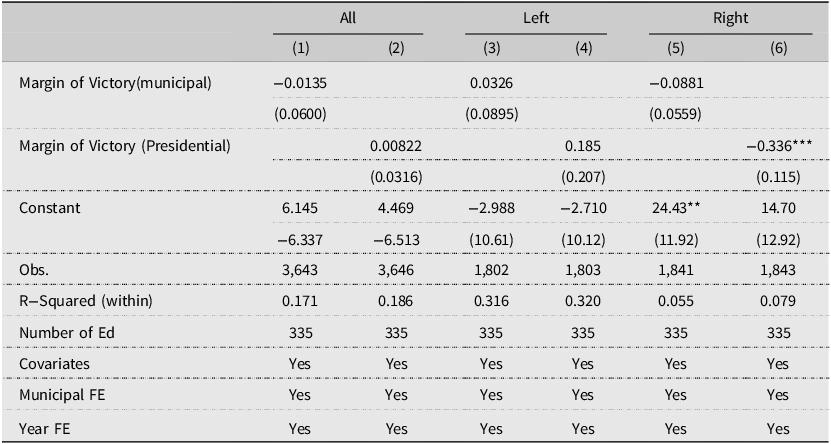
Note: Robust standard errors, clustered at the municipality level, are in parentheses. ***p<0.01, **p<0.05, *p<0.1.
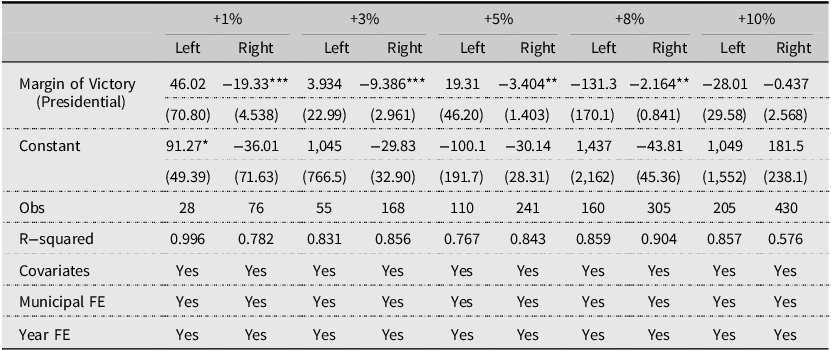
Based on the insights above, we ran Model 2 for the right and the left considering different margin of victory thresholds to see how enforcement varies with electoral competition for both political coalitions. Table 2 displays the coefficients when the vote difference between the first and the second is below +1%, +3%, +5%, +8% and +/10%. This exercise shows that the rate of inspections is higher in the most competitive municipalities under right-wing governments, whereas we find no statistically significant effect for the left. When the right won in the municipality by less than 1 percentage point, a 1% decrease in the margin of victory increases the rate of inspections by 19%. Thereafter, the rate decreases as presidential races become less competitive, and from a margin of victory above +10%, it is no longer statistically significant.
FE Estimations for Different Margin of Victory Thresholds and Enforcement for the Right and the Left
Note: Robust standard errors, clustered at the municipality level, are in parentheses.
***p<0.01, **p<0.05, *p<0.1.
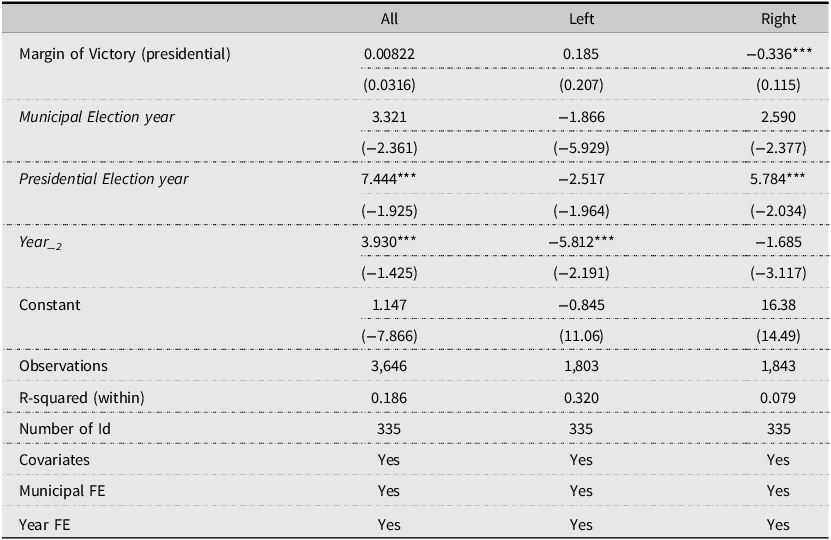
The second set of analyses examines whether the timing of elections conditions enforcement. In Table 3, the results for the effects of municipal and presidential elections (municipal election year and presidential election year, respectively) and the subsequent year (Year_ 2 ) are calculated, vis-à-vis Year_ 3 . Since both municipal and presidential races are in the last term, it seems reasonable to focus on ballot year. When we take the whole sample, inspection rate increases during the presidential election year and the following. In contrast, there is no significant effect in municipal election years. The general increment in audits as presidential polls approach is motivated by the performance of the right. The right boosts inspections just before presidential clashes, indicative of a strategic behavior to appeal to a constituency that demands a firm stance on informality. For the left, although all coefficients are negative, none is statistically significant except year_ 2 , which would indicate that it reduces the number of inspections one year after the presidential dispute.
FE Estimations for the Electoral Cycle and Enforcement
Note: Robust standard errors, clustered at the municipality level, are in parentheses.
***p<0.01, **p<0.05, *p<0.1.
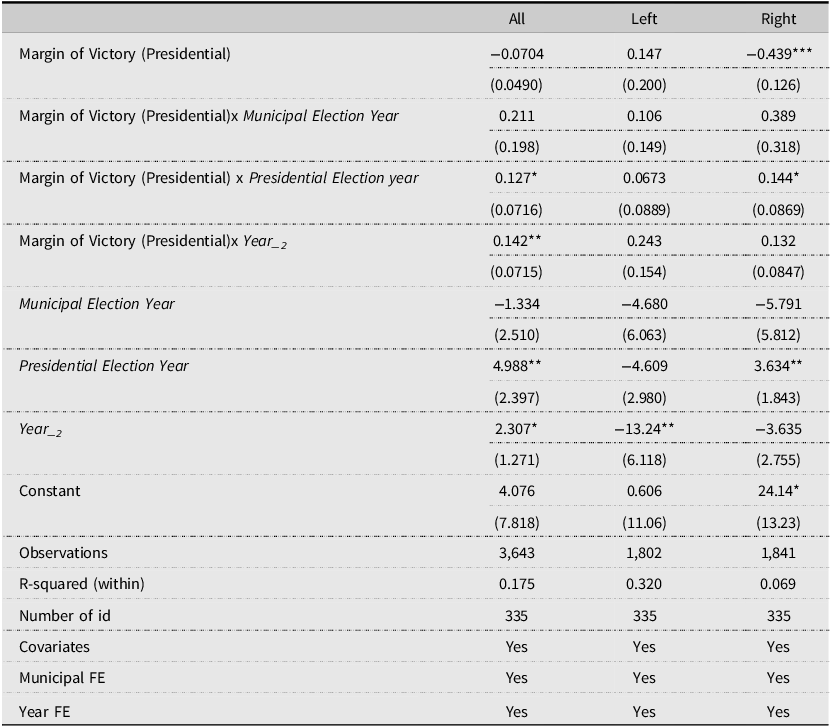
Table 4 captures the interactions between the margin of victory and election years to see whether competition dynamic varies throughout the election cycle. Consistent with Models 1 and 2, under conservative administrations the margin of victory is inversely related to enforcement and the number of audits increases during presidential ballot years. Additionally, the interaction between margin of victory (presidential) and presidential election year is statistically significant at 10%, suggesting a strategic performance in the most competitive districts as presidential elections come closer.
FE Estimations for the Electoral Cycle, Competition, and Enforcement
Note: Robust standard errors, clustered at the municipality level, are in parentheses.
*** p<0.01, ** p<0.05, * p<0.1.
Overall, the results of the econometric exercises confirm the hypotheses put forward for right-wing administrations that electoral dynamics drive enforcement decisions. Consistent with Hypothesis 1, conservative governments increase the rate of inspections in the most competitive settings to court part of their constituencies that demands a strong stance on informal work. Regarding Hypothesis 2, the fact that the pace of inspections accelerates as polls draw nearer suggests conservative governments’ intent to crack down on enterprises that hire informal work as an electoral lever. As such, the right combines the spatial allocation and the timing of labor inspections in a selective enforcement strategy, whereas we find no sign of forbearance by left-wing administrations. Therefore, our exercise also supports Hypothesis 3 that there are systematic differences in the application of regulations against labor informality between the right and the left.
Why does the right concentrate inspections in the most competitive districts and make them to vary throughout the electoral cycle? Determining the exact causes of this, let alone testing them empirically, is well beyond the scope of this article. Nevertheless, we can advance a number of arguments that help to understand the political process behind selective enforcement. The first is that the incumbent has margin to do so, in other words, there is room for maneuver in deciding both the resources used and their specific orientation. Most inspections are not complaint-driven, but are discretionary planned and, as noted above, under the Piñera governments the budget and the number of inspectors increased. Second, focusing on competitive districts where there is a higher proportion of swing voters can help win elections. Moreover, appealing to a small-business community facing unfair competition is a strategic decision to tip the balance, as this electorate can also be wooed by the center-left. Third, although less visible than other goods, using labor inspections as an electoral lever can be cost-effective. According to data obtained from the Budget Law, during the years of our sample each inspector made 47 inspections per year, and the cost of an inspection was US$ 160 at 2024 rate,Footnote 1 arguably, a much lower cost than other public goods.
Robustness Test
To check further the sensitivity of our results in relation to the election cycle (Hypothesis 2), we performed a panel event-study design. This approach can be used as an extension of two-way FE, and allows the estimation of dynamic leads and lags to the event of interest, while controlling for fixed factors by area and time. Panel event studies proceed by comparing the impact of some event that occurs in certain areas and at certain times (the treatment), with the counterfactual areas in which the event has not occurred (the controls). Considering the variation in outcomes around the adoption of the event compared with a baseline reference period, one can estimate both, event leads and lags, and represent visually the event’s causal impact (Clarke and Tapia-Schythe Reference Clarke2021).
We implement the panel event study for the election cycle to weight the time-effect. The periods ruling the right stand as treatment, and left-wing governments as controls. The specification is (Equation 5):
 $${Y_{it}}{ = \gamma_i}{ +\gamma _t} + {\mathop \sum \limits _{\tau = - q}^{ - 1}\gamma _\tau }\;{D_{it}}\; + \mathop \sum \limits_{\tau = 0}^m {\delta _\tau }\;{D_{it}} + \theta {X_{it}} + {u_{it}}$$
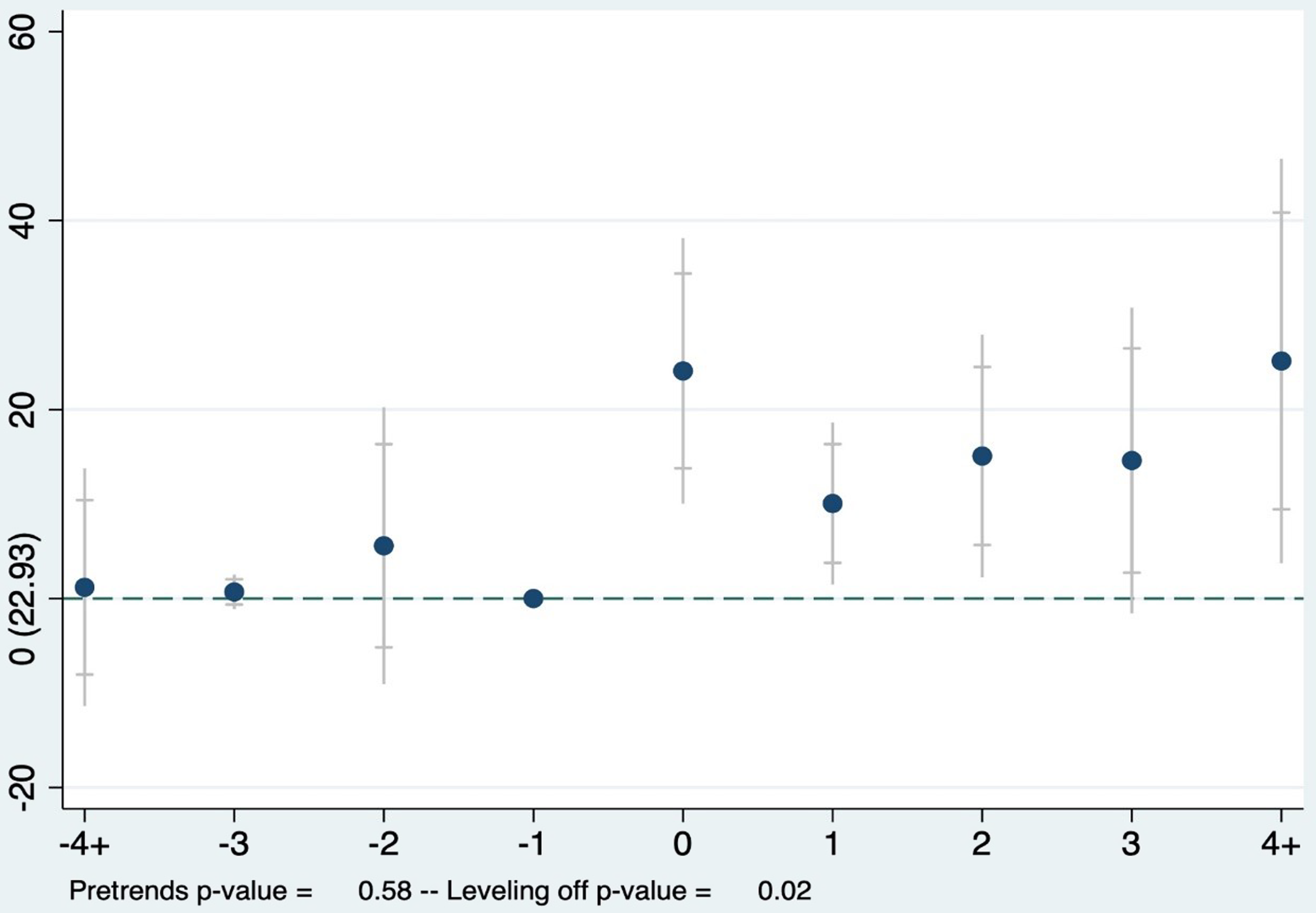
where treatment occurs in 0, q captures the leads or pre-treatment effects and m the lags or post-treatment effects (in this case, 0 stands for the presidential ballot year). Figure 3 plots the results of Equation (5), showing systematic differences between treatment and control groups. The pre-treatment coefficients are almost on the zero line, the pre-trends p-value is 0.58, and their standard errors are very small, which means that the difference is very precise. After treatment, the coefficients move away from the zero line and the p-value is 0.02. To put these coefficients into context, Figure 3 illustrates that, when the left rules, enforcement does not fluctuate in a statistically significant way (the left side of the diagram). However, for the right, during presidential election years (0) the rate of inspections increases significantly, and this impulse remains during y 1 and y 2 , indicative of an electoral cycle (the right side of the diagram).
Panel Event Study for the Electoral cycle.
Conclusions
This article has provided compelling evidence regarding how electoral constraints shape the enforcement of labor informality. Previous research has signaled the incentives facing progressive governments to forbear informal work: as those outside the formal labor market account for an important part of its constituency, the left finds itself with the need to tolerate them. Conservative governments also face a conundrum. A proportion of its middle and upper-middle class votership benefits from informal work, but another part of the electorate, especially the small-business sector, faces unfair competition and demands a tough hand. We have argued that whether the balance is tipped in one direction or the other depends on country-specific conditions. In countries with very high informality rates, where the competitiveness of the formal economy rests on informal enterprises, where inspection resources are scarce and where there is a tolerant attitude, forbearing informal work seems to be a rational choice for right-wing incumbents. However, if informality is not so widespread, the links between formal and informal activities are not so close and a significant part of the conservative electoral base demands more control to tackle informal work, the right has grounds for selective enforcement.
Based on the above characterization, our work has empirically analyzed whether in Chile left-wing and right-wing governments selectively enforce labor inspections for electoral purposes. In contrast to earlier findings, we find no significant sign of forbearance for the left. Although our estimates are consistent with a tolerant attitude towards informal work, none of the coefficients is statistically significant. On the contrary, the right does make a selective use of enforcement. The results, robust to fixed effects and an event-study design, indicate that conservative governments concentrate inspection efforts in the most competitive districts, and accelerate the pace of audits as elections approach.
Although our work is consistent across different models and specifications, a number of limitations have not allowed us to make progress on some elements that deserve to be explored. Probably the results vary by economic sector and the size of the firms, since it is not the same to inspect in rural areas (agricultural activity) as in tourism or retail. More important is the lack of a time series on informality that has not allowed us to see the effect of enforcement in reducing informality. From a public policy point of view, this is a major issue, because labor inspections have been conceived as the silver bullet to reduce informality, but the benefits of enforcement have not been identified.
In spite of these shortcomings, the article has significant implications for theory and policy. On a theoretical level, we believe that our argument that the right faces a trade-off based on the particular conditions of informal work, the institutional context, and the preferences of its core electorate should be tested for other countries. For the specific case of Chile, our work unveils the features of an electoral strategy of enforcement by the right. The control of informality is modulated according to the calendar and the results of presidential elections, whereas local polls have no impact. It would be interesting to examine whether, in an institutional setting in which competencies are distributed among different government tiers, voters are able to distinguish the source and credit goes to a given level of government, and why. Even more important is the fact that inspections are directed at districts where the government faces stiffer competition, namely those that are likely to swing in the next race. Targeting swing areas indicates that the right expects voters, beyond its most loyal constituency, to reward institutional performance. This result can be explained by the class division that characterizes Chilean society. To the extent that the traditional business and upper-class electorate of the right is unlikely to change its vote, the conservatives focus on small entrepreneurs who face unfair competition from those who profit from informal work.
The present study also raises significant implications for the politics of informality. A partisan use of inspections erodes trust in institutions, discourages the formalization of informal work, and leads to inequalities in enforcement, which in turn contributes to perpetuating informality. If employers perceive that incumbents modulate labor surveillance for electoral reasons, they may be disinclined to formalize their workers and adhere to existing laws, as they see that their compliance is not being adequately acknowledged and rewarded. Such a (dis)incentive scheme encourages offenses committed by certain employers while neglecting others, resulting in a skewed enforcement that potentially fuels informality.
On a policy level, some institutional reforms would be effective in reducing partisan bias. Independent labor inspectorates would increase transparency and accountability, decoupling the enforcement of informality from the electoral cycle and partisan competition. Independent and random audits of inspection services would also potentially improve institutional accountability. Finally, the effectiveness and productivity of the labor inspectorate would be improved if assessment procedures and operational benchmarks were established.
Supplementary material
The supplementary material for this article can be found at https://doi.org/10.1017/lap.2024.55.
Data availability Statement
Data files can be accessed at https://doi.org/10.7910/DVN/YF6TGF.
Acknowledgments
The authors would like to thank Alejando Portes and three anonymous reviewers for their comments and suggestions on earlier versions of the manuscript. Xabier Gainza acknowledges the support of the Human Security, Local Human Development, and International Cooperation research group of the Basque University System (IT1434-22). Felipe Livert is grateful to Miriam Golden for her support and guidance.
Competing interests
Xabier Gainza, Andrés Espejo, and Felipe Livert declare none.


 Open access

