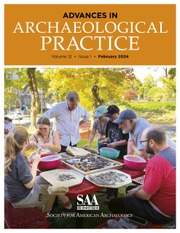


From the early era of great archaeological discoveries that captured the public imagination to the location of many archaeological sites across the globe where there is some level of public land ownership, archaeology has long had public aspects, if de facto ones. A more intentional public archaeology, including a shift to a higher standard of active engagement with local and descendant communities, often distinguished as community archaeology, really took off in the new millennium (a useful hallmark, perhaps, being the establishment of the journal Public Archaeology in 2000; see also Atalay Reference Atalay2006; Colwell-Chanthaphonh and Ferguson Reference Colwell-Chanthaphonh and Ferguson2008; Little Reference Little2002; Marshall Reference Marshall2002; Moser et al. Reference Moser, Glazier, Phillips, el Nemr, Saleh Mousa, Nasr Aiesh, Richardson, Conner and Seymour2002; Shackel and Chambers Reference Shackel and Chambers2004; Silliman Reference Silliman2008; Watkins Reference Watkins2000). An impact of these efforts has been that, whether or not we explicitly identify as public archaeologists, the idea that we should have some level of commitment to community engagement is increasingly widespread (Grima Reference Grima2016). However, there is still a vast continuum of practices that are interpreted as meeting this need for community engagement (McAnany and Rowe Reference McAnany and Rowe2015; Richardson and Almansa-Sánchez Reference Richardson and Almansa-Sánchez2015). At the low-investment end of the continuum, the expert (the archaeologist) shares out information with the public to educate them and increase buy-in around the value of archaeology (note, insufficiencies with this kind of low-investment practice were identified very early on in the rise of a more formal public archaeology, categorized variously as the “deficit model” [Merriman Reference Merriman and Merriman2004] and the “education model” [Holtorf Reference Holtorf2007] of public archaeology; see also Richardson and Almansa-Sánchez Reference Richardson and Almansa-Sánchez2015:Table 1). At the high-investment end of the continuum, the archaeologist collaborates actively with local and descendant communities to codevelop research questions and coproduce knowledge, practices increasingly widespread across the globe (e.g., Acabado et al. Reference Acabado, Marlon and Datar2017; Atalay Reference Atalay2012; Balanzátegui Moreno Reference Balanzátegui Moreno2018; Douglass et al. Reference Douglass, Morales, Manahira, Fenomanana, Samba, Lahiniriko and Chrisostome2019; Näser and Tully Reference Näser and Tully2019; Newsom et al. Reference Newsom, Soctomah, Blackwood and Brough2023; Stark Reference Stark2020). If such a continuum of practices can broadly satisfy one’s sense of their obligation to the “community,” we might ask why archaeologists who do not currently engage in high-investment community archaeology would seek to move along the continuum. High-investment, deeply collaborative community archaeology takes time; it requires trust and relationship-building that go beyond the parameters of a project and specific outputs, academic or applied (Newsom et al. Reference Newsom, Soctomah, Blackwood and Brough2023:304), but such investment creates a proactive archaeology that is responsive to, and so matters to, the communities whose pasts we study or whom we work with/serve. If developed robustly, it can contribute to more transformative aims of restorative justice and reclamation (see Laluk et al. Reference Laluk, Montgomery, Tsosie, McCleave, Miron, Russo Carroll and Aguilar2022; Montgomery and Supernant Reference Montgomery and Supernant2022; Montgomery et al. Reference Montgomery, Agbe-Davies, Cipolla, Mrozowski, Acebo, Camp and Campbell2023; and the recent special issue of this journal, “Archaeology as Service” [Herr et al. Reference Herr, van der Linde and Rieth2023]). Few archaeologists today are sitting back satisfied with the status quo of an archaeology disconnected from real-world concerns and impacts (Pitblado et al. Reference Pitblado, Cooley, Deere, Dudley, McLeod, Moore and Palacios2023:325). However, there are certainly those wondering if and how they can accommodate shifts to more service-oriented work in the face of all kinds of varied demands (on resources, time, etc.) and what benefits will emerge from such an investment. Here, we offer an example of practical benefits from our community-engaged project that we hope may encourage movement along the continuum from those in that position, movement that can ultimately contribute to encompassing transformative goals of a proactive archaeology. Our practical example comes from our community archaeology research program, the Great Bay Archaeological Survey (GBAS), which explores the Great Bay Estuary/P8bagok, one of the most complexly recessed estuaries on the Atlantic Ocean, its distinct ecology making it one of 29 National Estuarine Research Reserves in the United States (Figure 1; for more on the biodiversity of this ecosystem, see Short [Reference Short1992] and https://greatbay.org/). Note, P8bagok, pronounced P-ohn-ba-gock, is a general term for a bay in the Indigenous Abenaki language; it is being used by GBAS’s Indigenous collaborators, the head speakers of the Cowasuck Band of the Pennacook-Abenaki People, in their contemporary engagement with the ecosystem to acknowledge its ancestral roots (learn more at https://indigenousnh.com). Stewarded by Indigenous peoples for millennia, and falling between New England’s two erstwhile northern colonies, Maine and New Hampshire, the Great Bay Estuary/P8bagok formed a distinctive early colonial frontier (ca. AD 1600–1750; Baker and Maurer Reference Baker and Maurer2018; Bolster Reference Bolster2002; Candee Reference Candee1970; DeLucia Reference DeLucia2012).
The location of the Great Bay Estuary/P8bagok where GBAS has been exploring early colonialism and a more detailed look at the river tributaries and bays that make up the ecosystem that drains a total of 2,334 km2, two-thirds in New Hampshire and one-third in Maine (Kelly et al. Reference Kelly, Clark, Palace and Howey2023:3, Figure 1).

Colonial New England, with its many heritage tourist destinations, holds a special place among the public. Holiday celebrations and public commemorations often situate it as the backdrop of what would become America (Blackhawk Reference Blackhawk2023; DeLucia Reference DeLucia2018; O’Brien Reference O’Brien2010). However, much of this reputation is based on popular conceptions of Puritan Boston and the Massachusetts Bay Colony. Looking instead at the material evidence left behind by people living on a colonial frontier, one that Puritan Boston struggled to exert control over, GBAS sees an opportunity to recover overlooked stories of life in colonial New England, ones that speak to a more dynamic past. GBAS launched in 2016 and continues as an interdisciplinary and community-engaged archaeological research program being done in place. The project is based out of the University of New Hampshire (UNH), which is itself in Great Bay/P8bagok (on the Oyster River, one of the estuary’s seven inflowing rivers; Figure 1). Living and working here has shaped the dynamics of, and our ability to deeply invest in, community engagement. GBAS’s director, Meghan Howey, a professor of anthropology at UNH and first author of this article, built the project’s team after spending time in the community, talking to people who had knowledge about or who knew people who knew about the area’s early colonial history or archaeology. She decoupled the concept of expertise from academic degrees and prioritized community knowledge keepers. Diane Fiske, second author of this article, is a retired legal assistant who has no formal academic training in archaeology or history but who is the volunteer historian for the First Parish Church in Dover, New Hampshire. Learning this, and knowing that the church was the first civic center on this colonial frontier, Howey met with Fiske and brought her on board as GBAS’s historian. This article offers one glimpse into her detailed and rigorous research for GBAS (explored below and detailed for this case in Fiske Reference Fiske2024). Fiske has grown confident in her role and gives public presentations on GBAS herself. Other core team members have included a retired naval shipyard engineer, an organic farmer, a community college professor, and more (all primarily volunteer-based, though when funding has permitted, small stipends and reimbursements have been provided). All GBAS fieldwork has been open to volunteers; to date, over 100 community members, ranging in age from 14 to 78, have spent time in the field, most from parts of New Hampshire, some from Maine, and some from Massachusetts. GBAS’s field seasons also provide a field school–equivalent experience for free to UNH students. GBAS partnered with the New Hampshire State Conservation and Rescue Archaeology Program run by the Division of Historical Resources so that especially dedicated students or community volunteers could earn certifications in both field and lab methods. After they gained experience, GBAS was able to hire the most committed students as crew chiefs, and a few of these students have moved into core team member roles in GBAS. The third author of this article, Alyssa Damon, serves as an example of this; she continues to work with GBAS while pursuing her graduate education in the University of Massachusetts Boston’s Master of Arts in Historical Archaeology Program.
GBAS operates in close collaboration with the head speakers of the Cowasuck Band of the Pennacook-Abenaki People, regional Indigenous knowledge keepers, a collaboration developed from the earliest stages of the project. At the start of GBAS, we identified together a set of potential site locations and geographic features of interest. We started with a focus on seventeenth- and early eighteenth-century English colonial sites, approaching these as not just English sites but deep-time, multivalent places. We have combined a range of Western scientific survey approaches to find archaeological sites (walk-over and shovel-test survey, drones, ground-penetrating radar) with Indigenous knowledge scientific assessments by GBAS’s collaborators. As GBAS has run over the years, target potential English colonial sites, like the one featured in this article, have been brought to our attention that are not of specific interest to our collaborators. Work is done with full transparency, but as Indigenous leaders and activists with many interests and commitments, they make choices about where they want to spend their time contributing knowledge and insights. The head speakers and project director regularly copresent on shared aspects of our work on GBAS in various public and academic venues; we are committed to sharing our work and our model of bridging archaeology and Indigenous perspectives widely. Here, we cannot explore all the richness (and yes, at times, complexities) of GBAS’s community engagement and collaboration with Indigenous knowledge keepers, but we would point the reader to our StoryMap (https://bit.ly/greatbayarchaeology) to hear directly from team members and collaborators, as well as to the forthcoming book The Shock of Colonialism in New England: Fragments from a Frontier (Howey Reference Howey2025). We do want to emphasize how living and working in place has meant there is never really an off season to GBAS. When we are not in a field season, we are giving talks at local schools, libraries, and towns; we are networking with local historical societies to learn of possible sites; we are working with local land conservancies about possible site purchases; we are talking to the press, climate scientists, and students about sea-level rise and cultural heritage risk; we are running a National Endowment for the Humanities (NEH)–funded summer workshop for 72 K–12 teachers from across the country and helping them develop a curriculum to teach colonialism in new ways in their places (see https://www.fromthefragments.com/); we are connecting with other community organizations invested in the region’s overlooked histories; and we are working to do what we can to build trust and relationships, to share our findings, to be responsive, to make it matter. GBAS’s devotion to public-facing work, to decentering expertise and empowering community members as full research team members, to collaboration with regional Indigenous knowledge keepers, to building strong relationships with local stakeholders, and to making our findings accessible to nonacademic audiences has created an atmosphere for positive cascading effects. The idea that community archaeology can have unfolding impacts is not novel, but we find the concept of cascade effect to be a potentially helpful frame for capturing this process. A cascade effect is when initial events trigger chains of subsequent, and sometimes unforeseen, events, and our experiences with GBAS have shown us that our high-investment community engagement has led us to insights, finds, connections, and impacts we could not have anticipated when we set out. This phenomenon is studied in various fields, from civil engineering (infrastructure risk and collapse) to psychology (development and internalization cascade effects) to ecology (trophic cascades in ecosystems) (e.g., Borer et al. Reference Borer, Seabloom, Shurin, Anderson, Blanchette, Broitman, Cooper and Halpern2005; Seddon et al. Reference Seddon, Abdel-Baki, Feige and Thomassin2020; Zuccaro et al. Reference Zuccaro, De Gregorio and Leone2018). Cascade effects can be negative or positive; in fields that more formally study this phenomenon, these terms are used denotatively, so negative denotes a reduction or decrease, and positive denotes an amplification or increase. An example from ecology of a negative cascade effect is when overfishing of fish at a certain trophic level leads to unexpected collapses (so decreases) in other ocean species (Pinsky et al. Reference Pinsky, Jensen, Ricard and Palumbi2011). An example of a positive cascade effect from developmental psychology is where emotional stimulus results in increased emotional intensity (positive effect) from which behavioral dysregulation ensues (Selby et al. Reference Selby Edward, Anestis, Bender and Joiner2009). This example shows there can be dissonance between the denotative use and the connotative use, or the implied meaning, of the terms negative and positive, as behavioral dysregulation is not something most would connote as positive.
While we are suggesting cascade effect may be a useful frame for talking about the unfolding aspects of doing community archaeology, we are not advocating for a formal approach with a denotative use of negative and positive. Rather, we find more affinity with the idea from exercise science of the exercise positive event cascade that uses positive connotatively, where its implied meaning is good. Exercise is seen as a positive event that produces a positive cascade of more positive events in people’s lives, such as feeling better, which is not something clearly quantifiable as a net increase but that is appreciated as something good (Young et al. Reference Young, Machell, Kashdan and Westwater2018). To us, we suggest that honoring, elevating, sharing, and (when it makes sense) protecting heritage can be described as positive, as in appreciated as good, in archaeology (Pitblado et al. Reference Pitblado, Cooley, Deere, Dudley, McLeod, Moore and Palacios2023:325). This connotation is what we mean when we assign the term “positive” to cascade effects of high-investment community archaeology.
One of the cascade effects we did not foresee from our community engagement was how many tips we would get from local community members and organizations about possible colonial-era sites. Motivations for these tips have ranged, the two most common being tips from people or groups very interested in local heritage and others from people or groups hoping we might find a site on a given piece of land to halt the development process. GBAS has done most of our work on private land, but this has been driven by us identifying a target of interest and approaching landowners to gain permission to work on their land (with a mix of no and yes responses). Almost none of the possible site tips we have received have come directly from private landowners who felt they had a site on their property. We have observed an interesting duality in our work, which is that there is a very high interest in English colonial history and GBAS’s work broadly conceived but a hesitancy to have colonial heritage sites found and excavated on one’s own private land. The case we turn to here is notable because it is a positive example of this cascade effect that illustrates the practical value of a persistent community engagement in place, and that, as we will explore, also connects to more encompassing aims of a proactive archaeology.
When a local landowner noticed an interesting series of large stones that he was about to develop over, he stopped because he had heard about our GBAS project on public radio in one of our efforts to raise awareness about sea-level rise and vulnerable heritage. He then went and vetted us through informal local community channels, and because GBAS has been active in the area for years, he got encouraging feedback. Despite hesitancy about his private property, he invited us to explore his property’s cultural heritage. That invitation led to the discovery of a significant early colonial site and important revelations about overlooked presences in this New England colonial frontier landscape. During our work, we built a relationship with the landowner, and he became invested in the findings. He has committed to the perseveration of the cultural heritage on his property and to an inclusive public commemoration of it.
The Meserve Garrison Example
In 2020, the owner of a lot in the subdivision for Nelson Bolstridge in Madbury, New Hampshire, was clearing part of his property (specific subdivision records in Strafford County Registry of Deeds: “Subdivision for Nelson Bolstridge, in Madbury, NH [July 17, 1992]”; Plans 41–53, prepared by Bruce L. Pohopek, Land Surveyor, Barrington, New Hampshire). He had noticed what he thought was just exposed bedrock he would need to work around. He had also noticed an overgrown but visibly raised and circular feature that he thought was an old well he could fill in and build over. However, when he started clearing, he noticed the stone was not, in fact, bedrock. It consisted of separate large stones in a line, and when he took the thick overgrowth off the raised circular feature, it revealed an interesting brick covering, so he stopped clearing. When he bought his property, he heard it might have once had a colonial-era garrison house on it, the Meserve Garrison, and so he knew what he was seeing might be important. It is not surprising he had heard his property might have a garrison site on it: colonial-era garrisons have been the subject of long-standing interest in the region, and they continue to occupy a special place in public conceptions of the colonial period here. Today, everything from soccer teams to elementary schools to contemporary house styles to breweries across the estuary’s towns bear the name “Garrison.” The term “garrison” conjures images of a large, military-style structure, but, for most of the colonial era here in this frontier landscape, garrisons were homesteads, distinguished from their neighbors only by their larger size and occasional simple defensive features (like gun holes cut in the side boards, special window coverings, etc.). The conception of these early colonial garrisons as something more specialized is largely due to popular histories of the colonial era in this region (starting around the late 1700s and through the early twentieth century) that emphasized English colonists as hearty and brave in the face of harsh conditions, including Indigenous (often Abenaki allied with French) violence. While violence was part of this frontier landscape, it has been prioritized in popular conceptions and commemorations over more widespread, more mundane interactions between English colonists and the Pennacook and Abenaki peoples who lived in, and stewarded, this ecosystem for millennia (Howey Reference Howey2025; Howey and DeLucia Reference Howey and DeLucia2022). Because of this early, and lasting, interest in ideas of adversity and violence, the reality is that garrisons are the best-documented colonial features in the region and tend to have more information available about them than standard homesteads. Indeed, the garrison in question here, the Meserve Garrison, was recorded in one of the most notable early popular works on the region’s colonial history, Mary Thompson’s Landmarks in Ancient Dover, New Hampshire. She begins its entry so: “This is the story about the Misharvie (Misserve, Messervey, Messerve, Meserve, and sometimes ‘Harvey’) family who arrived at the New Hampshire seacoast from the Isle of Jersey around 1678Footnote 1 and settled on a parcel of land in Madbury, now known as the Meserve Garrison Site on Harvey Hill. Harvey’s Hill, otherwise Meserve’s Hill, is at the upper side of FreetownFootnote 2 on the road to Barrington. . . . Meserve’s garrison stood on this hill” (Thompson Reference Thompson1892:94). The landowner remembered that he had heard Dr. Howey and GBAS featured on NHPR (public radio) not long before. As a long-term resident of what is a relatively small set of interlocking communities along the Oyster River (Madbury-Durham-Lee), again, one of the tributaries of Great Bay, he asked around to see if anyone knew about her or the archaeology project in the area. He got feedback from a range of community stakeholders that GBAS had been engaging with since its inception indicating that GBAS was legitimate and exclusively focused on education (not profit) and had done years of fieldwork on private land; he also learned GBAS was attentive to landowners’ privacy concerns. He decided to contact Dr. Howey at the University of New Hampshire to inquire whether she and the GBAS team were interested in exploring what he was seeing.
Archaeological Assessment
Dr. Howey and GBAS’s community historian, Diane Fiske, conducted a walk-over survey on the property. The area where the landowner noticed the stones of interest is at the top of a sizable hill with vast views in all directions (Figure 2; ca. 68 m in elevation; the largest hill in Madbury today is named Hick’s Hill, at 97 m). There, on a clear day, we could see Pawtuckaway Mountains, about 56 km west of this location, in the distance. This hill carries no name today, but it struck us that it might align with the description above of Harvey Hill from Thompson’s Landmarks in Ancient Dover. The property’s position had other interesting aspects that struck us right away. This hill is located between the inland ends of two of the tributaries to the estuary, Oyster River and the Bellamay River (Figure 2). Before this inland end of the Bellamy River was transformed into a reservoir, this hill would have overlooked a vast marsh to the north. Then there is the fact that the road turns less than a kilometer from here and heads north/east to Barrington, again compelling hints of alignment with Thompson’s description of the Meserve Garrison (Figure 2). GBAS’s initial walk-over identified three visible features of interest. Two of these were the features that had been exposed when the landowner started clearing: (1) the series of large stones oriented in a line following north–south directionality and (2) the subterranean structure with a brick vaulted covering located less than 1.5 km past the line of stones (Figure 3). The third visible feature, a large late nineteenth- / early twentieth-century cellar hole along the contemporary road bordering the property today (Figure 4), was known before these other two were encountered. This more recent foundation has been accumulating debris for years, and GBAS did not explore this feature further.
General locational features of property where cultural foundations of interest were found by private landowner and assessed by GBAS team.

The two features of interest that became visible to the landowner when clearing for development: the brick covered subterranean structure and the line of large stones running north-south. You can see the clearing process was underway when the landowner stopped and contacted Great Bay Archaeological Survey (GBAS). This photograph is looking westerly, showing the notable views from this hill location. Photograph courtesy of GBAS.

The third visible cultural feature identified during GBAS’s assessment, this one long known to the landowner, a nineteenth-/early twentieth-century foundation that has accumulated debris over the years. Photograph courtesy of GBAS.

The Linear Series of Stones
To investigate the likelihood that the line of stones the landowner exposed during his clearing were (1) part of a foundation and (2) a foundation that could be from the Meserve Garrison, we opened a 1 m long profile cut that ran north–south and encapsulated an area of stones resting on the surface. The landowner requested as little earth movement as possible, and so we cut the trench back only as far as would allow us to see if and how the stones continued. We conducted this profile exposure using a combination of shovel shaving and troweling, working in 10 cm levels until we hit a depth of 45 cm, where we found no more stones and sterile soil composed of demineralizing rock and shale (presumably nearing bedrock). All materials removed from the trench were screened (using ¼-inch [6.4 mm] mesh). Very few artifacts were found, and the majority of those that were—including asphalt roof tiles, metal wire, steel wire cut nails, and glassFootnote 3—dated from the twentieth century. Only a few historical artifacts were found, these including older hand-cut nails and glazed redware. The artifacts together indicate that the property has seen a range of disturbance, modification, and filling episodes. We did five shovel test pits in the vicinity, placed in areas the landowner approved in order to minimize impact on his lawn/landscaping, et cetera. All of these tests produced the same artifactual results: twentieth-century debris and little evidence of intact soil horizons. Our profile cut did, though, reveal that the stones the landowner had uncovered indeed continued and were part of a foundation (Figure 5). Large irregular stones were stacked and then intricately wedged into place with other smaller stones to support the integrity of the foundation. No mortar was present or recovered. In the early years of colonial settlement in New England, “mortar and other binding materials were seldom used, so that construction of solid freestanding walls was done by the skillful placement of stone upon stone, tightly wedged together for stability. This became known as ‘dry walling’ or dry-stone masonry” (Brandau Reference Brandau1975:26). The use of large, irregular field stones to form foundation walls was also the standard in the early colonial era before quarrying was widespread (Garvin Reference Garvin2001:10). The stone type and construction technique of this foundation suggest an early colonial date, creating another alignment with the potential location of Meserve Garrison. We crawled along the line of stones, using a compass to identify the north–south orientation of this line of stones and evaluating for corners and wall ends and turns. Pushing chaining pins into the ground, we traced out where stones continued without doing any clearing of our own, to keep the area as intact as possible. Using this method, while we found gaps in the stone, we also found enough continuity to develop an estimate of the probable size of the foundation, rectangular, at approximately 24 × 48 feet (7.3 × 14.6 m). The first period houses of New England (that is, those built by colonists who came directly from England), which the Meserve Garrison would have been, were built using postmedieval English construction techniques of framing and a measurement system with a 12-base (Cummings Reference Cummings1979). The dimensions we estimated here are divisible by 12 and fit with the size of other larger late 1600s / early 1700s framed houses found in northern New England that were called garrisons (Garvin Reference Garvin2001).
The profile cut showing the stones the landowner found during clearing were the top of a dry masoned foundation most likely from the colonial era. Photograph courtesy of GBAS.

Brick-Covered Subterranean Structure
The overgrown raised circular feature that the landowner thought for years was an old well is located less than 1 m outside the linear stones our assessment identified as a dry-masoned foundation (Figure 3). As the landowner was clearing, he found this circular feature had an unusual brick covering that was built over a larger-than-expected subterranean, ruggedly constructed structure/hole. When he cleared off the thicket and brush, the brick covering became visible. In assessing this covering, we found it to be composed primarily of colonial-era brick, with some later brick (ca. 1800s-plus) and mortar included. Colonial brick is distinctive, as it was hand-formed, creating variation in shape and size, and it was fired at a lower temperature, creating a more orange coloring than later-dating, redder bricks that were mass-produced (Garvin Reference Garvin1994). This brick covering was constructed over a subterranean hole/structure that was larger than expected for just a well. It appeared to us that perhaps originally something like a well was expanded by nonmechanized digging, and then this unusual brick covering was erected over the top. Looking inside, we could see late twentieth-century discarded pots, pans, and dishes (and some trash). We did not investigate this seemingly makeshift structure further owing to safety as well as sensitivity concerns expressed to us by the landowner about its possible use before he purchased the land. With so much colonial brick in this covering, we feel it is highly likely that this brick was scavenged from remnants of the central chimney of the colonial-era homestead next to this subterranean structure. While clearly out of their original context, these colonial bricks are further evidence of a once-present colonial homestead.
Documentary and Archival Research
Alongside our archaeological assessment, Diane Fiske (again, GBAS’s community historian) conducted extensive documentary and archival research. As noted above, a key piece of GBAS’s commitment to being a community archaeology project has been a decentering of expertise, meaning we don’t just welcome community members to volunteer on our excavations or share information with them through public talks, but we include and empower community-based experts as full team members. Fiske has led land transfer and colonial family history research for GBAS since 2016. Diane Fiske took the lead on the research for this property and site. Through detailed investigation into deeds, wills, land grants, maps, and early town records, she confirmed the ownership and occupancy of this property by generations of the Meserve family. Tying this contemporary parcel conclusively to the Meserve family further bolsters the likelihood that the colonial-era foundation we found was the Meserve Garrison, the first homestead built by this family. Fiske (Reference Fiske2024) provides a detailed, first-hand exploration of her research process into the ownership and occupancy history of this land from the early colonial period to today (the reader can navigate directly to this account: https://core.tdar.org/document/502866/the-great-bay-archaeological-survey-gbass-archival-research-on-the-colonial-meserve-garrison-site-in-new-england). In this article, we can only explore a few key findings, and so we strongly encourage the reader to turn to this rich, informative, and detailed account to learn more. In her research, Fiske found two key early colonial Meserve land grants. The first grant of land was on May 28, 1701, when “Daniel Misserve” requested a grant of 30 acres (12 ha) from the town of Dover, “Adjoyning to John Bussey’s Land.” This request was approved by the Committee for Granting Land that same day, but it was not actually laid out until June 12, 1719, beginning at the south side of that way that rounds to the hook at a point at the great turn (Old Dover Records 1694–1757, Section 7:13, Section 8:2; www.dover.nh.gov). We do not know if Daniel Meserve settled on this parcel of land prior to 1719, as he also had a grant of 30 acres (12 ha) of land on the south side of Oyster River in Durham, laid out to him in 1712. In 1725, Daniel purchased another 30 acres (12 ha) from Thomas and Samuel Starbird, it being “at or near that part of ye town caled Madbery on ye South West Side of ye highway that Leads to ye Hook” adjoining to his own grant of 30 acres (12 ha) (Province [New Hampshire] Deeds, Vol. 15:241; https://www.familysearch.org/en/united-states/). The combined parcel of land containing 60 acres (24 ha) was granted to Daniel’s son, Daniel2, “that he now livith on” in his will in 1756 (Province [New Hampshire] Deeds, Vol. 19:571; https://www.familysearch.org/en/united-states/). Finding these grants made it clear that the original Meserve homestead parcels were on the southwest side of the road to the Hook, adjacent to each other. We knew “the Hook” established an association with the Bellamay River, but it was not immediately clear how. Knowing the Bellamay River had been flooded to create a reservoir, we turned to historic maps of Madbury to see what the course of the Bellamy River was before the reservoir. An 1805 map confirmed that “the Hook” referred to the course of the Bellamy River in Madbury, where it took a wide turn as it flowed from Barrington (Figure 6). This reference to “the Hook” was also integral to identifying the road that served as the northwest boundary of the two 30-acre (12 ha) parcels. In later deeds it was referred to as “the road from the Madbury Meeting House to Barrington”; Mary Thompson describes the Meserve Garrison as being along the road to Barrington; and today, again, the property of interest here is located on the road that turns from the site to Barrington. The next transfer came when Daniel2 died, 17 years later, in 1783. In the division of his property, he granted his widow, Abigail, the 60-acre (24 ha) parcel and the use of the easterly side of the house and barn as her “Thirds” (widows thirds, one of the only ways women could come to own property at the time). Daniel2 had acquired other land in Madbury and Barrington and split these lands among his children. Over generations and across different branches, the extended Meserve family came to own notable amounts of land in Madbury, surrounding towns, and beyond. Fiske’s research continued to trace this specific 60-acre (24 ha) original homestead parcel up through today, connecting the land transfers all the way to the current landowner who contacted us about the stones (see Fiske Reference Fiske2024). One Meserve living in proximity to Daniel2 at the time of his death, on this same road in Madbury, was Nathaniel Meserve. Nathanial, perhaps a cousin, was born around the same time as Daniel2. In the search for information on the original Meserve Garrison, Fiske found information about Nathanial because he was a Meserve living on this road of repeat in the deeds (the road to/from Madbury meetinghouse / Barrington). While he was not directly connected to this specific parcel, the information about him in the records sheds light on the social realities of colonial and postrevolutionary New England that continue to be overlooked, or, more actively, excluded from the ways we remember, research, and commemorate this past. Nathaniel Meserve married Martha (Dame) Meserve in 1769. In 1783, Nathaniel and Martha sold 25 acres (10 ha) (of a homestead farm) to Andrew Hanson on this road excepting “the small house now occupied by two Negroes named Boston & Coor” (Strafford County Registry of Deeds, Book 5:177, dated August 22, 1783). Looking into how these individuals came to be living here in Madbury, Fiske discovered that they were formerly enslaved by Martha’s grandmother, Sarah Dame. In her will in 1767, Sarah Dame granted her land (which had been granted to her by her husband on his death in 1758) to her granddaughter, Martha, upon her marriage (which, again, happened in 1769). She also in her will granted “freedom to ‘my’ Negro man Boston and Negro woman Coor, and to no longer be used as slaves or sold as such, free use of part of the house until the estate is settled, and an allowance out of the estate to live comfortably” (Province [New Hampshire] Deeds, 1767, Record 3416; https://www.familysearch.org/en/united-states/). It appears Boston and Coor stayed on this land for years after gaining their freedom, being present and acknowledged in 1783. It also appears they were Quakers (as was Sarah Dame, who granted them freedom); Fiske found their death records in Quaker records (Bill of Mortality), Boston in 1785 and Coor in 1790 (the latter reported to have been 100 years old). The fullness of their life stories remains unknown, including where they were born, whether they were trafficked across the Middle Passage or born into chattel slavery, when they arrived in and how they were moved through New England, how they came to be owned by Sarah Dame, and what they did in their later years of freedom. However, learning of and bringing to light their presence in colonial and postrevolutionary New Hampshire, a place many tend not to associate with slavery, is important in portraying a more accurate account of the region at that time (Fernald Reference Fernald2007; Mayo-Bobee Reference Mayo-Bobee2009; Warren Reference Warren2017).
An 1805 map of Madbury before the Bellamy’s River’s course was permanently altered by the creation of a reservoir. This map shows the “Hook” referenced in the first land grants, and it also shows the early roads mentioned in the land grants, those roads aligning with the property’s location today. (Photographed by Diane J. Fiske in Madbury Historical Society.)

Discussion
One of the cascade effects of GBAS’s commitment to high-investment community archaeology and persistent presence in the estuary year-round, year after year, has been an influx of tips about potential colonial heritage sites. As noted above, not all of these have led to heritage finds, and few have been private landowners themselves actively inviting GBAS onto their property. But this case of a private landowner stopping his development when he found interesting structural features and inviting us onto his property to explore the potential cultural significance of these features offers an example of where this cascade effect was positive, again, positive connoting resulting in elevating cultural heritage. The research into this Meserve Garrison has come to offer a microcosmic look at the trajectory of colonialism, as we traced out how here, in a rural colonial New England frontier landscape, there was a rise of intergenerational wealth over just a few generations, with attendant profound impacts on land and labor. These same themes played out across New England and much of the rest of the world during the rise of European global colonialism (Brooks Reference Brooks2018; Den Ouden Reference Den Ouden2005; Lewis and Maslin Reference Lewis and Maslin2018; O’Brien Reference O’Brien2010; Yusoff Reference Yusoff2018).
The first Meserve homestead was built in Madbury in the early 1700s by Daniel Meserve, who came over from England. Our archaeological assessment suggests that the foundation for this framed, first-period house was built by hand using irregular field stones and intricately dry-masoned with smaller stones to create lasting support. The structure was built on a hill with vast viewsheds, near a notable hydrographic feature, “the Hook,” in one of the Great Bay Estuary’s main tributaries, the Bellamy River, and along a road that connected Madbury to another colonial frontier town (Barrington). This homestead came to be known as the Meserve Garrison, reflecting long-standing popular narratives about colonialism in the region that prioritize Indigenous violence against English colonists and do not necessarily reflect the full, lived realities of the time. By the early 1700s, what violent clashes there were between Abenaki communities (who often allied with the French to help advance their resistance to English expansion) and English colonists had moved farther north and east than the Great Bay Estuary / P8bagok. By the time Daniel’s son, Daniel2, died in 1783 he owned a large amount of land. As noted above, his will gave his widow the 60-acre (24 ha) original homestead parcel, but he had also acquired another 300-plus acres (120-plus ha) that he was able to divide among his six offspring (in Madbury and Barrington; see the details of his will in Fiske Reference Fiske2024). In the span of one generational turnover, we see Indigenous homelands fully transformed into English property and property becoming the basis for intergenerational wealth as it is passed on to the next generation. Our documentary research also found that, attendant with this rising land-based wealth during the 1700s, some colonists were able to enslave Africans to meet the labor demands from their increasingly wealthy households and larger landholdings. Here, even in Madbury, a rural, low-population-density, northern New England frontier colonial settlement, land and labor dispossession occur quickly and form two interconnected, critical pieces of the expansion and permanence of colonial, and then early American, settlement. On our sharing our findings with the landowner, he committed to protecting what remains of what is probably the Meserve Garrison. Development happens, and can be necessary, so even if preservation is not a long-term outcome, this process has elevated this cultural heritage. Efforts are also underway to honor it, as, over the course of many open conversations together during our work, the landowner became inspired to commemorate the more dynamic story of the colonial era in Madbury that we found in our collective work and research into the Meserve case on his property. He is also working with Fiske to digitize the deed-tracing records she uncovered for the property. The landowner has contacted the newly revived Madbury Historical Society, and GBAS hopes to work with him and this group to develop commemorative signage to place near his property in a safe and accessible place that shares this piece of Madbury’s history, starting with Indigenous homelands, then the early English colonial homestead/garrison, subsequent land ownership expansion, and the not well-known presence of enslaved, and then freed, Africans here. The Meserve example shows a positive cascade effect from our community-engaged archaeological project—starting with a private landowner’s awareness of GBAS because of our community engagement and public presence, confidence contacting GBAS about a potential site on his land, and willingness to let GBAS explore his property. It extended to his goodwill toward the project, and, later, this evolved into personal investment, with him committing to protecting the findings and sharing with his local community how they speak to a dynamic colonial trajectory in this frontier landscape. The landowner did not invite GBAS to his land with ideas of doing deed research with GBAS’s community historian or working with a community organization to think through public commemoration of the finds on his property. This chain of unexpected events, with the practical benefits of finding, researching, protecting, and commemorating a multivalent archaeological site, illustrates how cascade effect may be a helpful conceptual frame for us to use when we talk about community archaeology and seek to encourage others to move along the investment continuum. The documentary evidence about Boston and Coor, enslaved, and then freed, Africans, living on a parcel of land close by the Meserve Garrison opens up a potential research avenue to investigate individuals minimized and marginalized within this landscape. GBAS, or another archaeological research team, could attempt to recover more of the story of Boston and Coor by systematically researching and surveying for the residence where they were recorded as living in 1783; while recognizing that archaeological traces may be difficult to link directly to Boston and Coor, the mention of their names in the documentary record speaks importantly to the power of recognition and acknowledgment of these individuals and their time spent in Madbury. This could be facilitated as an archaeology of reclamation, wherein communities are empowered to “assert control over their meaningful places, ancestors, belongings, and historical narratives” (Montgomery et al. Reference Montgomery, Agbe-Davies, Cipolla, Mrozowski, Acebo, Camp and Campbell2023). To accomplish this, it would be essential to partner with the well-established Black Heritage Trail of New Hampshire (BHTNH), a community organization dedicated to raising awareness of New Hampshire’s Black history, to ensure relevant community members and stakeholders (including descendants) are engaged and driving the project in ways that result in archaeology being a useful tool for their empowerment and reclamation goals (learn more about BHTNH at https://blackheritagetrailnh.org). GBAS has an established working relationship with BHTNH, and they are key community partners on our NEH-funded summer workshops for K–12 teachers. While we have not yet codeveloped archaeological field projects, we have discussed ideas for field projects focused on some of the better-known figures and places in Black New Hampshire of interest to BHTNH. Exploring this more rural landscape could form another area of future collaboration, showcasing the power of historical archaeology in combining material culture and written records.
Concluding Thoughts
In a vast landscape, the value of high-investment community archaeology and the cascade effect of that investment are more pronounced, something our Meserve example clearly illustrates. The Great Bay Estuary drains some 2,400 km2; no single archaeological research project could ever cover this expanse. By having a long-term commitment to community engagement and a public-facing project, GBAS has gained the benefit of landowners, as in this case, as well as community organizations such as historical societies and local land conservancies routinely reaching out about potential sites of interest. This open flow of community-driven information has helped expedite cultural heritage site discovery, documentation, and, when possible, protection across this vast landscape. Through our work here, an overlooked piece of colonial and early American history has been highlighted. There is also now a clear opportunity for an archaeological research program on enslaved, and freed, Africans in rural frontier colonial New England. This outcome offers a compelling example for those who aren’t satisfied with the status quo of archaeology but aren’t sure how to move, or whether they can manage to move, along the continuum to more high-investment community archaeology. Finding, accessing, and protecting an archaeological site are practical examples of a positive cascade effect from committing to community archaeology. The example we have highlighted here also shows how moving along the investment continuum can yield cascade effects that flow into more encompassing, transformative goals of a proactive archaeology, one where archaeology can become empowering to communities in their work toward cultural heritage recovery, restorative justice, and reclamation, and so may really come to matter.
Acknowledgments
The authors thank the generous landowner featured in this article who has become an active participant in the research and efforts explored here (and who, on top of that, made us coffee and homemade cinnamon rolls on cold fieldwork mornings). We also thank the many community team members, volunteers, and key collaborators who have made the Great Bay Archaeological Survey (GBAS) possible and successful. Former GBAS lab manager Emily Mierswa was instrumental in the first round of fieldwork at this location. We appreciate the four anonymous reviewers who offered constructive feedback that helped us focus and improve this manuscript.
Funding Statement
The Great Bay Archaeological Survey (GBAS) was made possible with funding from the James H. and Claire Short Hayes Professor of the Humanities, UNH Center for the Humanities. Support for additional analysis and sharing GBAS’s findings through articles, a forthcoming book, and public-facing outlets came from an Andrew Carnegie Fellowship (Howey).
Data Availability Statement
All fieldwork notes, photographs, and artifacts are curated and are accessible by vetted request at the University of New Hampshire Archaeology Lab, which houses the entire GBAS collection. Images of key primary historical sources are provided and archived on tDAR (https://core.tdar.org/document/502866/the-great-bay-archaeological-survey-gbass-archival-research-on-the-colonial-meserve-garrison-site-in-new-england).
Competing Interests
The authors declare none.


 Open access

