


Introduction
Legitimacy is important to public trust in the criminal justice system (CJS), supporting its authority and maintaining public participation as witnesses, jurors and lay magistrates.Footnote 1 Legitimacy takes on ‘a psychological property of an authority, institution, or social arrangement’ including the CJS ‘that leads those connected to it to believe that it is appropriate, proper, and just’.Footnote 2 The CJS’s legitimacy relies on the state holding and exercising ‘power with legality, justification and consent’.Footnote 3 This requires compliance ‘with a political community’s laws, rules, and customs’Footnote 4 and consistency across community ‘shared norms and values’.Footnote 5 This paper argues that, to secure moral credibility and social acceptability, there should be some congruence between the application of substantive criminal law and informed public opinion.Footnote 6
There is little empirical data on public opinion on offence and defence frameworks compared with sentencing.Footnote 7 Governments often claim criminal defence laws are influenced by public opinion, citing limited evidence – self-defence being a clear example. This is partially accurate, as consultation on law reform is open to the public, and responses often shape reform. It is debatable, however, whether these responses truly reflect public opinion, as consultations mainly attract responses from professionals, such as academics, practitioners and advocacy groups. Efforts to gather public opinion are understandably inhibited by the cost and time resources required for representative probability sampling.Footnote 8 Lack of public support for criminal law reform, however, can undermine the CJS by reducing effective participation as witnesses, jurors or magistrates and eroding trust in its legitimacy.Footnote 9
Whilst public opinion may guide criminal law, the question remains about how informed public opinion is on matters of criminal justice policy and what influences it. Knowledge from indirect sources such as the media is vulnerable to manipulation by the media itself, government, other powerful organisations and interest groups. This can result in punitive valuesFootnote 10 based on misconceptions and stereotypes about victims and defendants.Footnote 11 We examine these challenges using a social constructivist perspective,Footnote 12 which highlights learning through dialogue, interaction and exposure to diverse social and cultural contexts.Footnote 13 Our work shows how societal factors, individual beliefs and others’ views shape public perceptions of self-defence.Footnote 14
The authors review government assumptions about public perceptions which led to allowing disproportionate force in householder self-defence cases. It compares the circumstances of householders with victim-defendants who must use proportionate force in standard self-defence, and outlines reform proposals by the Centre for Women’s Justice (CWJ) which would extend the householder defence to victim-defendants.Footnote 15
We then consider how criminal law should respond to public opinion, drawing on the work of Tankebe, Robinson and Darley and feminist concerns regarding male-biased defences, which may be reflected in stereotypical public perceptions.Footnote 16 While the law should generally align with public perceptions to maintain legitimacy,Footnote 17 it should also educate when opinions are misinformed or prejudiced, especially regarding marginalised groups.
Our methodology used public opinion focus groups in Leicester, London and Newcastle to discuss eight vignettes on self-defence.Footnote 18 Discussions focused on when the plea of self-defence would and should be available. Following discussions, participants ranked vignettes from ‘most’ to ‘least deserving’ of self-defence. Transcripts were analysed using Braun and Clarke’s thematic analysis framework.Footnote 19
Our analysis and findings centre on ‘personal reflections on experience, media and the law’. Of the eight vignettes, participants selected two, featuring a female victim-defendant and a householder respectively, as ‘most deserving’; this paper focuses on them. In the householder case, participants assumed the defendant’s sex to be male, reflecting that the householder defence mostly applies to men, while women are more often domestic abuse victims.Footnote 20
Our research explores domestic abuse in heterosexual relationships and findings may be limited in their transferability to same-sex relationships where one partner uses violent resistance against their abusive intimate partner. In the context of domestic homicides, for example, it is evident that very few females kill their same-sex partner; between March 2020 and March 2022 there were no female domestic homicide victims killed by female partners or ex-partners. In the same period, seven men were killed by their same-sex intimate partner or ex-partner. In same-sex relationships there will less frequently be a size and strength differential compared with the male/female relationship equivalent, resulting in the victim-survivor being less likely to pick up a dangerous weapon. For some victim-survivors who present as masculine, they experience further stereotyping as police officers assume they are the aggressor thereby deterring them from seeking help from the authorities.Footnote 21 Notwithstanding these observations, the concerns raised by participants in our study provide a comparator for any future research on self-defence use in the context of non-dominant sexualities.Footnote 22 Furthermore, our participants’ support for increased accessibility to the plea of self-defence in fatal and non-fatal contexts adds to over 100 academics, practitioners, and organisations advocating for the decriminalisation of domestic abuse survivors.Footnote 23
1. Government responses to legal reform: householders v domestic abuse victim-defendants
The legal position of the householder resisting an intruder is different from a victim-defendant using violent resistance against their abuser. In standard self-defence, the force used must be necessary and proportionate in the circumstances as the defendant perceived them.Footnote 24 In householder cases, a discretionary area of judgement is applied, which permits the defence where the force is necessary and not grossly disproportionate in the circumstances as the defendant perceived them.Footnote 25 The effect is to apply ‘a gloss’ to the law, rendering disproportionate force potentially reasonable where a householder defends themselves against an intruder.Footnote 26
Public perception on the law was part of the rationale for providing a more liberalised defence to the householder. The Ministry of Justice (MoJ) explained:
It is rare for householders to be confronted by intruders in their homes and even rarer for them to be arrested, prosecuted and convicted [because …] of any force they used to protect themselves. When such cases do occur, the Government believes they can give rise to a public perception that the law is balanced in favour of the intruder. In response to these concerns the Coalition Agreement committed ‘to ensure that people have the protection that they need when they defend themselves against intruders’.Footnote 27
Generally, public input on criminal law reform is limited to consultations, but the householder defence reform represents a notable exception. An opinion poll was conducted, underpinned by a media-led ‘Right to Defend Yourself’Footnote 28 campaign, supported by then Shadow Home Secretary, Chris Grayling. He claimed the law in householder contexts was unclear, and ‘prosecutions and convictions should only happen in cases where courts judge the actions involved to be “grossly disproportionate”’.Footnote 29 In practical terms, there were only 11 prosecutions of such cases between 1990 and 2005, with only seven appearing to involve domestic burglaries.Footnote 30 The poll results were used to support extending the householder defence. However, where support for reform is canvassed in this manner, it undermines the legitimacy of those advocating for change and (being based on misleading, politically motivated information) of the ostensible support itself.Footnote 31 Clarity regarding the reform’s interpretation and application was lacking until the judicial review case of R (on the application of Collins) v Secretary of State for Justice Footnote 32 (Collins; see below), undermining the government’s claim that the change would make the law clear.
The effect of such liberalisation in householder contexts has been twofold. First, it opens a gateway to additional support for the householder defendant pre-trial and, given the increased protection afforded by the defence, provides less grounding for a charge to be brought by the Crown Prosecution Service (CPS). Guidance suggests cases must be ‘dealt with as swiftly and sympathetically as possible’, with an experienced investigator appointed to investigate and, should it progress to the CPS for a charging decision, prioritisation of the case and appointment of a senior lawyer.Footnote 33 Very few prosecutions are brought in householder contexts even where death or life-changing injury results, but that was long the case before reform.Footnote 34
The reform’s increased pre-trial protection (an incidental impact of the householder defence)Footnote 35 was underlined by the high-profile rejection of the judicial review case, Collins. Footnote 36 Collins was restrained by headlock after entering the home of an unnamed householder in 2013, sustaining serious personal injury from which he is not expected to recover. The Court of Appeal upheld the CPS’s decision not to prosecute, ruling the defence compatible with the claimant’s right to life under Article 2 of the European Convention on Human Rights.
The support for householders is not afforded to victim-defendants pre-trial. Domestic abuse evidence is relevant to CPS determinations of whether prosecution is in the public interest, but women have had claims of self-defence rejected in favour of prosecution and, where death has resulted, some have been encouraged to plead guilty to manslaughter where a justification of self-defence might apply.Footnote 37 Defence counsel suggest that these decisions may stem from family pressure to prosecute and reluctance to acknowledge state failures that contribute to the dire circumstances in which these families find themselves.Footnote 38 During parliamentary debate, the government rejected claims that statutory extension of the householder defence to domestic abuse cases would ensure greater consideration of such cases by the CPS and law enforcement agencies pre-trial. According to the government, this was already the case.Footnote 39 However, householders receive greater pre-trial protection than victim-defendants, driven by the introduction of the householder defence.
Where cases proceed to court, the different threshold tests in self-defence and the householder defence have complicated legal proceedings. For example, the trial judge in Gill Footnote 40 directed the jury on standard self-defence where Gill stabbed a police officer during a raid on his premises. According to Gill, he believed the officer to be an intruder involved in drugs or his criminal enterprise.Footnote 41 The trial judge considered that through his criminal activity (drug dealing and proceeds of crime), Gill had rendered himself vulnerable to possible attack. According to the trial judge, Gill’s circumstances were far from the type Parliament intended to protect with the householder defence.Footnote 42 On appeal, the conviction was regarded unsafe:
The proposition that a householder loses the benefit of [the householder defence] because he has admitted to criminal acts is contrary to the rule of law, which applies to everyone, and makes no-one an outlaw.Footnote 43
The householder defence potentially applies to every intruder case whether based on a mistaken belief or not, including a victim-defendant, if the court is satisfied she genuinely believed her abuser was an intruder. This strict application of the genuine belief principle has a perverse outcome, whereby it is easier to establish the householder defence in the case of a criminal fearing an attack from a criminal associate than for a victim-defendant, such as Magson.Footnote 44 Magson was convicted of her partner’s murder. According to Magson, her partner, Knight, left the home after accusing her of an affair but returned, kicking open the door and attacking her. When he pinned her against the sink, she grabbed a knife and not intending serious harm, used it to defend herself. Knight later died from the wound.Footnote 45 The Court of Appeal rejected Magson’s claim that the householder defence should have been left to the jury, despite the sentencing judge previously accepting she chose to keep Knight out of the home.
The Court of Appeal found ‘no evidential basis’ that Knight was a trespasser, referring to Magson’s testimony that Knight had a set of keys and ‘[i]t was his home’.Footnote 46 However, the issue is not whether the victim is a trespasser in law, but whether the defendant genuinely perceives them as such, following Gill;Footnote 47 an approach which has been criticised for allowing ‘any stupid or objectionable ground for believing oneself to be under attack’.Footnote 48 The threat victim-defendants experience does not depend on viewing the abuser as an intruder, but this perception affects access to the householder defence. Victim-defendants are also unlikely to offer trespassing evidence unless counsel actively pursue such information.Footnote 49
Prolonged trauma may desensitise … a householder to holding an honestly held belief in V as trespasser at the time force is used. In these cases, it is suggested, more hinges on when an inference will be made from ‘circumstances of events’.Footnote 50
The court’s or counsel’s recognition of the householder defence applying from the ‘circumstances of events’ depends on their awareness of those circumstances and the impact of domestic abuse. Anecdotal evidence suggests that defence counsel often advise clients against raising domestic abuse, assuming jurors perceive it as making an excuse.Footnote 51
The Court of Appeal considered the householder defence unnecessary since Magson’s strangulation was a ‘ferocious attack’ which would justify self-defence ‘had the jury believed her’.Footnote 52 Self-defence is often rejected in resisting strangulation cases,Footnote 53 despite homicide statistics showing it to be the second most common method of killing women.Footnote 54 Almost three-quarters of all homicides by strangulation and asphyxiation involve women as victims. Women are more likely to use a weapon given the respective size differential and threat posed by strangulation and other forms of abuse by the perpetrator.Footnote 55 As Wade states, women’s fatal use of a weapon is an aggravating factor compared with men’s use of bodily force.Footnote 56 Rejection of self-defence in cases where victim-defendants, such as Magson, resist strangulation undermines the government’s argument that self-defence works. More broadly, rather than experiencing an imminent threat as traditionally understood, victim-defendants are more likely to have a heightened awareness of the ongoing threat the abuser poses.Footnote 57 The cumulative impact of coercive control colours the victim-defendant’s experience of the threat and victim-defendants may use disproportionate force to protect themselves and/or dependents.Footnote 58 Arguments that force must be proportionate carry less weight following the inception of the householder defence, which maintains a safety valve in requiring that force is not grossly disproportionate and remains reasonable in the circumstances.Footnote 59
The CWJ recommended extending the householder defence to victim-defendants during the passage of the Domestic Abuse Act 2021 (DAA 2021)Footnote 60 and the Victims and Prisoners Act 2024 (VPA 2024).Footnote 61 The proposals, marshalled as amendment 37 in the Domestic Abuse Bill, were accepted by the House of Lords but ultimately fell in the Commons. If enacted, the amendments would have inserted ‘or a domestic abuse case’ into section 76(5A) of the Criminal Justice and Immigration Act 2008 to read:
in a householder case or a domestic abuse case, the degree of force used by D is not to be regarded as having been reasonable in the circumstances as D believed them to be if it [the force] was grossly disproportionate in those circumstances.
Under amendment 37, the defence would operate where ‘D is, or has been, a victim of domestic abuse’ and where the force is directed against the abuser. Akin to the householder defence, force would not automatically be deemed unreasonable, provided it is not grossly disproportionate. There would be no requirement to demonstrate that the victim-defendant believed the perpetrator to be trespassing at the material time, as is required under the householder defence. The recommendations require an imminent threat, limiting their usefulness in cases of psychological coercive control. Other defence models may be more appropriate in this context.Footnote 62 Non-physical forms of coercive control require better understanding, as the perpetrator may use gestures or non-verbal methods to threaten the victim-defendant, and they may sense imminent harm from experience. Accordingly, necessity should be viewed through the lens of the perpetrator’s coercive control and the level of force used must be contextualised within the victim-defendant’s perception of the circumstances.Footnote 63
In response to the proposals, the (then) government claimed, counter to academic and practitioner commentary, that there was no gap in the law and existing defences could accommodate the circumstances of victim-defendants.Footnote 64 Rejecting proposals to extend the householder defence, Atkins suggested the ‘definition of domestic abuse in the [now DAA 2021] should assist with clarifying the wide-ranging and pernicious nature of domestic abuse and alerting all those involved in the CJS to it’.Footnote 65 Though policy and legal understandings of domestic abuse and its impact have evolved, reflected in the statutory definition of domestic abuseFootnote 66 and criminalisation of coercive control,Footnote 67 the extent to which this has translated to public knowledge remains unclear (see Section 2, below, for further discussion).Footnote 68
A growing body of literature has reinvigorated representation of coercive control as a form of social entrapment.Footnote 69 This approach requires assessment of the abuser’s conduct and its impact on the victim/survivor’s space for action;Footnote 70 the effectiveness of any authority response, including how poor responses may embolden the abuser, further limiting help-seeking options; and any intersectional characteristics impacting on the victim/survivor’s experience.Footnote 71 Those from marginalised groups have greater difficulty in seeking support, fearing cultural alienation, discrimination, honour-based abuse, stigma, or that they will not be believed.Footnote 72 Discrimination may be based, inter alia, on age, sexual orientation, gender identity, and immigration status.Footnote 73 Threats to disclose immigration status may be used by the perpetrator to control the victim.Footnote 74 Language barriers, lack of resources and dependence on the perpetrator can impact on help-seeking capacity.Footnote 75 Victims often fear custody implications where children are involved.Footnote 76 It is important for the public to understand these factors as they make decisions as jurors and magistrates in cases where victim-defendants use violent resistance in response to domestic abuse.Footnote 77
Limited knowledge about public understanding and perceptions of domestic abuse and self-defence signifies a gap in the literature upon which the Law Commission (LC) have invited research, specifically on their review of homicide.Footnote 78 We address this request through the use of focus groups (see methodology in Section 3, below), however the findings apply more broadly across fatal and non-fatal cases involving violent resistance.
2. Should public opinion influence criminal law?
There is an important question regarding the extent to which criminal law should be responsive to wider public opinion, particularly in terms of its legitimacy. From a theoretical perspective, Tankebe outlines four dimensions of legitimacy: lawfulness; procedural fairness; distributive fairness; and effectiveness.Footnote 79 Lawfulness requires state power to be obtained and effected in accordance with the rule of law,Footnote 80 requiring prospectivity, preservation of due process, and that law is drafted and applied in general terms to ensure equality.Footnote 81 Procedural fairness requires decisions to be made in an impartial manner, allowing participation of the subject with consistent application;Footnote 82 there is also a need for fairness in terms of treatment of different categories of individual.Footnote 83 Procedural fairness is perceived as the most powerful indicator of whether society regards laws as legitimate.Footnote 84 The law ought to be based on shared values; ‘without a common framework of belief … the powerful can enjoy no moral authority for the exercise of their power, whatever its legal validity; and their requirements cannot be normatively binding, though they may be successfully enforced’.Footnote 85 In terms of distributive fairness, the law must not only be perceived to be fair, eg in deciding to prosecute, but the distribution of outcomes must be fair across different demographics.Footnote 86 Finally, the law must be effective, in a normative sense, in delivering outcomes that are beneficial to society.Footnote 87
The need for shared values has been explored by Robinson and Darley, who argue that community views should be reflected in the legal rules of society.Footnote 88 They acknowledge that desert theorists traditionally argue that distribution of ‘just desert’ according to community rules would be ‘immoral’ where the rules go beyond what is fair, should they be harsh and seem unfair if applied to themselves.Footnote 89 In Robinson and Darley’s view, the public determine what amounts to ‘just desert’ and the public’s ‘view may play a role in testing the derived rules’.Footnote 90 Perhaps more convincing is their response to the utilitarian position that shaping the criminal law on community values would produce an inefficient number of criminal violations.Footnote 91 Robinson and Darley argue that the public provide necessary moral condemnation, generating a powerful form of deterrent, and that the moral credibility of the CJS depends upon social acceptance.Footnote 92 When criminal law broadly aligns with the public’s moral code they are more likely to respect and obey it.Footnote 93 Where criminal law is out of step with public opinion, there is a risk to public confidence and its authority may be undermined.
This does not mean that the criminal law in its detail should be determined by public opinion, particularly where opinion is ill-informed.Footnote 94 Empirical evidence suggests that the DAA 2021 and campaigns regarding domestic abuse have impacted on public awareness of the issue:Footnote 95 87% of UK adults believe domestic abuse should be reported to the police, while more men (7%) than women (2%) perceived it to be a private family matter.Footnote 96 Many consider that they should not get involved, with victims being blamed for what is viewed as a failure to report, despite factors which impact on their help-seeking, identified above.Footnote 97 Perceptions continue of victims being responsible for the abuse they experience.Footnote 98 Some 40% think domestic violence ‘is worsened and enabled by wider sexism in society’, whilst 36% believe abusers are simply ‘bad people’.Footnote 99 Failure to recognise societal impact on domestic abuse, combined with structural inequalities as identified above, results in failure to appreciate the additional impacts on minoritised groups.Footnote 100 Coercively controlling behaviour and psychological abuse continue to be perceived as less harmful than physical forms of behaviour, with the notable exception of sharing intimate images online.Footnote 101 Financial control is perceived as more harmful than control limiting self-expression.Footnote 102 Verbal abuse continues to be regarded as less harmful than other forms of controlling behaviour, with the result that the cumulative impact of domestic abuse is not considered.Footnote 103
In terms of maintaining legitimacy, views of the public ought to be considered in law reform but should be contextualised within broader legitimacy considerations. While public opinion is important in the reform process, where that opinion is ill-informed, eg based on stereotypes or discriminatory beliefs, it sends a clear message that education is required. This is important not least because of the public’s role as lay decisionmakers in the justice process. We have outlined recommendations for meeting this educative need elsewhere.Footnote 104 For legitimacy, a law based on the misconception that domestic abuse victims should simply leave is contrary to both procedural and distributive fairness for failing to address the abusive behaviour and is ineffective in addressing the societal ill of domestic abuse.
Indeed, how far the criminal law should be shaped by public opinion is a matter of debate. A traditional perspective, the consensus model, considers criminal law legitimate where it reflects high levels of agreement among the people governed by a state regarding what constitutes an offence and the appropriate level of sanction imposed.Footnote 105 This model assumes that the state exercises its power in a neutral way.Footnote 106
For feminist scholars, the legal domain is created and governed by the dominant class – men, imposing its own view upon the CJS, and self-defence provides a salient example of this thinking. Despite the generality of the law being designed to ensure equality in terms of legitimacy,Footnote 107 neutrality in the application of self-defence between men and women is lacking, given limited access for women.Footnote 108 Naffine explains that perceived objectivity behind words describing the objects of criminal law, ie ‘persons’ or ‘individuals’, belies the traditional masculinity of the law, disguising the fact that men’s experience dominates and obscures women’s. Whilst women are deemed equal to men, the object of criminal law is imbued with characteristics historically assigned to men, such as reasonableness in self-defence (generally negating use of a weapon). The gender-neutral language of self-defence makes it ‘very difficult to pluck gender out of the abstraction of the person’, thereby neutralising the effects.Footnote 109 A gender hierarchy can be extrapolated from discussions about the typically conceived male householder defending ‘his’ castle and family from an unknown intruder verses a heterosexual woman protecting herself from intimate partner abuse.Footnote 110 In terms of shared values as articulated by Tankebe, the operation of self-defence is antithetical to the ‘shared aspiration in democratic societies’ mandating equal dignity of citizens and prohibiting ‘discrimination on account of social class, gender, race, or sexual orientation’.Footnote 111 This has significant legitimacy implications in procedural and distributive justice contexts.
Given the lack of neutrality emphasised by feminist scholars, self-defence could be more accurately said to reflect a ‘conflict model’ where the law is oppressive by supporting the values of the powerful to the detriment and criminalisation of those without power.Footnote 112 Much scholarship has identified the gendered nature in which defences, such as self-defence and provocation, have traditionally been – and continue to be – conceptualised and applied.Footnote 113 But that does not mean that they must continue to be reflective of a ‘conflict model’.
Criminal laws are best created, legitimised and applied when conceptualised through a consensus model of public opinionFootnote 114 – one that is based on informed public opinion, and attuned to the multiple dimensions of legitimacy, both empirical and normative.Footnote 115 Self-defence should not drastically deviate from the public’s perception of just results.Footnote 116 Policymakers seek to maintain public confidence in the CJS and do so by claiming their policies are (based on the consensus model) aligned with public attitudes.Footnote 117 However, ‘our knowledge of public attitudes regarding the CJS remains relatively superficial’.Footnote 118 As Mitchell highlights, ‘assumptions about the state of public opinion have also been made in the rationalization of the law’s approach to justifications and excuses’, particularly in relation to homicide defences.Footnote 119 The government’s beliefFootnote 120 that current defences are appropriate in domestic abuse cases cannot be justified across the entire defences framework.Footnote 121 In terms of legitimacy, the law is simply ineffective for victim-defendants attempting to defend themselves against their abusers.
As much as the consensus model has its benefits for legitimising criminal laws, ‘it is important to know whether a particular attitude is founded upon faulty knowledge, or some fundamental value’.Footnote 122 This knowledge may emanate from different media types or other individual factors. Zaller adopted a model of public opinion formation which identifies individual and contextual variables that influence a person’s comprehension of messages coming from the media.Footnote 123 Our social reality consists of both objectively observable facts and those we construct ourselves.Footnote 124 Individual construction of our social reality occurs collaboratively with other people; together members of society construct an ‘intersubjective common-sense world’, with shared meanings and perceptions.Footnote 125 What is constructed passes through generations and becomes historically conditioned, though we experience our construction as taken for granted. According to Couldry and Hepp, ‘through the variety of our sense-making practices, we construct our social world as something “common” to us from the beginning’.Footnote 126
Epstein and Goodman illustrate how ‘common’ understandings can be detrimental in justice contexts, where decision-makers believe their choices and judgements are universal and deviations are inappropriate.Footnote 127 In cases involving householders responding to an intruder compared with a domestic abuse victim reacting to an abuser, this aspect of knowledge and constructed social reality may be at play. There may be more unity in how people feel they would react in householder contexts, whether they have actual experience or not, whereas pre-existing and public understandings of how domestic abuse operates can be at odds with an abuse victim’s reality. This is reflected where views are expressed by non-survivors that victims should just leave relationships, when in truth that is a dangerous strategy for them.Footnote 128
Perceiving laypeople as ‘pragmatic social thinkers’,Footnote 129 we contend that the justice system’s educative role is to assist people to make optimal decisions, to avoid producing ones based on uninformed bias. This is particularly so as community values and social norms evolve, requiring criminal law to adapt, reflecting current ideas of justice in terms of who is and is not deserving of punishment.
Public perceptions of criminal law in general and specifically in relation to self-defence claims are important as they provide insights into existing biases and gaps in knowledge. With these insights, policies and law reform can be designed to enable laypeople to flourish as social pragmatic thinkers. The aim should be to move closer to a consensus model of public opinion in self-defence cases, contextualised within the varied dimensions of legitimacy and informed by progressive research, practice experience and human rights considerations. In terms of criminal law generally, this can be achieved by providing the appropriate scaffolding for meaningful public involvement in consultations. This ought to go beyond traditional calls for responses or media-led opinion polls and necessitate targeted public engagement with research models designed to draw on knowledge and opinion, as recently requested by the Law Commission in its Background Paper on Defences to Domestic Homicide.Footnote 130
Below, we highlight the importance of meaningful public engagement as a mainstay in legal reform processes. The purpose is to appreciate educative requirements in terms of lay decision-making, and to assess the extent to which there is consensus regarding when self-defence would and should be available.
3. Methodology: public perceptions on self-defence in householder and domestic abuse contexts
A mixed methods approach was adopted to gather qualitative and quantitative data from the public in England about their perceptions of when self-defence should and would apply through focus group discussions based on eight accessibly drafted vignettes.Footnote 131 Participants were also asked to individually rank the vignettes, providing a clear signifier as to those participants deemed most and least deserving of self-defence. A comprehensive pre-pilot study was undertaken to finalise vignettes and discussion questions.Footnote 132 Ethical approval was granted through Northumbria University Ethics Committee (Project ID 3792). Participation was voluntary, based on informed consent. Adopting a trauma-informed ethical approach, the team provided trigger warnings and signposting to support services at the beginning of each session.Footnote 133 Two researchers, a facilitator and observer, ensured that should any participant become uncomfortable, the focus group could continue whilst the observer checked on the participant. Recordings of the discussion were transcribed, anonymised then analysed, with participants labelled by gender (M/F),Footnote 134 a letter denoting the city (A for Newcastle, B for Leicester and C for London) and a number, eg FC3.
The sample was selected using a market research company on a non-probability basis.Footnote 135 Being less resource-intensive than probability samples, non-probability samples are suited to exploratory studies.Footnote 136 Use of a market research company provided access to a wider audience/demographic, reducing the potential for recruitment bias.Footnote 137 Screening excluded those who were or had close family friends working in research, PR, law, studying law to degree level or having done so, and under 18s. Participants engaged in market research in the six months preceding the study were excluded. Participation was self-selecting, with responses to advertisement calls likely indicating some interest in the subject.Footnote 138 A total of 24 participants were recruited, with 19 engaging across the three focus groups, and 18 engaging in the ranking exercise. Males comprised 58% of participants and 42% were female. In terms of age: 21% were aged 20–29; 16% were aged 30–39; 21% were aged 40–49; 16% were aged 50–59; 21% were aged 60–69 and 5% were aged 70–79. Ethnicity was divided as follows: 5% were Arabic, 11% were Asian or Asian British, 5% were Black, 5% were Mixed or Multiple, and 74% were White or White British.
(a) Qualitative method: focus groups
Three 90-minute focus groups took place in Newcastle (three female and four male participants), Leicester (three female and three male participants) and London (two female and four male participants). Focus groups ‘are a kind of public opinion jury, in which the task is not to render a verdict but to provide their opinion’,Footnote 139 and are useful where there is little known about the topic under consideration.Footnote 140 ‘Saturation’, where repeating of focus groups would identify no further themes, may be reached by the third focus group.Footnote 141
Focus groups were structured around the consecutive presentation of eight vignettes by a facilitator, also provided on individual cards to each participant. Vignettes have been used across disciplines ‘to explore diverse social issues and problems’,Footnote 142 and were used in our study to stimulateFootnote 143 discussion in response to two key questions, displayed throughout the session. These questions were ‘simple to moderately complex’:Footnote 144 do you think self-defence would be available? Do you think self-defence should be available? Avoiding overly complex questions enabled saturation to be reached sooner in our study. Unlike in juror simulation studies,Footnote 145 participants were not informed about the law. The study aimed to identify what the public thinks happens in self-defence cases and what they think ought to happen, unencumbered by an exposition of the law which might influence their views.
Whilst the topic area and issues presented are complex, the facilitator made clear that the questions were not a test. Participants were prevented from monopolising discussions through tight facilitation, ensuring every individual had the opportunity to respond to the questions in relation to all vignettes.
We gathered ‘salient themes’, rather than granular level data, considering the lack of rich qualitative data on public views on self-defence.Footnote 146 Similar themes arose across focus groups, with a clear suggestion that saturation had been reached by the third focus group. Braun and Clarke’s thematic analysis framework was adopted.Footnote 147 Conscious of our positionality as Professors with experience researching the topic,Footnote 148 we adopted a bi-directional approach to coding. Coding was partially deductive given our experience, and partially inductive in identifying emerging and novel codes from the data content.Footnote 149 We familiarised ourselves with the data, identifying initial codes before meeting to discuss code reliability and validity. We agreed a codebook, applied across the transcripts to ensure consistency.Footnote 150 Coding continued remotely before the team met to finalise codes and develop themes. We identified four themes: ‘culpability’, ‘personal reflections on experience, media and the law’, ‘understanding of domestic abuse and coercive control’ and ‘factors relating to the level of force applied’. This paper addresses the code: ‘experience of media reporting and perceptions of the court/CJS’ under the second theme.
(b) Quantitative method: rankings
At the end of each focus group, we asked participants to rank all vignettes providing a modest quantitative dataset which could be compared with the qualitative data. Ranking exercises, ie ‘asking respondents to rank-order a set of values according to their subjective importance’ is ‘regarded as the “gold standard” in obtaining empirical representations of individual value structures’.Footnote 151 18 out of 19 participants engaged in the exercise, with one voluntarily opting out. The sample size is justified on the basis that this is an exploratory study which for the first time provides novel and detailed insight into public views on self-defence in general and domestic abuse contexts in England. The use of focus groups in this way is particularly resource intensive but provides significant insight into the rationale underpinning public views. Here, we focus on the two vignettes identified by the participants as most deserving, both in terms of their individual ranking as first or second by participants and their mean average across all vignettes.
4. Findings
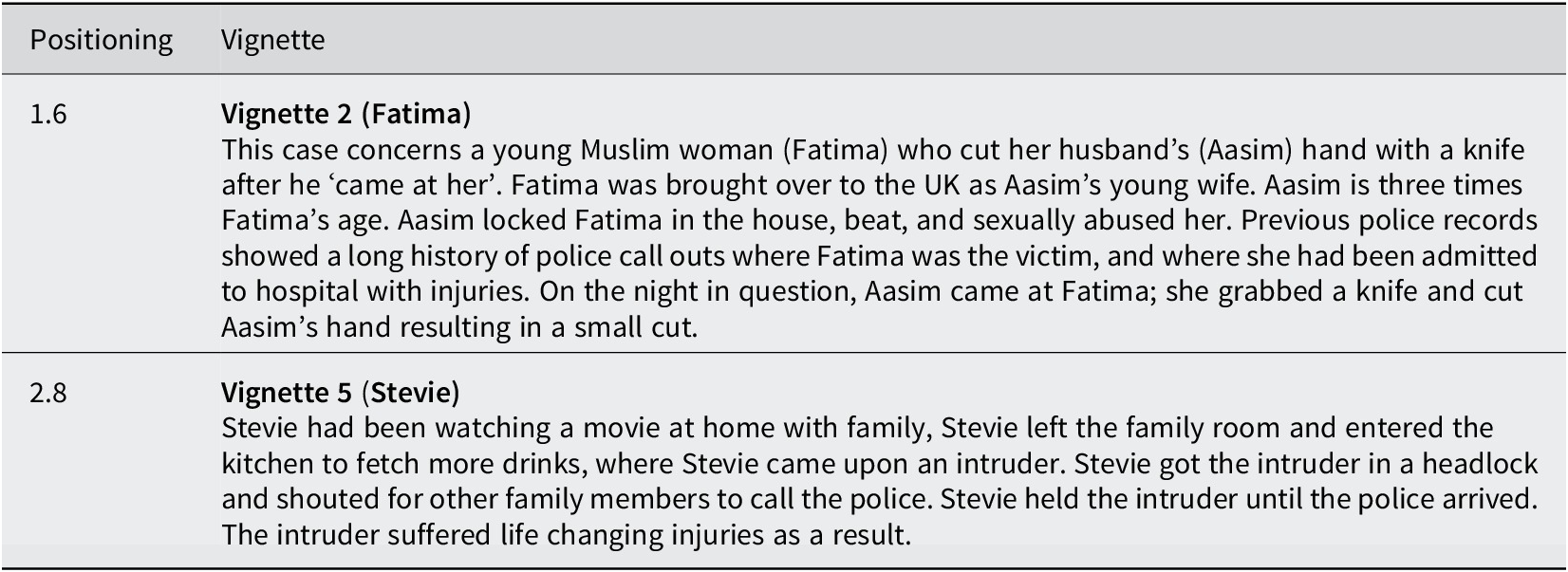
The two vignettes identified as ‘most deserving’ are detailed in Table 1 below. In terms of all eight vignettes, a hierarchy appeared to develop in relation to those deemed most to least deserving of self-defence. Whilst those identified in Table 1 were considered most deserving, in terms of the mean average, victims of domestic abuse who had committed a higher level of harm than in Fatima’s case (vignette 2)were regarded next most deserving. The public appeared to consider victim-defendants in domestic abuse cases where a child witnessed the abuse and child abuse cases as less deserving than domestic abuse cases per se. Bar brawl cases were consistently perceived as the least deserving. We discuss this hierarchy in greater detail elsewhere.
the two vignettes

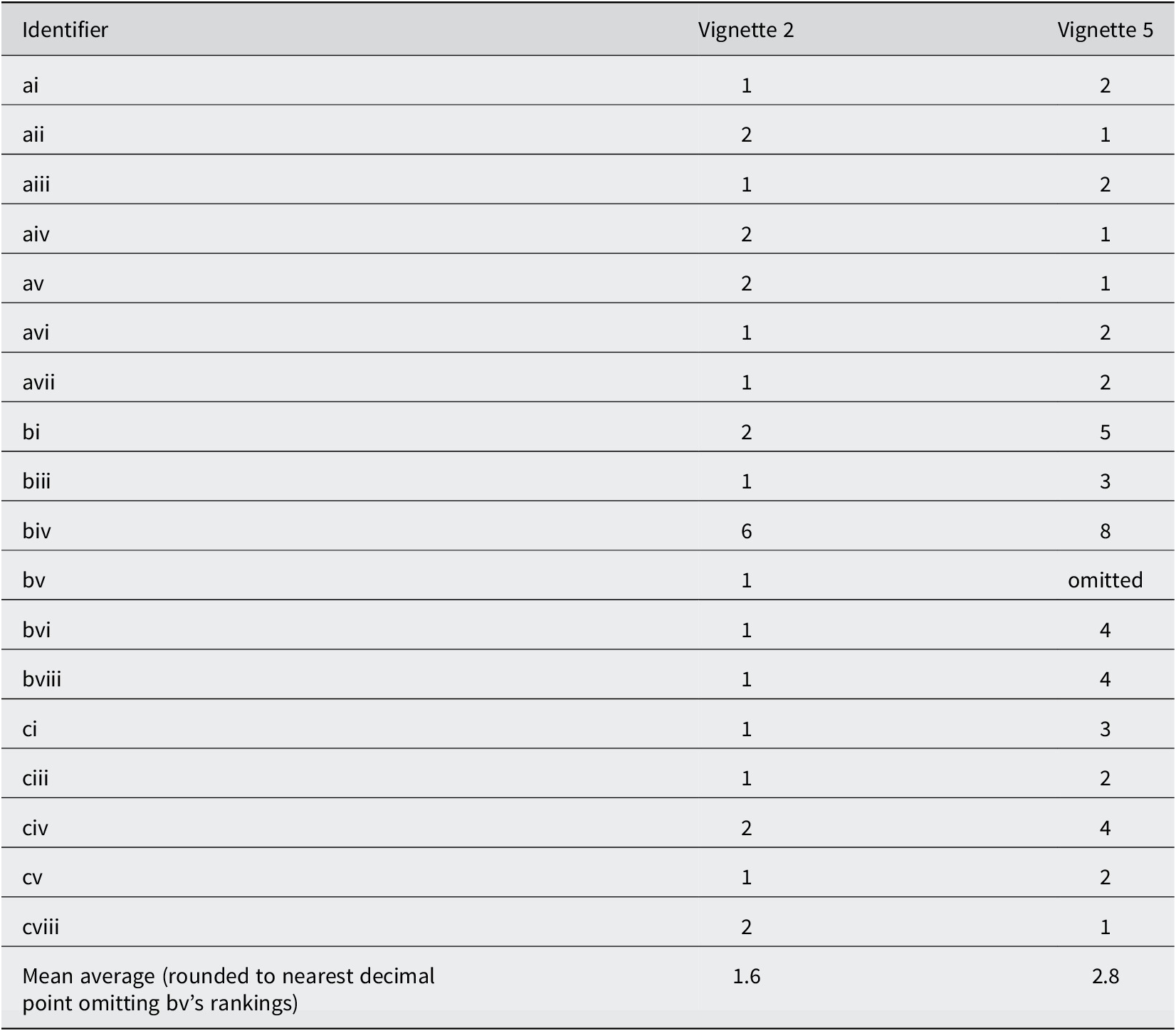
The raw data on the ranking exercise in relation to vignettes 2 and 5 are included in Table 2, below. One respondent omitted to include the card relating to vignette 5 and, as such, the mean averages for all vignettes were determined by calculated adjustment (removing bv’s rankings; note the ranking exercise was conducted anonymously and as such the quantitative identifiers do not align with the qualitative identifers).
raw data on the ranking exercise
(a) Media reporting and perceptions of the court and CJS
(i) The domestic abuse victim-defendant (vignette 2)
Vignette 2, Fatima’s case, was taken ab initio, save the names, from a real-life case presented by a practitioner during a CWJ roundtable included in the CWJ’s Double Standards report.Footnote 152 Participants were not provided with any additional information other than that outlined in Table 1. It is significant that this case concerned not only violence against a woman, but against a minoritised woman whose immigration status was affected by the outcome of the case. The resulting discussion suggested that participants constructed the reality of the circumstances beyond the information available through consideration of media, and sharing of personal experience and the experience of others.
Participants felt strongly that Fatima should have a defence but considered this may not be the case based on media reports. There is a widely held assumption that media misrepresents crimeFootnote 153 invoking a sense that the CJS is too lenient,Footnote 154 coupled with the view that media has significant influence over public perceptionFootnote 155 which governments may exploit.Footnote 156 Nevertheless, our study indicated that the public considered the law to be too harsh in some instances. For example, FA3 suggested:
[Fatima] should claim self-defence but having seen some of the cases in the news … even though to me it’s clear cut I’m still not sure a court would [accept it]…[I]t just seems … everything’s picked apart.
FA3’s view reflects the stark reality. Contrary to the views of participants regarding what they thought the outcome would and should be in Fatima’s case, the victim-defendant was charged with GBH, and spent two years in prison triggering deportation proceedings.Footnote 157 The case highlights the heightened risks for minoritised women with fragile immigration status. Not only did the state fail to intervene to protect the victim-defendant, but she was further victimised through deportation proceedings. At best, this reflects lack of understanding of domestic abuse. At worst, deportation combined with the poor agency response to previous domestic abuse help-seeking appears discriminatory. The outcome sends a clear message to minoritised women in similar circumstances that where they act to defend themselves against an abuse perpetrator, it may result in deportation. It is unsurprising that threats regarding deportation are often used by abusers to further the abuse.Footnote 158
It is important to appreciate the complexity of understanding how people make connections across competing influences in terms of constructing social reality.Footnote 159 Research regarding purported causal links between the media and people’s attitudes provides significant insights.Footnote 160 Whilst Katz and Lazarsfeld argue the media is connected strongly with aspects of everyday life that shape people’s thinking, attitudes and personality as a whole,Footnote 161 media is ‘potentially competing with other influences, and their messages are contextualised by individual and social interpretative mechanisms’.Footnote 162 Participant responses did indicate media influence. Participants referred to Sarah Everard,Footnote 163 Oscar Pistorius,Footnote 164 Tony Martin,Footnote 165 and films, such as Provoked,Footnote 166 Living with the Enemy Footnote 167 and Sleeping with the Enemy. Footnote 168 Influence and agreement are not synonymous, however, and the views suggest that a more nuanced approach needs to be adopted. Whilst participants indicated that their knowledge of the law was often informed by media, their opinions frequently differed from representation of self-defence and how it is addressed or perceived to be addressed across such platforms by them. Our social reality does not only consist of objectively observable facts; we construct parts of our social reality ourselves,Footnote 169 through media, interactions, dialogue, experience and other factors. According to Zaller, this makes public opinion ‘essentially unstable, fuzzy and difficult to grasp’,Footnote 170 and what the public may perceive as deserving or undeserving regarding law reform should not be assumed but actively sought.
In terms of legitimacy and whether the system operates in the public interest, MC4, reflected on the law’s function:
[I]n my belief the law is in there to keep us all safe, that’s why we have the law. Fatima doesn’t seem like a threat to society … [S]he was acting out of self-defence.
For MC4, the outcome would not be effective in benefiting society. Robinson and Darley note that legal rules should resonate with public opinion for legitimacy and to retain trust in the CJS.Footnote 171 In terms of legitimacy, participants considered contributory failures of the state in assessing Fatima’s position:
[T]he system, especially the police, have failed her because if they’ve been called numerous times, why haven’t they supported her … rather than just keep leaving her? (MC1)
She’s gone to hospital. Why did that never get to court? (FA4)
In reaching out, Fatima has done what Women’s Aid explained the public generally expect of victims of domestic abuse.Footnote 172 The case highlights, however, that help-seeking behaviour is not always met with an effective response. In this context, participants appeared sensitive to some factors embedded within the social entrapment approach in terms of limiting the victim-defendant’s help-seeking opportunities and capacity for action, but were less so in respect of intersectional characteristics.Footnote 173
Though participants in Newcastle and Leicester identified intersectional factors, stereotyping was prevalent and there was clear confusion regarding the relevance of ethnicity and age.
[H]e’s… three times her age, there’s…a clear power imbalance there (FA7)
He possibly brought [Fatima] to the country. So it sounds like [Fatima] was brought against her will as a child bride. The husband is three times her age (MB5)
Despite literature which highlights additional impacts of intersectional factors on domestic abuse victims, some participants considered these factors irrelevant.
[A]ge is only relevant because they put in young Muslim and older, if they’d taken out those words the scenario itself would still be the same. (FB1)
[W]e immediately relayed that to a Muslim situation, and it doesn’t make a scrap of difference. (MB4)
[T]he situation … is what we should be looking at [rather than] other factors around it. (FB1)
Age and ethnicity were not commented on at all by the London participants, suggesting a lack of awareness regarding the additional impact of domestic abuse in intersectional contexts. Nevertheless, participants recognised the lack of choice in Fatima’s situation:
[Fatima] had no choice because this guy was attacking her, and it just happened that she ended up cutting him …; a small cut in self-defence. (MC1)Footnote 174
She’s obviously gone through this for quite some time, she’s trapped. (FB2)
MA2 considered what Fatima did ‘entirely appropriate’, and MA5 noted that her ‘instinctively’ grabbing the knife ‘hadn’t been premeditated’. Participants did not consider use of the knife to be inherently dangerous, which runs counter to existing empirical findings on the issue, though this was likely influenced by the ‘small cut. It’s not life changing’ (MA5).Footnote 175
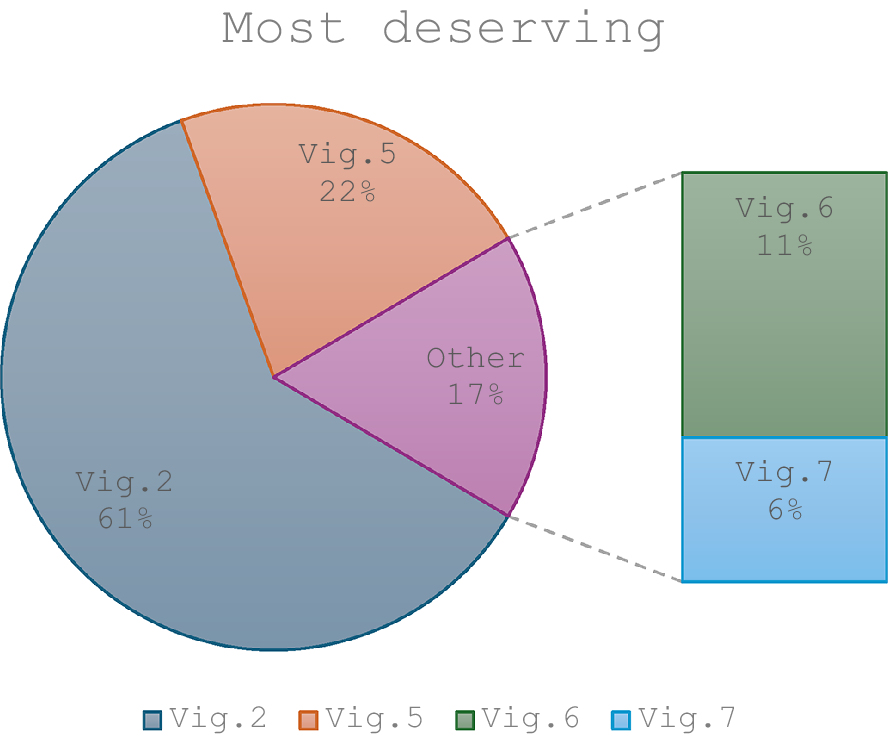
Qualitative comments were supported by the quantitative data obtained. Figure 1, below, showed participants considered Fatima’s case ‘most deserving’ of self-defence (61%) followed by Stevie’s case (22%). Only two other vignettes, both involving domestic abuse victims, were ranked ‘most deserving’ (collectively 17%).Footnote 176
illustrates the ‘most deserving’ cases in terms of modal value ranking 1.Footnote 177

(ii) the householder (vignette 5)
Views were mixed regarding whether Stevie, vignette 5, ought to be able to claim self-defence or more accurately, the householder defence. Vignette 5, based on Collins, ranked second, with 22% of participants considering Stevie ‘most deserving’ of self-defence. No additional information was provided beyond the text in Table 1 and participants tried to make sense of the case, constructing views based upon their knowledge of the media, personal experience and thoughts on domestic burglary. Qualitative comments aligned with the code, ‘experience of media reporting and perceptions of the court/CJS’ do provide some support for the MoJ’s assertion that the public think there is inadequate protection for householders confronted by an intruder. This is where, aligned to Katz and Lazarsfeld’s work, media influence appeared to have the most significant impact in terms of constructing societal understandings of the legal position.Footnote 178
You see stuff in the news … where you think that’s really reasonable but in fact … they’ve said … ‘no, you shouldn’t have restrained them’. (FA3)
Despite national media reporting on legal reform, guidance directed towards laypeople, and high-profile cases, none of the participants appeared to be aware of the increased latitude afforded to householders in self-defence cases.Footnote 179 This perhaps exemplifies Zaller’s public opinion model, which recognises that a variety of individual and contextual factors impact on a person’s consumption of media messaging,Footnote 180 whereby sensationalised headlines outweigh educational content. As MB4 reflected:
I’ve seen many cases reported in the media of people committing these kind of actions and the police have ended up taking them to court rather than the … intruder because they’ve used unnecessary and excessive force. I think you’re allowed to use commensurate force.
Similarly, FC3 expressed the following mistaken view:
[T]here’s been quite a few of these … cases with intruders and the person who lives at the house attacks … the intruder and actually hurts them, and the person that owns the property gets into trouble not the intruder.
Aligned with Couldry and Hepp’s research, there appears to be socially conditioned common understanding that self-defence is unavailable in householder contexts, which educative media cannot outweigh.Footnote 181 Several participants considered that the law does not adequately protect those defending themselves from intruders because they perceived it only allows the use of ‘commensurate’ (MB4) force or, in the words of MC1, the courts ‘would not be sympathetic because … as far as the law’s concerned you’re only allowed to use sufficient force’. This erroneous thinking signifies that education on the operation of self-defence in this context may have been more beneficial than reform, given that the latter has not substantively changed the views of the public on the effectiveness of the law.
Participants considered the way an individual defends themselves would impact the availability of self-defence, perceiving the law to be more punitive than it is in householder contexts:
I would support but I don’t think the law would … – because the guy’s restraining the intruder, the family members are there. They probably think well you should have tied him up or, you know, done something to keep him in a position until the police came but holding him in a choke hold or something like that is life threatening (MC2).
In terms of expressing retributivist views,Footnote 182 some considered Stevie’s defensive behaviour praiseworthy:
The chances are that Stevie … would be charged [and] found guilty; no case of self-defence. … [P]ublic opinion would be totally different … Stevie deserves a medal because he might have life-changing disabilities or whatever but trust me he’s not going to be burgling anybody else’s houses. (MC1)
The Intruder’s wrong for being there and deserves whatever they get … [Stevie] didn’t intend to … give them life changing injuries. [Stevie] had no choice but to hold them down. (FC3)
I think the law probably would do something to the guy owning the property really. Do I think it’s right? No … if someone comes into your house with the intent to do something, I think they deserve everything they’re going to get … but the law doesn’t work like that unfortunately. (MC3)
MB4, in contrast, considered that the defence should not be available, as the force used by Stevie was ‘not commensurate’ with the threat posed:
[D]oes that give Stevie the right to impose a life sentence on the intruder when the law would probably give him a slap on the wrist? He’d probably not even get a custodial sentence. The actual punishment … by suffering life changing injuries isn’t commensurate with the crime … Stevie’s got no right to be judge, jury and executioner.
In effect, for MB4 the threshold set by standard self-defence is appropriate in terms of moral condemnation; Stevie should not be able to rely on the defence. This appears to imply that MB4 would consider the householder defence too liberal in terms of moral credibility though, as noted, no participants appeared to be aware of this gloss on the criminal law.Footnote 183
Several participants also discussed their agreement with the unavailability of self-defence in the case of Tony Martin,Footnote 184 which pre-dated reform. Martin, who recently died aged 80, fatally shot a teenager and injured another who had attempted to burgle his farm, Bleak House. The case was notorious, with many supporting Martin’s rights to defend himself and his home, and others considering him ‘a violent eccentric who turned vigilante’.Footnote 185 Initially convicted of murder, the charge was subsequently reduced to manslaughter with evidence of his paranoid personality disorder forming the basis of a successful diminished responsibility plea.Footnote 186 At the time the householder defence was being considered, the Law Commission suggested, in reference to Martin amongst others, that public support was predicated on a fundamental ‘misunderstanding of the state of the present law, contributed to by incomplete understanding of certain notorious cases’.Footnote 187 Incidentally, the outcome in Martin would have been no different under the householder defence, since the threat was no longer present.Footnote 188 Participants made mixed references to the case of Martin. However, views seemed to be more nuanced or at least more so than it was perceived at the time of the 2013 reform, which may have been influenced by recent documentaries and dramatisations of the case, though these were not specifically referred to by participants.Footnote 189
(iii) Rankings: Fatima v Stevie
Table 3, below, shows ‘would’ and ‘should’ rankings for Fatima (vignette 2) and Stevie (vignette 5) across all participants to the second nearest decimal point. A total of 13 (six female and seven male) of the 19 participants thought Fatima would be able to claim self-defence. Two, one female (FA3) and one male (MB5), thought Fatima would be unable to claim self-defence. The remaining participants did not indicate a conclusive view. 15 (six female and seven male) of the 19 believed Fatima should be able to claim self-defence. The remaining participants did not indicate a view either way.
Participant responses (by percentage) as to whether self-defence would and should be available in responses to vignettes 2 and 5

A total of 17 of the 19 indicated whether they thought Stevie (vignette 5) would be able to claim self-defence: 14 (seven female and seven male) thought Stevie would be able to claim, despite expressing doubts; three male participants (MB4, MC1 and MC2) considered that Stevie would not be able to claim self-defence. The remaining participants did not indicate a conclusive view. Also, 12 (five female and seven male) of the 19 believed Stevie should be able to claim self-defence. MC4 caveated this view by requiring the intruder to be armed with a knife. One male (MB4) did not believe Stevie should be able to claim self-defence. The remaining participants did not express a conclusive view.
Fewer participants thought Fatima would have a successful self-defence claim under the current law than thought she ought to have it. Participants considered self-defence would be more available to Stevie than it should be. These findings are significant given that distributive fairness is a central tenet of legitimacy not only in how the law is perceived to operate but how it does in fact operate in the distribution of justice.Footnote 190 The findings are more stark given none of the participants appeared to be aware that the more liberal defence applies in the householder context. With regard to procedural fairness, the different treatment of these categories of offender may undermine the legitimacy of the law in terms of shared societal views on just outcomes.
Not one participant considered that Fatima should not be able to successfully claim self-defence, whereas a small percentage considered that Stevie should not. These tables do not include those who did not commit to an answer either way, and participants were more reticent about indicating whether Fatima and Stevie would not and should not be able to claim self-defence as compared with whether they would and should (see Table 3).
It is misleading to suggest that there is public support for the householder defence but not a more accessible defence for domestic violence situations, particularly considering the limited research on this issue. Our findings suggest, contrary to former government expositions, that there is indicative public support for extending the householder defence to victim-defendants. Though participants considered Stevie deserving of self-defence, they found Fatima more deserving. These findings reinforce the importance of obtaining data on what the public think would and should happen in such cases. If the public perceive the outcome of cases too harsh in some cases and too lenient in others, it risks undermining legitimacy of the law.
Conclusion
Government decisions on reform in the context of householders and victim-defendants has been based on limited evidence of public opinion.Footnote 191 An effect of this is the application of different standards in self-defence cases for householders and victim-defendants, providing householders with more leniency in respect of decisions to prosecute and during trial.Footnote 192 For householders, the MoJ argued that reform was needed due to public concerns about insufficient protection under standard self-defence, despite evidence suggesting the law was functioning well.Footnote 193 In contrast, the calls of the CWJ to extend the defence to victim-defendants were rejected during the passage of the DAA 2021Footnote 194 and VPA 2024.Footnote 195 The government claimed there was no legal gap.Footnote 196
Our study provides the first in-depth insights into public opinion on self-defence in England and suggests the government’s presumptions have been ill-founded, with participants determining that a domestic abuse victim-defendant was more deserving of self-defence than a householder responding to an intruder. These views are significant as they are based on real-life cases where the CPS chose not to prosecute a householder but did charge and convict the victim-defendant.Footnote 197 The current defence framework offers greater protection to householders, such as those who harm a police officer during a raid because they genuinely mistakenly believe him to be a drug dealer.Footnote 198 In contrast, victim-defendants defending themselves against abusers are less protected.Footnote 199 These discrepancies show, despite government claims and increased awareness of domestic abuse, that there is a gap in the law that needs to be addressed to maintain public and professional confidence in the CJS. Given the public are essential to the administration of justice in their roles as witnesses, magistrates and jurors, law and policymakers should have an awareness of public perceptions on these important issues, both in assessing educative needs and maintaining moral legitimacy of the law.
The findings of our exploratory study indicate that more research should be done on public perceptions of the criminal law to maintain the law’s legitimacy and identify educative need. Future large-scale study would benefit from probability sampling or the implementation of stratum quotas to allow greater generalisability, though neither are without challenges.Footnote 200 Surveys focused on scalability and generalisability of the quantitative data obtained could also be used; these could be supported by follow-up interviews or focus groups to explore understanding of the law and normative considerations regarding legitimacy and decision-making. Research could focus on specific facets of public understanding and views on self-defence, eg mistaken belief, assumptions regarding perpetrator and victim sex, and self-defence in non-dominant sexuality contexts.
The Law Commission has highlighted the importance of engaging with public perceptions on defences in consultations and this study has sought to do this in a meaningful way.Footnote 201 Proposals by the CWJ which seek equal protection for victim-defendants using violent resistance represent an optimal model for reform, aligned with shared community values.Footnote 202 With growing support from both the public and professionals, it is hoped that the current government, who previously supported the proposals in opposition, will address the issue and extend the householder defence to victim-defendants in line with renewed calls to do so.Footnote 203


 Open access

