


1. Introduction
Wheat protein levels vary widely yet are a significant determinant of wheat quality (engrain, 2023). Wheat protein is an important quality consideration because it forms the foundation for gluten, a protein complex. Wheat gluten is positively related to dough elasticity and the ability for dough to capture air bubbles during fermentation, which allows bread to rise and achieve a desired texture. This is particularly true for artisanal, sourdough, and baguette breads due to their dense loaves (Nelson, Reference Nelson2025).
Previous research has measured the impact of wheat protein levels on wheat prices in the United States (US) (Bale and Ryan, Reference Bale and Ryan1977; Bekkerman, Reference Bekkerman2021; Chen and Brorsen, Reference Chen and Brorsen2022; Espinosa and Goodwin, Reference Espinosa and Goodwin1991; Goodwin and Ogunjemilua, Reference Ogunjemilua2023; Parcell and Stiegert, Reference Parcell and Stiegert1998; Parcell and Stiegert, Reference Parcell and Stiegert2003; Smith, Reference Goodwin and Smith2009), Japan (Stiegert and Blanc, Reference Stiegert and Blanc1997), and global markets (Stiegert and Balzer, Reference Stiegert and Balzer2001; Wilson et al., Reference Wilson, Wilson and Dahl2005, Reference Wilson, Wilson and Dahl2009). In general, wheat protein has been found to be a positive determinant of wheat prices, as shown for both (1) the average daily wheat price and protein levels for the period 2021–2025 (Figure 1) and (2) the data used in this analysis, Kansas district-level wheat protein during 2001–2024 (Figure 2).
Average daily wheat price and protein, 2021–2025.
Note: “Ordinary” is standard baseline protein content for hard red winter (HRW) wheat, lower than 11 percent.
Source: United States Department of Agriculture Agricultural Marketing Service. (USDA/AMS, 2021–2025).

Relationship between Kansas wheat protein and wheat price.
Note: These data include 161 observations of seven Kansas CRDs during 2001–2023.
Sources: Kansas district-level wheat protein levels are from USDA/NASS, 2001–2023. District-level wheat prices are from Kansas State University (Reference O’Brien, Reid and Dhuyvetter2025), deflated by prices of No. 1 hard red winter wheat (ordinary protein) Kansas City, MO dollars per bushel (USDA/ERS, 2026).

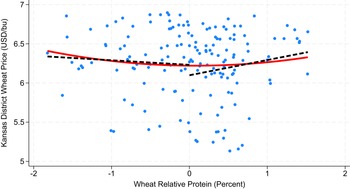
Parcell and Stiegert (Reference Parcell and Stiegert1998) demonstrated that wheat prices were determined not only by the protein level within a district but also by overall protein levels available at the State level and in different States. This relationship is demonstrated in Figure 3 for the data included in this research, where the difference between local and regional Kansas State protein levels are shown to have a nonlinear relationship with wheat prices. Local wheat price increases when the magnitude of the divergence of local protein levels from overall regional levels is greater, both when local protein is higher than regional protein levels and when regional protein is greater than local protein levels.
Impact of Kansas relative wheat protein on wheat price.
Notes: These data include 161 observations of seven Kansas CRDs during 2001–2023.
Sources: Kansas district-level wheat protein levels are from USDA/NASS, 2001–2023. District-level wheat prices are from KSU, deflated by prices of No. 1 hard red winter wheat (ordinary protein) Kansas City, MO dollars per bushel (USDA/ERS, 2026). The solid curved line is a quadratic trend, and the dashed segmented lines are linear trend lines for values of relative protein (relpro) above and below zero.

Testing wheat for protein in Kansas is becoming more widespread at county elevators, terminal elevators, and mills using Near-Infrared Spectroscopy (NIR) (Ehmke, Reference Ehmke2026; Snodgrass, Reference Snodgrass2026; Vulgamore, Reference Vulgamore2026). Low-cost portable testing equipment is now available to producers for approximately 5,000 USD, and testing is available with yield monitors in combines. Not all local elevators in Kansas test for protein, but the practice is becoming increasingly common (Lollato, Reference Lollato2026; Thiele, Reference Thiele2026). Many county elevators struggle to segregate wheat by protein level during harvest due to a lack of time and labor at this busy time. Instead, these elevators test for protein, but combine all wheat lots into a single bin and sell at the “station average” protein level (Ehmke, Reference Ehmke2026; Kastens, Reference Kastens2026).
Depending on the supply and demand for protein in a given time and location, a premium is sometimes paid for protein, which can be passed back to producers. Elevators may pay farmers a premium as an incentive. The protein market is often dynamic, and protein premium levels can change daily, especially during harvest as more information becomes available to millers and bakers. In most years and locations, higher protein is associated with a premium, since the targeted protein levels (demand) are often higher than the average protein level in the market (supply). However, in drought years, heat stress can result in smaller kernels with higher protein levels, and a “protein premium inversion” can occur, causing low-protein wheat to be more valuable than high-protein wheat due to relative scarcity (Gilpin, Reference Gilpin2026; Tierney, Reference Tierney2026). While this is rare at the market level, it frequently occurs at the local level as mills search for wheat with the desired protein level (Garr, Reference Garr2026).
Larger, more progressive producers test each truckload at the elevator (and increasingly, in the field), but most smaller producers do not (Vulgamore, Reference Vulgamore2026). Blending wheat of different protein levels to achieve the targeted protein level has traditionally taken place at the terminal elevators, since the concrete silo structures allow for efficient segregation and blending of wheat. Currently, some farmers can test, store, and segregate wheat by protein level to capture additional market value (Vulgamore, Reference Vulgamore2026). Protein testing and protein premiums at local elevators are relatively new and did not often occur during the time period considered here. The protein premiums measured here were paid at the next point in the marketing chain, the terminal elevators.
The only time that wheat trades without a measured protein level associated with it is when a farmer delivers wheat to the elevator. At each point forward in the supply chain, there is a protein level associated with the wheat, including elevator to terminal, flour mill, or export (Churchill, Reference Churchill2026; Gilpin, Reference Gilpin2026). Mills purchase wheat at a given protein target level achieved by the elevator blending wheat. The milling process results in a protein loss due to removing the outer layers of the kernel. After milling, wheat flour can be blended to provide products demanded by customers, allowing the mill to produce a small number of flours but a large range of final products (Churchill, Reference Churchill2026; Garr, Reference Garr2026). Blending is a profitable activity, as millers can arbitrage protein across time and space to find the lowest cost to produce a range of flour products (Ehmke, Reference Ehmke2026; Garr, Reference Garr2026). Protein levels differ by location, weather, and wheat class. Blending occurs across wheat classes and locations in a given year and across stored wheat from previous years. When protein premiums are paid, the cost is passed on to consumers, and the price of protein is reflected in flour product prices in grocery stores and restaurants (Garr, Reference Garr2026). The wheat industry in general, and wheat protein markets specifically, are characterized by rapid change (Fritz, Reference Fritz2026). Increasingly, producers can store their own grain by purchasing or building their own storage units and sell wheat at different protein levels at different prices.
Protein premiums are often not known until harvest is complete. Producers rarely have enough advance information to include protein premiums in their management decisions, and it is currently difficult for many farmers to take advantage of protein information and protein price differences. This is rapidly changing, as protein information during harvest is becoming more widespread and more attainable earlier in the harvest season. Over time, enhanced wheat protein testing and storage are likely to increasingly allow producers to share in the protein premiums as they increase their ability to test, segregate, and market wheat of different protein levels (Ehmke, Reference Ehmke2026; Fritz, Reference Fritz2026; Kastens, Reference Kastens2026).
This research builds upon Parcell and Stiegert’s (Reference Parcell and Stiegert1998) important work by estimating how local and regional protein levels influenced wheat prices in Kansas during 2001-2023. Results provide some evidence that wheat price is influenced by both (1) the absolute protein level at the local (Crop Reporting District) level and (2) the local level of wheat protein relative to the regional (State) protein level. Absolute protein levels are positively related to wheat prices: higher protein leads to higher prices, as shown in previous research and Figures 1 and 2. In addition to the absolute effect of wheat protein on price, there is also a relative effect: when local protein levels in Kansas Crop Reporting Districts (CRDs) diverge from the regional (State) protein level, higher prices are received in the local wheat market.
This topic is economically important to Kansas wheat producers, who have recently requested legislation to require the Kansas State Board of Agriculture to measure and report wheat protein levels to farmers at time of delivery (Nelson, Reference Nelson2025). The proposal does not mandate a wheat protein premium but instead allows farmers to be able to make production and marketing decisions that influence the protein level of their crop, based on market information (Nelson, Reference Nelson2025).
2. Literature review
Bread and other yeast-based products require higher-protein wheat to create a strong dough that can trap gas from the yeast during fermentation, whereas cookie and cracker doughs require a moderate amount of protein for shape and crispiness. Cakes and pastries retain softness with lower protein levels (engrain, 2023). Thus, the demand for high-protein wheat is derived from the demand for bread. The demand for low-protein wheat is derived from the demand for biscuits, cakes, and pastries, and livestock feed (Bale and Ryan, Reference Bale and Ryan1977, 530).
Production conditions such as weather determine the level of wheat protein available at both the local level and the overall market. Importantly, depending on protein availability in the market, some low-protein wheat is purchased as an “extender” to blend with high-protein wheat for bread flour (Bale and Ryan, Reference Bale and Ryan1977, footnote 2, 530; Garr, Reference Garr2026). Since wheat protein levels vary across time and space, wheat buyers perform arbitrage to purchase the optimal level of protein needed for the wide range of wheat products produced. Thus, wheat at any given location is a close substitute of wheat from other locations (Bale and Ryan, Reference Bale and Ryan1977, 530; Tomek and Robinson, Reference Tomek and Robinson1972, 134-143). Previous literature has consistently found a protein premium for Kansas wheat, as described next.
Bale and Ryan (Reference Bale and Ryan1977) estimated the effect of changes in available supplies of wheat of various protein content on relative prices with data from 1965 to 1974 and found a statistical relationship between protein levels and prices for hard red winter (HRW) and hard red spring (HRS) wheat. The authors report that high-protein wheats have a higher price than lower-protein wheats. Espinosa and Goodwin (Reference Espinosa and Goodwin1991) estimated hedonic price models to provide estimates of the marginal implicit prices of several wheat characteristics including wheat protein using a cross-sectional time-series panel of Kansas wheat quality data, and found that protein is an important wheat quality characteristic that garners a premium (74).
The impact of wheat quality characteristics, including protein, on wheat variety choice has been explored in both Kansas (Barkley and Porter, Reference Barkley and Porter1996) and the Pacific Northwest (Smith, Reference Smith2000). Stiegert and Blanc (Reference Stiegert and Blanc1997) estimate the marginal values of wheat protein in the Japanese import market, finding that wheat protein is linked to milling and baking characteristics that command higher value in the Japanese market. Stiegert and Balzer (Reference Stiegert and Balzer2001) explored the economic relationships between a wheat gluten and wheat protein. The authors estimated the impact of the US gluten import quota on producer protein premiums. Gafarova, et al. (Reference Gafarova, Perekhozhuk and Glauben2015) found that wheat protein was not rewarded separately in the Black Sea markets, including Kazakhstan, Russia, and Ukraine.
Parcell and Stiegert (Reference Parcell and Stiegert2003) develop a demand model of Kansas HRW wheat protein. For the period 1974 to 1996, own-district protein level was not economically significant; however, regional-level protein and protein levels in North Dakota had small but statistically significant positive impacts on local wheat prices. Parcell and Stiegert (Reference Parcell and Stiegert2003) provide an important foundation for the current research, which hypothesizes that the local wheat price depends not only on local wheat protein levels but also on protein levels in the wider wheat market.
Wilson et al. (Reference Wilson, Wilson and Dahl2005 and Reference Wilson, Wilson and Dahl2009) analyze the demand for wheat protein across importing countries and time, using a pooled data set of wheat shipments. The authors estimated that there have been shifts over time. They also find that wheat purchase probabilities are highly price elastic and vary across importing regions. Goodwin and Smith (Reference Goodwin and Smith2009) study dynamic relationships among three classes of wheat using threshold VAR models that incorporate the effects of protein availability. Changes in the stock of protein generate significant responses in the prices of HRS wheat and HRW wheat, but not soft red wheat. Barkley et al. (Reference Barkley, Peterson and Shroyer2010) use portfolio theory to evaluate wheat variety decisions of Kansas wheat producers.
Bekkerman (Reference Bekkerman2021) estimates an informed expectation model of elevators’ quality‐based wheat pricing strategies using a large dataset of weekly price observations. Bekkerman finds evidence that elevators use linear pricing schedules, aggressively discount wheat with protein levels lower than a baseline and reward higher‐protein wheat. Chen and Brorsen (Reference Chen and Brorsen2022) explored the spatial pattern of quality factors of HRW wheat in the Great Plains during 2012-2019. They found that high-protein wheat was found in the Texas panhandle up to Southwestern Kansas, probably due to arid growing conditions. Chen et al. (Reference Chen, Brorsen, Biermacher and Taylor2022) compared explicit wheat protein premiums with implicit premiums and estimated that the hedonic price premium was higher in Western Oklahoma, Kansas, and Texas. In the Southern wheat production region of Texas and Southern Oklahoma, grain elevators typically do not test for protein levels, and premiums are implicit in the basis price.
Roberts et al. (Reference Roberts, Brooks, Nogueira and Walters2022a and Reference Roberts, Brooks, Nogueira and Walters2022b) provide an important update and extension of previous work on wheat price premiums for wheat quality characteristics, including wheat protein. The study area of HRW wheat production is expanded, transportation costs are considered, and the role of market information across time is explored. The authors conclude that, “…US wheat producers are indirectly, through elevator basis, paid for end-use quality characteristics… Given this information, wheat breeders enhancing end-use characteristic traits may improve wheat producer outcomes” (7). The authors also emphasize the importance of transparency and efficiency of the HRW wheat pricing system, calling for greater information about wheat quality characteristics, a point also emphasized by (Nelson, Reference Nelson2025). Ogunjemilua (Reference Ogunjemilua2023) compared econometric techniques and machine-learning techniques in forecasting protein premiums for HRS wheat, using monthly terminal market data for 2011–2023. Gallardo et al. (Reference Gallardo, Lusk, Holcomb and Rayas-Duarte2009) used survey data to find that Mexican millers paid premiums for higher protein levels in hard red winter wheat but were relatively insensitive to protein variability.
To summarize, previous literature has consistently found a protein premium in Kansas wheat prices. Past literature has studied a variety of aspects of wheat protein, but none of the past work has investigated how local wheat prices are influenced by both (1) the absolute level of wheat protein in the local Crop Reporting District and (2) the local level of wheat protein relative to the overall wheat protein level in the rest of the State. Since protein premiums were not paid directly to producers during much of the period studied, a protein premium is expected to be identified and quantified in this study.
3. Model
The underlying assumption of this research is that the local wheat price is determined by both the absolute local protein level and relative scarcity: when local wheat protein levels diverge from the market regional protein level, then wheat buyers (millers and bakers) are at times willing to pay more for the wheat that differs from the rest of the market. The basis of this research is that scarcity drives value: when local wheat protein levels differ, either higher or lower, from regional market levels, wheat buyers could arbitrage across geographical space and time to acquire wheat with the optimal level of protein for their specific end-use purpose. Therefore, the magnitude of the difference between local wheat protein and regional wheat protein, regardless of sign, is hypothesized to influence local wheat prices (Figure 3). Here, we capture this feature of arbitrage across space and time by including, in addition to local protein levels, the difference between local and regional wheat protein levels as a determinant of wheat price in a quadratic panel regression model.
An interaction term between local and regional protein levels could capture a relationship between local and regional markets and would be included in a model when the effect of the level of one variable (local protein level) on the outcome is influenced by the level of another variable (regional protein level). However, a model specification that considers the magnitude of the difference between local and regional protein levels could provide new results that fit the relationship of the data in Figure 3. Based on this idea, we hypothesize that the district (local) level wheat price depends on both: (1) the absolute level of wheat protein in the local (district) market and (2) the level of local (district) wheat protein relative to the level of regional (State) wheat protein.
A numerical example can demonstrate how local and regional wheat protein levels could influence wheat prices (Table 1). Local protein levels (column 2) that diverge from average regional protein levels (column 3) have a greater value to end-use buyers (bakers). Local protein is expected to have greater market value in rows (1) and (2), whereas local protein in row (3) is not expected to enhance wheat prices. In cases where local and regional protein levels diverge from each other (rows 1 and 2), an interaction term (column 4) would not capture differences in protein value since all values of the interaction term are equal (=121) in this case. The difference between local and regional protein values (column 5) is also likely to be unrelated to wheat price, since positive differences (row 1, column 5) and negative differences (row 2, column 5) are both expected to be positively associated with wheat value. However, in this case, the positive difference (row 1) could offset the negative difference (row 2) in a regression framework, resulting in an insignificant estimated impact of protein level on wheat price. A regression specification that allows for a nonlinear relationship to be estimated when both positive differences (row 1) and negative differences (row 2) provides a positive association with local wheat prices. One such specification includes a squared relative protein term (column 6) to capture the “U-shaped” relationship between price and relative protein.
Numerical example of potential impact of wheat protein on wheat price

Table 1 Long description
A table with six columns and four rows, including a header row. The columns are labeled as follows: (1) Local and regional protein level divergent, (2) Percent local protein (distpro), (3) Percent regional protein (stapro), (4) Interaction term (distpro*stapro), (5) Difference (distpro - stapro), and (6) Squared difference (distpro - stapro)^2. The rows are labeled as (1) Yes, (2) Yes, and (3) No. Row 1: Yes, 12.1, 10, 121, +2.1, +4.41. Row 2: Yes, 10, 12.1, 121, -2.1, +4.41. Row 3: No, 11, 11, 121, 0, 0.
Notes: Suppose that value is determined by relative scarcity. In this context, scarcity is captured by the magnitude of the difference between local and regional wheat protein levels. Wheat prices are expected to be higher when local protein levels (column 2) diverge from average regional protein levels (column 3), as in rows 1 and 2, but not in row 3 (column 1). In cases where local and regional protein levels diverge from each other (rows 1 and 2), an interaction term between local and regional protein levels (column 4) would not capture differences in protein value since all of the interaction terms are equal in this case (=121). The difference between local and regional protein values (column 5) is also likely to be unrelated to wheat price, since positive differences (row 1, column 5) and negative differences (row 2, column 5) cancel each other out in a linear regression framework, yet are both expected to be positively associated with wheat price. A quadratic (squared) term for relative protein (column 6) allows for a relationship to be estimated where both positive differences (row 1) and negative differences (row 2) can be positively associated with local market prices. Alternative specifications that also capture this relationship could include the absolute value of the difference between district and regional protein and a piecewise (segmented) regression with a breakpoint at zero (Appendix Table A1 and Figure 3).
Our basic model follows the hedonic price literature applied to agricultural commodities (Espinosa and Goodwin, Reference Espinosa and Goodwin1991; Ladd and Martin, Reference Ladd and Martin1976; Parcell and Stiegert, Reference Parcell and Stiegert1998). Define y to be wheat output, x to be a vector of inputs in the production of wheat, and z to be a vector of input characteristics such as wheat quality characteristics, including protein. Profit maximization results in the first-order condition for wheat input characteristics, z k. For this study, the variable zk is defined to be wheat protein. For a given location and time, wheat producers are assumed to maximize profits with the first-order condition: ${P_x} = {P_y}\sum\limits_{k = 1}^m {\left( {{{\partial {f_y}} \over {\partial {z_{ky}}}}} \right)\left( {{{\partial {z_{ky}}} \over {\partial {x_y}}}} \right).}$
In equation (1), the optimal level of input characteristic is found, where Px is the input price, Py is the output (wheat) price, and f is a production function that relates wheat output (y) and input characteristics, fy(z). Note that time (t) and location (i) are not included in this theoretical model but will be added when the empirical model is specified below in the next section.
Following Espinosa and Goodwin (Reference Espinosa and Goodwin1991), we assume that the two right-hand terms in equation (1) are constant: $P_{y}{\partial f_{y} \over \partial z_{ky}}=A_{k}$
and
$P_{y}{\partial f_{y} \over \partial z_{ky}}=A_{k}$
and ${\partial z_{ky} \over \partial x_{y}}=z_{kxy}$
. These assumptions result in:
${\partial z_{ky} \over \partial x_{y}}=z_{kxy}$
. These assumptions result in: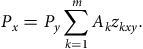 ${P_x} = {P_y}\sum\limits_{k = 1}^m {{A_k}{z_{kxy}}.}$
In equation (2), A k is the marginal implicit value of the k th characteristic and z kxy is the quantity of characteristic k contained in each unit of input x used in production function y. This profit-maximizing level of input characteristic leads to an empirical hedonic model with price as the dependent variable and a vector of good characteristics (z) as the independent variables, as shown in the next section. Following previous research, we assume the supply of wheat to be predetermined, or exogenous, and the demand for wheat protein to determine the price premiums. This simplifying assumption is realistic in wheat markets and addresses potential endogeneity in the hedonic model.
4. Empirical model specification and functional form
For estimation purposes, we add time (t) and location (i) subscripts to the model in equation (1) to specify the statistical model: ${P_{it}} = {\alpha _0} + \sum\limits_{k = 1}^m {{\beta _k}{z_{itk}} + {u_{it}},}$
where P it is the average local price of wheat (USD per bushel) in the ith Kansas Crop Reporting District (CRD) in year t and the β k terms are the estimated marginal implicit prices for the k = 1, …, m wheat characteristics, as measured by the z itk terms, and u it is the error term. We are focused on protein levels, so we rewrite the empirical equation (3) with the z itk terms defined to be (1) district-level protein levels (distpro), and (2) relative protein, defined as the difference between local and regional (State) protein levels (relpro = distpro – stapro). We also extend the simple model in equation (3) to a random effects panel regression model that includes other wheat quality characteristics (qual), transportation costs (τ), a location-specific random effect (ωi) and an error term (ϵit): ${P_{it}} = {\alpha _0} + {\beta _i}dist\,pr{o_{it}} + {\delta _i}rel\ pr{o_{it}} + {\phi _i}rel\ pro_{it}^2 + {\lambda _i}\; {\boldsymbol{qua}}{{\boldsymbol{l}}_{it}} + {\bf \tau}{_i} + {\bf \omega} {_i} + {{\rm \varepsilon} _{it}}.$
Wheat quality characteristics other than wheat protein are included as control variables (qual, Table 2). Following Espinosa and Goodwin (Reference Espinosa and Goodwin1991) and Parcell and Stiegert (Reference Parcell and Stiegert2003), transportation costs (τ i ) are captured as time-invariant spatial variables for each of the seven included Kansas CRDs. Below, we use a Hausman (Reference Hausman1978) test to determine whether these spatial variables should be modeled as fixed effects or random effects.
Summary statistics for Kansas wheat protein study

Table 2 Long description
A table with summary statistics for Kansas wheat protein study variables. The table has 11 rows and 5 columns. The columns are labeled Variable, Mean, Std. dev., Minimum, and Maximum. The rows list different variables and their corresponding statistical values. Row 1: Deflated district level price, 6.26, 0.44, 5.13, 6.90. Row 2: District level protein, 12.18, 0.87, 10.10, 14.90. Row 3: Relative protein, 0.03, 0.69, -1.82, 1.52. Row 4: Test weight, 0.73, 0.44, 0, 1.00. Row 5: Moisture content, 0.15, 0.36, 0, 1.00. Row 6: Grade 2, 27.61, 19.98, 0, 81.00. Row 7: Grade 3, 6.05, 14.88, 0, 100.00. Row 8: Damaged kernels, 0.44, 0.61, 0, 6.40. Row 9: Foreign materials, 0.06, 0.07, 0, 0.30. Row 10: Shrunken and broken kernels, 1.22, 0.29, 0.50, 2.40. Row 11: Dockage, 0.57, 0.13, 0.30, 1.10.
Notes: Number of observations = 161. Data are for seven Kansas CRDs, 2001-2023.
Sources: District wheat prices are from Kansas State University (Reference O’Brien, Reid and Dhuyvetter2025), deflated by the marketing year average of Kansas City Board of Trade Daily Wheat Bids, Coarse Wheat, hard red winter US #1, ordinary protein level (USDA/ERS 2026). Wheat protein levels are from USDA/NASS, (2001–2023). State protein is a weighted average using district wheat production (Kansas Department of Agriculture, 2001–2023). Grade One wheat is the omitted default (baseline) category. Test weight is equal to one for test weights under 60 pounds per bushel, and equal to zero otherwise (Espinosa and Goodwin, Reference Espinosa and Goodwin1991). Moisture content is equal to one for moisture content greater than one standard deviation above the mean value (Espinosa and Goodwin, Reference Espinosa and Goodwin1991).
5. Data
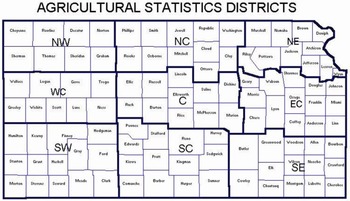
To better understand wheat protein markets, data was collected for the period 2001–2023 to estimate equation (4). The dependent variable is Kansas wheat prices at the CRD (local) level. District-level marketing year averages of wheat prices are “Seasonal Cash Grain Prices” (Kansas State University, Reference O’Brien, Reid and Dhuyvetter2025). District prices were converted to 2024 equivalent dollars with the prices of No. 1 hard red winter wheat (ordinary protein) at Kansas City, Missouri dollars per bushel (USDA/ERS, 2026).Footnote 1 Kansas wheat protein and other wheat quality data are from “Kansas Wheat Quality” (USDA/NASS, 2001–2023). Kansas wheat quality data is collected by the Kansas Grain Inspection Service, Inc. (KGIS) and reported by USDA/NASS (2001–2023). Wheat quality data collection is funded by the Kansas Wheat Commission. Test weight, protein content, grade, and defects are measured with samples collected throughout the State. The samples are representative of wheat moving in commercial rail cars and truck lots. Wheat data include both old and new crop wheat moving from the first point of sale (USDA/NASS 2001–2023). There are nine CRDs in Kansas (Figure 4). Wheat is produced in all nine districts, but wheat production in the Northeast (NE) and East Central (EC) districts is small relative to the other seven districts. Wheat protein data for the NE and EC districts is limited and unavailable for many years in the time period under investigation. Therefore, this study uses data from seven of the nine Kansas CRDs due to data availability. The data includes a balanced panel of 161 observations: seven districts and 23 years.Footnote 2
Kansas crop reporting districts (CRDs).
Notes: This study includes seven of the nine Kansas CRDs during 2001–2023, excluding NE and EC districts due to missing data for wheat quality.

This research is centered on wheat protein, with other wheat quality characteristics included in the regression models as control variables, including moisture, test weight, grain grades, damaged kernels, foreign materials, shrunken kernels, and dockage (USDA/NASS, 2001–2023). The focus of this study is on wheat protein differences between local (CRD) and regional (State) markets. The two main explanatory variables are (1) the average local wheat protein level (distpro) and (2) relpro, defined as the difference between distpro and stapro. The variable state protein (stapro) is defined to be the average wheat protein in the rest of the CRDs in the State. Following Parcell and Stiegert (Reference Parcell and Stiegert1998), State-level protein is calculated as the protein levels in all Kansas CRDs, excluding the own CRD, weighted by CRD-level wheat production (production weights are from the (Kansas Department of Agriculture, 2001–2023).
Summary statistics of the variables are shown in Table 2. Deflated wheat prices in Kansas CRDs averaged 6.26 USD/bu and fluctuated between a minimum of 5.13 USD/bu and a maximum of 6.90 USD/bu (Table 2). District-level wheat protein ranged from 10.10 to 14.90 percent, with a mean value equal to 12.18 percent.
6. Results
Several specifications of the panel regression model (equation 4) were estimated, based on the nonlinear relationship between district price (price) and relative protein (relpro) shown in Figure 3, with estimates shown in Appendix Table A1. Nonlinear specifications include (1) piecewise (segmented) regression with a breakpoint at zero (column 1), (2) the absolute value of relpro (column 2), and (3) a regression with both linear and quadratic terms for relpro. (column 3). Two additional specifications with interaction terms were also estimated: (1) an interaction between local and regional protein levels (distpro*stapro, column 4) and (2) interaction between local and relative protein levels (distpro*relpro, column 5).
Goodness of fit criteria based on maximum likelihood estimation (log-likelihood) were used to select the most appropriate regression model (Appendix Table A1). Akaike Information Criterion (AIC) and Bayesian Information Criterion (BIC) compare fixed-effect regression models by balancing goodness of fit against model complexity, with lower values indicating a better, less complex model. While AIC is typically used for prediction, BIC strongly penalizes complex models, making it better for identifying a more parsimonious model. The regression with the quadratic specification was selected based on these criteria (Appendix Table A1). Next, a Hausman specification test (Hausman, Reference Hausman1978) was used to determine that random effects was more appropriate than fixed effects estimation (Appendix Table A2).Footnote 3 A time series random effect was not considered. Significance levels could be overstated if time series random effects were important. Further research could estimate a mixed model to test for random time effects.
The random effects panel regression results (Table 3) show that protein levels are highly statistically significant determinants of wheat prices at the district level in Kansas during 2001–2023. The regression results shown in Table 3 and Appendix Table A1 are estimated with robust standard errors using the “vce(robust)” command (StataCorp, 2025). The regressions confirm that Kansas wheat prices depend on both (1) the level of local wheat protein (dispro) and (2) the level of local wheat protein relative to protein availability at the State level (relpro). The regression in Table 3 includes a vector of wheat quality controls (qual). The geospatial random effects reflect differences in production practices, weather, varieties planted, growing conditions, and transportation costs.
Random effects regression results for Kansas wheat protein on district wheat price

Table 3 Long description
A table with 12 rows and 3 columns. The columns are labeled Variable, Estimate, and Standard error. The table presents regression results for Kansas wheat protein on district wheat price. Row 1: Variable, District level protein (distpro); Estimate, 0.20***; Standard error, (0.02). Row 2: Variable, Relative protein (relpro); Estimate, -0.18***; Standard error, (0.05). Row 3: Variable, Relative protein squared (relpro^2); Estimate, 0.13***; Standard error, (0.04). Row 4: Variable, Test weight; Estimate, 0.03; Standard error, (0.08). Row 5: Variable, Moisture content; Estimate, 0.09; Standard error, (0.15). Row 6: Variable, Grade 2; Estimate, -0.01***; Standard error, (0.00). Row 7: Variable, Grade 3; Estimate, 0.00; Standard error, (0.00). Row 8: Variable, Damaged kernels; Estimate, -0.01; Standard error, (0.03). Row 9: Variable, Foreign materials; Estimate, 1.00***; Standard error, (0.37). Row 10: Variable, Shrunken and broken kernels; Estimate, 0.50***; Standard error, (0.17). Row 11: Variable, Dockage; Estimate, -0.20; Standard error, (0.36). Row 12: Variable, Constant; Estimate, 3.35***; Standard error, (0.29). R-squared value is 0.22.
Notes: Number of observations = 161. Data are for seven Kansas CRDs, 2001–2023. Robust standard errors (StataCorp) are reported in parentheses, with ***refers to statistical significance at the level p < 0.01. Test weight is equal to one for test weights under 60 pounds per bushel, and equal to zero otherwise (Espinosa and Goodwin, Reference Espinosa and Goodwin1991). Moisture content is equal to one for moisture content greater than one standard deviation above the mean value (Espinosa and Goodwin, Reference Espinosa and Goodwin1991).
Regression results for the included wheat quality characteristics (Table 3) report five statistically insignificant quality characteristics (test weight, moisture content, Grade 3, damaged kernels, and dockage), one statistically significant characteristic of the expected sign (Grade 2), and two statistically significant characteristics that are unexpected (foreign materials and shrunken and broken kernels). These results are similar to those found in previous literature (Barkley and Porter, Reference Barkley and Porter1996; Espinosa and Goodwin, Reference Espinosa and Goodwin1991) and have several possible explanations. The insignificant characteristics may be due to collinearity between the grade factors and the grades since they measure overall wheat quality. The unexpected positive signs estimated for foreign materials and shrunken and broken kernels could be due to how local elevators discount wheat. The included local prices may not be for a consistent protein, but they likely are for a consistent grade, resulting in unexpected regression results. Importantly, the quality data are taken from railcars. These may not be random samples, since some blending may have already occurred. The loads with the most items that reduce grade may have been sorted off to use in cattle feed or have been blended away.
Calculation of the marginal impact of distpro yields a protein premium of 0.024 USD/bu, over two cents per bushel for one additional percentage point of wheat protein. The marginal impact of stapro is equal to 0.176, over 17 cents per bushel, holding distpro constant. This calculated marginal impact reflects how the total level of regional (State) level protein influences market prices. These results provide new information and are similar to Parcell and Stiegert (Reference Parcell and Stiegert2003), who found that using data from Kansas during 1974–1996, own district protein levels were not statistically significantly different from zero, and regional protein levels were small and statistically significant, using an interaction term in the model specification. The nonlinear specification used here provides statistically significant estimates of wheat protein at both local and regional levels, in line with our expectations based on wheat industry expert knowledge.
Parcell and Stiegert (Reference Parcell and Stiegert1998) estimated a wheat protein premium of 0.085 USD/bu in 1996 USD, approximately 0.16 USD/bu in 2024 USD. Espinosa and Goodwin (Reference Espinosa and Goodwin1991) estimated a protein premium equal to 0.05 USD/bu in 1997 USD, approximately 0.10 USD/bu in 2024 USD. Roberts et al. (Reference Roberts, Brooks, Nogueira and Walters2022b) estimated a protein premium of 0.04 to 0.l05 USD/bu for an additional percentage point of protein in 2012–2019 USD, approximately 0.06 USD/bu in 2024 USD. The overall results of these studies taken together suggest that wheat protein premiums have become larger and more significant in recent years.
The piecewise linear regression (column 1, Appendix Table A1) confirms the main results of the regression results presented in Table 3. District-level protein receives a premium of 21 cents for a one percent increase in protein. When state-level protein is greater than district-level protein (relpro < 0), a premium occurs, equal to 39 cents per percent protein. These intuitive results confirm the findings of the preferred specification reported in Table 3. The main contribution of this study is the result that protein premiums depend on both the absolute protein level and the level of protein relative to the overall market.
7. Implications
These results provide some evidence that relatively small protein premiums are based on how the local protein level compares to protein available in the regional market. This information could be used by producers as protein testing becomes more affordable and widespread. Recent research has emphasized the possibility that wheat producers can influence protein levels (Dick et al., Reference Dick, Thompson, Epplin and Arnall2016; Dick, Reference Dick2015; Fowler, Reference Fowler2003; and Nuttall et al., Reference Nuttall, O’ leary, Panozzo, Walker, Barlow and Fitzgerald2017). Given this finding, to the extent that protein levels are known, Kansas wheat producers could, to some extent, manage crop production decisions to enhance profitability. The results of this paper indicate the possibility of enhanced profits based on a wheat producer’s individual protein level relative to the overall protein level.
Knowledge of geographical differences in wheat protein levels prior to harvest could provide important information to farmers, since wheat producers can use variety selection, soil nitrogen levels and timing decisions to optimize protein levels (Nelson, Reference Nelson2025). In general, higher levels of nitrogen result in higher protein content (Bongiovanni et al., Reference Bongiovanni, Robledo and Lambert2007). Zhong et al. (Reference Zhong, Chen, Pan, Wang, Sun, Chen, Cai, Zhou, Wang and Jiang2023) summarizes wheat production literature, emphasizing that protein content in wheat grain can be regulated by nitrogen supplements. The authors also conclude that spatial variation of wheat protein can be altered by cultivation practices such as nitrogen application, planting density, regulator spraying, and other production management choices.
The results of this research indicate the low-protein wheat is not discounted as much when state-level protein is high. Producers can also use knowledge about protein levels to make more profitable marketing strategies (Oklahoma State Extension, 2017). When segregation, storage, and blending wheat by protein levels are available, wheat producers could make marketing decisions to enhance profitability (Vulgamore, Reference Vulgamore2026). Many larger producers and progressive grain elevators are currently arbitraging wheat protein levels across both geographic space and time. As wheat protein testing becomes less expensive and more available, these practices are likely to become more widespread among both producers and grain elevators.
Weather conditions also impact wheat protein levels by affecting kernel size. Specifically, low precipitation levels, higher temperatures, and shorter grain fill periods reduce kernel size, increasing the protein-starch ratio, leading to higher levels of protein. Greater rainfall, lower temperatures, and longer fill period typically lower protein levels. To the extent that producers can use nitrogen fertilizer to enhance protein levels, they could enhance profitability by increasing their knowledge of wheat protein content not only in their own location but in the rest of the region.
Due to the impact of weather on wheat protein, different growing regions will have different levels of protein, creating the opportunity for arbitrage. Our statistical results provide some evidence that when local protein levels diverge from the greater market region, value is created, and producers can make marketing decisions for greater earnings. Producers with knowledge of their own wheat protein level together with protein levels in different locations could identify markets with the appropriate wheat protein relative to their own crop.
Arbitrage opportunities are also available across time. If a great deal of the wheat in storage is high-protein wheat, producers could lower fertilizer levels to lower costs and producer lower protein wheat. Conversely, if stored wheat is mostly low protein, protein premiums are likely to be available, and producers could invest in the production of higher wheat protein for higher returns (Anderson, Reference Anderson2017; Nelson, Reference Nelson2025).
8. Conclusions
This research provides some evidence that wheat prices are influenced by both (1) absolute protein levels at the local (CRD) level and (2) the relative difference between local (CRD) and regional (State) protein levels for seven Kansas CRDs during the time period 2001–2023. Specifically, the research results show that low-protein wheat is not discounted as much when state-level average protein is high. Arbitrage across space and time allows wheat buyers (millers and bakers) to purchase wheat to meet end-product specifications for bread, pasta, biscuits, and feed. The research uses a quadratic panel regression with random effects to estimate wheat protein premiums that could be passed back to producers. The result is economically significant, since wheat producers are increasingly able to change production practices to alter the level of protein in their wheat crop and adopt marketing strategies that enhance profitability based on knowledge of their own wheat protein level relative to broader market protein availability.
Data availability statement
Data were compiled from publicly available sources, including the US Department of Agriculture, Kansas State University, and the Kansas Department of Agriculture. Data are available from the corresponding author (AB) by request.
Acknowledgements
The following wheat industry experts, including producers, millers, breeders, industry leaders, and academics, have graciously shared their knowledge about wheat protein markets and provided outstanding feedback and comments. Thanks and grateful acknowledgement to: Fran Churchill, North American Milling Professor of Practice, Kansas State University, Manhattan, Kansas; Vance Ehmke, Ehmke Seed, Healy, Kansas; Allan K. Fritz, Professor, Wheat Breeding, Department of Agronomy, Kansas State University, Manhattan, Kansas; Andrew L. Garr, Center of Excellence (COE) Functional Leader for PLW, Ardent Mills, Springdale, Arkansas; Justin Gilpin, CEO, Kansas Wheat Commission and Kansas Association of Wheat Growers, Manhattan, Kansas; Terry Kastens, Kastens Inc. and Quad K Farms, Atwood, Kansas; Rich Llewelyn, Extension Assistant, Department of Agricultural Economics, Kansas State University, Manhattan, Kansas; Dan O’Brien, Department of Agricultural Economics, Kansas State University, Manhattan, Kansas; Robin Reid, Extension Farm Economist, Department of Agricultural Economics, Kansas State University, Manhattan, Kansas; Romulo Lollato, Professor, Wheat & Forages Production, Department of Agronomy, Kansas State University, Manhattan, Kansas; Roger Snodgrass, McDougal-Sager & Snodgrass Grain Inc., Atwood, Kansas; Shawn Thiele, Associate Director, International Grains Program, Flour Milling and Grain Processing Specialists, Kansas State University, Manhattan, Kansas; Bill Tierney, Chief Economist, AgResource Company, Chicago, Illinois; and Brian Vulgamore, VFF A Multi-Family Farm (formerly Vulgamore Family Farms), Scott City, Kansas.
Author contributions
Conceptualization, A.B.; Methodology, A.B.; Formal Analysis, A.B.; Data Curation, A.B.; Writing – Original Draft, A.B.; Writing – Review and Editing, A.B.
Financial support
This work that is supported by the National Institute of Food and Agriculture, U.S. Department of Agriculture, Hatch project KS00-0016-HA. This funding source had no involvement in study design, collection, analysis, and interpretation of data, writing the report, or the decisions to submit the article for publication.
Competing interests
Andrew Barkley declares none.
AI contributions to research
None.
Appendix
Specification test regressions for Kansas wheat protein

Table A1 Long description
A table comparing various specifications for Kansas wheat protein prices. The table has 23 rows and 6 columns. Column headers are: Variable, (1) Piecewise (relpro), (2) Abs. value (|relpro|), (3) Quadratic (relpro2), (4) Interaction (distpro*stapro), (5) Interaction (distpro*relpro). Row labels include Dist. level protein, Pos. rel. protein, Neg. rel. protein, Test weight, Moisture content, Grade 2, Grade 3, Damaged kernels, Foreign materials, Shrunk & broken, Dockage, Abs. value rel. pro., Relative protein, Rel. protein squared, Interact: dist. & rel. pro., State level protein, Interact: dist. & sta. pro., Constant, R-squared, Akaike Info. Crit. (AIC), Bayesian Info. Crit. (BIC). Each row contains values corresponding to the columns. Notable trends include significant values for Dist. level protein, Grade 2, Shrunk & broken, and Constant across different specifications.
Notes: Robust standard errors (StataCorp) appear in parentheses, “***” is statistical significance at the one (p < 0.01) percent level; “**” at the five (p < 0.05) percent level. N = 161.
Kansas wheat protein Hausman test

Table A2 Long description
A table comparing fixed and random effects on Kansas wheat price with various variables. The table has 13 rows and 4 columns. Column headers are Variable, Fixed effects, Random effects. Row labels include District level protein (distpro), Relative protein (relpro), Relative protein squared (relpro2), Test weight, Moisture content, Grade 2, Grade 3, Damaged kernels, Foreign materials, Shrunken and broken kernels, Dockage, Constant, R-squared, Hausman test. Values are provided for each variable under Fixed effects and Random effects columns. Notable trends include significant values for District level protein, Relative protein, Relative protein squared, Grade 2, Shrunken and broken kernels, and Constant. The Hausman test indicates a chi-squared value of 1.51 with a probability greater than chi-squared of 0.9996.
Notes: Number of observations = 161. Data are for seven Kansas CRDs, 2001–2023. Standard errors are reported in parentheses, where “***” refers to statistical significance at the one (p < 0.01) percent level and “**” refers to statistical significance at the five (p < 0.05) percent level. The Null Hypothesis (H0) states that the random effects model is appropriate (no correlation between individual effects and predictors). The Alternative Hypothesis (H1) states that the fixed effects model is necessary (correlation exists). The decision Rule is to reject H0 if the p-value < 0.05 (Use Fixed Effects) and fail to reject H0 if the p-value ≥ 0.05 (Use Random Effects).
Source: StataCorp, 2025. Stata Statistical Software: Release 19. College Station, TX: StataCorp LLC.






 Open access

