

Introduction
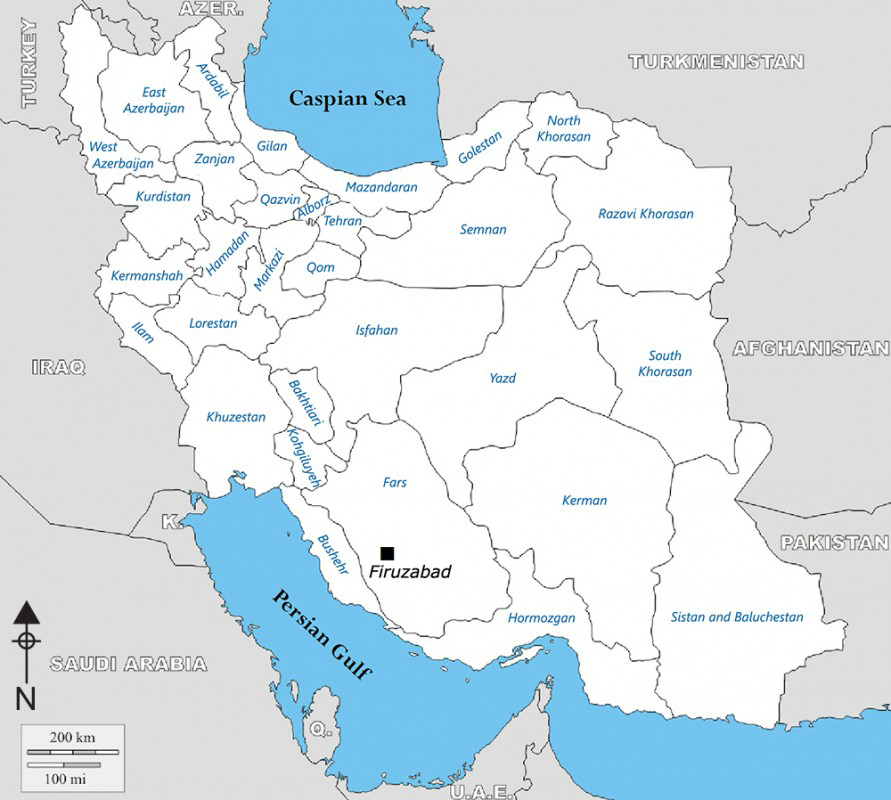
Location of the Firuzabad Plain.

The Firuzabad district is located in the western-central part of Fars province, Iran (Figure 1). The area is most famous for its historical monuments, including the City of Gur, the Palace of Ardashir, the Dokhtar Castle and a number of Sasanian rock reliefs. The first record of a prehistoric site (Tol-e Rigi) in this region was made by A. Stein back in 1934 (Reference SteinStein 1936), but no further examples were located during surveys of the Firuzabad Plain by D. Reference HuffHuff (1973) or R. Reference NoruziNoruzi (2005). In 2013, an archaeological survey directed by H. Ahmady was undertaken to identify Sassanian- and Islamic-period water-management systems on the plain. This survey discovered a prehistoric site, Tol-e Sabz, with typical Fars Neolithic ceramics. In this preliminary report, we introduce the site and consider its comparative chronology.
Tol-e Sabz
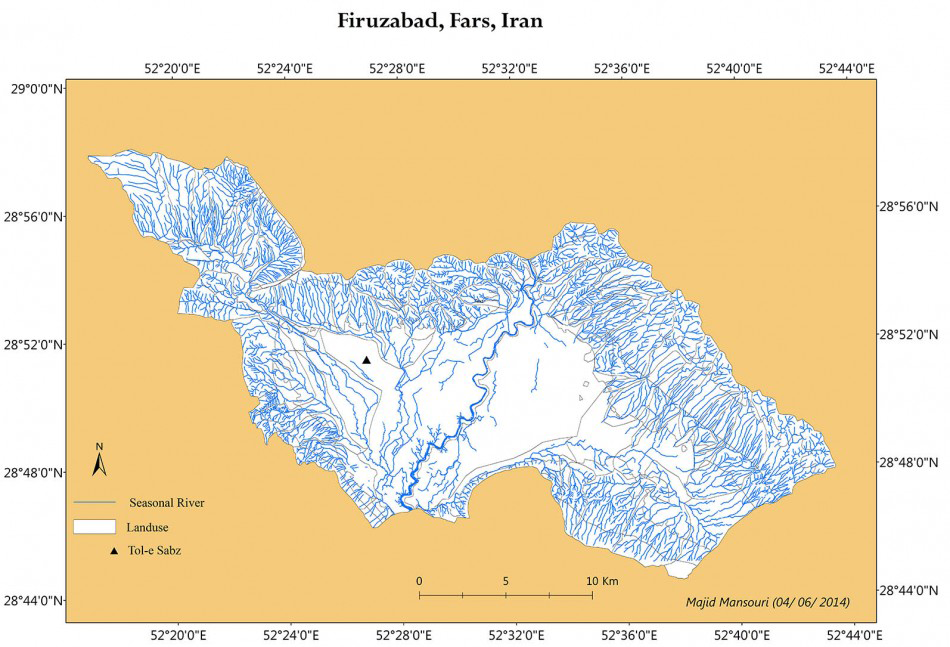
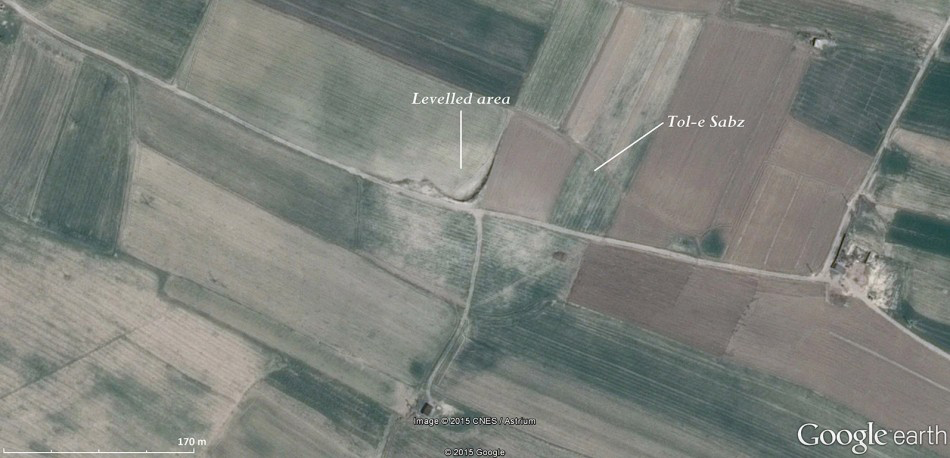
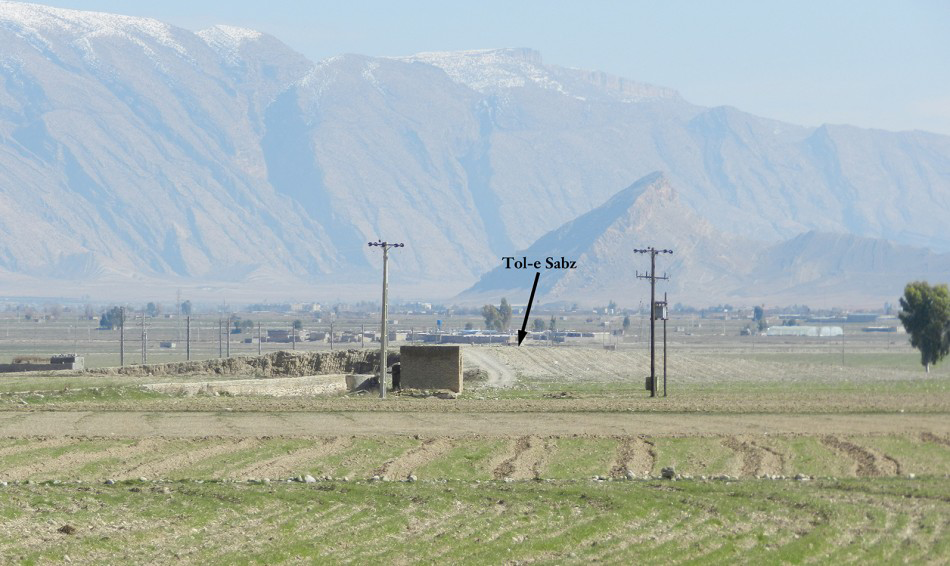
At c. 1325m above sea level, Tol-e Sabz (28° 51” 24” N and 52° 26” 47” E) is located in the north-west of the Firuzabad Plain, 2km south-east of the village of Baygan (Figure 2). The tell rises 4m above the surrounding plain and is almost 1.8ha in area (Figures 3 & 4). Stein visited the site in 1934, reporting only “a number of small, worked stone blades” on the slopes, but no ceramics other than some fragments of glazed ware on the top of the mound (Reference SteinStein 1936: 129). In 2013, the authors visited the site and collected diagnostic ceramics and lithics. The distribution of the ceramics across the site was scant and prehistoric pottery was only recovered from the northern part of the site, which has been levelled by agriculture.
Location of the Tol-e Sabz.

Tol-e Sabz (Google Earth 2015).

Tol-e Sabz, view from west.

Ceramics
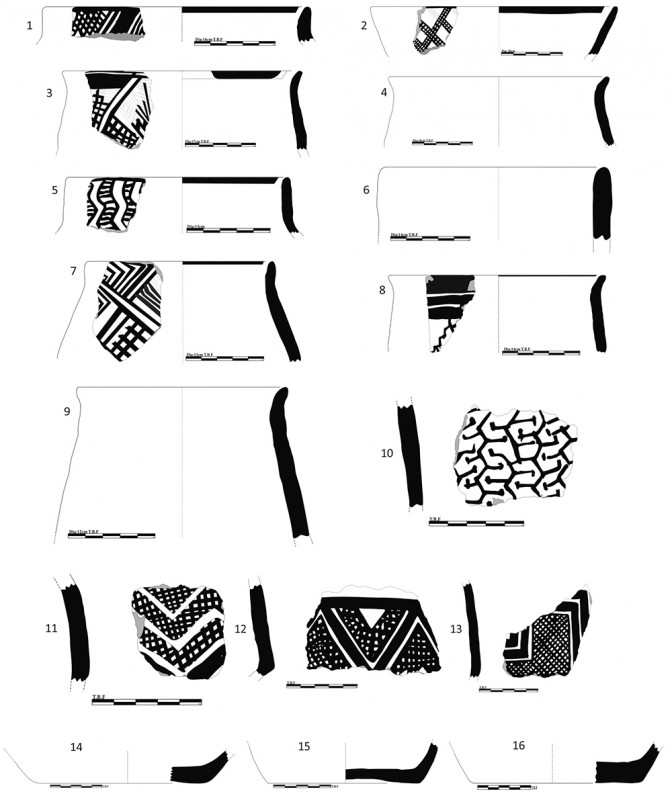
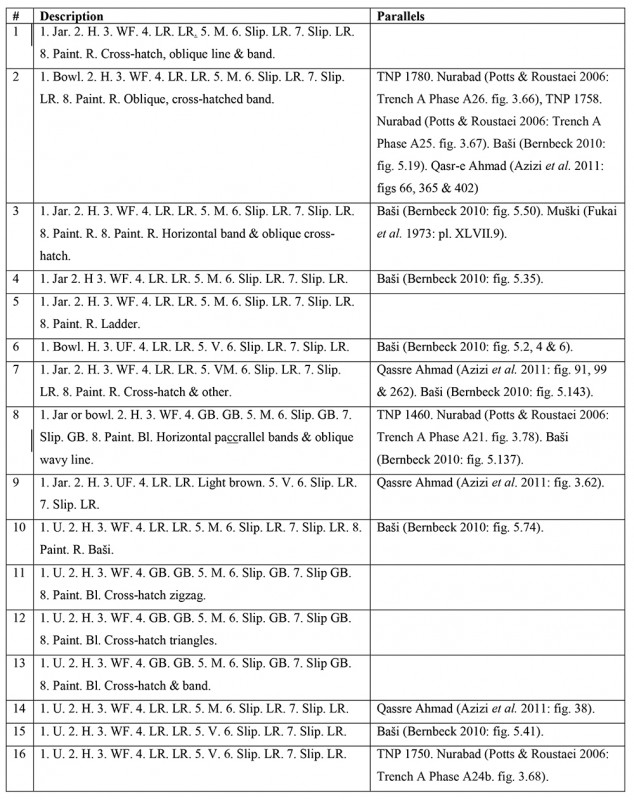
A total of 64 diagnostic sherds (23 rims, 36 bodies and 5 bases) was collected from the site (Figure 5). All of the ceramics were handmade with organic or organic-mineral temper. With the exception of five sherds, all of the pieces were well fired. Based on fabric and the colour of the painted decoration, the sherds can be divided into three groups: 1) red on red ceramics; 2) black on buff ceramics; and 3) simple red and buff ceramics. The first group (20 sherds) have a very pale red fabric with painted red decoration. Motifs include parallel bands, oblique ladders, intertwined lines, pair-lined lozenges and lozenges with a point inside. These decorative forms are best paralleled with Baši motifs (Reference Bernbeck, Bernbeck and AbdiBernbeck 2010: 65–151), although the lines are thicker than typical Baši examples (Table 1). The second group (32 sherds) are buff fabrics painted with black motifs: simple parallel bands, cross-hatched bands, lozenges, triangles and parallel bands with oblique lines. Some, but not all, of these motifs are very similar to those from Qasre Ahmad (Azizi & Khaluei 2011) and Jari A and B (Reference EgamiEgami 1967; Egami et al. 1977; Reference MaedaMaeda 1986). The third group (12 sherds) are simple red and buff ceramics comparable with those from Tol-e Nurabad (Potts & Roustaei 2006), Jari A and B (Reference EgamiEgami 1967; Egami et al. 1977; Reference MaedaMaeda 1986), Qasre Ahmad (Azizi & Khauei 2011) and Baši (Reference Bernbeck, Bernbeck and AbdiBernbeck 2010).
Tol-e Sabz; red on red ceramics (1–3, 5, 7 & 10), black on buff ceramics (8 & 11–13) and unpainted ceramics (4, 6, 9 & 14–16).


1: Vessel form; 2) manufacture; 3) firing; 4) fabric colour (ext. int. core.); 5) temper; 6) exterior coating. Colour; 7) interior coating colour; 8) decoration (ext. int.). Abbreviations: R (red); LR (light red); Bl (black); GB (greenish-buff); M (mineral); V (vegetal); VM (vegetal-mineral); U (unknown); H (hand); WF (well-fired); UF (under-fired).
Chipped stone tools
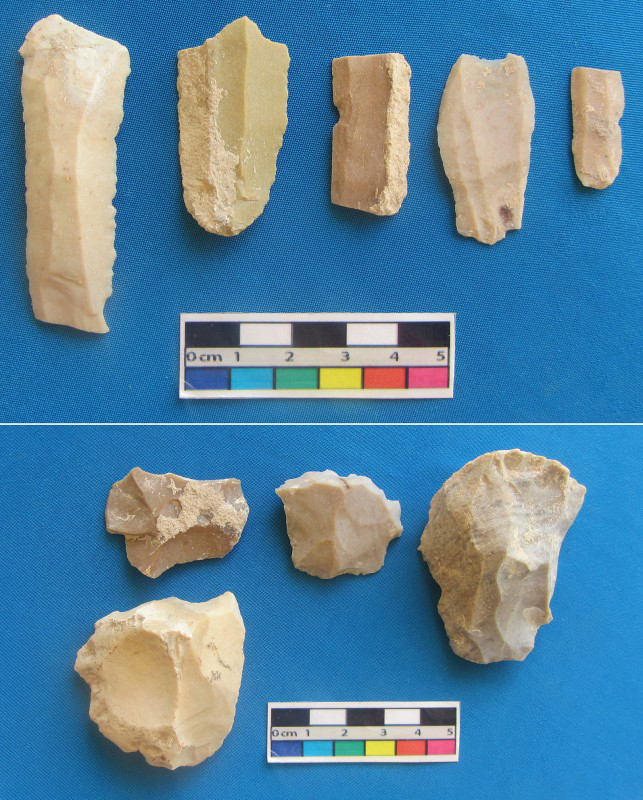
Lithics of Tol-e Sabz.

Ten chipped stone tools were collected from the northern part of the tell. The tools include blades, bladelets, an end scraper and flakes (Figure 6). All of them are made of chert and range in colour from light to dark brown. These lithics are mostly comparable with material from Muški (Fukai et al. 1973), Baši (Pollock et al. 2010) Rahmatabad (Azizi et al. 2013) and Kushke Hezar (Alden et al. 2004).
Conclusion
The ceramics of Tol-e Sabz indicate affinities with material from other Neolithic sites in the Fars province such as Qasr-e Ahmad, Baši, Nurabad and Jari A and B. Based on these parallels, Tol-e Sabz appears to have been occupied during the Muški–Baši period, late seventh and early sixth millennia BC.
Nevertheless, there are some decorative motifs that are currently only documented at Tol-e Sabz and that may therefore represent local forms. Alongside the evidence from other sites in the Kur River Basin (Fukai et al. 1973; Reference SumnerSumner 1977; Alden et al. 2004; Pollock et al. 2010; Ebrahimi et al. 2013), the Kazerun District (Reference SumnerSumner 1977), the valleys of Fasa and Darab (De Miroschedji 1973; Mansouri & Asadi 2013) and the Mamasani District (Potts & Roustaei 2006), it seems that cultural developments in the Ceramic Neolithic of Fars varied partially from valley to valley.
Acknowledgements
We are very grateful to Helen Taylor for reading the preliminary version of the article.