





Introduction
Historically, foundations have contributed to the reproduction of the social order, as numerous studies have demonstrated. They do so primarily by funding organizations frequented by the dominant classes, such as the wealthiest universities, hospitals, museums and symphony orchestras (Faber & McCarthy, Reference Faber and McCarthy2005; Odendahl, Reference Odendahl1990). Additionally, philanthropy gives a political voice to the wealthiest and their specific interests, notably through the influence of foundations and their donations, which often extend into public policy (Roelofs, Reference Roelofs2003).
However, from the early twentieth century onward, a few foundations began to diverge from this trend by engaging in the struggle for social justice. Social justice philanthropy seeks to redistribute power and resources—economic, social, cultural and political—more equitably (Ostrander, Reference Ostrander, Faber and McCarthy2005, p. 33). In the United States, a notable example is the Rosenwald Fund (1917–1948), which stands out for two key features: its lifespan—requiring the entire endowment to be spent within 25 years of the founder’s death—and its focus on defending African Americans. The Stern Fund (1936–1986), established by Edith Stern, Rosenwald’s daughter, continued this legacy in the 1970s by financing progressive causes, including feminist and anti-nuclear groups. By the 1950s, other foundations began funding protest movements (C. Jenkins & Halcli, Reference Jenkins, Halcli and Lagemann1999). For instance, the Field Foundation in New York financed the National Association for the Advancement of Colored People, while the Chicago-based Schwarzhaupt and Wieboldt Foundations supported Saul Alinsky’s community organizing initiatives to advance civil rights in the Deep South. These organizations were managed by professionals hired for their expertise and community connections.
The 1970s saw the emergence of a new generation of foundations that differed in their funding priorities, supporting social movements and adopting more democratic governance structures. Among the first of these was The Vanguard Public Foundation, founded in San Francisco in 1971, openly supporting groups challenging institutional power and promoting collective empowerment (Collins et al., Reference Collins, Rogers and Garner2001). In 1979, the Funding Exchange (FEX) network emerged, striving for “Change, not charity” (Lurie, Reference Lurie2016). These foundations challenged existing power structures by funding social movements that fight against capitalism, racism, patriarchy and colonialism while democratizing grant-making processes—often by entrusting funding decisions to committees of activists embedded within the targeted areas of support.
These dual ambitions—to combat injustice and transform philanthropy—gained new momentum from the 2000s onward with the creation of the Resource Generation network (Pittelman & Resource Generation, Reference Pittelman2013). Based in the United States, the network expanded to Canada in 2015, with groups in Montreal, Toronto and Vancouver. Over the past two decades, new struggles have influenced foundations’ agenda, such as the fight for fair taxation and the challenging of privilege and other forms of injustice (e.g., Black Lives Matter and #MeToo) (Lewis & Generation, Reference Lewis and Generation2013; Wernick, Reference Wernick2012).
The relationship between philanthropy and social justice is not only longstanding but also evolving, as reflected in the causes funded, the organizational models and the debates about philanthropy’s legitimacy. This relationship is further shaped by interactions with social movements, which themselves carry evolving conceptions of social justice that shift with societal changes. This fluidity complicates the development of a clear analytical framework for understanding foundations’ contributions to social justice.
Recent academic work has analyzed philanthropy’s role in perpetuating social, political and economic inequalities (Reich, Reference Reich2018; Saunders-Hastings, Reference Saunders-Hastings2022). What is new in the past decade is that critiques of philanthropy are increasingly discussed within the foundation sector itself (Giridharadas, Reference Giridharadas2019; Villanueva, Reference Villanueva2018). Emerging philanthropic practices grounded in trust (Trust-Based Philanthropy Project, 2025) or decolonial perspectives (Decolonizing Wealth Project, 2025) support both long-committed and more traditional foundations. For example, the Ford Foundation’s president has called for a shift “from generosity to justice” (Walker, Reference Walker2023). In response to criticism, foundations are adopting new practices and also new discourses. However, with numerous concepts circulating, it’s been challenging to distinguish between buzzwords and genuine turning points in philanthropy’s evolution (Maradeix et al., Reference Maradeix, Gautier, Pache, Neri-Castracan and Ugazio2025).
These developments underscore the need for a theoretical analysis framework for understanding how foundations implement social justice philanthropy at different times and with different means and objectives. Ideally, this framework should also distance itself from the narratives that foundations create about themselves with regard to social justice. In this article, we undertake to build such a framework, namely by adapting Nancy Fraser’s theory of social justice. That theory is based on three indivisible dimensions serving as analytical and theoretical categories: distribution, recognition and representation. Fraser developed her model of social justice to build bridges between social movements with differing conceptions of justice, grounded in the conviction that all individuals should be able to participate fully (Fraser, Reference Fraser and Olson2008). As such, Fraser’s model allows us to venture beyond a focus on institutional or legal conditions and to reflect on the potential of social justice as well as on the current state of society (Zurn, Reference Zurn and Olson2008). Thus, Fraser’s comprehensive model is particularly original and well-suited for examining the practices of actors who position themselves as allies of, or even within, social movements for social justice.
To demonstrate our framework, we apply it to a case study: a Canadian foundationFootnote 1 established in 1990 through a donation from an anonymous donor. This case seems particularly aligned with our objectives, as the donor, a woman, sees her foundation “not [as] an act of charity but simply an act of social justice”Footnote 2 (our translation). While existing scholarship on foundations and philanthropy in Canada is growing, the question of social justice itself remains largely unexplored.
Moreover, the landscape of philanthropy in the province of Quebec differs from that in the United States and the rest of Canada (Elson et al., Reference Elson, Fontan, Lefèvre and Stauch2018; Elson et al., Reference Elson, Lefèvre and et Fontan2020). In Quebec, philanthropy tends to be weaker, reflected in lower per capita donations compared to other provinces in Canada or the United States. Examining the distinctive features and context of Quebec provides a better understanding of this state of affairs. The Catholic Church traditionally played a central role in shaping not only the province’s religious life but also its political, social and educational spheres. This persisted up until the 1960s and the Quiet Revolution—a period in time marked by the modernization of Quebec society, the assertion of Quebec nationalism and a shift away from Catholicism toward secularism. Concurrently, Quebec developed a robust social state, characterized by higher tax rates, more comprehensive social policies and less social inequality. Other distinctive features of this social and political model include the significant role of community, mutualist and union actors. Historically, the first foundations were created in the early twentieth century by English-speaking elites, such as the McConnell Foundation. However, in the last three decades, large-scale francophone foundations have emerged, including the Fondation Lucie et André Chagnon, which holds assets exceeding one billion US dollars. Thus, in the Quebec landscape, foundations are relatively recent players whose legitimacy is occasionally contested by union and community organizations (Berthiaume & Lefèvre, Reference Berthiaume and Lefèvre2021). In this context, the meaning of social justice and the role of foundations are continually evolving.
Our research question is: How can Nancy Fraser’s theory of social justice allow us to understand the various aspects of social justice philanthropy when applied to the actions of foundations? To answer this question, we first present a three-dimensional analysis framework adapted from Fraser’s theory. Next, we present a case study on the evolution of a Canadian foundation, followed by an explanation of our methodology. Lastly, we discuss how the relationship between philanthropy and social justice has evolved over time and explore its broader democratic implications.
Social justice as an analytical framework
Nancy Fraser examines social inequalities from economic, cultural and political perspectives, arguing that injustice hinders “parity of participation” in democracy (Fraser & Honneth, Reference Fraser and Honneth2003). In other words, she believes that justice requires having a position and status that allows one to participate equally in all areas of social life, such as family, the labor market and politics. In this way, Fraser redefines social justice by recognizing its multidimensional nature (Paarlberg et al., Reference Paarlberg, Walk and Merritt2022). Additionally, Fraser’s conceptualization of social justice has evolved over time. Initially, she framed it as a duality between redistribution, addressing economic injustices, and recognition, relating to injustices of status (Fraser & Honneth, Reference Fraser and Honneth2003). Young (Reference Young and Olson2008), for her part, criticized this binary reductionism for its failure to consider power dynamics and institutional processes. She also criticized the reification of collective identities and an overly formalistic and abstract approach to justice with norms defined “top down.” Young calls for an approach that is more attentive to everyday, concrete practices as well as to the situated experiences of oppression and emancipation. Finally, she criticizes Fraser’s theory of justice for focusing on the role of the state, proposing instead a democratization grounded in participatory, local practices.
Fraser responded to Young’s criticisms (Fraser, Reference Fraser and Olson2008) by adding a third dimension—representation—to her concept of social justice. For our theoretical framework, we adopt this three-dimensional model which aligns with Young’s call for a bottom-up approach to the principles and practices of justice. In the following section on our case study methodology, we examine the model’s implications for individuals’ trajectories, organizational practices and evolving relationships between the Foundation and its stakeholders, demonstrating how these elements contribute to the construction of and experimentation with social justice. Building on Fraser’s model and the integrated critique, we propose these three dimensions as the foundation of social justice philanthropy.
The first dimension, redistribution, concerns injustice in the allocation of material resources and economic power among individuals. Economic inequalities concern unequal access to income, wealth and essential resources such as water, food and adequate housing. For foundations, redistribution involves combating socio-economic inequalities or the privatization of public spaces and natural environments. Internally, it calls for scrutinizing power dynamics, including those of donors, and ensuring that foundation members remain attuned to the living conditions of the poorest. This includes examining the working conditions of the Foundation’s staff. A further research question that arises is whether a foundation’s capital investments and financing methods avoid perpetuating economic inequalities, and if so, how. The redistributive dimension of foundation action also pertains to funding priorities for groups defending the rights of the poorest and most vulnerable, asserting participants’ independence and “voice.” In short, the institutionalization of foundations must above all avoid reinforcing the power of the wealthiest, particularly that of donors.
The second dimension, representation, addresses injustices linked to governance and political decision-making structures. It concerns barriers that limit or deny political rights, such as restrictions on protest, exclusion of affected groups from decision-making, or the consolidation of power among dominant actors (e.g., corporations). Within foundations, this translates into democratizing philanthropic decision-making. Questions arise about how closely the profiles of team and board members reflect that of supported groups. Externally, foundations position themselves as allies alongside social movements and civil society organizations (e.g., community groups, trade unions, women’s movements) in the pursuit of empowering marginalized groups to be heard and democratizing public life.
The third dimension, recognition, pertains to the social status of individuals and groups. Cultural injustices arise from dominant norms and ideologies that perpetuate discrimination or oppression. To combat cultural and identity-based discrimination internally, foundations may need to adopt equitable fund allocation mechanisms and human resource practices that promote equity, diversity and inclusion from hiring onward. Externally, foundations must consider how to support equity-seeking and marginalized groups effectively and ask themselves whether they should fund initiatives specifically targeting marginalized populations (e.g., Black, Indigenous peoples) or ensure their inclusion across all supported initiatives. In addition, they must examine the foundation’s role in combating groups that perpetuate discrimination. In sum, the recognition dimension raises critical questions about foundations’ role in addressing systemic discrimination that sustains the exclusion of minority groups.
By focusing on the preconditions of justice, this framework of participatory parity is negative insofar as it points out what counts as injustice in current social relations (Zurn, Reference Zurn and Olson2008). It also offers a critical perspective of social claims, helping to identify social relations of subordination and discarding claims from certain hate groups and oppositional minorities, such as demands from xenophobic groups for more recognition (Zurn, Reference Zurn and Olson2008).
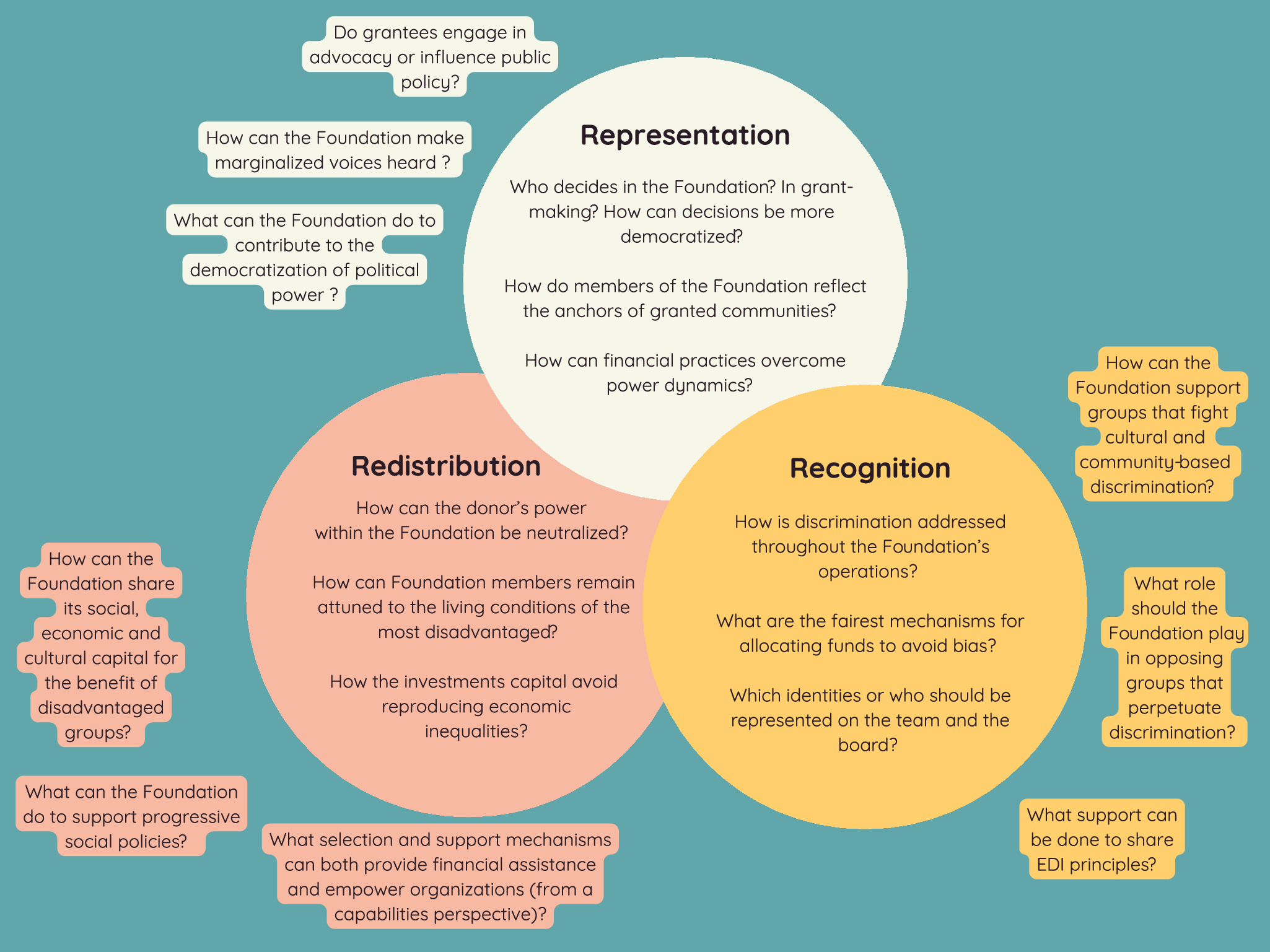
This theoretical proposition also sheds light on the tensions within struggles by examining how social justice is interpreted, contested and redefined by social movements—and here foundations—in relation with social reality (Fraser, Reference Fraser and Olson2008). Since Fraser criticizes the institutional co-optation of social movements, the application of her work to philanthropic support of social movements might seem contradictory. Indeed, Fraser (Reference Fraser1995) herself could suggest that foundations can co-opt claims and struggles toward “affirmative remedies” that maintain the existing social order. Zurn (Reference Zurn and Olson2008) suspects that the focus of Fraser’s framework on status equality threatens to flatten the radicalism of social movement claims. For example, the queer, anticapitalist or decolonial movements are demanding more than “just” participation; they are redefining ways of life, including of “the good life,” and are challenging structures, cultures, values and social practices. Nevertheless, we consider that Fraser’s iterative approach of highlighting power and its broader ramifications—beyond legal or institutional representations, which are central to this definition of social justice—to be a useful first step for foundations subscribed to social justice. Indeed, few foundations have integrated power as a central element to understand and take action towards social justice (Roberts & Deepak, Reference Roberts, Deepak, Lambin, Surender and Roberts2025). As pointed out by Roberts and Deepak (Reference Roberts, Deepak, Lambin, Surender and Roberts2025), social justice philanthropy has the potential to support advocacy for social justice by opening deliberative spaces of political discourse for those at the margin of the public sphere and alleviating barriers to participation. By supporting the development of public spaces where subalterns can gather and forge their discourses of social transformation, foundations can promote social resistance and claims for social justice, both against the state and more broadly. From this perspective, we find this framing particularly original given its insertion within a global theory of social justice centered on social movements exposing injustice. From a sociohistorical point of view, it offers foundations a pathway to move beyond traditional philanthropy and find “transformative remedies,” by asking “what are the structural conditions that prevent participative parity?.” This interpretation enables us to formulate questions for understanding philanthropic practices through the lens of these three dimensions. We present these questions in the following diagram (Figure 1).
Fraser’s framework adapted for social justice philanthropy

The diagram presents a series of questions designed to examine both internal and external practices. The questions within the circles focus on internal practices, such as the organization of philanthropic work and Foundation’s guiding principles. More specifically, this concerns the work team or various committees, working conditions, calls for projects (selection, support and evaluation) and decision-making mechanisms. The questions outside of the circles address the Foundation’s actions aimed at producing societal impact. These actions involve the use of financial capital (donations, endowment investments, loans), symbolic capital (advocacy, report production, media intervention, etc.) and social capital (event organization, networking, connecting groups). Reflecting on the Foundation’s practices through these three dimensions of social justice can help promote equitable participation of marginalized, oppressed or socially excluded groups.
Our case study methodology
We applied the theoretical framework developed from Fraser’s social justice approach to revisit a research project on a Quebec foundation. This foundation began with the donation of a woman from a very wealthy family who wishes to remain anonymous. Her Catholic faith was very strong, and having inherited a fortune of some ten million US dollars, she decided to keep only a very small portion for herself and to use the remaining part to set up a foundation to give back to the poorest. The Foundation does not bear her name, and she left the Foundation’s Board of Directors in 2004, expressing confidence in the team to uphold her vision of social justice. To this day, the current team does not know the identity of the donor, even though she is still alive.Footnote 3 Today, the Foundation ranks as medium size in the Quebec philanthropic landscape, with current assets of around ten million US dollars. It is recognized for its strong commitment to Quebec’s social struggles as well as for its leadership in philanthropic networks.
Ten years of research, including three inquiries and an immersion in this foundation’s ecosystem, have enabled us to clarify the Foundations’ work and its place within the Quebec philanthropic landscape. The initial inquiry focused on the Foundation’s operations and its relationships with funded organizations from 2013 to 2016. It consisted of interviews with members of the Foundation (n = 11), both individual (n = 5) and collective (n = 15) interviews with funded groups, participant observations and a document analysis. This was followed by two complementary inquiries, one examining the Foundation’s advocacy efforts in forming a collective of foundations combating inequality (2014–2015) (Berthiaume & Lefèvre, Reference Berthiaume, Lefèvre, Elson and Fontan2020) and the other its evolution nearly one decade later (2023–2024). These inquiries included semi-structured interviews with participating foundations (2014–2015: n = 9; 2023–2024: n = 18) and consultants (one person for each survey) as well as a document analysis of the collective’s outputs.
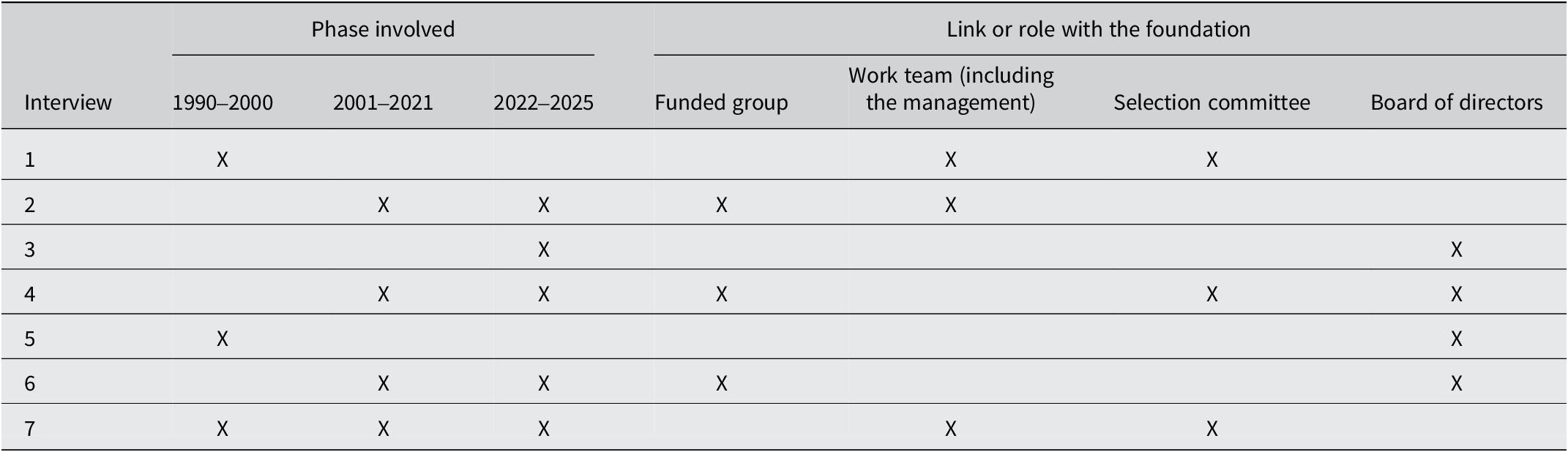
In 2025, we conducted interviews specifically on the Foundation’s contribution to social justice, involving seven interviewees active during different phases of the Foundation’s history. Interviewees were selected for their strategic role in the Foundation and with a view to obtaining a diversity of perspectives from interviews already carried out (Table 1).
Interviewees’ periods of involvement and roles within the foundation (2025)

Our interview gridFootnote 4 allowed us to conduct the interviews in a semi-structured manner, leaving room for the emergence of new themes. We organized our questions into three parts: the interviewee’s professional and commitment trajectory; their participation in the Foundation’s activities and how social justice dimensions were embodied therein; and their conception of social justice and its transformations.
Our data collection also included consultation of the Foundation’s internal documents, all publicly accessible. We focused on three types of materials: (1) activity reports from the past ten years, (2) a list of projects funded since 2017, and (3) internal policies published within the last two years. Reviewing these documents enabled us to trace shifts in the Foundation’s public discourse and identify changes in organizational practices and funding priorities over time. Additionally, this review provided contextual information of the interviews and allowed us to triangulate our analysis of the three phases described in the findings. Despite this extensive data gathered from various research projects, three limitations remain. First, our analysis of Phase 1 (1991–2000) relied heavily on the perceptions of board members and the director at the time, as little documentation was available—likely due to the lack of formalization of the Foundation’s practices during that time. Additionally, many individuals involved in the Foundation’s early years have since passed away or are difficult to locate. Second, regarding Phase 3 (2022–2025), many analyses are based on documents of intent; at the time of writing, no grants had yet been awarded under the new funding policy. Third, due to our prolonged immersion in Phase 2 (2001–2021), culminating in the production of works about that phase, some interviewees may have been hesitant to express critical views of the Foundation’s practices.
Analysis
The interviews conducted for this article were transcribed verbatim and analyzed using NVivo in three stages: (1) coding based on emerging themes; (2) grouping extracts according to the three phases; and (3) identifying themes based on Fraser’s framework. NVivo enabled us to efficiently structure our interview corpus and perform routine data analysis and management tasks (Woods et al., Reference Woods, Paulus, Atkins and Macklin2016). The software facilitated cross-referencing materials to explore co-occurrences between categories. However, this structuring also influenced our analytical stance. As Paulus et al. (Reference Paulus, Woods, Atkins and Macklin2017) note, analysis with data processing software can fragment discourses and compromise researcher reflexivity. To remedy this, we reread previously collected materials in preparation for this series of interviews. After each interview, we engaged in in-depth discussions about these rereadings and our preliminary analyses. Coding revealed shifts in how the Foundation and its team define social justice and allowed us to observe broader transformations within the philanthropic and community sectors. NVivo proved to be a useful, though not neutral, tool requiring constant vigilance to maintain an interpretive analytical perspective (Paulus et al., Reference Paulus, Woods, Atkins and Macklin2017).
This retrospective review of data collected by earlier surveys also highlighted certain blind spots in our previous analyses, due to a lack of hindsight on the political and social context. Our dual research focus—on philanthropy and community organization—enabled us to cross-reference observations and analyses from other contexts to better understand the transformations exemplified within the Foundation.
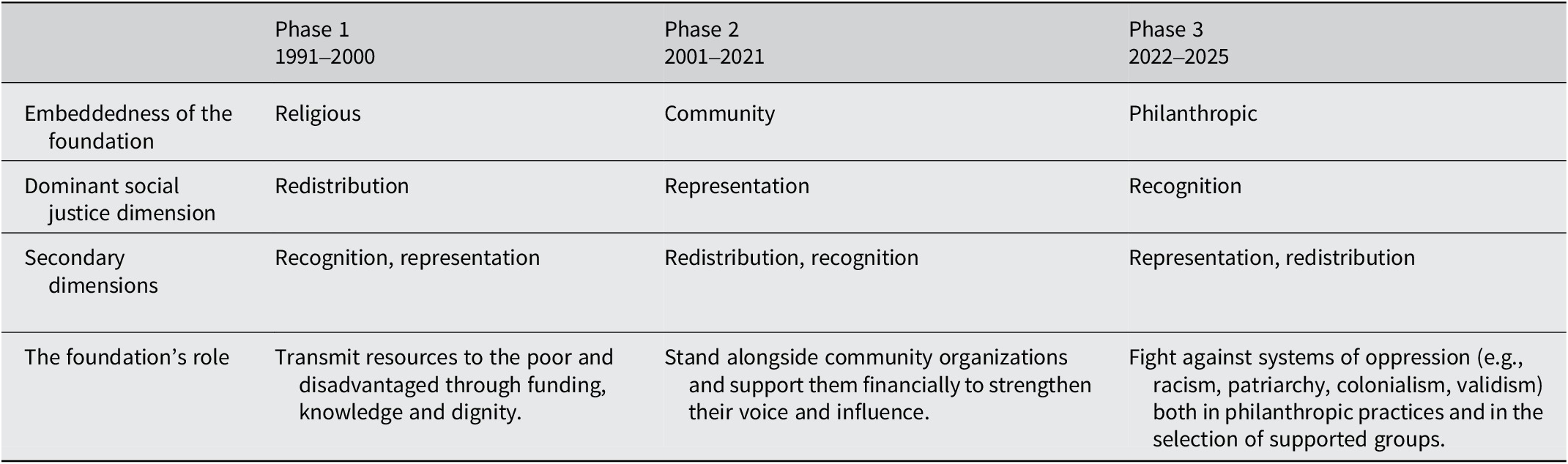
Our choice of this foundation to develop Fraser’s analytical framework is particularly appropriate for understanding the trajectory of social justice. The concept, initially born from nineteenth-century socialist and trade union movements (Dorrien, Reference Dorrien2021) and later absorbed into Christian social ethics, inspired the Foundation from its inception. Given the space constraints of this article, we limit ourselves to examining the dimension of social justice that predominates for each phase. While this representation of the Foundation is incomplete, it produces three ideal-types that allow us to describe and analyze the main issues a foundation may encounter when orienting its internal and external practices toward greater social justice. In the following three sections, we present the three phases and their respective predominant dimensions, alongside observations pertaining to their secondary dimensions. Phase 1 (1991–2000) focuses on redistribution; Phase 2 (2001–2021), on representation; and Phase 3 (2022–2025) on recognition.
Phase 1 (1991–2000): A religious and spiritual framework to combat economic injustice
The Foundation was established in Montreal in 1991, born from the donor’s desire to assist the working class and the poorest of the poor. She envisioned the Foundation as a means of fair redistribution, renouncing personal enrichment. Her statement “This is not a gesture of charity, but simply an act of social justice” encapsulates her stance. Her act of giving and her self-effacing role in structuring the Foundation clearly illustrate the Foundation’s focus on redistribution. Although the founder was involved throughout this first phase, guiding the board of directors, she remained one voice among many—albeit one with a special aura.
To create the Foundation, the donor surrounded herself with individuals committed to social struggles defending the poorest and who shared strong religious convictions. The founding team drew on social Catholicism and liberation theology, notably the Second Vatican Council (1962–1965), which advocated religious freedom, interfaith dialogue, simplification of rituals, and the Catholic Church’s commitment to work alongside the poorest. This religious embeddedness in solidarity with the poor influenced the Foundation’s early focus on economic justice and spiritual meaning. Organizationally, the Foundation’s first offices were located in a convent, and its first director was a former priest who had left the priesthood after twenty years to marry.
The Foundation’s chair of the board was a feminist theologian active in social work with working-class women. She summarized the Foundation’s social justice approach as: “Economic redistribution for the poorest, transformation of power relations and sharing of the tools that enable people to live better (e.g., training, popular education)” (our translation). Class analysis was foundational from the outset. To organize donation allocation, two strands were created: for projects of a pastoral (then spiritual) nature, and projects of a social nature (mainly community organizations). Support took the form of donations of US$18,000 for one year (occasionally two) to finance salaries. Priority was given to innovative practices and, above all, to projects run collectively by those experiencing the situation.
The focus was on combating socio-economic inequalities by supporting social movements and grassroots groups. For example, the Foundation supported the Marche Du pain et des roses (Bread and Roses March) in 1995, a large mobilization organized by a coalition of feminists to denounce poverty and violence against women. One of the organizers later joined the Foundation’s selection committee. The emphasis on socio-economic dimensions also extended to financial asset investment. From its inception, the donor and board set ethical guidelines for capital investment: “No oil, no weapons, keep it in Canada” (Interview 5).
Fraser’s other two dimensions of social justice—cultural and political inequalities—were present but aligned with the primary focus on socio-economic inequality. This first phase was dominated by the fight on behalf of impoverished people, recognizing their dignity and making them direct actors in their emancipation. This commitment to empowering the poorest was crucial in project selection and contrasted with conventional charity and typical Catholic giving.
From the Foundation’s first year, one organizational challenge was its relationship with the Catholic Church and its more charitable practices. Internally, early board members funded groups they knew personally, with one member visiting the supported organization and vouching for it. When the Foundation’s first coordinator was hired two years after its creation, he took charge of visits and structured a criteria grid to solicit and evaluate projects. He also set up a selection committee, composed not of any priests but rather of activists involved in grassroots and community groups in Montreal and more remote Quebec regions. The selection committee chose which groups to fund, with the board of directors ratifying these choices. Externally, the Foundation distanced itself from certain Catholic Church practices. Regarding spiritual matters, the selection committee tended to reject projects that were not grassroots enough, that is, those not originating from the people concerned and not aimed at social transformation. The donor emphasized that “it shouldn’t be the Church that has the upper hand in this” (our translation) (Interview 5). Conversely, innovative projects beyond the scope of the Catholic Church were funded as early as the 1990s, such as interfaith dialogue and an association of gay priests living anonymously.
Phase 2 (2001–2021): Community fabric and new political alliances
In the early 2000s, the Foundation took a new direction following a strategic review conducted between 1998 and 2001. A new director took office in 2001, after having served several years on the Foundation’s selection committee. He had been involved in progressive Catholic movements in his youth and was primarily active as a community organizer in a Montreal working-class district, close to grassroots social movements. The Foundation was run by only one employee—the director—up until the year 2002, when a second person, a woman, was hired. She was rooted in Christian youth work and social work in working-class neighborhoods. Neither employee was related to the donor and founder, and both were of a younger generation and lay people, more critical of the Catholic institution. At that time, the Foundation’s offices were located in a building shared with other community organizations.
In 2004, the donor began distancing herself from the Foundation. The board and selection committee were largely renewed to include activists from the various spheres the Foundation aimed to fund: community, feminist, trade union, spiritual (mainly Christian) and the social economy. Selection committee members often transitioned to the board after serving a few years. Unlike most other foundations, the Foundation had no members from the business world, did not recruit academics for theoretical expertise, and had no donor family members.
Compared with Phase 1, when the founding core shared interpersonal ties and common commitments (notably spiritual and religious) outside the Foundation, the Foundation’s operations of Phase 2 were less organic, or spontaneous. Instead, they were characterized by a more representative logic, with board members selected for their strong connections to social movements. Within governance, these individuals acted informally as representatives of various collective action currents in Quebec. This closeness shaped the Foundation’s identity, as observed in ethnographic research conducted from 2014 to 2016. During group visits and selection processes, Foundation employees presented this stage of the process as a way to better understand organizations and support them in completing applications, at times revealing their own identities as former community organizers or social workers.Footnote 5 These employees saw their role as engaging with the groups, and of helping them express themselves and make themselves be heard, rather than as funders who monitor and control. They were highly critical of foundations that dominate groups and demand excessive accountability. As one chairperson during this second phase stated, the Foundation aimed to support groups as equals, neither leading nor following them.
Phase 2 was also marked by a process of institutionalization, with more formal internal governance procedures (a “working conditions policy” in 2003 and a code of ethics in 2008) and strategic planning of the Foundation’s orientations and fund allocation. Calls for project funding extended local networks, attracting over a hundred applications annually, compared to around forty in the previous decade. Thematic guidelines clarified expectations in social and spiritual areas. Social themes included “social movements,” “popular education” and “local development” (for rural areas); spiritual themes included “social and spiritual intervention,” “ecumenical or inter-religious social commitment” and “transmission.” During this phase, the Foundation donated approximately US$20,000 annually to 15 to 20 projects, each funded for one year. Projects “by and for” the community were prioritized, with selection criteria emphasizing community empowerment and project leaders’ rootedness in the community. For example, to foster a community’s healing after a rail disaster, the Foundation supported a theater project based on statements from some 400 town residents.
The Foundation’s mission continued to evolve, expanding to encompass “project support,” “responsible investment” and “solidarity commitment” as additional functions. To provide project support, the salaried team advised funded and sometimes non-funded organizations on financing or project structuring. To engage in responsible investment, the Foundation committed to integrating environmental, social and governance (ESG) criteria, to the goal of allocating at least ten percent of assets to solidarity finance and to the development of community micro-credit. Finally, solidarity commitment refers to the Foundation’s active participation in various collective actions, such as consultations and public support of community demands. Particularly since the 2010s, it has sought to influence Quebec’s philanthropic foundation community, such as by initiating the Collectif québécois des fondations contre les inégalités sociales, which brought together some twenty foundations over a period of ten years with three main objectives: to lobby the government to do more to combat inequalities, to support the community movement and to transform foundation practices to reduce their own “inequality footprint”—including in governance, group funding and the investment of financial assets.
Using Fraser’s framework, we identify a shift in its social justice focus between 2001 and 2021, namely from redistribution toward representation. This manifested internally, in the selection of committee members and their roles, and externally, in the funding of groups that amplify mobilization, empowerment and advocacy. This logic of representation also characterizes the role of the Foundation, which sees itself as a supporter of social movements and community organizations, with a view to influencing government decisions.
This emphasis on combating political inequalities also influenced the other two components of social justice: redistribution and recognition. For example, during this second phase, the Foundation developed a critical discourse on philanthropy’s role in serving elite interests and contributing to the “privatization of social policies,” which absolves the welfare state of its responsibility. The Foundation argued that the democratic legitimacy of foundations must rest on supporting grassroots groups. The act of accompanying and listening to these groups, or forming political alliances with them, is a way to recognizing them and redistributing the Foundation’s power.
Phase 3 (2022–2025): Trust-based philanthropy and JEDI procedures
Phase 3 began in 2022 with the departure of the director and the arrival of a new one. The new director, a woman, is as an artist by training with a militant commitment to feminist and anti-racist struggles. Previously, she created and directed an organization promoting inclusion of discriminated populations, focusing on equality of intelligence and the use of art and culture. A social entrepreneur and Ashoka Fellow, she has also held advisory positions with various foundations and organizations. Her arrival brought significant renewal to the team and committees. Whereas in Phase 2, individuals’ value was primarily based on their ties to different movements, in Phase 3, that value is linked more to professional qualities skills, expertise and social characteristics such as diversity and minority status. The team and board now include specialists in management, social innovation and finance, and less with backgrounds in community organization, social work and theology. For example, the new president, a woman with an MBA from Oxford, specializes in responsible investment and has worked with various financial funds. Moreover, whereas the team and committee members had been predominantly white, French-speaking and Christian (in the case of religious people), Phase 3 now features much greater racial and cultural diversity. A commitment to defending rights is now also considered a key competency for members of the board of directors.
In this phase, management practices serve as modes of political action to defend a particular conception of social justice. As the director stated: “We participate in social movements that bring about social transformation, that attack systems of oppression” (our translation). To this end, the Foundation adopted numerous internal policies and procedures promoting ethical governance, all publicly available on its website. It also compiled over 100 open-access tools supporting ethical and inclusive management in groups. This managerial shift, emphasizing ethical governance procedures to serve political objectives, contrasts with the Foundation’s less formalized organizational culture of the previous decades. Another change was the relocation of the Foundation’s offices to a downtown tower, shared with one of Canada’s largest private foundations. The Foundation also began establishing numerous exchanges and collaborations with other Canadian foundations.
Phase 3 also embraces trust-based philanthropy more explicitly. For example, it has relinquished control and micromanagement and has reduced the workload for groups, resulting in the abandonment of the in-person visits that had been distinctive until then. It also integrated chatbots on its website, programmed to receive project proposals in multiple languages and formats (written or video) to enhance inclusivity. Once a project makes it to the next stage, the Foundation requests applicants to submit a written project plan and sets up a virtual meeting. Annually, eight grants of US$22,000 are awarded for three years, with no restrictions on the use of the funds. The Foundation new orientation is: “To support projects that profoundly transform existing structures and enable us all to imagine inclusive and equitable futures. Projects and initiatives that value the diversity of experience and knowledge, particularly that of groups seeking equity” (our translation). Projects now fall under two themes: “Unconditional Solidarity” and “Emancipatory Futures.” Exclusion criteria disqualify groups that are “anti-choice, do not recognize trans and non-binary identities, conspiracist, masculinist, climate-skeptic, or deny intersectionality, systemic racism, and various forms of oppression” (our translation). Equity targets aim to “overcome unconscious biases that can influence the distribution of funds.” One target allocates “a minimum of fifty percent of funds to initiatives led by and for Indigenous people, Black people, racialized people, LGBTQ2EAI+ communities, religious minorities, people with disabilities or functional limitations, and those on the atypical cognitive spectrum” (our translation). Another target directs at least fifty percent of funds outside major urban centers. The director and president emphasize supporting groups that are not necessarily registered charities or familiar with traditional philanthropy practices.Footnote 6
The JEDI (Justice-Equity-Diversity-Inclusion) principles are reflected both internally and externally. The Foundation has supported social movement demands against proposed legislation or discriminatory police practices through petitions, open letters and marches involving Indigenous, racialized, immigrant, LGBTQ+ and disabled communities. Inclusivity is also reflected in a redefinition of terms and vocabulary, with religious and spiritual references—previously tinged with Christian influence—replaced by a “quest for meaning” (our translation).
From Fraser’s perspective, it is recognition, understood as the fight against cultural and identity discrimination, that prevails during this phase. The other two dimensions, redistribution and representation, align with this horizon, demonstrated by procedures correcting biases against marginalized groups through the choice of board members, the framing of calls for projects or exclusion/inclusion criteria. These measures enable fairer philanthropic fund distribution, rectifying inequities resource access for affected populations.
After more than three decades of existence, the Foundation has undergone a profound evolution in terms of the world in which it is rooted, the principles of social justice that guide it and the conception of its own role (see Table 2).
Evolution of the conception of social justice promoted by the foundation, according to Fraser’s framework
Discussion: How is the philanthropic framing of social justice evolving?
As can be seen, a certain dimension of social justice stands out for each phase, even if the boundaries between the three dimensions tend to be blurred. In this article, we thus focused on the dimension that is most pronounced in each phase, it being understood that all three dimensions—redistribution, recognition, and representation—are present to varying degrees throughout. For example, in Phase 1, combating inequality primarily meant redistributing resources to groups by and for the impoverished. The Foundation favored projects that empowered individuals and recognized their dignity. From this phase onward, social justice aimed to overturn relationships of domination and oppression, though the nature of this struggle evolved in subsequent phases. In Phase 2, the Foundation supported community-based collectives and networks advocating for stronger public policies to combat poverty. It also formed alliances with other philanthropic and community actors to fight inequalities more effectively, including efforts to reduce foundations’ dominance over supported groups and to improve relations between the state and community organizations. In Phase 3, the Foundation signed a petition framing homelessness as a systemic crisis disproportionately affecting historically marginalized groups. Consistent with other position papers, it identified groups experiencing discrimination (women, LGBTQIA+ people, people with disabilities, BIPOC) and provided targeted support to address systemic biases.
Each phase highlights one dimension of justice, revealing evolving blind spots. For instance, in hindsight, Phase 1 actors acknowledged the Foundation’s lack of support for Indigenous causes, despite Indigenous peoples in Quebec being significantly affected by poverty and lack of resources. In Phase 2, the Foundation worked closely with groups that were already well represented organizationally (formal networks, spokespersons) and politically (inclusion in formal consultation bodies), but maintained fewer ties with informal players, who were thus underrepresented in the community fabric. These two phases illustrate that the recognition dimension, linked to diversity issues, was present but less pronounced than redistribution (Phase 1) and representation (Phase 2). Conversely, some members active during the first two phases expressed dissatisfaction with Phase 3’s reduced emphasis on social class in favor of a more intersectional, and at times more individual, understanding of inequalities. Similarly, these members disliked that board members now appear to be selected more for their individual skills than for their embeddedness in communities. Our adaptation of Fraser’s conception of social justice in this context reveals what is at stake in these blind spots: By prioritizing one dimension of social justice, the Foundation brings visibility to certain mechanisms of oppression and domination that were previously obscured. From an analytical point of view, this hierarchical approach may hinder achieving Fraser’s (Fraser & Honneth, Reference Fraser and Honneth2003) ideal of “parity of participation.”
This raises the question: How do philanthropic conceptions of social justice evolve? The Foundation’s example is interesting because it allows us to test several hypotheses related to the three phases presented. The first hypothesis concerns the evolution of people, positing that the values and profiles of those shaping the Foundation influence its conception of social justice. Our case supports this: In Phase 1, the director was a former priest and the president a feminist theologian, both committed to a Catholicism focused on the issue of economic inequality. In Phase 2, the director was a community organizer, and the team and the presidency included individuals linked to social work, international solidarity, community organizing and popular education. In Phase 3, the Foundation shifted to emphasizing skills in social entrepreneurship, social innovation, social finance and management across all organizational levels, while strengthening its commitment to diversity.
However, this profile-based explanation is insufficient. For example, why was the Indigenous cause not supported in Phases 1 and 2, despite several key members, including the donor, being sensitive and personally committed to it? During these phases, the Indigenous cause could have been addressed from the angle of economic and political injustice. Yet, support for this cause was apparently not among the Foundation’s priorities at the time. Nonetheless, in Phase 3, the Indigenous issue resurfaced as an important cause, as reflected in public statements.
This leads to a second explanation: The evolution of social justice conceptions advanced by social movements has influenced the Foundation’s agenda. In Quebec, major collective mobilizations against poverty shaped the 1990s and 2000s. Similarly, over the past fifteen years, Quebec and the rest of Canada have seen a resurgence of Indigenous issues,Footnote 7 LGBTQIA+ struggles and systemic racism debates, becoming central to the media and political agendas. Conversely, the progressive Catholic networks that nurtured the Foundation’s origins have gradually disappeared, with their main structures fading in Quebec. Given the Foundation’s deep roots in Quebec’s social movements, it is unsurprising that their evolution and issues influence the Foundation’s philanthropic orientations, notably from a decolonial lens.
The third explanation is that changes in the philanthropic sector have influenced the Foundation. Over less than twenty years, the foundation landscape in Quebec and the rest of Canada has evolved considerably. Initially, foundations operated in silos; now the sector is highly networked, with frequent collaborations, joint initiatives and professionals serving multiple foundations throughout their careers. Philanthropic orientations and relationships with funded groups, capital investment and public visibility have likewise evolved. For example, the 2008 financial crisis and debates on wealth inequality and tax justice sparked existential questions about foundations’ legitimacy and responsibility. In forging exchanges with other foundations in the early 2010s, the Foundation had to position itself on these issues. Since 2020, equity, diversity and inclusion (EDI) issues have become central to the Philanthropic Foundations Canada (PFC) network, with training on decolonizing philanthropy and support for Black and Indigenous communities. This has influenced the Foundation’s positioning as it engages in this professional field, contributes to debates and adopts sector-specific terminology (e.g., “trust-based philanthropy”). In contrast, in its early years, the Foundation was completely unfamiliar with the philanthropic world and had almost no interaction with other foundations.
In this context, the interplay of these three explanations—people’s profiles, the evolution of social movements, and changes in the philanthropic sector—allows for an understanding of how a foundation’s conception of social justice changes over time.
Limitations and further research
This study has several limitations that suggest avenues for future research. First, because it is based on a single case study of a foundation whose history, size and ideological orientation are not representative of the broader Canadian philanthropic sector, its generalizability is limited. Future research would benefit from comparative case studies across different regions, sizes and fields of action to strengthen the analytical robustness of Fraser’s framework and help identify potential patterns or divergences in how social justice is operationalized. Second, while our application of Fraser’s model highlighted its conceptual strengths, it also revealed limitations when analyzing private, non-elected institutions such as foundations. Further studies could examine how other theoretical lenses—such as critical philanthropy theory and decolonial approaches—might address issues of private authority, paternalism and subjectivity more directly. These different perspectives could enrich current theoretical and political discourse on democracy and social justice from a non-idealistic standpoint (Saunders-Hastings & Reich, Reference Saunders-Hastings, Reich, Fung and Gray2024). The third avenue addresses the shifting democratic context in the study of social justice philanthropy. The current authoritarian turn in several countries has transformed the term “social justice” into a red flag, placing foundations and social movements that champion it at heightened risk. Our study, however, is limited to a context where progress in rights and inclusion remains an ideal and still holds some value. It is therefore necessary to examine how social justice foundations position themselves in a more defensive contexts, where support for marginalized populations and political advocacy take on a different significance. Unfortunately, current political developments make this line of inquiry increasingly urgent.
Conclusion
Fraser’s theoretical framework helps in analyzing how foundations contribute to social justice and sheds light on historical and conflictual dynamics driving its evolution. Considering how foundations are embedded in the social debates of their time enhances understanding of their transformations. Our conceptual use of Fraser’s three dimensions of social justice—redistribution, recognition and representation—has enabled us to characterize the evolution of a Quebec foundation over several decades. Rather than a one-dimensional reading where each phase corresponds to a single principle of social justice, we highlight the value of examining how these principles are articulated and prioritized within each historical period. This framework allows for a much more nuanced understanding of contributions to social justice, including their blind spots and their current and future challenges within a threatening political context.
Acknowledgments
The authors thank Anne-Sophie Bordeleau and Jennifer-Anne Lussier for their research assistance. Both authors remain responsible for the content and contributed equally to its production.
Funding statement
This research was partially funded by the Fonds de recherche du Québec with a grant from the Centre de recherche sur les innovations sociales as well as by the Université de Sherbrooke’s academic publishing program in collaboration with the Faculté des lettres et sciences humaines.
Competing interests
The authors declare that they have no conflict of interest.
Appendix––Interview Grid
Section 1. Personal trajectory
-
1. To begin, could you tell me during which phase you were involved with the Foundation? In what capacity? What roles did you hold within the Foundation?
-
2. What led you to take on responsibilities within the Foundation? Did you already know any members or the Foundation?
-
3. Could you briefly describe your professional trajectory prior to becoming involved with the Foundation?
-
4. Could you also outline any other previous engagements, such as religious, community-based or political roles?
-
5. Did your profile resonate with those of others involved in the Foundation, or was it distinct? How would you characterize the profiles of staff, board members or committee participants?
Section 2. The Foundation and social justice
-
6. On the Foundation’s website, we find the following statement from the donor: “This is not an act of charity but simply an act of social justice.” In your opinion, how does the Foundation contribute to social justice?
-
7. What types of projects did the Foundation fund during your time there? What qualities made a “good project,” and what flaws led to the rejection of a “bad project”?
-
8. How did the Foundation’s governance function? How were decisions made? How were the board of directors and the selection committee composed in terms of represented groups and backgrounds?
-
9. Did the Foundation participate in public debates, advocacy actions and media interventions or issue joint statements with partners? If so, on what topics and which values did it seek to uphold?
-
10. What were the main topics of reflection, questioning or disagreements within the Foundation during your time there?
Conclusion
-
11. Do you feel the Foundation changed since your involvement? If so, in what ways?
-
12. In your view, has the concept of social justice evolved? What might it signify today?

 Open access

