

Background
Twins Research Australia (TRA) is a community of twins and researchers working on health research to benefit everyone, including twins and their families. TRA leads multidisciplinary research through the application of twin and family study designs, with the aim of sustaining long-term twin research that improves outcomes for the community and beyond.
TRA, formerly known as the Australian Twin Registry (Hopper et al., Reference Hopper, Foley, White and Pollaers2013), was rebranded in 2017 to reflect its wider breadth of activities. In addition to maintaining a national twin and family registry, TRA strives to nurture a community where researchers, government, health and educational institutions work alongside twins and their families to engage in globally relevant research. To ensure that the research has an impact, TRA embeds knowledge exchange and transfer in all twin research and integrates meaningful involvement of those affected by research findings. TRA builds the capacity and capability of both researchers and students through education programs on the applications of the twin design methodology, data analysis and study recruitment. The vision of TRA is to build a vibrant and unified twin research community to improve health and wellbeing through the discovery of new knowledge to benefit humankind. Twins bring unique capabilities to research, allowing the roles of genes and the environment in human health to be studied more powerfully than through studies of individuals or unrelated people. Many different twin and family study designs have been applied to a wide range of health research areas (Hopper et al., Reference Hopper, Treloar, de Klerk and Morley2006, Reference Hopper, Foley, White and Pollaers2013). Furthermore, new designs and analyses are continually being developed (Li et al., Reference Li, Wong, Bui, Nguyen, Joo, Stone and Hopper2019; Li, Wong, Dugué, et al., Reference Li, Wong, Dugué, McRae, Kim, Joo and Hopper2018)
In recognition of the value of twin studies to health research, the Australian National Health and Medical Research Council has funded a national resource of twin pairs to participate in health and medical research for four decades. TRA’s membership now comprises more than 45,000 twin pairs, of all ages and zygosity types, and their families. Based at the University of Melbourne, TRA has supported more than 120 research teams from institutes across Australia and globally, contributing to more than 240 studies and producing 1180 publications.
Objectives
TRA’s objectives are to:
(1) integrate knowledge translation and exchange in all of TRA’s work, as well as seek to improve the lives of multiple-birth families by undertaking research of particular relevance to them, nurturing community connections, providing evidence-based resources and advocating on their behalf;
(2) develop new frontiers in twin methodology with a focus on causation and new-omics technologies and develop new opportunities for twin research by analyzing linked administrative datasets, and large and complex datasets (big data) in Australia and internationally;
(3) continue to provide and deliver a comprehensive suite of research support services that optimize the involvement of twins and their families in research of high scientific merit and build the capability and capacity of the twin research workforce through formal education programs and supervision of students and researchers at all stages of career and study development;
(4) continue to build and maintain a critical infrastructure of twin research involving twins and their families as part of the twin registry to underpin the above initiatives.
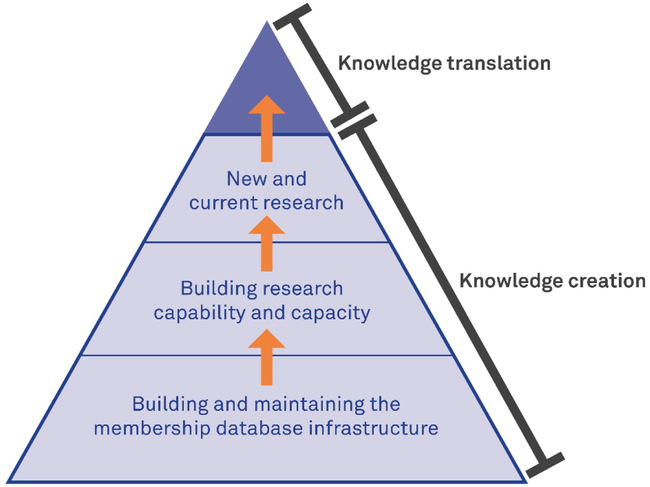
Figure 1 shows how all these objectives are important as they build on one another to achieve our ultimate aim, Objective 1.
TRA’s new paradigm for knowledge creation and translation.
Knowledge Exchange and Translation
TRA prioritizes knowledge translation in its work so that twin research has an impact on society. TRA’s work is underpinned by its membership and the resources it produces for the twin community and researchers (refer to the sections ‘The Membership’ and ‘Resources for Researchers’). This aligns TRA with community and funders’ expectations that ensure knowledge translation is at the forefront of all the work it does. TRA’s knowledge translation plan engages stakeholders in a structured and systematic way, with a focus on the twin community to maximize the transfer of outcomes to health policy and practice.
Stakeholder Engagement
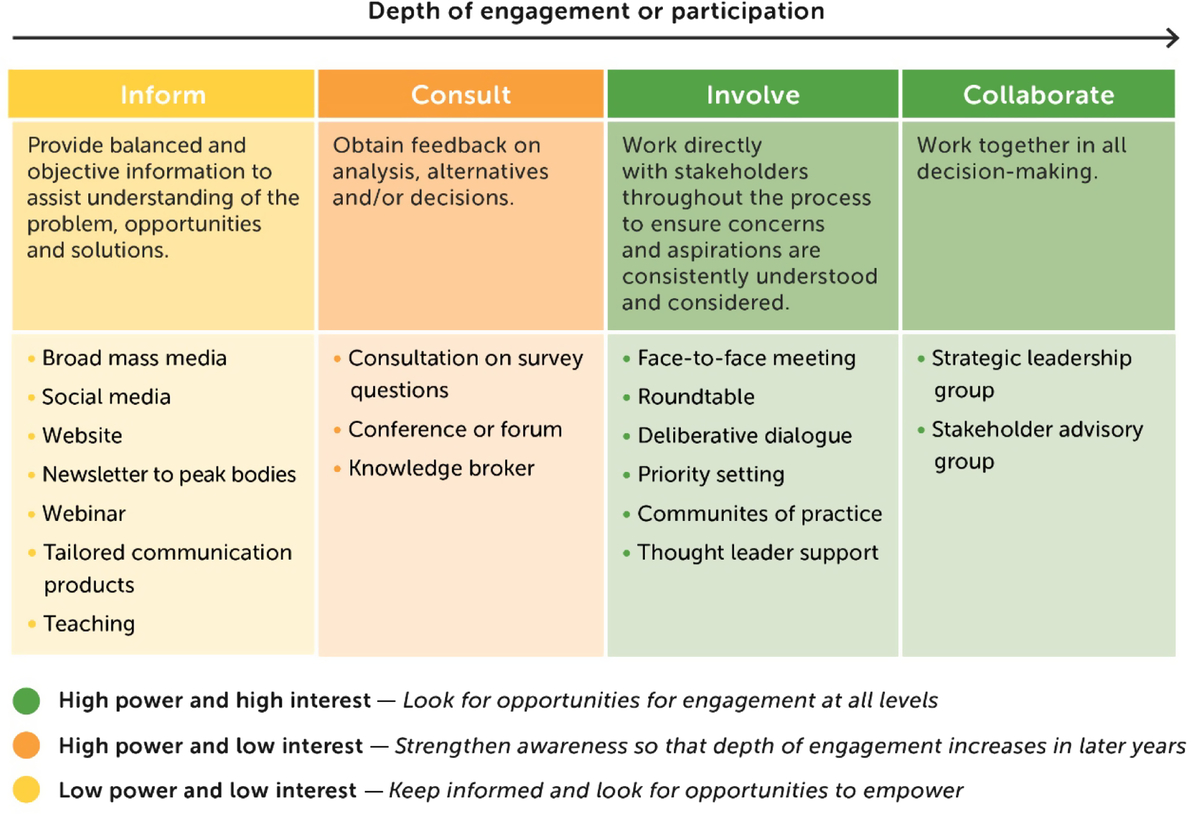
TRA has identified the following key stakeholder groups: twins and their families, researchers, educators, nongovernment organizations, end users and beneficiaries of research outcomes, governments and funders. TRA has developed a matrix to describe the depth of engagement of stakeholders with TRA to help strengthen relationships with the most relevant groups and to ensure translational efforts are as effective as possible (see Figure 2). This process has allowed us to identify stakeholders with high power and high interest, high power and low interest or low power and low interest.
TRA’s stakeholder engagement.
Ongoing Membership Engagement
Member communications are vital for sharing information on TRA’s activities and updates on study findings and to provide opportunities to participate in studies and events. TRA maintains a comprehensive website (www.twins.org.au) to provide news and information to twin members, their families, researchers and others. TRA’s social media notifications and quarterly email newsletter are TRA’s main ways of maintaining contact with members and publicizing the work of researchers. All twins and parents of twins who participate in studies receive study-specific feedback after completing each study.
Stakeholder Advisory Group
Accountability to all stakeholders will be overseen by the Stakeholder Advisory Group (currently in development), consisting of twin community representatives, early childhood development and education experts, government and policy professionals, health services representatives, researchers, statisticians and other stakeholders. The Stakeholder Advisory Group is guided by the established Stakeholder Advisory Group framework, which guides the review of all TRA activities, operations and stakeholder engagement.
Twin Pregnancy Booklet and Microsite
TRA, in conjunction with health professionals and twin parents, has developed a comprehensive Twin Pregnancy Booklet (print and online), which is available free of charge to families expecting twins. This valuable resource contains information about twin pregnancy, including nutrition and weight gain, zygosity, tips for twin rearing and sources of information and support. Due to demand (>600 booklets requested in 2018), this unique resource will be developed into a microsite within TRA’s website in 2020, to provide interactive, up-to-date material for families all over Australia.
Improving Knowledge of Zygosity and Chorionicity
In response to feedback from twins and parents of twins, and from research TRA has conducted (Cutler et al., Reference Cutler, Murphy, Hopper, Keogh, Dai and Craig2015), TRA has developed an article explaining how parents of twins and professionals can determine zygosity. ‘The importance of zygosity knowledge for twins and science’ was then published in TRA’s online Conversations in Twin Research series (Craig et al., Reference Craig, Murphy, Cutler, Rankin, Denton, Schofield and Carrick2019).
The article explains how accurate knowledge of zygosity is important for medical, social, financial and ethical reasons. The article also explains how incorrect assumptions mean that twins are often misclassified and recommends that medical professionals receive more education about twin zygosity and that parents be informed of their twins’ chorionicity and be encouraged to undertake zygosity testing. The article also provides resources for clinicians in the form of a professionally illustrated diagram and a flowchart for zygosity determination.
Twin Community Forum
In October 2017, TRA conducted a one-day forum with researchers, clinicians and peak body associations of twins and multiples to discuss the needs of twins, multiples and their families. This event was a community-driven initiative designed to highlight potential ways to address social and health inequities of families of twins and multiples. Key stakeholders came together to share and listen to each other’s knowledge and experience.
Encouraged by the success of this initiative, forum members developed a discussion paper entitled ‘Multiple Perspectives: What Support Do Multiple Birth Families Need To Live Happy And Healthy Lives?’ in collaboration with the Australian Multiple Birth Association, the Twin And Multiple Births Association, UK, and the International Council of Multiple Birth Organizations. The paper aimed to stimulate discussion, identify recommendations and influence practice and policy-making in Australia, while also bringing the twin and multiple-birth community closer by providing them with an opportunity to voice their concerns.
The Global Twins and Multiples Priority Setting Partnership
The Global Twins and Multiples Priority Setting Partnership, which also came about from the twin community forum, aims to identify the top priorities for research that matter to twins and multiples and the health care professionals who work with them.
In this collaborative participatory project, TRA, Twin and Multiple Births Association, UK, and St. George’s University, London, are bringing together twins, multiples, parents, carers, clinicians and scientists to reduce the incidence and severity of disease conditions and deaths for twins and multiples and to improve long-term health outcomes. The ultimate goal is to provide health research funders with powerful evidence of the issues that matter most to the twins, multiples and families themselves, thereby ensuring that future research is relevant, appropriate and able to improve everyday lives. Over 1000 people from around the world have contributed over 3000 questions for consideration thus far.
Conversations in Twin Research: Highlighting Twin Research to External Stakeholders
Conversations in Twin Research are an ongoing series of papers highlighting twin-related issues of public importance. TRA’s aim is to produce a freely available series of short papers written by experts, using accessible language. To date, TRA has published six papers covering topics such as the importance of zygosity knowledge, understanding early-life origins of chronic disease, twin research design methodologies and conducting clinical trials in twin populations.
New and Future Research
New methodologies are being developed and used to combine the power of twin research with the strengths of large linked administrative datasets and cohorts. This approach allows estimates of associations that are unconfounded by the wide spectrum of familial factors that underlie many risk factors and disease and is particularly important for data produced by new technologies in fields such as genomics, epigenomics, metabolomics, the microbiome and other ‘omics’ platforms. Linkage of whole population administrative datasets provides a powerful and cost-effective approach to create a chronological sequence of health events and health service use for individuals and their relatives, where genealogical linkage capacity exists. Linkage of datasets will provide more information about causation for measured and potentially modifiable environmental risk factors and will reduce bias because these datasets are essentially population-complete. TRA has established several collaborations to explore and maximize these opportunities. The outcome is a strengthened evidence base to drive quality decision-making for health policy and practice.
Zygosity-Predicting Algorithms
Most twin study designs rely on knowing the zygosity of the twin-pairs. This represents a potential barrier to applying those designs to administrative datasets that do not include twins’ zygosity status. To overcome this problem, TRA has used machine learning and other statistical techniques to develop zygosity-predicting algorithms based on absolute within-pair differences and absolute within-pair means for variables included in linked datasets. This approach relies on the assumption that monozygotic (MZ) pairs are, as a group, more alike than dizygotic (DZ) pairs (irrespective of whether this is due to genetic or environmental factors shared to different extents according to zygosity). As data accrue on twin pairs through their lifetime, it should be possible to better identify their true zygosity with high probability. Having pairs in these datasets with known zygosity can help develop better zygosity-predicting algorithms.
Geo-Coding of TRA Members’ Environments
Inclusion of geospatial data in health datasets provides a rich source of information to study environmental influences on health and education outcomes. TRA collaborates with researchers to enable the creation and analysis of geocoded datasets focusing on twins. Previous analyses have linked socioeconomic indices to individuals at the postcode level and smaller areas such as census collector districts (Scurrah et al., Reference Scurrah, Kavanagh, Bentley, Thornton and Harrap2016).
All of TRA members’ addresses have been geocoded and linked to rankings of relative socioeconomic advantage and disadvantage in Australia. Twins’ locations can be combined with additional geocoded environmental information such as proximity to proposed protective (e.g. green space) and risk (e.g. industrial factories) factors, and indices of environmental conditions (e.g. pollution, crime) from publicly available data sources such as the Australian Bureau of Statistics, the Australian Urban Research Infrastructure Network, and the World Health Organization Global Urban Ambient Air Pollution Database (e.g. Pettit et al., Reference Pettit, Tanton and Hunter2017; World Health Organization 2018). Prenatal data on maternal health and health behaviors during pregnancy and other perinatal data through the Centre for Health Record Linkage, educational scores from the National Assessment Program Literacy and Numeracy Twin Study (Byrne et al., Reference Byrne, Grasby, Olsen and Coventry2017) and Health and Lifestyle Questionnaire data will be linked with geospatial data to develop large-scale, effective risk indices for health and achievement. Several projects are underway to examine the associations between location (e.g. urban vs. rural or distance to health services), health care costs, health outcomes, school environments, distance to schools, school attendance records, educational achievement and the relative contributions of genes and environment to variation in educational or health outcomes by geographic location (Davis et al., Reference Davis, Haworth, Lewis and Plomin2012); neighborhood quality and behavior-related health risks (Rhew et al., Reference Rhew, Kosterman, Duncan and Mair2018); neighborhood quality and achievement (Little et al., Reference Little, Hart, Phillips, Schatschneider and Taylor2019), and proximity to green space and depression (Cohen-Cline et al., Reference Cohen-Cline, Turkheimer and Duncan2015). These projects can be extended to include multilevel and longitudinal analyses.
Statistical Methods for Causal Inference
Causation is the holy grail of science, especially of health and medical research. New approaches to assess evidence for causation are being developed and applied. These include directed acyclic graphs (Greenland et al., Reference Greenland, Pearl and Robins1999) and Mendelian randomization (Davey Smith & Hemani, Reference Davey Smith and Hemani2014), in which genetic variants are used as instrumental variables. The use of instrumental variables is well established in economics for teasing apart confounding from causation.
TRA Director John Hopper and colleagues have developed a simple regression analysis of data from pairs of twins or siblings to make inference about causation by examining familial confounding (ICE FALCON). In ICE FALCON, the co-twin’s exposure is used as a surrogate or proxy instrumental variable.
Hopper and colleagues have demonstrated that application of ICE FALCON results in the same causal inferences as Mendelian randomization but from much smaller datasets (e.g. 66 MZ pairs vs. 4000 unrelated individuals to find body mass index and smoking cause methylation, not vice versa; Li et al., Reference Li, Wong, Bui, Nguyen, Joo, Stone and Hopper2019; Li, Wong, Bui et al., Reference Li, Wong, Bui, Nguyen, Joo, Stone and Hopper2018). These studies also showed that ICE FALCON is similar to but outperforms Mendelian randomization and is much more widely applicable.
ICE FALCON is also an important technique for understanding why risk factors are maintained over time by addressing the important prevention-related question: Does the risk factor at a younger age have a causal effect on the risk factor at a later age? If not, interventions at a younger age have limited use. If so, the benefits of interventions at a younger age can be sustained over time.
New Studies
Studies of DNA methylation
New insights from analyses of twin and family data, not possible otherwise, have been found from studies of DNA methylation, an important new concept in disease etiology. Pooled data from seven twin and family studies, including four facilitated by TRA, provided evidence that the variation in genomewide average DNA methylation is mainly determined by environmental factors, starting with those shared in the womb by twins and then by families while cohabitating, with at most little variation explained by genetic factors (Li, Wong, Dugué et al., Reference Li, Wong, Dugué, McRae, Kim, Joo and Hopper2018). Evidence was also found that a twin birth changes the mother’s intrauterine environment such that siblings born after a twin birth are correlated in their average DNA methylation (Li, Kim et al., Reference Li, Kim, Wong, Joo, Nguyen, Stone and Hopper2017). As well as the examples in the section above, ‘Statistical methods for causal inference’, another important insight from within- and between-pair analyses of twin and sibling data was that an apparent association between DNA methylation at the SOCS3 gene and body mass index is due to familial confounding (Li, Wong et al., Reference Li, Wong, Southey and Hopper2017).
Men’s health study
The Men’s Health Study aims to apply twin designs to gain new insights into male health and improve quality of life (Australian Institute of Health and Welfare, 2016) and productivity (Bates et al., Reference Bates, Callander, Lindsay and Watt2018) for Australian men. The Men’s Health Study questionnaire is based on the Wave 1 questionnaire used by the Ten to Men study (Pirkis et al., Reference Pirkis, Macdonald and English2016). A substudy will focus on intergenerational men’s health, and the role of environments unique to males passed on to the next generation through changes to epigenetics (Perez & Lehner, Reference Perez and Lehner2019). Together with experts in male fertility and epigenetics, TRA is planning to study epigenetic differences in sperm DNA from male MZ twin pairs who are discordant for exposures such as stress, exercise and smoking. TRA will also compare health outcomes from their children.
Children of twins study
The Children of Twins Study examines the effects of parenting behavior on, and intergenerational transmission of mental health to, the children of adult twin pairs by comparing correlations between twin parents and their children with correlations between uncles or aunts and their nieces and nephews (Hannigan et al., Reference Hannigan, Rijsdijk, Ganiban, Reiss, Spotts, Neiderhiser and Eley2018).
Randomized controlled trials
A randomized controlled trial of the efficacy of a web-based sleep quality intervention for people with low back pain and insomnia, controlling for genetic factors, is being conducted using MZ twin pairs with subacute or chronic low back pain (Pinheiro et al, Reference Pinheiro, Ho, Ferreira, Refshauge, Grunstein, Hopper and Ferreira2016). Within each twin pair, one twin was randomly chosen to be assigned to the intervention group and the other was assigned to the control group. Other twin designs can be used for randomized controlled trials and the questions they address (Sumathipala et al., Reference Sumathipala, Yelland, Green, Shepherd, Jayaweera, Ferreira and Craig2018).
Resources for Researchers
While playing an active research role itself, TRA openly promotes the registry and its data resources to all researchers. TRA offers researchers across all disciplines an established infrastructure and access to an increasing network of twin researchers, statisticians and administrative staff who are experienced in establishing and conducting studies. Further information on resources and access are on our website.
Building Research Capability and Capacity Through Education Programs and Support
A key to the increasing success of TRA is its training and upskilling of researchers from many disciplines and of varying skillsets across the country and internationally. TRA aims to build capacity and capability in twin research through traditional and nontraditional educational training, professional development and mentoring activities that are integrated with other TRA activities. TRA’s highly successful workshop focuses on teaching the basics of statistical analysis of data from twins in a straightforward and statistically rigorous way that is accessible to researchers from all disciplines. TRA-supported scholars and fellows supervise research students and teach the workshops. The research students are also given training and opportunities in statistical consulting and collaboration (as appropriate depending on skills).
TRA has also developed the first components of a comprehensive online education and resources portal. This toolkit for twin research will include written and video materials based on the existing workshops as well as code for analysis of data in standard software packages such as R (R Development Core Team), SAS (SAS Institute, North Carolina, USA) and Stata (StataCorp LLC, Texas, USA). Currently in development are best practice recommendations to standardize identification, extraction and analyses of twin data from large linked datasets, including guidelines and procedures for specific frequently used large linked datasets (such as Medicare Benefits Schedule and Pharmaceutical Benefits Scheme data). The toolkit for twin research will also include materials adapted for statistical consulting groups throughout Australia and internationally. This outreach process is both effective and efficient.
A Twin Researcher and Statistics Group has been developed using a social media platform to allow peer-to-peer support and further teaching and learning from more experienced twin researchers. This group is aimed at all researchers new to, or interested in increasing their knowledge of, twin studies, rather than early career researchers specifically.
TRA’s aim is to make twin research a standard part of a population health researcher’s repertoire by building capacity and capability and facilitating collaborative research.
Collaborations and Networks
Collaboration is essential to the way TRA conducts all its activities. Generating and fostering enduring relationships with collaborators across all of TRA’s networks ensures that twin research has maximum impact on the wellbeing of society. Key partnerships include the establishment of the twin node at the Charles Perkins Centre, the University of Sydney.
TRA also actively participates in international collaborative twin research. It has played a key role in establishing and supporting the International Network of Twin Registries (Buchwald et al., Reference Buchwald, Kaprio, Hopper, Sung, Goldberg, Fortier and Harris2014) and provided data to large international consortia (Silventoinen et al., Reference Silventoinen, Jelenkovic, Sund, Honda, Aaltonen, Yokoyama and Kaprio2015).
TRA continues to support the development of the Brazilian Twin Registry, the first national twin registry in South America (Ferreira et al., Reference Ferreira, Oliveira, Junqueira, Cisneros, Ferreira, Murphy and Teixeira-Salmela2016). Data collection is ongoing under the coordination of Brazilian researchers at the Federal University of Jequitinhonha and Mucuri. TRA is also involved in initiatives to conduct twin studies using large linked Brazilian population-complete administrative health databases from DATASUS with the Federal University of Bahia (Pita et al., Reference Pita, Pinto, Sena, Fiaccone, Amorim, Reis and Barreto2018).
Enabling Research
To better enable research, TRA has established a data repository from new and historical twin studies. TRA has developed a baseline Health and Lifestyle Questionnaire and Family Questionnaire for junior and adult twin families to form a basis for this data resource. For further details, see the section on Resources for researchers below.
A large proportion of TRA’s resources is devoted to maintaining the registry to preserve and grow the membership, ensure data integrity and impart expertise and support to projects run through TRA.
Access to existing data and samples
TRA collects data and samples from twin members through core studies such as the Health and Lifestyle Questionnaires, Family Questionnaires, Men’s Health Questionnaire and studies involving TRA members including studies of mental health, infectious diseases, chronic pain conditions, cancers and bone health.
Data are used:
To allow TRA to better describe its membership through the publication of summary and descriptive statistics, made available to TRA members, researchers and the public.
To enable better targeting of potential participants for specific research projects, and in doing so, offering more cost-efficient services to researchers and reducing participation burden to TRA members.
To fast-track research by providing data without participant identifiers to researchers for ethically approved research analyses.
Health and Lifestyle Questionnaire
Established in 2014, the Health and Lifestyle Questionnaire forms the first major component of TRA’s data repository. The questionnaire is available to TRA members online in two versions: the Adult Health and Lifestyle Questionnaire for twins 18 years old or over and the Junior Health and Lifestyle Questionnaire, to be completed by the parents or guardians of twins aged from 1 to 17 years. The questionnaire contains demographic questions, a broad range of health conditions and risk factors for common diseases.
To date, 7117 adult twins have completed the Health and Lifestyle Questionnaire, including 1928 complete pairs. Parents of junior twin pairs (under 18 years of age) have completed the Health and Lifestyle Questionnaire for 4826 pairs. Of the completed pairs, the majority of adult participants were MZ female–female pairs (60%), followed by MZ male–male pairs (15%) and DZ female–female pairs (13%). For junior pairs, participation did not depend on sex with 40% male–male pairs, 39% female–female pairs and 21% opposite-sex pairs, but 57% were MZ.
Participants who completed the Health and Lifestyle Questionnaire were asked about diagnoses of more than 70 medical conditions, including allergic, neurological, digestive, heart, lung, autoimmune, psychological, congenital, developmental, bone, glandular, arthritic, hearing and vision conditions. Analyses of the associations of some of these medical conditions with risk factor and demographic data, including biometrics, geolocation, education, income, employment, ethnicity, screening history, and tobacco and alcohol use, have been completed. Within-pair concordance has also been examined (see Table 1 for selected conditions).
Concordance and discordance of medical conditions within pairs registered on TRA
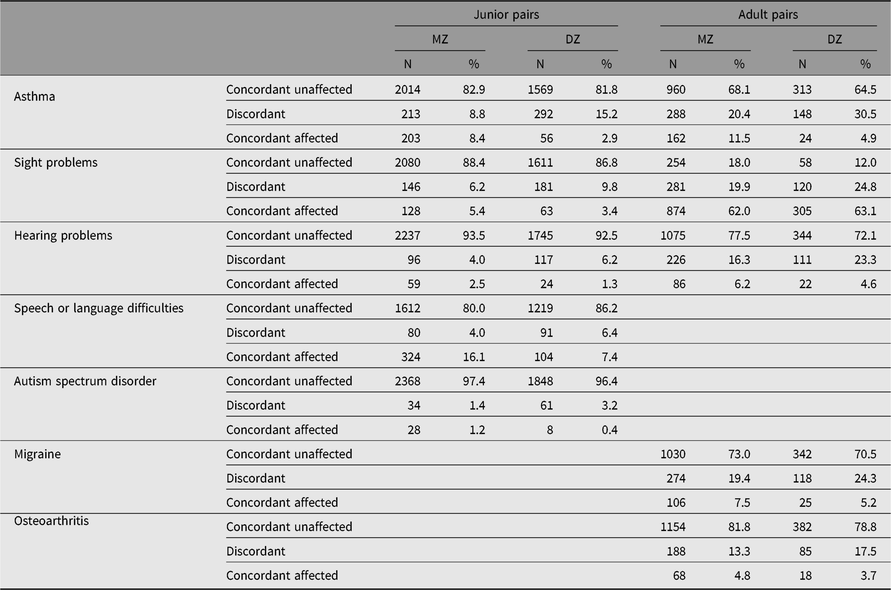
Note: MZ = monozygotic, DZ = dizygotic.
The Membership
TRA maintains information regarding the age, sex, zygosity, health status and contact details for members and their families on a network-protected relational database. Recruitment is continuing by about 1200 pairs per year.
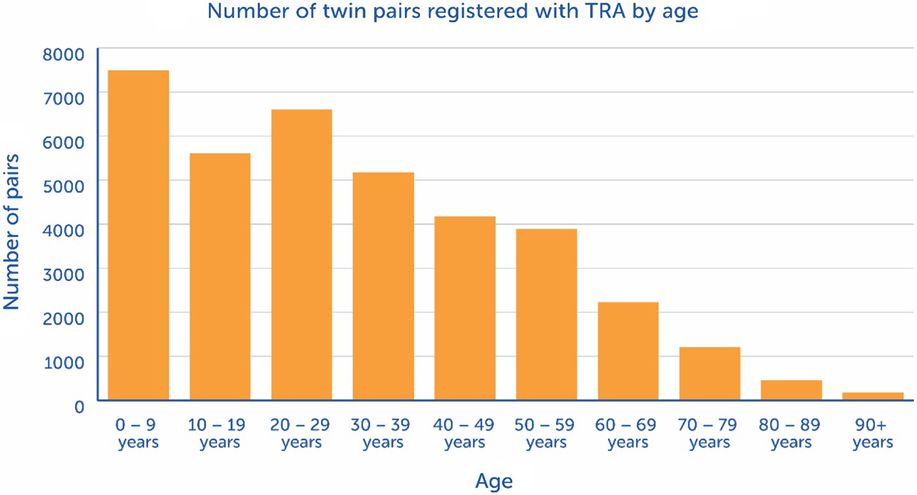
At the beginning of 2019, TRA held data on 97,951 persons from twin pairs and multiple sets. Of these, 74% were adults and 26% were children. Members are considered active if their contact details are up-to-date and they are currently interested in being involved in research activities. The current numbers of active adult and junior twin pairs by sex and zygosity are shown in Table 2. Of these, 41% are MZ, 56% are DZ and 3% are of unknown zygosity. Thirty-four percent of these pairs are male–male, 42% are female–female and 24% are opposite sex. The distribution of active twin pairs by age is shown in Figure 3.
TRA’s active twin pairs by sex and zygosity

Note: MZ = monozygotic, DZ = dizygotic.
Number of twin pairs registered with TRA by age.
New Member Recruitment
New recruitment to the registry is primarily of twins less than 5 years of age (80% of new recruitment) with members often remaining for their lifetimes. Members have informed us that motivation to join comes through wanting to give back to society, being informed of the latest research findings, and accessing up-to-date resources specific to twins. TRA maintains a number of recruitment channels, including advertising with the Australian Multiple Birth Association; news releases and print media; media opportunities such as participation in television shows and general comment on scientific progress; word of mouth; the TRA website, electronic newsletter and social media pages; promotion of the Twin Pregnancy Information Booklet and events such as information forums. The Twin Pregnancy Booklet is the dominant means of registration (28%), followed by internet searches (15%), word of mouth and Facebook (both 14%) and the Australian Multiple Birth Association (12%).
Updating Records
TRA undertakes a wide range of activities to keep its membership active and engaged. These include an electronic newsletter, printed newsletter, opportunities to update details on the website, and phone calls to the twins or their second and third contacts (to help us locate twins’ missing contact details) and following up return-to-sender mail from study approaches. TRA also undertakes proactive tracing of its members, which is an ongoing and important maintenance activity that ensures that the registry remains viable. In 2018, a new initiative that used SMS requests to update details saw more than 1300 members update their email addresses.
Database Upgrade
Over the last 18 months, TRA has undertaken a major revamp of its membership database. The membership database had been in place for over 12 years, and the outdated software it was built on had limited functionality and support. Commercial developers worked with TRA staff and technical specialists at the University of Melbourne to create a new user interface that allows TRA to more efficiently manage member, researcher and other stakeholder information and processes. The new database was released in October 2018.
Zygosity Determination for the Twin Membership
At the time of registration, all members are assigned a zygosity record that can be updated at any point during their membership. The method of zygosity determination is also recorded. Zygosity assignments of same-sex pairs from differing methods of determination are prioritized according to the accuracy of the method, with DNA zygosity testing being the preferred determination method, followed by validated pea-in-the-pod questionnaires (Ooki et al., Reference Ooki, Yamada, Asaka and Hayakawa1990), then self, parental or doctor’s report.
Summary
TRA fosters effective collaborations and builds research capacity to expedite and advance knowledge and improve population health outcomes.
By conducting research using linked data, TRA foresees the integration of linked administrative data with data from registry members and future studies as an opportunity to discover insights that lead to improved policy and practice. The advancement of twin methodology in causation and omics technologies, along with the inclusion of family members and multiple generations, will further the capacity of twin research to solve health issues for many.
Working in this modern world of competing agendas, we are creating new ways to engage twins over their lifetimes and learn their unique stories.
TRA will continue building collaborations and networks to address a broad range of research domains through novel approaches to complicated problems.
Acknowledgments
We acknowledge all the twins and families who are the members of TRA and have contributed to research over the last 40 years to improve health and wellbeing for all. We thank the Australian Multiple Birth Association for their years of collaboration in engaging twin families. We also acknowledge the TRA team members for their dedication and experience in the operations of TRA. Finally, we are grateful for the financial support from the National Health and Medical Research Council through a Centre of Research Excellence Grant (ID: 1079102).



