




On a spring evening in 1987, the Nottingham Association, a neighborhood residents’ group in Midwood, Brooklyn, gathered for its annual meeting at the local Public School (P.S.) 193. Top of the agenda was the topic of home break-ins: a major concern in a community that, despite operating a popular volunteer car patrol, had reported at least four separate burglaries in one six-block area over a recent Memorial Day weekend.Footnote 1 Noting the ineffectiveness of the police response and accepting the relative inevitability of property crime, the Association advised members to take matters into their own hands—not by taking up arms or vigilantism, but by completing a burglary prevention “checklist” to audit the security of their home. Also present were officers from the 70th Precinct, who distributed self-help crime prevention literature and advertised their home survey service in which police visited a property to evaluate its safety and advise on security devices and suppliers, and local security businesses that demonstrated the latest alarm systems on the market. Employing tropes more familiar to the electronics store or furniture showroom than the war on crime, Association president Stephen Epstein informed residents—simultaneously imagined as discerning consumers—that a $25 subscription to the car patrol was “a fantastic buy” and to “try before you buy” by leasing the alarms on a trial basis. The Association, which also used the meeting to honor forty of its patrol volunteers, advised members to solicit expert sales and installation advice before making their selection. Access to such insights, and the opportunity to feel a little safer as a result, was presented as one of the special “privileges” open to members of the Association.Footnote 2
In its emphasis on crime prevention, the meeting was not exceptional. New Yorkers of all backgrounds had been convening to discuss neighborhood crime and a wider perception of unsafety since the 1960s, amid the increased incidence (and reporting) of crime and the wider availability of such information. The 1964 murder of Kitty Genovese, during which neighbors allegedly failed to intervene despite witnessing or hearing the assault, triggered public debate and much political intervention about citizen apathy over crime and the decline of community.Footnote 3 Racialized anxieties over crime had dominated a 1966 referendum on a police civilian complaint review board and shaped city politics through the 1970s and 1980s.Footnote 4 Although especially pronounced in white outer borough neighborhoods like Midwood, where they underpinned the political coalition of Democratic Mayor Ed Koch and contributed to antiblack violence in nearby Bensonhurst and Howard Beach and support for “subway vigilante” Bernhard Goetz, such fears were also tangible in urban black communities, where residents had long instituted civilian patrols in response to state and police neglect and a sharp rise in drug-related crime.Footnote 5 Yet while often bound to the rise of a racially-inflected urban conservatism, culminating in the mayoralty of Republican Rudy Giuliani and “broken windows” policing in the 1990s, public anxiety over crime and civilian-led efforts to confront it were also deeply connected with the emergence of another ascendant political order in New York.Footnote 6 Indeed, while it shared many “intercurrent” features with conservative “law and order” politics—notably common demands for aggressive action on crime and disorder, defenses of property rights, and neighborhood “stability”—the Nottingham Association meeting was distinctive: in its expectation that individual New Yorkers, rather than expanded police power, would take the lead in not just reacting to crime but actively preventing it; that such activity was regarded as a symbol of citizenship; and that it would be performed not through large-scale state action but through changes to individuals’ everyday routines and behaviors, from their assessment of risk to what they consumed—subjectivities associated with an ascendant neoliberalism.Footnote 7
The Nottingham Association example illustrates not only the range of civilian crime prevention initiatives on offer in late-twentieth-century New York, but also their wider ideological meaning and significance within an era of market-oriented neoliberal restructuring in the city. Amid a crisis of unprecedentedly high crime rates, diminished municipal budgets, and a wider legitimacy deficit facing the police and public institutions, New Yorkers were encouraged to assume greater responsibility for managing crime, forging a reoriented relationship with state and private actors and a renewed sense of themselves as autonomous, risk-conscious “self-helpers.” It reveals the proliferation and grassroots popularity of “transformative alternatives” to public policing in this context, from volunteer civilian patrols to private security and alarm systems; alternatives that upended state monopolies on the delivery of ostensibly universal services, enhanced the power of commercial interests and the market, and naturalized the use of private initiative.Footnote 8 Bridging and essential to these developments was the enterprising, informed consumer–citizen, who sought out anticrime products and consumer knowledge, asserted their consumer rights, and framed safety as a consumer “privilege” to be acquired or choice to be made. While social scientists have theorized the relationship between an idealized entrepreneurial, vigilant citizen and neoliberal politics, and its value as a form of both governance and governmentality linking elite and non-elite actors and political economy and cultural life, less has been done to excavate the historical emergence and function of this ideal in legitimizing market logics at the grassroots and ultimately narrowing the boundaries of community and citizenship in the nascent neoliberal city.Footnote 9 In its focus on civilian crime prevention and consumer citizenship in 1970s and 1980s New York, this article addresses this gap, providing a new perspective on the popular dimensions of the city’s late-twentieth-century transformation and the emergence and validation of a new political order.
New York, Neoliberalism, and Citizenship
One of the major conceptual frameworks of late-twentieth-century American history is that of neoliberalism: the ascent of the market and the private sector as dominant forces in American public life, culture, and political economy.Footnote 10 New York City, often regarded as the exemplar of mid-century activist government, working-class social democracy, and welfare state liberalism, remains a central protagonist in this story.Footnote 11 Its 1975 near-bankruptcy and subsequent diet of economic austerity and restructuring represents a critical juncture in the reshaping of public expectations of government and urban political economy and how such entities should be organized and their resources distributed. In the words of its preeminent chronicler, New York’s fiscal crisis “seemed to delegitimize an entire way of thinking about cities and what they might do for the people who live in them.”Footnote 12 Yet in both critical and sympathetic accounts, the emergence and application of urban neoliberalism in New York—whether ideological experiment or pragmatic necessity—remains a largely elite project. “Imposition” or “regime change” are the preferred motifs, reinforcing an image of a top-down restructuring to which a demoralized city passively assented.Footnote 13 But as Brian Goldstein has argued, New York’s transformation was “never simply a process that happened to residents.”Footnote 14 How did it secure popular consent, even participation, from ordinary New Yorkers on the ground, and how did they assert agency in a process often assigned to pro-market elites or impersonal economic forces?
This article joins with more recent historical scholarship that has exposed some of the “popular” dynamics of the neoliberal turn in New York.Footnote 15 It complements work that identifies the emergence of civilian-led crime prevention as a symbol of New York’s embrace of a new political economy, privatizing public space, empowering private, market-led solutions, and entrenching economic power and inequality.Footnote 16 Yet it also offers a new perspective by exploring the more quotidian and individualized ways in which civilian crime prevention organized neoliberalism into New Yorkers’ everyday lives and activities, illustrative of a greater popular ideological pivot than is often suggested.Footnote 17 Consequently, it can also enrich histories of crime, policing, and incarceration since the 1960s, foregrounding the consumer economy and its mobilization of commercial interests, new media, and individuals’ material desires in the popular expansion of, and enlistment of the ordinary citizen in, a new war on crime—an endeavor scholars have typically attributed to political elites and law-and-order interest groups.Footnote 18
I do this by refocusing attention away from the formal practices of political economy—public–private partnerships, tax or housing policies—or crime control—patrols, private security, policing—and toward the changing ways in which New Yorkers imagined, through such practices, themselves and their neighbors, their rights and obligations, and their relationship with government and the state; essentially, how notions of citizenship shifted during the “crisis era.”Footnote 19 Theorists have identified the contemporary city as a significant site for the contestation and reformation of citizenship—“the political space where new rights of citizenship … are being negotiated”—and the neoliberal turn as a moment in which images of citizens shifted from those of a worker or producer to that of a consumer.Footnote 20 In the “post-Fordist” city, Susan Christopherson explains, citizenship became a “consumption activity … transformed to emulate consumer behavior,” with the individual citizen imagined as capable of and responsible for making informed choices, their rights linked to their status as consumers of goods or services in the marketplace.Footnote 21 Civilian crime prevention activities, many implemented within the context of New York’s “post-Fordist” transformation, can help to historicize many of these shifts. In their both practical and discursive applications, such activities illuminate the reconceptualization of citizens as consumers and its relationship with a “popular” urban neoliberalism, including the rationalization of public austerity, the reconfiguration of New Yorkers’ relationship with both public and private agents, and the everyday normalization of market logics.Footnote 22
The initial impetus for this process came in the early-mid 1970s and from above, as new municipal and police programs, private actors, and elite nonprofits directed ideas and resources into communities to stimulate citizen “responsibilization” in the fight against crime.Footnote 23 While they were driven by various motives—economic and practical expediency, reformism or communitarianism, perceptions of police failure—I show how these programs’ enlistment of civilian actors in the performance of crime prevention activities prompted New Yorkers to consider a new, “prudentialist” relationship or “partnership” with the state based on their assumption of individual responsibility and risk but also active consumption, heralding the ascent of a wider neoliberal subjectivity and the ultimate blurring of public-state and private-market initiative essential to urban neoliberalism by the 1980s.Footnote 24 Simultaneously, and again working from above, an emergent lifestyle media aimed at an ascendant cohort of urban professionals established a popular aesthetic around the consumption of anticrime products and activities and embedded it in individuals’ everyday consumer choices. While these outlets initially emphasized to readers the value of consumption for survival, by the 1980s this became melded with the pursuit of luxury, exclusivity, and status, reflective of New York’s growing stratification. Yet citizen-consumer identities and affiliations were also increasingly shaped by the agency of ordinary New Yorkers. Drawing on the activism and publicity of neighborhood block associations, I reveal how these new grassroots institutions disseminated ideas of community participation and self-governance but also consumer citizenship for residents themselves. While applying these logics to their anticrime activities, block associations and their members also extended them to their interactions with the state and even their fellow city-dwellers, further narrowing the boundaries of community and citizenship in the neoliberal city. This tripartite approach illustrates how neoliberal ideas around crime prevention and consumer citizenship operated at both the elite level and from the bottom up, were negotiated by different parties and across different contexts, and could be disseminated downwards and upwards, often simultaneously. Fundamentally, it reveals that urban neoliberalism was both an elite imposition and also something that could be adopted, shaped, and ultimately validated by New Yorkers themselves.
The Emergence of Civilian Crime Prevention
As both an idea and a practical endeavor, civilian crime prevention was not new or distinct to the 1970s and 1980s. The history of the United States is replete with local examples of citizen or private anticrime activism, from volunteer militia and self-defense organizations to private security and civilian auxiliaries to the police.Footnote 25 However, by the 1970s and amid a national War on Crime, a broader consensus was forming around greater public involvement in crime prevention activities, driven as often by liberals and critics of state power as by law-and-order conservatives. In the late 1960s, Lyndon Johnson’s Presidential Crime Commission identified civilian crime prevention as a means of community empowerment and addressing the social inequalities that incentivized crime, aligned with the War on Poverty’s Community Action Program and its emphasis on maximum feasible participation.Footnote 26 The inner-city uprisings of 1967–68 undoubtedly cemented white racial fears about crime and urban disorder, but the Kerner Commission report on the unrest also recognized it as an opportunity to address a crisis of state legitimacy in inner-city minority neighborhoods via greater community involvement in policing.Footnote 27 In 1973, amid fiscal pressures on public budgets and growing academic scrutiny—and doubt—of police effectiveness, the National Advisory Commission on Criminal Justice Standards and Goals, established by the federal Law Enforcement Assistance Administration (LEAA) to create a national framework for crime prevention, identified citizen action as a means of tackling rising crime but also a public assumption that “government and its agencies alone must respond … [and] marshal all available resources to choke off crime at its roots.”Footnote 28 While initially targeting resources toward public law enforcement, from 1972 the LEAA—a creation of Johnson’s Crime Commission—established a national Neighborhood Watch program, which enlisted citizens across the United States in anticrime patrols and other initiatives, and in 1976 a new Office of Community Anti-Crime Programs (OCAP)—pushed by liberal Democrat and House Subcommittee on Crime chairman John Conyers, an advocate of community empowerment for his Detroit district—with a $15-million annual budget.Footnote 29 An unprecedented federal commitment to neighborhood anticrime activism, OCAP disseminated seventy-five small grants of up to $250,000 to local anticrime projects in its first year. Both initiatives recognized the extensive “social and economic costs” of high crime rates but also the inherent limitations of the state’s efforts to control them; as OCAP Assistant Administrator Cornelius Cooper observed in 1979, “the system as currently defined can no longer satisfactorily contain crime without additional assistance from the citizen.”Footnote 30 Further LEAA support followed, including the 1980 Urban Crime Prevention Program designed to support citizen crime prevention in low- and middle-income communities in major cities.
Nineteen-seventies New York City offered fertile terrain for civilian crime prevention. Sharp increases in recorded crime and drug use over the 1960s, combined with demographic change and ongoing police service attrition amid growing city deficits, intensified public fears and community demands for safety as well as corporate anxieties about urban decline and the future possibilities of doing business in New York.Footnote 31 Underpinning these developments was a growing grassroots recognition that regular policing could no longer deliver the outcomes expected of it. New alternatives emerged in response: tenants’ patrols in public housing sponsored by a city Housing Authority eager to reduce costs and residents disquieted by new, poorer, and more disorderly arrivals; homeowners’ associations eager to protect property values in the face of racial transition and declining services; and civilian patrols in Black communities fearful of the threat unchecked crime and disorder posed to local businesses and middle-class consumption.Footnote 32 These alternatives represented various complex or longer-term inheritances, including a wider cultural turn toward “neighborhoodism,” grassroots demands for community control, or, conversely, defenses of property rights, historical experiences of institutional corruption or inefficacy, and negligent or invasive policing.Footnote 33 But they also hint at a prehistory of neoliberal subjectivity, as residents explored approaches to service delivery, including crime prevention, previously monopolized by the state and market logics of individual responsibility and consumer choice. Meanwhile, new lifestyle-oriented media networks and consumer markets disseminated the knowledge and commodities necessary for civilian crime prevention—New York’s private security industry expanded fifteen times between 1966 and 1976—especially for an aspirational “new middle class” returning to city living and “for whom,” Miriam Greenberg notes, “identity and politics [were] defined and constructed around consumer lifestyles.”Footnote 34
New York’s 1975 fiscal crisis and its subsequent regime of municipal austerity and retrenchment accelerated these trends. Police patrol strength was immediately reduced by a further 7,000 officers, while recorded felonies reached unprecedented highs in the wake of the cuts.Footnote 35 Efforts to rationalize policing by closing precinct houses, deprioritizing “lesser crimes” such as burglaries and muggings, or moving patrol from the streets into one-man patrol cars transformed policing into a more reactive, detached process and reinforced declining public confidence in the police’s ability to control crime; feelings intensified—and racialized—by widespread looting and disorder amid a citywide electrical blackout in July 1977.Footnote 36 Unsurprisingly, the enlistment of the responsible “self-helping citizen” in crime prevention gathered further momentum. “If the citizenry just … complains, we will have more victims,” declared the leader of the Bronx-based Interfaith Civilian Patrol. “The police don’t have the manpower anymore. You got to do something.”Footnote 37 Between 1977 and 1982 the number of civilian patrols grew from sixty groups with 5,000 members to 135 groups with 15,000 members, and the number of New Yorkers active in a civilian crime prevention program doubled from 70,000 to 150,000.Footnote 38 The logics of consumption, including a growing marketplace of anticrime products, were closely intertwined with this activity. By 1978 there were an estimated 90,000 private guards operating in the city, over three times the number of regular police—driven by the willingness of many residents’ associations to pay for their security.Footnote 39 Safe manufacturers in New York reported a “surge of interest” in their products, especially smaller, more affordable designs for domestic use; one security alarm executive estimated that by 1982, he installed over 2,000 systems in the city every year, and the New York Times’s financial pages advised readers to invest in a “growth industry.”Footnote 40 Take-up of martial arts or self-defense classes enjoyed similar expansion.Footnote 41
These examples, building upon preexisting initiatives and legacies but fully realized by the fiscal crisis, performed important ideological work, enlisting New Yorkers in the war on crime but also providing early adaptations to the city’s market-oriented transformation. Whether forming their own patrols, hiring security guards, or purchasing anticrime products, residents affirmed and normalized the limits of public provision and the possibilities of non-state solutions, especially consumption and the market. At a moment of constraint—municipal austerity, high crime, state dysfunction—these solutions offered residents the promise of individual autonomy and choice, “designing in” neoliberal ideas to everyday choices or routines. Civilian crime prevention empowered new criminological approaches essential to the neoliberal city—theories that emphasized routine opportunity in the making and prevention of a criminal “event” rather than intervention in crime’s “root causes,” and the necessity of surveillance and regulation of urban space and community. It also embedded a particular vision of urban citizenship—“responsibilized,” “prudentialist,” consumerist—through which New Yorkers undertook both greater responsibility and risk for crime prevention and developed a new relationship with the state. Initially disseminated from the top down via public programs, civic organizations, and new media, this vision—centered upon the consumer–citizen—would in time also be adapted and extended through the activities and behaviors of ordinary New Yorkers.
“Shop Around … [and] Get Three Bids”: Official Programming
The initial thrust for civilian crime prevention in New York came from city government, mirroring growing federal activity and investment. Mayor John Lindsay’s block security program, a $5-million (rising to $7 million) initiative launched in 1973, provided matching cash grants of up to $10,000 for low- and middle-income neighborhood groups to pursue “self-help community security programs.”Footnote 42 The program lauded citizen-led anticrime initiatives in communitarian and good government terms, illustrating its origins in post-Kerner concerns over state accountability, minority–police relations, and civic cohesion.Footnote 43 Crime prevention, program publicity declared, was “everyone’s business,” and by participating New Yorkers would “meet your responsibility to make your home, your street and your community a safer place.”Footnote 44 That responsibility was, however, closely tied to precepts of actuarialism and consumer choice. Successful grant-holders were to conduct a self-evaluation of their own crime prevention requirements (a “careful security tour” and “detailed checklist of your security needs”) before spending their award on anticrime products of their choosing—whistles, walkie-talkies, cameras, lighting—selected from a list of private providers.Footnote 45 Speaking in Congress in support of the initiative, Rep. Charles Rangel (D-NY) praised it for enfranchising “communities … who are frightened not only of the criminal but many times of their own civil servants,” but also reorienting perceptions of the police in his Harlem district toward “a service-delivering agency rather than the master–servant thing.”Footnote 46 Rangel’s comments illustrate the ways in which historic experiences of police brutality and a desire for greater state accountability could cohere with emergent discourses of choice and service to reconceptualize New Yorkers as consumers of public safety.
The block security program, which funded seventy-three local projects in its first year, failed to withstand New York’s fiscal crisis.Footnote 47 However, the private sector—business but also nonprofits and elite foundations—emerged to fill the void.Footnote 48 Especially prominent was the Citizens’ Committee for New York City (CCNYC), which as of 1976 channeled small grants of $400 to over 1,000 block-level community anticrime initiatives through its Self-Help Neighborhood Awards Program (SNAP). While presenting itself as a “non-political” effort, CCNYC privately acknowledged it is “unlikely New Yorkers can look forward to the full range of publicly-funded services enjoyed in the past” and underlined residents’ obligation to “make the difficult transition from an era of plenty to one of meager public resources” by “help[ing] themselves.”Footnote 49 SNAP criteria thus emphasized individualism (blocks could not pool resources or secure collaborative awards) and a vision of crime prevention as the management of risk (only surveillance and patrol activities were funded), but also the empowering potential of competition and consumer choice. CCNYC director Sandra Silverman noted that “the competitive nature of SNAP and the pride that comes with winning truly acts as an incentive for residents to … improve the quality of life on their block”; once successful, SNAP award holders were required to spend their funds on equipment via “the mobilization of private sector resources”—preventing crime by entering the marketplace.Footnote 50
This model of individual responsibility, competition, and consumption proved initially appealing. A 1977 evaluation of award holders reported that in contrast to the inertia and straitened universalism of public policing and experiences of “negative” or “hostile” city agencies, SNAP was seen as responsive to individual choice and consumer need. Participants “value the responsiveness of SNAP to their needs, the flexibility of the program, the fact the program is run efficiently with a minimum of red tape … the impression that CCNYC cares about their projects,” it reported. “This stood in sharp contrast to their efforts [with] City agencies.” Footnote 51 “CCNYC is personal and not bureaucratic,” affirmed one Bronx residents’ group. “The money for [our] project came fast.” Other winners noted their award’s empowering potential—as one declared, “a great boost to morale.”Footnote 52 But as the evaluation noted, SNAP grants also had an ideological impact, naturalizing the retreat of public provision: “There appears to be recognition on the part of community groups that the cutbacks in City services are not temporary, and they have responded by increasing their self-help efforts.”Footnote 53 To illustrate its effectiveness in shifting citizens’ expectations of the state, by 1980 SNAP had received over 1,500 applications and made over 400 self-help awards, over 30 percent of which addressed crime prevention.Footnote 54 It gained the attention of the LEAA, which provided CCNYC with a $450,000 grant in 1980 for further citizen crime prevention projects, and the Reagan administration, which heralded SNAP as “precisely the type of program President Reagan is encouraging Americans to become involved in” and an “outstanding example [of private sector initiative] … we’ll want to bring to the attention of others.”Footnote 55
Police programs also promoted the growing fusion of state and citizen activity. The Civilian Observation Patrol (COP) scheme, established in 1973, supported an estimated 145 private civilian patrols in 47 of the city’s 73 police precincts by 1977.Footnote 56 Blockwatchers, launched in 1972, enabled residents to report suspicious activities from their own homes, embedding the idea of an organic, self-governing but also implicitly bounded community in which surveillance was omnipresent.Footnote 57 “What we are trying to do,” the department’s new civilian participation director, previously the organizer of a network of civilian patrols in Brooklyn, explained, “[is] to give people the tools to help themselves.”Footnote 58
Yet police programs also accentuated consumer citizenship. Launched in 1972, Operation Identification provided residents with electronic etching equipment to mark valuable items and register them with the police, facilitating easier recovery of stolen property.Footnote 59 Its publicity applied the logic of consumer self-interest, reminding New Yorkers that participation provided “the cheapest insurance you can get.”Footnote 60 A home security survey service, introduced a year later, was even more explicit in its conceptualization of New Yorkers as consumers. Having requested an evaluation of their domestic security arrangements by officers “tailor-made for the individual premises,” residents could also solicit personalized “best buy” recommendations for improvement, including models of lock, bolt, and alarm systems, and book a seminar led by a detective featuring demonstrations of different security devices.Footnote 61 When the New York Times joined two policemen on a round of home surveys, the officers articulated their recommendations in consumerist terms, encouraging clients to “shop around” and “get three bids” on security installation, even providing estimated costs and names of recommended suppliers. “Alarms are good if you can afford them,” acknowledged one officer, adopting the guise of sales assistant, “but you’re better off spending your money on equipment that will keep the burglar outside.” Another, recommending a metal doorframe for a Brooklyn brownstone but noting, “That wouldn’t go well with the cornice moldings,” demonstrated a keen sensitivity to consumer aesthetics.Footnote 62 Exemplifying the “prudentialism” central to neoliberal governance and citizenship, these initiatives rewrote the function of the police officer and, by extension, the state—reimagined as a “partner” rather than protector, providing knowledge, consultancy, and advice to further citizen responsibility (and risk) for social harms such as crime.Footnote 63 But they also reconceptualized the crime-conscious citizen as an informed, enterprising consumer: asserting claims to municipal services, assessing risk and value, and using the state as a resource to facilitate choice.
Prudentialism was popular; a 1982 Department of Justice evaluation of the home surveys reported a “huge backlog” of requests from eager Brooklynites.Footnote 64 Yet it failed to acknowledge the wider implications of economic austerity and restructuring that prevented some communities from exercising agency and choice as freely as proposed. A 1977 CCNYC evaluation of mostly Black and Puerto Rican SNAP recipients in the Bronx observed the program’s limitations in “slum conditions” and “poor areas,” which “seem not to know how to, or can’t, trade off time for money. They lose enthusiasm for the project and have a very difficult time. Making any impact [preventing crime] on the block is difficult.”Footnote 65 Other studies reported that low-income grant-holders, unable to supplement their award with voluntary contributions, faced “hard choices,” including prioritizing some households for funds over others or purchasing substandard equipment.Footnote 66 Such disparities of outcome illustrated the limitations of voluntarism and consumer choice and anticipated the post-crisis entrenchment of significant inequalities in the quality of services received and communities’ access to them.
“An Air of Exclusivity”: Lifestyle Media
Alongside public programs, lifestyle media was critical in both legitimizing and disseminating the initial civilian turn in crime prevention. These outlets served what Sharon Zukin identifies as the “critical infrastructure” for the emerging post-industrial city: an affluent, cosmopolitan “new middle class,” many of whom had returned to New York attracted by the availability and authenticity of cheap nineteenth-century townhouses and apartments, and were now concentrated in gentrifying areas of Manhattan and Brooklyn.Footnote 67 Not only did this constituency consume new lifestyle media, but many also wrote for, designed, or edited them, absorbing but also disseminating a new “common sense” about the possibilities of urban life and providing “navigational tools for a landscape … of monumental flux.”Footnote 68 While scholars have scrutinized the relationship between these publications and the rise of neoliberalism as policy regime or political economy, their function in designing in the city’s transformation to residents’ everyday lives and behaviors is less well documented.Footnote 69 Essential to this process was lifestyle media’s promotion of, and readers’ reception of, civilian crime prevention—to be adopted both as a means of survival and empowerment—“[In a] city under siege … it’s time to start saving ourselves,” New York magazine proclaimed—and also as a symbol of consumer knowledge and rationality, providing what Zukin calls “the best life for the cheapest price.”Footnote 70 As scholars of the format have explained, lifestyle media are not simply “reflective … but constitutive of social life,” not functioning to passively display popular trends, aspirations, or identities but actively forging them themselves.Footnote 71 Consequently, they are an essential source for understanding the normalization of civilian crime prevention and consumer citizenship in neoliberal New York.
New York magazine, established in 1968 and boasting a circulation of 335,000 and advertising revenue of $7 million by 1973, was the most prominent of the new media. Fashioning itself as “a survival manual for coping with the urban mechanism,” providing “everything you should know about everything and everyone you have to deal with to survive in this city,” New York’s crime prevention advice combined can-do preparedness and utility with the pursuit of pleasure, style, and consumption.Footnote 72 Rivaling New York, the New York Times’s “Weekend,” “Home,” and “Living” sections, introduced in the mid-1970s, promised readers “an authoritative voice” on the possibilities of urban life.Footnote 73 Both publications followed a template not dissimilar to official programming: practical “how-to” guides that emphasized individual responsibility and self-enterprise; insider guidance in which state actors provided consultancy to transfer responsibility—and risk—to individuals and further consumer choice; and best-buy advice on anticrime products and technologies, even property, which entrenched ideas of market rationality and consumer citizenship via a familiar and accessible lexicon. They established a particular kind of knowledge: that in the neoliberal city, responsible citizenship came through informed consumption, and that safety—imagined not as a social good but a consumable commodity—was secured through the individual’s exercise of their personal responsibility and consumer rights.
Practical how-to guides dispensed practical advice for anxious New Yorkers on how to embed awareness of crime into their daily routines and assume greater personal responsibility for its prevention. Articles provided step-by-step technical guidance for “do-it-yourselfers” on anything from how to discourage a mugging to how to install a home alarm system.Footnote 74 A special issue of New York, “Protecting Yourself Against Crime,” offered twenty-three pages of “prudent guidance” and “common sense,” including risk management techniques for readers’ everyday lives and simple adjustments to individual behaviors that might deter crime. At the grocery store, readers were advised to keep purses or billfolds out of sight and line up the cash required for payment in advance; riding the subway, they were to travel close to the conductor’s car; walking home at night, they should compile an inventory of late-opening businesses in which they might seek refuge from assault.Footnote 75 Even if such advice emphasized the responsibility of citizens, not the state, to manage risk, readers responded willingly, sharing safety tips of their own or even recounting how such “vital and valuable” guidance “may have saved my life.”Footnote 76 Yet in their emphasis on the mundane, they established an assumption of crime’s universality and that the risks of victimization were shared evenly, obscuring the fact that they already fell more heavily on poorer, minority communities.Footnote 77 They also reflected an increasingly hegemonic understanding of crime by the 1980s, echoed in research on the new “criminologies of everyday life,” which affirmed both its inevitability and omnipresence in urban spaces, the quixotic quality of efforts to address crime’s root causes, and the responsibility of citizens for managing its risks.Footnote 78
Central to lifestyle media’s coverage of crime, however, was its framing of crime-conscious readers as consumers. Both the Times and New York regularly featured consumer-oriented consultancy from crime prevention “experts.” The Times carried a regular column by Mel Mandell, author of a best-selling guide on crime prevention, who provided practical how-to tips on home, office, and garage security featuring consumer recommendations.Footnote 79 The same publication also printed Police Department diagrams of burglarized apartments to enable readers to identify changes to their own spaces that might reduce their risk of victimization. Such illustrations provided immediately accessible sources of expert knowledge for consumption while underlining the emergent status of the “prudentialist” police officer as both consultant and actuary.Footnote 80 In New York, meanwhile, “veteran detectives and streetwise cops” traded a more competitive form of consumer knowledge by advising readers how to maximize access to police services under austerity: telling a 911 operator a burglary was “in progress”; reporting a broken or open window to secure a patrol car response.Footnote 81 Such counsel was also provided by those with immediate experience of the criminal event; in articles such as “What the Street Thieves Know,” perpetrators and victims provided firsthand advice on how to protect one’s possessions and the products effective enough to do so.Footnote 82 In each case, lifestyle media promised the informed citizen–consumer access to specialist forms of knowledge, insights that enabled them to make individual choices about effective crime prevention, the protection of property, and how one might outwit would-be criminals or outcompete fellow citizens to secure resources.
Lifestyle media most affirmatively identified responsible citizenship with consumption in the provision of reviews and recommendations on security “essentials.”Footnote 83 Window bars, locks, safes, alarms, private security—each were extensively reviewed, often with input from the same “insider” experts: detectives; security consultants; building superintendents.Footnote 84 Other areas of chic consumption also regularly established a link with crime prevention. A feature on dogs appraised breeds’ value against home intruders; the Japanese martial art iaido offered readers “a chance to get into kimonos [and] straw sandals” and “speak learnedly of exotic philosophies” but also “daydream of disarming vicious muggers.”Footnote 85 Whether of “essentials” or desirable extras, these reviews were again supplemented with details of local stockists and likely retail costs, establishing a sense of normalcy by equating the purchase of anticrime technologies to household items and applying consumerist language to crime prevention. While the Times provided a “shoppers’ guide” to buying a home safe and advised readers to select a locksmith “not from the Yellow Pages,” New York’s “Passionate Shopper” column detailed “The Locks Every New York Apartment Dweller Should Have.”Footnote 86
Such language permeated other city media, including those without a lifestyle brief or serving different constituencies. Harlem’s Amsterdam News had been a vocal advocate for more punitive, visible approaches to crime and drug addiction in Black communities since the 1960s and sponsored the community anticrime initiative Citizens’ Action for a Safer Harlem (CASH), but its pages also equated crime prevention with everyday consumption. The paper featured regular articles on self-defense classes and reviews of alarm systems for concerned consumers. A 1978 piece provided a buyers’ guide to purchasing a new burglar alarm system, reminding interested readers that “a conscientious consumer always makes sure he gets what he pays for.” And it too strove to normalize the consumption of home security and designing in of crime prevention to readers’ regular routines, contextualizing the arming and operation of an alarm system within the more everyday act of going out for an evening walk or attending a weekly bowling league or card party.Footnote 87
While this familiar, superficially universal language of normalcy, value, and quality encouraged popular participation, it also established a distinct civic identity for New Yorkers as consumers. By the late 1980s, and the city’s finance- and real estate–led economic boom, this meant luxury consumers. New York’s “Where to Find It” advice on shopping for home security, placed alongside equivalent advice on cigars, designer lamps, and cutting-edge stereo systems, described New Yorkers as “an acquisitive species” who inhabit “a city of insatiable craving” and demand “the absolute best.”Footnote 88 Providers and purchasers of anticrime products reciprocated alike in this pursuit of luxury and “the best” through crime prevention. The Madison Avenue Executive Self-Defense Center pledged to “cater to the affluent” and “provide an air of exclusivity” in its $1,200, six-month martial arts program for corporate directors. Warner Bros enlisted the upscale World Wide Personal Safety Program to provide private self-defense classes in its Midtown offices for its executives.Footnote 89 Such initiatives made clear that security in the post-crisis city was not a universal public good but, like the commodities advertised in the pages of New York, prioritized for private actors with the greatest resources.
Consumer guides covering other topics also merged affluent consumption with crime prevention and good citizenship. Real estate features advertising some of New York’s most desirable areas, notably New York’s “The City’s Safest Neighborhoods” (1981) or the Times’s “If You’re Thinking of Living In…” series (launched 1982), cited private patrols alongside schools, commuting distances, and median property prices as a measure of neighborhood value. Community crime prevention schemes were identified as consumable, aspirational commodities for a would-be home buyer or by residents eager to maintain property values.Footnote 90 These features provided normative representations of “safe” neighborhoods as inherently self-sustaining, responsible, and civic-minded, featuring profiles of car patrols or cheerful CB radio volunteers and linking security to intangible traits such as “community pride and cohesiveness,” an “ironclad spirit,” or “the willingness of people to look out for one another.” Yet they offered little acknowledgement of the disparities in political, economic, or social capital between “safe” neighborhoods—invariably white, affluent, and homeowning—and their pathologized “unsafe” equivalents—typically poorer and of color—nor the uneven distribution of municipal services, and cuts to services, in those neighborhoods following the fiscal crisis.Footnote 91 They failed to parse the histories of white “neighborhood defense” in some “safe” communities, notably Brooklyn’s Greenpoint and Carroll Gardens, nor the present reality, as one renters’ advocacy group informed New York, of arbitrary rent increases and evictions facing longstanding tenants in those newly classified as such.Footnote 92 The achievement of safety and “community” was presented as the product of enlightened private initiative by residents maintaining what one Upper East Sider called “little islands of safety”—an apt term given that a 1982 police study revealed such initiative only displaced crime onto neighboring, typically poorer, blocks, and given greater edge by the 1986 Howard Beach killing of African American Michael Griffith for transgressing those islands’ fragile boundaries.Footnote 93 To exemplify the neoliberal city’s spatial, racial, and socioeconomic polarization, this stratified, individualized vision of urban community was manifested on the cover of “The City’s Safest Neighborhoods,” featuring a stark illustration of a geodesic dome shielding an illuminated, orderly city block from its threatening neighbors, themselves cast in shadow.Footnote 94
“Auditing the Services We Pay for as a Community”: Patrols and Block Associations
While the ideal of consumer citizenship was often driven from the top through official programs and media coverage, many New Yorkers also came to shape it themselves through their own participation in crime prevention activities. These activities were often directed by new grassroots block and neighborhood associations, many representing middle-class homeowners, both white and of color. While these institutions’ use of civilian patrols in the face of a diminished state has been explored by other scholars, few have assessed how such community-led initiatives inspired not only new forms of activism but also governmentality, particularly the expectation that New Yorkers identify as consumers both in their acquisition of anticrime products and also in their interactions with state agencies and their fellow citizens.Footnote 95 These ideas were circulated via block association newsletters and community anticrime circulars, the latter new innovations in crime prevention by the 1980s often co-produced with local law enforcement but also published independently.Footnote 96 These sources are illustrative of the ways in which neoliberal approaches to crime prevention and citizenship were developed at the grassroots both in dialogue with and distinct from elite initiatives, disseminated downward and upward—often simultaneously—and required not necessarily the rollback of the state but its reorientation, again often through the ideal of the citizen–consumer.
Just as state programs embedded ideas of self-enterprise and individual responsibility via crime prevention activities, so too did block and neighborhood associations. Brooklyn’s Crown Heights Progress Council and Prospect Heights Neighborhood Corporation organized regular crime forums under the heading “You Can Protect Yourself!,” including seminars on home security choices and preventing robberies through changing behaviors.Footnote 97 The Nottingham Association offered similarly individualized, behavioralist understandings of crime prevention—leaving radios and lights on while on vacation and changing locks after moving home—alongside expert testimony and “common sense rules” from residents who themselves had been burglarized. While featuring police advice on anticrime insurance and home security, the Association’s newsletter also developed its own self-assessments of residential safety for use by members at home.Footnote 98 (Figure 1).
Nottingham Association burglary prevention “checklist.” Residents were advised to complete the self-assessment’s thirty questions, reviewing the security of doors, windows, and garage entrances, transferring responsibility to the enterprising individual. Source: Nottingham Park News, May 1986. Reproduced with permission of the Center for Brooklyn History.

Consumption was again central to block associations’ activities. Just as security agents and lifestyle media provided readers with “how-to” guides and “best buy” reviews, so block associations fashioned similar resources of their own, tailored for residents’ consumer tastes and identities. The Brownstoner, serving gentrifier homeowners in Brooklyn Heights and Park Slope, offered “good buy” recommendations on “do-it-yourself arrangements” including alarm systems and electronic sensors, as well as lists of contractors and estimated prices and practical advice on installation.Footnote 99 Recommended security “little extras” included the AstroGuard Mini, a small and discreet electronic listening post ideal for “‘improving’ neighborhoods like ours.”Footnote 100 Newsletters also solicited their own “insider” tips, including advice from former burglars on vulnerable windows and locks, the president of a local security firm on alarm systems, and a “subway sanitman” on graffiti-prevention substances.Footnote 101 In other examples, familiar rituals of consumption were harnessed to inform residents about new anticrime technologies and secure their consent for a new role in the fight against crime. The newsletter of the East Midwood Neighborhood Association advertised opportunities for residents to rent anti-intruder alarms to try at home before making a more substantive, longer-term purchase. To cover damage or loss, residents were required to pay a $50 bond, which would be refunded at the end of the trial period, and sign a release freeing EMNA of liability should the property be broken into.Footnote 102
This emphasis on crime prevention as property protection illustrated and informed many block associations’ conceptualization of neighborhood safety: not as a public good requiring collective confrontation with crime’s social or economic foundations, but as a commodity to be consumed by individuals. Consequently, the vision of citizenship they identified in their activism was often restrictive. Howard Katz, the founder of a Queens patrol, linked—and limited—patrol participation and good citizenship to homeownership: “The fear of crime is close to [patrol members] because they are individual homeowners. People in apartments can just pick up and run.” In largely white, suburban outer borough communities such as Katz’s, such sentiments reflected the legacy of bitter, sometimes violent conflicts over the racial integration of schools and housing in the early 1970s, notably in Brooklyn’s Canarsie and Queens’s Forest Hills.Footnote 103 Yet their narrow and particularistic interpretations of citizenship could also transcend racial boundaries. “People protecting their own property have more at stake,” declared Rev. Clarence Norman, coordinator of a Black block patrol in Crown Heights. “[They are] extremely conscious of their civic obligation to maintain a clean, safe neighborhood.”Footnote 104 Inevitably, the equation of citizenship with middle-class homeownership encouraged many patrols to focus on private goals, notably the protection of property values, and identify their activism—and its success—in individualized or privatized terms. The Nottingham Association urged residents to join its civilian car patrol to “protect your investments.” One Bronx patrol member admitted that “[We] worried [the patrol] might lower our real estate values because outsiders might think we had a lot of crime … [But] newcomers seem happy that people in the area care.”Footnote 105 In aligning crime prevention with the protection of property values and the generation of community with private initiative, civilian patrols established a priority for urban governance at the neighborhood level that would predominate citywide by the 1990s, an era of gentrification, property speculation and consumption, and aggressive “quality-of-life” policing of sites of high real estate value.Footnote 106
Block associations also aligned citizenship with consumption in other ways. For many, their anticrime activities were examples of rational economic actors exercising consumer choice and self-interest in the pursuit of better services. “We’re giving people a choice,” declared one Brooklyn association patrol leader, “to say whether or not it’s worth another $150–$200 a year to get protection.” When asked why her block association opted not to grant the $25,000 it invested in private security each year to public policing, an Upper East Sider responded: “Why should we? We get more protection this way. Our guards are beholden only to us.”Footnote 107 In these contexts, where the market was perceived by communities to deliver a higher standard of service tailored to individual needs, investment in civilian crime prevention represented a simple exercise of consumer preference.
Especially notable in its articulation of consumer citizenship was block associations’ policing of not only the streets but the performance of public services. Again, in part this impulse was driven from above; CCNYC resources advised block associations on how to monitor service provision and register complaints.Footnote 108 Yet many groups went further, identifying as “taxpayers” in their interactions with the state, scrutinizing agencies responsible for public safety, and utilizing consumerist discourses of efficiency, service, and value for money to demand better services and defend middle-class homeowner interests. The East Midwood Neighborhood Association identified its role as not simply supplementing the police but also as “auditing the services we pay for as a community.” “Every consumer knows simply paying for a service does not guarantee that the quality and quantity will be what we thought we purchased,” its president declared. “When we buy a product or service, we examine it carefully to make sure we have gotten our money’s worth.”Footnote 109 The Nottingham Association tracked police response times, filing complaints in the event of “poor service” and warning that “our middle-class community, which makes a sizeable contribution to our city’s tax structure through property taxes, deserves better delivery of municipal services than we have been receiving.”Footnote 110 Similar consumer regulation of police activity was undertaken by Brooklyn’s Association for the Improvement of Fulton Street, which monitored the 88th and 79th Precincts’ patrols with the aim of securing “more efficient police service,” and the Brooklyn Heights Association, which advised members to record police response times to “increase responsiveness from your precinct.”Footnote 111 More ambitious still, the Midwood-Kings Highway Development Corporation (MKDC), which identified as “a strong, clear voice for registering complaints and demanding services,” instigated a “court monitoring” program whereby members observed courtrooms to “increase the public accountability of judges [and] police” and “insure that sentences of arrested persons are given out with the safety of the community in mind.”Footnote 112 Between 1978 and 1981, the MKDC received federal and state grants of nearly $400,000 to support its work.Footnote 113
Again, these initiatives were not confined to affluent white suburbanites. Citizens’ Action for a Safer Harlem advised members on the active monitoring of police performance, urging them to “evaluate services,” “[not to] be afraid of pressing,” and to “ask what the precinct is doing about your concerns.”Footnote 114 Undoubtedly, such demands reflected a longstanding suspicion of the police and city government and historical experiences of municipal neglect or exclusion, memories sharpened by the uneven impact of city austerity on communities of color.Footnote 115 In that sense, they may be seen as evidence of the “unmanageable consumer” whose behaviors are utilized in ways that are unintended or transgressive—for instance, policing the police—or as acts of resistance that utilized a new vocabulary to assert longstanding claims to redress.Footnote 116 Yet they also echoed a more competitive, individualized vision of accessing municipal resources, a recognition that citizens’ rights were linked increasingly to their status as consumers of goods and services, and the class-conscious discourses of state inefficiency or waste mobilized by Mayor Koch and other post-crisis elites against the city’s poor and welfare programs.Footnote 117
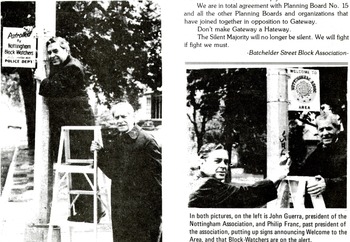
Block associations also distinguished themselves from official programs in their active construction of a hostile “anti-citizen,” who served as “a constant enticement and threat to the project of citizenship itself.”Footnote 118 Often the “anti-citizen” was rendered predictably and in ways informed by longstanding neighborhood fears of racial transition—a marauding external criminal threat for whom, without citizens’ mobilization in crime prevention initiatives, the community was easy prey.Footnote 119 Equally prominent, however, in block associations’ imaginary was another “anti-citizen”: the dissenting neighbor who refused to participate in crime prevention activities or make the correct consumer choices. Signs and decals advertising residents’ participation in civilian patrols or other block association schemes, hung from lampposts or affixed to windows and car bumpers, provided powerful visual reminders of the “in” and “out” groups of a self-governing community and who held citizenship within it. (Figure 2). The Nottingham Association and East Midwood Neighborhood Association (the president of which labeled residents unwilling to support the patrol as “a disgrace”) published “Honor Rolls” in their monthly newsletters of households that had signed up to or subsidized their motorized patrols while making plain the exclusion of those who opted not to participate.Footnote 120 These efforts performed an important self-disciplining function—a patrol beyond the patrol—while reinforcing the notion of active citizenship in the fight against crime through enlistment and consumption.
Photo of Nottingham Association members erecting signs advertising the area’s civilian patrol. Source: Nottingham Park News, March 1977. Reproduced with permission of the Center for Brooklyn History.

Legacy and Significance
Civilian participation in crime prevention initiatives in New York leveled out by the 1990s. Nationally, federal funding for community anticrime projects dried up with the disbanding of the LEAA in 1982. Locally, the stabilization and steady increase in police numbers and swing toward more visible forms of street patrol under Mayors Dinkins (Dem.) and Giuliani appeared to obviate the need for block security schemes and civilian patrols. While communities such as the Nottingham Association and East Midwood Neighborhood Association continued to operate volunteer anticrime patrols late into the 1990s, the overall number of New Yorkers active in such groups declined from its early 1980s peak, and Block Watchers saw citywide enrollment fall to around 15,000 by 1990.Footnote 121
Nonetheless, even if these more visible examples of civilian-led crime prevention withdrew from view, the ideal of consumer citizenship embedded within them remained intact. Despite a citywide fall in recorded crime in the 1990s and 2000s, enthusiasm for anticrime technologies and consumer goods continued to increase. Nationally, home security sales increased by 67 percent between 1988 and 1993 and by a further 80 percent between 1996 and 2005; in New York, security companies reported sales increases of 60 percent.Footnote 122 In part these trends may be explained by technological advances and the increased affordability of such products, and a renewed concern with security after 9/11. But they also reflected the enduring power and popularity of consumer citizenship to crime prevention in the neoliberal city. Significant impetus for this came from civic programs and lifestyle media. The CCNYC maintained SNAP’s “prudentialist” aesthetic through its Neighborhood Anti-Crime Program, which continued to provide community groups with cash grants to spend directly on anticrime equipment.Footnote 123 The New York Times retained “best buy” consumer features on security systems featuring insider advice from local firms, while New York magazine promoted “the latest crime prevention gizmos on the New York market” and its “Home Expo” section advertised home safes (“The Most Worthwhile Gift You Can Give Yourself”) alongside vintage furniture and luxury bathrooms.Footnote 124 Yet New Yorkers also continued to assert consumer affiliations and identities independently. Merchants, business and real estate groups utilized Business Improvement Districts (BIDs), which enabled them to collect their own tax revenues and spend the revenues on supplementary services of their choosing, to acquire expansive private security forces and surveillance systems. In prioritizing the largest percentage of their budgets—25 percent, according to a 1999 study—for security, BIDs further institutionalized the consumerist approach to crime prevention.Footnote 125 Its consolidation was also underlined by the continuing popularity of private guards, double the strength of the regular police force by 1985 and totaling three times as many in 2024.Footnote 126 Private security’s ascendancy was even rationalized, including by public agencies, in consumerist terms: “We’re losing market share,” acknowledged police commissioner Raymond Kelly in 1993.Footnote 127
The alignment of anticrime activities with consumption established a thriving market in crime prevention, but it also entrenched significant inequalities of access to that market. Despite their ostensibly universal presence in contemporary New York, cameras, alarm systems, and private security favored those groups with the greatest means to purchase but also, critically, to sustain them—as anticipated by the SNAP evaluation. Studies have revealed such systems are most effective at reducing crime when maintained over time and in greater density, equating safety with the stability and collective economic and social capital of a community.Footnote 128 The use of private security continued to largely displace crime onto areas without such protection rather than control or prevent it, exacerbating the uneven distribution of services and social problems. “It’s not crime prevention,” observed criminologist Andrew Karmen of private security, “[but] victimization prevention, deflecting the crime to someone else who’s less privileged, less guarded, less protected.”Footnote 129 In today’s New York, private security forces are concentrated in areas of high investment and even higher real estate value in Lower or Midtown Manhattan, where the city’s largest and wealthiest BIDs spend far more resources on security than do smaller outfits in more transitional areas.Footnote 130
Consumer-oriented crime prevention also entrenched inequalities of access to the city itself. By the 2000s some of the city’s safest—but most intensively-surveilled—districts were in Lower Manhattan, where cameras and private security were deployed to enhance perceptions of safety but also to regulate access to nominally public space.Footnote 131 Such curbs were most forcefully extended to New York’s more marginal populations, particularly the homeless or people of color.Footnote 132 A 2021 study revealed that areas with high concentrations of surveillance cameras also scored highly for instances of invasive policing and stop-and-frisk searches, predominantly of individuals of color.Footnote 133 In an era of purportedly limitless provision and choice, the groups more likely to encounter limits—lower-income, lower in social capital, often Black or brown—were also most likely to experience higher levels of victimization and criminalization, underlining the restrictive boundaries of community and citizenship in neoliberal New York.
These trends were aided by the expansion of civilian crime prevention during the 1970s and 1980s. Its alignment with consumer citizenship, and integration in New Yorkers’ lives via familiar consumer rituals and discourses, were distinctive features of the emerging neoliberal settlement in New York and its popular appeal. As state–citizen relations took on a “prudentialist” form, civilian crime prevention—driven initially by public policies and elite institutions but increasingly by resident agency—empowered ideas of individual responsibility, enterprise, and self-governance, in which consumer behaviors and choices were central to efforts to control crime, engage with state actors and services, and realize citizenship. It disciplined marginal individuals or communities who refused or were unable to adopt such behaviors or make the “right” choices, expanded popular participation in New York’s growing carceral state, and promoted new visions of community: competitive, self-sustaining, and individualized. And it developed a vision of active citizenship defined by consumption, in which individuals’ pursuit of safety, security, and even justice came via the acquisition of consumer goods or the assertion of consumer rights. This vision remains intact in today’s New York. A 2022 partnership agreement between the Police Department and Amazon enabled the police to participate in the Neighbors mobile app, monitoring and responding to app activity and posting insider information about crime and its prevention. New Yorkers concerned about neighborhood safety were advised to purchase Amazon’s Ring security cameras to maximize access to security “privileges.” Announcing the partnership, police commissioner Keechant Sewell reminded citizens, “True public safety is a shared responsibility”—a responsibility still measured, it seems, by one’s ability to consume.Footnote 134


 Open access

