

Introduction
The conversion between different energies (mechanical, electric, chemical or nuclear reaction, thermal, radiation, gravitation, hydro-mechanical) of each one into another follows the principle of the energy conservation in physics. One exception can be by restrictions that thermal energy cannot completely flow on its own to higher temperatures (second law of thermodynamics). The changing of chemical energy per reaction of about electron volt (eV) into mechanic energy by the heat from burning is used since the steam engine or the combustion motor. The processes at local thermal equilibrium (LTE) reduces the efficiency from few to not more than about the range of a dozen of percents at temperatures in the order of 0.1 eV. Without needing heat and combustion, the direct change of chemical energy into electric and then into mechanical energy of motion is possible by batteries or accumulators.
Can this be done with nuclear fusion energy? This was a fundamental question at the Third International Symposium on High Power Laser Science and Technology (HPLST) in a Mini-Worksop by the organizer (Zhou, Reference Zhou2018) in order to demonstrate that pulsed fusion with lasers in plasmas can offer the low-temperature initiation of fusion even at the important high plasma density of about the solid state! This has the advantage to avoid the thermal equilibrium temperature fusion much above 10 million degrees and the unfavorable conditions at extremely low densities at magnetic confinement fusion at more than ten orders of magnitudes lower densities for continuously working reactors like ITER (Bigot, Reference Bigot2017). These developments were fundamental for the special new initiative by the Chinese Academy of Science (Zhang, Reference Zhang2018) for a research program on laser fusion with picoseconds laser pulses at very extreme, ultrahigh power. This is possible now by using the latest developments of picosecond laser pulses for initiation of the ignition of fusion for providing plasma conditions of extreme non-LTE. In addition, it opens for the very first time the fusion of hydrogen with the boron isotope 11 (HB11 fusion) (Hora et al., Reference Hora, Korn, Giuffrida, Margarone, Picciotto, Krasa, Jungwirth, Ullschmied, Lalousis, Eliezer, Miley, Moustaizis and Mourou2015, Reference Hora, Eliezer, Kirchhoff, Nissim, Wang, Lalousis, Xu, Miley, Martinez-Val, McKenzie and Kirchhoff2017a). The difference by non-LTE conditions refers also to laser fusion with nanosecond laser pulses (Hurricane et al., Reference Hurricane, Callahan, Casey, Celliers, Cerjan, Dewald, Dittrich, Döppner, Hinkel, Berzak, Hopkins, Kline, Le Pape, Ma, MacPhee, Milovich, Pak, Park, Patel, Remington, Salomonson, Springer and Tommasini2014) where the differing LTE condition arrived at other kinds of respectable results yet below break-even.
The energy of nuclear reactions is in the range of 10 MeV in contrast to the eV of chemical reactions. For thermal equilibrium reactions at LTE processes, higher temperatures of >100 million degrees or >10 keV are needed. These are the temperatures needed for fusion power reactors at conditions of thermal equilibrium in contrast to thermal burning of chemicals. A splendid example is the stellarator reactor. After more than 20 years of experiments for continuous fusion of deuterium D in a stellarator, it was possible to produce the very first DD reactions in the Wendelstein experiment (Grieger and Wendelstein Team Reference Grieger1981), see also Section 2.6 of Hora (Reference Hora1991), where equilibrium temperatures of 800 eV (close to 10 million degrees) were reached and continued to arrive at to considerably higher values with the ITER option (Bigot, Reference Bigot2017).
The following summary about the results for the HB11 fusion with picosecond laser pulses was based on the measured ultrahigh acceleration of plasma blocks using lasers by Sauerbrey (Reference Sauerbrey1996). This is possible only based on the most exceptional related measurement by Zang et al. (Reference Zhang, He, Chen, Li, Zhang, Wang, Feng, Zhang, Tang and Zhang1998) that the picosecond laser pulses had to have a very difficult high contrast ratio such that relativistic self-focusing could be avoided. This was needed for the theory of plasma-block ignition (Hora Reference Hora1981, Reference Hora2016; Osman et al., Reference Osman, Cang, Hora, Cao, Liu, He, Badziak, Parys, Wolowski, Woryna, Jungwirth, Kralikova, Kraska, Laska, Pfeifer, Rohlena, Skala and Ullschmied2004; Hora et al., Reference Hora, Korn, Giuffrida, Margarone, Picciotto, Krasa, Jungwirth, Ullschmied, Lalousis, Eliezer, Miley, Moustaizis and Mourou2015, Reference Hora, Eliezer, Kirchhoff, Nissim, Wang, Lalousis, Xu, Miley, Martinez-Val, McKenzie and Kirchhoff2017a)
Extreme thermal non-equilibrium conditions for boron fusion
The following evaluation to reach the very high-energy gain from laser-driven fusion initiated by ultrahigh power picosecond laser pulses has to be explained, why a change of the HB11 fusion energy gains by nine orders of magnitudes above the classical values was needed. It is easy to understand that bridging such a big gap may be considered as good as impossible. But it has been just measured by laser technology.
The enormous bridging by nine orders of magnitudes is just possible by choosing the non-LTE option of a nearly non-thermal laser fusion based on the non-linear (ponderomotive) force by most extreme laser pulses of picosecond duration (Hora, Reference Hora1969, Reference Hora1981) as measured with HB11 fuel (Picciotto et al., Reference Picciotto, Margarone, Velyhan, Bellini, Krasa, Szydlowski, Bertuccio, Shi, Margarone, Prokupek, Malinowska, Krouski, Ullschmied, Laska, Kucharik and Korn2014; Margarone et al., Reference Margarone, Picciotto, Velyhan, Krasa, Kucharik, Mangione, Szydlowsky, Malinowska, Bertuccio, Shi, Crivellari, Ullschmied, Bellutti and Korn2015; Hora, Reference Hora, Korn, Giuffrida, Margarone, Picciotto, Krasa, Jungwirth, Ullschmied, Lalousis, Eliezer, Miley, Moustaizis and Mourou2015, Reference Hora, Eliezer, Kirchhoff, Nissim, Wang, Lalousis, Xu, Miley, Martinez-Val, McKenzie and Kirchhoff2017a).
This can be seen from the equation of motion for the force density f in a plasma with the thermokinetic pressure p given by the temperature T and the particle density n, and by Maxwell's stress tensor M of the electric and magnetic fields E and H of the laser with inclusion of the complex refractive index varying dynamically on time and space within the plasma (Hora et al., Reference Hora, Korn, Giuffrida, Margarone, Picciotto, Krasa, Jungwirth, Ullschmied, Lalousis, Eliezer, Miley, Moustaizis and Mourou2015, Reference Hora, Eliezer, Kirchhoff, Nissim, Wang, Lalousis, Xu, Miley, Martinez-Val, McKenzie and Kirchhoff2017a)
 $${\bf f} = - \nabla p + {\bf f}_{{\rm NL}} = - \nabla p{\rm} - \nabla \cdot M$$
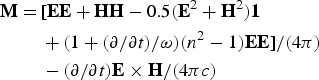 $$\eqalign{\; {\bf M} =\, &[{\bf EE} + {\bf HH} - 0.5\lpar {{\bf E}^2 + {\bf H}^2} \rpar {\bf 1} \cr & + (1 + (\partial /\partial t)/{\rm \omega} )\lpar {n^2 - 1} \rpar {\bf EE}]/(4{\rm \pi} ) \cr & - {\rm} (\partial /\partial t){\bf E} \times {\bf H}/(4{\rm \pi} c)} $$
with the unity tensor 1. For plane geometry interaction, the non-linear force fNL is for perpendicular irradiated plasma surface
 $$\eqalign{f_{{\rm NL}} & = - {\rm} (\partial /\partial x)\lpar {{\bf E}^2 + {\bf H}^2} \rpar /(8{\rm \pi} ) \cr & = - {\rm} ({\rm \omega} _{\rm p}/{\rm \omega} )^2(\partial /\partial x)\lpar {E_{\rm v}^2 /{\bf n}} \rpar /(16{\rm \pi})}$$
using the dielectric constant n and the vacuum electric field amplitude E v of the laser. At thermal equilibrium, the easiest fusion reactions of heavy hydrogen H with superheavy hydrogen D (DT fusion) need a temperature of about 100 million degrees and of HB11 fusion needs more than five times higher temperatures
 $$\hbox{D} + T = ^4\hbox{He} + n + 17.4\,\hbox{MeV}$$
 $$\hbox{H} + ^{11}\hbox{B} = 3^4\hbox{He} + 8.7\,\hbox{MeV}$$
where next to the harmless helium 4He, the generated neutrons n cause a problem of radioactivity in the reaction waste. This is primarily fully excluded in the HB11 reaction.
With the aim to minimize heat by using non-LTE or non-equilibrium plasmas, the equation of motion (1) needs such high laser intensities with fields that the non-linear force fNL produces much higher pressures than the thermal pressure p. The result of an example calculated in 1977 is shown in Figure 1 (Figs 10.18a&b of Hora Reference Hora1981 or drawn together in Fig. 8.4 of Hora Reference Hora2016).
The 1018 W/cm2 neodymium glass laser intensity in one-dimensional geometry is incident from the right-hand side on an initially 100 eV hot deuterium plasma slab of initially 0.1 mm thickness whose initial density has a very low reflecting bi-Rayleigh profile, resulting in a laser energy density and a velocity distribution from plasma hydrodynamic computations at time t = 1.5 ps of interaction. The driving non-linear force is the negative of the energy density gradient of the laser field (E2 + H2)/8π. The dynamic development of temperature and density had accelerated the plasma block of about 15 vacuum wave length thickness of the dielectric enlarged skin layer moving against the laser (positive velocity) and another block into the plasma (negative velocity) showing ultrahigh >1020 cm/s2 acceleration of the deuterium plasma block to velocities above 109cm/s within the 1.5 ps.
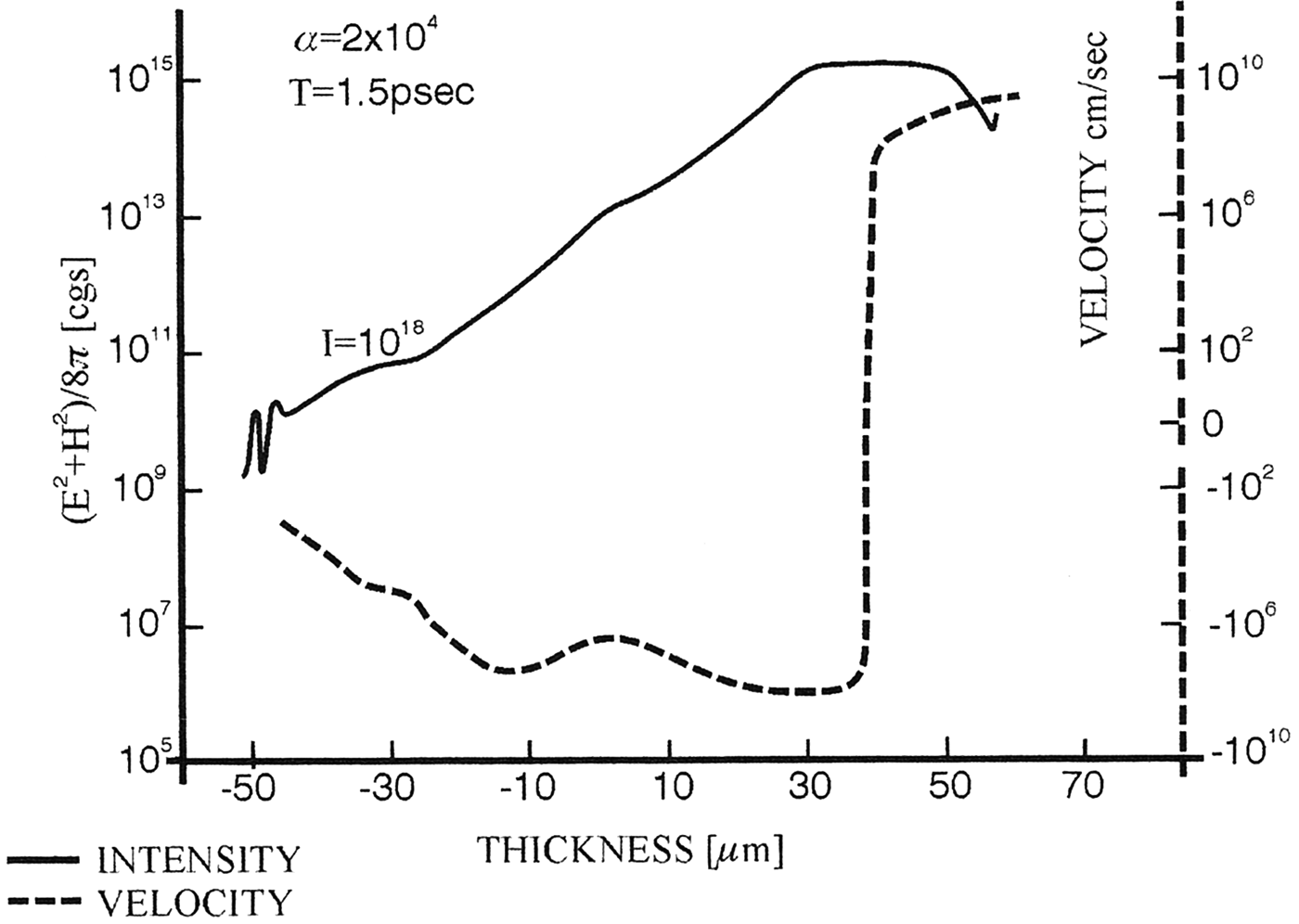
The motion of the plasma bocks after 1.5 ps interaction in Figure 1 can be seen in Figure 2. The ultrahigh acceleration of the plasma block when moving against the laser light were first measured by the blue Doppler shift of the spectral lines by Sauerbrey (Reference Sauerbrey1996) using the sub-picosecond laser pulses (Strickland and Mourou, Reference Strickland and Mourou1995) of the comparable intensities as in Figure 1 in agreement with the numerical calculation of 1977 (Hora, Reference Hora1981) with reconstructing a dielectric swelling of the laser intensity in the irradiated plasma of a usual value near 3 (Hora et al., Reference Hora, Badziak, Boody, Höpfl, Jungwirth, Kralikowa, Kraska, Laska, Parys, Perina, Pfeifer, Rohlena, Skala, Ullschmied, Wolowski and Woryna2017a, Reference Hora, Badziak, Read, Li, Liang, Liu, Shang, Zhang, Osman, Miley, Zhang, He, Peng, Glowacz, Jablonski, Wolowski, Skladanowski, Jungwirth, Rohlena and Ullschmied2007). This measurement was repeated (Földes et al., Reference Földes, Bakos, Gal, Juhasz, Kedves, Koscis, Syatmari and Verex2000) after similar accelerations were measured (Badziak et al., Reference Badziak, Kozlov, Makowski, Paris, Ryz, Wolowski, Woryna and Vankov1999) which were in drastic difference to the measurements with a red Doppler shift. The blue shift was proved to be possible only by using most extreme contrast ratios (Zhang et al., Reference Zhang, He, Chen, Li, Zhang, Wang, Feng, Zhang, Tang and Zhang1998; Danson et al., Reference Danson, Egan, Elsmere, Girling, Arvey, Hillier, Hoarty, Masoero, Hussei, McLoughlin, Parker, Penman, Sawyer, Treadwell, Winter and Hoppe2018) of the laser pulse in order to avoid relativistic self-focusing. This was measured in a most sophisticated way by Zhang et al. (Reference Zhang, He, Chen, Li, Zhang, Wang, Feng, Zhang, Tang and Zhang1998), see Chapter 8.3 of Hora (Reference Hora2016). The red shift happens always at plasma densities lower than critical when instead of the dielectric plasma-block explosion, only ordinary radiation pressure acceleration happens. The red shift was the result of numerous PIC computations where dielectric effects were not included. The first difficult inclusion of densities close to critical densities were successfully demonstrating the dielectric explosion of plasma blocks (Hora et al., Reference Hora, Eliezer, Wang, Korn, Nissim, Xu, Lalousis, Kirchhoff and Miley2018) (see Fig. 2).
Schematic representation of skin depth laser interaction where the non-linear force accelerates a plasma block against the laser light and another block toward the target interior. In front of the blocks are electron clouds of the thickness of the effective Debye lengths.

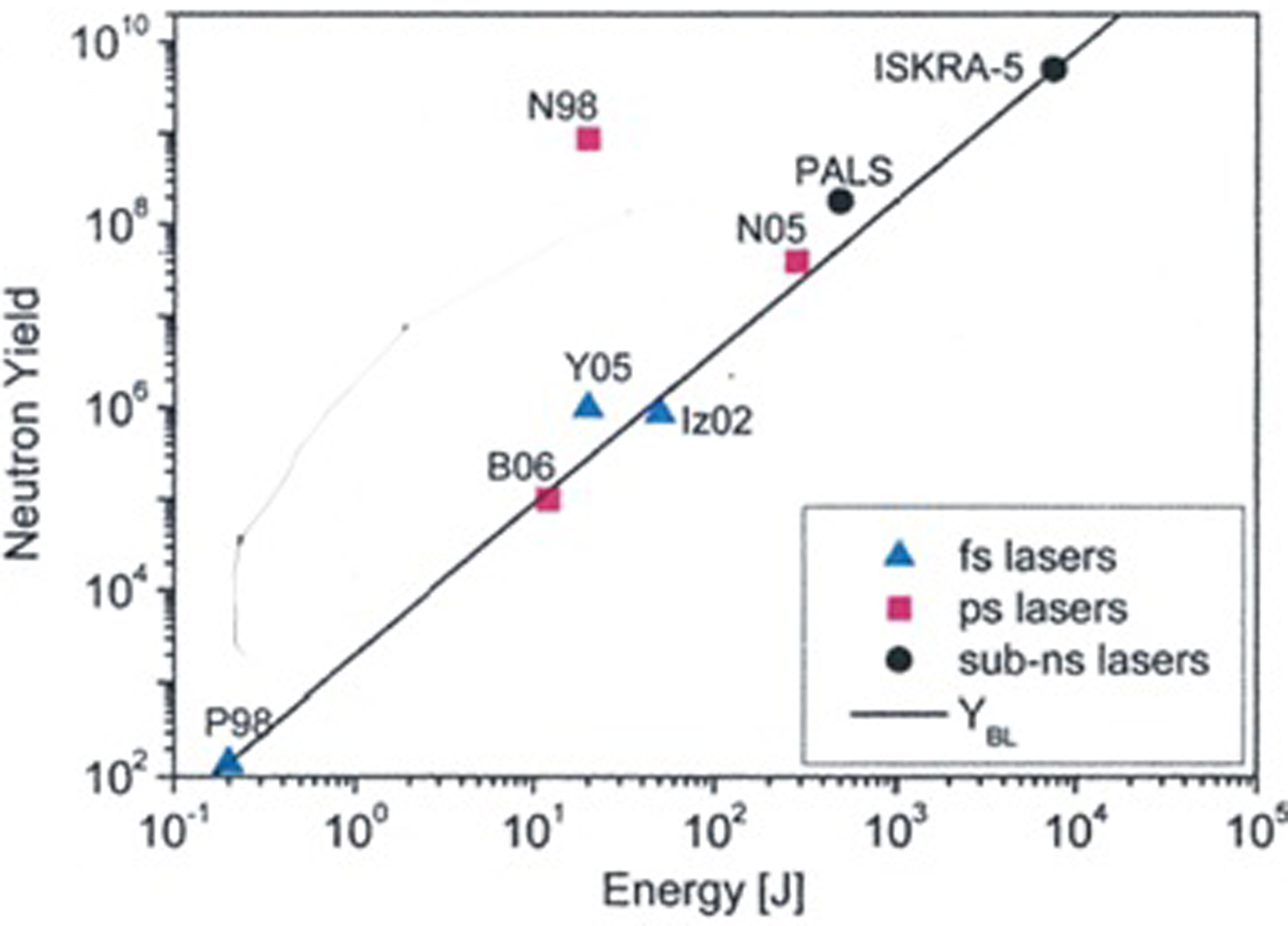
Measured fusion neutrons emitted from solid targets containing deuterium irradiated by femto to 300 ns laser pulses depending on the energy of the pulses [compiled by Krasa et al. (Reference Krasa, Klir, Velyhan, Margarone, Krousky, Jungwirth, Skala, Pfeiffer, Kravarik, Kubes, Rezac and Ullschmied2013)].
The discovery of Sauerbrey (Reference Sauerbrey1996) of the blue shift on the basis of the measurements by Zhang et al. (Reference Zhang, He, Chen, Li, Zhang, Wang, Feng, Zhang, Tang and Zhang1998), Badziak et al. (Reference Badziak, Kozlov, Makowski, Paris, Ryz, Wolowski, Woryna and Vankov1999) and Földes et al. (Reference Földes, Bakos, Gal, Juhasz, Kedves, Koscis, Syatmari and Verex2000) led to the exploring of the picosecond initiation of solid density fusion fuel (Hora et al., Reference Hora, Badziak, Boody, Höpfl, Jungwirth, Kralikowa, Kraska, Laska, Parys, Perina, Pfeifer, Rohlena, Skala, Ullschmied, Wolowski and Woryna2002a, Reference Hora, Peng, Zhang and Osman2002b; Picciotto et al., Reference Picciotto, Margarone, Velyhan, Bellini, Krasa, Szydlowski, Bertuccio, Shi, Margarone, Prokupek, Malinowska, Krouski, Ullschmied, Laska, Kucharik and Korn2014; Margarone et al., Reference Margarone, Picciotto, Velyhan, Krasa, Kucharik, Mangione, Szydlowsky, Malinowska, Bertuccio, Shi, Crivellari, Ullschmied, Bellutti and Korn2015) by updating (Hora, Reference Hora2009) of the computations by Chu (Reference Chu1972) and Bobin (Reference Bobin, Schwarz and Hora1974). This was leading to the five orders of magnitudes increased fusion gains of HB11 above the classical values (Hora et al., Reference Hora, Miley, Ghorannviss, Malekynia, Azizi and He2010) and the further four orders increase by the avalanche of the α reaction [Eq. (5)] (Eliezer et al., Reference Eliezer, Hora, Korn, Nissim and Martinez-Val2016) for arriving at the results (Hora et al., Reference Hora, Korn, Giuffrida, Margarone, Picciotto, Krasa, Jungwirth, Ullschmied, Lalousis, Eliezer, Miley, Moustaizis and Mourou2015, Reference Hora, Eliezer, Kirchhoff, Nissim, Wang, Lalousis, Xu, Miley, Martinez-Val, McKenzie and Kirchhoff2017a). Only this rather unusual research path led to the design of the basically new type of a clean and low-cost LASER BORON FUSION reactor.
First measurement of low-temperature fusion reactions by laser pulses
Up to 1998, laser fusion was studied mostly by heating of the fuel under conditions of thermal equilibrium. Many measurements were known how the laser interaction with nuclear fusion fuel – mostly with heavy hydrogen (deuterium D) or mixed with superheavy hydrogen (tritium T) – produced nuclear fusion (DT reactions) detected by the measured number of the generated neutrons. The experiments up to the year 1998 were mostly in the way that laser pulses of about nanosecond duration heated and compressed the fuel under thermal equilibrium. These reactions arrived now at the NIF-experiment in Livermore/California nearly at break-even but where the generated energy is still lower than the input laser energy but reached respectable values. These experiments are based on the conditions of LTE (Hurricane et al., Reference Hurricane, Callahan, Casey, Celliers, Cerjan, Dewald, Dittrich, Döppner, Hinkel, Berzak, Hopkins, Kline, Le Pape, Ma, MacPhee, Milovich, Pak, Park, Patel, Remington, Salomonson, Springer and Tommasini2014).
Apart from these studies with plasmas at LTE conditions, a most exceptional experiment was in 1998 by Norreys et al. (Reference Norreys, Fews, Beg, Bell, Dangor, Lee, Neslon, Schmidt, Tatarakis and Cable1998) irradiating deuterated targets, and to apply similar shorter than picosecond laser pulses as by Sauerbrey (Reference Sauerbrey1996). Compared with very many usually laser-driven experiments, suddenly, the number of fusion neutrons (Krasa et al., Reference Krasa, Klir, Velyhan, Margarone, Krousky, Jungwirth, Skala, Pfeiffer, Kravarik, Kubes, Rezac and Ullschmied2013), there was a neutron gain nearly four orders of magnitudes higher than under the known heating conditions (Fig. 3, see N98). It was clearly confirmed that the interaction area had a very low temperature exactly showing the conditions of non-LTE. In retrospect with what we know today, this was a typical non-linear force-driven plasma-block fusion (Hora, Reference Hora1969; Hora et al., Reference Hora, Korn, Giuffrida, Margarone, Picciotto, Krasa, Jungwirth, Ullschmied, Lalousis, Eliezer, Miley, Moustaizis and Mourou2015, Reference Hora, Eliezer, Kirchhoff, Nissim, Wang, Lalousis, Xu, Miley, Martinez-Val, McKenzie and Kirchhoff2017a). At different conditions when irradiating sandwich targets for thermally dominated reactions (NO5 of Fig. 3), the measured fusion neutrons were going down to the values in full agreement with all the large number of measured usual fusion gains at thermal equilibrium.
The understanding of the four orders of magnitudes increased fusion gains without much heating is given by the force density in the plasma in the presence of the very high laser intensity. The thermokinetic pressure p can be only a small perturbation against the pressure due to non-linear force by the laser electric and magnetic fields E and H with a much higher energy density (E2 + H2)/(8π) as in the case of Figure 1, where a first interpretation of a non-LTE, non-linear, force-dominated, low-temperature fusion was elaborated before (Hora et al., Reference Hora, Badziak, Boody, Höpfl, Jungwirth, Kralikowa, Kraska, Laska, Parys, Perina, Pfeifer, Rohlena, Skala, Ullschmied, Wolowski and Woryna2002a). This is now endorsed in convincing details by the results of laser boron fusion (Hora et al., Reference Hora, Korn, Giuffrida, Margarone, Picciotto, Krasa, Jungwirth, Ullschmied, Lalousis, Eliezer, Miley, Moustaizis and Mourou2015, Reference Hora, Eliezer, Kirchhoff, Nissim, Wang, Lalousis, Xu, Miley, Martinez-Val, McKenzie and Kirchhoff2017a, Reference Hora, Eliezer, Nissim and Lalousis2017b, Reference Hora, Eliezer, Wang, Korn, Nissim, Xu, Lalousis, Kirchhoff and Miley2018; Hora and Miley, Reference Hora and Miley2018; Eliezer et al., Reference Eliezer, Hora, Korn, Nissim and Martinez-Val2016).
Computations based on cases as in Figure 1 but with picsecond high-intensity block ignition were studied since 2000 for explanations of the results of Sauerbrey (Reference Sauerbrey1996) by related experiments and computations to analyse this ignition mechanism (Hora et al., Reference Hora, Badziak, Boody, Höpfl, Jungwirth, Kralikowa, Kraska, Laska, Parys, Perina, Pfeifer, Rohlena, Skala, Ullschmied, Wolowski and Woryna2002a, Reference Hora, Peng, Zhang and Osman2002b, Reference Hora, Badziak, Boody, Höpfl, Jungwirth, Kralikova, Kraska, Laska, Pfeifer, Rohlena, Skala, Ullschmied, Wolowski and Woryna2002c; Laska et al., Reference Laska, Jungwirth, Kralikova, Kraska, Pfeifer, Rohlena, Skala, Ullschmied, Basziak, Parys, Wolowski, Woryna, Gammino, Torrisi, Boody and Hora2003; Badziak et al., Reference Badziak, Hora, Woryna, Jablonski, Laska, Parys, Rohlena and Wolowski2003; Wolowski et al., Reference Wolowski, Badziak, Boody, Hora, Hnatowicz, Jungwirth, Kraska, Laska, Parys, Perina, Pfeifer, Rohlena, Ryc, Ullschmied and Woryna2003; Osman et al., Reference Osman, Cang, Hora, Cao, Liu, He, Badziak, Parys, Wolowski, Woryna, Jungwirth, Kralikova, Kraska, Laska, Pfeifer, Rohlena, Skala and Ullschmied2004; Hora, Reference Hora2004) the results of which were derived by further international support including the IAEA (UN-International Atomic Energy Agency in Vienna) (Cang et al., Reference Cang, Osman, Hora, Zhang, Badziak, Wolowski, Jungwirth, Rohlena and Ullschmied2005; Hora et al., Reference Hora, Badziak, Read, Li, Liang, Liu, Shang, Zhang, Osman, Miley, Zhang, He, Peng, Glowacz, Jablonski, Wolowski, Skladanowski, Jungwirth, Rohlena and Ullschmied2007, Reference Hora, Malekynia, Ghoranneviss, Miley and He2008). The high-energy density non-thermal equilibrium (low-temperature) fusion ignition by plasma blocks from picosecond ultrahigh acceleration were studied also based on the measurements by Sauerbrey (Reference Sauerbrey1996) but also at other centers in Poland, Hungary, Shanghai, and few other “fast ignition” projects. When from 2008 (Hora et al., Reference Hora, Malekynia, Ghoranneviss, Miley and He2008) instead of the most studied DT fusion, the usually five orders of magnitudes lower gaining HB11 (usually at classical thermal equilibrium) were used with non-thermal equilibrium for block ignition, it was most surprising that then gains like those of DT were the result (Hora et al., Reference Hora, Miley, Ghorannviss, Malekynia, Azizi and He2010). This increase by five orders of magnitudes for HB11 was – similar to the measurements of Norreys et al. (Reference Norreys, Fews, Beg, Bell, Dangor, Lee, Neslon, Schmidt, Tatarakis and Cable1998) – due to the non-equilibrium conditions of the block ignition. This was then in advance resulting in the conclusions of Hora et al. (Reference Hora, Korn, Giuffrida, Margarone, Picciotto, Krasa, Jungwirth, Ullschmied, Lalousis, Eliezer, Miley, Moustaizis and Mourou2015, Reference Hora, Eliezer, Kirchhoff, Nissim, Wang, Lalousis, Xu, Miley, Martinez-Val, McKenzie and Kirchhoff2017a) that could be concluded from the pioneering measurements of laser-produced HB11 fusion (Belyaev et al., Reference Belyaev, Matafonov, Vinogradov, Krainov, Lisista, Roussetski, Ignatyev and Adrianov2005; Labaune et al., Reference Labaune, Deprierraux, Goyon, Loisel, Yahia and Rafelski2013). The needed non-thermal and non-linear force-dominating conditions for HB11 fusion had been postulated earlier (Hora, Reference Hora1988) at a conference in Princeton in 1987 for justifying alternative research on aneutronic fusion in contrast to LTE conditions.
Design of laser boron fusion reactor
Though details of the clean and low-cost laser boron fusion reactor have been discussed before (Hora et al., Reference Hora, Eliezer, Kirchhoff, Nissim, Wang, Lalousis, Xu, Miley, Martinez-Val, McKenzie and Kirchhoff2017a, Reference Hora, Eliezer, Nissim and Lalousis2017b, Reference Hora, Korn Eliezer, Nissim, Lalousis, Giuffrida, Margarone, Picciotto, Miley, Moustaizis, Martinez-Val, Barty and Kirchhoff2017c), the following points should be underlined. The reaction unit in the center of the reaction sphere (Fig. 4) with the cylindrical solid density fuel of hydrogen and boron 11B is ignited by the direct-drive pulses of the picosecond laser 2 of more than 10 PW power. There is a flexibility about the details of the pulse profile that on the one hand is a problem how to generate this (Danson et al., Reference Danson, Egan, Elsmere, Girling, Arvey, Hillier, Hoarty, Masoero, Hussei, McLoughlin, Parker, Penman, Sawyer, Treadwell, Winter and Hoppe2018), but on the other hand, it permits modifications for producing optimized conditions. The same optimization is possible by the time dependence of the kilotesla magnetic field in the capacitor coil depending on the quality of the nanosecond laser pulse 1 of at least kJ energy. The laser technology permits a wide range of variations.
Clean generator for electric power by laser boron fusion with nanosecond laser 1 to produce the kilotesla magnetic field in the capacitor–coil (Fujioka et al. Reference Fujioka, Zhang, Ishihara, Shigemori, HironakaI, Johazaki, Sunahara, Yamamoto, Nakashima, Watanabe, Shiraga, Nishimura and Azechi2013) reaction unit in the center of the spherical generator (Hora et al., Reference Hora, Korn, Giuffrida, Margarone, Picciotto, Krasa, Jungwirth, Ullschmied, Lalousis, Eliezer, Miley, Moustaizis and Mourou2015, Reference Hora, Eliezer, Kirchhoff, Nissim, Wang, Lalousis, Xu, Miley, Martinez-Val, McKenzie and Kirchhoff2017a) and the >10 PW-ps laser pulse 2 to initiate end-on the non-thermal non-linear force-driven reaction in the HB11 fuel cylinder.

Another flexibility in modifications is the preparation of the fuel density within the first 10 µm at the target for the direct-drive interaction area of laser 2 at the end area of the fuel. This influences the initiation of the picosecond ignition process for the propagating reaction plane through the fuel as it was the result of a very large number of cases for calculation with the genuine multi-fluid computations (Lalousis and Hora, Reference Lalousis and Hora1983; Hora et al., Reference Hora, Lalousis and Eliezer1984, Reference Hora, Korn, Giuffrida, Margarone, Picciotto, Krasa, Jungwirth, Ullschmied, Lalousis, Eliezer, Miley, Moustaizis and Mourou2015). These details are also of importance when the non-linear force acceleration process in target layers is used for the generation of space charge neutral ion beams, with more than million times higher ion densities than the best classical accelerator can produce (Hora et al., Reference Hora, Badziak, Boody, Höpfl, Jungwirth, Kralikowa, Kraska, Laska, Parys, Perina, Pfeifer, Rohlena, Skala, Ullschmied, Wolowski and Woryna2017a, Reference Hora, Badziak, Read, Li, Liang, Liu, Shang, Zhang, Osman, Miley, Zhang, He, Peng, Glowacz, Jablonski, Wolowski, Skladanowski, Jungwirth, Rohlena and Ullschmied2007) for ion energies of few hundred MeV energy cancer treatment or for space craft propulsion (Hora et al., Reference Hora, Miley, Yang and Lalousis2011; Hora and Miley Reference Hora and Miley2018; Lalousis et al., Reference Lalousis, Hora, Eliezer, Martinez-Val, Moustaizis, Miley and Mourou2013; Hoffmann et al., Reference Hoffmann, Zhao and Katrick2018). Even nearly monoenergetic proton beams above GeV (Xu et al., Reference Xu, Wang, Qi, Li, Xing and Long2016; Reference Xu, Wang, Hora, Yifan, Yang and Zhu2018) are related to the results of Hora et al. (Reference Hora, Eliezer, Wang, Korn, Nissim, Xu, Lalousis, Kirchhoff and Miley2018).
It is shown in the 2nd and 3rd Sections that the ultrahigh plasma-block acceleration is the essential mechanism for the non-LTE process of the low-temperature ignition (Hora et al., Reference Hora, Korn, Giuffrida, Margarone, Picciotto, Krasa, Jungwirth, Ullschmied, Lalousis, Eliezer, Miley, Moustaizis and Mourou2015, Reference Hora, Eliezer, Kirchhoff, Nissim, Wang, Lalousis, Xu, Miley, Martinez-Val, McKenzie and Kirchhoff2017a, Reference Hora, Eliezer, Nissim and Lalousis2017b, Reference Hora, Korn Eliezer, Nissim, Lalousis, Giuffrida, Margarone, Picciotto, Miley, Moustaizis, Martinez-Val, Barty and Kirchhoff2017c, Reference Hora, Eliezer, Wang, Korn, Nissim, Xu, Lalousis, Kirchhoff and Miley2018) of the laser boron fusion for the new reactor design. This was possible only by the extreme contrast ratio (Danson et al., Reference Danson, Egan, Elsmere, Girling, Arvey, Hillier, Hoarty, Masoero, Hussei, McLoughlin, Parker, Penman, Sawyer, Treadwell, Winter and Hoppe2018) of the laser pulses as it was realized in retrospect only (Hora, Reference Hora2016) by the blue Doppler shift of spectral lines (Sauerbrey, Reference Sauerbrey1996; Zhang et al., Reference Zhang, He, Chen, Li, Zhang, Wang, Feng, Zhang, Tang and Zhang1998; Földes et al., Reference Földes, Bakos, Gal, Juhasz, Kedves, Koscis, Syatmari and Verex2000). The PIC computation with inclusion of dielectric response was difficult and succeeded only recently (Xu et al., Reference Xu, Wang, Qi, Li, Xing and Long2016, Reference Xu, Wang, Hora, Yifan, Yang and Zhu2018; Hora et al., Reference Hora, Eliezer, Wang, Korn, Nissim, Xu, Lalousis, Kirchhoff and Miley2018) to confirm the earlier hydrodynamic derivation of basic requirements for the operation of the reactor design of Figure 5.
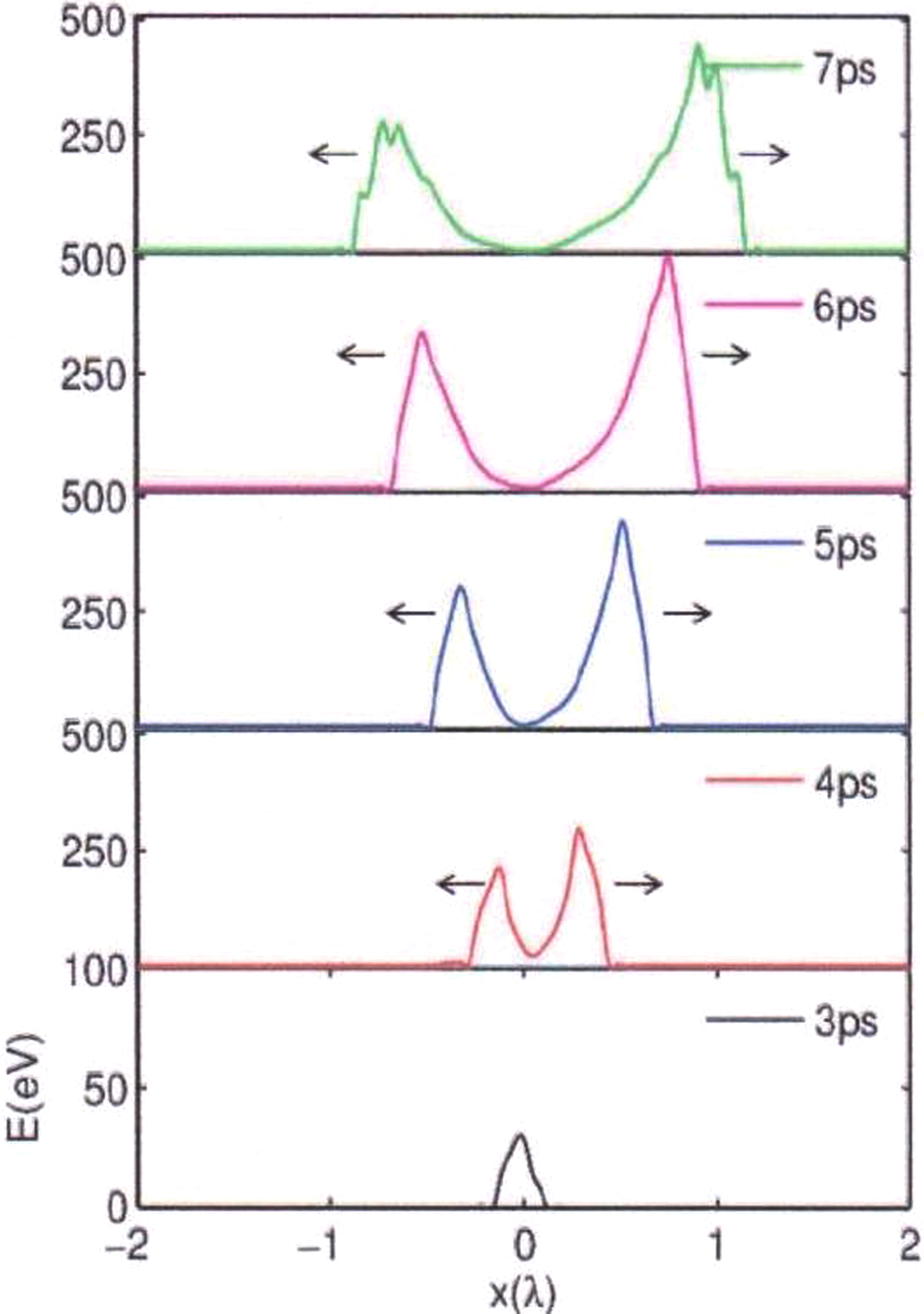
PIC computation of the dielectric explosion of the plasma blocks at plasma densities close to the critical density (Hora et al., Reference Hora, Eliezer, Wang, Korn, Nissim, Xu, Lalousis, Kirchhoff and Miley2018) confirming of the result of hydrodynamic computations (Fig. 1) as necessary process for the very rare measurement of the blue Doppler shift in the reflected light (Sauerbrey, Reference Sauerbrey1996; Zhang et al., Reference Zhang, He, Chen, Li, Zhang, Wang, Feng, Zhang, Tang and Zhang1998; Hora, Reference Hora1969, Reference Hora1981).
A further problem had to be solved with respect to the secondary neutron production of HB11 fusion. The primary HB11 reaction [Eq. (5)] is indeed free from neutron generation, but it is well known that secondary reactions produce about a neutron per thousand generated α particles of helium. The elimination of these neutrons is possible by screening the reactor sphere of Figure 4 by an equipment of about 10 cm thickness to the level that the reactor works clearly below the level of any radioactive pollution problem (Eliezer et al., Reference Eliezer, Hora and Nissim2017). This neutron capturing, for example, for a reactor for 100 PW generation of electricity does not need a replacement of the screening material for a few years. The advantage compared with the radioactive waste problem of fission reactors is that the neutrons decay with a half-life of 14.69 min into harmless electrons and protons.
Patenting procedures (Hora, Reference Hora2014) are based on HB11 reactions with some similarity to (Margarone et al., Reference Margarone, Korn, Picciotto and Bellutti2013) based on non-linear force ultrahigh acceleration processes. The essential difference consists in the fact that the patent (Hora, Reference Hora2014) is a combination with the otherwise earlier known kilotesla magnetic field generated by capacitor coils (Fujioka et al., Reference Fujioka, Zhang, Ishihara, Shigemori, HironakaI, Johazaki, Sunahara, Yamamoto, Nakashima, Watanabe, Shiraga, Nishimura and Azechi2013) for the cylindrical trapping of the reaction that is necessary for the reactor of Figure 4 to provide non-LTE low-temperature laser fusion.
Acknowledgements
This text is from a plenary lecture at the Third Symposium on High Power Laser Research and Engineering, 9–13 April 2018 in Suzhou/China. These results are based on the contribution by co-authors in the related references with acknowledging great thanks.



