




Stela 44 (Figure 1 [photo]; Figures 2 and 3 [illustration]) was uncovered at the site of El Perú-Waka’ (henceforth, Waka’ in reference to the city, and Wak when indicating the royal lineage) by the Proyecto Arqueológico Waka’ (PAW) in tunneling excavations in 2013 (Pérez Robles and Navarro-Farr Reference Pérez Robles, Navarro-Farr, Calderon and Freidel2013). It was encased in the penultimate construction phase of the building known as M13-1 (see Figures 4 and 5), where it had been sealed for 1,300 years in its cool, dark resting place. The monument was preliminarily analyzed by Stanley Guenter (Castañeda Reference Castañeda, Calderón and Freidel2013:197–202). The front depicts the imposing, front-facing image of a previously unknown king of Waka’, Chak Tok Ich'aak, in a posthumous portrait dedicated on the half-period ending 9.6.10.0.0 (January 30, a.d. 564). Erected by his son, Wa'oom Uch'ab Ahk, the text of this monument reveals early links between the elite of Waka’ and the political machinations put into play by the kaan (“snake”) kings—moves that shaped the Maya geopolitical landscape for the next three centuries.
Stela 44. Photo by Juan Carlos Pérez Calderón.

Illustration of front of Stela 44. Drawing by Mary Kate Kelly.
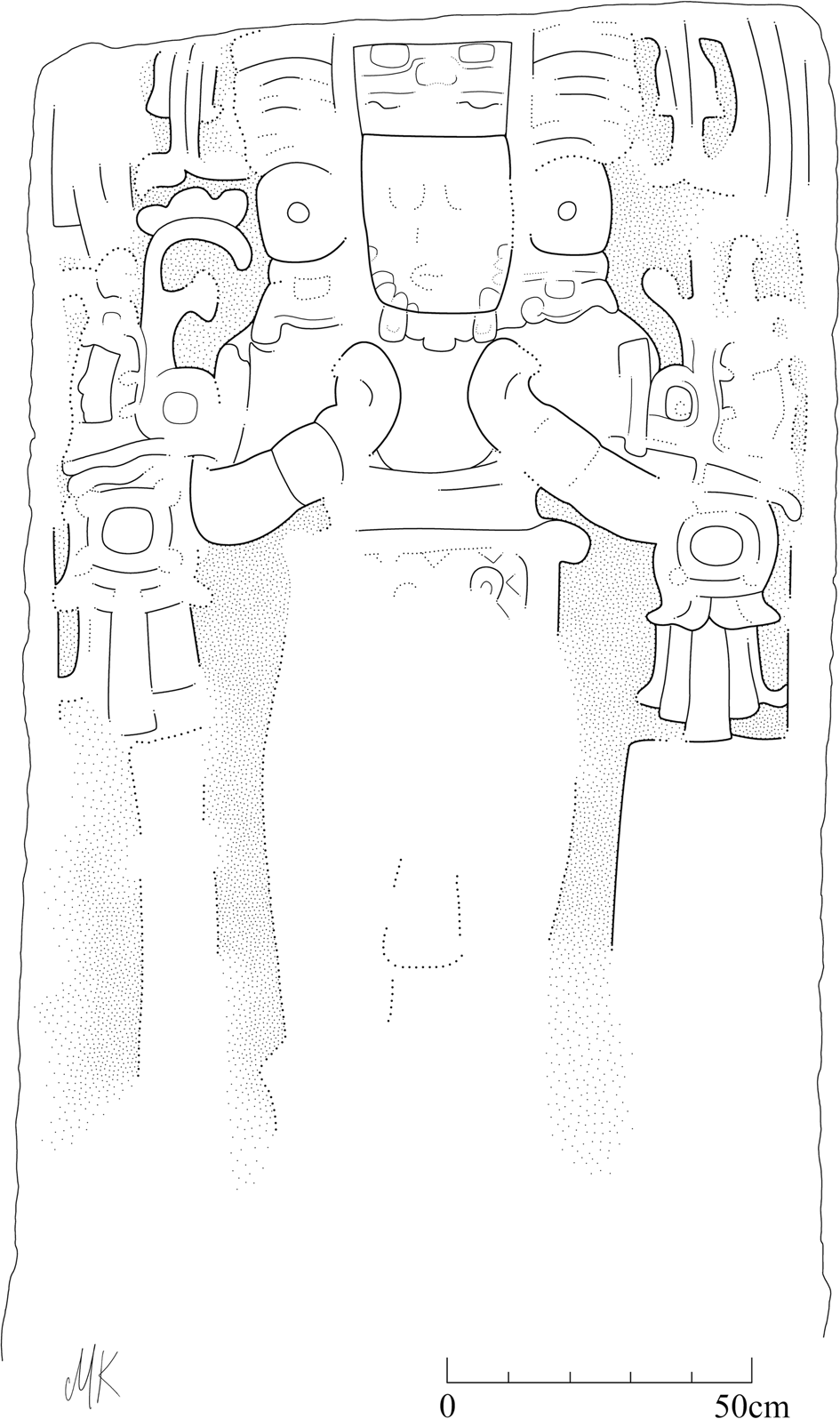
Illustration of sides of Stela 44. Drawing by Mary Kate Kelly.

Map of Waka’ Structure M13-1 with locations of key monuments. Map by Damien Marken, Olivia Navarro-Farr, Juan Carlos Pérez Calderón, Griselda Pérez Robles, Ana Lucía Arroyave Prera, and Mary Kate Kelly.

Profile of Structure M13-1 with location of Stela 44. Illustration by René Ozaeta, Juan Carlos Pérez Calderón, Griselda Pérez Robles, and Olivia Navarro-Farr; traced by Cyrus Hulen.

Prior to the discovery of Stela 44, it was already apparent that the kings of Waka’ boasted a close connection to the hegemonic state of the Kaan kings and celebrated these affiliations on many of the monuments erected at the site. Famously, Lady K'abel, whose magnificently carved portrait is on display at the Cleveland Museum of Art, is believed to have come from the Kaan royal blood line and to have married into the local ruling family of Waka’ (Guenter Reference Guenter, Navarro-Farr and Rich2014b:156; Miller Reference Miller and Robertson1974:8; Wanyerka Reference Wanyerka1996). The text of Stela 44 reveals that the historical connection between the Kaan kings and their vassals at Waka’ began more than a century earlier than previously known. This contribution to the historical narrative places the site of Waka’ squarely within the central strategic moves of early Kaan hegemonic practices, from the perspective of a nearly contemporaneous monument.
From Stela 44, we learn of two previously unknown kings of Waka’: Chak Tok Ich'aak and his son, Wa'oom Uch'ab Ahk, and we can fit them within the historical sequence of the site's kings. Through these rulers, the text from this monument draws strong connections to the Kaan regime. Wa'oom Uch'ab Ahk declares himself to be the vassal of K'ahk’ Ti’ Ch'ich’, who acceded as Kaan king in 550 (Martin and Beliaev Reference Martin and Beliaev2017). The monument also mentions Wa'oom Uch'ab Ahk's mother, Ix Ikoom, who is also known from Stela 43 (see Navarro-Farr et al. Reference Navarro-Farr, Robles, Bolaños and Calderón2013) (Figure 6), and who on both Stelae 43 and 44 is given the Kaan-affiliated title of sak wahyis. Her presence at Waka’ indicates a participation in the intermarriage strategies employed by Kaan dynasts (Martin Reference Martin2008, Reference Martin2020; Martin and Grube Reference Martin and Grube2008). Historical links between this monument and the newly discovered Altar 5 at La Corona (Stuart et al. Reference Stuart, Canuto, Barrientos and González2018) further entangle the connections between these two vassal sites of the Kaan kings. In addition to historical information, this monument may help to decipher a previously undeciphered sign, given the identifier MRD by Macri and Vail (Reference Macri and Vail2009), as the syllabogram la or logogram LAH (David Stuart, personal communication 2019).
Illustration of Stela 43. Drawing by Mary Kate Kelly.

Context
The archaeological context of Stela 44, encased as it was under M13-1 Sub I, revealed that this massive monument had been moved in antiquity to this locale from some other location (see Figures 4 and 5). We therefore argue that any interpretation of this monument and the historical information it records must be understood as intrinsically linked to the place where it is found archaeologically. Its resetting in this locale constitutes deliberate efforts to shape histories and social memories associated with this monument and the building within which it is situated. Here, we discuss the excavations leading to the discovery of Stela 44, its context indicating the stela is not in its original location, and the implications of its resetting.
We first briefly review the work conducted in that area in the year prior to Stela 44's discovery. In 2012, we probed the buried features of M13-1 from the summit of the fronting platform's final phase—which corresponded to a monumental fire shrine (adosada). Excavations continued through a buried phase, designated Structure M13-1 Adosada Sub I, before discovering a second buried phase, Sub II. Excavations of M13-1 Sub II revealed Burial 61, the royal tomb of the seventh-century ruler Lady K'abel (Navarro-Farr et al. Reference Navarro-Farr, Pérez Robles, Pérez Calderón, Menéndez Bolaños, Patterson, Eppich and Kelly2021). Tunnel excavations from cardinal north to south followed the basal stair tread of Sub II before locating its centerline and façade. The terminal-phase construction fill was structurally unsound, and further excavation endangered structural integrity. To ensure everyone's safety, we decided to excavate from the building's summit. These summit excavations were then sealed at the close of the 2012 season, and in 2013, an alternative means of accessing the Burial 61 funerary chamber was necessary. The goal in 2013 was therefore to connect a short east–west tunnel—reattempting a centerline tunnel from the plaza—with the north–south tunnel excavated in 2012. In the course of that work, Stela 44 was discovered.
The monument was discovered reset into the plaza floor of M13-1 Sub II. The next construction phase, Sub I, covered this monument and realigned the building's center to the north. Significantly, where Stela 44 stands is on the building's new—and final—centerline. It is positioned in a slightly reclined fashion, under the stairway, which leads up to the platform of Sub I (Figure 5; see also Pérez Robles and Navarro-Farr Reference Pérez Robles, Navarro-Farr, Calderon and Freidel2013). It is now clear that after the Burial 61 tomb was interred intrusively into the building's Sub II phase, the upper portion of that building's façade was clipped and capped with a thick plaster floor, essentially closing out the use of that building. Either at that time or sometime following, Stela 44 was reset in the position archaeologists discovered it.
It appears that the whole of Sub I was built to surround and incorporate this monument, and this effort also included a mindful reestablishing of the building's main centerline to farther north than it had previously been. The effort to incorporate the monument into the building was quite deliberate and carefully planned. For example, we noted that the final treads of the risers leading to the Sub I platform and access point were built right over the face of the ruler depicted on the monument. Importantly, this covering over of the face with stair risers did not appear to damage the face; rather, the incorporation deliberately combines architecture with the monument in a way that underscores the nature of memory associated with the figure and accompanying texts no longer visible but rendered invisibly incorporated into a renewed public building (Mills and Walker Reference Mills and Walker2008).
Recording of Stela 44
At its discovery, a series of photographs was taken of the front and sides of Stela 44, and they were used for preliminary discussions of the text and imagery among project members. Some of these photos were published as images in excavation report chapters (Freidel et al. Reference Freidel, Pérez, Pérez, Pérez and Pérez2016; Navarro-Farr et al. Reference Navarro-Farr, Freidel, Pérez, Hernández and Pérez2017; Pérez Robles and Navarro-Farr Reference Pérez Robles, Navarro-Farr, Calderon and Freidel2013), others in press announcements (Boyle Reference Boyle2013; Howard Reference Howard2013), and the discovery of Stela 44 has recently been discussed elsewhere (Navarro-Farr, Pérez Robles et al. Reference Navarro-Farr, Pérez Robles, Menéndez, Pérez Calderón, Stanton and Kathryn Brown2020). The first author's task upon joining the PAW team was to produce an illustration of this monument.
Due to the tight quarters of the tunnel in which Stela 44 was excavated, simple raking light photographs that encompassed an entire side of the monument were not possible. Raking light photos were taken of sets of glyph blocks and sections of the front of the monument. A preliminary illustration based on these raking light photographs was published in the 2018 season report chapter (Kelly Reference Kelly, Pérez, Pérez and Marken2019: Figure 7.3; to be superseded by the present illustration, Figures 2 and 3). Because these photographs needed to be stitched together digitally before producing the illustration, a certain amount of error was introduced, resulting in an illustration that did not reflect the monument accurately. To produce isometric images of the monument in its entirety, a photogrammetric model was made using Agisoft PhotoScan (now Metashape Pro), built from a series of photographs taken during the 2018 field season using even, consistent lighting. The model was exported to MeshLab, from which raking light images were produced. The illustration was produced in Adobe Photoshop and subsequently checked on the original monument during the 2019 season (Kelly Reference Kelly, Pérez, Robles and Marken2020).
Iconography
The front of the monument portrays a front-facing, splay-legged, male individual. All known Early Classic monuments at Waka’ that display portraits employ this pose, although as noted by Proskouriakoff (Reference Proskouriakoff1950:22, Reference Proskouriakoff1993:10), this frontal posture is unusual in the Early Classic period. Elsewhere in Peten during the Early Classic period, images in which the figure's face looks straight at the viewer are associated with Teotihuacan and the arrival of Sihyaj K'ahk’ (e.g., Tikal Stelae 4 and 18 display rulers seated in profile with only the face turned to viewer; on Tikal Stela 32, of which only the upper fragment is preserved, the face looks straight at the viewer; and on Yaxha Stela 11, a full-figure ruler is portrayed facing the viewer). Waka’ Stela 16, dedicated in a.d. 470, posthumously depicts Sihyaj K'ahk’ in frontal pose (Freidel et al. Reference Freidel, Escobedo, Guenter, Sabloff and Fash2007), and the site maintains this portrait style even as other iconographic elements of Teotihuacan origin fall out of use (Stelae 9, 10, 14, 22, 23, 26, and 51; see also Chochkitam Stela 3 [Estrada-Belli and Tokovinine Reference Estrada-Belli and Tokovinine2022] for a parallel use of this front-facing pose as a later Early Classic style without direct reference to Teotihuacan).
Though erosion or intentional defacing has erased some detail, the bare outlines of the ruler's face are still visible. He wears large earflares with dangling profile serpentine heads and a headdress with feathers and foliage. The headdress features a mask that surrounds the ruler's face with a front-facing deity portrayed above his head, and a maw surrounding the ruler's face, with teeth extending in toward the ruler's face.
Held horizontally in the ruler's arms is the serpent bar of rulership and divination that is a feature on at least eight monuments at Waka’ (Stelae 1, 9, 18, 23, 24, 26, 35, and 43). On each end of the bar, a serpent head emerges, with the elaborately headdressed faces of individuals who were presumably gods or revered ancestors. Dangling from each of the serpents’ lower jaws is a large, cartouched rosette, and a set of tassels hangs from each rosette. These rosettes also appear on Stelae 22 and 23 and may have been carved on Stela 26 as well. Although fifth-century stelae at Tikal have gods and ancestors’ bones descending from ceremonial bars, the rosettes are particular to these stelae at Waka’. Iconographically, the rosettes are cartouched circles with four bosses in the upper and lower corners creating a quadrangular pattern. This is a design shared by mirrors and battle shields in Classic Maya symbol systems (see Taube Reference Taube, Gallaga and Blainey2016; Reference Taube2018[1992]). Considering the evidence that ceremonial bars were bundles containing relics of gods and ancestors (e.g., Tikal Stelae 1 and 2), and that gods and ancestors manifest through mirrors, we think that these rosettes represent scrying mirrors used by the ruler (Freidel et al. Reference Freidel, Navarro-Farr, Rich, Meléndez, Pérez, Robles and Kelly2023).
The costume of the ruler on Stela 44 includes the broad belt of a ballplayer in its tight rather than bulky form combined with an apron or kilt. A version of the broad-belt-and-skirt ballplayer costume was worn by kings throughout the Classic period at Tikal (e.g., Tikal Stelae 3, 5, 8, 22). At Waka’, this ballplayer costume is found with certainty on two monuments: Stela 23, dated to a.d. 524, and Stela 44, dated to 564. A third monument, Stela 22, dated to 554, shows indications of it but, although there are traces of the kilt and loincloth knot, the belt area has been removed by looters. We think it a productive hypothesis to suggest that these three monuments all depict the same individual, the implications of which will be discussed below.
Although the lower section of the monument is heavily eroded, it is clear that the ruler's legs extend down, and for lack of room, we would anticipate that the ruler stood not on any figure but rather at the base of the figural register. Extending below the rosette on viewer's right is a rectangular, elevated section of the stone that likely would have given the first glyph blocks of the hieroglyphic text. Each side of the monument consists of a double-column of 14 rows, of which the last few are destroyed—similar to the destruction focused on the bottom of the front of the stela.
Text
Phrase 1: Remaining Initial Date Information, pA1–pB1
The preserved text begins at the top of the left side of the monument, part of the way through a Long Count date. Here we see Glyph A of the lunar series (pA1) giving a 29-day lunation, and the end of the Long Count with the haab date of 13 Pax (pB1). We can assume that the front glyphic panel included the Long Count information and a tzolkin date, along with some additional lunar information, before the reading continued along the left side. The exact Long Count associated with this fragmentary information can be fully reconstructed using two corroborating pieces of evidence. The first is a paleographic style that suggests a sixth-century date for this monument. This paired with a distance number and calendar round date given at pD2–pC4 allow for the opening date to be securely set at 9.6.10.0.0 8 Ahau 13 Pax (January 30, 564).
Phrase 2: Erection of Chak Tok Ich'aak's Monument, pA2–pB4
The opening date gives us the dedication date of this monument, stated in the glyphs at pA2 and pB2: tz'a[h]paj ulakamtuunil, “his stela was erected.” The name and title of the owner follow at pA3-pB4: WAK-CHAN-na PAN? CHAK-TOK-ICH'AAK WAK-AJAW. The personal name, Wak Chan Pan? Chak Tok Ich'aak, is one shared with two rulers of Tikal, known more simply as Chak Tok Ich'aak I and Chak Tok Ich'aak II (see Martin and Grube Reference Martin and Grube2008:28, 37; also for discussion of PAN? suggested reading, see Stuart et al. Reference Stuart, Canuto, Barrientos and González2018:6, fn.5). The individual named here is neither of these kings but a later namesake, and he is given the wak ajaw title. Interestingly, although he shares a name with prominent Early Classic Tikal kings, this individual seems to be tied to the political hegemonic structure of the Kaan kings, of which a more detailed discussion is provided below.
The wak ajaw emblem glyph at pB4 follows other Early Classic traditional spellings of the title, elsewhere substituted or prefixed/suffixed with the syllables wa and ka (see Guenter Reference Guenter2007:Figure 1; Martin Reference Martin and Trejo2000:Figure 19 for examples). Thanks to these substitutions, Simon Martin (Reference Martin and Trejo2000:116) deciphered this logogram as WAK, and Stanley Guenter has suggested—based on iconographic similarities to the CHAPAHT (“centipede”) logogram—that it is some kind of centipede or similar creature (Guenter Reference Guenter2007). Unfortunately, as Guenter (Reference Guenter2007:23) notes, no known term wak in any Mayan language has been identified that refers to centipedes, centipede-like creatures, or parts of centipedes. Consequently, the linguistic association is tenuous for the time being. This example of the wak ajaw title lacks the Late Classic development of a preceding K'UH and undeciphered youthful male head logogram.
Phrase 3: It Is His Image in Penance/Darkness for His Gods, pA5–pA8
The next glyph blocks tell us that the image on the front of the stela is that of Chak Tok Ich'aak in a ritual performed for his gods. Although his name is not restated, it is clear that Chak Tok Ich'aak is the deleted subject of the ubaah, “(it is) his image,” preterit noun at pA5. The ritual act is given in pB5–pA6 as uch'ab yahk'baal, “his penance, his darkness.” This act he is said to do tuk'uhuul, “for his gods,” and it proceeds to list the three patron deities of the site.
The list of patron gods given from pA7–pA8 is one of two examples of this list that have been discovered at Waka’. The example on Stela 16 (9.1.15.0.0 11 Ahau 18 Zip, June 11, 470) was recognized by Stanley Guenter (Reference Guenter, Escobedo and Freidel2005:153) (Figure 7). The Stela 16 and 44 lists have the same order of the triad: first is Akan Yaxaj, followed by the Jaguar Paddler, and last is an aspect of the Moon Deity.
Illustration of a section of the left side of El Perú Stela 16. Drawing by Mary Kate Kelly.

The first of these gods, Akan Yaxaj, is named on Tikal Temple IV Lintel 3 as the effigy god captured by Tikal in a war event against Waka’ in a.d. 743 in a larger campaign to reclaim power from Kaan-allied sites (Guenter Reference Guenter, Navarro-Farr and Rich2014b; Martin Reference Martin and Trejo2000). Akan is associated with death and drunkenness, and examples of this god incorporate insect characteristics—such as the bony, skeletal jaw; the percentage sign in the cheek; darkness markers; and the protruding eye on the forehead—and akan translates to “wasp” in Mayan languages (Stone and Zender Reference Stone and Zender2011:39). The second part of the name is composed of (1) the color sign YAX, which can mean “green,” “first,” or “new,” and (2) one of the “moon” family of signs, which incorporates the logograms for the number 20, UH (“moon”) and HUL (“to arrive”), as well as the syllable ja, all of which has led to some confusion in the reading of this name. The example on Stela 44, as well as other examples of this god's name from Calakmul and Palenque clearly show that there are three dots in the central element of the “moon” sign, restricting our reading options to UH or ja. Elsewhere, this name has been read as Akan Yax Uh, or “Blue-Moon Drunken Death-God” (Guenter Reference Guenter, Navarro-Farr and Rich2014b:153), also suggested to be “Akan (who is the) First/New Moon” (Marc Zender, personal communication 2020). However, considering the insect characteristics and translation of akan as “wasp,” Marc Zender has proposed another—and here preferred—possibility for the second part of this patron deity name in which the final lunar element is read instead as the -ja syllable, giving the term yaxaj, which translates to “fly” (Zender, personal communication 2020). Hull (Reference Hull2016:514) has an entry for yaxaj~yaxax yaxaj, “mosca grande, mosca verde,” which translates to “green house fly.” The name of this god would then be Akan Yaxaj, or “Wasp-Fly.”
The second god in the list is the Jaguar Paddler God, written on Stela 44 with the jaguar ear, large god eye, and Roman nose typical of this paddler god (Stone and Zender Reference Stone and Zender2011:51). On the example on Stela 16, the glyph block naming the Jaguar Paddler God is mostly broken off, and prior to the discovery of Stela 44, it was identified by Stanley Guenter as “an unknown god with a jaguar ear” (2014b:153). In comparing the new evidence with the example on Stela 16, elements such as the large earflare and eye would suggest that this must be representing the same deity.
The final deity of the Waka’ triad is an aspect of a moon deity, which Guenter (Reference Guenter, Navarro-Farr and Rich2014b:153) called “the moon goddess, Ixik Uh, ‘Lady Moon.’” The example on Stela 16 represents this deity as a head with a protruding element, which could be one of a few possible heads, as well as one of the “moon” family of signs, as discussed above. Based on Stela 16, the most likely seemed to be, as Guenter recognized, IX(IK), or the female head. However, also recognized by Guenter, the new example on Stela 44 clearly shows that this is instead the Wind God head, reading either IK’, “wind,” or standing in for the number 3, UX. Although moon elements do not appear in this deity's name on Stela 44, or at least are not preserved if they were infixed in the Wind God head, they are clear on the example from Stela 16. This deity is therefore most likely either IK’-UH, “Wind Moon,” or UX-UH, “Three Moon” (Freidel, Zender, personal communication 2020).
These patron deities are invoked as the creators and protectors of the Wak dynasty. It is the responsibility of the Wak lord to perform the necessary rituals to appease these gods, particular to their site or lineage, as Chak Tok Ich'aak is said to do here.
Phrase 4: His Son, Wa'oom Uch'ab Ahk, Tended to It, pB8–pB10
The subordinate clause that follows starting at pB8—u-*KAB-*ji, ukabjiiy, “he tended to it”—provides additional information for the opening verb phrase, giving the name of the individual responsible for erecting this monument. This person is said to be yune(n), “his son,” where the possessor, Chak Tok Ich'aak, as he was already named, is again syntactically deleted. The name of the son is moderately eroded in this section of the text. Luckily, his name is preserved at pC6–pC7, and enough remains of the text at pB9–pB10 to be certain that this is referring to the same individual. His name is spelled wa-o-ma u-CH'AB AHK, transcribed as Wa'oom Uch'ab Ahk. Guenter initially translated the final glyph as TZ'IKIN (Pérez Robles and Navarro-Farr Reference Pérez Robles, Navarro-Farr, Calderon and Freidel2013:11) but agrees that further inspection of the monument reveals that it is likely not a raptorial bird being represented here but an open-mouthed turtle (Guenter, personal communication 2022). His name incorporates the positional verb wa’, “to put upright; to erect,” with an agentive suffix -oom. This name translates roughly to “he who erected the penance/offering of the turtle.”
Phrase 5: 8 Eroded Glyph Blocks, pA11–pB14
The last section of this double column is severely eroded, as is the bottom section of the entire monument. Based on the information given, however, we can assume that this section of the text gave Wa'oom Uch'ab Ahk's title, likely wak ajaw, possibly along with other titles. This was most likely followed directly by a “child of mother” phrase and the first glyphs of the mother's name, given that we are presented with a woman's title in Phrase 6. Because we are already given the father's name and his relationship to Wa'oom Uch'ab Ahk, we would anticipate that a woman's name here would refer to a mother.
Phrase 6: End of Phrase Giving a Woman's Name and Title, pC1–pC2
The first glyph block is a part of a woman's name, for which we are likely missing the first section. Written here is i-yi-AJ, a sequence that is not known from any other name at Waka’, and it does not have a clear translation. However, the following title at pD1, ix sak wahyis, may identify her as the same woman named Ix Ikoom on Stela 43 (Figure 6, glyph blocks pE1–pG1).
The reason for associating these two women, besides their shared ix sak wahyis title, lies in their close temporal proximity. Stela 43 was dedicated on 9.13.10.0.0 7 Ahau 3 Cumku (January 27, 702), and harks back to two previous 7 Ahau dates. The first is much earlier on 8.14.0.0.0 7 Ahau 3 Xul (September 2, 317), but the second, which is associated with Ix Ikoom, falls on 9.7.0.0.0 7 Ahau 3 Kankin (December 8, 573). The assumption is that the same ceremony was performed on these three dates, linking them together because they each fell on a 7 Ahau date. This unknown event in 573 on Stela 43 is a mere 10 years after the dedication of Stela 44. Although it is certainly possible that there were two women given the ix sak wahyis title within this same period, we suggest that this is one and the same individual.
Assuming that this is the same person, the example on Stela 43 reads IX-i-ko-ma yo-? IX-SAK-WAY, from which her name was first identified by Stanley Guenter as Ix Ikoom (Pérez Robles and Navarro-Farr Reference Pérez Robles, Navarro-Farr, Calderon and Freidel2013:12). In addition, there is a second glyph block that contributes part of her name, but it cannot be fully read. It consists of a yo syllable and a skeletal—possibly insect—head that incorporates stone elements; consequently, perhaps having a ku syllable or TUUN logogram contributing to the name. Unfortunately, none of these elements are repeated on the example from Stela 44, which, as mentioned above, appears to be i-yi-AJ, preventing us from confirming that these are referring to the same woman.
Interestingly, in addition to the ix sak wahyis title, on Stela 44, this woman is also given the title k'uhul “cha”tahn winik (at pC2). This title, meaning “holy ‘cha’tahn person,” has not yet been fully translated (see Stuart Reference Stuart2013; Velásquez García and García Barrios Reference Velásquez García and Barrios2018:2, fn. 3). The “cha”tahn winik title appears to be strongly associated with the Mirador region and, later, Calakmul, which, taken in consideration with the sak wahyis title common to Kaan-affiliated individuals—especially those connected to the site of La Corona—provides strong evidence that this woman is somehow associated with the Kaan regime and is possibly from La Corona. She, like the later Lady K'abel, is probably a Kaan elite woman sent to marry into the Wak ruling lineage to establish an alliance between the Kaan kingdom and this strategically significant site.
Phrase 7: Distance Number and New Calendar Round, pD2–pC4
The distance number given here is 10 days, 12 winal, and 7 tuun, leading to the calendar round 7 Oc 18 Tzec. As mentioned above, this distance number counts backward from the dedication of the monument to the Long Count 9.6.2.5.10, or June 30, 556. Luckily, this date is given without any calendrical errors and allows for the certain placement of the dedication of the monument.
Phrase 8: Accession of Wa'oom Uch'ab Ahk, pD4–pC7
The verb phrase that starts at pD4 appears to stretch for three glyph blocks and to end in a clearly recognizable ta-AJAW-li, ta ajawiil, “in lordship.” This prepositional phrase makes it clear that this is an accession phrase for Wa'oom Uch'ab Ahk, whose name immediately follows. The verb is composed of four elements—two given in pD4 and two given in pC5—that together must form the accession verb. First in pD4 is what must be a slightly odd-looking CHUM, “to sit,” logogram, followed by a previously undeciphered glyph featuring a hand holding three blade- or leaf-like objects. The next glyph block significantly aids in this reading, because it is composed of the rodent head variant of the syllable ji and a suffixed -ya. These two syllables, particularly in their context after what must be the main verb and before the prepositional phrase, ta ajawiil, must be giving a verbal suffix -jiiy to be read as completing the word started in the preceding glyph block. Taking this into consideration, as well as other examples of this hand-holding-3-items glyph, David Stuart (personal communication 2019) has suggested the reading la or LAH. In this context, this would give the full, positional verb suffixation that we would expect for this accession verb: CHUM-la/LAH ji-ya, chumlajiiy, “he sat.”
Phrase 9: He Is the Vassal of K'ahk’ Ti’ Ch'ich’, pD7–pD8
Immediately following the name of Wa'oom Uch'ab Ahk is his direct assertion that he belongs to the contemporaneous ruler of the Kaan kingdom, K'ahk’ Ti’ Ch'ich’. He does this using the phrase yajaw, “(he is) his lord,” and listing the recognizable—although slightly eroded—name of K'AHK’-TI’-CH'ICH’/K'IK’, K'ahk’ Ti’ Ch'ich’, as the possessor (see also Martin and Beliaev Reference Martin and Beliaev2017). The following glyph, at pD8, likely gives the title of k'uhul kaan ajaw, although most of the internal details of the KAAN and AJAW glyphs are eroded. This statement of ownership indicates a direct overlord–vassal relationship between the king of the Kaan regime and the ruler of Waka’.
Phrase 10: 12 Eroded/Damaged Glyph Blocks, pC9–pD14
Unfortunately, the remainder of the text is unreadable, although the outlines of 12 final glyph blocks can be made out. Suggestions for the end of this text are entirely speculative, but if this monument follows the patterns of other inscriptions, we might expect something related to the death or burial ceremonies of Chak Tok Ich'aak, or some other event that would bring the narrative back to the time frame of the dedication of the monument. The apparent intentional and selective destruction of the bottom of this portion of the monument prevents us from learning for certain.
Discussion
Waka’ Stela 44 sheds light on an era in the site's history that was previously unknown. It was erected during a time in which no other known monuments were erected at the site, and to which very few other monuments refer. The kings named on Stela 44 are otherwise unknown at the site: neither Chak Tok Ich'aak nor Wa'oom Uch'ab Ahk is mentioned in any other text at Waka’. Although a connection between Waka’ and the Kaan kingdom is well established in later texts, this is the earliest reference to a Kaan affiliation, including a direct statement of the hierarchical subordination of Wa'oom Uch'ab Ahk to K'ahk’ Ti’ Ch'ich’. Additionally, although the exact accession dates are not known for most of the Wak kings, Stela 44 gives us a clear date of accession for Wa'oom Uch'ab Ahk in 556. His accession was likely overseen by—if not at least approved by—K'ahk’ Ti’ Ch'ich’. Between the accession of Wa'oom Uch'ab Ahk in 556 and the erection of Stela 44 in 564 is a tumultuous time in the Maya Lowlands. First, for Kaan dynasts, a recent insight into Caracol Altar 21 suggests that the transition of power from K'ahk’ Ti’ Ch'ich’ to “Sky Witness” may not have been a smooth, simple one (Helmke and Vepretskii Reference Helmke and Vepretskii2019; Martin Reference Martin2020:247–248). And significantly, Tikal was overpowered and fell in 562, likely due in large part to Kaan's successful accumulation of allies, including those named here on Stela 44 (Martin Reference Martin2020:247–248).
The most enigmatic figure in this narrative is Chak Tok Ich'aak, to whom this monument was dedicated. The explicit ubaah at pA5 states that he is the person portrayed on the front of the monument. Since we are also given the accession date of his son, Wa'oom Uch'ab Ahk, as a date seven and a half years before the dedication of the monument, this stela is presumably erected after the death of his father, meaning that this is a posthumous depiction of the father. Juan Carlos Meléndez (Reference Meléndez2019) identifies Burial 37 as the tomb of Chak Tok Ich'aak based on its sixth-century ceramic dating and the presence of five clusters of jaguar claws (his name translates to “Cloudy Red Jaguar Claw”) mixed with obsidian blade fragments and chert chips surrounding the body. Burial 37 contains a large slate-backed circular mosaic pyrite mirror above the head of the deceased, and this, combined with evidence from Burials 39 and 61, suggests that mirrors were considered royal regalia in this city. As mentioned above, these mirrors are represented iconographically in the rosettes that hang from the serpent bar.
Chak Tok Ich'aak shares a name with two kings of Tikal, dubbed Chak Tok Ich'aak I and Chak Tok Ich'aak II. Chak Tok Ich'aak I of Tikal was much earlier and reigned from circa 360 until he mysteriously died on the same day as the arrival of Sihyaj K'ahk’ in 378 (Martin and Grube Reference Martin and Grube2008:28–29; Stuart Reference Stuart, Carrasco, Jones and Sessions2000:478). Chak Tok Ich'aak II was a near-contemporary of our Chak Tok Ich'aak of Waka’, whose death in 508 was recorded at Tonina (Martin and Grube Reference Martin and Grube2008:37). Intriguingly, Chak Tok Ich'aak II of Tikal wears the same broad-belt-and-kilt costume on the fifth-century Stela 3 (Jones and Satterthwaite Reference Jones and Satterthwaite1982:Figure 4) as that worn by Chak Tok Ich'aak here on Waka’ Stela 44. Currently, it is unclear whether a connection existed between the Waka’ individual and the eponymous Tikal kings.
Regardless of the origins of Chak Tok Ich'aak's name, the text of Stela 44 marks him clearly as intimately affiliated with the Kaan regime. The woman mentioned on Stela 44, who we assume is his wife and who we also assume to be the same woman named Ix Ikoom on Stela 43, is given the ix sak wahyis title. This title appears at Calakmul and elsewhere in the region prior to the arrival of the Kaan kings at Calakmul (Grube et al. Reference Grube, Delvendahl, Seefeld and Volta2012:22–23; Martin Reference Martin2020:333, 424, fn. 16). However, from the time of Ix Ikoom in the early sixth century and onward, this title maintains a strong affiliation with the Kaan kings. The title is particularly prominent at La Corona and may identify Ix Ikoom as a woman from La Corona—a site that by 520, 44 years prior to the dedication of Waka’ Stela 44, was already allied to Kaan (Martin Reference Martin2008). To seal this relationship to the Snake kingdom, the son of Chak Tok Ich'aak and Ix Ikoom, Wa'oom Uch'ab Ahk, explicitly states that he is a vassal of a Kaan king.
If Stela 44 were the only mention of this Chak Tok Ich'aak, we would be inclined to assume that he was from Waka’, was likely a member of the Wak royal bloodline, and married a woman from the Kaan regime, as is seen as a hegemonic strategy of Kaan both later at Waka’ and at other sites (Martin Reference Martin2008, Reference Martin2020). However, a fortuitous find excavated at the site of La Corona in 2017 and 2018 shifts our narrative of this individual. La Corona Altar 5 features a seated individual, with an accompanying 12 glyph–long text naming this individual as Wak Chan Pan? Chak Tok Ich'aak (Stuart et al. Reference Stuart, Canuto, Barrientos and González2018). The date of Altar 5 is given in a clear Long Count date as 9.5.10.0.0 10 Ahau *8 *Zip (May 14, 544) (Stuart et al. Reference Stuart, Canuto, Barrientos and González2018:4–5). As discussed by Stuart and colleagues (2018:11), it is probable that La Corona Altar 5 and Waka’ Stela 44 are referring to the same individual. The presumed death date for Chak Tok Ich'aak of Waka’ was in or just before 556, which is only 12 years after the mention of Chak Tok Ich'aak at La Corona. Elements of the regalia on Altar 5 and Stela 44 suggest parallel costuming; both have the large circular earflares with reptilian elements just below, the wide-belt-and-kilt costume, and the double-headed ceremonial bar. Significantly, the title given to Chak Tok Ich'aak on Altar 5 is the local La Corona royal title of sak wahyis (Stuart et al. Reference Stuart, Canuto, Barrientos and González2018), whereas his title on Stela 44 is wak ajaw, the typical Early Classic royal title in this realm (Guenter Reference Guenter, Navarro-Farr and Rich2014b). Stuart and colleagues (2018:11) proposed two ways of interpreting his role at these sites: either he was from La Corona and later “promoted” to rule Waka’, or he was simultaneously ruling at both sites. We could offer two additional possibilities: (1) he was originally from the Kaan regime, positioned at La Corona to aid in the development of this site as a vassal site, and later moved, along with his wife, to establish a Kaan presence at Waka’; (2) based on the parallel costuming on Waka’ Stelae 22 and 23, the latter of which was dedicated in a.d. 524, 20 years prior to La Corona Altar 5, we think that there is a case to be made that Chak Tok Ich'aak was the rightful king of Waka’, ruling first at the site of Waka’, then married Ix Ikoom and was given the sak wahyis title and rule over La Corona. Regardless, this narrative tightly binds the histories of La Corona and Waka’ to one another as well as to Kaan strategic political moves. His presence at Waka’ raises a number of questions. It is possible, based on his mention at La Corona with the sak wahyis title, that Chak Tok Ich'aak comes into the Wak dynastic line, breaking the previous bloodline. In any case, he clearly established what was to become a crucial political alliance, yet he is not celebrated on any later texts that have been found so far at Waka’. No explicit king lists exist for the Wak ruling lineage, aside from an oblique reference to the “twenty-fourth successor” from Stela 28 (see Guenter Reference Guenter, Navarro-Farr and Rich2014b:150). We are left to wonder how later elite of Waka’ conceived of this enigmatic individual.
This story does not revolve solely around male actors, and Ix Ikoom was remembered, revered, and probably emulated after more than a century, as the fragmentary text of Stela 43 suggests (see Navarro-Farr, Pérez Robles et al. Reference Navarro-Farr, Pérez Robles, Menéndez, Pérez Calderón, Stanton and Kathryn Brown2020). Adding this woman to the narrative of the sixth-century geopolitical landscape results in a fascinating parallel in Kaan strategy with respect to the ruling lineages of Waka’ and La Corona. La Corona Panel 6 celebrates the arrival of three women from the Kaan lineage who marry La Corona rulers; the first in 520, the second in 679, and the third in 721 (Martin Reference Martin2008:2). Lady K'abel, mentioned above, arrived at Waka’ at some point before 692, and now, Stela 44 gives evidence of Ix Ikoom at the site in 556. This suggests that at least twice the Kaan regime employed the same strategy of deploying women as diplomatic liaisons: once in the sixth century, with the first woman arriving at La Corona within a generation of Ix Ikoom's arrival at Waka’, and again in the late seventh century, with the second and third who arrive at La Corona in conjunction with Lady K'abel's arrival at Waka’ (see Navarro-Farr, Kelly et al. Reference Navarro-Farr, Pérez Robles, Menéndez, Pérez Calderón, Stanton and Kathryn Brown2020 for an elaboration of the roles of these women). Thinking about the trajectory of the Kaan hold on the southern lowlands, the first cohort coincides with the beginnings of Kaan efforts to establish political dominance, and the second cohort with the height of Kaan influence over the region (compare to discussion in Martin Reference Martin2020:311–312). These women were integral to the Kaan regime efforts to control the western Peten, and the trade routes, resources, and allies that were implicated.
Confounding this narrative is the artifact of Stela 44 itself, which was moved from its original location and reset in the floor of M13-1 Sub II on what was to become the new center line of M13-1 Sub I. At some unknown point before Sub II was buried with the subsequent Sub I, the lower third of the monument was intentionally defaced, as was the face of Chak Tok Ich'aak. Layers of reverential and desecrating treatment reveal a complicated history surrounding the use life of this monument.
Stela 44 contributes to a narrative in which the ruling elites of Waka’ were embroiled in the larger political networks and rivalries of the Classic Maya era. The strategic location of Waka’ is likely responsible for its prominence on the broader geopolitical stage (Freidel et al. Reference Freidel, Escobedo, Guenter, Sabloff and Fash2007). In the Early Classic period, Waka’ was an important ally for Sihyaj K'ahk’ in his travels across the lowlands, and evidence of the Teotihuacan influence on the site marks Early Classic Waka’ (Guenter Reference Guenter, Navarro-Farr and Rich2014b:150–154). The Late Classic associations with the Kaan regime highlight the prominence of Waka’ in the struggle between the Mut (Tikal) and Kaan kingdoms. These new data gleaned from Stela 44 reveal a much longer historical connection to Kaan, putting the Middle to Late Classic histories of Waka’ and La Corona in much closer parallel with each other. The story told by this monument plays into the larger strategies initiated by the Kaan kings and the start of the geopolitical dynamics that would shape the Maya region for the remainder of the Classic period.
Transliteration, transcription, and translation
Transliteration
… 29 13-Pax tz'a-[pa]-ja u-LAKAM-TUUN-li WAK-CHAN-na PAN? CHAK-TOK-ICH'AAK WAK-AJAW u-BAAH u-CH'AB ya-AHK'AB-li tu-K'UH-li AKAN-YAX-ja “Jaguar Paddler” IK’/UX-UH u-*KAB-*ji yu-ne wa-*o-*ma u-*CH'AB *AHK … i-yi-AJ IX-SAK-WAYIS K'UH-“cha”-TAHN-WINIK 10-12-WINAL 7-HAAB-ya 7-Oc 18-ka-se-wa CHUM-?la/?LAJ ji-ya ta-AJAW-li wa-o-ma u-CH'AB AHK ya-AJAW-wa K'AHK'-TI'-CH'ICH’/K'IK’ K'UH-*KAAN-*AJAW…
Transcription
… bolon winak uxlajun pax tz'a[h]paj ulakamtuunil wak chan pan? chak tok ich'aak wak ajaw ubaah uch'a[h]b yahk'baal tuk'uhuul akan yaxaj “Jaguar Paddler” ik’/ux uh ukabjiiy yune[n] wa'oom uch'ab ahk … ? ix sak wahyis k'uh[ul] 'cha'tahn winik lajun lajunchan? winal huk haabiiy huk ook? waxaklajun kasew chumlajiiy ta ajawiil wa'oom uch'ab ahk yajaw k'ahk’ ti’ ch'ich’/k'ik’ k'uh[ul] kaan ajaw …
Translation
*On *9.6.10.0.0 *8 *Ahau … A9 13 Pax (January 30, 564), it was erected the stela of Wak Chan Pan? Chak Tok Ich'aak, the Wak lord. It is his image (in the act of giving) his penance, his darkness, for his gods, Akan Yaxaj, “Jaguar Paddler,” and Ik’/Ux Uh, he oversaw it, his son, Wa'oom Uch'ab Ahk … ? ix sak wahyis, the holy “cha”tahn person. It had been 10 days, 12 winal, and 7 years since, on 7 Oc 18 Tzec (9.6.2.5.10, June 30, 556) he sat in lordship, Wa'oom Uch'ab Ahk, the vassal of K'ahk’ Ti’ Ch'ich’, the holy Kaan lord…
Dates
*9.*6.*10.*0.*0 *8 *Ahau 13 Pax January 30, 564 – Initial date, stela dedication
- 7.12.10
(9.6.2.5.10) 7 Oc 18 Tzec June 30, 556 – Accession of Wa'oom Uch'ab Ahk
Acknowledgments
First, we would like to thank the dedicated team of excavators, assistants, kitchen staff, truck drivers, and guards who support this research with their expertise, energy, and enthusiasm, and without whom this work would not be possible. The Instituto de Antropología e Historia, the Ministero de Cultura y Deportes, and the Departamento de Monumentos Prehispánicos have generously granted us permission to conduct research at the site of Waka’.
This research was conducted with financial support from the Alphawood Foundation, the Hitz Foundation, the US Department of the Interior, the College of Wooster Henry Luce III Fund for Distinguished Scholarship, Washington University of St. Louis, the Jerry Glick and Jerome E. Glick Foundation, the Kendall-Rives Grant for Research in Latin America, the James McGlung Research Grant, and the College of Wooster Faculty Research Leave.
Thank you to Stanley Guenter for his initial work in recording and deciphering this monument. We would also like to thank Marc Zender, Dave Stuart, and Simon Martin for their help in understanding the nuances of this text and its broader historical relevance.
Competing interests
The authors declare none.
Data availability
Stela 44 is located at the site. Contact Proyecto Arqueológico Waka’ codirectors Olivia Navarro-Farr (ocnavarrofarr@gmail.com), Damien Marken (damienmarken@yahoo.com), and Juan Carlos Pérez Calderón (juancacpn@gmail.com) to visit the monument. All digital copies of photos and 3D renderings are in the possession of Mary Kate Kelly (marykate.kelly89@gmail.com).


 Open access

