


Introduction
The times when the issue of European integration was considered to be a ‘sleeping giant’ (Van der Eijk & Franklin Reference Van Eijk, Franklin, Marks and Steenbergen2004: 39–41) are long gone. Despite the scepticism regarding the impact of this issue on domestic political competition in the past (Mair Reference Mair2000), it has become clear that this issue can structure political competition. The potential for European Union integration to structure party competition depends on the extent to which policy preferences on EU integration are orthogonal to the dominant left‐right dimension (Van der Eijk & Franklin Reference Van Eijk, Franklin, Marks and Steenbergen2004: 33). Studies like Hix and Lord (Reference Hix and Lord1997) and Hooghe and Marks (Reference Hooghe, Marks and Kitschelt1999) have found such an orthogonal structure. Kriesi et al. (Reference Kriesi2008) later cemented the view that the West European political space is two‐dimensional and argued that the issue of further European integration forms a common dimension with cultural issues such as immigration and stands separate from economic issues.
In several publications, Kriesi et al. (Reference Kriesi2006, Reference Kriesi2008, Reference Kriesi2012) have described the West European political space in terms of two dimensions related to and influenced by the process of globalisation, in the form of immigration and EU integration. The first is the traditional left‐right dimension and concerns economic issues. This dimension has gained new relevance due to economic globalisation. The second dimension concerns new political and cultural questions that have come to the foreground due to European integration and immigration. It divides voters and parties that favour open borders and those who favour strengthening national borders.
In contrast to this growing consensus of two‐dimensional political space where the economy and the EU are the two key issues that structure the West European political space, Katsanidou and Otjes (Reference Katsanidou and Otjes2016), analysing crisis‐stricken Greece in 2012, found that policy positions on economic issues are closely related to attitudes towards European integration. This finding stripped most of the content from the left‐right dimension, which only captured issues like immigration. The events in Greece leading to such a development are part of a transformational moment in European politics: in order to prevent the sovereign debt crisis that affected countries Cyprus, Greece, Spain, Portugal and Ireland from becoming a Eurozone‐wide economic crisis, the European Commission was given the power to co‐determine budgetary policy in Eurozone states – particularly in Southern European countries that needed to be bailed‐out by European institutions. These bail‐outs came with strict agreements about austerity, privatisation and reforms. Because of the increased European involvement in budgetary decision making and the importance that European actors attached to budgetary discipline, it was impossible to conceive alternative economic policies without contesting membership of the Eurozone. The extent to which EU integration forms part of the economic or the cultural dimension may depend on the circumstances a country is in: in the immigration countries in Northern Europe, these relationships may differ from crisis‐stricken countries in Southern Europe. The goal of this study is to determine to what extent and under which conditions new cultural and economic issues relate to the issue of EU integration in the European Union after the European sovereign debt crisis.
Dimensionality of voter positions
Citizens use shortcuts to navigate the complex world of politics. Heuristics help citizens to overcome their limited cognitive ability and capacity to process information by simplifying decision making (Downs Reference Downs1957; Lau & Redlawsk Reference Lau and Redlawsk2006). Such heuristics assist citizens in making sense of politics, shaping their political attitudes and choosing their preferred political party (Lau & Redlawsk Reference Lau and Redlawsk2001). The left‐right dimension is a textbook example of a robust and enduring heuristic. Some researchers believe that it suffices to capture voter positions (Downs Reference Downs1957; Inglehart & Klingemann Reference Inglehart, Klingemann, Budge, Crewe and Farlie1976; Van der Eijk et al. Reference Van Eijk, Schmitt, Binder and Thomassen2005). It organises the political consciousness in a society (Laponce Reference Laponce1970). What makes this heuristic so robust is its absorptive power. When a new issue enters the political agenda, the left‐right dimension can integrate it. This characteristic allows the left‐right dimension to adapt to all political contexts in Western political systems and stay relevant across time (Inglehart & Klingemann Reference Inglehart, Klingemann, Budge, Crewe and Farlie1976). Despite the flexibility of the left‐right super issue, its singular dominance is contested by two‐dimensional models (Bakker et. al. Reference Bakker, Jolly and Polk2012).
One of the most prominent, early two‐dimensional models is Kitschelt (Reference Kitschelt1994). He envisioned the European political space having two dimensions: a socialist‐capitalist dimension that reflects the traditional economic left‐right division over issues like redistribution, taxation and the role of the government in the economy; and a libertarian‐ authoritarian dimension reflecting cultural issues, such as abortion. At the same time, those studying EU integration also used a two‐dimensional model: the notion that EU integration has created a two‐dimensional political space goes back to Hix and Lord (Reference Hix and Lord1997: 27). Hooghe and Marks (Reference Hooghe, Marks and Kitschelt1999) were among the first to theorise this development; the economic left‐right dimension captured EU decisions about economic and regulatory issues, but other aspects of EU integration dealing with national sovereignty form a separate pro‐/anti‐integration dimension. In this two‐dimensional model of the political space, the fundamental question of more or less European integration stands separate from daily economic issues.
Kriesi et al. (Reference Kriesi2008) brought together these different lines in the literature, arguing that globalisation has transformed the two‐dimensional political space. Their starting point is the political space in European countries in the 1970s. They see this as having the same economic and cultural dimensions that Kitschelt (Reference Kitschelt1994) described. Between 1970 and the 2000, these two dimensions have been influenced by the emerging importance of immigration, European integration and economic globalisation. Economic globalisation has reinvigorated the classical conflict between the economic left and right. The cultural dimension now primarily concerns how voters feel about cultural and political questions that are directly the results of the process of globalisation that Kriesi et al. (Reference Kriesi2008) describe. What is at stake is a country's national identity: conservatives believe that it should be maintained in the face of increasing levels of immigration and an ever‐expanding EU, while progressives favour a multicultural and European conception of identity. In linking the EU, immigration and identity politics, Kriesi et al. (Reference Kriesi2008) do not stand alone (De Vreese & Boomgaarden Reference Vreese and Boomgaarden2005; Evans Reference Evans1998; Llamazares & Gramacho Reference Llamazares and Gramacho2007; McLaren Reference McLaren2007; Toshkov & Kortenska, Reference Toshkov and Kortenska2015; Van Elsas & Van der Brug Reference Van Elsas and Van Brug2015).
In this article we analyse the content of the European integration issue across Europe and we theorise it as a new super issue. The starting point for our analysis is Kriesi et al.’s model, which reflects three key elements that we see in the literature: first, that the political space is two‐dimensional; second, that there is a cultural and an economic dimension; and third, that questions concerning EU integration are part of the cultural dimension. Our key argument is that EU integration is not always part of the cultural dimension, but that, depending on the particular national environment, it may also be closely related to voters’ views on economic issues.
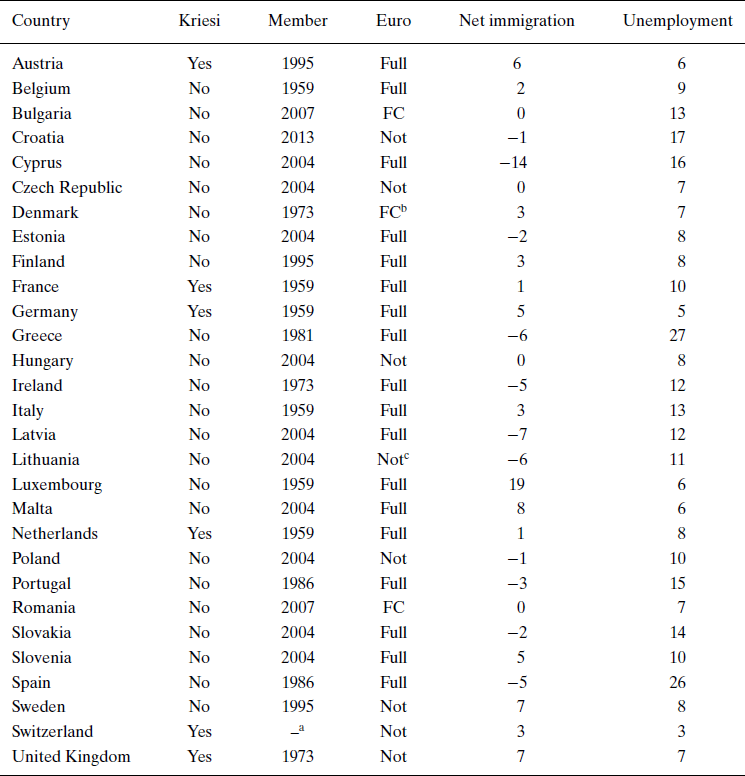
The combination of cultural and European issues in one dimension is confirmed in all cases that Kriesi et al. (Reference Kriesi2008) examine and an amorphous process of globalisation was identified as the underlying mechanism explaining this relationship. Because of the lack of variance in all Kriesi et al. cases, the underlying mechanism cannot be tested. One can unpack the pattern of globalisation in West European countries into two developments: EU integration and immigration. The countries that Kriesi et al. studied have been subject to similar conditions. They are host countries to immigration, and that can be the key to the lack of variance in their dimensionality results. As can be seen in Table 1, all these countries are net immigration countries, while 13 out of 28 EU countries are net emigration countries. The link between new cultural issues, such as immigration and European integration, may therefore not be a given in the entire EU, but rather a product of the specific circumstances in which the countries Kriesi et al. study find themselves.Footnote 1
Characteristics of European Union Member States and Switzerland

Notes: Kriesi = included in Kriesi et al. (Reference Kriesi2008).
Member = Year of membership; anot applicable for Switzerland.
Euro = Member of the Eurozone on 1 January 2014 Full, Not or FC (only a member of the Fiscal Compact);
bDenmark is the only EU Member State to have its currency pegged to the Euro; cLithuania joined the Eurozone in 2015.
Immigration = Net migration balance as permille of population.
Unemployment = Level of unemployment in January 2014.
A limited scope for the cultural logic?
It is well‐established that negative attitudes towards immigration and levels of immigration are related to decreasing support for European integration (Toshkov & Kortenska Reference Toshkov and Kortenska2015). Those who believe that the nation‐state is in danger have more negative attitudes towards European integration (McLaren Reference McLaren2007). Individuals with more pronounced national identity tend not to lend their support to European integration (Carey Reference Carey2002). For some citizens, immigration may be one central aspect of endangering the nation‐state as an increased number of immigrants threaten national identity. The EU is perceived as the reason for the influx of immigrants as it is a common labour market and this limits the ability of Member States to regulate immigration to their own country. Therefore, the issue of European integration is connected to the issue of immigration (De Vreese & Boomgaarden Reference Vreese and Boomgaarden2005).
The levels of immigration in a country are likely to play a significant role in shaping attitudes towards European integration. They do so through increasing the political salience of immigration (Kriesi et al. Reference Kriesi2008; Sides & Citrin Reference Sides and Citrin2007). Three patterns underlie this increase in saliency: first, citizens perceive the direct effect of immigration on their own neighbourhood (Sides & Citrin Reference Sides and Citrin2007); second, the media may respond to these societal changes and cover immigration more extensively in immigration countries (Sides & Citrin Reference Sides and Citrin2007); and third, new political parties may respond to the increased societal and media saliency of immigration and use the issue as a crowbar to break into the party system (De Vries & Marks Reference Vries and Marks2012). Existing political parties have an interest in maintaining control over the dominant lines of conflict (Mair Reference Mair1997; Schattschneider Reference Schattschneider1960). Political entrepreneurs, however, have an interest in creating a new dimension, linking issues on which established parties tend to take diverging positions from their voters, such as immigration and EU integration (Costello et al. Reference Costello, Thomassen and Rosema2012), together. Radical right‐wing populists in Northern Europe have linked anti‐immigration and anti‐European sentiment: the Dutch radical‐right wing populist PVV (2012: 37) wrote in their manifesto: ‘The most important thing: out of the EU = immigration back in Dutch hands.’ Or as Nigel Farage stated in the 2015 UK Leader debate: ‘As members of the EU, what can we do to control immigration? Let me tell you: nothing!’Footnote 2
Cultural hypothesis: The higher the levels of net immigration a country sees, the more voter positions on new cultural issues will be associated with positions on the European dimension in that country.
An alternative, economic logic?
Kriesi et al. (Reference Kriesi2008) propose that the economic left‐right dimension was strengthened in the era of globalisation as it captures an economic logic along which globalisation may be contested. In the face of international competition on a global market, governments may respond in two ways. First, they may choose to make their welfare states leaner in order to make their economies more competitive at the cost of equality, by reducing the tax burden and their redistributive projects. Alternatively, states may opt to protect their economies from the international market by limiting international trade and strengthening their welfare state. Thus the traditional competition between left and right may be reinvigorated (Kriesi et al. Reference Kriesi2008). In later work Kriesi et al. (Reference Kriesi2012) write that the extent to which globalisation is currently contested through this economic logic is only limited.
The link between socioeconomic attitudes and globalisation, particularly EU integration, has waxed and waned over time and between regions. Deflem and Pampel (Reference Deflem and Pampel1996) and Van Elsas and Van der Brug (Reference Van Elsas and Van Brug2015) have shown that before 1992 the link between economic left‐right orientation and EU integration was much stronger: in this period the European project was primarily oriented towards creating a common market. This liberalisation bred left‐wing Euroscepticism. After the Maastricht Treaty, the EU became more involved in regulating the Europe‐wide market it had created (Marks Reference Marks, Marks and Steenbergen2004). Therefore, the left became more positive about the EU. The creation of the Eurozone boosted pro‐European sentiment in the net‐receiving countries in Southern Europe and anti‐European sentiment in the net‐contributing countries in Northern Europe (Lubbers & Scheepers Reference Lubbers and Scheepers2010). In specific regions, however, a link between left‐wing economic policy preferences and negative views towards EU integration has been demonstrated: Llamazares and Gramacho (Reference Llamazares and Gramacho2007) show that Euroscepticism has been linked to egalitarian values in Southern European countries.
A new element influencing the relationship between attitudes towards the economy and EU integration is the European sovereign debt crisis (Katsanidou & Otjes Reference Katsanidou and Otjes2016). The Kriesi model of the political space holds that positions on EU integration are not necessarily tied to particular economic positions. One can be egalitarian and pro‐EU or inegalitarian and pro‐EU. This finding might be due to the fact that all countries in the Kriesi et al.’s (Reference Kriesi2012) study have fared relatively well in the European sovereign debt crisis, as is evident from their low unemployment rates (see Table 1). Katsanidou and Otjes (Reference Katsanidou and Otjes2016) argue that, due to European involvement in budgetary decision making in a country that was strongly affected by the crisis, citizens cannot conceive of expansionary budgetary policies without contesting the notion of Eurozone membership. This shows that in some Southern European countries the political space has been reshaped as a result of the events of the crisis.
Theoretically Katsanidou and Otjes (Reference Katsanidou and Otjes2016) build further on Mair (Reference Mair, Graziano and Vink2008), who argues that EU membership limits the policy freedom of political parties: because the EU has a common, harmonised free market, one cannot contest economic liberalisation without contesting EU integration. Due to monetary integration, this pattern now also applies to budgetary policies and macroeconomic management: in Eurozone countries, budgetary policies have been constrained by the Stability and Growth Pact that commits countries to a budget deficit that does not exceed 3 per cent of their gross domestic product (GDP) since 1999. When, during the global recession following the American banking crisis, a number of countries had difficulty meeting this criterion, a European sovereign debt crisis loomed: the trust of financial markets in Spain, Portugal, Greece, Cyprus and Ireland began to decline. They were no longer able to finance their budget deficits and had to turn to European institutions for a bail‐out. These came with strict conditions about the macroeconomic and budgetary policies these countries would pursue. These countries were committed to far‐reaching programmes of privatisation, austerity and reform. The future economic policies of these countries were (co‐)determined by European institutions. In order to decrease the likelihood of a future debt crisis, most EU countries signed a Fiscal Compact that expanded the ability of the European Commission to ensure compliance with the Stability and Growth Pact.
The pattern that Mair (Reference Mair, Graziano and Vink2008) has observed for the choice between a market‐based and a dirigist economic model has extended to the choice between fiscal discipline and expanded government expenditure in order to make the economy grow. Within the Eurozone, one cannot think of expansionary economic policies without contesting Eurozone membership. Therefore, the impact of the crisis on a country's economy may influence the relationship between policy positions on EU integration and economic policies. In Greece, for instance, Katsanidou and Otjes (Reference Katsanidou and Otjes2016) show that in the minds of voters, positions on the austerity measures that were included in the bail‐out agreement, but also general economic attitudes such as egalitarianism, were closely related to their views on EU integration: voters opposed to austerity, privatisation and reforms are more sceptical about EU integration.
In this article we set out to determine to what extent the patterns that Katsanidou and Otjes (Reference Katsanidou and Otjes2016) have found for Greece can be generalised to other Eurozone members. We expect that the severity of the crisis is an important interaction variable: in ‘debtor’ countries the link between economic and European issues is likely to be stronger than in ‘creditor’ countries because in these countries the effects of EU budgetary interference were much more visible to the public.
Economic hypothesis: The stronger a country has been affected by the European sovereign debt crisis, the more voter positions on the economic dimension will be associated with voter positions on the European dimension.
There are different ways to conceptualise the economic policy preferences of voters: one can think of whether voters support an egalitarian distribution of income, government intervention in the economy or how they want to balance taxes and spending. We expect that egalitarianism, in particular, will relate to EU attitudes in countries affected by the crisis for three reasons: first, because egalitarianism is generally considered to be the core of voters views on economic issues (Bobbio Reference Bobbio1996; Lipset et al. Reference Lipset and Lindzey1954); second, because in the crisis‐affected countries the division between tax cuts and better public services proved to be meaningless as governments sought to increase both tax revenue and cut public services; and third, because support for government intervention tends to depend on trust in government as well as views about the economic issues (Hetherington Reference Hetherington2005; Popp & Rudolph Reference Popp and Rudolph2011). During the crisis, citizens in the Southern countries in particular lost faith in their governments (Roth et al. Reference Roth, Nowak‐Lehmann and Otter2013), which were radically reducing the role of the government in the economy. As with the division between tax cuts and public services, this is likely to have muddied the distinction.
Methods
This study uses the 2014 Voter Study from the European Election Study (EES) for individual‐level data and data from Eurostat for the country‐level data. The 2014 EES has used the same questionnaire for representative samples of voters in all 28 EU countries (Schmitt et al. Reference Schmitt2015). In each country at least 1,000 voters were sampled, except for Malta and Luxembourg, where only 500 respondents were sampled.
The study employs a multilevel regression model with the sentiment of voters towards the EU as the dependent variable. We attempt to explain variance on this scale on the basis of voters’ responses to a battery of issue items that were measured. We add interactions with country‐level variables to test our hypotheses (which are at the country‐level).
To measure the sentiment of respondents towards the EU, we constructed a scale. We use a five‐item scale for the voters’ positions on the EU; items cover emotional attachment (whether respondents feel that they are a citizen of the EU or attached to Europe), trust in EU institutions (the EU in general and the European Parliament) and a question about attitudes towards membership. In the dataset, eight items tap into sentiments and attitudes towards the EU and its conduct. However, as can be seen in Online Appendix 3, the five‐item scale produces better results:Footnote 3 we use both Mokken scaling (Mokken Reference Mokken1971) and Cronbach's α to assess scalability (Cronbach Reference Cronbach1951). The eight‐item scale has three items that relate poorly with the other items according to the Mokken scaling. The Cronbach's α is also below the 0.7 bench mark; as a whole the scale (barely) meets the requirements for a sufficient scale in terms of the Mokken scaling. Removing the worst performing item from the scale leads to sufficient indicators for all items in terms of the Mokken scaling, but as a whole the seven‐item scale still does not meet the 0.7 requirements of the Cronbach's α. Only the five‐item scale meets this requirement. Higher values on the scale indicate more pro‐European sentiments.
At the individual level we use six policy indicators that measure voters’ attitudes on a range of different issues:
1. Three economic issues that are included separately in the model: voters’ position on economic egalitarianism, where higher values denote opposing economic redistribution; their position on government intervention in the economy, where higher values denote opposing government intervention; and how citizens place themselves in the trade‐off between tax cuts and investments in public services, where higher values represent tax cuts. Despite their conceptual closeness, the intervention, taxation and redistribution items do not form a sufficiently strong scale (H = 0.11, α = 0.26). As discussed above, we expect that egalitarianism in particular will relate to EU attitudes in countries affected by the crisis;
2. The voters’ position on a new cultural issue – namely immigration – where higher values denote pro‐immigration attitudes;
3. The voters’ left‐right self‐positioning, where higher values mean more right‐wing positions. We include left‐right self‐positioning as it has been shown to be an important predictor of Euroscepticism (Van Elsas & Van der Brug Reference Van Elsas and Van Brug2015);
4. The voters’ position on an old cultural issue (in the form of same‐sex marriage), where higher values denote moral liberalism;
5. The voters’ position on the trade‐off between fighting crime and protecting privacy. This item does not scale with immigration. Higher values imply law and order positions;
6. The voters’ position on the environment phrased as a trade‐off to the economy, where higher values indicate favouring economic growth.Footnote 4
At the country‐level we use two items: the level of net immigration, and a scale that measures the extent to which countries were affected by the European sovereign debt crisis. The net immigration is the total number of immigrants minus the annual number of emigrants, including both citizens and non‐citizens, taken as a permille of the total population (Eurostat 2015a, 2015b).Footnote 5 The crisis severity scale is a six‐item scale. The items scale sufficiently in terms of their H‐value. The idea is based on Kriesi and Pappas (Reference Kriesi and Pappas2015), who use a three‐item scale (unemployment, debt and GDP growth). In this study we add two variables: the size of the budget deficit (a key indicator for the European Commission), and the extent to which countries were bailed‐out by the European institution as measured by the total share of the GDP that was lent by European institutions. The data is drawn from Eurostat (2015c, 2015d, 2015e) and Katsanidou and Otjes (Reference Katsanidou and Otjes2016). These items form a sufficiently strong scale (see Online Appendix 4). Higher values imply that the country is more strongly affected by the crisis. All these variables are recalculated so they have a minimum of zero and a maximum of one.
Our models use control variables both on the individual and country levels. On the individual level, demographic variables such as age, gender, education, size of the city of residence, religiosity as well as employment and class status were included. On the country level we included a dummy variable that indicates whether the respondent resided in a Central and Eastern European postcommunist country.Footnote 6 As we explicitly have a theory on the developments in Western Europe, we include this variable as an interaction on the entire model, with the expectation that the hypotheses we formulate only apply in Western Europe. Previous research has shown that in Central and Eastern Europe the views of citizens’ are less coherent (Mondak & Gearing Reference Mondak and Gearing1998; Neundorf Reference Neundorf2011). Online Appendix 2 shows the descriptive statistics of all variables.
This article uses multilevel regression. The choice for a regression technique over a scaling technique is for two reasons. First, we want to compare the effect of immigration and crisis severity on the strength of the relationship between particular items. Such an interaction model is common in regression, but this cannot be implemented within a scaling methodology. Second, we do not argue that the relationships between voter positions on different issues are strong enough in every country that we study to classify as a scale. It is important to note that we do not argue that there is a causal effect between attitudes on the economy and immigration and attitudes towards Europe. Our focus is on their association. We use multilevel regression in Stata. This allows us to incorporate country‐level variables.
Results
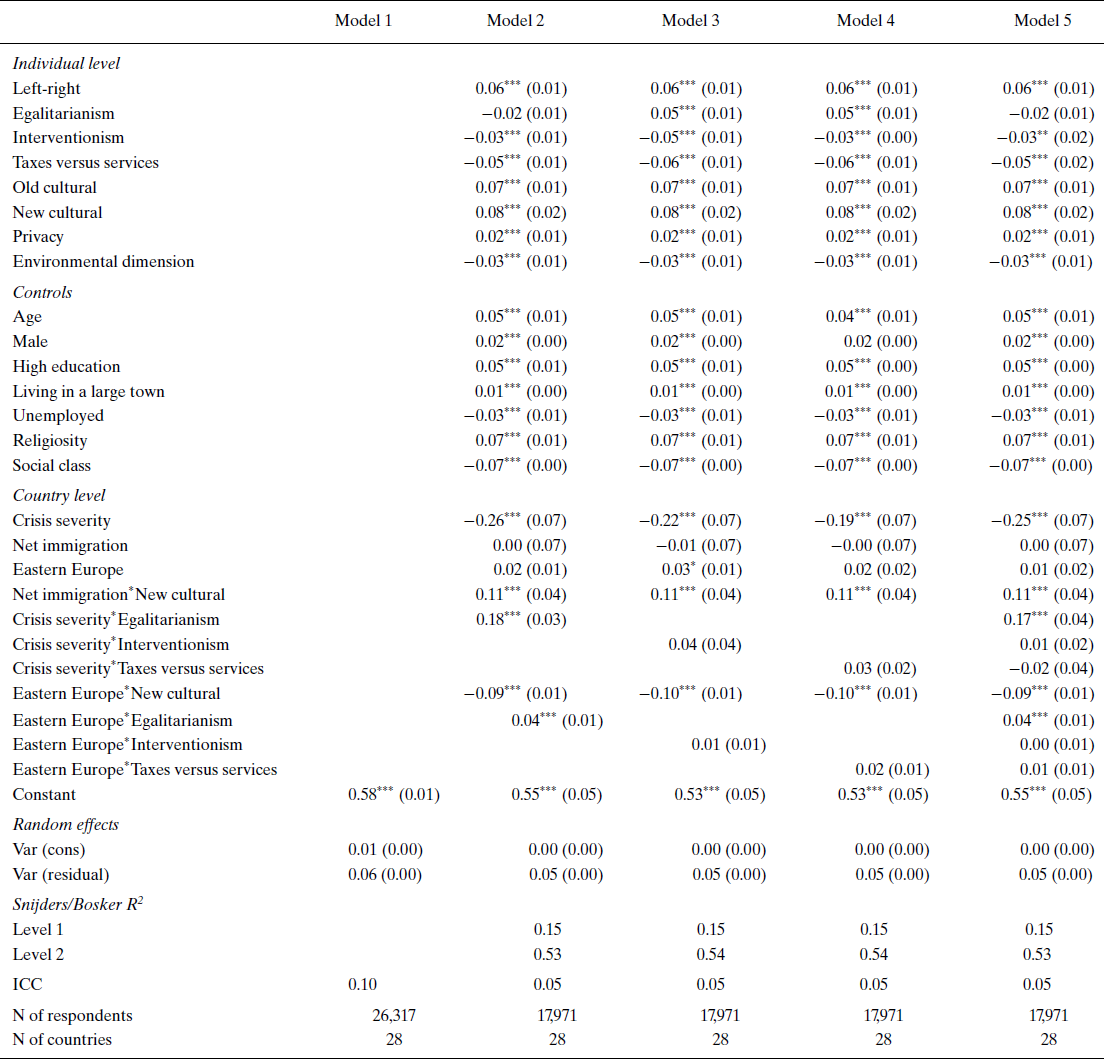
Table 2 presents the results of our multilevel regression. The empty model (model 1) shows that the variation that can be explained on the higher level is just about worth the use of a multilevel model (9.6 per cent). Note that all our hypotheses are based on cross‐level interactions. Models 2, 3 and 4 all include an interaction between the severity of a crisis in a country and one of the economic variables (egalitarianism, interventionism and taxes versus services). Model 5 includes interactions between all these three variables. Each of these models sustains the same substantive conclusions.
Models explaining Variation on the EU dimension

Note ***p < 0.01 **p < 0.05 *p < 0.1.
Source: Schmitt et al. (Reference Schmitt2015).
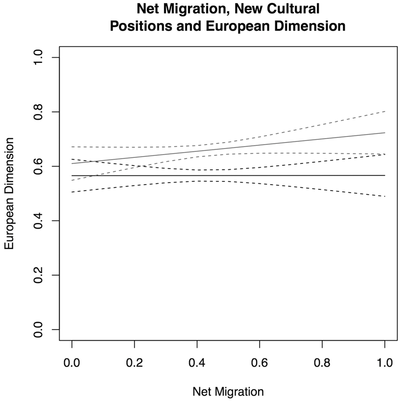
When it comes to the Cultural hypothesis, we can see an interaction between a voter's views on immigration and the net migration of the country in which they reside. Due to the difficulty of interpreting interaction effects solely based on coefficients (Brambor et al. Reference Brambor, Clark and Golder2006), we show graphically how net immigration and crisis severity, respectively, as higher‐level predictors, moderates the relationship between voters’ positions in favour of immigration, as lower‐level predictors, and their positions in favour of the EU (outcome). This is visualised in Figure 1 (which is based on model 5): while among citizens from countries where the net immigration levels are the lowest (i.e., citizens from countries where people tend to emigrate from) there is no significant difference between the EU sentiments of those who are most or least opposed to immigration. The higher the levels of net immigration, the wider becomes the divide between those who favour it and those who oppose it: the more immigration a country sees, the more those who favour immigration and EU integration. The difference is significant beyond a net immigration level of 0.2. This interaction effect is the same in all three models. This confirms the Cultural hypothesis, which held that there would be a higher association between the new cultural dimension and the European dimension with increasing levels of net immigration.
Net migration, new cultural positions and European dimension.

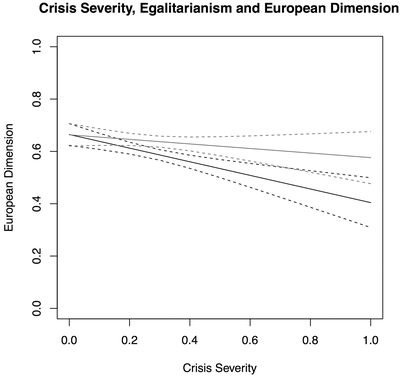
The Economic hypothesis proposed that voters’ views on economic issues are related to their views on European integration but that this relationship is stronger in countries that are deeply affected by the crisis. As discussed above, we believe that egalitarianism is the best indicator of the economic views that we are examining. The interaction between crisis severity and egalitarianism is included in model 2 (and 5). Two alternative indicators, interventionism and the balance between taxes and government services, are included in models 3 and 4 (and 5), respectively. In both model 2 and model 5 there is a clear interaction relationship between egalitarianism and the severity of the crisis. Figure 2 displays the difference in pro‐European sentiment between the citizens who favour income equality the most and those who oppose it the most in countries where the economic crisis has been more or less severe. It shows that in countries where the crisis was the least severe, there is no significant difference in the sentiments towards the EU of those who are most and least egalitarian. In line with our expectation, the more severe the crisis has been, the wider the difference between egalitarian and non‐egalitarian voters becomes: citizens who position themselves in favour of redistribution increasingly feel negatively about the EU, with increasing levels of crisis impact in their respective countries. The difference is significant from a crisis severity of 0.2 onwards. In 12 countries where the crisis was less severe this relationship is not significant.Footnote 7 These results sustain the Economic hypothesis, which predicted a stronger association between the economic and the European dimension for countries where the crisis has been worse, and our specific expectation that egalitarianism would be the economic issue to interact with crisis severity.Footnote 8 It is important to note that the case of Greece (which is the most extreme country in terms of its crisis severity) has a strong influence on the analysis (see Online Appendix 5). Substantially, when removing Greece the relationship between egalitarianism and EU attitudes no longer holds. However, when the analysis is run only on Eurozone countries, then the relationship remains significant but loses in strength. The pattern found in this analysis for Greece is also sustained by Katsanidou and Otjes (Reference Katsanidou and Otjes2016).
Crisis severity, egalitarianism and European dimension.

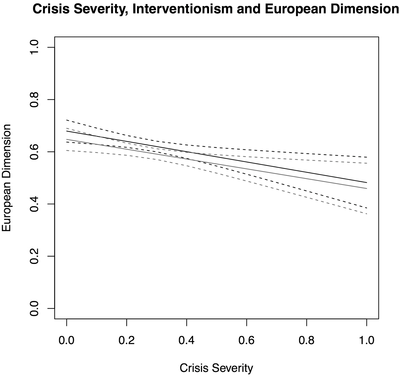
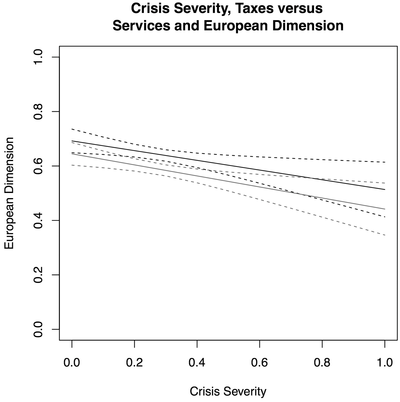
We applied similar interaction models to the two alternative economic indicators. These do not yield a significant interaction relationship, neither when only one of these interactions is included nor when all three are included. Figures 3 and 4 visualise these relationships. They show lines with similar gradients for both the most and least interventionist or the most anti‐taxation and most pro‐services that are mostly statistically indistinguishable.
Crisis severity, interventionism and European dimension.

Crisis severity, taxes versus services and European dimension.

These effects are significant even after controlling for similar interaction effects of being a Central and Eastern European country and economic egalitarianism or new cultural issues. These interaction effects show that for Central and Eastern European countries the relationship between views on immigration and views on the EU are weaker than in Western Europe, while there is no difference in the association between the three economic dimensions and the EU dimension.Footnote 9
We also included a large number of additional control variables that are associated with views on EU integration. Specifically, being right‐wing, in favour of gay marriage, in favour of fighting crime and prioritising environment over the economy is related positively with the pro‐European beliefs. Our control variables behave as expected: being pro‐EU is positively related to being older, religious, higher educated, employed, non‐working class, male and a resident of a larger town. These results are the same in all models.
Conclusion
The central conclusion of this article is that European integration is not associated with the same issues across Europe. We offer the insight that European integration is the giant that has finally awaken capturing different meanings in different countries. Our analysis showed that the relationship between attitudes towards the EU, immigration and economic issues depends on the societal and economic context.
We found that in the Southern European countries (particularly Greece) suffering from Eurozone crisis the relationship between economic orientations was stronger compared to those Northern European countries which were not much affected. In the debtor countries that were strongly affected by the European debt crisis, citizens with economic left‐wing orientations were more Eurosceptic than citizens with similar economic left‐wing orientations from creditor countries that fared better in the crisis. Greece is an influential case in our analysis. The relationship between economic attitudes and EU attitudes is strongest here, although the same relationship is also visible in other crisis‐affected Eurozone countries (see Online Appendix 5). Greece is not only the country hardest hit by the crisis, but also is the only European country that was bailed‐out by the EU twice before the 2014 European parliamentary elections. What is more, the crisis left its mark on the country's party system. The traditional pro‐European centre‐left and centre‐right poles of the party system were replaced by two poles accepting and rejecting support from the EU. On top of this, Greece experienced an exceptional weakness in its political institutions and the reluctance of politicians to agree to fiscal retrenchment due to their reliance on the selective distribution of state resources to keep clientelist linkages alive and ensure electoral survival (Afonso et al. Reference Afonso, Zartaloudis and Papadopoulos2014). The unique features of the Greek case may undermine the theoretical implications of this study across Europe. It is, however, important to note that the link made between economic issues and EU integration by Greek politicians was also made by politicians from other crisis‐affected countries. Therefore we can expect that as long as economic insecurity looms in the EU, this relationship is likely to become stronger.
The results of this article reflect a pattern that Katsanidou and Otjes (Reference Katsanidou and Otjes2016) have observed for Greece: the strongly crisis‐affected countries were bailed‐out by European institutions and these bail‐outs came with reforms, cuts and privatisations. Citizens who contested these austerity measures also had to contest European integration: in these countries, favouring European integration became linked to an economically right‐wing agenda. This became even more evident after the decision of the left‐wing SYRIZA government in Greece to sign the third memorandum in order to stay in the Eurozone. The government sacrificed its left‐wing agenda employing a fully‐fledged right‐wing economic policy in order to comply with the requirements set for Eurozone membership. While the EU's new budgetary rules also applied to many Northern European countries, the relationship is weaker here: the direct effect of European integration on the national economy and the welfare states was far less evident.
For Northern countries another pattern is more relevant: here those with culturally exclusivist views tend to foster anti‐European positions. European integration is contested as a threat to national identity. We identified a link between the net migration levels to a country and opposition to EU integration and opposition to immigration. In countries that are net‐immigration countries, citizens who oppose immigration are more Eurosceptic than citizens with similar anti‐immigration positions in countries with lower immigration. With the ongoing immigration crisis and the inability of the EU to respond efficiently this connection is likely to become stronger.
Our analysis has also extended the applicability of the Kriesi model: the strength of the link between new cultural issues and European integration is conditional upon the level of net immigration. Moreover, the absence of economic contestation of European integration that Kriesi et al. (Reference Kriesi2012) observe in the countries that they study may reflect the economic status of these countries: in countries strongly affected by the Eurozone crisis, the link between opposing EU integration and left‐wing economic values is much stronger than in countries unaffected by the crisis.
In short, we have identified the differing conditions under which new cultural and economic values relate to the issue of EU integration. The fact that the same overarching issue coheres with different issues in different political environments shows that European integration may be developing traits of a super issue. This article has demonstrated that it has different meanings in different systems and a mechanism that allows it to do so. The aspects that we have not studied here is its explanatory power, where it comes to vote choice and its importance for party competition. Where it comes to the last element, the extent to which a two‐dimensional model is justified to model party positions, is more contested than the model of the voter space (Lefkofridi et al. Reference Lefkofridi, Wagner and Willmann2014; Van der Brug & Van Spanje Reference Van Brug and Van Spanje2009). It is an open question to what extent the party space underwent the same change as the voter space. Katsanidou and Otjes (Reference Katsanidou and Otjes2016) show that this did happen in Greece, where the EU dimension now structures party positions on economic issues and Otjes (Reference Otjes2015) has shown that similarly even in the Netherlands, a North Western European state, party positions on economic policies and party positions on European integration became linked. Future research may want to study to what extent positions of parties towards EU integration relate to their economic policy positions and their positions on new cultural questions. It may very well be that similar patterns in terms of the effect of the economic crisis and immigration shape the strength of these relationships on the party level as well.
Supporting Information
Additional Supporting Information may be found in the online version of this article at the publisher’s web-site:
Appendix 1: Items included in analysis
Appendix 2: Descriptive Statistics
Appendix 3: Scaling analysis of EU dimension
Appendix 4: Economic Dependency
Appendix 5: Alternative Models
Appendix 6: East/West Dichotomy, New Cultural Positions and European Dimension
Appendix 7: East/West Dichotomy, Egalitarianism and European Dimension
Appendix 8: East/West Dichotomy, Interventionism and European Dimension
Appendix 9: East/West Dichotomy, Taxes versus Services and European Dimension


 Open access

