





Introduction
Artificial light, particularly that in the ultraviolet (UV) spectrum, attracts taxa from several insect orders (e.g., Ramamurthy et al. Reference Ramamurthy, Akhtar, Patankar, Menon, Kumar and Singh2010; van Grunsven et al. Reference van Grunsven, Donners, Boekee, Tichelaar, van Geffen and Groenendijk2014a; Wakefield et al. Reference Wakefield, Broyles, Stone, Jones and Harris2016). Hence, light trapping is commonly used to collect insects that are positively phototactic (e.g., Niermann and Brehm Reference Niermann and Brehm2022). Over the past century in which light trapping of nocturnal insects has occurred, various light sources have been used. Light trapping originated with the use of gas lamps, but now include mercury vapour, incandescent (tungsten) light bulbs, black-light fluorescents (BLFs) (which also use mercury vapour), and more recently, light-emitting diodes (LEDs; Niermann and Brehm Reference Niermann and Brehm2022). Light trapping has been a particularly effective means to collect nocturnal insects belonging to the Coleoptera, Trichoptera, and Diptera, but most notably, the Lepidoptera (i.e., moths).
Moths are a hyperdiverse taxon comprising approximately 160 000 species globally and approximately 5500 species in Canada (Pohl et al. Reference Pohl, Landry, Schmidt, Lafontaine, Troubridge and Macaulay2018). They provide important ecosystem services, such as pollination (e.g., Alison et al. Reference Alison, Alexander, Diaz Zeugin, Dupont, Iseli, Mann and Høye2022) and herbivory (e.g., Dhileepan et al. Reference Dhileepan, Callander, Shi and Osunkoya2018), and serve as an important food source for migratory birds, bats, and other arthropods (e.g., Visser et al. Reference Visser, Holleman and Gienapp2006; Kolkert et al. Reference Kolkert, Andrew, Smith, Radar and Reid2020). As such, moths are ecological indicators in forested ecosystems (e.g., Kitching et al. Reference Kitching, Orr, Thalib, Mitchell, Hopkins and Graham2000; Summerville et al. Reference Summerville, Ritter and Crist2004; Pinksen et al. Reference Pinksen, Moise, Sircom and Bowden2021). Researchers have long leveraged lepidopterids’ attraction to light sources to detect moths and collect data to make such ecological assessments (e.g., Pinksen et al. Reference Pinksen, Moise, Sircom and Bowden2021). Species, and even families, of moths are attracted to different light intensities and wavelengths (e.g., Somers-Yeates et al. Reference Somers-Yeates, Hodgson, McGregor, Spalding and ffrench-Constant2013; Merckx and Slade Reference Merckx and Slade2014).
Although BLF light traps are well established for sampling moth assemblages (e.g., Axmacher and Fiedler Reference Axmacher and Fiedler2004; Brehm and Axmacher Reference Brehm and Axmacher2006; Pinksen et al. Reference Pinksen, Moise, Sircom and Bowden2021), such traps are typically powered by deep-cycle lead acid batteries and are therefore logistically more difficult — heavy and expensive — and hazardous to set up and operate than are newer LED light traps, which are powered by smaller and more energy-efficient lithium-ion battery packs. Because of this, traps with LED lights offer a more ergonomic and safer option. Although numerous studies have examined the efficiency of different light sources to attract macromoth assemblages (e.g., Fayle et al. Reference Fayle, Sharp and Majerus2007; van Langevelde et al. Reference van Langevelde, Ettema, Donners, WallisDeVries and Groenendijk2011; Wakefield et al. Reference Wakefield, Broyles, Stone, Jones and Harris2016; Infusino et al. Reference Infusino, Brehm, Di Marco and Scalercio2017), comparisons of BLF and LED light sources are scarce. To our knowledge, this is the second peer-reviewed study comparing more traditional BLF light tubes to LEDs that are designed to attract nocturnal flying insects (see van Deijk et al. Reference van Deijk, Wever, van der Heide, Boers, van Deijl and van Grunsven2024).
As part of the ongoing early intervention strategy for spruce budworm management (Johns et al. Reference Johns, Bowden, Carleton, Cooke, Edwards and Emilson2019), we have been collecting nocturnal macromoths to determine nontarget impacts of Bacillus thuringiensis subsp. kurstaki (Btk) treatment in forested stands in western Newfoundland, Canada (see Young et al. Reference Young, Bowden, Moise, Scott, Schmidt and Warren2024). For the present study, we employed part of the study area from this larger project to compare the moth assemblages collected using traditional BLF tubes versus the LepiLED Mini switch (Brehm Reference Brehm2017).
Methods
Sites and forest stands
We established light traps during the summer of 2022 at six boreal forest sites near Glenburnie and Wiltondale, Newfoundland and Labrador, Canada. These sites are nearly uniform even-aged balsam fir, Abies balsamea (Linnaeus) Miller, stands that are approximately 35–40 years old. The stands regenerated after the last outbreak of spruce budworm that killed more than 90% of Newfoundland’s forests in the 1970s (Otvos and Moody Reference Otvos and Moody1978). In the present study, three of the six sites served as controls, where no insecticide was applied in 2022. The other three sites were treated with Btk. Bacillus thuringiensis subsp. kurstaki is a bioinsecticide used to manage irruptive lepidopteran pests that could have nontarget impacts to other species of caterpillars feeding at the time of application (mid- to late June). The treatment sites were located approximately 4, 6, and 8 km from the nearest control site, respectively.
Light traps
In each site, two different types of light–flight intercept traps were deployed approximately 2 m above the ground (e.g., Pinksen et al. Reference Pinksen, Moise, Sircom and Bowden2021) and 50 m into each stand from the nearest roadside edge. For the Btk–treated sites, we placed the traps at least 100 m inside of the spray block. At each site, we placed the traps 50 m apart to avoid attraction interference; previous mark–recapture studies have shown that more than 30 m is sufficient to avoid interference effects (Truxa and Fiedler Reference Truxa and Fiedler2012; Merckx and Slade Reference Merckx and Slade2014; van Grunsven et al. Reference van Grunsven, Lham, van Geffen and Veenendaal2014b), and other studies have used similar distances (e.g., Niermann and Brehm Reference Niermann and Brehm2022). We used a paired-site approach to minimise differences in plant community, local topography, and weather or climate. Each trap consisted of a 190-L (5-gallon) bucket to hold collected moths, and three insecticide strips were placed inside each bucket to kill the trapped insects (Hercon Vaportape II; Hercon Environmental, Emigsville, Pennsylvania, United States of America). One trap type employed a 15-W BLF UVA tube light (Quantum Bl; PestWest, Sarasota, Florida, United States of America) that was powered by a 12-V deep-cycle automotive battery with at least 80 Ampere hours and was in operation, via solar sensors, during dark hours. This schedule equated to about nine hours of activation during the first bout of sampling and 10 hours during the second. The BLF light tube has a large relative intensity, with peak spectral irradiance at 365 nm and smaller peaks at 404 nm, 435 nm, and 545 nm (Supplementary material, Fig. S1). The second trap type employed a 4-W LED light (LepiLED, Jena, Germany) set to “mixed radiation” (Brehm Reference Brehm2017) and powered by a 5-V lithium battery power bank at 26 000 mAh; the LED was controlled with a timer set to shine for eight hours each night, from 23:00 to 07:00 hours, local time. Each LepiLED assembly contains eight LED lights with the following wavelengths: four lights at 360 nm (UVA), two lights at 430 nm (blue), one light at 520 nm (green), and one light at 550 nm (cool white; Brehm et al. Reference Brehm, Niermann, Jaimes Nino, Enseling, Justel and Fiedler2021). Niermann and Brehm (Reference Niermann and Brehm2022) showed that similar numbers of individuals and numbers of moth species were collected using the mixed-radiation setting, relative to the UV-only mode of the lights. The light traps were exactly the same hold for the light sources.
Collection and identification
The light traps were operated during two periods in 2022: from 27 to 29 July and from 23 to 25 August, for a total of 72 trap nights (12 traps × 6 nights). Traps were collected and reset daily in each sample period. Samples were taken back to the lab daily, and only the macromoths — representing five families in our collection — were retained and identified for analysis: Geometridae, Drepanidae, Noctuidae, Notodontidae, and Erebidae.
Several sources were used for moth identification, including Beadle and Leckie (Reference Beadle and Leckie2012) and the Mississippi Entomological Museum’s Moth Photographers Group (http://mothphotographersgroup.msstate.edu; Digital Guide to Moth Identification, Mississippi Entomological Museum, Mississippi State University, Starkville, Mississippi, United States of America). Voucher specimens were sent to the Canadian National Collection of Insects, Arachnids and Nematodes (Agriculture and Agri-Food Canada, Ottawa, Ontario, Canada) for confirmation by B.C. Schmidt and are included in a voucher collection housed at Natural Resources Canada, Canadian Forest Service, Corner Brook Research Facility, Corner Brook, Newfoundland, Canada. All specimens were identified by morphological comparison to the comprehensive reference collection at the Canadian National Collection of Insects, Arachnids and Nematodes.
Moths too damaged to confidently identify to the species level were used only for analysis of total abundances.
Statistical analysis
We amalgamated samples over the two sampling periods. We created a species-by-site matrix and standardised abundances to the number of individuals collected per hour by dividing all cells by the number of hours the trap was in operation. All analyses were conducted using R (R Core Team 2023).
To test the difference in moth composition between the LEDs and the BLFs, we conducted a permutational multivariate analysis of variance, with light bulb type and treatment type (Btk–treated or control) as main effects using the adonis2 function (method = bray for pairwise distances and 999 permutations), and visualised the data using nonmetric multidimensional scaling ordination using Bray–Curtis dissimilarity (bray) and two dimension for easy visualisation and interpretation with the vegan package (Oksanen et al. Reference Oksanen, Simpson, Blanchet, Kindt, Legendre and Minchin2022). We used normal linear regression to test for the effects of light type and treatment type (Btk–treated or control) on abundance of trap captures in an additive model. We used the sum of the total abundances (including unidentifiable individuals) standardised for trapping effort (per hour). We compared diversity using Hill numbers (q = 0, 1, 2) representing species richness, Shannon diversity, and Simpson diversity between light trap for each stand treatment type (Btk–treated or control) using the package iNEXT (Hsieh et al. Reference Hsieh, Ma and Chao2016).
Results
A total of 3463 individual moths were collected, but 187 of these were unidentifiable due to damage, representing 5% (111) and 6% (76) of the BLF light- and LED-trapped moths, respectively. In the control sites, raw species richness totals of 70 and 57 were collected using the BLF lights and LEDs, respectively. In the treatment sites, 57 and 58 species were collected using BLF lights and LEDs, respectively. For the analyses, we used a dataset of 3275 macromoths representing five families — Noctuidae, Geometridae, Drepanidae, Notodontidae, and Erebidae — and 98 macromoth species. The seven most abundant species — Dysstroma citrata (Linnaeus), Xestia badicollis Grote, Syngrapha rectangula Kirby, Chrysanympha formosa Grote, Anaplectoides pressus Grote, Phlogophora periculosa Guenée, and Diarsia jucunda Walker — comprised 62% of the total abundance (Table 1), but some species appeared to differ in how attracted they were to the different light sources (Table 1).
Top, The seven most abundant (raw abundance) species collected totalled 2045 individuals, or 62% of the total collection; bottom, nine species differed in the number of individuals captured between the two light source types. BLF, black-light fluorescent light trap; LED, light-emitting diode light trap; control, site not treated with Bacillus thuringiensis subsp. kurstaki (Btk); treated, site treated with Btk

Species composition
Permutational multivariate analysis of variance revealed a significant difference in species composition between moths collected by LED light and BLF light (F 1,9 = 4.48, R 2 = 0.27, P = 0.001) and a significant difference between the Btk–treated and control sites (F 1,9 = 3.21, R 2 = 0.19, P = 0.01). These effects were recapitulated by the nonmetric multidimensional scaling ordination, which resulted in two dimensions and a stress of 0.1 (Fig. 1).
Nonmetric multidimensional scaling ordination of abundance-based moth assemblages collected in balsam fir-dominated boreal forest stands using black-light fluorescent (BLF) and LepiLED (LED) light sources at sites that were either treated with Bacillus thuringiensis subsp. kurstaki (treatment) or were untreated (control).

Species abundance
A total of 2046 moths were collected in the BLF light traps, and 1229 moths were collected in the LED traps. Although the LED light traps attracted fewer macromoths, when we standardised the abundances by trapping effort, the trap captures did not differ significantly (Fig. 2). Family-level abundance was also similar in comparison, with approximately half the number of individuals in each moth family collected in the LED light traps (Table 2). The most abundant families represented in the traps were the Noctuidae and Geometridae, which accounted for 98% of all moths collected in the study. The Noctuidae and Geometridae were collected in approximately the same proportions for both light-trap types, representing 63% and 35% of the collection in the BLF traps and 68.5% and 30% in the LED traps, respectively. We found no significant effect of Btk treatment on the abundance of macromoths collected (estimate = –0.09, Z = –0.85, P = 0.39).
Mean (± standard error) abundance per trap-hour (individuals collected per hour of operation) of the black-light fluorescent (BLF) and LepiLED (LED) light traps in Bacillus thuringiensis subsp. kurstaki– (Btk–)treated (treatments) and control (not treated with Btk) forest sites. Although more individuals were collected using the traditional black-light fluorescent light traps than with LepiLEDs, the difference was not significant.

Total abundance of moth families collected using black-light fluorescent (BLF) and LED light traps from boreal forest sites in western Newfoundland, Canada

Diversity indices
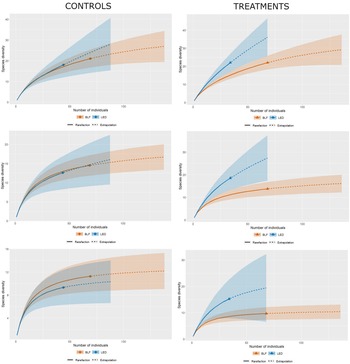
We detected no difference in the Hill numbers (q = 0, 1, 2) representing species richness, Shannon diversity, and Simpson diversity between the LED and BLF light traps in the control sites (Fig. 3). However, the values for species richness, Shannon diversity, and Simpson diversity were all higher for the LED traps in the treatment sites, with no overlap of the 95% confidence intervals in the rarefied or extrapolated metrics, except for Simpson (q = 3), which did overlap slightly.
Sample-sized based rarified and extrapolated Hill numbers 0, 1, 2, representing macromoth species richness, Shannon diversity, and Simpson diversity, collected using LED and black-light fluorescent (BLF) light traps: (left) data for control sites (not treated with Bacillus thuringiensis subsp. kurstaki (Btk); and (right) sites treated with Btk (treatment).

Discussion
In the present study, we measured how two light sources — traditional BLF lights that run on lead acid batteries and modern LepiLED lights that run on lithium-ion power banks — attracted different macromoth assemblages. We found significant differences in species composition between the two light sources, and this is reflected in the seemingly different preferences of some species for one or the other type of light source. For example, we collected 22 noctuid Apamea cogitata (Smith) in the BLF traps and one in the LED traps, and we collected eight geometrid Protoboarmia porcelaria (Guenée) in the BLF traps and 88 in the LED traps. Both species are broadly distributed across much of Canada and the United States of America, and A. cogitata may feed on grasses (BugGuide 2024, unconfirmed), and P. porcelaria feeds on deciduous and coniferous tree species (BugGuide 2024; Natural Resources Canada 2024).
We deployed light traps in sites that were being used for broader study that investigated the nontarget impacts of Btk spray on macromoth assemblages; the sites used in the present study represent a subset of those used in the larger study (Young et al. Reference Young, Bowden, Moise, Scott, Schmidt and Warren2024), the results of which are discussed in Young et al. ( Reference Young, Bowden, Moise, Scott, Schmidt and Warren2024).
Although moths are particularly attracted to shorter wavelengths of light in the UV–blue light spectrum (e.g., Brehm et al. Reference Brehm, Niermann, Jaimes Nino, Enseling, Justel and Fiedler2021), the mechanisms driving this response remain unclear. Recent research indicates that light attraction may not be flight-to-light behaviour but rather a dorsum-to-light response, whereby moths are adapted to keeping their dorsum to sources of UV light — that is, the sun, and now human-generated UV light (Fabian et al. Reference Fabian, Sondhi, Allen, Theobald and Lin2024). Empirical field-based studies such as the present study help to determine the types of light to which various moth taxa are attracted (or by which they are repelled) and reveal species-level information and broader phylogenetic patterns (Merckx and Slade Reference Merckx and Slade2014). This is particularly relevant for studies that are designed to attract species or groups of species and that focus on attracting only species of interest (e.g., focal pest species or species-specific studies), limiting nontarget bycatch.
In the present study, species diversity was higher in the LED traps, but surprisingly, this was the case only in the Btk–treated stands. Treatment with Btk may have affected the species pool unequally: although species might differ in their susceptibility to treatment, species-specific and community responses to Btk exposure require more research (but see Young et al. Reference Young, Bowden, Moise, Scott, Schmidt and Warren2024). van Deijk et al. (Reference van Deijk, Wever, van der Heide, Boers, van Deijl and van Grunsven2024) found that species richness and abundance were higher among captures from LED traps than among those from BLF traps. We collected more individual moths — although not significantly more — using the BLF light traps, despite the lower species diversity of moths captured in these traps. This contrasts with van Deijk et al. (Reference van Deijk, Wever, van der Heide, Boers, van Deijl and van Grunsven2024), who collected more than twice as many moths with LED (2835 LED light strips) traps than with traps fitted with 6-W fluorescent tubes. Although our LED sources differed in the number of light strips used, their irradiance peaks at 389 nm, which was not very different from the LepiLED (365 nm). However, given the large number of LEDs that van Deijk et al. (Reference van Deijk, Wever, van der Heide, Boers, van Deijl and van Grunsven2024) used in their traps, other peaks may have occurred at other wavelengths. A larger difference existed in the BLF tubes used in the present study versus those used in van Deijk et al.’s (Reference van Deijk, Wever, van der Heide, Boers, van Deijl and van Grunsven2024) study: we used 15-W tubes and van Deijk et al. (Reference van Deijk, Wever, van der Heide, Boers, van Deijl and van Grunsven2024) used 6-W tubes, which may have affected the extent of the attraction radius; that is, the 15-W tubes may have attracted individuals from a greater distance (Truxa and Fiedler Reference Truxa and Fiedler2012; van Grunsven et al. Reference van Grunsven, Lham, van Geffen and Veenendaal2014b).
In addition, unlike the solar sensor-controlled BLF UVA lights used in the present study, which operated during dark hours and adjusted automatically to changes in the time of sunset, the LEDs that we used ran from 22:00 to 06:00 hours, local time, capturing most dark hours. However, sunset occurs approximately 60 minutes earlier than 22:00 hours in July and approximately 90 minutes earlier than 22:00 hours in August, and as a result, the LED traps may have missed some of the earlier flying species, affecting the composition of species captured. That said, our personal observations suggest that the majority of moth species in the Corner Brook region that are attracted to light are active after 22:00 hours, local time (unpublished data). Some differences in trap captures by trap type may also be attributed to biogeography or phylogeography of regional pools of moth species.
Most of the moths we collected were members of the Noctuidae and Geometridae families, which corresponds to their respective species richness globally (Lees and Zilli Reference Lees and Zilli2019) and are readily collected via light trapping (e.g., Pinksen et al. Reference Pinksen, Moise, Sircom and Bowden2021; Niermann and Brehm Reference Niermann and Brehm2022). Some evidence indicates that different light sources may attract different sizes or taxa of moths (Nowinszky et al. Reference Nowinszky, Puskás, Tar, Hufnagel and Ladányi2013; Somers-Yeates et al. Reference Somers-Yeates, Hodgson, McGregor, Spalding and ffrench-Constant2013). Nowinszky et al. (Reference Nowinszky, Puskás, Tar, Hufnagel and Ladányi2013) found that larger macromoths were significantly more attracted to BLF UVA light traps over “normal” (presumably incandescent) light traps, which suggests species can be differentially attracted to lights that emit different wavelengths. Although we did not explicitly measure moth size in our collections, the proportions of moth families collected in the LED and black-light traps were about equal.
The difference in trap captures (i.e., composition) is likely due to the differences in peak irradiance (radiant energy received per unit surface area) between the BLF lights and the LEDs. The LEDs had two large peaks, whereas the fluorescent lights had four somewhat smaller peaks in the visible and UV light spectral regions. Because of their high spectral intensity at numerous wavelengths of light, mercury vapour lights traditionally have been preferred by professional and amateur moth collectors, but recent concerns about light pollution (Straka et al. Reference Straka, von der Lippe, Voigt, Gandy, Kowarik and Buchholz2021) and these lights’ high energy demands mean that they are becoming obsolete. Indeed, lab-controlled experiments reveal that moth activity (visits to light) generally increases with higher-intensity light or brightness (Jägerbrand et al. Reference Jägerbrand, Andersson and Tengelin2023). Also, Niermann and Brehm (Reference Niermann and Brehm2022) found that a black-light LED with nearly three times the irradiance of a smaller LED attracted significantly more moths and collected a different composition of species in a field-based study, although the authors provided no statistics.
From an economic standpoint, using LEDs (e.g., LepiLED) designed to attract nocturnal Lepidoptera and other insects costs $CAD 542 for the light, $CAD 25 for a lithium-ion USB battery bank, and $CAD 25 for a solar sensor (photocell) or timer, totalling $CAD 592 (all estimates approximate). In contrast, constructing a trap that uses a 15-W BLF light tube costs $CAD 30 for the light, $CAD 25 for the fixture, $CAD 25 for a battery box, $CAD 250 for a deep-cycle lead acid battery, and $CAD 50 for a solar sensor (photocell) or timer, totalling $CAD 380 (all estimates approximate). Although LEDs are now quite readily available on the market and it is possible to build appropriate light sources at a much lower cost, the LepiLED is commercially available, effective, and growing in use (e.g., Niermann and Brehm Reference Niermann and Brehm2022; Hawkes et al. Reference Hawkes, Davies, Weston, Moyes, Chapman and Wotton2023; Müller et al. Reference Müller, Mitesser, Schaefer, Seibold, Busse and Kriegel2023). Regarding power sources, the 12-V lithium batteries currently available that can power black-like fluorescent tubes remain fairly expensive and heavy, but the ergonomics and environmental concerns associated with the use of lead acid batteries also warrant consideration. These batteries weigh at least 22.68 kg and contain lead and sulphuric acid, whereas lithium-ion power banks do not contain heavy metals and weigh from 0.5 to 1kg. Therefore, economic considerations aside, the LED approach is clearly superior from a logistical and safety perspective.
Conclusions
The results of the present study show that LEDs and BLF lights attract different moth assemblages, with some species preferring one of the light sources over the other. The study also investigates the functionality of LEDs, which represent an effective, energy-efficient, environmentally considerate and economic means with which to attract positively phototactic insects. Further research is needed to explore the effects on moths of LEDs that emit light at specific wavelengths, which could potentially enable researchers to target specific nocturnal groups and to minimise the amount of nontarget bycatch.
Supplementary material
The supplementary material for this article can be found at https://doi.org/10.4039/tce.2024.49.
Acknowledgements
The authors thank the many summer students who helped in the field with this work and Parks Canada, Gros Morne National Park (Rocky Harbour, Newfoundland) for access to some sites for data collection (permit number GMP-2022-42098 to J.J.B.). This research was funded by Natural Resources Canada.
Competing interests
The authors declare that they have no competing interests.




 Open access

