
The post-anaesthetic care unit (PACU) provides unique challenges for the nurse. The physiological status of the patient undergoes profound and rapid changes as the effects of anaesthesia and surgery wear off and homoeostasis is re-established. Each patient presents multiple risk factors in the post-anaesthesia period, depending on his/her unique pre-surgical condition and individual physiological response to the combined anaesthetic and surgical intervention [Prowse, Reference Prowse and Lyne2000]. Caring for the patient in the immediate post-operative period demands rapid decision making based on a critical analysis of the patient's clinical status, followed by a skilful intervention in order to ensure patient safety and satisfactory outcomes. This article will analyse the concept of risk assessment and its relationship with critical decision making in this dynamic clinical area.
Risk assessment
The Health Protection Agency [2012] defines risk as the probability that a substance or a situation will produce harm under certain specified conditions. Risk is therefore a combination of two factors: one – the probability that an adverse event will occur and two – the consequences of the adverse event. Risk assessment is the process of estimating the potential impact of a hazard on a specified population under a particular set of circumstances within a certain timeframe. Risk in peri-anaesthetic care comprises the administration of anaesthetic drugs together with surgical manipulation on any given surgical patient for the duration of his operation and within the post-operative timeframe. The consequences of anaesthesia and surgery (adverse event) to the patient may be serious if risk has not been calculated and steps taken to minimise the impact of the operative assault on the patient. Figure 1 identifies the risk factors along the peri-operative pathway that may result in complications in the PACU. Patient risk factors include previous medical history, age, allergies and weight. The anaesthetist considers these variables along with the intended surgical intervention and plans his anaesthetic to reduce risk as much as possible both intra- and post-operatively [Association of Anaesthetists of Great Britain and Ireland (AAGBI), 2001].
Anaesthetic and surgical risk factors leading to potential complications in post-anaesthetic care unit. PACU = post-anaesthetic care unit; PONV = postoperative nausea and vomiting.

From the onset of induction up to the reversal stage, the patient is unconscious and totally dependent on the anaesthetist to maintain his airway and to ensure that his respiratory and cardiovascular functions are protected [Van Aken et al, Reference Van Aken1998].
Table 1 presents the major properties of the drugs administered during this process and identifies the longer term complications that may develop in PACU as a result of their use.
Anaesthetic and surgical processes with the resulting risk factors in PACU.

PACU = post-anaesthetic care unit
Risk factors in surgery and anaesthesia
As can be seen in Fig. 1, the risks to the patient undergoing anaesthesia and surgery are considerable and may present as single or multi-factorial risk elements [Arbous et al, Reference Arbous2001]. For example, a single risk factor may be airway obstruction caused by delayed return to consciousness, which, if severe, could lead to hypoxia. Multi-factorial risk elements could be added to this scenario. Suppose the patient is elderly and hypothermic, having been subjected to a prolonged intervention necessitating a large dosage of opioids administered incrementally. The risk of central respiratory depression accumulates due to the following factors:
• Opioids cause respiratory central depression by making the respiratory centre less sensitive to increasing levels of carbon dioxide, which normally stimulate respiration. Hypoventilation results with slow shallow respirations [O'Brien, Reference O'Brien2009].
• Elderly patients are especially at a risk of respiratory depression as they have an attenuated response to hypoxaemia and hypercapnia [Taylor and AynWelleford, Reference Taylor and AynWelleford2009].
• Hypothermic patients metabolise and excrete opioids slowly, leading to an increased risk of respiratory depression. A core temperature of <33°C has a marked anaesthetic effect itself and will potentiate the central nervous system effect of anaesthetic drugs. In addition, it also antagonises muscle relaxant reversal and limits drug metabolism [Radhakrishnan et al, Reference Radhakrishnan, Jesudasan and Jacob2001].
The risk of hypoxia due to the combined potential effects of airway obstruction coupled with respiratory depression is clear and well known to the experienced PACU practitioner, who will take proactive measures to ensure that this does not occur.
Anaesthetist's role in pre-assessment
There may be risks with large potential harmful consequences but a low probability of occurrence. For example, the risk of malignant hyperpyrexia may be very rare but fatal. Again, there are those risks with low harmful consequences but a high likelihood of occurrence [Health Protection Agency, 2012]. For example, post-operative nausea and vomiting is common but not usually harmful to the patient. It is the responsibility of the anaesthetist to minimise risk in both the intra- and the post-operative phase. To this end, he tailors his anaesthetic to the specific needs of the individual patient, with careful consideration of factors such as age, weight, previous medical history, surgical intervention and the patient character or preferences [AAGBI, 2010]. Modern techniques in anaesthesia and surgery have certainly reduced, but not eliminated, the risk of harmful consequences particularly in major procedures. The residual effects of drugs, surgical and anaesthetic techniques may complicate patient recovery particularly in the early stages. Delayed drug metabolism occurs in renal and hepatic failure and smaller doses may be required. For example, there is greatly increased sensitivity to particular agents, such as non-depolarising muscle relaxants in myasthenia gravis [Radhakrishnan et al, Reference Radhakrishnan, Jesudasan and Jacob2001].
Nature of PACU practice
PACU nursing represents a unique clinical nursing challenge. In no other clinical speciality does the patient experience such a rapid change in clinical status. Prowse [Reference Prowse and Lyne2000] discusses the patient trajectory from one of unconsciousness and instability to consciousness and stability, which incorporates a number of stages separated by critical transitions where the patient is physiologically unstable. These are times of increased risk where the vigilance and skills of the PACU nurse are critical in achieving intended outcomes for that part of the trajectory. Post-anaesthetic nursing practice developed to ensure ‘to critically assess and rapidly detect or better anticipate adverse events, thus ‘rescuing’ the patient from the consequences [Aitken, 1998]. Hatfield and Tronson [Reference Hatfield and Tronson2009] identify two risk management categories: proactive and reactive. Preventative (proactive) risk management identifies risks before they occur, putting in strategies to prevent their occurrence. Responsive (reactive) risk management involves dealing with adverse events as they occur or have become complications. Both skills form an essential part of critical thinking and it will be helpful at this stage to focus on how the PACU practitioner uses this advanced skill in practice.
Critical thinking
Price [2004] writes that critical thinking is the capacity to think systematically and logically, to analyse a situation and look at alternatives, while constantly questioning the reasons behind decision making. It is thus much more than fault finding and involves a mental process whereby patterns of information are formed and are logically assembled in the mind as the evidence increases to support conclusions [Edwards, Reference Edwards1998]. Analysis is a vital element in critical thinking; as evidence gathers, it must be broken down into component parts to explain the relationship between parts of the whole. Critical thinking in clinical practice could become overcomplex if not for the use of the nursing process to identify patient problems, risks and outcomes for enhancing health.
The nursing process
The nursing process is a systematic, rational method of planning and providing individualised nursing care that has been recognised in the United Kingdom since the 1970s and used as a framework for critical clinical thinking and problem solving [Funnell et al, Reference Funnell, Koutoukidis and Lawrence2009]. It constitutes the assessment, diagnosis, outcome identification, implementation and evaluation of care. The key difference between its use in the PACU and the ward lies within the assessment element. In the ward, the nurse collects data for assessment from client interview, physical examination, health history, family history, diagnostic data and observation. This may take some time to complete before the diagnostic phase. In the PACU, assessment relies on data other than from patient interview, and the process of assessment, diagnosis, intervention and evaluation must necessarily be much faster, given the dynamic change in patient clinical status during the immediate post-anaesthetic stage. Assessment in the PACU uses the data presented in Table 2 as a basis to plan care. Risk elements are identified and a record of the patient's physical intra-operative status up to arrival in PACU is given.
Evidence on which to plan nursing care in the PACU.

PACU = post-anaesthetic care unit; ASA = American Society of Anesthesiologists
The PACU nurse uses this evidence coupled with the patient's presenting status to plan both care to prevent the risk from developing into a complication and to rapidly correct any problem that may develop into an established complication. In both cases, the nursing diagnosis represents the PACU nurse's clinical judgement about actual or potential complications. The accuracy of this diagnosis is validated when the nurse can clearly identify and link the defining characteristics and related risk factors within the patient assessment as in Fig. 2.
The nursing process with application to post-anaesthetic care unit nursing. PACU = post-anaesthetic care unit.

Planning care
Planning care in the PACU, as with a diagnosis, must be swift and implemented quickly. Often, the presentation is complex and the risk factors accumulate to present a complex clinical picture. Here, the nurse prioritises which diagnosis will receive immediate attention according to the severity and the potential for causing more serious harm. Prioritising care in PACU is always delivered according to airway, breathing and circulation. The need for speed in planning care has necessitated the development of care plans that itemise known risks along the PACU continuum towards safe discharge where the nurse can speedily tick boxes to identify the actual complications and speedy correction [Wojahn, Reference Wojahn2002]. Evaluation of the care given shows that the intervention has been successful, in which case, care may cease, or if not successful, that the patient has regressed and the plan of care will be modified accordingly. The nursing process is cyclical and ongoing in the PACU until the patient is safe to be discharged. The validity of PACU as an acute care speciality lies in the fact that for the most part, patient risk is so well understood that the patient progresses towards discharge without undue complication. Initially, the cycles of assessment, intervention and evaluation are very frequent when the patient is experiencing profound dynamic physiological change. As he stabilises, the cycles of care become less frequent as can be seen in Fig. 3.
Patient trajectory in post-anaesthetic care unit: cyclical, ongoing assessment. PACU = post-anaesthetic care unit.

It will be useful at this point to substantiate the above theory by following a virtual patient called Mr X through his peri-operative journey, demonstrating en route the art of critical thinking using risk assessment at all stages by virtual Nurse Smith. Mr X entry on the theatre list is as follows:
Mr X: 81 years: laparotomy: Mr Fielding' list
On reviewing the theatre list, Nurse Smith, an experienced PACU practitioner, will immediately identify the risk elements from the scanty information provided above. Mr X is elderly and undergoing a major surgery. The known risk factors for this may be as follows:
Surgery and anaesthesia: prolonged procedure involving the risk of fluid loss, pain, hypothermia and accumulation of anaesthetic drugs, and potential for prolonged emergence from anaesthesia may be a significant risk factor, especially in the elderly patient.
Elderly patient: possible co-existent disease, cardiac, respiratory. Diminished ability to regulate cardiac, respiratory or thermoregulatory mechanisms to combat possible fluctuations in blood pressure associated with potential hypovolaemia [Hatfield and Tronson, Reference Hatfield and Tronson2009].
Summary: potential risk of delayed or complicated recovery necessitating full monitoring equipment, warming devices and fluids.
At this stage, Nurse Smith has not yet met Mr X but this information will enable her to start planning his care by ensuring that all necessary equipment is at hand. Invasive monitoring may be needed, warming equipment, analgesia prepared, blood ordered and, most importantly, a suitably experienced nurse to take on his care.
Handover of care
The process of coupling the knowledge of known risk factors together with patient physical presentation occurs first at handover. Clinical handover in PACU involves a particularly complex set of processes that require effective and interpersonal communication and cooperation [Botti, 2009]. Two nurses are needed to receive the patient: one to connect up monitoring equipment, drains and urinary catheter bags and the second to assess the patient and intervene as necessary [AAGBI, 2010]. Critical thinking at this stage is complex as evidence from the verbal handover, first set of observations and physical assessment needs to be rapidly assimilated, analysed and multiple diagnoses made. Cycles of care are extremely rapid. Nurse Smith will use a look, listen and feel approach to physical assessment that encapsulates all evidence about airway, breathing and circulation [Hatfield and Tronson, Reference Hatfield and Tronson2009]. While airway is the first priority, the experienced PACU nurse will be able to assess airway patency, breathing efficiency and circulatory status immediately before monitoring is set up. We will now examine this scenario under the headings of airway, breathing and circulation, focusing on how risk assessment is used to inform critical thinking.
Airway
Mr X is unconscious and lying supine on arrival, breathing 35% FiO2 via a medium concentration mask. He is an obese patient and Nurse Smith is informed that he has had a difficult intubation. Nurse Smith's knowledge and experience will allow her to immediately consider all the risk elements for airway obstruction implicit in his presentation (Table 3) while simultaneously assessing his physical status by the look, listen and feel technique to determine whether the risks factors have led to actual partial airway obstruction.
Risk factors in airway management.
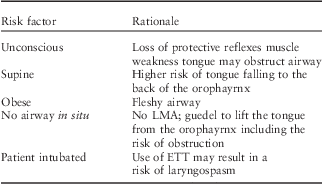
LMA = laryngeal mask airway
Table 4 shows that Mr X looks pale on arrival. His SaO2 is 93% on 35% FiO2, his breathing is regular but he is making a snoring noise. His mask is misting. Nurse Smith immediately deduces that his airway is patent, but that due to his unconscious state, size, position and lack of airway adjunct, he is demonstrating a degree of obstruction caused by the tongue falling to the back of the oropharynx [Pemberton, Reference Pemberton2002]. Critical thinking has taken place rapidly but without much hesitation since the risks in his presentation are well known to Nurse Smith and his physical assessment confirms the risks. The course of action is clear, combining a reactive element to correct the present degree of obstruction, and proactive, to pre-empt further obstruction that could develop into a clinical emergency. Intervention will include jaw thrust, the use of a guedel airway, increasing the oxygen and, if these measures fail, placing the patient in the recovery position. After each intervention, evaluation follows: has jaw thrust improved the situation? If not, then insertion of a guedel airway may remove the obstruction [Pemberton, Reference Pemberton2002]. This process continues until the obstruction has been corrected or the following scenario presents.
Mr X – physical assessment on arrival.

If Mr X displays pallor, falling saturation, with noisy breathing, limited sign of mask misting and any pattern of irregular breathing, then the obstruction that was routine has developed into a serious complication. Mr X is seriously obstructing and anaesthetic help must be summoned immediately. What is demonstrated here is how closely risk and physical appraisal, followed by an intervention, occurs.
Breathing
Assessment of breathing occurs virtually simultaneously along with airway. In the Mr X scenario, let us suppose that the anaesthetist has informed Nurse Smith on handover that the patient may be unconscious for a period due to the incremental dose of morphine administered towards the end of the procedure that terminated faster than expected. While handover is taking place, Nurse Smith is rapidly assessing his breathing rate, depth and pattern, along with colour and SaO2. By calling his name and gauging the response together with a check for pin-point pupils, Nurse Smith will determine how deep the level of unconsciousness is. At this early stage of recovery, Mr X is deeply unconscious, pale, with a saturation of 94%, respiratory rate of 10 breaths per minute and has shallow respiration with pin-point pupils. From this physical evidence, combined with the information from the anaesthetist, Nurse Smith quickly concludes that Mr X has a degree of central respiratory depression. Reference to the anaesthetic chart at this point confirms the dose and time of incremental doses of fentanyl and morphine administered during this procedure. Nurse Smith is fully aware that opioids together with volatile agents can render the respiratory centre less sensitive to carbon dioxide. As eliminating excess carbon dioxide is the primary trigger to breath, respiratory rate and volume decreases. Autonomic responses in the elderly are reduced; thus, the risk of developing respiratory depression is increased. Rapid recognition and diagnosis of this developing complication are possible as a result of her knowledge of the risk of opioid administration in the elderly along with confirmation by physical assessment. The critical thinking element incorporates weighing known risk with presenting symptoms.
Assuming that the anaesthetist has left and Mr X presents the above symptoms a little while after admission to PACU, at what point would Nurse Smith need to call for assistance in this situation? This requires an expert critical analysis of the situation. Nurse Smith realises that Mr X has little respiratory reserve due to his age. If his deep unconscious level is protracted, and he fails to respond at all to the stir-up regime, his rate and depth of respirations may result in severe hypoventilation with associated hypoxia. To avert this complication, Nurse Smith will call for assistance early, increase his oxygen, provide airway support, continue to try to rouse the patient and assess the effect of these interventions as they take place. The cycles of assessment are rapid at this stage. Depending on the assessment, she may start to bag the patient before the arrival of the anaesthetist and would certainly ensure that the emergency intubation trolley is at hand. As soon as the anaesthetist arrives, he takes over critical decision making and Nurse Smith will assist in whatever treatment he decides upon, in this case a probable dose of naloxone to reverse the opioid effect (BNF, 2011).
Nurse Smith's understanding of the potential for this risk of hypoventilation to develop into a real complication and the need to call for help at this juncture demonstrate critical thinking at its most acute. It is the result of her knowledge of underpinning applied anatomy and physiology related to normal breathing and the risk to this from general anaesthesia particularly in the elderly population. It is also the result of her experience in post-anaesthetic care nursing that she has seen this emerging complication before and knows what to do.
Circulation
We are now quite familiar with the case of Mr X. Let us now examine critical thinking in relation to circulatory performance. Mr X is now awake, the airway is secured and respiratory performance is satisfactory. He has now been in PACU for 40 minutes and we will assume that on reception his cardiovascular status was stable. Cycles of assessment are slowing down, there is more time now to consider in greater depth the risk factors implicit in Mr X's scenario related to circulatory stability and to formulate a plan that will pre-empt complications in this area.
Nurse Smith has now collected together evidence on which to base her plan of care. She understands the risk factors at this point from her knowledge of the effects of anaesthesia and large bowel surgery on the circulation particularly in the elderly (see Table 5). The anaesthetist has pointed out that the patient has a history of ischaemic heart disease and that fluid replacement will be a key factor in stabilising him. The anaesthetic chart details the pre and intra-operative vital signs together with fluid input and output.
Circulatory risk factors for Mr X with rationale.

At this point, Mr X's blood pressure has decreased while his heart rate has increased from those taken on admission. His urine output (measured hourly in urimeter) appears reduced and concentrated. Peripherally, he is still cool from the knees downwards and his central temperature is 35.5°C. Nurse Smith will consider all the above risk elements for this patient that appear to be confirmed by his physical assessment, demonstrating that he remains hypothermic and peripherally shut down, with decreasing blood pressure and a compensatory tachycardia. Nurse Smith now identifies the primary cause of Mr X's hypotension, which, if not corrected, could seriously complicate his recovery and lead to a cardiac incident. The diagnosis here must be hypovolaemic hypotension due to evaporative fluid loss, which is now compromising the intra-vascular volume. The secondary risks that are contributing towards hypotension are the use of epidural and volatile agents causing vasodilation. Blood pressure will decrease with reduced cardiac output against a decrease in peripheral vascular resistance [Sinclair et al, Reference Sinclair and Faleiro2006].
Mr X is already in established shock [Hatfield and Tronson, Reference Hatfield and Tronson2009] and his unstable circulatory status could bring on cardiac stress and cause myocardial damage, particularly if his pain is not well controlled and further myocardial stress is induced. His age represents another risk factor in that he does not have much cardiac reserve and his autonomic nervous system, which controls the heart rate, contractility and the calibre of the blood vessels, is inefficient [Drain et al, Reference Drain and Odom-Forren2009].
Nurse Smith has thought out all the multi-faceted risk elements implicit in this situation and considered these in the light of his current physical status. She diagnoses hypotension due primarily to hypovolaemia, with contributing vasodilation and hypothermia exacerbating this. Mr X's cardiovascular status is severely compromised and the underpinning cause must be treated by administering fluids, while protecting him from cardiac overload that will stress the myocardium. He must be filled and warmed to the peripheries slowly to avoid a sudden fluid shift and kept pain free and comfortable. Critical thinking using risk and contrasting it with physical status has enabled Nurse Smith to quickly diagnose this situation and alert the anaesthetist for a full review. Ongoing treatment will be provided in consultation and from meticulous observations of vital signs, input and urinary output.
Nurses knowledge of critical thinking
Critical assessment in the PACU incorporates both nursing knowledge and experience, essential elements in understanding risk, physically assessing the patient and arriving at a diagnosis and intervention (see Table 6). Critical thinking is increasingly demanded in clinical practice [Benning, Reference Benning2006]. However, there remains lack of evidence to demonstrate that Masters Degree programmes are successful in teaching these skills. Prowse [Reference Prowse and Lyne2000] suggests that knowledge of the biosciences and problem solving can be effectively taught in the practice setting embedded in a patient-specific context [Prowse, Reference Prowse and Lyne2000]. Certainly it would seem that with effective mentorship, critical care thinking can be routinely practiced in the PACU analysing the actual patient risk factors and complications and discussing likely patient diagnosis and treatment in context to his surgical history. There remains a dearth of literature on this important subject. Benning, [Reference Benning2006] cites the key characteristics of the critical thinker including being open-minded, inquisitive, truth-seeking, analytical, systematic and self-confident. All these qualities are essential in the PACU nurse, and developed with careful mentorship on practicing critical thinking by the bedside.
Building blocks to informed assessment and intervention.

PACU = post-anaesthetic care unit
There is no doubt that the risk factors in the peri-operative journey are being decreased in this fast-moving clinical world. Mitchell [Reference Mitchell2011] writes of ‘enhanced recovery’ encompassing patient pre-surgical optimisation, excellent intra-operative and post-operative management with nothing left to chance. Integrated care plans, risk protocols on intra-operative hypothermia and post-operative nausea and vomiting, balanced analgesia and the rapid development of day surgery have revolutionised care. Risk will, however, never be eradicated from peri-operative care. The PACU remains the only clinical speciality dedicated to understanding those risks, pre-empting them from developing into complications or treating these in a timely and appropriate manner. PACU nursing is a dynamic and underresearched clinical speciality. PACU nurses practice critical thinking routinely and have much to contribute towards the discussion on how best to advance critical thinking in nursing.





