

Tipu Sultan’s Plunder
In an early phase of the third Anglo-Mysore wars in September 1790, the Mysorean army under the command of Tipu Sultan very nearly overwhelmed a contingent of the Company’s forces. The Company’s army was forced to quickly retreat to Coimbatore, leaving roughly 500 of their own dead and many of their supplies behind. Among these, Tipu’s men found trunk-loads of books, instruments and manuscripts. Those that were deemed valuable or useful were moved to the palace library at Seringapatam, where they were carefully shelved. Some manuscript works of science were considered so valuable as to be rebound in red Moroccan leather decorated with gold tooling.
Thus it was that when, a few years later, the royal palace at Seringapatam was stormed by British troops and Tipu’s famous library was seized by the prize agents, some Company officers found their own lost journals beautifully preserved in the palace collections. Francis Buchanan (later Buchanan Hamilton), a naturalist and surveyor who in the spring of 1800 was sent out on a mission to conduct a survey of the Company’s latest territorial acquisition, was one such officer who discovered his work had been preserved at the Royal Library. When he arrived in Seringapatam, he was greeted with a notebook of his own that he had lost over a decade earlier. As Buchanan explains in a note he later wrote on the frontispiece.
These notes were taken by me at the Botanical Garden Edinburgh in summer 1780 [actually 1781]. In a voyage to India in 1785 Mr. Boiswell, then my mate and who remained in the country, had by mistake put them up in his trunk and lost them at the affair near Satimangulum where they were taken by Tippoo and by him bound up in their present form. At the taking of Seringapatam they fell into the hands of Major Ogg who has restored them to me.Footnote 1
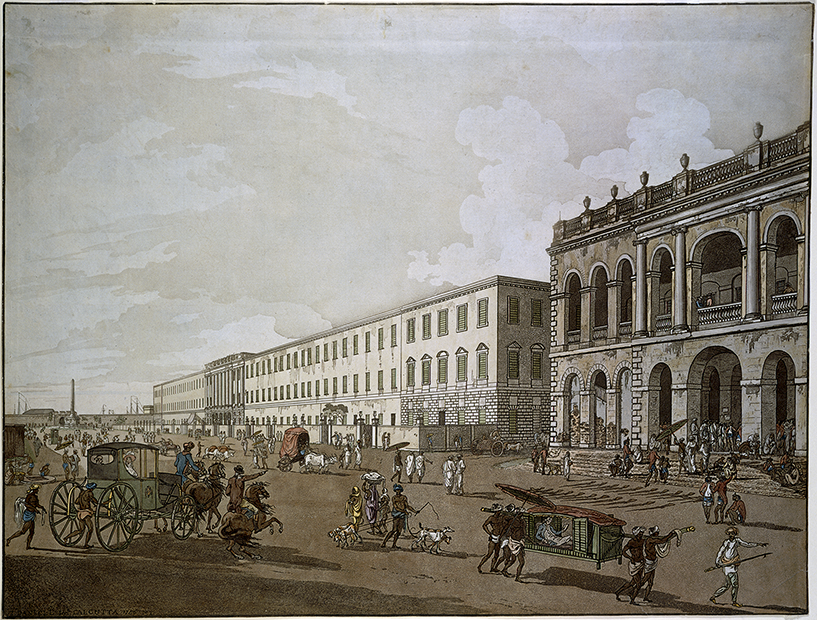
Some years later, Buchanan would return to Britain with not only his journal (which eventually ended up back at the library of the Royal Botanic Garden Edinburgh) but also a major collection of specimens and records collected during his survey of Mysore. And now it was Tipu’s personal writings and favorite books – including one of his copies of the Quran and a journal in which the sultan recorded his dreams – that would be rebound and carefully preserved in his enemy’s library. Eventually, the majority of Tipu’s library would also, after a bitter internal struggle between the directors and the governor-general, be sent back to India House (see Figure 2.2).
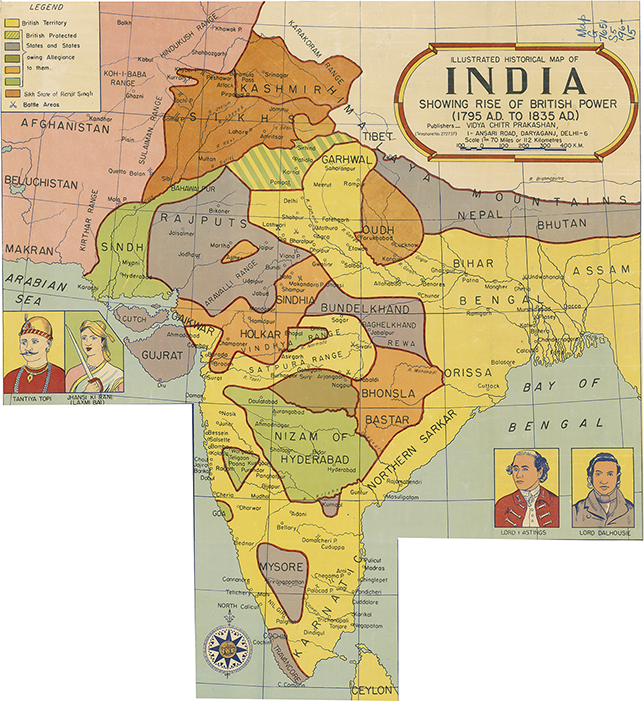
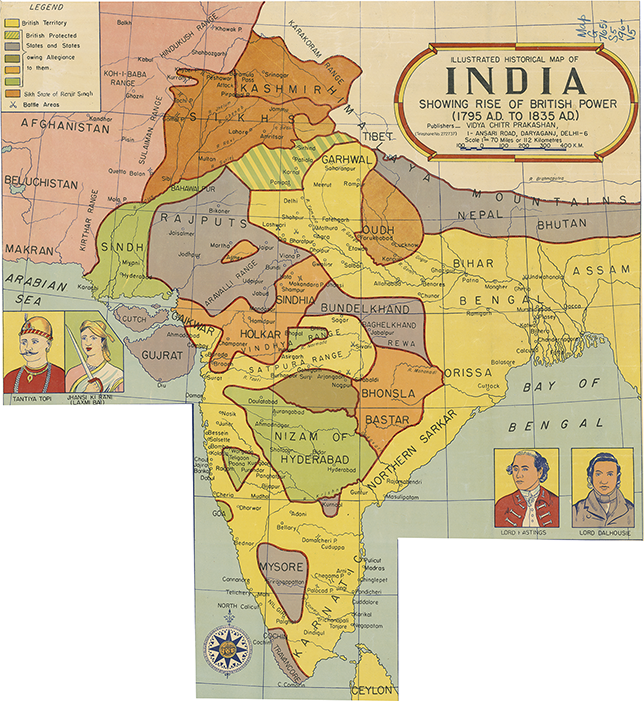
Map of East India Company territory in Asia, 1795–1835.
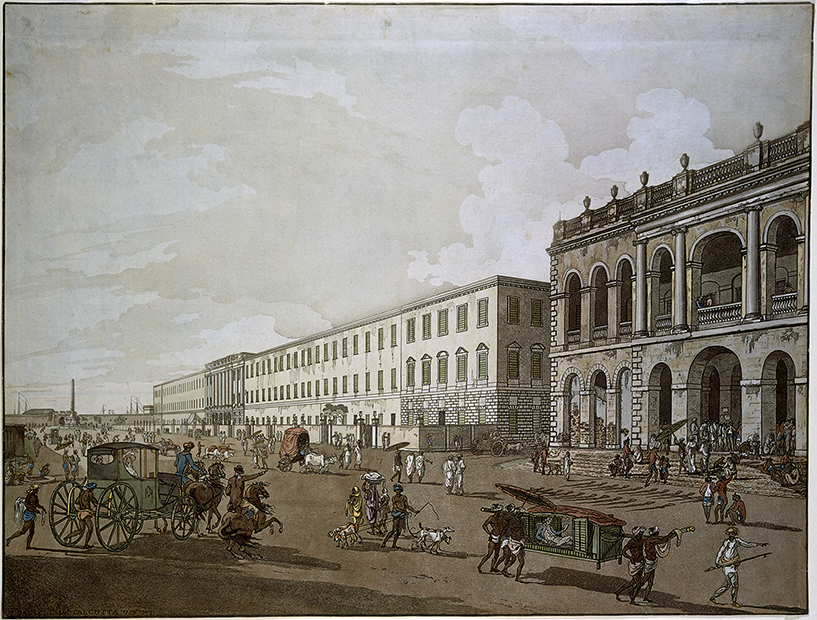
The Old Court House and Writer’s Building, Calcutta. By William Daniell, 1787.
This mutual capturing and recapturing of book collections between Mysore and the British is just one small example of the ways in which the capture of cultural property, including knowledge resources, was always, on all sides, a part of wartime plundering and looting. For centuries, Mughal powers on the subcontinent had, through war and other means, accumulated great collections.Footnote 2 By the mid eighteenth century, however, patterns of accumulation would begin to shift toward European collections. This was a period in which, as recent studies have shown, in the wealthy, increasingly cosmopolitan towns on the subcontinent, foreigners were able to study and collect only through establishing relationships with locals willing to be intermediaries and knowledge brokers.Footnote 3
In this chapter, I trace some of the wider political and economic changes that would allow foreigners, and particularly the British, to increasingly access and engage with the existing world of collecting, education and the sciences on the subcontinent. The result would be a slowing of the growth of resources in Indian centers such as Seringapatam and an acceleration of the growth of individual European-owned collections. The chapter begins by exploring changes in the patterns of accumulation that accompanied the conquest of Bengal. Here, I focus on the early careers of several Company servants who would eventually bring significant collections to Britain: Robert Orme, Alexander Dalrymple and Charles Wilkins. Each of these individuals would play an important role in the establishment of Company science back in Britain. And each, in their modes and methods of acquiring collections of knowledge resources from Asia, illustrate the debt that the growth of British resources would owe, in this period, to two major factors: wartime conventions of looting and plundering and (in consequence of the wartime upheaval) deepening social and political interaction between the foreign and local elite.Footnote 4 The final section of this chapter follows the Company’s first steps toward moving from contracted-out to Company-owned science, with new spaces and institutions of knowledge management being established in the wake of major land reforms in the 1790s.
Disaster Orientalism and Private Accumulation
In the India House library and museum’s carefully kept day books, November 20, 1801 marks the first material to be deposited in the new collections: John Corse’s presentation of “three Elephant heads with several detached parts intended to illustrate the natural history of those animals, so far as relates to their curious mode of Dentition.”Footnote 5 Three days later Charles Wilkins, the librarian, deposited a copy of Corse’s 1789 Philosophical Transactions essay on “Asiatic Elephants.” On that day, Wilkins also deposited one of his own works, a catalog of “Sanskrita manuscripts presented to the Royal Society by Sir William and Lady Jones.”Footnote 6 Into the stores on that day also came a “Persian manuscript traced on Oil Paper” with the English title “Mogul History” and six brass statues of Hindu deities.Footnote 7 These were presented to the library by John Roberts, one of the directors of the Company.
A week later, the first large deposit was recorded: fifty-seven volumes of printed material relating to the history of the Company; twenty-three volumes of manuscripts on the subject of India; thirty-seven rolls of maps and plans; thirty-five books of maps, plans and views; and four portfolios of maps.Footnote 8 This would turn out to be a large part of the collections gathered by Robert Orme who had been hired as the Company’s historiographer in 1769. The Company’s India House collections started, like most large collections, by absorbing and reordering other existing collections, particularly those privately held collections discussed in the previous chapter. And Orme’s material was itself a collection of collections. Initially, his material was purchased at bazaars in India where local antiquities traders were often dealing in broken-up family collections. His collection also contained manuscript copies of Company records. And a great deal of his books, maps and manuscripts were acquired by “right of conquest”; that is, plundering, in wars with the Mughals, the French and the Spanish. Orme’s collection, as we will see, was also an individual project (i.e. not a Company project) and was gathered (even when taken from various state archives) and used as his own private property. Eventually it would become an important founding collection for the India House library, and its origins and movements – like those of close contemporaries discussed later – illustrate some of the key steps in the Company’s transition from a renter or contractor of knowledge resources to a manager and, eventually, producer of the same.
Robert Orme was born in the kingdom of Travancore (now in Kerala) in 1728, joining the Company at the age of fifteen when he first returned to Fort St. George from his English boarding school years at Harrow. This was the beginning of a period of near-constant territorial skirmishes between the French Company and the English Company, going back to the War of Austrian Succession (1740–1748), and engaging a range of Indian states that aligned themselves with either France or Britain. Orme rose steadily through the ranks of the Company from individual writer to factor to, by 1755, senior member of the Madras Council, the top political body in the presidency. Amidst the regular work of a Company writer and factor, such as managing correspondence and negotiating trade agreements, Orme had also been working his way through the largely unorganized records held at the Madras presidency. By the mid eighteenth century, the Company’s operations at Fort William and Fort St. George had been regularized long enough that within the fort a large, largely unexamined archive of Company records had also accumulated. It was this collection that Orme had been probing and copying. Building up his own private version of the corporate archives, he employed local scribes to trace copies of manuscripts on oil paper.Footnote 9 Orme had also been collecting manuscripts from many other sources since joining the Company in 1742.Footnote 10
During the early 1750s, Orme shared his collecting and archival passion with another young officer of the Madras administration, the Scotsman Alexander Dalrymple. Dalrymple had joined the Company at the age of fifteen, working first in the factory stores, then under the assay-master at the mint, and then on to various junior positions within governing committees. Meanwhile, as a clerk and secretary, he also had access to the Company records. As he tells it, he had been obsessed with the idea of an as yet undiscovered southern continent since his youth, and had set his sights on following “Magalhanes [Magellan] and Columbus”; thus, once in the Company’s employment, “the desire of information” led him to seek out and copy Company records of eastward voyages.Footnote 11
Orme, meanwhile, had risen to the rank of senior administrator in Madras when the Seven Years’ War broke out. The decades between the Seven Years’ War and the start of the American Revolution in 1772 were the years of the making of what would become the infamous nabob fortunes in India. In 1756, at the outbreak of the war in Europe, long-simmering hostilities between the Company outpost-town of Calcutta and the French-backed nawab of Bengal, Siraj-ud-Daulah, boiled over into armed conflict. The nawab’s forces successfully captured Calcutta. Robert Clive was sent as commander of the Madras forces to recapture it. Clive’s forces retook Calcutta and marched on to a surprisingly decisive victory over the nawab’s forces, and, in the first of a series of direct political interventions, the Company installed one of Siraj-ud-Daulah’s generals, Mir Jafar, as the new nawab. This was the beginning of a complex process that would result in the Company becoming politically and economically intertwined with the existing Mughal state. Perhaps most importantly, the Company had now secured significant revenue rights over the vast and wealthy region of present-day Bengal, Bihar and Orissa. After formally taking over the administration of Bengal, over the next several decades the Company increased land taxes, began promoting the cultivation of poppy (for the Eastern opium trade) instead of grains and effectively established control over the grain markets. The attempt to increase revenues from Bengal was in part a response to the Company’s deteriorating finances, which had been hit hard by the cost of army expansion and the popularity of cheap smuggled Dutch tea in Britain and the Americas, undercutting their main line of trade revenue.Footnote 12 Meanwhile, in Bengal, food shortages beginning in 1768 were exacerbated by a poor annual monsoon season in 1769, and by 1770 the region was suffering a severe famine, which was followed by an epidemic of smallpox. Up to 10 million, or 30 percent of the population, were killed. During the famine period, even while the Company’s overall financial situation continued to deteriorate, the Company’s revenues from the region steadily increased.Footnote 13 So too did the individual wealth of many Company servants.
Clive became a patron of Orme, and, when he returned to London in 1769, so did Orme, bringing with him a massive private library. Dalrymple, meanwhile, continued to collect hydrographical material from the Madras archives. In 1759, he had obtained permission and support to attempt to discover a new route to China through the Molucca Islands and New Guinea. He would conduct three voyages between 1759 and 1764. Meanwhile, the Asian fronts of the Seven Years’ War had progressed. Not only had the Company established itself as the dominant European power in the northern Indian subcontinent and gained territorial control of a large portion of Bengal but it also now held Manila in the Spanish Philippines. The Admiralty and the Company had jointly invaded Manila, and the army plundered the city, invading private homes and burning, inadvertently, much of the state archives. During these voyages, and especially during his time in Manila in 1764, Dalrymple continued to amass his own personal collection.Footnote 14 As he later explained: “My peregrinations were of use even in this pursuit [i.e. building a collection]. I acquired amongst the Spaniards, some very valuable papers, and intimations from Spanish Writers, many of whose works [I] also procured.”Footnote 15
In this period, beyond the British-ruled territories, many native kingdoms extended their patronage to European naturalists, surgeons and engineers who had managed to gain a reputation on the subcontinent, and at this time Company servants were generally free to offer their employment to local British-aligned rulers. In the northeast, gardens and cabinets of curiosity were flourishing in Lucknow, capital of Awadh (Oudh), under the rule of Nawab Asaf-ud-Daula (ruled 1775–1795).Footnote 16 The Oudh Royal Library was particularly famous.Footnote 17 The Serampore gardens started out in 1771 as a public garden supported by local rulers.Footnote 18 In the south, the nawab of Arcot in the Carnatic (in which Madras was situated) employed in the late 1760s the first of Linnaeus’s “disciples” on the subcontinent. This Danish botanist, John Gerard Koenig, in turn became a prominent naturalist and collector and, via the nawab, supported a new generation of Company naturalist-collectors in southern India: James Anderson, physician general at Fort St. George in the 1770s; the physician and collector Patrick Russell; and botanist William Roxburgh (see Figure 2.3).Footnote 19 And, adjacent to the Carnatic, in the southern kingdom of Mysore, Sultan Hyder Ali was investing heavily in the growth of engineering, arts and sciences. Through his French allies, he imported European weaponry, instruments, works of art and literature and French military engineers.Footnote 20 Koenig eventually became salaried as a botanist by the Company as well after doing survey work in Siam and the Malay Peninsula. Russell would succeed Koenig as Company botanist in the Carnatic and made collections for the Madras government.Footnote 21 When Russell returned to Britain in 1790 (leaving his collections with the Madras government), Roxburgh, who had been experimenting with the cultivation of pepper, sugar-cane, coffee and other valuable commodities, was hired to replace him. Four years later, Roxburgh then moved up to Calcutta to direct the Company’s new botanical gardens (more on that in the final section of this chapter).
Pandanus Odorifer (Pandanus Odorifissimus), known for its aromatic oil, detail from Roxburgh, William. Plants of the Coast of Coromandel: Selected from Drawings and Descriptions Presented to the Hon.

In the same period, a small number of Company servants were becoming immensely wealthy from their personal dealings in India, and an increasing number of these “nabobs” were now back in Britain with their riches on full display. At the same time, drought and famine were ravaging Bengal. The Company was in deep financial trouble and was at times in the early 1770s unable to pay the annual customs duties on its imports in London, which in turn was a significant blow to the income of the British government.Footnote 22 These and other factors combined to push the Crown to seek increased control over the Company. When the disastrous state of the Company’s first decade of territorial rule became fully known in Britain, Parliament acted to impose for the first time a layer of direct Crown control over the Company’s activities with the Regulating Act of 1773. The Act banned private trade and imposed a new organization on the Company’s administration in India, with a single governor-general now heading the Government of India from Calcutta.
The appointment of Warren Hastings as the first governor-general after the Regulating Act is often taken as a turning point in colonial science in British India under the Company. Hastings promoted a version of imperial rule according to the “native” or “natural” laws already in place. Thus, as Hastings sometimes argued, the route to prosperous Company governance of Bengal must be guided by increasing knowledge of the history, laws and resources of the region, by way of the work of orientalists, surveyors and naturalists. In this mode, Hastings positioned himself as a translator of India for the British and as a “liberal” (i.e. generous) protector and promoter of the arts and culture.Footnote 23 With various forms of encouragement from Hastings, a new generation of Company servants also took on the collection and study of Indian language, history, geography and natural resources. These early British orientalists, such as Nathaniel Halhed, William Jones and Charles Wilkins, turned their interest to Sanskrit, Bengali and other languages that had so far been neglected relative to Persian, the language of state for the Mughal Empire. Such changes should not be read, as they sometimes have been, as primarily the result of Hastings’s own qualities, or of “Enlightenment values” reaching British India by way of Hastings’s patronage. Equally, if not more, important were the wider transformations in the British position in Bengal, which opened new opportunities for knowledge exchange, collecting and scholarship. For one thing, the new offices and administrative positions created in response to expanding British control over territorial revenue also created new sites and situations for British interaction with local scholars and administrators of the Mughal courts.Footnote 24 Furthermore, Hastings’s generation of scholars were perfectly poised to take advantage of the radical cultural and economic upheaval left by the famine.
It is that conjunction of genuine amateur orientalism with the brutality of the Company’s expansion at the time that is critical to understanding the growth of British orientalism in the period. Before 1757, it had been common for Company servants to complain that the local administrative and learned elite were uninterested in sharing their knowledge. Hastings claimed there had long been a “jealous prejudice” against interlocution with the British, which led them to “guard” their knowledge from foreigners.Footnote 25 By the early 1770s, however, with their student numbers decimated and many formerly wealthy patrons now unable to support them, the local intellectual elite increasingly turned to the British for employment. Pandits (experts in Persian) and munshis (experts in Sanskrit and Hindu jurisprudence) in Bengal at this time were often from long lines of families that had served as scribes, accountants and translators for the Mughal elites.Footnote 26 In the kingdoms of southern India, scribal elites played a similar role, and in the late eighteenth and early nineteenth centuries more and more had, out of necessity, shifted to working for the British. There was plenty of work of this kind to be had: in a partial step toward directly supporting officer education, all young men entering the India service in Calcutta or Madras were now granted a “munshi’s allowance” with which to hire a teacher for language instruction in their first few years of employment.Footnote 27
Native experts on local laws and religions were also increasingly hired directly by the presidency governments to compile and translate the existing laws and statutes in practice in different regions. Jones, for example, was given approval in 1788 to hire ten native scholars and writers, on competitive salaries, to produce a digest of Hindu laws of inheritance and contracts. And, as Jones explained to the Supreme Council, salaries for these positions would have to be high in order to attract qualified applicants. After the project was underway, one Company administrator noted that it was remarkable Jones had managed to hire enough qualified and willing people, interpreting the change as a matter of trust: “it may be remarked, as an occurrence of no ordinary nature, that the professors of the Brammanical faith should so far renounce their reserve and distrust, as to submit to the direction of a native of Europe, for compiling a digest of their own laws.”Footnote 28 Hastings would assert that his own government should take credit, attributing the dissipation of the “jealous prejudice” of the “Brahmans” to the “liberal treatment they have of late years experienced from the mildness of our government.”Footnote 29 However, the root cause of this new alignment of interests lay not with the “mildness” of Company rule but with a totally transformed political economy of education and knowledge production in the region.
This relatively large-scale integration of the local scholarly elite into the Company’s administration in the presidencies marked a new shift in the way information was being accumulated by the British. The collections of the generation before the Seven Years’ War were made largely through gift exchanges, the occasional plunder of rival French, Spanish or Dutch ships and purchases and exchanges in bazaars. Those of Orme and Dalrymple’s time were formed in similar ways, and in addition sometimes drew on the Company’s own records. Now, however, there was an increasingly important interpersonal dimension. Through directly hiring local experts, much new work was being produced. The Company writer and future Member of Parliament Nathaniel Brassey Halhed, for example, employed a group of eleven pandits and munshis (or “most experienced Lawyers” and “Professors of the Ordinances,” as he calls them) to gather materials and produce interpretations and translations for one of the first of the British compilations and translation/interpretations of native legal codes, the Code of Gentoo Laws (1778).Footnote 30 In his orientalist work, William Jones studied closely with Sanskrit tutors such as Ramlochan and munshis such as Bahaman, and when on the bench as a judge he depended on the advice of the court pandits Goberdhan Kaul and Ramcharan.Footnote 31
Charles Wilkins, the Company’s first curator of the India House library-museum, made his name in British India as a printer and authority on Sanskrit after managing to obtain access to renowned tutors in Benares. From a family of printers, Wilkins went to India as a Company writer and quickly became involved in producing the first native-language typefaces for such clients as the Raja of Tanjore.Footnote 32 Wilkins also focused on acquiring local languages and was allowed to remain on leave from his usual duties in Calcutta for a year in Benares, an important seat of Hindu scholarship and on the fringe of Company-controlled territory. Here, he was one of the first Europeans to be allowed to study Sanskrit under Indian Brahmin pandits.Footnote 33 He worked especially closely with Kasinatha Bhattacharya on a set of transcriptions and translations that would establish his reputation as the first English translator of, and leading authority on, Sanskrit. In this collaborative context, collecting often took the form of copying out texts provided by the teachers, transcribing oral lessons, and making vocabularies, word lists and dictionaries.
During this time, under Kasinatha, Wilkins pieced together a first English translation of one of the central texts of Hinduism, the Bhagavad Gita. After Wilkins sent Hastings a manuscript copy of the translation, Hastings secured (without Wilkins’s knowledge) the patronage of the Court of Directors to publish the work in London. Wilkins’s Gita was a commercial success, the first Hindu work of literature to be widely read in Europe, and was sold to the public as “one of the greatest curiosities ever presented to the literary world”; becoming something of a sensation, it was published in French, Russian and German within a decade.Footnote 34 Prefacing the work was a letter from Hastings to the chairman of the Company, Nathaniel Smith, which argues for the value (“if not utility”) of such projects to the interests of the Company: cultural exchanges will bond the British and the people of India in mutual understanding. On the one hand, having Company servants read the Gita will improve their virtue and trustworthiness.Footnote 35 On the other hand, he suggests that in producing a translation of the Gita, the British were demonstrating that – in contrast to the Mughal rulers of old – the new rulers of Bengal were respectful of the knowledge of the “Brahmans.” Here, Hastings promotes the value of Indian literature for the English along the lines of what Uday Singh Mehta has termed a “cosmopolitanism of sentiments,” according to which the route to improving imperial rule is increasing understanding and a meeting of minds between the subjects of Britain and the subjects of British India.Footnote 36 To Hastings and his generation, nothing could be so useful in creating a bond between Britain and India as an exchange of high art and knowledge.
Importantly for the subject of this chapter, Hastings also valorizes the very process of collecting and gathering knowledge as part of the meeting of British and Indian minds. In Hastings’s presentation, the social interaction around which the “accumulation” of knowledge occurs tends in itself to reduce prejudice and ill-feeling among both subjects and rulers, and both the inhabitants of India and of England:
Every accumulation of knowledge, and especially such as is obtained by social communication with people over whom we exercise a domain founded on the right of conquest, is useful to the state: it is the gain of humanity: in the specific instance which I have stated, it attracts and conciliates distant affections; it lessens the weight of the chain by which the natives are held in subjection; and it imprints on the hearts of our own countrymen the sense and obligation of benevolence.Footnote 37
The native centers of education, such as where Wilkins was based in Benares, are depicted here as a place of exchange, interaction and growing cultural understanding, a place where knowledge generates respect and respect generates further avenues for exchange.
Of particular relevance to the future creation of the Company’s library-museum at India House fifteen years later, Hastings argues that a lessening of prejudice among the inhabitants of England is also critically needed, hence the importance of accumulating knowledge of India back in Britain:
It is not very long since the inhabitants of India were considered by many, as creatures scarcely elevated above the degree of savage life; nor, I fear, is that prejudice yet wholly eradicated, though surely abated. Every instance which brings their real character home to observation will impress us with a more generous sense of feeling for their natural rights, and teach us to estimate them by the measure of our own.Footnote 38
In direct contrast to some later Company idealogues, most notably James Mill, Hastings is arguing that it is to the mutual benefit of all that the British public and the people of British India to come to know each other through cultural exchange.
By the mid 1780s, the Company was beginning to bring responsibility for the education of its servants under even more formal control. Hastings had established the Calcutta Madrassa. Meanwhile, Kasinatha remained in Benares and became personal pandit to the British Resident Jonathan Duncan. Kasinatha convinced Duncan, and ultimately the Court of Directors, to establish a Company-funded “Hindoo College or academy” for the collection and transcription of ancient texts; and for the education of new pandits who could go on to serve within the colonial government.
Along with the new madrassas and colleges, orientalists and naturalists among the Company’s servants also organized themselves, under the patronage of Hastings, into a scholarly society. William Jones’s idea in 1784 to establish a scholarly society in Calcutta “to enquire into the arts, sciences and literature of Asia” envisioned a new communal organization for what had long been a fragmented and individualistic pursuit.Footnote 39 The Asiatic Society of Bengal met at the Grand Jury Rooms of the Supreme Court, the same court of British-trained judges that had been imposed on the Company by the Regulating Act, where Jones himself (and several other founding members) was a junior judge. The Society had eighty-nine members by 1788, many of whom were drawn from the Company administration. The Court of Directors often extended support to the publications of Society fellows, usually subscribing in advance for a significant number (usually fifty) of books.Footnote 40 In these formal and informal ways, both native scholars and Company servants were increasingly given material – if irregular – support by the Company.
The Sciences of the Permanent Settlement
By the time the Company’s charter was up for renewal again in 1793, France had just invaded Austria, Louis XIV had been executed and the new Republic had declared all old monarchies its enemy. With France a growing presence on the Indian subcontinent as well, the Company’s armies were within the penumbra of potential war. Company profits were healthy, as the recent lowering of taxes on tea in 1784 led to a boom in the China trade, and the Company’s tea sales at India House had risen from £6.5 million to £15 million within the last two years. In this political climate, the Company’s charter was renewed with minimal debate and only minor changes.Footnote 41 In India, meanwhile, the Company had initiated a vast reworking of the land-ownership system in Bengal. The Permanent Settlement Plan, begun in 1786 and finalized in 1793, aimed to increase land productivity by stimulating technical and infrastructural change in agricultural practices. The regional tax collectors (zamindari) were compelled to enter into a “permanent” fixed-rate contract with the Company, on the basis that this would secure more reliable revenue while at the same time encouraging the new landed class to reinvest profits in capital development.
Historians have argued that, while Hastings and the early orientalists such as Wilkins and Jones had been focused on understanding and interpreting India, by the 1790s the idiom of the Board of Control, and of British politics in general, was increasingly one of change and improvement.Footnote 42 The Mughal instruments of state that had once been seen as the necessary basis for Company policy were increasingly disregarded as degraded relics. If Company rule was not bound to Mughal traditions, the door to bringing British traditions to the subcontinent was opened.Footnote 43 In the Permanent Settlement Act, the Company pursued liberal forms of “improvement” on a vast new scale according to a very British model of a landed class. The reworking of property relations would, it was hoped, create in Bengal a new class of improvement-minded landowners.Footnote 44 Decades later, similar thinking would also lead Thomas Munro to institute land-ownership reforms (ryotwari), giving direct ownership to cultivators, in the Madras and Bombay presidencies.
In other parts of its empire in the final years of the eighteenth century, the Company’s pursuit of “improvement” ranged widely, from small interventions such as the introduction of a new plow in St. Helena, to the production of a history of Indian snakes and poison treatments (produced by Madras naturalist Patrick Russell, whose collections would end up split between Joseph Banks and the Company’s museum), to much more ambitious attempts to introduce new cash crops to India.Footnote 45 Cash crop projects were one of the most contentious issues relating to science under the Company in this period. Especially in the wake of the loss of the North American colonies, manufacturers and politicians pushed for increasing the production of commodities of critical economic interest to Britain. In this period, the directors tended to act on this matter not by managing such projects directly but rather by offering individuals the chance to develop and profit from a new venture. For example, when Joseph Banks and the Board of Trade argued for the expansion of Indian hemp and flax, both being key materials for rope and cordage, and an absolutely critical naval supply, the Company, in response, granted passage to India for one agricultural projector named George Sinclair, “reputed to be well skilled in the culture and management of hemp and flax according to the most approved methods practiced in Europe.”Footnote 46 Sinclair had submitted a pamphlet to the directors in which he proposed new methods for growing improved hemp in Bengal. Sinclair was then permitted to proceed to Bengal “for the purpose of ascertaining by experiments to be made on his own private account how far his ideas, as detailed in this work, shall appear to be well founded.” The dispatch makes clear that although the directors viewed research into hemp production as a matter “of important national advantage,” and while they offer Sinclair “every degree of protection that may be needful,” they stop short of funding the project: “We have not deemed it expedient that the Company should be subject to any expence on this account.”Footnote 47 Fully flexing its monopoly on access to Asia’s nature, the Company offers only the right to travel and experiment in India and the “protection” of his ventures, in exchange for his self-funded pursuit of new agricultural projects. The Company also offers further encouragement to Sinclair in the form of a guarantee of wide freedom of movement and action. Should the hemp and flax project “fail to effect the improvements suggested,” Sinclair is given “liberty to engage in any other” so long as his operations remain strictly within the limits of the Company’s territories.Footnote 48 Sinclair was initially successful and in 1799 the Company agreed to a large experimental station, still funded by Sinclair, for the production of hemp, flax, and sunn, contracted with the Marine Board. When Sinclair died later that year, the Court arranged to pass the contract to Banks, who funded the voyage out to India of six flax growers.Footnote 49
Sometimes the directors developed interests in particular projects or regions from their informants or the pages of the Asiatic Society of Bengal’s journal. In these cases, again, the only direct action taken by the directors would be an expression of interest or a recommendation sent out to the presidencies, with the funding, personnel and details being left to those governments. For example, in 1797 the directors wrote in a public dispatch of their interest in obtaining more information about “the hill people of Tipperah, Garrow and Rajamhal,” about whom they had received some “first outlines” from an overland route journal of one “Ensign Blunt” that made its way into the hands of the Court of Directors. Desiring more information (“to be filled up with many particulars”) in order to “serve as the basis of opinion or of measures,” the directors “recommended this subject” to the attention of the governor-general. Another few paragraphs give some instructions (though the directors say they do not want to “prescribe minutely the mode or the instruments by which enquiry shall be prosecuted”) and stress that all should be done at minimum cost, with only “public utility” (not “private emolument”) in mind. The letter then goes on to give a list of “the subjects of investigation” – a list very similar to the “instructions for travelers” written by the Royal Society and other bodies seeking in some way to organize and direct the naturalist or surveyor’s attention. Also notable is the suggestion (likely at the behest of one of the Company orientalists back in London) of a comparative study of the languages of the hill regions and those of the plains, which “would probably throw much light upon the origin, perhaps also upon the early history, of both races, and upon other points of curious research.” But, again, while signaling support for research into questions of current natural philosophical interest, the directors also make it more than clear that the aim of these broad inquiries is “improvement”: to answer the question of “how the condition of these wild people may be improved, how they may be civilized.” And improvement of this kind, in turn, is meant to aid the Company in bringing these areas “within the boundaries of the Company’s government.”Footnote 50
Under an intensifying interest in “improving” the agricultural districts and “civilizing” the hill districts, the directors continued some of the old modes of science patronage by way of irregular individual enterprise. But more change was also coming to the organization of Company science in India. One of the earliest of these was the growing administration surrounding medical practice and hospitals. Back in the early 1760s, the three presidencies had each established Medical Service branches. These were staffed by officers under the management of a head surgeon, and civil and military branches of the service were also established. The institutional scope of the Medical Service would continue to grow steadily throughout the first half of the nineteenth century.Footnote 51 In addition, new institutions of science under the Company stemmed directly from the new land policies being applied to Bengal. These policies would also reorder the Company’s relationship to knowledge of India. First and foremost, the Permanent Settlement stimulated a new wave of revenue surveys and maps of property lines (as would the ryotwari system in the south).
Geography was now the fastest-growing branch of Company-owned science on the subcontinent. Just as hydrographical knowledge had always been critical to the success of the long-distance trade, geographical knowledge was now essential to the Company’s territorial, tax-funded administration. As Colin Mackenzie, the Company’s first surveyor-general (and who, as we will see, amassed a vast collection of manuscripts), would put it in 1795, “knowledge of Geography” is merely “a useful preliminary” to the real target of Company interest: “The Revenues, Resources, Populations, Natural Productions and Manufacturers of a Country.”Footnote 52 But geographical expertise was not (and perhaps could not be) contracted out, as hydrography had been through the ship captains. The Company hired its first in-house surveyor, James Rennell, in 1767, over thirty years before it created (for Dalrymple) the position of in-house hydrographer. Rennell’s first assignments were to produced route maps and topographic surveys of the Company’s new territories in Bengal and Bihar. After his Bengal Atlas of 1780, Rennell next pieced together the first English map of the entire subcontinent, the Map of Hindustan. And as surveying and mapmaking grew under the Company, so too did the need for astronomical measurements to determine longitude and keep time. In 1792, the Company formally took over the running of a small private observatory in Madras that had been set up by the administrator William Petrie, thus establishing the first of what would become, by the 1830s, a disparate network of Company-owned observatories across the empire, with Madras the colonial center of that network. Soon the Madras observatory would also be collecting stellar positions from the southern sky, to be exported to India House, which would in turn forward the data to Greenwich Observatory.
Surveying and astronomy were closely connected to the military, and these new institutions show how the Company’s army was, around the turn of the century, becoming, as Christopher Bayly puts it, “a most important store of information available to the colonial state, rivalling the civilian service.”Footnote 53 The army itself was becoming a form of “institutionalized knowledge.” As the army moved away from supplying by way of foraging, looting and forced extraction to formally engaging a wide range of supply contractors, procurement officers put together a web of local suppliers who provided to the army everything from maps and route guides to victuals and medicines to horses and armorers.Footnote 54
Meanwhile, a different kind of investment in a new institution of science was underway in Calcutta. In 1788, the Court of Directors approved funding for a new botanical garden. Far from the ornamental pleasure gardens they would become, botanical gardens in the late eighteenth century were experimentation stations for horticultural and agricultural projects such as the hemp and flax investigations of Sinclair. The Company had only tried to establish a botanical garden once before, in 1760, at their small spice-trading factory in Sumatra, Bencoolen. At the time, the capture of Manila had raised hopes of new success for the British spice trade. Earlier attempts to develop spice plantations were revived, and while Dalrymple was plundering the archives of the Spanish Philippines, the Company made a (then) rare effort to formally organize botanical collecting and development. It had been staffed by Philip and Charles Miller, sons of the head gardener at the Chelsea Physic Garden. The Millers were to develop “in the greatest secrecy” nutmeg and clove plantations, and there was hope that tea, ginger, turmeric and mulberries could also be cultivated. Spice plantations run by Chinese migrants already dotted the archipelago, and Bugis traders smuggled in seedlings purchased or gathered from these plantations or areas in which the British were not granted access.Footnote 55
Company support for the idea of a botanical garden at Calcutta was very strong, and its plan, drawn up by a military inspector, Lt Colonel Robert Kyd, was ambitious.Footnote 56 Upon receiving Kyd’s proposal, the Court of Directors sought the opinion of Joseph Banks, who was very enthusiastic about the idea. At this time, the closest the British had to a national botanical garden was George III’s Royal Gardens at Kew, where, since the early 1770s, Banks and others had conducted experiments in transplanting exotic flora. In support of a Company garden, Banks echoed Kyd’s rhetoric of the joint benefit to the inhabitants of India (food crops alleviating famine), the profit of the Company (developing produce for trade with China) and Britain (establishing export crops of use to British industry such as cotton or hemp). More surprisingly, in a report sent to the Court of Directors via the Royal Society’s president, Thomas Morton, Banks also argued that the Company’s proposal was too ambitious, large and expensive. Banks estimated the proposed garden was of an “immense size … which cannot be less than 50 or 55 acres” – much too large, he believed, to be managed successfully. Banks compared its proposed size to Kew, which he said was only about two acres, and he noted that even the large nurseries near London that supplied the whole city with “trees, shrubs and plants seldom occupy above 20 [acres].” He cautioned that “if the garden is established on this Extensive plan the seeds of its certain dissolution are sown at the very period of its institution.”Footnote 57
Kyd had actually chosen a site that would be 310 acres. And when the directors authorized the proposal, no mention was made of curbing his ambitions. Their usual cautions about overspending were relatively mild: “so sensible are we of the vast importance of the objects in view, that it is by no means our intention to restrict in point of expense in the pursuit of it.”Footnote 58 Thus, when George Sinclair first set out to make his fortune in hemp and flax (or some other new venture) in 1793, he was not entirely without formal Company support. Ahead of Sinclair, some seeds and other supplies were sent by him to the Calcutta gardens, where Sinclair would first test out some of his methods.Footnote 59
It seems clear that the Court of Directors’ enthusiasm for the botanical gardens was tied to both the desperate crisis of the recent famines and new hopes for “improving” the political economy of Bengal via agricultural development. Recent histories of colonial science in India have documented the immense political and scientific significance of the Calcutta gardens.Footnote 60 The disastrousness of the first years of Company rule in Bengal had, by the early 1770s, become fully recognized back in Britain. By the mid 1770s, the discourse surrounding how to improve or enrich the colony took on a new urgency.Footnote 61 There was, however, little agreement on the cause of Bengal’s woes and therefore how to proceed. Some British contemporaries saw the famines as evidence of the inherent defects of the land; others blamed the inhabitants, their character or husbandry.Footnote 62 Plenty others blamed the Company – both its policies from London and the apparently rapacious greed of its servants in India. Kyd’s proposal framed the key aim of the gardens in terms of alleviating the risk of famine in northern India. And although the directors agreed, the correspondence with Banks was much more focused on resources substitution and the possibility of introducing new cash crops such as tea. Over the next decades, as Zaheer Baber argues, “the possible role of the botanic gardens in alleviating the effects of famine on the population articulated in Kyd’s original proposal was forgotten and renewed attention to its contribution to enhanced revenue generation became salient.”Footnote 63
It would be many more years before the Calcutta gardens became a distribution hub for the multiplying plantations of new cash crops, including cotton, tea, chinchona and eventually rubber. In the meantime, the gardens became a center for the accumulation of botanical and natural historical collections, with ever larger shipments sending many of these materials back to Britain. Kyd died soon after his proposal was accepted, and William Roxburgh, then the Company’s naturalist in Madras, took over in 1794. For the next twenty years, Roxburgh experimented with many different kinds of economic plantations (teak was the most successful, though the garden was also propagating coffee from Arabia and tobacco from Virginia and Bengal hemp) and planted thousands of new species in the gardens. He also commissioned hundreds of drawings of native plants, folios of which he had been sending to Joseph Banks since 1790. With Banks as an intermediary, the Company agreed to support the publication of the multivolume result of Roxburgh’s botanizing around Madras.Footnote 64 This would be the beginning of a new pattern, continued first by Colebrooke and then Nathaniel Wallich, of regular exports of botanical collections from the Calcutta gardens to London, where, after 1801, for a time, the deposits would be placed at India House rather than with Banks or Kew.Footnote 65
*
Speaking to the Asiatic Society of Bengal of the challenges and opportunities for scientific investigation in British India, William Jones lamented that what Company servants needed in order to pursue their investigations was more time: “‘Give me a place to stand on,’ said the great mathematician [Archimedes] ‘and I will move the whole earth.” Give us time, we may say, for our investigators, and we will transfer to Europe all the sciences, arts, and literature of Asia.”Footnote 66
Whereas it had once been very difficult and expensive for Europeans to even gain minimal acquaintance with the “science, arts and literature of Asia,” now the greatest barrier was, according to Jones, time: time away from the official Company duties to which each and every British orientalist in India was tied. But that barrier, too, was beginning to fall as the Company started to create positions and offices devoted to knowledge management and production. Between the end of the Seven Years’ War and the beginning of the Napoleonic wars, the Company was beginning to engage much more directly in the organization and management of the sciences upon which its trade and governance depended. Kapil Raj calls this period “the first step in the transformation of the study of exotic peoples from an individual activity – mainly European missionaries – into a massive and institutionalized activity … [and] the first step in the transformation of the emerging British empire from one held by force of arms to one held – at least in theory – by information.”Footnote 67 As we have seen, those changes began with the wartime transformations of the political economy of knowledge in Bengal. While foreigners in India had always collected, both wartime plundering and the Company’s new position relative to the Mughal Empire would open up many new avenues of access for Britons intent on acquiring manuscripts, curiosities and other knowledge resources. The Company’s financial support for the publication of the Gita is one example of the kind of patronage that was extended to naturalists and orientalists. But the large collections that were beginning to be brought back to London would remain, for now, part of the private trade, destined for personal collections or sale by individuals. And, as we will see in Chapter 3, as more and more servants returned to London with their collections and skills in tow, a new form of Company public–private science would begin to form by the 1790s, eventually reshaping the institutional structures of science in London.
In this earlier period, as we have seen, virtually all of the new developments in Company science were happening in the colonies: the ambitious new terrestrial surveys, which deployed state-of-the-art techniques; the generously funded botanical gardens at Calcutta; and the wider, more formalized employment of pandits, munshis and other native educators and scholars. These new spaces for knowledge production and management within the Company represent some of the many changes that accompanied the Company’s structural transformation during the late eighteenth century from a relatively marginal militarized maritime trading company to the subcontinent’s dominant territorial imperial power. As we will see, however, within a few short years, pressures from both the subcontinent and the home country would lead the Company to sharply increase investment in institutions of science and education back in Britain.


 Open access