

The world will not be destroyed by those who do evil, but by those who watch them without doing anything.
Peter’s father, Richard Huttenlocher, was born in 1900 in Alte Weinsteige, in the hilly vineyards near Stuttgart. Richard’s father, Johann Huttenlocher, was a policeman in Stuttgart. Richard’s mother, Elisabethe, “Oma” Huttenlocher (family name Gaupp), was a doting mother and ran a traditional home, with a knack for German baking that she shared with her grandson Peter. Both Richard and his older brother Friedrich (Uncle Fritz) studied the sciences in the Gymnasium (high school), but their studies were interrupted by the First World War. Fritz was stationed at the western front from 1914 to 1918, where he was wounded, and was recognized with an Iron Cross from the Prussian government. Richard had only a brief stint as a young soldier, toward the end of the war. After the war, they both returned to live at the family home. Richard studied chemistry at the University of Stuttgart and Fritz studied geography/geology at the University of Tübingen. They both married young. Fritz married his wife Hannah, a traditional woman, in 1920, and continued to work at the University of Tübingen as a lecturer and then professor.
Richard, the second son, was more independent - minded and embraced the freedoms of Weimar Germany. He fell in love with Else, the rebellious and strong-minded young opera student. They were quickly married and shortly after welcomed their first son Dieter. After completing his PhD, Richard left the family home and moved to Oberlahnstein for his work at a chemical company while Else sang with the Cologne Opera. Shortly after their departure in 1931, around the time of Peter’s birth, Richard’s father passed away. As a child, Peter frequently visited his Oma and Uncle Fritz and their large dogs. From their home you could walk for miles on trails through the vineyards, with expansive views of the valley below. There were frequent family visits to the large extended Huttenlocher and Gaupp families, who lived near Stuttgart, in the village of Beutelsbach. Indeed, the Huttenlocher family can be traced to a small village in the region starting in the mid-1400s.
Uncle Fritz was an artist and an outdoors enthusiast who enjoyed hiking with his young nephews in the German Alps. Peter recalled hikes with his uncle as a child, an interest that he shared with his own children years later in the United States. There are scant details of how Peter’s extended family lived during the war. Fritz was a teacher and professor at the University of Tübingen and a leader in dissecting the geography and geological features of the Bavarian Alps. An online resource from the “Commission for the Geographic History of Baden-Wurttemberg” provides some information about his success as a geographer “as well as his highly artistic disposition, to which his numerous paintings, especially his landscape paintings, testify in their immediate and sure grasp of form and color. Initially, he even wavered as to whether he should follow the path of an artist or that of a scientist.” Fritz Huttenlocher took on the major part of southwestern Germany in the great joint work that German geographers undertook immediately after the Second World War. He was interested in cultural landscapes and how populations settled and formed towns in these geographical regions. It was also noted that “through the solid training of student teachers, who revered him as a competent, open-minded, always helpful, kind academic teacher, he had an extraordinarily broad impact.”
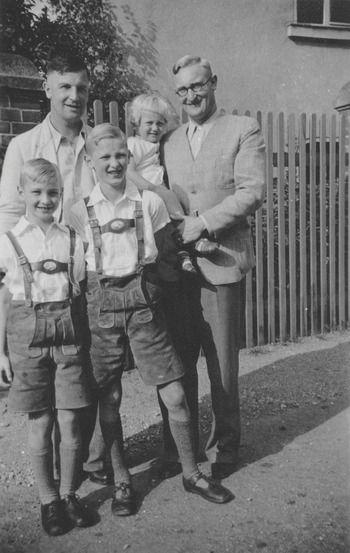
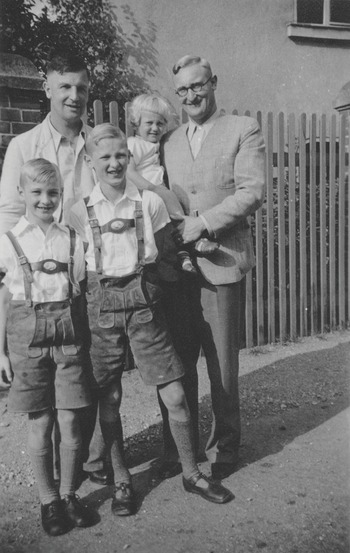
Fritz’s involvement with the Nazis generated some family disagreement. How Fritz responded to Richard and to Else, who openly opposed Nazism in the early 1930s, remains unclear. However, the brothers remained close with frequent family visits (Figure 4.1). But as time passed, Richard avoided the Nazi party with dogged determination. Peter struggled to reconcile his fondness for his “kind” Uncle Fritz with his uncle’s activities during the war. It was compulsory under Nazism that all professors join and serve the party to continue employment at the university. In the same source, it is documented that Friedrich Huttenlocher served from “1939–1945 Military service, and from 1941 as a military geographer; Captain of the reserves.” As in so many German families, this was not spoken of. After the war, Uncle Fritz and many other academics in Germany continued in their academic positions as if Nazism had not happened. The war years were shrouded in a zone of silence.
Richard worked in the private sector and party membership was not required. As Peter’s half-brother Wolfgang later described, even when Nazi officials appeared at his home to encourage party membership, he declined to join. Richard was remembered as a person who was always thinking ahead, considering all options and planning. As a chemist, he was expected to aid in the war effort through the production of ammunitions in their company factories that normally produced soaps and surfactants. He did the work, but he would not go as far as taking an oath of loyalty to Hitler. And although it was dangerous to do so, he communicated his disdain to his sons. As he wrote to Else after the war when helping to prepare her for Dieter and Peter’s arrival in her home: “You must keep in front of your eyes that both boys were raised in a constant dismissal and critique of Nazism – both were brought up to deny and criticize the national socialism. They were brought up to disagree with the government.”
Richard also wrote the following to Else in 1949, after Peter and his brother had emigrated, perhaps as part of a coming to terms with his own actions over the previous 15 years: “In the German concentration camps many found their end in a most terrible way. All of us really did not know whether we would not have to share the same end. When we disagreed then hell broke loose.” Else had been labeled deviant. She had openly defied and protested Nazism. Many “deviant” citizens were imprisoned and murdered. There was a fine line between deviant defiance and inconspicuous defiance. Quiet refusal to join the party was generally not met with imprisonment, at least for less prominent citizens. Richard had remained in Germany while Else fled, placing an ocean between herself and Germany but also her two children. Richard, we will see, schemed a bit. He survived and raised a family. He rejected Nazism in private but, as a chemist, also did his national duty for the war effort.