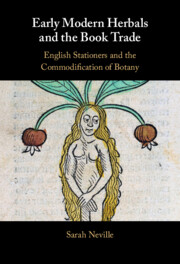


The previous chapter showed how seventeenth-century figures like Robert Burton and Elizabeth Isham believed that viewing ornate woodcuts of plants was a form of healthy recreation. The robust contemporary trade in botanical images cut from the pages of antique books indicates that these printed illustrations of plants continue to attract and fascinate our gaze. Yet one of the most regularly reprinted books in sixteenth-century England was a short, anonymous herbal that contained no illustrations at all. As I have outlined in the Introduction, in 1525 the London printer Richard Bankes issued from his shop a quarto “whiche sheweth and treateth of [the] vertues & proprytes of herbes” (STC 13175.1), and he saw fit to republish the book in the following year. By 1567, the text and variations upon it had been reprinted at least eighteen times by at least fifteen other publishers, testifying to the value that both booksellers and readers saw in this profitable little book.Footnote 1 Despite an influx of recent scholarship on the influence of printed botanical texts on early modern authors and readers, scholars have largely dismissed these early books as being of little interest to those concerned with issues of textual or intellectual authority. If the little Herball publications are mentioned at all, they are generally noted only to display the comparatively “authoritative” status of William Turner and then quickly dismissed. Leah Knight, for instance, finds that “[Turner’s] work is implicitly contrasted with that of his medieval predecessors, and even with slightly earlier sixteenth-century works like Banckes’ herbal, a book conventionally named for its printer instead of its author and one which is more of a translation and compilation than a recognizably ‘authored’ work.”Footnote 2 In a similar vein, Rebecca Laroche notes that “[t]hose herbals printed before [William Turner’s] in England, namely Bancke’s Herbal (1525) and the Grete Herball (1526), though interesting in their own right, are not infused with issues of textual authority that we find in Turner and post-Turner publications.”Footnote 3
While the little Herball does not fit with modern expectations of the genre, the surviving evidence of the text in print testifies that sixteenth-century readers found much to like in the book. This chapter will demonstrate how and why the little Herball became such an amazing commercial success, and it will raise the possibility that the audience for English herbals did not rise and fall with the expensive texts preferred by elite scholarly readers or gentry. The publishing history of the little Herball reveals that the purchasing preferences of Tudor London’s middling readers, as well as the regulatory constraints upon bookmaking and bookselling, created the economic conditions that later enabled the large, illustrated folio herbals of Turner, Gerard, and Parkinson to come into being. In other words, these large books with named authors on their title pages were a secondary development in the tradition of the printed English herbal, suggesting that the “author-function” that governed a text’s authoritative value was initially irrelevant to English readers. The association between herbals and particular botanical authorities did not result from readers’ perceptions of their accuracy but can be traced to commercial concerns: their publishers’ desire to sell an old and profitable text in innovative new ways.
The curious case of the little Herball demonstrates that, to uncover the origin and evolution of the printed English herbal, historians need to be attentive to the economic and material circumstances governing the production and circulation of books. My Introduction explained how, in printing the first edition of the little Herball in 1525, the publisher Richard Bankes sought to exploit the popularity of a late medieval manuscript work that had circulated widely, capitalizing on its existing familiarity with readers to sell many more copies of the text in a new medium. The evidence of Bankes’s immediate reprinting of his herbal the following year reveals his accurate reading of the marketplace for print in the mid-1520s, while the investment of other publishers in their own editions during the latter half of the 1530s confirms that the little Herball continued to be a vendible and valuable commodity – and was widely recognized as one. The evidence shows that, throughout the 1540s and 1550s, publishers continued to print new editions of this book. Even as the regulations and the market forces governing the English book trade shifted with the incorporation of the Stationers’ Company in 1557, the little Herball continued to be seen as worth publishing and protecting: John King sought a license for “the little herball” and thereby entered it into the Stationers’ Company Registers between November 30, 1560 and March 8, 1561, effectively removing the work from the public domain.Footnote 4 The license was an insurance policy in more ways than one. By entering the title, King both secured his right to profit indefinitely from any number of his future editions of the book free from the threat of piracy and eliminated the possibility that the little Herball could return to compete with any other botanical books he wished to publish in the future. (That King entered the rights to copy The Grete Herball at the same time suggests that he was thinking in exactly these terms.)
Taken as a whole, the efforts of the little Herball’s many publishers confirm that, once in print, this little book was in unusually high demand among Tudor book purchasers. The use of quantitative analytics helps to determine the relative popularity of books in the London book trade and prove, categorically, that the little Herball was a runaway bestseller. Only 1.8 percent of speculative books first printed between 1473 and 1580 reached eighteen editions by 1640; less than 1 percent of speculative books first printed between 1473 and 1580 reached eighteen editions within forty years.Footnote 5
The little Herball thus raises the same issues as those examined by Andy Kesson and Emma Smith in their study of print popularity in early modern England.Footnote 6 As it is an unqualified “best-seller” by any measure, interest in the little Herball in its many editions surpassed that of the three-volume New Herbal of William Turner, which was published in its entirety only once (1568), and the three editions of John Gerard’s commodious Herball or Generall Historie of Plants (1597; rev. 1633, 1636). As I noted in Chapter 3, Gerard’s Herball regularly appears in the notes of editions of Shakespeare, and Turner’s New Herbal is used by A. C. Hamilton to explain Edmund Spenser’s account of “the Poplar never dry” in book 1 of The Faerie Queene.Footnote 7 Yet while both Turner’s and Gerard’s herbals are often used as resources by scholars seeking to uncover Shakespeare’s or Spenser’s botanical understanding, the little Herball is virtually ignored as a viable botanical resource to explain an author’s use of plants like rosemary, borage, catmint, or wormwood. Unlike its much longer descendants, the little Herball lacks a clear author to demarcate its botanical authority, and scholars writing commentaries for literary texts evidently prefer to rely on, or default to, impressive-looking illustrated works with these more legible pedigrees. Gerard’s Herball or Historie of Plants has been found in the libraries of John Milton, Anne Clifford, and John Donne,Footnote 8 but it is hard to argue that it was anywhere near as popular as its smaller forebear. It is quite possible that more copies of the little Herball were circulating in sixteenth-century London than of all the other “authoritative” herbals combined, yet this little volume remains relatively unknown. The most popular early modern texts, in other words, were not always the largest and most imposing ones that have had a better chance of survival in famous libraries or notable collections.
Such obscurity in the face of quantity is characteristic of the paradoxical notion of print popularity. As Kesson and Smith note, the phrase “best-selling” can thus be at odds with “other, less quantifiable indices of value, or, to put it another way, the hyphenated term ‘best-selling’ is under some strain, as ‘best’ starts to serve less as an adjectival modifier to ‘selling’ and more its ideological opposite.”Footnote 9 In some respects, then, the popularity of the little Herball with Tudor readers seemingly justifies scholars’ lack of attention to it. Kesson and Smith remark that the very notion of popularity, particularly in its focus on the preferences of “non-elite” readers, “has odd and unexpected implications for the canon.” This too can be seen in the little Herball’s publication history. Richard Bankes’s decision to draw an old manuscript text forward into the new medium of print calls into question the typical “protocols of periodisation” that separate examinations of natural history in the medieval and Renaissance periods. An examination of the evidence of public demand can show that traditional literary and historical categories are much more complicated than they may initially seem.Footnote 10
This chapter attends to the publication history of the little Herball as a series of calculated investments by London booksellers as they navigated the dynamic English economy in printed books between 1525 and 1567. I first explain how the regulatory practice of generic privilege influenced Richard Bankes’s choice to print and then reprint the little Herball, as well as the influence that Bankes’s privilege had on the behavior of the other Tudor publishers who were the first to reprint the book. As part of that discussion, I explain how Bankes’s publication of the little Herball was one of several texts that he was issuing concurrently that readers could bind and sell together in a single, composite volume. I then explore how the editions of printer-publisher Robert Wyer changed the functionality of the little Herball, which has subjected Wyer to accusations of piracy. My analysis will show that these accusations are both anachronistic and unfounded. Finally, I examine another marketing innovation that booksellers hoped would attract new customers to the little Herball: the addition of a named author on its title page.
Richard Bankes and Generic Print Privileges
The colophon of Here begynnyth a newe mater / the whiche sheweth and treateth of [the] vertues & proprytes of herbes / the whiche is called an Herball, the first printed herbal in English, is dated March 25, 1525. The quarto’s title page also features the words “Cum gratia & priuilegio a rege induito,” a Latin phrase of such importance to its publisher, stationer Richard Bankes, that he also repeated it on the final page of the volume: “Cum priuilegio. Imprynted by me Rycharde Banckes / dwellynge in Lo[n]do[n] / a lytel fro [the] Stockes in [the] Pultry / [the].xxv.day of Marche. The yere of our lorde. M.LLLLL.&.xxv.”Footnote 11 Bankes reprinted the text the following year with an updated colophon but shortened his title page declaration: both the first and the last page of the 1526 text simply read “Cum priuilegio.”Footnote 12
In previous chapters, I outlined the forms of ecclesiastical, royal, and civic authority that adjudicated English publishers’ rights to make, distribute, and sell copies of printed works in the first half of the sixteenth century. In particular, I explained the system of ad hoc privileges that temporarily removed texts from the public domain for a specified number of years, a system that was in use prior to the incorporation of the Stationers’ Company in 1557, along with the subsequent economic protections that were created by the new company’s regulatory systems. As an earlier form of pre-incorporation economic insurance, the cum privilegio patent was a crown dispensation that granted a publisher a chance to earn back their return on an investment by preventing another publisher from printing their privileged texts for a set period. On occasion, these patents secured a privilege over specific titles, but more common were what Peter W. M. Blayney calls “generic” privileges that granted the recipient “temporary protection for any book (legally) printed at his costs and charges.”Footnote 13 In the case of some patents, such as those held by the King’s Printer, the term of the privilege was usually for the king’s life, but the patents granted to most booksellers were for a shorter and limited period of time up to seven years. In 1525, this is the sort of privilege that Bankes appears to have held and to have indicated with “Cum priuilegio” on the title page and colophon of his 1525 and 1526 herbals.
Bankes’s time as a printer is split between two periods, 1523–1526 and 1539–1545, but he published books throughout his career. The exact terms of Bankes’s privilege in 1525 are difficult to ascertain because no record of it from his earlier printing period survives outside of the claims he makes on his title pages and colophons; however, in accordance with King Henry’s 1538 proclamation that books published with the protection of the king’s privilege must also print “the effect” of that privilege in the text of the protected book, Bankes dutifully printed his privilege in full in a number of his works after 1538, and these instances provide a guide to what his earlier privilege may have looked like.Footnote 14 The text printed in his 1540 edition of the summer gospels (STC 2968) indicates that Bankes had been granted a seven-year monopoly on any work he chose to print at his own expense:
While it is prudent to note that it is possible that the 1540 privilege outlined here may be a different or shorter privilege than the one that is actually referenced by the cum privilegio of Bankes’s prior publications, assuming that he had a similarly termed, seven-year patent as early as 1525 may explain why more than a decade passed between Bankes’s second edition of the little Herball in 1526 and its first reprinting by another publisher sometime around 1537.Footnote 15 It is not clear how Bankes managed to acquire a crown privilege to protect his works, but unlike his contemporary privilege holder and fellow printer-publisher John Rastell (who was the brother-in-law of Sir Thomas More), there is no clear indication that Bankes was connected to the court. Bankes’s motivation for publishing the little Herball in 1525 must therefore be found through an examination of the other books he printed and published during his twenty-four-year bookselling career, as well as by putting Bankes in the wider context of the early English book trade in the 1520s and 1530s. Blayney identifies Bankes as one of the first English publishers to give up printing to concentrate their efforts on the more lucrative activity of publishing, and this shift suggests that he was a particularly astute reader of the marketplace for printed books in Tudor London.Footnote 16
At the time of Bishop Tunstall’s October 1526 meeting with London’s booksellers to forbid them from printing the works of English authors without first showing the books to a group of civic and ecclesiastical censors (a permission to publish later known as allowance), Bankes was operating his printing house at the Long Shop in the Poultry beside St. Mildred’s Church, just a few doors away from the bustling Stocks Market. Bankes’s first printed book, a short anonymous tract translated from Dutch, was issued from the Long Shop on October 5, 1523: Here begynneth a lytyll new treatse or mater intytuled & called The.ix.Drunkardes (STC 7260).Footnote 17 Playing on the established tradition of the Nine Worthies, Bankes’s quarto retells a selection of biblical stories and apocrypha illustrated with seventeen unique woodcuts.Footnote 18 Featured stories include Noah and the Ark, Cham espying his father’s drunken nakedness, Lot and his daughters, Judith beheading Holofernes, the banquet of Absalom, the foolish refusal of Nabal, and Belshazzar’s feast with the writing on the wall. Despite its novel illustrations, The. ix. Drunkardes likely did not sell particularly well, as Bankes himself never found cause to reprint it, nor did any of his fellow stationers see fit to copy the book. Would-be competitors considering reprinting Bankes’s text may have been deterred more by the work’s copious illustrations than by the cum gracia et privilegio appended to the colophon, since reprinting the illustrations would have required another publisher either to borrow the figures from Bankes or to copy and recut the wood blocks at a considerable expense. By contrast, the “cum priuilegio” declaration on Bankes’s twice-printed and unillustrated little Herball ably served its purpose, warning off other publishers to wait to reprint the book until after Bankes’s seven-year privilege expired. Nonetheless, the simultaneous and quick emergence of new editions after its expiration testifies to the vendibility that early printers saw in this particular work. Once the little Herball returned to the public domain, editions soon issued undated from the presses of John Skot, Robert Redman, and Robert Wyer towards the end of the 1530s, and another appeared from the press of Thomas Petyt in 1541. Though bibliographers have sometimes accounted these editions “piracies” (particularly those published by Wyer), these Tudor booksellers were making rational and perfectly legal choices in response to the regulatory and material circumstances in which they produced books. The latest terms of the patent held by the little Herball’s first printer would have expired in 1532 or (counting seven years from Bankes’s second edition) in 1533, when the text would have returned to the public domain. Skot, Redman, and Wyer were well within their rights to print the text.
The popularity of the little Herball may also have had something to do with characteristics of the verbal text itself. Later described by its twentieth-century editors Sanford Larkey and Thomas Pyles as being in manner “quaint, old-fashioned, yet racy and vigorous,” the texts offer brief descriptions of plants listed under their Latin names, coupled with details of their virtues or medical import.Footnote 19 For the most part, the medical information contained in the pages of the little Herball is slight, but the “racy and vigorous” charm that Larkey and Pyles find remarkable can be found in the specific wording of remedies, as in this cure for gout:
Take the rote of wylde Neppe & the rote of of [sic] wylde docke sothen by it selfe & cutte them in thynne pyces & pare a waye the utter rynde and cut them in quarters / than boyle them in clene water ii. or iii houres / than stampe them in a morter as small as thou can / than put therto a quantyte of sote of a chymnaye / than tempre the[m] vp with the mylke of a cowe that the heere is of one coloure / than take the vryne of a man that is fastynge & put thereo & make a playster therof & boyle it and laye it to the sore as hote as the seke maye suffre it / & let it ly styll a day and a nyght / & do so.ix.tymes & thou shall be hole on warantyse, by [the] grace of god.Footnote 20
Some of the little Herball’s plant therapies are mystical as well as practical. If Herba Joannis, or Saint John’s Wort (still prescribed by naturopaths to treat mild depression), is “putte in a mannes howse / there shall come no wycked sprite therin.”Footnote 21 Other remedies demonstrate evidence more of folk belief than of medicine, such as the recommendation that supplicants carry “veruayne,” or verbena, because “they that bere Veruayne vpon the[m] / they shall haue loue and grace of great maysters / & they shall graunte hym his asking / if his askynge be good and ryghtfull.”Footnote 22 By bearing motherworte, or mugwort, a man will avoid being grieved by venomous beasts, while he who “frots” his hands with Dragantia “without doubte he may take Adders they shall not venyme hym,” but only in the month of May.Footnote 23
Editions of the Little Herball Post Bankes
Because many of the editions of the little Herball printed by other publishers did not include dates in their imprints, providing a precise sequence of editions that allows a scholar to determine with certainty who copied whom is difficult. Though Blanche Henrey speculates that Robert Wyer was the first printer to copy the little Herball the year after Bankes’s seven-year royal privilege would have expired, in the revised Short-Title Catalogue (STC) Katharine Pantzer gives Wyer’s edition a queried date of 1543, positioning printer John Skot as the little Herball’s first copyist sometime around 1537.Footnote 24
Little is known about Skot, whose career, based on colophon evidence, spanned the period 1521 to 1537. He rarely dated his works and often failed even to append his name to his books. In his early career, he lived in St. Sepulchre without Newgate parish before moving, sometime before 1528, to St. Paul’s Churchyard. Present at Tunstall’s second meeting with the booksellers in October 1526, Skot was a hesitant printer-publisher, choosing to supplement the profits he made printing his own publications by also printing works for others. Early in his career, Skot sometimes printed for Wynkyn de Worde, presumably when the house of Caxton’s former assistant was too busy with other publications and wanted to rush into print an edition of a work like the second edition of Here begynneth a treatyse of this galaunt with the maryage of the bosse of Byllyngesgate. vnto London stone (1521?; STC 24242).Footnote 25 Skot printed his edition of A boke of the propertyes of herbes the which is called an Herball for himself, issued undated from his last recorded address, Foster Lane in St. Leonard’s parish. Having already been twice-printed by Bankes, it was reasonable for Skot to have assumed that the little Herball posed no ecclesiastical hazard and, once Bankes’s privilege expired, could easily be copied and sold throughout London without fear of ecclesiastical or chancery reprisal. Such concern with penal appropriation may have been rather important to Skot’s decision-making, as he, like many of his contemporaries, had recently run afoul of Thomas Cromwell. Skot had been one of the publishers of a work about Elizabeth Barton, the Maid of Kent, who was notorious for having opposed Henry VIII’s divorce from Catherine of Aragon and was convicted of treason.Footnote 26 After 1537, Skot disappears from the records of early English printing.
Scholars have been preoccupied with accounts of piratical activity in the publication history of the little Herball in part because of Bankes’s fellow stationer Robert Redman, whose aggressive and often illegal behaviors towards Richard Pynson and other booksellers left behind a number of records. Listed as being another attendant at Tunstall’s October 1526 meeting, Redman printed his own edition of the little Herball from his shop at the sign of “The George” (St. George) in Fleet Street in or around 1539. Like Bankes, Redman had begun his career in 1523, when he set up his first shop in St. Clement’s parish just outside of Temple Bar and began to produce copies of works printed by Richard Pynson, then both the King’s Printer and the Printer for the City of London. Pynson, a native of Normandy, had paid a fee to join the Stationers sometime before 1500. After that, Pynson was technically a citizen of the City of London and was able to practice his trade within the City limits, so in 1500 he moved his shop at the sign of the George from St. Clement Danes parish in Middlesex to just inside Temple Bar in St. Dunstan’s parish. By copying Pynson’s sign and address from his very beginnings, Redman seems to have deliberately targeted Pynson’s career as a model for his own, and his copying of Pynson’s books was so overt that Pynson began to issue attacks on this “Rude-man” in his addresses to the reader.Footnote 27 When Pynson died in 1530, Redman moved shops, taking over Pynson’s inside Temple Bar in St. Dunstan’s, where he remained until his own death in 1540.
Redman’s piratical activities were not limited to his attacks on the lawful material of Richard Pynson. Shortly after Pynson’s death, Redman was ordered in 1533 not to sell copies of his edition of Christopher St. Germain’s The Division of the Spirituality and Temporalty, the rights of which had been granted to Thomas Berthelet, who had succeeded Pynson as King’s Printer. Berthelet had issued his edition of The Division of the Spirituality and Temporalty (STC 21587) cum privilegio in 1532, and an illegal edition pirated by Redman had appeared around the same time. The Star Chamber forbade Redman to sell his copies of the work and barred him from reissuing it or any other book that had been printed with the king’s privilege, binding him with the threat of a 500-mark penalty.Footnote 28
Bankes’s own dealings with Redman seem not to have differed greatly from those of Pynson and Berthelet. In 1540, when he was brought before the Privy Council to account for printing a series of broadsides alternately condemning and defending Thomas Cromwell, Bankes blamed the late Redman, along with Richard Grafton (who later confessed his part in the publications), with deliberately falsifying Bankes’s imprint.Footnote 29 The Council found both the authors of the broadsides, Thomas Smyth and William Gray, and the publisher Grafton guilty of sedition and sentenced all three to a prison term in the Fleet.Footnote 30 Here again, as early as the reign of Henry VIII in England, the “penal appropriation” that Foucault asserts is crucial to the “author-function” was linked as much to stationers as to authors, to the practical distribution of textual materials as well as their imaginative origins. By virtue of their ability to make information public, the bookselling publishers, those agents who initiated the production and oversaw the distribution of printed books, were seen by civic and royal authorities as being just as responsible as authors. Conversely, such punitive measures made previously circulated and uncontroversial works in print or manuscript more attractive for would-be publishers because they had already been publicly tested and had not found controversy.
Redman’s explicit acts of violation of others’ privileged texts do not necessarily mean that all of his activities should be seen as suspicious or that his behaviors were always objectionable. Like that of his contemporary Richard Bankes, Redman’s extant output demonstrates that he had an especially keen eye for books that were likely to sell well, and he exploited the market to his advantage. All bibliographers have agreed that Redman’s undated edition of the little Herball appeared after Bankes’s privilege for the book had expired, when the work was once again a part of the public domain. Early reprints of the little Herball by other stationers thus are testimony not to criminality but to the marketability that savvy sixteenth-century publishers saw in this particular text. Redman’s edition was later copied and reprinted by his widow Elizabeth and by her successors in the shop at the George, William Middleton and William Powell.Footnote 31
One of Redman’s final projects before he died was printing Thomas Berthelet’s 1540 edition of the Great Bible (STC 2069) with Thomas Petyt.Footnote 32 Petyt had been hired by Berthelet to print editions of the New Testament twice in the previous year, and Redman’s shop may have been contracted for the 1540 edition because Petyt’s shop in St. Paul’s Churchyard at the sign of the Maiden’s Head was already working at maximum capacity. Petyt issued his own A boke of the propertyes of herbes the whiche is called an Harbal in an edition dated 1541, using Elizabeth Redman’s edition as his copy-text. A group of other stationers thereafter took turns reprinting their own editions of the work until a new means of establishing a text’s value emerged in 1557: the title was finally licensed and entered into the Stationers’ Registers by John King in late 1560 or early 1561.
By 1541, then, the work that most scholars know as “Bankes’s Herball” existed in seven distinct editions: two printed by Richard Bankes dated 1525 and 1526 and one each from the presses of John Skot (1537?), Robert Redman (1539?), Robert Wyer (1539?), Elizabeth Redman (1540?), and Thomas Petyt (1541). Such intensive publication of a single, popular title raises numerous questions: Why did the late 1530s and early 1540s create such a run on this particular book? If the little Herball was such a lucrative text with Tudor readers that four other publishers would seek to capitalize on its popularity, why did Bankes only reprint the work once before his privilege expired? The circumstances surrounding early attempts to control the book trade may provide some explanation.
With the exception of Elizabeth Pickering Redman (whose printing house was represented by the attendance of her husband Robert), all five printers had been present at Tunstall’s meeting of October 25, 1526. Shortly thereafter, the same group began to print a selection of octavos on popular topics, seemingly “copying” each other’s works; in addition to the Herball, Bankes’s The Seeing of Urines (1525–6; STC 22153) and Here beginneth a good boke of medicines intytulyed or callyd the treasure of pore men (1526; STC 24199)Footnote 33 appeared from the Redman and Wyer presses, while Wyer’s edition of Thomas Moulton’s This is the myrour or glass of helthe, necessary and nedefull, printed earlier than 1531 (STC 18214), was variously reprinted both by the Redmans and by their successors at the George, as well as by Thomas Petyt and Robert Copland.Footnote 34
As these octavo publications occur shortly after Tunstall’s meeting that highlighted the dangers of unapproved texts, the concurrence of a small group of limited privilege-holding printer-publishers issuing the same short works en masse raises a variety of questions. Did these publishers, seeking to attract English readers to the variety of information available in the new medium, issue these works as part of a larger series? Was such copying between publishers the result of a fear of ecclesiastical reprisal in a turbulent age? Many miscellaneous bound collections were broken up by nineteenth-century book collectors, but Crynes 873, a composite octavo volume held at the Bodleian Library, Oxford, provides an indication of the ways that book buyers approached these texts as a group. The bound volume features the single surviving copy of Thomas Petyt’s edition of the little Herball alongside Petyt’s 1540 edition of Medicines (STC 24202) and his 1545 Glass of Health (STC 18225.4). It also includes editions of John Gough’s Regiment or Dietary of Health (STC 3378.5, printed by Wyer) and Elizabeth Pickering Redman’s 1541 edition of Seeing of Urines (STC 22155). While the Crynes 873 volume might suggest that such often-reprinted works all had a health-related theme, the stationers’ recursive reprinting of legal works – such as Anthony Fitzherbert’s The newe boke of iustices of the peas (1538; STC 10969), translated from the French and originally printed by Robert Redman, or his Offices of sheryffes, bailliffes [and]coroners (1538; STC 10984) – suggests that the driving similarity may have been more broadly practical: small reference books with a high use value rather than books around a particular subject. Unfortunately, the rebinding habits of nineteenth-century book collectors make it difficult to do more than speculate. What such convergences in publication history do offer, however, is a cogent caveat to the inclination of print historians to see each new issue of a printed work as necessarily in competition with its precursors. Especially in an era preceding the Stationers’ Company’s control over the English book trade, booksellers occasionally worked together to increase consumer demand for their products, and Crynes 873 demonstrates that that form of collaboration could be recognized by readers and book purchasers.Footnote 35
There is also a material feature of the first edition of the little Herball that is worth further attention. Bankes appears for the first time in any extant records in the lay subsidy rolls of 1523, where he is described as a bookbinder, a detail that informed his approach to both printing and marketing his editions of the book.Footnote 36 Like many of the English books printed in the early decades of the sixteenth century, Bankes’s edition of the little Herball lacks both pagination and catchwords, leaving only the signatures that appear beneath the text in the right-hand corner of the first three recto pages of each quire to instruct a binder in the correct way to assemble the little Herball’s pages. In both the 1525 and the 1526 herbals, however, Bankes has set the abbreviated word “Her.” in the gutter opposite the signature, signifying that the quarto pages marked with each signature refer to his book’s title. If the little Herball was printed to be bound alone, Bankes’s use of this abbreviated title in the signature line would serve no purpose; however, if Bankes conceived of his little Herball as part of a series of quartos designed to be sold and bound together, a bookbinder would need to be able to distinguish the individual quires of the little Herball from those of another book in order to avoid mis-sewing. Two other contemporaneous Bankes publications share this signature-line title feature: Here begynneth the seynge of uryns, dated May 28, 1525, (STC 22153, with a signature-line title of “Seyng of wa.”) and Here begynneth a new boke of medecynes intytulyd or callyd the treasure of pore men (STC 24199, with a signature-line title of “Me.”), printed in or around 1526. Both books were printed for Bankes by John Rastell. Later in the 1530s, editions of The Seynge of Uryns came from the presses of Robert Wyer, as well as Robert and Elizabeth Redman and their successors at the George. Many of the same stationers also reprinted A New Boke of Medecynes. It was not just Bankes, then, but his fellow Tudor booksellers who conceived of the little Herball as one in a series of short informative volumes that could be bound with others. The material form of the little Herball first printed by Richard Bankes, along with its capacity to be linked with other, related texts, was thus a fundamental part of its popularity with Tudor readers.
Robert Wyer and His Readers
Like his contemporary Robert Redman, Robert Wyer is often credited as being a notorious pirate of other printers’ copy, but in the context of the English book trade prior to 1557, his three editions of Bankes’s Herball were perfectly legitimate. Though by the time Wyer started printing in 1529 London had had several foreign-born printers, he was the only citizen printer active at the time who was not a member of the Stationers’ Company. Wyer was free of the Salters’ Company (which ranked ninth in London’s “Great Twelve” livery companies from which the mayor was selected), a position that gave him considerable protection. As a bookseller, City custom decreed that Wyer had to obey the policies and standards of the Stationers’ Company; however, until 1557 the Stationers’ Company did not have authority over printing. What this meant was that, as a printer, Wyer had no specific governing customs and could do almost anything he wanted. What Wyer clearly wanted to do was print and wholesale as many books as possible; over the course of his career between 1529 and 1556, he published at least 140 items, many of which were reprints of works that had already established themselves in the marketplace. Yet Wyer was also willing to risk his capital on new works: of the 140 works he printed for himself, 74 titles were first editions. His biographer notes that he preferred to publish “small octavos dealing with subjects of a popular nature, and therefore readily saleable.”Footnote 37 Such a prolific output, which included works that had been first printed by others, has sometimes led scholars to view Wyer as a pirate of other stationers’ copy. In moralizing the legality of their subjects’ activities, narratives of the book trade sometimes miss the fact that stationers who copied others’ books were simply well-attuned to the best means of making money, and not all of these means of copying were necessarily illegal.
Wyer’s enthusiasm for popular books, coupled with his rather sloppy output (as bibliographer P. B. Tracy notes of Wyer’s copies, “founts are used to death, re-castings are of poor quality, presswork is uneven”), has led to accounts of his career as a printer and publisher that echo the derisive attitudes scholars have expressed about “rogue” herbalist John Gerard.Footnote 38 In an article titled “Some Rogueries of Robert Wyer,” H. B. Lathrop accuses him of publishing “dingy octavos” for the “uneducated” multitudes,Footnote 39 while Francis L. Johnson subjects Wyer to a more direct attack:
Robert Wyer’s methods of obtaining the copy for his handbooks stands revealed to the full measure of its unapologetic knavery. Neither the hiring of competent authors and translators nor respect for the rights of his fellow printers had any place in his system.Footnote 40
Johnson supposes that Wyer’s reprinting Bankes’s Herball in a trio of modified editions is sufficient evidence to label him a “knave,” but, given the willingness of other printers to enter into business relationships with Wyer, the animosity modern scholars surmise that early printers felt for his supposedly illicit trade practices is overstated. Everything Wyer was doing was completely legal within the terms of early Tudor printing and bookselling. That Bankes himself believed his privilege for the little Herball expired in the mid-1530s is confirmed by Bankes having hired Wyer to print for him after Bankes abandoned his own press at the Long Shop.Footnote 41 Neither Wyer’s inferior press nor his supposed knavery was enough to prevent his colleagues in the book trade from entrusting him to manufacture their products.
As I suggested in the Introduction, the editions of the little Herball published by John Skot, Robert Redman, Elizabeth Pickering Redman, and Thomas Petyt have few variations between them. Wyer’s reprints of the little Herball followed an entirely different approach,Footnote 42 one that has not endeared him to history. In a detailed analysis of the differences between Wyer’s three editions of the little Herball and Bankes’s two, Johnson suggests that Wyer’s changes were part of a fundamentally dishonest approach to bookmaking and bookselling. Johnson maintains that Wyer edited and reorganized the text of the little Herball in order to deliberately “gloss over his theft,” which was supposedly intended to thwart any attempt by Bankes to “obtain redress” for Wyer’s usurpation of his royal privilege.Footnote 43 Yet Johnson’s argument is muted by his misunderstanding both the nature and the terms of Bankes’s privilege. Once that knowledge is returned to the equation, Wyer’s status as a rogue pirate dissolves. Wyer had no offense to mask because there was no offense committed.
When Wyer reprinted the little Herball, he chose to identify the work not with the title favored by most of its earlier printers, Boke of the propertyes of herbes the which is called an Herball,Footnote 44 but as Hereafter foloweth the knowledge, properties, and the virtues of herbes (STC 13175.6).Footnote 45 Because he was working from the assumption that “enterprising” printers like Wyer engaged in outright piracy, Johnson makes several unqualified assertions about book production in an era preceding the regulatory effects of the Stationers’ Company Registers and licensing system:
by changing the title of the work and making a few minor alterations in the arrangement and wording of the text, the injured party, notwithstanding his royal privilege, would find it very difficult to obtain redress. The pirate need only maintain that his was a new book; then the Renaissance approval of free literary borrowing would force the complainant to rest his case on the debatable distinction between outright plagiarism and an unskillful, but not reprehensible, imitation.Footnote 46
Johnson’s account of Wyer’s production of the Herball is curiously inconsistent with his scholarly treatment of its other editions after Bankes. Though he notes that the largest group of these herbals (which includes the Redmans, Skot, and Copland editions) are essentially “page for page reprint[s]” of each other, Johnson nonetheless singles out Wyer’s editions as emblematic of printing villainy.Footnote 47 Yet none of these three post-Bankes editions of the Herball had any more or less legal right to the title than Wyer himself did in 1539. The first change in Bankes’s title came from Skot, not from Wyer. Johnson’s illogical claim that Wyer’s alteration of Bankes’s text was the “easiest and least expensive way of obtaining the text for a new herbal” is an argument that strains against both the systems of privilege at work in the period and the work’s extant publication history. For a sixteenth-century publisher like Wyer (as for the Redmans, Skot, Copland, and everyone else who followed Bankes, up to and including John King), by far the easiest way to obtain the text of an English herbal was simply to reprint something that had already been printed and that was no longer protected by an earlier privilege.Footnote 48 In 1539, Wyer could have legally printed Bankes’s Herball verbatim, but he chose not to do so. By changing the title of the work and by reorganizing the text of the Herball to improve its functionality for readers (which served no regulatory or nefarious purpose), Wyer’s alterations demonstrated not his roguery but his capacity for textual innovation.
Johnson supports his view of Wyer’s “unapologetic knavery” by itemizing other examples of where the printer “extracted,” “altered,” “corrected,” “augmented,” “abridged,” “compiled,” or “paraphrased” – all activities that Johnson believes should be undertaken only by “competent authors and translators.”Footnote 49 Though a selective collation, Johnson demonstrates that Wyer’s edition of the Herball introduced substantive changes in Bankes’s text by subtracting 27 of Bankes’s 207 chapters and adding 3 others, as well as by altering the wording of those chapters that he did include. Johnson surmises that, in order to create his edition, Wyer
himself, or some hack writer in his employ, goes through Bankes’s Herball, revising it, with the object of bringing it out under Wyer’s imprint. He adds supplementary material now and then from other sources … he omits sections that prove too difficult or seem of minor importance. When the text seems to him faulty or obscure, he makes a crude attempt to correct it … when a casual reference to these works fails to solve a problem, he makes a clumsy guess, and since he has no knowledge of botany to aid him in his task, his corrections, though they often replace an obsolete term with a seemingly familiar one, usually leave the meaning of the passage as obscure as it was before.Footnote 50
To make a case, a prosecution must establish motive, and Johnson incorrectly surmises that Wyer made alterations to the Herball primarily to “make a crude attempt at covering up his tracks” while violating Bankes’s privilege.Footnote 51 Yet in his desire to vilify Wyer, Johnson also makes an egregious claim about Wyer’s (or his compiler’s) lack of botanical knowledge. In doing so, he judges its botany by later standards, anachronistically turning to the evidence of later printed works such as William Turner’s herbal of 1568, Henry Lyte’s translation of Dodoens (1578), John Gerard’s Herball, or Historie of Plants (1597), and John Parkinson’s Theatrum botanicum (1640). Unsurprisingly, Wyer’s short compilation is unable to demonstrate the detail of many of these celebrated folio texts. Wyer should have, Johnson argues, been more careful in his consultation of contemporary English works like De proprietatibus rerum (de Worde, 1495; Berthelet, 1535) or The Grete Herbal (Treveris, 1526, 1529), because “these books and manuscripts would in most cases have sufficed for his task had he been a conscientious and intelligent workman. As it was, they only abetted his ignorance, so that his text as a rule merely introduced new errors in place of old confusion.”Footnote 52
Johnson characterizes Wyer’s use of compilation, his cross-referencing between various source texts, and his smoothing of elements that may prove confusing to his customers as “typical of Wyer’s notorious system of compiling popular handbooks by appropriating as much as he found useful of other men’s works and disguising them as his own.”Footnote 53 That such behavior seems to be perfectly in keeping with the “Renaissance approval of free literary borrowing” that Johnson elsewhere asserts exists does not dissuade him from calling Wyer’s herbal “a clumsy revision and augmentation of Bankes’s text, made with the intent of misleading the prospective purchaser.”Footnote 54 Johnson does not appear to know that the revising and augmenting that Wyer does to the Herball is a considerable effort, one that, given the expiration of Bankes’s original privilege, was also completely unnecessary to justify his activities with the text. After Bankes’s privilege expired, Wyer was in no more danger from Bankes’s royally sanctioned claim to the title than was Skot, Petyt, or Redman. Further, as the holder of his own royal privilege for books he’d created, if Wyer could have demonstrated to the king’s council that he had spent money in creating his new adaptation of the Herball, he could have claimed protection for it – but he didn’t.Footnote 55
Wyer was one of many early English printer-publishers who recognized that the increased availability of printed texts shifted contemporary debates about experimental knowledge making, and his changes to the text demonstrate Wyer’s investment in making the Herball more appealing to contemporary readers. In retitling the herbal Hereafter foloweth the knowledge, properties, and the virtues of herbes, Wyer ignored the stress on its status as a “boke” that other publishers were eager to emphasize in favor of an account of the text’s “knowledge” or use value. The OED offers a fifteenth-century use of “knowledge” specifically denoting “the fact or condition of being instructed, or of having information acquired by study or research” (n.11). Just such a usage of the word appears in a popular work first printed by Caxton in 1477 that was reprinted in 1528, one that seems to have accorded with Wyer’s similar handling of the term in 1539: “Knowlege is better than ignoraunce.”Footnote 56 Wyer’s addition to Bankes’s title thus served to illustrate the effort that the printer put into producing the text of his new volume by adding supplementary material available in other manuscript and printed works. As Martha Driver notes in an article on Wyer’s printing of Christine de Pisan’s The.C.Hystoryes of Troye (an edition that is sometimes accused of “suppressing” de Pisan’s authorship because of Wyer’s anti-feminist agenda), “in the first hundred years of printing, the printer, the new maker, superseded the author, in the transmission of texts, similar to the way Hollywood overwrites literary authors today.”Footnote 57 Driver’s account of Wyer and his contemporaries’ “active self-promotion” easily explains Wyer’s motivations in changing the title of Bankes’s text to emphasize the “fact or condition of having information acquired by study or research.” The changes that Wyer makes to the Herball suggest that there may be something more than the usual custom in Wyer’s deliberate emphasis on his role as the maker of this particular book, which had been “Imprynted by me Robert Wyer.”Footnote 58 Wyer’s colophon simultaneously highlights his work as a publisher and printer as well as his labor in reorganizing and supplementing the work through activities that we now chiefly associate with authors and editors.
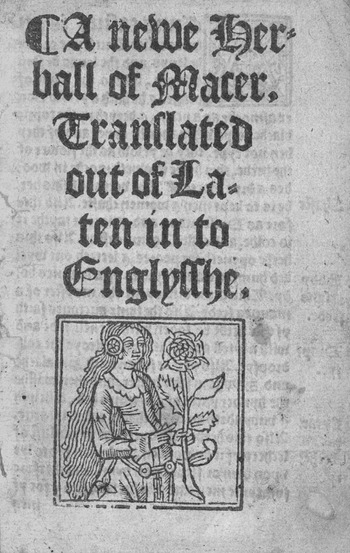
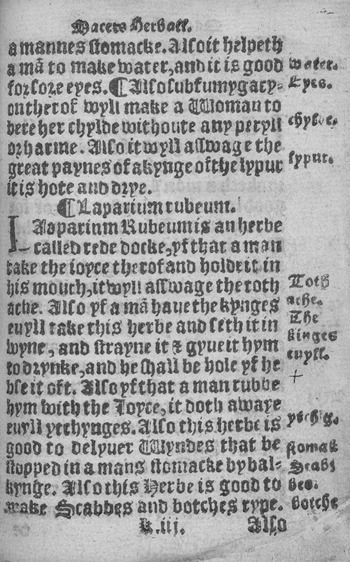
Even if in 1541 Wyer’s original intent was to “deceive” potential customers with the uniqueness of Hereafter foloweth the knowledge, properties, and the virtues of herbes, the similarities between it and the products of other publishers may still have been too obvious to early modern readers to convince them that it was in fact a different version of the work, and in 1544, Wyer determined to reprint his text under a completely different scheme. Wyer’s second edition of the work was published as A newe herball of Macer, translated out of Laten into Englysshe (STC 13175.8c)Footnote 59 and sought to capitalize on booksellers’ familiarity with a medieval manuscript poem on plants known as the “Macer Floridus,” often erroneously attributed to the classical poet Aemilius Macer (Figure 4.1).Footnote 60 Wyer’s addition of Macer’s name was wholly spurious and designed as an advertising feature – there was nothing added of Aemilius Macer or Macer Floridus that could justify the new title page claim. The improvements to Wyer’s new edition did not end with the title, however; he also supplied an important new textual affordance that shows Wyer’s understanding of the way readers engaged with such little books. Wyer added marginal notations alongside the body of his text, highlighting key words for readers scanning to locate plants appropriate to various ailments (Figure 4.2).
A newe Herball of Macer (Robert Wyer, 1544), sig. A1r.
A newe Herball of Macer (Robert Wyer, 1544), sigs. F3v–F4r.
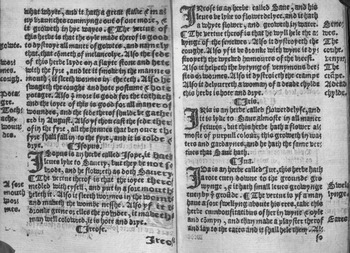
In the period before indexes were regularly keyed to either pagination or foliation, such marginal notations meant that readers searching for remedies for “wormes” or a means by which to “delyuereth a woman of a dead childe” needed only to scrutinize the margins of a herbal’s pages. Wyer’s New Herbal of Macer of 1544 was the first English herbal to recognize that such an edifying compendium might better serve its readers if it were accompanied by organizational markers in the margins that could quickly point readers towards the information they sought. Wyer’s innovation has hitherto gone unnoticed by those seeking to vilify Wyer’s contributions to the herbal genre.Footnote 61 Except for its new title and these marginal annotations, the 1544 work was otherwise a reprint of Wyer’s 1539 edition.
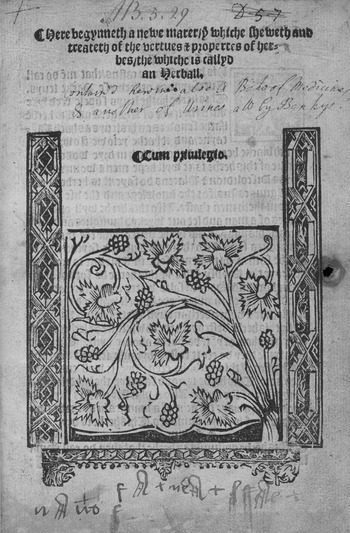
Wyer may have gotten the idea for his Macer marketing ploy from the misprint in the title of Bankes’s second edition of the text, which contained the error marer for mater in Here bygynnyth a newe mater (Figure 4.3). Such an error may have been the result either of poor composition (it was certainly an error in proof correction) or of an incorrectly distributed piece of type caused by a compositor’s misreading. If the lay of Bankes’s type case was anything similar to that illustrated in Joseph Moxon’s Mechanick Exercises on the Whole Art of Printing, in which the t and r sorts are at sufficient distance from each other that a compositor’s grabbing one for the other by mistake seems unlikely, the error likely resulted from a compositor’s error of the type as he redistributed it.Footnote 62 However the error occurred, it provided a suggestive opportunity. In the black letter typeface used throughout Bankes’s Herball, a lowercase r looks similar to a lowercase c. Wyer’s initial misreading of a copy of the 1526 Bankes may have ultimately proved fortuitous.
Here begynneth a newe marer [sic] (1526), sig. A1r.
Wyer’s New Herbal of Macer was at least somewhat successful with customers, as he reprinted the text as Macers Herbal again in 1552 (STC 13175.13c), this time so confident in his marketing ploy that he splashed the title of his work across the running head of each page (Figure 4.4). In addition to Macer, Wyer seems to have wanted his book to advertise an endorsement from a more local authority; on his 1550 title page, he added that Macers Herbal is presented as “practysyd by Dr Lynacro,” or Thomas Linacre, founder of the Royal College of Physicians of London in 1518 (Figure 4.5). Linacre was instrumental in translating selections of Galen’s work into Latin in a series of editions that were published by Richard Pynson in the 1520s, making Wyer’s claimed endorsement particularly clever since none of Linacre’s writings, including a Latin grammar, were yet available in English. Wyer’s marginal annotations also return in his 1550 text, this time as an affordance he considered worthy enough to advertise on his book’s title page.
Macers Herball (Robert Wyer, 1552), sig. K3r.
Macers Herball (Robert Wyer, 1552), sig. A1r.
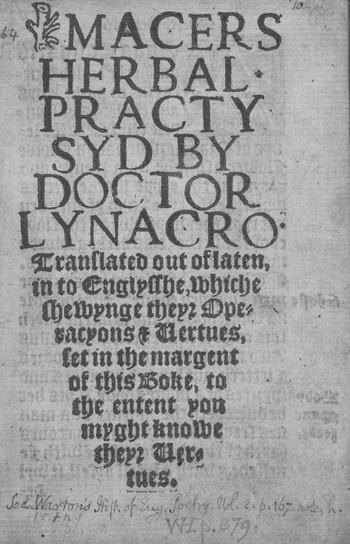
Though Rebecca Laroche finds that early herbals “are not infused with issues of textual authority that we find in Turner and post-Turner publications,” the artifacts produced by Wyer demonstrate that named authorities did find their way onto the title pages and running titles even of the small-format herbals available for sale prior to William Turner’s New Herbal of 1551.Footnote 63
The Little Herball Variations of William Powell and William Copland
Wyer’s success between 1539 and 1550 with his versions of the little Herball later provided the publishers William Powell and William Copland with a model for their own “Askham’s Herbal” (STC 13175.13) and “W.C. Herbal” (STC 13175. 18) versions of the text, which were printed between 1550 and 1567. Anthony Askham was a patronage-seeking Yorkshire physician known to would-be readers as the brother of humanist Roger Askham, Cambridge fellow and tutor to the young princess Elizabeth. Given that Powell was the publisher of a series of Askham’s astrological octavos, his choice to supplement his 1550 edition of the little Herball with Askham’s work to compete with Wyer’s Macer variations was a reasonable one. Powell had little competition to fear from the remnants of the Redman or Middleton editions, if those were still circulating in London’s retail book market; as the husband of Elizabeth Middleton, William Middleton’s widow, Powell would have succeeded to all of Middleton’s remaining stock at the time of his death, including all the unsold copies of various editions of the little Herball that Middleton may ultimately have acquired from his forerunner at the George, Elizabeth Pickering Redman.
Like the Macer herbals, Powell’s motivation in creating his Askham herbal was to offer readers something apparently novel. His herbal’s full title also promised additional astronomical information with the seeming imprimatur of an expert physician, and the title’s length left some ambiguity about who was responsible for its botanical information: A lytel herball of the properties of herbes newely amended and corrected, with certayne addicions at the end of the boke [as] appointed in the almanacke, made in M.D.L. the xii. Day of February by A. Askham. The ambiguity of the squinting modifier “made and gathered” left dangling at the end of the title when this edition was reprinted by John King in 1561 (STC 13175.19) led to some confusion in the first edition of the STC (which is organized by author name) as well as the Oxford Dictionary of National Biography (ODNB) (which still insists that Askham wrote the 1550 herbal). However, a collation of Powell’s edition with its most likely copy text, William Middleton’s edition of 1546, reveals that there is so very little change offered by Powell in 1550 that even Powell’s use of the phrase “newely amended and corrected” on the title page is suspect. The STC notes that “the additions mentioned were presumably to be a reissue of 857a.5,” or A lytel treatyse of astrouomy [sic], very necessary for physyke and surgerye, which was also published by Powell; however, no extant editions of Powell’s herbal survive that are bound with any Askham material, and it seems possible that the chief distinction of the text of the Askham herbal in the marketplace of Tudor London was located primarily on its title page. Powell’s retail customers may have been encouraged to bind their copies of his herbal with A lytel treatise; however, if readers who bought their texts elsewhere wished to read “Askham’s herbal” without the text of STC 857a.5, they were free to do so.
Such is not the case for the fourth variant in the Bankes’s Herball canon, those texts known as the W. C. herbals, which came first from the press of William Copland printing on behalf of the Draper John Wight and the stationer Richard Kele in 1552.Footnote 64 The title of Wight’s book in full is A boke of the proprerties [sic] of Herbes called an herball, wherunto is added the time [the] herbes, floures and Sedes shold be gathered to be kept the whole yere, with the vertue of [the] Herbes when they are stilled. Also a generall rule of all manner of Herbes drawen out of an auncyent booke of Phisyck by W.C. (STC 13175.15). As in the case of Powell’s Askham herbal, a squinting modifier comes into play in the title to confuse scholars desperately seeking title page authorship in the absence of clearer textual authority. The first edition of the STC originally listed this book under the name of Walter Cary, creator of such medical works as The Hammer for the Stone (1580, STC 4733) and A Briefe Treatise Called Cary’s Farewell to Physic (1583, STC 4730); however, this Walter Cary was still a child in 1552. The W. C. who drew a general rule of all manner of herbs from some unidentified “Ancient Book of Physic,” was likely someone else, possibly the work’s printer, William Copland, doing exactly what Wyer had done with his reorganization of the little Herball the decade before. Such a division in responsibility for the book’s manufacture likewise demonstrates the emergence of non-printing publishers like Wight and Kele, as well as the common occurrence of shared labor or expense in the printing of an edition.
The printer-translator Copland displayed his continued interest in the text by reprinting an edition for himself in 1559 (STC 13175.18), while in 1555, John Walley and Abraham Veale (another of Petyt’s former apprentices) hired John King to print for them a shared edition of the W. C. herbal of their own (13175.16, Walley; 13175.17, Veale).Footnote 65 In deciding upon an edition of the little Herball to print for himself in 1561 (STC 13175.19), King chose the Askham version of William Powell. King was also the first stationer to seek a Company license for the text, as is recorded in the Registers along with the licensing of two other titles sometime between November 20, 1560, and March 8, 1561. (Notably, the entry does not mention Askham’s name.) King’s death in August of that year meant that his records in the Registers didn’t prevent Antony Kytson from later printing another edition of the W. C. herbal circa 1567, which was at least the eighteenth and the last edition of the phenomenally popular work first printed by Richard Bankes in 1525.Footnote 66 The remedies the little Herball depicted, however, would resurface half a century later in another bestseller: Gervase Markham’s The English Housewife (1615).Footnote 67
Once we disaggregate the provenance of the work’s many editions, the publication history of Bankes’s Herball reveals that early English stationers were operating within a complex and dynamic marketplace that complicates a simple narrative of copyright ownership and competition. The combination of ecclesiastic control over seditious printing and the system of royal privilege during the pre-charter period actually did the opposite: it encouraged the spread of popular titles through the 1550s when the supply of printed books was outpaced by an increasing demand. Yet as England’s officials struggled to keep tabs on religious controversies, the solutions they used to control printed books had a knock-on effect upon nonreligious titles. The incorporation of the Stationers’ Company and their attendant regulations eventually pushed such early popular works out of the market: by the late sixteenth century, new editions of the little Herball were no longer available for sale to early modern readers. Despite its disappearance, however, the Herball in its multiple editions later served to convince cautious stationers that there was a sufficient English demand for printed botanical books in the vernacular to risk publishing much larger and more expensive editions. As a result, the London publisher Steven Mierdman could, in 1551, be assured that producing the illustrated folio of William Turner’s A New Herball in English was a good economic risk – after all, lay English readers were still buying copies of a 25-year-old, unillustrated octavo on a similar subject. Before accounting for the publication of this “authoritative English herbal” authored by the “Father of British botany,” however, I first need to discuss The Grete Herbal, another anonymous English herbal that helps us better understand how Tudor readers responded to printed works of natural history and medicine.


 Open access