
Skip to main content Accessibility help
×
  • Cited by 3
    • The digital format of this book is no longer available to purchase from Cambridge Core. Other formats may be available.
    • Show more authors
    • You may already have access via personal or institutional login
    • Select format
    • Publisher:
      Acumen Publishing
      Publication date:
      05 February 2013
      28 February 2008
      ISBN:
      9781844653805
      9781844650682
      9781844650699
      Dimensions:
      Weight & Pages:
      00kg,
      Dimensions:
      Weight & Pages:
      00kg,
    You may already have access via personal or institutional login
    Selected: Digital
    Add to cart View cart Buy from Cambridge.org

    Book description

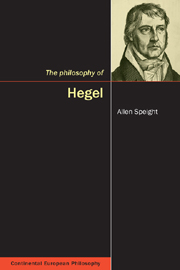
    Few philosophers can induce as much puzzlement among students as Hegel. His works are notoriously dense and make very few concessions for a readership unfamiliar with his systematic view of the world. Allen Speight’s introduction to Hegel’s philosophy takes a chronological perspective on the development of Hegel’s system. In this way some of the most important questions in Hegelian scholarship are illuminated by examining in their respective contexts works such as the Phenomenology and the Logic. Speight begins with the young Hegel and his writings prior to the Phenomenology focusing on the notion of positivity and how Hegel’s social, economic and religious concerns became linked to systematic and logical ones. He then examines the Phenomenology in detail, including its treatment of scepticism, the problem of immediacy, the transition from “consciousness” to “self-consciousness”, and the emergence of the social and historical category of “Spirit”. The following chapters explore the Logic, paying particular attention to a number of vexed issues associated with Hegel’s claims to systematicity and the relation between the categories of Hegel’s logic and nature or spirit (Geist). The final chapters discuss Hegel’s ethical and political thought and the three elements of his notion of “absolute spirit”: art, religion and philosophy, as well as the importance of history to his philosophical approach as a whole.

    Reviews

    "An outstanding book. It demonstrates a wide and deep knowledge of Hegel and modern Hegel scholarship and an evident enthusiasm for the study of Hegel’s ideas. Speight is a sure-footed interpreter of Hegel’s texts and his selection of particular topics cannot be faulted. It is a pleasure to read."

    Dudley Knowles

    Refine List

    Actions for selected content:

    Select all | Deselect all
    • View selected items
    • Export citations
    • Download PDF (zip)
    • Save to Kindle
    • Save to Dropbox
    • Save to Google Drive

    Save Search

    You can save your searches here and later view and run them again in "My saved searches".

    Please provide a title, maximum of 40 characters.
    ×

    Contents

    Metrics

    Altmetric attention score

    Full text views

    Total number of HTML views: 0
    Total number of PDF views: 0 *
    Loading metrics...

    Book summary page views

    Total views: 0 *
    Loading metrics...

    * Views captured on Cambridge Core between #date#. This data will be updated every 24 hours.

    Usage data cannot currently be displayed.

    Accessibility standard: Unknown

    Why this information is here

    This section outlines the accessibility features of this content - including support for screen readers, full keyboard navigation and high-contrast display options. This may not be relevant for you.

    Accessibility Information

    Accessibility compliance for the PDF of this book is currently unknown and may be updated in the future.
