


Psychotherapy is one of the recognised treatments for various mental health problems, Reference Da Silva and Blay1 particularly for depressive and anxiety disorders, which represent the major burden of mental illness in the general population. Reference Prince, Patel, Saxena, Maj, Maselko and Phillips2,Reference Goldberg3 Although social inequalities in the incidence, prevalence and course of common mental disorders are well documented, Reference Lorant, Deliege, Eaton, Robert, Philippot and Ansseau4–Reference Jokela, Singh-Manoux, Ferrie, Gimeno, Akbaraly and Shipley8 the patterns of psychotherapy treatment associated with socioeconomic status are surprisingly underexplored. Reference Briffault, Sapinho, Villamaux and Kovess9–Reference Clarkin, Levy and Lambert11 In France and Finland, higher educational level has been shown to be associated with higher probability of having psychotherapy. Reference Briffault, Sapinho, Villamaux and Kovess9,Reference Suoyrjö, Hinkka, Kivimäki, Klaukka, Pentti and Vahtera12 In a British sample, people living in more deprived areas were more likely to consult a general practitioner for mental health problems compared with those living in affluent neighbourhoods, Reference Oliver, Pearson, Coe and Gunnell13 while another British study found no association between neighbourhood deprivation or affluence and referrals to, or acceptance of, psychotherapy. Reference Saxon, Fitzgerald, Houghton, Lemme, Saul and Warden14 In the 1993 National Survey of Psychiatry Morbidity in Britain, social class was not related to receiving treatment for neurotic disorders. Reference Bebbington, Brugha, Meltzer, Jenkins, Ceresa and Farrell15 Given the sparseness of data to date, we examined socioeconomic status in relation to common mental disorder and psychotherapy treatment in the UK between 1991 and 2009.
Method
Our sample comprised participants in the British Household Panel Survey (BHPS), a longitudinal survey of a nationally representative sample of over 5000 British households with annual follow-up. Reference Taylor MR Brice, Buck and Prentice-Lane16 The original cohort included 10 264 individuals aged 16–97 years (mean = 44.4, s.d. = 18.3) at baseline in 1991, and was based on a clustered, stratified sample of addresses throughout Great Britain south of the Caledonian Canal (i.e. excluding the north of Scotland and Northern Ireland). New participants were included in the sample over the years if they were born to an original sample member, if they had moved into a household in the original sample or if a member of the original sample moved into a new household with one or more new people. In addition, the sample was enriched with additional recruitment of participants at waves 9 and 11, from Scotland and Wales and from Northern Ireland respectively, so extending the sample to cover the whole of the UK. The most recent (18th) follow-up of the BHPS took place in 2008–2009, after which the cohort has become part of the larger Understanding Society Study (www.understandingsociety.org.uk/).
For the present analysis we included all person-observations of participants for whom information on measures of socioeconomic status, common mental disorder, psychotherapy treatment and covariates was available (n = 28 054 unique individuals; 207 545 person-observations). The sample size was slightly smaller in the analysis of common mental disorder and psychotherapy (n = 22 586; 174 630 person-observations), for which each person-observation required data from two consecutive study waves (common mental disorder at baseline and psychotherapy treatment reported in the next wave). To take into account non-response, all analyses were weighted using cross-sectional sample weights.
Measures
At each study wave common mental disorders were identified using the 12-item General Health Questionnaire (GHQ). Reference Goldberg3,Reference Pevalin17 The items were scored using the GHQ scoring method (total scale range 0–12) and GHQ caseness was defined as a score above 2. At each study wave the participants were requested to report whether they had used different health and welfare services (‘Here is a list of some health and welfare services. Have you yourself made use of any of these services since September 1st last year?’). One of the items was ‘Psychotherapist (including psychiatrist or analyst)’ (no/yes), and the respondent was also requested to indicate whether this had been provided by the public (National Health Service, NHS) or the private sector.
Socioeconomic status was measured at each study wave by three indicators:
-
(a) annual household income from all income sources (categorised into quintiles at each year);
-
(b) educational level, stratified into four groups: 0, primary education or less; 1, secondary education (Certificate of Secondary Education, O-level); 2, tertiary education (A-level or diploma); 3, higher education (higher or first degree);
-
(c) occupational social class of the participant's most recent job, classified according to the Registrar General's scheme: 0, unskilled/partly skilled/never had a job; 1, skilled manual; 2, skilled non-manual; 3, managerial or professional.
Given the way the time interval for psychotherapy treatment was framed (see above), it had some variability across participants (average interval length 13.2 months, s.d. = 1.6). We therefore included time interval as a covariate in models predicting psychotherapy treatment. In addition, all models were adjusted for age, birth year, gender, ethnicity (0, White; 1, other ethnicity, based on the participant's self-reported ethnic background), subsample (0, original sample; 1, Wales; 2, Scotland; 3, Northern Ireland), marital status (0, married; 1, never married; 2, separated/divorced; 3, widowed; 4, civil partnership) and number of children (top-coded to four or more children). Two of the latter covariates were included to take into account the fact that a given household income level has different meanings for, say, a person living alone and for a couple with four children.
Statistical analysis
Given the longitudinal study design with annual surveys, each participant could contribute between 1 and 18 person-observations to the data-set (on average 7 measurements per participant). Psychotherapy treatment, GHQ caseness, socioeconomic status, marital status, number of children and age were treated as time-dependent variables, that is, the same participant could have different values in each person-observation (information for these covariates were reported at each wave). Gender, birth year, ethnicity and subsample membership were time-independent variables. The number of participants and person-observations included in each analysis varied somewhat depending on the availability of data for the specific socioeconomic status indicator.
To take into account the non-independence of the person-observations from the same individuals over time, we fitted logistic and multinomial logistic models using robust estimator with person as the clustering variable. This approach treats the repeated measures essentially as repeated cross-sectional data collections without considering longitudinal effects within individuals. Time trends in GHQ caseness and psychotherapy were assessed by predicting the outcomes with interaction effects between socioeconomic status and categorically coded year of interview (1991–1994, 1995–1999, 2000–2004, 2005–2009). When examining psychotherapy use according to GHQ caseness status, we used time-lagged GHQ status as the exposure, i.e. caseness in the previous study wave was used to predict psychotherapy use at the following study wave.
Results
Just over half of the 28 054 participants were women (53.0%) and 84.9% were White, with an average age of 45.2 years (s.d. = 18.1) and birth year of 1955 (s.d. 19). The mean duration of follow-up for a participant was 11.2 years (s.d. = 5.5). Table 1 shows the number of participants by study year and subsample group. Individuals and family members of the original sample composed 61.4% of the participants and 72.1% of the person-observations. Descriptive statistics of the study variables are reported in online Table DS1. Average prevalence of GHQ caseness and psychotherapy treatment per year was 26.0% and 2.1% respectively, with no marked change over the follow-up period. In total, 8.6% of the participants reported having had psychotherapy treatment at least once during the follow-up period. Of all the reported psychotherapy treatments (4274 person-observations from 2410 different individuals), 77.5% were provided by public health services, 21.3% by the private sector and 1.2% by both (the last group was excluded from the provider-specific analyses presented below).
Association between GHQ caseness and psychotherapy
Common mental disorders were more likely to precede publicly than privately provided psychotherapy treatment (Table 2), indicating lesser mental distress among clients of private compared with public psychotherapy. However, this difference attenuated over time (P = 0.01) because the association between GHQ caseness and privately provided psychotherapy strengthened over time (Table 2).
Social inequalities in GHQ caseness and psychotherapy treatment
A socioeconomic gradient in GHQ caseness was observed (Table 3), with higher household income and higher occupational status being associated with lower risk of GHQ caseness. High educational level was also associated with lower GHQ caseness risk, except for the highest educational group. The association between socioeconomic status and use of psychotherapy was dependent on the provider: high status was associated with lower odds of having publicly provided psychotherapy but higher odds of having privately provided psychotherapy (Table 3). Although the associations were substantial for both forms of psychotherapy, socioeconomic status was more strongly associated with private than public psychotherapy, education being the most prominent factor.
Number of participants in study wave and subsample groups

| Wave | Original sample | Wales | Scotland | Northern Ireland | Total |
|---|---|---|---|---|---|
| 1 | 9658 | 9658 | |||
| 2 | 9170 | 9170 | |||
| 3 | 8830 | 8830 | |||
| 4 | 8813 | 8813 | |||
| 5 | 8594 | 8594 | |||
| 6 | 8897 | 8897 | |||
| 7 | 8850 | 8850 | |||
| 8 | 8741 | 8741 | |||
| 9 | 8542 | 2240 | 2250 | 13 032 | |
| 10 | 8401 | 2179 | 2384 | 12 964 | |
| 11 | 8254 | 2174 | 2259 | 3029 | 15 716 |
| 12 | 8051 | 2053 | 2060 | 2558 | 14 722 |
| 13 | 7835 | 2003 | 2002 | 2473 | 14 313 |
| 14 | 7643 | 1928 | 1886 | 2228 | 13 685 |
| 15 | 7563 | 1941 | 1865 | 2230 | 13 599 |
| 16 | 7499 | 1949 | 1776 | 1942 | 13 166 |
| 17 | 7328 | 1872 | 1700 | 1843 | 12 743 |
| 18 | 7022 | 1812 | 1648 | 1570 | 12 052 |
| Total | 149 691 | 20 151 | 19 830 | 17 873 | 207 545 |
Caseness defined by General Health Questionnaire score as a predictor of subsequent publicly or privately provided psychotherapy treatment

| OR (95% CI) a | GHQ cases, b % | |||
|---|---|---|---|---|
| Period | Public | Private | Public | Private |
| 1991–1994 | 3.81 (2.97–4.89) | 1.79 (1.09–2.96) | 57 | 38 |
| 1995–1999 | 4.20 (3.44–5.12) | 1.59 (1.08–2.32) | 60 | 35 |
| 2000–2004 | 4.63 (3.78–5.68) | 2.53 (1.81–3.53) | 61 | 45 |
| 2005–2009 | 4.49 (3.53–5.71) | 3.19 (2.15–4.74) | 60 | 52 |
| Total | 4.39 (3.86–4.98) | 2.29 (1.87–2.80) | 60 | 43 |
GHQ, General Health Questionnaire.
a. Odds ratios for GHQ caseness assessed predicting psychotherapy treatment in multinomial logistic regression, adjusted for age, gender, ethnicity, study year, time interval of follow-up, marital status, number of children and subsample (n = 22 586; 174 630 person-observations).
b. Proportion of GHQ caseness among participants receiving psychotherapy treatment in the next year, calculated with logistic regression models.
There was no evidence of change in social inequalities in GHQ caseness (Fig. 1; P>0.18 for all interactions between time and socioeconomic status indicators) or in use of private psychotherapy during the years 1991–2009 (P>0.30 for time interaction). In contrast, the socioeconomic gradient in public psychotherapy treatments widened over time (Fig. 2). The odds ratios for highest v. lowest income quintile were 0.96 (95% CI 0.66–1.39) in 1991–1994 and 0.36 (95% CI 0.23–0.56) in 2005–2009 (for 1 unit increase OR = 0.97, 95% CI 0.89–1.06, and OR = 0.78, 95% CI 0.71–0.87 respectively; P<0.001 for time interaction). The odds ratios for highest v. lowest occupational status were 0.86 (95% CI 0.63–1.19) in 1991–1994 and 0.52 (95% CI 0.37–0.74) in 2005–2009 (for 1 unit increase OR = 0.94, 95% CI 0.85–1.05, and OR = 0.82, 95% CI 0.73–0.92, respectively; P = 0.02 for time interaction). A similar, although statistically non-significant, pattern of widening socioeconomic gradient in public psychotherapy treatments was observed when education was used as the indicator of socioeconomic status (for 1 unit increase OR = 1.03, 95% CI 0.89–1.18, in 1991–1994, and OR = 0.86, 95% CI 0.75–1.00 in 2005–2009; P = 0.21 for time interaction).
Associations of socioeconomic status with General Health Questionaire caseness and psychotherapy treatment
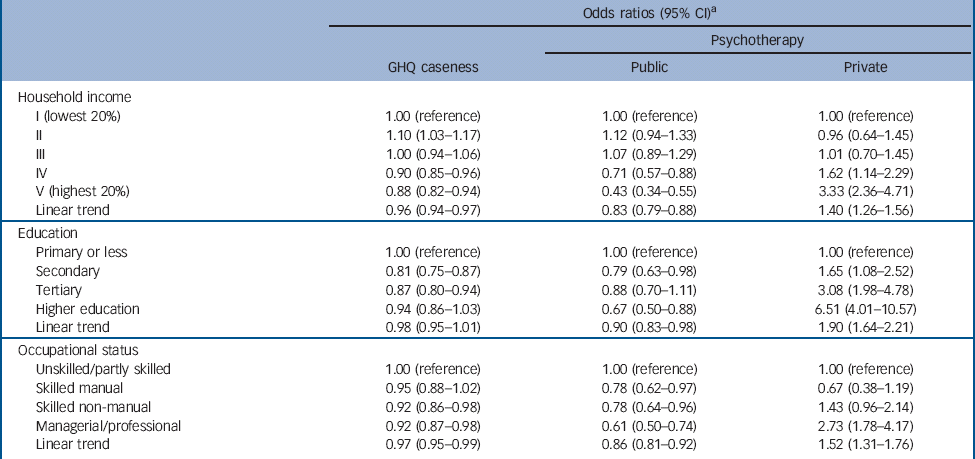
| Odds ratios (95% CI) a | |||
|---|---|---|---|
| Psychotherapy | |||
| GHQ caseness | Public | Private | |
| Household income | |||
| I (lowest 20%) | 1.00 (reference) | 1.00 (reference) | 1.00 (reference) |
| II | 1.10 (1.03–1.17) | 1.12 (0.94–1.33) | 0.96 (0.64–1.45) |
| III | 1.00 (0.94–1.06) | 1.07 (0.89–1.29) | 1.01 (0.70–1.45) |
| IV | 0.90 (0.85–0.96) | 0.71 (0.57–0.88) | 1.62 (1.14–2.29) |
| V (highest 20%) | 0.88 (0.82–0.94) | 0.43 (0.34–0.55) | 3.33 (2.36–4.71) |
| Linear trend | 0.96 (0.94–0.97) | 0.83 (0.79–0.88) | 1.40 (1.26–1.56) |
| Education | |||
| Primary or less | 1.00 (reference) | 1.00 (reference) | 1.00 (reference) |
| Secondary | 0.81 (0.75–0.87) | 0.79 (0.63–0.98) | 1.65 (1.08–2.52) |
| Tertiary | 0.87 (0.80–0.94) | 0.88 (0.70–1.11) | 3.08 (1.98–4.78) |
| Higher education | 0.94 (0.86–1.03) | 0.67 (0.50–0.88) | 6.51 (4.01–10.57) |
| Linear trend | 0.98 (0.95–1.01) | 0.90 (0.83–0.98) | 1.90 (1.64–2.21) |
| Occupational status | |||
| Unskilled/partly skilled | 1.00 (reference) | 1.00 (reference) | 1.00 (reference) |
| Skilled manual | 0.95 (0.88-1.02) | 0.78 (0.62-0.97) | 0.67 (0.38–1.19) |
| Skilled non-manual | 0.92 (0.86–0.98) | 0.78 (0.64–0.96) | 1.43 (0.96–2.14) |
| Managerial/professional | 0.92 (0.87–0.98) | 0.61 (0.50–0.74) | 2.73 (1.78–4.17) |
| Linear trend | 0.97 (0.95–0.99) | 0.86 (0.81–0.92) | 1.52 (1.31–1.76) |
GHQ, General Health Questionnaire.
a Odds ratios from logistic regression analysis for GHQ caseness and multinomial logistic regression analysis for psychotherapy. Separate models were fitted for household income, education and occupational status (n = 28 054 persons; 207 545 person-observations). All models are adjusted for study year, age, gender, ethnicity, time interval of follow-up (for models of psychotherapy), marital status, number of children and subsample.
Sensitivity analyses
To test whether the addition of the subsamples in waves 9 and 11 accounted for any of the observed associations or interaction effects with time, we refitted all the models using only data from the participants and family members of the original sample (n = 17 236; 149 691 person-observations). The results remained substantially the same as in the main analyses (data not shown). The results were also essentially unchanged when the models were fitted without sample weights (data not shown). The associations between socioeconomic status and psychotherapy treatment were similar in GHQ cases and GHQ non-cases (assessed in the previous study wave), suggesting that the status differences in the use of psychotherapy were not specific to those with symptoms of psychological distress (online Table DS2).
Estimated prevalence of General Health Questionnaire (GHQ) cases categorised by socioeconomic status indicator and year: (a) income; (b) occupational class (I, lowest 20%, V, highest 20%); (c) education.

Estimated prevalence of participants receiving privately and publicly provided psychotherapy treatment categorised by socioeconomic indicators and year. Privately provided: (a) income, (b) occupational class, (c) education. Publicly provided: (d) income, (e) occupational class, (f) education.

Discussion
In a cohort of 28 000 adults living in the UK between 1991 and 2009, we demonstrated socioeconomic inequalities in the prevalence of common mental disorders as indicated by the 12-item GHQ. Low education, household income and occupational status were also associated with greater odds of having psychotherapy treatment provided by the NHS. The socioeconomic gradients associated with publicly provided psychotherapy treatment widened between 1991–1994 and 2005–2009, suggesting that the treatment needs of those with the highest risk of common mental disorders were better met in the latter 5-year period than at the beginning of the 1990s. In contrast, the socioeconomic gradients associated with privately provided psychotherapy were inverse, its use being most common among those with high status (high education in particular), with no change over time.
Inequalities in health and treatment of disease between groups of different socioeconomic status are a major public health issue globally. According to the inverse care hypothesis, Reference Hart18 there is a mismatch between the distribution of care and clinical need, such that treatment rates tend to be lower in the disadvantaged groups despite their higher disease rates. In our study this hypothesis was supported in relation to socioeconomic status and use of privately provided psychotherapy treatment, which normally costs £40–100 per session. These findings accord with the large body of literature suggesting poorer care for mental health problems among people with low socioeconomic position. Reference Krvimaki, Gunnell, Lawlor, Smith, Pentti and Virtanen6,Reference Howard, Cornille, Lyons, Vessey, Lueger and Saunders19–Reference Muntaner, Eaton, Miech and O'Campo22 Higher socioeconomic status and education have been shown to correlate with greater probabilities of visiting a psychotherapist, Reference Briffault, Sapinho, Villamaux and Kovess9,Reference Suoyrjö, Hinkka, Kivimäki, Klaukka, Pentti and Vahtera12 and of taking antidepressant medication, Reference Krvimaki, Gunnell, Lawlor, Smith, Pentti and Virtanen6 suggesting that more wealthy and educated individuals are more likely to seek treatment even though they tend to experience a lower incidence of mental disorders compared with the socially disadvantaged.
Our findings on psychotherapy provided by the public sector did not support the inverse care hypothesis. Indeed, there appeared to be a favourable development over time indicating that publicly provided psychotherapeutic treatment is increasingly concentrated in the socioeconomic groups with the highest need, i.e. among those with low socioeconomic status. In a previous UK study, people living in more deprived areas were more likely to consult a general practitioner for mental health problems than those living in affluent areas, Reference Oliver, Pearson, Coe and Gunnell13 suggesting a similar socioeconomic pattern. Publicly provided psychotherapy is not as readily available as private psychotherapy. People seeking psychotherapy from the NHS first need a referral from their general practitioner (or other healthcare professional), and usually people need to wait for several months before receiving treatment.
The persistent socioeconomic gradient in common mental disorders needs to be considered in a broader context of health inequalities, Reference Weich, Lewis and Jenkins23,Reference Wilkinson and Pickett24 because mental disorders increase the risk of various physical diseases, including chronic physical illness. Reference Prince, Patel, Saxena, Maj, Maselko and Phillips2 Improving the balance between distribution of care and clinical need in relation to publicly provided mental health treatment might therefore contribute to overall reduction in socioeconomic inequalities in health. However, a corresponding favourable trend in the treatment of chronic physical illnesses is also needed in order to narrow social inequalities in mental disorders, because chronic physical diseases increase symptoms of common mental disorders. Reference Huang, Dong, Lu, Yue and Liu25
GHQ caseness as proxy for mental distress
Although GHQ caseness is not a precise indicator of the need for psychotherapy, it was strongly associated with subsequent psychotherapy use during the next year. Caseness can therefore be interpreted as a crude proxy for mental distress that might prompt individuals to seek psychotherapy. Clients of public and private psychotherapy differed in the frequency of common mental disorder preceding treatment: 60% of clients of publicly provided psychotherapy met criteria for GHQ caseness in the previous year compared with 43% of clients of privately provided psychotherapy. This implies that the psychological profiles of public v. private sector clients may exhibit important differences in terms of mental distress leading them to seek help. However, there was evidence for increasing rates of GHQ caseness among clients of privately provided psychotherapy from 1991–1994 to 2005–2009, suggesting that people seeking private psychotherapy today may be more mentally distressed than their counterparts in the early 1990s.
Study limitations
This study has several limitations. First, we measured common mental disorders with the 12-item GHQ which, although a validated screening measure, was not designed to make a psychiatric diagnosis. Our analysis thus cannot address directly the issue of unmet needs in mental health treatment. Second, information concerning psychotherapy treatment was based on a self-reported answer to a single question about use of the services of a psychotherapist (psychiatrist or analyst). This leaves out information on the indication, type, frequency, length or effectiveness of different psychotherapies. The use of, for example, cognitive–behavioural and psychoanalytically oriented therapies may follow different socioeconomic gradients and time trends, but our data were not capable of taking such differences into account. Third, we cannot exclude the possibility that socially patterned reporting biases may have affected our findings, e.g. it might have become more acceptable for individuals of low socioeconomic status to report having had psychotherapy. The strengths of the study, on the other hand, include a large, nationally representative sample, a long follow-up period and data on the use of public v. private psychotherapy.
Study implications
In summary, the recent socioeconomic patterns in use of publicly provided psychotherapy appear to present fairly positive trends in the UK. Low socioeconomic status was associated with higher likelihood of having publicly provided psychotherapy, which indicates an improving match between need and care for mental health treatment in socioeconomically disadvantaged groups. In contrast, private psychotherapy continues to be concentrated among those with high socioeconomic status. The existing socioeconomic gradients in common mental disorders demonstrate the continued need to combat socioeconomic inequalities in mental health in the UK.


 Open access


eLetters
No eLetters have been published for this article.