





Narrative competence plays a crucial role in the development of children’s linguistic and cognitive skills. Narrative competence involves an integration of multiple systems of language as it requires the simultaneous planning of meaningful content in terms of a coherent structure, cohesive language use, and a concern for the listeners’ informational needs (Johnston, Reference Johnston2008). Therefore, investigating children’s narrative skills provides enriched information on both linguistic and cognitive domains. The present study investigates the longitudinal effects of second language (L2) English immersion on children’s narrative skills in their first (L1) and second (L2) languages among 5-, 7-, and 9-year-old L1-Turkish speaking children.
Research on bilingual children’s narrative development is often limited to specific language pairs (e.g., Spanish/English), minority contexts with low SES (Miller et al., Reference Miller, Heilmann, Nockerts, Iglesias, Fabiano and Francis2006), and L2-dominant settings (but see Aktan Erciyes, Reference Aktan-Erciyes2019; Reference Aktan-Erciyes2021). Few studies employ a longitudinal approach, and L2-immersion schooling in preschool is mostly examined in low SES groups, especially when L1 is a minority language (Cummins, Reference Cummins2001; Fillmore, Reference Fillmore1991; Ventureyra et al., Reference Ventureyra, Pallier and Yoo2004). However, less attention has been given to high SES preschoolers in L1-dominant contexts (Aktan-Erciyes, Reference Aktan-Erciyes2019; Reference Aktan-Erciyes2021).
The present study examines the longitudinal effects of L2-English immersion in early childhood on the structural and linguistic properties of narrative skills in L1 in an L1-dominant society. We distinguish L2-immersion—where children receive intensive exposure to an L2 in an educational setting—from bilingualism, which broadly refers to proficiency in two languages regardless of acquisition context. For this purpose, we recruited L1-Turkish speaking children living in an L1-dominant country, Türkiye. Children were either exposed to L2-English immersion or L1-Turkish schooling at preschool ages. We specifically ask: (1) Do 5-, 7-, and 9-year-old L2-English immersion and L1-Turkish dominant children differ in their narrative skills in L1 in Time 1 and Time 2, longitudinally over a year? (2) Do L2-English immersion children differ in their narrative production in L1-Turkish and L2-English at different ages? (3) Are children’s vocabulary knowledge and narrative comprehension at Time 1 associated with their later narrative production skills at Time 2 for different ages? Do these factors differ for L2-English immersion and L1-Turkish dominant children?
Narrative production and comprehension
Producing narratives requires a coherent organization of the events. The story is made around a goal in a way that renders meaningful events in terms of the intentional states of the characters. In telling stories, we also use complex syntactic structures and appropriate lexical items (Berman & Slobin, Reference Berman and Slobin1994; Johnston, Reference Johnston2008). Furthermore, in conveying the conceptual content, the narrator must monitor and update the listener’s changing informational needs and respond with adequate linguistic expression (Arnold & Griffin, Reference Arnold and Griffin2007; Wong & Johnston, Reference Wong and Johnston2004). Narrative analyses are frequently separated into two parts or levels (e.g., Justice et al., Reference Justice, Bowles, Kaderavek, Ukrainetz, Eisenberg and Gillam2006). The Macrostructure, also known as the Story Structure, is the structural organization of the story content. The Microstructure, on the other hand, includes various measures of the linguistic structure, such as productivity (the length of the narrative), use of vocabulary, syntactic complexity, and the use of referential, temporal, and causal linking devices. Children’s narrative competence develops during preschool and early school years (e.g., Berman & Slobin, Reference Berman and Slobin1994; Hickmann et al., Reference Hickmann, Fletcher and MacWhinney1995; Justice et al., Reference Justice, Bowles, Kaderavek, Ukrainetz, Eisenberg and Gillam2006; Pearson, Reference Pearson, Oller and Eilers2002)
Narrative production requires children to learn that linguistic structures are multifunctional and that their use is multifaceted. Findings show that by the age of 5, children can tell simple, causally coherent narratives, making connections through their recounted episodes (Berman, Reference Berman and Shimron1997; Stein Reference Stein, Franklin and Barten1988; Stein & Trabasso, Reference Stein, Trabasso, Brainerd and Pressley1982; Trabasso & Nickels, Reference Trabasso and Nickels1992). At this stage, they make connections through combining clauses, employing complex syntax, and constructing well-organized narratives with several perspectives. In another review that focuses on cross-linguistic studies on discourse organization in person, space, and time, Hickman (Reference Hickmann, Fletcher and MacWhinney1995) indicated that narrative organization involving sentence-discourse relations is relatively late. Specifically, these abilities tend to develop at around 9 to 12 years of age. Before this age range, children often focus more on individual sentences or events without fully integrating them into a coherent overall narrative structure. At around 9 to 12 years, children begin to demonstrate a more sophisticated understanding of how sentences and events relate within the context of a story, leading to more organized and cohesive narratives. This delayed development was supported by Berman and Slobin (Reference Berman and Slobin1994), who noted that younger children may use fewer expressive options when telling stories because they cannot conceptualize all encodable perspectives, thoroughly assess the listener’s perspective, or use all formal devices. Similarly, Strömqvist and Day (Reference Strömqvist and Day1993) found distinct developmental patterns in narrative tasks for children and adult second language learners, highlighting that while young toddlers (aged 4 to 6) make connections through their recounted episodes, their narrative abilities are still evolving compared to older children (aged 7 to 12).
The processes of narrative comprehension and production are closely linked as storytelling relies heavily on how events are comprehended. Therefore, narrative production requires not only understanding narrative structure but also using appropriate language. Narrative comprehension involves understanding stories through cognitive processes such as recognizing structure, identifying characters and events, and understanding causal and temporal relationships. It requires making inferences about characters’ motivations and emotions, connecting events thematically, and using background knowledge (Graesser et al., Reference Graesser, Millis and Zwaan1997; Oakhill et al., Reference Oakhill, Cain and Bryant2003; Paris & Paris, Reference Paris and Paris2003; van den Broek et al., Reference Van den Broek, Rapp and Kendeou2005). While children as young as 4 and 5 years old engage in basic narrative comprehension, these processes become more complex by middle childhood (Goldman & Varnhagen, Reference Goldman and Varnhagen1986). Children at around 9 years old can draw causal inferences while reading brief texts (Casteel, Reference Casteel1993; Trabasso & Magliano, Reference Trabasso and Magliano1996). Preschool-aged children also demonstrate an awareness of narrative structure by correctly answering questions about key causal linkages in short stories (van den Broek et al., Reference Van den Broek, Lorch and Thurlow1996; Wenner, Reference Wenner1999). Although research on narrative comprehension focuses mostly on adults and elementary school-aged children, children as young as 4 and 5 engage in basic narrative comprehension, with abilities becoming more complex by middle childhood.
Story production requires not only an understanding of narrative structure but also the ability to use language creatively and precisely. The skills involved in narrative production are crucial for effective communication and are often developed through practice and exposure to storytelling activities (Curenton, Reference Curenton2011). Narrative comprehension and production both require synchrony of various factors such as receptive language, perspective-taking, and understanding story structure (Paris & Paris, Reference Paris and Paris2003). Overall, investigating narrative competence in childhood provides enriched and comprehensive information regarding language.
Narrative competence in L2-immersion contexts
Research on monolingual children’s language development has demonstrated that higher-level language abilities, such as narrative production, are particularly influenced by the linguistic environment. However, studying these processes in children who speak two or more languages is more complex. It is challenging to measure multilingual children’s language skills because there are few, if any, normed instruments available for numerous languages. While tools like the Bilingual English-Spanish Assessment (Peña et al., Reference Peña, Gutiérrez-Clellen, Iglesias, Goldstein and Bedore2018) and LITMUS (Armon-Lotem et al., Reference Armon-Lotem, Haman, Jensen de López, Smoczynska, Yatsushiro, Szczerbinski and van Der Lely2016) exist for bilingual populations, many languages still lack validated assessments, limiting cross-linguistic comparisons. Narrative production has emerged as a valuable tool for examining bilingual children’s language abilities (Gagarina et al., Reference Gagarina, Klop, Tsimpli and Walters2015a; Reference Gagarina, Klop, Kunnari, Tantele, Välimaa, Balčiūnienė and Walters2015b).
Research consistently shows that bilingual children’s narrative skills in both L1 and L2 develop from preschool onward, with growth in macrostructural elements, such as story structure (e.g., Gutierrez-Clellen, Reference Gutierrez-Clellen2002; Pearson, Reference Pearson, Oller and Eilers2002; Squires et al., Reference Squires, Lugo-Neris, Peña, Bedore, Bohman and Gillam2014; Uccelli & Páez, Reference Uccelli and Páez2007). While children in L2-immersion contexts often show stronger narrative skills in L2 due to greater exposure (Fiestas & Peña, Reference Fiestas and Peña2004; Pearson, Reference Pearson, Oller and Eilers2002), studies conducted in L1-dominant or non-immersion contexts show comparable macrostructural development to monolinguals, despite limited L2 use (Bonifacci et al., Reference Bonifacci, Barbieri, Tomassini and Roch2018; Vettori et al., Reference Vettori, Bigozzi, Incognito and Pinto2022; Uccelli & Páez, Reference Uccelli and Páez2007). These studies also highlight challenges in L2 vocabulary and morphosyntax, suggesting greater cognitive demands for L2 narration, even when coherence and structure remain intact. Moderate cross-linguistic associations have been found in narrative production, but discrepancies between macro- and microstructure persist, particularly when L1 input is stronger and L2 exposure is more constrained. While much of the existing literature has focused on Spanish-English bilinguals, fewer studies have examined languages typologically similar to Turkish, such as Finnish, Hungarian, Korean, or Japanese. For instance, research on Finnish-Swedish bilinguals (Bohnacker & Lindgren, Reference Bohnacker, Lindgren and Öztekin2022) shows that agglutinative morphology supports rich referential cohesion in children’s narratives. Studies on Korean-English bilinguals (Kim, Reference Kim1999) highlight how verb-final syntax and discourse markers influence event structuring across languages. Likewise, work on Japanese-English bilinguals (Minami, Reference Minami2011) emphasizes that children transfer narrative styles shaped by cultural and typological features of Japanese into their English storytelling. These findings suggest that agglutinative and discourse-oriented languages, such as Turkish, may follow somewhat different developmental trajectories than Indo-European languages, underscoring the importance of considering typological diversity when evaluating bilingual narrative development.
To investigate such patterns across diverse linguistic contexts, previous research has frequently relied on the Multilingual Assessment Instrument for Narratives (MAIN; Gagarina et al., Reference Gagarina, Klop, Kunnari, Tantele, Välimaa, Balčiūnienė, Bohnacker and Walters2012), which has been adapted into over 25 languages, including English, Turkish, German, French, Spanish, Italian, Arabic, Russian, and many others. This wide linguistic coverage allows for cross-linguistic and cross-cultural comparisons of narrative abilities in bilingual and multilingual children, using parallel story structures and elicitation protocols. The use of identical picture-based stories across languages ensures that assessments are comparable, regardless of linguistic background. Findings from literature using MAIN indicate that narrative macrostructure tends to be relatively stable across languages, as children often produce comparable story structures in both L1 and L2, despite differences in vocabulary or grammar. This suggests that macrostructural organization relies more on general cognitive and discourse skills than on language-specific knowledge (Bohnacker, Reference Bohnacker2016; Gagarina et al., Reference Gagarina, Klop, Kunnari, Tantele, Välimaa, Bohnacker and Walters2019; Suggate et al., Reference Suggate, Schaughency, McAnally and Reese2018)
In the context of L2-immersion, narrative skills, particularly morphosyntactic accuracy and story coherence, have been shown to be strong predictors of reading comprehension. Hipfner-Boucher et al. (Reference Hipfner-Boucher, Lam and Chen2015) found that grammatical competence in storytelling significantly contributed to reading comprehension in 4- to 5-year-old French immersion children, emphasizing that oral narrative competence supports literacy development. Similarly, Lucero (Reference Lucero2018) demonstrated that structured oral narrative retelling activities improved reading fluency and comprehension among Spanish-English 5- and 7-year-old emergent bilinguals. However, the effects of immersion on L1 development remain an unresolved issue. Aktan-Erciyes (Reference Aktan-Erciyes2020) found that while L1-Turkish speaking preschoolers in L2-English immersion settings showed no immediate differences in their narrative abilities, by the following year, when a more complex narrative was considered, their L1 storytelling skills lagged behind monolingual peers. A similar pattern was observed in Mandarin-English bilinguals in two age groups (6-year-olds and 10-year-olds), where older children exhibited advanced story structures but continued to struggle with grammatical complexity and lexical diversity (Sung, Reference Sung2022). These findings suggest that while children can transfer story organization skills between languages, sentence-level grammar and vocabulary require explicit instruction and exposure in both L1 and L2.
Cross-linguistic transfer remains a critical issue in bilingual education. Studies indicate that macrostructural skills, such as coherence and character development, transfer more readily between languages than microstructural elements, such as vocabulary and syntax. Pace et al. (Reference Pace, Lü, Guo and Zhou2024) found that Mandarin-English dual language instruction to first, third, and fifth-grade students who had strong storytelling skills in their dominant language were likely to exhibit similar strengths in their L2, but only if they had reached a certain level of proficiency in both languages. Lucero (Reference Lucero2018) also observed varied patterns of bilingual development, with some students excelling in L1 but struggling in L2, and vice versa, emphasizing the role of individual differences in bilingual literacy acquisition. These variations highlight the importance of ensuring balanced exposure to both languages to foster narrative skills.
Theoretical frameworks on narrative development in immersion contexts
The development of narrative skills in bilingual children is a complex and dynamic process. An integrated approach incorporating Multicompetence Theory (Cook, Reference Cook1991, 2016), the Competition Model (MacWhinney & Bates, 1989), Dynamic Systems Theory (DST) (de Bot et al., Reference de Bot2008) and Cummins’ Interdependence Hypothesis (2000) would provide a more comprehensive understanding of how bilinguals acquire and use narrative skills across their languages, particularly in immersion contexts. These theories collectively highlight the interconnectedness of L1 and L2, the role of linguistic competition, adaptation, and the nature of bilingual language development in narrative contexts.
The Multicompetence Theory views bilingualism as an integrated cognitive system rather than as two separate linguistic entities. From this perspective, bilingual children do not process narratives in L1 and L2 independently. Rather, they draw on a shared linguistic and cognitive resource, which allows them to transfer skills such as macrostructural narrative organization (coherence, character development, and story structure) between languages. However, microstructural elements such as grammatical complexity and lexical diversity tend to be language-specific, depending on input frequency and proficiency levels (Lucero, Reference Lucero2018; Pace et al., Reference Pace, Lü, Guo and Zhou2024). This explains why bilingual children, despite facing lexical or grammatical challenges in L2, often demonstrate narrative coherence and cohesion comparable to monolingual peers (Bonifacci et al., Reference Bonifacci, Barbieri, Tomassini and Roch2018; Vettori et al., Reference Vettori, Bigozzi, Incognito and Pinto2022). Additionally, multicompetence suggests that bilinguals strategically use languages in narrative production when one language provides more efficient resources for storytelling. This reinforces the idea that bilingual narratives should not be assessed solely by monolingual norms.
The Competition Model, on the other hand, focuses on the role of linguistic competition and input frequency in shaping bilingual narratives. This model posits that children acquire language structures based on the strength of competing cues in their linguistic environment (MacWhinney & Bates, Reference MacWhinney and Bates1989). For bilingual children, L1 and L2 structures compete for cognitive resources, with the dominant language often exerting greater influence on narrative production. This explains why bilingual children in L2-dominant environments frequently exhibit stronger storytelling abilities in L2, especially in macrostructural aspects of narrative organization. However, they may struggle with L1 morphosyntax due to reduced exposure (Pearson, Reference Pearson, Oller and Eilers2002; Uccelli & Páez, Reference Uccelli and Páez2007). The Competition Model also accounts for cross-linguistic influences in bilingual narratives, where children may apply L2 grammar rules or discourse markers when narrating in L1, particularly in immersion settings (Lucero, Reference Lucero2018; Sung, Reference Sung2022). This suggests that language exposure and reinforcement play a critical role in shaping narrative proficiency, and targeted interventions can strengthen weaker linguistic structures in bilingual narratives.
The DST further complements these perspectives by framing bilingual narrative development as a nonlinear and adaptive process, where linguistic skills evolve dynamically in response to environmental, cognitive, and social factors (de Bot et al., 2007). Unlike traditional models that assume a fixed trajectory of bilingual language acquisition, the DST highlights variability in bilingual narrative skills such that some children may develop stronger L2 narratives at an early stage due to immersion, while others may experience L1 regression but later recover with increased exposure. The DST also emphasizes that bilingual narrative development is an emergent property, meaning that children’s ability to transfer storytelling skills between languages depends on contextual input, educational experiences, as well as their cognitive flexibility. This perspective explains why some bilinguals, despite weaker L2 vocabulary, still demonstrate advanced storytelling structures due to their strong conceptual understanding of narrative macrostructure (Bonifacci et al., Reference Bonifacci, Barbieri, Tomassini and Roch2018; Pace et al., Reference Pace, Lü, Guo and Zhou2024). Additionally, the DST highlights the importance of intervention and structured narrative instruction, as the linguistic system can reorganize and recover weakened structures when proper support is provided.
Cummins’ Interdependence Hypothesis proposes that proficiency in an L2 is partly dependent on the level of development in L1. The key idea is that both languages share a common underlying proficiency. For instance, skills acquired in L1 (e.g., narrative structure, comprehension) can transfer to L2. This transfer is stronger for higher-order language skills like narrative production compared to more language-specific features like grammar or vocabulary.
Taken together, the Multicompetence Theory, the Competition Model, the DST, and the Interdependence Hypothesis together provide a comprehensive framework for understanding bilingual narrative development. Multicompetence underscores the interconnectedness of L1 and L2, leading to cross-linguistic transfer in storytelling skills. The Competition Model highlights the importance of language dominance and exposure, explaining why bilinguals may perform differently in narrative tasks depending on which language receives more input. The DST highlights narrative development within a constantly evolving system, emphasizing that bilinguals adapt to their linguistic environment dynamically. Last, the Interdependence Hypothesis underscores the significance of common underlying proficiency, especially for macro-level processes as narrative production. Thus, we draw on all frameworks to capture the dynamic, interactive, and adaptive nature of bilingual narrative development.
The present study
Research on bilingual narrative development shows inconsistencies in cross-linguistic transfer, immersion effects, and comprehension vs. production. Some studies (Bonifacci et al., Reference Bonifacci, Barbieri, Tomassini and Roch2018; Vettori et al., Reference Vettori, Bigozzi, Incognito and Pinto2022) suggest bilinguals develop macrostructure like monolinguals, while others (Pearson, Reference Pearson, Oller and Eilers2002; Uccelli & Páez, Reference Uccelli and Páez2007) highlight L2 dominance due to immersion. The impact of L2-immersion on L1 remains debated, with findings of both attrition (Aktan-Erciyes, Reference Aktan-Erciyes2020; Sung, Reference Sung2022) and positive effects with literacy support (Hipfner-Boucher et al., Reference Hipfner-Boucher, Lam and Chen2015; Lucero, Reference Lucero2018). Narrative comprehension vs. production findings also show conflicting results (Fiestas & Peña, Reference Fiestas and Peña2004; Gutiérrez-Clellen, Reference Gutierrez-Clellen2002; Uccelli & Páez, Reference Uccelli and Páez2007). Methodological differences, L2-dominant samples, and a lack of longitudinal data (Fillmore, Reference Fillmore1991; Gutierrez-Clellen, Reference Gutierrez-Clellen2002; Iluz-Cohen & Walters, Reference Iluz-Cohen and Walters2012; Johnston, Reference Johnston2008) further complicate understanding developmental trajectories and individual variability (Pace et al., Reference Pace, Lü, Guo and Zhou2024). Asli-Badarneh et al. (Reference Asli-Badarneh, Hipfner-Boucher, Bumgardner, AlJanaideh and Saiegh Haddad2023) examined the microstructure and macrostructure of narratives in Arabic-speaking immigrant children in Canada, emphasizing the impact of diglossia, which refers to the coexistence of Spoken Arabic (SpA) and Standard Arabic (StA). Their findings suggest that stronger exposure to StA contributes to more structured and coherent narratives. The observed relationship among lexical diversity, morphosyntactic structure, and discourse organization in Arabic-speaking children parallels the mechanisms expected in the present study, where L2 exposure may either enhance or lead to changes in organization and use of L1 narrative skills.
This study addresses these gaps by examining L2-English immersion children in an L1-dominant setting, providing a clearer picture of how L2-immersion influences narrative development. The study analyzes both comprehension and production, ensuring a holistic approach considering longitudinal changes, offering a more nuanced understanding of bilingual narrative development.
The present study involves high-SES contexts; however, language prestige, community attitudes, and language use patterns may also affect narrative skills. In L1-dominant contexts, strong community support helps maintain L1, while in L2-dominant settings, lower L1 prestige can lead to weaker skills (Silva-Corvalán, Reference Silva-Corvalán2014). Frequent use of both languages across settings enhances gains in both languages. This study examines how L2 exposure interacts with these sociolinguistic factors in an L1-dominant society within a longitudinal design.
All children in this study came from L1-Turkish speaking high-SES families in Türkiye (i.e., L1-dominant country). There were two language groups, L2-English immersion children and L1-Turkish dominant children, who were classified based on their early language exposure in three years of preschool context. L2-English Immersion was operationalized as receiving more than 30 hours per week of English input, delivered by instructors who were native speakers, across three academic years of preschool education. At around the age of 3 or younger, all children in the L2-English immersion group were exposed to intensive L2-English (full-time L2-English instruction in preschool) and completed their preschool education in L2-English. Since the L2-English immersion group in this age range had been exposed to early, intense exposure to L2-English before beginning L1-Turkish dominant primary school, starting at around age 6, we recruited 5-year-olds. We recruited 7- and 9-year-olds since L2-English immersion children of these age groups have been exposed to full-time L2-English instruction at the preschool and then started L1-Turkish dominant primary school at the age of 6. Thus, the implications of this change might also be examined in the present study. L1-Turkish dominant children came from private schools with SES comparable to those offering full-time L2-English immersion preschool, while L2-English immersion children were chosen from private schools offering such programs. Our L2-English immersion children attended a preschool where the children and staff spoke English exclusively, and the native English teachers spoke English (8 hours a day). The 5-year-old L2-English immersion group had previously attended this preschool for three academic years when we tested them. The L2-English immersion preschool did not provide L1-Turkish classes for children aged 3 and 4. At age 5—the transition year before primary school—students attended a one-hour weekly L1-Turkish literacy class designed to support their literacy development in preparation for the following year. However, the children in the 7- and 9-year-old groups had attended the same preschool for three years and had spent two and four years of their primary school education mostly in L1-Turkish. The 7-year-olds had nearly completed the second grade, and the 9-year-olds had nearly completed the fourth grade when we tested them. Despite beginning the L1-Turkish dominant curriculum at age 6, the 7- and 9-year-old L2-English immersion group continued to receive 10 hours of English instruction per week and developed L2-English literacy, which strengthened their L2-English. All L1-Turkish dominant children were chosen from Turkish-instruction preschools and elementary schools with the same socioeconomic status as the L2-English immersion group. L1-Turkish dominant children attended schools that offer 5 hours of L2-English per week for preschool (5-year-olds) and up to 8 hours of L2-English for primary school (7- and 9-year-olds). Therefore, they had some knowledge of L2-English. English instructors in L1-Turkish dominant schools were not always native English speakers. However, there were also a few native English instructors in the schools.
We used picture-based narrative book, Frog, Where are you? (Mayer, Reference Mayer1969) to elicit narrative production. Picture-based elicited narratives portray an ecologically valid evaluation of children’s overall language skills (Botting, 2002). Additionally, there are multiple methods to analyze narrative data (see Pavlenko Reference Pavlenko, Moyer and Wei2008 for an overview), which might reveal details on various aspects of children’s language development, including their ability to organize sophisticated discourse (Fiestas & Peña, Reference Fiestas and Peña2004). We used Test of Narrative Language, comprehension subtest to assess narrative comprehension. We also assessed L1 and L2 receptive vocabulary knowledge using standardized tests.
Hypotheses related to research questions are:
Time 1 – Time 2 L1 narrative production, narrative comprehension, and linguistic complexity predictions
-
(1) For Time 1, we expect 5-year-old L1-Turkish dominant children to outperform L2-English immersion peers for narrative production and linguistic complexity in line with previous findings; we expect the difference to disappear for 7 and 9 years of age. For Time 2, we expect no differences between L2-English immersion and L1-Turkish dominant groups due to L1-dominant formal schooling. We expect no differences in narrative comprehension for both Time 1 and Time 2.
-
(2) For narrative comprehension, we do not expect differences between the two language groups for all three age groups since comprehension develops much earlier than production abilities.
-
(3) For linguistic complexity, in line with narrative production scores, we expect 5-year-old L1-Turkish dominant children to outperform L2-English immersion peers and expect that the difference will disappear for 7- and 9-year-olds. For Time 2, we expect no differences between the two groups due to L1-dominant formal schooling.
Time 1 – Time 2 L1-L2 narrative production predictions
-
(1) Since L2-English immersion children are living in L1-dominant society and exposed to L2 dominantly in school context, we expect that L1 narrative production scores will be higher than their L2 scores. Likewise, L1 linguistic complexity score will be higher than L2 linguistic complexity score, both measures might be affected by L1 and L2 proficiency, such that higher L1 proficiency can be associated with higher L1 scores and higher L2 proficiency can be associated with higher L2 scores.
Longitudinal predictions
-
(1) For longitudinal outcomes, we expect age related increase in narrative production scores. However, due to shift to L1-dominant schooling in 5-year-old L2-English immersion children, we expect greater gains for that group. We expect Time 1 narrative production and comprehension scores, as well as Time 1 linguistic complexity scores, to be positively associated with Time 2 narrative production.
Method
Participants
A total of 155 children, 77 L2-English immersion (32 females) and 78 L1-Turkish dominant (40 females) children, participated in the study in Time 1, and 125 of the same children were tested in Time 2. We used the G*Power tool (Version 3.0) (Faul et al., Reference Faul, Erdfelder, Lang and Buchner2007) to estimate sample size with .80 power and .25 effect size. The calculated sample size was 166, and data were collected from 165 children; 5 children were discarded due to low-SES backgrounds to ensure the homogeneity of the sample. Children who completed the narrative production task were included in the present study (n = 155). Table 1 presents the breakdown of children by age, language group, and time. The ethical approval has been granted by [Blinded University] Institutional Review Board 82741295-200-E.5010
Number of participants by language group, age, and time

Materials
L1-L2 language measures
To assess L1 and L2 proficiency levels, we used TIFALDI-R (Turkish Receptive and Expressive Vocabulary Test-Receptive subtest) (Berument & Güven, Reference Berument and Güven2010) and PPVT-4 (Peabody Picture Vocabulary Test-4 [PPVT-IV]) (Dunn & Dunn, Reference Dunn and Dunn2007). Both tests measure receptive vocabulary skills.
Turkish expressive and receptive language test (TIFALDI-R)–receptive subtest
TIFALDI is a norm-referenced test, and the receptive subtest includes 159 items to test children between 2 and 12 years of age (Berument & Güven, Reference Berument and Güven2010). Participants were presented with a verbal word input and four pictures and asked to point to the picture that best corresponds to the target word. The total score was calculated based on the number of correct responses. Both L1-Turkish dominant and L2-English immersion children were administered the test.
Peabody Picture Vocabulary Test-IV (PPVT-IV)
The PPVT-IV is a standardized vocabulary test that includes 228 items and measures receptive vocabulary in English (Dunn & Dunn, Reference Dunn and Dunn2007). Participants were presented with a target word and four pictures and asked to indicate the picture that best corresponded to the target word. The total score was based on the number of correct responses. Both L1-Turkish dominant and L2-English immersion children were administered the test.
Narrative competence measures
Narrative production task
We used a wordless picture book, Frog, Where are you? (Mayer, Reference Mayer1969) to be presented with the child. Book pages were presented on a computer screen, and children could scroll through the pages as if looking at a printed book. Children were asked to go over the pages to comprehend the story and narrate the story to the experimenter. Children were given the following specific instructions: “Now you are going to go over pages of a story book, I want you to go over all the book till the end, and the second time you see the book on screen, I would like to narrative the story to me.” Children narrated the story while book pages were still in front of them on the screen. Both L1-Turkish dominant and L2-English immersion children were administered the task in L1-Turkish. L2-English immersion children were also administered the same task in L2-English in a separate session on a different day, scheduled at least 10 days after administering the L1 session.
Narrative comprehension task
We used the Test of Narrative Language – Second Edition (TNL-2) (Gillam & Pearson, Reference Gillam and Pearson2017) to examine participants’ narrative comprehension. TNL-2 offers three stories (McDonald’s, Shipwreck, and Treasure stories) with comprehension questions to be asked to children. Since the test is in English and we intended to examine L1-Turkish comprehension skills, one research assistant translated the test material into Turkish, and the other research assistant, who is blind to original questions, back-translated it into English to confirm the reliability of the translation. All participants were given TNL-2 in L1-Turkish. We used the total TNL-2 scores for the narrative comprehension score.
Demographic information questionnaire
We administered an online questionnaire for the parents to gather information regarding the education level of both parents.
Procedure
All children were tested in their schools. They were tested separately in a quiet room provided in their school settings in two separate sessions. In the first session, they were first given a narrative production task, followed by a narrative comprehension task, and finally, L1 and L2 language measures. All children received L1-Turkish sessions first and L2-English sessions second. This order was chosen because Turkish was the children’s native language, and the initial elicitation would be more comfortably delivered in their native language. All children completed the tasks in two sessions scheduled on different days to prevent fatigue. L1-Turkish dominant children received only the L2-English language test in the second session; L2-English immersion children were given the narrative production task in L2-English, followed by the L2-English language test in the second session. Different experimenters completed the first and second sessions to avoid language bias. Experimenters were native Turkish speakers who were proficient in L2-English. Time 1 and Time 2 procedures and measures were identical. Time 2 was planned 1 year after Time 1. One-year time span was chosen since 5-year-olds started primary school in a year, and that shift was important for narrative development. Likewise, developmental improvements regarding narrative competence required at least one year to occur (Berman & Slobin, Reference Berman and Slobin1994).
Coding
Narrative structure coding
We adopted the coding scheme from Pearson (Reference Pearson, Oller and Eilers2002) and Aktan-Erciyes (2017). The coding scheme captures four sub-components of narrative competence: Frog story elements, Sequence, Perspective/Affect, and Engagement. All four sub-components received a maximum score of 12 (see Appendix A for details of the coding scheme). We took total scores as Narrative production score and used it as the dependent variable.
Linguistic complexity coding
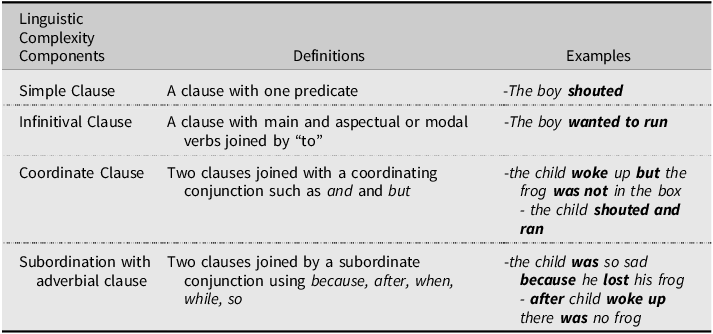
All Frog Story transcriptions were converted into a form following the conventions used by Berman and Slobin (Reference Berman and Slobin1994), with one “verbed clause” per line. A clause was defined as “any unit that contains a unified predicate … expressing a single situation (activity, event, or state)” (Berman & Slobin, Reference Berman and Slobin1994: p. 660). L1-Turkish and L2-English narratives were coded based on the linguistic components shown in Appendices B and C.
We used the percentage of complex clauses with respect to the total number of clauses as the linguistic complexity score for a dependent variable. Two independent raters coded each narrative for narrative structure and linguistic complexity for L1 and L2. Based on the Kappa analyses, there was a high agreement between the raters for plot complexity in L1-Turkish (κ = .89, 95% CI [.86, .93], p < .01.) and L2-English (κ = .91, 95% CI [.89, .94], p < .01) and linguistic complexity in L1-Turkish (κ = .92, 95% CI [.90, .96], p < .01) and L2-English (κ = .93, 95% CI [.91, .97], p < .01). All disagreements were resolved until an agreement was reached.
Data analyses plan
As preliminary analyses, we compared L1-Turkish dominant and L2-English immersion groups’ maternal and paternal education levels. There were no differences between L1-Turkish dominant and L2-English immersion groups based on maternal and paternal education (t(153) = 1.11, p = .27, d = .18, t(153) = 1.89, p = .06, d =.31, respectively). Thus, we did not consider parental education as a variable in further analyses. We also investigated whether there were sex differences regarding the outcome variables. Results indicated no significant differences between girls and boys on the outcome variables (all ts < 1.97 all ps > .052)
To investigate our research questions, we computed linear mixed-effects analyses using Jamovi (Version 2.5) (The Jamovi Project, 2024), using the GAMLj module (Gallucci, Reference Gallucci2019). To compare L1 narrative scores of L1-Turkish dominant and L2-English immersion groups, we took narrative production scores, narrative comprehension scores, and linguistic complexity as outcome variables. We also investigated L1-L2 comparisons within the L2-immersion group, taking narrative production and linguistic complexity as outcome variables. Last, for the longitudinal analyses, we performed regression analyses, taking Time 2 overall narrative production score as an outcome variable. Missing data across Time 1 and Time 2 were not imputed. Instead, linear mixed-effects models were employed, which appropriately account for missing observations under the assumption of missing at random. Regression analyses included only those cases with observations present at both time points.
Results
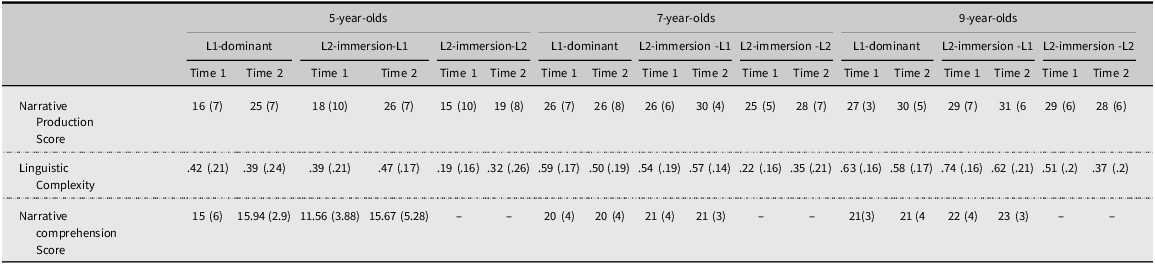
All descriptive statistics regarding language proficiency variables for Time 1 and Time 2 can be seen in Table 2, and all narrative scores can be seen in Table 3.
L1 and L2 language proficiency across language and age groups

Note: TIFALDI-R = L1-Turkish receptive vocabulary score, TIFALDI-R std = L1-Turkish receptive vocabulary standard score, PPVT-4 = L2-English receptive vocabulary score, PPVT-4 std = L2-English receptive vocabulary standard score.
Means and standard deviations of all narrative scores for Time 1 and Time 2

All details regarding analyses are given corresponding to research questions:
Do 5-, 7-, and 9-year-old L1-Turkish dominant and L2-English immersion children differ in their narrative skills in L1 for Time 1 and Time 2, longitudinally over a year?
To compare L1-Turkish dominant and L2-English immersion children for their L1-Turkish narrative skills, we took narrative production scores, narrative comprehension, and linguistic complexity scores as outcome variables in three separate linear mixed-effects analyses. We included the following fixed effects: Time (Time 1 and Time 2), Language group (L1-Turkish dominant and L2-English immersion), L1-proficiency (TIFALDI-R scores), Age (three age groups, 5, 7, and 9-year-olds at Time 1 and 6, 8, and 10-year-olds at Time 2), Time × Language group interaction, Time × Age interaction, Language group × Age interaction and finally, Time × Language group × Age interaction. Random effects included random intercepts of the participants. We scaled the continuous predictor (i.e., L1-proficiency) to simplify the interpretation and to avoid convergence problems for fitted models (Bates et al., Reference Bates, Maechler and Dai2009). We performed Bonferroni-corrected post-hoc analyses to investigate significant interactions and main effects.
Narrative production
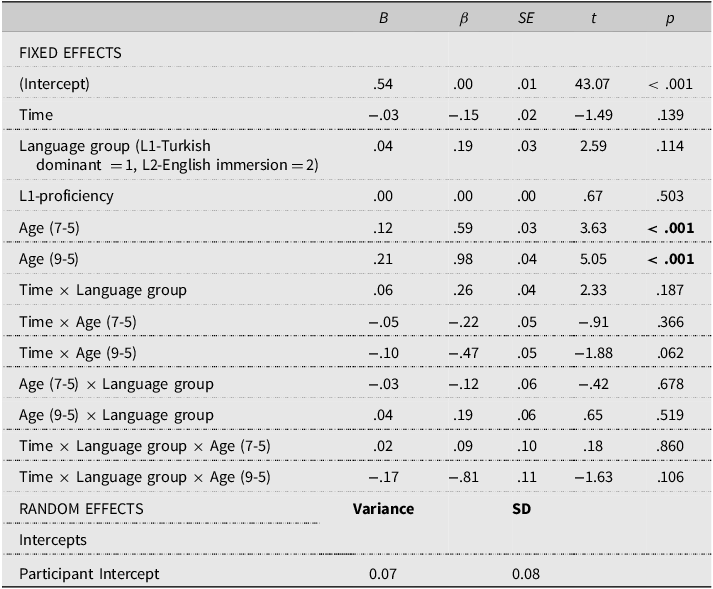
The linear mixed-effects analysis demonstrated a good fit of the data, R 2 = .33, X²(12) = 116.003, p < .001. Results revealed a significant effect of Time, indicating that narrative production scores improved from Time 1 to Time 2. Additionally, a significant effect of Language group indicated that L2-English immersion children exhibited higher narrative production scores than L1-Turkish dominant children. Age was also a significant predictor, with 7-year-olds and 9-year-olds scoring higher than 5-year-olds. L1-proficiency scores were positively associated with narrative production scores, with higher L1 vocabulary scores predicting higher narrative production scores. There was also a significant Time × Age interaction. Post-hoc analysis revealed that 5-year-old children at Time 1 had significantly lower scores compared to 7-year-olds (t(244)= −5.32, p < .001, d = .68) and to 9-year-olds (t(246) = −5.41, p < .001, d = .69). However, these differences were no longer significant at Time 2. Additionally, 5-year-olds performed better at Time 2 compared to Time 1 (t(135) = −6.35, p < .001, d = 1.09), whereas no significant time-related improvements were observed for 7- and 9-year-olds. This indicated that 5-year-old group had greater gains from Time 1 to Time 2, compared to older groups. Time × Language group and Language group × Age interaction and three-way Time × Language group × Age interaction were not significant (see Table 4 for the model statistics).
Model summary of narrative production

Narrative comprehension
The linear mixed-effects analysis demonstrated a good fit of the data, R² = .45, X²(12) = 139.879, p < .001. Results revealed significant main effects of Age, L1-proficiency, and significant interaction effects of Time × Language group and Age × Language group. Age differences indicated that 7- and 9-year-olds performed better in narrative comprehension than 5-year-olds t(167) = −7.39, p < .001, d = −.57; t(186) = −6.79, p < .001, d = −.50, respectively. However, there were no differences between 7- and 9-year-olds, t(154) = −0.79, p = 1, d =−.06. Results also indicated that as L1-proficiency increased, narrative comprehension scores also increased. Post-hoc analysis regarding Age × Language group interaction indicated that the difference between 5- and 7-year-olds in favor of 7-year-olds did not differ significantly by Language group. However, the difference between 5- and 9-year-olds was greater for L2-immersion group compared to L1-Turkish dominant group (p = .014). The post-hoc analysis regarding Time × Age (7-5) indicated that the change in narrative comprehension from Time 1 to Time 2 was different for 7-year-olds compared to 5-year-olds. Results indicated that 7-year-olds demonstrated smaller gains over time compared to 5-year-olds. Post-hoc comparisons demonstrated that 5-year-olds performed poorer than 7- and 9-year-olds for both Time 1 and Time 2 (t(254) = −7.38, p < .001, d = −.46; t(252) = −6.81, p < .001, d = −.43). There were no differences between 7- and 9-year-olds for both Time points (t(255) = −0.398, p = 1, d = −.02; t(261) = −0.83, p =1, d = −.05). Table 5 presents the model statistics.
Model summary of narrative comprehension

Linguistic complexity
The linear mixed-effects analysis demonstrated a good fit of the data, R² = .37, X²(12) = 62.231, p < .001. Results indicated a significant effect for only Age. Post-hoc analyses indicated that 7- and 9-year-olds performed better than 5-year-olds (t(163) = −3.63, p = .001, d = .43; t(182) = −5.05, p < .001, d = .57, respectively) and 9-year-olds performed better than 7-year-olds, t(152) = −2.58, p = .033, d = .43. No other significant effects were observed (see Table 6 for the model statistics).
Model summary of linguistic complexity

Do L2-immersion children differ in their narrative production and linguistic complexity for L1 and L2 for Time 1 and Time 1, longitudinally over a year?
To compare L1-Turkish and L2-English narratives of L2-English immersion children, we took narrative production scores and linguistic complexity scores as outcome variables in two separate linear mixed-effects analyses. We included the following fixed effects: Time (Time 1 and Time 2), Language (L1-Turkish and L2-English), L1-proficiency (TIFALDI-R scores), L2-proficiency (PPVT-4 scores), Age (three age groups, 5, 7 and 9-year-olds at Time 1 and 6, 8, and 10-year-olds at Time 2), Time × Language interaction, Time × Age interaction, Language × Age interaction and finally, Time × Language × Age interaction. Random effects included random intercepts of the participants. We again scaled the continuous predictors (i.e., L1-proficiency, L2-proficiency) to simplify the interpretation and to avoid convergence problems for fitted models (Bates et al., 2009). We performed Bonferroni-corrected post-hoc analyses to investigate significant interactions and main effects.
L1-L2 Comparison of narrative production
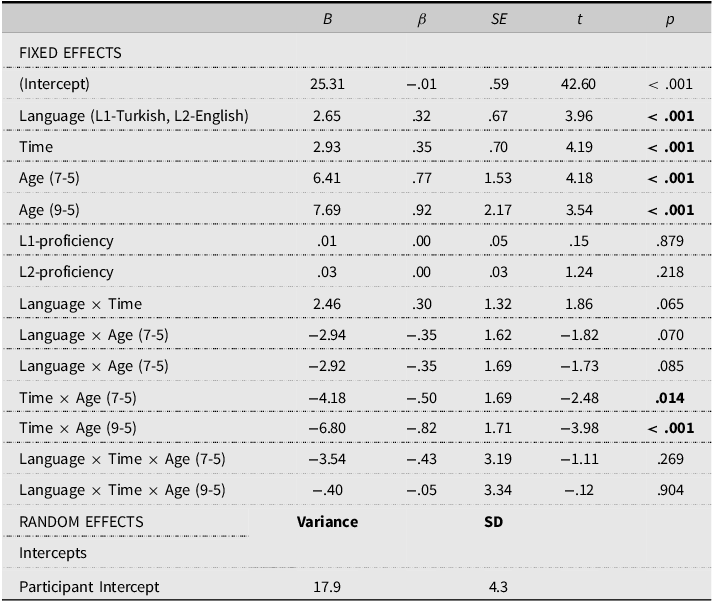
The linear mixed-effects analysis demonstrated a good fit of the data, R² = .58, X²(14) = 160.032, p < .001. Results revealed significant effects of Language, Time, and Age, as well as a significant interaction of Time × Age. Post-hoc comparisons indicated that for narrative production, L2-immersion children performed better in their L1-Turkish compared to their L2-English, t(194) = −3.96, p =< .001, d = .42. Post-hoc analyses regarding Time × Age interaction indicated that change in narrative production from Time 1 to Time 2 was different for 5-year-olds compared to 9-year-olds. Results indicated that 5-year-olds improved more over time compared to 7- and 9-year-olds, t(213.1) = −2.48, p = .014, d = .57 and, t(196.3) = −3.98, p < .001, d = .88. Since the three-way interaction (Language × Time × Age) was not significant, the improvement of 5-year-olds relative to older children reflects a general age effect observed across both L1 and L2. In other words, younger children improved more over time in both languages, and this developmental trend was not language-specific. Specifically, 5-year-olds performed worse than 7- and 9-year-olds for Time 1 (t(119.4) = −4.82, p < .001, d = .94; t(101.4) = −4.71, p < .001, d = .44, respectively) but this difference disappeared for Time 2 (t(127.1) = −2.48, p= .218, d = .37; t(101.3) = −1.85, p =1, d = .34, respectively). Additionally, 7- and 9-year-olds performed similarly at both Time 1 and Time 2, t(98.6) = −1.35, p = 1, d = .27; t(104.2) = −.14, p =1 d = .03 (see Table 7 for the model statistics).
Model summary of narrative production L1-L2 comparison

L1-L2 comparison of linguistic complexity
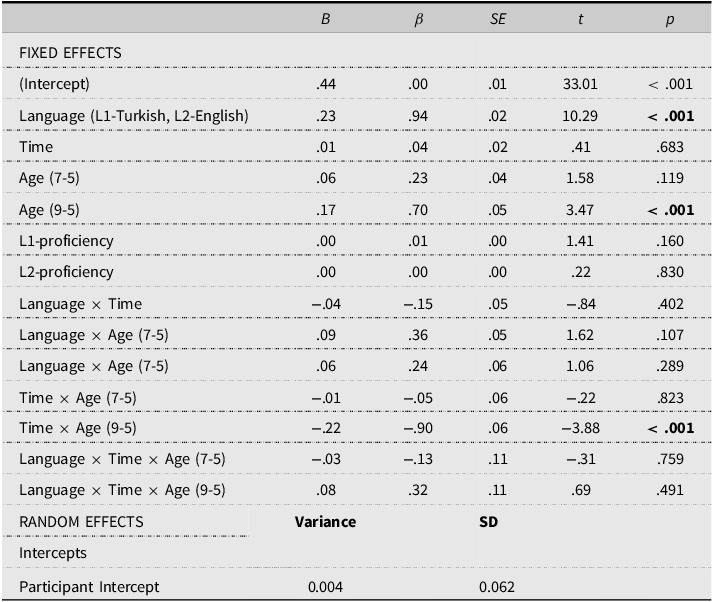
The linear mixed-effects analysis demonstrated a good fit of the data, R² = .46, X²(14) =147.0796, p < .001. Results revealed significant effects of Language, Age (9–5), as well as a significant interaction of Time × Age (9-5). Post-hoc comparisons indicated that L2-immersion children performed better in their L1-Turkish compared to their L2-English, t(201) = −10.3, p = < .001, d = 1.45. Results showed that 5-year-olds improved more over time compared to 9-year-old children, t(203.5) = −3.88, p < .001, d = .88. Specifically, 9-year-olds performed better than 5-year-olds and 7-year-olds for Time 1 (t(119.4) = −4.82, p < .001, d = .94, t(101.4) = −4.71, p < .001,respectively) but this difference disappeared for Time 2 (t(127.1) = −2.48, p= .218, d = .37, t(101.3) = −1.85, p =1, d = .27, respectively). Since the three-way interaction (Language × Time × Age) was not significant, this improvement reflects a general age effect across both L1 and L2, rather than being specific to one language. Additionally, 7- and 9-year-olds performed similarly for Time 2, t(98.6) = −1.35, p = 1, d = .54 (see Table 8 for the model statistics).
Model summary of linguistic complexity L1-L2 comparison

Longitudinal prediction of Time 2 L1 narrative production scores using Time 2 and Time 1 predictors
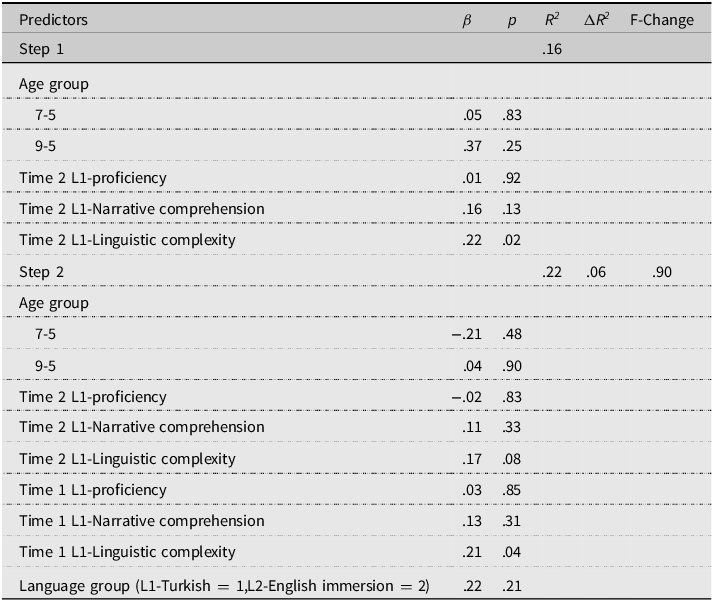
We ran a multiple linear regression analysis to predict Time 2 L1-Narrative production overall scores based on age group, Time 1 and Time 2, L1-proficiency, L1-Linguistic complexity, L1-Narrative comprehension, and language group (L1-Turkish dominant vs. L2-English immersion). We entered the predictors in two steps, first we included predictors from Time 2 to add first concurrent predictors, then we included Time 1 predictors in order to investigate longitudinal effects. In the first step, we entered age group, Time 2 L1-proficiency, Time 2 L1-Linguistic complexity, and Time 2 L1-Narrative comprehension. In the second step, we entered Time 1 L1-proficiency, Time 1 L1-Linguistic complexity, and Time 1 L1-Narrative comprehension. The overall model fit for Step 1 was significant, F (5,116) = 4.4, p =.001, R 2 =.159. The only significant predictor was L1-Linguistic complexity (β =.22, p =.02), indicating a positive association with concurrent linguistic complexity and narrative production scores. Adding L1 measures did not increase the overall R 2 significantly, F (4,112) =2.18, p = .076. Final model explained 22% of the total variation in narrative production scores. In the final model, the only significant predictor was Time 1 L1-Linguistic complexity (β = .21, p = .04), which indicated that higher earlier linguistic complexity scores were associated with higher later narrative production scores. See Table 9 for the model details.
Outcome: Time 2 narrative production—total score

Discussion
The present study investigated the longitudinal effects of early L2-English immersion on the development of narrative skills for children at ages 5, 7, and 9 years. We asked whether (1) 5-, 7- and 9-year-old L2-English immersion and L1-Turkish dominant children differed in their narrative skills in L1 at Time 1 and Time 2, longitudinally over a year (2) L2-English immersion children differred in their narrative production for L1 and L2 at different ages (3) children’s vocabulary knowledge and narrative comprehension at Time 1 were associated with their later narrative production skills at Time 2 for different ages and whether these factors differed for L2-English immersion and L1-Turkish dominant children?
Overall, the findings revealed that age had a significant impact on narrative skills, both on narrative production and comprehension. Specifically, for both Time 1 and Time 2, 5-year-olds performed poorer than 7- and 9-year-olds in both narrative production and comprehension, with no significant differences between 7- and 9-year-olds. For narrative production, 5-year-olds showed greater gains from Time 1 to Time 2 compared to 7- and 9-year-olds for both L1-Turkish and L2-English. For narrative comprehension, again 5-year-olds demonstrated greater gains from Time 1 to Time 2 compared to only 7-year-olds for L1-Turkish. When language group differences were considered, results revealed that L2-English immersion children exhibited higher narrative production scores than L1-Turkish dominant children, regardless of Time. For linguistic complexity, results only revealed a significant effect of age, which showed that older children performed better than younger ones. There were no language group differences for linguistic complexity. In terms of L1-L2 differences, L2-English immersion children exhibited higher narrative production scores for L1 compared to L2 for both Time 1 and Time 2. Additionally, L1- and L2-proficiency were not significant factors. For linguistic complexity, L2-English immersion children performed better in their L1-Turkish compared to L2-English narratives. Results also revealed that L2-English immersion 5-year-olds improved more over time compared to 9-year-olds. The longitudinal analysis showed that linguistic complexity in L1 at Time 1 was a significant predictor of narrative production scores at Time 2, highlighting the importance of early linguistic skills in narrative development. Findings emphasize the critical role of age and linguistic complexity in narrative skills development, while language group differences appear to be minimal.
Age-related differences in narrative skills
Our results are in line with earlier studies that report significant age-related development of narrative production not only across L1-Turkish dominant but also across L2-English immersion children. For Time 1, as expected, 5-year-olds scored significantly lower than 7- and 9-year-olds in both narrative production and linguistic complexity at both Time 1 and Time 2. This age-related progression in narrative production is in line with the presumption that the ability to produce coherent and complex narratives improves significantly during the early school years (Berman & Slobin, Reference Berman and Slobin1994; Hickmann et al., Reference Hickmann, Hendriks, Roland and Liang1996). No differences across 7- and 9-year-olds further suggest that narrative skills may stabilize during middle childhood.
Previous findings show that narrative production involves children’s acquisition of linguistic structures, which are typically well-developed by the age of 5. Around the age of 5, children are found to tell simple, causally coherent narratives (Stein, Reference Stein, Franklin and Barten1988; Trabasso & Nickels, Reference Trabasso and Nickels1992). Hickman (Reference Hickmann, Fletcher and MacWhinney1995) suggests that while linguistic structures develop by age 5, the ability to organize narratives by incorporating sentence-discourse relationships typically emerges later, between the ages of 9 and 12. Our findings regarding 5-year-olds’ gains from Time 1 to Time 2 without language group differences point to age related qualitative shift. Before the ages of 9 to 12, children tend to focus on individual sentences or events without fully integrating them into a coherent narrative structure. As they get older and reach this age range, they begin to demonstrate a more advanced understanding of the connections between sentences and events, resulting in more organized and coherent storytelling. This delayed development was confirmed by Berman and Slobin (Reference Berman and Slobin1994). Younger children may employ limited expressive possibilities while narrating stories due to their inability to conceptualize all encodable perspectives, comprehensively evaluate the listener’s perspective, or use all formal devices. Relatedly, Strömqvist and Day (Reference Strömqvist and Day1993) found that while 4- to 6-year-old children can link episodes in narratives, their skills are still developing compared to older children (e.g., 7- to 12-year-olds).
For narrative comprehension, age-related differences varied across language groups, with older children generally outperforming 5-year-olds. The gap between 5- and 9-year-olds was larger in the immersion group than in the L1-Turkish dominant group. This suggests that immersion may magnify developmental contrasts at earlier ages, as younger children appear to benefit more rapidly from intensive input. The smaller gains observed for 7-year-olds compared to 5-year-olds may indicate a developmental plateau, consistent with findings that comprehension skills stabilize earlier than production skills. The predictive role of L1 proficiency highlights that vocabulary knowledge forms a critical foundation for comprehension, underscoring the need for sustained L1 input to support discourse-level skills.
Effects of L2-immersion on narrative production and linguistic complexity
Contrary to our expectations, there was a significant difference between the L1-Turkish dominant and L2-English immersion in the narrative production scores in favor of L2-English immersion children. This result challenges the notion that bilingual children may lag behind their monolingual peers in narrative production in their L1. However, L2-English immersion children exhibited higher narrative production scores in L1 than L1-Turkish dominant children, indicating that intensive L2-English exposure did not hinder their ability to produce structurally complex narratives in their native language. It is important to note that L1-Turkish consistently receiving substantial exposure at home may also account for why L1 narrative scores remained higher than L2, despite intensive L2-immersion. Thus, the advantage in L1 cannot be attributed to cross-linguistic transfer alone, but rather to an interplay of strong L1 input in the home environment and transfer of discourse-level skills across languages. This interpretation aligns with the Interdependence Hypothesis, suggesting that sustained L1 support provides a solid base from which narrative skills can transfer to and interact with the developing L2. While the finding that L2-immersion children outperformed their L1-dominant peers in L1 narrative production may seem contradictory to some of the literature, we believe several factors may account for this pattern. One possibility is cross-linguistic transfer of discourse and narrative organization skills, which is supported by recent evidence of macrostructural transfer in bilingual children (e.g., Lindgren et al., Reference Lindgren, Tselekidou and Gagarina2023). Another explanation may relate to the sociolinguistic and demographic characteristics of our sample: the immersion group largely consisted of high-SES families who may provide enriched input and literacy opportunities, despite our efforts to match SES across groups. Selection effects cannot be fully ruled out, as parents who choose immersion programs may differ in unmeasured ways (e.g., attitudes toward bilingualism).
This finding also aligns with the Multicompetence Theory (Cook, Reference Cook1991, 2016), which argues that bilinguals develop an integrated linguistic system rather than processing L1 and L2 independently. The ability of L2-English immersion children to maintain strong L1 narrative production despite intensive L2 exposure suggests that macrostructural narrative skills can transfer across languages (Bonifacci et al., Reference Bonifacci, Barbieri, Tomassini and Roch2018; Jarvis & Pavlenko, Reference Jarvis and Pavlenko2008; Odlin, Reference Odlin1989; Vettori et al., Reference Vettori, Bigozzi, Incognito and Pinto2022). Additionally, Lindgren et al (Reference Lindgren, Tselekidou and Gagarina2023) showed that 5- to 6-year-old Turkish-Swedish bilingual children showed evidence of cross-linguistic transfer, particularly in narrative macrostructure, which again aligns with the Multicompetence Theory.
These findings also lend support to the Interdependence Hypothesis (Cummins, Reference Cummins2000), which posits that proficiency developed in one language can transfer and contribute positively to the other, particularly when both languages are supported in the environment. The observation that L2-English immersion children demonstrated improved narrative abilities in both L1-Turkish as well as L2-English suggests that rather than experiencing a trade-off, these children may benefit from shared underlying cognitive and discourse resources that support storytelling across languages. The cross-linguistic similarities observed in discourse organization and event structuring align with this view, pointing toward an interdependent relationship between the two language systems. Likewise, from the perspective of the Competition Model (MacWhinney & Bates, 1989), L2-English immersion children may have developed enhanced storytelling skills in L2 due to greater exposure to L2 English narrative structures; however, they performed better in L1. Instead, the cross-linguistic transfer of storytelling strategies, such as discourse organization and event structuring, may have strengthened their L1 narrative production (Lucero, Reference Lucero2018). Finally, the DST (de Bot et al., 2007) helps explain the adaptability observed in bilingual narrative development. The fact that L2-English immersion children did not show signs of L1 narrative decline suggests that their linguistic systems dynamically adjusted to dual-language exposure. This also supports the DST’s view that bilingual development is nonlinear and influenced by context and input. Rather than following a fixed trajectory, bilingual children adapt their language use based on environmental factors, cognitive flexibility, and input variability, allowing for robust narrative skills in both languages (Pace et al., Reference Pace, Lü, Guo and Zhou2024).
Taken together, these frameworks highlight that bilingual narrative production is shaped by dynamic interactions between cognitive, linguistic, and input factors. The observed advantage for L2-English immersion children in L1 narrative production underscores that L2-immersion does not necessarily place children at a disadvantage in their L1, but rather fosters complex language skills that adapt to contextual demands. The Multicompetence Theory emphasizes an integrated linguistic system, while the Competition Model focuses on input-driven, language-specific patterns. In contrast, the Interdependence Hypothesis highlights how skills in one language support the other, and the DST underscores the adaptive, nonlinear nature of development. While the Competition Model may predict language-specific gains, the Interdependence Hypothesis and DST better capture the observed cross-linguistic benefits. Together, these perspectives help explain how bilingual children flexibly build narrative skills across both languages.
Taken together, while all four frameworks provide valuable insights, the Interdependence Hypothesis and the DST best account for the unexpected advantage of immersion children, as they emphasize both the transfer of skills across languages and the adaptive, nonlinear nature of bilingual development.
Differences in L1-L2 narrative production of L2-English immersion children
L2-English immersion children performed significantly better in their L1-Turkish narratives in terms of narrative structure than in their L2-English narratives as expected. For linguistic complexity, again children performed better in their L1-Turkish compared to L2-English. Results also showed that 5-year-olds improved more over time than 9-year-olds for linguistic complexity. This might be a consequence of shift of primary school in 5-year-olds and improvement due to literacy activities.
Overall, L2-English immersion children in both their L1 and L2 seem to have acquired adequate macrostructure and linguistic properties as supported by several studies (e.g., Gutierrez-Clellen et al., Reference Gutiérrez-Clellen, Simon-Cereijido and Wagner2008; Iluz-Cohen & Walters, Reference Iluz-Cohen and Walters2012; Pearson, Reference Pearson, Oller and Eilers2002; Uccelli & Paez, Reference Uccelli and Páez2007). Although earlier research shows that macrostructure mostly remains unchanged in bilingual children’s both languages and should easily transfer between languages (e.g., Aktan-Erciyes et al., Reference Aktan-Erciyes, Ger and Göksun2024; Fiestas & Penía, Reference Fiestas and Peña2004; Iluz-Cohen & Walters, Reference Iluz-Cohen and Walters2012; Pearson, Reference Pearson, Oller and Eilers2002; Uccelli & Pañez, Reference Uccelli and Páez2007), the present study shows that children who were exposed to L2-English immersion are raised in L1-dominant society. Therefore, children were at an advantage in enrichment of both languages.
Longitudinal outcomes in narrative production
In addition to the cross-sectional age group comparisons, we conducted longitudinal analyses tracking children’s development from Time 1 to Time 2. While cross-sectional comparisons revealed expected age-related differences, the longitudinal analyses focused on within-child change across the one-year period. For longitudinal analyses, we expected age-related increases in narrative production scores. Importantly, for the L2-English immersion group, children at age 5 transitioned into L1-Turkish-dominant primary schooling at age 6, meaning that their input shifted from intensive L2-English exposure in preschool to enriched L1-Turkish input and literacy activities in elementary school. We therefore expected greater gains for this age group, and the results confirmed this pattern. The transition appears to have provided additional support for L1 narrative abilities. Our analyses also showed that higher L1 linguistic complexity at Time 1 predicted later narrative production at Time 2, underscoring the importance of early structural skills (Berman, Reference Berman and Shimron1997). By contrast, comprehension at Time 1 did not significantly predict later production, suggesting that comprehension may be more stable in early childhood, whereas production is more sensitive to shifts in input and schooling (Cain et al., Reference Cain, Oakhill and Bryant2004).
Implications and future directions
The results of the current study have important implications for bilingual education policies, particularly in multilingual and immersion settings. The increased narrative complexity observed in L2-immersion children across both languages suggests that early bilingual education fosters advanced linguistic and cognitive skills, reinforcing the importance of structured dual-language instruction. In view of these, educational strategies are needed to promote balanced bilingualism in which the L1 and L2 will be given equal weight in the curriculum. Given that language dominance and exposure influence narrative development, policies should support L1 maintenance programs, particularly for minority-language speakers in immersion settings. Providing bilingual narrative development, as well as classroom practices that integrate multilingual storytelling, can further enhance children’s narrative competencies. Extended longitudinal research conducted on a sample with more diversified language pairings and from different socioeconomic backgrounds would further highlight typical developmental pathways for bilinguals. The findings also highlight the importance of sustained L1 input in bilingual settings, demonstrating that early L2-English immersion does not appear to hinder L1 narrative development and may confer benefits under certain conditions, particularly in macrostructural organization. This suggests that educators and parents should actively promote L1 through storytelling and structured language activities to ensure balanced bilingual development. Schools implementing L2-immersion education programs could benefit from integrating narrative-based interventions to enhance both linguistic and cognitive skills in bilingual children.
Besides, these findings should also be considered in light of the sociolinguistic context. In Türkiye, Turkish holds high societal prestige as the dominant language, while English is valued as a language of education and global communication. This dual prestige may have facilitated children’s ability to maintain strong L1 narrative skills while also benefiting from early L2-immersion. In contexts where L1 has lower prestige or limited community support, outcomes for bilingual children might differ substantially from their monolingual peers, unlike present study’s findings (Silva-Corvalán, 2014).
Overall, besides statistical differences, the findings suggest that L2-immersion children’s advantage in narrative production may translate into practical benefits, such as stronger preparation for literacy and greater ease in handling complex discourse in school settings.
Limitations
There are number of limitations that should be mentioned. The first pertains to the sample that formed the basis of the current study: a large majority came from high-SES backgrounds. Thus, the results may not be fully generalized to children from more diversified SES backgrounds. The variability in language experience and educational resource access might be limited in our sample, potentially affecting the results. Second, this study targeted children in a specific L1-dominant setting, where L2-English is not the societal language, unlike many bilingual settings where the L2 holds power. Therefore, these findings cannot be generalized to other bilingual populations. Third, this longitudinal period was relatively short (i.e., one year) in comparison, so it might not capture long-term developmental trajectories of narrative skills between bilingual and monolingual children. Longer follow-up periods could offer a more complete understanding of the development of these skills over time. Future studies should incorporate longer follow-up periods to track narrative trajectories into adolescence and employ a variety of narrative elicitation methods to strengthen ecological validity. The use of one and same wordless book as the only method of elicitation for narrative production may not fully represent the child’s narrative competence in other contexts and within other narrative domains. In the future, research should benefit from the use of a wide range of narrative tasks that would enable an assessment of different aspects of narrative competence. Last, the order of narrative production was kept constant (i.e., L2 following L1), which can be a limitation. However, as we discussed in the methods section, collecting data in L1 first made children more comfortable with the testing.
Conclusion
The current study showed that L2-immersion children in an L1-dominant societal environment can master narrative skills in their L1 similar to their monolingual peers and develop strong narrative abilities in their L2. These results contribute to the growing evidence that young L2 learners are highly adaptable to the challenges of learning two languages, highlighting the cognitive and linguistic benefits of early bilingualism. Overall, L2-English immersion does not appear to hinder L1 narrative development and may confer benefits under certain conditions, particularly in macrostructural narrative organization.
Acknowledgements
We thank Büşra Sena Özcan, Songül Kandemir, Pınar Karataş, and Ayşenur Yılmaz for data collection and coding. We also thank Ece Yılmaz and Kardelen Koç for data transcription and coding. This study was supported by The Scientific and Technological Research Council of Turkey (TÜBİTAK), with project number 219K247 granted to Aslı Aktan-Erciyes.
Coding scheme for narrative structure

*Pearson (2002, p.173)
Linguistic Complexity Coding: L1-Turkish

Linguistic Complexity Coding: L2-English







 Open access

