





1. Introduction
Transformative change is required to address ongoing 21st century environmental challenges (O'Brien, Reference O’Brien2012; Patterson et al., Reference Patterson, Schulz, Vervoort, Van Der Hel, Widerberg, Adler, Hurlbert, Anderton, Sethi and Barau2017; United Nations, 2015). Sustainability scientists increasingly call on transdisciplinary research to inform transformations through integrative, action-oriented, and societally embedded knowledge co-production (Caniglia et al., Reference Caniglia, Luederitz, von Wirth, Fazey, Martín-López, Hondrila, König, von Wehrden, Schäpke, Laubichler and Lang2020; Lang et al., Reference Lang, Wiek and Bergmann2012). Transdisciplinary research represents a promising and necessary departure from the confines of disciplinary silos and barriers between academia and practice (Cornell et al., Reference Cornell, Berkhout, Tuinstra, Tàbara, Jäger, Chabay, De Wit, Langlais, Mills, Moll, Otto, Petersen, Pohl and Van Kerkhoff2013; Temper and Bene Reference Temper and Bene2016). Yet, navigating the diverse and sometimes conflicting perspectives of researchers and participants in transdisciplinary processes raises challenges, leading many scholars to call for reflexivity as a crucial part of research practice (Belcher et al., Reference Belcher, Rasmussen, Kemshaw and Zornes2016; Fazey et al., Reference Fazey, Schäpke, Caniglia, Patterson, Hultman, Mierlo, van, Säwe, Wiek, Wittmayer, Aldunce, Al, Battacharya, Bradbury, Carmen, Colvin, Cvitanovic, Souza, Gopel, Goldstein, Hämäläinen, Harper and Wyborn2018; Horcea-Milcu et al., Reference Horcea-Milcu, Dorresteijn and Leventon2024; Polk Reference Polk2015).
In the context of transdisciplinary sustainability science, references to reflexivity emphasize the importance of critical reflection about the different cognitive, perceptual, theoretical, cultural, or political orientations of participants in co-produced research and their influence on both research outcomes and on broader transformative change processes (Fazey et al., Reference Fazey, Schäpke, Caniglia, Patterson, Hultman, Mierlo, van, Säwe, Wiek, Wittmayer, Aldunce, Al, Battacharya, Bradbury, Carmen, Colvin, Cvitanovic, Souza, Gopel, Goldstein, Hämäläinen, Harper and Wyborn2018; Hakkarainen et al., Reference Hakkarainen, Mäkinen-Rostedt, Horcea-Milcu, Amato, Jämsä and Soini2022; Moore et al., Reference Moore, Olsson and Nilsson2018; Popa et al., Reference Popa, Guillermin and Dedeurwaerdere2015; Sellberg et al., Reference Sellberg, Cockburn, Holden and Lam2021; Wolff et al., Reference Wolff, Cockburn and De Wet2019). Demonstrations of operationalizing such reflexivity in transdisciplinary sustainability science are growing, for example in positionality statements of academic papers and doctoral dissertations (González García-Mon, Reference González García-Mon2022; Haider, Reference Haider2017), guiding frameworks for integrating multiple knowledge systems (Bornemann & Christen, Reference Bornemann and Christen2020; Norström et al., Reference Norström, Cvitanovic, Löf, West, Wyborn, Balvanera, Bednarek, Bennett, Biggs, De Bremond, Campbell, Canadell, Carpenter, Folke, Fulton, Gaffney, Gelcich, Jouffray, Leach and Österblom2020; Tengö et al., Reference Tengö, Brondizio and Elmqvist2014), more reflexive evaluations of the purpose and outcomes of transdisciplinary research (Hubeau et al., Reference Hubeau, Marchand, Coteur, Debruyne and Van Huylenbroeck2018; Mitchell et al., Reference Mitchell, Cordell and Fam2015), and early career reflections on how reflexivity can help navigate careers with early inter/transdisciplinary training (Care et al., Reference Care, Bernstein, Chapman, Diaz Reviriego, Dressler, Felipe-Lucia, Friis, Graham, Hänke, Haider, Hernández-Morcillo, Hoffmann, Kernecker, Nicol, Piñeiro, Pitt, Schill, Seufert, Shu and Zaehringer2021; Haider et al., Reference Haider, Hentati-Sundberg and Giusti2018; Sellberg et al., Reference Sellberg, Cockburn, Holden and Lam2021).
In the context of transformative transdisciplinary research, such reflexive processes are meant to open-up epistemic and solution spaces that elevate marginalized perspectives and challenge the status quo. In this way, reflexivity becomes closely tied to transformative learning, which has a rich theoretical background and has become increasingly drawn upon and developed in sustainability-related research (Alam, Reference Alam2022; Borie et al., Reference Borie, Gustafsson, Obermeister, Turnhout and Bridgewater2020; Herrero et al., Reference Herrero, Dedeurwaerdere and Osinski2019; O'Neil Reference O'Neil2018; Roux et al., Reference Roux, Nel, Cundill, O’farrell and Fabricius2017; Walsh et al., Reference Walsh, Böhme, Lavelle and Wamsler2020), including in relation to sustainability transformation (Horcea-Milcu et al., Reference Horcea-Milcu, Dorresteijn and Leventon2024; O'Brien, Reference O’Brien2012; Westley et al., Reference Westley, Olsson and Folke2011). We move from Borie et al. (Reference Borie, Gustafsson, Obermeister, Turnhout and Bridgewater2020) who consider transformative learning as ‘learning that creates changes, but also learning that is achieved reflexively’: going beyond the breadth of inputs but also attending to embracing multiple prospectus and knowledges (p. 72). This definition blurs the distinction between transformative learning and reflexivity, wherein transformative learning is inherently reflexive in nature. However, these concepts are still distinct: while reflexivity may occur without a transformative learning process, transformative learning is likely not possible without reflexivity.
Reflexivity has been widely developed and applied within the social sciences and environmental humanities. Reflexivity has been explored on a collective societal level, for example through Ulrich Beck's work on reflexive modernization wherein the unintended consequences of simple modernity motivate a reflexive turn across society, including to science itself: ‘science itself is deconstructed by means of science’ (Beck et al., Reference Beck, Bonss and Lau2003; Boström et al., Reference Boström, Lidskog and Uggla2017). Relatedly, reflexive governance literature has characterized the institutional structures and processes required to establish a self-scrutinizing governance system that may better deal with uncertainty (Boström et al., Reference Boström, Lidskog and Uggla2017; Voss, Reference Voss2006). Pickering (Reference Pickering2019) draws from this work and on Dryzek's (Reference Dryzek2016, p. 942) definition of reflexivity as ‘the capacity of an agent, structure or process to change in the light of reflection on its performance’ to characterize ecological reflexivity as a crucial aspect of governance in the Anthropocene. Reflexivity has also been described on an individual level as a social scientific practice, demanding researchers to ‘turn a critical gaze back on themselves’ (Finlay, Reference Finlay, Finlay and Gough2003) to articulate and situate their own subjectivities in relation to their research (Holland, Reference Holland1999; Knaggård et al., Reference Knaggård, Ness and Harnesk2018; Salzman, Reference Salzman2002; Stirling, Reference Stirling, Voss and Kemp2006). This is accompanied by significant work in humanities and critical social sciences, which call on reflexivity as a situated embodiment of knowledge production, enabling more emancipatory and socially robust forms of knowledge (Haraway, Reference Haraway1988; Sellberg et al., Reference Sellberg, Cockburn, Holden and Lam2021; Temper et al., Reference Temper, McGarry and Weber2019).
Despite the large but diffuse body of scholarship and the promise of reflexivity for sustainability science, researchers attempting to ‘be reflexive’ are met with several challenges. First, they are left without a sense of how various understandings of reflexivity relate to one another and fit within the context of complex transdisciplinary research processes in practice. For example, individual reflexivity is rarely traced through to a collective influence on the broader transdisciplinary research process, where the interactions between participants produce emergent research outcomes (Goodchild, Reference Goodchild2021; McIntyre et al., Reference McIntyre, Cloutis and McCarthy2023). Second, researchers meet institutional and structural barriers that limit their ability to conduct reflexive sustainability science in institutions that were not designed for transdisciplinarity, which places the ethical and practical responsibility for reflexivity on individuals without adequate resources or support (Cockburn and Cundill, Reference Cockburn, Cundill, Macleod, Marx, Mnyaka and Trehardne2018; Moore et al., Reference Moore, Olsson and Nilsson2018; Sellberg et al., Reference Sellberg, Cockburn, Holden and Lam2021). Third, and relatedly, calls for reflexivity are not explicitly linked to predominant modes of inquiry in sustainability science, so while scholars are documenting and discussing reflexivity, it is not mainstream or required automatically for methods to be deemed robust. These gaps create challenges for any sustainability scientist engaging in reflexivity to put their findings into practice.
The contribution of this paper draws on the social-ecological systems (SES) perspective as a predominant mode of inquiry in sustainability science which, alongside critical systems theory (CST), can contribute to addressing these challenges. The SES perspective views linked human and natural systems as co-evolving and intertwined complex adaptive systems and system behavior as emerging from cross-scale and nonlinear interactions and feedbacks (Levin et al., Reference Levin, Xepapadeas, Crépin, Norberg, De Zeeuw, Folke, Hughes, Arrow, Barrett, Daily, Ehrlich, Kautsky, Mäler, Polasky, Troell, Vincent and Walker2013; Reyers et al., Reference Reyers, Folke and Moore2018). CST brings important insights to how sustainability science – and in particular the complexity worldview underpinning much of the field – can understand and operationalize reflexivity (Lazurko et al., Reference Lazurko, Haider and Hertz2024). Thus, we aim to contribute to an emerging body of research developing actionable frameworks for reflexivity in sustainability and related areas (Beck et al., Reference Beck, Elliott, Booher, Renn and Montgomery2021; Montana, Reference Montana2020; Pienkowski et al., Reference Von Seggern, Holst and Singer-Brodowski2023; von Seggern et al., Reference Pienkowski, Kiik, Catalano, Hazenbosch, Izquierdo-Tort, Khanyari, Kutty, Martins, Nash, Saif and Sandbrook2023), by developing a framework for reflexivity as a transformative capacity for sustainability science using a critical systems approach. To achieve this, we first introduce the theoretical background in critical systems and SES approaches to reflexivity before providing a rapid review of existing research on reflexivity that remains spread across a wide range of literature on transdisciplinary and transformative research. Based on both the review and descriptive experiences in case study research by the lead author, we then develop a framework that aims to: (1) give shape to the various dimensions of reflexivity by detailing the types of boundary processes involved (i.e. using a critical systems lens), (2) guide how reflexivity can be facilitated in service of transformation in practice, and (3) do so in a way that is consistent with predominant modes of inquiry in the field of sustainability science (i.e. the SES perspective).
2. Critical systems and social-ecological systems approaches to reflexivity
SES resilience is a field of research that focuses on the unique capacities of SESs to persist, adapt, and transform in the face of unexpected and surprising change (Folke, Reference Folke2016; Haider and Cleaver, Reference Haider and Cleaver2023). From this view, transformation is a fundamental alteration or reorganization of a system, including its structure, functions, feedbacks, and system properties (Moore et al., Reference Moore, Tjornbo and Enfors2014; Reyers et al., Reference Reyers, Folke and Moore2018). Emerging research characterizes how the capacities required to transform are distinct from adaptive maintenance of SESs (Marshall et al., Reference Marshall, Park, Adger, Brown and Howden2012; Olsson et al., Reference Olsson, Bodin, Folke, Armitage and Plummer2010; Reyers et al., Reference Reyers, Folke and Moore2018; Wilson et al., Reference Wilson, Pearson and Kashima2013). One such capacity is the need for actors engaged in systems change to develop system(s) reflexivity. Moore et al. (Reference Moore, Olsson and Nilsson2018) define system reflexivity as the capacity to see the complexity and mobilize the agency in a system, while deeply engaging with diversity across multiple scales.
Given the focus on transformations and transdisciplinary research in SES research, scholars have focused efforts on how to better integrate and honor different knowledge systems, e.g., western scientific and non-western knowledge systems (Lam et al., Reference Lam, Hinz and Lang2020; Tengö et al., Reference Tengö, Brondizio and Elmqvist2014), and how this presents numerous ethical risks (Klenk & Meehan, Reference Klenk and Meehan2015; Turnhout, Reference Turnhout2019). Researchers are called to reflexive self-scrutiny and unlearning to facilitate ‘horizontal’ knowledge integration that allows them to participate ethically in, for instance, decolonized approaches (Chilisa, Reference Chilisa2017; Manuel-Navarrete et al., Reference Manuel-Navarrete, Buzinde and Swanson2021). Similarly, researchers are experimenting with how to reflexively surface the often-marginalized worldviews and practices that can enable societal change (Chambers et al., Reference Chambers, Wyborn, Klenk, Ryan, Serban, Bennett, Brennan, Charli-Joseph, Fernández-Giménez, Galvin, Goldstein, Haller, Hill, Munera, Nel, Österblom, Reid, Riechers, Spierenburg, Tengö and Rondeau2022; Marshall et al., Reference Marshall, van Zwanenberg and Eakin2021). Others have explored whether the capacity for institutional forms of reflexivity could be strengthened to support or enable transformative change, using the aforementioned view of (systems) reflexivity to interrogate and reimagine existing unsustainable systems (Moore et al., Reference Moore, Olsson and Nilsson2018). Early career researchers are also looking to reflexivity to navigate careers with early inter/transdisciplinary backgrounds, such as to nurture the unique combination of epistemological agility and methodological groundedness required to produce rigorous sustainability science (Haider et al., Reference Haider, Hentati-Sundberg and Giusti2018) and enable practices of care in transdisciplinary leadership and practice (Care et al., Reference Care, Bernstein, Chapman, Diaz Reviriego, Dressler, Felipe-Lucia, Friis, Graham, Hänke, Haider, Hernández-Morcillo, Hoffmann, Kernecker, Nicol, Piñeiro, Pitt, Schill, Seufert, Shu and Zaehringer2021; Sellberg et al., Reference Sellberg, Cockburn, Holden and Lam2021).
To complement SES resilience thinking, we draw on critical systems theory (CST), which offers important insights to how sustainability science – and in particular the complexity worldview underpinning much of the field – can understand and operationalize reflexivity (Lazurko et al., Reference Lazurko, Haider and Hertz2024). CST emerged from operational research to grapple with the theoretical and methodological pluralism of systems approaches (Churchman, Reference Churchman1970; Jackson, Reference Jackson2019). CST embraces a pragmatist perspective, which views knowledge as partial and provisional as it is ‘impossible to apprehend (non-contextually) the whole system’ (Churchman, Reference Churchman1970; Matthews, Reference Matthews, van Gigch and McIntyre-Mills2006), aligning with the critical complexity lens that has already been discussed in SES literature (Audouin et al., Reference Audouin, Preiser, Nienaber, Downsborough, Lanz and Mavengahama2013). This perspective draws attention to the role of boundaries and subjective boundary judgments in delineating any system understanding (Jackson, Reference Jackson2019; Midgley, Reference Midgley2000). Here, boundaries are broadly understood as any source of normative or empirical selectivity that delimits the frame of a system, moving beyond typical ‘boundary choices’ such as spatial scale to include any sources of motivation, power, knowledge, and legitimacy (Jackson, Reference Jackson2019; Ulrich, Reference Ulrich1983). For example, an indicator measuring desirable change can be a source of motivation and whose knowledge is considered to matter can be a source of knowledge or legitimacy. Midgley (Reference Midgley2000) expanded on this work to build a philosophical foundation for systemic intervention inspired by Whitehead (Reference Whitehead1978) that views reality and knowledge as produced through boundary processes.
Consequently, a critical systems lens recognizes that all knowledge is provisional because any frame of a system, including a complex SES, excludes important system elements and is thus dependent on subjective boundaries. CST also aligns with critical complexity literature by recognizing that researchers are situated within the complexity they seek to understand. So, demands for (systems) reflexivity (Moore et al., Reference Moore, Olsson and Nilsson2018) also apply to the researchers themselves as agents within the SESs (Audouin et al., Reference Audouin, Preiser, Nienaber, Downsborough, Lanz and Mavengahama2013; Cilliers, Reference Cilliers2002; Lazurko et al., Reference Lazurko, Haider and Hertz2024). If taken seriously, these insights present the opportunity to establish the reflexivity of sustainability scientists themselves as transformative capacity using a critical systems approach (i.e. focused on boundaries). We see this as an opportunity to develop a notion of reflexivity that broadly resonates with those developed in the (critical) social sciences (e.g. Haraway, Reference Haraway1988) but is more accessible to the systems thinking operative in sustainability science (Lazurko et al., Reference Lazurko, Haider and Hertz2024).
CST and the complexity worldview underpinning SES research highlights the role of boundary processes in understanding the dynamics of complex SESs, which are integral to system behaviour and dependent on subjectivity of the observer (Audouin et al., Reference Audouin, Preiser, Nienaber, Downsborough, Lanz and Mavengahama2013; Cilliers, Reference Cilliers2001; Preiser et al., Reference Preiser, Biggs, De Vos and Folke2018). Lazurko et al. (Reference Lazurko, Haider and Hertz2024) call for reflexivity to make boundary processes that produce ambiguity in complex systems explicit. These boundary processes include (1) being, i.e., the boundaries of a researcher's subjective orientation, how they influence their experience of complexity, and how multiple frames are exposed, understood, and mediated through the research process (Midgley, Reference Midgley1992; West et al., Reference West, Haider, Stålhammar and Woroniecki2020), (2) knowing, i.e., how knowledge about complexity is produced through the process of making boundary judgments, generating a partial, contextual, and provisional frame (Midgley, Reference Midgley2000; Preiser et al., Reference Preiser, Biggs, De Vos and Folke2018), and (3) intervening, i.e., how a researcher is part of the complexity they seek to understand, rendering any boundary process as an intervention that reinforces certain frames and marginalizes others (Caniglia et al., Reference Caniglia, Luederitz, von Wirth, Fazey, Martín-López, Hondrila, König, von Wehrden, Schäpke, Laubichler and Lang2020; Martin & Mirraboopa, Reference Martin and Mirraboopa2003; Midgley, Reference Midgley2000).
3. Method
3.1 Rapid scoping review of transdisciplinarity, transformation, and reflexivity
We conducted a rapid scoping review to synthesize literatures on reflexivity from transdisciplinary and transformations fields into a framework for reflexivity as a transformative capacity for sustainability science. Literature was retrieved from Web of Science in two interrelated searches. First, the search string transdisciplinar* AND transformat* retrieved literature discussing transdisciplinarity as a potentially transformative research paradigm. Second, the search string transdisciplinar* AND reflexiv* retrieved literature discussing reflexivity in transdisciplinary research. We sorted the searches by relevance and citations (highest) and reviewed the 20 highest ranked papers for each search to ensure they were relevant to the aforementioned topics (i.e. a significant proportion of the paper was dedicated to discussing operationalizing these concepts in research practice, not simply using them to produce research outputs; for example, transdisciplinary research on transformation processes were less relevant than research discussing how transdisciplinary research can become more transformative). This initial search was meant to provide an initial list of papers to validate our search terms, but following this review we already had a significant number of papers (44) that were seminal to the field and could provide a strong foundation for the development of the framework. Nine additional papers that were influential papers on reflexivity known to co-authors and/or cited in these initial 44 papers were added. The final database for the rapid scoping review included 53 papers, which are listed in the Supplementary Materials.
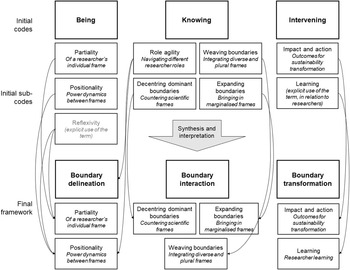
We analyzed these papers in NVivo using a combination deductive-inductive coding scheme. The deductive portion was structured by a broad conceptualization of the boundary processes described by Lazurko et al. (Reference Lazurko, Haider and Hertz2024): being, knowing, and intervening (section 2). The intention of using these categories as initial codes was to provide a structure for the review that addresses the ontological (i.e. the nature of reality) and epistemological (i.e. the theory of knowledge) dimensions of reflexivity and addresses its role in research as intervention (i.e. if operationalized as a transformative capacity for sustainability science). Under these broad categories, we used an inductive process to expand upon these initial codes and synthesize them into the framework for reflexivity as a transformative capacity. Through this process, additional sub-codes were added under each of these overarching codes, including a code that refers to explicit use of the term reflexivity. The main codes that stemmed from the deductive-inductive scheme are depicted in the top of Figure 1. Following this initial coding process, the content under each code was further analyzed by considering the boundary processes occurring within each code and sub-code more explicitly. In this process, more specific language was used to describe the boundary processes under each code and sub-code (i.e. being became boundary delineation) and repetition across the sub-codes was removed by synthesizing them under one sub-code (e.g. between role agility and partiality). This process of interpretation and synthesis led to the final framework shown in Figure 2.
Interpretation and synthesis of reflexivity in transformations and transdisciplinary research literature. Arrows show how initial sub-codes of Being, Knowing, and Intervening (from Lazurko et al., Reference Lazurko, Haider and Hertz2024) were synthesized into the final framework.

Framework for reflexivity as a transformative capacity for sustainability science.

3.2 Case study to demonstrate and refine the framework
We demonstrate how the framework could be applied through a critical reflection about a case study that the lead author previously studied. The purpose of the critical reflection is to explore how the boundary processes in the framework manifested in a transdisciplinary research study that had a transformative agenda but had not explicitly nurtured reflexivity. The reflection also helped refine the framework by nuancing the theoretical contributions from literature with considerations from practice. The critical reflection is presented as a first-person narrative that focuses on the reflexivity of the lead-author in the context of the transdisciplinary case study and its consequences for the research outcomes.
The case study is a transdisciplinary scenario modeling process led by the lead author in the Red River Basin (Lazurko et al., Reference Lazurko, Schweizer and Armitage2023). The Red River Basin is an agriculturally important transboundary river basin shared by the United States and Canada where significant natural climatic variability is expected to worsen due to climate change. The study aimed to explore big-picture (i.e. integrative and holistic) scenarios of a river basin under climate change by characterizing future change as emergent from interactions between the ongoing and diverse efforts to build resilience in a complex, cross-scale SES. This required a transdisciplinary approach involving partnerships with local governance and research organizations, in addition to intensive participation through a collaborative and iterative research design. The study also had an explicit transformative agenda: to ‘open up’ scenarios about the future of river basins to a more expansive and inclusive set of drivers and perspectives, thereby challenging actors to consider how efforts to ‘build resilience’ to climate change may reinforce unsustainable and unjust systems.
4. Results: framework for reflexivity as a transformative capacity
Based on the results of the rapid review, the framework for reflexivity as a transformative capacity in sustainability science characterizes reflexivity as the capacity to nurture a dynamic, embedded, and collective process of self-scrutiny and mutual learning in service of transformative change. This notion of reflexivity manifests through three interacting boundary processes: boundary delineation, boundary interaction, and boundary transformation. Here, boundaries are understood in line with the CST perspective (section 2) as constituted of any potential sources of empirical or normative selectivity in the system that generate a view of which facts or values are relevant (Ulrich, Reference Ulrich1983).
Boundary delineation is the process of self-scrutiny to describe the factors contributing to each individual researcher and participants' frame and situating that frame relative to others from the lens of power. Boundary interaction is the process of critically reflecting upon and facilitating the interactions between multiple subjective frames to produce plural and collective frames through the research process. Boundary interaction becomes transformative when it involves: decentring dominant boundaries to open up epistemic space, expanding boundaries beyond dominant frames to highlight novelty and heterogeneity, and weaving multiple boundaries to generate plural and collective frames. Boundary transformation is the process of mutual learning in which individual frames transform as a consequence of their interaction with others.
These three processes of boundary delineation, interaction, and transformation interact across time, space, and between actors in transdisciplinary research. The framework is depicted visually in Figure 2. We present the results of the scoping review and case study reflection for each boundary process in sections 4.1 to 4.3 in parallel to simultaneously explain and demonstrate the framework for reflexivity as a transformative capacity. Doing so reveals how boundary delineation, interaction, and transformation are far more messy, complex, and interdependent than is often discussed in the literature.
4.1 Boundary delineation
Boundary delineation is the process of self-scrutiny to describe and situate the subjective frame of each individual researcher or participant in transdisciplinary research. This process requires identifying the factors that determine the partiality and positionality of our frames (Nastar, Reference Nastar2023; Polk, Reference Polk2015). These factors can include our ontological and epistemological orientation (Fazey et al., Reference Fazey, Schäpke, Caniglia, Patterson, Hultman, Mierlo, van, Säwe, Wiek, Wittmayer, Aldunce, Al, Battacharya, Bradbury, Carmen, Colvin, Cvitanovic, Souza, Gopel, Goldstein, Hämäläinen, Harper and Wyborn2018; Fortuin & van Koppen, Reference Fortuin and van Koppen2016; Mitchell et al., Reference Mitchell, Cordell and Fam2015), norms and ideologies (Barnaud & van Paassen, Reference Barnaud and van Paassen2013; Knaggård et al., Reference Knaggård, Ness and Harnesk2018), cultural background (Berger-González et al., Reference Berger-González, Stauffacher, Zinsstag, Edwards and Krütli2016; Fazey et al., Reference Fazey, Schäpke, Caniglia, Patterson, Hultman, Mierlo, van, Säwe, Wiek, Wittmayer, Aldunce, Al, Battacharya, Bradbury, Carmen, Colvin, Cvitanovic, Souza, Gopel, Goldstein, Hämäläinen, Harper and Wyborn2018), problem orientation (Bornemann & Christen, Reference Bornemann and Christen2020; Goven et al., Reference Goven, Langer, Baker, Ataria and Leckie2015), personal experiences and disciplinary training (Knaggård et al., Reference Knaggård, Ness and Harnesk2018; Mitchell et al., Reference Mitchell, Cordell and Fam2015), in addition to normative factors such as values and ethics (Barnaud & van Paassen, Reference Barnaud and van Paassen2013; Fazey et al., Reference Fazey, Schäpke, Caniglia, Patterson, Hultman, Mierlo, van, Säwe, Wiek, Wittmayer, Aldunce, Al, Battacharya, Bradbury, Carmen, Colvin, Cvitanovic, Souza, Gopel, Goldstein, Hämäläinen, Harper and Wyborn2018; Horcea-Milcu et al., Reference Horcea-Milcu, Abson and Apetrei2019; Midgley, Reference Midgley2000). Characteristics associated with power and privilege also play a role, such as gender, age, race, and class (Holland, Reference Holland1999; Knaggård et al., Reference Knaggård, Ness and Harnesk2018; Nastar & Ramasar, Reference Nastar and Ramasar2012). Critically reflecting on these factors can help reveal how they influence our choice of questions and methodologies, boundaries of analysis, and what type of knowledge deemed valid, legitimate, or salient, which in turn influences how individuals interact with the perspectives and assumptions of others (Castree et al., Reference Castree, Adams and Barry2014; Fortuin & van Koppen, Reference Fortuin and van Koppen2016; Goven et al., Reference Goven, Langer, Baker, Ataria and Leckie2015; Mitchell et al., Reference Mitchell, Cordell and Fam2015). Further, these factors together influence how we situate ourselves in relation to the research; i.e., as a neutral and independent observer producing value-free science or as situated observers who are embedded within transformation processes (Fazey et al., Reference Fazey, Schäpke, Caniglia, Patterson, Hultman, Mierlo, van, Säwe, Wiek, Wittmayer, Aldunce, Al, Battacharya, Bradbury, Carmen, Colvin, Cvitanovic, Souza, Gopel, Goldstein, Hämäläinen, Harper and Wyborn2018; Polk, Reference Polk2015).
Reflexivity becomes potentially transformative when we situate our subjective frame relative to others. This requires deeper reflection about the power we hold as individuals in relation to the factors influencing the partiality of our frames and how this power manifests in knowledge production (Barnaud & van Paassen, Reference Barnaud and van Paassen2013; Baumber, Reference Baumber2022; de Geus et al., Reference de Geus, Avelino and Strumińska-Kutra2023). For example, scientists trained in more positivist disciplines may view their role in knowledge integration (see section 4.2) as benign, but by ignoring the role of power they may reinforce their own more dominant perspectives as neutral and objective while casting marginalized – and potentially more transformative – perspectives as political or subjective (Turnhout, Reference Turnhout2018; Turnhout et al., Reference Turnhout, Metze and Wyborn2020). The power asymmetries between researchers and participants are just as important (Fazey et al., Reference Fazey, Schäpke, Caniglia, Patterson, Hultman, Mierlo, van, Säwe, Wiek, Wittmayer, Aldunce, Al, Battacharya, Bradbury, Carmen, Colvin, Cvitanovic, Souza, Gopel, Goldstein, Hämäläinen, Harper and Wyborn2018; Fortuin & van Koppen, Reference Fortuin and van Koppen2016; Nastar, Reference Nastar2023; Popa et al., Reference Popa, Guillermin and Dedeurwaerdere2015). For example, interactions across wide ontological and epistemological or cultural gaps requires skillful navigation to avoid reinforcing existing historical power asymmetries (Berger-González et al., Reference Berger-González, Stauffacher, Zinsstag, Edwards and Krütli2016; McIntyre et al., Reference McIntyre, Cloutis and McCarthy2023), and researchers can block meaningful collaboration if they are not aware of the degree of these differences (Fortuin & van Koppen, Reference Fortuin and van Koppen2016). Further, researchers initiating transdisciplinary research projects often have the power to define the problem and design the research process (Mitchell et al., Reference Mitchell, Cordell and Fam2015). These choices are influenced by their own subjectivities (Goven et al., Reference Goven, Langer, Baker, Ataria and Leckie2015) and positions of influence within broader disciplinary academic systems (Knaggård et al., Reference Knaggård, Ness and Harnesk2018). Clarifying asymmetries in project ownership and control can help mitigate inequitable stakeholder participation, potentially improving the quality of the research and building societal ownership of research outcomes (Bornemann & Christen, Reference Bornemann and Christen2020; Goven et al., Reference Goven, Langer, Baker, Ataria and Leckie2015; Rosendahl et al., Reference Rosendahl, Zanella, Rist and Weigelt2015).
4.1.1 Boundary delineation in practice – reflection from the Red River Basin (Anita Lazurko)
I grew up on a farm on the Canadian prairies not far from the Red River Basin. I know how to navigate the texture of the terrain and the small talk about the weather. This familiarity helped build trust with partners and move to fieldwork relatively quickly. What was less familiar was how to navigate the Red River Basin as a transdisciplinary sustainability scientist with a worldview and transformative agenda that has evolved in institutions far from home. It was a disorienting and stimulating experience to translate theories and experiences learned elsewhere to the issues that my family used to discuss around the dinner table.
I was indoctrinated into the problem-solving mindset of an engineer through my undergraduate degree. As a result, while I no longer work or identify as an engineer, I find myself reaching toward heuristics and tools that break down complexity into solvable parts. I experience this tendency now as both a blessing and a curse given my more recent practice in transdisciplinarity and critical theory. Nevertheless, it contributed to my motivation to use SES theory and the cross-impact balances (CIB) scenario method to shape the scenario process in the Red River Basin. CIB is a system-theoretical scenario method that generates plausible narrative scenarios from a network of interacting drivers of change. At the time, I proposed CIB as a promising methodology to case study partners, because it could help them make sense of complexity by ‘opening up’ scenarios about the future of river basins to a more expansive and inclusive set of drivers and perspectives than strictly quantitative models. Together, we co-created a scenario process framed around the issue of climate resilience and structured by the CIB method, which could be a useful and stimulating for participants in the research context. While this framing was co-created, it could also be viewed as a soft imposition: my research was conducted under my own independent funding, so relative to project partners, I had the ultimate power to decide.
My own subjective frame is delineated by additional boundaries beyond disciplinary training, including that I am a young woman and a white settler Canadian (for the implications of colonial history in the Canadian context, see e.g. Borrows (Reference Borrows2010), Fontaine and Craft (Reference Fontaine and Craft2015) and Napoleon (Reference Napoleon2001)). Such factors influenced my access to study partners and participants and the type of information they felt comfortable to share. Before this research, I may have stopped my reflection there. But much of the fieldwork was conducted amid the Black Lives Matter protests in 2021, shortly after the Murdered and Missing Indigenous Womens Inquiry report (Ficklin et al., Reference Ficklin, Tehee and Killgore2021; National Inquiry into Missing and Murdered Indigenous Women and Girls, 2019), and during ongoing discussions of reconciliation in Canada. These events combined to mark an inflection point in the way that I and many other settlers experienced our Canadian identity. Operationalizing this deeper understanding of my role in the colonial present felt particularly important for my research, because the Red River Basin is steeped in the history of the struggle of Métis and First Nations people. This deeper process of boundary delineation (i.e. including situating my frame relative to others from the lens of power) surfaced important ethical and empirical considerations, which launched several discussions with respected mentors and Indigenous researchers to try to bring this learning into my PhD. Yet, at times I felt like I didn't have the skills, nor the space in my PhD timeline, to significantly pivot my approach.
4.2 Boundary interaction
Boundary interaction is the process of critically reflecting upon and facilitating the interactions between multiple subjective frames to produce a collective frame through the transdisciplinary research process. Boundary interaction has the potential to become transformative when it involves: (1) decentring dominant boundaries, (2) expanding boundaries, and (3) weaving boundaries.
4.2.1 Decentring dominant boundaries
Decentring dominant boundaries is the process of opening up epistemic space to allow for concurrent processes of expanding and weaving boundaries to occur (section 4.2.2/3). This process involves challenging the superiority of particular epistemologies, such as western science, through decolonizing and unlearning (Goven et al., Reference Goven, Langer, Baker, Ataria and Leckie2015; Polk, Reference Polk2015; Smith, Reference Smith2012; Staffa et al., Reference Staffa, Riechers and Martín-López2022). To do so, researchers and participants may need to challenge deeply held assumptions, many of which they may be unaware of, to be able to enter the ethical space between frames required for pluralist transdisciplinary research (Goodchild, Reference Goodchild2021; Stein et al., Reference Stein, Andreotti and Suša2020). When effective, transdisciplinary processes can ideally provide epistemic living spaces (Knaggård et al., Reference Knaggård, Ness and Harnesk2018), third spaces (Mascarenhas et al., Reference Mascarenhas, Langemeyer and Haase2021; Wittmayer & Schäpke, Reference Wittmayer and Schäpke2014), or transformative spaces (Marshall et al., Reference Marshall, Dolley and Priya2018; Pereira et al., Reference Pereira, Karpouzoglou, Frantzeskaki and Olsson2018b) between or beyond disciplines, where participants feel safe enough to share with equal voice and challenge prevailing structures and practices. In other words, decentring dominant boundaries can enable ‘a level of discernment in the use of different ontological and epistemological perspectives, as opposed to defaulting to the loudest perspective’ (McIntyre et al., Reference McIntyre, Cloutis and McCarthy2023). Such spaces also allow for concepts and methods for experimentation and imagination, and diverse approaches have been tested such as, for instance, real-world or T-lab methods (Bergmann et al., Reference Bergmann, Schäpke, Marg, Stelzer, Lang, Bossert, Gantert, Häußler, Marquardt, Piontek, Potthast, Rhodius, Rudolph, Ruddat, Seebacher and Sußmann2021; Huning et al., Reference Huning, Räuchle and Fuchs2021; Schäpke et al., Reference Schäpke, Stelzer and Caniglia2018) experimental futures methods, art-based approaches, and ethics of care (Galafassi et al., Reference Galafassi, Kagan and Milkoreit2018; Nastar, Reference Nastar2023; Pereira et al., Reference Pereira, Hichert and Hamann2018a; Vervoort et al., Reference Vervoort, Bendor and Kelliher2015). This process of ‘opening up’ is entangled with boundary delineation (section 4.1), wherein researchers have situated the boundaries of their own individual frame relative to others and can negotiate their own contributions accordingly (e.g. to step back and decentre their own perspective, or step forward and offer a novel view). While ideal in theory, this process can be extremely challenging in practice, requiring a deep level of humility, and critical reflection.
4.2.2 Expanding boundaries
Expanding boundaries is the process of moving beyond dominant frames to highlight novelty and heterogeneity. This first requires expanding the purpose of transdisciplinary research from describing problems to finding solutions, stepping beyond the descriptive-analytical domains of sustainability science to explore normative mechanisms for transformative change (Fazey et al., Reference Fazey, Schäpke, Caniglia, Patterson, Hultman, Mierlo, van, Säwe, Wiek, Wittmayer, Aldunce, Al, Battacharya, Bradbury, Carmen, Colvin, Cvitanovic, Souza, Gopel, Goldstein, Hämäläinen, Harper and Wyborn2018; Popa et al., Reference Popa, Guillermin and Dedeurwaerdere2015; Westley et al., Reference Westley, Olsson and Folke2011). When pursued in more open and experimental epistemic spaces (section 4.2.1), researchers are less restricted by what can be validated or considered probable by the dominant view (Fazey et al., Reference Fazey, Schäpke, Caniglia, Patterson, Hultman, Mierlo, van, Säwe, Wiek, Wittmayer, Aldunce, Al, Battacharya, Bradbury, Carmen, Colvin, Cvitanovic, Souza, Gopel, Goldstein, Hämäläinen, Harper and Wyborn2018; Morin, Reference Morin2008). This space allows for researchers to nurture a range of novel concepts, structures, and practices that hold promise for change (Hebinck et al., Reference Hebinck, Vervoort and Hebinck2018; Moore et al., Reference Moore, Tjornbo and Enfors2014; Pereira et al., Reference Pereira, Hichert and Hamann2018a; Rotmans & Loorbach, Reference Rotmans and Loorbach2009). Further, by embracing the normative aspects of research, transdisciplinary researchers can lean into the power-laden influence of their research choices in ways that may more effectively challenge incumbent structures (Fazey et al., Reference Fazey, Schäpke, Caniglia, Patterson, Hultman, Mierlo, van, Säwe, Wiek, Wittmayer, Aldunce, Al, Battacharya, Bradbury, Carmen, Colvin, Cvitanovic, Souza, Gopel, Goldstein, Hämäläinen, Harper and Wyborn2018; Turnhout et al., Reference Turnhout, Metze and Wyborn2020).
Because transformation is highly context-specific and political, the boundaries of engagement must expand to include diverse actors who hold knowledge beyond that which can be understood with academic knowledge alone (Baumber, Reference Baumber2022; Miller et al., Reference Miller, Baird and Littlefield2008). Further, transformation is a messy and emergent process that cannot be directed and controlled (Leach et al., Reference Leach, Scoones and Stirling2010; Stirling, Reference Stirling2014), so the objectives of stakeholder engagement must broaden from knowledge input toward partnership, deliberation, and mutual learning (Mitchell et al., Reference Mitchell, Cordell and Fam2015; Schmidt et al., Reference Schmidt, Falk, Siegmund-Schultze and Spangenberg2020). To be potentially more transformative, this engagement should cultivate heterogeneity to capture a wide range of priorities, knowledges, needs, and assumptions (Mitchell et al., Reference Mitchell, Cordell and Fam2015; Polk, Reference Polk2015). Ideally, this process should make as many of the power and epistemic asymmetries, objectives, and assumptions that can be known explicit, so those implicated in the wins and losses of transformation – yet may have less project ownership and control (section 4.1) – can make more informed choices about how to engage in the research (Barnaud & van Paassen, Reference Barnaud and van Paassen2013). When effective, cultivating novelty and heterogeneity can surface diverse and potentially contradictory interests and priorities between actors. Laying these disagreements and inequalities bare is itself a potentially transformative intervention (section 4.3) but can be extraordinarily difficult for researchers to navigate.
4.2.3 Weaving boundaries
Finally, weaving boundaries is the process of linking plural frames into a collective frame. Transdisciplinary sustainability science embraces theoretical and methodological pluralism, which is often synthesized through knowledge integration (Biggs et al., Reference Biggs, de Vos, Preiser, Clements, Schluter and Maciejewski2022; Jerneck & Olsson, Reference Jerneck, Olsson, Mino and Kudo2020). Knowledge integration can be broadly defined as ‘a cognitive operation that establishes a novel, hitherto non-existent connection between distinct entities of a given context’ (Jahn et al., Reference Jahn, Bergmann and Keil2012). While such a definition is seemingly neutral to power and difference, knowledge integration in transdisciplinary research practice is where asymmetries in power, perspective, and ethics come to the fore (Chilisa, Reference Chilisa2017; Cockburn, Reference Cockburn2022; Klenk & Meehan, Reference Klenk and Meehan2015; Turnhout, Reference Turnhout2019).
Unifying or consensus-oriented integration often aims to resolve or level differences. While consensus may offer clear recommendations for action, it can also reinforce inequalities and mask potentially transformative insights and solutions that are yet unknown or insufficiently described (Bornemann & Christen, Reference Bornemann and Christen2020; Goven et al., Reference Goven, Langer, Baker, Ataria and Leckie2015). Instead, broad acceptance that no epistemology can evaluate the legitimacy or validity of another (i.e. by decentring science, section 4.2.1) facilitates more reflexive processes wherein integration is possible while maintaining plurality and difference (Berger-González et al., Reference Berger-González, Stauffacher, Zinsstag, Edwards and Krütli2016; Cockburn, Reference Cockburn2022). In such processes, each knowledge system evaluates the validity and legitimacy of its own knowledge and relates it to the overarching purpose, concept, or content of study (Bornemann & Christen, Reference Bornemann and Christen2020; Mascarenhas et al., Reference Mascarenhas, Langemeyer and Haase2021; Mitchell et al., Reference Mitchell, Cordell and Fam2015; Tengö et al., Reference Tengö, Brondizio and Elmqvist2014). This process requires researchers to nurture their own epistemological and co-productive agility, allowing them to step back from the role of expert to act as knowledge brokers and convenors (Chambers et al., Reference Chambers, Wyborn, Klenk, Ryan, Serban, Bennett, Brennan, Charli-Joseph, Fernández-Giménez, Galvin, Goldstein, Haller, Hill, Munera, Nel, Österblom, Reid, Riechers, Spierenburg, Tengö and Rondeau2022; Haider et al., Reference Haider, Hentati-Sundberg and Giusti2018; Wittmayer & Schäpke, Reference Wittmayer and Schäpke2014). When effective, such knowledge brokering is no longer the ‘smooth’ process of consensus-oriented integration but rather surfaces and embraces incommensurability and pluralism between frames. This demands researchers to, rather than direct and control a predefined knowledge integration process, facilitate a political and messy process of disagreement, learning, and emergent change.
4.2.4 Boundary interaction in practice – Reflection from the Red River Basin (Anita Lazurko)
My fieldwork began with 45 virtual semi-structured interviews with 34 experts and opinion leaders in the Red River Basin over two rounds. The 34 interviewees for round 1 were recruited to represent various levels of governance and areas of expertise, with some interviewees representing multiple perspectives, and the 11 round 2 interviewees were selected from this original group. The levels of governance represented include transboundary (10), federal (8), provincial or state (11), municipal or watershed (7), Indigenous organization or governance (5), and general experts (9). Interviewees were experts or opinion leaders (i.e. a mixture of academics and practitioners) on at least one of the following: agriculture (8), climate (11), environment and ecology (15), governance (12), water management and infrastructure (17), and Indigenous governance (6). The interviews aimed to expand the boundaries of the future of the Red River Basin beyond those that are typically considered in mainstream water management with exploratory questions like ‘what does a resilient future look like to you,’ and ‘what projects or practices are happening now that contribute to that future?’ Efforts were also made to expand the boundaries of interviewee engagement by including representatives of diverse areas of expertise and levels of governance. I made the assumption that including Indigenous knowledge would primarily involve drawing from Elder stories, so I prioritized bringing in Indigenous perspectives through academic experts on Indigenous governance over Elders due to concerns regarding the ethics of translating Indigenous knowledge into a scenario model. This choice felt like an acceptable compromise to include Indigenous concerns without explicit epistemic harm.
The interviews were a rich and exciting source of data, which I translated into the structure of a CIB model through multiple rounds of coding. The model was analyzed over several months to produce eight plausible scenarios. The results offered an expansive view of the future of the Red River Basin under climate change by depicting the future as emergent from 15 interacting social and ecological drivers, ranging from agricultural markets to ecological integrity to the state of transboundary governance. The scenario analysis also revealed important insights, including the cornerstone role of full recognition of Indigenous water rights to achieving desirable ecological outcomes.
While CIB and its system-theoretical approach offered unique insights, there were also hidden trade-offs. Translating qualitative interviews into the CIB model surfaced significant uncertainty, which required a more rigorous sensitivity analysis than expected. Thus, the demands of the model drew attention away from a more iterative and reflexive engagement process that could have better embedded the findings in the context in a manner aligned with typical transdisciplinary research aims. Moreover, the use of a semi-quantitative model required a meet-in-the-middle approach, i.e., to be put on comparable footing, I had to sacrifice the numerical granularity of detailed quantitative information and the narrative richness of qualitative theories and experiences. While this may seem like a benign necessity, there were deeper consequences. Rather than decentering dominant boundaries (e.g. of western scientific knowledge), I was inadvertently translating all local, practitioner, and other forms of knowledge into a structure that those with dominant perspectives could understand. This not only put me in a position of power relative to participants (i.e. evaluating their knowledge), but also served to reinforce those dominant perspectives in ways that may have limited the transformative potential of the research. Further, despite my intention to expand boundaries to cultivate novelty and heterogeneity (e.g. through interviews with diverse participants), the CIB model structure acted as a filter that forced a certain degree of homogeneity onto the data. I see now that while my research did achieve its formal objectives (e.g. expanding the boundaries of scenarios to include diverse drivers of change), it did not decenter dominant boundaries to open up the epistemic space required to truly weave multiple frames.
4.3 Boundary transformation
Boundary transformation is the process of mutual learning in which individual frames transform as a result of their interaction with others. Transdisciplinary research is oriented toward impact beyond knowledge production and dissemination toward improvement on societal problems (Lang et al., Reference Lang, Wiek and Bergmann2012; Robinson, Reference Robinson2008; Schäpke et al., Reference Schäpke, Stelzer and Caniglia2018; Schneider et al., Reference Schneider, Giger and Harari2019). In transformative transdisciplinary research, processes of action, knowledge, and learning are intertwined, demanding an expansive scope of outcomes that extend beyond the life of the research (Fazey et al., Reference Fazey, Schäpke, Caniglia, Patterson, Hultman, Mierlo, van, Säwe, Wiek, Wittmayer, Aldunce, Al, Battacharya, Bradbury, Carmen, Colvin, Cvitanovic, Souza, Gopel, Goldstein, Hämäläinen, Harper and Wyborn2018). These outcomes can include the generation and sharing of new, socially robust knowledge, in addition to a real-world impact on societal problems (Mitchell et al., Reference Mitchell, Cordell and Fam2015; Polk Reference Polk2015). The latter impact is often difficult to disentangle in transformative transdisciplinary research, which is situated within complex and messy processes of change. Consequently, the mutual or transformative learning of researchers and participants is considered a crucial outcome of transdisciplinary research (Knickel et al., Reference Knickel, Knickel and Galli2019; Mitchell et al., Reference Mitchell, Cordell and Fam2015) and is also one of the primary motives for reflexivity (Jahn et al., Reference Jahn, Bergmann and Keil2012; Nastar, Reference Nastar2023; Polk, Reference Polk2015; van der Bijl-Brouwer et al., Reference van der Bijl-Brouwer, Kligyte and Key2021). This form of learning occurs through collective sensemaking and experimentation, in which participants have been exposed to pluralism and difference and, through reflexivity and just the right amount of cognitive dissonance, come away with a new perspective. The transformative potential of this learning is a new more ‘appreciative stance toward difference’ (Mitchell et al., Reference Mitchell, Cordell and Fam2015) that allows for more transformative engagement in future transdisciplinary processes (Fazey et al., Reference Fazey, Schäpke, Caniglia, Patterson, Hultman, Mierlo, van, Säwe, Wiek, Wittmayer, Aldunce, Al, Battacharya, Bradbury, Carmen, Colvin, Cvitanovic, Souza, Gopel, Goldstein, Hämäläinen, Harper and Wyborn2018; Fortuin & van Koppen, Reference Fortuin and van Koppen2016). This conceptualization of boundary transformation closely parallels research in sustainability for higher education, which links individual transformative learning to a collective and relational process that facilitates a deeper ontological change in how people relate to the material world (Burns, Reference Burns2015; O'Neil, Reference O'Neil2018; Souza et al., Reference Souza, Wals and Jacobi2019; Walsh et al., Reference Walsh, Böhme, Lavelle and Wamsler2020), including from a de-colonial perspective (Williams, Reference Williams2018; Wooltorton et al., Reference Wooltorton, Collard and Horwitz2020).
4.3.1 Boundary transformation in practice – reflection from the Red River Basin (Anita Lazurko)
Five of the most divergent scenarios were translated into narratives and visual art and discussed with twenty-two participants in a workshop, who were recruited from interviewees and the board of the Red River Basin Commission. Nineteen of the 22 participants had participated the interviews that were used to create the scenario model. The debrief revealed that the scenarios helped participants make sense of complexity, surfaced different perspectives, and affirmed the value of collaboration, revealing how the discussion created an opportunity for some engagement with reflexivity. This seems positive, but a deeper look at the transformative impact of the scenario process becomes more fraught. On one hand, there was some evidence of learning. For example, one participant shared that the experience galvanized their commitment to bring more social science to their work in the public service. Another shared how the scenario process was an important reminder that decisions are not just made based on evidence, but on priorities, biases, and different perspectives. Across the discussions, the findings roused support for more intentional collaboration with Indigenous leaders and organizations. On the other hand, some of the breakout group discussions were dominated by those who hold significant power in the Red River Basin. These power dynamics were never made explicit and thus may have influenced the process in nebulous ways, such as by influencing whether and how people with less dominant views felt comfortable to share.
My own perspective on my research dramatically changed when two individuals who work directly with Indigenous governance of the Red River Basin chose to disengage from the workshop. I asked the two individuals to meet to discuss their reticence, and the conversation rendered the political consequences of my research choices explicit. I saw how the model reduced the discussion about Indigenous water rights from a political struggle to a question of friendly governance processes, rendering more transformative changes that challenge existing power structures invisible (e.g. the struggle for land rights). Further, my assumption that Indigenous people could only contribute through Elder stories, which motivated my choice to engage with experts on Indigenous governance due to the risk of epistemic harm, was reductive. I should have consulted Indigenous people separate from my initial consultations with partners to see how they could contribute their historical and current understanding amid their active roles in the contemporary governance system.
The generous feedback of these two individuals helped me see clearly how my research failed to situate the future in a highly contested and colonial past and present, thereby masking certain perspectives and interests. It also shows how well-intentioned boundary delineation (e.g. about my role in the colonial present, see section 4.1) without commensurate training and time in the PhD agenda affected the possibilities for boundary transformation. While I shared this feedback and learning with my study partners, there were no mechanisms to embed my individual ‘boundary transformation’ into the broader system. As a researcher, I am accountable for the consequences of my research choices. The experience of being confronted by those consequences was a learning that I cannot ‘unsee’ and therefore carry forward with me into my future research. At the same time, my conversation with these two individuals generated a more collective learning that reflects the learnings discussed in literature (Care et al., Reference Care, Bernstein, Chapman, Diaz Reviriego, Dressler, Felipe-Lucia, Friis, Graham, Hänke, Haider, Hernández-Morcillo, Hoffmann, Kernecker, Nicol, Piñeiro, Pitt, Schill, Seufert, Shu and Zaehringer2021; Sellberg et al., Reference Sellberg, Cockburn, Holden and Lam2021): the challenges that I and others confront while navigating transdisciplinary research is a marker of universities and research in transition. We may all be in some sense accountable (and with different degrees of responsibility) to this larger need to muddle through an uncomfortable space and find something new together.
5. Discussion
Transdisciplinary research has the potential to contribute to the transformative change required to address ongoing 21st century environmental crises. Further, the SES perspective (often implicitly) situates researchers as part of the complexity they seek to understand, rendering all transdisciplinary research as intervention and thus embedded in processes of transformation. Sustainability scientists therefore need to take explicit responsibility and accountability for this position. Reflexivity is cited as a crucial capacity for navigating the complexity and pluralism inherent to transdisciplinary research (Fazey et al., Reference Fazey, Schäpke, Caniglia, Patterson, Hultman, Mierlo, van, Säwe, Wiek, Wittmayer, Aldunce, Al, Battacharya, Bradbury, Carmen, Colvin, Cvitanovic, Souza, Gopel, Goldstein, Hämäläinen, Harper and Wyborn2018; Horcea-Milcu et al., Reference Horcea-Milcu, Dorresteijn and Leventon2024; Polk, Reference Polk2015). However, amid growing attention to reflexivity, it remains difficult for transdisciplinary researchers to operationalize reflexivity in a way that considers how understandings of reflexivity relate to one another and fit within the context of highly dynamic and complex transdisciplinary research processes in practice. Further, researchers meet institutional and structural barriers that limit their ability to conduct reflexive sustainability science, which is reinforced as calls for reflexivity are not explicitly linked to all predominant modes of inquiry in the field. Thus, we turned the concept of transformative capacities in SES literature back on the researchers themselves by establishing a framework for reflexivity as a transformative capacity for sustainability science. We adopted an expansive view of what it means to be reflexive, including by grappling with its ontological, epistemological, and ethical dimensions and tracing individual reflection to a collective transdisciplinary process. We also used the lens of CST to give reflexivity shape in a language that is accessible to the complexity worldview underpinning much of sustainability science. In this way, we contribute to addressing the risks (1) that reflexivity remains on the periphery of sustainability science, by linking it to the SES literature on transformative capacities, and (2) that reflexivity becomes ‘unreflexive’, by explicitly linking it to the normative dimensions of sustainability science (i.e. transformative change).
The framework characterizes reflexivity as the capacity to nurture a dynamic, embedded, and collective process of self-scrutiny and mutual learning in service of transformative change that manifests through three interacting boundary processes in transdisciplinary research: boundary delineation, interaction, and transformation. In describing each boundary process, we explain how and why they can be made explicit and operational in service of transformation. For example, boundary delineation requires that everyone self-scrutinizes the factors that contribute to their own subjective frames and situates those factors relative to others from a lens of power. Similarly, boundary interaction becomes potentially transformative only if it also involves decentring dominant boundaries, expanding boundaries, and weaving multiple boundaries while maintaining plurality and difference. Finally, reflexivity becomes a transformative capacity through boundary transformation, when the interaction across boundaries stimulates learning that transforms individual perspectives and practices.
The case study reflection of a scenario process in the Red River Basin reveals how these boundary processes manifested in transdisciplinary research that had a transformative agenda but did not have an explicit aim to nurture reflexivity. It shows how factors like the researcher's familiarity to the Canadian prairies and engineering background influenced her framing methodological choices and how these choices later limited her ability to operationalize learnings related to her positionality as a Canadian settler in nuanced ways. Further, these choices somewhat limited the transformative potential of the research by failing to open-up epistemic space, instead facilitating consensus-oriented integration through a model that may have inadvertently reinforced more powerful frames. These power dynamics were made explicit in a conversation with two individuals who disengaged from the research, stimulating boundary transformation for the researcher.
More broadly, the case study reflection affirms the presence of boundary processes that influence the transformative potential of research in often hidden ways. It also suggests how making these boundary processes and their implications explicit may improve the transformative outcomes of the research, not by directing researchers toward particular interventions but by revealing how the multiple frames of researchers and participants in co-produced research may be exposed and negotiated in ways that ‘ready’ the system for change (Bateson, Reference Bateson2022). Mainstreaming this type of reflexivity requires broad institutional support, including through incentives, resources, and training that prepare researchers to slow down enough to be reflexive (Haider et al., Reference Haider, Hentati-Sundberg and Giusti2018; Lazurko et al., Reference Lazurko, Haider and Hertz2024; Sellberg et al., Reference Sellberg, Cockburn, Holden and Lam2021). However, we also note how the apparently ‘smooth’ boundary processes discussed in the literature were actually rather messy, emergent, and uncomfortable processes in the case study research practice. Thus, we also emphasize that reflexivity is not necessarily a skill that can be taught and implemented in a linear way. It is rather an emergent capacity that requires researchers to adopt theoretical understanding in addition to experiencing their own boundary transformation(s). This capacity can be explicitly nurtured, for example through transformative doctoral training programs (Chambers et al., Reference Chambers, Turnhout, Tengö, Nel, Shah, Duncan, Boogaard, Torrens and Student2024) or mainstreaming practices that facilitate greater discernment in inter-cultural and transdisciplinary collaboration (Jimmy et al., Reference Jimmy, Andreotti and Stein2019).
By making three domains of boundary processes explicit in our framework, we suggest that reflexivity can also be operationalized by systematically embedding it in transdisciplinary research processes. We suggest that doing so requires researchers to make explicit the boundary processes that are often implicit by asking questions of themselves and one another throughout the research process. We offer some suggested questions here:
• Boundary delineation – What are the disciplinary, social, cultural, or personal factors that influence my ‘reality’? What is ‘real’ to me? How do I think we can or should gain knowledge about the phenomenon under investigation? Do my answers differ to others, and why? If they differ, what relative power do my responses have in relation to others, including those who are often marginalized from producing knowledge in this system?
• Boundary interaction: decentring dominant frames – Who holds the dominant or more powerful perspectives in this transdisciplinary process, and what are the boundaries of their frame? Who holds the marginalised perspective, and what reactions do they have to previous research in the system? What are the boundaries of these marginalised frames? How can I decentre the dominant frame enough for those marginalised perspectives to be meaningfully and ethically included?
• Boundary interaction: expanding frames – Who is part of this ‘bounded system’ as I am defining it, and has this delineation been verified by those whose knowledge has been often marginalized? How and to what extent do I broaden the boundaries of who is included in the research? How do I highlight the novelty and heterogeneity that should emerge from a more inclusive process in the research itself?
• Boundary interaction: weaving frames – How has the transdisciplinary engagement process been designed to ensure care, honour, and respect of diverse perspectives are upheld? Who am I accountable to during this process, and what methods are preferred by those marginalized in the existing system? How do we evaluate the quality of different knowledges, and by whom? How do I link the plural frames emerging into a collective frame in the research? To what extent should there be consensus in our findings?
• Boundary transformation: How is reflexivity among all involved in the process included in the design, and how can I constantly verify whether perspectives are being heard? What perspectives or frames are difficult or uncomfortable for me to understand or take seriously? What actors might find my own perspective uncomfortable or harmful, and why? How has my perspective changed? How will I take this learning forward with me in future transdisciplinary research?
In addition to critical reflection on the questions above, we suggest that our framework can be further operationalized in diverse transdisciplinary processes through the use of supporting frameworks and tools. For example, boundary delineation can be facilitated by tools like the Wheel of Privilege (York Disability Rights Forum, Reference York Disability Rights Forum2021), the Ologies workbook (SES-Link, 2017), and the different roles researcher roles described in the co-productive agility (Chambers et al., Reference Chambers, Wyborn, Klenk, Ryan, Serban, Bennett, Brennan, Charli-Joseph, Fernández-Giménez, Galvin, Goldstein, Haller, Hill, Munera, Nel, Österblom, Reid, Riechers, Spierenburg, Tengö and Rondeau2022) and transgressive research (Temper et al., Reference Temper, McGarry and Weber2019) literature. Boundary interaction can be facilitated by knowledge integration frameworks like multiple-evidence based approaches (Tengö et al., Reference Tengö, Brondizio and Elmqvist2014), Indigenous methodologies (Martin, Reference Martin2012; Smith, Reference Smith2012), cooperative inquiry (Wooltorton et al., Reference Wooltorton, Collard and Horwitz2020), reflexive boundary critique (Lazurko et al., Reference Lazurko, Haider and Hertz2024), and tools related to critical realism (Cockburn, Reference Cockburn2022). These suggested tools are not an exhaustive list, and future research is required to elicit and map supportive tools to these boundary processes. Additionally, while we intend for this framework to be broadly applicable, future research is required to understand how specific enabling or constraining factors within a research study may limit its impact.
6. Conclusion
Our framework applies a critical systems approach to the concept of reflexivity, drawing on various prior work to adopt an appropriate theoretical lens that allowed us to establish a framework for reflexivity as a transformative capacity for sustainability science. Still, we recognize that the philosophical aspects are important, as meanings of reflexivity are relative to theoretical commitments (Lynch, Reference Lynch2000) and be situated within individual disciplines or transcend paradigms entirely (Holland, Reference Holland1999). We developed a notion of reflexivity that is commensurate with transdisciplinary research, which paradoxically both transcends paradigms to a degree while catering to the demands of a transdisciplinary research paradigm. To this end, we moved from the entry point inspired by transdisciplinary sustainability science literature, which emphasizes the importance of critical reflection about how different orientations of participants in co-produced research are embedded within the research contexts and influence research outcomes (Fazey et al., Reference Fazey, Schäpke, Caniglia, Patterson, Hultman, Mierlo, van, Säwe, Wiek, Wittmayer, Aldunce, Al, Battacharya, Bradbury, Carmen, Colvin, Cvitanovic, Souza, Gopel, Goldstein, Hämäläinen, Harper and Wyborn2018; Popa et al., Reference Popa, Guillermin and Dedeurwaerdere2015; Sellberg et al., Reference Sellberg, Cockburn, Holden and Lam2021; Wolff et al., Reference Wolff, Cockburn and De Wet2019). This relates to concepts of reflexivity as an important capacity for social scientific researchers (Holland, Reference Holland1999; Knaggård et al., Reference Knaggård, Ness and Harnesk2018; Salzman, Reference Salzman2002; Stirling, Reference Stirling, Voss and Kemp2006), while also moving beyond individual capacities to situate reflexivity as part of a relational and dialogical collective process. This latter collective capacity is closely related to transformative learning literature, particularly related to sustainability for higher education, which sees transformative learning as emerging from a collective and relational process that facilitates deeper ontological changes (Burns, Reference Burns2015; O'Neil, Reference O'Neil2018; Souza et al., Reference Souza, Wals and Jacobi2019; Walsh et al., Reference Walsh, Böhme, Lavelle and Wamsler2020). In establishing reflexivity as a transformative capacity and detailing how it can be facilitated in service of transformation, we also draw on notions of reflexivity from the critical social sciences and humanities, which is oriented toward producing emancipatory and socially robust knowledge (Haraway, Reference Haraway1988; Temper et al., Reference Temper, McGarry and Weber2019). We remain consistent with our starting point from (Borie et al., Reference Borie, Gustafsson, Obermeister, Turnhout and Bridgewater2020) wherein transformative learning is inherently reflexive in nature.
We invite future research that expands on our effort to establish reflexivity as a transformative capacity in transdisciplinary sustainability science. For example, studies that embed our framework in a transdisciplinary research process from the beginning would highlight the complexities of reflexivity in practice. Such studies could also reveal whether explicitly nurturing reflexivity in transdisciplinary research has any impact on research outcomes, or whether its impact is primarily on the learning that researchers and participants take forward into future experiences. Further, efforts to trace the transformative learning processes of researchers and participants both within and beyond the life of a transdisciplinary research project would further justify and inform efforts to stimulate reflexivity in practice.
A complexity perspective emphasizes how it is impossible to be a neutral and independent researcher within complex sustainability challenges. In fact, the framing of oneself as a descriptive-analytical observer is itself a distinct intervention that affects possibilities for change. In acknowledging the interventionist nature of any research, and in particular transdisciplinary and transformative research, reflexivity becomes crucial as researchers change those we engage with (e.g. participants in co-produced research), they change us, and the situation and contexts itself is changed. We encourage all sustainability scientists to consider how reflexivity can nurture more explicit understandings of the roles they are playing in social life and social change.
Supplementary material
The supplementary material for this article can be found at https://doi.org/10.1017/sus.2024.49.
Acknowledgments
The authors would like to thank all participants of the case study discussed in the reflection, in particular the two individuals who shared their feedback and in doing so launched the ideas for this paper. Thank you to Andy Sier at the UK Centre for Ecology and Hydrology for developing Figure 2. Thank you also to the two anonymous reviewers whose comments substantially improved the contribution.
Author contributions
AL, MLM, and LJH conceived the study. AL conducted data gathering and analysis. AL wrote the article. AL, MLM, LJH, SW, and DM reviewed and revised the article.
Funding statement
AL was supported by the Social Sciences and Humanities Research Council of Canada, the Pierre Elliott Trudeau Foundation, the Waterloo Institute for Complexity and Innovation, the School of Environment, Resources, and Sustainability at the University of Waterloo, and the UK Centre for Ecology and Hydrology. SW was supported by Formas (Swedish Research Council for Sustainable Development), grant number 2017-01631.
Competing interests
All authors declare none.
Publishing ethics
The authors assert that all procedures contributing to this work comply with the ethical standards of the relevant national and institutional committees on human experimentation and with the Helsinki Declaration of 1975, as revised in 2008. The original study for the case study reflection was reviewed and received ethics clearance through a University of Waterloo Research Ethics Committee, study no. 43193, which included informed participant consent.


 Open access

