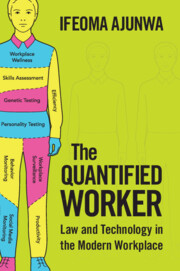


The quantified worker is awakened by an electronic device she wears on her wrist. First it is a gentle vibration, then the sensation gradually increases in intensity. The device tracks information on her sleeping habits – when she went to sleep, how long she slept, even whether it was fitful or peaceful sleep. An elevated heart rate – perhaps from vigorous nocturnal activity or perhaps merely a disturbing nightmare – is also noted. Once she is out of bed, the device counts her steps. In the mirror she brushes her teeth vigorously – she hopes that counts for exercise. Because the quantified worker is part of a workplace wellness program, all the information from her electronic device is dispatched to the program and, in return, her employer pays her health insurance premium. To continue with the program, the quantified worker must also exercise for 30 minutes every day; she earns redeemable points each time she goes to a gym because she has a card with an embedded chip that keeps electronic tabs on her gym visits. As part of her wellness program, the quantified worker must also keep a food diary. She is expected to photograph each meal and list the ingredients on an app on her phone. At the beginning of the program, the quantified worker submitted to genetic testing. The result: a genetic profile for the quantified worker outlining her propensity for certain diseases and extrapolating what diet she must follow to maintain optimal health. As part of the wellness program, the quantified worker was encouraged to download a health application on her phone. On this app, she is expected to track all her prescription medications and also her menstrual cycle. There is also an option for tracking ovulation cycles.Footnote 1
For the quantified worker, it is not only her body that is quantified, it is also her mind. To apply for the job, the quantified worker had to run the gauntlet of automated hiring platforms. She acquiesced to platform authoritarianism as the platforms demanded information to shape how she would be presented as a candidate and how she could eventually be sorted. Part of the application compelled the quantified worker to take a personality job test. She answered questions such as “How often do you smile per day?” and “Do you find yourself feeling sad for no reason?” Then the quantified worker sat for a video interview. In the comfort of her own home, she sat alone in a room, eyes rigidly fixed straight ahead on her laptop camera. She was careful to never show too much of the whites of her eyes, a sure sign of aggression. Instead, she kept her gaze just slightly narrowed, never looking right and most definitely not left. She stared straight at the camera, making eye contact with the machine. Her friends have told her she tends to speak with her hands, elucidating her points with fluid hand flourishes, so she kept her hands gripped on a pencil on the desk in front of her – like an anchor or deadweight. It is true that this made her feel like she was attempting to speak with a muzzle on, but no matter, she would appear confident to the machine evaluating her. She sat ramrod straight. After all, good posture is a proxy for good character. She reminded herself not to shift in her chair – you don’t want the AI thinking you are shifty, untrustworthy.
Once the quantified worker is hired, mechanical managers become her immediate supervisors. Whether she is hired to an office job where she wears a lapel pin that tracks her movements around the office and might record snippets of conversation, or whether she works a factory job requiring physical exertion where she must wear a safety exoskeleton that can detect whether she is indeed lifting with her knees, her mechanical managers silently and perpetually record her every move. If she works in an office with sensitive information, she might wear a badge with a radio-frequency identification (RFID) allowing her entrance to certain rooms and excluding her from others – for extra convenience, an RFID chip might be inserted under her skin, thereby taking the term embedded manager to new heights. If she works in an office, there are cameras everywhere except the bathroom – a code to unlock the bathroom door already documents who enters and for how long. As she sits and types at her computer, her keystrokes are logged. The websites she visits on her computer are logged. And for the hypervigilant employer, there is no need to stand over her shoulder to peer at her computer screen – a program will take a screenshot of her computer screen at whatever interval is required. Her email communications are also tracked. Is she perhaps disgruntled from all the surveillance? Is she planning to leave the company? A program will track her visits and behavior on LinkedIn and will alert her human manager if she proves to be a significant flight risk. Her social media accounts also are surveilled. Any criticism of her employer is flagged: Such action may reflect on her advancement in the company or could lead to dismissal.
If this sounds to you like a dystopian future, you are half correct. This is not the future. It is the current plight of workers. Most workers are now caught up in what scholars such as Shoshanna Zuboff have identified as “surveillance capitalism,” their every move tracked and monitored in service of profit-making. When William Whyte published The Organization Man in the fall of 1956, it carried a warning that large American corporations were systemically eroding the individuality of their workers. Furthermore, Whyte warned, this suppression of individuality would be detrimental, not just to the individual, but also to the corporation itself because of the concomitant loss of creativity and innovation. In addition to Whyte’s warning, other books such as Windows on the Workplace (1942) and The Electronic Sweatshop (1988) have raised questions about the deleterious effects of work technology on worker rights. With this book, I argue that technological advances have ushered in a new era in the workplace – the era of the quantified worker. This new era brings with it new legal challenges, both for the organization and for the worker.
I first started contemplating the quantified worker when I was a graduate student at Columbia University. At that time, as research for my dissertation, I was interviewing formerly incarcerated individuals who were seeking to re-enter society and the workplace. A common refrain emerged from the interviews: “I hate computers.” At first, I thought this had to do with computer illiteracy. Many of these individuals had gone to prison in the early 1990s before personal computing had become widespread. I thought their frustration stemmed from their unfamiliarity with digital systems and the internet. But it was something more insidious. These individuals felt themselves shut out by “computers.” In seeking to re-enter the workplace, they had confronted automated hiring platforms as gatekeepers. Gaps in their employment history or truthfully checking the box for “Have you been convicted of a crime?” or even merely “Have you ever been arrested?” was enough to get their application “red-lighted” and trashed – never to be considered by a human manager.
The individuals I interviewed were part of re-entry organizations, meaning that they were all actively seeking to re-enter society. They attended anger management classes, interviewing skills classes, and other courses meant to broker the social and cultural capital they needed to re-enter society. They were taught how to dress for an interview, how to firmly shake hands, how to make eye contact and convey confidence. How to speak professionally. How to explain their past criminal circumstances. How to relay the truth of their incarceration in a manner that would make them sympathetic to the hiring manager. But after hundreds of electronic applications that seemed to disappear into the internet chasm, they were starting to realize that none of that mattered. Unlike a human manager, artificial intelligence (AI) in the form of automated hiring lacks discretion. It is an unfeeling and implacable gatekeeper.
The Quantified Worker carries a warning – it rings the alarm bell that American workers are increasingly quantified in a manner and to a degree that had been hitherto unknown in history. The quantification of workers is not new; it is as old as the valuation of Roman slaves or the counting of bushels of cotton picked by African slaves in the Americas. What sets this new era of worker quantification apart is that the quantification is now aided by technological advances grouped under the catch-all term of artificial intelligence. These new technologies perform automated decision-making with machine learning algorithms, often ignoring the gestalt of the worker in favor of numbers on a screen. The zeitgeist of this new era of quantification is that it is simultaneously nebulous and impactful; the intangibles of human behavior and genetic predilection concretized as numbers to manage risk and profit for the firm.
First and foremost, this book is meant to serve as an eye-opening account of the impact of technology in the workplace – it is meant to spur academic discourse and further empirical exploration of the issues raised. Second, it is poised to answer this question: What should the law do? Given that the pervasive quantification of workers erodes worker personhood and belies the democratic ideal, how should the law respond? Thus, this is also a legally informed book that grapples with the complex legal questions raised by the introduction of AI technologies in the workplace. This book is also historically informed in that it reaches into the past to trace the development of worker subjugation through quantification as the most recent iteration of scientific management.
An important caveat is that the book’s scope is constrained to mapping law and technology issues present within the traditional employer–employee relationship. As such this book does not squarely address the gig economy and other important instances of platform or solely online work. For that, I would point to works by Mary Gray and Siddharth Suri (Ghost Work), Niels Van Dorn, and Veena Dubal, among others.
This book puts forth a theory of worker quantification and parses its legal implications for worker voice and worker domination. In doing so, the book describes the breadth of worker quantification as facilitated, and often obfuscated, by modern-day technologies deployed in the workplace. In Part I The Ideology of Worker Quantification, Chapter 1 explains how worker quantification sprang from Taylorism and its practiced form, scientific management. Worker quantification is not merely about maximizing profit, but is preoccupied with worker control. Chapter 2 traces the historical responses to quantification in the form of Taylorism and lays out the socio-legal issues raised by scientific management.
Part II, The Mechanical Managers, documents the rise of mechanical managers in which the work of hiring, monitoring, and evaluating workers is increasingly being delegated to AI technologies. Chapter 3 focuses on automated hiring systems and platforms, and how bias may become baked into these systems. In this chapter, I examine the question of legal responsibility for preventing discrimination in hiring decisions based on AI and algorithms. Chapter 4 analyzes personality tests used in hiring, showing how such tests may violate medical privacy laws and allow for proxy discrimination against neuro-atypical candidates or individuals with mental illness. Chapter 5 moves on to automated video interviews, demonstrating the significant shortcomings of the pseudo-sciences of facial analysis and emotional recognition, and connects these new technologies to the pseudo-science of phrenology. I explain how reliance on these tools promotes discrimination against various protected groups, and how current laws are limited in their ability to address these problems. Chapter 6, on worker surveillance, explains the history of workplace surveillance and how the theories behind this practice ignore workers’ rights to privacy and dignity in the workplace. Chapter 7 discusses the newest iteration of workplace wellness programs and how they may allow for genetic discrimination. Chapter 8 discusses the greater quantification of health (through surveillance) in the Covid era and how this might present new legal opportunities for health discrimination.
In Part III, Quantified Discrimination, I examine the ways in which technology used in the service of worker quantification can both facilitate and obfuscate discrimination on several axes. This is particularly troublesome for its potential to undo the gains for equal opportunity brought about by the Civil Rights Act of 1964 and other anti-discrimination laws. Chapter 9 focuses on wearable technologies as techno-solutions to employer concerns about maximizing profits and minimizing risks. In exploring how wearable technologies blur the line between work and non-work time, I discuss the legal questions of data ownership and control, the misuse and abuse of wearable tech, and the loss of worker privacy and autonomy. Chapter 10 delves into the long-standing issue of quantified racism in the workplace, revealing that workers are not equally quantified and that existing metrics of quantification bear the taint of racial prejudice.
Part IV, Business Ethics and New Legal Frameworks, examines ethical issues at the heart of worker quantification, and looks forward to propose new ethical and legal frameworks for tackling the issue of worker quantification. Chapter 11 discusses the ethical dimensions of worker quantification and relies on the legal philosopher John Rawls to argue for a new approach to the adoption of work technologies. In Chapter 12, I put forth proposals for legal frameworks that are more in line with the current capabilities of work technologies and will therefore be more adept at ensuring that workplace technologies do not contribute to worker domination.
We tend to think of a singular future of work. However, this tendency is a product of techno-fatalism – the belief that we must acquiesce to the unsavory unintended consequences of technology in exchange for reaping its benefits. Yet, many different futures of work are possible. Thus, in my conclusion, I imagine a future where data can be harnessed in the service of worker power. I contemplate how unions of the future could work together with organizations and corporations to transform the data in “data-driven workplaces” from driving whip to collaborative knowledge. Finally, I note that techno-solutionism can never be the full answer. Neither can we rely on business ethics as a self-policing measure for organizations. Technological innovation has served as a Trojan horse for surveillance technologies, and the law must act as a true bulwark against the rising inequality introduced by these technologies. In practice, this means the implementation of targeted laws and regulations that are intelligently tailored to address the discriminatory potential of our new mechanical managers.
