


1. Introduction
Additive Manufacturing (AM) has evolved from a rapid prototyping technique into a key enabler of digital production, supporting geometric freedom, functional integration, and decentralised manufacturing (Reference Ngo, Kashani, Imbalzano, Nguyen and HuiNgo et al., 2018; Reference Thompson, Moroni, Vaneker, Fadel, Campbell, Gibson, Bernard, Schulz, Graf, Ahuja and MartinaThompson et al., 2016). Design for Additive Manufacturing (DfAM) provides structured approaches to align design intent with process and material constraints, enabling lightweight, complex, and multifunctional structures (Reference Vaneker, Bernard, Moroni, Gibson and YichaVaneker et al., 2020). Over the past decade, DfAM has progressed from rule-based guidelines to computational and model-based strategies integrating topology optimisation, lattice generation, and process-informed modelling (Reference Kumke, Watschke and VietorKumke et al., 2016; Reference Yang and ZhaoYang & Zhao, 2015). Despite these advances, most DfAM approaches remain component centred where geometry is optimised under predefined boundary conditions, while user variability is typically treated as an external parameter. In contrast, individualisation integrates anthropometric or biomechanical measurements directly into the design process, enabling artefacts to be derived from quantifiable human morphology (Reference Kussmaul, Biedermann, Pappas, Jónasson, Winiger, Zogg, Türk, Meboldt and ErmanniKussmaul et al., 2019). Such data-driven approaches have demonstrated feasibility in biomedical and sports contexts (Reference Kermavnar, Shannon and O’SullivanKermavnar et al., 2021; Reference ZadpoorZadpoor, 2017), yet remains underexplored in military applications where ergonomic fit, endurance, and protection are operationally critical. Military systems are commonly produced in fixed size ranges optimised for average anthropometric data to ensure interoperability and certification robustness. While this standardisation simplifies logistics, it limits adaptability to individual users. AM does not replace standardisation but enables controlled geometric variability within certified system architectures, particularly at user equipment interfaces (Reference SegondsSegonds, 2018). The challenge lies in establishing a structured process that integrates user-specific variability while maintaining compliance with manufacturing and operational constraints.
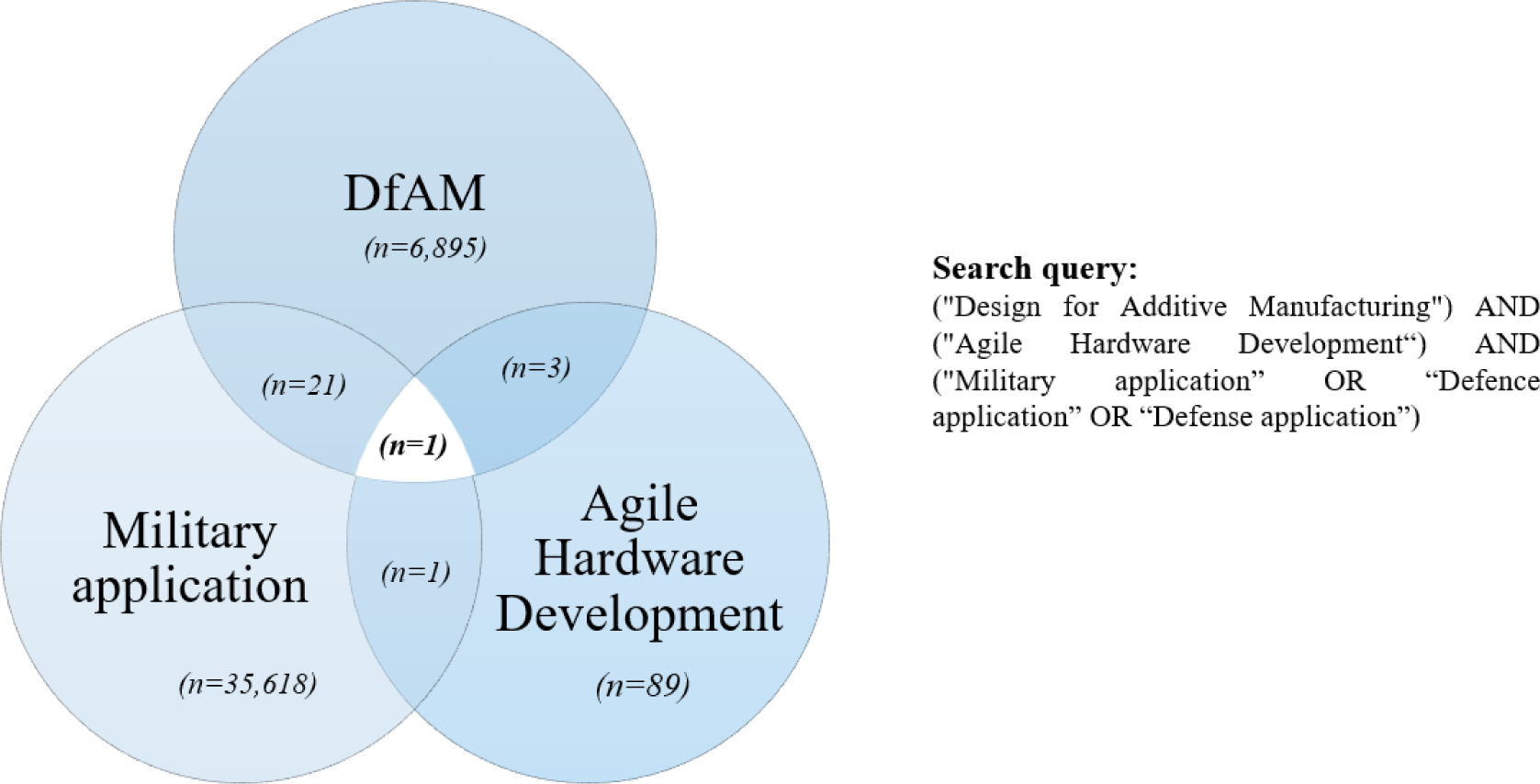
Established DfAM frameworks follow predominantly sequential process models, with iteration implicit within design stages rather than formalised across the full development cycle (Reference Kumke, Watschke and VietorKumke et al., 2016; Reference Pradel, Zhu, Bibb and MoultriePradel et al., 2018). Agile hardware development (AHD) addresses this through feedback-oriented cycles and continuous learning adapted to physical product contexts (Reference Atzberger and PaetzoldAtzberger & Paetzold, 2019; Reference Reichwein, Vogel, Schork and KirchnerReichwein et al., 2020). However, systematic consolidation o-f DfAM, iterative development, and defence-relevant individualisation remains limited. A bibliometric analysis in Scopus (Engineering, 2015–2025) illustrates this fragmentation (Figure 1). This decade marks the period in which both DfAM and AHD matured from conceptual discussion to structured, experimentally supported methodologies, coinciding with AM’s shift from prototyping to industrial deployment. While DfAM, and military applications are each well-represented as individual fields, their intersections with AHD remain sparse. At the triple intersection, only a single publication was identified. Extending the search to include individualisation (or “individualization”) as an explicit criterion yields no results, confirming that no prior work experimentally demonstrates an integrated methodology linking user-derived data, additive design strategy, and structured evaluation for defence individualisation.
Bibliometric analysis of Scopus publications (2015–2025, Engineering)

This observation motivates the following research question: How can user-derived anthropometric data, additive design reasoning, and iterative evaluation be systematically integrated into a structured DfAM process suitable for defence applications?
To address this question, this research develops and demonstrates a structured iterative DfAM process that connects anthropometric input, additive design strategy, manufacturing constraints, and defined evaluation metrics within military-relevant boundary conditions. The contribution lies not in introducing a new product concept or lattice topology, but in formalising a reproducible process architecture that links user data to progressively validated design artefacts through iterative refinement.
2. State of the art
2.1. Evolution and scope of DfAM
Building on the foundational principles outlined in the Introduction, DfAM research has evolved from empirical rule-based guidelines toward structured, computational, and model-based methodologies that explicitly couple design intent with AM process capabilities (Reference Kumke, Watschke and VietorKumke et al., 2016; Reference Laverne, Segonds, Anwer and Le CoqLaverne et al., 2015; Reference Sossou, Demoly, Montavon and GomesSossou et al., 2018; Reference Vaneker, Bernard, Moroni, Gibson and YichaVaneker et al., 2020). Early restrictive approaches focused on manufacturability constraints such as build orientation and support minimisation, while later opportunistic strategies leveraged AM’s geometric freedom to enable lightweight and multifunctional components (Reference Prabhu, Masia, Berthel, Meisel and SimpsonPrabhu et al., 2021; Reference Pradel, Zhu, Bibb and MoultriePradel et al., 2018). Techniques including topology optimisation, lattice generation, and architected material design have expanded structural efficiency and functional integration (Reference Hanks and FreckerHanks & Frecker, 2019; Reference Maskery, Sturm, Aremu, Panesar, Williams, Tuck, Wildman, Ashcroft and HagueMaskery et al., 2018; Reference Yang and ZhaoYang & Zhao, 2015).
Despite this methodological sophistication, established DfAM frameworks predominantly address optimisation of individual components under predefined and relatively stable boundary conditions (Reference Thompson, Moroni, Vaneker, Fadel, Campbell, Gibson, Bernard, Schulz, Graf, Ahuja and MartinaThompson et al., 2016). User variability and evolving operational requirements are typically incorporated as boundary inputs rather than as structured drivers within an explicitly iterative design process. Limited emphasis has been placed on formalising how user-derived variability and requirement adaptation can be systematically embedded within DfAM methodologies.
2.2. Individualisation in AM
Individualisation extends DfAM by integrating anthropometric and biomechanical data directly into the geometry generation process. Through 3D scanning and parametric modelling, user-specific anatomical information can be translated into manufacturable artefacts, enabling precise conformity and improved ergonomic fit (Reference Kermavnar, Shannon and O’SullivanKermavnar et al., 2021; Reference ZadpoorZadpoor, 2017). In biomedical and sports engineering, such approaches have enabled patient- or athlete-specific orthoses, prosthetics, and protective systems with enhanced comfort and load distribution (Reference Kussmaul, Biedermann, Pappas, Jónasson, Winiger, Zogg, Türk, Meboldt and ErmanniKussmaul et al., 2019; Reference Paari-Molnar, Qa’dan, Kardos, Told, Sahai, Varga, Rendeki, Szabo, Fekete, Molnar, Schlegl, Maroti and TothPaari-Molnar et al., n.d.). In parallel, research on architected and lattice structures has demonstrated how AM can be used to tailor energy absorption and lightweight performance to application-specific requirements (Reference Decker and KedzioraDecker & Kedziora, 2024; Reference Hao, Yan, Li and HanHao et al., 2025). Within defence-related domains, DfAM has been explored in aeronautics and protective systems, highlighting its potential for lightweight and functionally integrated components (Reference SegondsSegonds, 2018).
Although these studies demonstrate the technical feasibility of user-conformal geometry generation and performance optimisation, existing literature provides limited explicit formalisation of repeatable development architectures that integrate anthropometric acquisition, additive design strategy selection, manufacturing constraints, and iterative evaluation within a unified process model. Individualisation is therefore frequently implemented as a case-specific design strategy rather than as an explicitly structured methodological approach. This distinction becomes particularly relevant in defence applications, where variability must coexist with certification requirements, regulatory compliance, and operational robustness.
2.3. Iterative development in additive design
The increasing complexity of AM processes and materials has encouraged a shift from predictive, sequential product development toward evidence-based and iterative design strategies (Reference Mellor, Hao and ZhangMellor et al., 2014; Reference Wirths, Bleckmann and PaetzoldWirths et al., 2021). Iterative development integrates feedback from simulation and physical testing into successive design cycles, enabling incremental refinement of geometry and performance characteristics (Reference Thiele, Weber, Reichwein, Bartolo, Tchana, Jimenez and BorgThiele et al., 2020). The inherent flexibility of AM, especially the absence of dedicated tooling facilitates rapid design-manufacture-test loops and supports structured experimentation (Reference Joaquin, Alexander, Matthias, Jens and KristinJoaquin et al., 2019; Reference Reichwein, Vogel, Schork and KirchnerReichwein et al., 2020). AHD extends agile principles to physical product realisation, emphasising incremental learning, adaptive requirement prioritisation, and feedback-oriented development cycles (Reference Atzberger and PaetzoldAtzberger & Paetzold, 2019; Reference Omidvarkarjan, Streuli, Maghazei, Netland, Meboldt, Kim, Von Cieminski and RomeroOmidvarkarjan et al., 2022; Reference Orejuela, Motte and JohanssonOrejuela et al., 2023). Within AM contexts, agile-inspired approaches have been applied to enhance development responsiveness and prototyping efficiency.
However, published methodologies typically emphasise development pace and iterative prototyping rather than explicitly formalising requirement traceability and structured integration of evolving user-driven parameters within DfAM processes. Although incremental development is frequently described (Reference Reichwein, Vogel, Schork and KirchnerReichwein et al., 2020), detailed documentation of how requirement prioritisation and evaluation metrics are systematically embedded within iterative additive design workflows is less commonly articulated. In applications involving user-specific variability, iteration must function not only as a development strategy but as a structured mechanism for managing dynamic boundary conditions and performance verification.
2.4. Integration of user, design and process perspectives
Contemporary research in AM design can be broadly grouped into three complementary streams:
-
• First, DfAM frameworks provide structured methodologies for aligning geometry with manufacturing constraints and process capabilities (Reference Kumke, Watschke and VietorKumke et al., 2016; Reference Thompson, Moroni, Vaneker, Fadel, Campbell, Gibson, Bernard, Schulz, Graf, Ahuja and MartinaThompson et al., 2016; Reference Vaneker, Bernard, Moroni, Gibson and YichaVaneker et al., 2020)
-
• Second, individualisation research demonstrates how anthropometric data can drive user-specific geometry generation (Reference Kermavnar, Shannon and O’SullivanKermavnar et al., 2021; Reference ZadpoorZadpoor, 2017)
-
• Third, iterative and agile-oriented approaches establish procedural mechanisms for incremental learning and validation in physical product development (Reference Joaquin, Alexander, Matthias, Jens and KristinJoaquin et al., 2019; Reference Reichwein, Vogel, Schork and KirchnerReichwein et al., 2020)
While these streams are conceptually compatible, they are generally developed and applied independently. DfAM methodologies focus on manufacturability and structural optimisation, individualisation studies emphasise anthropometric adaptation, and agile hardware approaches prioritise feedback cycles and development responsiveness. The surveyed literature does not demonstrate how these perspectives together can be systematically integrated into a single unified process that links user requirements, additive design strategy, constraint management, iterative development, and structured evaluation within defence-relevant applications. Military systems operate under strict regulatory and certification frameworks, such as NATO AQAP and relevant EN standards that define non-negotiable manufacturing and performance boundaries (North Atlantic Treaty Organization, 2022). Within such regulated environments, user variability cannot be addressed through isolated design adaptation alone and it must be integrated within a structured process ensuring compliance, manufacturability, and operational reliability across configurations. The identification of this integration gap motivates the development of a structured process that consolidates these perspectives into an interconnected and traceable design architecture. The following section presents the methodological approach adopted to address this gap.
3. Methodology
In response to the identified gap in the literature, a two-phase approach was implemented in this research consisting of: Phase I which established a structured user-requirement foundation through an exploratory survey, and Phase II translated these requirements into a structured iterative DfAM process under defence-relevant boundary conditions.
3.1. Phase I – identifying the user needs
To establish a structured requirement basis, an exploratory survey was conducted among trainee officers enrolled in the Department of Aerospace Engineering at the Universität der Bundeswehr München, Germany (∼200 eligible participants; n = 59 complete responses). The objective was to identify recurring equipment related challenges and prioritised improvement needs relevant to military equipment design.
The questionnaire comprised 13 items organised into five sections (Figure 2): (A) current reality, (B) operational challenges, (C) improvement priorities, (D) AM readiness, and (E) open insights. Multiple choice items, Likert-scale assessments, prioritisation matrices, and open-ended questions captured quantitative trends and qualitative insights. Prior to deployment, the survey was reviewed by twelve academic experts to ensure clarity and content validity.
a. Structure of the user survey, b. User-identified improvement priorities

Results indicated that the combat helmet was the most frequently used item of personal equipment (approx. 77% of respondents). Fit and weight-related issues were consistently identified as dominant limitations. Respondents prioritised, improved fit and weight reduction as key areas for enhancement. Based on ergonomic relevance and usage frequency, the M92 combat helmet (Schuberth GmbH, Germany) was selected as the demonstrator system. To preserve certified ballistic integrity, the outer shell remained outside the design scope. The liner subsystem responsible for ergonomic fit and energy absorption was selected as the focus of the individualised iterative DfAM process. Survey findings were synthesised into a structured set of prioritised requirements forming the input for Phase II.
3.2. Phase II – adapting AHD principles
Phase II translated the user-derived requirements from Phase I into a structured, evidence-based development approach. To address the integration gap identified in Section 2, the process was structured using selected principles from AHD, which emphasise incremental learning, feedback-oriented validation, and adaptive requirement management in physical product development (Reference Joaquin, Alexander, Matthias, Jens and KristinJoaquin et al., 2019; Reference Reichwein, Vogel, Schork and KirchnerReichwein et al., 2020). In this research, AHD was not applied as a prescriptive framework but as a methodological foundation guiding how requirements, validation activities, and design decisions were organised. Rather than adopting fixed stage sequences, the process defined iterations through explicit verification objectives aligned with prioritised requirements. The adaptation of AHD principles was governed by the following guiding mechanisms:
-
• Iteration as a learning mechanism → Each development loop was defined not by duration but by knowledge goals: to verify design assumptions, evaluate manufacturability, or measure functional behaviour.
-
• Empirical validation as feedback → Each iteration concluded with digital or physical validation activities. The resulting data and observations informed requirement refinement and design adjustment.
-
• Dynamic requirement prioritisation → A structured requirement backlog was derived from survey findings. Requirements were re-ordered based on feasibility, constraint interactions, and test results.
-
• Incremental design maturity → Each cycle produced a validated model or prototype contributing to traceable requirement fulfilment.
Certification-relevant boundary conditions were embedded from the outset by restricting geometric adaptation to the liner subsystem while preserving certified system elements. This ensured that iterative refinement occurred within predefined regulatory (e.g. NATO AQAP) and operational limits. The structural organisation of the process and the interaction between its domains are detailed in the next section.
4. Process development and demonstrator evolution
4.1. Requirement definition and prioritization
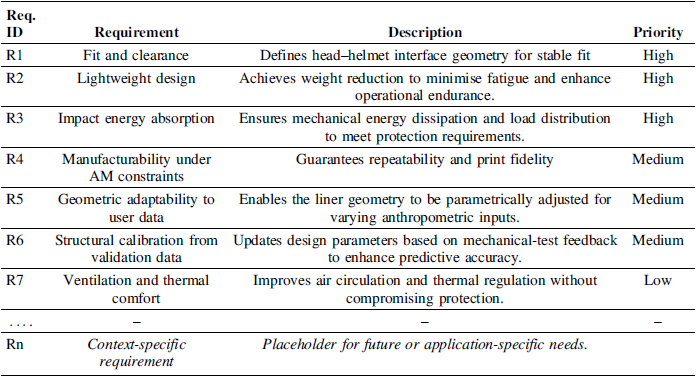
The user-centred insights obtained in Phase I were translated into a structured set of actionable design requirements guiding the iterative DfAM process. In addition to the user-derived needs summarised in Table 1, baseline specifications from the existing M92 helmet (e.g., dimensional envelope, attachment interfaces, and material compatibility) were retained as fixed boundary conditions to preserve interoperability and certification compliance. This treatment of manufacturing and operational constraints as defining boundary conditions aligns with established DfAM frameworks that emphasise early integration of process limitations within design definition (Reference Thompson, Moroni, Vaneker, Fadel, Campbell, Gibson, Bernard, Schulz, Graf, Ahuja and MartinaThompson et al., 2016; Reference Vaneker, Bernard, Moroni, Gibson and YichaVaneker et al., 2020). Each requirement corresponds to a functional, ergonomic, or process-related objective derived from user feedback, expert assessment, and technical feasibility. High-priority requirements (R1-R3) reflect dominant user concerns, i.e. fit stability, weight reduction, and impact energy absorption. While medium-priority requirements (R4-R6) capture manufacturability, parametric adaptability, and structural calibration from validation data. Although prioritised differently within the development backlog, manufacturability and regulatory compliance operate as non-negotiable constraints embedded within the process architecture rather than as optional objectives.
The requirement set therefore serves a dual role: it defines development focus and provides explicit verification criteria for iterative evaluation. In doing so, it establishes the traceable link between user-derived needs and measurable design outcomes that is central to the research question.
Prioritised design requirements derived from user survey

4.2. Process domains
The structured process developed in this research consists of five interdependent domains:
-
• User Input → This domain defines the foundation of the process. It comprises user-derived needs and anthropometric 3D scan data, establishing the boundary conditions for geometry generation. The user input serves as the origin of requirement definition, guiding fit, mass, and performance targets identified in Table 1.
-
• Constraints → Consolidates manufacturing limits, material selection, and operational standards (e.g., NATO AQAP, EN 1078), thereby delimiting the feasible design space. The explicit integration of process and material boundaries reflects DfAM methodologies that treat constraints as intrinsic to design reasoning rather than post-design checks (Reference Kumke, Watschke and VietorKumke et al., 2016; Reference Thompson, Moroni, Vaneker, Fadel, Campbell, Gibson, Bernard, Schulz, Graf, Ahuja and MartinaThompson et al., 2016).
-
• Strategic DfAM → Defines the additive design approach and parametric strategy selected to satisfy prioritised requirements under given constraints. In this study, “strategic” denotes the stage where the AM approach is fixed (e.g., lattice concept, parameterisation logic, target behaviours), before implementation-level tuning. This staged separation is consistent with DfAM frameworks that structure early process/strategy decisions prior to AM-process-specific optimisation (Reference Vaneker, Bernard, Moroni, Gibson and YichaVaneker et al., 2020; Reference Yang and ZhaoYang & Zhao, 2015).
-
• Operational DfAM → Executes successive verification-driven iterations, where each cycle is defined by a specific requirement-focused objective (e.g., geometric conformity, manufacturability, or mechanical response). Depending on the objective, the iteration may involve digital validation (e.g., CAD-based fit checks, virtual conformity assessment) and/or physical realisation and testing. Outputs from each iteration provide structured feedback for parameter refinement within the fixed additive strategy.
-
• Evaluation Metrics → Evaluation metrics provide the criteria for assessing design progress within each iteration. They include both qualitative parameters (fit perception, print quality, geometric stability) and quantitative measures (dimensional accuracy, weight reduction, and energy absorption). These metrics guide requirement reprioritisation and serve as the feedback mechanism linking evaluation outcomes to the next design iteration.
4.3. Process interaction and application – individualised helmet liner
Figure 3 illustrates the interaction of the five domains and introduces an explicit requirement-verification decision node within the iterative loop. The workflow begins with user input that consists of prioritised requirements and anthropometric geometry which define functional objectives and geometric boundaries, thereby embedding individual-specific morphology as the primary driver of geometry generation. These inputs are filtered through the constraints domain to establish a feasible design envelope under manufacturing and regulatory conditions. Within the Strategic DfAM domain, design intent and additive strategy are defined. In this study, lattice structuring was selected as the primary AM strategy to balance lightweight construction (R2) and impact-energy absorption (R3). Lattice structures have demonstrated favourable mass efficiency and energy dissipation characteristics in polymer additive manufacturing systems (Reference Cronau and EngstlerCronau & Engstler, 2025; Reference Hao, Yan, Li and HanHao et al., 2025). At this stage, the outcome is a parametric design logic that translates user requirements into a manufacturable solution space. The selected additive strategy remained fixed throughout subsequent iterations, while geometric parameters and structural configurations were refined within the next domain. The Operational DfAM domain implements successive validation activities across iterations. The first iteration focuses on digital geometry generation, where a conformal CAD model of the liner subsystem is derived from anthropometric input and assessed qualitatively for fit and interface stability. The second iteration translates this digital model into a physical artefact, enabling verification of manufacturability and dimensional fidelity within defined process limits. The third iteration subjects the printed structure to mechanical testing to evaluate functional performance under controlled conditions. At each stage, predefined qualitative and quantitative evaluation metrics govern progression through the explicit “Requirements fulfilled?” decision gate. If criteria are not satisfied, parameter adjustments are performed within the fixed additive strategy before advancing to the next validation level. This staged logic ensures that geometry definition, manufacturability, and structural performance are verified sequentially and traceably.
Structured iterative DfAM process showing information flow and feedback between user input, constraints, design, development, and evaluation

Figure 3 Long description
The flowchart illustrates the structured iterative Design for Additive Manufacturing process, showing information flow and feedback between user input, constraints, design, development, and evaluation. The process begins with user input, which includes requirements and parametric models. This input feeds into the design and development phase, divided into strategic and operational Design for Additive Manufacturing. Strategic Design for Additive Manufacturing involves defining the design space and AM design strategy, including lattice structures and topology optimization, leading to a design solution. Operational Design for Additive Manufacturing manages a requirement backlog and iterations, starting with a digital liner model, followed by a printed prototype, and lattice validation. Constraints are considered throughout the process, including process constraints like wall diameter and resolution limits, material constraints such as bio-compatibility and environmental factors, and operational standards like NJ III and NATO standards. Evaluation metrics are both qualitative and quantitative, assessing aspects like virtual fit, print quality, dimensional accuracy, and weight reduction. A decision point checks if requirements are fulfilled, leading to the output if yes, or back to the next iteration if no. The final output is a demonstrator with an individualized liner.
This sequential escalation from digital validation to physical verification reduces uncertainty while maintaining traceable linkage to prioritised requirements, ensuring that individualisation occurs within predefined compliance envelopes and preserves regulatory integrity.
5. Results
The structured process was evaluated through three completed iterations to assess whether requirement-driven integration of user input, additive strategy, constraints, and validation can be achieved in practice. Each iteration addressed defined requirements (Table 2) and functioned as a controlled feedback loop governed by explicit requirement verification, demonstrating cumulative refinement of geometry, manufacturability, and mechanical performance.
Results from three completed iterations illustrating incremental development of the individualised liner and progress toward fulfilling key design requirements

6. Conclusion and outlook
This study demonstrated that a structured, verification-driven DfAM process can translate user-derived requirements into validated additively manufactured artefacts within defence-relevant boundary conditions. Across three completed iterations, the helmet liner evolved from a parametric digital concept to a manufacturable and mechanically characterised prototype. The first iteration established the geometry-generation logic from anthropometric input, the second confirmed manufacturability and mass reduction under defined process constraints, and the third provided evidence of controlled impact-response behaviour within the selected lattice configuration. Mechanical characterisation was conducted on representative lattice coupon samples to isolate and validate the energy-absorption behaviour of the selected architecture prior to subsystem-level scaling. These results demonstrate that user-derived anthropometric data, additive design strategy selection, constraint management, and iterative verification can be systematically consolidated within a single, traceable process architecture. The explicit requirement-verification decision gate ensured that progression between iterations was governed by measurable performance criteria rather than by sequential prototyping alone. In doing so, the process maintained direct traceability between user input, design reasoning, manufacturing limits, and structural behaviour. Within the demonstrated subsystem context, individualisation was achieved without altering certified system elements, illustrating how controlled geometric variability can coexist with regulatory and operational boundary conditions in defence applications. Further iterations are underway to extend validation to larger representative liner sections and multi-user ergonomic assessment. In parallel, a second demonstrator application is being developed to assess the robustness of the proposed process logic under differing subsystem constraints.
Overall, this research contributes a structured iterative DfAM process that formalises the integration of anthropometric input, additive design reasoning, and performance-based validation within constraint-defined defence system architectures.
Acknowledgement
This research was funded by the European Union’s program NextGenerationEU and dtec.bw as part of the project FLAB-3Dprint.



 Open access

