


Introduction
Imprisonment in Russia is a notorious and oppressive system of inhumane and degrading punishment practices (Piacentini and Katz Reference Piacentini and Katz2022). A large and growing number of Russian prisoners are serving harsh prison sentences for political opposition to the state (CoE 2021). Its decades-long record of human rights violations has made Russia a pariah state on the international scene, and its political isolation has only intensified since the invasions of Ukraine in 2014 and 2022 (van der Vet Reference van der Vet2018). Despite the human rights crisis taking place in Russian prisons and its international implications, criminology and law-and-society scholars have woefully neglected the subject of imprisonment in Russia and the former Soviet Union. The roots of this crisis can be traced to the Soviet era when the biggest convict settlement and mass incarceration system in world history—the gulag—operated (see Badcock and Pallot Reference Badcock, Pallot and Anderson2018; Slade, Piacentini, and Kravtsova Reference Slade, Piacentini and Kravtsova2023). In late Soviet and post-Soviet Russia, incarceration continued as a brutal and colossal system—one of the largest prison systems in the world—until around 2008 when population rates started to drop (Rodley Reference Rodley1994). In 2000, the total number of people held in prison establishments across Russia was 1,060,404, but, in 2023, this dropped 59 percent to 433,006 (Prison Studies 2023). With rapacious speed, and a mostly positive outlook, penal and judicial reform were embraced, and a veritable avalanche of improvements were introduced (Bowring Reference Bowring2013; Khan Reference Khan2019).
The 1990s was certainly the period of human rights-facing penal reform, which was an outcome of the Russian Federation’s connection to European penal-political and justice institutions. Although not a European nation, Russia did join the Council of Europe (CoE) in 1996, and its membership required that it abide by certain human rights standards and meet what Pamela Jordan (Reference Jordan2003, 281) describes as “an agreed notion of what an expanded European identity is.”Footnote 1 Russia was also a signatory to the European Convention on Human Rights (ECHR).Footnote 2 Because of this ratification, the CoE’s European Prison Rules, which constitute soft standards, applied to Russia.Footnote 3 Through shared values and, perhaps also, strategic calculations on what could be reasonably expected of Russia, Russia’s inclinations toward political and legal proximity with Europe gave promise of alliances to the North Atlantic Treaty Organization and the European Union (EU) (Jordan Reference Jordan2003). Given Russia’s outcast status today—Russia was expelled from the CoE in 2022, and then, six months later in September, ceased being party to the ECHR—the decade-long period of penal reform has the feel of a profound, if solemn, irony and is far removed from the early 1990s.
This article asks whether CoE-defined norms and compliance rules have subverted a more refined understanding of the complex relationship between the prison and state-society relations in Russia—that is, the different roles that punishment performs: both the internal micro dynamics of imprisonment (what is prison like for those inside) and the macro study of what punishment is for (what is its external function) (see Carrabine Reference Carrabine2000). Through the presentation of data gathered from an empirical and theoretical project on the sociology of rights consciousnessFootnote 4 across a range of prison-related platforms in Russia, I consider how we might problematize hitherto ignored, but remarkable, penal transformations in the reform of Russian penal culture after 1991.Footnote 5 Scholars have recognized two dynamic eras regarding Russia’s positionality within the CoE—the early 2000s through to 2014 and after 2014 (Busygina and Kahn Reference Busygina and Khan2020). I add a third, earlier periodization: the period following the collapse of the Soviet Union in 1991 until around 2000.
I argue that the levers of geo-political carceral compliance that emerged within this tripartite system operate in constant competition with three overlapping factors: the residues of Soviet penal sensibilities; the compliance demands of the CoE; and the escalating authoritarian politics of President Vladimir Putin, whose regime uses penality to oppress dissent. This tension between the external drivers of human rights compliance and internal penal authoritarianism raises questions about how human rights risk comes to be assembled into the institutional environment of the prison. For example, while non-governmental organizations (NGOs) contribute as regulators and influencers in Russia’s post-Soviet penal space, Gaëtan Cliquennois, Sonja Snacken, and Dirk van Zyl Smit (2022) argue that this environment has also contributed to opportunistic behaviors. Risk management (the convergence of risk and the need for public protection) moves from being a siloed discourse or management tool to a state of cohabitation with existing “occupants” (Sparks Reference Sparks, Brown and Pratt2000, 129) and is delivered as a set of “complex configurations with other technologies’ (O’Malley Reference O’Malley2000, 26–27). Thus, Russian penal culture is expected to move toward competence and legitimacy in a societal and political context where many constituents struggle for influence, political power, and justice (see also Murphy and Whitty Reference Murphy and Whitty2007).
The article aims to contribute to the absence of sociological debates on human rights in penal culture through providing a road map—a tripartite model—to better understand how compliance connects and coheres with penal culture. While the tripartite model is not intended to apply to other former Soviet states or other global nations, it offers a road map for how the social and legal construction of rights compliance regimes may be problematized in penal cultural contexts more broadly.
A tragic penal culture
Russia’s deplorable record of inhumane and degrading treatment of prisoners and international prison rule violations is embedded in its brutal penal past. Although Russia’s pre-Soviet penal development followed ideological and material trends in the Western history of the prison, where industrial growth and nation building were tied to penal growth, it was during the twentieth century when prisons took on an exceptional place in Russia’s state and society relations. Authoritarian penal power and mass incarceration through forced displacement of millions of people and mass death, under the auspices of political correction, operated as the central tenets of Soviet penality (Applebaum Reference Applebaum2004). Soviet elites sought to sculpt society according to an idealized political image of a global class struggle, which was delivered through a hybrid carceral logic whereby prison establishments would operate in opposition to capitalist penal policy. Consequently, the penal system grew to exponential proportions—approximately eighteen million prisoners and six million special settlers passed through the gulag system (Khlevniuk Reference Khlevniuk2015). After the gulag decades, Soviet citizens were still subject to clandestine trials, confinement in camps, colonies, and prisons, and remote exile.
Whether Russia is culturally determined to carry forward the Soviet heritage legacies and infrastructure that are not easily shaken off and stop hiding them requires further empirical and theoretical attention. There was little consensus in the 1970s and 1980s, and particularly under Boris Yeltsin’s presidency in the 1990s, on how to conceptualize historical legacies. Today, Russian prisons appear locked into a version of the legacy of the past where gulag leitmotifs emerge across a range of fora to create what Laura Piacentini and Elena Katz (Reference Piacentini and Katz2022) refer to as usable memories held in contemporary official discourses in both museums and popular fiction (see also Slade, Piacentini, and Kravtsova Reference Slade, Piacentini and Kravtsova2023). The gulag’s stubborn legacy reflects the central role that Russia’s penal culture had in the development of the Soviet system of politics, economics, law, and society. As Oleg Khlevniuk (Reference Khlevniuk2015, 498) notes, “[t]he creation of a hefty and intricate penal apparatus, unrestrained by law in its terror, proved to have significant, lasting effects on mass consciousness.”
Since Putin came to power in Russia in 2000, considerable democratic backsliding is happening under his political leadership. The growth in penal authoritarianism, in particular, which has been taking place since the second invasion of Ukraine in 2022, is especially troubling. Further examples are the sinister and troubling mobilization of prisoners released into the Wagner mercenary groups that are fighting against Ukraine, the contentious deaths of opposition politicians such as Alexei Naval’ny who died in an Arctic penal colony in February 2024, and the severe prison sentences for seemingly minor critique of the government, which barely touch the surface of the extent to which Putin uses penality as a cruel foil to his authoritarian regime (Reynolds Reference Reynolds2019). More research is required to better understand these complex processes of the oppression of “dissent,” and the use of penal culture to achieve this goal, while the prison population decreases.
The socio-legal context of reforming Russia’s penal culture
While it is certainly the case that socio-legal scholarship has not engaged with penality in Russia, it is also the case that research into the relations between prison establishments and regimes of compliance has been relatively rare, despite the growing amount of prisoner litigation and rights consciousness amongst prisoners at the national and transnational level. In particular, Kitty Calavita and Valerie Jenness (Reference Calavita and Jenness2016) and Sarah Armstrong (Reference Armstrong2018) argue that several developments can be observed as co-occurring with the advancements in the legal empowerment of prisoners. These include prison population growth in many industrialized nations as well as prison regimes seeking political legitimacy through the operationalization of risk management. These developments, as Kelly Hannah-Moffat (Reference Hannah-Moffat2004) argues, have come at the cost of rights holders and may leave incarceration systems and cultures struggling to reform. So much so that human rights have not de-centered the prison nor minimized its pains but, rather, have aimed at enhancing penal power.
European compliance in penal contexts does not rely solely on instrumental cost/benefit. Emanuel Adler (Reference Adler1997) argues that collective learning, internalization, and persuasion can produce compliance. But how we might come to know when a state is persuaded, what proxies or measures are used to gauge collective learning on punishment’s purpose, and under what conditions are externally led norms internalized remains less known. Looking at penal reform specifically, and the transformative, positive change that is integral to such reform, a key question is: whose interests do penal reforms and compliance norms shape? Jeffrey Checkel (Reference Checkel2003, 554) refers to this as a “compliance puzzle,” which is whether compliance is pursued for rationalist, cost/benefit calculations and material incentives (rational compliance) or for social learning and to inform and reform social norms (constructivist compliance). Prison institutions everywhere are interesting case studies to interrogate these questions. While they operate, and fluctuate, according to notions of the denial of liberty and, in most countries, the loss of citizenship, they also use a range of perspectives on the use/s of punishment and penal norms, with the latter set not only through law but also through political and social cultures. When compliance demands that prisons make pledges to externally set strategies, policies, laws, and practices, norms face additional constraints because prisons are obligated to make pledges to externally set strategies. This then places prison institutions in competing logics between externally driven dynamics and internal state ideology (Risse and Sikkink Reference Risse, Sikkink and Risse2016).Footnote 6
When the Soviet Union collapsed, although the operational dynamics of the penal system remained internally determined, the moral obligation to human rights extended beyond the state, and even beyond the former Soviet borders, to the corridors of power in Strasbourg. The legal commitments of the ECHR were critical to ensuring Russia’s safe entry into the CoE, with its alignment to European justice values and the harmonization of Russian law and policies serving to push Russia into the future and away from its past (Piacentini and Katz Reference Piacentini and Katz2022). Both Moscow and Strasbourg officials knew, almost immediately after 1991, what a tremendous amount of work was needed to achieve a “human rights friendly transformation in Russia” (Mälksoo Reference Mälksoo2010, 4; emphasis added). Nevertheless, CoE members voting in the early to mid-1990s held the view that Russia’s admission to the CoE in 1996 was “commonly viewed as a result of giving greater weight to political factors than to legal criteria” (Janis Reference Janis1997, 97).
Readiness did, in the end, overrule inclusivity, and Russia was deemed unfit to join the CoE. It took five years from 1991 for Russia to meet the membership criteria of the CoE, and, in that time, the picture of inclusion was complicated by competition between the treaties that Russia had since signed—treaties with lower substantive benchmarks for human rights protections (Bernhardt Reference Bernhardt1994). With the help of rapporteurs (such as Sir Nigel Rodley) and various ECHR committees (including, but not exclusively, the European Committee for the Prevention of Torture and the European Committee of Social Rights), the process of Russia joining the CoE continued despite the country’s continued failure to achieve the rule of law due to “structures and mentalities inherited from the Soviet past” (Parliamentary Assembly 1996, paras 5–7). Nevertheless, the “Strasbourg effect” was clear; integration was better than isolation, and optimistic expectations could create positive legal and social transformation facilitated through Strasbourg and the European Court of Human Rights (ECtHR) (Mälksoo and Benedict 2010, xvi). With an awareness that progress would take many years on account of high standards and benchmarks within the Council of Europe, political levers were pulled by Western European political actors working with key policy committees and by Russian human rights lawyers (for example, Alexander Mironenko in the Institute for Penitentiary Reform, which operated in the early 1990s) (Parliamentary Assembly 1995).Footnote 7 It is notable that, although these European actors were a constituency whose Western concepts were rejected for decades, there was an impact: penal change had transformative potential.
In summary, Russia provides an interesting test case of how penal systems become situated in temporal and political contexts of human rights compliance regimes that are externally located. In a transitional context, such as that between the CoE (until 2022) and Russia, where the penal system is weathering the effects of change while continuing to operate internal governance rules, laws, and norms, these transformations are subject to additional and acute pressure points from multiple actors.
The unseen to seen prison
By 1996, Russia’s prison system was operating in two dimensions, one national and one European where collective learning, internalization, and persuasion could produce constructive compliance (Adler Reference Adler1997). These dimensions, of course, are foundational to penal cultures in most EU nations, but, due to both the legal and ideological aspirations of penal reform, a transitional context of complex geopolitical carcerality (of intertwining national prison infrastructure with European ideals and norms) emerged. Prisoners’ rights were now judicially recognized, but, with respect to penal dynamics—why Russia punishes in the way it does—there was an intended rhetorical effect of penal reform that “framed” punishment in a particular way and that had to be challenged by European norms. The European apparatus was intended to alter the ideas inherent in, and the forms of, penality that Russia was obligated to leave behind (Bowring Reference Bowring2013). Yet pressure was also piling in from domestic actors and internal and external NGOs (van Zyl Smit and Appleton Reference van Zyl Smit and Appleton2019).
One critically key area of penality where Russia has succeeded in terms of compliance lies in the reduction of the prison population rate. As mentioned earlier, the Russian prison population has dropped exponentially since 2000 by 59 percent. This extraordinary drop has been accounted for in the following non-chronological ways. These include, first, as Dirk van Zyl Smit and Catherine Appleton (Reference van Zyl Smit and Appleton2019) argue, human rights measures that were adopted under the ECHR and which were successfully used to minimize Russian penal elites’ propensity to overuse penal sentences as the default punitive response (but not in remand prisons, which continue to be overcrowded). Second, the Russian judiciary, argues Alexei Trochev (Reference Trochev2009, 145), “was the most ECtHR-friendly branch of Russian government,” with Russian courts pronouncing prison sentences for minor crimes (low level thefts, fraud, and anti-social behavior) much less frequently than in the past ten years and tending to issue alternative penalties (such as non-custodial sentences or community service). Third, there was the closure of a considerable number of “general regime” penal colonies (the least severe), together with amnesties. So much so that relations with the United States and Russia in the early 1990s warmed in part due to regional and transnational conventions, such as the ECHR and the Helsinki Agreement, which eased discussions on penal reform, through their significant oversight role, and provided a more vertical approach to prisoner litigation.Footnote 8
Following this, due to the number of recurring cases in the ECtHR on overcrowding, condemned CoE nations (including Russia) were given “clear indications of the type of remedial measures, including changes to national penal policies, needed to resolve underlying structural problems responsible for human rights violations” (Cliquennois, Snacken, and van Zyl Smit Reference Cliquennois, Snacken and van Zyl Smit2022, 14). Several well-defined guidance judgments, including Kalashnikov v. Russia in 2002Footnote 9 and the pilot judgment of Ananyev and Others v. Russia in 2012,Footnote 10 exposed the problem that, while entire population numbers were down, prison conditions remained appalling, and political developments were necessary to alter the landscape.Footnote 11 One example can be found in a penal political backlash of sorts against the power of Europe’s institutions, when, in 2012, not long after the creation of the Foreign Agents Law,Footnote 12 Russia’s constitutional courts stated that implementing rulings of international bodies would be impossible to reach despite international law having precedence over domestic courts (see Cliquennois, Snacken, and van Zyl Smit Reference Cliquennois, Snacken and van Zyl Smit2022).
As Cliquennois and Champetier (Reference Cliquennois and Champetier2016) note further, the politicized financial context of NGO donor funding under Putin’s increasingly authoritarian regime in the 2000s was also significant because the enormous resources at the disposal of elite third sector groups were leading to successful litigation. The authors argue that a twentieth-century typecast emerged but with a reboot: the “Cold War” trope (Cliquennois and Champetier Reference Cliquennois and Champetier2016). This was exacerbated, the authors argue, by well-funded sections of the NGO community acting as successful litigators in Russia (having played a part in penal moderation and driving numbers down). While it is recognized that some successful NGO litigation was financed by American private foundations such as the Ford Foundation, and that this in part contributed to the creation of a Foreign Agents Law as a hinderance to foreign funding, the notion of a new Cold War requires careful analysis and further research to avoid oversimplification. Indeed, a possible path into further analysis would be to explore and assess whether prison relations between Russia and the CoE have created a compliance context of rights instrumentalism. That is, in the penal-political context of Russia and Europe’s institutions, well-funded NGOs did thrive until recently and occupied an elevated position of power. By the early to mid-2000s, political hostilities between Russia and the CoE were increasingly evident, and this impacted on transnational penal and political relations. At the same time, within Russia itself, what might be called the sociological dimensions of penality (where penal change is situated in public and political discourse on the role of the prison in historical and cultural understandings of contemporary society) were all but over.
In summary, if penal culture remains something of a vector for politics in Russia, and human rights have become deeply, and more profoundly, politicized with the invasion of Ukraine in 2022, how might we explore the flows through which penal transformation and rights compliance have taken place? And do these flows generate new circuits of penal politics that render it impossible to peel away the layers to assess the sociological dimensions of penal culture? This is discussed below.
Methods
The secondary data presented in this article is drawn from a project that examined how persons in prison in Russia, and those impacted by imprisonment, demonstrate, express, and activate human rights awareness across a range of online fora including activist sites, family blogs, prisoner forums and chat rooms. Compliance emerged from this data—as a backdrop to the insights gathered from persons impacted by incarceration—in their discussions of what human rights meant to them. The data were analyzed using NVIVO software into the following thematic codes: socio-legal research; human rights law; human rights norms; rapporteur reports; case law; Council of Europe reports; prisoners and risk; prisons and risk; human rights regulation, and human rights and political security. The thematic codes were then organized under three periodizations: 1991 – late 1990s; 2000s –2014; and 2014 – present day. The periods reflect human rights phases referred to in law and political science scholarship (Mälksoo Reference Mälksoo2010; Khan Reference Khan2019).
Prisons in Russia are profound political artifacts of sociocultural exceptionality (see Busygina and Khan Reference Busygina and Khan2020) and, as such, present challenges for sociologists and legal scholars in how to better understand the tensions between externalized CoE compliance levers and the internal context where carceral logic was, and continues to be, situated in deeply authoritarian and repressive institutions of political power. This article argues that penal development has evolved through a continuum of penal transformation that is defined as a responsiveness to processes and narratives around compliance. The tripartite model is intended to offer a new pathway to understanding how compliance emerges in penal space from the interstices of prison sociology and human rights, especially when power is fought for between institutions in ideological alignment but, more often, where competing interests are played out.
Penal transformation
Until Russia was expelled from the CoE in 2022, the penal transformation process placed it at various cross-pressures in reaching collective learning, internalization, and persuasion (through political bargaining) (see Bowring Reference Bowring2013). There is not the space to interrogate fully the effects of penal transformations in all former Soviet societies, but it is notable that how EU compliance norms emerged in prison contexts in former Soviet Union countries is poorly examined. Some data have emerged, however, from Estonia where numerous Soviet-era prison establishments have closed, and new, smaller Euro-prisons have been built that reflect a somewhat alternative model to the Soviet system (Confederation of European Probation 2023).Footnote 13 In addition, in Latvia, while the prison population has dropped, the prison system “is the legacy of the Soviet prison system, and consequently many problems such as poor conditions, large dormitories, overcrowding of cells, strong internal prisoner hierarchies, and—still—disrespect of human rights remain” (Prison Observatory 2019).
In the early 1990s, Russia initiated a partnership with Europe’s institutions, hoping to create a post-Soviet society that would be democratic and marked by a dynamic, partner-competitor relationships where politics sometimes prevailed and, at other times, the law prevailed (Baracani Reference Baracani and Balzacq2009). Unsurprisingly (given the dearth of research in this area), questions in the corridors of power that connected Moscow to Strasbourg around what made Russian prisons exceptional and what made Russian prisons comparable to global punishment systems did not materialize. Normative understandings of how the Soviet system was intertwined with social relations and historical culture were subordinated to political will because instability meant that change needed to happen swiftly. Consequently, what was legally imperative prevailed over reflexivity (Börzel and Lebanidze Reference Börzel and Lebanidze2017).
The question of the use and purpose of punishment in Russia was not completely buried, however. By the 1990s, leading Russian-located human rights NGOs such as Moscow’s Center for Prison Reform, led by Valerii Abramkin, a late Soviet dissident and political prisoner, and the NGO Memorial pushed the question of reform continuously, and this message started to connect in modest ways with Russian senior prison figures (McAuley Reference McAuley2016). The immediate post-Soviet context was one of overlap between politics and punishment, with legal reforms seeking to create normative, institutional, and process-related dimensions of penal change, and the initial post-Soviet years did see a dramatic rise in voting along with the birth of new human rights institutions. Yet it cannot be understated that the rule framer was Europe’s institutions, which had the strongest—and, indeed, most legitimate—political and legal influence over internal penal matters (Ahmed Reference Ahmed2011; Busygina and Khan Reference Busygina and Khan2020), such as operationalizing compliance and managing the layers of risk around how the political and legal authorities would adapt in alignment with Western norms (Bernhardt Reference Bernhardt1994). The ways in which Russian penality engaged with the various compliance power circuits in the European space, therefore, was a continuum of penal transformation.
The tripartite framework presented here is normative, institutional, and process related. the first phase is “norm adaptation as compliance,” which dominated penal discourse between 1991 and the late 1990s. The second phase is “carceral compliance” between the 2000s and up until Russia’s first invasion of Ukraine in 2014. This article proposes that many cultural antecedents of the Soviet penal system were preserved over these years and yet, at the same time, that Russia formed organizational relationships with transnational organizations such as the CoE. These phases, it is asserted, have diminished the prospect of a fuller sociological understanding of the meaning of punishment in Russia today. Furthermore, after 2022 when Russia invaded Ukraine, there is a third phase where modernity is understood—in a Russian penal context—as acutely, politically risky (see Figure 1).
A tripartite compliance framework for understanding penal transformation in Russia
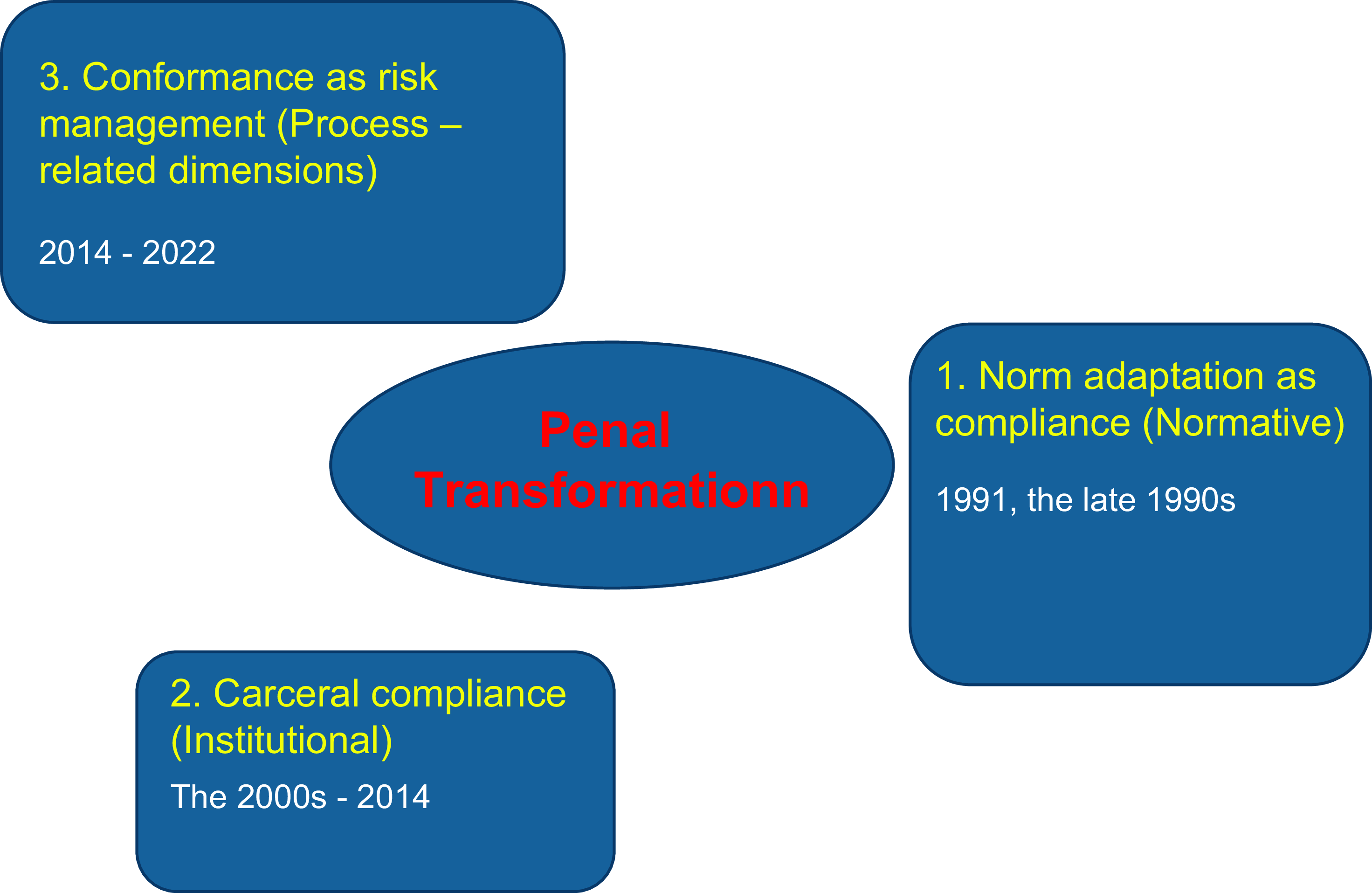
Phase 1: Penal transformation as norm adaptation, 1991 – late 1990s
The argument presented in the first phase follows Kieran McEvoy and Louise Mallinder’s (Reference McEvoy and Mallinder2012) work on transitional justice and, in particular, the ways in which the urgency of legal reform proliferates criminal justice institutions, such as prisons, where there once were human rights violations in wider society. When ratifying human rights treaties, norm adaptation is the intended outcome. Nevertheless, examining the efficacy of human rights in prisons is highly contingent and saturated with legal, political, and institutional problems that make prisoners’ rights uncertain and unprotected (see Behan Reference Behan2014). This is in part explained as being due to different branches of law carrying different commitments to compliance such that “the forces that induce compliance with other law … do not pertain equally to the law of human rights” (Henkin Reference Henkin1979, 235). In Russian penal culture, for example, despite the position that human rights standards were heralded after 1991 as working better than any known alternative (see Zinger Reference Zinger2006), the reality was that norm adaptation was minimal due to both the cost of meeting human rights standards and the struggles with treaty ratification (Bowring Reference Bowring2013; van Zyl Smit and Appleton Reference van Zyl Smit and Appleton2019) as well as for instrumental reasons that had to do with the CoE realigning and adjusting its own expectations to “justify keeping its members on board” (see also Jordan Reference Jordan2003, 688).
Echoing Douglass Cassel (Reference Cassel2001), the political and economic benefits of the trajectory of norm adaptation may then be understood as norm entrepreneurship, which is aimed at the gradual country internalization of a nation’s intention to adapt to new normative frameworks and social acculturation. In other words, what is the cultural meaning of, and rationale for, conforming to rights-based approaches to human rights in prisons? And if there is a need for aligned legal arrangements, there is then a need for strategic, institutional conformity. Yet how is this achieved? Thomas Risse and Kathryn Sikkink (Reference Risse, Sikkink and Risse2016) argue that the successful internal adoption of international norms into state institutions, such as prison systems, is best understood as a process of socialization, which is underpinned by a wider political and economic context that includes (but not exclusively) political bargaining (good governance and negotiation), foreign policy concerns (security), and economic partnerships (trade and development agreements). In Russia, the driver of legal and penal reform, where democratic norms are embedded and sustained, simply put, was wider political, economic, and social reform and harmonization. However, normative adaptation, while defining the first phase of the penal transformational framework, raises questions about routinization, which is where the frequency of repeated norm adoption becomes cast into a pattern of adaptation.
Of relevance to this article is the question of what habitualization would look like. The political worldview during the first phase was to “bring Russia” into Europe, and it was to be realized through the ongoing work of Russian NGO communities. Toward the mid- to late 1990s, an epistemic human rights community of transnational state actors, diplomats, and powerful NGOs, such as the Open Foundation (Cliquennois, Snacken, and van Zyl Smit Reference Cliquennois, Snacken and van Zyl Smit2022), were strategically positioned to define and measure effective plans for action that could correct and secure remedies for rights violations (McAuley Reference McAuley2016). Russia’s signatory status to many treaties also highlighted the significant role of the Helsinki Agreement, which has enabled monitoring up until the war in Ukraine.Footnote 14 This period was one of “cognitive comfort” because it provided psychological benefits of being in an insider group (the state actors became socialized as signatories to human rights treaties), and this was offset against the prospect of shaming and state exclusion that arose from regular interactions and pressures to conform (Neumayer Reference Neumayer2005, 929).
There was a considerable number of large state actors in the immediate post-Soviet years who interacted with domestic groups to lay the foundation for a persuasive, interactive, and democratic engagement with the normative benefits of becoming a signatory to human rights treaties. In an ad hoc way, a notion of democratization and habitualization in penal culture, therefore, was entering public consciousness through the monitoring work of the Open Society, Penal Reform International, and health-facing NGOs such as Médecins Sans Frontières (see Cliquennois, Snacken, and van Zyl Smit Reference Cliquennois, Snacken and van Zyl Smit2022). Alongside this monitoring work, new generation lawyers were also operating alongside their CoE counterparts to draft and implement new penal reform measures, keeping the spotlight on political prisoners and actively monitoring the conditions and outbreaks of violence in the penal system (see McAuley Reference McAuley2016). By the mid to late 1990s, activists did have the ear of the regime and succeeded in bringing leading figures together to campaign to reduce prison numbers.Footnote 15 With Russian NGOs present and active in domestic penal politics, this first phase was described as “the halcyon decade” (Busygina and Khan Reference Busygina and Khan2020, 64).
The criminal justice sector also achieved some notable change beyond norm adaptation through the establishment of a reasonably robust civil society. For example, in 1991, the new president, Boris Yeltsin, reached out to social groups,Footnote 16 and human rights treaties started to become part of public discourse and entered the parlance of transition and transformation. Marcia Weigle (Reference Weigle2002) argues that a populist-driven turn then emerged because the foundations of civil society were in part corresponding to so-called Western measurements. Hence, human rights workers were to some degree becoming compelled to operate from a more interest-driven set of priorities (such as foreign policy and security interests). In this context, the accusation of double standards was never far away. Laura Piacentini (Reference Piacentini2004) and Cliquennois, Snacken, and van Zyl Smit (Reference Cliquennois, Snacken and van Zyl Smit2022) have separately explained this period as one where, on the one hand, the ECtHR was operating with selected tolerance and instrumental bias. Yet, on the other hand, the ECtHR was pointing its radar east and working through and from NGOs to effect litigation and judicial lobbies to shame the former Soviet nations into compliance and norm adaptation. This is discussed further in the next section.
In summary, according to Bill Bowring (Reference Bowring2013), the burgeoning democracy and civil society helped steer the Russian state toward norm adaption to treaty commitments. With the warming of relations between the West and the East, the ECtHR grew in power and influence (Madsen, Cebulak, and Wiebusch Reference Madsen, Cebulak and Wiebusch2018). However, the political events in the late 1990s changed this path considerably, and penal-political discourses moved toward more stringent compliance as institutional and political risk.
Phase 2: Penal transformation and carceral compliance, 2000–14
The power relations in the second phase can be understood as imbalanced and removed from collective learning, internalization, and persuasion. These power relations were weighted toward rule-making, rule-following, and rule-enforcing behavior and were demonstrably externally driven. That said, since Russia did not wish to alienate its neighbors, it was hoped that a transformation, and an acceptance of international law, would change the public perceptions of its external audiences. By the late 1990s, two ways of seeing Russia emerged. First, there now needed to be a doctrinal shift and a new emerging approach: Russia had no Soviet Union to govern by. Second, there was a framing of Russia as “exceptional” (see Jordan Reference Jordan2003). Connecting the two was the establishment of what the transformational potential of penal reform could now be once treaties had been signed, protocols followed, and norms embedded (see Piacentini Reference Piacentini2004).
By 2000, the time and place that Russia was sitting in was moving toward a new form of authoritarian politics under Putin. The collective learning, internalizing, and persuasion that had underpinned the first phase was completely under strain as the Russian government launched a second offensive in Chechnya in 1999. When that happened, the Putin regime stepped further away from European values and ideas (see Busygina and Khan Reference Busygina and Khan2020). The hardening of Putin’s power-vertical politics also coincided with the total neutralization of civil society and NGOs, the arrest and contentious deaths of opposition politicians and journalists, the shutting down of public debate, mass censorship, and the state’s control of media. The prospect of a public debate on the uses of punishment in prisons, therefore, was now all but gone, and the erasure of debate from legal sectors was expedited by the earlier-mentioned banning of NGOs that relied on donations and “foreign money” and who required donations to successfully litigate.
The censorship politics led by Putin could have been, in part, a backlash against a form of regulatory capture of some international NGOs who had achieved notable success in human rights litigation and reform. Cliquennois and Champetier (Reference Cliquennois and Champetier2016, 97) argue that in Russia, despite working under acutely awful domestic conditions, which impacted the capacity of NGOs to contribute to norm compliance, it was the NGOs with “deep pockets” (Open Society, for example) that came to exert influence in the ECtHR. Complicating the context of who the key NGO actors in norm compliance were is the fact, that since the global financial crash of 2008, austerity has shrunk the funding of NGOs and other bodies such as monitors and ombudsmen (Leach Reference Leach, Føllesdal, Peters and Ulfstein2013). As such, private resourcing of NGO litigation was the inevitable development—so much so that NGO activity in the new authoritarian penal context came in the main from NGOs in the United States and the United Kingdom (Cliquennois and Champetier Reference Cliquennois and Champetier2016). This is of consequence for a country such as Russia because litigation against Russia in the ECtHR was, and remains, disproportionately high (Cliquennois and Champetier Reference Cliquennois and Champetier2016).Footnote 17
There is not the space in this article to probe in-depth the operations and funding of powerful externally financed NGO organizations, but the key players are funded to varying degrees by European embassies and large UN-located institutions as well as wealthy financiers who provide millions of euros, pounds sterling, and US dollars in endowment funds to support litigation and NGO work against the Russian government.Footnote 18 Their numbers are limited, but, collectively, these privately funded NGOs have been successful in adding force to case law against Russia. In the increasingly fraught relationship between the East and the West, a form of compliance inflation has therefore been inevitable because compliance has come to be situated in a political context where private donors have become the agents of change (see Leach Reference Leach, Føllesdal, Peters and Ulfstein2013; Cliquennois and Champetier Reference Cliquennois and Champetier2016). As a political response, the use of shaming strategies to create a condemnatory context that was rubber stamped by the institutions of Europe necessarily became a key geopolitical sore point between Russia and the United Nations before Russia invaded Crimea in 2014 (Börzel and Lebanidze Reference Börzel and Lebanidze2017).
While the cases cited by Cliquennois and Champetier (Reference Cliquennois and Champetier2016) do indicate the power and influence of privately resourced NGOs in forcing the Russian government to amend criminal justice places of detention, Russia nevertheless banned all NGO work in prisons, regardless of the source of the donor. Most notably, Memorial, although it was banned much later than the considered period (in December 2021), was tenuously operating its advocacy for the welfare of people held in confinement at this time and faced continued threats of closure in a penal political culture of domestic democratic decline. The binary of East versus West, now firmly re-established, operated in the penal context as follows: “foreignness” does not control Russia’s engagement with international human rights law.
In summary, international relations connect with the punishment-and-society scholarship on penal reform ideas, such as human rights, in two ways: first, in revealing that human rights and punishment forms exist as norms before they come to be legal rules and tools and, second, in shaping as both human rights and punishment the behaviors of powerful political actors and NGO groups and the structures within which they operate. In summary, the first two phases reveal how human rights emerge out of specific types of social and, crucially, political and economic relations, are then constituted as social structures, and mediated by a wide range of public and private power relations (Jordan Reference Jordan2003). Added to this are the internal domestic politics that heightens transnational political dissociation.
Phase 3: Penal transformation and conformance as risk management, 2014–22
One of the most significant political ironies of the CoE norms context, up until Russia’s invasion of Ukraine in 2022, was that the national boundaries and traditional geographical boundaries were going to be replaced by a salvational “European identity” (Jordan Reference Jordan2003, 663). Moreover, European culture itself would be saved by drawing in former communist countries into its “family.” This is a key point because human rights in the Russian penal culture, despite ad hoc ratification, was presented as operating for the global good and as though it would influence the practices of penal systems on their journey toward democracy. This kind of political and legal pragmatism has been underpinning the compliance context of Russian integration into Europe’s institutions for over twenty years. Nevertheless, it does not tell the full story of how norm adaptation and institutional operationalization would function in Russian penal culture. How we might understand the goals of imprisonment—particularly, prisoner rehabilitation—is useful here because rehabilitation, a transnational idea, is also, crucially, one of the key benchmarks in the delivery of human rights.
Rehabilitation has been doggedly pushing its way into the prison regimes of the former Soviet Union since 1991. International human rights articles (especially Article 10(3) of the International Covenant on Civil and Political Rights) place a legal obligation on signatory states to provide positive prison environments with references to the essential aim of the treatment of prisoners stated as “their reformation and social rehabilitation.”Footnote 19 In contrast, the 1957 United Nations Standard Minimum Rules for the Treatment of Prisoners, although not formally binding upon states, do specifically link the treatment needs of prisoners to the protection of society against crime (see Rule 58).Footnote 20 Between these polarities is the duty of penal systems, under international law and European jurisprudence, to provide for rehabilitation. Since the wider context of international law provides legal obligations where rights and rehabilitation are intertwined, rehabilitation encapsulates tensions between the rules in regimes (only the minimum standard is obligatory) versus the rights of prisoners to have more than the minimum (see van Zyl Smit and Appleton Reference van Zyl Smit and Appleton2019). Competing sociological narratives around what prison is for may emerge around these tensions: what are the institutional risks when the minimum is not met? Do prisoners deserve more than the minimum? The effectiveness of international obligations on rehabilitation in prisons become opaquer in this context due to insufficient weight being given to prisoners’ needs (Genders and Player Reference Genders and Player2014).
Human rights in penal culture problematize the meaning and operation of rehabilitation further, particularly around citizenship (Behan Reference Behan2014). That is, the legal and moral right to rehabilitation is an entitlement, but it may also be a conduit to becoming a full citizen after imprisonment. There are many societies where the movement of prisoners to a defined social status as a citizen requires not only a reconstruction of law but also a political, social, and cultural step change toward something that brings with it public support for prisoners. In the Russian case study, it is utterly inconceivable to imagine a penal context where prisoners as agents with rights are recognized as citizens. Russia, sadly, is unlikely to meet these progressive steps towards human rights compliance for very many years to come because prisoner citizenship does not take place in a socially inclusive society with genuine penal reform processes and where penal confinement is used with restraint and within the rule of law.
Although, as Hannah-Moffat (Reference Hannah-Moffat2004) argues, when human rights come to be operationalized in prisons, the prisons themselves become risks to be managed, so too is it the case that prisoners themselves become risks through their right to litigate. This creates a double bind for penal systems in transition because rehabilitation is intended to serve the prisoner and the community and, at the same time, is also measured in institutional terms using compliance norms. For example, in prison contexts in Northern Europe and North America, a penal cultural context has evolved, which is one of tension where rights and risk meet and mesh. This negotiated tension has coincided with an incremental, but certain, embedding of rights in prison as a rehabilitation management ideology where bureaucratic procedures, accreditation programs, and enhanced management outcomes are privileged over the normative and practical welfare of prisoners (see Armstrong Reference Armstrong2018). To be clear, this article is not arguing that punitive turns toward neo-liberalism were in evidence in Russia over that long period of engaging with the CoE. The point here is that care, rights, rehabilitation, and welfare in Russian prisons, over the last thirty years or so, have been severely damaged by a political environment where crime and punishment discourse is increasingly inhumane and authoritarian. The Russian prison system reveals, in extremity therefore, how the integrity of prisoners’ rights is evaluated against the integrity of a system that complies with transnational norms and rules.
This raises a further question around penal values, which are necessarily reflective not only of legally sanctioned practices maneuvered through the machinations of compliance norms, institutions, and bureaucracies but also of the internal and external social and cultural conditions that modern penal institutions across the world now follow (for example, what is the reality of prison and what are the historical roots of penal culture?). Where these questions are most acutely felt is in the kinds of societies where penal transformation is experienced, such as Russia, because there is a whole host of specific legal ideas and expectations moving from one idea of punishment to the next, which often means that the collective learning, internalization, and persuasion, referred to throughout this article, become diminished by other considerations. Prisoners, who make up a constituency not referred to explicitly in this article, then risk falling through a kind of sociological void; they become lost in the process of change and become the victims of political responses to human rights compliance (Murphy and Whitty Reference Murphy and Whitty2007). In these slightly differentiated responses to human rights, as they are organized around norm adaptation, carceral compliance, and risk, structural and cultural relations and conditions and contexts of penal culture still remain poorly understood and may create conditions whereby penal reform and prisoners’ rights can malfunction (Hannah-Moffat Reference Hannah-Moffat2004). Thus, while political strategy might work as a driver of compliance, it diminishes collective, institutional, and cultural understandings of the prison as a site of intractable social and cultural conflict.
In summary, campaigns for prisoners’ human rights are symbolic and expansive in their efforts to challenge prison standards, administrative decisions, and legal rules. The tripartite framework illustrates how human rights in prisons are debated from multiple standpoints: their legal status and effects on law, as part of a struggle for equality and fairness and their dominant influence in societies formerly marked by atrocity and the absence of the rule of law. Prisoners’ rights in Russia also reflect the sociological complexity of compliance systems in prisons because rights have evolved in a dynamic penal transformational context that did indeed bring Russia closer politically, culturally, and penologically to its European neighbors. Consequently, for twenty-five years, penal reform in Russia not only was constructed almost entirely from legal discourse but also benefited from the fluctuations in civil society and the power and prestige of key NGO players. As the tripartite framework illustrates, when prisoners’ rights are constructed as entitlements overseen by law, it may secure human rights compliance. The consequences of this in a culture where compliance and prison inhumanity are acutely felt requires further inquiry to the questions, introduced briefly here, not only about the differences between the treatment of ordinary prisoners and political prisoners but also about where the levers of power lie in the geopolitics of carcerality in this region, which are now so domestically repressive and globally erased.
Conclusion
This article has used Russian penality as a case study to discuss an area of penal culture overlooked by law and society and criminological scholarship, which is how compliance norms and laws translate in authoritarian penal cultures such as Russia. The article has presented a tripartite framework for understanding the penal transformations that have taken place in Russian penal culture since the collapse of the Soviet Union in 1991 until the invasion of Ukraine in 2022. It has argued that an externally led compliance context was the driver for Russia’s inclusivity, harmonization, and securitization into European penal space, which necessarily led to poor engagement at the state level with the norms of punishment in this vast, hidden, and exceptional penal culture. Norm conformance and the institutionalizing of human rights risk created pressure points and significant multiple actor complexity, so much so that Russia’s penal past was in constant competition with a transformational present—a penal past (the gulag’s legacy) that did not readily—internally at least—shake off its harsh and tragic legacies amid increasingly authoritarian domestic politics. Taken together, these factors produced different forms of political response, action, and struggle to articulate a key question on what the purpose of punishment in post-Soviet Russia is. Moreover, the institutional and cultural power of imprisonment as a high-risk space and domestically complex realm was structurally framed in ways that disregarded the rights claims. With many of Russia’s Sovietized institutional and cultural dynamics of incarceration remaining intact (human rights violations), if not worse (the use of penality as a tool of state oppression), the effect is that understandings of how rights come to be spatially and temporally organized, and culturally and politically articulated, remains hidden. In focusing on the legality and penal power nexus at the center of Russia’s penal reform journey, the article has argued that the varying ways in which multidisciplinary discourses around rights are framed in the penal transformational framework are non-linear but especially important. These discourses reveal a cycle of socio-political pressures: obligation dialogue and political alignment instead of a cultural debate about the role of the prison in society.
The tripartite model of transformation that been presented was a framework of a visible bureaucracy of rights mobilization—a bureaucratic drama of institutional regulation, a churning of procedural monitoring, regime regulation, adherence to legal obligations, norm conformance, carceral compliance, and new public and private audiences to which penal bureaucracy must speak. Russia, for over twenty years, has sat in a space where politics and penality have collided, where the so-called East was raised by the West. While there are important points of connection and overlap across all the facets of the penal transformational process, the turn toward securing human rights discourse also may play a role (but not entirely so) in securing the prison, which in Russia meant securing an internationally compliant regime (see Armstrong Reference Armstrong2018). Juxtaposed alongside human rights is the question of where and how prisoners express their everyday lives in prison.
As the current political crisis illustrates, Russia, despite keeping the CoE at arm’s length for much of the last twenty years, is not being guided to comply for the moment. Russia and its penal system, therefore, are adrift. As the shocking torture and death of leading Russian opposition politician and activist, Alexei Naval’ny, and the cruel, very lengthy sentences and imprisonment of many other opponents has illustrated earlier, the backward glances to Soviet penal forms are also seemingly louder in public discourse. With penality itself increasingly implicated in the exercise of new forms of oppression and control of Russia’s authoritarian culture, the future for penal reform in Russia seems utterly and profoundly fated.

 Open access

