

1. Introduction
Female labor force participation (FLFP) remains low in several parts of the world, particularly in the Middle East and North Africa, where thirteen of the fifteen countries with the lowest rates of female participation in the labor market are located [Bursztyn et al. (Reference Bursztyn, González and Yanagizawa-Drott2018), World Bank (2019)]. In addition to geographical proximity to each other, these countries share another common trait as Islam is the dominant religion of their nations. Several cross-country studies have documented that FLFP and female education are lower [Tzannatos (Reference Tzannatos1999), Norton and Tomal (Reference Norton and Tomal2009)] while fertility rates are higher [De La Croix and Delavallade (Reference De la Croix and Delavallade2018)] in Islamic countries although a study by Bayanpourtehrani and Sylwester (Reference Bayanpourtehrani and Sylwester2013) finds that the negative association of Islam and FLFP greatly diminishes once other controls are included in the regression. In general, it is hard to evaluate whether observed variations in economic or social outcomes across countries or along time are attributable to differences in religious and cultural values since, besides religious and cultural norms, a range of economic and institutional factors tend to differ across time and space. This can explain some of the contradicting results in the literature regarding the effect of religion on economic outcomes [Noland (Reference Noland2005), McCleary and Barro (Reference McCleary and Barro2006)].
This study focuses on a single country Turkey, a predominantly Muslim nation, and specifically aims to show the association of religion with FLFP and employment using new micro-level data on two distinct Muslim denominations in Turkey: Sunni and Alevi Muslims. Alevis read from the same Islamic texts as Sunni Muslims, but worship in a cemevi, or prayer hall, rather than a mosque. In cemevis, men and women pray alongside one another, and—unlike observant Sunnis—are not expected to pray five times a day (Photographs A.1 and A.2).
While there are many quantitative studies analyzing the association of economic outcomes and different religious doctrines within Christianity religion such as those of Catholic and Protestant denominations [Lehrer (Reference Lehrer1995, Reference Lehrer1996), Becker and Woessmann (Reference Becker and Woessmann2009), Cantoni (Reference Cantoni2015), Berman et al. (Reference Berman, Iannaccone and Ragusa2018)]; there are almost no empirical studies that examine how different religious doctrines within Islam and economic outcomes are linked.Footnote 1 In addition to contributing to an unexplored area, focusing on a single country such as Turkey has its advantages as labor market institutions, education system, language, geography, and economic conditions are uniform across the country at a given point in time. Since the Turkish Statistical Institute or any other government agency does not request information on a person's religious affiliation (other than to ascertain whether they are Islamic, Christian, or atheist) the differences in the economic outcomes of Sunni and Alevi Muslims have not been empirically studied in the literature. In this study, we use newly available and nationally representative individual-level data with information on religious affiliation, ethnicity, and all the relevant socio-demographic characteristics and labor market outcomes collected by the Research and Consultancy company Konda in 2015.
In recent years, an increasing number of papers combining sociology and economic outcomes have enriched the economic literature. The investigation of the relationship between religion and economic performance has been the focus of a number of these [Iannaccone (Reference Iannaccone1998), Noland (Reference Noland2005), McCleary and Barro (Reference McCleary and Barro2006), Becker and Woessmann (Reference Becker and Woessmann2018), Berman et al. (Reference Berman, Iannaccone and Ragusa2018)]. Both religion and social norms may play a major role in the formation of a country's culture; hence, economists also tried to understand the connection between culture and economic outcomes [Guiso et al. (Reference Guiso, Sapienza and Zingales2006), Tabellini (Reference Tabellini2008), Zhan (Reference Zhan2015)], frequently finding a significant effect of culture. Moreover, social norms, religion, and culture not only influence the economic development but also have an intergenerational transmission effect [Hazan and Maoz (Reference Hazan and Maoz2002), Bisin et al. (Reference Bisin, Topa and Verdier2004)].
Guiso et al. (Reference Guiso, Sapienza and Zingales2006) suggest that a necessary first step is to define culture in a sufficiently narrow way so that it becomes easier to identify a causal link from culture to economic outcomes. Some aspects of a specific religion such as its emphasis on strong work ethic and honesty can be conducive to economic growth and some others such as its discouragement of female education or labor supply can be an impediment to economic development. Hence broad categorizations of populations into large religious denominations such as Christian or Muslim and examining outcomes across countries and time may not be very helpful in understanding how religion and culture affect economic outcomes.
The literature analyzing the relationship between social norms and FLFP [Lehrer (Reference Lehrer1995), Antecol (Reference Antecol2000), Vendrik (Reference Vendrik2003), Fernández et al. (Reference Fernández, Fogli and Olivetti2004), Guiso et al. (Reference Guiso, Sapienza and Zingales2006), Burda et al. (Reference Burda, Hamermesh and Weil2013), Scoppa and Stranges (Reference Scoppa and Stranges2019)] show that the influence of social norms is significant. Lehrer (Reference Lehrer1995, Reference Lehrer1996) finds that in the United States, exclusivist Protestant groups tend to be least egalitarian in their definitions of male and female roles. Individuals with no religious affiliation are most egalitarian, with ecumenical Protestant and Catholic groups falling somewhere in between. She then shows that among women in homogamous unions, those affiliated to exclusivist Protestant unions display the lowest level of attachment to the labor force and attributes this result to their less egalitarian social norms regarding the role of men and women. Dean and Dilmaghani (Reference Dean and Dilmaghani2016) find that religious affiliation (Protestant, Catholic, Muslim, Jewish) is not a predictor of FLFP in Canada and only within the Protestant tradition, FLFP decreases with the degree of commitment to the religious doctrine. While there are studies examining the social norms and labor supply behavior across different denominations in Christianity, there are no such studies for different religious identities within Islam.
Antecol (Reference Antecol2000) finds that over half of the variation in the gender gap in labor force participation rate (LFPR) of immigrants is attributable to home country LFPR using data on immigrants to the US pointing out the enduring effect of social norms. Scoppa and Stranges (Reference Scoppa and Stranges2019) find that immigrants' FLFP rates at the host country can be explained by FLFP rates of their home countries using data on immigrants to Italy. One caveat in these studies is that migration is an endogenous decision to labor market outcomes in the home countries, and that results obtained for a selected sample may not be completely representative of the underlying population.
In our analysis, we do not have any sample selection issues since we have a representative sample of Turkish population and religious identity is determined at birth as children adopt the religious identity of their parents and changing denominations in adulthood is extremely rare in Turkey. Furthermore, the two religious identities, Sunni and Alevi Islam, have existed in their present form for centuries in Anatolia [Oz (Reference Oz1995)]. We contribute to the literature on FLFP and social norms by showing that religious identity is the basis of the social norm, and the social norm is the mechanism through which the religious beliefs manifest themselves in economic behavior. Ours is one of the first studies of female labor supply that defines religion in such a narrow way that institutions, language, geography, and economic conditions are held constant. To our knowledge, it is the first study that examines the effect of religion on female labor supply within the Islamic tradition.
Focusing on a single country allows us to investigate the channels through which religion may affect female employment as we can quantitatively compare the two denominations with respect to each probable channel. Specifically, we examine gender views, modernity, and piousness as possible channels through which being a member of Alevi denomination may have a positive effect on female labor market outcomes.Footnote 2 We find that an Alevi Muslim woman is 11.6 percentage point (ppt) more likely to participate in labor force than a Sunni Muslim woman whereas there are no significant differences in male labor market outcomes between the two denominations.
We examine underlying religious and cultural channels that can explain these differences. Alevi Muslims consider themselves as more modern and have more equal views on gender roles, especially regarding the role of women in the labor market. While members of both denominations consider themselves as believers of their faith (Islam), Alevis are more likely to state that they do not much abide by the rules of religion. We argue that differences in self-identity regarding modernity and gender roles between the two denominations drive the results on female labor market outcomes.
FLFP is an important topic for Turkey since FLFP rate, at 35%, is the lowest among OECD countries and the 23rd lowest in the world. Furthermore, FLFP has been relatively stagnant over time despite a recent policy in 2008 which provided tax incentives to employers for hiring female workers. Policy makers that aim to increase female labor supply need to consider how proposed policies will interact with existing social norms. More research is needed on interventions that can mitigate the adverse effects of social norms on female labor supply. In particular, work-family reconciliation such as flexible and alternative work arrangements, childcare supports, and care-related leaves may have more potential in mitigating the adverse effects of the traditional caregiver role of women in the household on female labor supply.
In the next section, we describe the institutional and cultural background for education and labor market in Turkey. Section 3 presents our conceptual framework that motivates our empirical analysis. In section 4, we describe the data used. Section 5 specifies our empirical methodology. Section 6 presents descriptive statistics and the main results. In section 7, we investigate possible channels through which Aleviness affects labor market outcomes. Section 8 presents alternative specifications to our main specification controlling for channels identified in section 7. Section 9 concludes.
2. Background
2.1 Alevis and Sunnis in Turkey
The Alevi Muslims comprise the second-largest faith community after Sunni Muslims in Turkey, estimated at about 15% of the population [Shankland (Reference Shankland2003), Erdemir (Reference Erdemir2005)]. Incorporating Shiite, Sufi, Sunni, and local traditions, Alevism is a strain of Islam that emerged in the 10th century in Turkey. Alevi Muslims believe that the Prophet Muhammad's nephew Ali Ibn Abi Talib was his rightful successor rather than the first three caliphs following the Prophet's death. Alevi means descendent from the lineage of Ali. In this fundamental difference from Sunni Muslims, Alevis can be considered to be a branch of Shiite Muslims who believe that Muhammad chose Ali as his successor. After Ali's death, Shiite Muslims were led by twelve imams, whom they believe were spiritual successors to the Prophet Muhammad rather than having any family connection to him. Alevis also believe in the twelve imams and look up to religious leaders for guidance [Tanriverdi (Reference Tanrıverdi2018)]. These spiritual leaders are often called Pir (sage), Rehber (guide), Seyyid (master), “Dede” (grandfather) and follow a hereditary line [Rençber (Reference Rençber2013)]. However, the succession is not pre-determined. Dede is supposed to be the most competent person in the family with a high level of education and ethical values. There is an emphasis on collective decision making where the Alevi community agrees that Dede indeed has these qualities. The tradition of Dedes with its emphasis on following the “Road of Muhammed and Ali” leaves room for debate and heterodox views. The Alevis hereditary holy men are empowered to solve disputes, but according to the dominant religious philosophy, women are equal to men [Shankland (Reference Shankland2003)]. Photograph A.1 shows Sunni men praying in a mosque where men and women worship in segregated areas.Footnote 3 Photograph A.2 shows a cemevi where men and women pray together.Footnote 4
After the Turkish Republic was established in 1923, the attempt to create a uniform public national ethnic identity was paralleled in the field of religion. The decision both to restrain and to permit religion had certain immediate consequences. The state had decided right from the onset that the basis of its reformed Islam was to be, broadly speaking, Sunni practice, it was able to take certain formal steps: grant permission to build mosques, print Korans, facilitate the pilgrimage to Mecca, which gradually resulted in albeit within the secular nation-state a huge increase in public orthodox activity. The state-sponsored Directorate of Religious Affairs (Diyanet Isleri Baskanligi) with its personnel of more than 100,000 people and power to appoint clerics to over 90,000 mosques has aimed to promote a unified, singular, orthodox version of Sunni Islam [Koca (Reference Koca2014) and Lord (Reference Lord2017)].Footnote 5 A sense of being part of the (Sunni) Islamic community, even within a secular republic, enabled ethnic differences among orthodox believers to be overlooked or forgotten in all but the sharply distinct Kurdish tribal regions in eastern Anatolia, and provides a forceful argument as to how such diverse ethnic, linguistic, and national groups could form modern Turkey so smoothly [Meeker (Reference Meeker2002)]. The Alevis, on the other hand, are far less comfortable in using active participation within a supra-religious community as a means to establish wider social contact. Instead, they have preferred to stress citizenship within a secular nation. As this conception of national identity is only one strand of the dominant Turkish/Islamic perception of citizenship, it means that they only partially overlap with the majority view. As they are not giving priority to fasting, to praying in the mosque, or to the everyday sayings and affirmations of belief, they are not automatically incorporated into one of the most important means by which diverse peoples have been socialized into a Turkish national community [Shankland (Reference Shankland2003)].
Some have argued that being an Alevi is a life style rejecting tradition and dogma embracing change and modernity [Balkiz (Reference Balkiz1992) and Yetkin (Reference Yetkin1993)]. Yetkin (Reference Yetkin1993) points out Alevis' historical support for leftist parties and argues that Alevism is a life style choice that transcends individual, societal, and political spheres. On the other hand, Oz (Reference Oz1995) argues that while Alevism is a life style that has evolved with social and political events throughout centuries, one cannot overlook that Alevism is also a system of beliefs and people of Alevi faith believe in Allah, Prophet Muhammet, and the Holy Book Kuran. Practicing Alevis read from the same Islamic texts as Sunni Muslims, but worship in a cemevi, or prayer hall, rather than a mosque. In cemevis, men and women pray alongside one another, and—unlike observant Sunnis—are not expected to pray five times a day. These differences in lifestyles in individual, societal, and political spheres concur with the idea that Sunnism and Alevism are different interpretations of Islam.
For centuries Alevis had to practice their rites in secret and have been victims of persecution during Ottoman times. Alevis in the secular Turkish Republic still have to struggle with distrust from some Sunni Muslims. By some metrics, however, the Alevis are safer now than at many points in their history. There are over 1,000 cemevis in Turkey, and although they do not benefit from states resources, Alevi Muslims are free to practice their religion at cemevis. In 2007, President Erdogan, who is an overtly Sunni Muslim, began what was termed an “Alevi opening”, a yearlong effort to discuss the improvement of Alevi rights. Mr. Erdogan spoke to a group of Alevi Muslims “We are all citizens of the Turkish republic. We are all hosts of this country, siblings without discrimination between you and us” [Kingsley (Reference Kingsley2017)].
Sunni Muslims are estimated to form about 80% of the population and Alevi Muslims are estimated to form about 15% of the population. Since the Turkish Statistical Institute or any other government agency does not request information on a person's religious affiliation, the exact share of Alevis in the population is not known [Shankland (Reference Shankland2003)]. Çarkoğlu (Reference Çarkoğlu2005) in a survey of political preferences of Alevi and Sunni voters find that when individuals are asked their religious affiliation directly about 3.3% identify themselves as Alevi in their data, whereas when individuals are asked from a list of religious figures whom they perceive as prominent nearly 15% picked a figure that is of clear significance in the Alevi tradition. Hence, he argues that direct questions on religious affiliation may result in underreporting of religious minorities. In our data, about 88% of the population identify themselves as Sunni Muslims, and 6% of the population identify themselves as Alevi Muslims. The 6% is lower than some of the estimates in the literature. While some of the survey respondents might have chosen to hide their religious affiliation, we would argue that in today's climate, in a recent survey conducted by a reputable research and consulting company, underreporting/nonreporting may not be a major issue for our purposes for several reasons. First, we should point out that the purpose of this survey is not to collect information on political preferences of respondents which in Turkey is a sensitive issue. Second, if there is underreporting, that means that some of the respondents who identify themselves as Sunnis are actually Alevis. To the extent that underreporting Alevis are closer to true-reporting Alevis in terms of their gender views, life style, and labor supply behavior than they are to Sunnis, this under-reporting will make it difficult for us to find an effect of being an Alevi on female labor supply. Hence our estimates can be interpreted as a lower bound and the true effect may even be higher. However, if underreporting Alevis are closer to Sunnis in terms of their labor supply behavior and only politically active Alevis who also happen to be more modern with more equal gender views and higher female labor supply report their Alevi identity, this can also cause an upward bias in our estimates. Third, it can be argued that some of the respondents who identify themselves as Alevis might choose to skip the question altogether and are dropped from the sample, which might create an upward bias in our estimates. We check the robustness of our results by assigning Alevi status to those who skip the religious identity question and show that our main results continue to hold.Footnote 6 Finally, in a 2006 Konda survey [Konda (2006)] on religious and ethnic identity, 53% of Alevis state that they live their religious identity freely, about 28% state that there are some problems, 14% state that there are legal impediments, and only 4% state that there are societal/environmental impediments. Furthermore, in a 2010 Konda survey [Konda (2010)] which is soon after to Alevi opening of 2007–2008, the percentage of Alevis is about 5% again consistent with the estimate in our data.
There are two major ethnic groups in Turkey: Turks and Kurds. About 80% of the population identify themselves as Turkish, and 20% identify themselves as Kurdish ethnically. Being an Alevi is a religious identity; hence, Alevis may belong to Turkish or Kurdish ethnic groups. Hence, there are no significant physical differences between Alevi Muslims and Sunni Muslims. In general, there are also no significant differences in the given names and last names of the two groups. Therefore, it is not possible to identify whether a person is an Alevi Muslim or a Sunni Muslim simply by physical appearance or by name.
2.2 Gender roles and modernity
2.2.1 Gender roles
Differences in gender roles have been offered as an explanation for observed gender differences in educational and labor market outcomes [Fortin (Reference Fortin2005) and Bertrand (Reference Bertrand, Ashenfelter and Card2011)]. Many believe that views on gender roles are largely determined early in childhood [Vella (Reference Vella1994)]. In some countries, children grow up in an environment in which son preference is strong [see, e.g., Zhang et al. (Reference Zhang, Kao and Hannum2007) for China and Stash and Hannum (Reference Stash and Hannum2001) for Nepal]. Even in countries that are not typically considered to have patrilineal family systems, female labor market outcomes may depend on parental views on gender roles [Farre and Vella (Reference Farre and Vella2013)].
A large body of research on Judeo-Christian influences finds a strong association between fundamentalist affiliation and participation and inegalitarian gender role attitudes [Heaton and Cornwall (Reference Heaton and Cornwall1989), Lehrer (Reference Lehrer1995), Bartkowski (Reference Bartkowski1999) and Read (Reference Read2003)]. Women who belong to and participate in orthodox Jewish and conservative Christian denominations, where issues regarding the family and gender roles are particularly important, hold more traditional gender role attitudes than women who belong to more moderate denominations or who have no religious affiliation [Peek et al. (Reference Peek, Lowe and Williams1991) and Hardacre (Reference Hardacre, Marty and Appleby1997)].
Ongoing resistance to gender equality in Muslim societies, despite considerable industrialization and development in many, has reinforced the assumption that Islam itself poses a formidable barrier to gender equality [Afkhami (Reference Afkhami1995), Fish (Reference Fish2002), Inglehart and Norris (Reference Inglehart and Norris2003), Inglehart (Reference Inglehart2004) and Hoodfar (Reference Hoodfar2007)]. Hoodfar (Reference Hoodfar2007) argues promoting more liberal interpretations of Islamic texts and reexamining what it means to be Muslim within an enabling environment can potentially empower women to make choices that can change gender relations. Through a review of the Afghan refugee educational movement in Iran, he outlines the processes that culminated in the empowerment of Afghan refugee women in ways that have substantially transformed women's roles and gender relations in Iranian Afghan refugee communities.
Painting all Muslims with a broad brush in terms of their attitudes toward gender equality can be misleading and unhelpful in understanding transformations favoring more gender equal views. Turkey is a good example illustrating that there can be important nuances in views on gender roles even in a predominantly Muslim society.
In socially conservative parts of Turkey, a traditional view on gender roles prevails [Caner et al. (Reference Caner, Guven, Okten and Sakalli2016)]. Indeed, several studies that have conducted face-to-face interviews with parents, teachers, and local officials in Turkey report conservative views against girls' education as a major impediment [Tunç (Reference Tunç2009) and Alat and Alat (Reference Alat and Alat2011)]. Dildar (Reference Dildar2015) finds that patriarchal norms and religiosity are negatively associated with FLFP. Conservative views on gender roles are also reflected in popular discourse. In 2015, the Minister of Health at the time has been quoted to say “Mothers should not put another career other than motherhood at the center of their lives” [Hurriyet Daily News (2015)].
However, Turkey also displays a wide spectrum of gender views across its regions, as shown by a gender view indicator based on the degree to which the respondents agree with the statement “when jobs are scarce, men should have more right to a job than women”. The regional averages (NUTS-1 level) of the indicator in Turkey vary between 3.22 in the most gender-equal region and 4.12 in the most unequal region. By comparison, the average value of the indicator is about 3.23 in Great Britain, about 3.48 in China, 3.59 in Russia, 3.78 in India, and 4 in Saudi Arabia [Caner et al. (Reference Caner, Guven, Okten and Sakalli2016)]. Anecdotal evidence suggests that Alevi Muslims have more gender-equal views than Sunni Muslims. However, prior to our study, this also has not been established empirically in the literature.
2.2.2 Modernity
Modernity refers to a powerful set of cultural, political, and economic relationships that are characterized by an emphasis upon rationality and science over tradition and myth; a belief in progress and improvement and a focus on individuality.
From a classical perspective, modernity was understood as a linear process, spreading from the West to the rest of the world. In this view, modernization was equated with westernization, and as such, was very much visible in the narrative of Turkish modernization [Kaya and Tecmen (Reference Kaya and Tecmen2011)]. The idea of multiple modernities opposes classical views of modernization and therefore denies the West its monopoly. Eisenstadt (Reference Eisenstadt2000) observes the emergence of new centers of modernity all over the world in which the originally western model of modernity is continuously reinterpreted and reconstructed. Gole (Reference Gole2003) supports this point of view by arguing that the rising visibility of Islamic symbols in the public space can be interpreted as modernity since it is a manifestation of social (civil) and political (civic) participation.
The notion of modernity in Turkey transcends socio-demographic characteristics, religious and ethnic identities for several reasons. First, in its classical meaning, it has been the premise in the foundation of the secular Turkish Republic. “The supreme guide in life is science” and “Our great ideal is to raise our nation to the highest standards of civilization and prosperity” are the very words of the founder of the Republic, Kemal Ataturk. Second, since its foundation, the country has experienced rapid economic development accompanied with dramatic mass migration from traditional rural areas to more progressive urban centers as the share of urban population increased from 25% during the 1927–50 period, to 42% by 1975 and 76% by 2019. Third, secular education is preferred over religious education by a vast majority of Turks. During 2019–2020 academic year, about 600,000 students were enrolled in religious high schools whereas over 3 million students were enrolled in secular high schools although there is ample supply of religious schools.
In our data, about a third of individuals identify themselves as modern and the rest define themselves as either traditional conservative or religious conservative. True to the complexity of the term, neither individuals' views on gender roles nor the extent of their piousness can fully explain whether they consider themselves modern or conservative (Table A.2). Balkiz (Reference Balkiz1992) and Yetkin (Reference Yetkin1993) have argued that being an Alevi is a life style rejecting tradition and dogma embracing change and modernity. However, prior to our study, this has not been empirically examined in the literature.
3. Conceptual framework
The history of Western modernity can be briefly outlined as a history characterized by the progressive emergence of individual freedom. Starting in the 16th century, divisions occurring between the Catholic Church and the Reformed Churches played an important role in the trajectory followed in the subsequent centuries by the countries that drove modernity—mostly Reformation countries—and by countries that aimed at modernity—especially Counter-Reformation countries [Magatti and Martinelli (Reference Magatti and Martinelli2016)]. Hence, the interpretation of religion has played a significant role in embracing or rejecting modernity in Western civilization.
Religion and the Protestant Reformation have been credited, both in the original Weberian formulation and more sophisticated versions of it, as developments in Europe in the centuries before the Industrial Revolution that in many ways were decisive in bringing it about [Weber (Reference Weber1904), Mokyr (Reference Mokyr2018)].
When we consider the two Muslim denominations in Turkey, Alevis are described as more modern and less pious compared to Sunnis in several qualitative studies [Balkiz (Reference Balkiz1992), Yetkin (Reference Yetkin1993)]. Modernity refers to a powerful set of cultural, political, and economic relationships that have fundamentally influenced the nature of social life, political life, and the economy. The general characteristics of these relationships include an emphasis upon rationality and science over tradition and myth; a belief in progress and improvement and a focus on individuality. In this paper, we hypothesize that Alevi Muslim women are more likely to participate in labor force than Sunni Muslim women because as a denomination Alevi Muslims are more modern, have more gender-equal views, and are less likely to abide by rules of religion compared to Sunni Muslims.
Focusing on a single country such as Turkey has its advantages as labor market institutions, education system, language, geography, and economic conditions are uniform across the country at a given point in time; and we can further investigate the channels through which religion may affect female employment. Specifically, we will examine gender views, modernity, and piousness as possible channels through which being a member of Alevi denomination may have a positive effect on female employment.
There can be alternative explanations for higher LFPR of Alevi women than the one we propose. First, Alevis and Sunnis might have different preferences for labor/leisure choice. Alevis might have a stronger taste for work. If the marginal rate of substitution of leisure for consumption is lower for Alevis at the non-participation point, this will result in lower reservation wage and job quality expectations. Hence at a given market wage, the probability of participating in the labor force may be higher for an Alevi Muslim than a Sunni Muslim. Second, Alevis may have better employment opportunities than Sunnis. They may face higher market wages than Sunnis, perhaps because they are more productive or find employment more easily due to their social networks or even face positive discrimination. These differences in labor/leisure preferences and employment opportunities between the two denominations, if they exist, are likely to hold for men as well as women. Hence, we will test the hypothesis that observed differences in the labor market outcomes are due to differences in preferences and/or employment opportunities by examining whether there are differences in labor market outcomes of Alevi and Sunni men. If it is primarily the role of women in the society that is driving the results, we should observe that an Alevi woman is more likely to participate in the labor force than a Sunni woman, but there should not be any significant differences between an Alevi man and a Sunni man in terms of their labor market outcomes.
It is also possible that Alevi women face positive discrimination and/or Sunni women face negative discrimination in the labor market. Cindoglu (Reference Cindoglu2010) documents that women who wear headscarves are more likely to face employer discrimination in the labor market, even in the private sector. At the time of her study, there was even a ban on wearing a headscarf for public sector employees. This ban in the public sector was appealed in 2013 and women with headscarves have become more visible in both private and public sectors since then. Even though our data are from 2015, we will consider that headscarf ban can have long-run effects on human capital investments and labor market attachment of women. If Alevi women are less likely to wear headscarves than Sunni women, they might face positive discrimination in the labor market and we might falsely attribute the effect of not wearing a headscarf on labor market outcome to the Alevi variable. We will investigate this channel and examine how our results vary according to wearing a headscarf.
4. Data
The main data source for labor market studies in Turkey, the Turkish Household Labor Force Survey (HLFS), does not have any information on religious affiliation or ethnicity as the Turkish Statistical Institute does not collect data on religious affiliation or ethnic identity. Turkish Demographic Household Survey (TDHS) also does not have any questions on religious affiliation. Hence, to study the effect of religious affiliation on FLFP and employment, we draw on a new survey conducted by Konda, Research and Consulting company, in 2015. The sample was collected according to the address-based population system with stratified sampling according to the 2011 General Election Results. The survey is representative of adults (18 years old or older) at the NUTS-1 regional level. There are 12 regions at NUTS-1 level in Turkey. The primary purpose of the survey was to gather views and opinions on gender roles and domestic violence [Konda (2015)]. We created our main estimation sample by dropping respondents who identified themselves as any denomination other than Alevis and Sunnis (3% of the observations) or skipped the question altogether (2.3% of the observations). In the final sample, 6.4% of the respondents are Alevis, and the rest are Sunnis.
Turkish HLFS asks an individual if she worked even one hour in order to earn income or as an unpaid family worker during the reference week. If the answer to this question is “yes” then the individual is classified as employed and hence in the labor force. In our survey, the individual is asked whether she is a paid employee, employer, own-account worker, farmer, retired, student, housewife, or unemployed. We classify an individual in labor force if she states that she is working as a paid employee, employer, own-account worker, farmer, or if she is unemployed. If an individual classifies herself as retired, housewife, student, or cannot work, we classify the individual as not in the labor force. The average female LFPR in our data is about 22%, which is lower than 35% that is computed using Turkish HLFS.
We believe that the lack of unpaid family worker category might be the primary reason for our lower female participation rate. Since there is a farmer category, some women who work on the family farm as unpaid family workers might have classified themselves as farmers while others might have considered themselves as housewives. Since we are more interested in FLFP for monetary gain, we think ours is the more appropriate measure for our purposes. In addition to labor force participation, we also construct variables for employment and unemployment status of respondents.
The survey has a number of questions on gender views of respondents which we use to examine whether Alevis have more equal gender views. Survey respondents are asked whether they strongly disagree, disagree, agree, or strongly agree with the following statements: (1) The main responsibility of a woman is to raise children and run a household; (2) Women entering the labor force leads to unemployment among men; (3) Women cannot be good managers by nature; (4) Women are delicate, it is not appropriate for them to work in men's jobs; (5) Women should be careful about their outfit. We construct dependent variables on gender views using this information. We define a gender view variable as equal to 1 if an individual strongly agrees or agrees with a gender view variable and 0 otherwise. Additionally, we construct a traditional gender view index which is the first principal component of all five gender view variables.
The survey also has a number of questions on modernity and piousness. About modernity, respondents are asked whether they consider themselves as: (1) religious conservative; (2) traditional conservative; (3) modern. About piousness, respondents are asked whether they consider themselves as: (1) believer and abides by the rules of religion; (2) believer and tries to abide by the rules of religion; (3) believer but does not much abide by the rules of Islam; (4) not a believer. Also, about piousness, there is a question about wearing a headscarf. We construct variables on modernity and piousness using these survey questions. Specifically, we construct modern variable coded as 1 if an individual is modern and 0 if an individual is religious conservative or traditional conservative. We construct pious variable coded as 1 if an individual is a believer and abides or tries to abide by the rules of religion and 0 if the individual is a believer but does not much abide by the rules of Islam. Since there are very few (only 1.7% of the data) observations where the individual is not a believer, we code pious variable as missing if individual is not a believer. Headscarf variable is equal to 1 if the individual (if the respondent is female) wears a headscarf and 0 otherwise.
5. Empirical framework
We estimate the effect of being an Alevi Muslim on female labor market outcomes by estimating the following linear probability model:

where L ir is the labor market outcome of individual i residing in region r. We have two primary labor market outcomes: labor force participation and employment. Labor force participation is equal to 1 if individual i residing in region r is in labor force or zero otherwise. Employment is equal to 1 if individual i is in labor force and employed (not looking for a job), zero otherwise. The sample used in these estimations is composed of individuals 18–65 years old. This is slightly different than working age population defined as 15–65 years old because the survey is conducted to adults, aged 18 or older.
A ir is equal to 1 if the individual is Alevi Muslim or zero otherwise. The coefficient will give us the percentage point difference in labor force participation and employment of an Alevi woman from a Sunni woman. X ir is a vector of sociodemographic characteristics such as age, education, marital status, household size, ethnicity, and urban/rural/metropolitan status. γ r is a vector of dummies for the region of residence, γ i is a vector of dummies for the region of birth. We control for age, age squared, education, and region of residence in order to control for differences in labor market opportunities of individuals. We control for marital status since married women have lower participation rates than single women due to their responsibilities at home. Women with children also have lower participation rates than women without children. Unfortunately, we do not have data on the number of children. As a proxy, we control for household size. Other than religious affiliation, the region of birth and ethnicity are socio-demographic characteristics that can influence social norms about work. Hence in our analysis, we also control for these variables. We do not have data on the hourly wage rate. However, we have data on household income. To check whether Alevi households have better income opportunities, we will also estimate equation (1) using household income as the dependent variable.
As we explained in the Conceptual framework section, Alevis and Sunnis might have different preferences for labor/leisure choice. Alevis might have a stronger taste for consumption and thereby for work and have lower reservation wage and job quality expectations. Besides, they may face a higher market wage due to higher productivity or positive discrimination. Hence, both Alevi women and men might be more likely to be in labor force or in employment than their Sunni counterparts. In order to examine this hypothesis, we will also estimate equation (1) with the male sample for comparison.
We will also examine the hypothesis that Alevis may find employment more easily; perhaps they have better employment networks, productivity levels, or even face positive discrimination in the labor market. We will estimate equation (1) with unemployment as the dependent variable. Unemployed is defined as 1 if the individual is looking for work and 0 if the individual is employed. In this estimation, the sample is composed of those in the labor force and hence smaller than our main sample.
After we show the effect of being an Alevi Muslim on the probability of FLFP and employment, we will examine the possible channels through which Aleviness may affect FLFP and employment, namely views on gender roles, modernity, and piousness. First, we will examine whether members of the two denominations differ according to each of these dimensions. Hence, variables on gender roles, modernity, and piousness will be outcome variables in these estimations. Second, we will estimate alternative specifications of equation (1) where we introduce additional explanatory variables for gender roles, modernity, and piousness to determine how the coefficient on the Alevi variable changes in response to the inclusion of these additional controls.
6. Descriptive statistics and main results
6.1 Descriptive statistics
Table 1 presents descriptive statistics for variables of interest. We present averages and standard deviations of variables for men and women separately. We also test whether differences in averages between Alevis and Sunnis are statistically different and present the results. Average labor force participation in the sample of Alevi women is 40.6% while it is 20.1% in the sample of Sunni women. Labor force participation and employment rates of Alevi women are significantly higher than that of Sunni women by 20.5 and 19.8 percentage points (ppt), respectively. However, there are no significant differences in LFPR or employment rates between Alevi and Sunni men.
Descriptive statistics
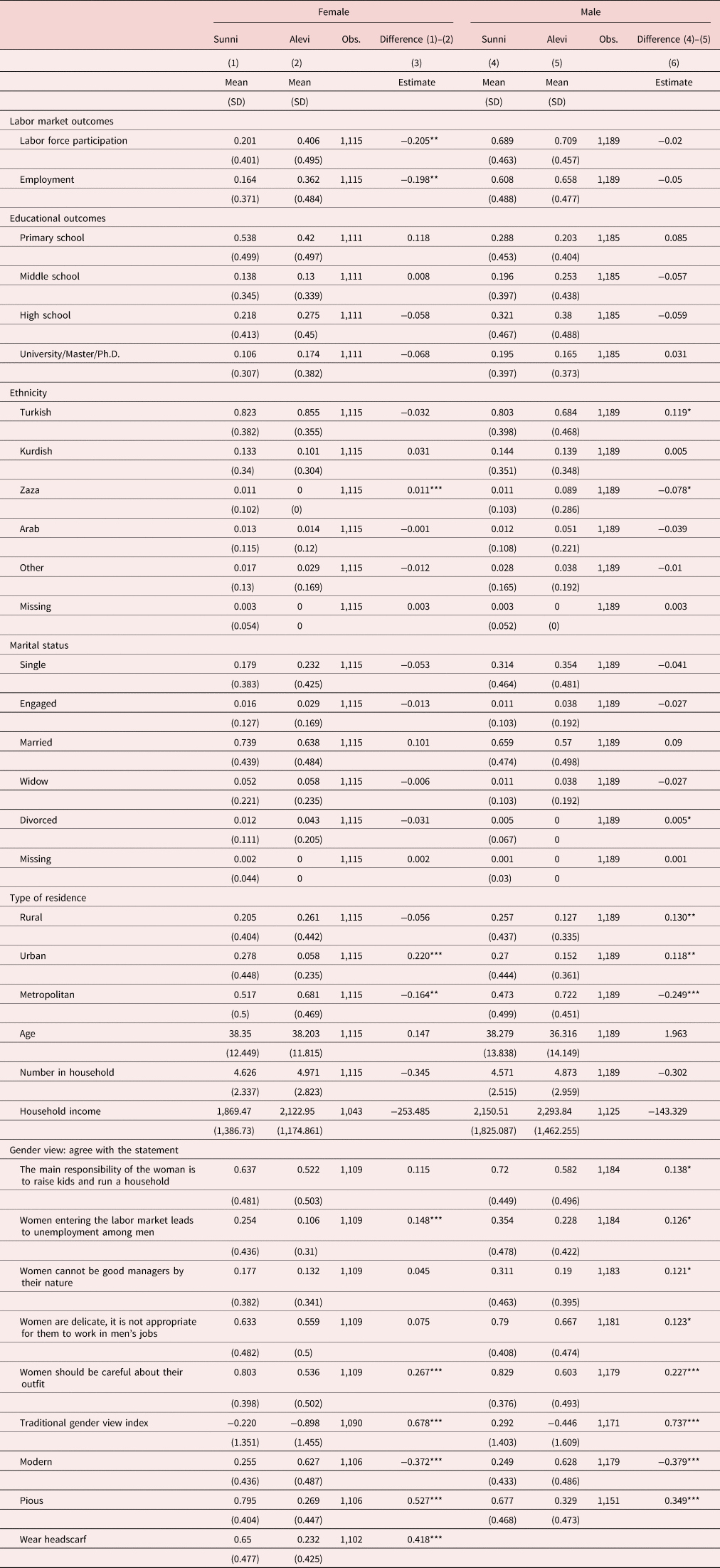
Note: The table presents the means, standard deviations, and number of observations. Data are from 2015 KONDA Barometer collected by KONDA Research and Consultancy. *p < 0.1, **p < 0.05, ***p < 0.01. Variables related to gender view are defined as a dummy variable equal to 1 if the respondent somewhat agrees or strongly agrees, 0 if the respondent strongly disagrees or does not agree. The lower value of the variables represents a more equal gender view.
Interestingly, there does not seem to be important differences in education levels between Alevis and Sunnis. Alevis are marginally less likely to have a primary school degree compared to Sunnis. Also, the average higher education attainment rate seems slightly higher for Alevi women compared to Sunni women; however, the difference is not statistically significant. Hence, given that there are some small differences between the education levels of the two groups, it is important to control for education in our estimations. We will also divide our sample into two groups: primary/middle school graduates and high school/university graduates and estimate equation (1) for these two groups separately and also examine the differences in education outcomes between the two groups in regression analysis.
When we consider variables on gender views, we observe that both Alevi women and men are more likely to hold more gender-equal views than their Sunni counterparts. For instance, while 80.3 of Sunni women agree with the statement that women should be careful about their outfit, only 53.6 of Alevi women agree with this statement. While 72% of Sunni men agree with the statement that the main responsibility of a woman is to raise children and run a household, only 53.2% of Alevi men agree with this statement. The statistics on the traditional gender view index also show that Alevis (both men and women) are significantly less likely to have traditional gender views.
There are also significant differences between the two denominations in terms of modernity and piousness. While 62.7% of Alevi women describe themselves as modern, only 25.5% of Sunni women do so. Similarly, Alevi women are less likely to describe themselves as pious and less likely to wear headscarf compared to Sunni women. While 79.5% of Sunni women consider themselves as pious, only 26.9% of Alevi women consider themselves as pious. Significant differences in modernity and piousness also exist between Alevi and Sunni men, such that Alevi men are more likely to describe themselves as modern and less likely to describe themselves as pious.
6.2 Main results: labor market outcomes
In Table 2, we present the estimation results of equation (1) where the dependent variable is equal to one if the individual is in labor force and zero otherwise. In columns 1 through 5, we present results for females and in columns 6 through 10 we present results for males. Columns 1 and 6 control for age, age squared, ethnicity, and region of birthplace. Hence, we first present results with control variables that are most exogenous to individual's labor market decision. We then start introducing other control variables which are arguably less exogenous. Columns 2 and 7 control for current region fixed effects and urban and metropolitan status (rural is the omitted variable) of the current region in addition to control variables in columns 1 and 6. Columns 3 and 8 include household size in addition to earlier controls. Columns 4 and 9 also include controls for education. Education is controlled by dummy variables. Middle school is equal to 1 if the individual's final diploma is middle school and zero otherwise. High school, and university or above dummy variables are defined similarly. The omitted category is equal to one if the individual's final diploma is primary school. Columns 5 and 10 further include marital status in addition to earlier controls.
Labor force participation regression results
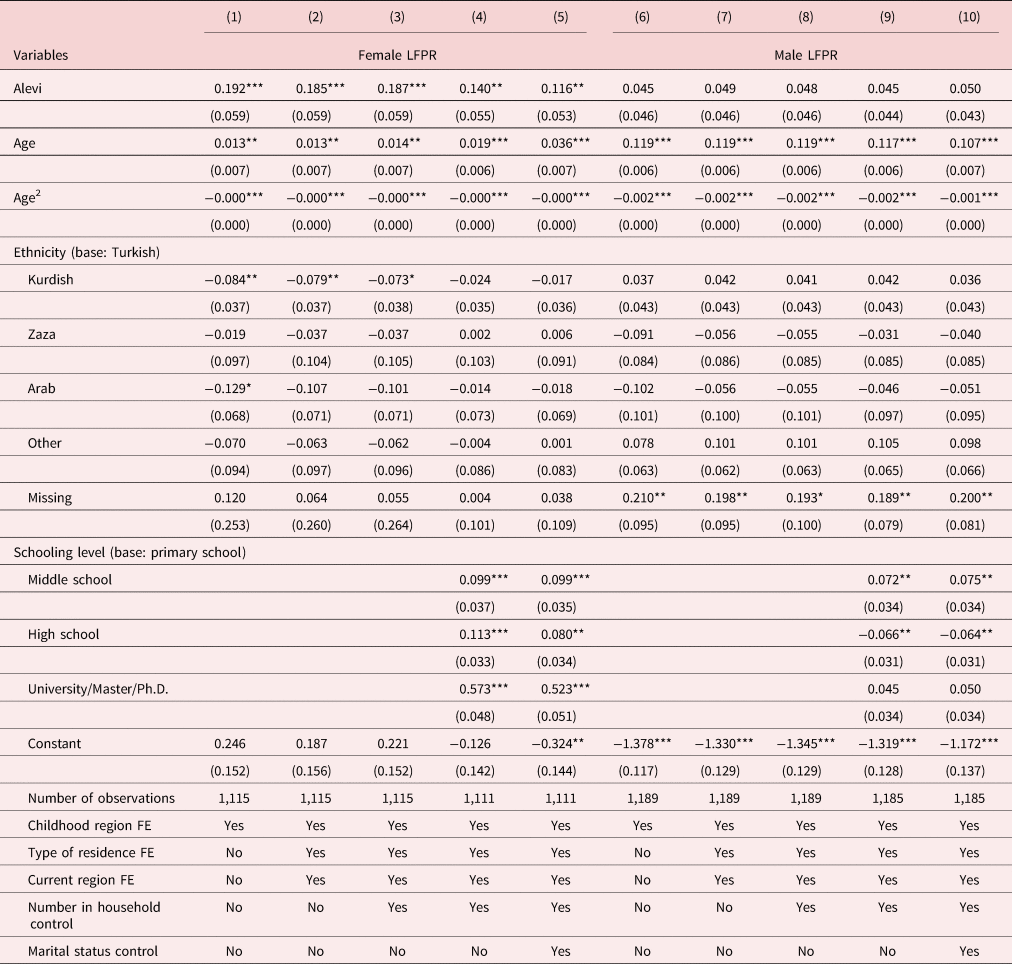
Note: Data are from 2015 KONDA Barometer collected by KONDA Research and Consultancy. *p < 0.1; **p < 0.05; ***p < 0.01. Standard errors are clustered by NUTS2 childhood region-birth cohort level.
In our most Spartan regression presented in column 1, we find the coefficient on Alevi variable is positive and significant and equal to 19.2. This means that being an Alevi woman is associated with a 19.2 ppt increase in labor force participation probability compared to a Sunni woman. When we include additional control variables, the coefficient on the Alevi variable decreases but remains positive and significant. In column 5, we observe that controlling for age, age squared, education, marital status, household size, ethnicity, region controls for birthplace, and residence, an Alevi woman is 11.6 ppt more likely to participate in the labor force than a Sunni woman.
The results in Table 2 show that when we control educational attainment and marital status of women, the coefficient of Alevi indicator decreases by about 7 percentage points, from 18.7 to 11.6. This suggests that there are differences between two denominations in these dimensions. In section 8 and Appendix B, we examine the differences between two groups in more detail. Interestingly, the coefficient on the Alevi variable is not significant in any of the regressions when we use the male sample (columns 6 through 10), and the size of the coefficient does not respond to the inclusion of additional controls. Hence, there is no statistical difference between an Alevi and a Sunni man in terms of their labor force participation.
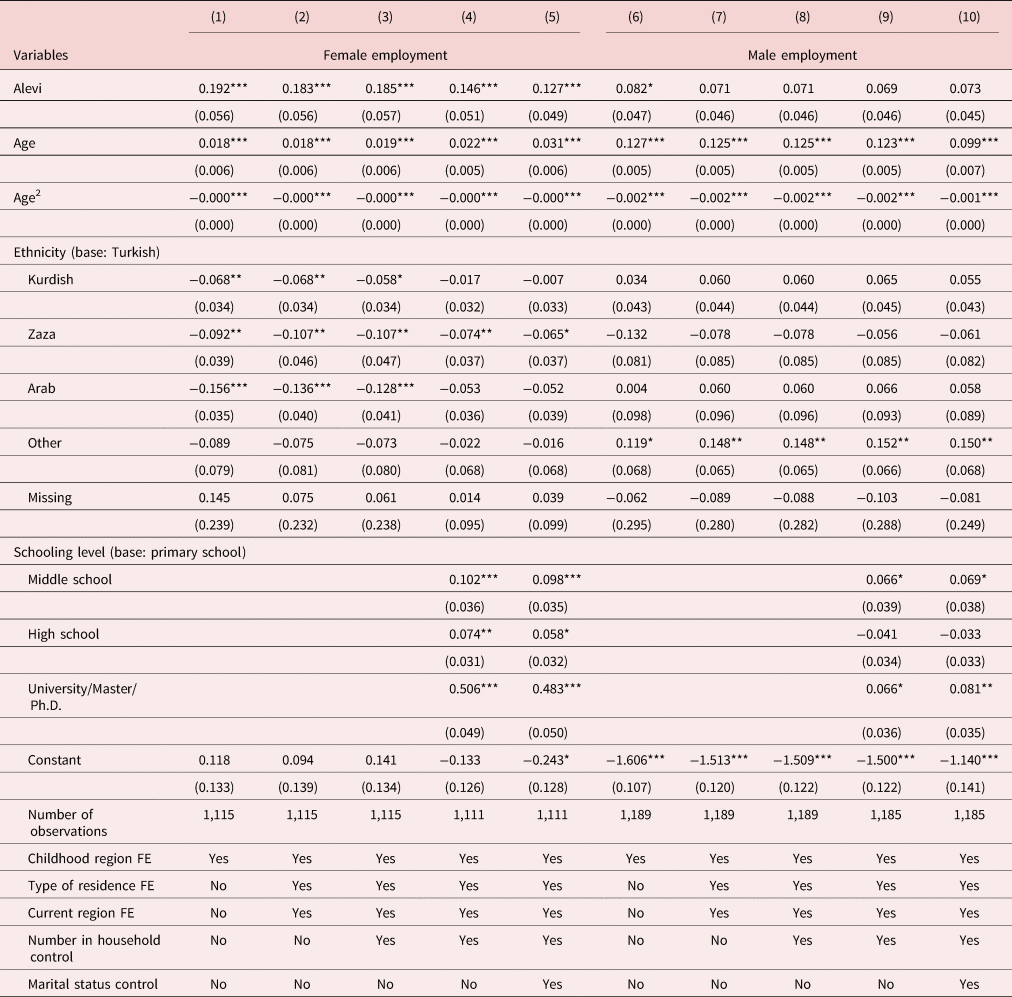
In Table 3, we estimate equation (1) with employment status as the dependent variable. The sample is composed of working-age population in this estimation, the same sample used in labor force participation regressions. Employed is equal to one if the individual is employed and zero otherwise. We gradually introduce our control variables as we did in Table 2. Our results on employment are similar to results on labor force participation. An Alevi woman is 12.7 ppt more likely to be employed than a Sunni woman; however, there are no significant differences between an Alevi and a Sunni man in terms of employment outcomes.
Employment regression results
Since we do not find any significant differences between Alevi men and Sunni men in terms of their labor market outcomes, it is unlikely that differences in preferences for work or labor market opportunities between Alevis and Sunnis can explain the observed differences in the labor market outcomes of Alevi women and Sunni women. However, one can still argue that difficulty or easiness of finding employment can also affect FLFP. Perhaps Alevi women have an easier time finding employment than Sunni women because they have better employment networks, are more productive or face positive discrimination. If that is the case, we expect Alevi women to have lower unemployment rates than Sunni women. To check this possibility, we estimate equation (1) with unemployment as the dependent variable. Unemployment is equal to 1 if the individual is looking for work and 0 otherwise. In this estimation, the sample is composed of individuals who are in the labor force and hence smaller in size than the working-age population sample. Table 4 presents these results. Columns 1–5 present results for women and columns 6–10 present results for men. Although the coefficient on the Alevi variable is negative in both female and male samples, it is not significant in any of these regressions. Hence, we do not find that unemployment rates are lower for Alevi women than Sunni women. Therefore, it is unlikely that differences in productivity or employment networks can completely explain our finding that Alevi women have higher labor force participation and employment rates than Sunni women.
Unemployment regression results

It is also possible that Alevi women face positive discrimination and/or Sunni women face negative discrimination in the labor market. As we discussed in the Conceptual framework Section, if Alevi women are less likely to wear headscarves than Sunni women, they might face positive discrimination in the labor market and we might falsely attribute the effect of not wearing a headscarf on labor market outcome to the Alevi variable. We will investigate this channel in the next section and examine how our results vary according to wearing a headscarf.
We also checked whether there are differences in income opportunities between the two groups and estimated equation (1) with household income as a dependent variable. We do not observe any effect of being an Alevi woman (man) relative to a Sunni woman (man) on household income in these regressions. These results are presented in Appendix Table A.1.
Alevis have a reputation for giving importance to education. We observed that the coefficient on Alevi variable decreased when dummy variables for education levels were included in the regression. A natural concern is that the process of selection into higher education might vary across the two groups. Perhaps we are finding the effect of an elite minority who is very engaged in both higher education and the labor market. In order to test whether our results hold for individuals with lower levels of education, we divide our female and male samples into two groups according to level of education (primary or middle school graduates and high school or university graduates) and estimate equation (1) for each group separately.Footnote 7 Table 5 panels A–C present results where the dependent variable is labor force participation, employment, and unemployment respectively. Columns 1 and 2 present results for the female sample and columns 3 and 4 present results for the male sample. Columns 1 and 3 present results for primary or middle school graduates and columns 2 and 4 present results for high school or university graduates. In panel A, we observe that the coefficient on the Alevi variable is positive and significant for primary and middle school graduate women (column 1) and positive but insignificant for high school or university graduate women (column 2). Specifically, an Alevi woman with less than a high school degree is 16.7 ppt more likely to participate in the labor market than her Sunni counterpart. We know from earlier results in the literature that [Karaoglan and Okten (Reference Karaoglan and Okten2015)] the average gender gap in FLFP decreases with education. Our result contributes to this finding in that the gap in FLFP between religious denominations also decreases with education. We do not find a significant association between being an Alevi and labor force participation probability for males in either education group.
Labor market result by education level

Note: Data are from 2015 KONDA Barometer collected by KONDA Research and Consultancy. *p < 0.1; **p < 0.05; ***p < 0.01. Standard errors are clustered by NUTS2 childhood region-birth cohort level. Regressions include age, age squared, current region and birth region fixed effects, ethnicity control, schooling level controls, marital status, number of people in the household, and the type of residence (rural, urban, or metropolitan).
Panel B presents results for employment outcome. Being an Alevi is positive and significantly associated with employment for females in both education groups (columns 1 and 2) whereas it is not significantly associated with employment for males (columns 3 and 4). It is intriguing to find no significant association of being an Alevi with labor force participation but positive and significant association with employment for highly educated women. This suggests that highly educated Alevi women either have an easier time in finding employment or have lower wage/job quality expectations than their Sunni counterparts. Results on unemployment support these hypotheses (panel C). An Alevi woman with high school or university degree is less likely to be unemployed than her Sunni counterpart, although the coefficient on the Alevi variable is significant only at 15.5% (panel C, column 2). There are no differences between Alevi and Sunni men in terms of unemployment outcomes in either education level (panel C, columns 3 and 4).
In conclusion, we observe a positive and significant association of being an Alevi and labor force participation and employment for females with only primary or middle school degrees as well as for the overall population of females. These results suggest that observed differences between Alevi and Sunni female labor market outcomes are not due to an omitted variable such as elite minority status characterized by higher education levels and higher labor supply responses of their female members.
7. Channels through which Aleviness affect labor market outcomes
We have established that there are important differences in labor force participation and employment outcomes between Alevi and Sunni women whereas there are no observed differences in labor market outcomes of Alevi and Sunni men. Since we only find differences in labor market outcomes of women and not men, it is unlikely that differences in labor/leisure preferences and employment opportunities between the two groups can explain our results. Also, we should emphasize that the effect of Alevi on female labor market outcomes we found go above and beyond the effect of being an Alevi on educational outcomes, marital status, and number of children as we control these variables in our main specification. Therefore, we will not focus on these channels in this section but present related results in Appendix B.
In this section, we explore possible differences in views on gender roles, modernity, and piousness between Alevis and Sunnis as possible transmission channels of the two religious doctrines that induce the observed differences in labor market outcomes between Alevi and Sunni women. We will also explore whether Alevi women face positive discrimination in the labor market as they may be less likely to wear a headscarf.
7.1 Gender views
As we explained in the Background section, differences in gender roles have been offered as an explanation for observed gender differences in labor market outcomes [Bertrand (Reference Bertrand, Ashenfelter and Card2011)]. Scholars of ethnography and sociology that study Alevi and Sunni communities argue that men and women are more equal in Alevi communities than in Sunni communities [Shankland (Reference Shankland2003)]. In this section, we empirically analyze this observation and examine the association of being an Alevi versus being a Sunni and views on gender roles. We estimate equation (1), using gender view variables described in the data section as dependent variables with the full set of controls. A negative and significant coefficient on Alevi variable indicates that an Alevi person is less likely to agree with the associated gender biased statement compared to her Sunni counterpart. Again, we estimate regression equations for men and women samples separately. It is important to consider gender views of men as well as women since labor supply decisions of women might depend on gender views of their father and/or husbands.
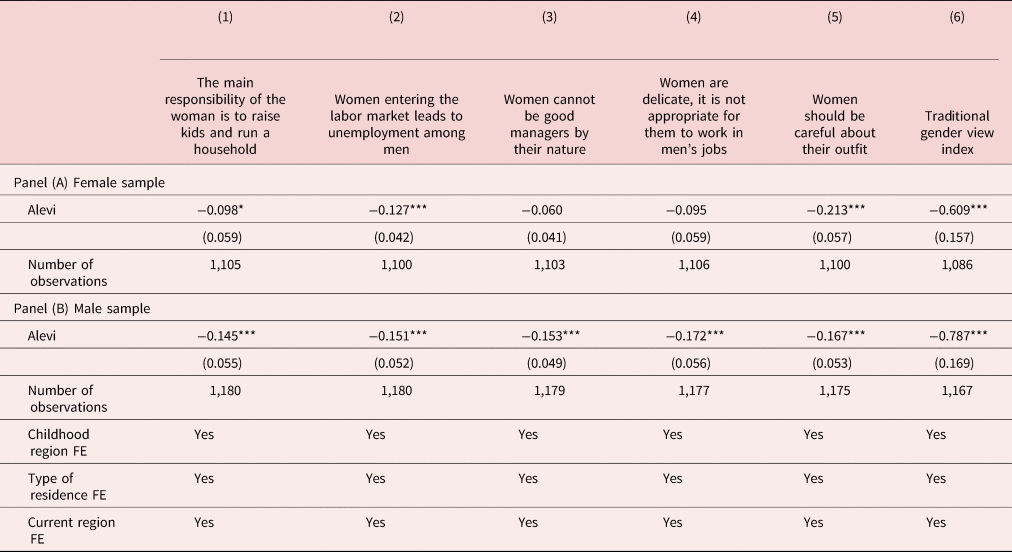
Table 6 panel A presents gender view regression results for the women sample. Our results show that Alevi women have more equal gender views than Sunni women. They are 9.8 ppt less likely to agree with the statement of “The main responsibility of a woman is to raise children and run a household”. They are also 12.7 and 21.3 ppt less likely to agree with the statement of “Women entering the labor market leads to unemployment among men”, and “Women should be careful about their outfit” than their Sunni counterparts. Additionally, the traditional gender index is significantly lower for Alevi women showing they have more equal gender views than Sunni women.
Gender view regression results
Note: Data are from 2015 KONDA Barometer collected by KONDA Research and Consultancy. *p < 0.1; **p < 0.05; ***p < 0.01. Standard errors are clustered by NUTS2 childhood region-birth cohort level. Regressions include age, age squared, current region and childhood region fixed effects, ethnicity control, schooling level controls, marital status, number of people in the household, and the type of residence (rural, urban, or metropolitan).
Our results on the gender views of men are even more striking. We present these results in Table 6 panel B. Alevi men are significantly less likely to agree with all the gender-biased statements than Sunni men. They have a significantly lower traditional gender index. Alevi men are 14.5 ppt less likely to agree with the statement of “The main responsibility of a woman is to raise children and run a household” and they are 17.2 ppt less likely to agree with the statement of “Women are delicate, it is not appropriate for them to work in men's jobs”. Hence differences in views on gender roles can help explain observed differences in female labor market outcomes between Alevi and Sunni women. We will examine how the inclusion of traditional gender view index as additional control may affect our results on labor market outcomes in section 8.
7.2 Modernity and piousness
As we discussed in the background section, Alevis are described as more modern and less pious compared to Sunnis in several qualitative studies [Balkiz (Reference Balkiz1992) and Yetkin (Reference Yetkin1993)]. In this section, we examine whether there are differences in modernity and piousness between Alevis and Sunnis using survey questions on self-identity.
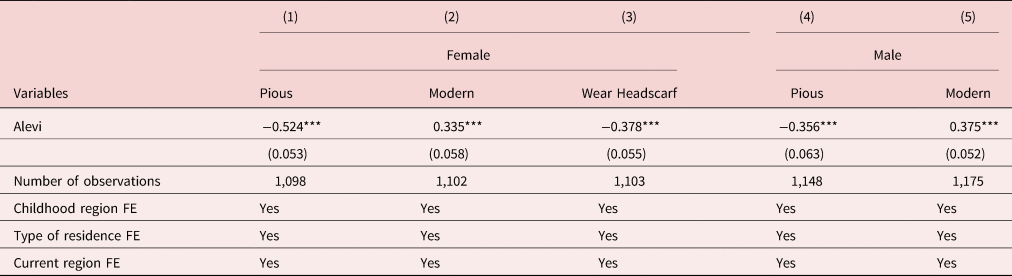
We construct dummy variables for modernity, religiousness, and wearing headscarf using survey questions as described in the data section. In Table 7, columns 1, 2, and 3, we present regression results for the female sample where dependent variables are pious, modern, and headscarf, respectively. Results for the male sample are presented in columns 4 and 5. Our results show that female Alevis are less likely to be pious and more likely to be modern than female Sunnis. They are also less likely to wear a headscarf. The results for the male sample are similar. Male Alevis are less likely to be pious and more likely to be modern than male Sunnis. Hence, we provide the first quantitative evidence supporting qualitative studies in the literature. Alevis are more likely to be modern and less likely to abide by the rules of religion.Footnote 8
Differences in two Muslim denominations in terms of religiosity, modernity, and wearing scarf
Note: Data are from 2015 KONDA Barometer collected by KONDA Research and Consultancy. *p < 0.1; **p < 0.05; ***p < 0.01. Standard errors are clustered by NUTS2 childhood region-birth cohort level. Regressions include age, age squared, current region and birth region fixed effects, ethnicity control, schooling level controls, marital status, number of people in the household, and the type of residence (rural, urban, or metropolitan).
In Table 7, we also show that Alevi women are less likely to wear headscarf which may affect their labor market outcomes positively if women wearing headscarf face discrimination in the labor market. To investigate this channel, we divide our sample into two subsamples: (1) women wearing headscarves; (2) women not wearing headscarves. We conduct our analysis separately for these samples for each labor market outcome variable. The results presented in Table 8 show that the association between Aliveness and labor market outcomes that we found earlier are still present in the sample of women not wearing headscarves. Hence in the sample of women not wearing headscarves, Alevi women are still more likely to be in the labor force and employed compared to Sunni women. This suggests that employer/customer discrimination against covered Sunni women is not the reason why Alevi women are more likely to be in the labor force and employed compared to Sunni women.
Labor market result across women wearing and not wearing headscarf

Note: Data are from 2015 KONDA Barometer collected by KONDA Research and Consultancy. *p < 0.1; **p < 0.05; ***p < 0.01. Standard errors are clustered by NUTS2 childhood region-birth cohort level. Regressions include age, age squared, current region and birth region fixed effects, ethnicity control, schooling level controls, marital status, number of people in the household, and the type of residence (rural, urban, or metropolitan).
A natural question at this point is whether the positive and significant association of being an Alevi with FLFP and employment remains in the presence of controls for gender views, modernity, and religiousness. We will examine this in section 8.
8. Alternative specifications
Our analysis on the channels through which Alevism and Sunnism affect female employment informed us that Alevis have more gender-equal views, less likely to wear headscarf consider themselves more modern and less pious.
In this section, we present alternative specifications to equation (1) where we include controls for gender views, modernity, piousness, and headscarf. Table 9 shows results for labor force participation, employment, and unemployment in panels A, B, and C, respectively. We present results for females and males separately. All regressions include controls for age, age squared, current region and birth region fixed effects, ethnicity control, schooling level controls, marital status, number of people in the household, and the type of residence.
Labor market results with additional controls

Note: Data are from 2015 KONDA Barometer collected by KONDA Research and Consultancy. *p < 0.1; **p < 0.05; ***p < 0.01. Standard errors are clustered by NUTS2 childhood region-birth cohort level. Regressions include age, age squared, current region and birth region fixed effects, ethnicity control, schooling level controls, marital status, number of people in the household, and the type of residence (rural, urban, or metropolitan).
We first discuss our results for the female sample. Column 1 presents our main specification for comparison. Columns 2 through 4 introduce controls for modern, headscarf, and pious respectively and separately. Column 5 controls for the traditional gender view index we created by taking first principal component of five variables regarding gender views. Column 6 controls modern and traditional gender view index simultaneously. By far, the variable that decreases both the magnitude of the coefficient and its significance on Alevi variable is the control for modernity. In column 2, when modern variable is included, Alevi variable is no longer significant at 10% (it is significant at 11.2%) in labor force participation regression (panel A) but remains positive and significant in employment regression although its magnitude decreases from 12.7 to 10.4 ppt (panel B). Modern is associated positively and significantly with both labor force participation and employment. Being modern is associated with a 7.8 and 5.8 ppt increase in FLFP and employment, respectively. Alevi variable remains positive and significant when headscarf variable and pious variables are introduced in both labor force participation and employment regressions though both its magnitude and significance decrease (columns 3 and 4). While pious variable is not significantly associated with labor force participation or employment wearing a headscarf is negatively and significantly associated with employment. Furthermore, in the unemployment regression, we find that wearing a headscarf is positively and significantly associated with unemployment. These results provide support for our concern that women with headscarves might face discrimination in the labor market. Hence, it is important that we have shown in Table 8 that our results on the positive association of Alevi variable with female labor supply are robust to restricting the sample of women to those that do not wear headscarves.
When we introduce traditional gender view index, Alevi variable remains positive and significant in both labor force participation and employment regressions with a slight decrease in magnitude and significance. Traditional gender view index is significantly and negatively associated with both labor force participation and employment. It is not surprising that females who have more traditional gender views are less likely to be in the labor force and less likely to be employed. Finally, in column 6, we control for modern and traditional gender view index simultaneously to see the change in Alevi effect when these mechanisms are controlled for. The results show that the coefficient of Alevi variable becomes insignificant in the labor force participation regression; however, it stays significant in the employment regression though both its magnitude and significance decrease.Footnote 9 The fact that the Alevi variable is no longer significant in FLFP decision when modernity and traditional gender view index are both controlled for provides further evidence that differences in gender views and modernity are the primary mechanisms through which Aleviness affects female labor supply.
In section 7.1, we found that differences in gender views between Alevi and Sunni men were even higher and more significant than differences in gender views between Alevi and Sunni women. Unfortunately, we do not observe the gender views of husbands of married women. This variable is likely to be important in determining the labor force participation of married women.Footnote 10
We next discuss our results for the male sample. Alevi variable remains insignificant in the labor force participation regressions when additional controls are introduced (columns 7 through 11, panel A) and furthermore additional controls are not significant in these regressions except for traditional gender view index. Men who have a more traditional gender view are more likely to be in the labor force. When we consider employment regressions for the male sample (panel B), Alevi variable becomes positive and significant at 10% when modern variable is introduced (column 8) and when traditional gender view index is introduced (column 10). Additional controls are not significant with the exception of pious. Men who are pious are more likely to be employed. The results on male employment suggest that there might be a penalty for being modern and not pious for men in the labor market.
It is intriguing that Alevi variable is no longer statistically significant (its significance drops to 16%) in FLFP regression but remains significant at 5% in female employment regression when both modern and traditional gender view index variables are included as an additional control. It might be the case that an Alevi and Sunni woman with similar gender views and with the same modernity levels may have equal likelihood of being in the labor force but an Alevi woman may be more likely to be employed either to her lower reservation wage and job quality expectations or better employment networks than her Sunni counterpart. Hence, in panel C, we examine the association of being an Alevi with being unemployed with additional controls. Our sample is restricted to those in labor force and therefore smaller in these regressions. The coefficient on the Alevi variable remains negative and insignificant when controls for modern and traditional gender view index are introduced as additional controls in both female and male samples. Insignificance may be due to small sample size in these regressions. Hence, the possible explanations for higher employment/lower unemployment of Alevi women such as their lower reservation wage or job quality requirements or better employment networks may warrant further examination in future work.
9. Conclusion
Social norms play an important role in female labor supply [Antecol (Reference Antecol2000), Vendrik (Reference Vendrik2003), Fernández et al. (Reference Fernández, Fogli and Olivetti2004); Guiso et al. (Reference Guiso, Sapienza and Zingales2006), Burda et al. (Reference Burda, Hamermesh and Weil2013), Bursztyn et al. (Reference Bursztyn, González and Yanagizawa-Drott2018), Scoppa and Stranges (Reference Scoppa and Stranges2019)]. We investigate the effect of religion on female labor market outcomes using new nationally representative data collected by Konda, Research and Consulting company, which includes information on the religious affiliations of the individuals in Turkey. There are mainly two distinct Muslim denominations in Turkey: Sunni and Alevi Muslims. We show that, although they are exposed to the same labor market institutions, education system, and economic conditions, Alevi Muslim women have better labor market outcomes compared to their Sunni counterparts. Specifically, Alevi women are more likely to be in labor force and employment, whereas we do not find any difference in the labor market outcomes of Alevi and Sunni men.
We also investigate the channels through which religion can affect labor market outcomes of women. We do not find any evidence for the hypotheses that Alevis as a group have a lower reservation wage or job quality expectations or better employment opportunities as there are no differences between Alevi and Sunni men in their labor market outcomes.
We investigate the association of being an Alevi on modernity, piousness, and views on gender roles. Our findings show that both Alevi men and women describe themselves as more modern and have more equal views regarding the role of women in the labor market than their Sunni counterparts. While members of both denominations describe themselves as believers in religion (Islam), Alevis are less likely to abide by the rules of religion (Islam).
Overall, our results imply that religious identity is the basis of the social norm, and the social norm is the mechanism through which the religious beliefs manifest themselves in economic behavior. Given our results, perhaps it is not surprising that FLFP rate in Turkey, at 30%, is still the lowest among OECD countries and has been relatively stagnant over time despite public policies that provided tax incentives to employers for hiring female workers in 2008. Policymakers that aim to increase female labor supply need to consider how proposed policies will interact with existing social norms. Exiting literature finds that the average gender gap in FLFP decreases with education. We contribute to this literature as we find that the gap in FLFP between religious denominations also decreases with education. More research is needed on interventions that can mitigate the adverse effects of social norms on female labor supply.
Supplementary material
The supplementary material for this article can be found at https://doi.org/10.1017/dem.2022.3.


 Open access

