





Impact statement
This review paper discusses recent advancements in the field of photocatalytic CO2 conversion. It covers the fundamentals and key materials used in photocatalysis, various conversion pathways for producing both commodity and value-added chemicals, and potential process configurations based on the current understanding of existing technologies. Key points for enhancing economic and environmental performance are also provided. This paper will be beneficial for readers who are new to this field and are interested in transitioning from experimental work to process development.
Introduction
Photocatalytic reaction technologies have emerged as a significant area of research in CO2 utilization. It harnesses solar energy to drive the transformation of carbon dioxide into value-added fuels and chemicals under mild conditions. Traditionally, CO2 conversion has been carried out using thermal catalytic methods. This conversion can be classified as either non-reductive or reductive, depending on whether the oxidation state of the carbon atom changes during the reaction. Reductive conversion primarily refers to the hydrogenation of CO2 to form hydrocarbons, alcohols, and others. In contrast, non-reductive pathways convert CO2 directly into various classes of chemicals, including alkyl carbonates (which react with alcohols), aliphatic polycarbonates (which react with diols), ureas (which react with amines), and carbamates (which react with both alcohols and amines) (Tomishige et al., Reference Tomishige, Tamura and Nakagawa2019; Tomishige et al., Reference Tomishige, Gu, Nakagawa and Tamura2020). Table 1 summarizes some pathways that have been widely reported in the literature. However, thermal catalytic conversion of CO2 has several drawbacks, including the requirement for elevated temperatures and pressures and challenges related to CO2 activation. In contrast, photocatalytic CO2 conversion, driven by solar energy and operating under milder conditions, inherently offers greater sustainability compared to thermal catalytic systems.
Possible reaction pathways for CO2 conversion

Overall, photocatalytic reactions utilize photon energy to generate charge carriers that directly drive CO2 reduction under relatively mild conditions (Guo et al., Reference Guo, Tang, Yang, Zhao, Liu, Zhao and Wang2023). Conventional photocatalytic reactions rely on the electron–hole pairs upon light irradiation (typically UV or visible lights), which enables redox reactions involving CO2 and co-reactants. Materials with appropriate bandgaps (e.g., the semiconductor type) have been extensively investigated as the catalysts. Existing examples include converting CO2 to CO (Chu et al., Reference Chu, Li, Cui, Jian, Lu, Gao and Wu2022; Liao et al., Reference Liao, Wang, Li, Fan, Wang, Shi and Lin2024), methane (Lee et al., Reference Lee, Kim, Moru, Kim, Jo and Tonda2021; Zhao et al., Reference Zhao, Xuan, Sun, Zhang, Zhu and Liu2024), methanol (Xi et al., Reference Xi, Xu, Zou, Ji, Cai, Wan and Dong2022; Huang et al., Reference Huang, Shi, Xu, Luo, Zhang, Lu and Zhang2024), and C2+ hydrocarbons (Song et al., Reference Song, Wang, Liu, Chong, Zhang, Wang, Zhang, Li, Tian, Zhang, Wang, Yao, Wang, Xiao, Yao, Mao, He, Lin, Zou and Liu2024; Zhang et al., Reference Zhang, Yang, Hu, Xiong, Wang, Li and Shen2024). However, such processes are currently limited by low conversion and selectivity due to inefficient CO2 adsorption and activation, rapid recombination of charge carriers, limited visible-light absorption, and insufficient catalyst stability. More recently, photothermal CO₂ conversion has emerged as a novel technology (Gao et al., Reference Gao, Liang, Wang, Jiang, Zhang, Zheng, Xie, Toe, Zhu, Wang, Huang, Gao, Wang, Jo, Wang, Wang, Liu, Louis, Scott, Roger, Amal, Heh and Park2020). It integrates light-induced excitation with thermal activation to enhance catalytic performance (Gao et al., Reference Gao, Liang, Wang, Jiang, Zhang, Zheng, Xie, Toe, Zhu, Wang, Huang, Gao, Wang, Jo, Wang, Wang, Liu, Louis, Scott, Roger, Amal, Heh and Park2020). Under solar or near-infrared irradiation, localized heating and energetic carriers promote charge separation, accelerate diffusion, and expand the usable solar spectrum (Cai et al., Reference Cai, Wu, Li, Wang, Sun, Tountas, Li, Wang, Feng, Xu, Tang, Tavasoli, Peng, Liu, Helmy, He, Ozin and Zhang2021). Materials exhibiting plasmonic properties or broad-spectrum absorption have been reported as effective catalysts for photothermal conversion. In addition to producing chemicals similar to those from conventional photocatalytic systems (Cai et al., Reference Cai, Wu, Li, Wang, Sun, Tountas, Li, Wang, Feng, Xu, Tang, Tavasoli, Peng, Liu, Helmy, He, Ozin and Zhang2021; Wu et al., Reference Wu, Li, Li, Feng, Cai, Zhang, Wang, Chu, Zhang, Shen, Huang, Xiao, Ozin, Zhang and He2021; Li et al., Reference Li, Wang, Li, Xing, Zhang and Liu2022; Deng et al., Reference Deng, Song, Wang, Hong, Song, Zhang, Peng, Zhang, Kako and Ye2023), photothermal systems can also convert CO2 into larger molecules such as dimethyl carbonate (DMC) (Jin et al., Reference Jin, Guan, Zhang, Zhang, Liu, Wang, Wang, Li, Li and Fan2023) or glycerol carbonates (GC) (Li et al., Reference Li, Liu, Ma, Liu and He2024). Although photothermal catalysis demonstrates improved conversion efficiency, it still faces challenges such as the need for elevated temperatures and pressures, and concerns over long-term catalyst stability (Gao et al., Reference Gao, Liang, Wang, Jiang, Zhang, Zheng, Xie, Toe, Zhu, Wang, Huang, Gao, Wang, Jo, Wang, Wang, Liu, Louis, Scott, Roger, Amal, Heh and Park2020).
Recent landmark reviews have advanced the understanding of photocatalytic CO₂ conversion. For instance, Fang et al. provided a comprehensive overview of catalyst synthesis, reactor design, testing protocols, and mechanistic studies (Fang et al., Reference Fang, Rahaman, Bharti, Reisner, Robert, Ozin and Hu2023). Sadanandan et al. highlighted efficiency limitations due to charge-carrier recombination and narrow visible-light absorption, and proposed strategies to address them (Sadanandan et al., Reference Sadanandan, Yang, Devtade, Singh, Dharmarajan, Fawaz, Leec, Tavakkoli, Jeon, Kumar and Vinu2024). Kumar et al. investigate multifunctional carbon-nitride nano-architectures, demonstrating how bandgap tuning and surface-site control enable both hydrogen evolution and CO₂ reduction (Kumar et al., Reference Kumar, Singh, Guan, Lee, Bahadur, Ramadass, Kumar, Kibria, Vidyasagar, Yi and Vinu2023). Gao et al. compared photocatalytic and photothermal CO₂ conversion as promising routes for CO2 utilization, detailing their principles, catalyst options, and performance metrics (Gao et al., Reference Gao, Liang, Wang, Jiang, Zhang, Zheng, Xie, Toe, Zhu, Wang, Huang, Gao, Wang, Jo, Wang, Wang, Liu, Louis, Scott, Roger, Amal, Heh and Park2020). Overall, this field remains emerging, with many aspects yet to be explored.
Extensive research has advanced both theoretical and experimental aspects of photocatalytic CO₂ conversion, yet gaps remain between lab-scale studies and process development. The absence of integrated frameworks for process studies limits discussion of economic, environmental, and safety considerations. Currently, the low product yields and selectivity of photocatalytic CO2 conversion hinders its practical deployment, highlighting the importance downstream separation strategies. To address this gap, this review aims to provide insights for advancing from experimentation to process development. It begins by summarizing advances in photocatalyst design, particularly focusing on the incorporation of heterojunction architectures, surface defect engineering, active site optimization, and enhanced reaction capacities to enable the efficient conversion of CO2 into valuable hydrocarbon fuels. Subsequently, essential perspectives for further advancing photocatalytic CO2 conversion processes are presented. Overall, this review offers readers a comprehensive framework that connects material fundamentals to plant-wide process implementation.
State-of-the-art progress in photocatalytic conversion of CO2
This section reviews recent advancements in the field. Section “Introduction of photocatalytic conversion” introduces potential photocatalysts for CO2 conversion. Sections “Photocatalytic reduction systems” and “Photothermal catalytic reaction systems” summarize recent experimental results on photocatalytic reduction and photothermal catalytic systems, respectively. Section “Standard procedure of photocatalytic CO2 conversion” covers standardized procedures for experimentation and process development, while Section “Modeling” highlights recent progress in modeling photocatalytic reaction systems.
Introduction of photocatalytic conversion
Fundamentals of photocatalytic conversion
Photocatalysis involves three key stages: light absorption, charge carrier generation and separation, and surface redox reactions (Du et al., Reference Du, Wang, Chen, Feng, Wen and Wu2020). Upon photon excitation, electrons (e−) are promoted from the valence band (VB) to the conduction band (CB), resulting in the formation of holes (h+) that drive reduction and oxidation reactions, including CO2 conversion and pollutant degradation under ambient conditions. Accordingly, the overall efficiency (ηₑ) of a photocatalytic system can be represented by Equation (1) (Li et al., Reference Li, Yu, Low, Fang, Xiao and Chen2015):
 $$ {\unicode{x03B7}}_{\mathrm{e}}={\unicode{x03B7}}_{\mathrm{a}}\mathrm{x}\;{\unicode{x03B7}}_{\mathrm{ce}}\mathrm{x}\;{\unicode{x03B7}}_{\mathrm{cs}}\mathrm{x}\;{\unicode{x03B7}}_{\mathrm{cu}} $$
Where ηₐ denotes the photon absorption efficiency, ηce represents the charge excitation efficiency, ηcs refers to the efficiency of charge separation and transport, and ηcu indicates the efficiency of charge carrier utilization in surface reactions (Zhang et al., Reference Zhang, Liu, Jia, Feng, Fu, Yang, Xiong, Su, Wu and Huang2021). Optimizing light harvesting (ηₐ) is critical, as it directly influences both ηce and ηcs. Strategies to enhance photocatalytic efficiency include tuning the bandgap, crystal structure, and surface area. The development of composite materials with extended spectral absorption ranges (UV–VIS–NIR), engineered heterojunctions, defect-engineered nanostructures, and integration of co-catalysts has been shown to improve charge separation and increase the density of active sites (Li et al., Reference Li, Song, Zhang, Wang and Yang2021; Man et al., Reference Man, Jiang, Guo, Ruzimuradov, Mamatkulov, Low and Xiong2024; Li et al., Reference Li, Yu and Jaroniec2016).
Potential photocatalyst design strategies
Conventional semiconductor metal oxides remain prevalent in photocatalytic applications due to their ability to facilitate UV-driven charge separation between the VB and CB. Nevertheless, their broad band gaps and limited electrical conductivity restrict their effectiveness in solar energy applications, considering that ultraviolet light accounts for merely about 5% of the solar spectrum. To exploit visible and infrared light, whereas the light accounts for approximately 46% and 49%, two-dimensional (2D) materials such as carbon-based substances (e.g., graphene and graphitic carbon nitride, g-C₃N₄), transition metal dichalcogenides (TMDs), and MXenes have emerged as promising alternatives. These materials exhibit tunable band gaps that can be aligned with the conduction and valence bands to match the reduction potential of CO2 and the corresponding oxidation half-reactions. Elemental doping or substitution techniques have been employed to modulate the bandgap and Fermi level, thereby positioning the conduction band minimum (CBM) just above the CO2/CO or CO2/CH4 reduction potentials (Lee et al., Reference Lee, Kim, Moru, Kim, Jo and Tonda2021; Li et al., Reference Li, Wei, Xiong, Tang, Wang, Wang, Zhao and Liu2024; Huang et al., Reference Huang, Sun, Ma, Liu, Zhong, Chen, Gao, Hai and Huang2025).
Furthermore, TMDs and MXenes have attracted considerable interest owing to their abundant surface atoms and compatibility with co-catalysts. Representative TMDs, including MoS2, WS2, ReS2, and NiS2, whereas MXenes are generally described by the formula Mn + 1XnTx, where M denotes transition metals such as Ti, V, or Nb; X represents carbon and/or nitrogen; and T corresponds to surface terminations like -O, -OH, or -F. These materials possess metallic conductivity, high surface reactivity, adaptable electronic structures, and strong interactions with co-catalysts, rendering them suitable for solar-driven CO2 conversion (Kuang et al., Reference Kuang, Low, Cheng, Yu and Fan2020). Heterostructure engineering approaches—including Type-II heterojunctions, Z-scheme architectures, core-shell structures, and 2D/2D or 2D/0D systems—offer ultrathin, layered configurations that minimize charge carrier diffusion distances and suppress electron–hole recombination, thereby enhancing photocatalytic performance (Zeng et al., Reference Zeng, Vahidzadeh, VanEssen, Kar, Kisslinger, Goswami, Zhang, Mahdi, Riddell, Kobryn, Gusarov, Kumar and Shankar2020; Xu et al., Reference Xu, Zhu, Cheng, Yu and Xu2018; Wang et al., Reference Wang, Zhang, Zhang, Luo, Shen, Lin, Long, Wu, Fu, Wang and Li2018; Cai et al., Reference Cai, Qian, Hu, Zheng, Luo and Zhao2024; Wang et al., Reference Wang, Li, Wang, Shen, Liu, Zhou and Li2021). Defect engineering introduces localized electronic states that serve as active sites for CO2 adsorption and activation, while also modulating charge carrier dynamics. The presence of oxygen vacancies, cation vacancies, and other point defects can enhance CO2 adsorption and stabilize reaction intermediates (Vennapoosa et al., Reference Vennapoosa, Tejavath, Prabhu, Tiwari, Abraham, Upadhyayula and Pal2023; Wang et al., Reference Wang, Lu, Lu, Lau, Zheng and Fan2021; Ji et al., Reference Ji, Li, Zhang, Duan, Liu, Wang and Shen2023).
Porous crystalline materials, including metal–organic frameworks (MOFs) and covalent organic frameworks (COFs), also demonstrate potential due to their high surface areas and ordered pore structure that facilitate CO2 capture and activation (Chemical Reviews, Reference Zhou, Long and Yaghi2012). However, their low electrical conductivity and rapid charge recombination limit performance. Recent research has improved these issues by hybridizing them with conductive materials and incorporating co-catalyst systems to enhance charge transport and visible-light responsiveness (Altintas et al., Reference Altintas, Erucar and Keskin2022).
In summary, advanced photocatalysts, ranging from metal oxides and 2D nanostructures to porous frameworks, enable efficient CO2 conversion into value-added products such as methane, methanol, ethylene, and ethanol. Continued innovations in material design, interface engineering, and mechanistic understanding will be essential to fully realize the potential of photocatalytic CO2 reduction.
Photocatalytic reduction systems
Among various pathways, photocatalytic CO2 reduction that produces C1 and C2 chemicals has been the primary focus of this field. Typically, the hydrogen source for these reactions is derived from water splitting, as illustrated in Equation (2).
 $$ {\displaystyle \begin{array}{l}\mathrm{Oxidation}\ \mathrm{reaction}:{H}_2O+2{h}^{+}\mathbf{\to}\frac{1}{2}{O}_2+2{H}^{+},\\ {}{E}_0=0.41\;V\; vs\; NHE\; at\; pH=7\end{array}} $$
This reaction is combined with the multi-electron reduction of CO2 to produce the targeted chemicals. Table 2 provides a comparative overview of representative photocatalytic reduction pathways, highlighting their compositional features, corresponding CO2 reduction products, and associated product selectivity. The following sections will discuss the advancements in producing C1 products (e.g., methanol and methane) and C2 products (e.g., ethane and ethylene) via photocatalytic CO2 reductive pathways.
The comparison of various catalytic systems

Production of methanol
Methanol is a primary focus in the domain of CO2 utilization due to its multifunctional role as an energy storage medium, a sustainable fuel alternative, and a precursor for the synthesis of diverse hydrocarbons. The photocatalytic conversion of CO2 to MeOH entails a six-electron reduction mechanism, as described by the standard reaction depicted in Equation (3):
 $$ {\displaystyle \begin{array}{l}{CO}_2+6{H}^{+}+6{e}^{-}\to {CH}_3 OH+{H}_2O,\\ {}{E}_0=-0.38\;V\; vs\; NHE\; at\; pH=7\end{array}} $$
Notably, the reduction potential of this reaction is slightly more positive than that of proton reduction (−0.41 V vs NHE), making it thermodynamically favorable under photocatalytic conditions. However, achieving efficient methanol production requires prolonged lifetimes of photoinduced charge carriers and effective charge separation. To this end, heterojunction engineering through metal or metal oxide modification of semiconductor photocatalysts has significantly improved charge carrier dynamics. For instance, Zhang et al. reported a vertically oriented Fe single-atom-decorated TiO2/SrTiO3 nanotube heterojunction (Fe-TSr), which enables directional separation and migration of photogenerated carriers. This system achieved a methanol yield of 154.20 μmol·gcat−1·h−1 with 98.90% selectivity in pure water, representing 50- and 3-fold enhancements relative to pristine TiO2 and TSr, respectively (Huang et al., Reference Huang, Shi, Xu, Luo, Zhang, Lu and Zhang2024). Similarly, Ag-doped 2H-MoS2 composites have shown promising performance in CO2 photoreduction. The incorporation of 20 wt% Ag resulted in the highest methanol yield of 365.08 μmol·gcat−1·h−1. This improvement is attributed to the formation of a Schottky barrier at the Ag-MoS2 interface, facilitating efficient electron transfer from the conduction band of MoS2 to Ag nanoparticles, while photogenerated holes participate in the oxidation of C3H8O to C3H6O. Thus, the barrier effectively suppresses charge recombination and prolongs carrier lifetimes (Zheng et al., Reference Zheng, Yin, Jiang, Bai, Tang, Shen and Zhang2019). Furthermore, enhancing CO2 adsorption and activation is vital for improving methanol production rates and selectivity. Li and co-workers developed a ternary heterostructure comprising 2.5% g-C3N4/1% CuO@MIL-125(Ti). In this system, MIL-125(Ti) offers a high surface area and porosity, CuO quantum dots facilitate CO2 capture and activation, and g-C3N4 nanosheets provide efficient charge transport pathways. Mott-Schottky analysis revealed that electrons and holes are spatially separated across the conduction band of CuO and the valence band of g-C3N4, respectively, reducing recombination losses. The composite photocatalyst exhibited high activity, yielding CO (180.1 μmol/g), CH3OH (997.2 μmol/g), CH3CHO (531.5 μmol/g), and CH3CH2OH (1505.7 μmol/g) using water as the electron donor (Li et al., Reference Li, Liu, Zhou, Chen and Liu2020).
Production of methane
Methane (CH4) serves not only as a clean and efficient fuel but also as a valuable intermediate for synthesizing syngas, hydrogen, and methanol through reforming processes. Among various C1 products derived from CO2 reduction, methane formation requires the highest number of electrons (eight) but has the least negative reduction potential. The thermodynamic stability of CO2, characterized by a high C=O bond dissociation energy (~750 kJ/mol), necessitates a high density of electrons and protons to drive its conversion into CH4. This reaction follows an eight-electron reduction pathway, as illustrated in Equation (4) (Yang et al., Reference Yang, Hou, Yang, Zhu, Fu, Zhang, Luo and Yang2023):
 $$ {CO}_2+8{H}^{+}+8{e}^{\hbox{--}}\to {CH}_4+2{H}_2O,{E}_0=-0.24\;V\; vs\; NHE\; at\; pH=7 $$
Among the proposed mechanisms, the carbene pathway is considered more plausible than the formaldehyde pathway. The rate-determining step is the protonation of adsorbed CO (*CO) to form *CHO, followed by further hydrogenation steps to *CHOH, *CH, *CH2, *CH3, and ultimately CH4. To promote this multi-electron transfer process, constructing an electron-rich microenvironment around the catalytic sites is essential. Strategies include incorporating plasmonic noble metal nanoparticles (Yan et al., Reference Yan, Xu, Jin, Xiao, Luo, Duan, Li, Yan, Lin and Yang2024) and π-conjugated systems such as COFs or 2D materials (Wang et al., Reference Wang, Zhang, Zhang, Luo, Shen, Lin, Long, Wu, Fu, Wang and Li2018; Madi & Tahir, Reference Madi and Tahir2024), which enhance charge mobility and surface area. Liu et al. introduced a BiVO4@TiO2 nanograss/needle array (NNAs) S-scheme heterojunction photocatalyst, further modified with 5 wt% of the ionic liquid 1-butyl-3-methylimidazolium tetrafluoroborate (BMIM-BF4) to improve CO2 solubility in aqueous systems. Under Xe lamp irradiation, photo-induced electrons from BiVO4 and holes from TiO2 undergo rapid recombination at the interface, resulting in electron accumulation at the TiO2 tip and hole enrichment in BiVO4. This charge spatial separation significantly enhances the photocatalytic performance, achieving CO, CH4, and H2 evolution rates of 321.5, 132.7, and 75.8 μmol·m−2·h−1, respectively (Zhao et al., Reference Zhao, Xuan, Sun, Zhang, Zhu and Liu2024). Moreover, Shankar et al. demonstrated a plasmonic photonic crystal photocatalyst comprising Au nanoparticle-decorated, periodically modulated TiO2 nanotube arrays (Au-PMTiNTs). The Z-scheme heterojunction, enhanced by hot-electron transfer under AM1.5G simulated sunlight, selectively produced CH4 at 302 μmol·gcat −1·h−1 with 89.3% selectivity (Zeng et al., Reference Zeng, Vahidzadeh, VanEssen, Kar, Kisslinger, Goswami, Zhang, Mahdi, Riddell, Kobryn, Gusarov, Kumar and Shankar2020). COFs have also emerged as promising platforms for CO2 photoreduction due to their tunable molecular structures, adjustable band gaps, and efficient internal charge transport. Maji and co-worker synthesized a triazole-linked COF (TFPB-TRZ) that delivered a remarkable CH4 production rate of 61.62 mmol·gcat−1·h−1 with an overall yield of 493 mmol·g−1 and excellent selectivity (~99%) under visible-light irradiation. In situ diffuse reflectance infrared Fourier transform spectroscopy (DRIFTS) confirmed the formation of key intermediates such as *COOH, *CO, *CH2O, *CH3O, -CH2, and -CH3, substantiating the eight-electron reduction pathway leading to methane formation (Biswas et al., Reference Biswas, Rahimi, Saravanan, Dey, Chauhan, Surendran, Nath and Maji2024).
Production of ethylene
The production of C2+ hydrocarbons, particularly ethylene (C2H4) and acetylene (C2H2), through photocatalytic reduction is of special interest due to their high energy densities and essential roles as industrial feedstocks. However, the conversion is hindered by CO2’s high thermodynamic stability (bond dissociation energy ~750 kJ/mol; ΔG°298K = −394.36 kJ/mol). Efficient C-C bond formation, typically achieved through the dimerization of C1 intermediates (e.g., CH2, CH3, or CHO), is crucial for synthesizing C2 products. These multistep, multi-electron/proton processes require surfaces with high charge carrier and proton densities, as well as strong adsorption of intermediates to avoid premature desorption as C1 products. The representative 12-electron reduction for ethylene is as follows:
 $$ {\displaystyle \begin{array}{l}2{CO}_2+12{H}^{+}+12{e}^{\hbox{--}}\to {C}_2{H}_4+4{H}_2O,\\ {}{E}_0=-0.33\;V\; vs\; NHE\; at\; pH=7\end{array}} $$
To improve C2 product selectivity, strategies such as heterojunction engineering, defect modification, light-harvesting enhancement, and surface activation have been explored. For instance, Xu et al. designed a nitrogen-doped CeO2 photocatalyst featuring surface-frustrated Lewis pairs (FLPs) of Ce3+/Ce-OH, enhancing CO2 activation and C-C coupling. This catalyst produced CO (224.56 μmol·g−1·h−1, 28.1%), C2H4 (33.18 μmol·g−1·h−1, 24.91%), and C2H2 (25.84 μmol·g−1·h−1, 16.16%) (Yan et al., Reference Yan, Gao, Zheng, Cheng, Zhou, Liu, Du, Yuan, Wang, Cui, Zhang, Kong and Xu2024). MOFs also offer promise. A Zr/Cu bimetallic UiO-67 MOF improved electron transfer and C-C coupling efficiency, achieving selective C2H4 production (69.1 μmol·g−1·h−1, 100% selectivity) (Asiri et al., Reference Asiri, Altalbawy, Sead, Makasana, M, Pathak, Juneja, Kumar and Saydaxmetova2025). Moreover, nonstoichiometric WO3-x (particularly WO2.9) exhibits enhanced visible/NIR absorption and reactivity due to oxygen vacancies (Lu et al., Reference Lu, Li, Yan, Li, Huang and Lou2020). Tu et al. synthesized a WO2.9/WTe2 photothermal catalyst that demonstrated a high ethylene production rate of 122.9 μmol·g−1 and a selectivity of 78%. When the reaction temperature was elevated to 240 °C, the ethylene yields significantly increased to 475.3 μmol·g−1. The WO2.9 component plays a key role in bandgap modulation and CO2 adsorption through its abundant oxygen vacancies, while WTe2 effectively stabilizes aldehyde intermediates, enriching the catalyst surface with reactive species and facilitating efficient C-C bond formation (Zhang et al., Reference Zhang, Yang, Hu, Chen, Shen and Tu2024).
Production of ethane
The photocatalytic reduction of CO2 to ethane (C2H6) involves a 14-electron transfer process and the formation of multiple reactive intermediates. The overall reduction reaction is represented as:
 $$ {\displaystyle \begin{array}{l}2{CO}_2+14{H}^{+}+14{e}^{\hbox{--}}\to {C}_2{H}_6+4{H}_2O,\\ {}{E}_0=-0.27\;V\; vs\; NHE\; at\; pH=7\end{array}} $$
Mechanistically, the surface-mediated C-C coupling of methyl (*CH3) radicals, which is necessary for the generation of C2+ hydrocarbons, poses challenges to the progression of the reaction. To overcome these limitations, researchers have fabricated dual-atom catalysts, exemplified by incorporating phosphorus and copper single-atom sites on carbon nitride nanosheets (P/CuSAs@CN). This photocatalyst achieved an ethane production rate of 616.6 μmol·g−1·h−1 with a selectivity of 33%. The Cu and P atoms serve as electron and hole trapping sites within the carbon nitride matrix, facilitating charge separation and accumulation at Cu sites, which is vital for driving multi-electron transfer steps. In situ FTIR spectroscopy identified key intermediates, including *CO and *OCCOH, confirming the involvement of hydrogenation of *OCCO as the rate-determining step in C2H6 formation (Wang et al., Reference Wang, Chen, Wang, Wang and Mao2022). The COFs and MOFs offer strong potential in photocatalysis due to their π-conjugated structures, which support charge transport and light absorption (Saadh et al., Reference Saadh, Mustafa, Altalbawy, Ballal, Prasad, Al-saray, Abbas, Al-Maliky, Mohammed, Alam and Elawady2025). Bai et al. developed a MoS2@COF hybrid by covalently integrating amino-modified MoS2 with an anthraquinone-based COF, achieving an ethane production rate of 56.2 μmol·g−1·h−1 and 83.8% selectivity under visible light, significantly outperforming individual components. In situ DRIFTS and DFT analyses confirmed that the hybrid promotes CO2 adsorption, CO hydrogenation, and C-C coupling, facilitating efficient C2H6 formation (Yang et al., Reference Yang, Lan, Zhang, Li and Bai2023).
Photothermal catalytic reaction systems
Photothermal CO₂ conversion leverages solar or near-infrared irradiation to generate localized heating and, in some cases, hot electrons, thereby enhancing CO2 hydrogenation efficiency (Guo et al., Reference Guo, Tang, Yang, Zhao, Liu, Zhao and Wang2023; Gao et al., Reference Gao, Liang, Wang, Jiang, Zhang, Zheng, Xie, Toe, Zhu, Wang, Huang, Gao, Wang, Jo, Wang, Wang, Liu, Louis, Scott, Roger, Amal, Heh and Park2020; Cai et al., Reference Cai, Wu, Li, Wang, Sun, Tountas, Li, Wang, Feng, Xu, Tang, Tavasoli, Peng, Liu, Helmy, He, Ozin and Zhang2021). Effective photothermal catalysts must exhibit synergistic properties, including strong light absorption and efficient thermal confinement (e.g., incorporation of core-shell structures, plasmonic coupling, or defect engineering) (Cai et al., Reference Cai, Wu, Li, Wang, Sun, Tountas, Li, Wang, Feng, Xu, Tang, Tavasoli, Peng, Liu, Helmy, He, Ozin and Zhang2021; Feng et al., Reference Feng, Wang, Zhang, Wang, Yu, Feng, Li, Zhu, Li, Cai, Wu, Kong, Yan, Zhong, Zhang, Ozin and He2020; Tang et al., Reference Tang, Wang, Guo, Wang, Zhao, Xiao, Liu, Jiang, Zhao, Wen and Wang2025; Li et al., Reference Li, Meng, Wu, Yuan, Wang, Liu, Wang, San, Gu and Meng2024). To date, significant progress has been made in producing light hydrocarbons, particularly methane, through photothermal conversion. Additionally, several studies have explored photothermal catalytic reactions to synthesize carbonates, such as dimethyl carbonate (DMC) and glycerol carbonate (GC), which have been scarcely reported in photocatalytic systems. Relevant findings are summarized in the following sections.
The production of C1 and C2 chemicals
Similar to photocatalytic conversion, the production of C1 and C2 chemicals via photothermal catalytic reduction of CO2, involving the use of gaseous hydrogen (i.e., photothermal hydrogenation) and/or water, has attracted attention. The experimental conditions, as well as the key performance indicators of these systems, are summarized in Table 2 for comparison with those from photocatalytic reduction systems. Among these pathways, the development in photothermal methanation systems has the most progress. Catalyst such as MXene-supported metal (e.g., Ni/Nb₂C [Wu et al., Reference Wu, Li, Li, Feng, Cai, Zhang, Wang, Chu, Zhang, Shen, Huang, Xiao, Ozin, Zhang and He2021]), metal nanoparticles (e.g., plasmonic Co-SiO2 superstructures [Cai et al., Reference Cai, Li, An, Zhong, Zhou, Feng, Wang, Zhang, Xiao, Wu, He, Wu, Shen, Zhu, Feng, Zhong and He2024], Ru/MnCo₂O₄ [Guo et al., Reference Guo, Tang, Yang, Zhao, Liu, Zhao and Wang2023]), single-atom catalysts (e.g., the Ru-F4 configuration [Tang et al., Reference Tang, Wang, Guo, Wang, Zhao, Yang, Xiao, Liu, Jiang, Zhao, Wen and Wang2024]), and core-shell designs (e.g., Ni@p-SiO2 [Cai et al., Reference Cai, Wu, Li, Wang, Sun, Tountas, Li, Wang, Feng, Xu, Tang, Tavasoli, Peng, Liu, Helmy, He, Ozin and Zhang2021]) have been reported successful for photothermal CO2 conversion to light hydrocarbons.
As illustrated in Table 2, photothermal catalytic reduction systems generally achieve higher product yield or selectivity than photocatalytic reduction processes, especially when hydrogen or water is used as co-reactants. For example, photothermal methanation systems exhibit greater reaction efficiency, with product yields reaching mmol·g−1·h−1 (or mol·g−1·h−1) levels (Guo et al., Reference Guo, Tang, Yang, Zhao, Liu, Zhao and Wang2023; Guo et al., Reference Guo, Wang, Tang, Yang, Zhao, Jiang, Wen and Wang2025), compared to photocatalytic reactions that typically yield μmol·g−1·h−1. Several studies also demonstrate successful photothermal methanation in flow systems (Guo et al., Reference Guo, Tang, Yang, Zhao, Liu, Zhao and Wang2023; Wu et al., Reference Wu, Li, Li, Feng, Cai, Zhang, Wang, Chu, Zhang, Shen, Huang, Xiao, Ozin, Zhang and He2021; Tang et al., Reference Tang, Wang, Guo, Yang, Zhao, Liu, Jiang, Wang, Zhang, Wu, Zhao, Wen and Wang2024), indicating potential for scale-up. Moreover, unlike most photocatalytic systems driven by lamp irradiation, successful photothermal systems for CO2-based light olefin (Ning et al., Reference Ning, Wang, Wu, Li, Zhang, Chen, Ren, Gao, Hao, Lv, Li and Ye2024) and syngas (Wu et al., Reference Wu, Wang, Yuan, Wang, Li, Guo, Zhang, San, Zhang and Ye2025) have been demonstrated using full sunlight, underscoring their potential.
Nonetheless, these systems often require higher temperatures and pressures, reducing the inherent benefits of photocatalytic methods. Moreover, the dependence on hydrogen poses a major challenge, particularly in areas without access to green hydrogen or the infrastructure for sustainable hydrogen production. Therefore, it is crucial to evaluate whether these improvements justify practical implementation.
Production of dimethyl carbonate (DMC)
The formation of DMC requires the reaction of CO2 with methanol. Prior research has reported the successful use of CeO2-based catalysts enriched with oxygen vacancies, which have proven to be efficient for this purpose.
Within the limited volume of previous studies, Guan et al. synthesized Bi3+-doped CexBi1 − xO2 − δ nanorods (Guan et al., Reference Guan, Jin, Liu, Zhao, Zhang, Zhang, Li and Fan2024), achieving a DMC yield of 3.13 mmol·g−1 at 140 °C and 1.6 MPa under photo-irradiation, attributing performance gains to asymmetric Bi-O-Ce oxygen vacancies that improve CO2 activation and light absorption efficiency. Bai et al. employed a low-temperature plasma-driven technique to introduce corner defects into quadrangular pyramid-octahedral CeO2 (Bai et al., Reference Bai, Lv, Liu, Wang, Cheng, Cai and Sun2023). This approach achieved a DMC yield of 1.58%, corresponding to an eightfold increase relative to conventional thermal catalysis performed at 140 °C and 7.5 MPa. Jin et al. prepared CeO2 nanorods with bifunctional oxygen vacancies via a template-free hydrothermal method (Jin et al., Reference Jin, Guan, Zhang, Zhang, Liu, Wang, Wang, Li, Li and Fan2023). This method resulted in improved photothermal catalytic activity, evidenced by a DMC yield of 17.7 mmol·g−1·h−1 under relatively mild reaction conditions (140 °C, 1.6 MPa). The enhanced performance was attributed to increased CO2 adsorption capacity and the inhibition of recombination of photo-induced electron–hole pairs.
Production of glycerol carbonate (GC)
The direct conversion of CO2 and glycerol to glycerol carbonate (GC) offers a promising solution to two environmental wastes. Within the currently limited findings, Liu et al. developed Au/ZnWO4-ZnO catalysts for photothermal conversion of glycerol and CO2 into GC, where Au nanoparticles enhanced performance via localized surface plasmon resonance (LSPR) under visible light and heat, significantly boosting GC yield compared to thermal catalysis (Liu et al., Reference Liu, Li, Liu and He2019). Liu et al. also reported a Co3O4-ZnO p-n heterojunction catalyst, achieving a GC yield of 5.3% at 150 °C and 5 MPa CO2 under visible light (Liu et al., Reference Liu, Li, Ma, Liu and He2022). The p-n heterojunction effectively increased visible light absorption and electron–hole separation, breaking the thermodynamic limitations of conventional thermal catalysis. Li et al. further improved the Co3O4-ZnO system by decorating it with Au nanoparticles to create Au/Co3O4-ZnO catalysts (Li et al., Reference Li, Liu, Ma, Liu and He2024). This strategy generated surface oxygen vacancies, enhanced visible-light absorption, and increased GC yield to 6.5% under the same photothermal conditions (150 °C, 5 MPa CO2) due to improved electron–hole separation. Additionally, Li et al. explored La2O2CO3-ZnO catalysts (Li et al., Reference Li, Liu, Ma, Liu and He2021), demonstrating strong photothermal synergy in glycerol carbonylation, achieving a 6.9% glycerol conversion under irradiation at 150 °C and 5.5 MPa CO2. The synergistic interaction between La2O2CO3 and ZnO played a crucial role in this enhanced catalytic performance.
Standard procedure of photocatalytic CO2 conversion
The standard method for photocatalytic CO2 conversion involves light sources (e.g., calibrated lamps or solar simulators), photoreactors, gas delivery systems, photocatalysts, and analytical tools for product analysis. Photoreactors are typically configured as suspended systems, where the catalyst is dispersed in a liquid (slurry reactors), or as heterogeneous systems, such as fixed-bed or monolithic reactors. Quartz or other optical-grade windows are essential for optimal light transmission. Selecting functionalized photocatalysts (detailed in Section “Fundamentals of photocatalytic conversion”) enhances charge separation and light absorption during CO2 conversion (Kou et al., Reference Kou, Lu, Wang, Chen, Xu and Varma2017). Before starting the reaction, the reactor is leak-tested, purged with high-purity CO2 or inert gas, and equilibrated to the desired temperature and pressure.
In suspended catalytic systems, reactions mainly occur in the liquid phase, where CO2 dissolves in an alkaline solution to promote the reaction. This process produces both gaseous products (e.g., methane, carbon monoxide) and liquid products (e.g., methanol), with liquid products often dominating due to fewer electron transfers. Conversely, heterogeneous systems enable gas-phase reactions that primarily yield methane. Gaseous hydrogen is continuously fed into the reactor to react with CO2, resembling conventional hydrogenation reactors. These features can be combined to create biphasic photocatalytic conversion systems (Bonchio et al., Reference Bonchio, Bonin, Ishitani, Lu, Morikawa, Morris, Reisner, Sarkar, Toma and Robert2023; Variar et al., Reference Variar, Ramyashree, Ail, Priya, Sudhakar and Tahir2021).
Controlled irradiation is applied using a calibrated AM 1.5G solar simulator or equivalent light source, with precise regulation of temperature and CO2 pressure to influence product selectivity. For example, lower temperatures (~70 °C) favor CO formation, whereas higher temperatures (100–120 °C) promote methane production. Regarding pressure effects, Moderate CO2 pressures (~110 kPa) optimize methanol synthesis, whereas higher pressures (>130 kPa) enhance methane generation (Meesattham & Kim-Lohsoontorn, Reference Meesattham and Kim-Lohsoontorn2022; Yang et al., Reference Yang, Huang, Nguyen and Wu2022). Throughout the reaction, gaseous and liquid products are periodically sampled and quantified using gas chromatography, liquid chromatography, or nuclear magnetic resonance spectroscopy, employing appropriate calibration standards. Overall, thorough documentation of catalyst properties, reactor setup, operational parameters, and error analysis is essential for scientific rigor and study comparability.
Modeling
Currently, advancements in the modeling of photocatalytic and photothermal catalytic processes remain constrained (Jesic et al., Reference Jesic, Jurkovic, Pohar, Suhadolnik and Likozar2021; Kovacic et al., Reference Kovacic, Likozar and Hus2020). Existing studies have primarily focused on the macroscopic description of photoreactors, including slurry reactors (Asadi et al., Reference Asadi, Larimi, Jiang and Naderifar2022), fixed-bed reactors (Rastgaran et al., Reference Rastgaran, Fatoorehchi, Khallaghi, Larimi and Borhani2023), twin reactors (Lu et al., Reference Lu, Luo, Tan and Maroto-Valer2021), and others (Ramyashree et al., Reference Ramyashree, Nandy, Bohari, Pramodh, Kumar, Priya and Sudhakar2024). The most comprehensive studies employed mathematical modeling (Ray, Reference Ray1999) or even computational fluid dynamics (CFD) (Lu et al., Reference Lu, Luo, Tan and Maroto-Valer2021) to conduct multiphysics simulations, attempting to characterize the flow field, velocity distribution, reactor geometry, and mass transfer within the reactor.
To our knowledge, there is a notable lack of process concepts for photocatalytic CO2 conversion in the literature, primarily due to several challenges. First, kinetic modeling is particularly difficult because it requires understanding interfacial behavior, various interactions (e.g., adsorption, desorption), site balance, and the effects of irradiation. Quantum approaches may help clarify these factors (Jesic et al., Reference Jesic, Jurkovic, Pohar, Suhadolnik and Likozar2021; Kovacic et al., Reference Kovacic, Likozar and Hus2020). Secondly, most experiments use diluted reaction media, resulting in low product yield and selectivity, complicating separation processes. Furthermore, reactor performance depends on its dimensions and irradiation conditions. Consequently, most models have focused on specific experimental setups, limiting the predictive capability.
From experimentation to processes
Despite extensive experimental research, photocatalytic CO2 conversion technologies have not yet reached their full potential. Key challenges include low yield, limited selectivity, and inefficient light utilization. This section proposes process configurations tailored to various photocatalytic conversion types, combining current experimental results with practical process insights.
Process consideration of the photocatalytic reduction of CO 2
From a macroscopic perspective, several experimental challenges must be addressed before scaling up photocatalytic CO2 reduction. First, most photocatalytic CO2 reduction reactions occur in the liquid phase within suspended catalytic systems, producing hydrocarbons and methanol as the main products, with water as the hydrogen source. Due to the low solubility of CO2 in the aqueous phase (approximately 0.033 mol per liter at 25 °C and 1 atm), reactions are typically conducted in alkaline solutions. This complicates downstream separation and recovery of photocatalysts and alkaline agents.
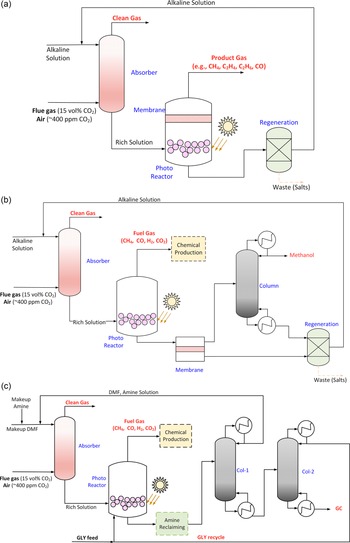
Figure 1a depicts a process configuration for hydrocarbon synthesis via photoreduction, which is proposed based on current knowledge. The process begins with capturing CO2 from point emission sources (e.g., flue gas) through chemical absorption, using the alkaline solvent. After absorption, the rich solvent undergoes photocatalytic reduction in a photoreactor. Note that this rich solvent has a composition similar to that in typical photocatalytic conditions. Hydrocarbon products, being only slightly soluble, can be separated easily by vapor–liquid separation. The next step should isolate hydrocarbons from CO2 using physical methods, such as adsorption and membrane techniques. If hydrocarbon concentration is low, it is more practical to use the effluent as gas fuel rather than purifying it for marketable products. Downstream of the photoreactor, alkaline solution recovery can be achieved through regeneration methods such as causticization (with CO2 stripping) and electrodialysis (Mahmoudkhani & Keith, Reference Mahmoudkhani and Keith2009; Sabatino et al., Reference Sabatino, Gazzani, Gallucci and van Sint Annaland2022).
Proposed conceptual configuration of the photocatalytic conversion processes. (a) Production of hydrocarbons; (b) Production of methanol (or oxygenates); (c) Production of GC.

In addition, photocatalytic reaction can also be integrated with the direct air capture (DAC) process. Currently, the main challenge in DAC is the very low concentration of CO2 in the atmosphere (approximately 400 ppm). However, using a strong alkaline solution as an absorbent can selectively capture CO2 from nitrogen and oxygen while simultaneously providing suitable conditions for the photocatalytic reduction of CO2. This synergistic effect may offer additional benefits for the future application of DAC.
To improve system performance, advanced photocatalysts that rapidly convert CO2 under vapor–liquid equilibrium are essential. Fast kinetics enable continuous CO2 dissolution in the alkaline solution, promoting ongoing reduction. Reducing mass transfer resistance is also crucial. Conversely, increasing system pressure offers only marginal gains in CO2 solubility and undermines the benefit of milder operating conditions in photocatalytic conversion.
Figure 1b illustrates a proposed process configuration for the synthesis of methanol (or other oxygenates) via photoreduction. A similar process layout is observed in the integration of CO2 capture with the photoreactor. Since the main products are in the liquid phase, downstream separation is challenging due to the low experimental yield (<1 wt%). Multiple distillation columns will likely be needed for purification. If the oxygenates have higher boiling points than water, distillation becomes more difficult, as large volumes of water must be removed. Additionally, alkaline regeneration is required. These factors cause high energy consumption, leading to economic and environmental impacts.
Process intensification strategies offer opportunities to improve the performance of such processes. For example, membrane-assisted distillation (Li et al., Reference Li, Guo, Guo, Yu, Li and Gao2019), which removes the bulk volume of water prior to distillation, may be a viable option. Furthermore, the gas effluent, which comprises CO, CH4, or H2, can subsequently be redirected to other facilities for the synthesis of additional chemical compounds (Liu et al., Reference Liu, Yang, Peng, Wu and Tsubaki2022; Wang et al., Reference Wang, Liu, Li, Wang and Xiao2023).
To enable continuous operation of this process using solar energy, the reactor can be irradiated and activated by sunlight during the day, while power lamps provide illumination at night. To support this approach, additional facilities can be developed to capture and store excess solar energy during the day, which can then be used to supply power at night.
Photothermal catalytic conversion to form carbonates
The photothermal conversion of CO2 and glycerol to GC shows promising results, with the highest yields reaching approximately 6%. This yield significantly surpasses the equilibrium conversion of the direct reaction of CO2 and glycerol. Therefore, this pathway is more relevant to industrial applications, and process design can be considered.
Figure 1c illustrates a potential process configuration for producing GC through the photothermal catalytic conversion of CO2 and glycerol. This process flow diagram is based on the experiment conducted by Li et al. (Reference Li, Liu, Ma, Liu and He2021), who performed the photothermal catalytic reaction in the presence of dimethylformamide (DMF). In this process, CO2 from the gas source is captured by an aqueous amine solvent, and DMF is used as a co-solvent to provide a synergistic effect for CO2 capture. After the reaction, the effluent contains amine, DMF, GC, and unreacted glycerol, which can be separated through a distillation sequence. Since both DMF and amine enter the absorber, further separation of these species is unnecessary. Additionally, the recovered glycerol can be recycled back to the reactor inlet. Moreover, an amine reclaiming section is required to recover and remove the degraded portion generated during the capture process. Similar to Figure 1b, the gaseous effluent can be used either for downstream chemical production or solely as a fuel gas.
In contrast, previous studies have demonstrated that the yields of DMC obtained via photothermal conversion can exceed those achieved through direct thermal conversion methods, while operating at lower pressures (photothermal: 15 to 25 bar; thermal: 30 to 50 bar). However, the overall conversion has consistently remained below 0.5%, resulting in a significantly low concentration of DMC after the reaction. Moreover, the formation of an azeotrope between DMC and methanol introduces additional complexities to the purification process. Consequently, we consider the current status of this process to be far from suitable for industrial application.
Economic and environmental prospects on photocatalytic CO2 conversion
Due to uncertainties in process development, it remains unclear whether the photocatalytic process can be economically or environmentally favorable compared to existing technologies. Currently, there is a lack of standardized metrics to evaluate the photocatalytic processes, whether from experimental data (e.g., quantum yield, turnover frequency, solar-to-fuel conversion efficiency) or process modeling (e.g., techno-economic and environmental indicators). However, previous assessments based on thermal catalytic processes may provide a foundational reference for evaluating photocatalytic processes.
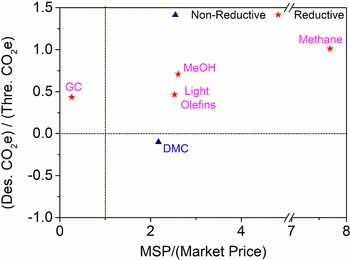
Figure 2 presents a comparative analysis of the economic feasibility and decarbonization potential of different thermal catalytic CO2 conversion processes, drawing upon data from our prior studies (Uddin et al., Reference Uddin, Yu and Lee2022; Chiu & Yu, Reference Chiu and Yu2024a,Reference Chiu and Yub; Chiou et al., Reference Chiou, Lee, Wen, Lin, Chen and Yu2023; Yu et al., Reference Yu, Chen and Chien2018; Wu et al., Reference Wu, Hsu, Yu and Lin2024). The x-axis shows the ratio of the minimum selling price (MSP, set to achieve a 15% internal rate of return) to the current market price. The y-axis represents the ratio of net decarbonization potential from the process design scenario to the theoretical CO2 uptake. Conceptually, processes in the upper-left quadrant indicate simultaneous economic and decarbonization benefits. However, a trade-off between economics and decarbonization potential can be identified from Figure 2. Specifically, the use of green hydrogen in hydrogenation processes offers greater decarbonization potential, while its currently high cost limits its economic feasibility (Uddin et al., Reference Uddin, Yu and Lee2022; Chiu & Yu, Reference Chiu and Yu2024a,Reference Chiu and Yub; Chiou et al., Reference Chiou, Lee, Wen, Lin, Chen and Yu2023). In contrast, producing value-added chemicals offers a better economic outlook but has limited decarbonization potential, due to low theoretical CO2 uptake and high energy requirements for process purification. (Yu et al., Reference Yu, Chen and Chien2018). Among various investigations, solely the GC process—which entails the indirect conversion of CO2 and glycerol using propylene oxide as a co-reactant—demonstrates the potential to simultaneously attain economic viability and decarbonization.
Comparison of economic and decarbonization performances across the previously studied thermal-based CO2 conversion process.

In terms of economic and environmental aspects, the photocatalytic conversion process offers several advantages. Notably, photocatalytic CO2 reduction may eliminate the need for green hydrogen, which is economically advantageous for countries struggling to produce hydrogen in a global net-zero economy. Furthermore, its ability to operate with minimal or no thermal electricity consumption could further reduce indirect greenhouse gas emissions. However, the practical deployment of photocatalytic processes is hindered by low product yields, which pose challenges and lead to economic and environmental impacts during separation. The incorporation of a solution phase, either as an alkali solution or by adding a solvent, adds complexity to the separation process. Although improving productivity is often emphasized in the literature, a quantitative framework to assess when yield (or conversion) becomes economically and environmentally viable is still lacking.
To address the aforementioned issues, it is highly recommended to implement process design and conduct a comprehensive evaluation that considers both the reaction and separation sections. Recently, Huang and Yu proposed a framework that compares the potential of the photothermal catalytic GC production process in terms of economics, environmental impact, and safety (Huang & Yu, Reference Huang and Yu2025). Their study quantified that the product yield of the photothermal process must be doubled from its current highest value (6.9%) to achieve performance metrics comparable to those of existing processes. The modeling framework developed in their work provides a foundational basis for future investigations of other photocatalytic systems.
Conclusion
This paper presents a comprehensive review of recent advancements in photocatalytic and photothermal catalytic CO2 conversion processes. Experimental results related to the synthesis of methane, methanol, C2 hydrocarbons, dimethyl carbonate, and glycerol are summarized. Additionally, potential process configurations for the production of these chemicals are conceptually proposed. Currently, enhancing the product yield of photocatalytic CO2 conversion is of paramount importance. Experimental research indicates that the development of novel catalysts, which are characterized by faster reaction kinetics, improved stability, and extended excited-state lifetimes, is essential. Additionally, optimizing the reaction system by minimizing mass transfer limitations can significantly improve operational efficiency. From a process development perspective, integrating concepts that combine CO2 capture, photoreactor design, and downstream separation is crucial. Technological feasibility should be evaluated through comprehensive techno-economic analyses, life cycle assessments, and safety evaluations. Overall, photocatalytic CO2 conversion presents inherent advantages for achieving a net-zero economy. However, substantial further research is necessary to realize its full potential.
Open peer review
To view the open peer review materials for this article, please visit http://doi.org/10.1017/cat.2025.10008.
Author contribution
Ting-En Su: Data curation, Investigation, Methodology, Writing (original daft). Yu-Xuan Chen: Data curation, Investigation, Methodology, Writing (original daft). Ting-Wei Huang: Data curation, Investigation, Methodology, Writing (original daft). Yi-Hsin Chien: Conceptualization, Writing (original daft), Writing (review and editing), Supervision, Project administration, Funding acquisition. Bor-Yih Yu: Conceptualization, Writing (original daft), Writing (review and editing), Supervision, Project administration, Funding acquisition.
Financial support
The research funding from the National Science and Technology Council of R.O.C. (grant number: 113–2218-E-002-027) is greatly appreciated. Y. -H. Chien appreciates the financial support provided by the National Science and Technology Council (NSTC 113–2113-M-035-001).
Competing interests
The authors declare that they have no known competing financial interests or personal relationships that could have appeared to influence the work reported in this paper.



 Open access


Comments
Invited Submission to Cambridge Prism: Carbon Technologies
Dear Editors,
On behalf of all co-authors, here I am submitting our recent work, entitled “Current Progress, Potentials, and Challenges for Developing Photo-assisted CO2 Conversion Processes” for possible publication in Cambridge Prism: Carbon Technologies. This is an invited submission for the journal, coordinated by Professor Yi-Hsin Chien from Feng Chia University and me.
This review paper discusses recent advancements in the field of photo-assisted CO2 conversion. It covers the fundamentals and key materials used in photocatalysis, various conversion pathways for producing both commodity and value-added chemicals, and potential process configurations based on the current understanding of existing technologies. Key points for enhancing economic and environmental performance are also provided. We believe that this paper will be beneficial for readers who are new to this field and are interested in transitioning from experimental work to process development.
For the referees to review this paper, my suggestions are as follows:
Professor Doh Chang Lee
Korean Advanced Institute of Science and Technology, South Korea
Email: dclee@kaist.edu
Professor Keiichi Tomishige
Tohoku University, Japan
Email: tomishige@tohoku.ac.jp
Professor Xin Gao
Tianjin University, China.
Email: gaoxin@tju.edu.cn
Professor Pham thanh Huyen
Hanoi University of Science and Technology, Vietnam
Email: huyen.phamthanh@hust.edu.vn.
Professor Jin Shang
City University of Hong Kong, Hong Kong
Email: jinshang@cityu.edu.hk
Professor Jae Woo Lee
Korean Advanced Institute of Science and Technology, South Korea
Email: jaewlee@kaist.ac.kr
Should you need any further information regarding this paper, please don’t hesitate to contact me. On behalf of our research team, I would like to thank you for the opportunity to publish in this excellent journal.
Yours sincerely,
Bor-Yih Yu
Assocaite Professor