At the height of a wet summer in August 1879, the ageing John Ruskin looks out over Coniston Lake from the study window of Brantwood, his Victorian home in the English Lake District. He has been up early, losing himself to the tattered web of febrile thoughts at which he has been poking and pulling with his pen, as though by catching them occasionally in black ink he might find respite from his low mood. A storm has been gathering, the air is ‘a loath-some mass of sultry and foul fog, like smoke’, rain has been falling in unreliable fits, the clouds lour, unfold and envelop him:
Quarter to eight, morning. – Thunder returned, all the air collapsed into one black fog, the hills invisible, and scarcely visible the opposite shore; heavy rain in short fits, and frequent, though less formidable, flashes, and shorter thunder. While I have written this sentence the cloud has again dissolved itself, like a nasty solution in a bottle, with miraculous and unnatural rapidity, and the hills are in sight again; a double-forked flash … Half-past eight. – Three times light and three times dark since last I wrote, and the darkness seeming each time as it settles more loathsome, at last stopping my reading in mere blindness. One lurid gleam of white cumulus in upper lead-blue sky, seen for half a minute through the sulphurous chimney-pot vomit of blackguardly cloud beneath, where its rags were thinnest.Footnote 1
The observations echo Ruskin’s own climate: he has been enduring bouts of despondent hesitancy for months. The campaigning zeal for life in all its untrammelled fecundity that had characterized nearly all his adult life has been deserting him. In bearing witness to the dawn of machine-led industrial capitalism, laissez-faire speculation and godless consumerism, he had spent large parts of his inherited income on experimenting with alternative ways of organizing the consumption and production of material wealth. But of late he has grown frustrated with these experiments. The last of these had begun just over a year ago: the founding of the Guild of St George, a limited liability association whose primary objective was: ‘To determine, and institute in practice, the wholesome laws of laborious (especially agricultural) life and economy, and to instruct first the agricultural, and, as opportunity may serve, other labourers or craftsmen, in such science, art, and literature as are conducive to good husbandry and craftsmanship.’Footnote 2
Ruskin was the ‘Master’, carrying the duty to encourage and goad others into handing over portions of their wealth to fund the Guild. In turn, the Guild would fund land purchases, build museums, schools and workshops, and give workers, peasants or labourers a ‘University education, wide as the fields, true as the laws, and fruitful as the roots of the earth, to all, without distinction, who desire to enjoy the happiness proper to men, and to fulfil the duties assigned to them’.Footnote 3 The students of this universal education were to be stewards of their own enjoyment and character as much as the soil, and the Guild was dedicated to the development of both. The Guild has been Ruskin’s most ambitious attempt at instituting what has been a consistent message throughout his life: think hard why you make and use what you do, consider how it gives to life, and if its existence has diminished life in any way, then refuse it. By life he means all life, that of the trees and Lakeland fells as much as human lives, a blending of life forms to which he has been inured from an early age.Footnote 4 A good life was a life led as close to nature as was possible, for here, in a state of ‘constant watchfulness’, was the source of all sustenance and stimulation: curtail nature and you curtail yourself.Footnote 5
It has been a struggle towards closeness and truthfulness, one which he first witnessed in the painter J. M. W. Turner whose unmatched watchfulness had been by Ruskin’s analysis the wellspring for a series of canvasses that revealed human nature to itself like no other medium. The greatest of these was Slavers Throwing Overboard the Dead and Dying – Typhoon Coming on, an ‘accurate’ and ‘fearless’ composition revealing the ‘deathfulness’ of the ocean alongside the dreadfulness of trade: the slaves ‘do not rise everywhere, but three or four together in wild groups, fitfully and furiously, as the under strength of the swell compels or permits them; leaving between them treacherous spaces of level and whirling water’, whilst the slaving ship: ‘labours amidst the lightening of the sea, its thin masts written upon the sky in lines of blood, girded with condemnation in that fearful hue which signs the sky with horror, and mixes its flaming flood with the sunlight, and, cast far along the desolate heave of the sepulchral waves, incarnadines the multitudinous sea’.Footnote 6
He had owned the painting for decades, and had hung it in his study, until 1872, when he sold it, unable to bear its weight.
Seven years later, as he writes in his diary, accompanied by the storm clouds smudging his window, a weight remains. He half remembers that it had been with Turner he had experienced his last sunset, three years previously. The smoke had been there then too, on the horizon, but it had been incipient, an occluding denouement to the sun’s descent which it hid ‘through gold and vermillion’. Now the smoke came in brumous stacks that stained everything: ‘Blanched Sun, – blighted grass, – blinded man’.Footnote 7 The strain is telling. Ruskin no longer knows where to turn; the clouds are everywhere. Not even the prospect of the ‘ziggy zaggy’ path at the garden entrance to Brantwood – seven twisting switchbacks leading up a plant-strewn embankment, each turn encouraging a gradual loosening from the weight of worldly sin – was offering him release.
It had not always been thus. He recalls how, in Modern Painters, his written paean to Turner, he had once been able to write quite differently about clouds:
Often in our English mornings, the rain-clouds in the dawn form soft level fields, which melt imperceptibly into the blue; or when of less extent, gather into apparent bars, crossing the sheets of broader cloud above; and all these bathed throughout in an unspeakable light of pure rose-colour, and purple, and amber, and blue, not shining, but misty-soft, the barred masses, when seen nearer, found to be woven in tresses of cloud, like floss silk, looking as if each knot were a little swathe or sheaf of lighted rain.Footnote 8
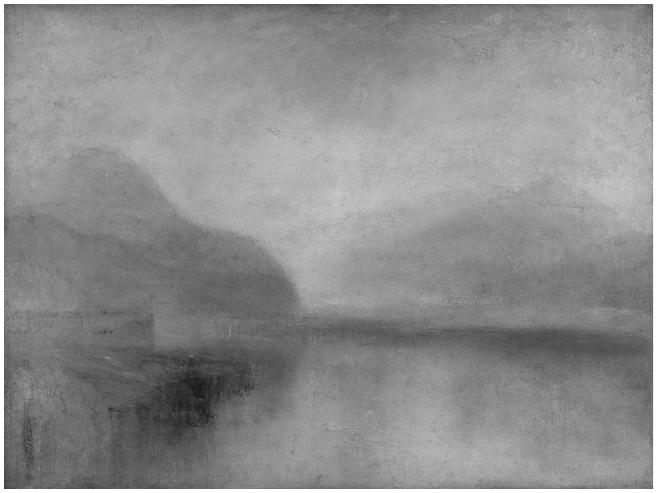
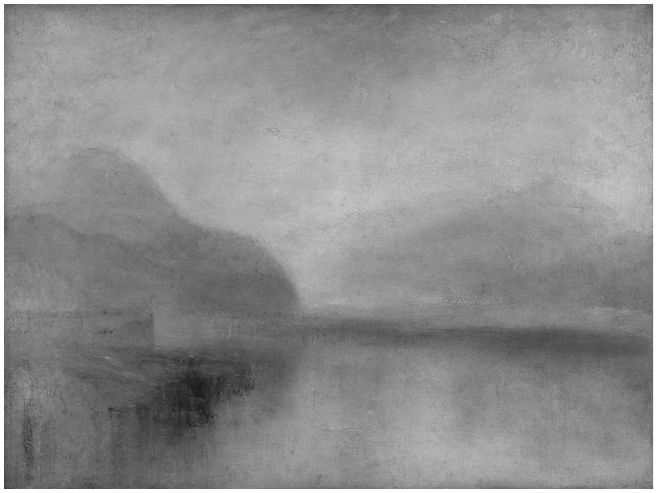
This is a typical piece of Ruskinian text: closely observed descriptions alive with their own considered, often exuberant fugue-like progressions. Attend closely, observe and listen, touch and smell, and you become aware that all that is beautiful, true and good comes from the earth. The human species would only flourish fully if it realized this intimacy and concourse with the earth and its teaming life: ‘[N]o air is sweet that is silent; it is only sweet when full of low currents of under sound – triplets of birds, and murmur and chirp of insects, and deep-toned words of men, and wayward trebles of childhood.’Footnote 9 No one painted clouds better than Turner because he painted them in concourse with humans; he painted the truthfulness of an experienced event rather than an isolated object. He painted clouds as they were felt (Figure 1).
Joseph Mallord William Turner, Inverary Pier, Loch Fyne: Morning, ca. 1845. Oil on canvas.
It is this entwined connexion with natural things that Ruskin fears to be on the wane. Humans, or at least those living in the places to which he has been most attentive – the parts geographically named as: the valley at Chamonui, the Italian cities of Verona and Venice, much of Switzerland, London, Scotland and the English Lakes – are steadily losing the capacity for encounters with nature. It has left him feeling increasingly isolated. Closely observed, the ragged, loathsome clouds underscore this fear. They are plague clouds.
Plague Clouds
Five years later, in 1884, Ruskin excavated these parts of his diaries to form the narrative structure of two lectures given in London. The intervening years had provided him with space to reflect and expand upon the incipient feelings of gloom, to the point where, now, he had a full-blown thesis. The plague clouds were manifest, they were empirically present in the vapours, mists, dust and light seeping into the brick of the lecture hall and the bodies of the attendees. If those listening to him talk couldn’t sense the plague clouds, then perhaps he could assist by pointing them out. After all, unless one has practised the watchfulness for which Ruskin prided himself, it was notoriously difficult to trace the edges of a cloud and to say with any definiteness that a cloud is there, or not there. Clouds are elusive, and if not seen might still be there, lurking. As well as rocks, buildings, temperaments, ornament, withered leaves and worked landscapes, Ruskin had spent years observing clouds, watching how they formed from the air eddying on the leeward side of cold mountaintops, or how they would emerge along the front between cold and warm air in a slow turmoil of rivalling densities. Now they were gathering and streaking the sky across industrialized nations, and with impunity, blurring and deadening the light. Not just the light by which to see, but the inner light of the soul. As well as in the air, the plague clouds settle upon human souls as these too belonged to biological life and were dependent upon ‘a disposition of molecules to swing’, an oscillating vitality coursing through all life forms.Footnote 10
In writing Modern Painters, he had been able to tap into this swing, to create almost as readily as a cloud is created, to experience the formation of a work authored as much by the surrounding perturbations of air as the internal agitations of thought. Ruskin, in all seriousness, attributed the potency of his greatest work as much to the prevailing weather as he did the genius of those he wrote about, or his own genius; it was all one great atmosphere. Which was why, by 1879, when the climate had changed so irrevocably, so had he, and so had his audience. Whilst hour by hour occasional spots of weather might elicit the odd memory of a past harmony, the prevailing scene was a doom-riven murk through which any sun could only shine like a crooked, false coin.Footnote 11
Though he felt he was writing alone, others were also associating the industrial acceleration and expanding material wealth of the 1870/80s with moral demise. Mark Twain, for example, had christened it a Gilded Age, a time of rapid machine-led commercial growth in which plenty lived cheek by jowl with extreme deprivation.Footnote 12 The earth had become an open, measured space traversed by telegraph wires announcing the arrival of railroads, factories, modern management systems, trading exchanges, entertainment halls, glass arcades and mineral mines, all of which was being put place under the direction of joint-stock holding companies and other such novel, impersonal organizational forms. The gilding was everywhere, a surface sustained by poverty and exploitation. But Ruskin’s is a distinct voice. He, and he alone, has been able to set the unfortunate coupling of industrialized prowess and social injustice against a backdrop of creeping, atmospheric despoilation that potentially covered the entire world. Ruskin’s plague clouds are not metaphorical: they are ecological phenomena emerging through the cracks of a newly broken world; their poison was real, lasting and global.Footnote 13 The clouds built and built, fusing with the sky, leaving nothing untouched by their pall. Where the clouds settled, they left residues marking the soil and the oceans, and where there remained aloft, they altered the chemical texture of the air. And they were being replenished and expanded by the steam and smoke which stained the earth, tainted the water, and laced the air with particulates that stunted natural growth and restricted breathing. Their expansion was accompanied by an expanded cadre of managers and clerks who oversaw the breaking of labour into increasingly smaller units set within an urban sprawl that knew no restraint. They address one another not just through machinery, but as machines: they push, tap, vibrate, stop, dream, fight and incur loss at the behest of machines. The machinery mediating human life is of a totalizing order: it is the ecological setting by which all relations might take their cue, becoming as homogenized as the soured elements of vapour that permeate their offices, factory floors and streets.Footnote 14
His two lectures on the storm cloud are delivered as a warning to those in the audience who fail to glimpse the enormity of this transformation. Rather than communicate a clear and direct thesis in easily consumed terms, however, Ruskin’s instinct is to surround his audience in a flock of confused, discordant phrases which peck at their sensibility as relentlessly as crows might peck at a carcass. Those who attend – the industrialists, merchants, politicians and financiers whose concerted, collective efforts had given birth to this world-breaking technology – are to hear the truth, and the truth is a splintering of the old order. They believe themselves in control, pre-eminent, and they remain quite unaware of the quiet and creeping domination of the cloud-producing machinery they have installed. Far from being a prosthesis designed to augment human powers, Ruskin hints otherwise; his very delivery, the shards of grammar, evoke the deranging effects of this handing over to machine life.
The Coniston Mechanics Institute
After delivering his warning about the plague clouds, Ruskin returned to Brantwood, and to his study window looking out over Coniston. Guild business still gave him brief spasms of hope, and the pathways in his garden had not failed him completely; their climbing power, though sporadic, was still felt. He (with his retinue of gardeners) had been working on the garden, steadily. It was a place in which he felt able to show his credentials as a thinker and writer who acts and implicates himself in his own edicts. In his 1881 report to the Guild, he had described his own efforts at land improvement in some detail:
Leaving the emergent crags, the bosquets of heath, and the knolls of good sheep pasture untouched, as well as the deeper pieces of morass which are the proper receptacles of rainfall and sources of perennial streams, I have attacked only the plots of rank marsh grass which uselessly occupy the pieces of irregular level at the banks of the minor rivulets, and the ledges of rock that have no drainage outlet. The useless marsh grass, and the soil beneath it, I have literally turned upside-down by steady spade labour, stripping the rock surfaces absolutely bare (though under accumulations of soil often five or six feet deep), passing the whole of this loose soil well under the spade, cutting outlets for the standing water beneath, as the completely seen conformation.Footnote 15
Under the gathering clouds, he carried on. He could work in small ways, noticing how natural growth might still bloom amid the broken world to which he was repeatedly calling attention.Footnote 16
As well as working to improve the land, he was also reminded that the investments he had made in revivifying small, local ventures were not always failing, and that his writing had not gone completely unheeded.Footnote 17 One such venture lay just across the water from his study: the Coniston Mechanics Institute, for whose survival Ruskin had organized a public subscription in 1876, and to which he had been donating monies and materials to assist in the running of woodwork classes. These were led by Susanna Beever and W. G. Collingwood, both of whom were evergreen supporters of Ruskin’s projects and members of the Guild. One of the ad hoc lecturers at the Institute was Arthur Simpson, trained as an apprentice in wood carving at the nearby furniture makers of Gillows in Lancaster. Simpson was an avid reader of Ruskin, taking to heart the claims that it was through craft or hand work that people might best bring about the good in life, and that everyone, by dint of a universal education, should ‘learn to take a straight shaving off a plank, or draw a fine curve without faltering, or lay a brick level in its mortar’.Footnote 18 Folk like Simpson were, felt Ruskin, living proof of his assertion of the intimacy between craft work, personal flourishing and civic rectitude. To make and use things well is to live well, not just personally, but as part of a flourishing community to whose health one bound oneself, as a worker bee is bound by both the hive and the flowers.
The proof lay not just in Coniston but further afield, in sixteenth-century Florence for example, a city that thrived, he argued, because
for the provision of things necessary in domestic life, there developed itself, together with the group of inventive artists exercising these nobler functions [sculpture and painting, and histories], a vast body of craftsmen, and, literally, manufacturers, workers by hand, who associated themselves, as chance, tradition, or the accessibility of material directed, in towns which thenceforward occupied a leading position in commerce, as producers of a staple of excellent, or perhaps inimitable, quality; and the linen or cambric of Cambray, the lace of Mechlin, the wool of Worsted, and the steel of Milan, implied the tranquil and hereditary skill of multitudes, living in wealthy industry, and humble honour.Footnote 19
These craft workers occupied what Ruskin likened to a Third Estate, a body of upright citizens committed to public enterprise, to compliment the other two estates of the knights (state) and priests (religion). The city – along with other Italian cities – flourished from the thirteenth century until the Reformation, at which juncture people lost faith in both the ethical and spiritual integrity of their city, a situation made all the worse by the gradual exploitation of craft work by crass mercantilism. Florence became tainted by
the pride of the knights, the avarice of the priests, and the gradual abasement of character in the craftsman, changing him from a citizen able to wield either tools in peace or weapons in war, to a dull tradesman, forced to pay mercenary troops to defend his shop door, are the direct causes of common ruin towards the close of the sixteenth century.Footnote 20
Through the vigour and independence of each city reflected a similar state in their craft workers, those who had ‘accurate knowledge of their business in all respects; the ease and pleasure of unaffected invention; and the true sense of power to do everything better than it had ever been yet done, coupled with general contentment in life, and in its vigour and skill’.Footnote 21 Uphold craft work and one upholds the social, cultural and political relations that give to life, but uphold the interests of money and one elevates the idle, aggressive and elitist instincts of those who assume privilege a natural right.
The craft workers teaching and learning at the Coniston Mechanics Institute understood this too. But in contrast with Florence, they were working under the pall of industrialism, making the job both more urgent and far harder. The Institute drew people in from all walks of life. Simpson was very explicit in this attempt to entice even the most reluctant and unskilled into craft work. He developed self-assembly kits for basic pieces like trays, whilst encouraging the more gifted to learn carving and embossing (in leather, pewter and copper). His maxim of instruction was to encourage a form of learning in which error had a pre-eminent place, for to err is to take imperfection into one’s nature, and to find there a spur to learning. Simpson’s pedagogy was infused with Ruskin’s advice: the teacher’s role was to begin with whatever rough and ready capacity the student possessed, and ‘to look for the thoughtful part of them, and get that out of them, whatever we lose for it, whatever faults and errors we are obliged to take with it. For the best that is in them cannot manifest itself, but in company with much error.’Footnote 22
The intent was to lead them to a place where, rather than being satisfied with neat, narrow accomplishment, they felt skilled and confident enough to take things on for themselves, to expand upon their growing capacity rather than settle back into the complacency of easy success.
Simpson applied the same principles to himself. By 1885 he had set up a handicrafts workshop in the nearby town of Kendal, employing apprentices and making furniture on commission. From the start he committed, where possible, to using quarter sawn oak. The tree is cut in such a way that the growth rings run through the thickness of the board, setting them perpendicular to the cut, rather than the much flatter angles found in plain sawn oak. Quarter sawing makes the wood more moisture resistant and less prone to twisting and cupping. It also reveals medullary rays that flare and leap across the surface in unruly and arresting patterns. It is more laborious and hence expensive to cut oak this way, and the resulting planks are restricted in width to a quarter of the tree’s girth, but the resulting furniture lasts for as long as users wish to care for and use it. The pieces emerging from the workshop followed basic principles which Simpson had distilled from Ruskin’s advice; above all, a commitment to an honest complicity with made things. The joints were exposed rather than hidden, unashamedly revealing the process of making, whilst also using the maximum possible depth of the timbers, making for stronger joins. The contrasting grain patterns also drew the eye and hand, they wanted to be seen and touched, as ornament, but ornament that belonged to the wood itself. It was not added, and unlike some forms of ornamentation using painting and gilding it was created by revealing and not concealing the raw material. Further ornament emerged from an attentiveness to function. Bookcases, for example, were made on a cascading principle, so smaller shelves at the top, widening as they descended, with the largest at the bottom, stood on feet that widened further still, providing both a waterfall effect and stout foundations when the shelves were loaded. Each shelf was bracketed to prevent bowing and hinged with a small vertical flap along the top that could be raised to accommodate the books, then lowered, preventing dust from gathering.
The quiet zeal shown by Simpson and his ilk was, for Ruskin, an adequate response to the broken world. The craft worker belonged to traditions that lay askance from a mechanized present intent upon breaking the human experience of the world into isolated compartments that could be managed predictably, irrespective of time and place. Craft workers were untimely because they resolved to remain placed. What gave them resolve, in Ruskin’s eyes, was their disciplined capacity to use rather than conquer space and time. They were patient, they struggled to think and to see as clearly as they might how things could connect, they worked patiently and curiously, they refused to be caught up in the speed of capital transformation, they understood the value of lingering with things and appreciated their provocation.
A fool always wants to shorten space and time: a wise man wants to lengthen both. A fool wants to kill space and kill time: a wise man, first to gain them, then to animate them. Your railroad, when you come to understand it, is only a device for making the world smaller: and as for being able to talk from place to place, that is, indeed, well and convenient; but suppose you have, originally, nothing to say.Footnote 23
The problem with industrial capitalism and its technologies was the furious, fast-paced urge to spread its reach, to corral as much space as possible, in as little time as possible, and to do so through processes of standardization whose uniformity was disguised by the superficial circulations of fashion.Footnote 24 More distressing still was the relentless ‘using up’ of workers entailed by this speed and spread. The plague clouds emerge from the machinery of divided workers, their whole being has been segmented to a point where they are not even capable of making a chair or table, but only a leg, and then only at the behest of a mean pattern from which deviation is an unimaginable liberty. Workers are no longer workers, but belong to the machine, they are a new form of life, they have ‘sunk into an unrecognized abyss, to be counted off into a heap of mechanism numbered with its wheels, and weighed with its hammer strokes’.Footnote 25 Even where work is more complex, such as glass making, where the emphasis is on a cleanliness of line and tight, smooth edges, the worker becomes a prisoner of arithmetic.
Ruskin’s Lake District had been no stranger to industrial capitalism, or what decades earlier William Wordsworth, in his poem The Excursion, called ‘the local summons to unceasing toil’, a bell which called
Those working there were not incorporated into nature, but the factory. The children were working the bobbin mills, slate mines, gunpowder factories. Wordsworth observes closely the scouring effects of machines and work patterns dedicated to the production of a form of wealth built on sacrificed health and diminishing prospects. There was no diffusion of wealth and any chance for betterment remained with the better classes. Wordsworth felt keenly how industrial capitalism cast a pall of powerlessness over workers, conditioning them to a deadening similarity in outlook. Ruskin took up the refrain, and in craft work found a riposte. Craft work had the poise to play with the surplus that lay within all human bodies. The surplus associated not just with labour power, but the experience of hitherto untapped potential and enthusiasm, the feeling of excess that resides in us, would we learn to tend it through the acquisition of skill. What is being made in craft work are human beings as much as useful objects, and in both cases these made things refuse to be reduced to the co-efficient of utility; they are as pointless as they are purposeful, as endless as they are finite. In preparing his lectures on the plague clouds Ruskin had spent hours walking around central London observing for just how long the sun shone. Less than an hour each day. Like Turner, Ruskin had always been interested in reading the sky: it was mercurial, vast, inscrutable, and its provocation was immense and enduring. Would we only attend to it now and then, the sky:
is fitted in all its functions for the perpetual comfort and exalting of the heart, for soothing it and purifying it from its dross and dust. Sometimes gentle, sometimes capricious, sometimes awful, never the same for two moments together; almost human in its passions, almost spiritual in its tenderness, almost divine in its infinity, its appeal to what is immortal in us is as distinct, as its ministry of chastisement or of blessing to what is mortal is essential. And yet we never attend to it, we never make it a subject of thoughtFootnote 27
The sky, what John Constable called ‘the chief organ of sentiment’,Footnote 28 shows the way in the interplay of light and dark, emptiness and volume, cold and warmth, beginnings and endings, still and frenzied. The sky was the undefined yet very present thing that drew us in and on, whose undiminished potency allowed us to live alongside the rough errors of noble failure that would inevitably accompany ambition. It was the unreachable mark by which human beings might call upon themselves to become more than they are. There was a religiosity to Ruskin’s sense of the sky, a sense that it was here, if anywhere, that humans might teach themselves of their own capacities, might, like the poet George Herbert looking out from a church porch, apprehend the intimacy between nature and belief:
With industrial capitalism, the likelihood of the sky remaining such a stirring provocation was diminishing day by day. The urge to discover and refine the material uses of all things meant humans were no longer looking at the clouds; worse still, they had ‘got the clouds packed into iron cylinders’ so they might power belts and cranks and pistons in a ceaseless motion that in turn stained the air with poisonous soot.Footnote 30
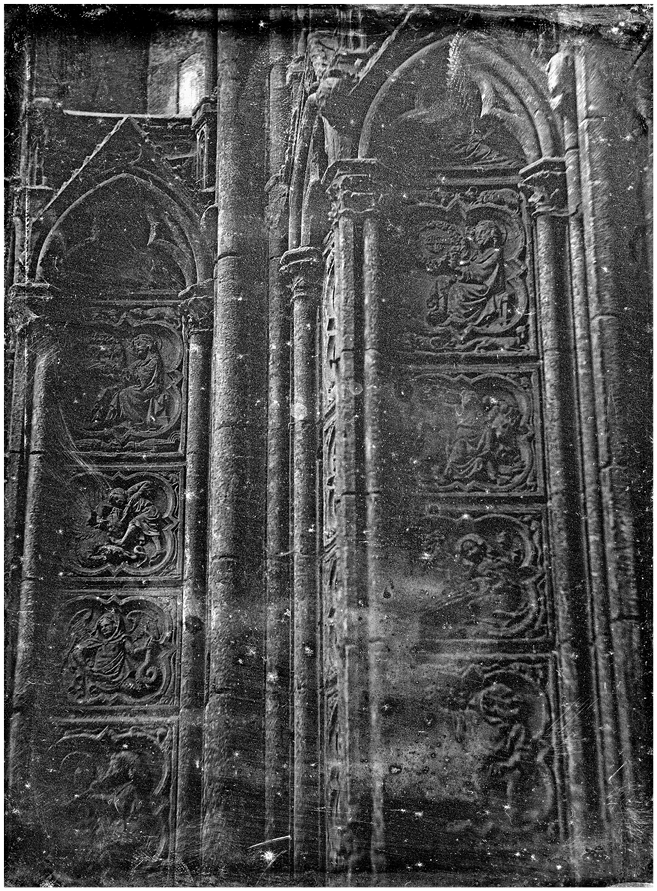
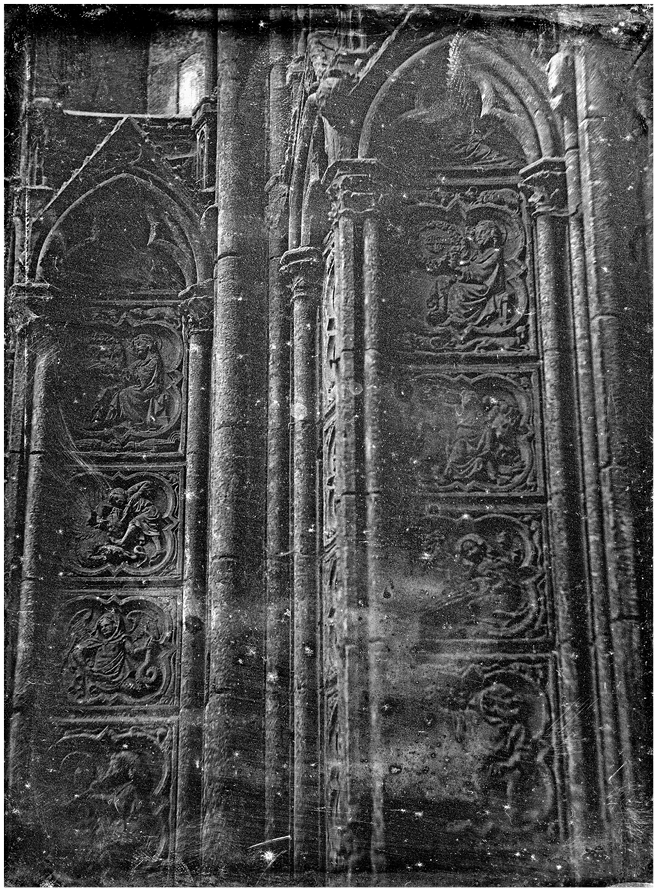
Just as the sun broke the London cloud, briefly, for an hour or so each day, so craft work breaks through the surface of an industrial landscape like a flower through the surface of a tarred road. Ruskin may have lamented how meagre was the interlude but, equally, been transfixed by the contrasts that it could set in play. Craft workers no longer run an entire city, but craft work might still create small, beguiling worlds of unabashed surfaces, hidden niches, occasional bright flashes and resilient persistence made possible by the ‘taking of the one nature into another’, a hypostatic union whose animating power Ruskin distilled into the concept of Gothic (Figure 2). Though derived largely from his obsessive attention to the stonework of Medieval cathedrals and Venetian Palazzos, Ruskin’s views on Gothic extend in broader application to the forms of craft work that held economic uniformity in abeyance. As objects, Gothic buildings revealed themselves in a gathering of distinct qualities for which Ruskin used the following categories: savageness; changefulness; naturalism; grotesqueness; rigidity; and redundance. In isolation, none were sufficient. It was only in concert they amounted to something distinct, and the builders, in turn, bore Gothic sensibility when they held within them an embodied assembly of related human characteristics: rudeness, love of change; love of nature; disturbed imagination; obstinacy; and generosity.
John Ruskin and Frederick Crawley, right-hand register of the bas-relief on the north transept door of the Cathedral of Notre-Dame, Rouen, 1854. Daguerreotype. 1996D0084.
To be rude was to entertain what was wild and remote with as much care as the familiar and habituated. To love change was to find in the order of tradition the rudiments of disorder, and to expose oneself to the free orders of variation. To love nature was to refuse the humanist conceit that civilization progressed only as far as it walled itself off from the accident and blind force of an indifferent, cold and mute world. To disturb the imagination was to be enticed by the irregular and broken and to embrace the deficient, for it was from fragments rather than ‘wholes’ that one might learn anew. To be obstinate was to commit to the grounding values of consistency and integrity. And to be generous was to create things that continued to give with repeated and renewed use; nothing is exhausted or discarded and what is made contributes to, rather than depletes, the available stocks of wealth.
Reading craft work through these qualities is itself, much like the making of craft objects, a risky undertaking. Ruskin’s reading of Gothic was highly idiosyncratic. Through patient and attentive observation heightened by his skills in drawing, Ruskin came to develop his own systems of classification that were just as likely to take lines of flight from the orthodox divisions of style and technique as they were to admit them. His analysis and reasoning were often eclectic and advanced in leaps and lurches rather than the gradual, systemic and transparent movements that characterized typical scholarly efforts to ensure the variability and reliability of knowledge claims. He barely stopped to consider alternate arguments to his own.
The accepted understanding of the Gothic was an architectural style of the Middle Ages, sitting between the Romanesque and the Renaissance. As Christianity spread throughout Europe and became the hearth around which all spiritual, cultural and social life gathered, larger cathedrals were being built. The use of pointed arches aligned in arcades, flying buttresses, spires and rib vaulting allowed the buildings to encompass large congregations and to reach upwards towards God. The point – and it was a style that excelled in the use of points – was to prove the presence of God on earth by providing believers with weighty, vertical evidence of the hierarchical chain of being, with God at the top, then the angels, the saints, the rulers, the priests and so on down to the smallest of sentient life.Footnote 31
Yet it is precisely because of his refusal to fall in with this standard reading of Gothic that he gained a passionate readership. Ruskin’s popularity lay with those willing to question a class system of styles and tastes whose only virtue was an upright rigidity. His readers were tempted to become edge dwellers, and they found in Ruskin someone who authorized this precarious position by dint of his own example. Here was someone unafraid of pursuing the unanswerable questions of meaning with infectious gusto, someone who seemed willing to challenge establishment belief, to recognize how religion might be little more than what the poet Philip Larkin was later to describe as that ‘vast moth-eaten musical brocade/Created to pretend we never die’.Footnote 32 Ruskin did not hide away amongst the pews of the establishment (though at times his own Christianity drifted into an occluding orthodoxy) and nor did he pursue their plaudits, preferring instead to pursue things with which he might link and love. He wrote and spoke as he felt fit, and he did so tirelessly and to as many of his readers and listeners as he might. There is an ego at play here of course, a desire to be heard and be at the centre of conversations, yet the self-love is more in the way of what Rousseau called amour de soi, a natural, robust concern with what allowed human beings to flourish. Ruskin used hard-phrased maxims whose weighty, stentorian tone was sifted with, and lightened by, looping, ornate prose that allowed what might otherwise be ponderous in meaning to float and settle with an unplanned abandon. The effect was more akin to the spread of dandelion seeds than the planting of sturdy trees, an effect which exemplified his version of Gothic, a version that was committed to a broad, enveloping thesis: the happiness and integrity of all organization rests in the free interplay of disciplined imagination and manual expression of individuals bound to one another in common, playful industriousness.
It is towards this realization that any concern with craft work and its organization must turn. Ruskin’s work on Gothic was isolated by William Morris as ‘one of the few necessary and inevitable utterances of the century’ for it outlined ‘a new road upon which the world should travel’, a road that might only be taken would we first realize:
that art is the expression of man’s [sic] pleasure in labour; that it is possible for man to rejoice in his work, for, strange as it may seem to us to-day, there have been times when he did rejoice in it; and lastly, that unless man’s work once again becomes a pleasure to him, the token of which change will be that beauty is once again a natural and necessary accompaniment of productive labour, all but the worthless must toil in pain, and therefore live in pain. So that the result of the thousands of years of man’s effort on the earth must be general unhappiness and universal degradation – unhappiness and degradation, the conscious burden of which will grow in proportion to the growth of man’s intelligence, knowledge, and power over material nature.Footnote 33
It is, Morris continues, curious to think how unhappiness grows in strict sympathy with the progress of science and industry, and it is, he continues, an absurdity to embrace a laissez-faire system of material wealth production in which assets and rents are procured on the prospect of others’ immiseration, a sadness which is kept at bay by the persistent and proliferating divisions that break the world up into assets.
Nothing much has changed. We continue to take satisfaction in a broken world, not just of things being broken to make way for newer things, but of broken relations, a world diminished in the spirit of which Gothic speaks. Ruskin’s advocacy of Gothic is a diagnosis of this anomaly: in dividing thought from activity, imagination from logic, spirit from materiality, the body from thoughtfulness, and management from labour, we have, following Morris’ prediction, continued to work and consume with little heed for the sustained pleasure to be had in making (and using) things well, in giving them good form. The advocacy of craft work in this book is an attempt to use Ruskin’s Gothic to conceptualize the nature of such pleasure in such a way that it might make sense to reconnect with Morris’ warning, and to think anew what it means to make and use things well, to work well, and why.