


Human behavioral-genetic facts, theory and methodologies have become integral and mainstream in psychology, psychiatry and related behavioral disciplines. It was not always this way. Here, we outline major milestones in the history of behavioral genetics, and then describe how activities at the University of Minnesota contributed to these events. While our focus on Minnesota by necessity does not detail the many important contributions from scientists at other institutions, our goal is to present a focused history of a single institution and tradition of research, and perhaps encourage those at other institutions to do the same.
Behavioral-genetic ideas are traceable to animal breeding and domestication, although the practitioners were not completely aware of the implications of the domestication process. The beginnings of the field of human behavioral genetics as a formal scientific discipline are often attributed to Francis Galton, a broadly influential figure in the history of psychology who, among many other innovations, proposed family, twin and adoption studies to parse genetic and environmental origins of behavioral attributes. Galton increasingly turned his attention to eugenics in the early 20th century, having coined the term ‘well-born’ in 1883. These movements were embraced by progressive writers and politicians as a means to improve the common good, at the expense of some individuals, often through forced sterilization. Eugenics laws in Western countries, including the United States, were used as models by Nazi Germany, which notoriously took them to more terrifying extremes. The post-war vilification of eugenics and, by extension, behavioral genetics, chilled genetic research on behavior for decades. Psychology and psychiatry, bereft of behavioral-genetic thought, drifted to radical environmental explanations of behavior reminiscent of the tabula rasa, including schizophrenogenic mothers causing schizophrenia in their offspring.
The resurgence of behavioral-genetic research began in earnest in the 1960s when graduate training programs began emerging in US institutions, including the University of Colorado Boulder, University of Texas at Austin and the University of Minnesota. During the next four decades, twin and adoption studies routinely found that psychological traits and psychopathology were heritable, and behavioral geneticists went to lengths to test assumptions and refine their study designs to meet the many prominent critics of such findings.
Overlapping this era of twin and adoption studies, Gusella et al. (Reference Gusella, Wexler, Conneally, Naylor, Anderson, Tanzi, Watkins, Ottina, Wallace, Sakaguchi, Young, Shoulson, Bonilla and Martin1983) discovered linkage between the short arm of chromosome 4 and Huntington’s chorea in 1983, ushering in a new era of excitement in gene mapping and biological explanations of complex behaviors. Linkage studies of other behavioral disorders soon followed, with limited success for complex traits. The Human Genome Project, completed in 2003, paved the way for the current technological revolution in behavioral genetics: the use of genomewide DNA markers. Genomewide association studies of common variants have been conducted at large scales now for over a decade, and whole-genome sequencing studies of the full allelic spectrum are following. These data are being combined with new analytical technologies not just to map genes to phenotypes, but to complement and extend traditional family studies such as twin and adoption designs. The University of Minnesota and its faculty and staff have significantly contributed along the way, especially from the 1960s onward. Here, we outline some of these contributions.
Early History at Minnesota: The Role of Psychology
The beginning of behavioral-genetic research and scholarship at Minnesota is not simple to trace. From 1890 to 1899, psychology was under the purview of the Department of Philosophy, which changed its name to the Department of Philosophy and Psychology from 1899 to 1917, when the Department of Psychology was formed. Robert Yerkes assumed chairmanship of the new department in 1917 and resigned in 1919, having never even visited the department due to a leave of absence for service in World War I. In 1919, Richard M. Elliott was hired as chairman, and the history of the Department of Psychology began in earnest.
In briefly reviewing this very early history, we focus on the most prominent early faculty employed before the arrival of Elliott in 1919, each of whom later served as president of the American Psychological Association. Serving brief stints at Minnesota were John Dewey (1888), James Rowland Angell (1894–1895), John Fredrick Dashiell (1915–1917), Joseph Peterson (1915–1918), and the longer serving faculty member Herbert Woodrow (1909–1927).
It remains unclear whether any of these seminal figures in psychology brought or developed behavioral-genetic ideas while at Minnesota. Dewey’s and Angell’s tenures in Minnesota were short and sparsely documented. Angell’s review on inheritance of behavior in The Influence of Darwin on Psychology was not published until 1909 and The Evolution of Intelligence in 1922, long after he left Minnesota for Chicago in 1895, and eventually to the presidency of Yale in 1921.
Dashiell trained at Columbia University under James Cattell and Robert Woodworth. Cattell was an unabashed eugenicist, conducting original empirical research on inheritance of eminence, including his work on American Men of Science, in which Dashiell assisted. While Dashiell was a graduate student, Woodworth published Racial Differences in Mental Traits in 1910, which outlined a lack of meaningful racial differences (Woodworth, Reference Woodworth1910). In the paper, Woodworth went on to describe the difficulties in delineating etiological sources of any putative difference, and explored issues of natural selection, evolution and migration as suitable explanations for any differences. In 1923, six years after resigning his appointment at Minnesota, Dashiell went on to publish on class and race differences but without reference to heredity, and was clearly preoccupied with his work in experimental psychology (McFadden & Dashiell, Reference McFadden and Dashiell1923). Any behavioral-genetic activity of Dashiell’s at Minnesota, whether related to race or otherwise, may be lost to history.
Joseph Peterson, on the other hand, made the investigation of race differences in intelligence a major part of his career, sometimes explicitly attributing group differences to ‘innate’ differences (Peterson, Reference Peterson1923) while at others allowing that environmental considerations may play substantial roles (Peterson, Reference Peterson1923, Reference Peterson1928; Peterson & Lanier, Reference Peterson and Lanier1929). This work was conducted in the 1920s after Peterson left Minnesota.
Finally, Herbert Woodrow served on the faculty of Philosophy and Psychology from 1909 to 1917, and then in the new Department of Psychology under Yerkes and then Elliott until 1927, when he took a new position at Ohio State. His research interests were broad, including a focus on the development and individual differences of intelligence and character (Young, Reference Young1974). He appears to be the first Minnesota psychologist who wrote at length on the topic of heredity of a complex trait, intelligence, in a 1919 book on intellectual disability (Woodrow, Reference Woodrow1919). Like Dashiell, Woodrow received his PhD at Columbia and would have been exposed to scholarship on eugenics, heredity and racial disparities, by Cattell, Woodworth, and Thorndike (Thorndike, Reference Thorndike1913), thanking them all in the acknowledgments of his dissertation (Woodrow, Reference Woodrow1909).
1919 to the Early 1960s: Eugenics, World War II and Postwar Resurgence of Behavioral Genetics
More explicit instruction and research in behavioral genetics at the University of Minnesota can be traced to some of the first hires made by Elliott as the new chair: Donald G. Paterson (faculty at Minnesota from 1921–1960), William Heron (1926–1962), and what may have been a more general influence on Minnesota psychological research from yet another future APA president, Karl Lashley (1917–1926).
Lashley obtained his PhD in zoology in 1911 under Herbert S. Jennings, a prominent geneticist and eugenicist at Johns Hopkins. In fact, Lashley would refer to his PhD as one in ‘genetics’ specifically, versus the broader field of zoology (Weidman, Reference Weidman1999, p. 12), having published multiple papers on inheritance in model organisms with Jennings (Jennings & Lashley, Reference Jennings and Lashley1913a, Reference Jennings and Lashley1913b; Lashley, Reference Lashley1915). After obtaining his degree, Lashley began working with John B. Watson of behaviorism fame, conducting conditioning experiments on human infants. Watson was responsible for a strong separation of psychology from philosophy, eschewing introspection and focusing only on observables such as outward behavior. Somewhat ironically given Lashley’s training in genetics, Watson is perhaps the single person most responsible for a form of radical environmentalism during the 20s and 30s: the notion that individuals are a product of their learning history. The idea is famously described in Watson’s Behaviorism, published in 1924:
Give me a dozen healthy infants, well-formed, and my own specified world to bring them up in and I’ll guarantee to take any one at random and train him to become any type of specialist I might select – doctor, lawyer, artist, merchant-chief and, yes, even beggar-man and thief, regardless of his talents, penchants, tendencies, abilities, vocations, and race of his ancestors. I am going beyond my facts and I admit it, but so have the advocates of the contrary and they have been doing it for many thousands of years (Watson, Reference Watson1924, p. 82).
This is but one brief quote from two chapters regarding unlearned human instinct where Watson argues that almost all behavior, even, say, crying in infants, is largely a function of conditioning rather than inheritance. Lashley formed a strong friendship and bond with his mentor Watson (Weidman, Reference Weidman1999), but embarked on his own in 1917 to conduct his longstanding work on sense perception, learning and memory in rats, all of which started at Minnesota.
Lashley was best known for his precise experimentation, especially his work on rat learning and brain function. He would surgically lesion or ablate brain tissue on the live rat, allow it to recuperate, and then, before or after the surgery, engage the rat in a learning paradigm, testing the effect of the brain damage on learning and memory. Lashley concluded from this work that specific behavioral functions are not localized in the brain. Rather, diverse behavioral functions, including learning, could be accomplished even with severely damaged brains, and no specifically placed lesion would have disproportionate effects on any individual behavior. Instead, the deficit in task performance was proportional to the amount of brain damage, not to the location of that damage. Lashley referred to this general cognitive reserve of ability in the rat as ‘intelligence’. The finding was consistent with the general intelligence (g) conceptualization by Spearman, Thorndike, and others at the time, a connection Lashley himself pointed out but with which he was far from satisfied (Lashley, Reference Lashley1929). While humans with high intelligence performed well on a wide variety of cognitive tasks, ablations in rats, regardless of placement, would reduce ‘intelligence’ proportional to amount of tissue ablated. Perhaps remarkable given his formal training in genetics, Lashley did not engage in genetic explanations for his version of intelligence while at Minnesota in the ‘20s, nor later in his career (Weidman, Reference Weidman1999).
In fact, Lashley never formulated a grand theory of learning like Hull, Spence, Clark, or even Skinner (another Minnesota psychologist). Lashley was more interested in falsifying theories than in concocting them (Beach, Reference Beach1961; Hebb, Reference Hebb1959), a focus that included a prominent refutation of his mentor and lifelong friend Watson’s influential theory of behaviorism (Lashley, Reference Lashley1923a, Reference Lashley1923b). This skeptical tradition in Minnesota psychology was inherited by many of those listed in Figure 1, including Donald Paterson, to whom we turn next.
Major historical figures and events in behavioral genetics at the University of Minnesota.

Paterson, a founding member of the Minnesota Civil Liberties Union, is best known as a key figure in the founding of applied psychology, especially industrial/organizational and counseling psychology. He has been remembered as an influential mentor, brilliant lecturer and meticulous researcher (Meehl, Reference Meehl and Lindzey1989), graduating an astounding 88 PhD students in his 39 years on the faculty and epitomizing the skeptical quantitative ‘dustbowl empiricist’ mentality of psychology departments across the Midwestern US during that time (Meehl, Reference Meehl and Lindzey1989). He taught for decades (Jenkins & Paterson, Reference Jenkins and Paterson1961) a required graduate course on differential psychology that became locally famous in its time (Meehl, Reference Meehl and Lindzey1986). The course contained a great deal of content related to heredity and environmental influences on intelligence, a construct of central interest to Paterson in his research as well as in his work on Army alpha and beta intelligence tests during World War I. Reflecting on his training at Minnesota in the ‘30s and ‘40s, Paul Meehl wrote in his autobiography that Paterson’s lectures were so effective that ‘Minnesota PhDs in the 1930s emerged with a strong predilection for genes at a time when almost all social science was anti-hereditarian’ (Meehl, Reference Meehl and Lindzey1986, p. 23). The anti-hereditarian stance of the broader field referred to by Meehl was no doubt due to the radical behaviorism of John Watson. It may be that Lashley’s presence at Minnesota in the ‘20s and his criticisms of behaviorism contributed to an intellectual environment that was freed from radical behaviorist dogma.
A few of Paterson’s published works are most relevant to the theme of the present article. First, in 1929, Paterson published a critique (Paterson & Williamson, Reference Paterson and Williamson1929) of a failed replication of Galton’s Hereditary Genius, taking issue primarily with the measurement of occupational status and its relationship to intelligence and eminence. A reanalysis and review of relevant literature essentially defended Galton’s original conclusions. At the end of their paper, Paterson and his coauthor stressed that their disagreement with their opponent was over matters of fact. In the final two sentences they pointed out that the facts are consistent with an increase in the rates of marriage and childbirth among the ‘upper levels of society’, bringing about the ends sought by eugenicists, without committing to approval of those ends. Nowhere did they express support for forcible sterilization or more extreme measures to reduce the reproduction of the less able.
Second, Paterson published the landmark book Physique and Intellect (Paterson, Reference Paterson1930), in which he assembled and critically reviewed virtually the entire literature on correlations between physical and psychological measurements published prior to 1930. Some of his negative conclusions have since been overturned by more rigorous research, often by the application of genetic methods (Bulik-Sullivan et al., Reference Bulik-Sullivan, Finucane, Anttila, Gusev, Day, Loh, Duncan, Perry, Patterson, Robinson, Daly, Price and Neale2015; Lee et al., Reference Lee, Yang, Goddard, Visscher and Wray2012). But in his time,
Paterson was highly respected as a highly competent and sophisticated methodologist in psychometrics and differential psychology. These strengths, combined with his scholarly thoroughness, his meticulous accuracy in reporting, and his consistently objective critical acumen, make it practically unnecessary to reexamine the numerous studies reviewed [over 300 pages] in Physique and Intellect. (Jensen & Sinha, Reference Jensen, Sinha and Vernon1993).
Paterson would go on to publish original empirical work on parent-child similarity in intelligence (Paterson & Rundquist, Reference Paterson and Rundquist1933). The final relevant publication comes in the same year as his death, 1961, when Paterson and his former student James Jenkins published an edited collection (Jenkins & Paterson, Reference Jenkins and Paterson1961) of 66 articles related to intelligence, many from the primary literature. In addition to foundational articles on measurement of the construct, the collection includes a wide variety of classic articles on inheritance of intelligence describing family designs (e.g., Galton & Burks), the use of twins and co-twin control methods (e.g., Woodworth, Gesell) to evaluate nature and nurture (e.g., Thorndike, Merriman, Gesell), migration studies to evaluate particular environmental effects (e.g., Brigham), and, perhaps most controversial today, studies attempting to delineate etiological sources of race and sex differences (including Woodworth’s Racial Differences described above, as well as work by Franzblau, Alper & Boring, Hobson, and Lee)..
In the 1930s and early 1940s, William Heron conducted some of the earliest breeding experiments to study the inheritance of learning and memory in rats (Heron, Reference Heron1935, Reference Heron1941; Heron & Skinner, Reference Heron and Skinner1940; Innis, Reference Innis1992). He also taught a course that he called ‘genetic psychology’, although Meehl remembered that the course ‘did not deal very much with genes but with comparative and ethological topics such as the social life of the bee’ (Meehl, Reference Meehl and Lindzey1986, p. 88). To our knowledge, Heron’s papers were not archived upon his death, so reconstructing his contributions to behavior genetics is difficult.
The prewar history of the department has to be considered within the context of the moral milieu of the time. Outside the psychology department and far more conspicuous, Charles F. Dight, a University of Minnesota physician (until 1913) was a major proponent of the eugenics movement in the state of Minnesota. Dight was a public reformer who served on the Minneapolis city council, elected as a member of the Socialist Party of Minnesota. At first he was concerned with public health measures such as the pasteurization of milk, before turning his interest into eugenic interventions. He founded the Minnesota Eugenics Society in 1923 and lobbied to legalize sterilization of the ‘feeble-minded and insane’, apparently arguing that 10% of the Minnesota population should be sterilized — about 200,000 people (Ladd-Taylor, Reference Ladd-Taylor2005). The state passed a forced sterilization law in 1925, eventually resulting in >2000 sterilizations. In 1933, Dight sent a letter to Adolf Hitler, praising his efforts to ‘stamp out mental inferiority among the German people’. Upon his death in 1938, he left his estate ($200,000; ∼$4M in today’s dollars) to the University of Minnesota to form the Dight Institute for Eugenics Research. The center was later renamed the Dight Institute for Promotion of Human Genetics (Welter, Reference Welter2015), and was one of the first centers for human genetics research in the United States.
Of course, from 1939 to 1945 much of the world was consumed by World War II and Nazi atrocities including eugenics programs, and coercive eugenics policies have been spurned ever since. Genetic explanations of behavioral conditions became taboo, and into this scientific vacuum came extreme environmental explanations of behavior. Shortly after the war, the University of Minnesota made the consequential decision to recruit Sheldon Reed to lead the Dight Institute in 1947. Reed was a biology PhD turned human geneticist who had worked with William Castle, Sewall Wright, and George Snell. Part of Dight’s will stipulated that a primary function of the Institute was to provide consultation and advice on questions related to human genetics. Upon assuming the directorship of the Dight institute in 1947, Reed was bombarded by physicians with questions about apparently genetic conditions of their patients. In response, he developed and named the field of genetic counseling. He contributed to the founding of that field through promotional and scholarly efforts, and personally handled thousands of cases. He published a classic text on genetic counseling in 1955 (Reed, Reference Reed1955; later editions in 1963 and 1988), and that same year served a term as president of the American Society for Human Genetics.
While Reed was focused on the new field of genetic counseling, the state of behavioral genetics was poor. Inheritance of behavior was essentially ignored by the field of psychology after World War II, becoming dominated by such notions that autism and schizophrenia were caused by parenting behaviors (e.g., the so-called refrigerator mothers). Indeed, part of Reed’s apparent motivation for advancing the field of genetic counseling was to advise parents away from blaming themselves for a genetic condition of their child (Anderson, Reference Anderson2003). He also saw genetic counseling as a more ethical reformulation of past eugenics movements, using genetic realities and knowledge to assist parents and families in making personal reproductive decisions rather than to further some interest of the state or broader society, whose involvement in reproductive decisions he explicitly rejected.
In the years immediately following World War II, Minnesota psychology began to slowly diverge from the naïve environmentalism of psychology at large. Scattered references to heritability and twin research from Minnesota faculty exist (Tinker, Reference Tinker1946), but there is no obvious program of research related to behavior genetics during the late ‘40s or early ‘50s. Paterson and Heron were approaching retirement. Paul Meehl took his PhD in psychology from Minnesota in 1944 and was hired as faculty immediately after, but was preoccupied with issues in clinical assessment and philosophy of psychology during this time.
Changes began in the mid to late 50s as Reed began a research program on inheritance of intellectual disability, using pedigree data from 549 probands institutionalized for the condition from 1911 to 1918, as well as 80,000 descendants of the probands’ grandparents. These nationwide records had been transferred to the Dight Institute in 1939. Before that they were held at the Eugenics Record Office, a research center hosted in the Cold Spring Harbor Biological Laboratory, which was shut down the same year. Reed found strong patterns of inheritance (Reed & Reed, Reference Reed and Reed1965) and addressed questions of IQ and fertility (Higgens et al., Reference Higgins, Reed and Reed1962), including Cattell’s paradox that larger families tended to have members with lower IQs but there was no general decline in IQ in the population, as one might expect. Reed believed that the resolution was a simple one of ascertainment: Prior studies only included families, and individuals who did not reproduce were excluded. The full truth may be more complex than this. Reed’s study was conducted toward the end of the Baby Boom, and subsequent papers have shown that the IQ-fertility relationship became slightly positive (or at least less negative) during this atypical time (Lynn & van Court, Reference Lynn and Court2004; van Court & Bean, Reference Court and Bean1985; Vining, Reference Vining1982). Why the trend has apparently moderated or reversed is unclear. But regardless of its interpretation, Reed’s study retains its significance.
While Reed was conducting this seminal research on intergenerational transmission of intellectual disability, the Department of Psychology hired David Lykken and Gardner Lindzey in 1955, two hires of great consequence for behavioral genetics at Minnesota. Lykken was a Minnesota PhD specializing in psychophysiology; Lindzey was a personality psychologist who had been introduced to behavioral genetics by Calvin Hall (Runyan, Reference Runyan2009). Lindzey and Lykken immediately began working in the late ’50s on behavioral-genetic research of complex traits in mice, demonstrating that variation in traits such as temperament was genetically influenced (Lindzey, Reference Lindzey1964; Lindzey et al., Reference Lindzey, Lykken and Winston1960). At around this same time, doctoral theses on genetic psychology began to appear more prominently in the psychology department (Figure 2). Of note was Irving Gottesman’s 1960 dissertation, ‘The Psychogenetics of Personality’, a twin study of the heritability of personality that included both a review of behavioral-genetic research and original empirical work on personality pathology and psychopathology, which demonstrated heritability of major mental illness. In his acknowledgments, Gottesman singled out Sheldon Reed more than anyone else for ‘advice, encouragement, and criticism’, as well as the Department of Psychology and the Dight Institute for financial support. Studying under Lindzey, personality psychologist Auke Tellegen earned his PhD in clinical psychology with his dissertation ‘The Effect of Genetic and Experiential Factors Upon Emotional Reactions in Mice’ in 1962. Like Gottesman, Tellegen would later return to the University of Minnesota as a professor after postdoctoral work. In fact, 1960 is an important historical marker more broadly in behavioral genetics (Loehlin, Reference Loehlin and Kim2010) representing the emergence of the field as a coherent scientific discipline with the publication of the eponymous seminal text by Fuller and Thompson (Reference Fuller and Thompson1960). Minnesota was already playing an important role in this new field. After graduating, Gottesman took a position at Harvard, and then was recruited to London’s Institute of Psychiatry in 1963 by Elliot Slater, where he began his groundbreaking twin research on schizophrenia with James Shields.
Notable dissertations at the University of Minnesota related to genetics (1930−1990).

During the same time that Reed, Lindzey and Lykken were developing empirical research programs in behavioral genetics, Paul Meehl formulated a dominant gene theory of schizophrenia, extending ideas articulated by Elliot Slater and others. In 1962, Meehl had spent two decades defending the legitimate study of mental states and traits against radical behaviorism (MacCorquodale & Meehl, Reference MacCorquodale and Meehl1948), formulating a comprehensive position on validity in psychological testing (Cronbach & Meehl, Reference Cronbach and Meehl1955), devising novel psychological assessment techniques (Meehl, Reference Meehl1973), and showing that actuarial prediction techniques (like those insurance companies use) were more accurate than expert psychological judges, such as clinicians, in predicting behavior (Meehl, Reference Meehl1954). He blazed new ground again in his 1962 presidential address to the American Psychological Association, the single dominant professional organization representing all of psychology at the time. He referenced Fuller and Scott’s 1960 textbook, defended the utility of twins, and ultimately postulated ‘that schizophrenia, while its content is learned, is fundamentally a neurological disease of genetic origin’, a radical departure from psychological explanations relying entirely on learned experience or refrigerator mothers.
In the 1960s, behavioral-genetic research at Minnesota took off. Elving Anderson joined Reed at the Dight Institute in 1960, starting a research program on the genetics of breast cancer and epilepsy. In 1966, a National Institutes of Health grant to support behavioral-genetic training was awarded to Reed and Lykken, and they convinced Gottesman to return to Minnesota to direct the first formal training program in behavioral genetics in the United States (Anderson, Reference Anderson2003). At this time, Gottesman began teaching a course in behavioral genetics at Minnesota, which has now been taught continuously for nearly 60 years. Shortly after Reed and Lykken received their training grant, similar grants were awarded to the Institute for Behavioral Genetics at the University of Colorado Boulder, as well as the University of Texas at Austin, to which Lindzey had departed in 1964. Despite the loss of Lindzey, Minnesota was quickly becoming a major hub for behavioral-genetic research (Loehlin, Reference Loehlin and Kim2010) in the United States and the world.
Major Scientific Contributions Since the 1960s
We now pivot from a strict chronology to a focus on major domains of behavioral-genetic research at the University of Minnesota, including psychopathology and drug abuse, intelligence, and endophenotypes. For each domain, we describe major events and discoveries made at Minnesota and the historical context in which they were made.
Psychopathology and Addiction
While Meehl theorized on the genetic underpinnings of schizophrenia, Gottesman collected and analyzed data on afflicted individuals and their relatives. While not the first to conduct research on twins and psychosis, his studies with James Shields in the Institute of Psychiatry in the early ‘60s was by far the largest and most comprehensive, delivering overwhelming evidence that schizophrenia was heritable (Gottesman & Shields, Reference Gottesman and Shields1966, Reference Gottesman and Shields1976). After returning to Minnesota, he postulated in 1967 that schizophrenia risk would be affected by many genes — contrary to Meehl’s single-gene theory — and proposed a threshold model whereby genetic risk was probabilistically associated with manifestation of the clinical disorder (Gottesman & Shields, Reference Gottesman and Shields1967). His theory has stood the test of time. While the threshold issue and categorical nature of schizophrenia may still be debated (Kotov et al., Reference Kotov, Jonas, Carpenter, Dretsch, Eaton, Forbes, Forbush, Hobbs, Reininghaus, Slade, South, Sunderland, Waszczuk, Widiger, Wright, Zald, Krueger and Watson2020), genetic etiology for the disorder as typically defined is clearly highly polygenic (Ripke, Reference Ripke2013).
The etiology of schizophrenia also interested Reed, who followed up his 1963 book on intellectual disability with a similar large-scale pedigree study on psychosis. Conducted throughout the 1960s and published in 1973, Reed et al. (Reference Reed, Hartley, Anderson, Phillips and Johnson1973) made important discoveries related to fecundity in schizophrenia, and observed patterns of relatedness that were proposed to support quantitative (supporting Gottesman) versus Mendelian (contra Meehl and Slater) inheritance. In particular, Reed et al. found that mothers with schizophrenia were twice as likely as fathers with schizophrenia to have children with the disorder. They speculated that women with higher polygenic risk were more likely to bear children than similar men, and those children would consequently be at the highest risk of schizophrenia themselves. The study made significant contributions to understandings of social class and pleiotropy — in which a gene contributes to multiple traits that appear unrelated — in mental disorders.
Roy Pickens, a behaviorist who had joined the Minnesota psychiatry faculty in 1966, became interested in the variability in drug abuse he observed while consulting for the alcohol/drug treatment facility Hazelden in the late 1970s. This curiosity prompted him to begin investigating the genetic influence on drug dependence in twin pairs from treatment facilities across Minnesota (Katz et al., Reference Katz, Hatsukami, Henningfield and Gust2022). In 1986, with funding from the National Institute on Drug Abuse, Lykken, Matt McGue, and Bill Iacono expanded this early twin research by founding the Minnesota Twin Family Study, which has been expanded and maintained to the present day by McGue and Iacono (Wilson et al., Reference Wilson, Haroian, Iacono, Krueger, Lee, Luciana, Malone, McGue, Roisman and Vrieze2019). Now referred to under the umbrella of the Minnesota Center for Twin and Family Research (MCTFR), the Center maintains ongoing cohorts of 10,000+ participants from nuclear families with twin or adoptive offspring. The offspring were first recruited as adolescents and followed longitudinally, allowing developmentally informed studies of prospective relationships. Hundreds of papers have been published, but here we focus on a few major findings related to common forms of drug abuse (nicotine, alcohol and marijuana) and mental illness (e.g., antisocial behavior, depression, anxiety, ADHD).
One major unifying theme of the work within the Center is what has become known as continuum conceptions of psychopathology, which postulated that continuous and highly heritable general vulnerabilities influence risk to manifest a diverse range of conditions. Using twin designs, one can decompose the observed relations among personality variables, clinical disorders and other behaviors (e.g., phenotypic variance covariance matrix) into its genetic, shared environmental and nonshared environmental components. The result of such an exercise has repeatedly suggested that phenotypically related behavior is largely attributable to pleiotropic genetic vulnerabilities. Factoring such matrices reveals sources of pleiotropy that affect multiple phenotypes. One source was termed ‘externalizing’ by another Minnesota-trained psychologist, Thomas Achenbach. Externalizing is hypothesized to link drug use, antisocial behavior, ADHD, and lack of constraint (Hicks et al., Reference Hicks, Krueger, Iacono, McGue and Patrick2004; Krueger et al., Reference Krueger, Hicks, Patrick, Carlson, Iacono and McGue2009).
The other source of pleiotropy has been termed ‘internalizing’ and links depression- and anxiety-related conditions. These two vulnerabilities are related to one another and to a third continuum of vulnerability to psychotic conditions, forming part of the basis for current initiatives to reconfigure psychiatric diagnostic nosologies to reflect the genetic covariance structure. Among those at the forefront of this integrative approach today is Robert Krueger, who studies the mechanisms, associations and etiology of familial transmission among internalizing and externalizing phenotypes in the Minnesota Twin Family Study. Along with others such as McGue and Iacono, Krueger has been instrumental in establishing a model of comorbidity in both externalizing and internalizing disorders and their relationships with personality traits with MTFS twins (Krueger et al., Reference Krueger, McGue and Iacono2001).
The general approach has been expanded in multiple ways within the MCTFR, including incorporating the parents of twins and adoptees, finding that intergenerational transmission of externalizing psychopathology is largely attributable to transmission of the general risk vulnerability (Bornovalova et al., Reference Bornovalova, Hicks, Iacono and McGue2010; Hicks et al., Reference Hicks, Krueger, Iacono, McGue and Patrick2004). More developmentally informed research was conducted as the twin children continued to age, revealing that the general vulnerability to externalizing affects drug use most prominently during the teenage years, reducing in influence into the late 20s (Vrieze et al., Reference Vrieze, Hicks, Iacono and McGue2012). Other studies have examined gender differences in externalizing disorders over development in MTFS twins, finding that a modest gender gap in which men showed increased symptoms at age 17 widened after age 24 (Hicks et al., Reference Hicks, Blonigen, Kramer, Krueger, Patrick, Iacono and McGue2007). Many of these twins are now in their 40s and even 50s, and we expect updates on such findings in the near future.
Around 2010 and on the heels of the success of the Welcome Trust Case-Control genomewide association study (GWAS) consortium (Wellcome Trust Case Control Consortium, 2007), 85% of participants in the MCTFR were genotyped genomewide (Miller et al., Reference Miller, Basu, Cunningham, Eskin, Malone, Oetting, Schork, Sul, Iacono and McGue2012). Excitement about the potential of these new data waned as power issues became apparent, and even comprehensive, longitudinal and genetically informed measures developed within the MCTFR (Hicks et al., Reference Hicks, Schalet, Malone, Iacono and McGue2011) were no match for the tiny effects of individual variants in GWAS (McGue et al., Reference McGue, Zhang, Miller, Basu, Vrieze, Hicks, Malone, Oetting and Iacono2013). GWAS discovery quickly became the purview of international collaborations to which the MCTFR contributed and in some cases managed (Brazel et al., Reference Brazel, Jiang, Hughey, Turcot, Zhan, Gong, Batini, Weissenkampen, Liu, Barnes, Bertelsen, Chou, Erzurumluoglu, Faul, Haessler, Hammerschlag, Hsu, Kapoor and Vrieze2019; Erzurumluoglu et al., Reference Erzurumluoglu, Liu, Jackson, Barnes, Datta, Melbourne, Batini, Surendran, Jiang, Adnan, Afaq, Agrawal, Altmaier, Antoniou, Asselbergs, Baumbach, Bierut, Bertelsen, Boehnke and Howson2020; Liu et al., Reference Liu, Jiang, Wedow, Li, Brazel, Chen, Datta, Davila-Velderrain, McGuire, Tian, Zhan, Choquet, Docherty, Faul, Foerster, Fritsche, Gabrielsen and Vrieze2019), leading to the discovery of hundreds of genomic loci associated with nicotine and alcohol use and addiction. Research within the Center shifted to characterizing individual variants and polygenic scores (Vrieze et al., Reference Vrieze, McGue, Miller, Hicks and Iacono2013; Vrieze et al., Reference Vrieze, McGue, Miller, Legrand, Schork and Iacono2011), and using such information in novel ways to understand the intergenerational transmission of substance use and dependence.
The Center has also been active in characterizing environmentally mediated etiology in substance use and addiction. The adoption study (McGue et al., Reference McGue, Keyes, Sharma, Elkins, Legrand, Johnson and Iacono2007) has been used to control for passive gene-environment correlation to evaluate parent-child similarity and the effect of parent behavior, with modest evidence for some similarity attributable to the rearing environment (Keyes et al., Reference Keyes, Legrand, Iacono and McGue2008; King et al., Reference King, Keyes, Malone, Elkins, Legrand, Iacono and McGue2009). Genetic nurture designs in the twin family cohorts have found consistent small but non-zero effects of the rearing environment on adolescent offspring substance use (Saunders et al., Reference Saunders, Liu, Vrieze, McGue and Iacono2021). Finally, Mendelian randomization has been used with some success, especially variation in the alcohol dehydrogenase 2 gene (ALDH2), which is responsible for encoding an enzyme involved in the metabolism of alcohol and which shows higher variation within a large subsample of adoptees born primarily in South Korea. These studies found that alcohol use does not cause other substance use, dependence or related psychopathology (Irons et al., Reference Irons, McGue, Iacono and Oetting2007). On average in these population samples, results across all studies suggest moderate impact of genes in the development of substance use disorders, and related psychopathology (i.e., externalizing), and small to negligible impact of the rearing environment (including parenting behavior). These findings are grossly consistent across study designs (twins and adoptees) and technologies (pedigrees versus measured genotypes).
Endophenotypes
Meehl’s theory of schizophrenia included the notion that individuals with the genetic predisposition to develop schizophrenia could be identified by clinicians using his schizotypy rating scale. This scale probably constitutes the first measure of what Gottesman came to characterize as an endophenotype. Borrowing from fruit fly research that showed there were genetically influenced biological characteristics of Drosophila that could only be identified using laboratory techniques, Gottesman and Shields introduced the endophenotype concept to psychiatric research. By the mid-1970s, this concept had gained popularity as scientists began to show that the healthy first-degree relatives of schizophrenia patients produced deviant scores on laboratory measures that were similar to those generated by their affected relatives. At the time, these measures were known by a variety of confusing terms, like genetic vulnerability, and biological marker; it was not until the publication of Gottesman and Gould in 2003 (now cited over 6000 times) that they were abandoned in favor of the authors’ thoughtfully defined endophenotype concept (Gottesman & Gould, Reference Gottesman and Gould2003).
Because the prevalence of schizophrenia is relatively low (under 1%) and only about 10% of the first-degree relatives of patients develop schizophrenia, uncovering genetic etiology using traditional methods (like pedigree and eventually linkage studies) that were prominent in the 1970s was severely hampered by the inability to identify gene carriers among schizophrenia relatives. Research with monozygotic (MZ) twins had shown that they are discordant for schizophrenia about half the time, indicating that many with the genetic predisposition did not develop the disorder. In their 1989 study of children of discordant twins, Gottesman and Bertelsen showed that schizophrenia liability can be passed to offspring through the unaffected co-twin of a schizophrenia proband (Gottesman & Bertelsen, Reference Gottesman and Bertelsen1989). The promise of endophenotypes was that they had the potential to identify these unaffected ‘gene carriers’ and thus greatly enhance the ability to uncover how schizophrenia was genetically transmitted.
Against this backdrop, William Iacono, who was a graduate student in David Lykken’s laboratory in the late 70s, began a program of research focused on the evaluation of psychophysiological measures for their potential as endophenotypes. At the time of Iacono’s arrival in Lykken’s lab, Lykken was conducting psychophysiological studies with twin pairs that compared the frequency composition of their resting EEG. Lykken observed that MZ twins produced nearly identical EEG spectra while DZ twins were no more similar than unrelated people, leading to his hypothesis that EEG spectra were determined by the configuration of the underlying genetic architecture, a configuration fully shared only by MZ twins. This hypothesis suggested an emergenic trait that was genetically influenced through the interactions of gene effects, but did not run in families because a complex network of genes cannot be passed to offspring in its entirety (Lykken, Reference Lykken1982). Working with Lykken on emergenesis gave Iacono access to Lykken’s twin registry, and led Iacono to recognize the value of using general population twin samples to evaluate psychophysiological measures for their endophenotype potential. His dissertation, which demonstrated remarkably similar oculomotor performance between co-twins in a healthy community sample, was, to our knowledge, the only study ever published in the Archives of General Psychiatry that included no measures of psychopathology (except for measurement of the putative endophenotype; Iacono & Lykken, Reference Iacono and Lykken1979).
Iacono left Minnesota in 1979 to take a position at the University of British Columbia. While there, he extended his endophenotype research in a large-scale study of first-episode psychotic patients and their first-degree relatives, measuring EEG, brain event-related potentials, eye tracking and electrodermal activation. This work, because it showed that relatives produced abnormalities on many of these measures, offered compelling support for their candidate endophenotype status. Iacono returned to Minnesota in 1985, continuing his schizophrenia endophenotype research in collaboration with William Grove who joined the Minnesota faculty at the same time. Grove and Iacono, in a multitrait endophenotype study, showed that a common genetic liability appeared to underlie schizophrenia vulnerability. With Brett Clementz, who was a postdoctoral fellow at the time and is now a leader of the Bipolar and Schizophrenia Network for Intermediate Phenotypes (BSNIP consortium; Clementz et al., Reference Clementz, Sweeney, Hamm, Ivleva, Ethridge, Pearlson, Keshavan and Tamminga2016), they found that eye tracking dysfunction was bimodally distributed among schizophrenia patients and their relatives, a pattern shown through segregation analysis to suggest polygenic risk that included influence of a major gene (Grove et al., Reference Grove, Clementz, Iacono and Katsanis1992).
Shortly thereafter, the National Institute on Drug Abuse (NIDA), noting that its portfolio for biological research on addiction was almost entirely animal based, published a request for application designed to encourage more biologically based human addiction research. Led by Lykken, Iacono and McGue proposed to establish a collection of phenotypes that showed evidence of heritability from twin studies, including endophenotype measures that were associated with alcoholism or schizophrenia. This collection eventually became the Minnesota Twin Family Study (MTFS). In a series of investigations with Robert Krueger, Christopher Patrick, Stephen Malone, Brian Hicks, Scott Vrieze, Uma Vaidyanathan and many others, they published influential papers on the nature of endophenotypes relevant to substance abuse and related externalizing problem behavior. Exploiting the twin-family study design, they found that the comorbidity among substance use, childhood disruption and antisocial personality disorders could be accounted for by a highly heritable externalizing latent trait that captured the behavioral disinhibition common to these disorders, and specific environmental and genetic effects that accounted for their differentiation from each other. Reduced amplitude of the P300 visual event-related potential serves as an endophenotype for the latent trait and predicted the development of externalizing disorders in prospective investigations of MTFS twin youth. Many other psychophysiological endophenotypes were also found to be associated with externalizing psychopathology, including EEG frequency characteristics and electrodermal activity. These findings led to an entire issue of the journal Psychophysiology devoted to the molecular genetic basis of 17 candidate endophenotypes in an MTFS sample of approximately 4000 individuals, the largest study of endophenotype genetics ever undertaken at the time of publication in 2014 (Iacono et al., Reference Iacono, Vaidyanathan, Vrieze and Malone2014).
Using GWAS and sequencing, and following candidate gene study leads, Iacono and colleagues were unable to replicate any finding in the literature, and showed that endophenotypes, like the clinical phenotypes with which they are associated, are massively polygenic. Based on this experience, they published an endophenotype best practices article to discourage more candidate gene and small sample studies and encourage more large-sample consortia, investigating how endophenotypes change with development and inform developmental processes, examining the degree to which verified psychopathology genetic variants are also associated with specific endophenotypes, constructing animal models for endophenotypes, and using knowledge about the functional significance of these variants to develop new endophenotypes with potential to generate mechanistic insights (Iacono et al., Reference Iacono, Malone and Vrieze2017). Following these guidelines, this endophenotype research continues to expand by identifying new candidates, examining associations with polygenic scores for psychopathological disorders, and showing how endophenotypes predict unique variance over traditional risk factors for the development of adolescent drinking.
Intelligence
Sandra Scarr completed her PhD under the supervision of Irving Gottesman during his stint at Harvard University. A few years later in 1971 she came to Minnesota as a faculty member at the Institute of Child Development. She did not stay long, moving on in 1978 to Yale University, where she became the first woman in the psychology department to attain the rank of full professor. During her short time at Minnesota, she initiated several research projects of enduring importance.
Arthur Jensen had published his infamous Harvard Educational Review article raising the possibility of a genetic contribution to racial IQ differences in 1969. Scarr believed that the differences could be explained mostly by environmental factors, and began to explore the question on her own (Scarr, Reference Scarr1987).
We highlight two attempts to address this incendiary issue. In one study, Scarr used 13 blood groups as ancestry-informative genetic markers and calculated, within a sample of black American twins varying in degree of African ancestry, the correlation between IQ and the quantitative measure of ancestry afforded by these markers (Scarr et al., Reference Scarr, Pakstis, Katz and Barker1977). She found weak relationships between extent of African ancestry and IQ (e.g., correlations ranging from -.12 to .15), concluding that the genetic hypothesis of race difference in IQ was unsupported. In a second more well-known investigation, Scarr and Richard Weinberg compared black and white children adopted by white upper-middle-class families (Scarr & Weinberg, Reference Scarr and Weinberg1978). At age 7, the 130 black/biracial adoptees in her study showed an average IQ above that of white children in the same area of the country, although the black/biracial adoptees still performed slightly less well than the 25 white adoptees in the sample. Scarr and her coauthor Richard Weinberg interpreted this finding as evidence for the black-white IQ gap being largely the result of remediable environmental causes. Follow-up of the adoptees at age 17 revealed an apparent increase in the IQ difference between the black/biracial adoptees (as well as Asian adoptees) and the white adoptees. The subgroups were too small to conduct well-powered tests of differences, and the resulting ambiguity led to multiple interpretations. Scarr and colleagues interpreted the results to be generally consistent with the malleability of IQ and the importance of the rearing environment. Others claimed evidence for a genetically determined race-based IQ gap (Levin, Reference Levin1994; Lynn, Reference Lynn1994; Waldman et al., Reference Waldman, Weinberg and Scarr1994). This led to controversy, as did the very notion of studying black adoptees into white families, and Scarr and her colleagues received threats and dealt with assaults (Scarr, Reference Scarr1987).
Scarr and Weinberg also completed data collection for the Minnesota Study of Adolescent Youth during her tenure at Minnesota. This was a path-breaking study as well; to our knowledge no previous biometrical study had employed the adoption design with offspring so advanced in age (18.5 years old on average). The correlation between the IQ scores of biological siblings was estimated to be .35, whereas the correlation between the scores of adoptive siblings was very close to zero. And whereas the correlation between parent and offspring IQ in biological families was highly significant, consistent with a narrow-sense heritability of roughly .5, no such correlation was observed in adoptive families (Scarr & Weinberg, Reference Scarr and Weinberg1978). A picture is worth a thousand words, and a striking side-by-side comparison of the scatterplots in biological and adoptive families was later presented in a book chapter by Scarr (Reference Scarr, Sternberg and Grigorenko1997, pp. 30−31). Figure 2 of Willoughby et al. (Reference Willoughby, Giannelis, Ludeke, Klemmensen, Nørgaard, Iacono, Lee and McGue2021), a paper reporting very similar results in a recent adoption study of 30-year-old offspring, was inspired by Scarr’s plots (Figure 3).
Comparison of scatterplots and associated regression lines for adoptive and biological parent-offspring correspondence in IQ from Scarr and Weinberg (Reference Scarr and Weinberg1978; top panel) and Willoughby, McGue et al. (Reference Willoughby, McGue, Iacono and Lee2021; bottom panel). All values are standardized. Scarr and Weinberg’s data was based on midparent (mean of mother and father) WAIS IQ scores; Willoughby et al. data shows intake and follow-up 3 for both biological (left panel) and adopted (right panel) offspring and their rearing parents. Intake measure is full-scale Wechsler IQ score, and follow-up 3 measure is ICAR-16 score. All parent-offspring pairs are included, which means that the data points are not independent.

No previous study of its size, with more than 100 families of each type (biological, adoptive), had suggested as small an influence of familial environment on IQ at age 18 as the Minnesota Study of Adolescent Youth. Scarr and Weinberg (Reference Scarr and Weinberg1983) proposed that the conflicting results could be reconciled by positing the fadeout of certain environmental effects with age:
[O]lder adolescents are largely liberated from their families’ influences and have made choices and pursued courses that are in keeping with their own talents and interests. Thus, the unrelated siblings have grown less and less alike…. We can think of no other explanation for the markedly low correlations between the adopted siblings at the end of the child-rearing period, in contrast to the several studies of younger adopted siblings, who are embarrassingly similar. (p. 264)
Regardless of whether Scarr and Weinberg were correct about the mechanism behind the declining variance due to shared environment, the fact of the decline has since been borne out in numerous studies (Briley & Tucker-Drob, Reference Briley and Tucker-Drob2013). Interestingly, at the same time as the influence of shared environment is diminishing, the heritability of intelligence increases, as first posited in the influential book chapter by McGue et al. (Reference McGue, Bouchard, Iacono, Lykken, Plomin and McClearn1993). This general developmental pattern is among the most robust discoveries in behavioral genetics (Plomin et al., Reference Plomin, DeFries, Knopik and Neiderhiser2016).
When Scarr left Minnesota, her mantle was taken up by Thomas Bouchard Jr., who joined the psychology faculty before Scarr but initially specialized in industrial-organizational psychology (Segal, Reference Segal2012). Gottesman took credit for inspiring Bouchard’s interest in behavioral genetics during the 1970s — although one manifestation of that interest unlikely to have been encouraged by Gottesman was an admiration for the work of Arthur Jensen, who was at Bouchard’s alma mater, Berkeley. Bouchard began to teach Jensen’s writings in his class on individual differences, which provoked a response like that which Scarr experienced: ‘people picketed me, called me a racist, tried to get me fired’ (Holden, Reference Holden2009). Indeed the graffiti ‘FIRE BOUCHARD’ appeared on a building adjacent to Bouchard’s office, but university administration staunchly backed him in his research and teaching.
Whatever the political climate of the day, Bouchard is perhaps most well known for founding and directing the Minnesota Study of Twins Reared Apart. He had discussed conducting a study of twins reared apart with Gottesman, Lykken, and Tellegen, but worried that he would not be able to gather a large enough sample. Then Bouchard read about the ‘Jim twins’ in an article reprinted in the Minneapolis Star Tribune on February 20, 1979, which reported that both of these identical twins separated at birth had, before meeting for the first time at age 39, ‘smoked Salems, chewed their fingernails, suffered from tension headaches, vacationed on the same Florida beach, and … twice married women with the same first name (Linda and Betty)’ (Segal, Reference Segal2012, p.10). Intrigued, Bouchard vowed to bring the Jim twins to Minnesota for a thorough assessment, even if he had to ‘beg, borrow, or steal’ to fund it. (Bouchard later took on as much as $60,000 in personal debt to support his twin research during lean times.) His team managed to assess 13 additional pairs of twins reared apart within a year, and so began the Minnesota Study of Twins Reared Apart (MISTRA) — the most publicized and widely discussed twin study in the history of behavioral genetics (Boomsma, Reference Boomsma2012).
Over the next 20 years, 137 sets of reared-apart twins participated in the study. The stories of the astounding similarities between some of the twins are too numerous to recount here (Segal, Reference Segal1999, Reference Segal2005, Reference Segal2012). A cartoon in the New Yorker gives the flavor: two identical twins separated at birth, reuniting at the patent office with identical Rube Goldberg contraptions. Some of the similarities are so eerie that upon his retirement Bouchard commented that twins are ‘still amazing and a great mystery to me’ (Holden, Reference Holden2009). Epistasis undoubtedly has something to do with it (Lykken et al., Reference Lykken, McGue, Tellegen and Bouchard1992). Besides such anecdotes and qualitative similarities, the exhaustive quantitative measurements showed that twins reared apart are typically almost as similar as twins of the same zygosity reared together. At the time of the study’s flagship publication in Science, the average correlation between MZ twins reared apart over three separate IQ batteries was .75 (Bouchard et al., Reference Bouchard, Lykken, McGue, Segal and Tellegen1990), which remains to this day a reasonable estimate of the g factor’s broad-sense heritability.
MISTRA had continuous problems with funding; despite multiple requests to the National Science Foundation and the National Institute of Mental Health, Bouchard was mostly unsuccessful. One grant reviewer noted that ‘rejection is the only intellectually defensible course for NSF’ (Segal, Reference Segal2012). In the late 1970s, behavioral genetic research was still viewed with suspicion. Eventually, MISTRA obtained funding from a number of sources, primarily from the Koch Charitable Foundation, the Tufts University Nutrition and Aging Laboratory, and the University of Minnesota Periodontal Group. Donations were made by many other private funds, one of which was the Pioneer Fund, an organization with an explicitly eugenicist orientation. The Pioneer Fund had funded other seminal behavioral genetic studies, such as the Texas Adoption Project, but also research on race differences. As Lykken put it, ‘the argument was that we could take bad money and do good things with it’. Gottesman added: ‘The Pioneer Fund got no reinforcement for any ideas about race differences in behavior because race never entered this project’ (Segal, Reference Segal2012). MISTRA was eventually discontinued in 2006, partly due to lack of funding.
Nancy Segal spent nine years working on MISTRA as a postdoc and center director, and we highly recommend her fascinating accounts of the study (Segal, Reference Segal1999, Reference Segal2005, Reference Segal2012), the latter of which contains quantitative and methodological details of interest to scholars. The impression left by her books is that MISTRA was a spine-tingling encounter with a natural phenomenon close to the heart of nature, the kind of experience that every scientist should get to have at least once.
In addition to continuing work on IQ using twin and adoption studies, Minnesota’s contributions to research on the genetics of intelligence over the past decade include taking part in several GWAS of IQ and related traits (Lee et al., Reference Lee, Wedow, Okbay, Kong, Maghzian, Zacher, Nguyen-Viet, Bowers, Sidorenko, Karlsson Linnér, Fontana, Kundu, Lee, Li, Li, Royer, Timshel, Walters, Willoughby and Cesarini2018; Okbay et al., Reference Okbay, Beauchamp, Fontana, Lee, Pers, Rietveld, Turley, Chen, Emilsson, Meddens, Oskarsson, Pickrell, Thom, Timshel, de Vlaming, Abdellaoui, Ahluwalia, Bacelis, Baumbach and Benjamin2016; Rietveld et al., Reference Rietveld, Medland, Derringer, Yang, Esko, Martin, Westra, Shakhbazov, Abdellaoui, Agrawal, Albrecht, Alizadeh, Amin, Barnard, Baumeister, Benke, Bielak, Boatman, Boyle and Koellinger2013; Sniekers et al., Reference Sniekers, Stringer, Watanabe, Jansen, Coleman, Krapohl, Taskesen, Hammerschlag, Okbay, Zabaneh, Amin, Breen, Cesarini, Chabris, Iacono, Ikram, Johannesson, Koellinger, Lee and Posthuma2017). For decades, behavioral genetics, and especially research on the genetics of intelligence, has elicited great hostility and disbelief. Twin and family studies provided estimates of heritability, but could not pinpoint any specific genes or biological mechanisms. Although mechanisms remain unclear, we can now confidently say that the causal genes as a whole tend to be disproportionately expressed in the brain, and are involved in the biological processes of ‘regulation of nervous system development, central nervous system neuron differentiation, and regulation of synapse structure or activity’ (Savage et al., Reference Savage, Jansen, Stringer, Watanabe, Bryois, De Leeuw, Nagel, Awasthi, Barr, Coleman, Grasby, Hammerschlag, Kaminski, Karlsson, Krapohl, Lam, Nygaard, Reynolds, Trampush and Posthuma2018, p. 913). One of the many follow-up lines of research in the wake of these GWAS has provided strong evidence that brain size is not only a correlate but a cause of intelligence (Grasby et al., Reference Grasby, Jahanshad, Painter, Colodro-Conde, Bralten, Hibar, Lind, Pizzagalli, Ching, McMahon, Shatokhina, Zsembik, Thomopoulos, Zhu, Strike, Agartz, Alhusaini, Almeida, Alnæs and Medland2020; Jansen et al., Reference Jansen, Nagel, Watanabe, Wei, Savage, de Leeuw, van den Heuvel, van der Sluis and Posthuma2020; Lee et al., Reference Lee, McGue, Iacono, Michael and Chabris2019). Recall that one of the first publications about intelligence from Minnesota was Paterson’s (Reference Paterson1930) critical review of the research on physical correlates of intelligence done until that point. The more recent work allows us to close this section with a bit of symmetry and an example of the progress that does occasionally occur in scientific psychology.
Other Individual Differences
Early Minnesota psychologists such as Gardner Lindzey and David Lykken were at the forefront of genetic research in a wide range of traits. Perhaps the most notable was genetic research into personality and temperament, which began as early as the 1950s with, as was typical for the time, studies on rats and mice. Lindzey, Lykken, and Winston, for example, demonstrated in a 1960 paper that four separate breeding lines of mice — whose parent animals were chosen from colonies with markedly different behavioral tendencies — performed differently on tests of timidity, emotionality and exploration after 27 to 93 generations of selective breeding (Lindzey et al., Reference Lindzey, Lykken and Winston1960). The same study observed that mice from all strains that were subjected to infantile trauma scored higher on tests of emotionality than their same-strain control brethren, indicating strong evidence for both genetic and environmental sources of variance in mouse behavior.
Gottesman’s 1960 dissertation on the heritability of personality was perhaps one of the earliest twin studies to demonstrate a genetic etiology of personality traits in humans. Gottesman administered the Minnesota Multiphasic Personality Inventory (MMPI) and Cattell’s High School Personality Questionnaire (HSPQ) to a sample of 34 pairs each of MZ and dizygotic (DZ) twins, finding that genetics predominates in 6 of the 14 HSPQ scales and 6 of the 10 MMPI scales; the remaining scales indicate roles of both heredity and environment. Broad findings from this early foray into the genetics of personality have generally stood the test of time, with more modern reviews showing a heritability between 40% and 80% for personality traits (Bouchard & McGue, Reference Bouchard and McGue2003). Genetic and environmental sources of occupational and leisure interests, which have been studied by Minnesota faculty including Lykken, Tellegen, and Niels Waller since the 1980s, have yielded similar findings to those of personality (Lykken et al., Reference Lykken, Bouchard, McGue and Tellegen1990; Waller et al., Reference Waller, Lykken, Tellegen, Lubinski and Dawis1995).
The extraordinary number of questionnaires, measurements and tests that have been administered to Minnesota twin and family studies have provided a rich substrate for researchers to test hypotheses regarding a wide range of less-studied traits in genetics. Happiness or subjective wellbeing (SWB), for example, was one of Lykken’s many side interests during his Minnesota tenure. Along with Tellegen, he administered the SWB scale of the MPQ to several thousand middle-aged twins in the 1990s, finding that while measures such as educational attainment, religiosity and income accounted for less than 3% of the variance in self-reported happiness, between 44% and 52% of SWB variance was accounted for by genetics (Lykken, Reference Lykken1999; Lykken & Tellegen, Reference Lykken and Tellegen1996).
Perhaps inspired by the many uncanny similarities he discovered in adult reared-apart twins, Bouchard was similarly interested in the genetic and environmental sources of variance in social attitudes, for which he noticed a significant effect of the common environment for attitudes such as religiousness and traditionalism in the original description of this study (Bouchard et al., Reference Bouchard, Lykken, McGue, Segal and Tellegen1990). However, he noted that the reliabilities for these scales were markedly lower than most, and he followed up on these findings with several colleagues by examining conservatism — a construct he found to be more valid and reliable — in the MISTRA sample in 2003 (Bouchard et al., Reference Bouchard, Segal, Tellegen, McGue, Keyes and Krueger2003). He found substantial heritability (56%) for conservatism with little evidence for the influence of the common environment, yet another broad finding that has generally stood the test of time in Minnesota samples (Willoughby, Giannelis et al., Reference Willoughby, Giannelis, Ludeke, Klemmensen, Nørgaard, Iacono, Lee and McGue2021).
As a final example of the more unusual traits that have been studied in a behavior-genetic context at Minnesota, McGue and Lykken conducted a twin study of divorce risk in ∼1500 same-sex twin pairs in 1992. Across both sexes, they found a combined genetic influence of about 52% on divorce risk and noted that the family backgrounds of both spouses contributed independently to the risk of divorce (McGue & Lykken, Reference McGue and Lykken1992). In a subsequent study, they examined the contribution of personality factors to divorce risk, finding a strong contribution of MPQ Constraint (negative) and both Positive and Negative Emotionality (positive) on divorce risk (Jocklin et al., Reference Jocklin, McGue and Lykken1996).
The Future
The strong legacy of behavior-genetic research in Minnesota continues today, with a total of over 9800 individual twins, siblings, parents and adoptees having contributed to the MCTFR’s two flagship longitudinal studies (MTFS and SIBS) as of 2022 (Figure 4). The MTFS, having begun in 1989 with 1400 twin pairs, has enrolled an additional 500 pairs in 2000, and currently includes two cohorts of 2764 MZ and same-sex DZ twins first assessed at age 11 or age 17, along with their parents. These ‘younger’ and ‘older’ MTFS cohorts have each been assessed upwards of six times as of 2019 (Wilson et al., Reference Wilson, Haroian, Iacono, Krueger, Lee, Luciana, Malone, McGue, Roisman and Vrieze2019). The Sibling Interaction and Behavior Study (SIBS), by contrast, began with 617 participating adoptive and biological families, and has recently completed its third follow-up assessment phase with the fourth planned to begin this year.
A timeline of the Minnesota Center for Twin and Family Research’s two flagship studies: The Minnesota Twin-Family Study (MTFS) and the Sibling Interaction and Behavior Study (SIBS).
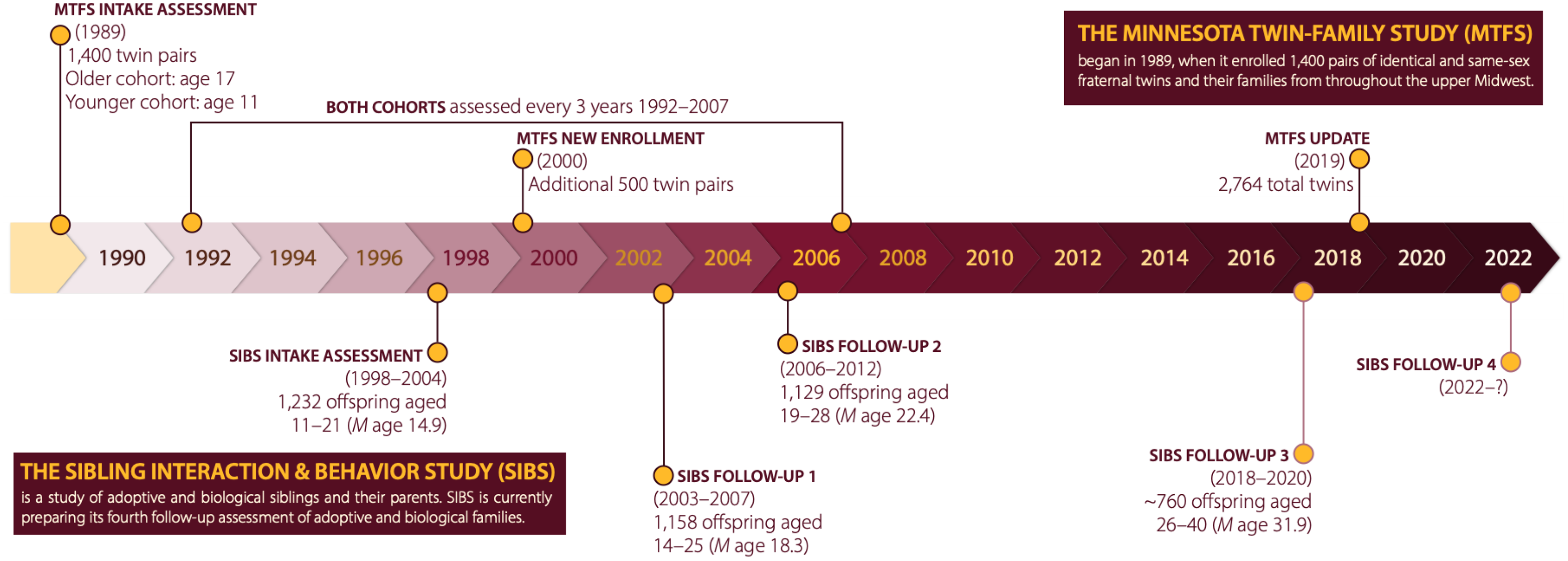
In addition to these two ongoing studies, Minnesota participates in several additional cohorts of families, some of which are nationwide. The Adolescent Brain Cognitive Development (ABCD) study, for example, is composed of family cohorts from 21 institutions in the United States, with the Minnesota branch currently being overseen by Bill Iacono and Monica Luciana. The MCTFR has been gathering MRI imagining data since 2007. As it moves into the future, the ABCD study will continue to incorporate novel brain-imaging and genetic data to track brain development over time, the effects of substance use on discordant twins on brain development and structure, and many other cutting-edge technologies. As genotyping becomes cheaper and easier over time, all Minnesota twin and family cohorts are increasingly being genotyped, beginning with NIDA’s Genes, Environment, Development Initiative (GEDI) project, which was established in Minnesota in 2007. A number of new projects are being laid out for the future of these MCTFR twin-family cohorts, including new assessments and the incorporation of infants of twins, spouses and partners. The genomics revolution has added to the toolkit of behavior-genetic methods, and molecular data are now increasingly complementing MCTFR’s family studies. Minnesota is still an active participant in GWAS consortium efforts, including within-family GWAS that have identified strictly causal variants in a multitude of behavioral and medical traits (Howe et al., Reference Howe, Nivard, Morris, Hansen, Rasheed, Cho and Davies2022). Apart from gene discovery, the department has also incorporated polygenic scores into studies of social and health outcomes (e.g., McGue et al., Reference McGue, Anderson, Willoughby, Giannelis, Iacono and Lee2022; Saunders et al., Reference Saunders, Liu, Vrieze, McGue and Iacono2021; Willoughby et al., Reference Willoughby, Giannelis, Ludeke, Klemmensen, Nørgaard, Iacono, Lee and McGue2021).
A perennial problem with differential psychology and genetics has been the underrepresentation of certain groups. The great majority of twin study participants are European-ancestry, middle-class citizens of Western countries. This problem has become very relevant in light of GWAS, where non-European subjects have been typically excluded from studies. Minnesota has been taking significant steps in increasing the diversity of study samples. The SIBS cohort contains a large portion of Asian Americans, mostly siblings from South Korea who had been adopted by Minnesota families. MTFS has joined forces with the University of Colorado to form the Colorado and Minnesota twin study (COMN), which includes many twins of Hispanic ethnicity. The GWAS & Sequencing Consortium of Alcohol and Nicotine use (GSCAN), which has been spearheaded by MCTFR researchers, is increasingly recruiting more African American participants, and MCTFR is establishing collaborations with other institutes that include African American samples.
The history of behavioral genetics in Minnesota is complex, and mirrors that of the field. Eugenicist efforts by Dight and others resulted in the forced sterilization of thousands, but also set the stage for the later development of genetic counseling, a field that has benefited the lives of parents and offspring for the past 50 years. Minnesota researchers persisted in studying genetic influences on individual differences, in times when behaviorism was dominant. Despite severe criticisms, this line of research has been vindicated in the era of GWAS. Gene discovery has served to elucidate the biological mechanisms of psychopathology and addiction, creating exciting prospects for the understanding and alleviation of human suffering.
Acknowledgments
Thank you to Auke Tellegen, Tom Bouchard, and James J. Lee for helpful conversations, historical anecdotes, and comments on previous drafts.
Author contributions
Conceptualization, S.I.V., M.M., W.G.I.; writing — original draft preparation, S.I.V., M.M., E.A.W., A.G.; writing —review and editing, E.A.W., A.G., M.M., S.I.V., W.G.I.; visualization, E.A.W.; project administration, S.I.V., M.M.
Financial support
None.
Conflict of interest
The authors have no competing or conflicting interests to declare.


 Open access

