





Introduction
How do elections affect credit-claiming and blame-shifting patterns in times of crisis? Although different kinds of crises around the world have taught us a lot about blame games, this question has so far remained unanswered, despite its relevance for the functioning of governmental crisis management in democratic institutions (Kuhlmann et al., Reference Kuhlmann, Franzke and Dumas2022; Mavrot & Sager, Reference Mavrot and Sager2024; Trein et al., Reference Trein, Biesbroek, Bolognesi, Cejudo, Duffy, Hustedt and Meyer2021). During crises, governments come under enormous pressure, and especially in the run-up to elections, blame-based politics might dominate. Democracies which are able to address their citizens’ concerns – even when politics get rough – seem to be better equipped for difficult times than democracies that only offer distractions on the occasion of policy controversies (Hinterleitner, Reference Hinterleitner2023).
This study provides insights into officeholders’ credit-claiming and blame-shifting strategies in times of crisis when simultaneously facing elections. While blaming strategies might be more common in polarised political systems, the political tone has also changed with the rise of populist challenger parties in consensus democracies (Hinterleitner et al., Reference Hinterleitner, Kammermeier and Moffitt2023). Germany is well known for its consensus-oriented political system, shaped by a volatile government coalition and a vertically integrated party system. However, in 2021, when the COVID-19 crisis still created many problems in Europe, the German government not only had to deal with the pandemic but also with the forthcoming federal election and the rise of the far-right party Alternative für Deutschland (AfD). Simultaneously, Germany centralised the usually decentralised governance structures during the COVID-19 ‘federal emergency brake’. This situation is hence an ideal case to analyse how crises and elections generate blame and how institutions can moderate blame games.
To answer the research question, this study examines credit-claiming and blame-shifting strategies used by the German Minister of Health, Jens Spahn, before and after the federal election, which took place on 26.9.2021. The data includes 12 media conferences during the second year of the COVID-19 pandemic (January-December 2021), which are analysed by using both quantitative and qualitative content analysis. Despite pressure and blame stemming from the combination of crisis and election, the Minister of Health claimed credit almost as often as he shifted responsibility and blame to the subnational level before the election. This pattern changed after losing the election, when Jens Spahn shifted more blame to the subnational level than he claimed credit. He also mainly chose implicit forms of blame shifting towards the subnational level before the election, but started blaming Länder and municipalities more explicitly after losing the election. This indicates that the institutions of consensus democracies (in this case, a volatile government coalition and a vertically integrated party system) can moderate blame games, even when a crisis meets an election. Finally, the results indicate that the centralisation of power through emergency law leads to more credit claiming and less blame shifting to the subnational level.
Based on these findings and existing literature, this study introduces a new framework that not only accounts for the change in governance structures to explain blame-shifting direction (Hinterleitner et al., Reference Hinterleitner, Honegger and Sager2022) but also the form of government to explain how blame is shifted. The theoretical argument is that the form of government and governance structures operate as moderators and shape blame games considerably. Including these factors is therefore crucial for gaining a better understanding of how democratic institutions function in hard times, and it advances the blame avoidance and crisis management literature not only empirically but also theoretically.
This article starts with the research gap and motivation. I then introduce the new framework, followed by the research design, including a method and data section. Finally, I present the empirical findings and conclude with a discussion of the results.
Research gap and motivation
Previous research showed that under better COVID-19 conditions (decreasing hospitalisations and case numbers), political leaders claimed more credit and used less blaming strategies, but that credit and blame rose when the public health situation deteriorated (Leong et al., Reference Leong, Howlett and Safaei2023). This means that leaders tried to be positive about their efforts to solve a problem while trying to shift blame. Others argue that centralisation (through emergency law) and decentralisation can be explained by officeholders’ anticipatory efforts to gain credit for popular actions and shift blame for unpopular ones (Greer et al., Reference Greer, Rozenblum, Falkenbach, Löblová, Jarman, Williams and Wismar2022).
A case study from Germany found that parliamentarians whose parties are integrated in intergovernmental bodies of cooperative federalism used soft rather than hard blame attribution and that the vertically integrated party system created an effective blame barrier during the pandemic (Souris et al., Reference Souris, Kropp and Nguyen2023). A case study in Switzerland – another prototype of consensus democracy – showed that the federal government did not only centralise responsibility through emergency law during the COVID-19 pandemic but that blame simultaneously spilt out of the political system towards citizens and experts (Hinterleitner et al., Reference Hinterleitner, Honegger and Sager2022). For the German case, Kuhlmann et al. (Reference Kuhlmann, Franzke and Dumas2022) found that the strategic use of technocratic arguments increased citizens’ acceptance of complying with COVID-19 policies. However, policymakers also actively shifted blame to scientists and escaped political accountability by advocating a technocratic model of policymaking, saying that they are determined by science when deciding on pandemic containment measures (Kuhlmann et al., Reference Kuhlmann, Franzke and Dumas2022). Previous research hence recognises the importance of situational factors (deterioration/amelioration of the situation) and of institutional factors (governance structures and vertically integrated party systems) in the context of blame games. However, a study which systematically analyses crisis and elections as factors creating credit and blame and combining it with the form of government and governance structures – being crucial moderators when it comes to credit claiming and blame shifting – has been missing so far. Therefore, the motivation for this study is not only to fill an empirical research gap but also to contribute to the theory of blame avoidance.
The German case – being a prototype of consensus democracy – allows to combine all these factors because the government not only had to deal with the pandemic but also with the forthcoming federal election and the rise of a far-right party in 2021. The present study also advances our understanding of strategic crisis communication by not only including blame-shifting form and direction but also credit claiming. In this way, it allows us to get a more detailed picture of how contextual factors affect officeholders’ communication strategies and the way they govern a crisis. The study also provides new insights into actors’ dynamics in consensus democracies and opens a new way for comparative studies in the field of strategic crisis communication.
The theoretical puzzle: how the form of government and governance structures affect credit-claiming and blame-shifting patterns
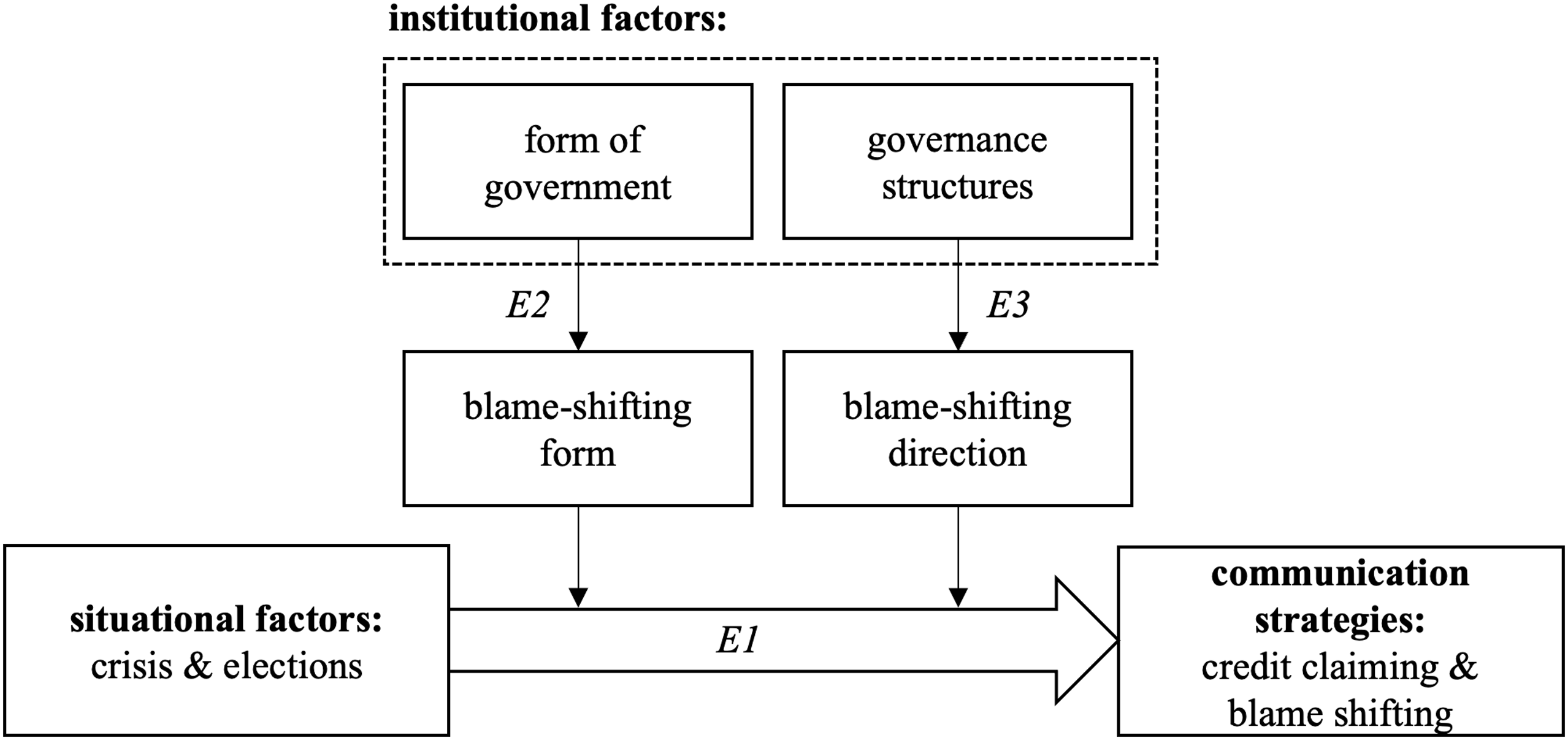
To govern a crisis like the COVID-19 pandemic, officeholders need to make unpopular decisions which directly impact the economy and society (Mavrot & Sager, Reference Mavrot and Sager2024). At the same time, these decisions require swift action under pressure and uncertainty, complicating efforts to maintain public support, which is crucial, especially in times of a pandemic. Given the transboundary nature of a crisis, coordinated action becomes increasingly important, but also increasingly difficult. When officeholders simultaneously face elections, the strategies of blame shifting and credit claiming seem to become even more important to enhance chances of re-election (Walsh, Reference Walsh2006). If officeholders aim to shift blame, for example, when the crisis deteriorates, governance structures come into play which affect blame-shifting directions and the form of government affecting which blame-shifting form is strategically reasonable. Figure 1 illustrates these situational and institutional factors which affect officeholders’ credit-claiming and blame-shifting strategies. Expectations (E1, E2, E3) will be derived in the next section.
Analytical framework and expectations.

Situational factors: crisis and elections
Crises like pandemics or disasters typically require a rapid response, which must be delivered under pressure and uncertainty while simultaneously having very direct economic and social consequences (Mavrot & Sager, Reference Mavrot and Sager2024). These challenges become harder to manage when a crisis spreads across geographical borders and policy boundaries because more participants are involved (Ansell et al., Reference Ansell, Boin and Keller2010). In addition, publicly debated controversies about policies’ configuration, performance, and distribution of benefits often put pressure on governments (Hinterleitner, Reference Hinterleitner2020; Hinterleitner & Sager, Reference Hinterleitner, Sager, Ritz, Haldemann and Sager2019). Therefore, incumbents cannot only claim credit for success but also need to avoid blame for failures or unpopular decisions when put in the limelight of crisis management (Boin, Reference Boin2008; Boin et al., Reference Boin, Hart and McConnell2009). Concepts of credit claiming and blame avoidance offer a comprehensive understanding of damage control in crisis communication, as leaders need to show they are in control of a situation by blaming others for faults and praising their own work being done in difficult conditions (Leong et al., Reference Leong, Howlett and Safaei2023).
Elections are the primary transmission device of citizens’ preferences and are hence particularly relevant for research in the context of policy and opinion (Powell, Reference Powell2004). Citizens aggregate their preferences on a number of policy issues into vote choices, which lead to a selection of policymakers, who adopt and implement policies in line with their preferences (Wlezien & Soroka, Reference Wlezien and Soroka2019). Therefore, elections are an opportunity for citizens to act as a ‘rational god of vengeance and reward’ (Key, Reference Key1966: 568) and hold governments accountable for their actions. Politicians hence seek to avoid responsibility for contested policies or blame for failures and claim credit for policy successes to enhance their chances of re-election, re-appointment, or career advancement (Walsh, Reference Walsh2006).
Credit-claiming and blame-avoidance behaviour can also be seen as a ‘cost-benefit’ approach to the analysis of strategic communication where an optimum is thought to be one which is blame minimising and credit maximising (Hood, Reference Hood2002). However, playing an explicit blame game of ‘blame-shifting, buck passing, and risk transfer’ (Hood, Reference Hood2007: 199) may be riskier for an incumbent government than credit claiming, since negativity in government communication can generate ‘cynicism and disgust on the part of the electorate’ (Weaver, Reference Weaver2013: 2). This can have negative electoral consequences, for a purely blame avoiding government (Leong et al., Reference Leong, Howlett and Safaei2023). By excessively engaging in blame games, officeholders also risk losing control over their own agendas and end up in a mediated scandalisation of events, losing the ability to govern effectively (Hinterleitner & Sager, Reference Hinterleitner and Sager2015). Particularly, in the case of a serious crisis like the COVID-19 pandemic, we can expect that officeholders not only admit the existence of the problem and signal their willingness to address it but they also demonstrate activism (Hinterleitner, Reference Hinterleitner2020). Evidence of such dynamics during COVID-19 supports the idea that positive communication and credit claiming can be an effective strategy for a government to pursue, even in a declining situation (Greer et al., Reference Greer, Rozenblum, Falkenbach, Löblová, Jarman, Williams and Wismar2022). This leads to the expectation that when facing an election during crises, officeholders rather try to claim credit for success than avoiding blame. Or in other words: (1) during crisis, officeholders engage more in credit claiming than in blame shifting before elections.
Blame shifting and credit claiming are also linked to the institutional context, which drives the political and electoral accountability of politicians for their actions (Leong et al., Reference Leong, Howlett and Safaei2023). These factors will be elaborated in the next section.
Institutional factors: form of government and blame-shifting forms
Officeholders have the choice between different forms of blame shifting. They can either shift responsibility explicitly to other actors and blame them if things go wrong, or they can diffuse (potential) blame by sharing responsibility for a certain policy or outcome with other actors. They hence have the choice between explicit and implicit forms of blame shifting.
Political actors in federal multi-party coalition systems are considered to be more consensus-oriented and non-confrontational than those in systems with more elite polarisation (Ruiter & Kuipers, Reference Ruiter, Kuipers, de Ruiter and Kuipers2022) because power and responsibility are not only distributed between different levels of government, but also between several parties. In his seminal analyses of how ‘patterns of democracy matter’, Lijphart (Reference Lijphart2012) shows that consensus democracies are ‘kinder and gentler’ and also seem to be ‘more effective’ (Lijphart, Reference Lijphart2012: 255) than their majoritarian counterparts, even during crises like the COVID-19 pandemic (Freiburghaus et al., Reference Freiburghaus, Vatter and Stadelmann-Steffen2023). However, it remains unclear if officeholders in consensus democracies also use ‘kind and gentle’ blame-shifting strategies when crisis meets election.
In fragmented party systems, political actors also need to form coalitions with changing partners across federal entities. Officeholders in such systems must not only consider the preferences of their current coalition partners but also potential future coalition partners. In addition, increasing volatility and the changing composition of coalition governments complicate reliable assessments of which coalition can be formed after elections (Souris et al., Reference Souris, Kropp and Nguyen2023). One could hence expect that due to mandatory cooperation and intertwined responsibilities, officeholders rather use implicit forms of blame shifting in consensus democracies. This leads to the expectation that (2) in multi-party coalition governments, officeholders use the implicit form of responsibility sharing rather than the explicit form of blaming within the political system before elections.
Institutional factors: governance structures and blame-shifting directions
The political system of a country not only affects in which tone but also between which actors blame games take place. The degree of decentralisation in a political system affects the opportunity to delegate or diffuse blame: More blame-shifting opportunities exist in decentralised systems with many actors involved in the policy and political processes than in comparatively centralised systems (Hinterleitner & Sager, Reference Hinterleitner and Sager2015). The delegation of power, roles and responsibilities involving both horizontal and vertical dimensions is inevitably linked to concerns regarding governability, coordination, democratic legitimacy and accountability (Bache et al., Reference Bache, Bartle, Flinders and Marsden2015; Benz, Reference Benz2009). Within such complex governance structures, with weaker accountability mechanisms, it is easy to pass the buck or find a scapegoat. However, vertical blame shifting prevails over horizontal blame shifting because loyalty and interdependence are higher within the same level (Heinkelmann-Wild & Zangl, Reference Heinkelmann-Wild and Zangl2019; Schönhage et al., Reference Schönhage, Baekgaard and Geys2024).
In federal systems, voters’ ability to hold governmental levels accountable is reduced because policymaking and implementation are shared between levels (Cutler, Reference Cutler2004; Maestas et al., Reference Maestas, Atkeson, Croom and Bryant2008). Studies reveal that national governments use this setting to shift responsibility and blame to the subnational level or vice versa (Hinterleitner et al., Reference Hinterleitner, Honegger and Sager2022; León et al., Reference León, Jurado and Garmendia Madariaga2018; Mavrot & Sager, Reference Mavrot and Sager2024). Significant shifts in power relations between government levels (centralisation and decentralisation) can be explained by policymakers’ efforts to gain credit for popular actions and outcomes and to shift blame for unpopular ones (Greer et al., Reference Greer, Falkenbach, Jarman, Löblová, Rozenblum, Williams and Wismar2021). Centralising and consolidating responsibility (e.g., during emergency law) makes the federal government accountable, which leads to less blame-shifting opportunities from the national to the subnational level and, instead, blame spills out of the political system, for example, to citizens and experts (Hinterleitner et al., Reference Hinterleitner, Honegger and Sager2022). When governments use experts’ advice to justify measures and rules, they can also use them as scapegoats when being criticised publicly (Flinders & Dimova, Reference Flinders and Dimova2020).
Not only can experts be blamed when the institutional context impedes vertical blame shifting but also citizens. Dowding (Reference Dowding2020) argues that governments have developed a habit of blaming social problems on their citizens by placing emphasis on personal responsibility and pursuing policies to ‘nudge’ their citizens to better behaviour (Dowding, Reference Dowding2020). In this way and by not deciding on stronger policies, officeholders shift responsibility to the citizens and are then able to blame them if the situation deteriorates. This leads to the following expectation: (3) during centralised governance structures, the subnational level receives less responsibility and blame, while experts and citizens receive comparatively more responsibility and blame.
In conclusion, we can expect that officeholders try to gain credit for popular actions and outcomes before elections, but also shift blame for bad or unpopular ones. However, given a consensus-oriented political system, they might rather use implicit responsibility sharing than explicit blaming within the political system. Finally, we can expect that they shift responsibility and blame towards non-political actors like citizens and experts when governance structures are more centralised. The following section provides an overview of the research design, the data and the method used to answer the research question and to test the expectations.
Research design
To analyse the mechanisms between situational factors (crisis and electoral pressure), institutional moderators (form of government and governance structures), and strategic communication, Germany is an ideal case. The German federal model is a prototype of consensus democracy and is often called ‘cooperative federalism’, shaped by shared rule, mandatory cooperation and intertwined responsibilities (Benz, Reference Benz1999; Kropp, Reference Kropp, Sonnicksen and Benz2021). Such systems demand from competing party actors the willingness to collaborate and find compromises in a plethora of federal and partisan bodies and networks (Souris et al., Reference Souris, Kropp and Nguyen2023). The German Länder are strong veto players represented by the German Bundesrat, and policies are oftentimes only successful if consensus between the national and subnational levels is high (Kropp, Reference Kropp, Sonnicksen and Benz2021).
Cooperative federalism is reinforced by multi-party coalition governments at both levels of government, which requires coordination and cooperation between competing parties within governments. Therefore, politicians whose parties are involved in intergovernmental bodies and coalition governments resort to ‘softer’ forms of blame attribution, and the vertical integration of the party system creates an effective blame barrier (Souris et al., Reference Souris, Kropp and Nguyen2023). Simultaneously, elections took place in Germany during the second year of the pandemic, and the federal government centralised governance through the ‘federal emergency brake’ before the federal elections.
This case hence allows to analyse if (1) during crisis, officeholders engage more in credit claiming than in blame shifting before elections. It also allows to examine if (2) in multi-party coalition governments, officeholders use the implicit form of responsibility sharing rather than the explicit form of blaming within the political system before elections, since the German case allows to compare the government’s blame-shifting strategies before and after losing the election. And finally, it allows to analyse if (3) during centralised governance structures, the subnational level receives less responsibility and blame, while experts and citizens receive comparatively more responsibility and blame, because during the ‘federal emergency brake’, governance is centralised.
The second year of the COVID-19 pandemic was generally marked by less uncertainty (compared to the beginning of the crisis), which allows to govern and communicate more strategically than during the first emergency responses to the crisis. To gain a comprehensive understanding of the interplay between crisis-related and electoral pressures, form of government, governance structures, and communication strategies, I first analyse COVID-19 media conferences held by the German Federal Minister of Health qualitatively. This allows to derive forms of blame shifting and blame attribution targets abductively (see Appendix below), meaning that there is a constant, iterative dialogue between empirical findings and existing concepts (AbouAssi, Reference AbouAssi2014).
I then use the setting given by the federal election and the ‘federal emergency brake’ to conduct a longitudinal analysis of the same media conferences, to test the expectations and identify changes in credit-claiming and blame-shifting patterns over time. More precisely, I first analyse the number of credit-claiming and blame-shifting moves before and after the federal election, which took place on 26.9.2021. Second, I analyse blame-shifting forms within the political system before and after the federal election. Third, I analyse blame-shifting directions before, during and after the ‘federal emergency brake’ – which was in force from 23.4.2021 to 30.6.2021.
The introduction of this state of emergency can be seen as a climax of pandemic-related standardisation and centralisation, since, during this time, a certain number of COVID-19 cases within a certain territory led to legally binding national standards and indicators for pandemic containment, which replaced local assessments automatically (Kuhlmann et al., Reference Kuhlmann, Franzke and Dumas2022). This measure is hence not only a form of centralisation but also a form of automatic government by using automatic mechanisms instead of personal responsibility for taking stronger measures (Weaver, Reference Weaver1986). When this law expired, Germany returned to the decentralised approach of governing the crisis. In times of the political courant normal, the Länder and local governments are exclusively empowered to take containment measures, whereas, the federal government can only use recommendations and incentives (Kuhlmann et al., Reference Kuhlmann, Franzke and Dumas2022). This allows to compare credit-claiming and blame-shifting patterns in the context of decentralised and centralised governance structures, while the severity of the crisis was rather consistent.
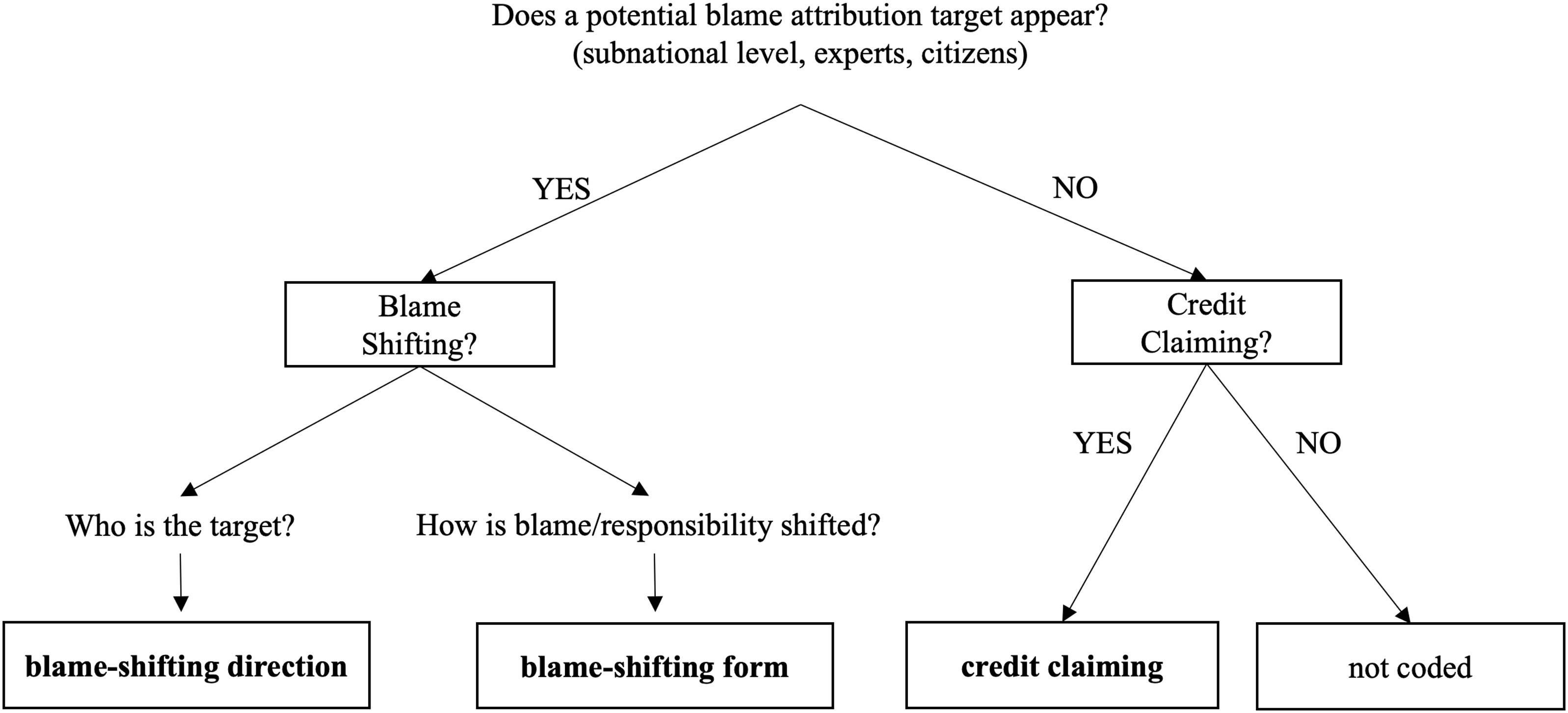
In the second year of the COVID-19 pandemic, policies were mostly focused on vaccination and testing strategies. These policies (particularly vaccination policies) led to controversies within society and were fuelled by opposition parties. Finding the right words to gain public support and, at the same time, facing elections seems particularly challenging for officeholders. It is also the moment when voters choose their favourite candidates and parties and when reputation becomes particularly relevant. This context is crucial for a comprehensive understanding of credit-claiming and blame-shifting patterns which will be analysed as follows: Similar to Kriegmair et al. (Reference Kriegmair, Rittberger, Zangl and Heinkelmann-Wild2021), I operationalise public responsibility attribution (PRA) by identifying the attribution object (policy which leads to a controversy), the attribution sender (officeholder under pressure giving a public statement), and the attribution target (to whom the officeholder shifts blame). The units of analysis are hence officeholders’ utterances, and they are coded as shown in Figure 2. In addition to blame-shifting strategies, I analyse if credit is claimed.
Decision tree: credit claiming and blame shifting.
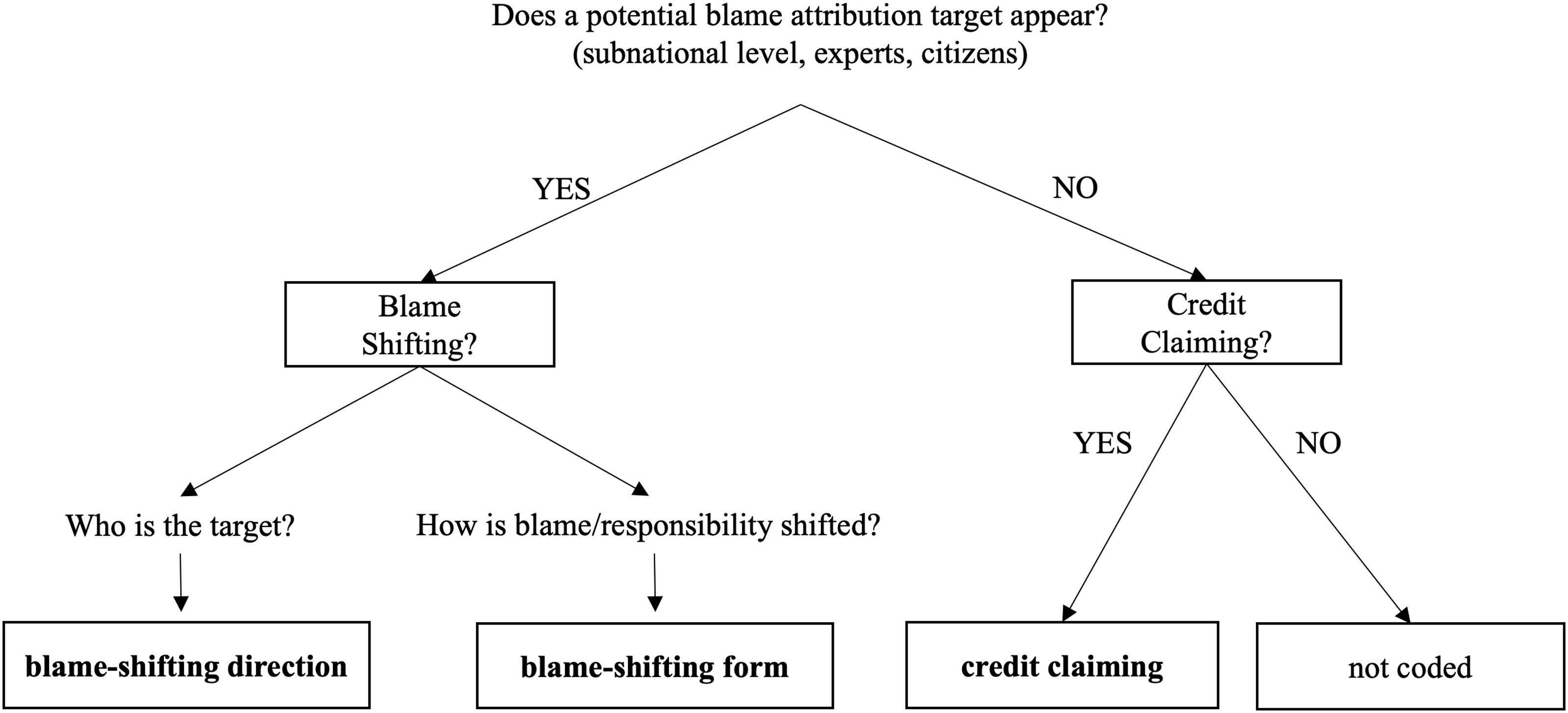
Figure 2 shows that when a potential blame target is mentioned in a speech, two things need to be considered: to whom officeholders shift responsibility or blame (direction) and how they are doing it (form). When officeholders shift, share or explain responsibilities for a potentially contested policy, they can avoid future blame – also called anticipatory blame avoidance (Hinterleitner & Sager, Reference Hinterleitner and Sager2017). Both shifting and sharing responsibilities are thus types of verbal blame shifting. But there are important differences between implicit and explicit blame-shifting: Implicit forms include praising another actor or sharing responsibilities (e.g., by reminding the public that responsibility is shared in complex systems like multi-level governance). Explicit forms involve clearly shifting responsibility away from oneself or blaming another actor. In both implicit and explicit verbal blame shifting, officeholders try to avoid taking (sole) responsibility. In contrast, when officeholders praise their own actions, they engage in credit claiming and take responsibility for something that went well.
Data
The data set consists of media conferences organised by the so-called ‘Bundespressekonferenz’ (BPK), which is an independent journalist organisation. These media conferences are publicly available and can be found on the BPK YouTube channel. The BPK invited government officials and experts to inform journalists and the public about the status of the COVID-19 pandemic and included Q&As. There were also other channels of communication used by the government and the Federal Ministry of Health during the COVID-19 pandemic. However, during the BPK, journalists had the chance to ask critical questions and Jens Spahn had to justify policies. Moreover, the BPK took place regularly. There was only a gap during the summer, likely because of lower COVID-19 numbers (in Switzerland, for example, the government also held less media conferences about COVID-19 during this period). The analysed videos reached between 4,000 and 30,000 viewers per media conference. This number is not extremely high, but since journalists from different media houses were present at these media conferences, blame games, credit claiming, and explanations reached a lot more people indirectly through the media. For the reasons above, the BPK is suitable to analyse credit-claiming and blame-shifting strategies.
I focus on speeches and answers by the former Minister of Health Jens Spahn (Christian Democratic Union of Germany/CDU) because he was, together with his office, the central crisis manager and particularly under pressure publicly during the pandemic. At the same time, he was a politician facing the approaching federal election and potentially needed to form a coalition with opponents. Ministers therefore have two roles when facing an election during crisis: crisis manager and election candidate. In their communication strategies, they need to be considerate of both roles.
I analyse media conferences between January 2021 and December 2021. The first reason to choose this time is that the federal election took place in Germany on 26.9.2021, allowing to analyse changes in credit-claiming and blame-shifting patterns before and after the election. Second, the first shock of the pandemic was over, but with the ‘federal emergency brake’, governance was consolidated at the national level. This situation affects vertical blame-shifting opportunities to the subnational level and allows to analyse if changes in the institutional context lead to changes in the blame-shifting direction. The data set consists of 12 media conferences. The distribution of the analysed media conferences allows to compare credit-claiming and blame-shifting patterns before the federal election (29.1., 19.2., 26.2., 12.3., 29.4., 12.5., 10.6., 25.6.) and after the election (6.10., 3.11., 26.11., 3.12.) by using percentage shares for each strategy (credit claiming and blame-shifting moves). It also allows to analyse changes before (29.1., 19.2., 26.2., 12.3.), during (29.4., 12.5., 10.6, 25.6.) and after (6.10., 3.11., 26.11., 3.12.) the ‘federal emergency brake’. This leads to a total of 472 coded segments, which entail credit-claiming and blame-shifting strategies to the subnational level, citizens and experts.
Method
First, a qualitative content analysis of the media conferences helps to code utterances and to identify blame-shifting forms and directions abductively by using the MAXQDA software. The coding scheme is hence based on blame avoidance literature and complemented by analysing the given data. MAXQDA also allows to count credit claiming and the number of each blame-shifting form and direction and to calculate the percentage shares. In this way, blame-shifting moves per target and the form of blame shifting can be analysed over time. This approach allows to analyse the mechanisms between crises, elections, form of government, governance structures and the choice of communication strategies.
Intercoder reliability is ensured through careful definition, discussion, and redefinition of blame-shifting categories to achieve a common understanding of the concepts. For this, two coders who independently coded four media conferences discussed the results and achieved 99% intercoder agreement in MAXQDA. Subsequently, a fifth media conference was coded independently, resulting in an agreement of 62%. To ensure consistency, both then coded and discussed all 12 media conferences. These discussions led to a codebook and Table A1 (see Appendix below). A third person then coded a randomly selected sample of 18% (n = 84) of statements to assess intercoder reliability. This resulted in a Krippendorff’s alpha of 0.72, considered sufficient for exploratory and descriptive research (Krippendorff, Reference Krippendorff2011).
Results
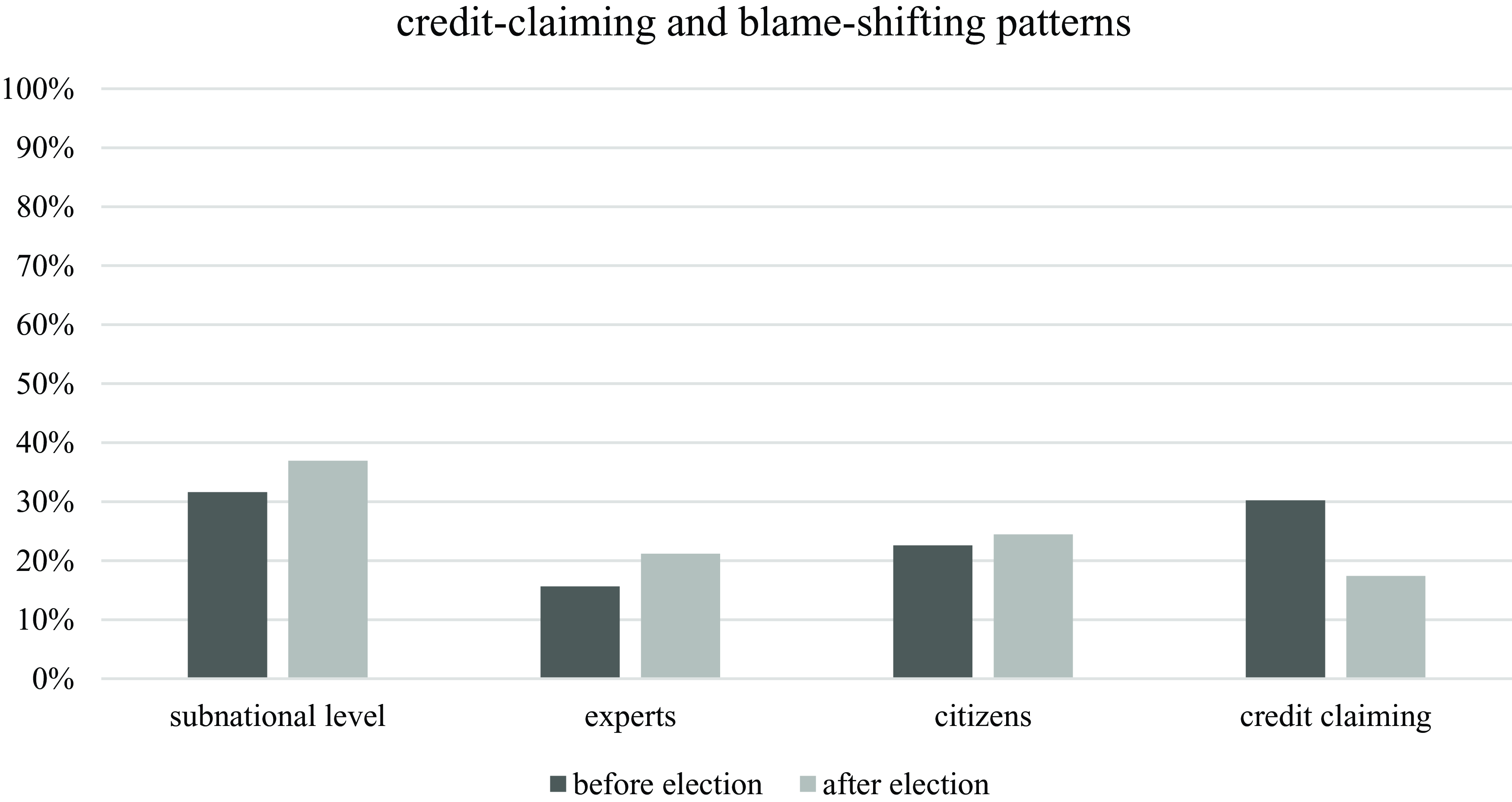
This section provides empirical findings for each expectation. Figure 3 illustrates that before the federal election, the Minister of Health used credit-claiming strategies almost as often as he shifted responsibility and blame to the subnational level. Compared to experts and citizens, he even used credit-claiming strategies more often. For example, he claimed credit in the beginning of 2021 by saying: ‘I can only say that we have already created the legal and financial foundation months ago for significantly more tests in care facilities, both ambulant and stationary’ (Jens Spahn, BPK 29.1.21). And a few months before the federal election: ‘[…] compared to many other countries in Europe and around the world, we have overall come through this pandemic, this crisis of the century, relatively well so far’ (Jens Spahn, BPK 25.6.21).
Percentage share of blame-shifting moves to each blame attribution target and of credit claiming before and after the federal election.
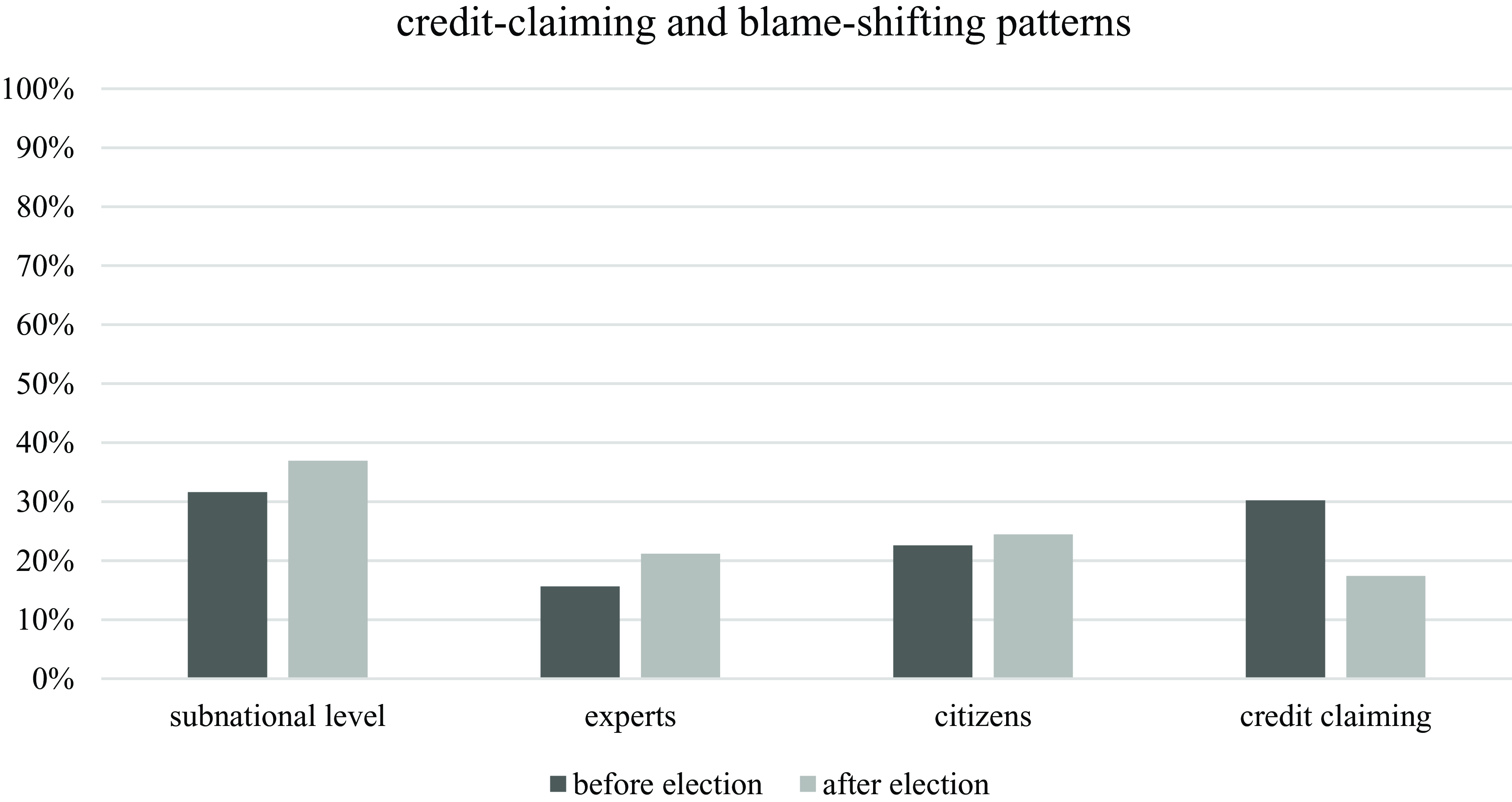
Credit claiming was a frequent communication strategy – particularly before the federal election – but in total, the Minister of Health shifted or shared responsibility and blame more often than he claimed credit. However, he rather claimed credit than he made citizens and experts responsible before the election. After the election, credit claiming decreased, and blame shifting remained on a high level. These results are hence partly in line with the expectation that (1) during crisis, officeholders engage more in credit claiming than in blame shifting before elections.
Figure 4 provides a clearer picture of blame-shifting forms used within the political system, or more precisely, from the national to the subnational level. The different forms of blame shifting have been derived abductively. The Appendix below provides an overview of the blame-shifting forms with examples for each strategy. Figure 4 shows that Jens Spahn used praising strategies to shift the focus away from the federal government. For example, by saying: ‘The Länder are doing good work under these difficult conditions’ (Jens Spahn, BPK 29.1.21). However, praising the subnational level for their good work was not a very frequent strategy before the election and even decreased slightly after the election. Instead, the Minister of Health frequently shared responsibilities and reminded the public of the federal system – another implicit form of blame shifting. For example, by saying: ‘It’s important that the federal and state governments work together’ (Jens Spahn, BPK 29.1.2021), the Minister of Health stressed that the federal and subnational levels share responsibilities for crisis management.
Percentage share of each form of blame shifting towards the subnational level before and after the federal election.
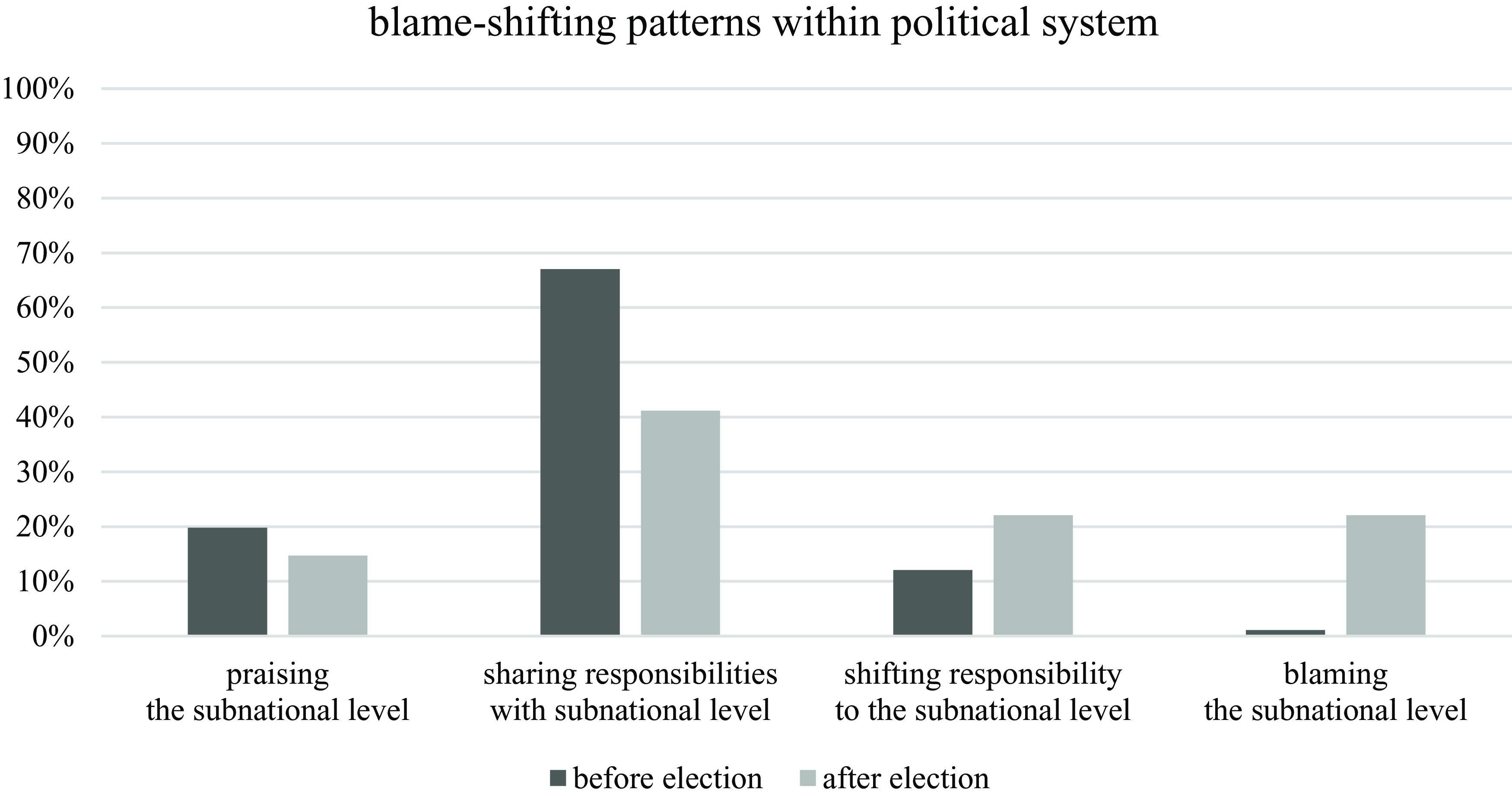
He also used more explicit strategies to shift responsibility to the subnational level – particularly after losing the election: ‘[…] I would like the Länder to expand their public vaccination offers. These don’t have to be the central, large vaccination centers’ (Jens Spahn, BPK 3.11.21). He also blamed the subnational level and played the Länder off against each other: ‘I just want to say: we have federal states where 60% of 12- to 17-year-olds are vaccinated. And we have states where it’s only 20 to 30%’ (Jens Spahn, BPK 3.11.2021). Without calling names, Jens Spahn hence quite explicitly blamed Länder with low vaccination rates. He also blamed other political actors for not assessing the severity of the crisis right: ‘So many, whether in political responsibility or future responsibility, seem to think it will somehow work out. But it won’t’ (Jens Spahn, BPK 26.11.21).
Figure 4 shows that blaming the subnational level was quasi-non-existent before the election. It only increased after Jens Spahn and his party lost the election. Moreover, shifting responsibility to the subnational level increased after the election. This might also be due to the ‘federal emergency brake’, which was in force before the election and restricted opportunities to shift responsibility and blame to the subnational level. Most prevalent was the sharing responsibilities strategy. This strategy remained at a high level also after the federal election. These findings support the expectation that (2) in multi-party coalition governments, officeholders use the implicit form of responsibility sharing rather than the explicit form of blaming within the political system before elections.
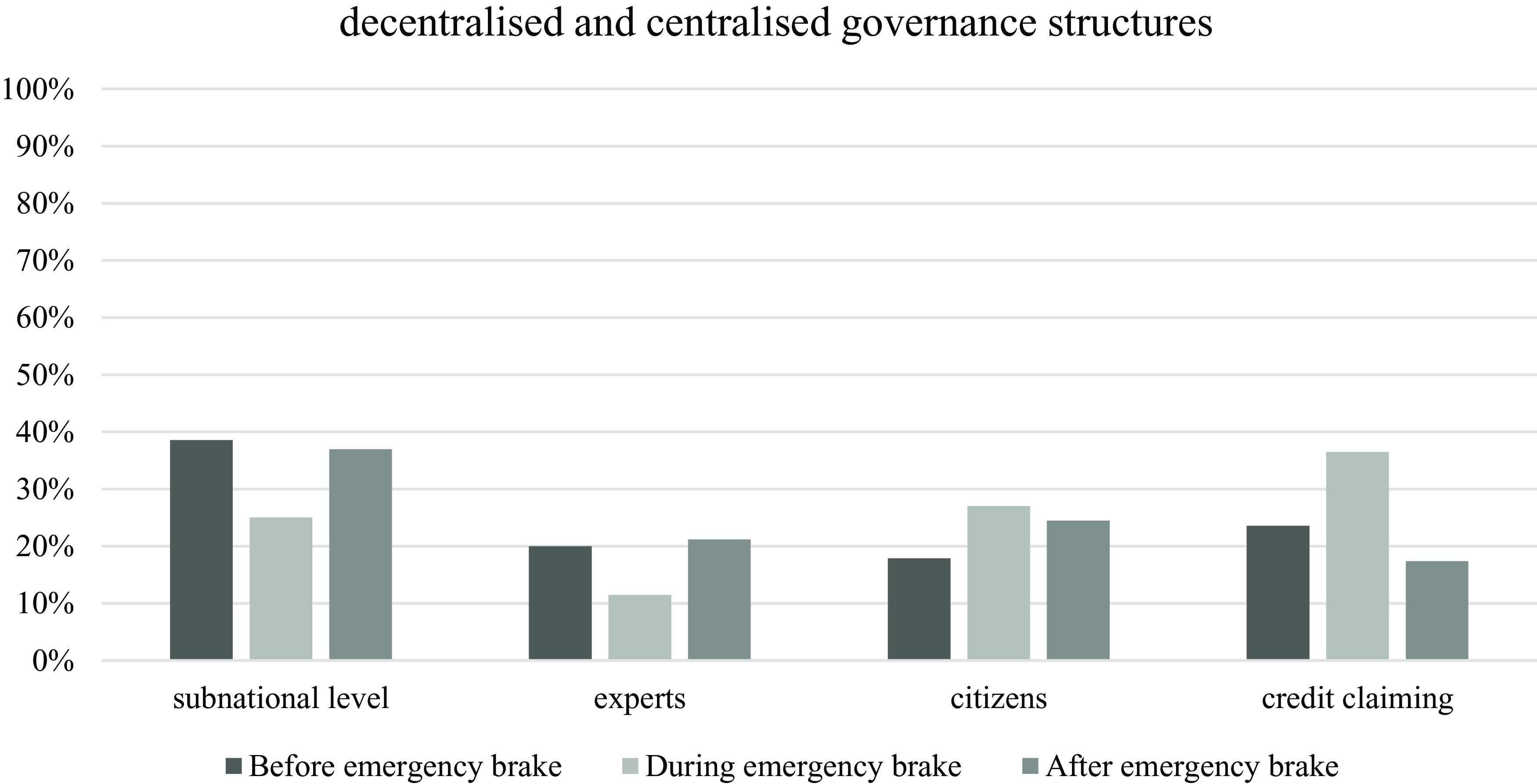
Figure 5 illustrates that during the ‘federal emergency brake’, between 23.4.2021 and 30.6.2021, blame and responsibility shifting towards the subnational level decreased and shifting responsibility to citizens increased. This indicates that governance structures shape blame-shifting directions. Experts received the lowest percentage share of blame-shifting moves and even less during the ‘federal emergency brake’. Credit claiming became the most frequent strategy during the ‘federal emergency brake’ – only a few months before the federal election.
Percentage share of blame-shifting moves to each blame attribution target and credit claiming before, during and after the ‘federal emergency brake’.
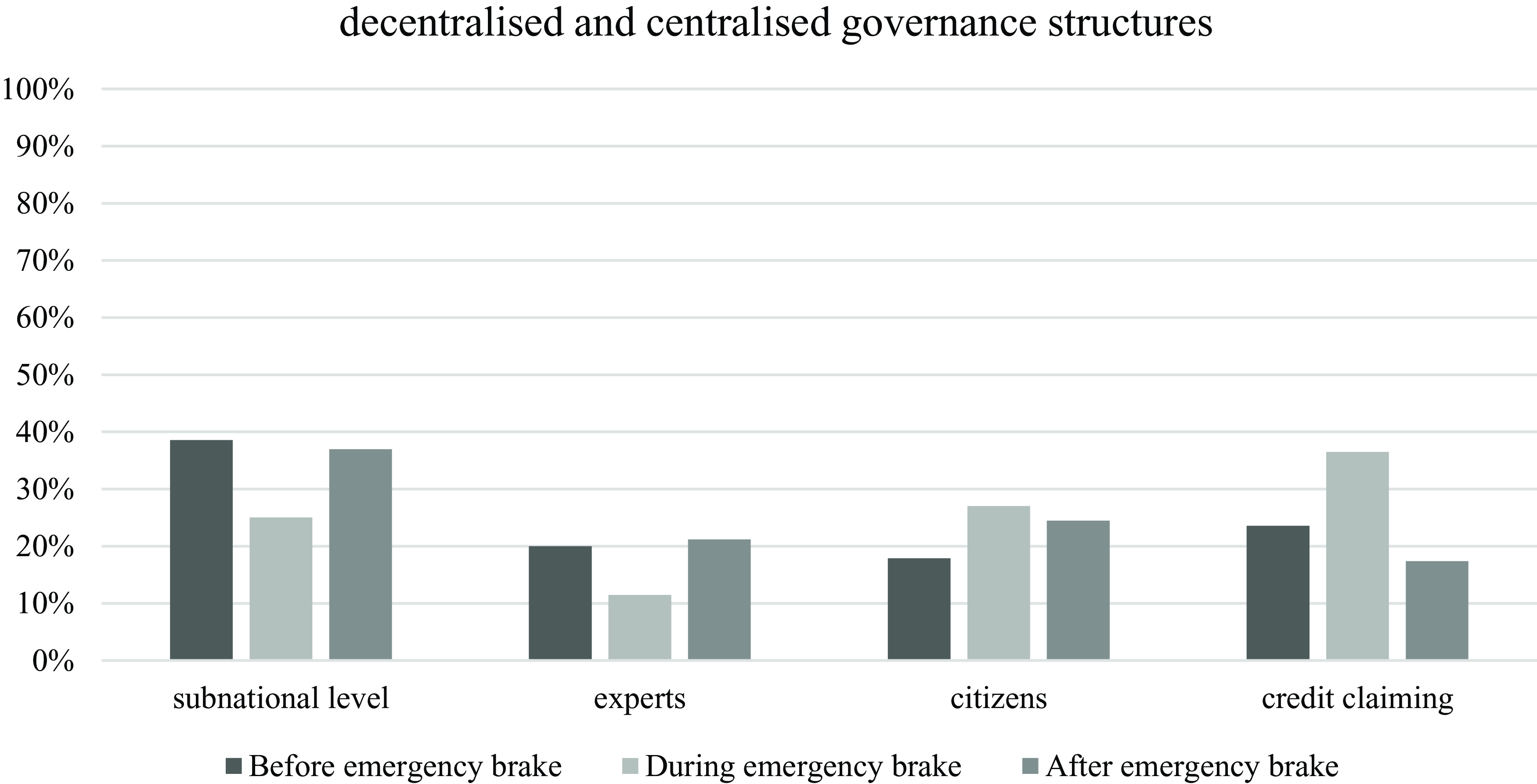
These results are partly in line with expectation (3) during centralised governance structures, the subnational level receives less responsibility and blame, while experts and citizens receive comparatively more responsibility and blame. Overall, the results indicate that officeholders not only shift blame but also claim credit – even in times of severe crisis and particularly before elections. Moreover, the findings indicate that volatile multi-party coalitions and vertically integrated party systems moderate blame games and that centralisation impedes blame shifting towards the subnational level. Simultaneously, citizen blaming increases in times of emergency law.
Discussion
The theoretical contribution of this study is to combine situational factors (crisis and election) with two institutional moderator variables (form of government and governance structures) to explain credit claiming, blame-shifting form and direction. Empirically, this study fills a research gap by analysing the case of Germany, where the COVID-19 crisis coincided with the federal election. In many other countries, emergency laws were introduced quite early in the pandemic to centralise decision-making, but not in Germany. The introduction of the ‘federal emergency brake’ during the second year of the pandemic is hence somewhat surprising and might have a strategic component: to claim credit and simultaneously be able to avoid blame through automatic government. These findings are in line with Greer et al. (Reference Greer, Rozenblum, Falkenbach, Löblová, Jarman, Williams and Wismar2022) who state that centralisation and decentralisation patterns in times of crisis can be explained by officeholders’ efforts to gain credit and deflect (potential) blame. The findings of this study are also partly in line with the first expectation: the German Minister of Health does engage more in credit claiming before the federal election than after the election. However, overall, he shifts blame more often than he claims credit. Further research might analyse how these patterns look like in a different situational context, for example, when an election meets a distant and non-salient crisis.
Second, the findings support the second expectation that officeholders in consensus-oriented, federal coalition systems use implicit forms of blame shifting rather than explicit blaming, which is also in line with the findings of Souris et al. (Reference Souris, Kropp and Nguyen2023). The present study further elaborates on blame-shifting forms and shows that blame can be deflected quite implicitly, for example, by reminding the public of the given governance structures (sharing responsibilities) or by praising another actor. This, in turn, can support democratic governance and have a stabilising character in times of crisis. However, further research is needed to analyse if and how crisis communication can affect public perception of democratic norms and governance. Future studies might also look at cases with more elite polarisation or how blame-shifting patterns appear in majoritarian democracies.
Third, this study looks at governance structures and how they affect credit-claiming and blame-shifting patterns. The results indicate that by centralising governance, officeholders on the national level decrease the possibility of shifting blame to the subnational level, which is in line with Hinterleitner et al. (Reference Hinterleitner, Honegger and Sager2022). During the same period, blame shifting towards citizens and credit claiming increases. This finding indicates that centralising governance structures can be used to claim more credit and that officeholders praise their own work, particularly before elections. Future research might also analyse unitary systems with more centralised governance structures.
Although the most frequent strategy was sharing responsibilities with the subnational level, credit claiming was used almost as often and even more often during the ‘federal emergency brake’ and the months before the federal election. The analysed data support the finding that a technocratic model of policymaking is used to shift blame to experts (Kuhlmann et al., Reference Kuhlmann, Franzke and Dumas2022), but the results also show that this strategy was not frequently used by the Minister of Health during the second year of the pandemic. The findings rather indicate that officeholders shift responsibility to the citizens, which is in line with Dowding’s (Reference Dowding2020) findings. Future research might also reveal other blame attribution targets depending on the type of crisis and the institutional context, or shed light on the role of individual responsibility and citizen blaming in times of crisis. The findings are tightly coupled with the given case and the political actor. It is therefore not possible to generalise the findings. However, the new form of operationalisation of credit-claiming and blame-shifting patterns elaborated in this research can be used for further studies in different institutional and political contexts, which might lead to more generalisable results. To increase intercoder reliability, future studies might work with less categories (e.g., implicit and explicit blame shifting) or further refine the existing categories.
Conclusion
To answer the question of how elections affect credit-claiming and blame-shifting patterns in times of crisis, this study sheds light on the communication strategies used by the German Minister of Health during the COVID-19 pandemic while simultaneously facing federal elections. The findings contribute to a better understanding of the politics of governing crises and illustrate how officeholders communicate when put under crisis-related and political pressure simultaneously. The study also highlights how the form of government and governance structures shape officeholders’ communication strategies in terms of credit claiming, blame-shifting form and direction. By stressing the importance of situational and institutional factors and by providing more nuanced ways of measuring blame shifting, this study opens up new analytical avenues for research on crisis communication.
The study indicates that officeholders, like the German Minister of Health, shift blame to other levels of government and non-political actors like citizens or experts, but also frequently claim credit to uphold and foster their reputation and electoral success. This is in line with recent findings on the use of credit-claiming strategies and contrasts with the common understanding of prospect theory. The results also indicate that vertical blame-shifting strategies within cooperative multi-party coalition systems are rather implicit: Despite high pressures created by the COVID-19 crisis and the federal elections, the Minister of Health mainly chose implicit forms of blame shifting towards the subnational level before the election. This changed after losing the election when Jens Spahn started blaming Länder and municipalities. This indicates that the vertically integrated party system can moderate blame shifting before elections. The results also indicate that sharing blame with the subnational level is easier when governance structures are decentralised. In other words, institutional factors can moderate blame games in particularly challenging situations when it is essential for political systems to address societal and underlying political problems instead of getting caught up in blame games.
As a single case study, the findings do not provide any causal evidence, nor do they claim generalisability. Nevertheless, this study provides important empirical findings and a new framework for future studies to operationalise and compare credit-claiming and blame-shifting patterns in different institutional and situational contexts. To better understand how governance structures and forms of government impact credit-claiming and blame-shifting strategies, more studies in different political systems and during diverse forms of crises are needed. Further research is also necessary to analyse the role of strategic crisis communication in shaping both public perception and public policies. This study thus provides a foundation for more comprehensive analyses aimed at better understanding the linkages between crisis, politics, institutions, and strategic communication, encouraging further context-driven blame avoidance research.
Supplementary material
The supplementary material for this article can be found at https://doi.org/10.1017/S1475676525100443
Data availability statement
The data that support the findings of this study are available on request from the corresponding author.
Acknowledgements
I would like to thank Baptiste Ruedin and Tom Felber for their help with coding the data and Fritz Sager and Susanne Hadorn for their valuable feedback on earlier drafts of the article.
Funding statement
This work was funded by the Multidisciplinary Center for Infectious Diseases (MCID) under Grant MCID_ECRG_12.
Competing interests
The author reports there are no competing interests to declare.
Appendix
In general, the same blame attribution targets as seen in the literature review can be found in the analysed data: subnational level, citizens and experts. Similar to Souris et al. (Reference Souris, Kropp and Nguyen2023), blame shifting ranges between soft and hard forms. However, blame-shifting direction and form differ between the executive government and the legislative parliamentary debates analysed by Souris et al. (Reference Souris, Kropp and Nguyen2023). While parliamentarians attribute blame to a certain actor, officeholders who are in the media spotlight, rather shift blame. I hence use the terms blame-shifting direction and blame-shifting form. Table A1 provides an overview of the identified strategies and shows some examples for each form of blame shifting and credit claiming. While praising other actors and sharing responsibilities are implicit forms of blame shifting, shifting responsibility and blaming are explicit forms of blame shifting.
Identified forms of blame shifting and blame attribution targets




 Open access

