

The curation crisis has generated a great deal of debate regarding its causes and how to solve its concurrent problems (Barker Reference Barker, Zimmerman, Vitelli and Hollowell-Zimmer2003, Reference Barker and Terry Childs2004; Bawaya Reference Bawaya2007; Childs Reference Childs1995, Reference Childs2004, Reference Childs, Agnew and Bridgland2006; Kersel Reference Kersel2015; Sullivan and Childs Reference Sullivan and Childs2003). S. Terry Childs and Danielle M. Benden (Reference Childs and Benden2017:12) state that “inadequate, unsecure storage space, shortage of professional curatorial staff, poor accessibility to collections for research and other uses, and orphaned collections are some of the many problems identified as part of the curation crisis besieging the United States … and many other countries.” Katie Kirakosian and Heidi Bauer-Clapp and (Reference Kirakosian and Bauer-Clapp2017) emphasize the need to properly care for the archives (“the paper trail”) and discuss what to save and how, curation considerations, digitization of analog records, and the storage of both digital and non digital materials. It has also been pointed out that it is unethical to continue excavating without long-term planning for proper curation or correct methods (Majewski Reference Majewski2010, Reference Majewski, Terry Childs and Warner2019; Sonderman Reference Sonderman and Terry Childs2004; Trimble and Marino Reference Trimble, Marino, Zimmerman, Vitelli and Hollowell-Zimmer2003). Furthermore, within the discipline of archaeology, there is misinformation when it comes to the scale, current location, and composition of existing collections. In this article, I argue that one way to avoid worsening the archaeological curation crisis is to embrace the analysis or reanalysis of existing collections, rather than creating new collections through academic investigations of unthreatened sites.
Now is the time to advocate strongly for museum-based research for graduate theses and dissertations in lieu of new field-based research (Childs Reference Childs, Agnew and Bridgland2006; Goetze and Mills Reference Goetze and Mills1991; King Reference King2016; MacFarland and Vokes Reference MacFarland and Vokes2016; Rothschild and Cantwell Reference Rothschild and Cantwell1981; Schiappacasse Reference Schiappacasse2016a; Stone Reference Stone2018; Swain Reference Swain2007). As Childs and Benden have remarked, “Both archaeologists and granting institutions, such as the National Science Foundation (NSF), National Endowment for the Humanities (NEH), and the Wenner-Gren Foundation, should support research on existing collections to validate their research potential and justify the need for their long-term curation” (Reference Childs and Benden2017:18). Julia A. King (Reference King2014) also makes a sound point: “Collections-based research should be at the forefront of possibilities for the design and development of archaeological academic projects.”
Throughout my career, I have studied archaeological collections from Puerto Rico in an effort to shed light on their historiography and encourage revisions to their interpretation. My investigations begin by first finding these collections and then developing collections-based research questions and projects that can enhance our knowledge of the past without creating new collections. My hope is that by highlighting the value of existing collections, others will be encouraged to follow this research approach.
As part of my master's thesis, I studied precolumbian collections in four museums across the eastern United States. Tracking down known collections was possible by consulting published resources and conferring with local archaeologists (Stone Reference Stone2018). The most significant difficulties encountered in these initial investigations were as follows: obtaining funding for research trips (because of a historical lack of curation facilities on the island, as well as a result of archaeological expeditions and private collecting, Puerto Rican collections are widespread in off-island locations), determining the identity and contact information for museum personnel in charge of access to each collection, and delineating the specifics on the size and composition of each collection (see Stone [Reference Stone2018] for practical advice on how to conduct research using museum collections). Looking back, I can see how much progress has been made at repositories in terms of access and use. Today, it is feasible to conduct a significant amount of research using online resources, cutting down on expenses (King Reference King, Sebastian and Lipe2009; King and Samford Reference King and Patricia2019).
Eventually, research interests led me to work with Spanish colonial collections curated by the San Juan National Historic Site (U.S. National Park Service) and the Museum of History, Anthropology and Art of the University of Puerto Rico, Río Piedras. The majority of collections have one unfortunate commonality: an absence or incompleteness of information, whether provenience, associated records, uncataloged artifacts, and/or final reports (Barker Reference Barker, Zimmerman, Vitelli and Hollowell-Zimmer2003; King Reference King2014). Some collections are known as orphaned collections (those with unclear ownership and not in qualified curatorial facilities) or legacy collections (those that do not comply with current curation standards; MacFarland and Vokes Reference MacFarland and Vokes2016:162).
COLLECTION-BASED RESEARCH: PUERTO RICO AS A CASE STUDY
Archaeological collections generated through various activities can be found in museums, universities, foundations, and government agencies (Voss Reference Voss2012; Warner Reference Warner2014). Using Caribbean collections as a case study, it is clear that their histories are complex. Through the avenue of collections-based research, we are better poised to identify the collectors, acquisition processes, provenience and provenance, collection size, completed studies, and publications. In order to delineate the history of Caribbean archaeological collections, it is important to know how many artifacts have been taken off-island as a formal collection to be accessioned in a museum and eventually loaned, exchanged, or gifted. Indeed, the vast majority of the archaeological material excavated in Puerto Rico is often not curated on the island.
The earliest written references to the collection of objects employed by native Caribbean populations can be found in Spanish chronicles. The exact number of items that may have been taken to Europe from the sixteenth through the twentieth centuries by colonial hegemonic powers (Spain, France, England, Denmark, Sweden, the Netherlands, and Courland [Germany]) is currently unknown. During the eighteenth and nineteenth centuries, the art of collecting was intertwined with antiquarianism, and in the case of Puerto Rico, it was members of the elite who accumulated artifacts and exchanged them with fellow collectors and, in some instances, with those hoping to understand the cultural groups responsible for such craftsmanship. Some of those collections eventually found their way to museums in Berlin, Madrid, Copenhagen, London, and Paris, as well as institutions in the United States. The European Research Council's project NEXUS1492: New World Encounters in a Globalizing World carried out a survey of collections in selected European museums. Mariana Françozo and Amy Strecker (Reference Françozo and Strecker2017:456) report that “collections of Caribbean archaeological objects have been identified in 59 museums across Europe.” The NEXUS 1492 project database can be queried for information by sorting the object's material class (10 variables), collecting period (5 variables), and collection origin (35 variables). From this database, it is possible to identify at least 18 museums in Austria, Belgium, Denmark, England, France, Germany, the Netherlands, and Spain with collections from Puerto Rico.
In the late nineteenth and early twentieth centuries, numerous collections from Puerto Rico were acquired by museums in the United States, such as the National Museum of Natural History (NMNH), the American Museum of Natural History (AMNH), the Yale Peabody Museum of Natural History (YPMNH), and the Peabody Museum of Archaeology and Ethnology (PMAE) at Harvard University. In addition, collections were derived from fieldwork conducted by Jesse W. Fewkes (Reference Fewkes1903) for the Bureau of American Ethnology; Franz Boas, Robert Aitken, Herman Haeberlin, John Mason, and Herbert Spinden from the AMNH (Britton Reference Britton1926; Haeberlin Reference Haeberlin1917; Mason Reference Mason and Hodge1917, Reference Mason1941); Froelich Rainey and Irving Rouse from YPMNH (Rainey Reference Rainey1940; J. Rodríguez López Reference Rodríguez López2009; M. Rodríguez López Reference Rodríguez López1989; Rouse Reference Rouse1952a, Reference Rouse1952b); and Samuel K. Lothrop from PMAE (Guzmán Reference Guzmán2011; Lothrop Reference Lothrop1917; Schiappacasse Reference Schiappacasse1994, Reference Schiappacasse, Pérez Merced and Rivera Fontán2002).
Some of the problems with these early collections include scarce or nonexistent acquisition data; high monetary value having led to removal and sale of certain items; changes to the original collection due to poorly documented exchanges and gifts; and lack of associated materials such as notes, drawings, maps, photographs, or reports. Here, I will discuss a few examples from my research carried out at the NMNH in Washington, DC, the AMNH in New York City, and the San Juan National Historic Site in Puerto Rico.
Collections at the National Museum of Natural History
The NMNH inventory includes information pertaining to the donor, date accessioned, collector, and date collected, among other information. Through these records, I have discovered that 16 collections from Puerto Rico resulting from various activities have been accessioned, amounting to 1,228 entries (Schiappacasse Reference Schiappacasse1994; see Table 1). Currently, the information can be consulted using the Smithsonian Collections Search.
Collections at the National Museum of Natural History.

Source: Museum database and Jesse W. Fewkes papers, Identifier NAA.MS4408, Field notes 45, 45a, 45b.
George Latimer Collection. Although the scarcity of acquisition data might be problematic, there are viable solutions to augmenting these documents by tracking down information related to the collector and those involved in the acquisition, registration, and cataloging processes of these artifacts. The NMNH was among several museums in the United States interested in archaeological artifacts from Puerto Rico in the late nineteenth and early twentieth centuries. Their first accessioned collection from the island was bequeathed by George Latimer, U.S. consul to Puerto Rico, and consisted of ceramic and stone objects (NMNH, Accession No. 1534). The documentation related to this collection, specifically the card catalog of accessions and the catalog database, contains 256 entries.
Three stone collars, six stone chisels, and six pottery images, were registered on April 1869 (NMNH, Ledger book, Vol. 2, p. 182), and the rest were bequeathed through his nephew William Latimer in May 1875. Former curator Otis Tufton Mason published the report The Latimer Collection of Antiquities from Porto Rico in the National Museum in 1876, which was republished in 1899. He provides a description of the artifacts and explains that the collection was ceded and consisted of artifacts found in caves or during agricultural activities. Latimer acquired the items during his frequent travels around the island (Mason Reference Mason1899).
Jesse W. Fewkes Collection. This collection was accessioned in 1904 and consists of 522 artifacts that were either purchased or donated by local collectors during Fewkes's fieldwork on the island between 1902 and 1904 (Fewkes Reference Fewkes1907:17). W. H. Holmes, chief of the Smithsonian Institution Bureau of American Ethnology, in his administrative report for the fiscal year 1904, describes Fewkes's dealings and the formation of the eponymous collection:
March and April were spent by Doctor Fewkes mainly on the southern side of the island of Porto Rico.… He purchased in Ponce the important collection of Senor Neumann, containing several stone collars, rare idols, complete pieces of pottery, and other objects. The whole collection made by Doctor Fewkes, including ethnological and archeological objects, numbers 630 specimens [Holmes Reference Holmes1907:xv].
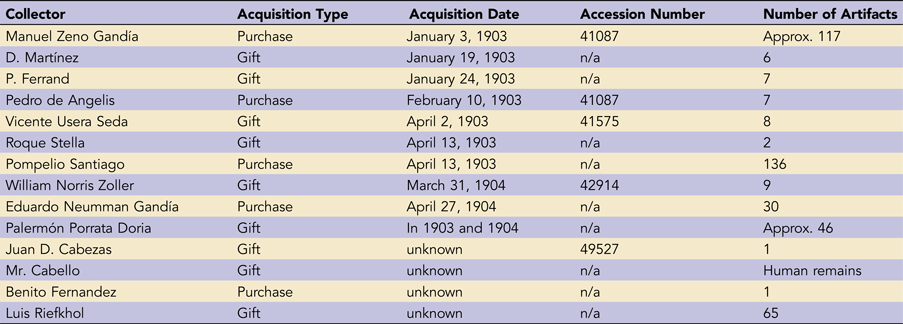
This made evident the possibility that the artifacts’ provenance could have been truncated, since in the museum database, Fewkes is listed as the donor, while no information was recorded under the collector's name. Therefore, accession files for the collection were consulted, including forms titled “Memorandum to Registrar.” An entry that reads, “Please enter as accession from,” signed by curators Otis Mason and Walter Hough between 1903 and 1904 was identified. Furthermore, Fewkes's field diaries and notebooks, available for consultation at the Smithsonian Institution National Anthropological Archives, became a decisive source for understanding how he secured local private collections (finding aids are available through Smithsonian Collections Search). Table 2 shows the information compiled from three notebooks: (#45) Diary: Puerto Rico trip, continued; (#45-a) Diary and archaeological notes and drawings: Puerto Rico and Santo Domingo; and (#45-b) Notebook (Smithsonian Institution National Anthropological Archives, Jesse Walter Fewkes papers, MS 4408, Box 6).
Collections Acquired by Jesse Walter Fewkes.

Source: NAA.MS4408, Field notes 45, 45a, 45b.
Information about these collectors is pivotal to understanding who was collecting what and when, identifies how the artifacts were originally acquired (e.g., if Fewkes contacted them or vice versa), the nature of the acquisition, and how much was paid for certain objects. Five collections were purchased. It is interesting to know that Pompelio Santiago was paid 25 cents to a dollar for each of the five stone collars he sold, and 16 years later, the museum paid $15 to acquire a three-pointed stone, or cemi, from Janet Hays Houston (Schiappacasse Reference Schiappacasse1994). It is appropriate to note here that the Fewkes collection underlines the high research value of these early collections because he and other early investigators were often able to amass collections of excellent examples of items very rarely seen in more recent collections.
Agustín Stahl Collection at the American Museum of Natural History
Agustín Stahl was born in Puerto Rico in 1842 to a German father and a Dutch mother (Maldonado Reference Maldonado2010). He was raised on the island and carried out studies in anthropology, zoology, botany, and ornithology in both Germany and Spain. One of his biggest contributions to the field of anthropology was his book Los Indios Borinqueños (Stahl Reference Stahl1889) in which he explored a myriad of topics and includes an inventory of his collection of 600 stone hatchets, 44 figurines, 22 stone collars, 12 mortars, and 62 diverse artifacts. This collection, commonly known as the Stahl Collection, was acquired by the AMNH in 1900 and reported by Jesse W. Fewkes in his 1903–1904 report (Reference Fewkes1907:22).
The story behind how the collection ended up in New York is explained by Frederic Ward Putnam, then director of the Department of Anthropology, in a letter addressed to the president of the museum, Morris K. Jessup (AMNH, Anthropology Division, Agustín Stahl Acquisition file, letter, 28 July 1900). In 1900, Stahl traveled to New York and met with Putnam to explore the possibility of the museum acquiring his collection, which he had shipped at his own expense and was in the museum at the time of their meeting. Putnam provided the following comment: “It is a collection of great scientific value and interest, and if it can be secured for the Museum, it will make our exhibit from Porto Rico equal if not superior to any in the world” (AMNH, Department of Anthropology, Agustín Stahl Acquisition file, letter, 28 July 1900). Putnam implied that the collection could be acquired for $1,500–$1,800. Unfortunately, no records related to the official purchase were found within the acquisition file except a handwritten list titled “The Agustín Stahl Collection from Porto Rico, 1900,” and annotated on the side, it reads, “Collection [illegible] July 30,1900—Gift of Morris K. Jessup” (AMNH, Department of Anthropology, Agustín Stahl Acquisition file).
As seen in these short case studies, it is clear that the history of a collection can be gleaned through accession documents and field notes. But additional narratives could still be written about these histories. First, we should go back to the files and gather specifics on the purchase price of artifacts and/or whole collections to study how these numbers played a role in the acquisition process. Second, we must trace the path of exchanges of artifacts between museums. For example, some artifacts of the George Latimer Collection at the NMNH found their way to the PMAE and the Carnegie Museum of Natural History (CMNH) in Pittsburgh, Pennsylvania. At the time, it was a common practice for museums to exchange artifacts with little or no paper trail. Furthermore, 161 hatchets from the Agustín Stahl Collection ended up at the PMAE, YPMNH, and CMNH (Schiappacasse Reference Schiappacasse1994; Watters and Brown Reference Watters and Brown2001). The correspondence from museum personnel could shed light on the objectives behind these activities and which items were received in return. Were these exchanges made to expand the Caribbean holdings or the museum general collections? Moreover, it would be fascinating to learn if the original collectors had placed a ban on potential exchanges and/or requested that their collections remain intact, or at a specific location, and explore the consequences of such implications.
Considering that in many instances it is not feasible to travel to all the museums one would like to consult due to monetary and time constraints, there are other ways in which to build or increase a collection's intellectual offerings. For example, nowadays it is possible to gain access to digitized materials using online search aids to identify inventories, registries, photographs, and exhibition catalogs.
1961 El Morro, or Hale Smith, Collection at the San Juan National Historic Site
Castillo San Felipe del Morro is a massive masonry fortification that was constructed by the Spanish in the sixteenth century to protect the entrance of San Juan Bay, Puerto Rico. Various elements have been added and/or removed over the past five centuries to enhance the military defense aspects of the structure. The fortification remained under the Spanish crown until 1898, when it was turned over to the U.S. Army and Fort Brooke was established. In 1916, the National Park Service (NPS) was created, and in 1949, by order of the U.S. Congress, the San Juan National Historic Site (SJNHS) was established to preserve Spanish colonial fortifications in San Juan. Between 1949 and 1961, the army oversaw the preservation of these fortifications. Since 1961, the NPS has been the primary caretaker of Castillo de San Cristóbal, Castillo de San Felipe del Morro, much of the wall that surrounds the colonial city of San Juan, and Fortín de San Juan de la Cruz.
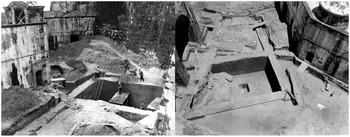
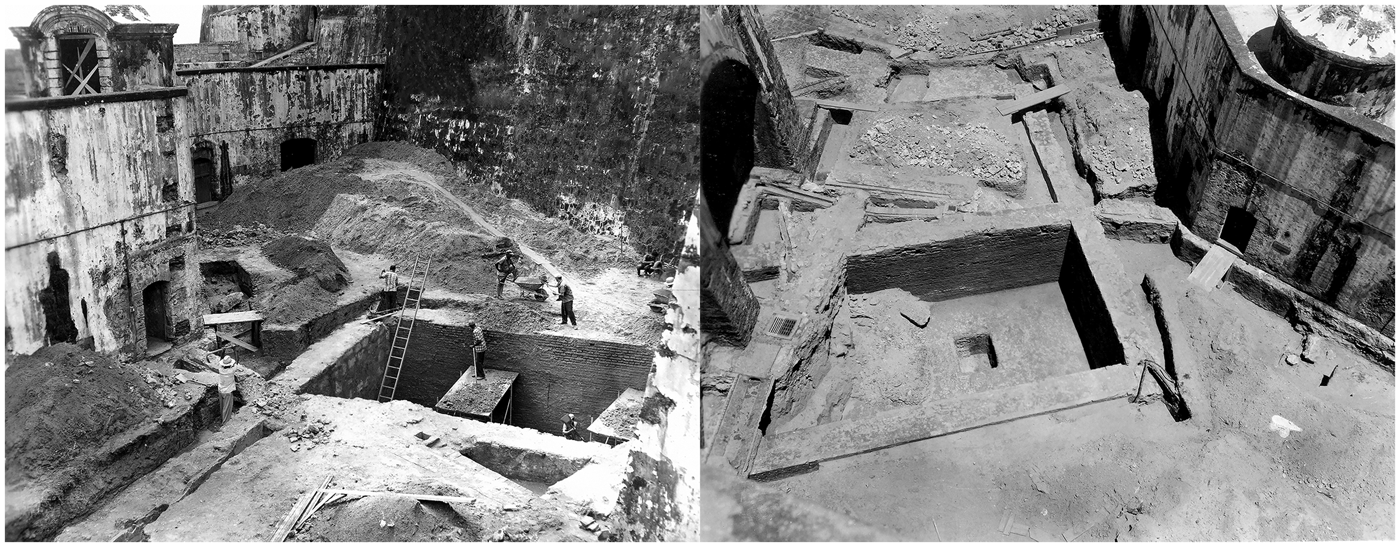
On April 3, 1961, the NPS drafted a contract with Hale G. Smith of the Department of Anthropology at Florida State University in Tallahassee. Smith was responsible for technical and professional services and directed excavations at the Castillo de San Felipe del Morro in San Juan (SJNHS, NPS, Accession file #40, Contract No. 14-10-0131-745). The work was to be completed with Mission 66 funds, monies set aside to modernize the national parks. The purpose and objectives of the excavations were “to disclose and register information which would serve as a guide for the repair, restoration, and interpretation of this historic fort … and determine the extent of archaeological research which might prove necessary at the site” (Smith Reference Smith1962:viii). To achieve these objectives, Smith selected four areas for the excavations that were carried out between June 12 and August 24, 1961. The moat area was selected to observe the construction details of the fortification. Five trenches were excavated, over 8,000 items were unearthed, and information regarding the construction episodes was successfully recorded. The second area studied was the kitchen and patio (Figure 1). The excavations exposed two structures in the patio, a forge and a kitchen, and 5,942 artifacts were collected. The third selected area was the water battery, whose original construction dates from the first half of the sixteenth century with later modifications. Almost 900 artifacts were recovered, and a hotshot oven was exposed. The fourth area corresponds to the shoreline trail where three test units were located, and 1,265 artifacts were collected. A year later, Smith published the field and laboratory report, Archaeological Excavation at El Morro, San Juan, Puerto Rico (1962).
Many local archaeologists in Puerto Rico assumed that this collection was housed at the Southeast Archaeological Center in Tallahassee, Florida. Javier Martínez Báez, then archival technician for the Cultural Resources Management Division (SJNHS), informed me that the collection was actually housed in the repository in Old San Juan. The collection was used to develop a project that reconstructs its history from 1961 to the 2010s. A chronological timeline of the field and laboratory work allowed me and Martínez Báez to understand the type and number of analyses that had been completed, while particular consideration was given to locating artifacts, notes, drawings, and photographs (Kirakosian and Bauer-Clapp Reference Kirakosian and Bauer-Clapp2017). This effort was made to demonstrate the scientific value of the collection and the importance of this excavation for both local and regional historical archaeology. In the summer of 2012, rehousing of the archaeological collections began, consisting of an inspection of the accession file and associated documents, review of the catalog data, and assessment of all cabinets and drawers; digitization of associated materials and their eventual transfer to archival quality folders; replacement of acidic bags and boxes with archival ones; reorganization of artifacts by material class; and updates to the electronic database (MacFarland and Vokes Reference MacFarland and Vokes2016).
Fieldwork activities at the kitchen's patio area and bird's-eye view of completed excavations. Source: NPS, SJNHS Accession file #40.
This gave us the opportunity to study the collection in detail. First, we noticed that the sherds were marked with two numbers: the field number, with the prefix EM, and the catalog number. Then we checked the number of artifacts in the drawers against the electronic database and compared that to the total numbers reported by Smith, which was approximately 16,385. The numbers did not match, so the question was, what happened to the rest of the collection?
As the project continued, five plastic containers labeled “accession number 116” with a tag that read “EM 1961 various grids” were located. This presented a discrepancy; the accession number did not correspond to that provenience and vice versa. Although the sherds in the containers were marked with the prefix EM, it was impossible to determine if they were part of the Smith collection due to the fact the prefix could have corresponded to any materials excavated at El Morro.
In order to solve this problem, we compared the published data with the cataloged artifacts. The first problem encountered was that the tabulated data on the published report did not include details regarding the field numbering; specifically, the provenience for every number. We consulted the accession file and found a list of field numbers with their provenience and three letters addressed to the SJNHS superintendent that shed light on what happened with the collection. The first letter by Elizabeth R. Albro (museum specialist, Region One, NPS) on November 22, 1961, indicates that the material was being cataloged at Florida State University by Rosalind Kochel. A second letter from W. E. O'Neil Jr. (acting assistant regional director, Conservation, Interpretation and Use, Southeast Region) dated February 15, 1963, mentions that “all the archaeological material has been returned via Railway Express collect to San Juan in two lots on November 17 and December 18 respectively.” A third letter dated June 12, 1963, from O'Neil states that “the greater part of the exhibitable items, for example, ceramic pieces and restorable objects, had been retained at San Juan, the remaining material being forwarded to Florida for processing.” It also mentions that Smith “advised in his May 27 letter to you, the EM numbers or field numbers are not related to the second number which is the permanent catalogue number. The objects with permanent catalogue numbers are those selected for the collection and should be separated from the objects with EM only. The EM numbered material was retained so future techniques yet unknown could be applied to this material. We suggest that the ‘EM’ material be stored by type and locality. In other words, ceramics in one box, glass in another, etc.”
Once the logistics behind the processing of the collection were understood, 1,642 original card catalogs were verified against the artifacts to confirm the provenience. The information was then corroborated against the electronic database, which was in turn updated when necessary. Other tasks consisted of organizing the accession file that contains the contract, official correspondence, more than a hundred photographs of the field activities and some artifacts, newspaper clippings, registries of the preservative treatment of the coins, the published report, loan sheets, and documentation regarding the management of the collection. As of this writing, it has not been possible to locate the original field notes and drawings.
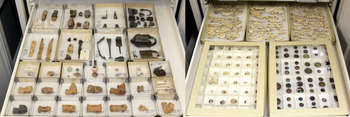
The “exhibitable” collection was rehoused following the suggestions made in the 1963 letter using four main categories: ceramic, glass, metal, and construction materials (Figure 2). The most representative artifacts such as buttons, buckles, tobacco pipes, and coins, among others, were separated using individual trays. Much work can still be done with these collections, especially when we take into consideration that it had not been studied in over 50 years (Schiappacasse Reference Schiappacasse2016b). First, I suggest that a complete reanalysis should be done on all the cataloged artifacts because the ceramic and glass typologies have been refined over the last five decades. The ceramic categories used are in some cases too general, and it could be possible to reduce the mean ceramic date and/or terminus post quem, therefore strengthening the chronological sequences. My interest in this collection is the enigmatic ceramic type named Morroware, which some claim was manufactured in Spain while others believe was locally made in Puerto Rico. For many archaeologists working the Caribbean colonial milieu, the names Morroware and Reyware are well-known, but some are unaware that these ceramic types were first identified during the El Morro excavations. Therefore, characterization of these types should be a priority. With reference to this type of project, MacFarland and Vokes (Reference MacFarland and Vokes2016:173) note, “The rehousing process preserves the cultural heritage of already excavated sites and enables the incorporation of these previously unavailable data into multi-disciplinary studies.”
Examples of rehoused artifacts from the 1961 El Morro collection. Photos by the author.

MOVING FORWARD WITH COLLECTION-BASED ACADEMIC RESEARCH
A few years ago, I designed and taught Museums and Archaeological Collections as an undergraduate elective in the Department of Sociology and Anthropology, University of Puerto Rico, Río Piedras campus. The main objective was to expose students to the realities of archaeological collections with an emphasis on the curation crisis and have them critically think about the benefits of collection-based academic research.Footnote 1 Examples of potential lines of investigation were established using the Phase III Ballajá Archaeological Collections resulting from fieldwork undertaken in three urban blocks of the Santo Domingo and Ballajá wards in San Juan between 1986 and 1992. This represents one of the largest collections from within the walled city of San Juan (Barnes and Medina Reference Barnes and Medina1995; Joseph and Bryne Reference Joseph and Bryne1992). This area was inhabited toward the end of the eighteenth century but formally developed during the nineteenth century.
In the late 1990s, part of the collection consisting of approximately 900 boxes, field forms, drawings, and photos was transferred by the Puerto Rico State Historic Preservation Office to the Museum of History, Anthropology and Art. Curation activities have included rehousing the collection (replacement of bags and boxes), the completion of a registry, and partial cataloging by museum personnel and specialists alongside undergraduate students. Use of the collection has been inconspicuous aside from an exhibition (Museo de Historia, Antropología y Arte Reference de Historia and Arte2000) and fewer than five master's theses. Recognizing that this is potentially the largest collection from an urban setting on the island, I started to delineate projects that could be carried out with students to enhance our understanding of daily life in nineteenth- and twentieth-century San Juan. Research issues to be investigated could include the following:
• Connecting the material culture to households and people. This investigation contemplates the incorporation of population census data as well as property records to link the material culture to specific loci within the archaeological projects. The main objective is to create a database with available census data to reconstruct stories of the Ballajá residents by concentrating on (1) characterization of the neighborhood and buildings and their function (commercial or residential use), (2) identification of household dynamics (number of families, owners versus renters), (3) characterization of residents (name, age, sex, place of origin, language spoken, and literacy levels), and (4) classification of trades and professions. A pilot project was started with the 1910 data, which allowed us to prepare graphics that illustrate the blocks and parcels and the distribution of families. In the long run, this information will help individually study households by having all the data organized by provenience, therefore aiding researchers interested in this collection.
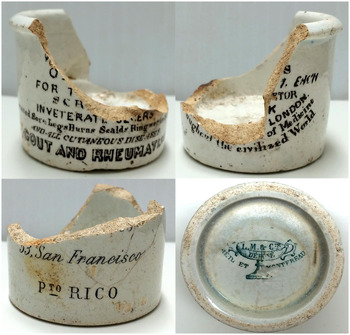
• Connecting advertisements to material culture and workplaces. The second project is a compilation of newspaper advertisements for medicines between 1871 and 1891. A pilot study was funded by the Program to Encourage Undergraduate Research, Faculty of Social Sciences, University of Puerto Rico, by assigning two research assistants. Julissa Collazo López and Elías Salgado Marrero created a database of the advertised products including the name of the medicines and the people who produced them, the ingredients, and information on pharmacies and apothecaries throughout the capital city, as well as diseases, ailments, and conditions commonly mentioned. This dataset will serve to correlate medicinal bottles and jars recovered in Ballajá in order to study health practices within the ward (Figure 3).
• Connecting material culture to economic data. For this project, a list of all the makers’ marks found in ceramic artifacts from Ballajá along with site provenience information will be compiled. The goal is to establish place of manufacture and aspects related to consumer preferences and/or economic accessibility, as well as data on import activities. In addition, remote research will be carried out using websites to identify specifics on the companies, designs, and shapes (e.g., a site dedicated to Société Céramique Maastricht includes the original drawings pertaining to a decoration motif, as well as the shapes available; Figure 4). The identification of imported ceramics from household assemblages could be used to illustrate their distribution within the Ballajá ward (Joseph and Bryne Reference Joseph and Bryne1992).
(Top) Fragment of Holloway's Ointment recovered in the Ballajá ward (UPR 1.2013.885). (Bottom) Fragment of an ointment jar produced by L.M. ET Cie DEPOSE CREIL ET MONTEREAU for an apothecary located on 33 San Francisco St., San Juan (UPR 1.2013.888). Photos by the author.

Example of chamber pot in the Ballajá collection (UPR 1.2009.1811; photo by the author) and manufacturer's decal drawing (source: https://www.geheugenvannederland.nl).

Other short-term projects contemplate the compilation of a list of CRM-generated collections by consulting reports filed with regulatory agencies. This work could facilitate the identification of existing CRM collections with strong potential to support additional analyses. The creation of a database of collections exhibited in local museums, private foundations, community centers, and historical societies throughout the municipalities or counties can be achieved by using this idea in a semester-long project in which students collect the information. Standardized forms will ensure that the data collection is uniform and will simplify the transcription process. Illustrated maps can aid in presenting the type collections available throughout the region studied. For collections with no inventories or registries, a community-based project could be developed so that locals can actively participate in order to preserve their heritage. Lastly, consulting newspapers and magazine articles on archaeological excavations may reveal information on where the collections reside. This effort will focus on finding field and laboratory photographs and details provided by the journalists, as well as their impressions, therefore adding layers of information to the history of collections
CONCLUSION
Academics, whenever feasible, should avoid excavating unthreatened sites and should instead “excavate” existing collections. This will prevent a worsening of the curation crisis. Echoing numerous articles, books, and presentations, this is a call for action to improve the curation crisis we are facing worldwide. It should be emphasized that current storage space for new collections is finite (Barker Reference Barker and Terry Childs2004; Bawaya Reference Bawaya2007; Childs Reference Childs1995, Reference Childs2004, Reference Childs, Agnew and Bridgland2006; Kersel Reference Kersel2015; Schiappacasse Reference Schiappacasse2016a; Sonderman Reference Sonderman and Terry Childs2004; Sullivan and Childs Reference Sullivan and Childs2003; Voss Reference Voss2012). By providing to new generations of scholars a sense of ethical responsibility from the field to the curation facility, we will ensure changes on the horizon within the next decade. The analysis of existing collections might help ease the crisis only if that analysis is done in place of new excavations at an unthreatened site; that is, the reanalysis of a collection, in and of itself, does not make that collection take up less space on the shelf. It is the trade-off between reanalysis and creating new collections that will lessen the stress on curation facilities. Supporting students who in fact want to use collections—rather than excavating unthreatened sites and creating even more non-fee collections—will permit us to achieve the following:
1. Preserve more archaeological sites for the future by eliminating unnecessary excavation of unthreatened sites.
2. Alleviate the growing space and staff crises by producing zero new collections.
3. Significantly reduce the labor and expenses needed to conduct research, as a large field crew is not needed to reanalyze existing collections.
4. Maximize the research potential of existing collections.
Specifically, for Puerto Rico, collection-based research may also provide the benefit of identifying the collections with the highest research potential, in hopes of repatriating such collections to an on-island curation facility. Revisiting collections with the purpose of reassessing what we know by conducting new analyses and using new technologies would benefit archaeologists and the public, as new information could be used to interpret past human dynamics.
Acknowledgments
I am indebted to colleagues who are passionate about collection-based research for many stimulating conversations, particularly Reniel Rodríguez Ramos, Javier Martínez Báez, Joanna Ostapkowicz, and Mariana de Campos Françozo. I want to acknowledge the support of Félix López from the San Juan National Historic Site; Flavia Marichal and Yvonne Narganes Storde at the Museo de Historia, Arqueología y Arte; and personnel at the National Museum of Natural History and the American Museum of Natural History. My gratitude goes to Danielle Benden and Michelle Knoll for putting together the panel “Archaeological Collections Care for the Collections Specialist: Current Topics and Innovative Trends in the Repository” presented at the 83rd Annual Meeting of the Society for American Archaeology and the anonymous reviewers and Chris Espenshade for their suggestions to enhance the original manuscript.
Data Availability Statement
No original data were presented in this article.