




Introduction
Conservation programmes are increasingly encouraged to involve and empower local people and communities in efforts to protect biodiversity (Berkes Reference Berkes2004, Roe Reference Roe2008, Mishra Reference Mishra2016). However, community-based conservation efforts in many parts of the world have failed to adequately secure the participation of marginalized members of society, as determined by ethnicity, class and gender (Agrawal & Gibson Reference Agrawal and Gibson1999, Chatty & Colchester Reference Chatty and Colchester2002, McShane et al. Reference McShane, Hirsch, Trung, Songorwa, Kinzig and Monteferri2011, Keane et al. Reference Keane, Gurd, Kaelo, Said, De Leeuw, Rowcliffe and Homewood2016). In particular, participatory structures designed to support conservation programmes have paid inadequate attention to gender mainstreaming, including women’s participation in decision-making (Agarwal Reference Agarwal2009, Torri Reference Torri2010, Keane et al. Reference Keane, Gurd, Kaelo, Said, De Leeuw, Rowcliffe and Homewood2016, Costa et al. Reference Costa, Casanova and Lee2017).
This situation persists despite international commitments to integrate gender perspectives in conservation programmes and to ensure appropriate representation of women and girls in management structures (Alvarez & Lovera Reference Alvarez and Lovera2016). Engaging women supports inclusiveness and equity and can improve biodiversity outcomes by harnessing women’s knowledge regarding the environment and leveraging opportunities for their contributions to conservation activities (Agarwal Reference Agarwal2009, Keane et al. Reference Keane, Gurd, Kaelo, Said, De Leeuw, Rowcliffe and Homewood2016, Kaeser et al. Reference Kaeser, Willcox and Panti2018, Kahsay et al. Reference Kahsay, Nordén and Bulte2021). In South Asia, for example, there is compelling evidence regarding the importance of engaging women in forest management groups for improved governance and conservation outcomes (Agarwal Reference Agarwal2009, Leisher et al. Reference Leisher, Temsah, Booker, Day, Samberg and Prosnitz2016).
The contributions of women to the conservation of large carnivores may be of particular significance (Dickman et al. Reference Dickman, Marchini and Manfredo2013). They play critical roles in agro-pastoral and pastoral economies, which large carnivores can impact through costs incurred by livestock depredation and related protection measures (Suryawanshi et al. Reference Suryawanshi, Bhatia, Bhatnagar, Redpath and Mishra2014). Studies suggest that women tend to have greater fears of and hold more negative views towards carnivores than men (Zinn & Pierce Reference Zinn and Pierce2002, Lagendijk & Gusset Reference Lagendijk and Gusset2008, Dickman et al. Reference Dickman, Marchini and Manfredo2013, Suryawanshi et al. Reference Suryawanshi, Bhatia, Bhatnagar, Redpath and Mishra2014, Alexander et al. Reference Alexander, Chen, Damerell, Youkui, Hughes, Shi and Riordan2015, Bhatia et al. Reference Bhatia, Redpath, Suryawanshi and Mishra2016). They express concerns for the security of their families and emotional connections with livestock (Zinn & Pierce Reference Zinn and Pierce2002, Bhatia et al. Reference Bhatia, Redpath, Suryawanshi and Mishra2016). There are, however, few published examples of purposive efforts to engage women in large carnivore conservation. This represents a missed opportunity to harness their potential to influence human–carnivore coexistence. It also addresses issues of equity and justice mandated by the need to engage groups who are affected by and have the potential to affect environmental risks (Verchick Reference Verchick and Stein2004).
Studies in India and China that have explored gendered perspectives regarding the snow leopard Panthera uncia, a flagship species for conservation in Asia’s high mountains, show that women hold more negative views regarding their protection than men (Suryawanshi et al. Reference Suryawanshi, Bhatia, Bhatnagar, Redpath and Mishra2014, Alexander et al. Reference Alexander, Chen, Damerell, Youkui, Hughes, Shi and Riordan2015, Bhatia et al. Reference Bhatia, Redpath, Suryawanshi and Mishra2016). These settings are characterized by complex gendered division of livestock husbandry, agricultural work, household responsibilities, income generation and other tasks (Flintan Reference Flintan2008, Khadka & Verma Reference Khadka and Verma2012). Stark differences also persist in power relations that shape women’s and men’s access to and control over resources (Khadka & Verma Reference Khadka and Verma2012, Murali et al. Reference Murali, Bijoor and Mishra2021, Reference Murali, Bijoor, Thinley, Gurmet, Chunit and Tobge2022). Women therefore have specific stakes in snow leopard conservation issues and approaches.
A conservation-linked income-generation and skills-building programme called Snow Leopard Enterprises (SLE) specifically focuses on the empowerment of women living in snow leopard habitats and their engagement in conservation action (Agvaantseren et al. Reference Agvaantseren, Allen, Dashzeveg, Mijiddorj, Snell Rullman, McCarthy and Mallon2016). SLE provides opportunities for participants from local communities to enhance their livelihoods through handicraft production and sales in exchange for a commitment towards wildlife conservation (Agvaantseren et al. Reference Agvaantseren, Allen, Dashzeveg, Mijiddorj, Snell Rullman, McCarthy and Mallon2016, Mishra Reference Mishra2016). The partner community takes responsibility for active measures to prevent the hunting of wildlife, including snow leopards and their prey, within their area of responsibility. The system involves an additional bonus payment over the price of handicrafts to their producers if the conservation commitment is honoured during the year and/or if women participate in conservation activities (Agvaantseren et al. Reference Agvaantseren, Allen, Dashzeveg, Mijiddorj, Snell Rullman, McCarthy and Mallon2016, Mishra Reference Mishra2016). SLE seeks to increase people’s tolerance towards snow leopards and to garner their support for conservation in different settings through income generation, skills building and the strengthening of community linkages. It also indirectly aims to reduce poaching and retaliatory killing – a major threat to snow leopards (Agvaantseren et al. Reference Agvaantseren, Allen, Dashzeveg, Mijiddorj, Snell Rullman, McCarthy and Mallon2016). Finally, it seeks to help enhance women’s agency at the household and community levels by providing a platform for women in the conservation dialogue (Mishra Reference Mishra2016).
The finding that women in Spiti Valley (latitude 32°00′–32°42′N, longitude 77°37′–78°30′E), India, had more negative attitudes than men towards snow leopards and wolves Canis lupus (Suryawanshi et al. Reference Suryawanshi, Bhatia, Bhatnagar, Redpath and Mishra2014) spurred us to initiate a SLE programme called Shen (the Spitian word for the snow leopard) in the region in 2013. The programme sought to enhance women’s agency at the household and community levels, improve their attitudes towards carnivores and wildlife and increase their involvement in conservation action. Here, we provide an assessment of Shen over its first 7 years of implementation. Our assessment was informed by a theory of change (Supplementary Appendix S1, available online) and aimed to monitor progress made in implementing the programme and in reaching its expected outcomes in terms of increasing women’s income, changing women’s attitudes towards snow leopards and increasing women’s participation in locally relevant conservation action.
Methods
Study area
Spiti Valley (Fig. 1) is located in the state of Himachal Pradesh in northern India. It covers a geographical area of 7101 km2 at 3300–6700 m altitude. This part of the Trans-Himalaya range is characterized by dry alpine and cold desert vegetation. Common species of large mammals are blue sheep Pseudois nayaur, ibex Capra ibex and their predators, the snow leopard and the wolf.
Locations of the eight villages participating in the Shen Snow Leopard Enterprises programme in Spiti Valley, India.

Spiti Valley has a low human population density (c. 1 person/km2) across 95 villages. The majority of the population practices Vajrayana Buddhism. Families mostly own small agricultural land holdings (c. 1.1 ha) and/or herd livestock (Mishra Reference Mishra2000). The livestock assemblage includes sheep, goats, donkeys, cattle, yaks, cattle–yak hybrids (dzo, dzomo) and horses. Social hierarchies of gender, class and caste intersect to determine household property rights, division of labour and economic endowments (Singh et al. Reference Singh, Sharma and Babu2015, Murali et al. Reference Murali, Bijoor and Mishra2021). Men hold most of the property rights and conduct decision-making related to livestock grazing in pastures (Murali et al. Reference Murali, Bijoor, Thinley, Gurmet, Chunit and Tobge2022). Women are primarily involved in irrigation, weeding, harvesting and other aspects of livestock husbandry such as milking, shearing and stall feeding (Murali et al. Reference Murali, Bijoor and Mishra2021, Reference Murali, Bijoor, Thinley, Gurmet, Chunit and Tobge2022).
Families are frequently exposed to economic losses due to livestock depredation by carnivores (Suryawanshi et al. Reference Suryawanshi, Bhatia, Bhatnagar, Redpath and Mishra2014). While poaching and retaliatory killing of carnivores are not widely prevalent, they have occasionally been reported. The area is undergoing rapid change through the advent of tourism and infrastructure development, which bring new opportunities and challenges for conservation (Murali et al. Reference Murali, Ikhagvajav, Amankul, Jumabay, Sharma and Bhatnagar2020). Tourism is becoming an important source of income for some villages, while it is contributing to an increase in environmental waste (Home et al. Reference Home, Pal, Sharma, Suryawanshi, Bhatnagar and Vanak2017).
SLE programme description
We introduced Shen in 2013 to two villages in an effort to strengthen the engagement of women in ongoing conservation activities (predator-proof corrals, community-based livestock insurance, grazing-free village reserves, garbage management, conservation education of children, etc.) and to improve their outcomes.
Participatory processes for monitoring key programme outputs and outcomes were introduced in 2016 in order to emphasize community ownership and learning. Women took on the role of tracking annual costs of raw materials, number of products produced and sold and profits from handicraft sales. Appendix S1 provides further details on the Shen programme’s implementation.
SLE programme records
Data from programme records provided information regarding participation (number of program participants, number of dropouts), activities (number of trainings conducted and of field trips), payments made to participants for handicrafts produced, conservation bonuses awarded and instances of poaching of wildlife, if any. Data were recorded and tracked on a yearly basis, with full programme records available for 7 years (2013–2019), although data collection was not systematic in the first 2 years of the programme.
In addition, conservation activities were identified through the review of group conservation diaries maintained in each village (2016–2019). Participant women generally documented their conservation actions in these diaries in response to three simple questions: (1) Describe the event. (2) What action did you take? And (3) what did this lead to?
Programme coverage was calculated as the proportion of adult women in the village who were active participants in the Shen programme, in which the number of adult women in each village was estimated by key informants.
Household questionnaire survey
The questionnaire survey was designed and carried out in line with the ethical guidelines of the University of Aberdeen (Appendix S2). An ethical statement guided procedures to ensure that the rights and sensitivities of those involved were respected and upheld and that all participants understood and freely consented to being part of the project.
A questionnaire survey conducted in 2017 provided complementary information on the level of satisfaction with the programme and explored the programme’s influence on attitudes and perceptions regarding the conservation of snow leopards. The survey was conducted in five of eight villages that were exposed to Shen together with some of our other conservation programmes, hereafter called ‘programme villages’. We also conducted surveys in seven ‘control’ villages that had not at that time been exposed to Shen or other conservation interventions.
In programme villages, 71 households were selected on the basis of key informant knowledge about programme participation to ensure the representation of various groups (typically based on geographical location of houses) within a village. The sample included respondents from 10 households not participating in any conservation interventions, 10 households participating in one conservation intervention and 10 households participating in two or more conservation interventions. In control villages, 89 households were selected, with attention given to ensuring spatial representation across the village and that women and men household respondents were included.
Women respondents from Shen participant households (n = 20) were asked about the perceived benefits of the programme. More specifically, they were asked whether they had received payments for their handicrafts and the bonus as agreed and whether they felt more skilful in making handicrafts as a result of the Shen programme. They were also asked whether their household income had increased as a result of the Shen programme and their view as to what extent this has occurred (‘increased a lot’, ‘increased moderately’, ‘increased slightly’, ‘no change’). They were asked whether they agreed with the following statements: ‘I feel more confident than I was before I joined the scheme’; ‘As a result of the Shen programme, there is increased cooperation within the village’; ‘I am more skilful in making handicrafts as a result of the Shen programme’; and ‘My household income has increased as a result of the Shen programme’. Responses were recorded on a five-point Likert scale (‘a lot more’, ‘somewhat more’, ‘no change’, ‘somewhat less’, ‘a lot less’).
Based on the theory of planned behaviour (Ajzen Reference Ajzen, Kuhl and Beckman1985), we also assessed behavioural intent towards the preservation of snow leopards. The guidelines of Francis et al. (Reference Francis, Eccles, Johnston, Walker, Grimshaw and Foy2004) were used to prepare the questionnaires for collecting data on attitudes, social norms and perceived behaviour control. In assessing attitudes, we focused on behavioural beliefs and not behavioural outcomes, as requesting information regarding respondents’ participation in illegal behaviours such as the actual killing of a snow leopard was considered too sensitive and inappropriate in this context. Attitudes were measured using a five-point Likert scale (1 for ‘strongly disagree’, 3 for ‘neutral’ and 5 for ‘strongly agree’) for three statements (‘If a snow leopard is in the area, it should not be killed’; ‘If a snow leopard is in the area and causing damage, it should be killed’; ‘If a snow leopard is killed in my area, it would make me unhappy’). The second statement purposely asked whether respondents held an undesirable attitude in order to minimize potential biases. We recoded the responses to the first and third statements so that the higher score would always reflect increasing intolerance towards snow leopards. The total attitude score was calculated by summing the attitude scores for the first and third statements and the reversed score for the second statement (i.e., ‘strongly disagree’ was changed to 5 and ‘strongly agree’ was changed to 1 for the second question) so that the total scores ranged from 3 (‘snow leopards should not be killed’) to 15 (‘snow leopards should be killed’).
Two statements explored subjective social norms. First, we assessed perceived injunctive norms on a five-point scale using the statement ‘Opinion leaders would disapprove if a snow leopard was killed’ (–2 for ‘strongly disagree’, 0 for ‘neutral’ and +2 for ‘strongly agree’). We recoded the responses so that the positive scores would reflect increasing intolerance towards snow leopards. This scale clarified positive and negative norms for the preservation of snow leopards to support the subsequent multiplication of perceived norm scores. Second, we assessed motivation to comply with prevailing norms on a five-point scale using the statement ‘Behaving in the way that these persons/institutions expect is important’ (with a score of 1 for ‘strongly disagree’, 3 for ‘neutral’ and 5 for ‘strongly agree’). The total perceived social norms score was calculated by multiplying the score for beliefs about prevailing norms and that for motivation to comply (ranged from –10 for high perceived social pressure to preserve snow leopards to +10 for low perceived social pressure to preserve snow leopards).
Two statements explored whether a person was confident that they were able to perform the target behaviour. The first statement (‘It is possible to kill a snow leopard if someone wanted to’) assessed perceived ability, and the second statement (‘Whether someone decides to kill a snow leopard is entirely up to them’) assessed beliefs about controllability. The sum of the responses to both of these statements was used as the total perceived behaviour control score and ranged from 2 (a person feels unable to kill a snow leopard) to 10 (a person feels able to kill a snow leopard).
The analysis of behavioural intent involved assessing variations in attitudes, social norms and perceived behaviour control between Shen participants (n = 20) and women non-participants from control villages (n = 43). We also compared women from villages with the Shen programme (n = 31), irrespective of whether or not they were Shen participants individually, with women non-participants from control villages (n = 43).
We performed unpaired t-tests using R software to assess differences in attitudes and perceptions between: (1) women respondents participating in the Shen programme and non-participant women respondents from control villages; and (2) women respondents from Shen programme villages and non-participant women respondents from control villages. For the mean values, 95% confidence intervals (Cis) were estimated from 1000 bootstrap samples using the R package ‘boot’.
Results
Programme participation and coverage
In 2013, 30 participants from two villages (Chicham and Kibber) were recruited into the Shen programme. By the end of 2019, this number had increased to eight villages (Chicham, Kibber, Kee, Getey, Tashigang, Shashuna, Mane Yongma and Mane Kongma) and 79 participants (Fig. 2). Five of these villages were also exposed to other programme interventions.
Number of participants, participant dropouts and villages and the percentage of programme coverage (proportion of adult women in the village who were active participants in the Shen program) over time between 2013 and 2019 in the Shen Snow Leopard Enterprises programme in Spiti Valley, India.
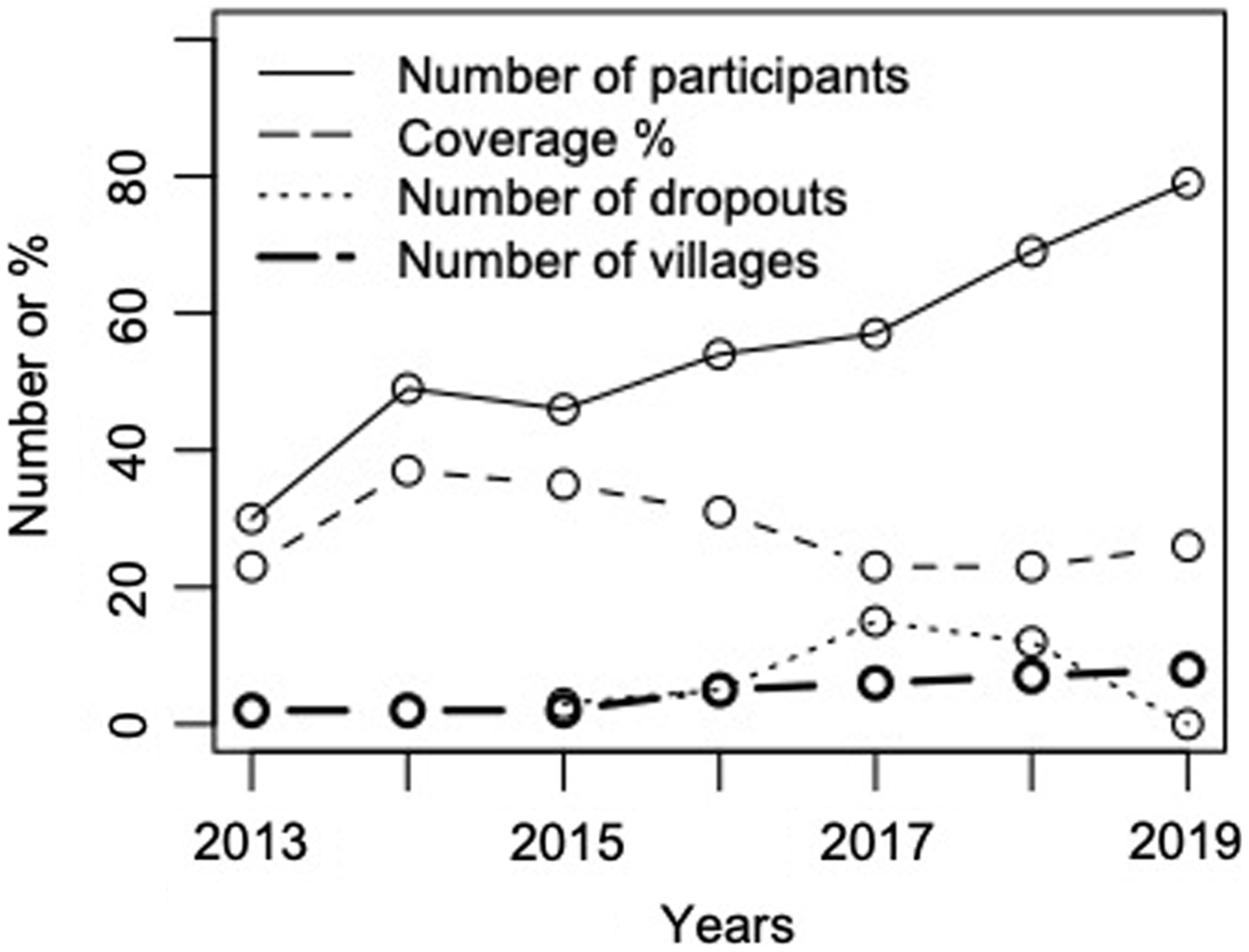
A total of 92 women participated over time in Shen over the entire duration. The number of Shen participants increased over time (Fig. 2). Between 2013 and 2019, a total of 35 women dropped out either permanently or temporarily. The average yearly dropout rate was 12% (± 10% SD). Participants reported dropping out for various reasons, including childbirth, household commitments and sometimes due to long pilgrimage trips during winter months to other parts of the country. Most participants, however, remained associated in an informal way, and programme records indicate that some participants re-joined the programme at a later stage. The programme coverage ranged between 23% and 37% of all adult women in participating villages across the years.
A total of 19 trainings were offered for skill building in handicrafts production and quality control during 2013–2019. A mean of 69 (range 56–104) women took part directly in each training programme. Eight exposure trips were organized for participants in locations outside Spiti Valley. A total of 71 women (mean of 17 per year), selected by their respective Shen groups, took part in these trips.
Reported benefits
Programme records indicated that the collective earnings of Shen participants increased annually except in 2017–2018 (Table 1). The mean annual earning per individual programme participant increased from US$13 in 2013 to US$50 in 2018. The bonus was fixed at 20% of the annual Shen income for each participant, and bonus amounts also increased steadily. Total bonus amounts per group increased from US$134 to US$661. This amount was used by the participants for a range of purposes, from pilgrimage trips by participants to providing financial support to people in need within the village, as decided collectively.
Total earnings and average earning per participant over time between 2013 and 2019 in the Shen Snow Leopard Enterprises programme in Spiti Valley, India.

Fifteen (75%) women respondents from Shen participant households surveyed in 2017 indicated that their income increased slightly (n = 13) or moderately (n = 2) as a result of the programme. All 20 respondents surveyed confirmed that their group received funds as agreed from the selling of handicrafts, and 19 (95%) of the respondents confirmed that they received the conservation-linked bonuses. All 20 respondents indicated that they appreciated the handicraft-making skills that they had learnt. Nineteen (95%) respondents indicated that they felt somewhat (n = 6) or a lot (n = 13) more confident as a result of the Shen programme. Fourteen (70%) respondents indicated that cooperation within the village had increased either a lot (n = 9) or somewhat (n = 5) as a result of the Shen programme.
Attitudes and perceptions towards snow leopards
Shen programme participants (n = 20; mean attitude = 4.17; 95% CI = 3.01–5.24) reported more positive attitudes towards snow leopards compared to women from control villages (n = 43; mean attitude = 7.30; 95% CI = 6.64–8.30; t = –4.25, p < 0.001). Taken together, women (both participant and non-participant) in Shen programme villages (n = 31; mean attitude = 4.63; 95% CI = 3.71–5.60) expressed more positive attitudes towards snow leopards than those from control villages (n = 43; mean attitude = 7.30; 95% CI = 6.33–8.25; t = –3.91, p < 0.001).
On the other hand, perceived social norms did not differ significantly between Shen programme participants (n = 20; mean attitude = –5.94; 95% CI = –8.44 to –3.45) and women from control villages (n = 43; mean attitude = –5.79; 95% CI = –8.04 to –3.57; t = –0.09, p = 0.93). Overall, perceived social norm scores suggested the existence of social pressure to preserve snow leopards. Similarly, perceptions on behavioural control suggested that most respondents did not feel that they had the ability to kill a snow leopard, and these did not significantly differ between Shen programme participants (n = 20; mean attitude = 3.84; 95% CI = 3.01–4.70) and women from control villages (n = 43; mean attitude = 2.97; 95% CI = 2.48–3.50; t = 1.67, p = 0.10).
Involvement in conservation and environmental action
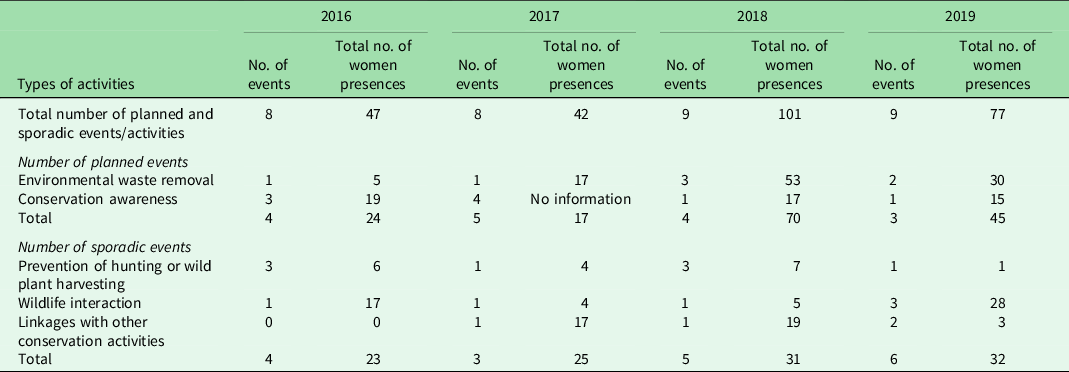
Between 2016 and 2019, Shen participant women recorded 33 self-directed conservation and environment protection actions in the conservation diaries (Table 2). Such actions were reported with an annual frequency of 8–9, involving 42–101 women presences each year (Table 2). Many actions took place sporadically to prevent activities posing risks to wildlife. These included preventing the hunting of blue sheep or birds, preventing the collection of wild plants and supporting the building of predator-proofed corrals. For example, three participants reported instances in which snow leopards entered the household corral. One event resulted in the death of 10 livestock, while no livestock were killed in the other events. In all cases, the affected households reached out to our local programme representative and the snow leopard was allowed to escape without injury. In addition, in all cases, programme staff subsequently assisted in corral reinforcement in the participant households and villages. The following in an excerpt from one of the conservation diaries:
In our meeting [a participant] informed us that in April a snow leopard was seen outside her house. Then it slowly went in the corral near [a participant]’s house. The animal left without causing any damage. Taking note of this event and in the interest of our livestock, the women requested programme staff to fix grills and metal doors. (2017, Chicham Shen diary)
Number of conservation activities and women’s attendance as recorded in the conservation diaries of communities (n = 8) involved in the Shen Snow Leopard Enterprises programme in Spiti Valley, India, between 2016 and 2019. The number of women presences indicates the number of individual attendances at each activity.
In another instance, Shen participants reported how supporting the education programme for children spurred them to undertake wider environmental action:
We discussed solutions to the problem of landslides in our village. If we plan to stabilize the soil the landslides can be prevented. That is why we all decided that that from March 2019 we will start working on this initiative. (June 2018, Mane Kongma Shen diary)
In some cases, Shen participants intervened when they saw someone disturbing a snow leopard or wild ungulates or trying to kill a bird:
When people had gathered to see the snow leopard, they were making a lot of noise. Five of us went there and stopped them from making noise and also to not throw stones at the animal. If they try to scare the animal again we will complain to the Wildlife Department. (March 2018, Kibber Shen diary)
On another occasion, it was recorded that
… [a participant] saw a labourer trying to kill birds. He was using stones to kill birds. She stopped him from killing birds. She said that if he was found again trying to kill birds, she would report him to the police. This is how she explained it to him. The labourer let the bird go. He said he will not kill birds with stones from now on. (July 2018, Mane Kongma Shen diary)
Another record stated:
Many labourers were trying to catch blue sheep when the three of us stopped them and told them to not catch them or else they would all be put in jail. (June 2018, Kibber Shen diary)
Other activities were planned during meetings and usually involved all Shen members. These included raising conservation awareness and clearing garbage (Table 2), for example:
We call a general meeting every year for discussions on protecting wildlife and maintaining cleanliness. We also discuss the work done in the previous year. Like last year, in the interest of protecting wildlife and maintaining cleanliness we shall create awareness among villagers. All the women attended this meeting. (2018, Chicham Shen diary)
Carried out a garbage clearing drive on 2 October. Women were divided in four groups; each group was sent to one corner of the village; each group carried out their tasks well. (October 2017, Chicham Shen diary)
80 labourers came into our village who were informed that they must not harm wild animals. (2016, Chicham Shen diary)
A lot of garbage is gathering in the village. Our animals and wild animals eat from these dumps and fall ill. The 19 Shen participants carried out a cleanliness drive. All the garbage was collected and dumped inside a pit and filled with soil from the top. We explained this to the women and children of the village that they not dispose their garbage in the open and throw it in the dumping ground. This can prevent the spread of disease in our village. (October 2019, Kibber Shen diary)
Programme records did not identify any instances of poaching of snow leopards or their prey in any of these communities between 2008 and 2019.
Discussion
Engaging women in conservation
Our results show that the Shen programme in Spiti Valley encouraged the entry of women into the conservation dialogue and enhanced their agency in conservation and environmental action. The programme generated high levels of interest and involved over 20% of all adult women in target communities in any year. The drop-out rate was low and remained stable. This is striking in a context where women have multiple responsibilities related to the household, livestock husbandry and the land, some of which are episodic (giving birth) and others of which are daily (livestock care) or seasonal (irrigation, weeding or the harvest; Murali et al. Reference Murali, Bijoor and Mishra2021). Flexible arrangements enabled women to remain associated with the programme in informal ways and to re-join the programme when possible, highlighting that women’s multiple workloads and responsibilities must be accommodated in order to secure their engagement (Westermann et al. Reference Westermann, Ashby and Pretty2005, Coleman & Mwangi Reference Coleman and Mwangi2013).
Agriculture represents the predominant source of livelihood in Spiti Valley, and it provides an average family income that is 16 times greater than the average income that each participant made from Shen (Murali et al. Reference Murali, Ikhagvajav, Amankul, Jumabay, Sharma and Bhatnagar2020). The programme therefore did not lead to a substantial increase in household income. Our results suggest that the participants valued other non-financial benefits from the programme, including the opportunity to learn new skills, to build social networks, to travel to other parts of the country and to undertake collective action for the environment. These factors are meaningful in these villages, where women hold strong values regarding inter-household cooperation for agricultural tasks (Murali et al. Reference Murali, Bijoor and Mishra2021). Other studies have emphasized the social benefits accrued by women through personal income and networking opportunities, with positive effects on individual and collective self-esteem and agency being recorded (Westermann et al. Reference Westermann, Ashby and Pretty2005, Ogra & Badola Reference Ogra and Badola2015).
As proposed in the programme’s theory of change, the Shen programme provided an opportunity to influence attitudes and perceptions. Positive attitudes towards snow leopards found among Shen participants could be associated with direct programme participation and/or increased exposure to other conservation activities, given that all communities where Shen was present also had more than two other conservation interventions. These did not specifically target women, but they may have held a particular significance for women because of their role in livestock management and the risks that they face related to depredation (Singh Reference Singh, Sharma and Babu2015). Programmes that address broader livestock welfare issues are expected to reduce fear and anxiety in families, especially among women, and to increase their resilience to wildlife impacts (Zimmermann et al. Reference Zimmermann, Wabakken and Dötterer2001, Khumalo & Yung Reference Khumalo and Yung2015). Gender-neutral conservation interventions may not address women’s specific concerns and needs (Khumalo & Yung Reference Khumalo and Yung2015) and tend to forego their unique contributions based on livestock management roles and responsibilities (Kerven et al. Reference Kerven, Steimann, Dear and Ashley2012).
Our results indicate that the Shen objective of promoting the participation of women in conservation efforts (Agvaantseren et al. Reference Agvaantseren, Allen, Dashzeveg, Mijiddorj, Snell Rullman, McCarthy and Mallon2016) was largely achieved. The programme helped build supportive structures for cooperation, provided incentives and catalysed self-directed conservation action at the local level. It also served to complement and support other community-based conservation interventions (Mishra et al. Reference Mishra2016); for instance, in one site, programme participants experiencing snow leopard predation on livestock facilitated corral building. In another, they supported our conservation education programme focused on children.
Monitoring and evaluation approaches
Strong conservation programmes integrate monitoring and evaluation to improve implementation and verify results (Kleiman et al. Reference Kleiman, Reading, Miller, Clark, Scott and Robinson2000, Stem et al. Reference Stem, Margoluis, Salafsky and Brown2005, Woodhouse et al. Reference Woodhouse, Homewood, Beauchamp, Clements, McCabe, Wilkie and Milner-Gulland2015). We relied on a structured theory-based approach that focused on tracking process, outputs and outcome indicators (Stem et al. Reference Stem, Margoluis, Salafsky and Brown2005, Woodhouse et al. Reference Woodhouse, Homewood, Beauchamp, Clements, McCabe, Wilkie and Milner-Gulland2015). The original theory of change assumed that improved livelihoods for women would shift negative attitudes regarding predators and increase support for conservation. However, the monitoring data indicated that incomes from participation in Shen remained modest. Programme staff were accordingly able to reconsider assumptions and redirect programme attention to building incentives and skills for conservation action.
Importantly, we fostered women’s involvement in our approach to monitoring and evaluating key aspects of the Shen programme. Shen participants played a central role in tracking the costs of the raw materials, handicraft sales and profits. They were responsible for documenting their conservations actions in the conservation diaries. Participatory approaches that involve beneficiaries in assessing outcomes merit wider consideration as an integral part of the monitoring and evaluation frameworks of community-based conservation programmes (Cox et al. Reference Cox, Butler, Webber and Young2020). They could enhance the ownership and sustainability of such programmes (Butler et al. Reference Butler, Young, McMyn, Leyshon, Graham and Walker2015, Cox et al. Reference Cox, Butler, Webber and Young2020).
Conclusion
This study provides a concrete example of a community-based programme that harnesses women’s specific contributions to large carnivore conservation. The programme took forward tailored and flexible approaches to building women’s agency and motivation in support of locally relevant environmental and conservation actions. Participation levels remained high over the first 7 years of implementation. We provide robust evidence of positive changes in attitudes and behaviours through a prospective, theory-based and systematic assessment of the results. These results show promise for engaging women in efforts to promote carnivore–human coexistence.
Supplementary material
To view supplementary material for this article, please visit https://doi.org/10.1017/S0376892922000236.
Acknowledgements
We acknowledge the team members who helped in this programme since its inception in 2013: Saloni Bhatia, Radhika Timbadia, Akshatha Venkatasha and Preety Sharma. We thank Juliette Young and Steve M Redpath for their technical input and guidance regarding the social surveys conducted as part of the Darwin Initiative.
Financial support
We thank the Darwin Initiative for its financial support (grant 22-044). We thank Dynafit, Disney Conservation Fund, Kahtoola for the People and the ICICI Prudential Life Insurance for supporting the Snow Leopard Enterprises programme. We thank the Whitley Fund for Nature, which has continued to support our research and conservation work.
Competing interests
The authors declare none.
Ethical standards
Throughout our work, we ensured that all project staff were aware of and followed the PARTNERS Principles. The questionnaire survey was designed and carried out in line with the ethical guidelines developed during the Darwin Project (grant 22-044).


 Open access

