





Introduction
In recent years, citizens’ assemblies (CAs), deliberative innovations based on the random selection of participants by lot, have emerged across Europe as promising instruments for enhancing democratic participation in complex policy areas (Dryzek et al., Reference Dryzek, Bächtiger, Chambers, Cohen, Druckman, Felicetti, Fishkin, Farrell, Fung, Gutmann, Landemore, Mansbridge, Marien, Neblo, Niemeyer, Setälä, Slothuus, Suiter, Thompson and Warren2019; Elstub & Escobar, Reference Elstub, Escobar, Elstub and Escobar2019; Reuchamps et al., Reference Reuchamps, Vrydagh and Welp2023; Smith, Reference Smith2021), gaining particular traction in the field of climate governance (Courant & Reber, Reference Courant and Reber2025; Escobar & Elstub, Reference Escobar and Elstub2025; Smith, Reference Smith2024). Despite its reputation as a climate laggard and its post-communist institutional legacy, Poland nevertheless has joined this European trend, witnessing a short-lived but intense “boom” of local CAs since 2016, and even emerging as a regional pioneer in organizing climate-related CAs in the years 2020–2025 (Gąsiorowska, Reference Gąsiorowska2023; Podgórska-Rykała, Reference Podgórska-Rykała2024; Pospieszna & Hoffmann, Reference Pospieszna and Hoffmann2026; Pospieszna & Pietrzyk-Reeves, Reference Pospieszna, Pietrzyk-Reeves, McMahon, Pickering and Pietrzyk-Reeves2024; Ufel, Reference Ufel2022).
Since the global climate mobilizations of 2018–2019, a new generation of activists has emerged in Poland (Kocyba et al., Reference Kocyba, Łukianow and Piotrowski2021; Medoń, Reference Medoń2020; Pluciński, Reference Pluciński2022), coinciding with the rapid spread of climate CAs in Polish cities. As the adoption and sustainability of participatory tools often depend on civic engagement, we examine how activists understood and shaped these processes. Preliminary evidence suggested that activists played a substantive role in initiating and diffusing CAs (Bua & Bussu, Reference Bua and Bussu2023; della Porta, Reference della Porta2020; della Porta & Felicetti, Reference della Porta and Felicetti2018), thus they can offer both a comprehensive view of the process and more testimonies than institutional actors (Font et al., Reference Font, del Amo and Smith2016; Schwartz-Shea & Yanow, Reference Schwartz-Shea and Yanow2013).
Drawing on in-depth interviews with activists who initiated, monitored, or engaged with climate assemblies across Poland, this article seeks to address three key questions. First, why and how did climate activists initiate and diffuse CAs in Poland, and why did they choose this instrument given the wide range of other institutionalized participatory tools available? Second, how did activists understand the democratic potential and practical functioning of CAs, including their deliberative value as well as their design limitations? Third, what institutional and governance conditions shaped the functioning and impact of climate CAs at the local level, and what do activists’ experiences reveal about the broader state of deliberative democracy in Poland and its prospects in the region?
By embarking on this study, we address a gap in the deliberative democracy literature regarding the bottom-up adoption of democratic innovations (Bua & Bussu, Reference Bua and Bussu2021; della Porta & Pavan, Reference della Porta and Pavan2017) in Central and Eastern Europe. This region, marked by polarized political cultures, presents a distinct configuration of civic governance shaped by territorial decentralization (and recurring centralization pressures linked to democratic backsliding), the gradual emergence of an urban middle class as a civic actor (Jacobsson & Korolczuk, Reference Jacobsson and Korolczuk2017; Kubicki, Reference Kubicki, Mach, Pożarlik and Sondel-Cedarmas2022; McMahon et al., Reference McMahon, Pickering and Pietrzyk-Reeves2024; Sześciło, Reference Sześciło, Sommermann, Krzywoń and Fraenkel-Haeberle2025), as well as highly politicized and institutionally constrained climate governance (Cianciara, Reference Cianciara2017; Marcinkiewicz & Tosun, Reference Marcinkiewicz and Tosun2015). Given the high expectations placed on deliberative tools to strengthen democracy, understanding what supports or hinders their development is crucial. While such tools are seen as remedies for polarization, disillusionment with assemblies may instead erode trust and legitimacy. Examining the experiences of those most actively engaged thus allows us to assess the democratic potential of CAs in Poland, a highly polarized and low-trust contexts (CBOS, 2024) that alongside Hungary, has hosted an unusually high number of climate-related assemblies as compared to other CEE countries (Česnulaitytė, Reference Česnulaitytė2024). It also helps clarify the prospects of these largely one-off experiments undertaken by effectively autonomous local actors, in the absence of a comprehensive legal framework of the kind found in some regions in Europe.
Our findings indicate that climate activists’ engagement with CAs in Poland reflects a search for new, more democratic, and publicly legitimate avenues of influence over public policy. At the same time, their experience exposed significant design and institutional shortcomings: assemblies were often weakly embedded in broader governance frameworks, lacked enforcement and follow-up mechanisms, and depended heavily on personal commitment rather than stable institutional arrangements. Although procedures were generally evaluated positively, their impact proved uneven and vulnerable to instrumentalization. Consequently, while activists recognize the democratic potential of CAs, their future sustainability appears to depend less on continued grassroots mobilization and more on stronger institutionalization and clearer governance integration.
Deliberative democracy and climate activism
Deliberative democracy theorists posit that inclusive, reasoned discussion among citizens can enhance legitimacy and improve decision-making in democratic systems (Dryzek, Reference Dryzek2002; Smith, Reference Smith2009). Mini-publics such as CAs exemplify this ideal by bringing together randomly selected yet representative groups of citizens to deliberate on complex issues and formulate recommendations for public authorities. CAs are valued for providing politically independent spaces for dialogue and collective learning (Courant & Reber, Reference Courant and Reber2025; Escobar & Elstub, Reference Escobar and Elstub2025; Reuchamps et al., Reference Reuchamps, Vrydagh and Welp2023; Smith, Reference Smith2024). Beyond this deliberative role, they are increasingly recognized as key institutional solutions in the epistemic turn in policymaking, which emphasizes balancing expert knowledge with everyday experiences and social needs (Elstub & Escobar, Reference Elstub, Escobar, Elstub and Escobar2019; Landemore, Reference Landemore2017).
At the same time, deliberative processes are embedded in power structures and institutional legacies that not only shape their trajectories but can also be reproduced through them (Bua & Bussu, Reference Bua and Bussu2021; Dryzek et al., Reference Dryzek, Bächtiger, Chambers, Cohen, Druckman, Felicetti, Fishkin, Farrell, Fung, Gutmann, Landemore, Mansbridge, Marien, Neblo, Niemeyer, Setälä, Slothuus, Suiter, Thompson and Warren2019; Young, Reference Young2001). While critics warn that selected forms of deliberation may suppress conflict (Mouffe, Reference Mouffe1999) and hinder democratic innovation (Ufel & Rodziewicz, Reference Ufel and Rodziewicz2024), others highlight its potential to complement representative democracy (Chambers & Warren, Reference Chambers and Warren2023; Ettlinger & Michels, Reference Ettlinger and Michels2024) and to function as a tool of social struggle alongside protest or strike (della Porta, Reference della Porta2020), thereby sustaining the promise of redistributing knowledge and power between citizens and institutions.
Scholars have increasingly highlighted the democratization of climate governance as a normative and practical imperative, arguing that effective and just transitions require the inclusion of diverse public voices, particularly those of historically marginalized or underrepresented groups (Burnell, Reference Burnell2012; della Porta & Felicetti, Reference della Porta and Felicetti2018). Climate assemblies have been framed as a response to these calls. Climate activists have played a crucial role in advocating for and shaping CAs across Europe and elsewhere. In France, for example, the Citizens’ Convention for Climate was partially a response to pressure from the Yellow Vests movement and environmental activists (Courant & Reber, Reference Courant and Reber2025). In the UK, groups like Extinction Rebellion have explicitly called for CAs as a democratic corrective to political inaction on climate (BBC, 2020; Smith, Reference Smith2024). Both cases reflect a broader strategic shift within climate movements: drawing on the experience of post-2008 global protests, widely noted for deliberately avoiding specific programmatic goals (Kang, Reference Kang, Welty, Bolton, Nayak and Malone2013), a new generation of activists moved toward clearly articulated demands. The growing number of climate-related CAs across Europe (Griessler et al., Reference Griessler, Alonso Raposo, Cristea, Di Ciommo, Frankus, Andrei and Stack2026) may itself be read as a symptom of this learning.
This activist-driven turn toward deliberative instruments reflects broader trends within climate movements, including growing frustration with conventional channels of influence, increasing professionalization and tactical diversification, as well as a more strategic engagement with public institutions (della Porta, Reference della Porta2020; Seyfang & Smith, Reference Seyfang and Smith2007). Yet activist strategies remain far from uniform: whereas some groups have embraced deliberative tools, others have opted for more contentious forms of action, a variation that reflects distinct national political contexts (Doerr & Porsild Hansen, Reference Doerr and Porsild Hansen2024).
Climate activism and the emergence of deliberative innovations in Polish local governance
Several bottom-up processes in Poland challenge earlier Western-centric narratives that depicted civic organizing in the region as weak or underdeveloped for diverging from Western liberal models (Fagan & Buzogány, Reference Fagan and Buzogány2022; Foa & Ekiert, Reference Foa and Ekiert2017; Howard, Reference Howard2008). Scholars highlight the persistence of everyday activism, informal organizing, civic resilience, and acts of solidarity in Poland, particularly as responses to authoritarian tendencies, neoliberal pressures, and moments of crisis (Baća, Reference Baća2022; Jehlička & Jacobsson, Reference Jehlička and Jacobsson2021; McMahon et al., Reference McMahon, Pickering and Pietrzyk-Reeves2024; Polanska & Chimiak, Reference Polanska and Chimiak2016; Theiss et al., Reference Theiss, Kurowska, Petelczyc and Lewenstein2017). However, some challenges to activism in the region remain underexplored, notably its historically fragmented nature (Rymsza, Reference Rymsza, Krenz, Mocek and Skrzypczak2015), its predominantly elitist character, and the persistent difficulty of building a durable and broad social base (Gliński, Reference Gliński1996), tendencies that can be traced in part to Poland’s distinct urbanization path and a relatively recent institutionalization of local civic governance (Kubicki, Reference Kubicki, Mach, Pożarlik and Sondel-Cedarmas2022).
Environmental issues were largely taken up by the anarchist movement, whose members were predominantly secondary school students. Political repression in the mid-1980s (Antonów, Reference Antonów2004; Żuk, Reference Żuk2001) curtailed their organizational development. At the time long-term collective action took the form of underground cultural initiatives, informal organizing around workplaces and parishes, and rural self-organization (Cichońska et al., Reference Cichońska, Snopek and Popera2016; Kubicki, Reference Kubicki, Mach, Pożarlik and Sondel-Cedarmas2022). These informal networks helped pave the way for the mass Solidarity movement in the late 1970s and early 1980s (Cizewska-Martyńska, Reference Cizewska-Martyńska2015; Jacobsson & Korolczuk, Reference Jacobsson and Korolczuk2017; Pietrzyk-Reeves & McMahon, Reference Pietrzyk-Reeves and McMahon2022). Yet the movement’s internal divisions between workers and intellectuals (Ost, Reference Ost2018), combined with the broadly documented anti-socialist sentiment among former Soviet bloc citizens (Szulecka & Szulecki, Reference Szulecka and Szulecki2022; Vilenica, Reference Vilenica2025) and the neoliberal reorientation of the 1990s (Kubicki, Reference Kubicki, Mach, Pożarlik and Sondel-Cedarmas2022), collectively marginalized environmental activism and deepened social polarization. These tensions provided fertile ground for the subsequent rise of populist politics (Bustikova & Guasti, Reference Bustikova and Guasti2017; Stanley & Cześnik, Reference Stanley, Cześnik and Stockemer2019). While ecological organizations in Poland managed to establish national networks in the 1990s, their influence remained limited, reflecting decades of constrained civic activity and a political culture in which environmental advocacy relied predominantly on individual dedication and occupied a peripheral position, remaining largely the domain of educated urban elites (Gliński, Reference Gliński1996; Kubicki, Reference Kubicki, Mach, Pożarlik and Sondel-Cedarmas2022).
Although Poland’s urbanization path left limited space for institutionalized traditions of citizenry self-governance (Kubicki, Reference Kubicki, Mach, Pożarlik and Sondel-Cedarmas2022), the reforms of the 1990s brought a significant shift, introducing a degree of decentralization widely regarded as among the most extensive in the region (Gendźwiłł, Reference Gendźwiłł, Walecka, Guerra and Bértoa2025; Swianiewicz, Reference Swianiewicz2014). However, the functioning of local government remained difficult to navigate, given successive legislative reforms and the strong influence of external expertise, rather than historically embedded traditions of civic self-governance. The entrenched position of long-serving mayors (Gendźwiłł, Reference Gendźwiłł, Walecka, Guerra and Bértoa2025) entrenched clientelist patterns in local policymaking, limiting collective influence over local affairs. This institutional configuration generated a gap between formal decentralization and citizens’ genuine civic agency.
Since the post-2008 socio-economic crisis, Poland has seen the rise of urban movements and grassroots organizing, rooted predominantly in segments of the creative class such as students and recent graduates, whose disillusionment with market-oriented urban governance fuelled civic engagement (Jacobsson & Korolczuk, Reference Jacobsson and Korolczuk2017; Lewenstein et al., Reference Lewenstein, Zielińska and Gójska2020; Pluciński, Reference Pluciński2012; Theiss et al., Reference Theiss, Kurowska, Petelczyc and Lewenstein2017). This civic renewal, however, met with insufficient responsiveness from established local political elites, generating demands for more inclusive decision-making. Within a few years, local groups of urban movements developed sufficient visibility and expertise to place representatives in local councils of major cities, and in some cases to secure positions within local government administrations (Popławska, Reference Popławska2021). As part of a broader transnational diffusion of participatory practices (della Porta, Reference della Porta2020), civic activism in Poland contributed also to the introduction of local civic initiatives, participatory budgeting, and public consultations initiated by civic request (Zielińska & Wilczyńska, Reference Zielińska and Wilczyńska2019). These practices expanded the legal framework for civic participation established through post-transformation reforms (Ustawa, 1990, 2003) and EU cohesion policies following Poland’s accession in 2004 and have since become integral to local democratic governance (Domaradzka, Reference Domaradzka, Hou and Knierbein2017; Lewenstein et al., Reference Lewenstein, Zielińska and Gójska2020; Rymsza, Reference Rymsza2016). Nevertheless, the introduction of these instruments did not automatically translate into meaningful participation and the increase of social trust (Cent et al., Reference Cent, Grodzińska-Jurczak and Pietrzyk-Kaszyńska2014; Martela et al., Reference Martela, Dąbrowska, Flis, Gendźwiłł and Lackowska2026). Surveys conducted in 2022 continued to register a strong demand for greater public participation in policymaking, particularly among younger generations (Swianiewicz, Reference Swianiewicz2024).
The new wave of climate activism, inspired mostly by Greta Thunberg and Fridays for Future (Medoń, Reference Medoń2020; Pluciński, Reference Pluciński2022), has grown rapidly in the late 2010s with new groups, such as Polish branches of Extinction Rebellion, Youth Climate Strike, and Last Generation emerging alongside more institutionalized environmental organizations from 1990s and urban movements. Notably, the consolidation of organized climate activism coincided with a wave of nationwide protests, including those against the tightening of abortion law that gave rise to the women’s movement under the banners of Girls for Girls [Dziewuchy Dziewuchom], Black Protest [Czarny Protest], and All-Poland Women’s Strike [Strajk Kobiet].
It was in this political and civic environment that the first CA in Poland was held in Gdańsk in 2016, as part of the city’s climate adaptation strategy addressing heavy rainfall. The city went on to organize two more assemblies, reinforcing its leadership in participatory climate governance. Lublin followed in 2018, and since then, nearly all major Polish cities have organized CAs, most of them focusing on climate-related issues (Pospieszna & Pietrzyk-Reeves, Reference Pospieszna, Pietrzyk-Reeves, McMahon, Pickering and Pietrzyk-Reeves2024).
The relative openness of some local governments to deliberative innovations during this period can be linked to a broader reconfiguration of political opportunities. Tensions between certain municipal administrations and the national government created incentives for local leaders to experiment with participatory instruments as a means of differentiation and legitimacy building. This context allowed progressive deliberative practices to flourish despite broader democratic backsliding (Cichosz & Ufel, Reference Cichosz and Ufel2022; Krawczyk, Reference Krawczyk2021; Podgórska-Rykała, Reference Podgórska-Rykała2024; Pospieszna & Pietrzyk-Reeves, Reference Pospieszna, Pietrzyk-Reeves, McMahon, Pickering and Pietrzyk-Reeves2024; Rupnik, Reference Rupnik2007).
Taken together, the developments outlined above constitute the institutional and civic environment within which climate CAs emerged in Poland. Patterns of urban engagement, the trajectory of democratic transformation, the evolving role of local self-government, and the growing visibility of local activism as well as transnational climate activism shaped the broader field of possibilities available to civic actors. The following sections explore whether CAs came to be regarded by climate activists as a meaningful institutional option in addressing climate issues in Poland.
Research design
To answer research questions, we collected data on climate assemblies held in major Polish cities and conducted in-depth interviews with activists involved in initiating, supporting, or monitoring these assemblies. We selected CAs using three criteria to ensure thematic and chronological proximity: the assemblies (1) were focused on climate-related issues, including greenery, energy, and transport; (2) took place within two years of the emergence of a new wave of climate movements around 2019; and (3) were organized under the same constraints on in-person meetings, given the COVID-19 pandemic. The selected cases occurred in Poland’s five largest cities: Łódź, Kraków, Wrocław, Warsaw, and Poznań. All assemblies were commissioned by local authorities. Basic information on these assemblies is presented in Table A1 in the Appendix.
We sought to capture the views of actors involved both in consolidating climate-focused groups and in activities surrounding CAs. Desk research and snowball sampling showed that many were active in both, so we broadened the sample to include not only young climate activists but also local citizen representatives, often rooted in urban movements. Their engagement often overlapped with the global climate agenda while extending beyond it.
In line with our goal of reaching the most knowledgeable respondents, and as such, likely those already heavily engaged in social activity, we set an ethical limit of contacting each person no more than twice for an interview. This occasionally constrained our sample to individuals who were directly involved in at least one phase of the process, whether initiation, participation in stakeholder sessions, or monitoring and evaluation.
Respondents included activists who (1) initiated, participated in, or monitored CAs, and represented (2) national or cross-city organizations (e.g., Extinction Rebellion, Youth Climate Strike, Polish Green Network), or (3) locally based organizations. The selection began with individuals mentioned in press materials and on CA websites, and the pool was subsequently expanded through snowball sampling to include participants with diverse perspectives.
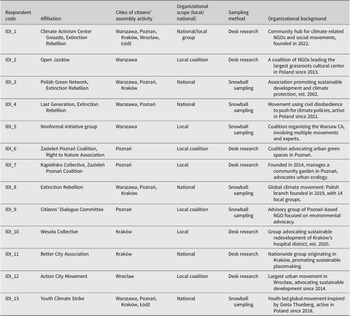
The final sample (see Table A2 in the Appendix) reflected a broad activist spectrum: global movements (Extinction Rebellion, Youth Climate Strike), civil disobedience networks (Last Generation), NGOs (Polish Green Network), grassroots groups (e.g., Wesoła Collective in Kraków, Kąpielisko Collective in Poznań), and urban coalitions (e.g., Zazieleń Poznań, Akcja Miasto, Right to Nature Association, Gniazdo). Notably, no backlash groups were found, likely because their activity intensified only after the wave of CAs studied (Drozda, Reference Drozda2025; Kubicki, Reference Kubicki2020).Footnote 1
Between January and March 2025, we conducted 13 in-depth interviews using a semi-structured questionnaire. Respondents described the process, identified supportive or obstructive actors, and reflected both on this case and on CAs as a democratic innovation. We qualitatively analyzed the transcripts, first deductively, coding references to CAs, their phases, and the role of social actors. Each segment was examined in relation to the speaker’s organizational role, city, and type of organization. We also assessed sentiment toward CAs: positive, negative, or ambivalent, linking it to specific situations. This informed a more inductive analysis of how institutional environments shape implementation. By combining thematic, contextual, sentiment, and interpretive approaches (Schwandt, Reference Schwandt1994), we captured how activists perceive CAs and how political and institutional frameworks may affect their future use.
Perspectives of climate activists on CAs in Poland
Let us first reconstruct, together with our respondents, how the process began. As most of the interviewees noted [IDI_3,5,6,8, 9,12,13], two individuals emerged as key popularizers of CAs in Poland: Marcin Gerwin a former activist and author of a handbook on CAs, and Edwin Bendyk, a journalist and independent expert on social trends. Through public endorsements and knowledge production, they played a crucial role in promoting CAs. However, the push to implement CAs as a core democratic tool was directly influenced by the British Extinction Rebellion, which included the organization of CAs among its three core demands [IDI_3,4,5,8,13].
This triggered a wave: the first CA after the climate mobilization took place in Łódź, driven by two simultaneous lobbying initiatives: one from participants of the 2018 School of City Leaders program and another from a coalition of local activists under the banner “Łódź Citizens’ Assembly.” Two more assemblies followed in fall 2020 (Wrocław and Warsaw) and two in spring 2021 (Poznań and Kraków), convened either in response to formal requests or following protest actions by Polish branches of Extinction Rebellion, Youth Climate Strike, or both.
Although the COVID-19 pandemic hampered implementation by limiting in-person engagement, lobbying was effective thanks to experienced local activists embedded in institutional networks [IDI_6,8,12,13]. Because “climate change” was considered too broad, municipalities had to narrow the topics, sparking major disputes in Poznań [IDI_5,6,8,9]. In the end, all assemblies took place, even when the topic was criticized as overly broad or vague.
Why citizens’ assemblies? Normative and strategic motivations
As discussed earlier, Poland offers diverse local civic engagement opportunities, both contentious (e.g., protests) and non-contentious (e.g., petitions), previously used by activists. How do CAs fit into this broader repertoire?
First, respondents saw CA as a strategic opportunity to ensure that their previous efforts in promoting climate policies would not be in vain (IDI_all). Even though a CA is not legally binding, much like other forms of public consultations, there was greater hope that its results would at least be considered. As one of our interviewees stated:
You can submit a petition, but there is no guarantee that it will be accepted. And if the petition is rejected, that’s the end of the matter [IDI_9].
By contrast, a recommendation adopted by the panel with 80%, percentage that became Polish standard, support was expected to carry real weight [IDI_10], as broad citizen support makes it harder for decision-makers to dismiss proposals [IDI_2,6,12,13] as representing only own perspective of self-selected group (…), not actually the residents [IDI_6]. This legitimacy is particularly valuable in urban policy areas prone to unpredictability, administrative limitations, and for example, in debates potential backlash. In such contexts, strong public backing would complicate opposition efforts [IDI_2,6,12,13].
For some respondents, CA was also seen as a means of testing public opinion, not only regarding the acceptability of activist demands but also in identifying needs that activists might not be aware of. It was noted that, especially for certain types of topics, such as highly controversial ones, it could function as a valuable research tool, much more effective than traditional opinion polls or referendums, where respondents lack the opportunity to acquire knowledge on the subject and often provide answers influenced by media-driven emotions [IDI_3,5].
Respondents noted that experiential knowledge from social and urban movements sometimes surpassed theoretical expertise yet was not easily disseminated to the broader public. Presenting proposals to a randomly selected group of citizens offered hope of reaching a broader audience [IDI_2,7,10,11], which is typically impossible in the case of highly complex and challenging issues:
We hoped that this [citizen assembly] wouldn’t just be another case of us speaking to ourselves, like during the Civic Dialogue Committee meetings — where it’s just a few, maybe a dozen people who already understand and know these issues very well. [IDI_7]
Assemblies provided a mechanism for bridging the gap, while also deepening activists’ own understanding during preparation [IDI_3,5,13]. Activists also hoped that assemblies would inspire public engagement with climate policies through expert-informed discussion [IDI_4], while also allowing them to delegate responsibility for large-scale demands beyond their capacity [IDI_1,2,7,8,10,11].
While randomness, as we see above, served strategic goals such as wider outreach and legitimacy, the deliberative aspect of CAs was universally valued, particularly in a polarized political context [IDI_all]. A representative of a consensus-based organization argued that democracy must be experienced to be learned, noting that CAs provide a valuable opportunity for this. This respondent also emphasized that involving people in decision-making is essential for them to take responsibility for solutions yet lamented that some climate activists today do not recognize this connection [IDI_1]. There was the belief that the tool needed to be learned and repeated until it could be institutionalized within a legal framework and used regularly. One of the supporters of this approach saw it as a component of democratic system reform—an expression of radical democracy [IDI_5] that could ultimately necessitate structural changes to the separation of powers and, if necessary, even constitutional amendments.
Concerns that recommendations might not align with activists’ goals were alleviated by participants’ exposure to expert knowledge [IDI_all]. Some respondents noted that their arguments were so well supported by evidence that they could not be easily challenged [IDI_6,12]. Additionally, activists often influenced the selection of experts, sometimes being better informed than public officials, which helped ensure that participants’ decisions aligned with the activists’ agenda [IDI_12].
However, simply knowing what experts recommended was considered insufficient for inform decision-making. Some respondents emphasized that the real value of CAs lays in confronting expert knowledge with people’s needs, with “people’s wisdom” [IDI_11]. It was not only the dialogue between participants, and between participants and experts, but also the opportunity to expose panellists to the complexities of public administration that was appreciated, as the latter helps build mutual understanding between citizens and civil servants [IDI_8]. To summarize, CAs were seen as ideal democratic tools because of their epistemic and dialogical potential.
Activists’ experiences with CAs: Democratic potential and design limitations
Over time, especially among respondents from the new wave of climate movements, it became clear that no legal enforcement mechanisms or procedures compelled authorities to act, even when recommendations received over 80% support from panellists. For some it was a surprising realization that a public political declaration by a city president was not enough, marking, as several put it, the first collapse of a romantic view of top-down-supported democratic processes [IDI_3,4,5,8,13]. One respondent reflected that excessive optimism and trust among the group initiating the assembly had been a mistake. They recalled an activist, Mr. X, who would warn: they’ll just cheat us anyway, but whose concerns were dismissed at the time as cynicism from a burnt-out activist. Reflecting, this respondent remarked: From today’s perspective, I think we all should have had a bit more of that internal ’Mr. X’ in us; maybe then the outcomes would have been different [IDI_8]. However, more experienced activists were skeptical of politicians from the outset. Having faced numerous rejections of their demands by local administrations, they planned from the very start to make use of the recommendations, even if these were not implemented.
We primarily hoped that, in any discussions and in future various strategic documents such as the urban adaptation plan, spatial development study, local plans, or any other strategic documents, we would be able to refer to the recommendations of the citizens’ assembly panel. In fact, we did this. [IDI_6]
The mobilizing potential of CAs proved limited. The involvement of ordinary citizens rarely extended beyond the assemblies themselves, and no mechanisms ensured broader integration, which further constrained their impact [IDI_6]. Disillusioned by the weak mobilization effect and the disproportionate effort required, respondents identified alternative strategies as more effective: concentrating on single issues [IDI_6,7,10], carefully timing interventions within investment and consultation processes [IDI_10] and combining legalistic instruments with mobilizational tactics [IDI_3,6]. They further emphasized coalition-building and embedding issues in the local context, which facilitated the recruitment of allies and sustained engagement of core participants [IDI_6,10]. Paradoxically, this capacity was reinforced by the involvement of diverse activist groups in organizing the assemblies, which became a platform for activists’ intergenerational integration.
Activists, particularly those with greater experience in civic engagement and those who had the opportunity to observe the deliberation phase, highlighted several challenges in the design of CAs. While they still considered the tool theoretically well suited, they emphasized that its next iterations should address and improve several of its aspects.
Climate CAs dealt with issues far removed from everyday experience [IDI_6,11,12]. Tensions were noted between producing general policy guidance for officials and developing detailed, implementable solutions, which require geographically or materially specific topics, clearly defined budgetary limits, and consideration of expert-prepared scenarios [IDI_12,13]. None of these practices, however, was systematically applied in the assemblies, contributing to the dilution of recommendations [IDI_12, 13].
As noted in the sections above, informed dialogue was considered the most important feature of CAs as a tool. Nevertheless, it was the way this dialogue was organized that discouraged some of the strongest critics, an effect only partly attributable to COVID-19-related restrictions. Educational, stakeholder, and deliberative sessions were strictly separated, limiting interaction between panellists, experts, officials, and interest groups [IDI_3,9]. While providing panellists with space to discuss independently was seen as essential [IDI_3], the absence of dialogical confrontation reduced some assemblies to mere opinion polls, failing to generate new knowledge or integrate theoretical insights with practical experience of panellist and stakeholders at the same time. Not only the dialogical aspect of this phase, but also its protracted duration, was regarded as a weakness [IDI_3,9,12].
Random selection of participants was generally approved, though one activist noted a paradox: when explaining the concept to family or friends, the idea that ordinary people could make decisions on important matters was met with surprise or skepticism: They were saying: “What? Ordinary people making decisions on such important matters?!” [IDI_5]. According to this interviewee, this highlighted the importance of emphasizing, particularly in public communication, that the decisions made by randomly selected panellists are based on the knowledge provided during the assemblies [IDI_5]. It also pointed to an additional concern: that CAs were insufficiently publicized, despite the substantial efforts invested in their organization, which limited their visibility and perceived impact [IDI_1,13].
Tensions between expectations and unintended outcomes led some respondents to a more nuanced evaluation: CAs were regarded as a valuable participatory instrument only once activist lobbying would be no longer required for their establishment, their role would become transparently institutionalized, and dialogue among the different contributors would be enhanced.
Citizens’ assemblies and institutional constraints
Interpreting respondents’ answers, several shortcomings of the first wave of CAs in Poland become apparent, reflecting broader challenges in local deliberative policymaking.
The organization of CAs was largely taken for granted by both activists and politicians, which led to notable limitations. Assemblies were rarely integrated into a coherent participatory process; in most cases, they functioned as one-off events rather than elements of a long-term strategy. They were tool-driven rather than problem-driven: the procedural framework existed before the issue was clearly defined, and there were often no supporting events to facilitate cross-sectoral dialogue on the recommendations [IDI_6,8,9].
For the youth wave of climate activists, CAs were perceived at the beginning as an almost perfect mechanism, expected to immediately initiate the process of designing climate policies. However, no proactive public information strategies were implemented (except in Warsaw) to keep them informed after the recommendations were submitted for implementation [IDI_1,3,4,5,8,9,13], which in turn shaped how the process was perceived in retrospect.
Budgetary and scheduling frameworks were also largely absent, leaving social actors to improvise the follow-up. Only in Warsaw did activists recall being part of cross-sectoral teams working on the results, a practice confirmed by civil servants evaluating the process during public events (Martela and Wojcieszak, Reference Martela and Wojcieszak2025). The effect was related to personal commitment, not institutional arrangement; without dedicated individuals the implementation of recommendations often stalled once the assembly concluded. This contributed to perceptions of superficiality and led one respondent to describe the process as a way for politicians to pull the wool over people’s eyes [IDI_9].
Activists played a pivotal role in shaping the assemblies. From the activists’ perspective, the event’s impact derived more from its organization and framing than from the substantive content of the recommendations. Their strategic use of recommendations in lobbying efforts demonstrates both their growing effectiveness in navigating institutional channels and the continued opacity of public policymaking in Poland. Despite the formal inclusion of citizen voices, clientelist practices persisted, indicating that while assemblies provided a tool for civic influence, the process remained vulnerable to elite capture.
Finally, even when the organization of the assembly was considered successful, the exhausting efforts required to initiate the process and monitor outcomes sometimes led to the disintegration of activist groups [IDI_1,3,4,5,8,9,13], reflecting a cyclical pattern of mobilization followed by withdrawal.
Discussion and conclusion
This study set out to explore why and how climate activists in Poland initiated and diffused CAs as a democratic innovation, how they understood their democratic potential and practical functioning, and what institutional conditions shaped their impact. One of the key contributions of this research lies in reconstructing the activist-driven wave of climate CAs in Poland and in demonstrating how both strategic calculation and normative commitment informed their engagement.
Activists were motivated to promote and participate in CAs both strategically and normatively. Strategically, they viewed assemblies as a means of increasing leverage: through randomly selected citizen endorsement, broadening public engagement beyond self-selected activist circles, and embedding recommendations in future policy documents. Compared to petitions or consultations, CAs were viewed as offering a stronger “stamp of approval” particularly when recommendations reached the 80% support threshold that became standard in Poland. Normatively, activists valued the deliberative ideals underpinning assemblies: inclusive dialogue, knowledge-based decision-making, and the integration of technical expertise with everyday experience. For many respondents, CAs represented not only a tactical instrument but also a desirable model of democratic renewal grounded in learning, mutual understanding, and shared responsibility.
At the same time, activists’ trust in CAs was conditional and evolved over time. While the deliberative phase was generally assessed positively, the absence of legal enforcement mechanisms and clear follow-up procedures exposed structural weaknesses. The implementation of recommendations, even when strongly supported, depended largely on the personal commitment of individual civil servants and activists rather than on institutionalized governance frameworks. Activists increasingly recognized the limits of assemblies as stand-alone tools, especially when they were organized as one-off events, insufficiently integrated into broader policy processes, or weakly embedded in communication strategies.
The findings further show that activists did not treat CAs as substitutes for protest and lobbying but rather incorporated them into a broader repertoire of action. Assemblies were used instrumentally to generate arguments, strengthen negotiation positions, and legitimize claims while contentious and legalistic strategies remained in use. This dual approach reflects a pragmatic understanding of deliberative innovations as complementary rather than transformative on their own.
More broadly, the Polish case contributes to debates on the bottom-up adoption of democratic innovations (Bua & Bussu, Reference Bua and Bussu2021; della Porta & Pavan, Reference della Porta and Pavan2017) by demonstrating that CAs did not emerge primarily as technocratic institutional reforms initiated from above but as politically mediated instruments advanced by civic actors seeking leverage within constrained governance environments. Consistent with deliberative democratic theory (Dryzek, Reference Dryzek2002; Smith, Reference Smith2009), activists valued assemblies for their epistemic and dialogical promise, their capacity to combine expert knowledge with everyday experience (Elstub & Escobar, Reference Elstub, Escobar, Elstub and Escobar2019; Landemore, Reference Landemore2017) and to create politically independent spaces of collective learning. Yet the findings also confirm that deliberative arenas remain embedded in existing power structures (Dryzek, Reference Dryzek2012; Young, Reference Young2001): without institutional anchoring and enforceable follow-up mechanisms, their transformative potential is contingent and vulnerable to political inertia. In this sense, climate assemblies in Poland illustrate both the promise and limits of deliberation as a complement to representative institutions (Chambers & Warren, Reference Chambers and Warren2023) and as a tool within broader repertoires of contention (della Porta, Reference della Porta2020). Rather than replacing protest, assemblies became part of activists’ strategic diversification, revealing deliberative innovation as an arena of political struggle as much as democratic experimentation.
Overall, Poland’s first wave of climate CAs illustrates both the potential and the limitations of deliberative innovations. While CAs created spaces for dialogue, learning, and temporary coalition-building, their long-term impact was constrained by limited institutional anchoring, insufficient policy integration, and the considerable effort required from civic actors to initiate and monitor them. The future development of CAs in Poland will therefore depend less on continued activist mobilization and more on whether public institutions are willing to embed deliberative mechanisms within stable governance structures, establish transparent standards of implementation, and ensure that citizen input translates into accountable policy outcomes.
Data availability statement
Data deposited in the repository can be found in Pospieszna and Zielińska (Reference Pospieszna and Zielińska2025). https://researchportal.amu.edu.pl/info/researchdata/UAM97f05f904c5d432e996c453124cb84c5/.
Funding statement
This research has been supported by research grant “Deliberative Innovations in Central and Eastern Europe—a panacea for democracy in crisis? (DelibDemCEE)” UMO-2021/42/E/HS5/00155, Sonata Bis, National Science Centre, Poland (NCN).
Competing interests
The authors declare none.
Ethical standard
The present research was reviewed and approved by the Ethics Review Board.
Informed consent
Informed consent was obtained from all subjects involved in the study.
Appendix
Local climate citizens’ assemblies in Poland (2016–2023): Cities, topics, initiators, and organizers

Source: Authors’ own elaboration based on desk research. Those highlighted in bold were selected as a sample for this study.
Overview of interviewed activists and organizations involved in local climate citizens’ assemblies in Poland



 Open access

