

All the power of the gang […] can only be explained by the […] organisation of the drug traffickers. The[ir] headquarters [are] in Marseille, […] a major redistribution centre that fears no competition because [of] […] the meticulousness of its organisation and the perfection and mastery of its operation.
Blaise Cendrars [(1934) Reference Cendrars1986: 52-53]Footnote 1
It was a Friday morning in early March 2022. The sun was still struggling to put on an appearance, but spring was in the air in Marseille. We were chatting with FlorenceFootnote 2 and Paco in front of the premises of the local association that they run in Félix-Pyat, a cité (a disadvantaged neighbourhood) in Marseille’s 3rd arrondissement (district) where we were conducting research on the dynamics of urban violence. Suddenly, three teenage youths came roaring round the corner on a scooter and started tearing up and down the pavement in front of us. It felt a bit intimidating as they accelerated towards us, braking just in time to avoid hitting us before turning around and repeating the process several times. After a while, however, they stopped and proceeded to warmly greet the unruffled Florence and Paco, who chatted for a few minutes with one of the youths called Sammy, until one of the others received a phone call, at which point the three roared away on their scooter.
When we queried Florence and Paco about the interaction we had just witnessed, they shrugged and told us that this was not unusual behaviour on the part of Sammy and his two companions. They were part of the core of a group of youths in Félix-Pyat known as les petits (the small ones), most of whom were associated with the local réseau (network)—as the neighbourhood drugs trade is known—albeit in a subordinated manner to les grands (the big ones). To this extent, the scene we had just witnessed initially seemed a rather familiar one compared to our prior research, both individually and together, on gang dynamics in Nicaragua and South Africa [Jensen Reference Jensen2008; Jensen and Rodgers Reference Jensen, Rodgers, Leys and Panitch2008, Reference Jensen and Rodgers2022, Reference Jensen and Rodgers2024; Rodgers Reference Rodgers2024; Rodgers and Jensen Reference Rodgers and Jensen2015]. During the course of the latter, we had both observed similar small groups of young men acting out in public spaces, part of larger, hierarchically organised groups involved in drug dealing and other criminal activities. When we remarked to Florence that “anywhere else in the world, they would be considered a gang”, however, she smiled wryly and replied, “well, not here”,Footnote 3 going on to explain that the label petits was an ascribed one, and that the group was chaotic and disordered.
At the same time, however, it became clear during our subsequent conversation that Florence and Paco were not impressed by their encounter with Sammy. They told us they would try to take him on a camping expedition, one of the many activities that their association organised for local youths whom they identified as petits, to try to turn them away from drug dealing. This seemed to indicate that the petits did indeed constitute a definite collective unit, but they denied this, saying that sometimes a petit was just a youth, and sometimes they were not. We then asked whether they only organised such activities for the petits, or whether they also tried to engage with the grands. In stark contrast to their cool response to Sammy and his companions, Florence and Paco exhibited a certain reluctance and nervousness about discussing the grands, eventually telling us that “there are some grands around who should not be here; there will be trouble”.Footnote 4 This suggested that the grands, at least, were not an ambiguous group and that they had some autonomous social power.
Florence and Paco’s anxieties were clearly related to the murder, a few weeks previously, of Bobby, a Félix-Pyat grand widely known to have been involved in drug dealing. There had been considerable tensions in the cité in the immediate aftermath of his death, which the media had represented as a classic “règlement de comptes”, or an impersonal “settling of scores” between rival drug dealers. Discussions abounded in the cité about the identity of Bobby’s drug dealing killer, although several other competing explanations also circulated. While none of them questioned the fact that Bobby had been involved in drug trafficking, many of the explanations for his murder had little to do with drug dealing: he had been killed because he had “looked” or “spoken to someone wrong”. He had winked at someone else’s wife. He owed money. The most intriguing narrative, however, claimed that Bobby had been killed by les petits, who included his younger brother, potentially making his death a very intimate, communal affair.
We have encountered such uncertainty surrounding the activities of gangs and drug dealing many times during the course of our previous research in Nicaragua, South Africa, and elsewhere.Footnote 5 At the same time, however, as Laurence Montel [Reference Montel2024: 6] has pointed out, the use of terms such as réseau, règlement de comptes, as well as the petits and grands categorisations, also points to a particular construction of gangs and drug dealing that depicts them as “separate” from their broader social context. For example, the notion of the règlement de comptes circumscribes the scope and logic of drug dealing violence, making it a function of the business’ internal dynamics and something that only involves dealers (unless there are “collateral victims”, but even that term intrinsically distinguishes the latter as removed from the underlying logic of the violence). Similarly, the word réseau—which in its English iteration of “network” could, of course, be taken to indicate fluid relations—is understood both in French and more locally in Marseille as embodying a certain organisational formalism.
This kind of terminology frames representations of Marseille as “an urban territory engulfed by [a] drug trafficking” that is “an ‘octopus’ whose head is elsewhere”, according to Montel [Reference Montel2024: 7-8]. The drugs trade is inherently portrayed as a deleterious externality, one that is widely perceived to have precipitated a particular “articulation between crime, politics, and urban order”, whereby Marseille has become a “narcocity”, that is to say, “an administrative entity where the drugs trade accounts for a considerable, even a majority, share of the economy and where legitimate institutions have been corrupted by the power and wealth generated by drug trafficking” [Ibid.: 9]. To this extent, drug dealing as described in Marseille is a phenomenon that can be said to embody the essence of the notion of “criminal governance”, understood here as involving “the regulation of social order, including informal or illegal economies through the establishment [by criminal entities] of formal and informal institutions that replace, complement, or compete with the state and distribute public goods such as social services, justice, and security” [Mantilla and Feldman Reference Mantilla and Feldmann2021: 2].
Although the above definition might seem to stress the formality of criminal governance, Mantilla and Feldman usefully suggest that successful criminal governance also requires strong ties to the community in question. Likewise, our research in Marseille, as well as our previous studies in Nicaragua and South Africa, suggest that we need to be cautious about formalised representations of the way that “gangs and other criminal groups manage conflict, impose specific rules and norms” [Lamotte and Rodgers Reference Lamotte and Rodgers2023: 27]. Gangs and drug dealing are frequently ambiguously embedded within broader, intimate, and fluctuating local social relations, processes and practices [Jensen and Rodgers Reference Jensen and Rodgers2022]. As Varese suggests in the Introduction to this special issue and elsewhere [Breuer and Varese Reference Breuer and Varese2023], drug dealing, as a trade activity, does not necessarily require formalization. However, as we show below, its practice will often oscillate between different degrees of formalization and governance depending on the context where certain forms of violence associated with drug dealing can be seen as intimately embedded within local social relations and their transformation, while others are linked to more external processes.
Our aim in this article, then, is to contribute to, complement, and critically engage with the rich literature on criminal governance on the basis of our empirical research in Marseille. In particular, we home in on the three emic concepts introduced above: the binary distinction between les petits and les grands, and the ideas of the réseau and règlement de comptes, which we will explore in conversation with our previous experiences studying gangs and drug dealing in Nicaragua and South Africa. We do not aim to compare directly. Indeed, many of our interlocutors in Marseille vehemently resisted comparisons with South Africa and Nicaragua that we brought up during the course of our fieldwork, saying “this is France, after all”. However, we believe that the cross-site conversation can reveal critical insights for broader discussions about criminal governance, both empirically in relation to Marseille and more conceptually.
Such an approach may also help address and engage with ideas about Marseille’s “exceptionalism”. Certainly, there is no doubt that Marseille is a city that suffers a particularly “bad” reputation [Boura (1998) Reference Boura2022; Hewitt Reference Hewitt2019; Maisetti and Mattina Reference Maisetti and Mattina2021; Mucchielli Reference Mucchielli, Dargère and Héas2016], due to its perceived status as France’s “crime capital” [Montel Reference Montel2024]—even if average overall crime rates in Marseille are in fact often no higher than those in the Paris region [Mucchielli Reference Mucchielli2013]—as well as its long-standing association with corruption and clientelist politics [Mattina Reference Mattina2016]. Indeed, it is precisely this combination of being perceived as a unique urban space fundamentally marked by violence and drug dealing governed by a particular politics that has led to the city being widely perceived and considered as “exceptional” [Peraldi and Samson Reference Peraldi and Samson2006; Ingram and Kleppinger Reference Ingram and Kleppinger2023; Rodgers and Jensen Reference Rodgers and Jensen2024a].
Rather than beginning this article by outlining a specific conceptual framework of criminal governance, we are adopting an inductive framing where we present our empirical material first in order to allow us to subsequently discuss how and to what extent the concept of criminal governance enriches our analysis of drug trafficking in Marseille, and how the Marseille case can add to existing debates. We begin by exploring the history of drug dealing and violence in Marseille, going back to its 19th century origins and the rise and fall of what has been called the “French Connection”. This illustrates the transitions and developments of criminal governance in Marseille across time and space. The next section then starts by providing some background context to Félix-Pyat, as well as a brief discussion of our research methods, positionality and ethics, after which we trace the transformation of drug dealing and gang violence in the cité from the 1990s to the present day. We focus particularly on its recent evolution through an exploration of three murders, a case of torture and a gang war. Drawing on this narrative, we then inductively rethink the notion of criminal governance through a specific discussion of the three emic concepts of le réseau, les petits and les grands, and the règlement de comptes, in order to show how criminal governance not only varies across time and space, but also within time and space, often coming together as an assemblage. Based on this analysis, we offer some general conceptual reflections about the notion of criminal governance, in Marseille and elsewhere.
A short history of gangs, drug dealing, and criminal governance in Marseille
In this section, we outline the development of gangs, drug dealing, and criminal governance in Marseille from the mid-19th century to the present day. This will not be an exhaustive history but rather aims to provide an overview that allows us to understand present-day criminal governance in Félix-Pyat in context. We begin by tracing the development of the infamous Fosse (Trench), before moving on to the emergence of what is referred to as the “French Connection”, or La French, and Marseille’s elevation as a central linchpin of global drug trafficking. We will then discuss how the city’s criminal governance subsequently became increasingly parochial in scope.
Origins
As Martin Huc [Reference Huc2024] has superbly and extensively described, we can trace the origins of contemporary organised crime in Marseille back to the second half of the 19th century. The city’s position as the Mediterranean’s leading port, boosted by the opening of the Suez Canal in 1869, brought a steady stream of travellers and, in 1878, Marseille—like many other cities in France and the colonies—created a zone where prostitution was legalised. Sailors and tourists from all over the world flocked to the so-called Quartier Réservé (Reserved Quarter), which became a veritable multi-ethnic melting pot, unique in its kind. And for a nascent local underworld, a source of profit from pimping, gambling, and theft. The Quartier Réservé, better known as La Fosse, was in fact just a small rectangle of land measuring 300 by 100 metres, made up of around 15 narrow streets and alleys on the edge of the Old Port, just behind the Town Hall building. A maze of dark alleyways and dilapidated buildings climbing up from the Old Port towards the hill of Le Panier neighbourhood, the Quartier Réservé was centred around the Rue Bouterie, which ran for more than 200 metres right through the area and was home to bars and brothels. It was here that the cheapest prostitutes could be found, working for the equivalent of a litre of red wine per pass, hence their nickname of filles à litron (litre bottle girls).
The first generation of pimps often only ran one or two prostitutes. But the Marseille underworld rapidly became more organised, and the beginning of the 20th century saw the first gang war break out, between the 21 gang, led by the Neapolitan François “le Fou” (the madman) Albertini, and the Ace of Clubs gang, led by Louis Ausset, better known as “Testasse”, from Marseille’s working-class district of Saint-Mauront, then located to the north of the city.Footnote 6 Fighting over control of pimping and racketeering, the two gangs fought each other for several years, until the arrest of a large number of 21 gang members led to the Ace of Clubs gang seizing control. Competition was, however, fierce on the streets of Marseille, and new groups emerged regularly, fighting for control of La Fosse. As Claude McKay [Reference Mckay1929: 55] famously wrote in his novel, Banjo, about his experience of living in Marseille during this period: “theah’s a shooting-up or a cutting-up—and sometimes moh—every day in this here burg”.
It was also during this period that the illegal drugs trade began to spread, following a 1916 law banning the use and sale of opium, cocaine and hashish. Local trafficking was initially organised around a dozen or so clandestine opium dens, mainly in the hands of Chinese and Indochinese merchants, who took advantage of their links with the producer countries in South-East Asia to import the drug, but other networks rapidly began to emerge, sourcing drugs from Egypt or Turkey. By the mid-1920s, however, it was Corsicans who had achieved a commanding position in the French underworld, in particular in Marseille, where they were the most numerous [see Montel Reference Montel2024]. Partly due to their culture of vendetta, the use of firearms and American-style shootouts became commonplace during this period, as did links between the underworld and local politicians. This was perpetuated during the German occupation in World War II. In the post-war period, the Marseille underworld’s criminal links became more national in scope, while their involvement in trafficking of all kinds became international at breakneck speed.
La French
Some readers will probably remember the scene in the 1975 film The French Connection II, where Gene Hackman runs through the streets of Marseille in hot pursuit of an individual at the centre of a global drug dealing network supplying heroin to the US. The “French Connection”, or La French, was the name given to the network that connected poppy fields in Turkey and even further east with the United States via Marseille. This connection was established on the back of the decades-long tradition of Corsican organised crime syndicates in Marseille producing heroin. Picking up in the 1960s as drug consumption rose in the US and Europe, Marseille became the central hub for the distribution of refined heroin to a global market. As detailed by the journalist Christophe Berliocchi [Reference Berliocchi2022]—in a sensationalist manner, confirming all the stereotypes about Marseille violence—the period of La French produced some of the most iconic figures (and their murders) associated with the Marseille underworld, adding to Marseille’s reputation as “unruly”, “wicked”, “criminal”, and “violent” [Maisetti and Mattina Reference Maisetti and Mattina2021; Boura (1998) Reference Boura2022; Hewitt Reference Hewitt2019; and Montel Reference Montel2024].
As drug consumption increasingly became an object of police intervention, both in France and in the US, the syndicates of the French Connection were put under pressure. In the early 1970s, the French Connection began to weaken as high-profile gangsters were killed or imprisoned. At the same time, drug consumption in the US shifted towards cocaine and crack. While these developments had more twists and turns, they also left Marseille less relevant in the global drug market. As succinctly summarised on the dust jacket of journalist Philippe Pujol’s Reference Pujol2014 book, French Déconnection: Au cœur des trafics, “in the 1970s, the French Connection was about drugs manufactured in Marseille and sold in the United States. Today, the French ‘Disconnection’ is about drugs manufactured in Morocco and sold in Marseille”.
While hash has long been sold in Marseille, often brought in via family and diasporic networks, the remnants of La French initially assumed control of the trade as it developed in the 1980s and 1990s.Footnote 7 Iconic figures such as Tony Zampa, Jacky Le Mat, or Francis Vanderberghe—known as “Le Belge” (The Belgian)—became central figures of organised criminality in Marseille and beyond during this period [Berliocchi Reference Berliocchi2022; Pujol Reference Pujol2014]. From the mid-1990s onwards, however, new figures began to emerge, including Farid Berrahma, who represented a “link between the traditional organised crime from which he originated and the organised criminalité of the cités whose rise to prominence he witnessed and accompanied. ‘Fafa’ is, so to speak, a special figure […], straddling two generations and two criminal models. His career is thus symptomatic of the changes that took place in organised crime in the south of France between the 1990s and 2000s, and seems to encompass every aspect of it, […] from the explosion in hashish and cocaine trafficking to […] the emergence of organised crime in the cités”.Footnote 8
Cité criminality
While Corsican organised crime groups reportedly remain important actors at a regional level—along with newer, North African groups—they have very much gone behind the scenes. The new, very visible focal points of drug trafficking in Marseille are the cités, the disadvantaged neighbourhoods mostly concentrated in the so-called Quartiers Nord (Northern Quarters) of the city [Pujol Reference Pujol2016]. Indeed, drug dealing and violence have assumed an important role in how the cités are viewed and acted upon today, as we have written about elsewhere [Rodgers and Jensen Reference Rodgers and Jensen2024a]. Although there is significant ambiguity as to the extent of city—as opposed to a cité—level criminal governance,Footnote 9 with media reports recently referring to the existence of two rival groups, Yoda and DZ Mafia, fighting it out for dominance,Footnote 10 there is an unequivocal discourse about Marseille’s cités that depicts them as “cités interdites”, or no-go zones, controlled by drug dealing organisations locally referred to as réseaux. These are described as exercising both social and spatial control, through extensive surveillance, threats, the erection of barricades, and the occupation of flats and common areas of apartment blocks [Poyet Reference Poyet2022].
We are very aware that the above narrative could in many ways be read as contributing to a narrative exceptionalising Marseille as a space of crime and delinquency. There is no doubt that local drug dealing organisations produce fear and misery among residents, but there is also unquestionably a huge vagueness surrounding the phenomenon [Rodgers and Jensen Reference Rodgers and Jensen2024b]. Moreover, by focusing on violence and drug trafficking, blame for the misfortunes of residents in these poor urban neighbourhoods is implicitly represented as lying with the residents themselves rather than the often depressing and desperate circumstances produced by unemployment, unhealthy and sometimes dangerous housing, and discrimination [Pujol Reference Pujol2014]. Hence the importance of placing such images within a broader context, insofar as Marseille very much constitutes a “mosaic”, to use the metaphor that Mark Ingram and Katheryn Kleppinger [Reference Ingram and Kleppinger2023: 1] propose—citing the Marseille rapper Akhenaton—in order to properly get to grips with the city: “If you only focus on individual tiles of the mosaic, you do not see the whole, ‘and the whole is magnificent’”.
Summarising what we have sought to show in this section, then, we can gauge the extent to which drug trafficking has developed in phases, from ad hoc, small-scale, and interstitial origins to the height of La French, when it had reached significant levels of formalization and where criminal governance reached into the formal economy and political world. As La French collapsed, drug dealing exhibited fewer governance characteristics for a period, until, as Varese suggests in the Introduction, it slowly, patchily, acquired more formal characteristics. This illustrates the point that there are important temporal dimensions to criminal governance as it oscillates between different degrees of formalization. While this also meant that the violence changed, we must be careful not to reduce or relate violence only to drug dealing, but rather stress the complex connections and assemblages of distinct processes involved, as our analysis of Félix-Pyat in the next section will illustrate.
Félix-Pyat
Despite their ascribed notoriety, there are precious few in-depth, ethnographic accounts of crime and delinquency in Marseille’s Quartiers Nord. Instead, the area’s reputation is based on and saturated by media, police and popular culture accounts. This was part of our rationale for choosing Marseille as a European research site to complement our South African and Nicaraguan research data. Doing ethnographic research in Marseille is not easy, however. While we came with considerable experience, we had to work hard to gain access and to connect with people in Félix-Pyat and elsewhere in Marseille. Our initial connection to the former was established through the friend of a family friend of Dennis’s who used to work at the local school. They introduced us to Paco and Florence who ran a local association through which we were able to establish a regular presence in the cité. While far from unproblematic and with evident biases, this gave us a privileged presence in Félix-Pyat from which we gained access to important networks of residents and the associational life of the cité.
Although in many ways we were extremely fortunate with our initial gatekeepers, we were also particularly positioned as white, cis-gender, middle-aged men. This put us in the same category as a host of individuals working in official government institutions, media, NGOs, or social workers, all of whom are treated with differing degrees of suspicion. Initially, it was clearly only Paco and Florence’s endorsement that enabled us access, while also structuring our ability to connect to people. For instance, their local association in many ways catered principally for members of the Comorian community within Félix-Pyat, for both historical and local geographical reasons—their premises were located in a building that was mostly occupied by Comorians—which clearly (sometimes) constrained our possible relations with members of the Maghrebin community in the cité. With time, however, we managed to establish a degree of autonomy and also increase our reach within different Félix-Pyat communities, often aided by the fact that we were not French, hence, potentially less associated with the French state institutions frequently blamed—rightly or wrongly—for the marginalization of the cité’s migrant communities. Our prior research experiences in Nicaragua and South Africa also led us to ask questions “from elsewhere”, which was a source of curiosity but also positioned us as different from most other (French) researchers that people had encountered.
In this way, then, our multiple positionalities—in terms of race, age, gender, identity, but also as researchers and socially within the cité—fundamentally impacted on our fieldwork, and structured what we could analyse [see Rodgers and Jensen Reference Rodgers and Jensen2024a, Reference Rodgers and Jensenb, Reference Rodgers and Jensenc for more details]. We ended up conducting a total of 7 months of ethnographic fieldwork in Félix Pyat, a cité that is officially known as the Parc Bellevue. The fieldwork comprised extensive participant observation and informal discussions in Félix-Pyat, 54 formal interviews with a range of cité inhabitants as well as with members of local associations and public institutions, and a quantitative victimisation survey that also collected basic household socio-economic data. We continue this section with a brief overview of Félix-Pyat’s history and key characteristics to contextualise our narrative about the evolution of local drug dealing.
Félix-Pyat was built as a co-propriété (local housing condominium complex) between 1958 and 1961 to accommodate pieds-noirs, French colonial settlers returning from Algeria and the French Protectorates of Tunisia and Morocco. In the decade following the construction of the cité, a second wave of immigrants arrived, mainly Maghrebins from North Africa. This new population slowly, and then more rapidly, replaced the original pieds-noirs residents. However, instead of selling their flats, many of these began renting them out to the new arrivals. Because they no longer lived in Félix-Pyat, many of the owners stopped paying the co-propriété services and charges, and the complex became heavily indebted. Buildings gradually fell into disrepair and a vicious circle began: those who could afford to moved out as quickly as possible, while those who stayed were the poorest and least socially mobile in the population. From the early 1990s, immigration from the Maghreb was replaced by the arrival of Bosnian and Kurdish refugees, as well as Albanians and, above all, a wave of Comorian immigrants. This was mirrored at the level of Marseille as a whole, with Comorians making up approximately 10% of the total population of the city, according to Fritsch [Reference Fritsch2022]. Indeed, Félix-Pyat is now known as the “capital of the Comoros” in Marseille, which itself has the highest concentration of Comorians outside the Comoros. Félix-Pyat is also distinguished by the fact that, geographically, it is one of the most central of Marseille’s so-called Quartiers Nords, located in the city’s 3rd arrondissement, in the Saint-Mauront district. The cité is therefore much more accessible to and from the rest of the city than other cités further North, such as La Castellane, or Frais Vallon to the East.
The household survey that we conducted in 2022 was based on a representative sample of 228 of the 605 households in the cité, and reported that it has a population of around 3,500, with an average ratio of 5.8 people per household, living in dwellings of varying sizes. The population of the cité is generally young, with an average age of 28. It is evenly split in terms of gender. A majority of households in the cité say they identify with the “Comorian community”: 57% of the population, compared with 30% who identify with the “Maghrebin community”, and 13% who identify with another community. Our survey also confirms that Félix-Pyat today remains a very poor cité: 63% of heads of households earn less than €1,000 a month, and 54% of households depend principally on social welfare.
At the same time, Félix-Pyat is also home to a large number of community organisations, and there is clearly a very strong collective social and cultural fabric within the cité, which is visibly mobilised during the celebrations of grands marriages (big weddings), around religion, or during sporting events, such as the CAN 2021, when the Comoros football team reached the quarter-finals, and matches were screened in the cité’s main square. People live, laugh, love, and cry in Félix-Pyat, whose history is ultimately “a plural history, emblematic of the evolution of French society over the last five decades”, as Marie d’Hombres and Blandine Scherer [Reference D’hombres and Scherer2012: 13] aptly describe in their superb book, Au 143 Félix-Pyat, which brings together texts, commentaries and testimonies from a wide spectrum of residents.
We do not wish to play down the undeniable presence or violence of drug trafficking in Félix-Pyat. However, we feel that it is important to note that our quantitative survey highlighted that drug dealing and violence were perceived as constituting less important challenges for inhabitants than pollution, poverty, health hazards and marginalization, for example. This was also evident in our qualitative interviews where residents frequently highlighted the terrifying fires that regularly occur in cité accommodation, the dilapidation, the rats, and other health risks when talking about their perception of insecurity. Furthermore, drug trafficking in Marseille is a highly variable phenomenon [Fouillade Orsini Reference Fouillade Orsini2018], and drug-related activities were much more visible in several other cités that we visited in the city. Having said this, there are many obvious signs of drug trafficking in Félix-Pyat. Graffiti on the walls of one of the first buildings at the entrance to the cité states that “everything happens over there, nothing here”,Footnote 11 with an arrow pointing to the next building, where the cité’s main charbon, or drug sales point, is located. Customers can regularly be seen going there to buy drugs, usually in the evening, but also during the day. Lookouts are also a regular presence on the street corners of the cité, which they barricade at regular intervals to facilitate drug deliveries.
There have also been several drug-related murders in the cité over the years, as well as multiple injuries. As a result, the anxiety of parents of cité youth, whether or not involved in trafficking, was often palpable during many of the interviews we conducted. Some residents also expressed the more general feeling of living in fear because of drug trafficking, although this clearly varied according to the individual and their relationship with different areas of the cité: paradoxically, those who lived closer to a drug salespoint often expressed less fear than those living further away, probably because of a familiarisation effect. Nonetheless, one of our interlocutors called Tarek, who had previously been connected with drug dealing and crime, expressed the most common view of local drug dealers when he laconically remarked that “they are not very nice”.Footnote 12
Three murders, a case of torture and a gang war
According to our older interlocutors in Félix-Pyat, drug dealing in the cité began in the mid-1990s. One of the first generation involved was an individual called Disco, a Comorian who arrived in the cité as a youth in the early 1980s. During an interview in May 2022, he explained to us how drug dealing in Félix-Pyat had initially developed in something of an ad hoc manner, and how this meant that he had been able to operate as an independent dealer, “something that is not possible now.” He would sell directly from his first floor flat, and corrupt police officers were his major source of drugs—“they knew that they could come to me and that I would buy whatever they wanted from them.” Disco claimed that he was ratted out by a competitor to a non-corrupt police officer. As a result he was jailed for 6.5 months in 1999, after which he did not go back into the drugs trade but sought to establish himself as a local political fixer for a municipal politician.
Disco never explained why he did not try to get back into dealing, but another of our interlocutors, Youssef, suggested that the reason was because the drugs trade in Félix-Pyat had been in the process of professionalising. As he put it, “it used to be run by, in inverted commas, we used to call them delinquents, especially [Disco], who had his little flat on the first floor and the customers used to go there, […] but it wasn’t in plain sight like it is today. The street wasn’t occupied, there weren’t little sofas with people sitting on them, wearing balaclavas, there wasn’t any of that”.Footnote 13 More specifically, Youssef talked of the “Kalashnikov turn”:Footnote 14
From the 2000s, maybe 2005, you could say […] [B]ecause it wasn’t like that before. Before, there were no weapons, really no weapons. If there was going to be violence, it was […] between them, but nobody knew, they dealt with each other, it wasn’t external. […] [I]t’s [afterwards] […] that one person was killed, another […] burnt in his car, and so on. […] [B]efore […] you didn’t have those kinds of stories.Footnote 15
The mid-2000s is when local inhabitants in Félix-Pyat reportedly started using the term le réseau to talk about local drug trafficking, according to an interlocutor called Aamira, who grew up in the cité and whose brother was involved in the drugs trade in the early 2010s. She explained to us how the emergent drugs trade in Félix-Pyat was originally controlled by, and exclusively involved, Algerians. This began to change from around 2010 onwards, when young non-Algerian residents of Félix-Pyat began to be recruited as low-level guetteurs (look-outs) and rabatteurs (street dealers). According to several interviewees, most of the latter were of Comorian origin, and were treated badly and exploited by the Algerians, who kept the higher-level jobs of charbonneurs (drug handlers), gérants de point de vente (salespoint managers), or gérants de quartier (neighbourhood managers), for themselves.
By the mid-2010s, the Félix-Pyat réseau was reportedly led by an individual called Fathi Ganzouai. The fact that he also worked for the Marseille Métropole (Marseille Metropolitan Area) as a drug counsellor clearly suggests that his authority drew at least partly on old-style Marseille organised crime collusion with clientelistic politics. In 2015, however, the police arrested 19 individuals involved in the Félix-Pyat réseau in one fell swoop, including Fathi. All of those arrested in 2015 were Algerians, which in effect decapitated the Félix-Pyat réseau. The lower-level Comorian dealers then took over the control of dealing in the cité. In 2017, Fathi’s right-hand man Chérif was released from prison early, and tried to reassert control over drug dealing in Félix-Pyat. He was dramatically and very publicly killed by the Comorians who had taken over the drug trade. Although Fathi did not attempt to reassert control over drug-dealing in Félix-Pyat after he was released from prison in 2019, he was also killed in June 2020, gunned down in the street near the cité. His death was never solved, but several of our interlocutors, including inhabitants of Félix-Pyat and the police, suggested that he had been killed pre-emptively by Comorian members of the Félix-Pyat réseau, to ensure that he would not be a potential future threat. It also sent a message to their city-level drug suppliers—reputedly an Algerian-dominated organised crime group—that dealing in Félix-Pyat was firmly in their hands.
Fathi’s death signalled the full transformation of the cité’s drug trafficking operation, which not only became dominated by Comorians, but also became much more inwardly-focused, insofar as Fathi had clearly been well-connected with local politicians, which the new generation was not. In addition, while these two murders obviously responded to intelligible internal drug dealing dynamics, they could also be linked to broader urban migratory-demographic trends that had taken place in Félix-Pyat, and more specifically the minorisation of the neighbourhood’s previously majority Maghrebin population by Comorians, something that by all accounts had led to general racial tensions, evident in the way that Chérif’s killing was often described to us both by individuals associated with the drugs trade and local inhabitants: as part of a symbolically powerful, historicised discourse that justified his death as the revenge of the Black “enslaved” against the Arab “slavers”.
At the same time, however, Aamira also explained the transition as an intergenerational one:
[t]hose 19 people […] they were the grands, they were the people in charge and when they went [to prison], those who were the petits took over. And now, they’re the ones in charge, they’re the ones laying down the law. Now, if a grand talks to them, they won’t listen. If there’s going to be a fight or if there’s going to be a murder, that’s what’s going to happen. It’s since then, you could say, that’s it, it’s since then. Because they really took the grands, the ones in charge. They went [to prison], they stayed there for a long time, so things had to change, after all, there had to be a rotation, so afterwards, it was the petits who took over, and when they took over, they said: “Even if the grands come back, we’re not going to let ourselves be bossed around”, and if there’s to be a reckoning, there will be a reckoning—and it’s been going on like that ever since.Footnote 16
As is the case in many other cités, both in Marseille and elsewhere, those involved in the Félix-Pyat réseau are stratified by age, including in particular between les petits and les grands. More than the actual age group, these categories represented an occupational hierarchy within the drug trade, with the petits for example generally acting as lookouts and street dealers, and the grands as drug handlers and salespoint managers.
As mentioned in the Introduction, in February 2022, Bobby, a 23-year-old Félix-Pyat youth was shot dead at night and his body left in the streets of the cité till the morning. He was a grand, and it was strongly rumoured that he was killed by members of the petits—a group that included his younger brother. Irrespective of whether this was true or not, the fact that the rumour was actively circulating is significant. It suggests a transition from racialised to intergenerational conflict within what might be termed the political economy of réseau violence. Certainly, we repeatedly heard during our fieldwork in 2022 that the Félix-Pyat petits were “now uncontrollable”, and many individuals of different ages and backgrounds expressed everyday fears of the petits. Mariama and Jeanne, two young women in their 20s, for example, told us that even if they knew the petits, stating forcefully “we know them all, we grew up with them”,Footnote 17 nevertheless
we don’t go by them, it’s better to avoid them. They’re unpredictable and dangerous. We don’t know what they’re thinking or what they’re saying to each other. They are not friendly at all; you could say that they don’t give a damn. It’s better to keep our distance for our own sake.Footnote 18
This sense of ambivalence and fear was significantly reinforced by a rather sordid episode in 2019 when a runaway youth from Northern France who tried to sell drugs on a freelance basis in Félix-Pyat was sequestered and tortured for 24 hours by a group of petits. This included burning his genitals with a blowtorch. His ordeal only came to an end when a grand forced his way into the location where the torture was taking place, and took the youth to hospital, “in order to avoid the petits killing him and risking life sentences”, according to somebody closely associated with him. The episode clearly shocked the cité, all the more so as only one of the four people subsequently arrested by the police was reportedly involved in the torture, and the main perpetrators remain at large. When the date of the trial of those captured was announced in May 2022—initially for November 2022, but subsequently delayed to September 2023—tensions in Félix-Pyat reached an unprecedented high, as those who had not been caught feared becoming involved, while local inhabitants feared being drawn in as witnesses, thus facing the wrath of the petits. Footnote 19
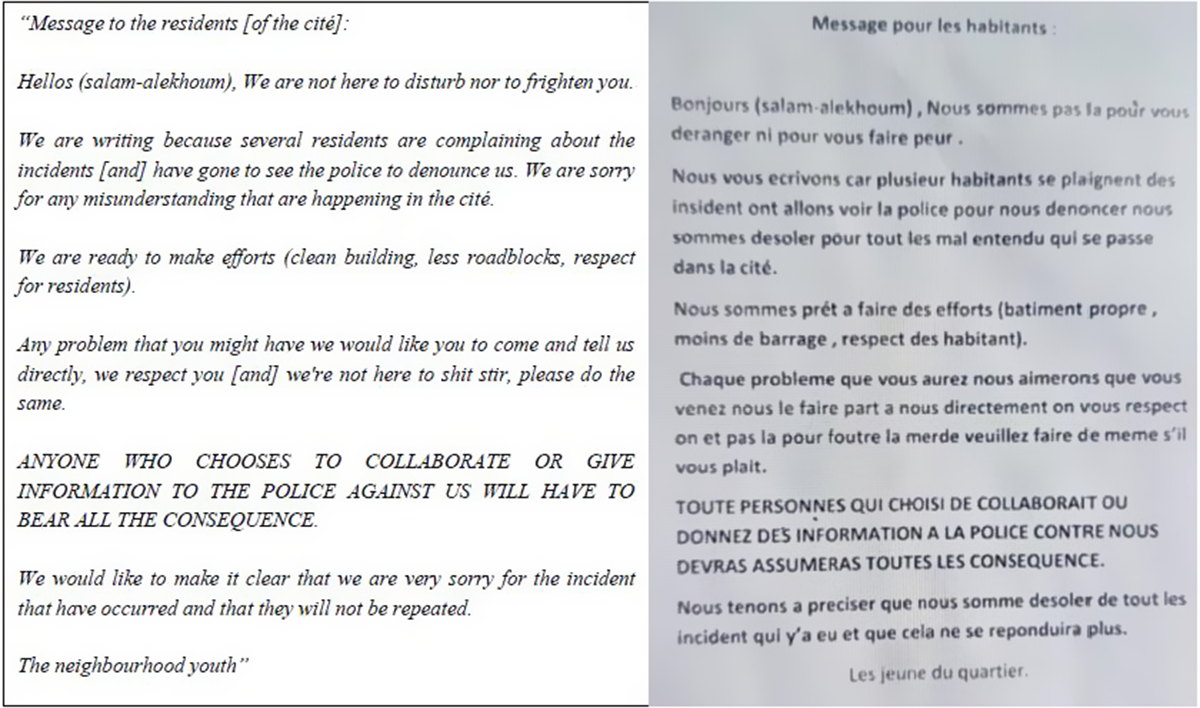
The petits, however, arguably underwent something of a transformation between our fieldwork in 2022 and when we returned to Félix-Pyat in May-June 2023, after an 11-month absence. We were once again discussing with Florence and Paco in front of their association’s premises, when—in stark contrast to the scooter episode that we described in the Introduction—a group of seven petits came over to greet us and shake our hands, before sitting down companionably near us as we continued to talk to Florence and Paco. They also displayed an unprecedented sartorial uniformity—all dressed in black and grey sports clothes, beanie hats, with sunglasses and face masks—and they left as they had arrived, as a group. But perhaps the most dramatic evidence of the collective evolution of the petits was a letter (see figure 1) that they posted throughout the cité in early May 2023, after a series of local marches against violence that had disrupted their drug dealing.
The letter from the Félix-Pyat réseau to the local community

Such a letter was unprecedented in Félix-Pyat—although reputedly a copy of one that had previously circulated in a Parisian banlieue—and it was clear from conversations that it was perceived as marking a turning point in relations between the réseau and the community. Although some of the local inhabitants focused on its threatening nature, with some even talking about the “shame” of sons effectively threatening their mothers, many actually saw the letter in a more positive light, highlighting that the petits who were now the jeunes du quartier (neighbourhood youth) had apologised and were offering to try to minimize the impact of the drug trade on everyday neighbourhood life. Aamira, for example, told us:
I had to laugh at the spelling mistakes […] It’s a warning, yes, but they also said they would make an effort, it’s give and take—the jeunes will try to keep things cool, they will respect their parents, they’ll clean up […] It’s only threatening if you don’t respect the warning.Footnote 20
Another of our interlocutors, Abu, told us, “they’ve made an effort and taken responsibility”.Footnote 21 He described how réseau youth were now regularly cleaning up the dirty streets of the cité, and were also trying to “securitize” them by placing rubbish containers in the street to prevent the possibility of drive-by shootings. Similarly, Fatima explained how following a mass brawl that had taken place in the streets of Félix-Pyat in April 2023, linked to a conflict between two families, several réseau youths had intervened and shot multiple times in the air to try to calm everybody down.
This transformation from the previously anarchic petits into the more structured jeunes du quartier sharing a definite social cohesion and esprit de corps, and with ambitions to impose a form of governance in the cité, was clearly being at least partly driven by a transformation in broader dynamics of criminal violence in Marseille, and more specifically the outbreak of a city-wide gang war in January 2023 between two more organised, city-level drug trafficking groups respectively known as “Yoda” and “DZ Mafia”. According to media reports as well as some of our interlocutors,Footnote 22 this new pattern of violence—which in many ways can be said to echo the historic gang wars of Marseille’s past described above—were linked to a broader conflict related to the organisation of metropolitan drug dealing. The leaders of Yoda and DZ Mafia were, according to Aamira, “two former partners who worked together before, and grew up together, but who are now fighting each other to try to get as many people and selling points as possible [working for them]”.Footnote 23 When we asked her why they had fallen out, she rather sheepishly said that she had heard that it was because a friend of one of the two had thrown an ice cube at the other in a nightclub in Thailand, and that when the former had refused to discipline the ice cube thrower, the latter had gone ballistic and declared war. Others, on the other hand, said that it was a straight-up economic conflict between the two groups.
Indeed, the latter explanation was very much seized upon by Aamira, who while expressing an incomprehension of the roots of the conflict, suggested that it would only end once the violence became bad for business, but that “won’t happen before a lot of people have died”.Footnote 24 At the same time, Aamira also intimated that the jeunes du quartier “had got involved in matters that don’t concern them”.Footnote 25 This was because the Félix-Pyat réseau had reportedly affiliated with the Yoda group, and between January and May 2023, there were several drive-by shootings and assaults by individuals associated with the DZ Mafia group in the cité that left several dead and dozens injured, including many “collateral” victims not associated with the réseau. This cycle of violence culminated in three local Félix-Pyat youths being gunned down in their car as they were leaving a nightclub in Marseille’s 11th arrondissement on 22 May 2023, an event that profoundly affected the neighbourhood, as we have described elsewhere [Rodgers and Jensen, Reference Rodgers and Jensen2024c]. This violence was clearly experienced as very different to the prior brutality associated with the drugs trade. As Aamira told us, “these are no longer about the settling of scores. Before, the person who died was targeted, that was normal. Now, there is no logic”.Footnote 26 Almost everybody else whom we talked to was clearly struggling to interpret and understand the new violence. “They continued shooting through Ramadan”,Footnote 27 a visibly shocked Nadia told us, for instance, while Fatima confided, “we’re all afraid. Can you imagine, you could die just because you went out to get some bread”.Footnote 28 What these traumatic statements suggest very starkly is that the symbolic order that previously allowed people to predict and cope with violence was perceived as having broken down, with the jeunes du quartier ambiguously positioned as both bulwarks against and generators of this new, unpredictable violence.
Revisiting criminal governance: petits and grands, réseaux and règlements de comptes
At its most basic, the notion of “criminal governance” can be understood as involving the regulation of social order. Gangs or gang-like institutions are often at the heart of instances of criminal governance, which are furthermore often thought to revolve around some form of illegal economic activity such as drug trafficking. Numerous studies have highlighted how gangs can emerge institutionally as organising mediums for local social life, particularly in the slums and poor neighbourhoods of cities, providing micro-regimes of order as well as communal forms of belonging to definite, albeit bounded, collective entities [see e.g. Arias Reference Arias2006; Brotherton and Barrios Reference Brotherton and Barrios2004; Jensen Reference Jensen2008; Lepoutre Reference Lepoutre1997; Mohammed Reference Mohammed2011; Rodgers Reference Rodgers2006a; Stephenson Reference Stephenson2015; Suttles Reference Suttles1968; Whyte Reference Whyte William1943]. The same is true of drug trafficking, which is widely portrayed as being “governed by its own internal logic that connects to—but also diverges from—dominant economic models and is often deeply implicated in local, normatively regulated exchanges” [Arias and Grisaffi Reference Arias and Grisaffi2021: 3]. Primarily emanating from North and Latin American research, such representations of gangs and drug dealing often tend to see them in formalistic terms, with much gang research for example being focused on the organisational taxonomy of the phenomenon, while drug dealing is often considered and modelled as a rational economic activity [Lessing and Denyer Willis Reference Lessing and Denyer Willis2019; Levitt and Venkatesh Reference Levitt and Venkatesh2000; Padilla Reference Padilla1992].
Criminal governance, in other words, is something that is observably institutionally autonomous. Rivke Jaffe [Reference Jaffe2013], for example, has described how gangs facilitate localised forms of “hybrid citizenship” in deprived neighbourhoods of Kingston, Jamaica, through their assumption of governance functions that the Jamaican state does not provide in these areas, including the provision of infrastructural services, jobs, financial loans, and even healthcare. At the same time, part of the reason for such assumptions of institutional autonomy is that the social legitimization of illegal activities is often perceived as being based on violence [Arias Reference Arias2017; Lessing Reference Lessing2021; Snyder and Durán-Martínez Reference Snyder and Durán-Martínez2009]. This implicitly positions processes of criminal governance in opposition to legal ones that are more commonly regulated through non-violent means (even if the threat of violence remains fundamental). At the same time, however, there also exists a significant literature on crime and illegal economic activity in Latin America that emphasizes the ambiguity and “messiness” of criminal governance. In particular, many scholars have pointed out that criminal governance operates along a continuum, interlinking with non-criminal forms of state and non-state governance [Arias Reference Arias2006; Auyero and Sobering Reference Auyero and Sobering2019; Rodgers Reference Rodgers2006b], and operating much more as an “assemblage” than a “system” or “regime”, strictly speaking [Abrahamsen and Williams Reference Abrahamsen and Williams2009; Diphoorn and Grassiani Reference Diphoorn and Grassiani2019; Jaffe Reference Jaffe2013; Tapscott Reference Tapscott2023].
Partly for this reason, Varese suggests in the introduction to this special issue and elsewhere [Breuer and Varese Reference Breuer and Varese2023; Varese Reference Varese, Bucerius, Haggerty and Berardi2022] that we should focus on what criminal groups do rather than on the degree of formalization of their internal structure in order to understand the nature of their governance. In particular, he suggests that it is important to heuristically separate governance from other criminal activities such as those involving trade and production. He points out that drug dealing, when conceived as a trade activity, does not necessarily require formalization, as opposed to when considered from the perspective of production. At the same time, however, as we have shown, gangs and drug dealing have oscillated historically between different degrees of formalization as practices linked to governance, depending on the context where certain forms of violence associated with drug dealing can be seen as intimately embedded within local social relations and their transformation, while others are linked to more external processes.
Certainly, the historical development of organised crime in Marseille from its origins through to La French described above arguably highlights how processes of criminal governance oscillate temporally, taking on different characteristics at different points in time, from being rather ad hoc, informal, and small-scale to more formalised iterations with clear actors interacting according to established rules and regulations, and with straightforward and logical purposes. The overarching trajectory is one of increasing formalisation and then unravelling, as reflected in the historical transformation of gang and drug trafficking dynamics in Marseille from La Fosse to La French to la cité. The picture, however, becomes more complicated and more “assemblage”-like when we explore it from the ethnographic vantage point of Félix-Pyat, and the more contemporary evolutions of crime and drug dealing. In particular, the binary tropes of petits and grands, the notion of the réseau, as well as the concept of the règlement de comptes, that are used by our different interlocutors to describe drug dealing and delinquency in the cité potentially complicate our understanding of criminal governance.
Let us begin by exploring the distinction between les petits et les grands. As our conversation with Florence and Paco suggested, the distinction occludes the extent to which these groups participate collectively in violence and criminal activities, arguably invisibilizing the peer group’s gang-nature. However, the distinction also allows us to see something important that is often ignored by gang studies. Firstly, the distinction testifies to generational and familial hierarchies. In this way, it illustrates that the putative actors of a criminal enterprise are frequently also deeply embedded in the communities within which they emerge, at least in Marseille’s cités. They are always someone’s son or brother, or later, someone’s father. In our previous research in Nicaragua, South Africa, and the Philippines, we have shown how these factors are important for issues such as recruitment or the mitigation of violence [Jensen Reference Jensen2004; Jensen and Hapal Reference Jensen and Hapal2022; Rodgers Reference Rodgers2017, Reference Rodgers2023]. The distinction also highlights important insights about the transformation of these (criminal) peer groups as people move through life stages, from “feral” teenage years (les petits incontrôlables) to becoming responsible, albeit potentially violent, members of the community (les jeunes du quartier). These generational transformations are rarely thought about in relation to gangs which are often only captured in a synchronic manner [Rodgers Reference Rodgers2022].
Moving on to the concept of le réseau, it was striking that we were strongly advised not to use the term “gang” when we first arrived in Marseille. It would put people off, our French academic colleagues told us; it was stigmatizing and not helpful in explaining our research. Instead, we were informed, we had to use the term réseau. Yet to us, the use of the term in Marseille suggests a rather corporate, business-like institutionalisation of the drugs trade. As we write elsewhere [Rodgers and Jensen Reference Rodgers and Jensen2024b], we are less than convinced about that, certainly in Félix-Pyat. One element we were particularly sceptical about was the alleged salaries associated with drug dealing, which appeared exaggerated. We were for example repeatedly told—by the police, social workers, state functionaries, local activists, as well as some local inhabitants—that guetteurs (lookouts), who are the lowest rung of the trafficking ladder, were paid €200 a day. The fact that this figure was repeated in an almost mantra-like manner meant we were highly suspicious of it, but it is also simply impossible to reconcile this figure with the levels of trafficking we observed at Félix-Pyat (or the police drug seizure figures to which we had access, which were very low).
The volume of sales needed to be able to offer €200 every day to each of the 15 or so lookouts that we were able to observe daily in Félix-Pyat would have to be much, much higher than anything we observed during our fieldwork (and this, even taking into account that most of the drug dealing now takes place online). Moreover, the lookouts were clearly rather impoverished, partly because being a lookout was an irregular, part-time activity. Indeed, it was often not paid; a youth who had tried to become a lookout explained to us how he had just started looking out on a freelance basis, imitating other youths, in order to try and get closer to the réseau little by little—something that never happened in the end. Other young people who seemed closer to the réseau suggested that, at best, a lookout could expect “a kebab and some drugs, maybe €20 if he’s lucky”. This does not mean, however, that the réseau does not provide important resources for its young members. Due to the gendered nature of socio-economic life in the cité––where jobs are hard to come by for young men and social welfare grants mostly go to women––any income is important, even if it is minimal. And there were of course non-economic, reputational dimensions to being a member of the réseau. Seen from this perspective, talking about drug dealing through the metaphor of the réseau, and implicitly presenting it as a hyper-organized, locally lucrative enterprise, arguably invisibilizes important aspects of the political economy of the drug trade—its precarity, communal embeddedness, and its affective nature.
More generally, our previous research in Nicaragua and South Africa has highlighted the organisational fluidity of gangs, and the need not to fixate on the gang as an organisation but rather see how it is located within a broader relational political economy [Rodgers Reference Rodgers2024; Jensen and Rodgers Reference Jensen and Rodgersforthcoming]. The notion of a highly organized and socially autonomous réseau, as suggested in the local usage of the term, clearly goes against the grain of such an approach. At the same time, however, perhaps invoking an anglophone conception of the réseau as a more classic “network” can help us in relation to understanding criminal governance more broadly: by focusing on the networks, we avoid the fallacies associated with constantly deducing gang practices from their internal logics only. A gang is both a phenomenon and an epiphenomenon, and its sociological import can only be properly grasped in a fundamentally contextualised manner. The same is true for criminal governance more broadly, where the institutional organisation of gangs and the drugs trade is often foregrounded at the expense of the more abstract, ontological elements, such as those corresponding to the development of self-understandings that are constitutive of a collectivity, and therefore relate to what might be termed “deep institutional structure”, that is to say, “the ways in which people imagine their social existence, how they fit together with others, how things go on between them and their fellows, the expectations that are normally met, and the deeper normative notions and images that underlie these expectations” [Taylor Reference Taylor2002: 106]. The way this happens, however, is diffuse and multiform, involving multiple elements that come together as an assemblage rather than a fixed system or regime. These elements are also multidimensional, involving both top-down and bottom-up processes [DeLanda Reference Delanda2016].
This is something that a problematization of the concept of the réglement de comptes also highlights well. Although the term has no formal legal status, it is nonetheless widely used, particularly by the police, the media, and public institutions, to describe many of the drug-related homicides that take place in Marseille and elsewhere. The underlying logic of the expression is to distinguish between murders linked to the internal dynamics of drug trafficking—for example, because of financial conflicts or market control—and murders that are more interpersonal or accidental [Kletzen, Reference Kletzen2020]. But describing a homicide systematically as a règlement de comptes is epistemologically problematic, because it decontextualises this violence, limiting its cause and consequences to drug trafficking and the people directly involved, i.e. a conflict between the victim and his killer. In reality, however, the dynamics and motivations underlying drug-related violence often have other dimensions, as the murders of Chérif, Fathi, and Bobby all highlighted. In different ways, they all showed how the causes of this kind of violence often go beyond drug trafficking issues alone, and may be linked to a particular local history and, in this case, ethno-racial and generational dynamics.
This is not just a representational issue. An expression such as the règlement de comptes—as well as the more recent notion of narchomicide Footnote 29—ends up conditioning the way we think about and deal with violence. In particular, the media coverage of settling scores contributes to dehumanising the protagonists of such violence, generally describing them only as people “known to the police”, “known for drug-related offences”, or “known for drug trafficking”. Reducing both the perpetrators and the victims of a règlement de comptes to their status as recidivist criminals not only conditions the public authorities’ response to drug trafficking but also the emotional and moral reception of this violence. It prevents us from understanding how this violence can emerge and the far-reaching consequences it can have beyond just the victim and the perpetrator. It thus inherently legitimizes whatever repressive security-focused response the police may implement.
It is striking in this regard to compare the social reaction to the murders classified as règlements de comptes in Félix-Pyat compared to the case of torture in 2019, which individuals were unable to explain and clearly felt went beyond the pale of decency. Yet its logic arguably responded to a similar process to Bobby’s murder, a form of intergenerational conflict by proxy that was occulted by the particular emotional and moral reception surrounding torture [see Jensen and Andersen Reference Jensen and Andersen2017]. At the same time, however, the notion of a règlement de comptes, and in particular the way in which it is deployed by the media and the authorities, also tells us something about how policing in the cités of Marseille works, how violence is understood and not understood, why repression rather than prevention is the order of the day, and how life more generally matters in different ways under different circumstances. Through this kind of analysis, then, we can understand something important about how violence is categorized, and becomes the basis for a different form of criminal governance that could be categorized as emanating from above.
To summarize our argument, then, we are suggesting that we need to stress the more fluid, multiform, and multidimensional aspects to be found in criminal governance, rather than foregrounding its formal, static organization. This suggests two important, conceptual contributions to the literature on criminal governance, around the temporality and relationality of governance. As Varese highlights in the Introduction to this special issue, there are important temporal dimensions to the extent to which criminal governance can oscillate with varying strength between being almost non-existent to highly formalized. This is well reflected in the historical transformation of gang and drug trafficking dynamics in Marseille from La Fosse to La French to la cité, but also the specific ways in which gangs, crime, drug dealing, violence, petits and grands, réseau, and règlements de comptes are all talked about in variable ways at different points in time. At the same time, criminal governance both in practice and representation is constituted through a combination of different processes, understandings, and actions emanating from different points, levels, and that have different temporalities. It is potentially useful to think about these “relations of exteriority” [DeLanda Reference Delanda2016] to the drug trade as constitutive of “assemblages” [Deleuze and Guattari Reference Deleuze and Guattari1988]. At any point in time, an assemblage of different—and sometimes contradictory—processes can be seen to contribute to the emergence of criminal governance, in ways that are shaped by a combination of endogenous and exogenous factors. To this extent, the notion of criminal governance should arguably be explored in a non-monolithic manner, one that assumes the possibility of there being “varieties of governance” [Capano, Howlett and Ramesh Reference Capano, Howlett and Ramesh2015]. In many ways, however, such a conclusion is perhaps not surprising, insofar as state governance—which ultimately remains criminal governance’s primary epistemological reference point—is itself something highly fluid, “assembled”, and variable [see Abrams Reference Abrams1988; Hansen and Stepputat Reference Hansen and Stepputat2001; Mitchell Reference Mitchell1991; Trouillot Reference Trouillot2001]. As such, there is no reason why criminal governance should be any different since, in the final analysis, both constitute iterations of a more universal process of social ordering, in Marseille and elsewhere.
Acknowledgements
This article is based on research carried out for the project “Gangs, Gangsters, and Ganglands: Towards a Global Comparative Ethnography” (GANGS), funded by the European Research Council (ERC) under the European Union’s Horizon 2020 research and innovation programme (grant agreement no. 787935), directed by Dennis Rodgers at the Geneva Graduate Institute between 2019–2024. See https://www.graduateinstitute.ch/research-centres/centre-conflict-development-peacebuilding/gangs-gangsters-and-ganglands-towards.
Competing interests
The authors declare none.

 Open access

