





1 Introduction
The study of connexive logics has undergone a recent increase in attention resulting in a number of papers published on the subject.Footnote
1
Omori and Kapsner [Reference Omori and Kapsner36] broadly differentiate two approaches on how to characterize and construct systems that incorporate the general idea of connexivity, one via tweaking the verification (or truth) conditions of the implication, and the other via tweaking the falsification (or falsity) conditions of the implication.Footnote
2
The former has been pursued in the initial papers on connexive logic, for example, in [Reference Angell2, Reference McCall29], but also [Reference Pizzi and Williamson45, Reference Priest50, Reference Routley59] are examples of this approach.Footnote
3
The latter has been implemented in [Reference Wansing, Schmidt, Pratt-Hartmann, Reynolds and Wansing67] by replacing the falsification conditions of implication in Nelson’s four-valued constructive logic with strong negation, N4 [Reference Almukdad and Nelson1], resulting in the connexive logic C. An interesting feature of C is that it is not only a connexive logic but also a contradictory logic, meaning that it is non-trivially inconsistent in the sense of containing formulas of the form A and ${\sim } A$
in its set of theorems.Footnote
4
In this paper I want to present and discuss the negation-free fragment of a bilateralist version of this system, which I will call 2C
${\sim } A$
in its set of theorems.Footnote
4
In this paper I want to present and discuss the negation-free fragment of a bilateralist version of this system, which I will call 2C $_-$
.Footnote
5
This approach will have two conceptual consequences. First, a different notion of contradictory logics that does not rely on negation inconsistency seems to be in order. Second, the philosophical considerations of certain properties of this system will ultimately lead to proposing a change of the usual definition commonly given for connexive logics.
$_-$
.Footnote
5
This approach will have two conceptual consequences. First, a different notion of contradictory logics that does not rely on negation inconsistency seems to be in order. Second, the philosophical considerations of certain properties of this system will ultimately lead to proposing a change of the usual definition commonly given for connexive logics.
The paper will be structured as follows. In §2, I will present the general ideas of connexivity, the characterizing features of connexive logics and how the system C is constructed. In §3, after briefly presenting the general ideas of proof-theoretic semantics (PTS) and bilateralism I will discuss the idea of having bilateralist proof systems in the sense that two derivability relations are implemented, one for provability and one for refutability (§3.1), and argue that with such a system as background we should reconsider our notion of contradictory logics (§3.2). This bilateralist setting also leads to the need for extending our notion of connexivity to dual-connexivity and bi-connexivity (§3.3). In §4, I will motivate and present an example of such a bilateralist system, namely, a natural deduction system for the negation-free fragment of 2C, and conclude by pointing out certain peculiarities that are the outcome of dismissing negation, the philosophical consequences of which will be discussed in the next sections. More specifically, I will firstly discuss whether and how we can still conceive of this system as connexive—given that the usual demarcations of connexive logic seem to heavily rely on a negation connective (§5.1). I will argue that in light of this question we need to integrate a relevance condition for the implication connectives in the form of disallowing vacuous assumption discharge for the implications in our system. This, however, will show the need to redefine the concept of connexive logics. Thus, I will propose a conception of connexive logics based on (bilateralist) PTS (§5.2). It should be emphasized that this definition is not just another addition to the long list of different forms of connexive logics, which all center around whether or not different versions of formulas are validated. Rather, I will propose a definition that radically breaks with the definitions that have been proposed so far in that none of these formulas (or their many variants) are necessarily validated but which relies purely on a proof-theoretic rule-based account of connexivity. A final issue that will be considered (§6) is about the connection between proofs and refutations in this system. In bilateralist systems with strong negation a close connection between these concepts is inherently present, since this kind of ‘toggle negation’ serves as a direct switch between them. So a question that arises when we dismiss strong negation is whether we lose this tight connection between proofs and refutations. The answer is ‘yes and no’. The concepts become more independent—which I do not consider unwanted from a bilateralist point of view—in that a proof (resp. a refutation) of A within the proof system cannot be immediately transferred into a refutation (resp. a proof) of ${\sim }A$
. Yet, as will be shown, by introducing a two-sorted typed
${\sim }A$
. Yet, as will be shown, by introducing a two-sorted typed $\lambda $
-calculus for 2C
$\lambda $
-calculus for 2C $_-$
and by defining a notion of duality in this system, there is still a way to give a close relation between proofs and refutations in the system at a meta-level.
$_-$
and by defining a notion of duality in this system, there is still a way to give a close relation between proofs and refutations in the system at a meta-level.
2 Connexivity and connexive logics
Connexive logics belong to so-called contra-classical logics [Reference Humberstone21], standing orthogonal to classical logic in that they contain theorems that are non-theorems of classical logic. Other contra-classical logics are, for instance, Abelian logics, containing the axiom schema $((A \rightarrow B) \rightarrow B) \rightarrow A$
, or Arieli and Avron’s [Reference Arieli and Avron3] bilattice logic. The name of connexive logics is supposed to imply that there must be some connection between antecedent and consequent of valid implications or, resp., between premises and conclusions of valid inferences. In that, connexive logics share the basic intuition underlying relevance logics. The general idea of connexivity that should be implemented by these systems is that no formula provably implies or is implied by its own negation. Formally, this is usually realized by validating so-called Aristotle’s (AT) and Boethius’ Theses (BT) while not validating symmetry of implication. Hence, the following is the most common, agreed-upon definition.Footnote
6
$((A \rightarrow B) \rightarrow B) \rightarrow A$
, or Arieli and Avron’s [Reference Arieli and Avron3] bilattice logic. The name of connexive logics is supposed to imply that there must be some connection between antecedent and consequent of valid implications or, resp., between premises and conclusions of valid inferences. In that, connexive logics share the basic intuition underlying relevance logics. The general idea of connexivity that should be implemented by these systems is that no formula provably implies or is implied by its own negation. Formally, this is usually realized by validating so-called Aristotle’s (AT) and Boethius’ Theses (BT) while not validating symmetry of implication. Hence, the following is the most common, agreed-upon definition.Footnote
6
Definition 1 (Connexive logics)
A logic is connexive iff
1.) the following formulas are provable in the system:
-
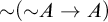
• AT: ${\sim } ({\sim } A \rightarrow A)$
,
${\sim } ({\sim } A \rightarrow A)$
, -
• AT’:
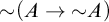
${\sim } (A \rightarrow {\sim } A)$
, -
• BT:
$(A \rightarrow B) \rightarrow {\sim }(A \rightarrow {\sim } B)$
, -
• BT’:
$(A \rightarrow {\sim } B) \rightarrow {\sim }(A \rightarrow B)$
, and


2.) the system satisfies non-symmetry of implication, i.e., $(A\rightarrow B) \rightarrow (B \rightarrow A)$
is not provable.
$(A\rightarrow B) \rightarrow (B \rightarrow A)$
is not provable.
Let us now consider an example of a connexive logic, namely, the system C.Footnote 7 Since, as mentioned in the introduction, the conceptual background assumed in this paper is from a point of view of (bilateralist) PTS, our presentation of logics will be solely based on their (rule-based, not axiomatic) proof systems.Footnote 8 So let us consider a natural deduction system as, e.g., Prawitz [Reference Prawitz47, p. 97] gives it for Nelson’s N4 (from which C is obtained) by adding the following rules to the positive fragment of NJ, Gentzen’s natural deduction calculus for intuitionistic logic:Footnote 9


As said above, it is the rules for the negated implication that need revision from a connexive point of view, i.e., to obtain a connexive system these rules must be replaced by the following:

So the set of rules presented above with ${\sim \rightarrow } I_c$
and
${\sim \rightarrow } I_c$
and ${\sim \rightarrow } E_c$
replacing
${\sim \rightarrow } E_c$
replacing ${\sim \rightarrow } I$
,
${\sim \rightarrow } I$
, ${\sim \rightarrow } E_1$
and
${\sim \rightarrow } E_1$
and ${\sim \rightarrow } E_2$
are the rules for the connexive propositional logic C. I will take this system as a starting point and now move on to a dualized presentation of these rules.
${\sim \rightarrow } E_2$
are the rules for the connexive propositional logic C. I will take this system as a starting point and now move on to a dualized presentation of these rules.
3 Bilateralism, bi-connexive systems and contradictory logics
3.1 Bilateralism and proof-theoretic semantics
In [Reference Wansing68] a bilateralist version of C is given, which is called a bi-connexive logic. Bilateralism, in a nutshell, contends that ‘negative’ concepts, like denial, rejection, or, in our case, refutation, should be considered on a par and equally primitive as their respective dual concepts of assertion, acceptance, or proof. The idea of bilateralism started out in the context of what is nowadays called PTS, the view that it is the inferential rules (represented in a logic’s proof system) which constitute the meaning of logical connectives, not, as is the common and traditional view, model-theoretic notions.Footnote 10 Importantly, on such a view the primary question is not what can be proved in a system, but rather how something can be proved and this has implications on how logic itself is conceptualized. There seem to be two main views on that, which will become important in §5.2, namely, on the one hand, to conceive of logic as a set of theorems, or on the other, to conceive of logic as a consequence relation.Footnote 11 Obviously, it is the latter that would be closer at heart for the PTS-theorist, since this relates to how something, instead of just what, can be proved. Also, related to this focus on proofs instead of truth is that PTS has overall taken a favorable stance towards intuitionistic, rather than classical logic. Formally, the reasons for this preference are related to the property of harmony, which the rules in Gentzen’s natural deduction system for intuitionistic logic, NJ, have, while this is not the case for the rules in his classical version NK.Footnote 12 As an answer to that problem, it was Rumfitt [Reference Rumfitt60] who came up with a bilateralist approach to PTS, his aim being to show that PTS and classical logic could be reconciled by using a proof system with signed formulas that not only includes rules for the connectives capturing their assertion conditions but also ones capturing their denial conditions.
Since then, various methods for implementing bilateralism in proof systems have been developed. While much of the focus has been on natural deduction systems with signed formulas la Rumfitt,Footnote
13
other approaches explore different directions. For example, some reinterpret (classical) sequent calculus with multiple conclusions, defining an inference as valid if it is incoherent to assert all premises while simultaneously denying all conclusions [Reference Restall, Hajek, Valdes-Villanueva and Westerstahl54, Reference Restall, Tanaka, Berto, Mares and Paoli55, Reference Ripley57, Reference Ripley58]. In these cases, bilateralism is not about creating a new proof system but rather reinterpreting an existing one through the dual concepts of assertion and denial.Footnote
14
The approach to bilateralism taken in this paper differs from both directions—I will consider signed consequence relations instead of signed formulas, i.e., our proof system will display a duality of inferential relations, one for proving and one for refuting.Footnote
15
It is important to emphasize here that our underlying notion of refutability is in the spirit of Nelson’s [Reference Nelson31] ‘constructible falsity’, i.e., refutability of A is to be understood in a strong sense of falsifying A (constructively showing the logical falsity of A), rather than merely showing that A is not valid (which is also sometimes called ‘refutation’). I will construct our system in a similar manner as has been done in [Reference Wansing69], where a natural deduction system containing rules both for proofs and for refutations is given for a system called 2Int. 2Int is a bi-intuitionistic logic with the same connectives as BiInt, or also called ‘Heyting-Brouwer logic’, i.e., $\top $
,
$\top $
, $\bot $
,
$\bot $
, $\wedge $
,
$\wedge $
, $\vee $
,
$\vee $
, $\rightarrow $
,
$\rightarrow $
,  . So, what we have here with the latter connective is a connective dual to implication, which we call ‘co-implication’. Note that, although the vocabulary of 2Int and BiInt is the same, the interpretation of
  differs between the systems.Footnote
16
Importantly, by accommodating this connective, we reflect the balance of the two consequence relations in our object language, as well. To make it clearer what such a proof system would look like, let us consider the example of the rules for implication:Footnote
17
differs between the systems.Footnote
16
Importantly, by accommodating this connective, we reflect the balance of the two consequence relations in our object language, as well. To make it clearer what such a proof system would look like, let us consider the example of the rules for implication:Footnote
17

Here, single lines indicate proofs and double lines refutations. Also, a distinction is drawn in the premises between assumptions (taken to be verified) and counterassumptions (taken to be falsified). This is indicated by an ordered pair $(\Gamma; \Delta )$
(with
$(\Gamma; \Delta )$
(with $\Gamma $
and
$\Gamma $
and $\Delta $
being finite, possibly empty sets) of assumptions (
$\Delta $
being finite, possibly empty sets) of assumptions ( $\Gamma $
) and counterassumptions (
$\Gamma $
) and counterassumptions ( $\Delta $
), together called the basis of a derivation. Single square brackets denote a possible discharge of assumptions, while double square brackets denote a possible discharge of counterassumptions. Thus, the rules
$\Delta $
), together called the basis of a derivation. Single square brackets denote a possible discharge of assumptions, while double square brackets denote a possible discharge of counterassumptions. Thus, the rules $\rightarrow I$
and
$\rightarrow I$
and $\rightarrow E$
are just the ones usually given in a Gentzen-style natural deduction proof system, while the rules with superscript
$\rightarrow E$
are just the ones usually given in a Gentzen-style natural deduction proof system, while the rules with superscript $^{d}$
(for ‘dual’) give the refutation conditions of implication. As can be seen, the understanding of what it means to refute an implication
$^{d}$
(for ‘dual’) give the refutation conditions of implication. As can be seen, the understanding of what it means to refute an implication $A \rightarrow B$
is to prove A and refute B, i.e., an understanding compatible with classical logic. The rules for co-implication are now obtained by dualizing these rules, i.e., we get the following ones:
$A \rightarrow B$
is to prove A and refute B, i.e., an understanding compatible with classical logic. The rules for co-implication are now obtained by dualizing these rules, i.e., we get the following ones:

What becomes apparent in these rules too, is that a mixture of proof and refutation conditions is possible within one rule: the refutation rules for $\rightarrow $
contain such a mixture as well as the proof rules for
$\rightarrow $
contain such a mixture as well as the proof rules for  . I will return to bilateralist proof systems and 2Int later but for now I want to consider how bilateralism and contradictions relate, specifically in the context of so-called ‘contradictory logics’.
3.2 A bilateralist conception of contradictory logics
A crucial aspect of bilateralism is connected to negation in that the Fregean view is rejected that denial, rejection or refutation is to be simply understood in terms of the respective ‘positive’ notion, like assertion of a negation, acceptance of a negation, or proof of a negation.Footnote
18
Rather, in relation to negation, these negative concepts are the more primitive ones—they are on a par with their positive counterparts and thus, negation is to be understood in terms of them, not the other way around. On this assumption it also makes sense to consider a view of contradictions that does without negation. Instead of considering contradictions as statements containing a conjunction of formulas A and ${\sim }A$
or sets containing these formulas, and thus, making contradictions dependent on negation, we can rather see contradictions as occurrences of a simultaneous assertion and denial of A or, as I will do here, as having both a proof and a refutation of A.
${\sim }A$
or sets containing these formulas, and thus, making contradictions dependent on negation, we can rather see contradictions as occurrences of a simultaneous assertion and denial of A or, as I will do here, as having both a proof and a refutation of A.
When considering a logical system, in which such a phenomenon can be studied, certainly we need a paraconsistent system. However, we will go further than that in considering a non-trivial contradictory logic, i.e., a logic going beyond paraconsistency in that contradictions are actually part of the theorems without this leading to triviality. So far, contradictory logics that have been studied are usually characterized over negation inconsistency, i.e., over them having both formulas of the form A and ${\sim } A$
in their set of theorems (e.g., in [Reference Niki32, Reference Wansing70, Reference Wansing, Niki and Drobyshevich71]). The connexive logic C presented above is a contradictory logic, for example. To give a simple example of a provable contradiction in C:
${\sim } A$
in their set of theorems (e.g., in [Reference Niki32, Reference Wansing70, Reference Wansing, Niki and Drobyshevich71]). The connexive logic C presented above is a contradictory logic, for example. To give a simple example of a provable contradiction in C:

Instead, I want to consider a bilateral logic displaying two derivability relations, one for proving and one for refuting, as described in §3.1. In such a framework, it is possible, then, to characterize a logic as contradictory in the following way.
Definition 2 (Bilateralist definition of contradictory logics)
In a bilateralist framework with two dual derivability relations, one for proving and one for refuting, a logic is contradictory if it is non-trivial and there is a formula A, such that A is both provable and refutable in the system.
Wansing [Reference Wansing68] uses a different characterization as to why the logic 2C, which is also bilateral in the sense of the definition above, is to be considered contradictory, namely, again due to its negation inconsistency—although it should be mentioned that he only considers this matter briefly as an interesting peculiarity, not as a major point:
[N]ote that like C, the system 2C is a non-trivial inconsistent logic: For any A, $(A\wedge {\sim }A) \rightarrow {\sim }(A\wedge {\sim }A)$
and
$(A\wedge {\sim }A) \rightarrow {\sim }(A\wedge {\sim }A)$
and ${\sim }((A\wedge {\sim }A) \rightarrow {\sim }(A\wedge {\sim }A))$
, for example, are both provable and, moreover, the formulas
${\sim }((A\wedge {\sim }A) \rightarrow {\sim }(A\wedge {\sim }A))$
, for example, are both provable and, moreover, the formulas  and
and  are both dually provable. Also, $(A \wedge {\sim }A) \rightarrow A$
and
$(A \wedge {\sim }A) \rightarrow A$
and ${\sim }((A \wedge {\sim }A) \rightarrow A)$
are both provable [
${\sim }((A \wedge {\sim }A) \rightarrow A)$
are both provable [ $\ldots $
].
$\ldots $
].
[Reference Wansing68, p. 436]Footnote 19
It is not completely clear from this quote whether or not it would be sufficient to have an example like the latter pair of formulas, i.e., whether a negation inconsistent pair of formulas with respect to the provability relation would be enough to establish the inconsistency of the system—but given usual characterizations of (unilateral) non-trivial inconsistent logics, I would assume so.
But in any case, I think we can sharpen the conception of inconsistent logicsFootnote
20
and, from a bilateralist point of view, it would indeed be preferable to define the feature of inconsistency of a bilateralist logic not only with respect to one derivability relation. First, if we want to keep the formulation as in the quote, using negation as the essential concept to characterize inconsistency, then we can still strengthen this characterization of 2C by saying that there are formulas A, such that both A and ${\sim }A$
are provable (resp. refutable) and for all such formulas A, also both their dual formulas,
${\sim }A$
are provable (resp. refutable) and for all such formulas A, also both their dual formulas, $d(A)$
and
$d(A)$
and $d({\sim }A)$
, are refutable (resp. provable). Wansing does not give a formal definition of dual formulas but that would be easily doable in the same way as we do below (see §6) with the addition of strong negation being self-dual. So what is stated in the quote about the first four formulas is no coincidence but it is the case because the latter ones are the duals of the former ones. Consequently, we could add to Wansing’s examples in the last sentence the dual formulas of
$d({\sim }A)$
, are refutable (resp. provable). Wansing does not give a formal definition of dual formulas but that would be easily doable in the same way as we do below (see §6) with the addition of strong negation being self-dual. So what is stated in the quote about the first four formulas is no coincidence but it is the case because the latter ones are the duals of the former ones. Consequently, we could add to Wansing’s examples in the last sentence the dual formulas of $(A \wedge {\sim }A) \rightarrow A$
and its negation and mention that also
$(A \wedge {\sim }A) \rightarrow A$
and its negation and mention that also  and
and  are both refutable. However, using the bilateralist definition given above will simplify things even more. Since strong negation serves as a toggle between proofs and refutations in this system, the proof of a negated formula is always equivalent with a refutation of the formula. So we can just apply our bilateralist conception and say that this logic is inconsistent because there are formulas A, such that A is both provable and refutable in the system.Footnote
21
It can be added as an interesting observation, then, that whenever this is the case, the dual of A will also be provable and refutable—but that is not necessary to make the case about the system’s inconsistency.
are both refutable. However, using the bilateralist definition given above will simplify things even more. Since strong negation serves as a toggle between proofs and refutations in this system, the proof of a negated formula is always equivalent with a refutation of the formula. So we can just apply our bilateralist conception and say that this logic is inconsistent because there are formulas A, such that A is both provable and refutable in the system.Footnote
21
It can be added as an interesting observation, then, that whenever this is the case, the dual of A will also be provable and refutable—but that is not necessary to make the case about the system’s inconsistency.
3.3 Connexivity, dual-connexivity and bi-connexivity
Since the systems with which we are working here are constructive, the connectives are best understood via (extensions of) the Brouwer–Heyting–Kolmogorov (BHK) interpretation, giving an interpretation of complex formulas in terms of proof via the clauses i)–iv) below. For atomic formulas it is assumed that we have an intuitive understanding of what constitutes a proof.
-
i) A proof of
$A \wedge B$
is a pair
$\langle d,e \rangle $
, where d is a proof of A and e is a proof of B. -
ii) A proof of
$A \vee B$
is a pair
$\langle i,d \rangle $
, where
$i = 0$
and d is a proof of A, or
$i = 1$
and d is a proof of B. -
iii) A proof of
$A \rightarrow B$
is a function that maps any proof of A to a proof of B. -
iv) There is no proof of
$\bot $
.


In [Reference López-Escobar27] a dual version of these clauses is given in that they interpret the logical connectives in terms of a primitive notion of refutation. Again, for atomic formulas an intuitive understanding of what constitutes a refutation is presupposed. I will call an extension of the set of clauses contained in the BHK-interpretation with the following set of dual clauses à la López-Escobar henceforth ‘BHKL-interpretation’:
-
i) d A refutation of
$A \wedge B$
is a pair
$\langle i,d \rangle $
, where
$i = 0$
and d is a refutation of A, or
$i = 1$
and d is a refutation of B. -
ii) d A refutation of
$A \vee B$
is a pair
$\langle d,e \rangle $
, where d is a refutation of A and e is a refutation of B. -
iii) d A refutation of
$A \rightarrow B$
is a pair
$\langle d,e \rangle $
, where d is a proof of A and e is a refutation of B. -
iv) d There is no refutation of
$\top $
.


Note that iv) $^{d}$
is not mentioned in [Reference López-Escobar27] but instead—based on his criticism of clause iv)—he adds a clause for the strong negation
$^{d}$
is not mentioned in [Reference López-Escobar27] but instead—based on his criticism of clause iv)—he adds a clause for the strong negation ${\sim }$
saying that a refutation of
${\sim }$
saying that a refutation of ${\sim }A$
is a proof of A. However, since both
${\sim }A$
is a proof of A. However, since both $\bot $
and
$\bot $
and $\top $
are part of our language, while
$\top $
are part of our language, while ${\sim }$
is not, in the following deliberations, it makes sense to integrate rather clause iv)
${\sim }$
is not, in the following deliberations, it makes sense to integrate rather clause iv) $^{d}$
too. Now, first, we need to ‘connexivize’ the BHKL-interpretation. Second, we need to add clauses that specify the proof and refutation conditions for co-implication in order to make it truly bilateralist. Remember that in Wansing’s approach, obtaining connexive logics is about tweaking the falsity conditions for implication. Thus, the connexive BHKL-interpretation is obtained from the BHKL-interpretation by replacing clause iii)
$^{d}$
too. Now, first, we need to ‘connexivize’ the BHKL-interpretation. Second, we need to add clauses that specify the proof and refutation conditions for co-implication in order to make it truly bilateralist. Remember that in Wansing’s approach, obtaining connexive logics is about tweaking the falsity conditions for implication. Thus, the connexive BHKL-interpretation is obtained from the BHKL-interpretation by replacing clause iii) $^{d}$
by the following [Reference Wansing70]:
$^{d}$
by the following [Reference Wansing70]:
-
iii) d c A refutation of
$A \rightarrow B$
is a function that maps any proof of A to a refutation of B.

Finally, to fully dualize the system and thus, obtain a bi-connexive BHKL-interpretation we need to add the following clauses, which are obtained by dualizing clauses iii) and iii) $^{d}_c$
:
$^{d}_c$
:
-
v) c A proof of
is a function that maps any refutation of B to a proof of A. -
v) d A refutation of
is a function that maps any refutation of B to a refutation of A.Footnote
22
 is a function that maps any refutation of B to a proof of A.
 is a function that maps any refutation of B to a refutation of A.
In the presence of such a dual connective to implication as well as a dual derivability relation, the notions of dual connexivity and bi-connexivity can be defined then by considering dual versions of Aristotle’s and Boethius’ Theses [Reference Wansing and Omori72, p. 26].Footnote 23
Definition 3 (Dually connexive logics)
A logic is dually connexive iff
1.) the following formulas are refutable in the system:
-
• dAT:
, -
• dAT’:
, -
• dBT:
, -
• dBT’:
, and
 ,
, ,
, ,
, , and
, and 2.) the system satisfies non-symmetry of co-implication, i.e.,  is not refutable.
Definition 4 (Bi-connexive logics)
A logic is bi-connexive iff it is connexive and dually connexive.
4 A bilateralist contradictory logic without primitive negation
4.1 Motivating the system
In the following I present the negation-free fragment of 2C, the bilateral version of the connexive and contradictory logic C. What are the reasons to consider such a negation-free version of the existing bilateral system? 2C was obtained from the system 2Int, mentioned in §3.1 above, by ‘connexivizing’ the rules for (co-)implication and adding strong negation to the system. So, since with 2Int we also have a well-behaved system without any primitive negation, we could rather ask the other way around: How is the need to add a primitive strong negation to the system motivated? Wansing [Reference Wansing68] says that adding this negation leads to an understanding of dual provability (i.e., in our terminology: refutability) as disprovability because the strong negation internalizes falsity with respect to provability and truth with respect to refutability. It is for this reason that strong negation is also often called ‘toggle negation’—it creates a very tight relation between the dual derivability relations in that any proof of A can be turned into a refutation of ${\sim }A$
(and vice versa) and any refutation of A into a proof of
${\sim }A$
(and vice versa) and any refutation of A into a proof of ${\sim }A$
(and vice versa), which is represented by the following rules:
${\sim }A$
(and vice versa), which is represented by the following rules:

Certainly, there are contexts in which this is a nice feature to have for your system, especially if one is working in areas with definite and clear-cut concepts, like mathematics.Footnote 24 There might be other contexts, though, in which such a tight relation between proving and refuting is not that desirable, especially when we think of natural language use.Footnote 25 So our argument to consider a system such as negation-free 2C is not so much about why we should get rid of a primitive strong negation but rather saying that, considering the philosophical motivations underlying this paper, there is no necessity to add this negation to our system and thus, it is a legitimate endeavor to analyze what happens if we go with a negation-free fragment. Coming from a bilateralist point of view, we wanted to conceive of contradictions and contradictory logics without dependence on a negation but rather in terms of provability and refutability. These relations are internalized by the connectives of implication and co-implication, respectively. The primitive strong negation adds an internalization of the interdependence of these relations but this is not necessary from the bilateralist perspective. Moreover, bilateralist systems with strong negation in the style given here are exactly those, which can be reduced to unilateralist systems. So, if we want to show something new and interesting that is inherently bilateralist about such a system, we should at least start out without this connective.Footnote 26
Still, there are two arguments that could be made for the need of a primitive negation, one from the perspective of connexivity and one from the natural language perspective. From the connexive perspective, and this might be another reason why ${\sim }$
was added in [Reference Wansing68], a negation might be said to be necessary in order to represent connexivity in a system. That is, for example, what Wansing and Omori [Reference Wansing and Omori72, p. 4] mention in their introduction to a special issue about the topic in the context of Definition 1 being the widely accepted one nowadays: “A connexive logic thus must contain at least a conditional and a unary connective of negation.”Footnote
27
However, as I will discuss below (see §5), with the philosophical considerations about the here presented system, I want to motivate an alternative conception of connexivity, which does not necessarily rely on the presence of a negation.
${\sim }$
was added in [Reference Wansing68], a negation might be said to be necessary in order to represent connexivity in a system. That is, for example, what Wansing and Omori [Reference Wansing and Omori72, p. 4] mention in their introduction to a special issue about the topic in the context of Definition 1 being the widely accepted one nowadays: “A connexive logic thus must contain at least a conditional and a unary connective of negation.”Footnote
27
However, as I will discuss below (see §5), with the philosophical considerations about the here presented system, I want to motivate an alternative conception of connexivity, which does not necessarily rely on the presence of a negation.
From the point of natural language, a common objection would be that it seems that we definitely need some kind of negation in our language. Well, although we do not have a primitive negation, just like in 2Int due to the presence of $\bot $
and
$\bot $
and $\top $
, we still can define a negation or rather even two. We have the usual intuitionistic negation, defined
$\top $
, we still can define a negation or rather even two. We have the usual intuitionistic negation, defined $\neg A:= A\rightarrow \bot $
, and the dual intuitionistic negation, what we will call ‘co-negation’, defined
$\neg A:= A\rightarrow \bot $
, and the dual intuitionistic negation, what we will call ‘co-negation’, defined  . Since they are defined via implication and co-implication, which are manifestations of the two derivability relations in the object language, this seems to us in accordance with the bilateralist view of refutation (and here also proof) as the more primitive concept upon which negation is defined. There is no immediate need for a connective internalizing what can be seen as a kind of co-ordination principles between these relations and if we do not want this tight connection between them, we should dismiss a primitive negation of this kind.Footnote
28
. Since they are defined via implication and co-implication, which are manifestations of the two derivability relations in the object language, this seems to us in accordance with the bilateralist view of refutation (and here also proof) as the more primitive concept upon which negation is defined. There is no immediate need for a connective internalizing what can be seen as a kind of co-ordination principles between these relations and if we do not want this tight connection between them, we should dismiss a primitive negation of this kind.Footnote
28
4.2 A bi-connexive logic without negation
Let us take a look now at a natural deduction system for 2C as it is given in [Reference Wansing68]. The only difference in representation is that for the rules $\bot E$
,
$\bot E$
, $\top E^{d}$
,
$\top E^{d}$
, $\wedge E^{d}$
and
$\wedge E^{d}$
and $\vee E$
, I use a generalized version, indicated by the dashed lines, meaning that it can be either a single or a double line in place of it (but for
$\vee E$
, I use a generalized version, indicated by the dashed lines, meaning that it can be either a single or a double line in place of it (but for $\wedge E^{d}$
and
$\wedge E^{d}$
and $\vee E$
all occurrences of the dashed line need to be replaced by the same kind of line).Footnote
29
Also, there are explicit rules for introducing
$\vee E$
all occurrences of the dashed line need to be replaced by the same kind of line).Footnote
29
Also, there are explicit rules for introducing $\bot $
and
$\bot $
and $\top $
, which are implicitly mentioned in [Reference Wansing68] in that it is stated there that
$\top $
, which are implicitly mentioned in [Reference Wansing68] in that it is stated there that $\overline {\overline {\bot }}$
is a refutation of
$\overline {\overline {\bot }}$
is a refutation of $\bot $
from
$\bot $
from $(\emptyset; \emptyset )$
and
$(\emptyset; \emptyset )$
and $\overline {\top }$
is a proof of
$\overline {\top }$
is a proof of $\top $
from
$\top $
from $(\emptyset; \emptyset )$
.
$(\emptyset; \emptyset )$
.
Let Prop be a countably infinite set of atomic formulas. Elements from Prop will be denoted by $\rho $
,
$\rho $
, $\sigma $
,
$\sigma $
, $\tau \ldots $
. Formulas generated from Prop will be denoted by
$\tau \ldots $
. Formulas generated from Prop will be denoted by $A, B, C$
,
$A, B, C$
, $\ldots $
. We use
$\ldots $
. We use $\Gamma $
,
$\Gamma $
, $\Delta $
,
$\Delta $
, $\ldots $
for sets of formulas. The concatenation
$\ldots $
for sets of formulas. The concatenation $\Gamma $
, A stands for
$\Gamma $
, A stands for $\Gamma \cup \left \{A\right \}$
.
$\Gamma \cup \left \{A\right \}$
.
The language $\mathcal {L}_{2C_-}$
of 2C without strong negation is defined in Backus–Naur form as follows:
$\mathcal {L}_{2C_-}$
of 2C without strong negation is defined in Backus–Naur form as follows:

If there is a derivation of A from a (possibly empty) basis $(\Gamma; \Delta )$
whose last inference step is constituted by a proof rule, this will be indicated by
$(\Gamma; \Delta )$
whose last inference step is constituted by a proof rule, this will be indicated by $(\Gamma; \Delta ) \Rightarrow ^{+} A$
. If there is a derivation of A from a (possibly empty) basis
$(\Gamma; \Delta ) \Rightarrow ^{+} A$
. If there is a derivation of A from a (possibly empty) basis $(\Gamma; \Delta )$
whose last inference step is constituted by a refutation rule, this will be indicated by
$(\Gamma; \Delta )$
whose last inference step is constituted by a refutation rule, this will be indicated by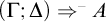 $(\Gamma; \Delta ) \Rightarrow ^{-} A$
. We assume that if
$(\Gamma; \Delta ) \Rightarrow ^{-} A$
. We assume that if $(\Gamma; \Delta ) \Rightarrow ^{+} A$
,
$(\Gamma; \Delta ) \Rightarrow ^{+} A$
, $\Gamma \subseteq \Gamma '$
then
$\Gamma \subseteq \Gamma '$
then $(\Gamma '; \Delta ) \Rightarrow ^{+} A$
and that if
$(\Gamma '; \Delta ) \Rightarrow ^{+} A$
and that if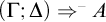 $(\Gamma; \Delta ) \Rightarrow ^{-} A$
,
$(\Gamma; \Delta ) \Rightarrow ^{-} A$
, $\Delta \subseteq \Delta '$
, then
$\Delta \subseteq \Delta '$
, then $(\Gamma; \Delta ') \Rightarrow ^{-} A$
. I do not yet use ‘N2C
$(\Gamma; \Delta ') \Rightarrow ^{-} A$
. I do not yet use ‘N2C $_-$
’ as a name for the proof system but rather the clumsy ‘N2C without strong negation’ as a label for this calculus because the former will be reserved for the system with a prohibition on vacuous assumption discharge in the rules for (co-)implication, as presented in §6.
$_-$
’ as a name for the proof system but rather the clumsy ‘N2C without strong negation’ as a label for this calculus because the former will be reserved for the system with a prohibition on vacuous assumption discharge in the rules for (co-)implication, as presented in §6.
N2C without strong negation


As mentioned above, 2C without strong negation is—just as C and 2C—a contradictory logic. In the spirit of the bilateralist characterization of contradictory logics given above, let us take a look at an example of a contradictory formula, i.e., one that is provable and refutable in the system:
![[A and open parenthesis A implies bottom close parenthesis] all over A, conjunction elimination one, all over open parenthesis A and open parenthesis A implies bottom close parenthesis close parenthesis implies A, implication introduction. To the...](https://static.cambridge.org/binary/version/id/urn:cambridge.org:id:binary:20260525103521963-0521:S1755020326101063:S1755020326101063_eqnu9.png?pub-status=live)
In light of dismissing strong (and thereby any primitive) negation, we have to ask at least two questions, though. First, given that Aristotle’s and Boethius’ Theses heavily rely on the presence of a negation, is 2C without strong negation even still connexive? Second, given that we lose the toggling feature of strong negation, what is the relationship between proofs and refutations in this system? I will consider the first question in §5 and the second one in §6.
5 Towards a proof-theoretic conception of connexive logic
5.1 Is the system still connexive?
As we have seen above, both the definition for connexivity and for dual connexivity, and thus, for bi-connexivity, depend on (the duals of) Aristotle’s and Boethius’ Theses and these in turn all contain a negation. As said above, we have two defined negations, though, $\neg A:= A\rightarrow \bot $
, and
$\neg A:= A\rightarrow \bot $
, and  . So what if we use (one of) these negations in Aristotle’s and Boethius’ Theses? Let us consider the example of AT and AT’. Since we have two negations at hand, there are different ways of how to implement those in the theses, either using the same negation for each instance or different ones for the ‘outer’ and ‘inner’ negations, i.e., we get the following possible cases:Footnote
30
. So what if we use (one of) these negations in Aristotle’s and Boethius’ Theses? Let us consider the example of AT and AT’. Since we have two negations at hand, there are different ways of how to implement those in the theses, either using the same negation for each instance or different ones for the ‘outer’ and ‘inner’ negations, i.e., we get the following possible cases:Footnote
30

So the question is whether (any or all of) these are provable in our system. A positive answer will be indicated by $\checkmark $
and a negative answer by
$\checkmark $
and a negative answer by
 :
:

What we can see here is that, first, AT and AT’ are provable with respect to co-negation but not with respect to intuitionistic negation. Second, only the outer negation seems decisive here, not the inner negation. Let’s take a look at the dual versions now, for which, again, there are different cases depending on which negation is instantiated where:

With the dual versions the question is of course whether or not these formulas are refutable, with the following result:

Long description
The left column contains four numbered items, each with a logical formula and a symbol. From top to bottom: 1. not open parenthesis not A implies A close parenthesis, check mark. 2. not open parenthesis A implies A close parenthesis, check mark. 3. not open parenthesis not A implies A close parenthesis, contradiction symbol. 4. not open parenthesis not A implies A close parenthesis, contradiction symbol. The right column mirrors this structure but with the implication order reversed: 1. not open parenthesis A implies not A close parenthesis, check mark. 2. not open parenthesis A implies not A close parenthesis, check mark. 3. not open parenthesis A implies not A close parenthesis, contradiction symbol. 4. not open parenthesis A implies not A close parenthesis, contradiction symbol. Each formula is followed by either a check mark or a contradiction symbol, indicating validity or invalidity.
And again, dAT and dAT’ are refutable, here with respect to intuitionistic negation, though, not with respect to co-negation, and also again, the inner negation does not matter for that question. It can be easily checked that the same holds for BT, BT’, dBT and dBT’:
-
1. For BT and BT’, if the outer negation is instantiated by co-negation, then the formulas are provable (no matter how the inner negation is instantiated). They are not provable if the outer negation is instantiated by intuitionistic negation.
-
2. For dBT and dBT’, if the outer negation is instantiated by intuitionistic negation, then the formulas are refutable (no matter how the inner negation is instantiated). They are not refutable if the outer negation is instantiated by co-negation.
This seems to suggest a positive answer to our question whether 2C without strong negation can still be considered connexive: We can say that it is bi-connexive because it is connexive with respect to co-negation and dually connexive with respect to intuitionistic negation (the definition of bi-connexivity did not require that there can be just one negation in question). This is exactly what Wansing, Niki, and Drobyshevich [Reference Wansing, Niki and Drobyshevich71] claim for their system, NB2C, in which the situation is the same with respect to the above derivabilities.
However, let us take a step back and consider these derivabilities a bit closer. After all, as I said above, in PTS we are not only interested in what is derivable but rather how something is derivable. So let us take a look at how these formulas are derived in that system at the example of AT and dAT in the two versions with the different inner negations:


And AT’ and dAT’:


These are enough to immediately see what is wrong (or at least very odd!) about this system: It is not only that the inner negation does not matter for the derivability but rather, the whole inside of the brackets does not matter at all for deriving these formulas. As is obvious, in the present system for any formula A its co-negation is provable and its intuitionistic negation is refutable, since for a proof of  all we need is a proof of $\top $
and for a refutation of
$\top $
and for a refutation of $A \rightarrow \bot $
all we need is a refutation of
$A \rightarrow \bot $
all we need is a refutation of $\bot $
, which we both trivially have:
$\bot $
, which we both trivially have:

As can be seen, since vacuous assumption discharge is permitted, A does not play any role in these inferences. The systems 2C and NB2C actually have the same feature and Wansing, Niki, and Drobyshevich [Reference Wansing, Niki and Drobyshevich71] explicitly say that this is not worrisome because for constructivists—as opposed to relevantists—vacuous discharge is unproblematic. In general, of course, this is true but the question is whether it has been unproblematic for constructivists just because they did not study systems in which this feature has such an odd consequence. What is more, even if we accept this as a strange but not too worrisome feature of our system, a question that we must ask is this: Can we seriously use these derivations as a demarcation for the logic to be (bi-)connexive? That is, do we want to say that the logic is (dually) connexive because it fulfills the requirement that (dAT-dBT’) AT-BT’ are derivable, even though the specific structure of these formulas, what they are stating, does not play any role here? At least to me, that looks like a very odd feature to base the connexivity of the system on. So, it would seem, in order to avoid this strange consequence, we need to implement some relevance restrictions in the form of disallowing vacuous discharge for (co-)implication. This is the system we will call 2C $_-$
: a negation-free fragment of 2C with a prohibition of vacuous assumption discharge in the introduction rules for (co-)implication.Footnote
31
$_-$
: a negation-free fragment of 2C with a prohibition of vacuous assumption discharge in the introduction rules for (co-)implication.Footnote
31
One might be worried now that this seems like an ad hoc move, since, as an anonymous reviewer remarked, constructivists are usually fine with vacuous assumption discharge and the problematic feature of being able to prove (resp. refute) any co- (resp. intuitionistic) negation has nothing to do with the constructivist conceptual agenda as such. I see such a worry as not completely unjustified because, yes, we disallow vacuous discharge in the (co-)implication rules in order to prevent this undesirable feature. On the other hand, I think that there are some reasons that can be considered in order to further justify this move. First, although there definitely is something like a ‘constructivists’ agenda’, it is worth emphasizing that constructivists are not a completely unified group. As is already obvious from the systems discussed in this paper, there are different constructive logics and N3 and N4, for instance, were developed from a criticism about intuitionistic negation not being constructive enough, just like minimal logic from a criticism about the principle $\bot \rightarrow A$
.Footnote
32
And it does not, at least, seem anti-constructive to demand of a function to actually apply to something in order to produce a result. Moreover, as mentioned above, with their demand on a connection between A and B in
$\bot \rightarrow A$
.Footnote
32
And it does not, at least, seem anti-constructive to demand of a function to actually apply to something in order to produce a result. Moreover, as mentioned above, with their demand on a connection between A and B in $A\rightarrow B$
connexive logics definitely have been developed with a relevance flavor in mind. So again, although this is not a usual requirement for connexive logics, it does not seem to stand contrary to them at least. As a last point, I think that just from a conceptual angle these negations simply only make sense if there are actual assumptions present. That a proof of A leads to a refutation of some form of negation of A (
$A\rightarrow B$
connexive logics definitely have been developed with a relevance flavor in mind. So again, although this is not a usual requirement for connexive logics, it does not seem to stand contrary to them at least. As a last point, I think that just from a conceptual angle these negations simply only make sense if there are actual assumptions present. That a proof of A leads to a refutation of some form of negation of A ( $A\rightarrow \bot $
) and that a refutation of A leads to a proof of some form of negation of A (
$A\rightarrow \bot $
) and that a refutation of A leads to a proof of some form of negation of A ( ) seems reasonable enough (if we do not consider connexive implications as such as completely unintelligible). That you should get, in an otherwise quite well-behaved system, the refutation and proof of some negation of any formula, on the other hand, does not.
5.2 Connexivity without negation
To circle back to the question of whether this system is connexive, it has to be emphasized now, that by disallowing vacuous assumption discharge no version of Aristotle’s and Boethius’ (dual) Theses is derivable anymore. What this implies is that either our system is not really connexive after all or that the standard definition of connexivity, as given in Definition 1, is not entirely capturing what it is supposed to capture. With an implication present, though, that resembles so closely what is considered as connexive in a Wansing-approach, the first choice does not seem right. I rather think that the problem is that such a PTS, i.e., logic-as-consequence-relation approach and the usual conception of connexivity, in which the logic-as-set-of-theorems view is deeply entrenched, do not go together well. After all, it does seem to be the case that the idea of connexivity is still alive in 2C $_-$
, although maybe not spelled out with a negation and thus, not expressible via Aristotle’s and Boethius’ Theses. But the (co-)implication rules do capture the spirit, most clearly this can be seen in the way BT’ can be read off the
$_-$
, although maybe not spelled out with a negation and thus, not expressible via Aristotle’s and Boethius’ Theses. But the (co-)implication rules do capture the spirit, most clearly this can be seen in the way BT’ can be read off the $\rightarrow I^{d}$
rule. So I think that Definitions 1 and 3 are too strong: The requirements that are given are sufficient but not necessary for yielding a connexive, respectively, dually connexive, logic. Thus, I think within this approach we should consider a different conception of connexivity—one that fits the rule-focus of the PTS approach and centers around (co-)implication. I want to propose a rule-based conception of connexivity along the following lines instead, where ‘(co-)implication clause’ refers to formulations of the form iii), iii)
$\rightarrow I^{d}$
rule. So I think that Definitions 1 and 3 are too strong: The requirements that are given are sufficient but not necessary for yielding a connexive, respectively, dually connexive, logic. Thus, I think within this approach we should consider a different conception of connexivity—one that fits the rule-focus of the PTS approach and centers around (co-)implication. I want to propose a rule-based conception of connexivity along the following lines instead, where ‘(co-)implication clause’ refers to formulations of the form iii), iii) $^d_c$
, v)
$^d_c$
, v) $_c$
and v)
$_c$
and v) $^d$
given above.Footnote
33
$^d$
given above.Footnote
33
Definition 5 (PTS-conception of connexivity)
A logic $\mathcal {L}$
containing an implication connective is connexive if its rules are sound with respect to the implication clauses of the connexive BHKL interpretation, insofar that any implication formula provable (refutable) in
$\mathcal {L}$
containing an implication connective is connexive if its rules are sound with respect to the implication clauses of the connexive BHKL interpretation, insofar that any implication formula provable (refutable) in $\mathcal {L}$
has a proof (refutation) in the sense of the implication clauses of the connexive BHKL interpretation.
$\mathcal {L}$
has a proof (refutation) in the sense of the implication clauses of the connexive BHKL interpretation.
Definition 6 (PTS-conception of dual connexivity)
A logic $\mathcal {L}$
containing a co-implication connective is dually connexive if its rules are sound with respect to the co-implication clauses of the dually connexive BHKL interpretation, insofar that any co-implication formula provable (refutable) in
$\mathcal {L}$
containing a co-implication connective is dually connexive if its rules are sound with respect to the co-implication clauses of the dually connexive BHKL interpretation, insofar that any co-implication formula provable (refutable) in $\mathcal {L}$
has a proof (refutation) in the sense of the co-implication clauses of the dually connexive BHKL interpretation.
$\mathcal {L}$
has a proof (refutation) in the sense of the co-implication clauses of the dually connexive BHKL interpretation.
Definition 7 (PTS-conception of bi-connexivity)
A logic $\mathcal {L}$
containing an implication and a co-implication connective is bi-connexive if its rules are sound with respect to the (co-)implication clauses of the bi-connexive BHKL interpretation, insofar that any (co-)implication formula provable (refutable) in
$\mathcal {L}$
containing an implication and a co-implication connective is bi-connexive if its rules are sound with respect to the (co-)implication clauses of the bi-connexive BHKL interpretation, insofar that any (co-)implication formula provable (refutable) in $\mathcal {L}$
has a proof (refutation) in the sense of the (co-)implication clauses of the bi-connexive BHKL interpretation.
$\mathcal {L}$
has a proof (refutation) in the sense of the (co-)implication clauses of the bi-connexive BHKL interpretation.
It is not only due to the informal nature of BHK(L) interpretations that one must be careful to just request soundness and not completeness but there are clear cases that show why such a requirement would be too strong: Due to the restriction on vacuous assumption discharge, as the examples above show, there is less derivable in 2C $_-$
than in 2C, both of which we would consider bi-connexive logics. Note also that we do not have an ‘iff’ in the Definitions 5–7, i.e., the given requirements are—like I think should be the ones in the traditional definitions, Definitions 1 and 3—only considered to be sufficient, not necessary for getting a connexive logic. Though it might seem desirable to replace the standard definition by one trying to give stricter, necessary conditions, I do not consider this a practical way to go. Certainly there are connexive logics in which such a notion of refutation adhering to a BHKL interpretation is simply not implemented. We could claim that these must be at least translatable in such a system but this does not seem very straightforward at all, considering the very different approach to connexive logics via tweaking the truth conditions of the implication that was described above. Still, our approach seems to be in line with the beginnings of connexive logic, as, for example, McCall’s [Reference McCall29] discussion also centers around implication, not negation.
$_-$
than in 2C, both of which we would consider bi-connexive logics. Note also that we do not have an ‘iff’ in the Definitions 5–7, i.e., the given requirements are—like I think should be the ones in the traditional definitions, Definitions 1 and 3—only considered to be sufficient, not necessary for getting a connexive logic. Though it might seem desirable to replace the standard definition by one trying to give stricter, necessary conditions, I do not consider this a practical way to go. Certainly there are connexive logics in which such a notion of refutation adhering to a BHKL interpretation is simply not implemented. We could claim that these must be at least translatable in such a system but this does not seem very straightforward at all, considering the very different approach to connexive logics via tweaking the truth conditions of the implication that was described above. Still, our approach seems to be in line with the beginnings of connexive logic, as, for example, McCall’s [Reference McCall29] discussion also centers around implication, not negation.
However, as said in the introduction, it should be emphasized that this is not another refinement of characterizations of connexive logic(s), as are given in the extensive list in [Reference Wansing and Omori72]. While these are all about tweaking, extending or restricting in some way the standard definition, here I am suggesting a completely different way of grasping connexive logic, that I think would be better suited for Wansing’s approach, namely, by abandoning a conception centered around axioms and theorems and rather move to one that focuses on the rules of the system. Such an approach, then, seems very well in line with the spirit of PTS. Note that this does not necessarily contradict what the authors in [Reference Estrada-González and Nicolás-Francisco9] advocate, suggesting that there is something like a ‘connexive negation’. Their approach is about generating a connexive logic by keeping a ‘standard’ implication while tweaking the negation in order to validate Aristotle’s and Boethius’ Theses. These can all be sufficient ways to get a connexive logic. The point here is just that it is not necessary to have a negation in order to get connexivity. Another advantage of this conception as opposed to the standard one is that we avoid the problem—at least this is seen by some as a problem—that it is not clear whether the ‘inner’ and ‘outer’ negations in Aristotle’s and Boethius’ Theses are different or the same.
6 Proofs and refutations in
$\lambda ^{2C_-}$

In order to consider the second question, about the relationship between proofs and refutations in 2C $_-$
, I provide now a
$_-$
, I provide now a $\lambda $
-term calculus,
$\lambda $
-term calculus, $\lambda ^{2C_-}$
, which I use to give a term-annotated natural deduction system in Curry-style typing for 2C
$\lambda ^{2C_-}$
, which I use to give a term-annotated natural deduction system in Curry-style typing for 2C $_-$
. Whenever the superscript
$_-$
. Whenever the superscript $^{*}$
is used with a symbol, this is to indicate that the superscript can be either
$^{*}$
is used with a symbol, this is to indicate that the superscript can be either $+$
or
$+$
or $-$
(called polarities). When
$-$
(called polarities). When $^{*}$
is used multiple times within a symbol, this is meant to always denote the same polarity. In contrast, when
$^{*}$
is used multiple times within a symbol, this is meant to always denote the same polarity. In contrast, when $^{\dagger }$
is used next to
$^{\dagger }$
is used next to $^{*}$
in a symbol this means that it can—but does not have to—be of another polarity (yet again multiple
$^{*}$
in a symbol this means that it can—but does not have to—be of another polarity (yet again multiple $^{\dagger }$
denote the same polarity), i.e., for example,
$^{\dagger }$
denote the same polarity), i.e., for example, $\texttt {case}~ r^{*}\{x^{*}.t^{\dagger } | y^{*}.s^{\dagger }\}^{\dagger }$
could either stand for
$\texttt {case}~ r^{*}\{x^{*}.t^{\dagger } | y^{*}.s^{\dagger }\}^{\dagger }$
could either stand for $\texttt {case}~ r^{+}\{x^{+}.t^{+} | y^{+}.s^{+}\}^{+}$
,
$\texttt {case}~ r^{+}\{x^{+}.t^{+} | y^{+}.s^{+}\}^{+}$
, $\texttt {case}~ r^{-}\{x^{-}.t^{-} | y^{-}.s^{-}\}^{-}$
,
$\texttt {case}~ r^{-}\{x^{-}.t^{-} | y^{-}.s^{-}\}^{-}$
, $\texttt {case}~ r^{+}\{x^{+}.t^{-} | y^{+}.s^{-}\}^{-}$
, or
$\texttt {case}~ r^{+}\{x^{+}.t^{-} | y^{+}.s^{-}\}^{-}$
, or $\texttt {case}~ r^{-}\{x^{-}.t^{+} | y^{-}.s^{+}\}^{+}$
but not for, e.g.,
$\texttt {case}~ r^{-}\{x^{-}.t^{+} | y^{-}.s^{+}\}^{+}$
but not for, e.g., $\texttt {case}~ r^{+}\{x^{+}.t^{+} | y^{+}.s^{-}\}^{-}$
.
$\texttt {case}~ r^{+}\{x^{+}.t^{+} | y^{+}.s^{-}\}^{-}$
.
Definition 8. The set of type symbols (or just types) is the set of all formulas of $\mathcal {L}_{2C_-}$
. Let Var
$\mathcal {L}_{2C_-}$
. Let Var $_{2C_-}$
be a countably infinite set of two-sorted term variables. Elements from Var
$_{2C_-}$
be a countably infinite set of two-sorted term variables. Elements from Var $_{2C_-}$
will be denoted by
$_{2C_-}$
will be denoted by $x^{*}$
,
$x^{*}$
, $y^{*}$
,
$y^{*}$
, $z^{*}$
,
$z^{*}$
, $\ldots $
. The two-sorted terms generated from Var
$\ldots $
. The two-sorted terms generated from Var $_{2C_-}$
will be denoted by
$_{2C_-}$
will be denoted by $t^{*}, r^{*}, s^{*}$
,
$t^{*}, r^{*}, s^{*}$
, $\ldots $
. The set Term
$\ldots $
. The set Term $_{2C_-}$
can be defined in Backus–Naur form as follows:
$_{2C_-}$
can be defined in Backus–Naur form as follows:
-
$t ::= x^{*} \mid \texttt {top} ^{+} \mid \texttt {bot} ^{-} \mid abort(t^{*})^{\dagger } \mid \langle t^{*},t^{*}\rangle ^{*} \mid fst(t^{*})^{*} \mid snd(t^{*})^{*} \mid inl(t^{*})^{*} \mid$
$inr(t^{*})^{*} \mid \texttt {case}~ t^{*}\{x^{*}.t^{\dagger } | x^{*}.t^{\dagger }\}^{\dagger } \mid (\lambda x^{*}.t^{\dagger })^{\dagger } \mid App(t^{*},t^{\dagger })^{*}$
.Footnote
34


Definition 9. A (type assignment) statement is of the form $t: A$
with term t being the subject and type A the predicate of the statement. It is read “term t is of type A” or, in the ‘proof-reading’, “t is a proof of formula A”. In a basis
$t: A$
with term t being the subject and type A the predicate of the statement. It is read “term t is of type A” or, in the ‘proof-reading’, “t is a proof of formula A”. In a basis $(\Gamma; \Delta ) \Gamma $
and
$(\Gamma; \Delta ) \Gamma $
and $\Delta $
are now to be understood as sets of type assignment statements.
$\Delta $
are now to be understood as sets of type assignment statements.
Thus, as opposed to the type system presented in [Reference Wansing68] for 2C, I use a type-system à la Curry, in which the terms are not typed, in the sense that the types are part of the term’s syntactic structure, but are assigned types. Let $FV(t)$
denote the set of free variables of t, defined in the standard way and substitution for terms be expressed by
$FV(t)$
denote the set of free variables of t, defined in the standard way and substitution for terms be expressed by $t[s/x]$
, meaning that in term t every free occurrence of x is substituted by s. The usual capture-avoiding requirements for variable substitution are to be observed. As can be seen below, prohibiting vacuous assumption discharge in the (co-)implication rules here takes the form of disallowing vacuous binding of variables in the operation of lambda-abstraction.
$t[s/x]$
, meaning that in term t every free occurrence of x is substituted by s. The usual capture-avoiding requirements for variable substitution are to be observed. As can be seen below, prohibiting vacuous assumption discharge in the (co-)implication rules here takes the form of disallowing vacuous binding of variables in the operation of lambda-abstraction.
Definition 10. We write that there is a derivation $(\Gamma; \Delta ) \Rightarrow _{N2C_{-\lambda }}^{*} t^{*}:A$
to express that
$(\Gamma; \Delta ) \Rightarrow _{N2C_{-\lambda }}^{*} t^{*}:A$
to express that $t^{*}: A$
is derivable in N2C
$t^{*}: A$
is derivable in N2C $_{-\lambda }$
from
$_{-\lambda }$
from $(\Gamma; \Delta )$
if:
$(\Gamma; \Delta )$
if:
-
•
$t^{*}=x^+$
and
$x^+:A \in \Gamma $
, or -
•
$t^*=x^-$
and
$x^-:A \in \Delta $
, or -
•
$t^*:A$
can be produced as the conclusion from the premises
$(\Gamma ;\Delta )$
(with
$\Gamma '\cup \Gamma "\cup \Gamma "'=\Gamma $
and
$\Delta ' \cup \Delta "\cup \Delta "'=\Delta $
) according to the following rules:Footnote
35




N2C $_{-\lambda }$


![[x super plus colon A], Gamma semicolon Delta above t super plus colon B above open parenthesis lambda x super plus dot t super plus close parenthesis super plus colon A yields B right arrow I, x super plus in F V open parenthesis t super plus clo...](https://static.cambridge.org/binary/version/id/urn:cambridge.org:id:binary:20260525103521963-0521:S1755020326101063:S1755020326101063_eqnu31.png?pub-status=live)


To reconsider our example from above of a formula that is both provable and refutable in the system, now annotated with $\lambda $
-terms:
$\lambda $
-terms:

![[x plus: A and open parenthesis A implies bottom close parenthesis] snd open parenthesis x close parenthesis plus: A implies bottom and E f st open parenthesis x close parenthesis plus: A implies E App open parenthesis snd open parenthesis x close...](https://static.cambridge.org/binary/version/id/urn:cambridge.org:id:binary:20260525103521963-0521:S1755020326101063:S1755020326101063_eqnu36.png?pub-status=live)
Let us now consider the reductions available in our framework. To quote an informal characterization of compatibility: a “compatible relation ‘respects’ the syntactic constructions” [Reference Sørensen and Urzyczyn64, p. 12] of the terms, i.e., let $\mathcal {R}$
be a compatible relation on Term
$\mathcal {R}$
be a compatible relation on Term $_{2C_-}$
, then for all
$_{2C_-}$
, then for all $t, r, s \in $
Term
$t, r, s \in $
Term $_{2C_-}$
: if
$_{2C_-}$
: if $t \mathcal {R} r$
, then
$t \mathcal {R} r$
, then $(\lambda x^{*}.t^{*})^{*} \mathcal {R} (\lambda x^{*}.r^{*})^{*}$
,
$(\lambda x^{*}.t^{*})^{*} \mathcal {R} (\lambda x^{*}.r^{*})^{*}$
, $App(t^{*}, s^{*})^{*} \mathcal {R} App(r^{*}, s^{*})^{*}$
,
$App(t^{*}, s^{*})^{*} \mathcal {R} App(r^{*}, s^{*})^{*}$
, $App(s^{*}, t^{*})^{*} \mathcal {R} App(s^{*}, r^{*})^{*}$
, etc.
$App(s^{*}, t^{*})^{*} \mathcal {R} App(s^{*}, r^{*})^{*}$
, etc.
Definition 11 (Reductions)
-
1. The least compatible relation
$\rightsquigarrow _{1\beta }$
on Term
$_{2C_-}$
satisfying the following clauses is called
$\beta $
-reduction:
$App((\lambda x^{*}.t^{\dagger })^{\dagger }, s^{*})^{\dagger } (x^{*} \in FV(t^{\dagger })) \rightsquigarrow _{1\beta } t[s^{*}/x^{*}]^{\dagger }$
$fst(\langle s^{*},t^{*}\rangle ^{*})^{*} \rightsquigarrow _{1\beta } s^{*}$
$snd(\langle s^{*},t^{*}\rangle ^{*})^{*} \rightsquigarrow _{1\beta } t^{*}$
$\texttt {case}~ inl(r^{*})^{*} \{x^{*}.s^{\dagger } | y^{*}.t^{\dagger }\}^{\dagger } \rightsquigarrow _{1\beta } s[r^{*}/x^{*}]^{\dagger }$
$\texttt {case}~ inr(r^{*})^{*} \{x^{*}.s^{\dagger } | y^{*}.t^{\dagger }\}^{\dagger } \rightsquigarrow _{1\beta } t[r^{*}/y^{*}]^{\dagger }$
. -
2. For all clauses, the term on the left of
$\rightsquigarrow _{1\beta }$
is called
$\beta $
-redex, while the term on the right is its contractum. -
3. The relation
$\rightsquigarrow _\beta $
(multi-step
$\beta $
-reduction) is the transitive and reflexive closure of
$\rightsquigarrow _{1\beta }$
.








Due to the disjunction elimination rule and the dual conjunction elimination rule, we also need permutation and simplification conversions next to $\beta $
-reductions.
$\beta $
-reductions.
Definition 12 (Permutation conversions)
-
1. The least compatible relation
$\rightsquigarrow _{1 p}$
on Term
$_{2C_-}$
satisfying the following clauses is called permutation conversion:
$App(\texttt {case}~ r^{+} \{x^{+}.s^{*} | y^{+}.t^{*}\}^{*}, u^{\dagger })^{*} \rightsquigarrow _{1 p} \texttt {case}~ r^{+} \{x^{+}.App(s^{*},u^{\dagger })^{*} | y^{+}.App (t^{*}, u^{\dagger })^{*}\}^{*}$
$App(\texttt {case}~ r^{-} \{x^{-}.s^{*} | y^{-}.t^{*}\}^{*}, u^{\dagger })^{*} \rightsquigarrow _{1 p} \texttt {case}~ r^{-} \{x^{-}.App(s^{*},u^{\dagger })^{*} | y^{-}.App(t^{*}, u^{\dagger })^{*}\}^{*}$
$fst(\texttt {case}~ r^{*} \{x^{*}.s^{\dagger } | y^{*}.t^{\dagger }\}^{\dagger })^{\dagger } \rightsquigarrow _{1 p} \texttt {case}~ r^{*} \{x^{*}.fst(s^{\dagger })^{\dagger } | y^{*}.fst(t^{\dagger })^{\dagger }\}^{\dagger }$
$snd(\texttt {case}~ r^{*} \{x^{*}.s^{\dagger } | y^{*}.t^{\dagger }\}^{\dagger })^{\dagger } \rightsquigarrow _{1 p} \texttt {case}~ r^{*} \{x^{*}.snd(s^{\dagger })^{\dagger } | y^{*}.snd(t^{\dagger })^{\dagger }\}^{\dagger }$
$\texttt {case}~ \texttt {case}~ r^{*} \{x^{*}.s^{\dagger } | y^{*}.t^{\dagger }\}^{\dagger }\{z_1^{\dagger }.u^{+} | z_2^{\dagger }.v^{+}\}^{+} \rightsquigarrow _{1 p}$
$\texttt {case}~ r^{*} \{x^{*}.\texttt {case}~ s^{\dagger }\{z_1^{\dagger }.u^{+} | z_2^{\dagger }.v^{+}\}^{+} | y^{*}.\texttt {case}~ t^{\dagger }\{z_1^{\dagger }.u^{+} | z_2^{\dagger }.v^{+}\}^{+}\}^{+}$
$\texttt {case}~ \texttt {case}~ r^{*} \{x^{*}.s^{\dagger } | y^{*}.t^{\dagger }\}^{\dagger }\{z_1^{\dagger }.u^{-} | z_2^{\dagger }.v^{-}\}^{-} \rightsquigarrow _{1 p}$
$\texttt {case}~ r^{*} \{x^{*}.\texttt {case}~ s^{\dagger }\{z_1^{\dagger }.u^{-} | z_2^{\dagger }.v^{-}\}^{-} | y^{*}.\texttt {case}~ t^{\dagger }\{z_1^{\dagger }.u^{-} | z_2^{\dagger }.v^{-}\}^{-}\}^{-}$
. -
2. For all clauses, the term on the left of
$\rightsquigarrow _{1 p}$
is called p-redex. -
3. The relation
$\rightsquigarrow _p$
(multi-step permutation conversion) is the transitive and reflexive closure of
$\rightsquigarrow _{1 p}$
.












Definition 13 (Simplification conversion)
-
1. The least compatible relation
$\rightsquigarrow _{1 s}$
on Term
$_{2C_-}$
satisfying the following clause is called s-conversion:
$\texttt {case}~ r^{*} \{x^{*}.s_1^{\dagger } | y^{*}.s_2^{\dagger }\}^{\dagger } \rightsquigarrow _{1 s} s_i^{\dagger } (i \in \{1, 2\}),$
where
$x^{*}$
and
$y^{*}$
do not occur freely in
$s_i^{\dagger }$
. -
2. The term on the left of
$\rightsquigarrow _{1 s}$
is called s-redex. -
3. The relation
$\rightsquigarrow _s$
(multi-step simplification conversion) is the transitive and reflexive closure of
$\rightsquigarrow _{1 s}$
.


Definition 14 (Normal form)
A term $t \in $
Term
$t \in $
Term $_{2C_-}$
is said to be in normal form iff t does not contain any
$_{2C_-}$
is said to be in normal form iff t does not contain any $\beta $
-, p-, or s-redex.
$\beta $
-, p-, or s-redex.
I do not intend to give a normalization proof here. With the restrictions we implemented on $\wedge I$
,
$\wedge I$
, $\vee E$
,
$\vee E$
, $\vee I^d$
and
$\vee I^d$
and $\wedge E^d$
to have the same set of free variables in the premises this would seem to be doable in the way Prawitz [Reference Prawitz47, chap. VII.] discusses in his considerations on relevant implication but I leave working out the details for future work.Footnote
36
What is rather interesting for our present purpose is to establish the relation between proofs and refutations on a formal level. Since we do not have strong negation at hand, we do not have the same means as in 2C, i.e., the system presented above extended by strong negation, to ‘toggle’ between proofs and refutations at will. Still, there are means to retrieve proofs from refutations and vice versa, which I want to demonstrate in this section. For this I want to examine how the polarities in
$\wedge E^d$
to have the same set of free variables in the premises this would seem to be doable in the way Prawitz [Reference Prawitz47, chap. VII.] discusses in his considerations on relevant implication but I leave working out the details for future work.Footnote
36
What is rather interesting for our present purpose is to establish the relation between proofs and refutations on a formal level. Since we do not have strong negation at hand, we do not have the same means as in 2C, i.e., the system presented above extended by strong negation, to ‘toggle’ between proofs and refutations at will. Still, there are means to retrieve proofs from refutations and vice versa, which I want to demonstrate in this section. For this I want to examine how the polarities in $\lambda ^{2C_-}$
relate to each other, and thereby, more generally speaking, the relation between proofs and refutations in this system. Therefore, I will firstly define dualities in
$\lambda ^{2C_-}$
relate to each other, and thereby, more generally speaking, the relation between proofs and refutations in this system. Therefore, I will firstly define dualities in $\lambda ^{2C_-}$
, based on which a Dualization Theorem can be stated.
$\lambda ^{2C_-}$
, based on which a Dualization Theorem can be stated.
Definition 15 (Duality)
I will define a duality function d mapping types to their dual types, terms to their dual terms and bases to their dual bases as follows:Footnote 37
1. $d(\rho ) = \rho $
2. $d(\top ) = \bot $
3. $d(\bot ) = \top $
4. $d(A \wedge B) = d(A) \vee d(B)$
5. $d(A \vee B) = d(A) \wedge d(B)$
6. 
7. 
8.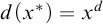 $d(x^{*}) = x^{d}$
9. $d(\texttt {top}^{+}) = {bot}^{-}$
10. $d(\texttt {bot}^{-}) = {top}^{+}$
11. $d(abort(t^{*})^{\dagger }) = abort(d(t^{*}))^{d}$
12. $d(\langle t^{*},s^{*} \rangle ^{*}) = \langle d(t^{*}),d(s^{*}) \rangle ^{d}$
13. $d(inl(t^{*})^{*}) = inl(d(t^{*}))^{d}$
14. $d(inr(t^{*})^{*}) = inr(d(t^{*}))^{d}$
15. $d((\lambda x^{*}.t^{\dagger })^{\dagger }) = (\lambda d(x^{*}).d(t^{\dagger }))^{d}$
16. $d(fst(t^{*})^{*}) = fst(d(t^{*}))^{d}$
17. $d(snd(t^{*})^{*}) = snd(d(t^{*}))^{d}$
18. $d(\texttt {case}~ r^{*}\{x^{*}.s^{\dagger } | y^{*}.t^{\dagger }\}^{\dagger }) = \texttt {case}~ d(r^{*})\{d(x^{*}).d(s^{\dagger }) | d(y^{*}).d(t^{\dagger })\} ^{d}$
19. $d(App(s^{*},t^{\dagger })^{*}) = App(d(s^{*}),d(t^{\dagger }))^{d}$
20. $d((\Gamma; \Delta )) = (d(\Delta ); d(\Gamma ))$
,with
$d((\Gamma; \Delta )) = (d(\Delta ); d(\Gamma ))$
,with $d(\Delta ) = \{d(t^{*}) \mid t^{*} \in \Delta \}$
, resp. for
$d(\Delta ) = \{d(t^{*}) \mid t^{*} \in \Delta \}$
, resp. for $d(\Gamma )$
.
$d(\Gamma )$
.
A similar function has been stated in [Reference Ayhan5] concerning a $\lambda $
-term-annotated version for a natural deduction system for 2Int with the only difference being—unsurprisingly, given the comments above about the difference between 2Int and 2C—in the terms for (co-)implication. Therefore, it will suffice to consider the relevant clauses here, starting with a Generation Lemma and then the Dualization Theorem. More specifically, the relevant cases, because they differ from 2Int, are the ones that concern the following rules:
$\lambda $
-term-annotated version for a natural deduction system for 2Int with the only difference being—unsurprisingly, given the comments above about the difference between 2Int and 2C—in the terms for (co-)implication. Therefore, it will suffice to consider the relevant clauses here, starting with a Generation Lemma and then the Dualization Theorem. More specifically, the relevant cases, because they differ from 2Int, are the ones that concern the following rules: $\rightarrow I^d$
,
$\rightarrow I^d$
, $\rightarrow E^d$
,
$\rightarrow E^d$
,  and
and  , plus only due to the prohibition of vacuous binding also $\rightarrow I$
and
$\rightarrow I$
and  . The full proof for all the other cases can be seen in Appendix 2 of [Reference Ayhan5].
Definition 16. The height of a derivation is the greatest number of successive applications of rules in it, where assumptions have height 0.
Lemma 1 (Generation Lemma)
-
1.
$\rightarrow $
-rules1.1 If
$(\Gamma; \Delta ) \Rightarrow ^{+} (\lambda x^{+}.t^{+})^{+}:C$
, then
$\exists A, B[(\Gamma , x^{+}:A; \Delta )\Rightarrow ^{+} t^{+}: B ~\&~ C \equiv A \rightarrow B ~ \&~ x^{+} \in FV(t^{+})]$
.1.2 If
$(\Gamma; \Delta ) \Rightarrow ^{-} (\lambda x^{+}.t^{-})^{-}:C$
, then
$\exists A, B[(\Gamma , x^{+}:A; \Delta )\Rightarrow ^{-} t^{-}: B ~\&~ C \equiv A \rightarrow B ~ \&~ x^{+} \in FV(t^{-})]$
.1.3 If
$(\Gamma , \Gamma '; \Delta , \Delta ') \Rightarrow ^{-} App(s^{-}, t^{+})^{-}: B$
, then
$\exists A[(\Gamma; \Delta )\Rightarrow ^{-} s^{-}: A \rightarrow B ~\&~ (\Gamma '; \Delta ')\Rightarrow ^{+} t^{+}:A]$
. -
2.
-rules2.1 If
$(\Gamma; \Delta ) \Rightarrow ^{+} (\lambda x^{-}.t^{+})^{+}:C$
, then .2.2 If
$(\Gamma , \Gamma '; \Delta , \Delta ') \Rightarrow ^{+} App(s^{+}, t^{-})^{+}: B$
, then .2.3 If
$(\Gamma; \Delta ) \Rightarrow ^{-} (\lambda x^{-}.t^{-})^{-}:C$
, then .







 -rules
 .
.
 .
.
 .
.Proof. Trivial by induction on the height n of the derivation and the rules given above for N2C $_{-\lambda }$
.
$_{-\lambda }$
.
Now we can state the following theorem, saying that whenever we have a proof (refutation) of a formula, we can construct a refutation (proof) with the same height of its dual formula in our system. Again, we’re only covering the cases for the proof that have not been covered before. Since the vacuous binding does not change anything essential, as can be seen in the first two cases, we’ll omit the cases for $\rightarrow I$
and
$\rightarrow I$
and  .
.
Theorem 6.1 (Dualization)
If $(\Gamma; \Delta ) \Rightarrow ^{*} t^{*}:A$
with a height of derivation at most n, then
$(\Gamma; \Delta ) \Rightarrow ^{*} t^{*}:A$
with a height of derivation at most n, then $(d(\Delta ); d(\Gamma ))\Rightarrow ^{d} d(t^{*}): d(A)$
(called its dual derivation) with a height of derivation at most n.
$(d(\Delta ); d(\Gamma ))\Rightarrow ^{d} d(t^{*}): d(A)$
(called its dual derivation) with a height of derivation at most n.
Proof
By induction on the height of derivation n using the Generation Lemma.
If $n=0$
, then dual derivations can be trivially constructed with a height of
$n=0$
, then dual derivations can be trivially constructed with a height of $n=0$
.
$n=0$
.
Assume height-preserving dualization up to derivations of height at most n.
If $(\Gamma; \Delta ) \Rightarrow ^{-} (\lambda x^{+}.t^{-})^{-}: A \rightarrow B$
is of height
$(\Gamma; \Delta ) \Rightarrow ^{-} (\lambda x^{+}.t^{-})^{-}: A \rightarrow B$
is of height $n+1$
, then (by Generation Lemma 1.2) we have
$n+1$
, then (by Generation Lemma 1.2) we have $(\Gamma , x^{+}:A; \Delta )\Rightarrow ^{-} t^{-}:B$
with height at most n and
$(\Gamma , x^{+}:A; \Delta )\Rightarrow ^{-} t^{-}:B$
with height at most n and $x^{+} \in FV(t^{-})$
.
$x^{+} \in FV(t^{-})$
.
Then by inductive hypothesis $(d(\Delta ); d(\Gamma ), x^{-}:d(A))\Rightarrow ^{+} d(t^{-}): d(B)$
is of height at most n as well and by the definition of duality
$(d(\Delta ); d(\Gamma ), x^{-}:d(A))\Rightarrow ^{+} d(t^{-}): d(B)$
is of height at most n as well and by the definition of duality $x^{-} \in FV(d(t^{-}))$
.
$x^{-} \in FV(d(t^{-}))$
.
By application of  we can construct a derivation of height $n+1$
s.t.
$n+1$
s.t.  . By our definition of dual terms $d((\lambda x^{+}.t^{-})^{-})=(\lambda x^{-}.d(t^{-}))^{+}$
.
$d((\lambda x^{+}.t^{-})^{-})=(\lambda x^{-}.d(t^{-}))^{+}$
.
If  is of height $n+1$
, then (by Generation Lemma 2.1) we have
$n+1$
, then (by Generation Lemma 2.1) we have $(\Gamma; \Delta , x^{-}:B)\Rightarrow ^{+} t^{+}:A$
with height at most n and
$(\Gamma; \Delta , x^{-}:B)\Rightarrow ^{+} t^{+}:A$
with height at most n and $x^{-} \in FV(t^{+})$
.
$x^{-} \in FV(t^{+})$
.
Then by inductive hypothesis $(d(\Delta ), x^{+}:d(B); d(\Gamma ))\Rightarrow ^{-} d(t^{+}): d(A)$
is of height at most n as well and by the definition of duality
$(d(\Delta ), x^{+}:d(B); d(\Gamma ))\Rightarrow ^{-} d(t^{+}): d(A)$
is of height at most n as well and by the definition of duality $x^{+} \in FV(d(t^{+}))$
.
$x^{+} \in FV(d(t^{+}))$
.
By application of $\rightarrow I^{d}$
, we can construct a derivation of height
$\rightarrow I^{d}$
, we can construct a derivation of height $n+1$
s.t.
$n+1$
s.t. $(d(\Delta ); d(\Gamma ))\Rightarrow ^{-} (\lambda x^{+}.d(t^{+}))^{-}: d(B) \rightarrow d(A)$
. By our definition of dual terms
$(d(\Delta ); d(\Gamma ))\Rightarrow ^{-} (\lambda x^{+}.d(t^{+}))^{-}: d(B) \rightarrow d(A)$
. By our definition of dual terms $d((\lambda x^{-}.t^{+})^{+})=(\lambda x^{+}.d(t^{+}))^{-}$
.
$d((\lambda x^{-}.t^{+})^{+})=(\lambda x^{+}.d(t^{+}))^{-}$
.
If $(\Gamma; \Delta ) \Rightarrow ^{-} App(s^{-}, t^{+})^{-}: B$
is of height
$(\Gamma; \Delta ) \Rightarrow ^{-} App(s^{-}, t^{+})^{-}: B$
is of height $n+1$
, then (by Generation Lemma 1.3) for
$n+1$
, then (by Generation Lemma 1.3) for $\Gamma = \Gamma ' \cup \Gamma "$
and
$\Gamma = \Gamma ' \cup \Gamma "$
and $\Delta = \Delta ' \cup \Delta "$
we have
$\Delta = \Delta ' \cup \Delta "$
we have $(\Gamma '; \Delta ')\Rightarrow ^{-} s^{-}:A \rightarrow B$
and
$(\Gamma '; \Delta ')\Rightarrow ^{-} s^{-}:A \rightarrow B$
and $(\Gamma "; \Delta ")\Rightarrow ^{+} t^{+}:A$
with height at most n.
$(\Gamma "; \Delta ")\Rightarrow ^{+} t^{+}:A$
with height at most n.
Then by inductive hypothesis  and
and $(d(\Delta "); d(\Gamma "))\Rightarrow ^{-} d(t^{+}): d(A)$
is of height at most n as well.
$(d(\Delta "); d(\Gamma "))\Rightarrow ^{-} d(t^{+}): d(A)$
is of height at most n as well.
By application of  we can construct a derivation of height $n+1$
s.t.
$n+1$
s.t. $(d(\Delta ); d(\Gamma ))\Rightarrow ^{+} App(d(s^{-}), d(t^{+}))^{+}: d(B)$
. By our definition of dual terms
$(d(\Delta ); d(\Gamma ))\Rightarrow ^{+} App(d(s^{-}), d(t^{+}))^{+}: d(B)$
. By our definition of dual terms $d(App(s^{-}, t^{+})^{-}) = App(d(s^{-}), d(t^{+}))^{+}$
.
$d(App(s^{-}, t^{+})^{-}) = App(d(s^{-}), d(t^{+}))^{+}$
.
If $(\Gamma; \Delta ) \Rightarrow ^{+} App(s^{+}, t^{-})^{+}: B$
is of height
$(\Gamma; \Delta ) \Rightarrow ^{+} App(s^{+}, t^{-})^{+}: B$
is of height $n+1$
, then (by Generation Lemma 2.2) for
$n+1$
, then (by Generation Lemma 2.2) for $\Gamma = \Gamma ' \cup \Gamma "$
and
$\Gamma = \Gamma ' \cup \Gamma "$
and $\Delta = \Delta ' \cup \Delta "$
we have
$\Delta = \Delta ' \cup \Delta "$
we have  and
and $(\Gamma "; \Delta ")\Rightarrow ^{-} t^{-}:A$
with height at most n.
$(\Gamma "; \Delta ")\Rightarrow ^{-} t^{-}:A$
with height at most n.
Then by inductive hypothesis $(d(\Delta '); d(\Gamma '))\Rightarrow ^{-} d(s^{+}): d(A) \rightarrow d(B)$
and
$(d(\Delta '); d(\Gamma '))\Rightarrow ^{-} d(s^{+}): d(A) \rightarrow d(B)$
and $(d(\Delta "); d(\Gamma "))\Rightarrow ^{+} d(t^{-}): d(A)$
is of height at most n as well.
$(d(\Delta "); d(\Gamma "))\Rightarrow ^{+} d(t^{-}): d(A)$
is of height at most n as well.
By application of $\rightarrow E^{d}$
we can construct a derivation of height
$\rightarrow E^{d}$
we can construct a derivation of height $n+1$
s.t.
$n+1$
s.t. $(d(\Delta ); d(\Gamma ))\Rightarrow ^{-} App(d(s^{+}), d(t^{-}))^{-}: d(B)$
. By our definition of dual terms
$(d(\Delta ); d(\Gamma ))\Rightarrow ^{-} App(d(s^{+}), d(t^{-}))^{-}: d(B)$
. By our definition of dual terms $d(App(s^{+}, t^{-})^{+}) = App(d(s^{+}), d(t^{-}))^{-}$
.
$d(App(s^{+}, t^{-})^{+}) = App(d(s^{+}), d(t^{-}))^{-}$
.
So, although we do not have the toggling negation at hand to switch easily (but for our understanding of bilateralism—also kind of artificially) between proofs and refutations, we do have means to obtain proofs from refutations and vice versa in our system.
7 Conclusion
Our investigation of the system 2C $_-$
, a negation-free fragment of a bi-connexive, contradictory logic, within a bilateralist PTS framework has shown that dispensing with a primitive negation invites a reconceptualization of the defining principles of both contradictory and connexive logics. First, in a bilateralist setting based on the notions of proof and refutation, contradictory logics can be understood without any reference to negation inconsistency but rather as non-trivial systems in which some formulas are both provable and refutable. Second, I have argued for a novel, rule-based conception of connexive logics that does not rely on the validation of traditional formula schemata, but instead derives its character from the understanding of proof and refutation with respect to its implication connective(s). Furthermore, the exploration of proof–refutation duality in this framework, supported by a two-sorted typed
$_-$
, a negation-free fragment of a bi-connexive, contradictory logic, within a bilateralist PTS framework has shown that dispensing with a primitive negation invites a reconceptualization of the defining principles of both contradictory and connexive logics. First, in a bilateralist setting based on the notions of proof and refutation, contradictory logics can be understood without any reference to negation inconsistency but rather as non-trivial systems in which some formulas are both provable and refutable. Second, I have argued for a novel, rule-based conception of connexive logics that does not rely on the validation of traditional formula schemata, but instead derives its character from the understanding of proof and refutation with respect to its implication connective(s). Furthermore, the exploration of proof–refutation duality in this framework, supported by a two-sorted typed $\lambda $
-calculus, demonstrates that even without strong negation a structural correspondence between proofs and refutations can be preserved, albeit in a less direct form. The present analysis highlights not only the philosophical significance of dismissing negation but also the broader potential of bilateralist PTS for rethinking connexivity and contradiction.
$\lambda $
-calculus, demonstrates that even without strong negation a structural correspondence between proofs and refutations can be preserved, albeit in a less direct form. The present analysis highlights not only the philosophical significance of dismissing negation but also the broader potential of bilateralist PTS for rethinking connexivity and contradiction.
Acknowledgments
I would like to thank the audience of the 10th Workshop on Connexive Logics at Tohoku University, November 2025, for several insightful comments and questions that helped to get this paper into its final shape. Also, many thanks to Heinrich Wansing for reading and discussing earlier versions of this paper and to two anonymous reviewers for their helpful comments and suggestions.
Funding
This research has received funding from the European Research Council (ERC) under the European Union’s Horizon 2020 Research and Innovation Programme, grant agreement ERC-2020-ADG, 101018280, ConLog.


 Open access

