

Introduction
The Arctic Council (AC or “Council”) has played a special role in Arctic affairs by providing a link between local and international levels of governance. Indigenous Peoples have made major contributions to the Council’s activities as Permanent Participants (PPs) since its establishment in 1996, their special position in the Council’s consensus-based governance framework being widely acknowledged as a key feature in what makes the AC stand out in international politics (Barry, Daviðsdóttir, Einarsson, & Young, Reference Barry, Daviðsdóttir, Einarsson and Young2020; ICC, 2024; Heininen, Reference Heininen2018; Koivurova, Reference Koivurova2010; Reference Koivurova2011; Koivurova & Heinämäki, Reference Koivurova and Heinämäki2006; Koivurova, Kleemola-Juntunen, & Kirchner, Reference Koivurova, Kleemola-Juntunen, Kirchner, Scott and VanderZwaag2020; Tennberg, Reference Tennberg2010). This key feature has advanced the norm of including Indigenous Peoples in international political and scientific dialogues (Chater, Reference Chater, Landriault, Payette and Roussel2021; Chuffart, Reference Chuffart, Conde and Wood-Donnelly2025; Koivurova & Heinämäki, Reference Koivurova and Heinämäki2006). It has also been an important part of a broader shift in the boundaries of international law and global affairs led by Indigenous Peoples organisations to advance their right to self-determination (Dorough, Reference Dorough, Dahl, Holmberg, Olsvig and Wessendorf2024; Olsvig & Cullen, Reference Olsvig, Cullen, Dahl, Holmberg, Olsvig and Wessendorf2024; Shadian, Reference Shadian, Keil and Knecht2016).
As Arctic stakeholders navigate a new era of great power competition – emphasised by Russia’s 24 February 2022 invasion of Ukraine, which cast doubt on the AC’s future (see Andreeva & Rottem, Reference Andreeva and Rottem2024) – it has become increasingly salient to reflect on the distinct influence Indigenous Peoples have had on the Council over time. The AC has evolved since its founding in 1996 (Exner-Pirot et al., Reference Exner-Pirot, Ackrén, Loukacheva, Nicol, Nilsson and Spence2019), and this article asks the question: what have the PPs contributed to that evolution?
State-centric narratives of the Council’s existence, including a rich body of literature on Arctic regimes, identify the unique position PPs hold at the AC and suggest that through these regimes, non-state actors have opportunities to influence the behaviour of states (Smieszek, Reference Smieszek2019; Stokke, Reference Stokke, Stokke and Hønneland2006; Wilson & Øverland, Reference Wilson, Øverland, Stokke and Hønneland2006; Young, Reference Young2012). Critically engaging with this theme, this article applies a constructivist lens, with special attention paid to the influence of Indigenous Peoples in the evolution of the AC’s identity, practices, and activities since the Council’s founding. In doing so, it provides an alternative perspective to state-centric narratives of the AC by (1) reframing Indigenous Peoples as co-founders of the AC system based on existing literature of Indigenous Peoples’ pursuit of self-determination in relation to the Council’s history and (2) highlighting how their influence as PPs of the Council has helped to co-constitute the AC’s identity, practices, and activities over time. The article addresses this second point by discussing findings from multiple interviews and an extensive document analysis of the Council’s ministerial-level Declarations and official joint statements from 1996 to 2021.
Co-constitution, also referred to as mutual constitution, refers to the notion that agents and structures do not exist independently but instead form and influence each other over time (Adler, Reference Adler, Carlsnaes, Risse and Simmons2013). The research findings in this article identify the evolving recognition and inclusion of Indigenous worldviews, Knowledges, and rights by the AC – an evolution driven by PP advocacy on these issues. The article argues that the PPs’ role in the AC’s evolution emphasises the fact that they are a crucial part of the AC’s structure and co-constitute its identity. This constructivist analysis suggests that just as the AC could not exist without states, it would also fail to exist without the PPs. Indeed, a Council or agreement among Arctic states is always possible (such as the 2008 Ilulissat Declaration produced among the five coastal states of the Arctic Ocean that did not include Indigenous organisations), but it would lack the elements that have made the AC an innovative space of Arctic and global governance (as is the case with the Ilulissat Declaration – see Plouffe, Reference Plouffe2011).
While the evolution described in this article demonstrates that the AC’s character and purpose have been co-constituted through sustained interaction between states and PPs, this co-constitution is structurally constrained. Importantly, even as this article places the PPs as crucial pillars of the AC, it also highlights the effects of the Council’s embedded structural hierarchy on their ability to realise the full potential of their role. Despite the PPs being a core element of what makes the AC what it is, a variety of challenges and limitations remain for PPs while they work to contribute across the numerous tables in the AC system. Additionally, the pause of AC work following Russia’s invasion of Ukraine exposed gaps in the recognition and full implementation of the rights and self-determination of Indigenous Peoples within the AC.
By observing the evolution of the AC through a constructivist lens and connecting it to broader trends of Indigenous self-determination, this paper emphasises the Council as an important platform of struggle for Indigenous rights and agency within the sphere of global governance. Understanding the impact the PPs have had on the AC, as well as the enduring limitations they face, is important for all Arctic stakeholders interested in maintaining or improving effective, inclusive, and legitimate circumpolar cooperation in the Arctic.
Beyond participation: a constructivist approach to understanding PP influence
Although the unique position of the PPs in the AC is widely acknowledged, state-centric IR paradigms often frame the eight Arctic states and their mutually recognised sovereign territories as the foundations for cooperative arrangements to deal with specific Arctic issue areas, including Indigenous rights (Osherenko & Young, Reference Osherenko and Young1989; Stokke, Reference Stokke, Stokke and Hønneland2006; Young, Reference Young1998; Reference Young2012; Reference Young2016a). These types of perspectives suggest that while PPs assert an overlapping authority with states rooted in geography and their representation of Arctic peoples, a hierarchy has been maintained whereby the “most successful performance of authority remains explicitly political, rooted in the logics of sovereignty and statehood” (Wilson Rowe, Reference Wilson Rowe2018, p. 123). While some critical accounts of Arctic governance acknowledge the important presence and influence of non-state actors through soft-law (Koivurova, Reference Koivurova2016; Koivurova et al., Reference Koivurova, Kleemola-Juntunen, Kirchner, Scott and VanderZwaag2020) or informal regimes (Smieszek, Reference Smieszek2019), they rarely consider the deeper possibility that such actors co-constitute the international system along with states. As a result, the central role of Indigenous organisations in shaping forums like the AC is often down-played or overlooked.
Organisations persist or evolve based on actors’ behavior, which is in turn shaped by institutional rules and shared meanings (Klotz & Lynch, Reference Klotz and Lynch2007). This notion of co-constitution is central to constructivism, a theoretical approach within International Relations that argues the international system is socially constructed (Acharya & Buzan, Reference Acharya and Buzan2019; Ruggie, Reference Ruggie1998). Constructivism opens space to examine how non-state actors like the PPs shape global politics by influencing norms, identities, and legitimacy (Adler, Reference Adler, Carlsnaes, Risse and Simmons2013). Constructivist perspectives put greater emphasis on whose ideas matter (Avant, Finnemore, & Sell, Reference Avant, Finnemore and Sell2010) and can provide opportunities to highlight the underlying dynamics related to how actors and institutions gain legitimacy, accountability, and various forms of authority (moral, expert, delegated, institutional, etc.) in international politics (Barnett & Finnemore, Reference Barnett and Finnemore2004).
Constructivist thinking has been applied by various scholars in Arctic governance literature (Hansen-Magnusson & Gehrke, Reference Hansen-Magnusson and Gehrke2025; Keskitalo, Reference Keskitalo2004; Reference Keskitalo2007), including Keil and Knecht (Reference Keil, Knecht, Keil and Knecht2017) who have suggested the Arctic is framed by different and sometimes competing political imaginaries that influence regional politics. Arctic governance literature has also highlighted the crucial involvement of non-state actors in the work of the AC and their subsequent influence in circumpolar affairs (Chater, 2019; Reference Chater, Landriault, Payette and Roussel2021; Knecht, Reference Knecht2017; Knecht & Spence, Reference Knecht, Spence, Shibata, Zou, Sellheim and Scopelliti2019; Landriault, Chater, Wilson Rowe & Lackenbauer, Reference Landriault, Chater, Wilson Rowe and Lackenbauer2019; Prip, Reference Prip2020; Sellheim & Menezes, Reference Sellheim, Menezes, Sellheim and Menezes2022; Spence, Rødven, & Ågren, Reference Spence, Rødven, Ågren, Tuihedur Rahman and Pigford2025; Tennberg, Reference Tennberg2010; Wehrmann, Reference Wehrmann, Keil and Knecht2017). As many of these scholars have articulated, the challenges facing the region – including climate change, sustainable development, and environmental protection – cannot be addressed by states alone.
This article contributes to constructivist IR and existing Arctic governance scholarship by arguing that PPs do more than participate in the AC. They co-constitute it alongside states, shaping its institutional development, interests, and practices over time. This is demonstrated in this article through analysing key dynamics explored in two distinct sections. The first section below sets the stage by discussing a secondary analysis of existing literature that characterises domestic movements for Indigenous self-determination and the early advocacy and role of the Inuit Circumpolar Council (ICC), Saami Council, and RAIPON as co-founders of the Council. The second section of the article turns to an analysis of primary data from interviews and a document analysis focused on the dedicated engagement and advocacy of the PPs at the AC and their impact on the AC’s evolution over time.
Self-determination of Indigenous Peoples and their role as AC permanent participants
The six PPs of the AC are the Gwich’in Council International (GCI), ICC, the Russian Arctic Indigenous Peoples of the North (RAIPON), the Aleut International Association (AIA), the Arctic Athabaskan Council (AAC), and the Saami Council. These organisations collectively represent more than 650,000 Indigenous Peoples from seven of the eight Arctic countries (the eighth, Iceland, has no Indigenous Peoples). This includes more than 40 distinct cultures, economies, languages, territories, and traditions (Chater, Reference Chater and Nord2019). While this article most often refers to the PPs collectively as a distinct group within the AC, the six PPs are characterised by a variety of institutional, political, and geographical differences they bring to AC tables that inform the more specific initiatives they choose to pursue. Tracing those differences is beyond the scope of this article, which instead focuses on the collective influence they have had on the politics within the AC.
According to the Council’s founding declaration (Arctic Council, 1996) and corresponding Rules of Procedure (Arctic Council, 2013), PPs are active participants within the Council and must be fully consulted on decisions. Unlike AC Observers but similarly to states, the PPs can attend and contribute to all meetings and activities. They have exercised their influence through a variety of means, including an informal vetoFootnote 1 , the right to participate and engage at any AC table, and the inclusion of Traditional Ecological Knowledge (TEK) (Cambou & Koivurova, Reference Cambou and Koivurova2020; Chater, 2019; Reference Chater, Landriault, Payette and Roussel2021; Coote Reference Coote2016; Dorough, Reference Dorough2017; Gamble, Reference Gamble, Heininen, Exner-Pirot and Plouffe2016; Larocque, Reference Larocque, Dahl, Holmberg, Olsvig and Wessendorf2024; Poto, Reference Poto2017; Spence, Reference Spence2017). Through the PP role in the AC, Indigenous perspectives have informed global governance agendas both directly and indirectly (Ahlness Abdulmuminov, Reference Ahlness Abdulmuminov2021; Dorough, Reference Dorough2017; Spence, Reference Spence2017). Their influence has also extended beyond the Arctic due to their contributions to many of the most important international debates on environmental standards and human rights, including climate change, black carbon emissions, and POP emissions (Dorough, Reference Dorough2017; Landriault et al., Reference Landriault, Chater, Wilson Rowe and Lackenbauer2019; Selin, Reference Selin, Keil and Knecht2016).
Self-determination and the rights of Indigenous Peoples
The key role of PPs in the AC is linked to wider developments in Indigenous self-determination since the 1970s (Olsvig & Cullen, Reference Olsvig, Cullen, Dahl, Holmberg, Olsvig and Wessendorf2024), and scholars have argued that the broader political trend towards devolution and the empowerment of regional Indigenous actors has fundamentally shaped the “political contours” of the contemporary Arctic (Nicol, Reference Nicol2010; see also Cambou & Koivurova, Reference Cambou and Koivurova2020; Tennberg, Reference Tennberg2010). At the international level, the UN and its charter have been central to defining the concept of self-determination in international law regarding minority populations (Cristescu, Reference Cristescu1981), and related UN processes have recognised peoples of non-self-governing territories as associate members in UN specialised agencies since its early days (Jones, Reference Jones2021). The process that led to the UN Declaration on the Rights of Indigenous Peoples (UNDRIP) also brought greater participation of Indigenous Peoples into UN fora since the 1980s (Jones, Reference Jones2021). According to Lightfoot (Reference Lightfoot2018), the UNDRIP is more than just a new set of norms emerging and diffusing on the global stage: the Indigenous rights movement behind it represents a shift in both the structure and practice of global politics, serving as a transformational norm vector that presents alternative ways of doing global politics and new imaginings of political order (Lightfoot, Reference Lightfoot2018). Indigenous organisations like the ICC are working within frameworks like the AC (see ICC, 2024), and also within the UN system (see Jones, Reference Jones2021; Lightfoot, Reference Lightfoot2018), to advocate for the full implementation of the UNDRIP at both the international and domestic levels.
These international developments are closely linked to changes at the domestic level that have increased self-determination and self-government, including in Canada and Greenland. In Canada, a legal decision by the Supreme Court in 1973 recognised the legal existence of “Aboriginal title to land” for the first time and set in motion comprehensive land claims processes across the North (Alacantra, Reference Alacantra2013). The land claim settlements that took place in the Canadian Arctic between 1975 and 2008 “reterritorialized over 3.7 million square kilometers (1.4 million square miles) of land into seven different settlement areas and Nunavut” (Stuhl, Reference Stuhl, Bocking and Heidt2019, p. 153) and include specified rights and self-government provisions for Indigenous signatories (Alacantra, Reference Alacantra2013; Stuhl, Reference Stuhl, Bocking and Heidt2019). Stuhl (Reference Stuhl, Bocking and Heidt2019) highlights how Indigenous leaders and scholars gained important experience through the proposal, negotiation, agreement, and ratification processes of these land claim settlements. Greenland is another example where the process of self-determination achieved a degree of self-government for Greenlanders when Denmark granted them Home Rule in 1979 (Nuttal, Reference Nuttal2008). In 2009, the Act on Greenland Self-Government was adopted by referendum and recognises that “the people of Greenland is a people pursuant to international law with the right of self-determination.” The Act has provided the people of Greenland with “significant control over their own affairs and the right to access independence” (Cambou, Reference Cambou2020).
These domestic level trends are important to consider when thinking about the roles and influence the PPs have harnessed – albeit to varying degrees – in the AC context. The ICC, for example, is representing Inuit that have negotiated significant self-government agreements with Canada, Denmark, and the United States. For the PPs representing constituents that hold these types of agreements, they help to define domestic relationships, expectations, and norms of interaction between states and PPs.
Key critiques and debate
Critiques about the reality of implementing the right to self-determination highlight important tensions related to Indigenous self-government in a colonial context. Alfred (Reference Alfred2005) and Nadasdy (Reference Nadasdy2003; Reference Nadasdy2017), for example, have identified how domestic processes of self-government and resource co-management have largely reproduced colonial models of bureaucracy. On the international level, Lightfoot (Reference Lightfoot2018) argues that the changes that UNDRIP and the Indigenous rights movement demand represent a fundamental threat to the order of sovereign states, and thereby a moral dilemma for states that see themselves as world leaders in human rights.
On the regional level, these international and domestic processes have generated debate about the structure and goals of the AC, particularly in relation to the challenges posed by the international state system and how its legal framework can be addressed in that forum. This has included important debates about successfully fulfilling UNDRIP and UNCLOS frameworks in the region (Cambou & Koivurova, Reference Cambou and Koivurova2020; Young, Reference Young2016), the connections between the exertion of Indigenous self-determination and the bond Indigenous Peoples hold with their traditional lands and natural resources (Poto, Reference Poto2017), and more broadly about articulations of Indigenous sovereignty in the Arctic (ICC, 2009). These debates have included proposals by the ICC and Saami Council for the elevation of the PP organisations to the status of full and equal partners with states at the AC (Koivurova, Reference Koivurova2011; see also ICC 2024; 2025). Although these proposals have not been successful, the realisation of Indigenous rights has continued to be a substantive issue in Arctic sovereignty discussions among the members of the AC (ICC, 2024; Olsvig, Reference Olsvig2025; Shadian, Reference Shadian, Keil and Knecht2016).
From the margins to the center: Indigenous Peoples’ organisations as Arctic Council “co-founders”
Indigenous Peoples have played an active and transformative role in establishing contemporary Arctic governance and the AC (Olsvig & Cullen, Reference Olsvig, Cullen, Dahl, Holmberg, Olsvig and Wessendorf2024; Retter, Reference Retter, Dahl, Holmberg, Olsvig and Wessendorf2024). Scholars often highlight two key international policy initiatives that helped to establish contemporary Arctic governance: the Finnish initiative (Arctic Environmental Protection Strategy) and the Canadian initiative (AC). They are typically referred to this way due to the prominent roles their governments played in leading their early negotiations. However, as various scholars and Indigenous leaders have highlighted, Arctic Indigenous Peoples and their organisations played a crucial role in initiating, leading, and contributing to the processes and negotiations that would shape the vision of the AC and influenced the structure it should take (English, Reference English2013; Lackenbauer & Dean, Reference Lackenbauer and Dean2021; Retter, Reference Retter, Dahl, Holmberg, Olsvig and Wessendorf2024).
Through their historical look at the founding of the AC and its early negotiations, Axworthy and Dean (Reference Axworthy and Dean2013) argue that one of the leading drivers of the AC initiative was a skilled group of Indigenous leaders, such as Mary Simon, who seized important opportunities as the movement towards multi-lateral cooperation in the Arctic grew over time. Axworthy and Dean (Reference Axworthy and Dean2013, p. 9) argue that “if the Government of Canada was a lead actor in the creation of the AC, one of the most significant influences on that government was the activities of a generation of indigenous leaders, especially the Inuit, who played an active role in all phases of the Council’s creation.” Their involvement in establishing the AC and its structure institutionalised the important role that international Indigenous Peoples organisations were already playing in Arctic and international politics at the time (Axworthy & Dean, Reference Axworthy and Dean2013). This key involvement, which was recognised in the AC’s founding documents, is an example of Indigenous Peoples exercising self-determination at the international level and underlines the notion that Indigenous organisations are co-founders of the AC (see ICC, 2024).
From co-founders to consequential partners: the PPs’ impact on the AC’s evolution
The trends discussed so far – that Indigenous Peoples have achieved significant political gains through self-government agreements and UNDRIP – connects directly to the foundational role Indigenous Peoples have played in Arctic governance and their influence on how the AC has evolved over time. Building on this analytical reframing of the PPs’ agency within Arctic governance and the AC, the article will now shift to exploring if and how the PPs sustained engagement has contributed to the AC’s evolution since its founding.
Methods
The constructivist process described above – the cycles of agent-structure mutual constitution – is explored here by observing the AC’s evolution over time. Data collection activities for this article consisted of: (a) 14 interviews with expert informants representing specific Permanent Participant organisations, Arctic states, and AC Observers; (b) a document analysis of the AC’s 14 Declarations and official joint statements prior to Russia’s invasion of Ukraine (1996–2021); and (c) a review of literature related to the founding of the AC. The interviews and the AC Declarations (including a 2019 official joint statement) were analysed through an iterative process of coding and memoing, conducted with NVIVO software to help identify key themes and note changes over time.
The methods used in this analysis were inspired by process-tracing (Klotz & Lynch, Reference Klotz and Lynch2007) and discourse analysis (Fairclough & Fairclough, Reference Fairclough and Fairclough2012) to search for patterns of behaviour, inflection points, and evolution over time. Process tracing can be used to systematically uncover and test causal pathways, including a particular actor’s influence or a shift in norms and practices within an organisation. In this case, the question at hand is: How have PPs contributed to the evolution of the AC since its founding in 1996? To answer this question – and to investigate a shared perspective among interview participants that indeed the AC has evolved in part due to PP advocacy – a document analysis of the AC’s Declarations and an official joint statement (2019) between 1996 and 2021 was conducted.
These high-level political documents are carefully negotiated by consensus. They were chosen for analysis specifically because they represent the official perspectives shared among the AC’s core members and are considered the official position of the AC. At the ministerial and Senior Arctic Official (SAO) level, the AC’s Declarations are negotiated and produced every two years at the conclusion of each Chairship. The Council’s Declarations and official joint statementsFootnote 2 are closely scrutinised by the SAOs as they work towards consensus among states and are confirmed by their ministers, governments, and/or leaders. As such, they represent the collective view of the eight member states and six PPs. Although individual Arctic states and Permanent Participant organisations may hold different policy objectives, these documents represent how these key actors have aligned their interests at the AC.
These documents were analysed not only for what they revealed about institutional positions regarding the interests of the PPs (outcomes of PP advocacy), but also for how language, framing, and terminology changed over time (process of mainstreaming PP priorities) in ways that could indicate underlying normative influence (see Klotz & Lynch, Reference Klotz and Lynch2007). Discourse analysis was used to examine how language in the AC’s Declarations constructs the social and political realities and perceptions of the Council. Special attention was paid to the institutionalisation of key concepts (e.g., “Indigenous Knowledge” and/or “Traditional Knowledge”) and how these shifts reflect transformations in the Council’s identity and practices over time. Paired with the interviews, the shifts identified in the documents were grounded in the perspectives of key actors involved in the AC’s evolution. This helped to consider competing explanations as to why the recognition of Indigenous Knowledges and Indigenous rights could have been increasingly institutionalised at the AC, such as whether this change was driven instead by state interest or external pressures.
Klotz and Lynch (Reference Klotz and Lynch2007) suggest that “because communities of people often articulate shared expectations, in the process endowing them with normative force, scholars can use texts (official documents) to demonstrate general patterns of state compliance” and that “these patterns can substantiate claims that norms influence behaviour” (p. 17). Thus, the analysis searched for key moments or indicators related to (1) patterns of engagement and acknowledgement of the PPs and their perspectives; (2) the adoption and use of specific terminologies in official documents related to the involvement of Indigenous Peoples; and (3) the ways in which the AC and its purpose has been framed by its official documents (and thus its key actors). After completing the document analysis, the author returned to the interview transcripts to understand the phenomena behind the key moments identified in the document analysis, where that was also described by interview participants. This iterative process helped establish both temporal sequencing and the plausibility of causal influence, highlighted by the thematic trends discussed in the findings below.
Findings
The AC has undergone significant evolution since its formation in 1996. Although addressing issues related to environmental protection and sustainable development has been a core focus since its establishment, the Council has become a more comprehensive forum for addressing a wide range of Arctic issues. In addition to the AC’s expanding body of work, the document analysis and interviews indicate significant developments in how the Council has publicly and internally portrayed itself. Two primary themes, as summarised in Table 1, highlight the PPs’ contribution to the AC’s evolution. They are organised in terms of (1) how the PPs have been engaged within the AC’s structure and (2) the increasing inclusion and formal acknowledgement of Indigenous Knowledges, worldviews, and rights by the forum. Combined, these factors have helped to position the PPs as central to the AC’s identity and perceived legitimacy in Arctic governance as well as international affairs more broadly. The document analysis provided the temporal sequencing of each factor depicted in Figures 1–3 while the interviews provided important context and nuance.
Primary themes and key findings

Indigenous agency and the Arctic Council structure
As various interview participants noted, the historical context of Arctic governance and the emergence of the AC is important for understanding the important role the PPs play. As Evan Bloom, former Acting Deputy Assistant Secretary for Oceans and Fisheries and Director for Ocean and Polar Affairs at the US Department of State, noted in an interview, “the AC was an innovation at the time, not only because of the issues it was setting out to tackle such as environmental protection and sustainable development, but also having Permanent Participants sit at the table as equals.” Literature on the history of the AC highlights that the successful advocacy of Indigenous leaders not only helped to initiate discussions on the idea of an AC alongside Canada but also played a central part in convincing the other Arctic states that such a Council was necessary and valuable (Axworthy & Dean, Reference Axworthy and Dean2013). The expectation of PP engagement at every level of the Council was set by the Ottawa Declaration and is outlined in the AC’s Rules of Procedure. This is the context in which the PPs have exercised their agency within the AC structure.
Permanent participant agency within the AC structure
The interview participants discussed examples of how the PP organisations have effectively harnessed the AC’s structure. Many participants highlighted pathways of influence between the working group level and the SAO level, including that what reaches the SAO level is what comes from working groups where the active participation of PPs shapes outcomes shared in SAO meetings. Various participants also described how the PPs have intervened at the SAO level: while the PPs do not have a formal vote, the PPs have influenced states to not reach consensus. Edward Alexander, Co-Chair of Gwich’in Council International and Head of Delegation to the Senior Arctic Officials, reflected that “anytime we’ve ever offered an objection to something, people have held back and said, ‘okay, let’s reconsider this. Does this work? Does that work? Let’s go back to our states and let’s have this conversation.’” James Gamble, former executive director of AIA, stated that they have “never seen a substantive issue that was of great urgency to the PPs that wasn’t dealt with before moving forward.” Interview participants described how the relationships the PPs have built with individuals leading the working groups also provides back channels to object to certain issues at the Council and informally block consensus, which speaks to the value that is placed on PP perspectives.
Besides their influence in relation to reaching consensus, PPs have demonstrated their ability to promote the projects they feel are important through their participation (and vice-versa). Dr. Dalee Sambo Dorough, Senior Scholar and Special Advisor on Arctic Indigenous Peoples at the University of Alaska Anchorage & former International Chair of the Inuit Circumpolar Council, described how the ICC has consistently pushed the AC working groups to do meaningful work for Arctic Indigenous Peoples, and that the PPs have the had the readiness to speak up about certain projects that “are not a priority” for their peoples and communities.
The PPs also provide important leadership within the Council due to their institutional knowledge and consistency across tables, in contrast to the rotations of state ministers, SAOs, and other state representatives. Many interview participants identified that the turnover of state representatives is a problem because of the loss of institutional memory. This, however, highlights the fact that many PP representatives are seen as experts on the processes and substance of AC work. As stated by John Crump, former ICC Canada senior policy advisor, “it’s the PPs who have the most consistent representation over decades, who are the knowledge holders of the Arctic Council.”
Interviewees described how the PPs have been able to build important domestic, transnational, and international relationships with government officials, other Indigenous groups, and experts through the AC framework. On the domestic level, the AC framework has created opportunities for PP representatives and domestic policymakers to meet with one another on the sidelines of AC meetings, and for issues of importance to the PPs to be brought to the attention of high-level government officials both directly and indirectly (including, for example, the US Secretary of State). On the transnational level, some participants noted the connections Indigenous Peoples have been able to make across the US/Russia border to discuss important shared issues, including modern land-claims agreements and self-determination in their own countries (David Roddick, former AAC Senior Advisor).
On the international level, Cindy Dickson, Executive Director of Arctic Athabaskan Council (AAC), noted that getting more internationally involved with the AC’s AMAP working group and UN climate meetings presented another avenue for AAC to access senior level government officials and world class scientists. According to Evan Bloom (USA), although in some cases Indigenous Peoples may not get sufficient attention within their country, if they make a public speech at the AC “their central government has to listen and come to grips with what they’re saying.” This phenomenon has increased influence over policies at the federal level, which has enhanced community capacities to gain resources (Cindy Dickson).
Influence of Indigenous worldviews, knowledges, and rights on AC identity and legitimacy
Various participants described the influence of Indigenous worldviews, knowledges, and rights on the AC’s work. Participants articulated that there has been an effort to link these factors over the course of the AC’s evolution, and that their inclusion in AC work has underpinned the Council’s identity and legitimacy (discussed further in subsection III). Importantly, while the evolution described below was generally on a positive trend on all fronts between 1996 and 2021 according to the document analysis, participants noted that significant work remains to fully include them in all areas, particularly regarding Indigenous rights (an issue that has come under increased scrutiny since the AC’s pause in 2022).
Indigenous worldviews
Interview participants discussed how PP engagement at the AC has led to an evolution of international thinking and dialogue. Some described the perspectives and knowledges that the PPs represent as more holistic in comparison to the more “siloed” perspectives of scientists, diplomats, and other state officials. John Crump argued that “the broad view that Indigenous Peoples have about their Arctic homeland at large – that it’s this massive ecosystem, it’s all integrated – is a really important message for governments to realize…[and] has been a really important part of the evolution of that thinking.”
Edward Alexander (GCI) highlighted a key difference between the PPs’ and states’ perspectives, which rests on distinct ways of thinking about AC processes. They articulated that while states are typically focused on outcomes such as deliverables or an agreement, Gwich’in people “think and talk a lot about relationships, about collective action, and how to work together.” They went on to describe the orientation of state representatives as typically “very noun focused, everything is about a thing.” On the other hand, “for Gwich’in, it’s all about verbs because that’s the important part. It’s the process that’s important, the doing that’s important, it’s the struggle that’s important.” Explaining this difference, Edward Alexander stated that “Gwich’in have been around for tens of thousands of years and our thinking is more perennial and longer term because of this.” For example, issues like climate change impacts are intersectional, and as Bridget Larocque stated, “the holistic intersectionality of Indigenous Knowledge, worldviews, and lived experience of the Arctic has influenced the Arctic Council by highlighting the need for partnerships and interdisciplinary research.”
Integrating Indigenous Knowledges
A common perspective shared by participants was that projects that have included substantive input from PPs, including a meaningful effort to achieve knowledge co-production between scientists and Indigenous Peoples, lead to a more complete picture of the issues, more buy-in from communities, more willingness of state and local governments to listen to Indigenous Peoples, and ultimately better solutions. Participants generally agreed that a commitment to incorporating Indigenous Knowledge has become the norm at the SAO level. Petteri Vuorimäki, Finland’s Ambassador for Arctic and Arctic Affairs & Senior Arctic Official in the AC, for example, stated that “we listen to [the Permanent Participants] very attentively… we are talking about their ancestral homelands.”
The interviews described an evolution in the uptake and implementation of Indigenous Knowledges and expertise over time, while the AC’s Declarations have indicated the importance of Indigenous Knowledge since the Council’s establishment. The terms Indigenous, Traditional, and Local knowledge are used interchangeably across the AC’s Declarations. A working definition of “Traditional Knowledge” along with 13 principles was created by the PPs and published by the AC Indigenous Peoples Secretariat in 2015. The Ottawa Traditional Knowledge Principles states (Indigenous Peoples’ Secretariat, Reference Peoples’ Secretariat2015, p. 1):
Traditional Knowledge is a systematic way of thinking and knowing that is elaborated and applied to phenomena across biological, physical, cultural and linguistic systems. Traditional Knowledge is owned by the holders of that knowledge, often collectively, and is uniquely expressed and transmitted through indigenous languages. It is a body of knowledge generated through cultural practices, lived experiences including extensive and multigenerational observations, lessons and skills. It has been developed and verified over millennia and is still developing in a living process, including knowledge acquired today and in the future, and it is passed on from generation to generation.
Figure 1 highlights the key instances when the terms Indigenous, Traditional, or Local Knowledge were referred to in each Declaration. Four key inflection points have been emphasised in Figure 1 that relate to the evolution described by participants. Inflection Point 1 is the inclusion of Indigenous Knowledges as a key principle and overarching mandate for the Council’s founding 1996 Declaration. This set an expectation for the inclusion of IK that interview participants suggested has not always been met, but has been a guiding principle that has been increasingly respected over time.
Key instances of acknowledging Indigenous/traditional/local knowledge in Declarations.

Inflection Point 2 is the release of the Arctic Climate Impact Assessment (ACIA) in 2004. The ACIA was referred to by most interview participants because of the groundbreaking methodology implemented by Robert (Bob) Corell (lead investigator) for its meaningful inclusion of PPs and Indigenous Knowledges in its research process prior to its release in 2004. Grete Hovelsrud, former President at the International Arctic Social Sciences Association (IASSA), shared their perspective that the involvement of PPs in the ACIA helped shift a broader narrative of Indigenous Peoples as victims of climate change towards one that acknowledges their agency in developing its solutions.
Inflection Point 3 highlights the first time the AC recommended that traditional knowledges be used in AC projects (2009). Inflection Point 4 is the welcoming of two key documents in the 2015 Iqaluit Declaration that were developed to guide AC work: the Recommendations for the Integration of Traditional and Local Knowledge into the Work of the Arctic Council developed by the Sustainable Development Working Group (SDWG) and the Ottawa Traditional Knowledge Principles published by the Indigenous Peoples Secretariat. Both documents were corroborated by most participants as marking a shift in the accepted approach to engaging IK throughout the entire AC system, beginning at the project development stage.
Indigenous rights
Interview participants suggested that there has been an important evolution in how Indigenous rights have been acknowledged at the AC. John Crump stated that “on its best days, the Arctic Council demonstrates its recognition that Indigenous rights are important and valued… I say on its best days, because sometimes it doesn’t happen, but I do think that there’s a slow evolution.” Indeed, the document analysis reflects a slow uptake by the AC in acknowledging the rights of Indigenous Peoples in its formal Declarations. Unlike its recognition of IK, respecting the rights of Indigenous Peoples has not been an overarching mandate of the AC throughout its entire history.
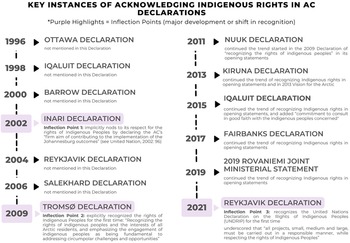
The document analysis highlights three inflection points that indicate the Council’s uptake of acknowledging Indigenous rights (indicated in Figure 2). Inflection Point 1 is the AC’s implicit reference in 2002 to the rights of Indigenous Peoples by declaring the AC’s “firm aim of contributing to the implementation of the Johannesburg outcomes,” a UN document that emerged from the 2002 World Summit on Sustainable Development in Johannesburg, South Africa. The Johannesburg outcomes outline key connections between sustainable development, Indigenous Knowledges, and the rights of Indigenous Peoples by “[r]ecognizing and valuing indigenous knowledge as well as respecting the rights and cultures of indigenous people” (United Nations, 2002, p. 96). The AC did not explicitly recognise Indigenous rights until the 2009 Tromsø Declaration (Inflection Point 2) and did not recognise the UNDRIP until the 2021 Reykjavik Declaration (Inflection Point 3). The UNDRIP was adopted by the UN in 2007.
Acknowledgement of indigenous rights in AC Declarations.

Some participants described how the issue of recognising Indigenous rights at the AC has been tied to domestic politics. John Crump provided Canada as an example, highlighting how Canada was a “late bloomer” compared to other states, noting that Canada adopted the UNDRIP into domestic law in 2021, the same year it was acknowledged by the AC. Although some participants noted the evolution in language about Indigenous rights being important and valued, others discussed that it is not as consistent or as meaningful as it should be. Dr. Dalee Sambo Dorough, for example, argued that human rights, and more significantly Indigenous Peoples’ human rights in international law, have been the foundation of their positions in domestic and international affairs, but the full realisation of their human rights have not been consistently aligned within State-Indigenous Peoples relations in the AC context. Although the PPs are often said to have an equal status due to their involvement at every level of the Council (and their ability to informally block consensus), it was suggested by interview participants that true recognition of Indigenous rights and responsibilities in their homelands would be reflected by the ability to vote alongside states.
AC identity and legitimacy
The engagement and increased promotion of Indigenous worldviews, knowledges, and rights are key factors that have helped to shape how the AC presents itself, and the AC Declarations display an evolution in the Council’s self-reflection since 1996. This evolution progressed more gradually over time, making the identification of specific inflection points in the document analysis more challenging. Instead, three key eras in the evolution of the AC between 1996 and 2021 can be distilled that reflect changes in language, clarity, or emphasis regarding the AC’s character and identity (highlighted in Figure 3 below).
Key self-reflections.

The first era between 1996 and 2000 (see Figure 3 – Grey) is characterised by the founding of the Council and its structure; the establishment of the Council’s Rules of Procedure; and the roles of the working groups, PPs, and observers. The second era between 2002 and 2011 (see Figure 3 – Blue) represents a period of increased focus on the issues, knowledges, and rights of Arctic Indigenous Peoples (see Figures 1 & 2 above), the inclusion of Indigenous perspectives at the working group level and in key reports, and a more clear articulation of the special position that the PPs hold in relation to the Arctic states (2002) and observers (2011). Notably, the 2002 Inari Declaration endorsed the Senior Arctic Official (SAO) report to Ministers on the Review of the AC Structures, which states that the PPs representatives “take part in the discussions of the Arctic Council on an equal basis with government representatives” (p. 9), underlining their position as central actors within the AC framework.
The third era between 2013 and 2021 (see Figure 3 – Purple) signalled a strong shift in the AC’s self-reflection as an intergovernmental forum. This phase in the AC’s evolution is also characterised by the PPs becoming increasingly recognised as a fundamental aspect of the AC’s identity. The Declarations through this period have a clearer emphasis (although not always more emphasis) on the role of the PPs and issues facing Indigenous Peoples through stronger language and self-reflection (e.g. their “unique role,” the “unique character” of the AC, greater emphasis on “communities” and their issues, “cooperative strength of Arctic states and Permanent Participants”).
In addition to the Declarations during this period, the AC’s “Vision for the Arctic” was adopted in 2013, which is a collective statement from the Arctic states and PPs. Symbolically important due to its release at the beginning of the second round of AC Chairships, the “Vision” underlines the original vision for the Council set in 1996 and explicitly indicated the importance of traditional knowledge, the rights of Indigenous Peoples, and the important role of the PPs among its priorities. In 2016, the member states of the AC released an official statement on the 20th anniversary of the Ottawa Declaration called “The Arctic Council: A Forum for Peace and Cooperation.” This statement is a clear self-reflection of the Council’s work that states that the “Arctic Council is at the forefront of this cooperation and has become the most important body for promoting a positive agenda and coordinating joint action on all vital issues in the region” and that the Council’s success “can also be attributed to the active participation of the indigenous Permanent Participants.”
Interview participants shared important context that highlights how the AC’s evolving identity has also been tied to the issues the forum has sought to address. An increasing focus on community needs and engagement in AC projects and processes placed even greater emphasis on the role of the PPs and the legitimacy their presence brings to the table. John Crump discussed how working with Indigenous Peoples is something the AC markets all the time, and this has underlined the evolution of PP influence in the forum:
it’s all over the AC website and the rhetoric of speeches… and this has meant that the work has had to evolve from “okay, it’s nice to have you at the table,” to: “what do you think of our stuff?” And then to: “how do you co-create right up front?”
Grete Hovelsrud (IASSA) argued that “without the Permanent Participants, the Arctic Council would be weak because they are the people that are living in the Arctic that we talk about.” A Norwegian representative described how the local dimension has been put higher on the AC agenda over the last 5–10 years and that the daily work of the AC is all about the involvement of communities. Bridget Larocque clearly articulated how outside interest in working with the PPs has made them influential throughout the whole AC framework:
When [Arctic states] see outside and external forces engaging with Indigenous Peoples, it brings attention to the Arctic Council and this is the reason that it is as effective as it is: because it has the voice of the Indigenous Peoples in the conversations… they have international attention.
Petteri Vuorimäki (Finland’s SAO) said that “the Arctic Council is hugely important for the Indigenous Peoples, but also the Indigenous Peoples are hugely important for the Arctic Council… They are an inseparable part of the AC and an inseparable part of wider circumpolar cooperation.” Reflecting on the history of the AC, James Gamble said that one of the strong arguments that supported the establishment and inclusion of the PPs was the question:
How can the world look at what we’re doing and understand it, and if not agree with it, understand the position that led to it without us being able to say Arctic Indigenous Peoples are involved in this process from top to bottom?
Discussion
The findings of this research describe the evolution that the AC has gone through since its establishment in 1996, specifically in relation to how Indigenous worldviews, Knowledges, and rights have been included in and influenced AC practices, norms, and identity. They also suggest that various pathways of influence are being harnessed within the AC’s structure by the PPs. These include connections that the PPs have between the working group level and the SAOs, the links they offer between the community level and the working groups, and the relationships the PPs have built with government officials and experts domestically, transnationally, and internationally. The combined findings from the interview and document analysis suggest that the PPs have helped to define the shared interests of the AC’s members and observers, influenced their practices, and helped define what is considered legitimate behaviour in the Arctic. This influence has been exercised despite significant limitations in funding and capacity, as well as the failure to fully implement Indigenous rights at the international level.
Cycles of mutual constitution
The AC has been framed by scholars in numerous ways, including as an element of a broader epistemic community (Bertelson, Reference Bertelsen2019), a polycentric governance structure (Spence et al., Reference Spence, Rødven, Ågren, Tuihedur Rahman and Pigford2025), and as the leading intergovernmental forum in the Arctic governance regime (Smieszek, Reference Smieszek2019). No matter how it is framed, the Council – along with its members, contributors, and stakeholders – has engaged with the structure of the Council over time. This has influenced both the issues the Council has sought to address while responding to new policy demands and geopolitical contexts (see Barry et al., Reference Barry, Daviðsdóttir, Einarsson and Young2020, Young, Reference Young2019) as well as the activities of its members domestically and internationally. In constructivist terms, the agent–structure relationship within the AC has been constantly evolving, leading to new or altered meanings or accepted norms in Arctic governance.
Reframing agency: the active role of the PPs in the AC’s structure
Reframing the PP–Council relationship in this way places greater emphasis on the agency the PPs have harnessed within the AC’s structure – they are not passive observers but active agents who have helped to shape the Council’s identity, norms, and activities. This mutual constitution has gone through cycles, but began with Indigenous advocacy during the earliest efforts to develop new avenues for circumpolar cooperation as the Cold War came to its end (see Axworthy & Dean, Reference Axworthy and Dean2013; Kleivan, Reference Kleivan1992; Lackenbauer & Dean, Reference Lackenbauer and Dean2021; Olsvig & Cullen, Reference Olsvig, Cullen, Dahl, Holmberg, Olsvig and Wessendorf2024; Rothwell, Reference Rothwell1996). The push for greater self-determination at domestic levels, alongside the international developments culminating in UNDRIP, positioned organisations like the ICC to assert their influence based on the moral, expert, and representative authority they have established over time. This took the form of early international activism from ICC, RAIPON, and Sami Council, as well as a vision for a peaceful and cooperative Arctic. Their success in these areas positioned them as co-founders of the AC’s structure (see ICC, 2024; Retter, Reference Retter, Dahl, Holmberg, Olsvig and Wessendorf2024) and as PPs within it (English, Reference English2013), institutionalising the place they made for themselves in Arctic governance. Advocacy by these organisations at the AC, along with AIA, AAC, and GCI following their inclusion, was foundational to the process of bringing Indigenous worldviews, knowledges, and rights to the fore of the Council’s work (see Retter, Reference Retter, Dahl, Holmberg, Olsvig and Wessendorf2024).
While the findings identified clear markers related to the gradual recognition of these elements, part of the groundwork in bringing them to the fore of AC politics has occurred at the working group level. The PPs have been ensuring AC work informs policy, guides frameworks and conversations, and supports partnerships as co-leads and advisors of projects taking place within working groups. On this topic, Chater (Reference Chater and Nord2019) has described how the PPs have been highly responsible for bringing community concerns to the AC agenda through their sponsorship and support of projects related to local community priorities. Chuffart (Reference Chuffart, Conde and Wood-Donnelly2025) has also described how working groups like Conservation of Arctic Flora and Fauna (CAFF) and the SDWG have connected human rights perspectives with broader governance topics like conservation, food security, and public health. According to Spence et al. (Reference Spence, Rødven, Ågren, Tuihedur Rahman and Pigford2025), the polycentric structure of the AC is conducive to bringing a wide variety of experts together to contribute to the Council’s working groups, but the Council’s internal mechanisms ensures that the Arctic states’ and PPs’ priorities and positions are consistently represented. This structure has relied on mechanisms to bridge the translation and transfer of knowledge gained through working group activities so that policymakers can establish recommendations and policy actions. This “bridging mechanism” has been particularly evident at the SDWG, for example, because of the working group’s specific requirement for project proposals to outline the degree of engagement with Indigenous issues and knowledges (Spence et al., Reference Spence, Rødven, Ågren, Tuihedur Rahman and Pigford2025, p. 161).
Evolution through engagement
The AC has evolved in both form and function since 1996 (Exner-Pirot et al., Reference Exner-Pirot, Ackrén, Loukacheva, Nicol, Nilsson and Spence2019), and the evolution observed in this article reflects – at least in part – the impact of sustained PP engagement with the Council. As observed in the findings of this article, institutional practices, decision-making norms, and knowledge frameworks have shifted in response to the presence and activities of PPs. Indeed, the interview participants described a variety of examples of how the PPs interests and priorities led to formal acknowledgements or calls for action in the AC’s Declarations. The AC’s Declarations and official joint statements have indicated increasingly clear assertions about engaging the PPs and integrating their knowledges and expertise, including the SDWG’s Recommendations for the Integration of Traditional and Local Knowledge into the Work of the Arctic Council (Sustainable Development Working Group, 2015) formally adopted by the Council and the expectation of AC Observers to support PP initiatives at the AC outlined in the Arctic Council Observer Manual for Subsidiary Bodies (2013) (see Knecht, Reference Knecht2016; Landriault et al., Reference Landriault, Chater, Wilson Rowe and Lackenbauer2019).
The key involvement of Indigenous Peoples and PPs in the ACIA and wider international negotiations on climate change, POPs, and mercury contamination have all been important parts of the holistic message that Arctic Indigenous Peoples have helped shape by sharing their knowledges, experiences, and expertise collected over millennia (see Cambou & Koivurova, Reference Cambou and Koivurova2020; Selin, Reference Selin, Keil and Knecht2016; Spence, Reference Spence2017). This is reflective of how Indigenous knowledges have “enhanced overall understandings of environmental change and the governance processes used to navigate that change” in the Arctic, beyond just the AC context (see Rathwell, Armitage, & Berkes, Reference Rathwell, Armitage and Berkes2015, p. 854).
These moments have contributed to redefining what authority looks like in Arctic governance, tempering state sovereignty with moral, cultural, and expert authority. This evolution has underlined the authority the PPs have on topics related to their homeland and the expertise their constituents can bring to the table. PPs like the ICC, for example, enter into discussions with states like Canada at the domestic and international levels based on the rights their constituents hold at home through land claim agreements and through the domestic implementation of UNDRIP. This has helped to center Indigenous worldviews, knowledges, and rights in Arctic-related dialogues. Wilson Rowe (Reference Wilson Rowe2018, p. 122) has suggested that this authority is typically exercised at the higher level political meetings, particularly when speaking about the Arctic in other political settings, where PPs and states “seem to be in agreement about retaining that global public voice for themselves.”
The politics of identity
Constructivism treats organisations not just as arenas for interaction, but as actors in their own right with evolving identities shaped by norms, roles, and relationships. The AC’s identity has shifted from a primarily environmental forum to one increasingly characterised by inclusive, multi-actor governance and a normative emphasis on Indigenous Knowledges and rights. In other words, the AC has become what it is through repeated social practices and interactions that have included the PPs. The PPs’ collective efforts have had an effect on how the Council has communicated publicly about itself through media (Arctic Council, 2021), but also how it has portrayed its identity externally in its official Declarations. The document analysis highlighted key moments in the evolution and self-recognition of “the character of the Arctic Council as a unique partnership among Governments and organizations representing indigenous peoples and communities in the Arctic” (2002 Inari Declaration) and the “the cooperative strength of the Arctic States and the Permanent Participants to address new challenges and opportunities in the Arctic” (2021 Reykjavik Declaration).
Scholars have underlined that the Council’s working-group processes, knowledge co-production, and consensus-building efforts have become routine performances (Chater, Reference Chater and Nord2019; Wood-Donnelly, Reference Wood-Donnelly, Wood-Donnelly and Ohlsson2023). Through a constructivist lens, these routines signal how the AC collectively constitutes its evolving identity and reflects that identity in institutional practices. These routines and practices are what makes the AC’s model of governance unique, and the PPs active engagement in them has shaped the AC’s identity over time. Interview participants suggested that the basis of the AC’s identity and legitimacy comes from the fact that the PPs have “a large voice in what happens” and that the AC has become what it is because of the “PP’s tenacity to keep plugging away to try to make the AC something that is high level, not only because of the eight Arctic states, but because of the PP’s meaningful, dedicated, responsible commitment to that model of governance” (Bridget Larocque, personal correspondence).
Arctic states have recognised this identity in their own policy documents, including Canada, which states in its Arctic Foreign Policy (Global Affairs Canada, 2024) that the AC’s “unique work, done in collaboration between the Indigenous Peoples of the Arctic and the Arctic states, is what makes the Arctic Council so valuable.” Additionally, the recognition of this identity by outside actors and institutions also helps to reinforce it. Indeed, various UN bodies, including the IPCC (Meredith et al., Reference Meredith, Sommerkorn, Cassotta, Derksen, Ekaykin, Hollowed, Kofinas, Mackintosh, Melbourne-Thomas, Muelbert, Ottersen, Pritchard, Schuur, Pörtner, Roberts, MassonDelmotte, Zhai, Tignor, Poloczanska, Mintenbeck, Alegría, Nicolai, Okem, Petzold, Rama and Weyer2019), have acknowledged the unique structure of the AC and the presence of Indigenous Peoples at the working group and political levels. The participation of PP organisations like the ICC in these international fora, as well as UNFCCC and the Convention on Biological Diversity, has also benefitted the AC through “cross-pollination” (ICC, 2024).
Feedback loops: how the AC shapes PPs’ identities and strategies
While this article is mainly focused on the influence the PPs have had on the AC, constructivism suggests that co-constitution is a dynamic, reciprocal process that means mutual influence between actors and structures (Adler, Reference Adler, Carlsnaes, Risse and Simmons2013). Not only have the PPs shaped the AC through their advocacy on certain issues (Indigenous Knowledge, rights, inclusive governance, etc.), but the Council also shapes the strategies, discourses, and organisational identities of the PPs. According to Wilson and Øverland’s (Reference Wilson, Øverland, Stokke and Hønneland2006: 58) analysis, “the establishment of high-level Arctic political forums served as an impetus for indigenous peoples with primarily domestic organizations to mobilize more effectively for participation at the international level.” Indeed, the AAC, which joined the AC in 2000 (and whose purpose has expanded since), was originally established specifically to represent U.S. and Canadian Athabaskan First Nations within the Council (CYFN, 2025). The establishment of the AEPS and AC, and the PPs’ important role within them, necessitated the establishment of the Indigenous Peoples Secretariat (IPS) in 1994 to support the PPs in coordinating communications, navigating bureaucratic procedures, and facilitating internal capacity-building (IPS, 2025).
Another example of how the AC has shaped the PPs is related to the limitations the PPs experience within the Council’s structure and ICC’s call for reforms to address them. The ICC, Saami Council, and RAIPON are recognised as co-founders of the AC, a status they actively asserted in the Statement of the Arctic Peoples’ Conference 2023. This co-founder identity underpins a position paper released in July 2024 by ICC, which expresses concern over recent geopolitical shifts and a “troubling trend” in how states engage with PPs. The paper calls for a new approach to governance reform that strengthens Indigenous representation and influence within the Council (ICC, 2024).
The six recommendations proposed by the ICC link the need for greater recognition of Indigenous rights, Knowledges, and PP participation throughout the AC’s processes. The position paper’s recommendations include action items that call to “[e]stablish consensus on future Permanent Participant Arctic Council Co-Chairships,” to “[i]mplement consistent Permanent Participant Co-Chairs in Working Groups and Expert Groups,” “[c]ollaboratively develop inclusive protocols and processes with Permanent Participants for the Arctic Council, its Working Groups and Expert Groups” related to fully recognising Indigenous Knowledge; and to “develop ethical and equitable mechanisms and approaches throughout the Arctic Council and its subsidiary bodies, especially in the development and early stages of project design and implementation and apply them consistently” (ICC, 2024).
While the ICC’s position paper underscores longstanding calls for greater recognition and procedural equality with states, it also reflects how sustained participation in the AC has influenced PPs’ political strategies and institutional identities. Although the ICC remains consistent in terms of its own core principles, it has adopted the Council’s own procedural language and norms in its advocacy for significant governance reforms. Whether or not their recommendations for significant procedural changes to the Council are viable or successful, the position paper illustrates the co-constitutive dynamic at the heart of constructivism: as PPs influence the AC, they are simultaneously transformed by its structures, expectations, and discursive frameworks; and those institutional frames in turn shape their continued advocacy regarding the future of the AC.
Tensions and limits in co-constitution
Co-constitution is not an equal process. While PPs have influenced the AC, their role is still constrained by structural hierarchies, political interests of other actors, and procedural limitations. The document analysis demonstrates a shift in discourse regarding the recognition and inclusion of IK and Indigenous rights at the AC, but the interviews highlighted important limitations related to fully implementing them. As interview participants (and literature including Chater, Reference Chater and Nord2019; Dorough, Reference Dorough2017; Gamble, Reference Gamble, Heininen, Exner-Pirot and Plouffe2016; ICC, 2024; Wilson Rowe, Reference Wilson Rowe2018) clearly state, the ability of the PPs to fully participate across all AC tables and initiatives (which have grown considerably since the AC’s founding) is limited by financial and capacity challenges. The findings highlighted the leadership and institutional knowledge that PPs have due to their consistency attending meetings over longer periods (in some cases decades). However, unlike states, which might have dozens of experts and professional diplomats at meetings across the AC, the PPs do not have a professional diplomatic corps or large sources of funds to move initiatives forward on their own.
These funding and capacity gaps are noted as an issue in various AC declarations, including an acknowledgement of the PP initiative to launch the Álgu Fund to strengthen their capacity in 2017. Despite this recognition and efforts to address it, a lack of financial resources to support PP participation remains. This has implications for the ability of PPs to fully engage with all AC programs and include their knowledges in related research, and therefore has a substantive impact on PP contributions (see Chater, Reference Chater and Nord2019).
Interview participants recognised that the evolution of incorporating Indigenous Knowledges into AC work has been significant, but more needs to be done to fully include it across all the working groups. Sidorova (Reference Sidorova2020) has argued that while the inclusion of TEK is a priority of the Council, it is often paid “lip-service” to rather than having meaningful integration into the development and recommendations of its outputs. This is reflective of critiques in other research and policy contexts as well (Lauter, Reference Lauter2023), underlining the challenges western political systems face when seeking to bridge knowledge systems (Kovach, Reference Kovach2009).
Although the exercise of PP agency within the AC structure has demonstrated the moral and expert authority they hold related to their homelands, restrictions on their political authority at the international level remain (see ICC, 2024; Wilson Rowe, Reference Wilson Rowe2018). The findings highlight that there has been a positive trend in the recognition of Indigenous rights, but the interviews also emphasised that they are not being fully implemented at the AC. According to participants, as well as statements made by certain PPs, this is most obvious in the lack of a formal vote that would, in their view, recognise the rights and responsibilities they hold in their homelands. It is the right to vote that most clearly highlights the hierarchy that is maintained between states and PPs at the AC. Wood-Donnelly (Reference Wood-Donnelly, Wood-Donnelly and Ohlsson2023, p. 31) has argued that although the inclusion of Indigenous Peoples as PPs was a step forward, “the resulting inequality could merely be perceived as a new injustice” based on the fact that the states have maintained their advantageous position within the forum.
Participants described the PPs ability to informally block consensus, but there are deeper implications behind being unable to formally submit a vote. These include instances when the Arctic states have gone against the spirit of the AC framework and made important decisions without the PPs. For example, the decision made in February 2022 to pause the work of the AC following Russia’s invasion of Ukraine without consulting the PPs beforehand (despite condemnation of Russia’s actions from all PPs except RAIPON) underlines the limited political authority the PPs hold without a formal vote equal to the eight Arctic states. Whether in relation to formal voting rights or to the specific implementation of Indigenous rights in AC working groups and projects, there is clearly a need for more research to chart the degree to which high-level recognition, as well as moral and expert authority, is translated into concrete practices.
The AC as a space for political struggle
The limitations described above are effectively the boundaries on the degree to which the PPs have been able to influence the AC’s evolution. However, the AC has also been a space for political resistance that has had different effects. While the ICC’s recommendations in its 2024 position paper highlight key gaps that remain, they are also a concrete illustration of the power of the AC as a platform to struggle for Indigenous rights and agency within the sphere of global governance.
The AC has been a space where colonial tensions have been continuously coming to the fore. As stated by Rosemarie Kuptana (former international chair of the ICC) at an event in 2022,
geopolitical and colonial forces require that Inuit participate at the Arctic Council with the very states that colonized our lands. One of our goals from the beginning has been to modernize the relationship between Indigenous Peoples and Arctic states so that it aligns with international human rights (University of Washington, 2022)
The establishment of the AC and its evolution between 1996 and 2021 can be seen as a long-term process of advancing self-determination and resisting state-centric ways of doing international relations. As Edward Alexander (GCI) stated in an interview, the AC has been a space where different worldviews have been shared through dialogue and increasing mutual understanding. Although significant gaps remain, the states and PPs have the opportunity to collectively adapt the AC’s processes to fill them when needed, as they have on other issues.
For example, the AC has experienced recent innovations to how Chairships operate in relation to the PPs since the AC’s pause in 2022 – the most challenging period of the AC’s history so far. The Norwegian Chairship of the AC (2023–2025) undertook significant diplomatic maneuvering to ensure the Council’s survival following Russia’s invasion of Ukraine. With state officials unable to meet with their Russian counterparts, the PPs became a central focus of the Norwegian Chairship agenda. At the time, the PPs remained the only members of the Council that could continue to meet, ensuring some form of circumpolar dialogue that could support the continuation of the AC (see Olsvig, Reference Olsvig2025). A new practice emerged under the Norwegian Chairship where the SAO Chair hosted meetings with the PPs (Olsvig, Reference Olsvig2025) – a practice that has continued under the Danish Chairship of the AC (2025–2027).
Constructivist thinking suggests that agents and structures are continuously evolving (Klotz & Lynch, Reference Klotz and Lynch2007), and thus the AC and its members will continue to shift. Co-constitution is a dynamic, uneven, and contested process. Understanding both its transformative potential and structural limits offers a fuller view of how Indigenous actors shape, and reshape, institutions like the AC. The AC has changed significantly since its founding in 1996, and even more so when compared to Cold War-era narratives of the Arctic. It will continue to evolve as PPs advocate for greater recognition of their Knowledges and rights while states also pursue their own interests. The extent to which the AC reflects these (at times) competing priorities reveals the degree to which PPs are co-constituting the institution.
Conclusion
From a constructivist perspective, the findings of this research demonstrate that PPs are a crucial part of the AC’s structure and co-constitute its identity, challenging state-centric understandings of its existence. Just as the AC could not exist without states, it would also fail to exist as we know it without the PPs. Harnessing their agency within it, the PPs have had an influence on the Council’s rules and norms, shaped the types of activities it has conducted, and informed the methods it has used throughout its existence. The AC has communicated that the PPs are key players in circumpolar relations, that their status allows them to influence discussions and decisions, and that their knowledges and worldviews are essential for understanding the Arctic.
This evolution has influenced the behaviour of Arctic states and non-Arctic states regarding a variety of topics over time, and this influence is reflected in the shared interests, practices, and programs that the AC promotes. These social practices, and the engagement of states and other non-state actors in them, have mediated the relationship between the PPs, the Arctic states, and the Council’s Observers. These relations have embedded notions of legitimacy within AC practices; in this case, the legitimacy is backed by the evolving expectation for all AC members and observers to include Indigenous Knowledges in decision-making and recognise the rights of Indigenous Peoples. Indigenous Knowledges and perspectives have been increasingly valued in Arctic governance because of this, and clear examples exist in terms of how they have been applied to climate change, food security, community well-being, and sustainable development. This is an area that warrants further investigation at the working group level of the Council.
Although their ability to fully exert their influence is limited by fewer resources and capacity disparities compared to states, the PPs have been influential in shaping agendas, leading projects, and advocating for Indigenous and human rights. As the AC faces an uncertain future, the Council’s legacy in international affairs is tied to the contributions of the PPs and the value they have brought to governance dialogues in the Arctic. The Council’s future in a new era of geopolitical tension, on the other hand, will be based on its ability to articulate a clear purpose in international affairs. Based on the direction of the AC’s evolution thus far, it is difficult to imagine the Council articulating such a purpose without leaning into the role of the PPs, including further moves to centre Indigenous Knowledges and advance Arctic Indigenous Peoples’ self-determination.
Acknowledgements
The author would like to thank the support, mentorship, and feedback provided by Alex Latta, Jennifer Spence, Miguel Sioui, Derek Armitage, and Bridget Larocque and thank Andrew Chater for a helpful early discussion on the topic. The author would also like to acknowledge the valuable time and expertise shared with him by the research participants, many of whom are quoted in this article, and without whom this research would not have been possible. The author is grateful to the two anonymous reviewers for their feedback on the manuscript.
Financial support
The research for this article was supported by the Social Sciences and Humanities Research Council (SSHRC)-MINDS Canada Graduate Scholarship – Doctoral (CGS-D), Polar Knowledge Canada’s Northern Scientific Training Program Grant, and the Balsillie Doctoral Fellowship.
Competing interests
The author declares none.




 Open access

