





Impact statement
This study utilises the energy justice theoretical framework to review prevalent themes, such as energy access and energy poverty, energy finance and markets within sub-Saharan Africa. In doing so, it highlights persistent inequalities faced by actors in the energy ecosystem, including communities, governments and the private sector. It then provides a framework that integrates these inequalities with constraints faced by these actors that cause or exacerbate injustice.
This framework provides an approach that can be used to assess root causes of energy injustice. It also enables the identification of critical trade-offs in efforts to address injustice while illustrating how the systemic injustices identified in the paper operate as constraints that ultimately shape and perpetuate energy injustice. The adoption of this framework will enable the movement of energy justice from a theoretical concept to practical application by providing information that can be used to holistically address energy injustice in sub-Saharan Africa.
Introduction
This paper adopts a systematised literature review to identify root causes of energy injustices in sub-Saharan Africa.
Energy access is a requirement for sustainable development, improved livelihoods and delivery of essential services like education and health (Bazilian et al., Reference Bazilian, Nussbaumer, Cabraal, Centurelli, Detchon, Gielen, Rogner, Howells, McMahon, Modi and Nakicenovic2010, Reference Bazilian, Nussbaumer, Rogner, Brew-Hammond, Foster, Pachauri, Williams, Howells, Niyongabo, Musaba, Gallachóir, Radka and Kammen2012; Bhattacharyya, Reference Bhattacharyya2012; Castán Broto and Kirshner, Reference Castán Broto and Kirshner2020; Acheampong et al., Reference Acheampong, Dzator and Shahbaz2021; Banerjee et al., Reference Banerjee, Mishra and Maruta2021). However, 600 million people in sub-Saharan Africa lack access to electricity for lighting and other basic services, while another 970 million people do not have access to clean energy for cooking (IEA, 2022). Development partners, governments and the private sector have, therefore, united under Sustainable Development Goal (SDG) 7, which seeks to attain universal access to clean energy by the year 2030 (United Nations, 2015).
Despite considerable efforts by various stakeholders, low energy access levels remain a formidable challenge in sub-Saharan Africa. Challenges include investment that is not commensurate with the scale of the challenge, low income levels that limit consumers’ ability to pay and political instability (Chirambo, Reference Chirambo2018; Kwakwa et al., Reference Kwakwa, Adusah-Poku and Adjei-Mantey2021). Another challenge has been limited engagement with communities to determine their needs and aspirations with the goal of including them in projects, programmes and policies (Cloke et al., Reference Cloke, Mohr and Brown2017; Ambole et al., Reference Ambole, Musango, Buyana, Ogot, Anditi, Mwau, Kovacic, Smit, Lwasa, Nsangi, Sseviiri and Brent2019). For example, in Kenya, households connected to the grid were unable to consume electricity due to high tariffs, a gap that could have been identified through community engagement, resulting in significant utility losses (Business Daily, 2017; World Bank, 2025). Concepts such as energy justice, which focus on inclusivity of energy systems, further defined in section ‘Energy justice’, address this missing community perspective in the development of energy systems (McCauley et al., Reference McCauley, Heffron, Stephan and Jenkins2013; Sovacool et al., Reference Sovacool, Heffron, McCauley and Golthau2016).
This paper applies the energy justice framework, which centres end users over technology in energy discourse, to the underexplored context of sub-Saharan Africa (Sovacool and Dworkin, Reference Sovacool and Dworkin2015). Despite severe energy poverty, most research remains focused on the Global North (Lacey-Barnacle et al., Reference Lacey-Barnacle, Robison and Foulds2020; Jenkins, Reference Jenkins, Sovacool, Mouter, Hacking, Burns and McCauley2021). Guided by the principle put forth by Heffron et al. (Reference Heffron, McCauley and Sovacool2015), that the first step toward energy justice is understanding where injustice occurs, this study adopts a systematised literature review to identify key themes of energy injustice on the continent. It should be noted that this paper does not conduct an in-depth analysis of energy injustice in any country but instead focuses on identifying recurring themes of energy injustice in sub-Saharan Africa. While the focus of the paper is regional, it will be observed that some countries are mentioned more than others reflecting the uneven coverage of academic literature. This regional focus is adopted because it supports the development of an inclusive analytical framework – applicable across sub-Saharan Africa – for identifying the root causes of the continent’s prevailing injustices. The framework does this by depicting the flow of injustices between stakeholders, such as governments and communities. In doing so, it demonstrates multiple perspectives of energy injustice experienced by various stakeholders, including community, government and private sector. It also shows the trade-offs that must be considered to achieve energy justice, thereby including nuance in energy justice discourse.
This study is part of a broader PhD that uses sub-national energy planning to address energy injustices in Kenya.
Energy justice
Energy justice has its roots in both environmental justice and climate justice (Jenkins et al., Reference Jenkins, McCauley, Heffron and Stephan2014; Schlosberg and Collins, Reference Schlosberg and Collins2014; Jenkins, Reference Jenkins2018; Pulido and De Lara, Reference Pulido and De Lara2018; Galvin, Reference Galvin2020; Svarstad and Benjaminsen, Reference Svarstad and Benjaminsen2020). Environmental justice emerged between 1978 and 1982 when critiques of environmental racism in the United States opposed the dumping of highly toxic hazardous waste in areas occupied predominantly by communities of colour (Bullard, Reference Bullard1990, Reference Bullard and Bullard1993; Schlosberg and Collins, Reference Schlosberg and Collins2014; Pulido and De Lara, Reference Pulido and De Lara2018; Galvin, Reference Galvin2020; Svarstad and Benjaminsen, Reference Svarstad and Benjaminsen2020). Activists first united around environmental racism, a term that later expanded into the broader concept of environmental justice. This evolution allowed activists to unite around a broad array of issues within the United States. It also allowed globalisation of the movement, with the concept being used to tackle other injustices beyond environmental racism (Benford, Reference Benford and Pellow2005; Walker, Reference Walker2009). In South Africa, for example, the concept has been used to frame the harm that has been experienced by marginalised black communities during apartheid and after. In this context, it has been important to explore linkages between environmental and epistemic injustice, which has robbed black communities and indigenous peoples, such as the Khoi and San, of their credibility in describing injustices they face (Karmakar and Chetty, Reference Karmakar and Chetty2023). Epistemic injustice within environmental justice has also been furthered by the adoption of a framework developed in the United States without consideration of local context. Critique of this injustice has been undertaken by Latin American scholars who argue that it is necessary to incorporate values and knowledge of people from the developing world into the justice framework. These authors argue that adopting the theory as is will perpetuate injustice in Global South contexts (Álvarez and Coolsaet, Reference Álvarez and Coolsaet2018; Rodríguez and Inturias, Reference Rodríguez and Inturias2018; Temper, Reference Temper2018; Karmakar and Chetty, Reference Karmakar and Chetty2023).
The concept of climate justice emerged in the early 2000s after the realisation that activities which impacted the environment could impact the climate which would, in turn, affect human beings (Finley-Brook, Reference Finley-Brook2014; Schlosberg and Collins, Reference Schlosberg and Collins2014). In both environmental and climate justice, the emphasis was on how marginalised people such as indigenous communities and those with low incomes bore significant burdens for activities which they had not contributed to or only benefited from minimally. Additionally, both justices addressed energy issues but from different angles. Climate justice emphasised the human impacts of climate change driven by emissions from power plants, while environmental justice centred on the human impacts caused by environmental degradation that arose from same plants (McCauley et al., Reference McCauley, Heffron, Stephan and Jenkins2013; Schlosberg and Collins, Reference Schlosberg and Collins2014; Sovacool and Dworkin, Reference Sovacool and Dworkin2015; Fuller and McCauley, Reference Fuller and McCauley2016). Energy justice then emerged out of these theories with the goal of addressing social and ethical concerns of energy systems while providing safe, affordable and sustainable energy for all (McCauley et al., Reference McCauley, Heffron, Stephan and Jenkins2013; Heffron and McCauley, Reference Heffron and McCauley2014; Sovacool and Dworkin, Reference Sovacool and Dworkin2015; Jenkins et al., Reference Jenkins, McCauley and Warren2017; Jenkins et al., Reference Jenkins, McCauley and Forman2017).
The foundational tenets of energy justice are rooted in environmental justice theory, which itself draws from broader justice theory, particularly the work of John Rawls (Reference Rawls1971) on distributive and procedural justice. Recognition justice, later developed by philosophers such as Nancy Fraser and Axel Honneth, added a critical social dimension by emphasising the importance of acknowledging and valuing marginalised groups (Honneth, Reference Honneth and Anderson1996; Fraser and Honneth, Reference Fraser and Honneth2003; McCauley et al., Reference McCauley, Heffron, Stephan and Jenkins2013). Originally conceptualised as a triumvirate – distributive, procedural and recognition justice – these tenets have since expanded into five dimensions of energy justice (McCauley et al., Reference McCauley, Heffron, Stephan and Jenkins2013; Heffron et al., Reference Heffron, McCauley and Sovacool2015; Heffron, Reference Heffron2023). Distributive justice concerns the equitable allocation of the benefits and burdens associated with energy production and consumption. Procedural justice focuses on ensuring that decision-making processes in energy planning and governance are inclusive and transparent. Recognition justice emphasises the need to acknowledge and respect marginalised communities, ensuring that they are not further disadvantaged by energy transitions. Restorative justice addresses the need to correct historical and ongoing injustices caused by energy systems. Finally, cosmopolitan justice highlights the global nature of energy justice, recognising that injustices occurring in one part of the world can have wide-reaching implications beyond national borders (McCauley et al., Reference McCauley, Heffron, Stephan and Jenkins2013; Heffron et al., Reference Heffron, McCauley and Sovacool2015; Heffron, Reference Heffron2023).
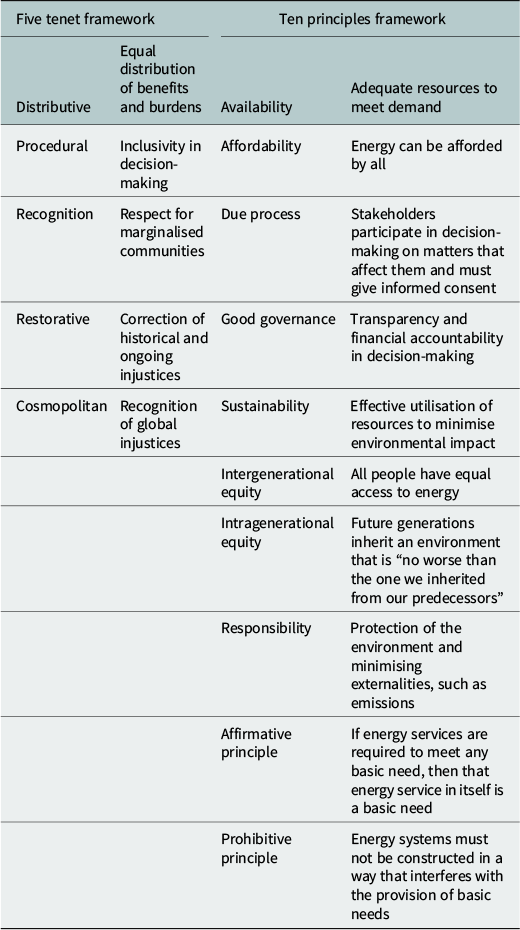
Sovacool and Dworkin (Reference Sovacool and Dworkin2015) put forth an alternative framework for energy justice to be used in policy making. This framework was originally established on eight principles, including availability, affordability, due process, good governance, sustainability, intergenerational equity, intragenerational equity and responsibility. Jones, Sovacool and Sidortsov (Reference Jones, Sovacool and Sidortsov2015) added to the above principles by introducing the affirmative and prohibitive principles of energy justice. While the five-tenet framework and the ten principles could be considered independent, some authors like Tarekegne and Sidortsov (Reference Tarekegne and Sidortsov2021) apply them concurrently in evaluating energy (in)justice. Table 1 summarizes the five-tenet framework and the ten principle framework.
Summary of energy justice frameworks

Table 1. Long description
Table 1-1 summarises two of the most common energy justice frameworks. The first is the five-tenet framework which comprises of distributive, procedural, recognition, cosmopolitan and restorative justice. The second framework is the ten principles framework, and it consists of availability, affordability, due process, good governance, sustainability, intergenerational equity, intragenerational equity, responsibility, affirmative and prohibitive principles.
The five-tenet framework is adopted for this review because it is most commonly used to study energy justice (Lacey-Barnacle et al., Reference Lacey-Barnacle, Robison and Foulds2020). It is, however, worth noting that we see a relationship between the two frameworks, for example, affordability, intergenerational equity, sustainability and intragenerational equity expand on distribution justice. They argue for equal distribution of the benefits of energy access across people of different incomes, present generations and future generations. On the other hand, due process and good governance expand on procedural justice. They seek to ensure that stakeholders have full information during the decision-making process.
Critiques of the energy justice have indicated that it lacks a well-developed philosophical foundation that can be clearly used to define what justice is and what it is not (Wood, Reference Wood2023; Van Uffelen et al., Reference Van Uffelen, Taebi and Pesch2024; Wood et al., Reference Wood, van, Frigo, Melin, Milchram, Lee and Bessa2024). Furthermore, it does not allow for multiple perceptions of justice or injustice among different stakeholders (Wood, Reference Wood2023). This absence may be further shaped by a divergence from the activist roots of environmental justice and the adoption of a predominantly top-down approach, where energy justice is incorporated into policy frameworks without a clear understanding of how injustice is experienced by the people it is meant to serve (Wood, Reference Wood2023; Wood et al., Reference Wood, van, Frigo, Melin, Milchram, Lee and Bessa2024). This divergence is in part caused by the academic roots of energy justice. While environmental justice emerged from civil rights movement, akin to slaves seeking freedom from their oppressors, energy justice was developed by scholars to address perceived inequalities in the energy system (Galvin, Reference Galvin2020). Environmental justice is a movement that enabled communities to articulate their lived injustices and mobilise against them, whereas energy justice was conceptualised by scholarly elites who developed conceptual frameworks to inform development of just policies. Such an approach may lead to the framing of self-interests by those in power as justice issues while neglecting realities experienced by local communities (Wood, Reference Wood2023; Wood et al., Reference Wood, van, Frigo, Melin, Milchram, Lee and Bessa2024). Further, it assumes that policymakers will have the goodwill required to enhance energy justice (Galvin, Reference Galvin2020; Tornel, Reference Tornel2023). Using empirical data to allow framing of energy injustices may be the first step in reuniting energy justice with its activist’s roots (Galvin, Reference Galvin2020).
Another short coming emerges in the study of root causes of justice. Social justice scholarship examines whether injustices arise from moral shortcomings or societal systems; however, this discourse remains underdeveloped in the energy justice literature (Rawls, Reference Rawls1971; Sadurski, Reference Sadurski1985). Lee and Byrne (Reference Lee and Byrne2019) indicate that research on energy justice often identifies what they term as “tailpipe” problems without identifying the “structural and ideological problems pillars that drive it.” These problems could be in the form of systems such as the legacy of colonialism, which causes power imbalances both between and within nations, cultural dynamics including gender and class dynamics, limited financing and income poverty (Tornel, Reference Tornel2023; Karakislak, Reference Karakislak2025). Clarity on the root causes of energy injustice and whether they emerge as systemic or moral issues or a combination of the two is important because they provide guidance on where restorative justice efforts should be directed. Where systemic challenges prevail, such as limited government financing for expanding energy access, restorative justice would not focus on assigning blame to a particular regime. Instead, it would prioritise strengthening and expanding available financing mechanisms. By contrast, moral issues would focus on specific perpetrators of energy injustice; for example, in cases of corruption, targeted regulations can be designed and enforced to hold actors accountable. This paper, therefore, supports restorative justice by developing a framework that accommodates multiple perspectives of injustice and provides information that enables identification of root causes of energy injustice.
Methodology
To conduct this review, the keywords “energy justice” and “Africa” were used as search terms on Web of Science and Scopus databases. The search was restricted to peer-reviewed articles published in English between January 2013 and November 2025. The year 2013 was used as the starting point, as it corresponds with the release of the paper that introduces the triumvirates of tenets (McCauley et al., Reference McCauley, Heffron, Stephan and Jenkins2013). The initial search yielded a total of 241 papers, with 112 of them being relevant to the subject matter and geography. Some of the papers (within the 112) focused on climate and environmental justice but used these frameworks to discuss the impact of energy generation on human life. These were included in the study. Themes pertaining to energy injustice were identified through deductive analysis by manual reading and focusing on recurring concepts (Azungah, Reference Azungah2018). Themes that were identified included energy access, community engagement and others which have been studied by scholars before the inception of the energy justice framework. Further literature searches were, therefore, undertaken to fully develop these themes within the energy justice framework using the snow balling approach. This involved utilising the reference list of papers identified from the systematised review (Wohlin, Reference Wohlin2014) or searches on Google Scholar (Arnstein, Reference Arnstein1969; Ahmad and Puppim De Oliveira, Reference Ahmad and Puppim De Oliveira2015; Bouzarovski and Petrova, Reference Bouzarovski and Petrova2015; Day et al., Reference Day, Walker and Simcock2016; Khavari et al., Reference Khavari, Ramirez, Jeuland and Fuso Nerini2023).
Findings: Energy injustice in sub-Saharan Africa
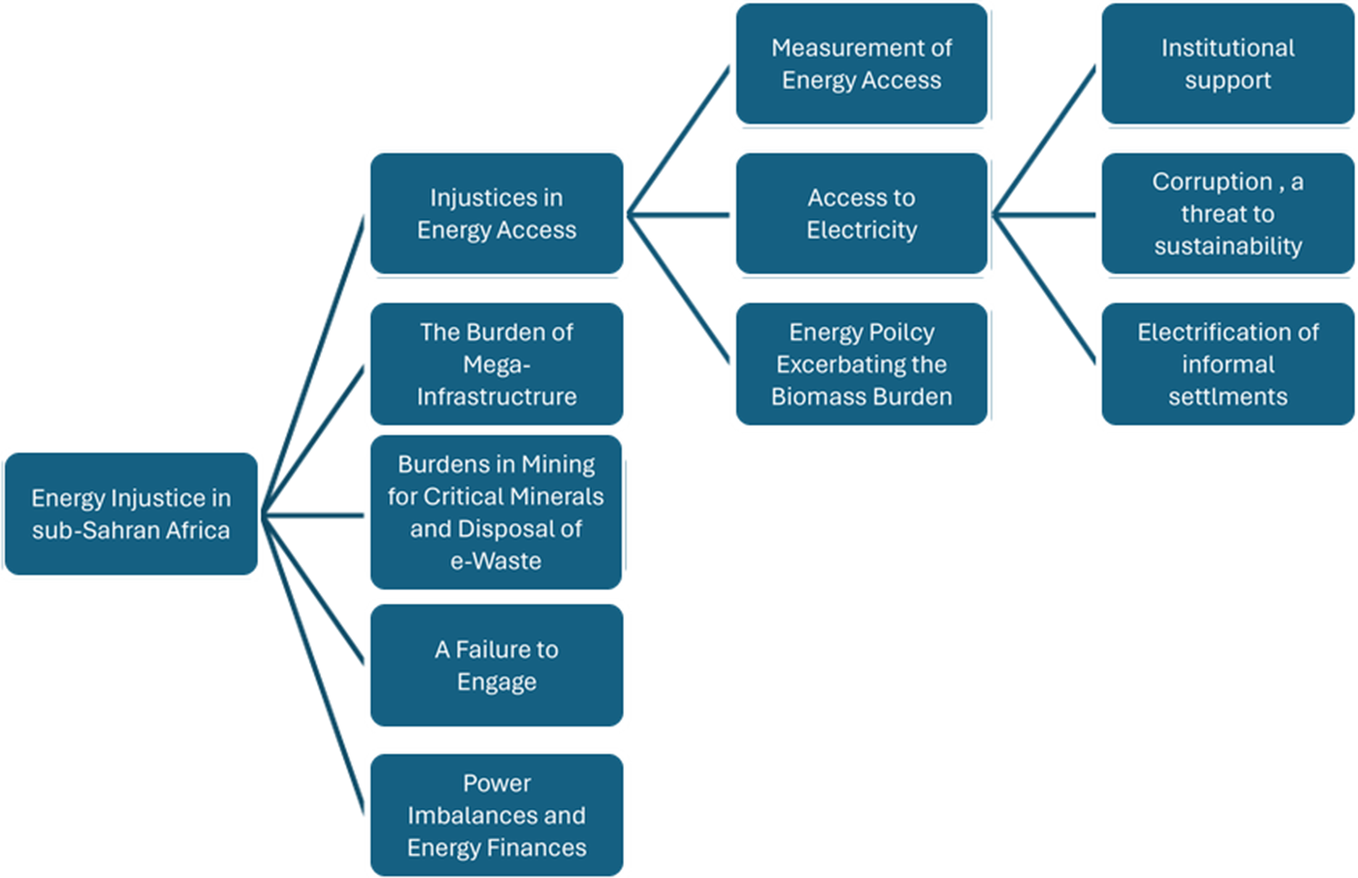
A graphical description of the themes and sub-themes found during the study is shown in Figure 1. These themes reveal that energy injustices are found within the energy lifecycle, including access to energy services, energy production, particularly on those who bear the burdens of mega-infrastructure and finally access to critical minerals and disposal of e-waste. Energy injustices also exist within cross-cutting issues that support activities within the energy life cycle. These include community engagement, access to finance for countries in sub-Saharan Africa and geopolitics, which limits the ability of countries on the continent to determine their own energy systems.
Themes identified during the systematised literature review.

Figure 1. Long description
Figure 3-1 shows that there are four main themes in the paper, injustice in energy access, the burden of mega-infrastructure, burdens in mining for critical minerals and disposal of e-waste, a failure to engage and power imbalances and energy finance. Injustices in energy access have three sub-themes underneath it: Measurement of energy access, access to electricity and energy policy exacerbating the biomass burden. Finally, access to electricity has three themes underneath it: institutional support, corruption, a threat to sustainability, electrification of informal settlements.
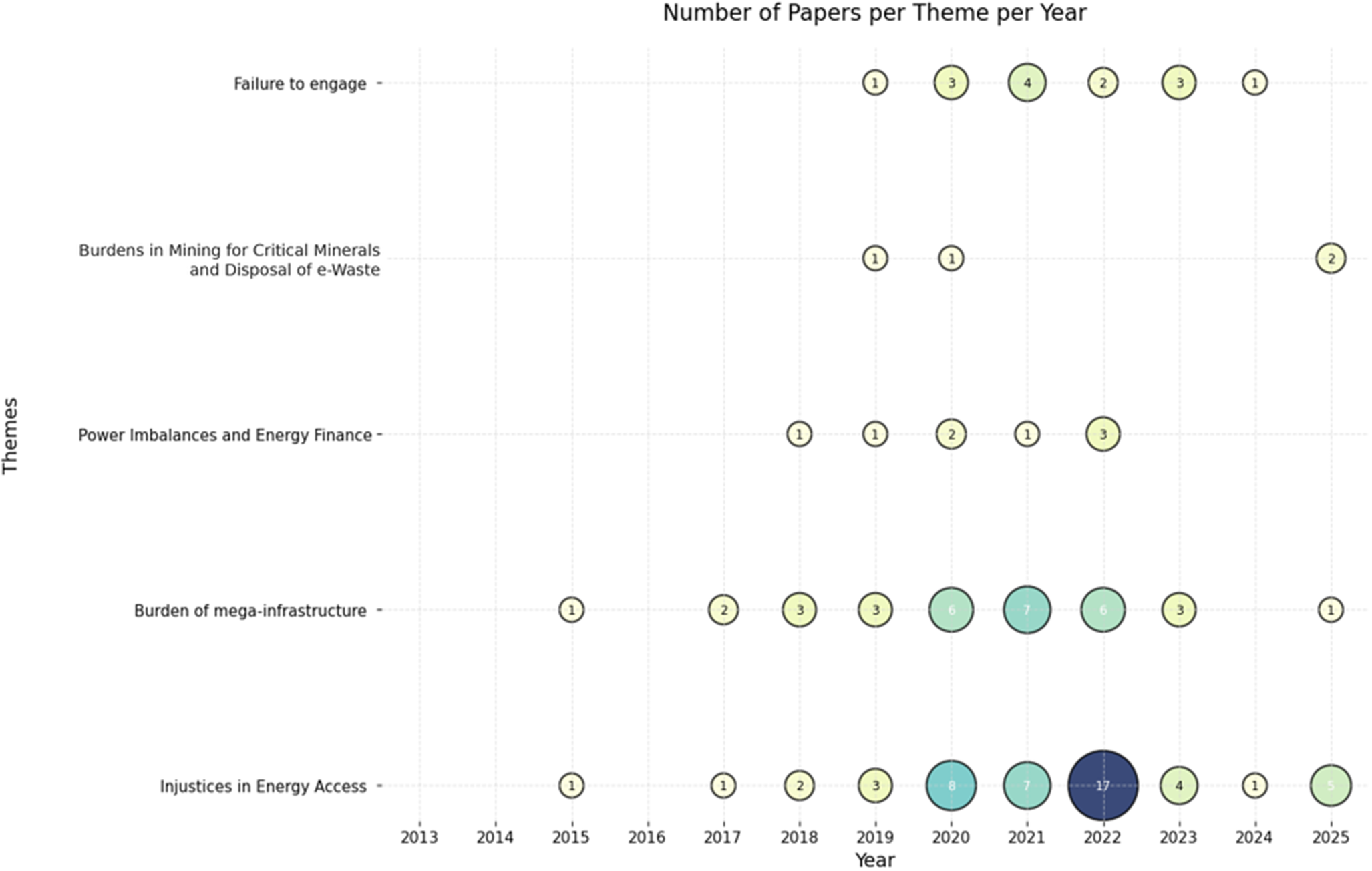
Figure 2 illustrates the number of papers that discussed the identified themes between 2013 and 2025. It should be noted that this figure only contains papers that were identified during the systematised literature search. Additional papers and grey literature identified using the snowballing approach, as described in the Methodology’, are not included. Figure 2 shows that majority of papers were published between 2019 and 2022. The most discussed theme is “Injustice in Energy Access” with 49 papers covering it. This theme includes electricity access, energy policy exacerbating the biomass burden and measurement of electricity access and energy poverty as sub-themes.
Themes covered per year.

Figure 2. Long description
See Figure 3-2 accessibility description.
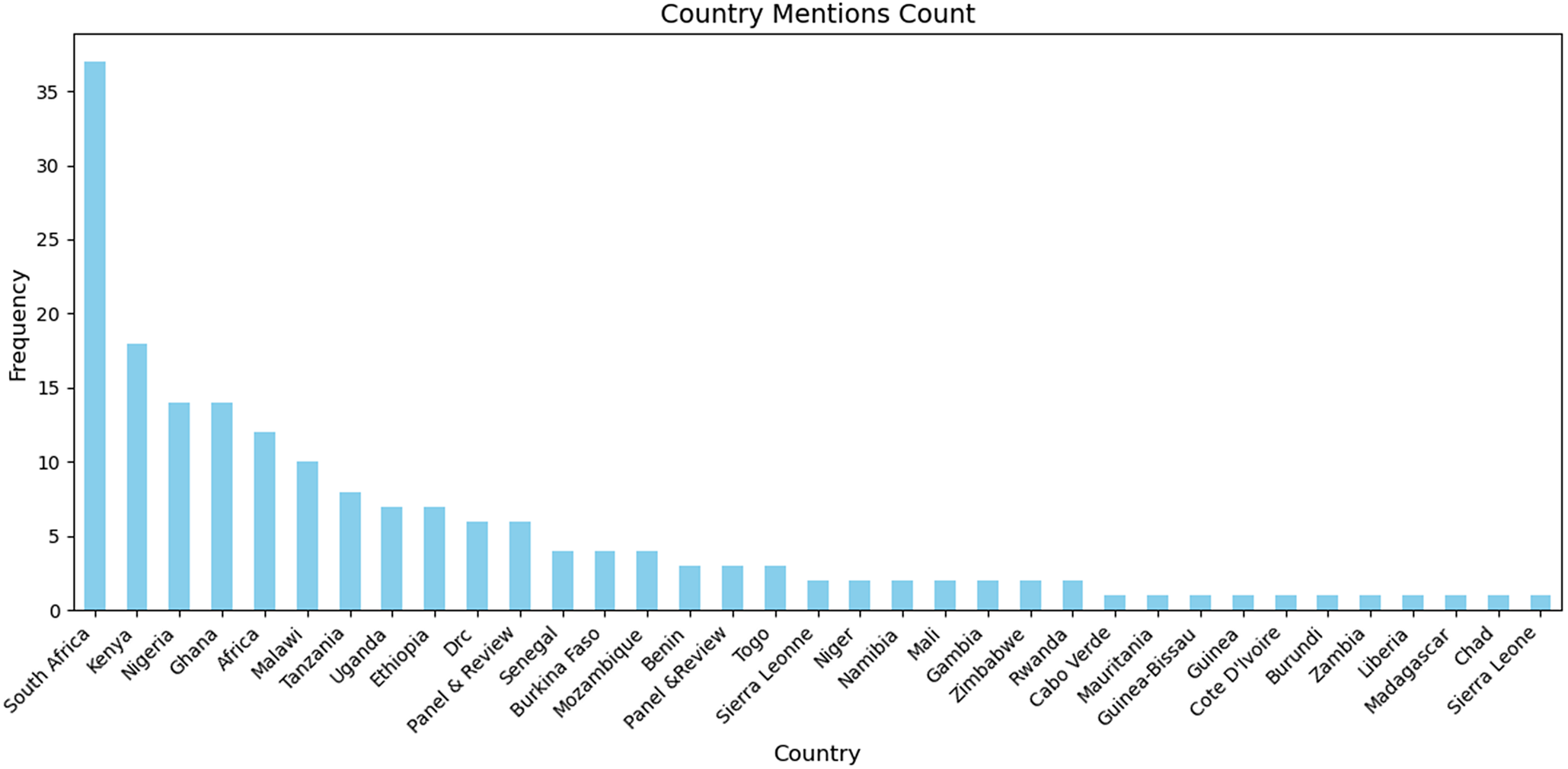
While the systematised review focused on sub-Saharan Africa, most research on energy justice has focused on a few countries in sub-Saharan Africa. Countries receiving major focus included South Africa, Kenya, Nigeria and Ghana, as shown in Figure 3. The countries that received the most focus from the academic literature reviewed were anglophone. Additionally, countries termed least developed with low energy access levels, like Chad and Madagascar, had few papers (one each) describing energy justice in their contexts. As such, further research is needed on the least developed and non-anglophone countries.
Sub-Saharan African countries mentioned in energy justice research.

Figure 3. Long description
The vertical Y axis is labeled Frequency and ranges from 0 to 35 in increments of 5. The horizontal X axis is labeled Country and lists 34 categories. The data shows a sharp decline from the first bar to the rest of the set.
* South Africa has the highest frequency at 37.
* Kenya follows at 18.
* Nigeria and Ghana are tied at 14.
* Africa as a general category is at 12.
* Malawi is at 10.
* Tanzania is at 8.
* Uganda and Ethiopia are tied at 7.
* D r c and Panel and Review are tied at 6.
* Senegal, Burkina Faso, and Mozambique are tied at 4.
* Benin, Panel and Review, and Togo are tied at 3.
* Sierra Leone, Niger, Namibia, Mali, Gambia, Zimbabwe, and Rwanda are tied at 2.
* The remaining countries, Cabo Verde, Mauritania, Guinea-Bissau, Guinea, Cote D’Ivoire, Burundi, Zambia, Liberia, Madagascar, Chad, and Sierra Leone, are all tied at 1.
The following sections describe the themes that were identified during the systematic literature review.
Injustices in energy access
Energy injustice emerged in indicators used to describe energy access, as well as the physical access to energy including access to electricity and energy for cooking. Access to electricity included additional sub-themes such as a comparison of institutional support provided to households obtaining connection from the grid versus those relying on off-grid systems, corruption that occurs in countries where private contractors install infrastructure required for grid connection and prevalence of illegal electricity connections within informal settlements.
This section describes these findings in further detail.
Measurement of energy access and energy poverty
Indicators often used to measure energy access or energy poverty obscure injustices faced in sub-Saharan Africa. Binary metrics used to describe access, such as percentage level of access in a continent, exclude the challenges faced by users, such as reliability or quality of supply. Such metrics may present households as having access to electricity, but in actual sense, they may spend a significant number of hours or even days without supply. Farquharson et al. (Reference Farquharson, Jaramillo and Samaras2018) indicate that countries with a high number of outage hours per year include Nigeria with 4,600, Niger with 1,400 and Democratic Republic of Congo with 830 hours. In the case of off-grid technologies, this metric does not consider technological failure of end of life of solar home systems. In the absence of financial capability, some users will detransition from electricity (Obinegbo et al., Reference Obinegbo, Benson and Osman2025).
The multi-tier framework, which improves on binary metrics for describing access to electricity, still focuses on technical challenges and excludes psychological and social ones. Obinegbo et al. (Reference Obinegbo, Benson and Osman2025) indicate that it does not describe the emotional stress of reliability. It also does not measure lack of access to appliances that support energy consumption. Finally, it does not consider cultural dynamics, which in some contexts may limit energy consumption for household members with limited power, such as women and children, because men control appliances (Clark, Reference Clark2021; Chiteka and Enweremadu, Reference Chiteka and Enweremadu2025; Obinegbo et al., Reference Obinegbo, Benson and Osman2025). These injustices are perpetuated by the limited presence of women policymakers and the limited influence of women during project development and implementation (Van Der Merwe et al., Reference Van Der Merwe, De Kock and Musango2020; Mang-Benza, Reference Mang-Benza2021; Mang-Benza et al., Reference Mang-Benza, Jodoin, Onibon Doubogan, Gaye and Kola2023; Götzmann and Dicalou, Reference Götzmann and Dicalou2025). Presence of women is important as it enhances energy justice outcomes across genders (Njangang et al., Reference Njangang, Tadadjeu and Kamguia2025).
Measuring energy access is intricately linked to measuring energy poverty. A commonly used metric is the percentage of income used for energy consumption (Gafaa et al., Reference Gafaa, Egbendewe and Jodoin2022). In sub-Saharan Africa, this obscures the fact that biomass, which is used by the majority in sub-Saharan Africa for cooking, may be “freely” from the environment; however, it is paid for with valuable time spent to access it and the health burden of using it. Utilising monetary terms to describe energy poverty ignores opportunity costs or risks faced (Gafaa et al., Reference Gafaa, Egbendewe and Jodoin2022; Obinegbo et al., Reference Obinegbo, Benson and Osman2025).
Access to electricity
In 2020, only 28.5% of rural populations in sub-Saharan Africa had access to electricity, compared to 78.5% in urban areas (World Bank, 2022), highlighting a clear distributional injustice. This disparity stems not from moral failure of electricity service providers, including utilities and private sector, but from systemic challenges, including higher poverty rates in rural areas, low population densities that limit demand and investment returns, and financial constraints faced by governments and utilities. For instance, in Zimbabwe, limited public funds must be shared across competing priorities, such as health and agriculture, hindering rural electrification efforts (Peters et al., Reference Peters, Sievert and Toman2019; Chipango, Reference Chipango2020).
Decentralised renewables, such as solar home systems and mini-grids, are more cost-effective compared to the grid, particularly for low-demand contexts with sparse population density and far from the grid (Gladkykh et al., Reference Gladkykh, Davíðsdóttir and Diemer2021; IEA, 2022). Solar home systems, in particular, present an affordable solution, particularly for entry-level energy services such as lighting and mobile phone charging (Wagner et al., Reference Wagner, Rieger, Bedi, Vermeulen and Demena2021; Walwyn and Hanlin, Reference Walwyn and Hanlin2022). However, these technologies are not without injustices. First, they often offer lower service quality compared to the grid. In Tanzania, users reported limited capacity for productive use (Cross and Neumark, Reference Cross and Neumark2021), while in South Africa, weather variability affected reliability (Monyei et al., Reference Monyei, Adewumi and Jenkins2018b). Poor households often access only basic systems, forcing them to prioritise limited energy use, such as choosing between lighting and entertainment (Ojong, Reference Ojong and Ojong2022). Unlike grid users, they face energy constraints when adding appliances (Monyei et al., 2018b). These limitations, intensified during rainy seasons due to reduced solar charging, reflect a distributional injustice. Yet, expanding grid access to improve equality can increase system costs and impact affordability (Nock et al., Reference Nock, Levin and Baker2020). While scholars like Jenkins (Reference Jenkins2018), Monyei et al. (Reference Monyei, Adewumi and Jenkins2018b) and Boamah (Reference Boamah2020) highlight the injustices brought about by these technologies, particularly when comparing them to users of the grid, others like Tarekegne and Rouleau (Reference Tarekegne and Rouleau2019) and Opoku-Mensah et al. (Reference Opoku-Mensah, Chen, Tuffour, Agozie, Gyamfi and Mahmoud2025) highlight that they enhance energy justice while reducing emissions.
While the grid in this case might seem like the “ideal” technology, affordability and reliability present significant challenges (Lee et al., Reference Lee, Brewer, Christiano, Meyo, Miguel, Podolsky, Rosa and Wolfram2014; Lee et al., Reference Lee, Brewer, Christiano, Meyo, Miguel, Podolsky, Rosa and Wolfram2016; Blimpo and Postepeska, Reference Blimpo and Postepeska2017; Maqelepo et al., Reference Maqelepo, Wamalwa, Raji and Williams2023; Osunmuyiwa et al., Reference Osunmuyiwa, Odero, Wall, Goode, Flaspohler, Abrokwah, Adkins and Klugman2025). Reliability has been discussed in the Section describing ‘Measurement of energy access and energy poverty’. In the case of affordability, challenges are observed through limited connectivity of under-grid households and limited consumption of grid-connected households (Lee et al., Reference Lee, Brewer, Christiano, Meyo, Miguel, Podolsky, Rosa and Wolfram2014; Lee et al., Reference Lee, Brewer, Christiano, Meyo, Miguel, Podolsky, Rosa and Wolfram2016; Blimpo and Postepeska, Reference Blimpo and Postepeska2017). While solar home systems present an affordable alternative, larger grid-connected solar PV systems threaten affordability for low-income consumers. An example from South Africa indicates that their utilisation by the urban wealthy, who typically subsidise low-income consumers, leads to their reduced consumption from the grid. This leads to reduced availability of grid subsidies for low-income consumers (Jaglin, Reference Jaglin2023).
The affordability of electricity can be improved by addressing unemployment, as higher incomes enable greater energy consumption (Koomson and Awaworyi Churchill, Reference Koomson and Awaworyi Churchill2022). Additionally, innovations like mobile money can also enhance financial inclusivity, which in turn can support increased access to electricity (Ajide et al., Reference Ajide, Oladipupo, Dauda and Soyode2025). Electrification programs that promote productive use of energy, supporting job creation and business growth, can boost community incomes and thus energy access, making productive use an energy justice issue (Domegni and Azouma, Reference Domegni and Azouma2022; Babayomi et al., Reference Babayomi, Olubayo, Denwigwe, Somefun, Adedoja, Somefun, Olukayode and Attah2023). However, Baker et al. (Reference Baker, Nock, Levin, Atarah, Afful-Dadzie, Dodoo-Arhin, Ndikumana, Shittu, Muchapondwa and Sackey2021) caution that prioritising productive use may increase system costs and reduce affordability for the poor, requiring careful planning.
Institutional support. Some low-income grid users are provided with lifeline tariffs that support consumption, therefore enhancing distributive justice. This contrasts with majority of off-grid end users who lack access to subsidies (Jenkins, Reference Jenkins2018; Peters et al., Reference Peters, Sievert and Toman2019; Boamah, Reference Boamah2020; Todd and McCauley, Reference Todd and McCauley2021). Instead, in the case of decentralised renewables like solar home systems, their payment terms may include the cost of credit, which increases the cost of access. When they default, companies remotely disconnect them, which is a significant threat to distributive justice. In fact, Ferrall et al. (Reference Ferrall, Callaway and Kammen2022) find that some households in Tanzania prefer to avoid credit and instead use informal mechanisms to save money with shop owners until they can afford the purchase price of their desired systems.
Notable exceptions to subsidies for off-grid systems have been found in South Africa and Kenya. In South Africa, the government has provided free basic alternative energy (FBAE) to end users, worth approximately three dollars to users who are not grid-connected. However, this program, implemented by municipalities, has had limited success due to limited funds to support subsidies. A notable exception is found in the iShack project within Stellenbosch municipality (Azimoh et al., Reference Azimoh, Klintenberg, Wallin and Karlsson2015; World Bank, 2015; Bloem et al., Reference Bloem, Swilling and Koranteng2021; Cantoni et al., Reference Cantoni, Caprotti and de Groot2022). In Kenya, the Government has enabled subsidised consumption from mini-grids in 14 of 47 counties, which are considered marginalised. Mini-grids consumers in other areas must pay full costs, despite higher tariffs when compared to the grid (Taylor, Reference Taylor2023).
The limited support offered to the off-grid sector by governments, coupled with the push for profitability by the private sector, has led some academics to question the appropriateness of markets to provide electricity access, particularly for the poorest of the poor (Fungisai Chipango, Reference Chipango2020; Cross and Neumark, Reference Cross and Neumark2021; Park, Reference Park2021; Mottram, Reference Mottram2022). Markets are questioned for two reasons: First, the push for profitability by the private sector makes electricity seem like an economic good rather than a public one (Gill-Wiehl et al., Reference Gill-Wiehl, Ferrall and Kammen2022; Mottram, Reference Mottram2022). However, Munro et al. (Reference Munro, Samarakoon, Kearnes and Paisley2023) challenge this, indicating that the private sector needs this funding to satisfy investors and pay debt. Markets are also questioned because they require consumers who often limited capabilities to make rational decisions, including determination of product quality and catering for maintenance. This decision-making must be undertaken in an environment with proliferation of sub-standard products, a dearth of qualified technicians and limited distribution channels to enable access to quality products, as witnessed in Malawi and Kenya (Cross and Murray, Reference Cross and Murray2018; Harrington and Wambugu, Reference Harrington and Wambugu2021; Samarakoon et al., Reference Samarakoon, Bartlett and Munro2021; Gill-Wiehl et al., Reference Gill-Wiehl, Ferrall and Kammen2022; Samarakoon et al., Reference Samarakoon, Munro, Zalengera and Kearnes2022). On the other hand, regulatory support by governments is limited by little to no access to testing equipment, which can be used to enforce standards (Harrington and Wambugu, Reference Harrington and Wambugu2021). This limited testing capacity means that, even when marks of quality are used, quality is still not guaranteed (Harrington and Wambugu, Reference Harrington and Wambugu2021). This is unlike the grid where the government is responsible for quality of the system and subsequent maintenance.
Corruption, a threat to the sustainability of electricity access. Corruption affects the quality and sustainability of electricity access. In some countries within sub-Saharan Africa, it is used by citizens to avoid the bureaucracy or high costs associated with electricity access (Boamah and Williams, Reference Boamah and Williams2019; Boamah et al., Reference Boamah, Williams and Afful2021). It is also prevalent in cases where the utility sub-contracts the grid connection to private contractors. While this arrangement is undertaken to fast-track grid connection, it creates opportunities for corruption, particularly during the procurement of installation services. The contractors also further contribute to corruption by utilising sub-standard materials possibly to increase profit margins (Boamah, Reference Boamah2019; Boamah and Williams, Reference Boamah and Williams2019; Boamah et al., Reference Boamah, Williams and Afful2021). In these cases, corruption threatens the sustainability of access and frustrates citizens because it muddles the process of obtaining electricity connectivity (Boamah et al., Reference Boamah, Williams and Afful2021).
Corruption driven by political decisions threatens the sustainability of electrification initiatives. Two cases are seen in Zimbabwe. In the first, the utility is forced to buy overpriced electricity and sell it at a loss, and this further threatens its financial capacity to expand access (Chipango, Reference Chipango2020). In the second, a member of parliament orders the removal of a transformer supplying electricity to an agricultural cooperative, forcing them to resort to wood fuel to power their activities (Chipango, Reference Chipango2020).
Utilities facing difficult policy circumstances also resort to corruption to survive. In Ghana, corruption is used by the utility to survive during the implementation of the net metering policy, which would have threatened their long-term financial viability had it been successfully implemented (Boamah et al., Reference Boamah, Williams and Afful2021). This case of corruption is a procedural injustice in reaction to a prior injustice, rooted in poor policy design. In this case, consumers who installed solar PV systems with the goal of reducing their electricity bills are frustrated upon non-payment by the utility (Boamah et al., Reference Boamah, Williams and Afful2021).
Corruption can also affect a country’s ability to secure donor funding and improve its access rates. In Madagascar, the energy sector has failed to attract funding from donors after allegations of corruption (Cholibois, Reference Cholibois2020), causing significant limitations, while in Kenya, a donor embargo of the energy sector (between 1991 and 1999) prompted the development of new policies to provide donor comfort and limit corruption (Boamah, Reference Boamah2019).
While the relationship between corruption and morality has been explored (Gebel, Reference Gebel2012; Nardo and Francis, Reference Nardo and Francis2012), it is worth demonstrating a link between it and systemic injustice, particularly the legacy of colonialism. Colonialism was preceded by the division of the African continent into states that ignored existing political or economic groupings. As a result, most African countries were unable to achieve full unity after independence. It is, therefore, unsurprising that many soon transitioned into authoritarian rule, with governance structures that primarily benefited a small elite (Alemazung, Reference Alemazung2010; Fentahun, Reference Fentahun2023). Corruption was then one of the mechanisms used by the small majority or elite to maintain their power (Fraser-Moleketi, Reference Fraser-Moleketi2007).
Informal settlements. In some cases, corruption is also used by forgotten communities to obtain electrification. This is best illustrated by communities in informal settlements that use illegal connections. These connections are facilitated by corruption between local technicians and utility agents to access to the electricity grid (de Bercegol and Monstadt, Reference de Bercegol and Monstadt2018; Allan et al., Reference Allan, Lemaadel and Lakhal2022; Yaguma et al., Reference Yaguma, Parikh and Mulugetta2022). Payment for consumption is often at a lower tariff than the grid and is a forceful attempt to correct the injustice arising from their neglect (de Bercegol and Monstadt, Reference de Bercegol and Monstadt2018; Kovacic et al., Reference Kovacic, Musango, Buyana, Ambole, Smit, Mwau, Ogot, Lwasa and Brent2020; Boamah et al., Reference Boamah, Williams and Afful2021). Informal settlements were neglected for various reasons, including their perceived illegality, low demand or peri-urban nature, which made them unsuitable for electrification initiatives targeting rural or urban areas (Njoroge et al., Reference Njoroge, Ambole, Githira and Outa2020; Sheridan et al., Reference Sheridan, Njogu and Maki2020; Cantoni et al., Reference Cantoni, Caprotti and de Groot2022; Monyai et al., Reference Monyai, Chivanga and Katsande2023). In South Africa, neglect had historical racial connotations, with black people living in informal settlements not being prioritised for service provision (Strauss, Reference Strauss2019; Ndinda and Ndhlovu, Reference Ndinda and Ndhlovu2020; Mögenburg, Reference Mögenburg2022). In addition to illegal connections, inhabitants of informal settlements have, in some cases, responded to these circumstances by rejecting off-grid systems because they felt that this would deny them eventual grid access and the legitimacy it would provide. In South Africa, this was remedied by framing solar home systems as a temporary solution (Kovacic et al., Reference Kovacic, Musango, Buyana, Ambole, Smit, Mwau, Ogot, Lwasa and Brent2020; Bloem et al., Reference Bloem, Swilling and Koranteng2021).
Despite their utilisation to correct pre-existing injustice, illegal connections do not completely remedy “felt injustice.” Instead, they make end-users vulnerable to dangers like electrocution due to poor quality workmanship. Second, they make electricity supply unreliable within the settlements and the surrounding areas as they impose a higher load on the electricity infrastructure than was planned for (Kovacic et al., Reference Kovacic, Smit, Musango, Brent and Giampietro2016, Reference Kovacic, Musango, Buyana, Ambole, Smit, Mwau, Ogot, Lwasa and Brent2020; de Bercegol and Monstadt, Reference de Bercegol and Monstadt2018; Cantoni et al., Reference Cantoni, Caprotti and de Groot2022). Finally, they are also a source of significant commercial losses for utilities, threatening their sustainability (de Bercegol and Monstadt, Reference de Bercegol and Monstadt2018; Yaguma et al., Reference Yaguma, Parikh and Mulugetta2022).
Utilities have, therefore, employed several strategies to deal with this threat. These include: portraying illegal electricity theft as a societal ill, a strategy employed by Eskom in South Africa, the community, however, rejects this, indicating that they cannot afford electricity because voting (attainment of democracy in 1994) “did not bring jobs” (Mögenburg, Reference Mögenburg2022). In Uganda, the utility employs universal disconnection of informal settlements, leading to feelings of injustice both over lost electricity supply and jobs created by illegal connections (Yaguma et al., Reference Yaguma, Parikh and Mulugetta2022). In Kenya, the utility attempts to formalise connections, but the first attempt fails due to poor community engagement. The second attempt initially succeeds but is later threatened by unmet expectations, as local youth become disillusioned by the utility’s lack of permanent employment opportunities (de Bercegol and Monstadt, Reference de Bercegol and Monstadt2018).
Energy policy exacerbating biomass burden
Beyond electricity access, discourse and initiatives surrounding energy access in sub-Saharan Africa have also been framed as moving away from fuels like firewood and charcoal for cooking to “modern fuels” like LPG, electricity and biogas (Sander et al., Reference Sander, Gros and Peter2013; Munro et al., Reference Munro, van der Horst and Healy2017; Doggart et al., Reference Doggart, Ruhinduka, Meshack, Ishengoma, Morgan-Brown, Abdallah, Spracklen and Sallu2020; Grant et al., Reference Grant, McCauley, von Maltzan, Grattage and Mwathunga2021; Branch et al., Reference Branch, Agyei, Anai, Apecu, Bartlett, Brownell, Caravani, Cavanagh, Fennell, Langole, Mabele, Mwampamba, Njenga, Owor, Phillips and Tiitmamer2022). Biomass fuels, such as firewood and charcoal, impose a burden on users, including health risks from smoke inhalation and significant physical drudgery associated with obtaining these fuels, particularly the collection of firewood. This burden impacts women more than men because they bear the brunt of fetching firewood, sometimes walking long distances to do this, facing predators and dealing with smoke inhalation while cooking (Johnson et al., Reference Johnson, Gerber and Muhoza2019; Grant et al., Reference Grant, McCauley, von Maltzan, Grattage and Mwathunga2021; Park, Reference Park2021; Mccauley et al., Reference McCauley, Grant and Mwathunga2022; Mang-Benza et al., Reference Mang-Benza, Jodoin, Onibon Doubogan, Gaye and Kola2023). In Countries like Togo, women also face punitive measures imposed by governments to limit environmental degradation associated with firewood (Mang-Benza et al., Reference Mang-Benza, Jodoin, Onibon Doubogan, Gaye and Kola2023).
Inspired by the drudgery caused by these fuels, as well as their associated emissions and deforestation claims, policymakers across the continent have implemented various strategies to curb utilisation of biomass, which in some cases have furthered injustice. In Sierra Leone, for example, the government implemented a license for accessing firewood and another for charcoal production, both of which are too expensive for local communities to acquire. Although these licences were introduced to generate revenue and curb deforestation, in practice, they led to job losses and made it more difficult for citizens to access energy for food preparation (Munro, Reference Munro2013; Munro et al., Reference Munro, van der Horst and Healy2017). Similar examples are seen in Tanzania (Doggart et al., Reference Doggart, Ruhinduka, Meshack, Ishengoma, Morgan-Brown, Abdallah, Spracklen and Sallu2020) where policies meant to fast-track transition to clean fuels ended up making it more difficult for the poor to access energy services for cooking, thereby interfering with a basic need, food. In fact, Standal et al. (Reference Standal, Ulsrud, Grimsby and Aamaas2024) highlight that the clean cooking policy in Tanzania was developed with limited input from end-users. This is, therefore, a procedural injustice. While access to clean cooking fuels can reduce deforestation, these policies need to be carefully developed while including those affected to enhance energy justice (Njangang et al., Reference Njangang, Tadadjeu and Kamguia2025).
The burden of mega-infrastructure
In addition to injustices in accessing energy services, sub-Saharan Africa also faces injustices arising from energy production, particularly in mega-infrastructural projects. These are experienced in both renewable and non-renewable energy projects alike. In renewable energy projects, like the case of Lake Turkana Wind Power plant in Kenya and Bui hydro power plant in Ghana, they are often accompanied by loss of land and livelihood for host communities, increasing costs for access to basic infrastructure, including housing and often with little to no compensation (Shirley, Reference Shirley2015; Cormack and Kurewa, Reference Cormack and Kurewa2016; Yenneti et al., Reference Yenneti, Day and Golubchikov2016; Osiolo et al., Reference Osiolo, Pueyo and Gachanja2017; Hensengerth, Reference Hensengerth2018; McCauley et al., Reference McCauley, Heffron, Stephan and Wood2019; Hoffman et al., Reference Hoffman, Davies, Bauwens, Späth, Hajer, Arifi, Bazaz and Swilling2021). In some cases, where compensation is provided, like during the construction of Takoradi thermal power plant in Ghana, community leaders retain what they are meant to cascade to the community (Nolan et al., Reference Nolan, Goodman and Menga2020; Babalola and Olawuyi, Reference Babalola and Olawuyi2022). Additionally, where indigenous communities are present, they are often not recognised as such and therefore denied the support and compensation that is due to them (Cormack and Kurewa, Reference Cormack and Kurewa2016). These communities often face these burdens while receiving minimal benefits, such as jobs or even electrification (Cormack and Kurewa, Reference Cormack and Kurewa2016; Hensengerth, Reference Hensengerth2018; Lawrence, Reference Lawrence2020; Kalt et al., Reference Kalt, Simon, Tunn and Hennig2023). In other cases, governments develop these projects and target external markets rather than their citizens (Chiteka and Enweremadu, Reference Chiteka and Enweremadu2025). In Congo, the Inga dam is to be constructed to supply electricity to South Africa, while Ethiopia targets East Africa with its Grand Ethiopian Renaissance Dam (Kruger and McCauley, Reference Kruger, McCauley, Bombaerts, Kirsten and Yekeens2020; Tarekegne, Reference Tarekegne2020; Tesfamichael, Reference Tesfamichael2022). This likely occurs because governments prioritise economic growth and political power over citizens’ access to energy (Tesfamichael, Reference Tesfamichael2022). The community in Congo describes this as “cooking food and being left with none to eat” (Kruger and McCauley, Reference Kruger, McCauley, Bombaerts, Kirsten and Yekeens2020). However, Opoku and Acheampong (Reference Opoku and Acheampong2023) argue that energy justice in the form of equitable access to energy leads to economic growth.
The injustices described above demonstrate that renewable energy projects are not without fault. In fact, a significant portion of research on energy justice in sub-Saharan Africa focuses on renewable energy projects despite additional burdens imposed by non-renewables, including exposure to emissions or environmental degradation (Langerman, Reference Langerman2019; Lacey-Barnacle et al., Reference Lacey-Barnacle, Robison and Foulds2020; Babalola and Olawuyi, Reference Babalola and Olawuyi2022; Barnes, Reference Barnes2022; Morocco-Clarke, Reference Morocco-Clarke2023). These studies underscore that, in some cases, the adoption of renewables merely “greens” energy systems while reproducing the same injustices associated with centralised non-renewable energy infrastructures (Avila, Reference Avila2018; Mikulewicz and Taylor, Reference Mikulewicz and Taylor2019; Sovacool et al., Reference Sovacool, Turnheim, Hook, Brock and Martiskainen2021). In cases, like in South Africa, through the renewable energy independent power producer procurement program (REI4P), the energy system adds renewables without addressing injustices that exist due to dependence on non-renewables (Lawrence, Reference Lawrence2020; Cock, Reference Cock2021; Barnes, Reference Barnes2022).
Governments sometimes justify these projects by the “good” they will bring while neglecting the burdens imposed on communities near them. Political ecologists have, therefore, coined the term “sacrifice zones” for spaces occupied by these communities (Sovacool et al., Reference Sovacool, Hook, Martiskainen, Brock and Turnheim2020; Greiner et al., Reference Greiner, Klagge and Owino2023). Barnes (Reference Barnes2022) introduces the term “net justice” to further describe situations in which energy injustice caused by large renewable energy projects is overlooked because of the benefits they bring, particularly in reducing emissions.
The presence of sacrifice zones raises the question: Is the just energy transition just? Large-scale renewable projects in countries like South Africa are pursued to facilitate the adoption of renewable energy and reduce dependency on fossil fuels. However, in their implementation, they still leave significant sections of the community behind, particularly those impacted by coal generation, which violates energy justice principles. McCauley and Heffron (Reference McCauley and Heffron2018) argue that just energy transition should involve integration of energy, environment and climate justice principles; however, currently, in its implementation, it seems to pursue adoption of climate goals while neglecting energy justice principles. However, it must be noted that “perfect justice” is difficult to achieve with trade-offs emerging at critical decision-making points.
Burdens in mining for critical minerals and disposal of e-waste
Moving away from energy production, injustices are also experienced in access to critical minerals and in the disposal of e-waste, associated with renewable energy technologies. Discourse around the transition to renewable energy often cites benefits while neglecting the burdens borne, particularly at the beginning of the lifecycle during the mining of critical minerals and in the tail end during the disposal of energy technologies. Injustices in mining critical minerals have been found in Katanga, Congo, which supplies approximately 64% of the world’s cobalt, a key input in the manufacture of lithium-ion batteries (Mostert et al., Reference Mostert, Young and Hassman2019; Sovacool et al., Reference Sovacool, Furszyfer Del Rio and Griffiths2020; Chiteka and Enweremadu, Reference Chiteka and Enweremadu2025). Injustices have also been identified in Ghana, where the majority of e-waste from the United Kingdom is disposed (Sovacool et al., Reference Sovacool, Hook, Martiskainen, Brock and Turnheim2020). In the future, this e-waste will likely include smart meters with a shorter lifespan than their predecessors. Challenges in the disposal of energy technologies are not unique to Ghana. As the proliferation of solar home systems grows in sub-Saharan Africa, the end-of-life disposal of the accompanying batteries becomes a challenge. Many countries, including Kenya, lack regulatory guidance; hence, these batteries end up in local dumpsites, posing health risks to waste recyclers and residents of surrounding settlements (Kasper, Reference Kasper2025).
Both the e-waste sorters and miners who perform these tasks face significant health challenges and high mortality rates. Women are vulnerable to sexual exploitation and child labourers, as young as six years old, are involved (McCauley et al., Reference McCauley, Heffron, Stephan and Wood2019; Sovacool et al., Reference Sovacool, Furszyfer Del Rio and Griffiths2020). Adoption of cosmopolitan justice within the energy lifecycle will be critical in alleviating these burdens (Heffron and De Fontenelle, Reference Heffron and De Fontenelle2023).
A failure to engage
Beyond energy injustices in the energy lifecycle, they are also found in cross-cutting activities that support it. Community engagement, as a cross-cutting activity, is a vital component of procedural justice. When neglected, it often contributes to the failure of energy projects and the ineffectiveness of related policies (Abe, Reference Abe2022). In some cases, governments, such as during the construction of a natural gas plant in Tanzania, have completely rejected dialogue with affected communities, instead branding them as anti-development (Poncian and Jose, Reference Poncian and Jose2019). In other cases, community engagement is often undertaken as a check box activity without adequate consideration of due process. This goes against engagement principles, requiring community members to be equal partners in the implementation of projects and take part in all phases of development, from design to implementation (Arnstein, Reference Arnstein1969; Taliep, Reference Taliep2022; Oemmelen et al., Reference Oemmelen, Page and Parikh2025). A failure of adequate engagement was seen in the Lamu coal power plant in Kenya (Tarekegne and Rouleau, Reference Tarekegne and Rouleau2019; UNEP, 2019; Abe, Reference Abe2022), where the community was not given adequate time to participate in community engagement activities or given full information regarding the impact of the coal power plant, as mandated by the country’s environmental management regulations process, therefore violating the procedural justice principle of inclusion (UNEP, 2019; Tarekegne, Reference Tarekegne2020; Abe, Reference Abe2022).
Chisika and Yeom, Reference Chisika and Yeom2024 and Boateng (Reference Boateng2025) indicate that sub-national governments are best placed to engage with community members and enhance energy justice. However, even they can be influenced by politics and favour those who are aligned with their parties and neglect other citizens (Haque et al., Reference Haque, Lemanski and de Groot2021; Peprah et al., Reference Peprah, Gyamfi, Effah-Donyina and Amo-Boateng2023; Boateng, Reference Boateng2025).
Community engagement can also be hampered by a culture that prevents marginalised community members from participating. In Ethiopia, for example, women were barred from participating in community engagement exercises because they were perceived as “incapable” (Oemmelen et al., Reference Oemmelen, Page and Parikh2025). One initiative that has demonstrated mixed performance in community engagement is the Renewable Energy Independent Power Producer Procurement Programme in South Africa (REI4P). This initiative has been lauded for its stringent requirements for local content and local ownership (WWF, 2015; Müller et al., Reference Müller, Claar, Neumann and Elsner2020; Todd and McCauley, Reference Todd and McCauley2021; Chiteka and Enweremadu, Reference Chiteka and Enweremadu2025). However, critics have indicated that it does not define clear procedures for engagement and therefore leaves loopholes that companies can exploit. A company in South Africa took advantage of these loopholes and registered a community trust to receive money on behalf of the community for project implementation (Lawrence, Reference Lawrence2020; Funder et al., Reference Funder, Wlokas, Jhetam and Olsen2021).
Beyond community engagement, meaningful collaboration is also required among other stakeholders, including between the private sector and government, across governance levels (national and subnational), and even among different private-sector actors. In these cases, engagement is hampered by politics, especially where government is involved and competition between private sector players (Boateng, Reference Boateng2025).
Power imbalances and energy finance
Governments in sub-Saharan Africa often rely on donor funding to execute their energy-related mandates; however, this funding is not equitably distributed across the continent (Tarekegne and Sidortsov, Reference Tarekegne and Sidortsov2021; Younsi et al., Reference Younsi, Bechtini and Khemili2021). Countries with higher electricity access rates receive more donor funding and higher private sector investment likely because of their market capacity (Tarekegne and Sidortsov, Reference Tarekegne and Sidortsov2021; Weko and Goldthau, Reference Weko and Goldthau2022). Conversely, least developed countries, often perceived as high risk due to political instability, weak policy and regulatory frameworks, and limited technical capacity to engage with donors, receive less funding, a dynamic that further entrenches distributive injustice (Cholibois, Reference Cholibois2020; Müller et al., Reference Müller, Neumann, Elsner and Claar2021; Mccauley et al., Reference McCauley, Grant and Mwathunga2022; Chiteka and Enweremadu, Reference Chiteka and Enweremadu2025). To mitigate the capacity challenge, these countries often have to rely on international consultants, who often have prohibitive costs, to support engagement with donors (Cholibois, Reference Cholibois2020; Müller et al., Reference Müller, Neumann, Elsner and Claar2021). In these countries, donor support can be directed towards developing an enabling environment for receiving funding. This can include capacity building and the development of a robust policy and regulatory framework.
Climate financing, targeted at supporting energy transition in developing countries, also mirrors some of the above injustices. For example, least developed countries received only 2% of climate finance in 2022 (Karg et al., Reference Karg, Gupta and Chen2025). Second, debt is the largest instrument used to disburse funding, making countries like Madagascar focus on commercially viable projects and neglect economically unviable areas, which in the long term may increase inequality in electrification (Cholibois, Reference Cholibois2020). Additionally, scholars indicate that debt makes African countries pay to alleviate climate change, yet they contributed little to cause it (Karg et al., Reference Karg, Gupta and Chen2025). Moreover, climate financing delivered through partnerships, such as the Just Energy Transition Partnership benefiting South Africa and Senegal, tends to prioritise capacity expansion rather than addressing energy access and affordability. This increased focus on capacity expansion leads to the construction of large renewable energy power plants that may contribute to injustice caused by mega-infrastructure, as described in Section describing ‘Burdens in mining for critical minerals and disposal of e-waste’ while neglecting communities that are currently burdened by injustice (Gürtler, Reference Gürtler2025; Karg et al., Reference Karg, Gupta and Chen2025).
Financing for energy systems is influenced by power imbalances, which often lead to the development of energy systems that meet donor interests, sometimes at the expense of local people (Mikulewicz and Taylor, Reference Mikulewicz and Taylor2019; Okpanachi et al., Reference Okpanachi, Ambe-Uva and Fassih2022; Sokona et al., Reference Mulugetta, Sokona, Trotter, Fankhauser, Omukuti, Croxatto, Steffen, Tesfamichael, Abraham, Watson, Rocha, Adedoyin, Asafu-Adjaye, Bazilian, Calzadilla, Chen, Denton, Elum, Gielen, Hafner, Ikejemba, Kammen, Krey, Lee, Lior and Lütkenhorst2022; Symons and Friederich, Reference Symons and Friederich2022). This has been reflected in the tension between achieving climate goals by transitioning from fossil fuels and strengthening sub-Saharan Africa’s energy security. This has been a recurring theme in discussions between the states in the global North and sub-Saharan Africa and within academic circles (Monyei et al., Reference Monyei, Jenkins, Serestina and Adewumi2018a; Todd et al., Reference Todd, de Groot, Mose, McCauley and Heffron2019; Agbaitoro and Oyibo, Reference Agbaitoro and Oyibo2022; Bugaje et al., Reference Bugaje, Dioha, Abraham-Dukuma and Wakil2022; Hege et al., Reference Hege, Okereke, Treyer, Sokona, Kingiri, Keijzer and Denton2022; Sokona et al., Reference Mulugetta, Sokona, Trotter, Fankhauser, Omukuti, Croxatto, Steffen, Tesfamichael, Abraham, Watson, Rocha, Adedoyin, Asafu-Adjaye, Bazilian, Calzadilla, Chen, Denton, Elum, Gielen, Hafner, Ikejemba, Kammen, Krey, Lee, Lior and Lütkenhorst2022; Symons and Friederich, Reference Symons and Friederich2022; Babayomi et al., Reference Babayomi, Olubayo, Denwigwe, Somefun, Adedoja, Somefun, Olukayode and Attah2023; Nsafon et al., Reference Nsafon, Same, Yakub, Chaulagain, Kumar and Huh2023; Abe and Azubike, Reference Abe and Azubike2024).
In political discussions, African leaders in countries like Nigeria, Mozambique and Senegal have come out repeatedly calling for natural gas to be given the status of a transition fuel so that they can use it as they move towards renewable energy (Hege et al., Reference Hege, Okereke, Treyer, Sokona, Kingiri, Keijzer and Denton2022; Sokona et al., Reference Mulugetta, Sokona, Trotter, Fankhauser, Omukuti, Croxatto, Steffen, Tesfamichael, Abraham, Watson, Rocha, Adedoyin, Asafu-Adjaye, Bazilian, Calzadilla, Chen, Denton, Elum, Gielen, Hafner, Ikejemba, Kammen, Krey, Lee, Lior and Lütkenhorst2022; Torinmo Salau, Reference Salau2022; Kincer and Ramachandran, Reference Kincer and Ramachandran2023). These countries depend on financing from the Global North to develop infrastructure for extraction of these deposits and markets for export of the resources. However, since 2019, multi-lateral institutions like the World Bank and the European Investment Bank announced that they would cease funding the development of fossil fuel infrastructure, particularly upstream investments, in line with climate goals (The Guardian, 2019; Kincer and Ramachandran, Reference Kincer and Ramachandran2023). Contrary to expectations, these Global North countries continued to develop natural gas infrastructure. Their dependence on this resource was exposed by the war between Ukraine and Russia, constraining access to this resource and forcing them to sign agreements with developing countries to supply them with these fuels (Hege et al., Reference Hege, Okereke, Treyer, Sokona, Kingiri, Keijzer and Denton2022; Sokona et al., Reference Mulugetta, Sokona, Trotter, Fankhauser, Omukuti, Croxatto, Steffen, Tesfamichael, Abraham, Watson, Rocha, Adedoyin, Asafu-Adjaye, Bazilian, Calzadilla, Chen, Denton, Elum, Gielen, Hafner, Ikejemba, Kammen, Krey, Lee, Lior and Lütkenhorst2022; Torinmo Salau, Reference Salau2022; Onyango, Reference Onyango2023). However, Sokona et al. (Reference Mulugetta, Sokona, Trotter, Fankhauser, Omukuti, Croxatto, Steffen, Tesfamichael, Abraham, Watson, Rocha, Adedoyin, Asafu-Adjaye, Bazilian, Calzadilla, Chen, Denton, Elum, Gielen, Hafner, Ikejemba, Kammen, Krey, Lee, Lior and Lütkenhorst2022) point out that Europe is still working towards decarbonisation, and once its short-term needs for natural gas have been met, African countries may be left with stranded assets and no market for their natural gas. Africa is then seen as a source of raw materials that supports the Global North’s continued prosperity, pointing to neocolonialism on the continent (Kalt et al., Reference Kalt, Simon, Tunn and Hennig2023) This is also evident in the case of hydrogen, where developed countries are seeking to establish hydrogen plants in developing countries to supply their own markets (Kalt et al., Reference Kalt, Simon, Tunn and Hennig2023; Lindner, Reference Lindner2023; Chiteka and Enweremadu, Reference Chiteka and Enweremadu2025).
This lack of agency in African countries to determine their own energy futures is a procedural injustice that may perpetuate colonial relationships where colonisers look to their colonies as a source of cheap materials to further their own needs (Okpanachi et al., Reference Okpanachi, Ambe-Uva and Fassih2022). Sokona et al. (Reference Mulugetta, Sokona, Trotter, Fankhauser, Omukuti, Croxatto, Steffen, Tesfamichael, Abraham, Watson, Rocha, Adedoyin, Asafu-Adjaye, Bazilian, Calzadilla, Chen, Denton, Elum, Gielen, Hafner, Ikejemba, Kammen, Krey, Lee, Lior and Lütkenhorst2022) indicate that this situation is perpetuated by the casting of Africa as a single entity, where a “one size fits all” solution is possible. They suggest that country-specific, evidence-based approaches, potentially grounded in national energy plans, should guide the development of energy systems capable of meeting broader developmental objectives. However, this planning should be undertaken transparently and inclusively to avoid further perpetuation of injustices (Chiteka and Enweremadu, Reference Chiteka and Enweremadu2025).
Discussion
This review used the energy justice theoretical framework to identify injustices occurring in Sub-Saharan Africa. Key injustices identified included uneven distribution of electricity access, policies that marginalised biomass consumers, mega-infrastructural energy projects that imposed higher burdens than benefits on local communities, among others. These injustices, included challenges across the five-tenets, did not occur in isolation but were caused by stakeholder interactions. For example, energy service providers were unable to electrify end-users using similar technologies or offer the same quality of service across geographies. Similarly, the private sector was unable to guarantee the quality of off-grid technologies supplied for electricity provision. Governments were unable to develop a policy that balanced the trade-offs between environmental conservation and consumption of biomass for energy use.
The injustices identified in this study were largely influenced by systemic issues. Governments, for example, were limited in their capacity to enforce standards governing the quality of off-grid products because they lacked testing equipment. The lack of testing equipment also meant that the private sector could not verify the quality of the products it distributed. Utilities and governments were severely constrained in their grid expansion efforts by limited financing. End users, on the other hand, could not afford grid connection because they had limited incomes.
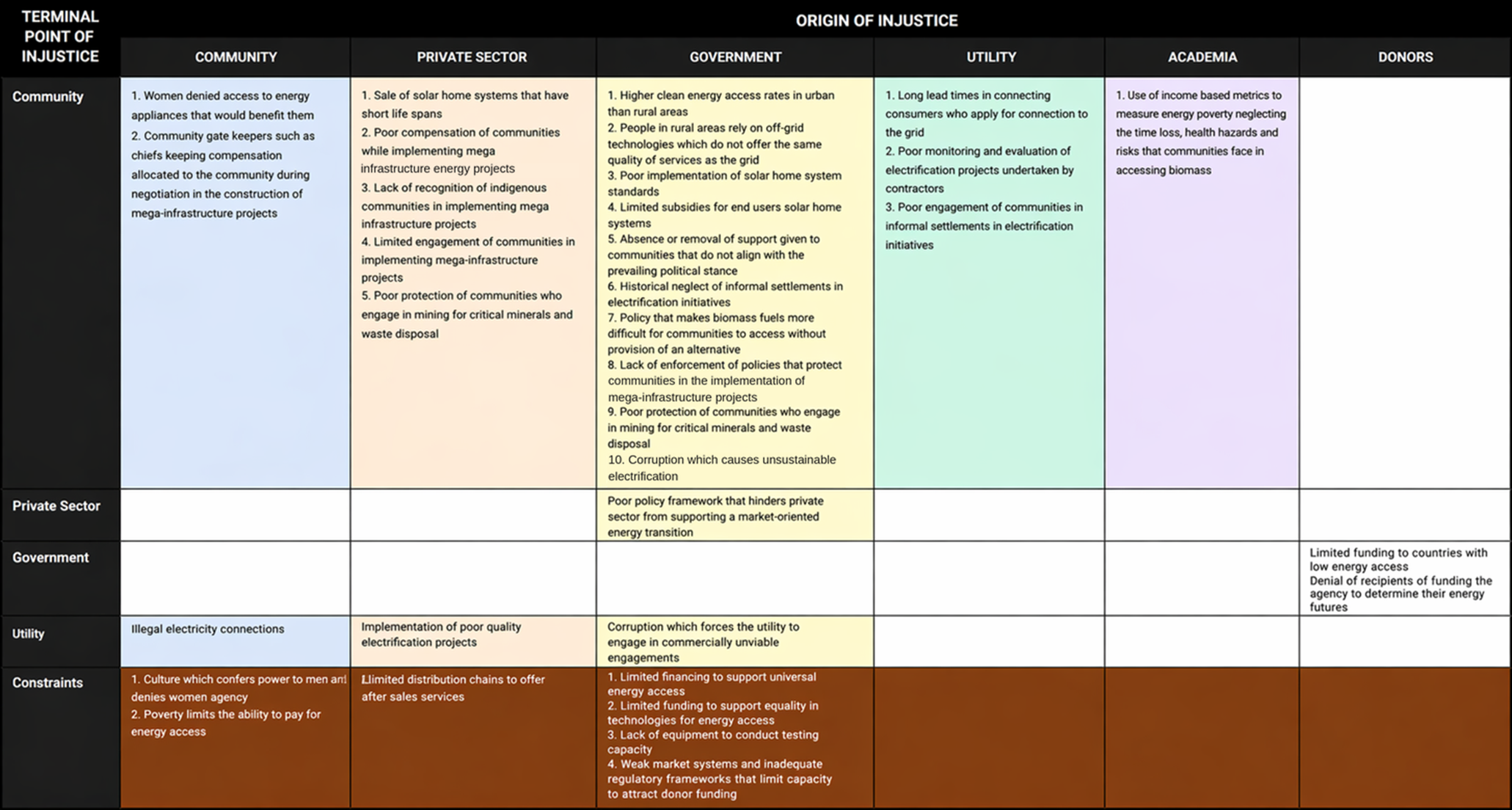
Framing energy injustices within the context of stakeholder interactions, while also accounting for the systemic factors that exacerbate them, is essential to developing a holistic and nuanced understanding of energy injustice. To do this, a framework that is hinged on the victim-perpetrator approach used in criminal and environmental justice (Pellow et al., Reference Pellow, Weinberg and Schnaiberg2001) and adapted from Kruger and McCauley (Reference Kruger, McCauley, Bombaerts, Kirsten and Yekeens2020) is developed. However, the terminology “victim” and “perpetrator” may be problematic, as it may convey the message that energy injustices are purely moral issues. As such, the terminology “origin” and “terminal point of injustice” is proposed to replace “victim” and “perpetrator,” respectively. Understanding both the constraints that perpetuate injustice and the injustices themselves will support the development of holistic mechanisms for restorative justice. This framework, illustrated in Figure 4, does this by encapsulating the injustices experienced by various stakeholders within the energy ecosystem while presenting the constraints that cause or exacerbate them. It also demonstrates how layers of injustices are transferred from one level of stakeholder to the next. For example, unequal donor funding across the continent (labelled as an injustice to governments in sub-Saharan Africa) continues to reinforce limited access to electricity in those same contexts, thereby compounding existing injustices. However, this injustice occurs because some countries may lack robust markets or regulatory frameworks that enable them to attract donor funding (indicated in the section constraints faced by governments). This framework, therefore, enables root-cause analysis of energy injustices, thus supporting actions towards restorative justice. The example of the private sector’s sale of poor-quality solar home systems shows how this can be addressed. Using Figure 4, it is seen that poor quality systems are sold partly because of limited capacity for testing quality of solar home systems on the continent, which leads to low enforcement of solar home system standards. Restorative justice efforts would, therefore, be directed at acquiring testing equipment on the continent and at providing capacity building centred on its use. In doing this, the framework enables practical use of energy justice theory and addresses the criticism that this concept has little practical application.
Energy injustice in stakeholder interactions.

It should be noted that justice theorists like Sangiovanni (Reference Sangiovanni2007) indicate that only human beings are the ultimate units of concern, while groupings, including those used in this paper, like government and private sector, are secondary (Sangiovanni, Reference Sangiovanni2007). This philosophy could have been influential in the development of the environmental justice concept, which sought to free the oppressed. Energy justice, however, draws on John Rawls’ theory of justice, equating justice with “fairness” (Rawls, Reference Rawls1971; Galvin, Reference Galvin2020). Applying this principle enables the recognition of injustices and unfair constraints faced by institutions, particularly in contexts shaped by systemic or structural inequities. Young (Reference Young2011) in her seminal work on structural injustice undertakes this when she provides the example of governments that may be unable to implement labour laws in the form of minimum wages because of capital flight threats imposed by powerful private sector agents. This may be termed an injustice (or “unfairness”) as governments are denied the agency to implement regulations that benefit citizens. This, in turn, is passed on to the people who end up working in unjust conditions. This paper, therefore, recognises injustices experienced by institutions as well as individuals. This recognition is important because it unearths all factors that must be addressed to alleviate injustice to human beings.
Conclusion and recommendations
The objective of this study was to develop a framework to support the identification of root causes of energy injustice in sub-Saharan Africa. A systematised literature review was utilised to develop this framework by identifying dominant themes of energy injustice. Themes that were identified were not new and included energy poverty and limited financing, corruption and limited community engagement. This paper made an important academic contribution by reviewing these themes through the lens of energy injustice, which considers equity and inclusivity.
The identification of these themes supported the development of a framework, the paper’s primary conceptual contribution, which integrated injustices experienced by various actors and constraints that cause or exacerbate them. This framework, termed “Energy Injustice in stakeholder interactions,” also shifts discourse on energy justice from theoretical considerations to practical applications. By showing the flow of injustices from the origin to the terminal point and depicting constraints that cause or exacerbate injustice, this framework enables a deeper understanding of root causes of energy justice while facilitating the entrance of nuance into energy justice discourse. This framework has been developed with data from sub-Saharan Africa; however, further research can be undertaken to determine its transferability to other contexts.
A key limitation of this study and is that it generalises energy injustices in sub-Saharan Africa. Energy (in)justice is place-based and varies across communities and geographies. To mitigate this, empirical data should be collected to understand energy injustices at a local level. Additionally, due to generalisation, this study does not support observation of temporal or spatial trends of injustice in sub-Saharan Africa. This framework developed in this paper can, however, support root-cause analysis of energy injustices identified using empirical data and enable a place-based approach for restorative justice.
The following recommendations emerge through this research: First, nuance should be adopted in discourse around energy injustice in sub-Saharan Africa. This is required to develop a better understanding of trade-offs and constraints that cause energy injustice. Trade-offs emerge when addressing injustices. For example, as previously mentioned, providing universal grid access raises the affordability barrier as electricity consumption becomes more expensive. On the other hand, financial constraints limit the provision of subsidies to enable universal grid access. Understanding these trade-offs and constraints can support restorative justice efforts. Second, further research should be conducted to understand the relationship between systemic injustice identified as constraints in this paper and energy justice. Understanding these relationships will deepen understanding of energy injustices and their relationships with societal systems. Finally, the “Energy Injustice in Stakeholder Interactions Framework” should be adopted as a tool for analysing empirical qualitative data, with the results utilised in the development of energy policies and energy plans. This tool, alongside empirical data, provides a powerful instrument to synthesise injustices in a multi-dimensional manner, allowing policymakers to develop a holistic understanding of energy issues in their localities and eventually develop policies and plans towards restorative justice.
Open peer review
To view the open peer review materials for this article, please visit https://doi.org/10.1017/etr.2026.10017.
Author contribution
Sarah Odera led the study’s conceptualisation, developed the methodology, synthesised, reviewed relevant literature and drafted the paper. Jiska De Groot contributed to the conceptualisation, development of methodology, reviewed and edited the paper. Debbie Sparks contributed to the conceptualisation, reviewed and edited the paper. Dimitrios Mentis contributed to the conceptualisation, reviewed and edited the paper. Izael Da Silva reviewed and edited the paper.
Financial support
This research was undertaken as part of a PhD study, partially funded by Konrad Adenauer Stiftung.
Competing interests
The authors declare no competing interests, financial or otherwise, that could influence the work reported in this article.

 Open access


Comments
It is with much delight that we submit the manuscript for this paper titled “Systematised Assessment of Energy Injustice in Sub-Saharan Africa”.
This paper critically reviews academic literature on energy injustice in sub-Saharan Africa with the goal of uncovering recurring themes and developing a framework that can be used to support the identification of root causes of energy injustice. In doing so, it explores stakeholder interactions and how they cause energy injustices. It also unearths constraints faced by different stakeholders such as communities, governments and private sector in executing their mandates which either cause or exacerbate injustice. Through this approach, the paper highlights the complexity of energy justice and offers deeper insight into the root causes of energy injustice in sub-Saharan Africa. This paper is therefore is inline with the journals scope of investigating how people are affected by energy systems.
We look forward to sharing this paper with others in the academic community and are happy to receive feedback towards improvement of the paper